
×
Hero Background
English
Chinese
French
Japanese
Korean
German
Spanish

Aviation MRO Software Market Trends

ID: MRFR/AD/6949-HCR
100 Pages
Sejal Akre
October 2025

Aviation MRO Software Market Research Report Information By Solution (Enterprise Resource Planning (ERP) Solution, Point Solution), By Deployment (On-Premise, Cloud), By Application (Commercial, Military) and By End-User (Airlines, MRO Companies, OEMs) - Forecast to 2030

Share:
Download PDF ×

We do not share your information with anyone. However, we may send you emails based on your report interest from time to time. You may contact us at any time to opt-out.

Aviation MRO Software Market Infographic
Purchase Options

Market Trends

Key Emerging Trends in the Aviation MRO Software Market

In the aviation MRO software industry, there are a number of significant trends that reflect how aircraft maintenance operations evolve. One major occurrence is the increased implementation of cloud-based MRO software solutions. Cloud computing provides superior accessibility, scalability and flexibility that allow aviation MRO companies to have their operations streamlined more efficiently. The use of cloud-based solutions enables real time collaboration, data sharing and remote access to crucial information that contributes greatly in matters pertaining to decision making processes as well the overall operational efficiency. Predictive maintenance using Internet of Things (IoT) technologies is another important trend in the aviation MRO software market. IoT sensors that have been placed on aircraft and many other components are always collecting data about equipment health and performance. The MRO software that uses IoT analytics can foresee potential problems and allow maintenance teams to respond in a proactive manner before the issues escalate. This tendency not only improves the safety and reliability of aircrafts, but also it helps to save costs at the same time as reducing unplanned maintenance events reduces associated downtime. The industry is moving towards more overall, integrated MRO software solutions that cover a wide range of functions. Modern MRO software systems are developed to perform the maintenance operations of several areas such as inventory control, tracking work orders and meeting regulations. This trend indicates that the industry requires integrated systems that present a comprehensive perspective of maintenance processes, simplifying management for managing independent software solutions and aligning various aspects of MRO operations effectively. Another major trend that is taking shape in the Aviation MRO Software market involves the integration of Artificial Intelligence (AI) and Machine Learning (ML). AI and ML algorithms are used to analyse historical maintenance data for revealing patterns and trends that facilitate more precise predictive analytics. These technologies provide MRO organizations with the ability to optimize maintenance schedules, predict component failures and improve overall fleet reliability. The use of AI and ML in MRO software is consistent with the industry’s mission to make decisions based on data, increase efficiency. As cybersecurity issues are on the rise, increased attention is being paid to data security and compliance in the Aviation MRO Software market. MRO software plays an important role in that sensitive information and critical systems depend on it, which is why the industry spends considerable resources to build solid cybersecurity infrastructure against possible attacks.


Author
Sejal Akre
Senior Research Analyst

She has over 5 years of rich experience, in market research and consulting providing valuable market insights to client. Hands on expertise in management consulting, and extensive knowledge in domain including ICT, Automotive & Transportation and Aerospace & Defense. She is skilled in Go-to market strategy, industry analysis, market sizing, in depth company profiling, competitive intelligence & benchmarking and value chain amongst others.

Leave a Comment

FAQs

What is the CAGR for Aviation MRO Software Market?

Aviation MRO Software Market can expand at 4% CAGR by 2030.

What is the valuation of the Aviation MRO Software Market?

The Aviation MRO Software Market value can reach USD 10 Billion by 2030.

Who are key players of the Aviation MRO Software Market?

SAP SE (Germany), HCL Technologies (India), and IBM (US) are some renowned names in the Aviation MRO Software Market.

What is the Aviation MRO Software Market driver?

The growing adoption of SaaS can promote the Aviation MRO Software Market.

What is the Aviation MRO Software Market restrain?

The lack of common data standards can restrains the Aviation MRO Software Market expansion.

Market Summary

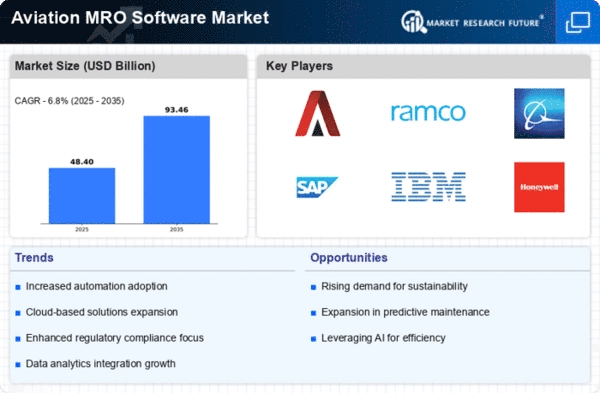
As per MRFR analysis, the Aviation MRO Software Market Size was estimated at 45.32 USD Billion in 2024. The Aviation MRO Software industry is projected to grow from 48.4 USD Billion in 2025 to 93.46 USD Billion by 2035, exhibiting a compound annual growth rate (CAGR) of 6.8 during the forecast period 2025 - 2035.

Key Market Trends & Highlights

The Aviation MRO Software Market is poised for substantial growth driven by technological advancements and evolving industry needs.

  • The integration of Artificial Intelligence is transforming maintenance processes, enhancing efficiency and accuracy.
  • Cloud-based solutions are gaining traction, offering flexibility and scalability to aviation MRO operations.
  • A growing focus on sustainability is influencing software development, aligning with environmental regulations and corporate responsibility.
  • The increasing demand for efficient maintenance solutions and regulatory compliance are key drivers propelling market expansion, particularly in North America and the fast-growing Asia-Pacific region.

Market Size & Forecast

2024 Market Size 45.32 (USD Billion)
2035 Market Size 93.46 (USD Billion)
CAGR (2025 - 2035) 6.8%
Largest Regional Market Share in 2024 North America

Major Players

<p>SAP (DE), Oracle (US), IBM (US), Boeing (US), Airbus (FR), Honeywell (US), Rockwell Collins (US), Ramco Systems (IN), MRO Software (US)</p>

Market Trends

The Aviation MRO Software Market is currently experiencing a transformative phase, driven by advancements in technology and the increasing need for efficiency in maintenance, repair, and operations. As airlines and aviation service providers seek to optimize their operations, the demand for sophisticated software solutions has surged. These tools not only streamline processes but also enhance compliance with regulatory standards, thereby reducing operational risks. Furthermore, the integration of artificial intelligence and data analytics into MRO software is reshaping how organizations approach maintenance strategies, allowing for predictive maintenance and improved asset management. In addition to technological advancements, the Aviation MRO Software Market is influenced by the growing emphasis on sustainability and cost reduction. Companies are increasingly adopting software that supports eco-friendly practices and minimizes waste. This shift reflects a broader trend within the aviation industry towards greener operations. Moreover, the rise of cloud-based solutions is facilitating greater accessibility and collaboration among stakeholders, enabling real-time data sharing and decision-making. As the market evolves, it appears poised for continued growth, driven by innovation and a focus on operational excellence.

Integration of Artificial Intelligence

The incorporation of artificial intelligence into Aviation MRO Software is becoming more prevalent. This trend allows for enhanced predictive maintenance capabilities, enabling organizations to anticipate issues before they arise. By leveraging AI, companies can optimize their maintenance schedules, reduce downtime, and improve overall operational efficiency.

Cloud-Based Solutions

The shift towards cloud-based Aviation MRO Software is gaining momentum. These solutions offer flexibility and scalability, allowing organizations to access critical data from anywhere. This trend supports collaboration among teams and facilitates real-time updates, which can lead to more informed decision-making and improved responsiveness.

Focus on Sustainability

There is a growing emphasis on sustainability within the Aviation MRO Software Market. Companies are increasingly seeking software solutions that promote eco-friendly practices and reduce environmental impact. This trend reflects a broader commitment to sustainable operations, aligning with global efforts to minimize carbon footprints and enhance corporate responsibility.

Aviation MRO Software Market Market Drivers

Market Trends and Forecasts

The Global Aviation MRO Software Industry is characterized by various trends and forecasts that shape its future landscape. Key trends include the increasing adoption of cloud-based solutions, the integration of advanced analytics, and the growing emphasis on sustainability in aviation operations. These trends are expected to influence market dynamics significantly, with projections indicating a compound annual growth rate of 4.87% from 2025 to 2035. As the industry adapts to these changes, stakeholders must remain vigilant in monitoring emerging trends to capitalize on new opportunities and navigate potential challenges.

Growing Focus on Cost Efficiency

Cost efficiency remains a paramount concern for airlines and aviation operators, significantly influencing the Global Aviation MRO Software Industry. With rising operational costs, organizations are increasingly turning to MRO software solutions to optimize maintenance processes and reduce expenditures. By streamlining workflows and improving resource allocation, these software solutions enable companies to achieve substantial cost savings. As the market evolves, the emphasis on cost-effective maintenance strategies is likely to drive further adoption of MRO software, fostering a competitive landscape that prioritizes efficiency and profitability.

Expansion of the Global Aviation Market

The expansion of the global aviation market serves as a significant catalyst for the Global Aviation MRO Software Industry. As emerging economies invest in their aviation infrastructure and the demand for air travel continues to rise, the need for efficient maintenance solutions becomes increasingly apparent. This growth is reflected in the projected increase in market size from 7.49 USD Billion in 2024 to 12.6 USD Billion by 2035. The burgeoning aviation sector necessitates robust MRO software to manage the complexities of maintenance operations, thereby driving market growth and innovation.

Increasing Demand for Aircraft Maintenance

The Global Aviation MRO Software Industry experiences a notable surge in demand for aircraft maintenance services. As the global fleet of commercial and cargo aircraft expands, airlines and operators are increasingly investing in advanced MRO software solutions to enhance operational efficiency and ensure compliance with safety regulations. In 2024, the market is projected to reach 7.49 USD Billion, reflecting the industry's commitment to maintaining high safety standards. This trend is likely to continue, with the market expected to grow to 12.6 USD Billion by 2035, indicating a robust growth trajectory driven by the need for reliable maintenance solutions.

Regulatory Compliance and Safety Standards

Regulatory compliance and safety standards are critical drivers of the Global Aviation MRO Software Industry. Governments and aviation authorities worldwide impose stringent regulations to ensure the safety and reliability of aircraft operations. MRO software solutions assist organizations in adhering to these regulations by providing tools for tracking maintenance schedules, documenting repairs, and ensuring compliance with safety protocols. As the aviation industry continues to prioritize safety, the demand for MRO software that facilitates compliance is expected to rise. This trend not only enhances operational safety but also contributes to the overall growth of the market.

Technological Advancements in MRO Solutions

Technological advancements play a pivotal role in shaping the Global Aviation MRO Software Industry. Innovations such as predictive maintenance, artificial intelligence, and the Internet of Things are revolutionizing how maintenance operations are conducted. These technologies enable airlines to anticipate maintenance needs, thereby reducing downtime and operational costs. As a result, MRO software solutions are becoming increasingly sophisticated, allowing for real-time data analysis and improved decision-making. The integration of these technologies is expected to contribute to a compound annual growth rate of 4.87% from 2025 to 2035, underscoring the importance of technology in driving market growth.

Market Segment Insights

By Application: Maintenance Management (Largest) vs. Inventory Management (Fastest-Growing)

<p>In the Aviation MRO Software Market, the application segment is predominantly driven by Maintenance Management, which occupies the largest share. This segment benefits from the increasing emphasis on regulatory compliance and operational efficiency, with organizations seeking robust solutions to streamline maintenance processes. Inventory Management, while smaller, is the fastest-growing segment, driven by advancements in technology and a push for better resource utilization and cost savings.</p>

<p>Maintenance Management (Dominant) vs. Inventory Management (Emerging)</p>

<p>Maintenance Management remains the dominant application in the Aviation MRO Software Market due to its critical role in ensuring aircraft safety and compliance with aviation regulations. This segment focuses on scheduling, tracking, and automating maintenance tasks, directly impacting operational efficiency. Conversely, Inventory Management is emerging rapidly as airlines and MRO providers realize the importance of effective inventory control in reducing operational costs and improving turnaround times. Technological advancements such as real-time tracking and analytics are enhancing inventory management capabilities, making it increasingly vital to the overall efficiency of MRO operations.</p>

By End Use: Commercial Aviation (Largest) vs. Military Aviation (Fastest-Growing)

<p>In the Aviation MRO Software Market, the 'End Use' segment is predominantly led by Commercial Aviation, which holds the largest share due to the extensive fleet operations and maintenance requirements of airlines globally. This segment benefits from a steady demand for software solutions that enhance operational efficiency and compliance with safety regulations. In contrast, Military Aviation is experiencing rapid growth, driven by increased defense budgets and the modernization of aging aircraft fleets, necessitating advanced software systems for maintenance operations.</p>

<p>Commercial Aviation (Dominant) vs. Military Aviation (Emerging)</p>

<p>Commercial Aviation serves as the cornerstone of the Aviation MRO Software Market, supporting a vast network of airlines and operators that necessitate stringent maintenance and compliance standards. Its dominance is attributed to the high volume of commercial flights, requiring robust and scalable MRO solutions to streamline operations and reduce downtimes. On the other hand, Military Aviation is represented as an emerging segment, characterized by significant investments in technology upgrades and the integration of next-generation MRO software to maintain a competitive edge. This sector is poised for rapid advancements, focusing on efficiency and effectiveness to cater to the evolving demands of military operations.</p>

By Deployment Type: Cloud-Based (Largest) vs. On-Premises (Fastest-Growing)

<p>In the Aviation MRO Software Market, the deployment type segment is significantly influenced by the shift towards cloud-based solutions, which currently claim the largest market share. This dominance can be attributed to their scalability, accessibility, and cost-effectiveness, appealing particularly to organizations aiming for digital transformation. On-premises solutions still command a notable portion of the market, favored by entities that require stringent control over their data and operate in highly regulated environments. Growth trends indicate a robust movement towards cloud-based platforms, projected to maintain its leading stance due to the rising demand for remote access and collaboration capabilities. Conversely, on-premises solutions are witnessing a resurgence as industries look for tailored, secure options. The hybrid deployment model is also gaining traction, leveraging the strengths of both cloud and on-premises systems to address the diverse needs of MRO operations.</p>

<p>Cloud-Based (Dominant) vs. On-Premises (Emerging)</p>

<p>Cloud-based deployment continues to be the dominant choice in the Aviation MRO Software Market, characterized by its flexibility and ability to integrate easily with various technological ecosystems. This model empowers organizations with superior data analytics and real-time monitoring capabilities while significantly reducing the need for heavy upfront investments in infrastructure. On-premises solutions are emerging as a viable option among traditional firms who prioritize data sovereignty and customization. Despite being slower to adapt to the cloud revolution, they are actively enhancing their offerings by incorporating advanced features that cater to specific regulatory and operational requirements. Consequently, a hybrid approach that reflects the preferences of both cloud and on-premises users is also on the rise, aiming for optimized efficiencies.</p>

By User Type: Large Enterprises (Largest) vs. Small Enterprises (Fastest-Growing)

<p>In the Aviation MRO Software Market, the user type segmentation showcases a significant distribution with large enterprises dominating the share. These organizations benefit from their extensive operational needs and greater budgets, leading to a substantial uptake of advanced MRO software solutions. Conversely, small enterprises, while holding a smaller portion of the market, exhibit rapid growth driven by increased investments in technology and digital transformation that enhance their operational efficiency and compliance with regulations.</p>

<p>Large Enterprises (Dominant) vs. Small Enterprises (Emerging)</p>

<p>Large enterprises in the Aviation MRO Software Market are characterized by their scale and ability to invest in comprehensive MRO solutions that integrate multiple functions. These players typically have well-established infrastructures and a high demand for customized software to streamline their vast operations. In contrast, small enterprises are emerging contenders in the market, propelled by a growing need to modernize and access sophisticated MRO capabilities. They often seek affordable solutions that offer essential functionalities, enabling them to compete effectively and improve service offerings, thus marking their presence as the fastest-growing segment.</p>

By Functionality: Scheduling (Largest) vs. Tracking (Fastest-Growing)

<p>In the Aviation MRO Software Market, the functionality segment has witnessed a diverse distribution of market share among its key components: Scheduling, Tracking, Reporting, Inventory Control, and Quality Assurance. Scheduling holds a preeminent position, commanding the largest market share due to its critical role in managing maintenance plans and resources efficiently. Conversely, Tracking has emerged as a fast-growing segment, driven by growing demands for real-time asset visibility and operational performance monitoring across the aviation industry.</p>

<p>Scheduling (Dominant) vs. Tracking (Emerging)</p>

<p>Scheduling is a dominant function in the Aviation MRO Software Market, as it integrates various maintenance tasks to optimize operations and ensure aircraft availability. By streamlining workflows, it enhances efficiency, reduces downtime, and significantly contributes to the overall productivity of aviation enterprises. In contrast, Tracking represents an emerging functionality, fueled by advancements in technology and data analytics. It allows stakeholders to monitor aircraft components' health and maintenance schedules, creating a more proactive approach to MRO. As airlines acknowledge the importance of real-time insights, the demand for integrated tracking systems is expanding rapidly, showcasing its potential to reshape maintenance strategies in the aviation sector.</p>

Get more detailed insights about Aviation MRO Software Market Research Report - Forecast till 2035

Regional Insights

North America : Market Leader in MRO Software

North America continues to lead the Aviation MRO Software market, holding a significant share of 22.5% in 2024. The region's growth is driven by increasing air traffic, stringent regulatory requirements, and the need for efficient maintenance solutions. The presence of major players like Boeing, Honeywell, and Oracle further fuels demand, as they innovate to meet evolving industry standards. Regulatory catalysts, such as FAA guidelines, enhance the focus on safety and compliance, propelling market expansion. The competitive landscape in North America is robust, with key players investing heavily in R&D to develop advanced MRO solutions. The U.S. stands out as a leader, supported by a strong aviation infrastructure and a high number of aircraft in operation. Companies like SAP and IBM are also making significant strides, ensuring that the region remains at the forefront of technological advancements in aviation maintenance. This competitive edge is crucial for sustaining market growth in the coming years.

Key Players and Competitive Insights

The Aviation MRO Software Market is currently characterized by a dynamic competitive landscape, driven by technological advancements and the increasing demand for efficient maintenance solutions. Key players such as SAP (DE), Oracle (US), and Boeing (US) are strategically positioning themselves through innovation and partnerships. SAP (DE) focuses on integrating advanced analytics and cloud solutions to enhance operational efficiency, while Oracle (US) emphasizes its robust data management capabilities to streamline MRO processes. Boeing (US), leveraging its extensive aerospace expertise, is investing in digital transformation initiatives to optimize maintenance workflows, thereby shaping a competitive environment that prioritizes technological integration and operational excellence.

The market structure appears moderately fragmented, with a mix of established players and emerging companies vying for market share. Key business tactics include localizing manufacturing and optimizing supply chains to enhance responsiveness to customer needs. The collective influence of major players fosters a competitive atmosphere where innovation and customer-centric solutions are paramount, potentially leading to increased collaboration among firms to address evolving market demands.

In November 2025, Honeywell (US) announced a strategic partnership with a leading airline to implement its latest MRO software solutions, aimed at enhancing predictive maintenance capabilities. This collaboration is significant as it underscores Honeywell's commitment to leveraging data analytics to improve aircraft reliability and reduce operational costs. Such partnerships may serve as a model for other companies seeking to enhance their service offerings through collaborative innovation.

In October 2025, Ramco Systems (IN) launched a new version of its MRO software, incorporating AI-driven functionalities to automate maintenance scheduling and inventory management. This development is crucial as it positions Ramco Systems at the forefront of technological advancement in the MRO sector, potentially attracting clients looking for cutting-edge solutions to streamline their operations. The integration of AI could significantly enhance decision-making processes, thereby improving overall efficiency.

In September 2025, Airbus (FR) expanded its MRO service portfolio by acquiring a smaller software firm specializing in digital maintenance solutions. This acquisition is indicative of Airbus's strategy to bolster its technological capabilities and offer comprehensive MRO services. By integrating innovative software solutions, Airbus aims to enhance its competitive edge and provide clients with more efficient maintenance options, reflecting a broader trend of consolidation in the market.

As of December 2025, the competitive trends in the Aviation MRO Software Market are increasingly defined by digitalization, sustainability, and AI integration. Strategic alliances are becoming more prevalent, as companies recognize the need to collaborate to stay ahead in a rapidly evolving landscape. The shift from price-based competition to a focus on innovation, technology, and supply chain reliability is evident, suggesting that future competitive differentiation will hinge on the ability to deliver advanced, sustainable solutions that meet the complex needs of the aviation industry.

Key Companies in the Aviation MRO Software Market market include

Industry Developments

  • Q2 2024: Ramco Systems Launches Next-Gen Aviation MRO Suite with AI Capabilities Ramco Systems announced the launch of its next-generation Aviation MRO software suite, integrating advanced AI and machine learning features to enhance predictive maintenance and operational efficiency for airlines and MRO providers.
  • Q2 2024: Swiss-AS and Lufthansa Technik Announce Strategic Partnership for AMOS Integration Swiss AviationSoftware (Swiss-AS) and Lufthansa Technik entered a strategic partnership to integrate AMOS MRO software with Lufthansa Technik’s digital platform, aiming to streamline maintenance operations for global airline customers.
  • Q3 2024: IFS Appoints New Head of Aerospace & Defense Division IFS, a leading provider of aviation MRO software, appointed a new global head for its Aerospace & Defense division to drive growth and innovation in digital MRO solutions.
  • Q3 2024: GE Digital Wins Major Contract to Provide MRO Software to Emirates GE Digital secured a multi-year contract to supply its aviation MRO software suite to Emirates, supporting the airline’s digital transformation and predictive maintenance initiatives.
  • Q4 2024: Honeywell Launches Cloud-Based MRO Platform for Commercial Aviation Honeywell introduced a new cloud-based MRO software platform designed to help commercial airlines optimize maintenance schedules and reduce aircraft downtime.
  • Q4 2024: Rusada Expands Presence in Asia with New Singapore Office Aviation MRO software provider Rusada opened a new regional office in Singapore to support growing demand for its ENVISION platform among Asian airlines and MROs.
  • Q1 2025: TRAX Signs Multi-Year MRO Software Deal with Air France-KLM TRAX, a leading MRO software provider, signed a multi-year agreement to supply its maintenance management platform to Air France-KLM, supporting the airline group’s digitalization strategy.
  • Q1 2025: EmpowerMX Raises $30 Million to Accelerate MRO Software Development EmpowerMX, a provider of cloud-based MRO software, closed a $30 million funding round to expand its product development and global market reach.
  • Q2 2025: Boeing Launches New Predictive Maintenance Module for MRO Suite Boeing announced the launch of a new predictive maintenance module within its MRO software suite, leveraging real-time aircraft data to improve maintenance planning for airline customers.
  • Q2 2025: Ultramain Systems Wins Contract with Japan Airlines for MRO Software Implementation Ultramain Systems secured a contract to implement its MRO software across Japan Airlines’ fleet, supporting digital transformation and paperless maintenance operations.
  • Q3 2025: SITA Acquires MRO Software Firm AerData from Boeing SITA, a global IT provider for air transport, acquired AerData, a specialist in aviation MRO software, from Boeing to strengthen its digital solutions portfolio for airlines and lessors.
  • Q3 2025: Swiss-AS Launches AMOSmobile/EXEC, a New Mobile MRO Execution App Swiss-AS released AMOSmobile/EXEC, a mobile application designed to enable real-time execution of MRO tasks on the hangar floor, enhancing efficiency and compliance for airline maintenance teams.

Competitive Landscape

The aviation MRO software companies that are expected to soar high owing to the splendid degree of equilibrium between the demand and the supply chain mechanism of the aviation MRO software market are mentioned as follows:

  • IBS Software (India)
  • Flatirons Solutions, Inc. (US)
  • Rusada (Switzerland)
  • Sopra Steria (France)
  • Communications Software Limited (UK)
  • Aviation Intertec Services (Canada)
  • GE Aviation (US)
  • BytzSoft Technologies Pvt. Ltd. (India)
  • Lufthansa Technik AG (Germany)
  • Tracware Limited (UK)
  • Aerosoft Systems Inc. (US)
  • FLY Online Tools (US)

Recent Developments

The MRO industry is known to be using aviation MRO software mainly for the enhancement of the functional efficiency for various aviation MRO activities, such as services, maintenance, upgrade, and retrofitting of different aircraft engines, spares, components, and systems. The MROs segment has further been classified based on employee size, considering which the adoption of aviation MRO software is decided. The talks regarding the replacement of old MRO software systems with advanced digitalized software solutions and IT infrastructure modernization programs are likely to water the expectations to drive the MROs segment.

Many prominent and key players such as Honeywell International, Inc. are taking to the international market for launching new and advanced MRO solutions to strengthen their presence in the aviation MRO software market. Honeywell International, Inc. launched its new range - Honeywell Forge for Airlines in July 2019. It is an advanced analytics-based platform that helps and provides data for flight efficiency, flight operations, and other provisions like connected maintenance.

The cloud segment of the aviation MRO software market is anticipated to grow at a higher CAGR during the forecast period that ends in. Cloud-based solutions are also called software-as-a-service. These services and solutions are provided as a service wherein the ERP vendor manages the tasks like data, and the services are accessed through the help of a web browser. More recently, the global industry has adopted a hybrid model, in which cloud software is hosted on a company’s private servers.


Future Outlook

Aviation MRO Software Market Future Outlook

<p>The Aviation MRO Software Market is projected to grow at a 6.8% CAGR from 2024 to 2035, driven by technological advancements, increasing fleet sizes, and regulatory compliance demands.</p>

New opportunities lie in:

  • <p>Integration of AI-driven predictive maintenance solutions</p>
  • <p>Development of cloud-based MRO management platforms</p>
  • <p>Expansion into emerging markets with tailored software solutions</p>

<p>By 2035, the market is expected to be robust, reflecting substantial growth and innovation.</p>

Market Segmentation

Aviation MRO Software Market End Use Outlook

  • Commercial Aviation
  • Military Aviation
  • Business Aviation
  • Helicopter Operations

Aviation MRO Software Market User Type Outlook

  • Small Enterprises
  • Medium Enterprises
  • Large Enterprises

Aviation MRO Software Market Application Outlook

  • Maintenance Management
  • Inventory Management
  • Work Order Management
  • Compliance Management
  • Reporting and Analytics

Aviation MRO Software Market Functionality Outlook

  • Scheduling
  • Tracking
  • Reporting
  • Inventory Control
  • Quality Assurance

Aviation MRO Software Market Deployment Type Outlook

  • On-Premises
  • Cloud-Based
  • Hybrid

Report Scope

MARKET SIZE 202445.32(USD Billion)
MARKET SIZE 202548.4(USD Billion)
MARKET SIZE 203593.46(USD Billion)
COMPOUND ANNUAL GROWTH RATE (CAGR)6.8% (2024 - 2035)
REPORT COVERAGERevenue Forecast, Competitive Landscape, Growth Factors, and Trends
BASE YEAR2024
Market Forecast Period2025 - 2035
Historical Data2019 - 2024
Market Forecast UnitsUSD Billion
Key Companies ProfiledSAP (DE), Oracle (US), IBM (US), Boeing (US), Airbus (FR), Honeywell (US), Rockwell Collins (US), Ramco Systems (IN), MRO Software (US)
Segments CoveredApplication, End Use, Deployment Type, User Type, Functionality
Key Market OpportunitiesIntegration of artificial intelligence and predictive analytics enhances efficiency in the Aviation MRO Software Market.
Key Market DynamicsTechnological advancements drive competitive forces in the Aviation MRO Software Market, enhancing operational efficiency and compliance.
Countries CoveredNorth America, Europe, APAC, South America, MEA

FAQs

What is the CAGR for Aviation MRO Software Market?

Aviation MRO Software Market can expand at 4% CAGR by 2030.

What is the valuation of the Aviation MRO Software Market?

The Aviation MRO Software Market value can reach USD 10 Billion by 2030.

Who are key players of the Aviation MRO Software Market?

SAP SE (Germany), HCL Technologies (India), and IBM (US) are some renowned names in the Aviation MRO Software Market.

What is the Aviation MRO Software Market driver?

The growing adoption of SaaS can promote the Aviation MRO Software Market.

What is the Aviation MRO Software Market restrain?

The lack of common data standards can restrains the Aviation MRO Software Market expansion.

  1. EXECUTIVE SUMMARY
    1. Market Attractiveness Analysis
      1. Global Aviation MRO Software Market, by Solution
      2. Global Aviation MRO Software Market, by Deployment
      3. Global Aviation MRO Software Market, by End User
      4. Global Aviation MRO Software Market, by Application
      5. Global Aviation MRO Software Market, by Region
  2. MARKET INTRODUCTION
    1. Market Definition
    2. Scope of the Study
      1. Research Objectives
      2. Assumptions & Limitations
    3. Market Structure
  3. MARKET RESEARCH METHODOLOGY
    1. Research Process
    2. Secondary Research
    3. Primary Research
    4. Forecast Model
  4. MARKET LANDSCAPE
    1. Supply Chain Analysis
      1. Raw Material Suppliers
      2. Manufacturers/Producers
      3. Distributors
      4. End Users
    2. Porter’s Five Forces Analysis
      1. Threat of New Entrants
      2. Bargaining Power of Buyers
      3. Bargaining Power of Suppliers
      4. Threat of Substitutes
      5. Internal Rivalry
  5. MARKET DYNAMICS OF GLOBAL AVIATION MRO SOFTWARE MARKET
    1. Introduction
    2. Drivers
    3. Restraints
    4. Opportunities
    5. Challenges
  6. GLOBAL AVIATION MRO SOFTWARE MARKET, BY SOLUTION
    1. Introduction
    2. Enterprise ReSolution Planning (ERP) Solution
      1. Market Estimates & Forecast, 2020–2027
      2. Market Estimates & Forecast, by Region, 2020–2027
      3. Maintenance Management
      4. Operations Management
      5. Business Management
    3. Point Solution
      1. Market Estimates & Forecast, 2020–2027
      2. Market Estimates & Forecast, by Region, 2020–2027
      3. Health Monitoring
      4. Electronic Flight Bag & Logbook
      5. Inventory Management
      6. Documentation
      7. Others
  7. GLOBAL AVIATION MRO SOFTWARE MARKET, BY DEPLOYMENT
    1. Introduction
    2. On-Premise
      1. Market Estimates & Forecast, 2020–2027
      2. Market Estimates & Forecast, by Region, 2020–2027
    3. Cloud
      1. Market Estimates & Forecast, 2020–2027
      2. Market Estimates & Forecast, by Region, 2020–2027
  8. GLOBAL AVIATION MRO SOFTWARE MARKET, BY APPLICATION
    1. Introduction
    2. Commercial
      1. Market Estimates & Forecast, 2020–2027
      2. Market Estimates & Forecast, by Region, 2020–2027
    3. Military
      1. Market Estimates & Forecast, 2020–2027
      2. Market Estimates & Forecast, by Region, 2020–2027
  9. GLOBAL AVIATION MRO SOFTWARE MARKET, BY END USER
    1. Introduction
    2. Airlines
      1. Market Estimates & Forecast, 2020–2027
      2. Market Estimates & Forecast, by Region, 2020–2027
    3. MRO Companies
      1. Market Estimates & Forecast, 2020–2027
      2. Market Estimates & Forecast, by Region, 2020–2027
    4. OEMs
      1. Market Estimates & Forecast, 2020–2027
      2. Market Estimates & Forecast, by Region, 2020–2027
  10. GLOBAL AVIATION MRO SOFTWARE MARKET, BY REGION
    1. Introduction
    2. North America
      1. Market Estimates & Forecast, 2020–2027
      2. Market Estimates & Forecast, by Solution, 2020–2027
      3. Market Estimates & Forecast, by Deployment, 2020–2027
      4. Market Estimates & Forecast, by Application, 2020–2027
      5. Market Estimates & Forecast, by End User, 2020–2027
      6. Market Estimates & Forecast, by Country, 2020–2027
      7. US
      8. Canada
    3. Europe
      1. Market Estimates & Forecast, 2020–2027
      2. Market Estimates & Forecast, by Solution, 2020–2027
      3. Market Estimates & Forecast, by Deployment, 2020–2027
      4. Market Estimates & Forecast, by Application, 2020–2027
      5. Market Estimates & Forecast, by End User, 2020–2027
      6. Market Estimates & Forecast, by Country, 2020–2027
      7. Germany
      8. UK
      9. France
      10. Italy
      11. Rest of Europe
    4. Asia-Pacific
      1. Market Estimates & Forecast, 2020–2027
      2. Market Estimates & Forecast, by Solution, 2020–2027
      3. Market Estimates & Forecast, by Deployment, 2020–2027
      4. Market Estimates & Forecast, by Application, 2020–2027
      5. Market Estimates & Forecast, by End User, 2020–2027
      6. Market Estimates & Forecast, by Country, 2020–2027
      7. China
      8. Japan
      9. India
      10. Singapore
      11. Rest of Asia-Pacific
    5. Middle East & Africa
      1. Market Estimates & Forecast, 2020–2027
      2. Market Estimates & Forecast, by Solution, 2020–2027
      3. Market Estimates & Forecast, by Deployment, 2020–2027
      4. Market Estimates & Forecast, by Application, 2020–2027
      5. Market Estimates & Forecast, by End User, 2020–2027
      6. Market Estimates & Forecast, by Country, 2020–2027
      7. UAE
      8. Saudi Arabia
      9. Africa
      10. Rest of the Middle East & Africa
    6. Latin America
      1. Market Estimates & Forecast, 2020–2027
      2. Market Estimates & Forecast, by Solution, 2020–2027
      3. Market Estimates & Forecast, by Deployment, 2020–2027
      4. Market Estimates & Forecast, by Application, 2020–2027
      5. Market Estimates & Forecast, by End User, 2020–2027
      6. Market Estimates & Forecast, by Country, 2020–2027
      7. Brazil
      8. Rest of Latin America
  11. COMPETITIVE LANDSCAPE
    1. Introduction
    2. Market Strategy
    3. Key Development Analysis
    4. (Expansions/Mergers & Acquisitions/Joint Ventures/New Product Developments/Agreements/Investments)
  12. COMPANY PROFILES
    1. Boeing
      1. Company Overview
      2. Financial Updates
      3. Product/Business Segment Overview
      4. Strategies
      5. Key Developments
      6. SWOT Analysis
    2. IBM
      1. Company Overview
      2. Financial Updates
      3. Product/Business Segment Overview
      4. Strategies
      5. Key Developments
      6. SWOT Analysis
    3. HCL Technologies
      1. Company Overview
      2. Financial Updates
      3. Product/Business Segment Overview
      4. Strategies
      5. Key Developments
      6. SWOT Analysis
    4. SAP SE
      1. Company Overview
      2. Financial Updates
      3. Product/Business Segment Overview
      4. Strategies
      5. Key Developments
      6. SWOT Analysis
    5. Ramco Systems
      1. Company Overview
      2. Financial Updates
      3. Product/Business Segment Overview
      4. Strategies
      5. Key Developments
      6. SWOT Analysis
    6. Oracle
      1. Company Overview
      2. Financial Updates
      3. Product/Business Segment Overview
      4. Strategies
      5. Key Developments
      6. SWOT Analysis
    7. IFS (Industrial and Financial Systems)
      1. Company Overview
      2. Financial Updates
      3. Product/Business Segment Overview
      4. Strategies
      5. Key Developments
      6. SWOT Analysis
    8. TRAX
      1. Company Overview
      2. Financial Updates
      3. Product/Business Segment Overview
      4. Strategies
      5. Key Developments
      6. SWOT Analysis
    9. Infor
      1. Company Overview
      2. Financial Updates
      3. Product/Business Segment Overview
      4. Strategies
      5. Key Developments
      6. SWOT Analysis
    10. Swiss AviationSoftware Ltd.
      1. Company Overview
      2. Financial Updates
      3. Product/Business Segment Overview
      4. Strategies
      5. Key Developments
      6. SWOT Analysis
  13. OTHER PROMINENT PLAYERS
    1. Honeywell International, Inc.
    2. IBS Software
    3. Valsoft
    4. Flatirons Solutions, Inc.
    5. Sopra Steria
    6. Seabury Solutions
    7. AerData B.V.
    8. Rusada
    9. Collins Aerospace
    10. ADSOFTWARE
  14. CONCLUSION
  15. LIST OF TABLES
  16. Global Aviation MRO Software Market, by Region, 2020–2027
  17. North America: Aviation MRO Software Market, by Country, 2020–2027
  18. Europe: Aviation MRO Software Market, by Country, 2020–2027
  19. Asia-Pacific: Aviation MRO Software Market, by Country, 2020–2027
  20. Middle East & Africa: Aviation MRO Software Market, by Country, 2020–2027
  21. Latin America: Aviation MRO Software Market, by Country, 2020–2027
  22. Global Aviation MRO Software Market Size, by Region, 2020–2027
  23. North America: Aviation MRO Software Market Size, by Country, 2020–2027
  24. Europe: Aviation MRO Software Market Size, by Country, 2020–2027
  25. Asia-Pacific: Aviation MRO Software Market Size, by Country, 2020–2027
  26. Middle East & Africa: Aviation MRO Software Market Size, by Country, 2020–2027
  27. Latin America: Aviation MRO Software Market Size, by Country, 2020–2027
  28. Global Aviation MRO Software Solution Market, by Region, 2020–2027
  29. North America: Aviation MRO Software Solution Market, by Country, 2020–2027
  30. Europe: Aviation MRO Software Solution Market, by Country, 2020–2027
  31. Asia-Pacific: Aviation MRO Software Solution Market, by Country, 2020–2027
  32. Middle East & Africa: Aviation MRO Software Solution Market, by Country, 2020–2027
  33. Latin America: Aviation MRO Software Solution Market, by Country, 2020–2027
  34. Global Aviation MRO Software Deployment Market, by Region, 2020–2027
  35. North America: Aviation MRO Software Deployment Market, by Country, 2020–2027
  36. Europe: Aviation MRO Software Deployment Market, by Country, 2020–2027
  37. Asia-Pacific: Aviation MRO Software Deployment Market, by Country, 2020–2027
  38. Middle East & Africa: Aviation MRO Software Deployment Market, by Country, 2020–2027
  39. Latin America: Aviation MRO Software Deployment Market, by Country, 2020–2027
  40. Global Aviation MRO Software End User Market, by Region, 2020–2027
  41. North America: Aviation MRO Software End User Market, by Country, 2020–2027
  42. Europe: Aviation MRO Software End User Market, by Country, 2020–2027
  43. Asia-Pacific: Aviation MRO Software End User Market, by Country, 2020–2027
  44. Middle East & Africa: Aviation MRO Software End User Market, by Country, 2020–2027
  45. Latin America: Aviation MRO Software End User Market, by Country, 2020–2027
  46. Global Aviation MRO Software Application Market, by Region, 2020–2027
  47. North America: Aviation MRO Software Application Market, by Country, 2020–2027
  48. Europe: Aviation MRO Software Application Market, by Country, 2020–2027
  49. Asia-Pacific: Aviation MRO Software Application Market, by Country, 2020–2027
  50. Middle East & Africa: Aviation MRO Software Application Market, by Country, 2020–2027
  51. Latin America: Aviation MRO Software Application Market, by Country, 2020–2027
  52. Global Aviation MRO Software Market, by Region, 2020–2027
  53. Global Aviation MRO Software Market, by Solution, 2020–2027
  54. Global Aviation MRO Software Market, by Deployment, 2020–2027
  55. Global Aviation MRO Software Market, by End User, 2020–2027
  56. Global Aviation MRO Software Market, by Application, 2020–2027
  57. North America: Aviation MRO Software Market, by Country, 2020–2027
  58. North America: Aviation MRO Software Market, by Solution, 2020–2027
  59. North America: Aviation MRO Software Market, by Deployment, 2020–2027
  60. North America: Aviation MRO Software Market, by End User, 2020–2027
  61. North America: Aviation MRO Software Market, by Application, 2020–2027
  62. Europe: Aviation MRO Software Market, by Country, 2020–2027
  63. Europe: Aviation MRO Software Market, by Solution, 2020–2027
  64. Europe: Aviation MRO Software Market, by Deployment, 2020–2027
  65. Europe: Aviation MRO Software Market, by End User, 2020–2027
  66. Europe: Aviation MRO Software Market, by Application, 2020–2027
  67. Asia-Pacific: Aviation MRO Software Market, by Country, 2020–2027
  68. Asia-Pacific: Aviation MRO Software Market, by Solution, 2020–2027
  69. Asia-Pacific: Aviation MRO Software Market, by Deployment, 2020–2027
  70. Asia-Pacific: Aviation MRO Software Market, by End User, 2020–2027
  71. Asia-Pacific: Aviation MRO Software Market, by Application, 2020–2027
  72. Middle East & Africa: Aviation MRO Software Market, by Country, 2020–2027
  73. Middle East & Africa: Aviation MRO Software Market, by Solution, 2020–2027
  74. Middle East & Africa: Aviation MRO Software Market, by Deployment, 2020–2027
  75. Middle East & Africa: Aviation MRO Software Market, by End User, 2020–2027
  76. Middle East & Africa: Aviation MRO Software Market, by Application, 2020–2027
  77. Latin America: Aviation MRO Software Market, by Country, 2020–2027
  78. Latin America: Aviation MRO Software Market, by Solution, 2020–2027
  79. Latin America: Aviation MRO Software Market, by Deployment, 2020–2027
  80. Latin America: Aviation MRO Software Market, by End User, 2020–2027
  81. Latin America: Aviation MRO Software Market, by Application, 2020–2027
  82. LIST OF FIGURES
  83. Research Process of MRFR
  84. Top-Down & Bottom-Up Approaches
  85. Market Dynamics
  86. Impact Analysis: Market Drivers
  87. Impact Analysis: Market Restraints
  88. Porter's Five Forces Analysis
  89. Value Chain Analysis
  90. Global Aviation MRO Software Market Share, by Solution, 2020 (%)
  91. Global Aviation MRO Software Market, by Solution, 2020–2027 (USD Million)
  92. Global Aviation MRO Software Market Share, by Deployment, 2020 (%)
  93. Global Aviation MRO Software Market, by Deployment, 2020–2027 (USD Million)
  94. Global Aviation MRO Software Market Share, by End User, 2020 (%)
  95. Global Aviation MRO Software Market, by End User, 2020–2027 (USD Million)
  96. Global Aviation MRO Software Market Share, by Application, 2020 (%)
  97. Global Aviation MRO Software Market, by Application, 2020–2027 (USD Million)
  98. Global Aviation MRO Software Market Share, by Region, 2020 (%)
  99. Global Aviation MRO Software Market, by Region, 2020–2027 (USD Million)
  100. North America: Aviation MRO Software Market Share, 2020 (%)
  101. North America: Aviation MRO Software Market, by Country, 2020–2027 (USD Million)
  102. Europe: Aviation MRO Software Market Share, 2020 (%)
  103. Europe: Aviation MRO Software Market, by Country, 2020–2027 (USD Million)
  104. Asia-Pacific: Aviation MRO Software Market Share, 2020 (%)
  105. Asia-Pacific: Aviation MRO Software Market, by Country, 2020–2027 (USD Million)
  106. Middle East & Africa: Aviation MRO Software Market Share, 2020 (%)
  107. Middle East & Africa: Aviation MRO Software Market, by Region, 2020–2027 (USD Million)
  108. Latin America: Aviation MRO Software Market Share, 2020 (%)
  109. Latin America: Aviation MRO Software Market, by Region, 2020–2027 (USD Million)
    1. "

Aviation MRO Software Market Segmentation

Market Segmentation Overview

  • Detailed segmentation data will be available in the full report
  • Comprehensive analysis by multiple parameters
  • Regional and country-level breakdowns
  • Market size forecasts by segment
Infographic

Free Sample Request

Kindly complete the form below to receive a free sample of this Report

Get Free Sample

Customer Strories

Compare Licence

×
Features License Type
Single User Multiuser License Enterprise User
Price $4,950 $5,950 $7,250
Maximum User Access Limit 1 User Upto 10 Users Unrestricted Access Throughout the Organization
Free Customization
Direct Access to Analyst
Deliverable Format
Platform Access
Discount on Next Purchase 10% 15% 15%
Printable Versions