×
Hero Background
English
Chinese
French
Japanese
Korean
German
Spanish

Automotive Torque Actuator Motor Market Share

ID: MRFR/AT/4682-HCR
100 Pages
Sejal Akre
October 2025

Automotive Torque Actuator Motor Market Research Report Information by Type (Pneumatic, Electric, Mechanical), Motion Output (Linear, Rotary, Electric), Application (Electronic Throttle Control, Turbocharger, Exhaust Gas Circulation) – Forecast Till 2035

Share:
Download PDF ×

We do not share your information with anyone. However, we may send you emails based on your report interest from time to time. You may contact us at any time to opt-out.

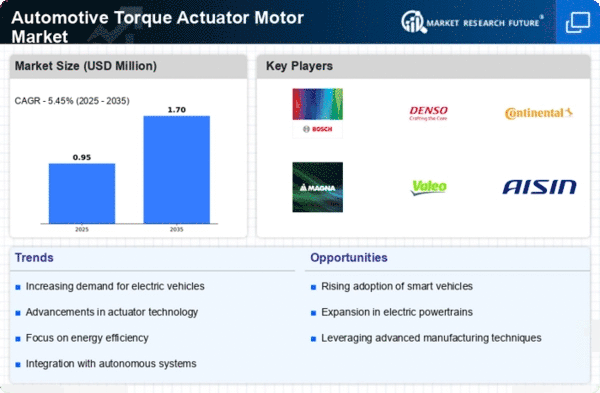
Automotive Torque Actuator Motor Market Infographic
Purchase Options

Market Share

Automotive Torque Actuator Motor Market Share Analysis

In recent times, there has been a significant surge in investments by manufacturers towards the research and development (R&D) of advanced technologies aimed at enhancing the efficiency of combustion engines and mitigating the environmental impact of vehicles. This strategic focus on R&D not only demonstrates a commitment to technological advancement but also serves as a means to gain a competitive advantage in the market.

One key aspect of this investment strategy involves the exploration of system integration and the incorporation of new functionalities into vehicles. By doing so, manufacturers aim to deliver products of superior quality and innovation to consumers. This approach not only caters to the evolving demands of the market but also positions companies as industry leaders in the rapidly changing automotive landscape.

Several noteworthy developments have emerged from these R&D initiatives, showcasing promising opportunities for market growth. One notable trend is the ongoing work in the development of electric turbochargers. This innovative technology represents a departure from traditional combustion engine components, offering a cleaner and more sustainable alternative. The pursuit of electric turbochargers aligns with the broader industry trend of transitioning towards eco-friendly solutions, addressing concerns related to carbon emissions and environmental sustainability.

Another area of focus in turbocharger development is the advancement of ball bearing turbochargers. This technology aims to enhance the overall performance of combustion engines by optimizing key components. The utilization of ball bearings in turbochargers contributes to increased efficiency and reliability, translating into improved vehicle performance and durability. This not only meets consumer expectations for better quality but also aligns with the industry's commitment to delivering sustainable and long-lasting automotive solutions.

Gasoline DualBoost Turbochargers represent yet another facet of the evolving turbocharger landscape. This technology introduces a dual-boost system for gasoline engines, providing a notable boost in performance. The dual-boost configuration allows for higher operating speeds, contributing to an enhanced driving experience. This development caters to the growing demand for vehicles that not only deliver on fuel efficiency but also offer a more dynamic and powerful performance on the road.

Collectively, these advancements underscore the industry's dedication to pushing the boundaries of technology in pursuit of cleaner, more efficient, and high-performing vehicles. The continuous investment in turbocharger development technologies reflects a commitment to meeting consumer expectations and staying ahead in a competitive market.

As manufacturers delve deeper into the realm of R&D, the resulting innovations are poised to shape the future of automotive technology. The ongoing evolution of turbocharger technologies not only addresses the immediate need for improved engine efficiency but also aligns with broader industry goals of environmental sustainability and consumer-centric innovation.

Author
Sejal Akre
Senior Research Analyst

She has over 5 years of rich experience, in market research and consulting providing valuable market insights to client. Hands on expertise in management consulting, and extensive knowledge in domain including ICT, Automotive & Transportation and Aerospace & Defense. She is skilled in Go-to market strategy, industry analysis, market sizing, in depth company profiling, competitive intelligence & benchmarking and value chain amongst others.

Leave a Comment

FAQs

What is the predicted revenue generation of the automotive torque actuator motor market?

The global automotive torque actuator motor market is poised to record a market value of USD 8247.14 million by 2021.

At what growth rate is the automotive torque actuator motor market evolving?

The global automotive torque actuator motor market is maturing at a whopping 6.3% CAGR over the review period of 2023 to 2032

Who are the major market giants operating in the global automotive torque actuator motor market?

A few significant players of the global automotive torque actuator motor market are Mitsuba (India), Rheinmetall (Germany), Bray (U.S.), NSK (Japan), Electrocraft (U.S.), Siko-Global (Germany), and HIWIN (U.S.), among others.

Which type segment of the automotive torque actuator motor market is observing the fastest growth?

The electric segment is expected to drive market growth over the review period.

Which motion type segment of the automotive torque actuator motor market is expected to witness the highest demand?

The oscillatory segment is likely to witness the highest demand in the automotive torque actuator motor market.

Market Summary

As per MRFR analysis, the Automotive Torque Actuator Motor Market Size was estimated at 0.9 USD Million in 2024. The Automotive Torque Actuator Motor industry is projected to grow from 1.0 in 2025 to 1.7 by 2035, exhibiting a compound annual growth rate (CAGR) of 5.45 during the forecast period 2025 - 2035.

Key Market Trends & Highlights

The Automotive Torque Actuator Motor Market is poised for substantial growth driven by technological advancements and increasing demand for electric vehicles.

  • Technological advancements are reshaping the automotive torque actuator motor landscape, enhancing performance and efficiency. North America remains the largest market, while Asia-Pacific is emerging as the fastest-growing region in this sector. The power steering segment holds the largest market share, whereas the throttle control segment is witnessing rapid growth. Rising vehicle electrification and a growing focus on fuel efficiency are key drivers propelling market expansion.

Market Size & Forecast

2024 Market Size 0.9 (USD Million)
2035 Market Size 1.7 (USD Million)
CAGR (2025 - 2035) 5.45%
Largest Regional Market Share in 2024 North America

Major Players

<p>Bosch (DE), Denso (JP), Continental (DE), Magna International (CA), Valeo (FR), Aisin Seiki (JP), ZF Friedrichshafen (DE), Nidec Corporation (JP), Mitsubishi Electric (JP)</p>

Market Trends

The Automotive Torque Actuator Motor Market is currently experiencing a transformative phase, driven by advancements in technology and increasing demand for efficient vehicle performance. As automotive manufacturers strive to enhance the functionality of vehicles, the integration of torque actuator motors has become more prevalent. These components play a crucial role in various applications, including throttle control, transmission systems, and steering mechanisms. The growing emphasis on electric and hybrid vehicles further propels the market, as these technologies often rely on precise actuator systems to optimize performance and energy efficiency. Moreover, the Automotive Torque Actuator Motor Market is influenced by the rising consumer preference for smart and connected vehicles. Innovations in automation and artificial intelligence are reshaping the automotive landscape, leading to a greater reliance on sophisticated actuator systems. This trend suggests that manufacturers are likely to invest in research and development to create more advanced and reliable torque actuator motors. As the market evolves, it appears that sustainability and regulatory compliance will also play pivotal roles in shaping future product offerings, as stakeholders seek to align with environmental standards and consumer expectations.

Technological Advancements

The Automotive Torque Actuator Motor Market is witnessing rapid technological advancements, particularly in the development of electric and hybrid vehicles. These innovations enhance the efficiency and performance of actuator systems, making them integral to modern automotive design.

Increased Demand for Electric Vehicles

The shift towards electric vehicles is significantly impacting the Automotive Torque Actuator Motor Market. As manufacturers focus on producing more electric models, the need for efficient torque actuator motors that support energy conservation and performance optimization is growing.

Focus on Automation and Connectivity

There is a notable trend towards automation and connectivity within the Automotive Torque Actuator Motor Market. As vehicles become smarter, the demand for advanced actuator systems that can integrate with automated driving technologies is likely to increase.

Automotive Torque Actuator Motor Market Market Drivers

Market Growth Projections

The Global Automotive Torque Actuator Motor Market Industry is projected to experience substantial growth, with estimates indicating a market size of 17.0 USD Billion by 2035. This growth is driven by various factors, including technological advancements, regulatory support, and increasing consumer demand for electric vehicles. The anticipated CAGR of 5.64% from 2025 to 2035 reflects the industry's potential as it adapts to evolving market dynamics and consumer preferences. As the automotive landscape transforms, the torque actuator motor market is poised for significant expansion.

Rising Demand for Electric Vehicles

The increasing global emphasis on sustainability and environmental concerns drives the demand for electric vehicles (EVs). As automakers pivot towards electrification, the Global Automotive Torque Actuator Motor Market Industry experiences heightened demand for torque actuator motors, which are essential for various EV functionalities. In 2024, the market is projected to reach 9.31 USD Billion, reflecting the growing integration of advanced technologies in EVs. This trend is likely to continue as consumer preferences shift towards greener alternatives, suggesting a robust growth trajectory for the industry.

Growing Focus on Vehicle Safety Features

The increasing consumer focus on vehicle safety features significantly impacts the Global Automotive Torque Actuator Motor Market Industry. As safety becomes a paramount concern, automakers are integrating advanced safety technologies that rely on torque actuator motors for optimal functionality. Features such as electronic stability control and adaptive cruise control require precise motor control, driving the demand for high-quality actuators. This trend is likely to persist as consumers prioritize safety in their purchasing decisions, suggesting a sustained growth trajectory for the industry.

Regulatory Support for Emission Reductions

Government regulations aimed at reducing vehicle emissions play a crucial role in shaping the Global Automotive Torque Actuator Motor Market Industry. Stricter emission standards compel automakers to adopt technologies that improve fuel efficiency and reduce carbon footprints. Torque actuator motors are integral to achieving these objectives, as they optimize engine performance and enhance overall vehicle efficiency. As countries worldwide implement more stringent regulations, the demand for these motors is likely to increase, thereby driving market growth and innovation in the automotive sector.

Technological Advancements in Automotive Systems

Technological innovations in automotive systems, such as advanced driver-assistance systems (ADAS) and automated driving technologies, significantly influence the Global Automotive Torque Actuator Motor Market Industry. These advancements necessitate the incorporation of sophisticated torque actuator motors to enhance vehicle performance and safety. As manufacturers invest in research and development to create smarter vehicles, the demand for high-performance torque actuators is expected to rise. This trend may contribute to the market's growth, with projections indicating a CAGR of 5.64% from 2025 to 2035, underscoring the industry's potential.

Expansion of Automotive Manufacturing in Emerging Markets

The expansion of automotive manufacturing in emerging markets contributes to the growth of the Global Automotive Torque Actuator Motor Market Industry. Countries such as India and Brazil are witnessing a surge in vehicle production, driven by rising disposable incomes and urbanization. This growth creates a substantial demand for torque actuator motors, which are essential for modern vehicles. As these markets continue to develop, the industry is expected to see increased investments and innovations, further propelling the demand for torque actuator motors in the coming years.

Market Segment Insights

By Application: Power Steering (Largest) vs. Throttle Control (Fastest-Growing)

<p>In the Automotive Torque Actuator <a href="https://www.marketresearchfuture.com/reports/automotive-motor-market-5595">Motor Market</a>, the application segment is dominated by power steering, which accounts for a significant share of the overall market. This segment's strong presence is driven by the increasing adoption of advanced steering systems in vehicles, emphasizing the need for precision and responsiveness in steering mechanisms. Other application areas such as throttle control, transmission control, brake control, and suspension control also contribute to the market, albeit with varying degrees of penetration and market acceptance. Analysis of growth trends reveals a shifting landscape within the Automotive Torque Actuator Motor Market. Throttle control is emerging as the fastest-growing segment, fueled by a rise in demand for more efficient fuel management systems and enhanced vehicle performance. Furthermore, advancements in technology and automation are set to propel the adoption of transmission control and brake control systems, contributing to an overall increase in the use of torque actuator motors in diverse automotive applications.</p>

<p>Power Steering (Dominant) vs. Throttle Control (Emerging)</p>

<p>Power Steering has established itself as the dominant application in the Automotive Torque Actuator Motor Market, owing to its critical role in enhancing driving comfort and vehicle handling. This segment is characterized by its reliance on efficient actuator motors that allow for smoother and more responsive steering. Meanwhile, Throttle Control stands out as an emerging segment, driven by the increasing focus on fuel efficiency and performance enhancement in modern vehicles. As automakers move towards integrating electric and hybrid powertrains, the need for precision in throttle control systems is escalating, positioning this segment for robust growth. Together, these segments highlight the ongoing evolution in automotive technologies, where performance and efficiency are paramount.</p>

By End Use: Passenger Vehicles (Largest) vs. Electric Vehicles (Fastest-Growing)

<p>The automotive torque actuator motor market showcases a diverse range of end-use applications, with passenger vehicles dominating the landscape. This segment accounts for the largest share of the market, driven by the increasing consumer demand for enhanced vehicle performance and comfort features. Alongside, the commercial vehicles segment contributes significantly, supporting various industrial applications. In contrast, electric vehicles are rapidly gaining traction, reflecting a shift in consumer preferences towards sustainable mobility solutions and eco-friendly technologies. Looking towards growth trends, the electric vehicle segment is emerging as the fastest-growing area within the automotive torque actuator motor market. This growth can be attributed to the global push for electrification and stringent emissions regulations prompting manufacturers to innovate. Additionally, advancements in technology and infrastructure improvements are further propelling demand in this segment. The trend towards hybrid vehicles also indicates a growing consumer inclination towards combining traditional and electric powertrains, contributing further to market dynamics.</p>

<p>Passenger Vehicles (Dominant) vs. Commercial Vehicles (Emerging)</p>

<p>In the automotive torque actuator motor market, passenger vehicles stand as the dominant segment, primarily due to the increasing preference for advanced safety features and automated functionalities in consumer vehicles. These motors facilitate critical functions like throttle control and other electronic systems, elevating overall vehicle performance and user experience. On the other hand, commercial vehicles represent an emerging segment, characterized by their robust applications in logistics and transportation. As industries evolve, demand for efficient and reliable torque actuators is rising, driven by the need for optimization in large vehicle fleets. With advancements in technology, both segments are set to evolve, adapting to changing consumer needs and regulatory frameworks.</p>

By Type: DC Motor (Largest) vs. Brushless Motor (Fastest-Growing)

<p>The automotive torque actuator motor market is seeing a diverse distribution across various types of motors. DC motors hold the largest share of the market, favored for their simplicity, reliability, and cost-effectiveness. Their established presence in numerous automotive applications contributes to their dominance. In contrast, stepper motors and servo motors, while significant, have smaller market shares, reflecting their niche applications and specialized performance for specific tasks. Recent trends indicate a growing preference for brushless motors, which are recognized for their efficiency and reduced maintenance needs. As automakers push for more electrification in vehicles, brushless motors are emerging as the fastest-growing segment due to their enhanced performance and energy savings, making them increasingly popular in advanced driver-assistance systems and electric vehicles.</p>

<p>Motor Type: DC Motor (Dominant) vs. Servo Motor (Emerging)</p>

<p>DC motors are the dominant players in the automotive torque actuator motor market, recognized for their widespread applicability and reliability. They are often used in traditional automotive systems due to their ease of use and lower manufacturing costs. On the other hand, servo motors are emerging as key contenders, particularly in high-performance applications where precision and control are paramount. As vehicle technology advances and the industry evolves towards automation and precision engineering, servo motors are being increasingly integrated into modern automotive systems, allowing for sophisticated maneuverability and improved overall vehicle performance.</p>

By Technology: Electromechanical (Largest) vs. Hydraulic (Fastest-Growing)

<p>In the Automotive Torque Actuator Motor Market, the technology segment is primarily composed of Electromechanical, Hydraulic, and Pneumatic actuators. Electromechanical actuators hold the largest market share due to their efficiency and broad application in various automotive systems. Hydraulic actuators, while smaller in share, are experiencing significant growth, driven by their high torque output and adaptability in performance-oriented applications. Pneumatic actuators, although less common, are also making strides in niche markets where lightweight solutions are crucial.</p>

<p>Technology: Electromechanical (Dominant) vs. Hydraulic (Emerging)</p>

<p>Electromechanical actuators dominate the market owing to their precision, controllability, and suitability for electric vehicles and advanced driver-assistance systems. They provide consistent performance with lower energy consumption, making them a preferable choice across the automotive sector. On the other hand, hydraulic actuators are emerging as a viable alternative, especially in heavy-duty applications that require high torque and rapid response times. Their robust construction and ability to operate in extreme conditions position them well in the market, especially as manufacturers seek to enhance vehicle performance. This dynamic between the two technologies highlights the ongoing evolution within the industry.</p>

By Functionality: Position Control (Largest) vs. Speed Control (Fastest-Growing)

<p>The Automotive Torque Actuator Motor Market is diverse, particularly when dissecting the functionality segment. Position control stands out as the largest share holder, utilized extensively in various applications requiring precise movements and reliability. Speed control, on the other hand, has emerged as a dynamic player, showcasing rapid growth due to the increasing demand for high-performance vehicles that require sophisticated control systems.</p>

<p>Control: Position Control (Dominant) vs. Speed Control (Emerging)</p>

<p>Position control technology has long been dominant in the automotive sector, facilitating fine-tuning of actuators to maintain exact positions in mechanisms such as throttle systems and valves. Its reliability and precision are critical in vehicles that prioritize stability and efficiency. In contrast, speed control technology is gaining traction as an emerging trend, driven by the need for enhanced vehicle performance and responsiveness. This segment is bolstered by growing consumer preferences for faster and more efficient vehicles, prompting manufacturers to invest in advancements in speed control mechanisms that enhance vehicle dynamics.</p>

Get more detailed insights about Automotive Torque Actuator Motor Market Research Report – Forecast to 2035

Regional Insights

North America : Market Leader in Innovation

North America holds a commanding 45% share of the Automotive Torque Actuator Motor Market, driven by robust demand for advanced automotive technologies and electric vehicles. Regulatory support for emissions reduction and fuel efficiency is propelling growth, alongside increasing consumer preference for smart automotive solutions. The region's focus on innovation and sustainability is expected to further enhance market dynamics. The United States and Canada are the leading countries in this sector, with major players like Bosch, Denso, and Magna International establishing strong footholds. The competitive landscape is characterized by significant investments in R&D and strategic partnerships among key manufacturers. This collaborative environment fosters innovation, ensuring that North America remains at the forefront of automotive technology advancements.

Europe : Emerging Hub for Technology

Europe accounts for 25% of the Automotive Torque Actuator Motor Market, with stringent regulations on emissions and safety standards driving demand. The European Union's commitment to sustainability and the transition to electric vehicles are key growth catalysts. Additionally, the increasing adoption of advanced driver-assistance systems (ADAS) is expected to boost market expansion in the coming years. Germany, France, and the UK are the leading countries in this market, hosting major manufacturers like Continental and Valeo. The competitive landscape is marked by a strong emphasis on innovation and collaboration among industry players. The presence of established automotive giants and a growing number of startups contribute to a dynamic market environment, positioning Europe as a leader in automotive technology.

Asia-Pacific : Rapidly Growing Market

Asia-Pacific holds a 15% share of the Automotive Torque Actuator Motor Market, driven by rapid industrialization and increasing vehicle production. Countries like Japan and China are at the forefront, with a growing demand for electric vehicles and advanced automotive technologies. Government initiatives promoting electric mobility and environmental sustainability are further fueling market growth in the region. Japan and China are the leading countries, with key players such as Denso and Aisin Seiki making significant contributions. The competitive landscape is characterized by a mix of established manufacturers and emerging companies, fostering innovation and technological advancements. The region's focus on smart mobility solutions is expected to enhance its market position in the global automotive sector.

Middle East and Africa : Untapped Market Potential

The Middle East and Africa represent a nascent segment of the Automotive Torque Actuator Motor Market, with a modest 5% share. The region is witnessing gradual growth driven by increasing vehicle ownership and infrastructure development. Government initiatives aimed at enhancing transportation networks and promoting electric vehicles are expected to catalyze market expansion in the coming years. Countries like South Africa and the UAE are emerging as key players in this market. The competitive landscape is still developing, with opportunities for both local and international manufacturers to establish a presence. As the region invests in automotive technology and infrastructure, it is poised for significant growth in the automotive sector.

Key Players and Competitive Insights

The Automotive Torque Actuator Motor Market is currently characterized by a dynamic competitive landscape, driven by technological advancements and increasing demand for electric vehicles (EVs). Key players such as Bosch (DE), Denso (JP), and Valeo (FR) are strategically positioning themselves through innovation and partnerships. Bosch (DE) has focused on enhancing its product portfolio with advanced torque actuator motors that cater to the growing EV segment, while Denso (JP) emphasizes sustainability and efficiency in its manufacturing processes. Valeo (FR) is actively pursuing collaborations with automotive manufacturers to integrate its torque actuator technologies into next-generation vehicles, thereby shaping a competitive environment that prioritizes technological prowess and strategic alliances.

In terms of business tactics, companies are increasingly localizing manufacturing to reduce costs and enhance supply chain efficiency. The market appears moderately fragmented, with several players vying for market share. However, the collective influence of major companies like ZF Friedrichshafen (DE) and Aisin Seiki (JP) is notable, as they leverage their extensive networks and technological capabilities to maintain a competitive edge. This competitive structure suggests that while individual companies may have distinct strategies, their collective actions significantly impact market dynamics.

In November 2025, Bosch (DE) announced a partnership with a leading EV manufacturer to develop a new line of torque actuator motors specifically designed for high-performance electric vehicles. This collaboration is expected to enhance Bosch's market presence and solidify its reputation as a leader in innovative automotive solutions. The strategic importance of this partnership lies in its potential to accelerate the adoption of electric vehicles, aligning with global sustainability goals.

In October 2025, Denso (JP) unveiled a new manufacturing facility in North America aimed at producing torque actuator motors with a focus on reducing carbon emissions. This facility is part of Denso's broader strategy to localize production and meet the increasing demand for environmentally friendly automotive components. The establishment of this facility underscores Denso's commitment to sustainability and positions the company favorably in a market that is increasingly prioritizing eco-friendly solutions.

In September 2025, Valeo (FR) launched an innovative torque actuator motor that integrates artificial intelligence (AI) for enhanced performance and efficiency. This product is designed to optimize vehicle dynamics and improve energy consumption in electric and hybrid vehicles. The introduction of AI into their product line reflects Valeo's strategic focus on digital transformation and positions the company at the forefront of technological advancements in the automotive sector.

As of December 2025, the competitive trends in the Automotive Torque Actuator Motor Market are increasingly defined by digitalization, sustainability, and the integration of AI technologies. Strategic alliances among key players are shaping the landscape, fostering innovation and collaboration. Looking ahead, competitive differentiation is likely to evolve from traditional price-based competition to a focus on technological innovation, supply chain reliability, and sustainable practices. This shift indicates a transformative phase in the market, where companies that prioritize innovation and adaptability will likely emerge as leaders.

Key Companies in the Automotive Torque Actuator Motor Market market include

Industry Developments

    • Hella increased its electronics expertise in the field of specific applications in August 2019. The firm broadened its product portfolio, which now includes actuators, sensors, and energy management, as well as body electronics and driver assistance systems. The agriculture sector's Universal Rotary Actuator (URA) is projected to play a key role in this progress.

    • Continental announced the groundbreaking of its greenfield factory in Talegaon, Pune, devoted to its powertrain division in January 2019. Until 2020, EUR 30 million will be invested on infrastructure and construction. The building phase has already begun. Production of different drivetrain items, including as engine management systems, sensors, and actuators, as well as fuel and exhaust management components for passenger cars, 2-wheelers, and commercial vehicles, is set to begin in early 2020.

    • DENSO Corporation and Smiths Manufacturing (Pty) Limited, which is controlled by Metair Investments Limited, announced the formation of DENSO Sales South Africa (Pty) Limited in July 2019, a joint venture devoted to selling aftermarket goods and services in Southern Africa. South Africa has one of the most developed economies in the continent, and automobile ownership is the highest in the area. DENSO Sales South Africa was created to sell repair parts and accessories as well as provide services such as repairs for passenger cars and commercial vehicles in South Africa and surrounding countries.

Based on product type:

    • Brake Actuator
    • Cooling Valve Actuator
    • EGR Actuator
    • Grille Shutter Actuator
    • Headlamp Actuator
    • Hood Lift Actuator
    • HVAC Actuator
    • Piezoelectric Actuator
    • Power Seat Actuator
    • Power Window
    • Quick Attach
    • Steering Column Adjustment Actuator
    • Sunroof Actuator
    • Tailgate Actuator
    • Telescopic Actuator
    • Throttle Actuator
    • Turbo Actuator

Based on vehicle type:

    • On-Highway
    • Off-Highway

Based on on-highway vehicle:

    • Passenger Car
    • Light Commercial Vehicle
    • Heavy Commercial Vehicle

Based on motion:

    • Linear
    • Rotatory

Based on application:

    • Engine
    • Body & Exterior
    • Interior

Based on the region:

    • Asia Pacific
      • China
      • India
      • Japan
      • South Korea
      • Thailand
      • Rest of Asia Pacific
    • North America
      • US
      • Canada
      • Mexico
    • Europe
      • France
      • Germany
      • Italy
      • Russia
      • Spain
      • United Kingdom
      • Rest of Europe
    • Rest of the World (Rest of the World)
      • Brazil
      • Iran
      • RoW

Future Outlook

Automotive Torque Actuator Motor Market Future Outlook

<p>The Automotive Torque Actuator Motor Market is projected to grow at a 5.45% CAGR from 2024 to 2035, driven by advancements in electric vehicles, automation, and increasing demand for fuel efficiency.</p>

New opportunities lie in:

  • <p>Development of integrated torque actuator systems for electric vehicles</p>
  • <p>Expansion into emerging markets with tailored actuator solutions</p>
  • <p>Partnerships with OEMs for advanced actuator technology integration</p>

<p>By 2035, the market is expected to be robust, reflecting substantial growth and innovation.</p>

Market Segmentation

Automotive Torque Actuator Motor Market Type Outlook

  • DC Motor
  • Stepper Motor
  • Servo Motor
  • Brushless Motor

Automotive Torque Actuator Motor Market End Use Outlook

  • Passenger Vehicles
  • Commercial Vehicles
  • Electric Vehicles
  • Hybrid Vehicles

Automotive Torque Actuator Motor Market Technology Outlook

  • Electromechanical
  • Hydraulic
  • Pneumatic

Automotive Torque Actuator Motor Market Application Outlook

  • Power Steering
  • Throttle Control
  • Transmission Control
  • Brake Control
  • Suspension Control

Automotive Torque Actuator Motor Market Functionality Outlook

  • Position Control
  • Speed Control
  • Torque Control
  • Force Control

Report Scope

MARKET SIZE 2024 0.9(USD Million)
MARKET SIZE 2025 1.0(USD Million)
MARKET SIZE 2035 1.7(USD Million)
COMPOUND ANNUAL GROWTH RATE (CAGR) 5.45% (2024 - 2035)
REPORT COVERAGE Revenue Forecast, Competitive Landscape, Growth Factors, and Trends
BASE YEAR 2024
Market Forecast Period 2025 - 2035
Historical Data 2019 - 2024
Market Forecast Units USD Million
Key Companies Profiled Bosch (DE), Denso (JP), Continental (DE), Magna International (CA), Valeo (FR), Aisin Seiki (JP), ZF Friedrichshafen (DE), Nidec Corporation (JP), Mitsubishi Electric (JP)
Segments Covered Application, End Use, Type, Technology, Functionality
Key Market Opportunities Integration of advanced electric vehicle technologies enhances demand in the Automotive Torque Actuator Motor Market.
Key Market Dynamics Rising demand for electric vehicles drives innovation in automotive torque actuator motor technology and efficiency.
Countries Covered North America, Europe, APAC, South America, MEA

FAQs

What is the predicted revenue generation of the automotive torque actuator motor market?

The global automotive torque actuator motor market is poised to record a market value of USD 8247.14 million by 2021.

At what growth rate is the automotive torque actuator motor market evolving?

The global automotive torque actuator motor market is maturing at a whopping 6.3% CAGR over the review period of 2023 to 2032

Who are the major market giants operating in the global automotive torque actuator motor market?

A few significant players of the global automotive torque actuator motor market are Mitsuba (India), Rheinmetall (Germany), Bray (U.S.), NSK (Japan), Electrocraft (U.S.), Siko-Global (Germany), and HIWIN (U.S.), among others.

Which type segment of the automotive torque actuator motor market is observing the fastest growth?

The electric segment is expected to drive market growth over the review period.

Which motion type segment of the automotive torque actuator motor market is expected to witness the highest demand?

The oscillatory segment is likely to witness the highest demand in the automotive torque actuator motor market.

  1. Executive Summary
  2. Scope of the Report
    1. Market Definition
    2. Scope of the Study
      1. Definition
      2. Research Objective
      3. Assumptions
      4. Limitations
    3. Research Process
      1. Primary Research
      2. Secondary Research
    4. Market size Estimation
    5. Forecast Model
  3. Market Landscape
    1. Porter’s Five Forces Analysis
      1. Threat of New Entrants
      2. Bargaining power of buyers
      3. Threat of substitutes
      4. Segment rivalry
      5. Bargaining Power of Buyers
    2. Value Chain/Supply Chain Analysis
  4. Market Dynamics
    1. Introduction
    2. Market Drivers
    3. Market Restraints
    4. Market Opportunities
    5. Market Trends
  5. Global Automotive Torque Actuator Motor Market, By Type
    1. Introduction
    2. Pneumatic
      1. Market Estimates & Forecast, 2023-2032
      2. Market Estimates & Forecast by Region, 2023-2032
    3. Electric
      1. Market Estimates & Forecast, 2023-2032
      2. Market Estimates & Forecast by Region, 2023-2032
    4. Mechanical
      1. Market Estimates & Forecast, 2023-2032
      2. Market Estimates & Forecast by Region, 2023-2032
  6. Global Automotive Torque Actuator Motor Market, By Motion Output
    1. Introduction
    2. Linear
      1. Market Estimates & Forecast, 2023-2032
      2. Market Estimates & Forecast by Region, 2023-2032
    3. Rotary
      1. Market Estimates & Forecast, 2023-2032
      2. Market Estimates & Forecast by Region, 2023-2032
    4. Oscillatory
      1. Market Estimates & Forecast, 2023-2032
      2. Market Estimates & Forecast by Region, 2023-2032
  7. Global Automotive Torque Actuator Motor Market, By Application
    1. Introduction
    2. Electronic Throttle Control (ETC)
      1. Market Estimates & Forecast, 2023-2032
      2. Market Estimates & Forecast by Region, 2023-2032
    3. Turbocharger
      1. Market Estimates & Forecast, 2023-2032
      2. Market Estimates & Forecast by Region, 2023-2032
    4. Exhaust Gas Circulation
      1. Market Estimates & Forecast, 2023-2032
      2. Market Estimates & Forecast by Region, 2023-2032
    5. Others
      1. Market Estimates & Forecast, 2023-2032
      2. Market Estimates & Forecast by Region, 2023-2032
  8. Global Automotive Torque Actuator Motor Market, By Region
    1. Introduction
    2. North America
      1. Market Estimates & Forecast, 2023-2032
      2. Market Estimates & Forecast by Type, 2023-2032
      3. Market Estimates & Forecast by Motion Output, 2023-2032
      4. Market Estimates & Forecast by Application, 2023-2032
      5. U.S.
      6. Canada
    3. Europe
      1. Market Estimates & Forecast, 2023-2032
      2. Market Estimates & Forecast by Type, 2023-2032
      3. Market Estimates & Forecast by Motion Output, 2023-2032
      4. Market Estimates & Forecast by Application, 2023-2032
      5. U.K.
      6. Germany
      7. France
      8. Italy
      9. Rest of Europe
    4. Asia Pacific
      1. Market Estimates & Forecast, 2023-2032
      2. Market Estimates & Forecast by Type, 2023-2032
      3. Market Estimates & Forecast by Motion Output, 2023-2032
      4. Market Estimates & Forecast by Application, 2023-2032
      5. China
      6. Japan
      7. India
      8. Rest of Asia Pacific
    5. Rest of the World
      1. Market Estimates & Forecast, 2023-2032
      2. Market Estimates & Forecast by Type, 2023-2032
      3. Market Estimates & Forecast by Motion Output, 2023-2032
      4. Market Estimates & Forecast by Application, 2023-2032
  9. Competitive Landscape
  10. Company Profile
    1. CTS (US),
      1. Company Overview
      2. Products/Services Offering
      3. Financial Overview
      4. Key Developments
      5. Strategy
      6. SWOT Analysis
    2. Johnson Electric (Hong Kong),
      1. Company Overview
      2. Products/Services Offering
      3. Financial Overview
      4. Key Developments
      5. Strategy
      6. SWOT Analysis
    3. Mitsuba (India)
      1. Company Overview
      2. Products/Services Offering
      3. Financial Overview
      4. Key Developments
      5. Strategy
      6. SWOT Analysis
    4. Rheinmetall (Germany)
      1. Company Overview
      2. Products/Services Offering
      3. Financial Overview
      4. Key Developments
      5. Strategy
      6. SWOT Analysis
    5. Bray (US)
      1. Company Overview
      2. Products/Services Offering
      3. Financial Overview
      4. Key Developments
      5. Strategy
      6. SWOT Analysis
    6. NSK (Japan)
      1. Company Overview
      2. Products/Services Offering
      3. Financial Overview
      4. Key Developments
      5. Strategy
      6. SWOT Analysis
    7. Electrocraft (US)
      1. Company Overview
      2. Products/Services Offering
      3. Financial Overview
      4. Key Developments
      5. Strategy
      6. SWOT Analysis
    8. Siko-Global (Germany)
      1. Company Overview
      2. Products/Services Offering
      3. Financial Overview
      4. Key Developments
      5. Strategy
      6. SWOT Analysis
    9. Valmatic (US)
      1. Company Overview
      2. Products/Services Offering
      3. Financial Overview
      4. Key Developments
      5. Strategy
      6. SWOT Analysis
    10. HIWIN (US)
      1. Company Overview
      2. Products/Services Offering
      3. Financial Overview
      4. Key Developments
      5. Strategy
      6. SWOT Analysis
    11. List of Tables
  11. Global Automotive Torque Actuator Motor Market: By Region, 2023-2032
  12. North America Automotive Torque Actuator Motor Market: By Country, 2023-2032
  13. Europe Automotive Torque Actuator Motor Market: By Country, 2023-2032
  14. Asia Pacific Automotive Torque Actuator Motor Market: By Country, 2023-2032
  15. RoW Automotive Torque Actuator Motor Market: By Country, 2023-2032
  16. Global Automotive Torque Actuator Motor Market, By Type, By Regions, 2023-2032
  17. North America Automotive Torque Actuator Motor Market, By Type, By Country, 2023-2032
  18. Europe Automotive Torque Actuator Motor Market, By Type, By Country, 2023-2032
  19. Asia Pacific Automotive Torque Actuator Motor Market by Type, By Country, 2023-2032
  20. RoW Automotive Torque Actuator Motor Market by Type, By Country, 2023-2032
  21. Global Autonomous Trucks by Motion Output Market: By Regions, 2023-2032
  22. North America Automotive Torque Actuator Motor Market by Motion Output: By Country, 2023-2032
  23. Europe Automotive Torque Actuator Motor Market by Motion Output: By Country, 2023-2032
  24. Asia Pacific Automotive Torque Actuator Motor Market by Motion Output: By Country, 2023-2032
  25. RoW Automotive Torque Actuator Motor Market by Motion Output: By Country, 2023-2032
  26. Global Autonomous Trucks by Application Market: By Regions, 2023-2032
  27. North America Automotive Torque Actuator Motor Market by Application: By Country, 2023-2032
  28. Europe Automotive Torque Actuator Motor Market by Application: By Country, 2023-2032
  29. Asia Pacific Automotive Torque Actuator Motor Market by Application: By Country, 2023-2032
  30. RoW Automotive Torque Actuator Motor Market by Application: By Country, 2023-2032
  31. Global Automotive Torque Actuator Motor Market: By Region, 2023-2032
  32. Global Automotive Torque Actuator Motor Market: By Type, 2023-2032
  33. Global Automotive Torque Actuator Motor Market: By Motion Output, 2023-2032
  34. Global Automotive Torque Actuator Motor Market: By Application, 2023-2032
  35. North America Automotive Torque Actuator Motor Market, By Country
  36. North America Automotive Torque Actuator Motor Market, By Type
  37. North America Automotive Torque Actuator Motor Market, By Motion Output
  38. North America Automotive Torque Actuator Motor Market, By Application
  39. Europe: Automotive Torque Actuator Motor Market, By Country
  40. Europe: Automotive Torque Actuator Motor Market, By Type
  41. Europe: Automotive Torque Actuator Motor Market, By Motion Output
  42. Europe: Automotive Torque Actuator Motor Market, By Application
  43. Asia Pacific: Automotive Torque Actuator Motor Market, By Country
  44. Asia Pacific: Automotive Torque Actuator Motor Market, By Type
  45. Asia Pacific: Automotive Torque Actuator Motor Market, By Motion Output
  46. Asia Pacific: Automotive Torque Actuator Motor Market, By Application
  47. RoW: Automotive Torque Actuator Motor Market, By Region
  48. RoW Automotive Torque Actuator Motor Market, By Type
  49. RoW Automotive Torque Actuator Motor Market, By Motion Output
  50. RoW Automotive Torque Actuator Motor Market, By
    1. List of Figures
  51. Research Process of MRFR
  52. Top down & Bottom up Approach
  53. Market Dynamics
  54. impact analysis: market drivers
  55. impact analysis: market restraints
  56. porter’s five forces analysis
  57. Value chain analysis
  58. Global Automotive Torque Actuator Motor Market SHARE, By Type, 2023 (%)
  59. Global Automotive Torque Actuator Motor Market, By Type, 2023-2032 (USD MILLION)
  60. Global Automotive Torque Actuator Motor Market SHARE, By Motion Output, 2023 (%)
  61. Global Automotive Torque Actuator Motor Market, By Motion Output, 2023-2032 (USD MILLION)
  62. Global Automotive Torque Actuator Motor Market SHARE, By Application, 2023 (%)
  63. Global Automotive Torque Actuator Motor Market, By Application, 2023-2032 (USD MILLION)
  64. Global Automotive Torque Actuator Motor Market SHARE (%), BY REGION, 2023
  65. Global Automotive Torque Actuator Motor Market, BY REGION, 2023-2032 (USD MILLION)
  66. North America Automotive Torque Actuator Motor Market SHARE (%), 2023
  67. North America Automotive Torque Actuator Motor Market BY Country, 2023-2032 (USD MILLION)
  68. Europe Automotive Torque Actuator Motor Market SHARE (%), 2023
  69. Europe Automotive Torque Actuator Motor Market BY Country, 2023-2032 (USD MILLION)
  70. Asia Pacific Automotive Torque Actuator Motor Market SHARE (%), 2023
  71. Asia Pacific Automotive Torque Actuator Motor Market BY Country, 2023-2032 (USD MILLION)
  72. Rest of the World Automotive Torque Actuator Motor Market SHARE (%), 2023
  73. Rest of the World Automotive Torque Actuator Motor Market BY Country, 2023-2032 (USD MILLION)

Automotive Torque Actuator Motor Market Segmentation

Market Segmentation Overview

  • Detailed segmentation data will be available in the full report
  • Comprehensive analysis by multiple parameters
  • Regional and country-level breakdowns
  • Market size forecasts by segment
Infographic

Free Sample Request

Kindly complete the form below to receive a free sample of this Report

Get Free Sample

Customer Strories

Compare Licence

×
Features License Type
Single User Multiuser License Enterprise User
Price $4,950 $5,950 $7,250
Maximum User Access Limit 1 User Upto 10 Users Unrestricted Access Throughout the Organization
Free Customization
Direct Access to Analyst
Deliverable Format
Platform Access
Discount on Next Purchase 10% 15% 15%
Printable Versions