Request Free Sample ×

Kindly complete the form below to receive a free sample of this Report

* Please use a valid business email

Leading companies partner with us for data-driven Insights

clients tt-cursor
Hero Background
English
Chinese
French
Japanese
Korean
German
Spanish

Automotive Smart Display Market Size

ID: MRFR/AT/2590-HCR
110 Pages
Shubham Munde
Last Updated: April 06, 2026

Automotive Smart Display Market Size, Share & Growth Analysis Report By Technology (Liquid Crystal Display, Organic Light Emitting Diode, MicroLED, Digital Light Processing), By Display Type (Instrument Cluster, Center Stack Display, Head-Up Display, Rear Seat Entertainment), By Vehicle Type (Passenger Cars, Light Commercial Vehicles, Heavy Commercial Vehicles, Electric Vehicles), By Functionality (Infotainment, Navigation, Vehicle Monitoring, Communication) and By Regional (North America, Europe, South America, Asia Pacific, Middle East and Africa) - Industry Growth & Forecast to 2035

Share:
Download PDF ×

We do not share your information with anyone. However, we may send you emails based on your report interest from time to time. You may contact us at any time to opt-out.

Automotive Smart Display Market Infographic
Purchase Options

Automotive Smart Display Size

Automotive Smart Display Market Growth Projections and Opportunities

The car smart show marketplace is stimulated via a large number of market elements that together form its increase, adoption, and technological evolution. One pivotal element is the growing patron demand for superior in-car features and connectivity. As drivers and passengers searching for more included and tech-savvy riding revel, the car enterprise responds by incorporating sophisticated, clever presentations that offer intuitive controls, infotainment alternatives, and seamless connectivity with smartphones and different gadgets.

Regulatory factors additionally play an essential position in shaping the car clever display market. Governments worldwide are increasingly imposing safety policies that concentrate on minimizing driving force distractions and enhancing normal avenue protection. This has caused the improvement of clever presentations that prioritize finger-free operation, voice controls, and different safety-centric features. Manufacturers are compelled to align their merchandise with these guidelines, influencing the design and functionality of clever displays to make certain they agree to protection standards.

The international shift closer to electric-powered and autonomous vehicles is another sizable market thing impacting car clever presentations. As electric motors (EVs) gain traction, there's a growing want for presentations that provide actual-time information on battery reputation, strength consumption, and charging infrastructure. Smart displays play a critical function in delivering key statistics to EV drivers, contributing to the general reputation and adoption of electric mobility.

Technological advancements and innovations constitute a riding force inside the automobile clever show marketplace. Global economic elements also impact the automobile smart display marketplace. Economic situations impact purchaser shopping power and common market demand for vehicles. During financial downturns, consumers may additionally prioritize basic vehicle functions over superior technologies, affecting the adoption charge of clever displays. Conversely, for the duration of durations of economic prosperity, purchasers can be more willing to put money into motors with modern-day technology, riding a market boom.

In the end, the automotive smart display market is fashioned by way of a complicated interplay of things, which includes consumer needs, regulatory requirements, technological advancements, worldwide financial situations, and collaborative efforts within the enterprise.
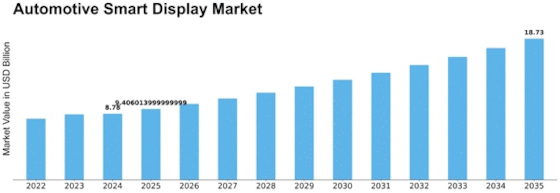

Automotive Smart Display Market Size Graph
Author
Author Profile
Shubham Munde
Team Lead - Research

Shubham brings over 7 years of expertise in Market Intelligence and Strategic Consulting, with a strong focus on the Automotive, Aerospace, and Defense sectors. Backed by a solid foundation in semiconductors, electronics, and software, he has successfully delivered high-impact syndicated and custom research on a global scale. His core strengths include market sizing, forecasting, competitive intelligence, consumer insights, and supply chain mapping. Widely recognized for developing scalable growth strategies, Shubham empowers clients to navigate complex markets and achieve a lasting competitive edge. Trusted by start-ups and Fortune 500 companies alike, he consistently converts challenges into strategic opportunities that drive sustainable growth.

Leave a Comment

FAQs

What is the projected market valuation of the Automotive Smart Display Market by 2035?

<p>The projected market valuation for the Automotive Smart Display Market is 18.73 USD Billion by 2035.</p>

What was the market valuation of the Automotive Smart Display Market in 2024?

<p>The overall market valuation was 8.78 USD Billion in 2024.</p>

What is the expected CAGR for the Automotive Smart Display Market during the forecast period 2025 - 2035?

<p>The expected CAGR for the Automotive Smart Display Market during the forecast period 2025 - 2035 is 7.13%.</p>

Which technology segment is expected to show significant growth in the Automotive Smart Display Market?

<p>The Liquid Crystal Display segment, valued at 3.5 USD Billion in 2024, is expected to grow significantly, reaching 7.5 USD Billion by 2035.</p>

What are the key functionalities driving the Automotive Smart Display Market?

<p>Key functionalities include Infotainment, which was valued at 3.51 USD Billion in 2024, and is projected to grow to 7.45 USD Billion by 2035.</p>

Which vehicle type is anticipated to contribute most to the Automotive Smart Display Market growth?

<p>Passenger Cars, valued at 3.5 USD Billion in 2024, are anticipated to contribute significantly, with a projected growth to 7.5 USD Billion by 2035.</p>

Who are the leading players in the Automotive Smart Display Market?

<p>Key players in the Automotive Smart Display Market include Continental AG, Denso Corporation, and Robert Bosch GmbH.</p>

What display type is expected to see the highest valuation increase in the Automotive Smart Display Market?

<p>The Center Stack Display, which was valued at 2.8 USD Billion in 2024, is expected to reach 6.0 USD Billion by 2035.</p>

How does the market for Electric Vehicles impact the Automotive Smart Display Market?

<p>The Electric Vehicles segment, valued at 2.28 USD Billion in 2024, is projected to grow to 4.23 USD Billion by 2035, indicating a strong impact on the market.</p>

What is the significance of the Head-Up Display segment in the Automotive Smart Display Market?

<p>The Head-Up Display segment, valued at 1.5 USD Billion in 2024, is projected to grow to 3.5 USD Billion by 2035, highlighting its increasing importance.</p>

Market Summary

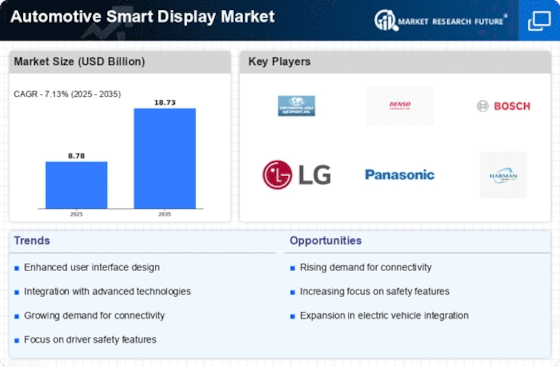
As per Market Research Future analysis, the Automotive Smart Display Market Size was estimated at 8.78 USD Billion in 2024. The Automotive Smart Display industry is projected to grow from 9.406 USD Billion in 2025 to 18.73 USD Billion by 2035, exhibiting a compound annual growth rate (CAGR) of 7.13% during the forecast period 2025 - 2035

Key Market Trends & Highlights

The Automotive Smart Display Market is poised for substantial growth driven by technological advancements and evolving consumer preferences.

  • North America remains the largest market for automotive smart displays, reflecting a strong demand for advanced in-vehicle technologies. The Asia-Pacific region is emerging as the fastest-growing market, fueled by increasing vehicle production and consumer interest in smart features. Liquid Crystal Displays dominate the market, while Organic Light Emitting Diodes are rapidly gaining traction due to their superior performance and efficiency. Key market drivers include the rising demand for enhanced user experience and the growing adoption of electric vehicles, which necessitate advanced display solutions.

Market Size & Forecast

2024 Market Size 8.78 (USD Billion)
2035 Market Size 18.73 (USD Billion)
CAGR (2025 - 2035) 7.13%
Largest Regional Market Share in 2024 North America

Major Players

Continental AG (DE), <a href="https://www.denso.com/global/en/business/products-and-services/mobility/safety-cockpit/">Denso Corporation</a> (JP), Robert Bosch GmbH (DE), LG Electronics (KR), Panasonic Corporation (JP), Harman International (US), <a href="https://www.visteon.com/products-technology/technology/default.aspx">Visteon Corporation</a> (US), Magna International Inc. (CA), NVIDIA Corporation (US)

Market Trends

The Automotive Smart Display Market is currently experiencing a transformative phase, driven by advancements in technology and changing consumer preferences. As vehicles become increasingly integrated with digital interfaces, the demand for sophisticated display systems is on the rise. These displays not only enhance the driving experience but also provide essential information and entertainment options, thereby appealing to a tech-savvy audience. The integration of features such as touchscreens, voice recognition, and connectivity with mobile devices is reshaping how drivers interact with their vehicles. Furthermore, the emphasis on safety and convenience is prompting manufacturers to innovate continuously, ensuring that their offerings remain competitive in a rapidly evolving landscape. In addition to technological advancements, the Automotive Smart Display Market is influenced by regulatory frameworks and environmental considerations. Governments are increasingly mandating the inclusion of advanced safety features in vehicles, which often necessitates the incorporation of smart displays. This trend suggests a growing alignment between regulatory requirements and consumer expectations, as buyers seek vehicles that not only meet safety standards but also provide a seamless user experience. As the Automotive Smart Display Market continues to evolve, it appears that the focus will remain on enhancing functionality while ensuring that displays are user-friendly and aesthetically pleasing, thus catering to a diverse range of consumer needs.

Integration of Advanced Technologies

The Automotive Smart Display Market is witnessing a surge in the integration of advanced technologies such as augmented reality and artificial intelligence. These innovations enhance user interaction and provide real-time data, making driving safer and more enjoyable. As manufacturers adopt these technologies, the displays are becoming more intuitive, allowing for a more personalized experience.

Focus on User Experience

There is a notable trend towards prioritizing user experience within the Automotive Smart Display Market. Manufacturers are increasingly designing interfaces that are not only functional but also visually appealing. This focus on aesthetics and usability is likely to attract a broader audience, as consumers seek products that enhance their overall driving experience.

Sustainability and Eco-Friendly Solutions

Sustainability is emerging as a critical consideration in the Automotive Smart Display Market. As environmental concerns grow, manufacturers are exploring eco-friendly materials and energy-efficient technologies. This trend indicates a shift towards more sustainable practices, aligning with consumer preferences for greener products.

Automotive Smart Display Market Market Drivers

Growing Electric Vehicle Adoption

The shift towards electric vehicles (EVs) is significantly influencing the Automotive Smart Display Market. As more consumers opt for EVs, the need for sophisticated displays that provide essential information about battery status, charging locations, and energy consumption becomes increasingly critical. The market for automotive displays in electric vehicles is anticipated to grow at a CAGR of around 12% over the next five years. This growth is fueled by the necessity for drivers to have access to real-time data that enhances their driving experience and optimizes energy usage. Consequently, the Automotive Smart Display Market is adapting to meet the unique requirements of the evolving electric vehicle landscape.

Increased Focus on Safety Features

Safety remains a paramount concern in the automotive sector, driving innovations within the Automotive Smart Display Market. Displays that provide critical information, such as speed, navigation, and alerts, are becoming essential for enhancing driver safety. The integration of advanced driver-assistance systems (ADAS) with smart displays allows for real-time monitoring of vehicle surroundings, thereby reducing the likelihood of accidents. Market data suggests that the demand for safety-oriented displays is expected to rise, with projections indicating a market share increase of approximately 15% by 2025. This focus on safety not only meets regulatory requirements but also aligns with consumer expectations, further propelling the Automotive Smart Display Market.

Regulatory Compliance and Standards

Regulatory frameworks and standards are playing a crucial role in shaping the Automotive Smart Display Market. Governments worldwide are implementing stringent regulations aimed at improving vehicle safety and environmental sustainability. These regulations often mandate the inclusion of advanced display technologies that provide critical information to drivers. For instance, displays that facilitate hands-free operation and minimize distractions are becoming increasingly necessary to comply with safety standards. As a result, manufacturers are compelled to innovate and enhance their display offerings to meet these regulatory requirements. The Automotive Smart Display Market is likely to see a surge in demand for compliant technologies, which could lead to a more standardized approach across the sector.

Integration of Advanced Technologies

The Automotive Smart Display Market is experiencing a notable surge due to the integration of advanced technologies such as augmented reality (AR) and artificial intelligence (AI). These technologies enhance the functionality of smart displays, providing drivers with real-time information and navigation assistance. For instance, AR can overlay navigation prompts directly onto the road view, improving situational awareness. The market for automotive displays is projected to reach approximately 30 billion USD by 2026, driven by these technological advancements. Furthermore, the incorporation of voice recognition and gesture control systems is likely to enhance user interaction, making driving safer and more intuitive. As manufacturers increasingly adopt these technologies, the Automotive Smart Display Market is poised for substantial growth.

Rising Demand for Enhanced User Experience

Consumer preferences are shifting towards vehicles that offer a superior user experience, significantly impacting the Automotive Smart Display Market. Modern drivers expect intuitive interfaces that seamlessly integrate with their digital lives. This demand has led to the development of displays that support smartphone connectivity, enabling features such as navigation, music streaming, and communication. According to recent estimates, the user experience-focused segment of the automotive display market is expected to grow at a compound annual growth rate (CAGR) of over 10% through 2027. As automakers prioritize user-centric designs, the Automotive Smart Display Market is likely to witness an influx of innovative solutions aimed at enhancing driver satisfaction and engagement.

Market Segment Insights

By Technology: Liquid Crystal Display (Largest) vs. Organic Light Emitting Diode (Fastest-Growing)

In the Automotive Smart Display Market, the technology segment is primarily characterized by an impressive distribution of various display technologies such as Liquid Crystal Display (LCD), Organic Light Emitting Diode (OLED), MicroLED, and Digital Light Processing (DLP). Among these, LCD holds the largest Automotive Smart Display Market share due to its widespread adoption in automotive applications, offering a cost-effective solution with adequate performance. OLED, on the other hand, is rapidly gaining ground, driven by its superior visual quality and increasing integration into high-end vehicle displays, making it a compelling choice for modern automotive designs. As drivers increasingly demand enhanced displays with better brightness, contrast, and responsiveness, the automotive industry is witnessing a significant shift towards OLED technology, which is expected to grow at the fastest rate. The expansion of electric and autonomous vehicles is further propelling the demand for innovative display technologies, enabling brands to capitalize on advanced features such as touch responsiveness and adaptive visuals tailored to user preferences. Additionally, ongoing technological advancements and reductions in production costs for OLED and MicroLED are likely to spur their adoption in future automotive models, potentially reshaping the competitive landscape within this segment.

Technology: LCD (Dominant) vs. OLED (Emerging)

Liquid Crystal Displays (LCD) continue to dominate the Automotive Smart Display Market due to their established presence and cost-effectiveness. They offer reliable performance, making them a standard choice for a variety of vehicle models. On the other hand, Organic Light Emitting Diodes (OLED) are emerging as a strong contender, providing better color accuracy, contrast, and flexibility in design. The innovative features associated with OLED technology, such as thinner panels and the ability to create curved screens, make them particularly attractive for high-end automotive applications. Although still in the early adoption phase compared to LCD, the rapid advancements and decreasing manufacturing costs of OLED are positioning it as a favorable alternative, promising to challenge the dominance of LCD in the not-so-distant future.

By Display Type: Instrument Cluster (Largest) vs. Rear Seat Entertainment (Fastest-Growing)

In the Automotive Smart Display Market, the distribution of market shares is notably dominated by the Instrument Cluster segment, which plays a critical role in driver assistance and user experience. Instrument Clusters represent the largest share due to the essential nature of conveying vital vehicle information directly in the driver's line of sight. In contrast, Rear Seat Entertainment is witnessing rapid growth, fueled by increasing consumer demand for in-car entertainment solutions that enhance passenger engagement during travel.

Entertainment: Rear Seat (Emerging) vs. Instrument Cluster (Dominant)

The Instrument Cluster segment remains dominant in the Automotive Smart Display Market, as it integrates advanced functionalities like navigation and vehicle diagnostics, providing essential information to the driver. This technology often includes high-resolution graphics and customizable interfaces which enhance user experience and safety. On the other hand, Rear Seat Entertainment systems are emerging as a vital segment, driven by the rising demand for interactive in-car entertainment among passengers. These systems are increasingly being equipped with advanced features like streaming services, game applications, and high-definition displays, appealing to families and travel enthusiasts, thus driving the segment's rapid growth.

By Vehicle Type: Passenger Cars (Largest) vs. Electric Vehicles (Fastest-Growing)

In the Automotive Smart Display Market, the distribution of market share among vehicle types showcases the dominance of <a href="https://www.marketresearchfuture.com/reports/passenger-cars-market-42133">passenger cars</a>, as they account for the largest segment. This is primarily driven by the ongoing demand for enhanced features that improve the driving experience and safety. Light commercial vehicles follow closely, while heavy commercial vehicles hold a smaller share. Electric vehicles, on the other hand, are gaining significant traction as sustainability becomes a crucial factor in consumer choices.

Passenger Cars (Dominant) vs. Electric Vehicles (Emerging)

Passenger cars, as the dominant segment in the automotive smart display market, are characterized by their extensive adoption of advanced display technologies. Features such as infotainment systems, navigation aids, and driver-assistance displays are now standard, catering to consumer expectations for connectivity and safety. Meanwhile, electric vehicles, as an emerging segment, are rapidly evolving. The integration of smart displays in EVs is becoming essential as they provide crucial information about battery performance and energy consumption, reflecting the shifting consumer focus towards sustainable driving solutions. This segment's growth is fueled by technological advancements and increasing environmental awareness, positioning electric vehicles as a key player for future Automotive Smart Display Market developments.

By Functionality: Infotainment (Largest) vs. Navigation (Fastest-Growing)

The Automotive Smart Display Market showcases a diverse functionality segment, prominently featuring infotainment, navigation, vehicle monitoring, and communication. Infotainment holds the largest Automotive Smart Display Market share, driven by increasing consumer demand for entertainment and connectivity during drives. Navigation functionalities are rapidly growing, appealing to users seeking enhanced travel and route optimization experiences through advanced display technologies.

Functionality: Infotainment (Dominant) vs. Navigation (Emerging)

Infotainment systems are becoming essential features in modern vehicles, offering a myriad of entertainment options and connectivity solutions. They dominate the Automotive Smart Display Market primarily due to their integration with smartphones and various multimedia content, driving user engagement. On the other hand, navigation systems are emerging as critical tools in the automotive industry, capitalizing on the demand for real-time traffic updates and intuitive user interfaces. Their rapid integration with artificial intelligence and advanced mapping technologies positions them as vital functionalities, ensuring that both infotaiment and navigation play complementary roles in enhancing the overall user experience in vehicles.

Get more detailed insights about Automotive Smart Display Market Research Report - Global Forecast till 2035

Regional Insights

North America : Innovation and Technology Hub

North America is the largest market for automotive smart displays, holding approximately 40% of the global Automotive Smart Display Market share. The region's growth is driven by increasing consumer demand for advanced infotainment systems, stringent safety regulations, and the rapid adoption of electric vehicles. Government initiatives promoting smart transportation technologies further catalyze market expansion. The United States and Canada are the leading countries in this sector, with major players like Harman International, Visteon Corporation, and NVIDIA Corporation establishing a strong presence. The competitive landscape is characterized by continuous innovation and partnerships among automotive manufacturers and technology firms, ensuring a robust market environment.

Europe : Regulatory-Driven Market Growth

Europe is the second-largest market for automotive smart displays, accounting for around 30% of the global share. The region's growth is propelled by stringent EU regulations on vehicle safety and emissions, alongside a growing consumer preference for connected car technologies. Initiatives like the European Green Deal are also influencing the adoption of smart displays in electric vehicles. Leading countries include Germany, France, and the UK, where companies like Continental AG and Robert Bosch GmbH are key players. The competitive landscape is marked by a focus on innovation and sustainability, with many firms investing in R&D to enhance user experience and integrate advanced features into their products. The European market is poised for significant growth as it adapts to evolving consumer needs and regulatory frameworks.

Asia-Pacific : Emerging Market Potential

Asia-Pacific is witnessing rapid growth in the automotive smart display market, holding approximately 25% of the global share. The region's expansion is fueled by increasing vehicle production, rising disposable incomes, and a growing demand for advanced infotainment systems. Government policies promoting smart city initiatives and electric vehicles are also significant growth drivers. China, Japan, and South Korea are the leading countries in this market, with major players like Denso Corporation and LG Electronics actively participating. The competitive landscape is dynamic, with numerous local and international firms vying for market share. The region's focus on technological advancements and consumer preferences for connectivity is expected to drive further growth in the coming years.

Middle East and Africa : Untapped Market Opportunities

The Middle East and Africa region is gradually emerging in the automotive smart display market, currently holding about 5% of the global share. The growth is driven by increasing urbanization, rising vehicle ownership, and a growing interest in advanced automotive technologies. Government investments in infrastructure and smart city projects are also contributing to market development. Countries like the UAE and South Africa are leading the way, with a growing number of automotive manufacturers exploring smart display technologies. The competitive landscape is still developing, with both local and international players looking to capitalize on the region's untapped potential. As consumer awareness increases, the demand for smart displays is expected to rise significantly in the coming years.

Key Players and Competitive Insights

The Automotive Smart Display Market is currently characterized by a dynamic competitive landscape, driven by rapid technological advancements and increasing consumer demand for enhanced in-vehicle experiences. Key players such as Continental AG (Germany), Denso Corporation (Japan), and Harman International (US) are strategically positioning themselves through innovation and partnerships. Continental AG (Germany) focuses on integrating advanced driver-assistance systems with smart display technologies, while Denso Corporation (Japan) emphasizes the development of user-friendly interfaces that enhance driver safety and convenience. Harman International (US) is leveraging its expertise in connected car technologies to create immersive infotainment systems, thereby shaping a competitive environment that prioritizes user experience and technological integration. The market structure appears moderately fragmented, with several players vying for market share through localized manufacturing and supply chain optimization. Companies are increasingly localizing their production to reduce costs and enhance responsiveness to regional demands. This strategy not only streamlines operations but also allows for quicker adaptation to local market trends, thereby influencing the competitive dynamics among key players. The collective influence of these companies fosters a competitive atmosphere where innovation and operational efficiency are paramount. In August 2025, Denso Corporation (Japan) announced a partnership with a leading software firm to develop next-generation smart display interfaces that utilize artificial intelligence for personalized user experiences. This strategic move is likely to enhance Denso's product offerings, positioning the company as a frontrunner in the integration of AI within automotive displays. The collaboration underscores the importance of technological partnerships in driving innovation and meeting evolving consumer expectations. In September 2025, Harman International (US) unveiled a new line of smart displays that incorporate augmented reality features aimed at improving navigation and driver engagement. This launch is significant as it reflects Harman's commitment to enhancing the in-car experience through cutting-edge technology. By integrating augmented reality, Harman is not only differentiating its products but also setting a new standard for user interaction within vehicles. In October 2025, Continental AG (Germany) revealed its latest smart display technology that integrates seamlessly with electric vehicle platforms. This development is crucial as it aligns with the growing trend towards electrification in the automotive sector. By focusing on compatibility with electric vehicles, Continental is positioning itself to capture a significant share of the market as consumer preferences shift towards sustainable mobility solutions. As of October 2025, the competitive trends within the Automotive Smart Display Market are increasingly defined by digitalization, sustainability, and the integration of artificial intelligence. Strategic alliances are becoming more prevalent, as companies recognize the need to collaborate in order to innovate effectively. The competitive differentiation is likely to evolve from traditional price-based competition to a focus on technological innovation, enhanced user experiences, and reliable supply chains. This shift suggests that companies that prioritize innovation and adaptability will be better positioned to thrive in the rapidly changing automotive landscape.

Key Companies in the Automotive Smart Display Market include

Industry Developments

  • Q2 2024: Hyundai Motor Group and LG Display Sign Strategic Partnership to Develop Next-Generation Automotive OLED Displays Hyundai Motor Group announced a strategic partnership with LG Display to co-develop advanced OLED smart displays for upcoming vehicle models, aiming to enhance in-car infotainment and instrument cluster experiences.
  • Q2 2024: Continental AG opens new automotive display manufacturing facility in China Continental AG inaugurated a new manufacturing plant in Changzhou, China, dedicated to producing automotive smart displays, expanding its capacity to meet growing demand from Asian automakers.
  • Q2 2024: Bosch Launches Curved Smart Display for Mercedes-Benz S-Class Bosch introduced a new curved smart display, which debuted in the 2024 Mercedes-Benz S-Class, featuring advanced touch and haptic feedback technology.
  • Q3 2024: Panasonic to supply next-gen automotive smart displays to Toyota Panasonic announced it has secured a contract to supply its latest generation of automotive smart displays for Toyota’s 2025 vehicle lineup.
  • Q3 2024: Valeo and Faurecia Announce Joint Venture for Automotive Smart Display Market Modules Valeo and Faurecia revealed a new joint venture focused on the design and production of integrated smart display modules for global automotive OEMs.
  • Q3 2024: Apple Car project hires former Samsung Display executive to lead automotive display development Apple has appointed a former Samsung Display executive to head its automotive display division, signaling a renewed focus on in-car display technology for its upcoming vehicle project.
  • Q4 2024: Denso Unveils New Head-Up Display Technology for Electric Vehicles Denso launched a new head-up display (HUD) system designed specifically for electric vehicles, offering enhanced AR navigation and driver assistance features.
  • Q4 2024: Magna International acquires minority stake in automotive display startup Envisics Magna International announced the acquisition of a minority stake in Envisics, a UK-based startup specializing in holographic automotive smart displays.
  • Q1 2025: Samsung Display secures $1 billion contract to supply OLED panels for Volkswagen Samsung Display signed a $1 billion contract to provide OLED smart display panels for Volkswagen’s next-generation electric vehicles, starting with 2025 models.
  • Q1 2025: General Motors partners with Sharp for next-gen in-car infotainment displays General Motors announced a partnership with Sharp to co-develop and supply advanced infotainment smart displays for its upcoming electric and autonomous vehicles.
  • Q2 2025: Automotive display startup VividScreen raises $75M Series B to expand production VividScreen, a startup specializing in high-resolution automotive smart displays, raised $75 million in Series B funding to scale up manufacturing and accelerate R&D.
  • Q2 2025: Tesla unveils new panoramic smart display for Model S and Model X Tesla introduced a new panoramic smart display system for its 2025 Model S and Model X vehicles, featuring seamless integration of navigation, entertainment, and vehicle controls.

Future Outlook

Automotive Smart Display Market Future Outlook

The Automotive Smart Display Market is projected to grow at a 7.13% CAGR from 2025 to 2035, driven by advancements in connectivity, consumer demand for enhanced user experiences, and increased vehicle automation.

New opportunities lie in:

  • <p>Integration of augmented reality navigation systems Development of customizable user interface solutions Expansion into electric vehicle smart display technologies</p>

By 2035, the Automotive Smart Display Market is poised for substantial growth, reflecting evolving consumer preferences and technological advancements.

Market Segmentation

Automotive Smart Display Market Technology Outlook

  • Liquid Crystal Display
  • Organic Light Emitting Diode
  • MicroLED
  • Digital Light Processing

Automotive Smart Display Market Display Type Outlook

  • Instrument Cluster
  • Center Stack Display
  • Head-Up Display
  • Rear Seat Entertainment

Automotive Smart Display Market Vehicle Type Outlook

  • Passenger Cars
  • Light Commercial Vehicles
  • Heavy Commercial Vehicles
  • Electric Vehicles

Automotive Smart Display Market Functionality Outlook

  • Infotainment
  • Navigation
  • Vehicle Monitoring
  • Communication

Report Scope

MARKET SIZE 2024 8.78(USD Billion)
MARKET SIZE 2025 9.406(USD Billion)
MARKET SIZE 2035 18.73(USD Billion)
COMPOUND ANNUAL GROWTH RATE (CAGR) 7.13% (2025 - 2035)
REPORT COVERAGE Revenue Forecast, Competitive Landscape, Growth Factors, and Trends
BASE YEAR 2024
Market Forecast Period 2025 - 2035
Historical Data 2019 - 2024
Market Forecast Units USD Billion
Key Companies Profiled Continental AG (DE), Denso Corporation (JP), Robert Bosch GmbH (DE), LG Electronics (KR), Panasonic Corporation (JP), Harman International (US), Visteon Corporation (US), Magna International Inc. (CA), NVIDIA Corporation (US)
Segments Covered Technology, Display Type, Vehicle Type, Functionality, Regional
Key Market Opportunities Integration of advanced driver assistance systems enhances the Automotive Smart Display Market potential.
Key Market Dynamics Rising consumer demand for advanced infotainment systems drives innovation in Automotive Smart Display technology.
Countries Covered North America, Europe, APAC, South America, MEA

FAQs

What is the projected market valuation of the Automotive Smart Display Market by 2035?

<p>The projected market valuation for the Automotive Smart Display Market is 18.73 USD Billion by 2035.</p>

What was the market valuation of the Automotive Smart Display Market in 2024?

<p>The overall market valuation was 8.78 USD Billion in 2024.</p>

What is the expected CAGR for the Automotive Smart Display Market during the forecast period 2025 - 2035?

<p>The expected CAGR for the Automotive Smart Display Market during the forecast period 2025 - 2035 is 7.13%.</p>

Which technology segment is expected to show significant growth in the Automotive Smart Display Market?

<p>The Liquid Crystal Display segment, valued at 3.5 USD Billion in 2024, is expected to grow significantly, reaching 7.5 USD Billion by 2035.</p>

What are the key functionalities driving the Automotive Smart Display Market?

<p>Key functionalities include Infotainment, which was valued at 3.51 USD Billion in 2024, and is projected to grow to 7.45 USD Billion by 2035.</p>

Which vehicle type is anticipated to contribute most to the Automotive Smart Display Market growth?

<p>Passenger Cars, valued at 3.5 USD Billion in 2024, are anticipated to contribute significantly, with a projected growth to 7.5 USD Billion by 2035.</p>

Who are the leading players in the Automotive Smart Display Market?

<p>Key players in the Automotive Smart Display Market include Continental AG, Denso Corporation, and Robert Bosch GmbH.</p>

What display type is expected to see the highest valuation increase in the Automotive Smart Display Market?

<p>The Center Stack Display, which was valued at 2.8 USD Billion in 2024, is expected to reach 6.0 USD Billion by 2035.</p>

How does the market for Electric Vehicles impact the Automotive Smart Display Market?

<p>The Electric Vehicles segment, valued at 2.28 USD Billion in 2024, is projected to grow to 4.23 USD Billion by 2035, indicating a strong impact on the market.</p>

What is the significance of the Head-Up Display segment in the Automotive Smart Display Market?

<p>The Head-Up Display segment, valued at 1.5 USD Billion in 2024, is projected to grow to 3.5 USD Billion by 2035, highlighting its increasing importance.</p>

  1. SECTION I: EXECUTIVE SUMMARY AND KEY HIGHLIGHTS
    1. | 1.1 EXECUTIVE SUMMARY
    2. | | 1.1.1 Market Overview
    3. | | 1.1.2 Key Findings
    4. | | 1.1.3 Market Segmentation
    5. | | 1.1.4 Competitive Landscape
    6. | | 1.1.5 Challenges and Opportunities
    7. | | 1.1.6 Future Outlook
  2. SECTION II: SCOPING, METHODOLOGY AND MARKET STRUCTURE
    1. | 2.1 MARKET INTRODUCTION
    2. | | 2.1.1 Definition
    3. | | 2.1.2 Scope of the study
    4. | | | 2.1.2.1 Research Objective
    5. | | | 2.1.2.2 Assumption
    6. | | | 2.1.2.3 Limitations
    7. | 2.2 RESEARCH METHODOLOGY
    8. | | 2.2.1 Overview
    9. | | 2.2.2 Data Mining
    10. | | 2.2.3 Secondary Research
    11. | | 2.2.4 Primary Research
    12. | | | 2.2.4.1 Primary Interviews and Information Gathering Process
    13. | | | 2.2.4.2 Breakdown of Primary Respondents
    14. | | 2.2.5 Forecasting Model
    15. | | 2.2.6 Market Size Estimation
    16. | | | 2.2.6.1 Bottom-Up Approach
    17. | | | 2.2.6.2 Top-Down Approach
    18. | | 2.2.7 Data Triangulation
    19. | | 2.2.8 Validation
  3. SECTION III: QUALITATIVE ANALYSIS
    1. | 3.1 MARKET DYNAMICS
    2. | | 3.1.1 Overview
    3. | | 3.1.2 Drivers
    4. | | 3.1.3 Restraints
    5. | | 3.1.4 Opportunities
    6. | 3.2 MARKET FACTOR ANALYSIS
    7. | | 3.2.1 Value chain Analysis
    8. | | 3.2.2 Porter's Five Forces Analysis
    9. | | | 3.2.2.1 Bargaining Power of Suppliers
    10. | | | 3.2.2.2 Bargaining Power of Buyers
    11. | | | 3.2.2.3 Threat of New Entrants
    12. | | | 3.2.2.4 Threat of Substitutes
    13. | | | 3.2.2.5 Intensity of Rivalry
    14. | | 3.2.3 COVID-19 Impact Analysis
    15. | | | 3.2.3.1 Market Impact Analysis
    16. | | | 3.2.3.2 Regional Impact
    17. | | | 3.2.3.3 Opportunity and Threat Analysis
  4. SECTION IV: QUANTITATIVE ANALYSIS
    1. | 4.1 Automobile, BY Technology (USD Billion)
    2. | | 4.1.1 Liquid Crystal Display
    3. | | 4.1.2 Organic Light Emitting Diode
    4. | | 4.1.3 MicroLED
    5. | | 4.1.4 Digital Light Processing
    6. | 4.2 Automobile, BY Display Type (USD Billion)
    7. | | 4.2.1 Instrument Cluster
    8. | | 4.2.2 Center Stack Display
    9. | | 4.2.3 Head-Up Display
    10. | | 4.2.4 Rear Seat Entertainment
    11. | 4.3 Automobile, BY Vehicle Type (USD Billion)
    12. | | 4.3.1 Passenger Cars
    13. | | 4.3.2 Light Commercial Vehicles
    14. | | 4.3.3 Heavy Commercial Vehicles
    15. | | 4.3.4 Electric Vehicles
    16. | 4.4 Automobile, BY Functionality (USD Billion)
    17. | | 4.4.1 Infotainment
    18. | | 4.4.2 Navigation
    19. | | 4.4.3 Vehicle Monitoring
    20. | | 4.4.4 Communication
    21. | 4.5 Automobile, BY Region (USD Billion)
    22. | | 4.5.1 North America
    23. | | | 4.5.1.1 US
    24. | | | 4.5.1.2 Canada
    25. | | 4.5.2 Europe
    26. | | | 4.5.2.1 Germany
    27. | | | 4.5.2.2 UK
    28. | | | 4.5.2.3 France
    29. | | | 4.5.2.4 Russia
    30. | | | 4.5.2.5 Italy
    31. | | | 4.5.2.6 Spain
    32. | | | 4.5.2.7 Rest of Europe
    33. | | 4.5.3 APAC
    34. | | | 4.5.3.1 China
    35. | | | 4.5.3.2 India
    36. | | | 4.5.3.3 Japan
    37. | | | 4.5.3.4 South Korea
    38. | | | 4.5.3.5 Malaysia
    39. | | | 4.5.3.6 Thailand
    40. | | | 4.5.3.7 Indonesia
    41. | | | 4.5.3.8 Rest of APAC
    42. | | 4.5.4 South America
    43. | | | 4.5.4.1 Brazil
    44. | | | 4.5.4.2 Mexico
    45. | | | 4.5.4.3 Argentina
    46. | | | 4.5.4.4 Rest of South America
    47. | | 4.5.5 MEA
    48. | | | 4.5.5.1 GCC Countries
    49. | | | 4.5.5.2 South Africa
    50. | | | 4.5.5.3 Rest of MEA
  5. SECTION V: COMPETITIVE ANALYSIS
    1. | 5.1 Competitive Landscape
    2. | | 5.1.1 Overview
    3. | | 5.1.2 Competitive Analysis
    4. | | 5.1.3 Market share Analysis
    5. | | 5.1.4 Major Growth Strategy in the Automobile
    6. | | 5.1.5 Competitive Benchmarking
    7. | | 5.1.6 Leading Players in Terms of Number of Developments in the Automobile
    8. | | 5.1.7 Key developments and growth strategies
    9. | | | 5.1.7.1 New Product Launch/Service Deployment
    10. | | | 5.1.7.2 Merger & Acquisitions
    11. | | | 5.1.7.3 Joint Ventures
    12. | | 5.1.8 Major Players Financial Matrix
    13. | | | 5.1.8.1 Sales and Operating Income
    14. | | | 5.1.8.2 Major Players R&D Expenditure. 2023
    15. | 5.2 Company Profiles
    16. | | 5.2.1 Continental AG (DE)
    17. | | | 5.2.1.1 Financial Overview
    18. | | | 5.2.1.2 Products Offered
    19. | | | 5.2.1.3 Key Developments
    20. | | | 5.2.1.4 SWOT Analysis
    21. | | | 5.2.1.5 Key Strategies
    22. | | 5.2.2 Denso Corporation (JP)
    23. | | | 5.2.2.1 Financial Overview
    24. | | | 5.2.2.2 Products Offered
    25. | | | 5.2.2.3 Key Developments
    26. | | | 5.2.2.4 SWOT Analysis
    27. | | | 5.2.2.5 Key Strategies
    28. | | 5.2.3 Robert Bosch GmbH (DE)
    29. | | | 5.2.3.1 Financial Overview
    30. | | | 5.2.3.2 Products Offered
    31. | | | 5.2.3.3 Key Developments
    32. | | | 5.2.3.4 SWOT Analysis
    33. | | | 5.2.3.5 Key Strategies
    34. | | 5.2.4 LG Electronics (KR)
    35. | | | 5.2.4.1 Financial Overview
    36. | | | 5.2.4.2 Products Offered
    37. | | | 5.2.4.3 Key Developments
    38. | | | 5.2.4.4 SWOT Analysis
    39. | | | 5.2.4.5 Key Strategies
    40. | | 5.2.5 Panasonic Corporation (JP)
    41. | | | 5.2.5.1 Financial Overview
    42. | | | 5.2.5.2 Products Offered
    43. | | | 5.2.5.3 Key Developments
    44. | | | 5.2.5.4 SWOT Analysis
    45. | | | 5.2.5.5 Key Strategies
    46. | | 5.2.6 Harman International (US)
    47. | | | 5.2.6.1 Financial Overview
    48. | | | 5.2.6.2 Products Offered
    49. | | | 5.2.6.3 Key Developments
    50. | | | 5.2.6.4 SWOT Analysis
    51. | | | 5.2.6.5 Key Strategies
    52. | | 5.2.7 Visteon Corporation (US)
    53. | | | 5.2.7.1 Financial Overview
    54. | | | 5.2.7.2 Products Offered
    55. | | | 5.2.7.3 Key Developments
    56. | | | 5.2.7.4 SWOT Analysis
    57. | | | 5.2.7.5 Key Strategies
    58. | | 5.2.8 Magna International Inc. (CA)
    59. | | | 5.2.8.1 Financial Overview
    60. | | | 5.2.8.2 Products Offered
    61. | | | 5.2.8.3 Key Developments
    62. | | | 5.2.8.4 SWOT Analysis
    63. | | | 5.2.8.5 Key Strategies
    64. | | 5.2.9 NVIDIA Corporation (US)
    65. | | | 5.2.9.1 Financial Overview
    66. | | | 5.2.9.2 Products Offered
    67. | | | 5.2.9.3 Key Developments
    68. | | | 5.2.9.4 SWOT Analysis
    69. | | | 5.2.9.5 Key Strategies
    70. | 5.3 Appendix
    71. | | 5.3.1 References
    72. | | 5.3.2 Related Reports
  6. LIST OF FIGURES
    1. | 6.1 MARKET SYNOPSIS
    2. | 6.2 NORTH AMERICA MARKET ANALYSIS
    3. | 6.3 US MARKET ANALYSIS BY TECHNOLOGY
    4. | 6.4 US MARKET ANALYSIS BY DISPLAY TYPE
    5. | 6.5 US MARKET ANALYSIS BY VEHICLE TYPE
    6. | 6.6 US MARKET ANALYSIS BY FUNCTIONALITY
    7. | 6.7 CANADA MARKET ANALYSIS BY TECHNOLOGY
    8. | 6.8 CANADA MARKET ANALYSIS BY DISPLAY TYPE
    9. | 6.9 CANADA MARKET ANALYSIS BY VEHICLE TYPE
    10. | 6.10 CANADA MARKET ANALYSIS BY FUNCTIONALITY
    11. | 6.11 EUROPE MARKET ANALYSIS
    12. | 6.12 GERMANY MARKET ANALYSIS BY TECHNOLOGY
    13. | 6.13 GERMANY MARKET ANALYSIS BY DISPLAY TYPE
    14. | 6.14 GERMANY MARKET ANALYSIS BY VEHICLE TYPE
    15. | 6.15 GERMANY MARKET ANALYSIS BY FUNCTIONALITY
    16. | 6.16 UK MARKET ANALYSIS BY TECHNOLOGY
    17. | 6.17 UK MARKET ANALYSIS BY DISPLAY TYPE
    18. | 6.18 UK MARKET ANALYSIS BY VEHICLE TYPE
    19. | 6.19 UK MARKET ANALYSIS BY FUNCTIONALITY
    20. | 6.20 FRANCE MARKET ANALYSIS BY TECHNOLOGY
    21. | 6.21 FRANCE MARKET ANALYSIS BY DISPLAY TYPE
    22. | 6.22 FRANCE MARKET ANALYSIS BY VEHICLE TYPE
    23. | 6.23 FRANCE MARKET ANALYSIS BY FUNCTIONALITY
    24. | 6.24 RUSSIA MARKET ANALYSIS BY TECHNOLOGY
    25. | 6.25 RUSSIA MARKET ANALYSIS BY DISPLAY TYPE
    26. | 6.26 RUSSIA MARKET ANALYSIS BY VEHICLE TYPE
    27. | 6.27 RUSSIA MARKET ANALYSIS BY FUNCTIONALITY
    28. | 6.28 ITALY MARKET ANALYSIS BY TECHNOLOGY
    29. | 6.29 ITALY MARKET ANALYSIS BY DISPLAY TYPE
    30. | 6.30 ITALY MARKET ANALYSIS BY VEHICLE TYPE
    31. | 6.31 ITALY MARKET ANALYSIS BY FUNCTIONALITY
    32. | 6.32 SPAIN MARKET ANALYSIS BY TECHNOLOGY
    33. | 6.33 SPAIN MARKET ANALYSIS BY DISPLAY TYPE
    34. | 6.34 SPAIN MARKET ANALYSIS BY VEHICLE TYPE
    35. | 6.35 SPAIN MARKET ANALYSIS BY FUNCTIONALITY
    36. | 6.36 REST OF EUROPE MARKET ANALYSIS BY TECHNOLOGY
    37. | 6.37 REST OF EUROPE MARKET ANALYSIS BY DISPLAY TYPE
    38. | 6.38 REST OF EUROPE MARKET ANALYSIS BY VEHICLE TYPE
    39. | 6.39 REST OF EUROPE MARKET ANALYSIS BY FUNCTIONALITY
    40. | 6.40 APAC MARKET ANALYSIS
    41. | 6.41 CHINA MARKET ANALYSIS BY TECHNOLOGY
    42. | 6.42 CHINA MARKET ANALYSIS BY DISPLAY TYPE
    43. | 6.43 CHINA MARKET ANALYSIS BY VEHICLE TYPE
    44. | 6.44 CHINA MARKET ANALYSIS BY FUNCTIONALITY
    45. | 6.45 INDIA MARKET ANALYSIS BY TECHNOLOGY
    46. | 6.46 INDIA MARKET ANALYSIS BY DISPLAY TYPE
    47. | 6.47 INDIA MARKET ANALYSIS BY VEHICLE TYPE
    48. | 6.48 INDIA MARKET ANALYSIS BY FUNCTIONALITY
    49. | 6.49 JAPAN MARKET ANALYSIS BY TECHNOLOGY
    50. | 6.50 JAPAN MARKET ANALYSIS BY DISPLAY TYPE
    51. | 6.51 JAPAN MARKET ANALYSIS BY VEHICLE TYPE
    52. | 6.52 JAPAN MARKET ANALYSIS BY FUNCTIONALITY
    53. | 6.53 SOUTH KOREA MARKET ANALYSIS BY TECHNOLOGY
    54. | 6.54 SOUTH KOREA MARKET ANALYSIS BY DISPLAY TYPE
    55. | 6.55 SOUTH KOREA MARKET ANALYSIS BY VEHICLE TYPE
    56. | 6.56 SOUTH KOREA MARKET ANALYSIS BY FUNCTIONALITY
    57. | 6.57 MALAYSIA MARKET ANALYSIS BY TECHNOLOGY
    58. | 6.58 MALAYSIA MARKET ANALYSIS BY DISPLAY TYPE
    59. | 6.59 MALAYSIA MARKET ANALYSIS BY VEHICLE TYPE
    60. | 6.60 MALAYSIA MARKET ANALYSIS BY FUNCTIONALITY
    61. | 6.61 THAILAND MARKET ANALYSIS BY TECHNOLOGY
    62. | 6.62 THAILAND MARKET ANALYSIS BY DISPLAY TYPE
    63. | 6.63 THAILAND MARKET ANALYSIS BY VEHICLE TYPE
    64. | 6.64 THAILAND MARKET ANALYSIS BY FUNCTIONALITY
    65. | 6.65 INDONESIA MARKET ANALYSIS BY TECHNOLOGY
    66. | 6.66 INDONESIA MARKET ANALYSIS BY DISPLAY TYPE
    67. | 6.67 INDONESIA MARKET ANALYSIS BY VEHICLE TYPE
    68. | 6.68 INDONESIA MARKET ANALYSIS BY FUNCTIONALITY
    69. | 6.69 REST OF APAC MARKET ANALYSIS BY TECHNOLOGY
    70. | 6.70 REST OF APAC MARKET ANALYSIS BY DISPLAY TYPE
    71. | 6.71 REST OF APAC MARKET ANALYSIS BY VEHICLE TYPE
    72. | 6.72 REST OF APAC MARKET ANALYSIS BY FUNCTIONALITY
    73. | 6.73 SOUTH AMERICA MARKET ANALYSIS
    74. | 6.74 BRAZIL MARKET ANALYSIS BY TECHNOLOGY
    75. | 6.75 BRAZIL MARKET ANALYSIS BY DISPLAY TYPE
    76. | 6.76 BRAZIL MARKET ANALYSIS BY VEHICLE TYPE
    77. | 6.77 BRAZIL MARKET ANALYSIS BY FUNCTIONALITY
    78. | 6.78 MEXICO MARKET ANALYSIS BY TECHNOLOGY
    79. | 6.79 MEXICO MARKET ANALYSIS BY DISPLAY TYPE
    80. | 6.80 MEXICO MARKET ANALYSIS BY VEHICLE TYPE
    81. | 6.81 MEXICO MARKET ANALYSIS BY FUNCTIONALITY
    82. | 6.82 ARGENTINA MARKET ANALYSIS BY TECHNOLOGY
    83. | 6.83 ARGENTINA MARKET ANALYSIS BY DISPLAY TYPE
    84. | 6.84 ARGENTINA MARKET ANALYSIS BY VEHICLE TYPE
    85. | 6.85 ARGENTINA MARKET ANALYSIS BY FUNCTIONALITY
    86. | 6.86 REST OF SOUTH AMERICA MARKET ANALYSIS BY TECHNOLOGY
    87. | 6.87 REST OF SOUTH AMERICA MARKET ANALYSIS BY DISPLAY TYPE
    88. | 6.88 REST OF SOUTH AMERICA MARKET ANALYSIS BY VEHICLE TYPE
    89. | 6.89 REST OF SOUTH AMERICA MARKET ANALYSIS BY FUNCTIONALITY
    90. | 6.90 MEA MARKET ANALYSIS
    91. | 6.91 GCC COUNTRIES MARKET ANALYSIS BY TECHNOLOGY
    92. | 6.92 GCC COUNTRIES MARKET ANALYSIS BY DISPLAY TYPE
    93. | 6.93 GCC COUNTRIES MARKET ANALYSIS BY VEHICLE TYPE
    94. | 6.94 GCC COUNTRIES MARKET ANALYSIS BY FUNCTIONALITY
    95. | 6.95 SOUTH AFRICA MARKET ANALYSIS BY TECHNOLOGY
    96. | 6.96 SOUTH AFRICA MARKET ANALYSIS BY DISPLAY TYPE
    97. | 6.97 SOUTH AFRICA MARKET ANALYSIS BY VEHICLE TYPE
    98. | 6.98 SOUTH AFRICA MARKET ANALYSIS BY FUNCTIONALITY
    99. | 6.99 REST OF MEA MARKET ANALYSIS BY TECHNOLOGY
    100. | 6.100 REST OF MEA MARKET ANALYSIS BY DISPLAY TYPE
    101. | 6.101 REST OF MEA MARKET ANALYSIS BY VEHICLE TYPE
    102. | 6.102 REST OF MEA MARKET ANALYSIS BY FUNCTIONALITY
    103. | 6.103 KEY BUYING CRITERIA OF AUTOMOBILE
    104. | 6.104 RESEARCH PROCESS OF MRFR
    105. | 6.105 DRO ANALYSIS OF AUTOMOBILE
    106. | 6.106 DRIVERS IMPACT ANALYSIS: AUTOMOBILE
    107. | 6.107 RESTRAINTS IMPACT ANALYSIS: AUTOMOBILE
    108. | 6.108 SUPPLY / VALUE CHAIN: AUTOMOBILE
    109. | 6.109 AUTOMOBILE, BY TECHNOLOGY, 2024 (% SHARE)
    110. | 6.110 AUTOMOBILE, BY TECHNOLOGY, 2024 TO 2035 (USD Billion)
    111. | 6.111 AUTOMOBILE, BY DISPLAY TYPE, 2024 (% SHARE)
    112. | 6.112 AUTOMOBILE, BY DISPLAY TYPE, 2024 TO 2035 (USD Billion)
    113. | 6.113 AUTOMOBILE, BY VEHICLE TYPE, 2024 (% SHARE)
    114. | 6.114 AUTOMOBILE, BY VEHICLE TYPE, 2024 TO 2035 (USD Billion)
    115. | 6.115 AUTOMOBILE, BY FUNCTIONALITY, 2024 (% SHARE)
    116. | 6.116 AUTOMOBILE, BY FUNCTIONALITY, 2024 TO 2035 (USD Billion)
    117. | 6.117 BENCHMARKING OF MAJOR COMPETITORS
  7. LIST OF TABLES
    1. | 7.1 LIST OF ASSUMPTIONS
    2. | | 7.1.1
    3. | 7.2 North America MARKET SIZE ESTIMATES; FORECAST
    4. | | 7.2.1 BY TECHNOLOGY, 2025-2035 (USD Billion)
    5. | | 7.2.2 BY DISPLAY TYPE, 2025-2035 (USD Billion)
    6. | | 7.2.3 BY VEHICLE TYPE, 2025-2035 (USD Billion)
    7. | | 7.2.4 BY FUNCTIONALITY, 2025-2035 (USD Billion)
    8. | 7.3 US MARKET SIZE ESTIMATES; FORECAST
    9. | | 7.3.1 BY TECHNOLOGY, 2025-2035 (USD Billion)
    10. | | 7.3.2 BY DISPLAY TYPE, 2025-2035 (USD Billion)
    11. | | 7.3.3 BY VEHICLE TYPE, 2025-2035 (USD Billion)
    12. | | 7.3.4 BY FUNCTIONALITY, 2025-2035 (USD Billion)
    13. | 7.4 Canada MARKET SIZE ESTIMATES; FORECAST
    14. | | 7.4.1 BY TECHNOLOGY, 2025-2035 (USD Billion)
    15. | | 7.4.2 BY DISPLAY TYPE, 2025-2035 (USD Billion)
    16. | | 7.4.3 BY VEHICLE TYPE, 2025-2035 (USD Billion)
    17. | | 7.4.4 BY FUNCTIONALITY, 2025-2035 (USD Billion)
    18. | 7.5 Europe MARKET SIZE ESTIMATES; FORECAST
    19. | | 7.5.1 BY TECHNOLOGY, 2025-2035 (USD Billion)
    20. | | 7.5.2 BY DISPLAY TYPE, 2025-2035 (USD Billion)
    21. | | 7.5.3 BY VEHICLE TYPE, 2025-2035 (USD Billion)
    22. | | 7.5.4 BY FUNCTIONALITY, 2025-2035 (USD Billion)
    23. | 7.6 Germany MARKET SIZE ESTIMATES; FORECAST
    24. | | 7.6.1 BY TECHNOLOGY, 2025-2035 (USD Billion)
    25. | | 7.6.2 BY DISPLAY TYPE, 2025-2035 (USD Billion)
    26. | | 7.6.3 BY VEHICLE TYPE, 2025-2035 (USD Billion)
    27. | | 7.6.4 BY FUNCTIONALITY, 2025-2035 (USD Billion)
    28. | 7.7 UK MARKET SIZE ESTIMATES; FORECAST
    29. | | 7.7.1 BY TECHNOLOGY, 2025-2035 (USD Billion)
    30. | | 7.7.2 BY DISPLAY TYPE, 2025-2035 (USD Billion)
    31. | | 7.7.3 BY VEHICLE TYPE, 2025-2035 (USD Billion)
    32. | | 7.7.4 BY FUNCTIONALITY, 2025-2035 (USD Billion)
    33. | 7.8 France MARKET SIZE ESTIMATES; FORECAST
    34. | | 7.8.1 BY TECHNOLOGY, 2025-2035 (USD Billion)
    35. | | 7.8.2 BY DISPLAY TYPE, 2025-2035 (USD Billion)
    36. | | 7.8.3 BY VEHICLE TYPE, 2025-2035 (USD Billion)
    37. | | 7.8.4 BY FUNCTIONALITY, 2025-2035 (USD Billion)
    38. | 7.9 Russia MARKET SIZE ESTIMATES; FORECAST
    39. | | 7.9.1 BY TECHNOLOGY, 2025-2035 (USD Billion)
    40. | | 7.9.2 BY DISPLAY TYPE, 2025-2035 (USD Billion)
    41. | | 7.9.3 BY VEHICLE TYPE, 2025-2035 (USD Billion)
    42. | | 7.9.4 BY FUNCTIONALITY, 2025-2035 (USD Billion)
    43. | 7.10 Italy MARKET SIZE ESTIMATES; FORECAST
    44. | | 7.10.1 BY TECHNOLOGY, 2025-2035 (USD Billion)
    45. | | 7.10.2 BY DISPLAY TYPE, 2025-2035 (USD Billion)
    46. | | 7.10.3 BY VEHICLE TYPE, 2025-2035 (USD Billion)
    47. | | 7.10.4 BY FUNCTIONALITY, 2025-2035 (USD Billion)
    48. | 7.11 Spain MARKET SIZE ESTIMATES; FORECAST
    49. | | 7.11.1 BY TECHNOLOGY, 2025-2035 (USD Billion)
    50. | | 7.11.2 BY DISPLAY TYPE, 2025-2035 (USD Billion)
    51. | | 7.11.3 BY VEHICLE TYPE, 2025-2035 (USD Billion)
    52. | | 7.11.4 BY FUNCTIONALITY, 2025-2035 (USD Billion)
    53. | 7.12 Rest of Europe MARKET SIZE ESTIMATES; FORECAST
    54. | | 7.12.1 BY TECHNOLOGY, 2025-2035 (USD Billion)
    55. | | 7.12.2 BY DISPLAY TYPE, 2025-2035 (USD Billion)
    56. | | 7.12.3 BY VEHICLE TYPE, 2025-2035 (USD Billion)
    57. | | 7.12.4 BY FUNCTIONALITY, 2025-2035 (USD Billion)
    58. | 7.13 APAC MARKET SIZE ESTIMATES; FORECAST
    59. | | 7.13.1 BY TECHNOLOGY, 2025-2035 (USD Billion)
    60. | | 7.13.2 BY DISPLAY TYPE, 2025-2035 (USD Billion)
    61. | | 7.13.3 BY VEHICLE TYPE, 2025-2035 (USD Billion)
    62. | | 7.13.4 BY FUNCTIONALITY, 2025-2035 (USD Billion)
    63. | 7.14 China MARKET SIZE ESTIMATES; FORECAST
    64. | | 7.14.1 BY TECHNOLOGY, 2025-2035 (USD Billion)
    65. | | 7.14.2 BY DISPLAY TYPE, 2025-2035 (USD Billion)
    66. | | 7.14.3 BY VEHICLE TYPE, 2025-2035 (USD Billion)
    67. | | 7.14.4 BY FUNCTIONALITY, 2025-2035 (USD Billion)
    68. | 7.15 India MARKET SIZE ESTIMATES; FORECAST
    69. | | 7.15.1 BY TECHNOLOGY, 2025-2035 (USD Billion)
    70. | | 7.15.2 BY DISPLAY TYPE, 2025-2035 (USD Billion)
    71. | | 7.15.3 BY VEHICLE TYPE, 2025-2035 (USD Billion)
    72. | | 7.15.4 BY FUNCTIONALITY, 2025-2035 (USD Billion)
    73. | 7.16 Japan MARKET SIZE ESTIMATES; FORECAST
    74. | | 7.16.1 BY TECHNOLOGY, 2025-2035 (USD Billion)
    75. | | 7.16.2 BY DISPLAY TYPE, 2025-2035 (USD Billion)
    76. | | 7.16.3 BY VEHICLE TYPE, 2025-2035 (USD Billion)
    77. | | 7.16.4 BY FUNCTIONALITY, 2025-2035 (USD Billion)
    78. | 7.17 South Korea MARKET SIZE ESTIMATES; FORECAST
    79. | | 7.17.1 BY TECHNOLOGY, 2025-2035 (USD Billion)
    80. | | 7.17.2 BY DISPLAY TYPE, 2025-2035 (USD Billion)
    81. | | 7.17.3 BY VEHICLE TYPE, 2025-2035 (USD Billion)
    82. | | 7.17.4 BY FUNCTIONALITY, 2025-2035 (USD Billion)
    83. | 7.18 Malaysia MARKET SIZE ESTIMATES; FORECAST
    84. | | 7.18.1 BY TECHNOLOGY, 2025-2035 (USD Billion)
    85. | | 7.18.2 BY DISPLAY TYPE, 2025-2035 (USD Billion)
    86. | | 7.18.3 BY VEHICLE TYPE, 2025-2035 (USD Billion)
    87. | | 7.18.4 BY FUNCTIONALITY, 2025-2035 (USD Billion)
    88. | 7.19 Thailand MARKET SIZE ESTIMATES; FORECAST
    89. | | 7.19.1 BY TECHNOLOGY, 2025-2035 (USD Billion)
    90. | | 7.19.2 BY DISPLAY TYPE, 2025-2035 (USD Billion)
    91. | | 7.19.3 BY VEHICLE TYPE, 2025-2035 (USD Billion)
    92. | | 7.19.4 BY FUNCTIONALITY, 2025-2035 (USD Billion)
    93. | 7.20 Indonesia MARKET SIZE ESTIMATES; FORECAST
    94. | | 7.20.1 BY TECHNOLOGY, 2025-2035 (USD Billion)
    95. | | 7.20.2 BY DISPLAY TYPE, 2025-2035 (USD Billion)
    96. | | 7.20.3 BY VEHICLE TYPE, 2025-2035 (USD Billion)
    97. | | 7.20.4 BY FUNCTIONALITY, 2025-2035 (USD Billion)
    98. | 7.21 Rest of APAC MARKET SIZE ESTIMATES; FORECAST
    99. | | 7.21.1 BY TECHNOLOGY, 2025-2035 (USD Billion)
    100. | | 7.21.2 BY DISPLAY TYPE, 2025-2035 (USD Billion)
    101. | | 7.21.3 BY VEHICLE TYPE, 2025-2035 (USD Billion)
    102. | | 7.21.4 BY FUNCTIONALITY, 2025-2035 (USD Billion)
    103. | 7.22 South America MARKET SIZE ESTIMATES; FORECAST
    104. | | 7.22.1 BY TECHNOLOGY, 2025-2035 (USD Billion)
    105. | | 7.22.2 BY DISPLAY TYPE, 2025-2035 (USD Billion)
    106. | | 7.22.3 BY VEHICLE TYPE, 2025-2035 (USD Billion)
    107. | | 7.22.4 BY FUNCTIONALITY, 2025-2035 (USD Billion)
    108. | 7.23 Brazil MARKET SIZE ESTIMATES; FORECAST
    109. | | 7.23.1 BY TECHNOLOGY, 2025-2035 (USD Billion)
    110. | | 7.23.2 BY DISPLAY TYPE, 2025-2035 (USD Billion)
    111. | | 7.23.3 BY VEHICLE TYPE, 2025-2035 (USD Billion)
    112. | | 7.23.4 BY FUNCTIONALITY, 2025-2035 (USD Billion)
    113. | 7.24 Mexico MARKET SIZE ESTIMATES; FORECAST
    114. | | 7.24.1 BY TECHNOLOGY, 2025-2035 (USD Billion)
    115. | | 7.24.2 BY DISPLAY TYPE, 2025-2035 (USD Billion)
    116. | | 7.24.3 BY VEHICLE TYPE, 2025-2035 (USD Billion)
    117. | | 7.24.4 BY FUNCTIONALITY, 2025-2035 (USD Billion)
    118. | 7.25 Argentina MARKET SIZE ESTIMATES; FORECAST
    119. | | 7.25.1 BY TECHNOLOGY, 2025-2035 (USD Billion)
    120. | | 7.25.2 BY DISPLAY TYPE, 2025-2035 (USD Billion)
    121. | | 7.25.3 BY VEHICLE TYPE, 2025-2035 (USD Billion)
    122. | | 7.25.4 BY FUNCTIONALITY, 2025-2035 (USD Billion)
    123. | 7.26 Rest of South America MARKET SIZE ESTIMATES; FORECAST
    124. | | 7.26.1 BY TECHNOLOGY, 2025-2035 (USD Billion)
    125. | | 7.26.2 BY DISPLAY TYPE, 2025-2035 (USD Billion)
    126. | | 7.26.3 BY VEHICLE TYPE, 2025-2035 (USD Billion)
    127. | | 7.26.4 BY FUNCTIONALITY, 2025-2035 (USD Billion)
    128. | 7.27 MEA MARKET SIZE ESTIMATES; FORECAST
    129. | | 7.27.1 BY TECHNOLOGY, 2025-2035 (USD Billion)
    130. | | 7.27.2 BY DISPLAY TYPE, 2025-2035 (USD Billion)
    131. | | 7.27.3 BY VEHICLE TYPE, 2025-2035 (USD Billion)
    132. | | 7.27.4 BY FUNCTIONALITY, 2025-2035 (USD Billion)
    133. | 7.28 GCC Countries MARKET SIZE ESTIMATES; FORECAST
    134. | | 7.28.1 BY TECHNOLOGY, 2025-2035 (USD Billion)
    135. | | 7.28.2 BY DISPLAY TYPE, 2025-2035 (USD Billion)
    136. | | 7.28.3 BY VEHICLE TYPE, 2025-2035 (USD Billion)
    137. | | 7.28.4 BY FUNCTIONALITY, 2025-2035 (USD Billion)
    138. | 7.29 South Africa MARKET SIZE ESTIMATES; FORECAST
    139. | | 7.29.1 BY TECHNOLOGY, 2025-2035 (USD Billion)
    140. | | 7.29.2 BY DISPLAY TYPE, 2025-2035 (USD Billion)
    141. | | 7.29.3 BY VEHICLE TYPE, 2025-2035 (USD Billion)
    142. | | 7.29.4 BY FUNCTIONALITY, 2025-2035 (USD Billion)
    143. | 7.30 Rest of MEA MARKET SIZE ESTIMATES; FORECAST
    144. | | 7.30.1 BY TECHNOLOGY, 2025-2035 (USD Billion)
    145. | | 7.30.2 BY DISPLAY TYPE, 2025-2035 (USD Billion)
    146. | | 7.30.3 BY VEHICLE TYPE, 2025-2035 (USD Billion)
    147. | | 7.30.4 BY FUNCTIONALITY, 2025-2035 (USD Billion)
    148. | 7.31 PRODUCT LAUNCH/PRODUCT DEVELOPMENT/APPROVAL
    149. | | 7.31.1
    150. | 7.32 ACQUISITION/PARTNERSHIP
    151. | | 7.32.1

Automobile Market Segmentation

Automobile By Technology (USD Billion, 2025-2035)

  • Liquid Crystal Display
  • Organic Light Emitting Diode
  • MicroLED
  • Digital Light Processing

Automobile By Display Type (USD Billion, 2025-2035)

  • Instrument Cluster
  • Center Stack Display
  • Head-Up Display
  • Rear Seat Entertainment

Automobile By Vehicle Type (USD Billion, 2025-2035)

  • Passenger Cars
  • Light Commercial Vehicles
  • Heavy Commercial Vehicles
  • Electric Vehicles

Automobile By Functionality (USD Billion, 2025-2035)

  • Infotainment
  • Navigation
  • Vehicle Monitoring
  • Communication
Infographic

Free Sample Request

Kindly complete the form below to receive a free sample of this Report

Get Free Sample

Customer Strories

Compare Licence

×
Features License Type
Single User Multiuser License Enterprise User
Price $4,950 $5,950 $7,250
Maximum User Access Limit 1 User Upto 10 Users Unrestricted Access Throughout the Organization
Free Customization
Direct Access to Analyst
Deliverable Format
Platform Access
Discount on Next Purchase 10% 15% 15%
Printable Versions