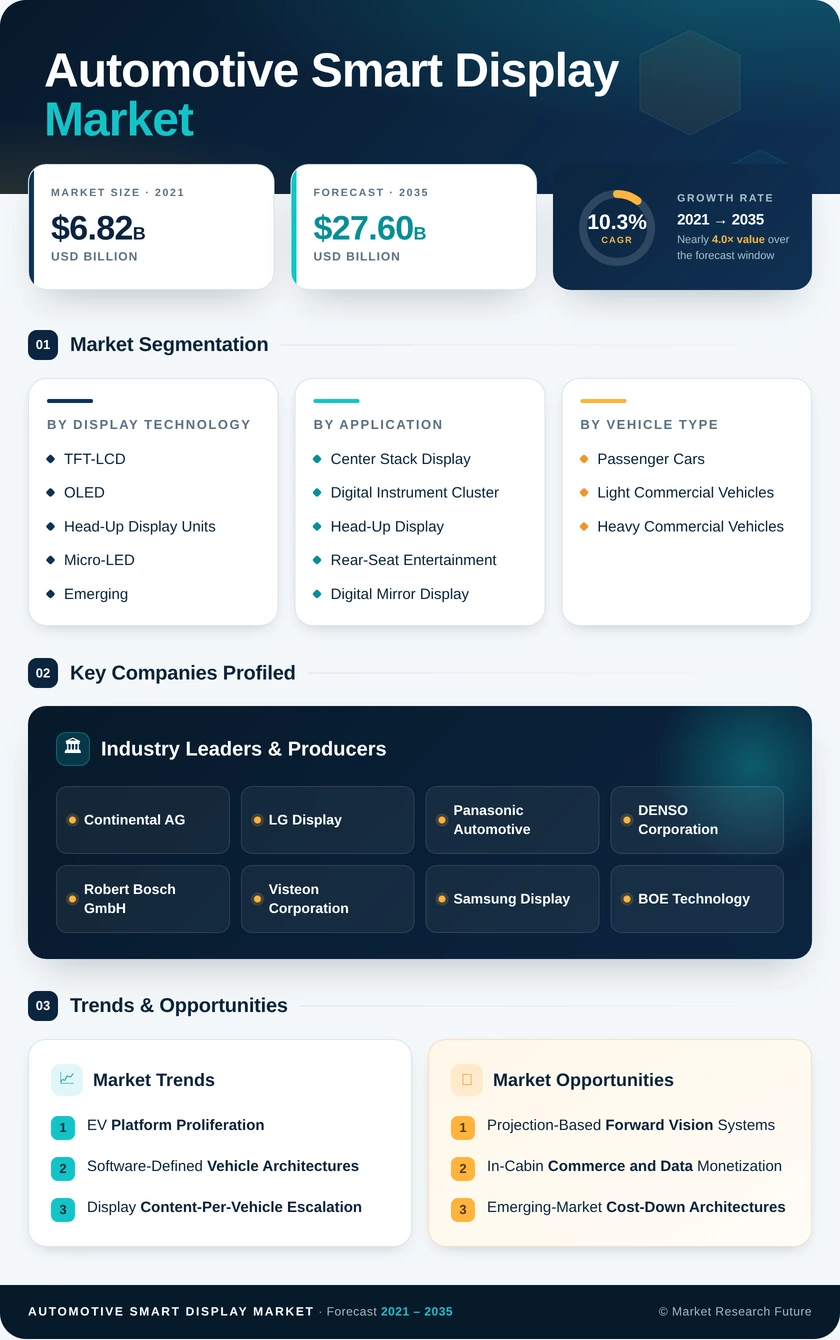
Automotive Smart Display Market (2026 - 2035)

ID: MRFR/AT/2590-HCR 110 Pages Shubham Munde Last Updated: October 16, 2026
Automotive Smart Display Market Research Report By Display Technology (TFT-LCD, OLED, Head-Up Display Units, Micro-LED and Emerging, MiniLED / MicroLED), By Application (Center Stack Display, Digital Instrument Cluster, Head-Up Display, Rear-Seat Entertainment, Digital Mirror Display, By Product Type, Center Stack Display, Instrument Cluster Display, Head-Up Display, Rear-Seat Entertainment Display), By Display Size (Less than or Equal to 5-Inch, 6 to 10 Inch, Above 10 Inches), By Vehicle Type (Passenger Cars, Light Commercial Vehicles, Heavy Commercial Vehicles), By Sales Channel (OEM, Aftermarket) and By Regional (North America, Europe, South America, Asia Pacific, Middle East and Africa) - Forecast to 2035
Automotive Smart Display Market
Market Size
Forecast Period2026-2035
CAGR (2026-2035)10.3%
2025 Market SizeUSD 10.40 Billion
2035 Market SizeUSD 27.6 billion
Key Players
Continental AG
LG Display
Panasonic Automotive
DENSO Corporation
Robert Bosch GmbH
Visteon Corporation
Opportunities
  • Projection-Based Forward Vision Systems
  • In-Cabin Commerce and Data Monetization
  • Emerging-Market Cost-Down Architectures
  1. 1 Market Summary |
    1. 1.1 Study Assumptions & Market Definition |
    2. 1.2 Scope of the Study |
    3. 1.3 Research Methodology
  2. 2 Key Report Takeaways |
    1. 2.1 By Technology |
    2. 2.2 By Sector |
    3. 2.3 By Region
  3. 3 Market Size & Forecast (2021–2035) |
    1. 3.1 Historical Market Size (2021–2024) |
    2. 3.2 Base Year Assessment (2025) |
    3. 3.3 Forecast Market Size (2026–2035) |
    4. 3.4 Year-over-Year Growth Analysis
  4. 4 Driver Impact Analysis |
    1. 4.1 EV Platform Proliferation |
    2. 4.2 Safety and Driver-Monitoring Regulation |
    3. 4.3 Software-Defined Vehicle Architectures |
    4. 4.4 Display Content-Per-Vehicle Escalation
  5. 5 Restraints Impact Analysis |
    1. 5.1 Driver Distraction Regulatory Backlash |
    2. 5.2 Automotive-Grade Qualification Cost |
    3. 5.3 Display Panel Supply Concentration
  6. 6 Opportunities |
    1. 6.1 Projection-Based Forward Vision Systems |
    2. 6.2 In-Cabin Commerce and Data Monetization |
    3. 6.3 Emerging-Market Cost-Down Architectures |
    4. 6.4 Aftermarket and Retrofit Channels |
    5. 6.5 Commercial Fleet Cockpit Standardisation
  7. 7 Regional Market Share & Country-Level Analysis |
    1. 7.1 Asia-Pacific | |
      1. 7.1.1 China | |
      2. 7.1.2 Japan | |
      3. 7.1.3 South Korea | |
      4. 7.1.4 India | |
      5. 7.1.5 Rest of Asia-Pacific |
    2. 7.2 Europe | |
      1. 7.2.1 Germany | |
      2. 7.2.2 France | |
      3. 7.2.3 United Kingdom | |
      4. 7.2.4 Italy | |
      5. 7.2.5 Rest of Europe |
    3. 7.3 North America | |
      1. 7.3.1 United States | |
      2. 7.3.2 Canada | |
      3. 7.3.3 Mexico |
    4. 7.4 South America | |
      1. 7.4.1 Brazil | |
      2. 7.4.2 Argentina | |
      3. 7.4.3 Rest of South America |
    5. 7.5 Middle East & Africa | |
      1. 7.5.1 Saudi Arabia | |
      2. 7.5.2 United Arab Emirates | |
      3. 7.5.3 South Africa | |
      4. 7.5.4 Rest of Middle East & Africa
  8. 8 Future Outlook (2026–2035) |
    1. 8.1 Generative Interfaces and In-Cabin AI |
    2. 8.2 Platform Economics and Feature Licensing |
    3. 8.3 Electrification Supercycle |
    4. 8.4 Circularity and Material Disclosure
  9. 9 Market Segmentation Analysis |
    1. 9.1 By Display Technology | |
      1. 9.1.1 TFT-LCD | |
      2. 9.1.2 OLED | |
      3. 9.1.3 Head-Up Display Units | |
      4. 9.1.4 Micro-LED and Emerging | |
      5. 9.1.5 MiniLED / MicroLED |
    2. 9.2 By Application | |
      1. 9.2.1 Center Stack Display | |
      2. 9.2.2 Digital Instrument Cluster | |
      3. 9.2.3 Head-Up Display | |
      4. 9.2.4 Rear-Seat Entertainment | |
      5. 9.2.5 Digital Mirror Display | |
      6. 9.2.6 By Product Type
    3. 9.2 7 Center Stack Display | |
      1. 9.2.8 Instrument Cluster Display | |
      2. 9.2.9 Head-Up Display | |
      3. 9.2.10 Rear-Seat Entertainment Display |
    4. 9.3 By Display Size | |
      1. 9.3.1 Less than or equal to 5-inch | |
      2. 5.3.2 6 to 10 inch | |
      3. 5.3.3 Above 10 inches |
    5. 9.4 By Vehicle Type | |
      1. 9.4.1 Passenger Cars | |
      2. 9.4.2 Light Commercial Vehicles | |
      3. 9.4.3 Heavy Commercial Vehicles |
    6. 9.5 By Sales Channel | |
      1. 9.5.1 OEM | |
      2. 9.5.2 Aftermarket
  10. 10 Competitive Landscape |
    1. 10.1 Market Concentration Analysis |
    2. 10.2 Competitive Benchmarking Matrix |
    3. 10.3 Company Profiles | |
      1. 10.3.1 Continental AG | |
      2. 10.3.2 LG Display | |
      3. 10.3.3 Panasonic Automotive | |
      4. 10.3.4 DENSO Corporation | |
      5. 10.3.5 Robert Bosch GmbH | |
      6. 10.3.6 Visteon Corporation | |
      7. 10.3.7 Samsung Display | |
      8. 10.3.8 BOE Technology | |
      9. 10.3.9 Nippon Seiki | |
      10. 10.3.10 Desay SV Automotive
  11. 11 Recent News & Developments
  12. 12 Report Scope & Methodology |
    1. 12.1 Study Period & Base Year |
    2. 12.2 Valuation Currency & Assumptions |
    3. 12.3 Abbreviations
  13. 13 Detailed Sources & Citations
  14. 14 Frequently Asked Questions (FAQs)
  15. 15 LIST OF TABLES
  16. 16 LIST OF FIGURES

Segmentation Quick Reference

DimensionSub-SegmentsDominant SegmentFastest Growing Segment
By Display TechnologyTFT-LCD; OLED; Head-Up Display Units; Micro-LED and EmergingTFT-LCDMicro-LED and Emerging
By ApplicationCenter Stack Display; Digital Instrument Cluster; Head-Up Display; Rear-Seat Entertainment; Digital Mirror DisplayCenter Stack DisplayDigital Mirror Display
By Vehicle TypePassenger Cars; Light Commercial Vehicles; Heavy Commercial VehiclesPassenger CarsLight Commercial Vehicles
By Sales ChannelOEM; AftermarketOEMAftermarket
By RegionAsia-Pacific; Europe; North America; South America; Middle East & AfricaAsia-PacificAsia-Pacific


Market Segmentation Overview

By Display Technology

Sub-SegmentKey Trend
TFT-LCDMini-LED backlighting and local dimming extend competitiveness against OLED
OLEDTandem-stack structures address automotive lifetime and burn-in objections
Head-Up Display UnitsOptical engine miniaturisation moves projection into mid-tier vehicles
Micro-LED and EmergingPilot programmes target extreme-brightness and long-life cabin applications


Technology selection increasingly follows vehicle price band rather than model year. Volume programmes stay with enhanced LCD because qualification history and cost predictability matter more than contrast ratio, while flagship interiors adopt emissive technologies to enable curved and wrap-around geometries.

By Application

Sub-SegmentKey Trend
Center Stack DisplayDiagonal sizes converging toward 12–15 inches across mainstream segments
Digital Instrument ClusterBecoming default fitment as electric platforms remove analog gauge relevance
Head-Up DisplayADAS alert surfacing drives specification beyond navigation-only use cases
Rear-Seat EntertainmentRide-hailing and premium chauffeur fitment sustain niche demand
Digital Mirror DisplayRegulatory approval spread and aerodynamic benefit expand attach rates


Application boundaries are blurring. Pillar-to-pillar assemblies increasingly merge cluster and center-stack functions into a single laminated surface, which complicates segment attribution and pushes suppliers toward selling integrated cockpit assemblies rather than discrete screens.

By Vehicle Type

Sub-SegmentKey Trend
Passenger CarsMulti-screen fitment migrating from premium into mid-priced NEV models
Light Commercial VehiclesFleet telematics consolidation onto certified in-cab displays
Heavy Commercial VehiclesDriver comfort and retention investment lifts cabin electronics content


Passenger car demand sets the technology agenda, but commercial vehicles are the faster-improving category on a percentage basis. Fleet operators value display standardisation because it reduces driver training cost across mixed-brand fleets.

By Sales Channel

Sub-SegmentKey Trend
OEMFactory integration with domain controllers limits retrofit substitutability
AftermarketLarge ageing vehicle parc supports retrofit connectivity upgrades


Factory channels will retain overwhelming revenue share throughout the forecast, since deep integration with vehicle networks makes post-sale replacement technically difficult. The aftermarket nonetheless grows faster from a small base, concentrated in vehicles built before infotainment became standard equipment.




Download PDF ×

We do not share your information with anyone. However, we may send you emails based on your report interest from time to time. You may contact us at any time to opt-out.