
Request Free Sample ×

Kindly complete the form below to receive a free sample of this Report

* Please use a valid business email

Leading companies partner with us for data-driven Insights

clients tt-cursor
Hero Background
English
Chinese
French
Japanese
Korean
German
Spanish

Over the Air Update (OTA) Market Size

ID: MRFR/AT/6137-CR
196 Pages
Shubham Munde
January 2020

Automotive Over-The-Air (OTA) Updates Market Research Report Information By Technology (Firmware Over-The-Air [FOTA], Software Over-The-Air [SOTA]), By Application (Electronic Control Unit (ECU), Infotainment, Safety & Security, Telematics Control Unit (TCU), others ) By Propulsion (ICE, Electric Vehicle), By Vehicle Type (Passenger Car, Light Commercial Vehicle, Heavy Commercial Vehicle) - Growth & Industry Forecast to 2035

Share:
Download PDF ×

We do not share your information with anyone. However, we may send you emails based on your report interest from time to time. You may contact us at any time to opt-out.

Automotive Over The Air Updates Market Infographic
Purchase Options

Automotive Over The Air Updates Size

Automotive Over The Air Updates Market Growth Projections and Opportunities

The global automotive Over-the-Air (OTA) updates market is on the cusp of significant growth, driven by the proliferation of connected cars and the rising adoption of electric vehicles. Original Equipment Manufacturers (OEMs) are actively investing in OTA update solutions to provide car owners with seamless and convenient updates, contributing to the expansion of this burgeoning market. Currently, several global technology players have entered the automotive OTA updates arena, intensifying their research and development efforts to deliver secure and cost-effective solutions to car manufacturers. While a few major players dominate the market, the potential for revenue in regions such as Asia-Pacific, the Middle East and Africa, and South America is attracting new entrants, thereby increasing competition.

One of the primary factors fueling the growth of the automotive OTA updates market is the surge in connected cars and the advent of electric vehicles. As vehicles become more integrated with advanced technologies and software-driven functionalities, the need for efficient and streamlined update processes becomes paramount. OTA updates present a solution that allows car manufacturers to deliver updates directly to vehicles without requiring them to visit service centers physically. This not only enhances the user experience but also ensures that vehicles are equipped with the latest software and features, contributing to overall safety and performance.

OEMs are recognizing the importance of investing in robust OTA update solutions to stay competitive and meet the evolving expectations of car owners. The ability to remotely update software, fix bugs, and introduce new features is becoming a key differentiator for car manufacturers. This trend is not only prevalent in traditional automotive markets but is gaining traction globally.

In the current landscape, established technology players are making substantial investments in research and development to offer secure and cost-effective OTA update solutions. These solutions need to address the growing concerns related to cybersecurity, ensuring that the update process is protected from potential threats. The focus is on delivering end-to-end encrypted OTA updates, safeguarding sensitive information and ensuring the integrity of the update process. Additionally, the integration of advanced security measures, including blockchain-based techniques, is being explored to fortify the entire ecosystem against cyberattacks.

While the market is currently dominated by a few major players with a global presence, the attractiveness of emerging regions is drawing the attention of new entrants. The Asia-Pacific, the Middle East and Africa, and South America present untapped opportunities due to the increasing number of connected cars and the rising automotive market in these regions. As a result, new players are expected to enter the market, introducing fresh perspectives and technologies, thereby intensifying competition.

The entry of new players is poised to stimulate innovation and drive advancements in OTA update solutions. This competition is beneficial for the industry as a whole, fostering the development of more efficient, secure, and cost-effective solutions. Car manufacturers will have a wider array of choices, and consumers can expect a more dynamic landscape of OTA update offerings.

In conclusion, the global automotive OTA updates market is poised for significant growth, driven by the proliferation of connected cars, the rise of electric vehicles, and the industry's recognition of the importance of seamless software updates. Established technology players are actively shaping the market with their research and development initiatives, while the potential for revenue in untapped regions is attracting new entrants. This dynamic landscape promises innovation, competition, and ultimately, a more advanced and connected future for the automotive industry.

Automotive Over The Air Updates Market Size Graph
Author
Author Profile
Shubham Munde
Team Lead - Research

Shubham brings over 7 years of expertise in Market Intelligence and Strategic Consulting, with a strong focus on the Automotive, Aerospace, and Defense sectors. Backed by a solid foundation in semiconductors, electronics, and software, he has successfully delivered high-impact syndicated and custom research on a global scale. His core strengths include market sizing, forecasting, competitive intelligence, consumer insights, and supply chain mapping. Widely recognized for developing scalable growth strategies, Shubham empowers clients to navigate complex markets and achieve a lasting competitive edge. Trusted by start-ups and Fortune 500 companies alike, he consistently converts challenges into strategic opportunities that drive sustainable growth.

Leave a Comment

FAQs

What is the projected market valuation of the Automotive Over-The-Air (OTA) Updates Market by 2035?

<p>The projected market valuation is expected to reach 41.86 USD Billion by 2035.</p>

What was the market valuation of the Automotive Over-The-Air (OTA) Updates Market in 2024?

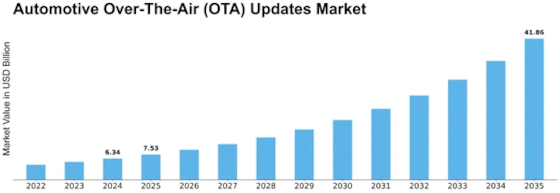
<p>The market valuation was 6.34 USD Billion in 2024.</p>

What is the expected CAGR for the Automotive Over-The-Air (OTA) Updates Market during the forecast period 2025 - 2035?

<p>The expected CAGR is 18.72% during the forecast period 2025 - 2035.</p>

Which companies are considered key players in the Automotive Over-The-Air (OTA) Updates Market?

<p>Key players include Tesla, Ford, General Motors, BMW, Volkswagen, Toyota, Hyundai, Daimler, and Nissan.</p>

What are the two main technology segments in the Automotive Over-The-Air (OTA) Updates Market?

<p>The two main technology segments are Firmware Over-The-Air (FOTA) and Software Over-The-Air (SOTA), with valuations of 16.75 USD Billion and 25.11 USD Billion respectively by 2035.</p>

How does the market valuation for Electric Vehicles compare to Internal Combustion Engine vehicles in the OTA Updates Market?

<p>By 2035, the market valuation for Electric Vehicles is projected to be 26.86 USD Billion, compared to 15.0 USD Billion for Internal Combustion Engine vehicles.</p>

What application segment is expected to have the highest valuation in the Automotive Over-The-Air (OTA) Updates Market by 2035?

The Electronic Control Unit (ECU) application segment is expected to reach a valuation of 12.5 USD Billion by 2035.

What is the projected valuation for the Passenger Car segment in the Automotive Over-The-Air (OTA) Updates Market by 2035?

The Passenger Car segment is projected to reach a valuation of 16.0 USD Billion by 2035.

What is the expected valuation for the Safety & Security application segment by 2035?

The Safety &amp; Security application segment is expected to reach a valuation of 6.5 USD Billion by 2035.

How does the market for Heavy Commercial Vehicles compare to Light Commercial Vehicles in the OTA Updates Market?

By 2035, the Heavy Commercial Vehicle segment is projected to reach 13.86 USD Billion, while the Light Commercial Vehicle segment is expected to reach 12.0 USD Billion.

Market Summary

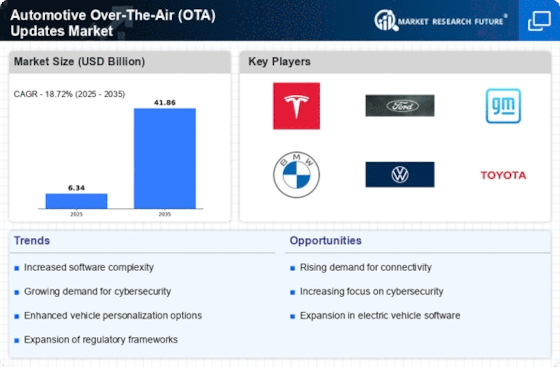
As per Market Research Future analysis, the Automotive Over-The-Air (OTA) Updates Market was estimated at 6.34 USD Billion in 2024. The OTA updates industry is projected to grow from 7.526 USD Billion in 2025 to 41.86 USD Billion by 2035, exhibiting a compound annual growth rate (CAGR) of 18.7% during the forecast period 2025 - 2035

Key Market Trends & Highlights

The Automotive Over-The-Air (OTA) Updates Market is poised for substantial growth driven by technological advancements and evolving consumer preferences.

  • The market experiences increased vehicle connectivity, enhancing the overall driving experience. A heightened focus on cybersecurity is evident as manufacturers prioritize data protection and user privacy. Integration of AI and machine learning technologies is transforming OTA updates, enabling more efficient and personalized services. Rising demand for software updates and consumer preference for enhanced features are key drivers propelling market expansion in North America and Asia-Pacific.

Market Size & Forecast

2024 Market Size 6.34 (USD Billion)
2035 Market Size 41.86 (USD Billion)
CAGR (2025 - 2035) 18.72%
Largest Regional Market Share in 2024 North America

Major Players

Tesla (US), Ford (US), General Motors (US), BMW (DE), Volkswagen (DE), Toyota (JP), Hyundai (KR), Daimler (DE), Nissan (JP)

Market Trends

The Automotive Over-The-Air (OTA) Updates Market is currently experiencing a transformative phase, driven by the increasing demand for enhanced vehicle connectivity and software management. As vehicles become more sophisticated, the necessity for timely updates and improvements has become paramount. This market appears to be evolving rapidly, with manufacturers recognizing the potential of OTA updates to enhance user experience, improve safety features, and maintain competitive advantage. The integration of advanced technologies, such as artificial intelligence and machine learning, seems to be further propelling this sector forward, allowing for more efficient data management and personalized services. Moreover, the growing emphasis on sustainability and reducing carbon footprints is influencing the Automotive Over-The-Air (OTA) Updates Market. Automakers are likely to leverage OTA capabilities to optimize vehicle performance and reduce emissions through software enhancements. This trend indicates a shift towards a more sustainable automotive ecosystem, where software updates play a crucial role in vehicle efficiency. As the market continues to mature, it may witness increased collaboration between automotive manufacturers and technology firms, fostering innovation and expanding the scope of OTA applications in the industry.

Increased Vehicle Connectivity

The Automotive Over-The-Air (OTA) Updates Market is witnessing a surge in demand for connected vehicles. This trend indicates that consumers are increasingly seeking vehicles equipped with advanced connectivity features, allowing for seamless software updates and enhanced user experiences.

Focus on Cybersecurity

As the reliance on OTA updates grows, so does the emphasis on cybersecurity measures. The Automotive Over-The-Air (OTA) Updates Market appears to be prioritizing the protection of vehicle software from potential cyber threats, ensuring consumer trust and safety.

Integration of AI and Machine Learning

The incorporation of artificial intelligence and machine learning technologies into the Automotive Over-The-Air (OTA) Updates Market is becoming more prevalent. This trend suggests that automakers are leveraging these technologies to enhance the efficiency and effectiveness of software updates.

Automotive Over The Air Updates Market Market Drivers

Rising Demand for Software Updates

The Automotive Over-The-Air (OTA) Updates Market experiences a notable surge in demand for software updates as vehicles become increasingly reliant on advanced technologies. Consumers expect their vehicles to receive regular updates that enhance performance, fix bugs, and introduce new features. This trend is driven by the growing integration of infotainment systems, navigation, and driver assistance technologies. According to industry estimates, the OTA updates market is projected to reach a valuation of approximately 30 billion dollars by 2026, reflecting a compound annual growth rate of around 20%. This demand for continuous improvement in vehicle software is reshaping the Automotive Over-The-Air (OTA) Updates Market, compelling manufacturers to adopt OTA capabilities to meet consumer expectations.

Cost Efficiency in Vehicle Maintenance

Cost efficiency emerges as a critical driver in the Automotive Over-The-Air (OTA) Updates Market. By enabling manufacturers to deploy updates remotely, OTA technology significantly reduces the need for physical service visits, which can be both time-consuming and expensive. This shift not only lowers operational costs for manufacturers but also enhances customer satisfaction by minimizing vehicle downtime. Reports indicate that OTA updates can save manufacturers up to 50% in service costs compared to traditional methods. As a result, the Automotive Over-The-Air (OTA) Updates Market is witnessing a growing inclination towards adopting OTA solutions, as they provide a more economical approach to vehicle maintenance and software management.

Consumer Preference for Enhanced Features

Consumer preference for enhanced features significantly influences the Automotive Over-The-Air (OTA) Updates Market. As technology advances, consumers increasingly seek vehicles equipped with the latest functionalities, such as improved navigation systems, entertainment options, and autonomous driving capabilities. OTA updates allow manufacturers to deliver these enhancements seamlessly, ensuring that vehicles remain competitive in a rapidly evolving market. Surveys indicate that a substantial percentage of consumers prioritize vehicles that can receive regular updates, reflecting a shift in purchasing behavior. Consequently, the Automotive Over-The-Air (OTA) Updates Market is adapting to meet these consumer demands, fostering innovation and continuous improvement in vehicle offerings.

Regulatory Compliance and Safety Standards

Regulatory compliance plays a pivotal role in shaping the Automotive Over-The-Air (OTA) Updates Market. Governments worldwide are increasingly mandating that automotive manufacturers adhere to stringent safety and emissions standards. OTA updates facilitate timely compliance with these regulations by allowing manufacturers to implement necessary changes without requiring physical recalls. This capability is particularly crucial in addressing software-related safety issues, which can be resolved swiftly through OTA updates. As regulatory frameworks evolve, the Automotive Over-The-Air (OTA) Updates Market is likely to expand, driven by the need for manufacturers to maintain compliance and ensure the safety of their vehicles.

Integration of Connected Vehicle Ecosystems

The integration of connected vehicle ecosystems serves as a vital driver for the Automotive Over-The-Air (OTA) Updates Market. As vehicles become more interconnected with smart devices and infrastructure, the need for seamless software updates becomes paramount. This interconnectedness enhances the overall driving experience, allowing for real-time data exchange and improved vehicle performance. Industry analysts project that the connected vehicle market will grow substantially, with OTA updates playing a crucial role in maintaining the functionality and security of these systems. The Automotive Over-The-Air (OTA) Updates Market is thus positioned to benefit from this trend, as manufacturers seek to leverage OTA technology to enhance connectivity and user experience.

Market Segment Insights

By Technology: Firmware Over-The-Air (FOTA) (Largest) vs. Software Over-The-Air (SOTA) (Fastest-Growing)

In the Automotive Over-The-Air (OTA) Updates Market, Firmware Over-The-Air (FOTA) holds the largest market share among the segment values. This technology is pivotal in enhancing vehicle performance and security by allowing manufacturers to deploy firmware updates seamlessly. On the other hand, Software Over-The-Air (SOTA) is rapidly gaining ground, driven by the increasing demand for <a href="https://www.marketresearchfuture.com/reports/software-market-11924">software </a>enhancements and customer-specific applications. As vehicles become more connected, the ability to deliver these updates efficiently is crucial for manufacturers looking to enhance customer satisfaction and loyalty.

Technology: FOTA (Dominant) vs. SOTA (Emerging)

Firmware Over-The-Air (FOTA) represents the dominant segment within the Automotive OTA Updates Market, primarily characterized by its ability to address core vehicle functionalities and maintain system integrity through regular updates. FOTA is essential for ensuring that the vehicle's operating systems and embedded software remain current and secure. Meanwhile, Software Over-The-Air (SOTA) is emerging rapidly in this sector, focused on the delivery of applications and features that enhance user experience. The shift toward SOTA is fueled by consumer expectations for customizable software features and the increasing integration of infotainment systems, making vehicles more technologically equipped and user-friendly.

By Application: Infotainment (Largest) vs. Electronic Control Unit (Fastest-Growing)

In the Automotive Over-The-Air (OTA) Updates Market, the application segment is characterized by a diverse range of contributions from various segment values. Infotainment systems stand out as the largest segment, thanks to the increasing demand for enhanced in-car entertainment and connectivity features. Following closely, the Electronic Control Unit (ECU) plays a critical role in managing vehicle functions, contributing significantly to the overall market share. Other segments such as Safety &amp; Security and Telematics Control Unit (TCU) also hold their respective shares, creating a balanced distribution across the application spectrum that supports the growth of OTA updates. Looking at growth trends, the Electronic Control Unit (ECU) segment is emerging as the fastest-growing segment driven by advancements in automotive technology and the rising complexity of vehicle systems. The push for connected and autonomous vehicles is propelling the demand for ECU updates, which enhances vehicle performance and features in real time. Additionally, increasing consumer expectations for digital features within vehicles are contributing to rapid advancements in infotainment systems, which continue to evolve as crucial platforms for OTA updates. Consequently, the market dynamics reflect a robust evolving landscape aiming to meet consumer demand and technological advancements.

Infotainment (Dominant) vs. Safety &amp; Security (Emerging)

Infotainment systems have established themselves as the dominant application segment within the Automotive Over-The-Air (OTA) Updates Market, primarily due to their ability to deliver a vast array of multimedia features and connectivity options that appeal to a tech-savvy consumer base. As automakers increasingly embed advanced infotainment systems that allow for seamless integration with smartphones, improving user experience, the need for regular OTA updates has surged. Conversely, the Safety &amp; Security segment is regarded as an emerging force, gaining traction as vehicles become more connected. With the growing emphasis on vehicle safety and cybersecurity, manufacturers are prioritizing OTA updates for safety-critical systems to address vulnerabilities and enhance security measures, indicating a dynamic shift towards integrating safety features that can be updated remotely.

By Propulsion: Electric Vehicles (Largest) vs. ICE (Fastest-Growing)

In the Automotive Over-The-Air (OTA) Updates Market, the share distribution indicates a significant lead for Electric Vehicles (EVs). This segment has captured a substantial portion of the market, thanks to the rapid adoption of EV technology by manufacturers and consumers alike. Meanwhile, Internal Combustion Engine (ICE) vehicles, while traditionally dominant, are currently experiencing a resurgence fueled by advancements in software updates that enhance vehicle performance and compliance with evolving regulations. The growth trends within this segment reveal a robust shift towards EVs, driven by the increasing consumer demand for sustainable transportation solutions and government incentives promoting electric mobility. Simultaneously, ICE vehicles are leveraging OTA updates to remain competitive, improving functionality and extending automotive lifespan. This dual evolution showcases a transforming landscape in the propulsion segment of the automotive sector, positioning both EVs and ICE for significant advancements in the coming years.

Propulsion: Electric Vehicles (Dominant) vs. ICE (Emerging)

Electric Vehicles (EVs) are establishing themselves as the dominant force in the Automotive Over-The-Air (OTA) Updates Market, largely due to their inherent capability for software-driven enhancements and updates that optimize performance, safety, and user experience. Their reliance on advanced technology for functionalities like battery management and autonomous features enables seamless OTA updates, appealing to a tech-savvy consumer base. Conversely, Internal Combustion Engine (ICE) vehicles, traditionally seen as the mainstay of the automotive industry, are emerging with a renewed focus on OTA capabilities. Manufacturers are increasingly looking to software updates to address emissions, regulatory compliance, and overall vehicle performance. This shift illustrates the importance of OTA technology in maintaining relevance in a rapidly evolving market, enabling ICE vehicles to improve their appeal in an environment where EVs are becoming the standard.

By Vehicle Type: Passenger Car (Largest) vs. Light Commercial Vehicle (Fastest-Growing)

In the Automotive Over-The-Air (OTA) Updates Market, the market share distribution is heavily skewed towards passenger cars, dominating the segment with a substantial percentage of total OTA update implementations. This can be attributed to the growing number of connected vehicles and consumer demand for enhanced infotainment systems and safety features, which are prevalent in passenger vehicles. Light commercial vehicles, while currently smaller in market share compared to passenger cars, are experiencing rapid growth due to increasing digitalization and the need for fleet management solutions that enhance operational efficiency.

Passenger Car (Dominant) vs. Light Commercial Vehicle (Emerging)

Passenger cars are the dominant segment in the Automotive OTA Updates Market, primarily due to their high connectivity features and the necessity for regular software updates to enhance user experience and vehicle performance. On the other hand, light commercial vehicles are emerging as a significant player, driven by the demand for improved telematics and fleet management technologies. These vehicles require OTA updates to adapt to operational demands and regulatory compliance, paving the way for advancements in logistics and service delivery. The growing emphasis on efficiency and performance in light commercial vehicles positions them as a vital area for OTA development, ensuring seamless operations in a highly competitive environment.

Get more detailed insights about Automotive Over-The-Air (OTA) Updates Market Research Report - Global Forecast till 2035

Regional Insights

North America : Innovation and Leadership Hub

North America is the largest market for Automotive Over-The-Air (OTA) updates, holding approximately 45% of the global market share. The region's growth is driven by the increasing demand for connected vehicles, advancements in automotive technology, and supportive regulatory frameworks. The U.S. government has been proactive in promoting digital innovation, which further accelerates the adoption of OTA updates. Key players like Tesla, Ford, and General Motors are leading the charge in this market, leveraging their technological expertise to enhance vehicle performance and customer experience. The competitive landscape is characterized by rapid innovation and strategic partnerships, with companies focusing on improving cybersecurity measures and user interfaces to attract consumers. The presence of major automotive manufacturers solidifies North America's position as a leader in the OTA updates market.

Europe : Regulatory-Driven Market Growth

Europe is the second-largest market for Automotive Over-The-Air (OTA) updates, accounting for approximately 30% of the global market share. The region's growth is significantly influenced by stringent regulations aimed at enhancing vehicle safety and emissions standards. The European Union's commitment to digital transformation in the automotive sector has catalyzed the adoption of OTA technologies, making it a key player in the global market. Leading countries such as Germany, France, and the UK are at the forefront of this trend, with major automotive manufacturers like BMW, Volkswagen, and Daimler investing heavily in OTA capabilities. The competitive landscape is marked by a focus on sustainability and innovation, as companies strive to meet regulatory requirements while enhancing customer satisfaction. The presence of established automotive brands ensures a robust market environment for OTA updates.

Asia-Pacific : Emerging Market Potential

Asia-Pacific is witnessing rapid growth in the Automotive Over-The-Air (OTA) updates market, holding approximately 20% of the global market share. The region's expansion is driven by increasing vehicle production, rising consumer demand for connected features, and government initiatives promoting smart mobility. Countries like China and Japan are leading this growth, with significant investments in automotive technology and infrastructure. China, in particular, is a major player, with companies like Toyota and Nissan focusing on OTA capabilities to enhance user experience and vehicle performance. The competitive landscape is evolving, with both established manufacturers and new entrants vying for market share. The region's focus on innovation and technology adoption positions it as a key player in The Automotive Over-The-Air (OTA) Updates, with a promising outlook for future growth.

Middle East and Africa : Untapped Market Opportunities

The Middle East and Africa region is gradually emerging in the Automotive Over-The-Air (OTA) updates market, currently holding about 5% of the global market share. The growth in this region is primarily driven by increasing vehicle ownership, urbanization, and a growing interest in connected vehicle technologies. Governments are beginning to recognize the importance of digital transformation in the automotive sector, which is expected to catalyze further growth in OTA adoption. Countries like South Africa and the UAE are leading the charge, with local automotive manufacturers exploring OTA capabilities to enhance vehicle performance and customer satisfaction. The competitive landscape is still developing, with opportunities for both local and international players to establish a foothold. As infrastructure improves and consumer awareness increases, the region is poised for significant growth in the OTA updates market.

Key Players and Competitive Insights

Leading market players are investing heavily in research and development to expand their product lines, which will help the automotive over-the-air (OTA) updates to the market grow even more. Market participants are also undertaking various strategic activities to expand their global footprint, with important market developments including new product launches, contractual agreements, mergers and acquisitions, higher investments, and collaboration with other organizations. The Automotive over-the-air (OTA) updates industry must offer cost-effective items to expand and survive in a more competitive and rising market climate. Manufacturing locally to minimize operational costs is one of the key business tactics manufacturers use in the global automotive over-the-air (OTA) updates industry to benefit clients and increase the market sector. The automotive over-the-air (OTA) updates industry has offered the military some of the most significant advantages in recent years. Major players in the automotive over-the-air (OTA) updates to market, including Robert Bosch GmbH, NXP Semiconductors N.V, Verizon Communications Inc., Continental AG, Infineon Technologies AG, Qualcomm Incorporated, Intel Corporation, HARMAN International, Airbiquity Inc, Aptiv, HERE Technologies, BlackBerry QNX Software Systems Limited, Garmin Ltd., Intellias Ltd., and others, are attempting to increase market demand by investing in research and development operations. Qualcomm is an American multinational corporation headquartered in San Diego, California, and incorporated in Delaware. It creates semiconductors, software, and services related to wireless technology. It owns patents critical to the 5G, 4G, CDMA2000, TD-SCDMA, and WCDMA mobile communications standards. Qualcomm Technologies Inc, a subsidiary of Qualcomm Inc, had announced the expansion of 5G test networks. The expansion of networks included Over-the-air configuration for sub-6 GHz bands and millimeter waves. Verizon Communications Inc., commonly known as Verizon, is an American multinational telecommunications conglomerate and a corporate component of the Dow Jones Industrial Average. The company is headquartered at 1095 Avenue of the Americas in Midtown Manhattan, New York City, but is incorporated in Delaware. Verizon had launched Hum, the first 4G LTE-connected solution for cars that came with built-in Google Assistant.

Key Companies in the Automotive Over The Air Updates Market include

Industry Developments

NXP Semiconductors N.V.: January 2024: NXP Semiconductors was recognized as a major player in the automotive OTA updates market, reflecting its significant role in the industry.

Verizon Communications Inc.: January 2024: Verizon Communications Inc. was acknowledged as a key participant in the automotive OTA updates market, highlighting its involvement in advancing OTA technologies.

Infineon Technologies AG: January 2024: Infineon Technologies partnered with Aurora Labs to enhance automotive safety through AI-driven predictive maintenance OTA solutions. This collaboration combines Aurora Labs' Line-of-Code Intelligence™ technology with Infineon's AURIX™ TC4x microcontrollers to improve the reliability and safety of critical vehicle components.

Robert Bosch GmbH: May 2021: Bosch introduced the Bosch Software Update Service, an OTA platform designed to provide secure and scalable software updates to vehicles and other connected devices.

Continental AG: April 2021: Continental launched Continental OTA Plus, a solution aimed at enabling secure and efficient software updates for vehicles and other connected devices.

February 2019: Qualcomm Technologies Inc, a subsidiary of Qualcomm Inc, announced the expansion of 5G test networks. The expansion of networks included Over-the-air configuration for sub-6 GHz bands and millimeter waves.

January 2019: Verizon launched Hum, the first 4G LTE-connected solution for cars that came with built-in Google Assistant.

Future Outlook

Automotive Over The Air Updates Market Future Outlook

The Automotive Over-The-Air (OTA) Updates Market is projected to grow at an 18.72% CAGR from 2025 to 2035, driven by increasing vehicle connectivity, demand for software enhancements, and regulatory compliance.

New opportunities lie in:

  • <p>Development of advanced cybersecurity solutions for OTA updates. Partnerships with automotive manufacturers for integrated OTA platforms. Expansion into emerging markets with tailored OTA services.</p>

By 2035, the market is expected to be robust, reflecting substantial growth and innovation.

Market Segmentation

Automotive Over The Air Updates Market Propulsion Outlook

  • ICE
  • Electric Vehicle

Automotive Over The Air Updates Market Technology Outlook

  • Firmware Over-The-Air (FOTA)
  • Software Over-The-Air (SOTA)

Automotive Over The Air Updates Market Application Outlook

  • Electronic Control Unit (ECU)
  • Infotainment
  • Safety & Security
  • Telematics Control Unit (TCU)
  • others

Automotive Over The Air Updates Market Vehicle Type Outlook

  • Passenger Car
  • Light Commercial Vehicle
  • Heavy Commercial Vehicle

Report Scope

MARKET SIZE 2024 6.34(USD Billion)
MARKET SIZE 2025 7.526(USD Billion)
MARKET SIZE 2035 41.86(USD Billion)
COMPOUND ANNUAL GROWTH RATE (CAGR) 18.72% (2025 - 2035)
REPORT COVERAGE Revenue Forecast, Competitive Landscape, Growth Factors, and Trends
BASE YEAR 2024
Market Forecast Period 2025 - 2035
Historical Data 2019 - 2024
Market Forecast Units USD Billion
Key Companies Profiled Tesla (US), Ford (US), General Motors (US), BMW (DE), Volkswagen (DE), Toyota (JP), Hyundai (KR), Daimler (DE), Nissan (JP)
Segments Covered Technology, Application, Propulsion, Vehicle Type
Key Market Opportunities Integration of advanced cybersecurity measures enhances consumer trust in Automotive Over-The-Air (OTA) Updates Market.
Key Market Dynamics Rising demand for enhanced vehicle connectivity drives competition in the Automotive Over-The-Air Updates Market.
Countries Covered North America, Europe, APAC, South America, MEA

FAQs

What is the projected market valuation of the Automotive Over-The-Air (OTA) Updates Market by 2035?

<p>The projected market valuation is expected to reach 41.86 USD Billion by 2035.</p>

What was the market valuation of the Automotive Over-The-Air (OTA) Updates Market in 2024?

<p>The market valuation was 6.34 USD Billion in 2024.</p>

What is the expected CAGR for the Automotive Over-The-Air (OTA) Updates Market during the forecast period 2025 - 2035?

<p>The expected CAGR is 18.72% during the forecast period 2025 - 2035.</p>

Which companies are considered key players in the Automotive Over-The-Air (OTA) Updates Market?

<p>Key players include Tesla, Ford, General Motors, BMW, Volkswagen, Toyota, Hyundai, Daimler, and Nissan.</p>

What are the two main technology segments in the Automotive Over-The-Air (OTA) Updates Market?

<p>The two main technology segments are Firmware Over-The-Air (FOTA) and Software Over-The-Air (SOTA), with valuations of 16.75 USD Billion and 25.11 USD Billion respectively by 2035.</p>

How does the market valuation for Electric Vehicles compare to Internal Combustion Engine vehicles in the OTA Updates Market?

<p>By 2035, the market valuation for Electric Vehicles is projected to be 26.86 USD Billion, compared to 15.0 USD Billion for Internal Combustion Engine vehicles.</p>

What application segment is expected to have the highest valuation in the Automotive Over-The-Air (OTA) Updates Market by 2035?

The Electronic Control Unit (ECU) application segment is expected to reach a valuation of 12.5 USD Billion by 2035.

What is the projected valuation for the Passenger Car segment in the Automotive Over-The-Air (OTA) Updates Market by 2035?

The Passenger Car segment is projected to reach a valuation of 16.0 USD Billion by 2035.

What is the expected valuation for the Safety & Security application segment by 2035?

The Safety &amp; Security application segment is expected to reach a valuation of 6.5 USD Billion by 2035.

How does the market for Heavy Commercial Vehicles compare to Light Commercial Vehicles in the OTA Updates Market?

By 2035, the Heavy Commercial Vehicle segment is projected to reach 13.86 USD Billion, while the Light Commercial Vehicle segment is expected to reach 12.0 USD Billion.

  1. SECTION I: EXECUTIVE SUMMARY AND KEY HIGHLIGHTS
    1. | 1.1 EXECUTIVE SUMMARY
    2. | | 1.1.1 Market Overview
    3. | | 1.1.2 Key Findings
    4. | | 1.1.3 Market Segmentation
    5. | | 1.1.4 Competitive Landscape
    6. | | 1.1.5 Challenges and Opportunities
    7. | | 1.1.6 Future Outlook
  2. SECTION II: SCOPING, METHODOLOGY AND MARKET STRUCTURE
    1. | 2.1 MARKET INTRODUCTION
    2. | | 2.1.1 Definition
    3. | | 2.1.2 Scope of the study
    4. | | | 2.1.2.1 Research Objective
    5. | | | 2.1.2.2 Assumption
    6. | | | 2.1.2.3 Limitations
    7. | 2.2 RESEARCH METHODOLOGY
    8. | | 2.2.1 Overview
    9. | | 2.2.2 Data Mining
    10. | | 2.2.3 Secondary Research
    11. | | 2.2.4 Primary Research
    12. | | | 2.2.4.1 Primary Interviews and Information Gathering Process
    13. | | | 2.2.4.2 Breakdown of Primary Respondents
    14. | | 2.2.5 Forecasting Model
    15. | | 2.2.6 Market Size Estimation
    16. | | | 2.2.6.1 Bottom-Up Approach
    17. | | | 2.2.6.2 Top-Down Approach
    18. | | 2.2.7 Data Triangulation
    19. | | 2.2.8 Validation
  3. SECTION III: QUALITATIVE ANALYSIS
    1. | 3.1 MARKET DYNAMICS
    2. | | 3.1.1 Overview
    3. | | 3.1.2 Drivers
    4. | | 3.1.3 Restraints
    5. | | 3.1.4 Opportunities
    6. | 3.2 MARKET FACTOR ANALYSIS
    7. | | 3.2.1 Value chain Analysis
    8. | | 3.2.2 Porter's Five Forces Analysis
    9. | | | 3.2.2.1 Bargaining Power of Suppliers
    10. | | | 3.2.2.2 Bargaining Power of Buyers
    11. | | | 3.2.2.3 Threat of New Entrants
    12. | | | 3.2.2.4 Threat of Substitutes
    13. | | | 3.2.2.5 Intensity of Rivalry
    14. | | 3.2.3 COVID-19 Impact Analysis
    15. | | | 3.2.3.1 Market Impact Analysis
    16. | | | 3.2.3.2 Regional Impact
    17. | | | 3.2.3.3 Opportunity and Threat Analysis
  4. SECTION IV: QUANTITATIVE ANALYSIS
    1. | 4.1 Automobile, BY Technology (USD Billion)
    2. | | 4.1.1 Firmware Over-The-Air (FOTA)
    3. | | 4.1.2 Software Over-The-Air (SOTA)
    4. | 4.2 Automobile, BY Application (USD Billion)
    5. | | 4.2.1 Electronic Control Unit (ECU)
    6. | | 4.2.2 Infotainment
    7. | | 4.2.3 Safety & Security
    8. | | 4.2.4 Telematics Control Unit (TCU)
    9. | | 4.2.5 others
    10. | 4.3 Automobile, BY Propulsion (USD Billion)
    11. | | 4.3.1 ICE
    12. | | 4.3.2 Electric Vehicle
    13. | 4.4 Automobile, BY Vehicle Type (USD Billion)
    14. | | 4.4.1 Passenger Car
    15. | | 4.4.2 Light Commercial Vehicle
    16. | | 4.4.3 Heavy Commercial Vehicle
    17. | 4.5 Automobile, BY Region (USD Billion)
    18. | | 4.5.1 North America
    19. | | | 4.5.1.1 US
    20. | | | 4.5.1.2 Canada
    21. | | 4.5.2 Europe
    22. | | | 4.5.2.1 Germany
    23. | | | 4.5.2.2 UK
    24. | | | 4.5.2.3 France
    25. | | | 4.5.2.4 Russia
    26. | | | 4.5.2.5 Italy
    27. | | | 4.5.2.6 Spain
    28. | | | 4.5.2.7 Rest of Europe
    29. | | 4.5.3 APAC
    30. | | | 4.5.3.1 China
    31. | | | 4.5.3.2 India
    32. | | | 4.5.3.3 Japan
    33. | | | 4.5.3.4 South Korea
    34. | | | 4.5.3.5 Malaysia
    35. | | | 4.5.3.6 Thailand
    36. | | | 4.5.3.7 Indonesia
    37. | | | 4.5.3.8 Rest of APAC
    38. | | 4.5.4 South America
    39. | | | 4.5.4.1 Brazil
    40. | | | 4.5.4.2 Mexico
    41. | | | 4.5.4.3 Argentina
    42. | | | 4.5.4.4 Rest of South America
    43. | | 4.5.5 MEA
    44. | | | 4.5.5.1 GCC Countries
    45. | | | 4.5.5.2 South Africa
    46. | | | 4.5.5.3 Rest of MEA
  5. SECTION V: COMPETITIVE ANALYSIS
    1. | 5.1 Competitive Landscape
    2. | | 5.1.1 Overview
    3. | | 5.1.2 Competitive Analysis
    4. | | 5.1.3 Market share Analysis
    5. | | 5.1.4 Major Growth Strategy in the Automobile
    6. | | 5.1.5 Competitive Benchmarking
    7. | | 5.1.6 Leading Players in Terms of Number of Developments in the Automobile
    8. | | 5.1.7 Key developments and growth strategies
    9. | | | 5.1.7.1 New Product Launch/Service Deployment
    10. | | | 5.1.7.2 Merger & Acquisitions
    11. | | | 5.1.7.3 Joint Ventures
    12. | | 5.1.8 Major Players Financial Matrix
    13. | | | 5.1.8.1 Sales and Operating Income
    14. | | | 5.1.8.2 Major Players R&D Expenditure. 2023
    15. | 5.2 Company Profiles
    16. | | 5.2.1 Tesla (US)
    17. | | | 5.2.1.1 Financial Overview
    18. | | | 5.2.1.2 Products Offered
    19. | | | 5.2.1.3 Key Developments
    20. | | | 5.2.1.4 SWOT Analysis
    21. | | | 5.2.1.5 Key Strategies
    22. | | 5.2.2 Ford (US)
    23. | | | 5.2.2.1 Financial Overview
    24. | | | 5.2.2.2 Products Offered
    25. | | | 5.2.2.3 Key Developments
    26. | | | 5.2.2.4 SWOT Analysis
    27. | | | 5.2.2.5 Key Strategies
    28. | | 5.2.3 General Motors (US)
    29. | | | 5.2.3.1 Financial Overview
    30. | | | 5.2.3.2 Products Offered
    31. | | | 5.2.3.3 Key Developments
    32. | | | 5.2.3.4 SWOT Analysis
    33. | | | 5.2.3.5 Key Strategies
    34. | | 5.2.4 BMW (DE)
    35. | | | 5.2.4.1 Financial Overview
    36. | | | 5.2.4.2 Products Offered
    37. | | | 5.2.4.3 Key Developments
    38. | | | 5.2.4.4 SWOT Analysis
    39. | | | 5.2.4.5 Key Strategies
    40. | | 5.2.5 Volkswagen (DE)
    41. | | | 5.2.5.1 Financial Overview
    42. | | | 5.2.5.2 Products Offered
    43. | | | 5.2.5.3 Key Developments
    44. | | | 5.2.5.4 SWOT Analysis
    45. | | | 5.2.5.5 Key Strategies
    46. | | 5.2.6 Toyota (JP)
    47. | | | 5.2.6.1 Financial Overview
    48. | | | 5.2.6.2 Products Offered
    49. | | | 5.2.6.3 Key Developments
    50. | | | 5.2.6.4 SWOT Analysis
    51. | | | 5.2.6.5 Key Strategies
    52. | | 5.2.7 Hyundai (KR)
    53. | | | 5.2.7.1 Financial Overview
    54. | | | 5.2.7.2 Products Offered
    55. | | | 5.2.7.3 Key Developments
    56. | | | 5.2.7.4 SWOT Analysis
    57. | | | 5.2.7.5 Key Strategies
    58. | | 5.2.8 Daimler (DE)
    59. | | | 5.2.8.1 Financial Overview
    60. | | | 5.2.8.2 Products Offered
    61. | | | 5.2.8.3 Key Developments
    62. | | | 5.2.8.4 SWOT Analysis
    63. | | | 5.2.8.5 Key Strategies
    64. | | 5.2.9 Nissan (JP)
    65. | | | 5.2.9.1 Financial Overview
    66. | | | 5.2.9.2 Products Offered
    67. | | | 5.2.9.3 Key Developments
    68. | | | 5.2.9.4 SWOT Analysis
    69. | | | 5.2.9.5 Key Strategies
    70. | 5.3 Appendix
    71. | | 5.3.1 References
    72. | | 5.3.2 Related Reports
  6. LIST OF FIGURES
    1. | 6.1 MARKET SYNOPSIS
    2. | 6.2 NORTH AMERICA MARKET ANALYSIS
    3. | 6.3 US MARKET ANALYSIS BY TECHNOLOGY
    4. | 6.4 US MARKET ANALYSIS BY APPLICATION
    5. | 6.5 US MARKET ANALYSIS BY PROPULSION
    6. | 6.6 US MARKET ANALYSIS BY VEHICLE TYPE
    7. | 6.7 CANADA MARKET ANALYSIS BY TECHNOLOGY
    8. | 6.8 CANADA MARKET ANALYSIS BY APPLICATION
    9. | 6.9 CANADA MARKET ANALYSIS BY PROPULSION
    10. | 6.10 CANADA MARKET ANALYSIS BY VEHICLE TYPE
    11. | 6.11 EUROPE MARKET ANALYSIS
    12. | 6.12 GERMANY MARKET ANALYSIS BY TECHNOLOGY
    13. | 6.13 GERMANY MARKET ANALYSIS BY APPLICATION
    14. | 6.14 GERMANY MARKET ANALYSIS BY PROPULSION
    15. | 6.15 GERMANY MARKET ANALYSIS BY VEHICLE TYPE
    16. | 6.16 UK MARKET ANALYSIS BY TECHNOLOGY
    17. | 6.17 UK MARKET ANALYSIS BY APPLICATION
    18. | 6.18 UK MARKET ANALYSIS BY PROPULSION
    19. | 6.19 UK MARKET ANALYSIS BY VEHICLE TYPE
    20. | 6.20 FRANCE MARKET ANALYSIS BY TECHNOLOGY
    21. | 6.21 FRANCE MARKET ANALYSIS BY APPLICATION
    22. | 6.22 FRANCE MARKET ANALYSIS BY PROPULSION
    23. | 6.23 FRANCE MARKET ANALYSIS BY VEHICLE TYPE
    24. | 6.24 RUSSIA MARKET ANALYSIS BY TECHNOLOGY
    25. | 6.25 RUSSIA MARKET ANALYSIS BY APPLICATION
    26. | 6.26 RUSSIA MARKET ANALYSIS BY PROPULSION
    27. | 6.27 RUSSIA MARKET ANALYSIS BY VEHICLE TYPE
    28. | 6.28 ITALY MARKET ANALYSIS BY TECHNOLOGY
    29. | 6.29 ITALY MARKET ANALYSIS BY APPLICATION
    30. | 6.30 ITALY MARKET ANALYSIS BY PROPULSION
    31. | 6.31 ITALY MARKET ANALYSIS BY VEHICLE TYPE
    32. | 6.32 SPAIN MARKET ANALYSIS BY TECHNOLOGY
    33. | 6.33 SPAIN MARKET ANALYSIS BY APPLICATION
    34. | 6.34 SPAIN MARKET ANALYSIS BY PROPULSION
    35. | 6.35 SPAIN MARKET ANALYSIS BY VEHICLE TYPE
    36. | 6.36 REST OF EUROPE MARKET ANALYSIS BY TECHNOLOGY
    37. | 6.37 REST OF EUROPE MARKET ANALYSIS BY APPLICATION
    38. | 6.38 REST OF EUROPE MARKET ANALYSIS BY PROPULSION
    39. | 6.39 REST OF EUROPE MARKET ANALYSIS BY VEHICLE TYPE
    40. | 6.40 APAC MARKET ANALYSIS
    41. | 6.41 CHINA MARKET ANALYSIS BY TECHNOLOGY
    42. | 6.42 CHINA MARKET ANALYSIS BY APPLICATION
    43. | 6.43 CHINA MARKET ANALYSIS BY PROPULSION
    44. | 6.44 CHINA MARKET ANALYSIS BY VEHICLE TYPE
    45. | 6.45 INDIA MARKET ANALYSIS BY TECHNOLOGY
    46. | 6.46 INDIA MARKET ANALYSIS BY APPLICATION
    47. | 6.47 INDIA MARKET ANALYSIS BY PROPULSION
    48. | 6.48 INDIA MARKET ANALYSIS BY VEHICLE TYPE
    49. | 6.49 JAPAN MARKET ANALYSIS BY TECHNOLOGY
    50. | 6.50 JAPAN MARKET ANALYSIS BY APPLICATION
    51. | 6.51 JAPAN MARKET ANALYSIS BY PROPULSION
    52. | 6.52 JAPAN MARKET ANALYSIS BY VEHICLE TYPE
    53. | 6.53 SOUTH KOREA MARKET ANALYSIS BY TECHNOLOGY
    54. | 6.54 SOUTH KOREA MARKET ANALYSIS BY APPLICATION
    55. | 6.55 SOUTH KOREA MARKET ANALYSIS BY PROPULSION
    56. | 6.56 SOUTH KOREA MARKET ANALYSIS BY VEHICLE TYPE
    57. | 6.57 MALAYSIA MARKET ANALYSIS BY TECHNOLOGY
    58. | 6.58 MALAYSIA MARKET ANALYSIS BY APPLICATION
    59. | 6.59 MALAYSIA MARKET ANALYSIS BY PROPULSION
    60. | 6.60 MALAYSIA MARKET ANALYSIS BY VEHICLE TYPE
    61. | 6.61 THAILAND MARKET ANALYSIS BY TECHNOLOGY
    62. | 6.62 THAILAND MARKET ANALYSIS BY APPLICATION
    63. | 6.63 THAILAND MARKET ANALYSIS BY PROPULSION
    64. | 6.64 THAILAND MARKET ANALYSIS BY VEHICLE TYPE
    65. | 6.65 INDONESIA MARKET ANALYSIS BY TECHNOLOGY
    66. | 6.66 INDONESIA MARKET ANALYSIS BY APPLICATION
    67. | 6.67 INDONESIA MARKET ANALYSIS BY PROPULSION
    68. | 6.68 INDONESIA MARKET ANALYSIS BY VEHICLE TYPE
    69. | 6.69 REST OF APAC MARKET ANALYSIS BY TECHNOLOGY
    70. | 6.70 REST OF APAC MARKET ANALYSIS BY APPLICATION
    71. | 6.71 REST OF APAC MARKET ANALYSIS BY PROPULSION
    72. | 6.72 REST OF APAC MARKET ANALYSIS BY VEHICLE TYPE
    73. | 6.73 SOUTH AMERICA MARKET ANALYSIS
    74. | 6.74 BRAZIL MARKET ANALYSIS BY TECHNOLOGY
    75. | 6.75 BRAZIL MARKET ANALYSIS BY APPLICATION
    76. | 6.76 BRAZIL MARKET ANALYSIS BY PROPULSION
    77. | 6.77 BRAZIL MARKET ANALYSIS BY VEHICLE TYPE
    78. | 6.78 MEXICO MARKET ANALYSIS BY TECHNOLOGY
    79. | 6.79 MEXICO MARKET ANALYSIS BY APPLICATION
    80. | 6.80 MEXICO MARKET ANALYSIS BY PROPULSION
    81. | 6.81 MEXICO MARKET ANALYSIS BY VEHICLE TYPE
    82. | 6.82 ARGENTINA MARKET ANALYSIS BY TECHNOLOGY
    83. | 6.83 ARGENTINA MARKET ANALYSIS BY APPLICATION
    84. | 6.84 ARGENTINA MARKET ANALYSIS BY PROPULSION
    85. | 6.85 ARGENTINA MARKET ANALYSIS BY VEHICLE TYPE
    86. | 6.86 REST OF SOUTH AMERICA MARKET ANALYSIS BY TECHNOLOGY
    87. | 6.87 REST OF SOUTH AMERICA MARKET ANALYSIS BY APPLICATION
    88. | 6.88 REST OF SOUTH AMERICA MARKET ANALYSIS BY PROPULSION
    89. | 6.89 REST OF SOUTH AMERICA MARKET ANALYSIS BY VEHICLE TYPE
    90. | 6.90 MEA MARKET ANALYSIS
    91. | 6.91 GCC COUNTRIES MARKET ANALYSIS BY TECHNOLOGY
    92. | 6.92 GCC COUNTRIES MARKET ANALYSIS BY APPLICATION
    93. | 6.93 GCC COUNTRIES MARKET ANALYSIS BY PROPULSION
    94. | 6.94 GCC COUNTRIES MARKET ANALYSIS BY VEHICLE TYPE
    95. | 6.95 SOUTH AFRICA MARKET ANALYSIS BY TECHNOLOGY
    96. | 6.96 SOUTH AFRICA MARKET ANALYSIS BY APPLICATION
    97. | 6.97 SOUTH AFRICA MARKET ANALYSIS BY PROPULSION
    98. | 6.98 SOUTH AFRICA MARKET ANALYSIS BY VEHICLE TYPE
    99. | 6.99 REST OF MEA MARKET ANALYSIS BY TECHNOLOGY
    100. | 6.100 REST OF MEA MARKET ANALYSIS BY APPLICATION
    101. | 6.101 REST OF MEA MARKET ANALYSIS BY PROPULSION
    102. | 6.102 REST OF MEA MARKET ANALYSIS BY VEHICLE TYPE
    103. | 6.103 KEY BUYING CRITERIA OF AUTOMOBILE
    104. | 6.104 RESEARCH PROCESS OF MRFR
    105. | 6.105 DRO ANALYSIS OF AUTOMOBILE
    106. | 6.106 DRIVERS IMPACT ANALYSIS: AUTOMOBILE
    107. | 6.107 RESTRAINTS IMPACT ANALYSIS: AUTOMOBILE
    108. | 6.108 SUPPLY / VALUE CHAIN: AUTOMOBILE
    109. | 6.109 AUTOMOBILE, BY TECHNOLOGY, 2024 (% SHARE)
    110. | 6.110 AUTOMOBILE, BY TECHNOLOGY, 2024 TO 2035 (USD Billion)
    111. | 6.111 AUTOMOBILE, BY APPLICATION, 2024 (% SHARE)
    112. | 6.112 AUTOMOBILE, BY APPLICATION, 2024 TO 2035 (USD Billion)
    113. | 6.113 AUTOMOBILE, BY PROPULSION, 2024 (% SHARE)
    114. | 6.114 AUTOMOBILE, BY PROPULSION, 2024 TO 2035 (USD Billion)
    115. | 6.115 AUTOMOBILE, BY VEHICLE TYPE, 2024 (% SHARE)
    116. | 6.116 AUTOMOBILE, BY VEHICLE TYPE, 2024 TO 2035 (USD Billion)
    117. | 6.117 BENCHMARKING OF MAJOR COMPETITORS
  7. LIST OF TABLES
    1. | 7.1 LIST OF ASSUMPTIONS
    2. | | 7.1.1
    3. | 7.2 North America MARKET SIZE ESTIMATES; FORECAST
    4. | | 7.2.1 BY TECHNOLOGY, 2025-2035 (USD Billion)
    5. | | 7.2.2 BY APPLICATION, 2025-2035 (USD Billion)
    6. | | 7.2.3 BY PROPULSION, 2025-2035 (USD Billion)
    7. | | 7.2.4 BY VEHICLE TYPE, 2025-2035 (USD Billion)
    8. | 7.3 US MARKET SIZE ESTIMATES; FORECAST
    9. | | 7.3.1 BY TECHNOLOGY, 2025-2035 (USD Billion)
    10. | | 7.3.2 BY APPLICATION, 2025-2035 (USD Billion)
    11. | | 7.3.3 BY PROPULSION, 2025-2035 (USD Billion)
    12. | | 7.3.4 BY VEHICLE TYPE, 2025-2035 (USD Billion)
    13. | 7.4 Canada MARKET SIZE ESTIMATES; FORECAST
    14. | | 7.4.1 BY TECHNOLOGY, 2025-2035 (USD Billion)
    15. | | 7.4.2 BY APPLICATION, 2025-2035 (USD Billion)
    16. | | 7.4.3 BY PROPULSION, 2025-2035 (USD Billion)
    17. | | 7.4.4 BY VEHICLE TYPE, 2025-2035 (USD Billion)
    18. | 7.5 Europe MARKET SIZE ESTIMATES; FORECAST
    19. | | 7.5.1 BY TECHNOLOGY, 2025-2035 (USD Billion)
    20. | | 7.5.2 BY APPLICATION, 2025-2035 (USD Billion)
    21. | | 7.5.3 BY PROPULSION, 2025-2035 (USD Billion)
    22. | | 7.5.4 BY VEHICLE TYPE, 2025-2035 (USD Billion)
    23. | 7.6 Germany MARKET SIZE ESTIMATES; FORECAST
    24. | | 7.6.1 BY TECHNOLOGY, 2025-2035 (USD Billion)
    25. | | 7.6.2 BY APPLICATION, 2025-2035 (USD Billion)
    26. | | 7.6.3 BY PROPULSION, 2025-2035 (USD Billion)
    27. | | 7.6.4 BY VEHICLE TYPE, 2025-2035 (USD Billion)
    28. | 7.7 UK MARKET SIZE ESTIMATES; FORECAST
    29. | | 7.7.1 BY TECHNOLOGY, 2025-2035 (USD Billion)
    30. | | 7.7.2 BY APPLICATION, 2025-2035 (USD Billion)
    31. | | 7.7.3 BY PROPULSION, 2025-2035 (USD Billion)
    32. | | 7.7.4 BY VEHICLE TYPE, 2025-2035 (USD Billion)
    33. | 7.8 France MARKET SIZE ESTIMATES; FORECAST
    34. | | 7.8.1 BY TECHNOLOGY, 2025-2035 (USD Billion)
    35. | | 7.8.2 BY APPLICATION, 2025-2035 (USD Billion)
    36. | | 7.8.3 BY PROPULSION, 2025-2035 (USD Billion)
    37. | | 7.8.4 BY VEHICLE TYPE, 2025-2035 (USD Billion)
    38. | 7.9 Russia MARKET SIZE ESTIMATES; FORECAST
    39. | | 7.9.1 BY TECHNOLOGY, 2025-2035 (USD Billion)
    40. | | 7.9.2 BY APPLICATION, 2025-2035 (USD Billion)
    41. | | 7.9.3 BY PROPULSION, 2025-2035 (USD Billion)
    42. | | 7.9.4 BY VEHICLE TYPE, 2025-2035 (USD Billion)
    43. | 7.10 Italy MARKET SIZE ESTIMATES; FORECAST
    44. | | 7.10.1 BY TECHNOLOGY, 2025-2035 (USD Billion)
    45. | | 7.10.2 BY APPLICATION, 2025-2035 (USD Billion)
    46. | | 7.10.3 BY PROPULSION, 2025-2035 (USD Billion)
    47. | | 7.10.4 BY VEHICLE TYPE, 2025-2035 (USD Billion)
    48. | 7.11 Spain MARKET SIZE ESTIMATES; FORECAST
    49. | | 7.11.1 BY TECHNOLOGY, 2025-2035 (USD Billion)
    50. | | 7.11.2 BY APPLICATION, 2025-2035 (USD Billion)
    51. | | 7.11.3 BY PROPULSION, 2025-2035 (USD Billion)
    52. | | 7.11.4 BY VEHICLE TYPE, 2025-2035 (USD Billion)
    53. | 7.12 Rest of Europe MARKET SIZE ESTIMATES; FORECAST
    54. | | 7.12.1 BY TECHNOLOGY, 2025-2035 (USD Billion)
    55. | | 7.12.2 BY APPLICATION, 2025-2035 (USD Billion)
    56. | | 7.12.3 BY PROPULSION, 2025-2035 (USD Billion)
    57. | | 7.12.4 BY VEHICLE TYPE, 2025-2035 (USD Billion)
    58. | 7.13 APAC MARKET SIZE ESTIMATES; FORECAST
    59. | | 7.13.1 BY TECHNOLOGY, 2025-2035 (USD Billion)
    60. | | 7.13.2 BY APPLICATION, 2025-2035 (USD Billion)
    61. | | 7.13.3 BY PROPULSION, 2025-2035 (USD Billion)
    62. | | 7.13.4 BY VEHICLE TYPE, 2025-2035 (USD Billion)
    63. | 7.14 China MARKET SIZE ESTIMATES; FORECAST
    64. | | 7.14.1 BY TECHNOLOGY, 2025-2035 (USD Billion)
    65. | | 7.14.2 BY APPLICATION, 2025-2035 (USD Billion)
    66. | | 7.14.3 BY PROPULSION, 2025-2035 (USD Billion)
    67. | | 7.14.4 BY VEHICLE TYPE, 2025-2035 (USD Billion)
    68. | 7.15 India MARKET SIZE ESTIMATES; FORECAST
    69. | | 7.15.1 BY TECHNOLOGY, 2025-2035 (USD Billion)
    70. | | 7.15.2 BY APPLICATION, 2025-2035 (USD Billion)
    71. | | 7.15.3 BY PROPULSION, 2025-2035 (USD Billion)
    72. | | 7.15.4 BY VEHICLE TYPE, 2025-2035 (USD Billion)
    73. | 7.16 Japan MARKET SIZE ESTIMATES; FORECAST
    74. | | 7.16.1 BY TECHNOLOGY, 2025-2035 (USD Billion)
    75. | | 7.16.2 BY APPLICATION, 2025-2035 (USD Billion)
    76. | | 7.16.3 BY PROPULSION, 2025-2035 (USD Billion)
    77. | | 7.16.4 BY VEHICLE TYPE, 2025-2035 (USD Billion)
    78. | 7.17 South Korea MARKET SIZE ESTIMATES; FORECAST
    79. | | 7.17.1 BY TECHNOLOGY, 2025-2035 (USD Billion)
    80. | | 7.17.2 BY APPLICATION, 2025-2035 (USD Billion)
    81. | | 7.17.3 BY PROPULSION, 2025-2035 (USD Billion)
    82. | | 7.17.4 BY VEHICLE TYPE, 2025-2035 (USD Billion)
    83. | 7.18 Malaysia MARKET SIZE ESTIMATES; FORECAST
    84. | | 7.18.1 BY TECHNOLOGY, 2025-2035 (USD Billion)
    85. | | 7.18.2 BY APPLICATION, 2025-2035 (USD Billion)
    86. | | 7.18.3 BY PROPULSION, 2025-2035 (USD Billion)
    87. | | 7.18.4 BY VEHICLE TYPE, 2025-2035 (USD Billion)
    88. | 7.19 Thailand MARKET SIZE ESTIMATES; FORECAST
    89. | | 7.19.1 BY TECHNOLOGY, 2025-2035 (USD Billion)
    90. | | 7.19.2 BY APPLICATION, 2025-2035 (USD Billion)
    91. | | 7.19.3 BY PROPULSION, 2025-2035 (USD Billion)
    92. | | 7.19.4 BY VEHICLE TYPE, 2025-2035 (USD Billion)
    93. | 7.20 Indonesia MARKET SIZE ESTIMATES; FORECAST
    94. | | 7.20.1 BY TECHNOLOGY, 2025-2035 (USD Billion)
    95. | | 7.20.2 BY APPLICATION, 2025-2035 (USD Billion)
    96. | | 7.20.3 BY PROPULSION, 2025-2035 (USD Billion)
    97. | | 7.20.4 BY VEHICLE TYPE, 2025-2035 (USD Billion)
    98. | 7.21 Rest of APAC MARKET SIZE ESTIMATES; FORECAST
    99. | | 7.21.1 BY TECHNOLOGY, 2025-2035 (USD Billion)
    100. | | 7.21.2 BY APPLICATION, 2025-2035 (USD Billion)
    101. | | 7.21.3 BY PROPULSION, 2025-2035 (USD Billion)
    102. | | 7.21.4 BY VEHICLE TYPE, 2025-2035 (USD Billion)
    103. | 7.22 South America MARKET SIZE ESTIMATES; FORECAST
    104. | | 7.22.1 BY TECHNOLOGY, 2025-2035 (USD Billion)
    105. | | 7.22.2 BY APPLICATION, 2025-2035 (USD Billion)
    106. | | 7.22.3 BY PROPULSION, 2025-2035 (USD Billion)
    107. | | 7.22.4 BY VEHICLE TYPE, 2025-2035 (USD Billion)
    108. | 7.23 Brazil MARKET SIZE ESTIMATES; FORECAST
    109. | | 7.23.1 BY TECHNOLOGY, 2025-2035 (USD Billion)
    110. | | 7.23.2 BY APPLICATION, 2025-2035 (USD Billion)
    111. | | 7.23.3 BY PROPULSION, 2025-2035 (USD Billion)
    112. | | 7.23.4 BY VEHICLE TYPE, 2025-2035 (USD Billion)
    113. | 7.24 Mexico MARKET SIZE ESTIMATES; FORECAST
    114. | | 7.24.1 BY TECHNOLOGY, 2025-2035 (USD Billion)
    115. | | 7.24.2 BY APPLICATION, 2025-2035 (USD Billion)
    116. | | 7.24.3 BY PROPULSION, 2025-2035 (USD Billion)
    117. | | 7.24.4 BY VEHICLE TYPE, 2025-2035 (USD Billion)
    118. | 7.25 Argentina MARKET SIZE ESTIMATES; FORECAST
    119. | | 7.25.1 BY TECHNOLOGY, 2025-2035 (USD Billion)
    120. | | 7.25.2 BY APPLICATION, 2025-2035 (USD Billion)
    121. | | 7.25.3 BY PROPULSION, 2025-2035 (USD Billion)
    122. | | 7.25.4 BY VEHICLE TYPE, 2025-2035 (USD Billion)
    123. | 7.26 Rest of South America MARKET SIZE ESTIMATES; FORECAST
    124. | | 7.26.1 BY TECHNOLOGY, 2025-2035 (USD Billion)
    125. | | 7.26.2 BY APPLICATION, 2025-2035 (USD Billion)
    126. | | 7.26.3 BY PROPULSION, 2025-2035 (USD Billion)
    127. | | 7.26.4 BY VEHICLE TYPE, 2025-2035 (USD Billion)
    128. | 7.27 MEA MARKET SIZE ESTIMATES; FORECAST
    129. | | 7.27.1 BY TECHNOLOGY, 2025-2035 (USD Billion)
    130. | | 7.27.2 BY APPLICATION, 2025-2035 (USD Billion)
    131. | | 7.27.3 BY PROPULSION, 2025-2035 (USD Billion)
    132. | | 7.27.4 BY VEHICLE TYPE, 2025-2035 (USD Billion)
    133. | 7.28 GCC Countries MARKET SIZE ESTIMATES; FORECAST
    134. | | 7.28.1 BY TECHNOLOGY, 2025-2035 (USD Billion)
    135. | | 7.28.2 BY APPLICATION, 2025-2035 (USD Billion)
    136. | | 7.28.3 BY PROPULSION, 2025-2035 (USD Billion)
    137. | | 7.28.4 BY VEHICLE TYPE, 2025-2035 (USD Billion)
    138. | 7.29 South Africa MARKET SIZE ESTIMATES; FORECAST
    139. | | 7.29.1 BY TECHNOLOGY, 2025-2035 (USD Billion)
    140. | | 7.29.2 BY APPLICATION, 2025-2035 (USD Billion)
    141. | | 7.29.3 BY PROPULSION, 2025-2035 (USD Billion)
    142. | | 7.29.4 BY VEHICLE TYPE, 2025-2035 (USD Billion)
    143. | 7.30 Rest of MEA MARKET SIZE ESTIMATES; FORECAST
    144. | | 7.30.1 BY TECHNOLOGY, 2025-2035 (USD Billion)
    145. | | 7.30.2 BY APPLICATION, 2025-2035 (USD Billion)
    146. | | 7.30.3 BY PROPULSION, 2025-2035 (USD Billion)
    147. | | 7.30.4 BY VEHICLE TYPE, 2025-2035 (USD Billion)
    148. | 7.31 PRODUCT LAUNCH/PRODUCT DEVELOPMENT/APPROVAL
    149. | | 7.31.1
    150. | 7.32 ACQUISITION/PARTNERSHIP
    151. | | 7.32.1

Automobile Market Segmentation

Automobile By Technology (USD Billion, 2025-2035)

  • Firmware Over-The-Air (FOTA)
  • Software Over-The-Air (SOTA)

Automobile By Application (USD Billion, 2025-2035)

  • Electronic Control Unit (ECU)
  • Infotainment
  • Safety & Security
  • Telematics Control Unit (TCU)
  • others

Automobile By Propulsion (USD Billion, 2025-2035)

  • ICE
  • Electric Vehicle

Automobile By Vehicle Type (USD Billion, 2025-2035)

  • Passenger Car
  • Light Commercial Vehicle
  • Heavy Commercial Vehicle
Infographic

Free Sample Request

Kindly complete the form below to receive a free sample of this Report

Get Free Sample

Customer Strories

Compare Licence

×
Features License Type
Single User Multiuser License Enterprise User
Price $4,950 $5,950 $7,250
Maximum User Access Limit 1 User Upto 10 Users Unrestricted Access Throughout the Organization
Free Customization
Direct Access to Analyst
Deliverable Format
Platform Access
Discount on Next Purchase 10% 15% 15%
Printable Versions