Request Free Sample ×

Kindly complete the form below to receive a free sample of this Report

* Please use a valid business email

Leading companies partner with us for data-driven Insights

clients tt-cursor
Hero Background
English
Chinese
French
Japanese
Korean
German
Spanish

Automotive NVH Materials Market Share

ID: MRFR/AT/9245-HCR
188 Pages
Triveni Bhoyar
Last Updated: April 06, 2026

Automotive NVH Materials Market Size, Share & Growth Analysis Report By Material Type (Foams, Rubber, Composite Materials, Textiles, Acoustic Matting), By Application (Passenger Cars, Commercial Vehicles, Two-Wheelers, Electric Vehicles), By Function (Sound Absorption, Vibration Damping, Sound Insulation), By End Use (OEM, Aftermarket) and By Regional (North America, Europe, South America, Asia-Pacific, Middle East and Africa) - Industry Outlook & Forecast to 2035

Share:
Download PDF ×

We do not share your information with anyone. However, we may send you emails based on your report interest from time to time. You may contact us at any time to opt-out.

Automotive NVH Materials Market Infographic
Purchase Options

Market Share

Automotive NVH Materials Market Share Analysis

Multifunctional administrations, autonomous driving, digitalization, and electric powertrains are transforming the car industry. Due to the complexity of NVH materials, automotive professionals utilize mathematical models to analyze and design. Hot stamping may become the commercial norm for underlying body components. Passenger vehicle NVH materials are often used since lower NVH levels impact buyers' purchases. Automotive NVH materials' growing income from battery-controlled light vehicles will drive the industry. Vehicle dynamic noise reduction systems may drive the automotive NVH materials industry. Noise, vibration, and harshness (NVH) materials reduce car noise, vibration, and pain.

A trend toward lightweight NVH materials is also evident. NVH materials that regulate sound and vibration without adding too much weight are sought by automakers since they reduce vehicle weight for eco-friendliness and performance. strong-level lightweight materials with strong NVH weakening qualities meet the business' need for lighter, calmer vehicles and the desire for eco-friendly cars.

In the automobile industry, affordable and eco-friendly NVH materials are becoming more popular. To reduce environmental impact, companies are studying reused and bio-based NVH materials. Recycled textures, regular filaments, and bio-based polymers reduce noise and promote eco-friendly assembly, addressing purchasers' concerns about environmental sustainability.

Additionally, smart and versatile NVH materials must be improved. Beyond noise and vibration management, these materials protect against fire, heat, and effect. Smart materials use stage shifting materials and shape memory compounds to adapt to diverse driving conditions, improving vehicle performance and security while addressing NVH issues.

The NVH materials industry is also affected by electric and crossover car trends. Electric and hybrid cars have unique functioning characteristics that require particular NVH solutions to reduce noise sources including electric engine whine and street/tire noise. Creators are generating NVH materials tailored to electric impetus framework acoustics, making electric vehicle lodges quieter and more refined.

Innovations in noise and vibration management, lightweight materials, supportability drives, multifunctional materials, electric vehicle applications, testing and replication, and cooperation organizations are driving the automotive NVH materials industry. These patterns influence the outcome and acceptance of cutting-edge NVH materials, indicating calmer, more pleasant, and environmentally conscious automobiles. NVH materials help automakers meet consumer demands for better driving experiences and eco-friendly automobiles by reducing lodges and vibrations, improving vehicle refinement and customer loyalty.


Author
Author Profile
Triveni Bhoyar
Senior Research Analyst

Triveni Bhoyar has over 5 years of experience in the market research industry, specializing in the Automotive and Aerospace & Defense sectors. She has contributed to 200+ reports, including numerous custom projects for leading global companies, delivering solutions to complex business challenges. Renowned for her ability to generate valuable insights, Triveni excels in addressing unique market dynamics with precision and depth. Her expertise spans market sizing, competitive intelligence, and trend analysis, enabling clients to craft data-driven growth strategies. With strong analytical rigor and a client-centric approach, she plays a pivotal role in driving impactful, strategic decision-making.

Leave a Comment

FAQs

What is the projected market valuation of the Automotive NVH Materials Market by 2035?

<p>The projected market valuation of the Automotive NVH Materials Market is expected to reach 38.36 USD Billion by 2035.</p>

What was the market valuation of the Automotive NVH Materials Market in 2024?

<p>The market valuation of the Automotive NVH Materials Market was 27.39 USD Billion in 2024.</p>

What is the expected CAGR for the Automotive NVH Materials Market during the forecast period 2025 - 2035?

<p>The expected CAGR for the Automotive NVH Materials Market during the forecast period 2025 - 2035 is 3.11%.</p>

Which material type segment is projected to have the highest valuation by 2035?

<p>The Acoustic Matting segment is projected to have the highest valuation, expected to reach 13.36 USD Billion by 2035.</p>

What are the key applications of Automotive NVH Materials?

<p>Key applications of Automotive NVH Materials include Passenger Cars, Commercial Vehicles, Two-Wheelers, and Electric Vehicles.</p>

Which end-use segment is anticipated to dominate the market by 2035?

<p>The OEM end-use segment is anticipated to dominate the market, projected to reach 21.0 USD Billion by 2035.</p>

What is the expected valuation for the Rubber material type segment by 2035?

<p>The Rubber material type segment is expected to reach a valuation of 8.0 USD Billion by 2035.</p>

Who are the leading players in the Automotive NVH Materials Market?

<p>Leading players in the Automotive NVH Materials Market include BASF SE, 3M Company, and DuPont de Nemours Inc.</p>

What is the projected valuation for the Sound Insulation function segment by 2035?

<p>The Sound Insulation function segment is projected to reach a valuation of 15.36 USD Billion by 2035.</p>

How does the market for Electric Vehicles compare to other applications in 2035?

<p>The market for Electric Vehicles is expected to reach 7.36 USD Billion by 2035, indicating a growing interest in this application.</p>

Market Summary

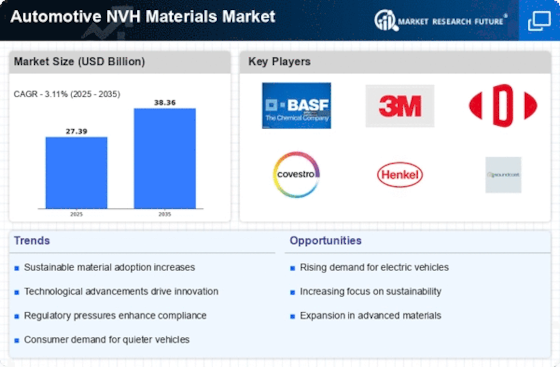
As per Market Research Future analysis, the Automotive NVH Materials Market was estimated at 27.39 USD Billion in 2024. The Automotive NVH Materials industry is projected to grow from 28.24 USD Billion in 2025 to 38.36 USD Billion by 2035, exhibiting a compound annual growth rate (CAGR) of 3.1% during the forecast period 2025 - 2035

Key Market Trends & Highlights

The Automotive NVH Materials Market is poised for substantial growth driven by technological advancements and evolving consumer preferences.

  • Sustainability in material selection is becoming increasingly prevalent among manufacturers in North America. The integration of smart technologies is enhancing the performance of NVH materials, particularly in the Asia-Pacific region. Focus on lightweight solutions is driving innovation in the foams segment, which remains the largest in the market. Rising consumer demand for comfort and regulatory pressure for noise reduction are key drivers propelling the growth of acoustic matting in electric vehicles.

Market Size & Forecast

2024 Market Size 27.39 (USD Billion)
2035 Market Size 38.36 (USD Billion)
CAGR (2025 - 2035) 3.11%
Largest Regional Market Share in 2024 North America

Major Players

<p>BASF SE (DE), 3M Company (US), DuPont de Nemours Inc (US), Covestro AG (DE), Henkel AG &amp; Co KGaA (DE), Soundcoat Company (US), Sika AG (CH), Trelleborg AB (SE), Nitto Denko Corporation (JP)</p>

Market Trends

The Automotive NVH Materials Market is currently experiencing a transformative phase, driven by the increasing demand for enhanced vehicle comfort and reduced noise levels. As consumers become more discerning regarding their driving experiences, manufacturers are compelled to innovate and integrate advanced materials that effectively mitigate noise, vibration, and harshness. This shift is not merely a response to consumer preferences; it also aligns with regulatory pressures aimed at improving vehicle acoustics and overall performance. Consequently, the Automotive NVH Materials market is witnessing a surge in the adoption of diverse materials, including foams, composites, and specialized coatings, which are engineered to address these challenges.

Moreover, the NVH Materials Market is influenced by the growing trend towards electric and hybrid vehicles. These vehicles often require unique NVH solutions due to their different operational characteristics compared to traditional combustion engines. As such, manufacturers are exploring novel materials that not only enhance sound insulation but also contribute to weight reduction and energy efficiency. This evolving landscape suggests a dynamic interplay between technological advancements and consumer expectations, indicating that the Automotive NVH Materials market will continue to adapt and expand in response to emerging trends and innovations.

Sustainability in Material Selection

There is a noticeable shift towards sustainable materials within the Vehicle Noise Vibration Harshness Materials Market. Manufacturers are increasingly prioritizing eco-friendly options, such as recycled and bio-based materials, to meet both consumer demand and regulatory requirements. This trend reflects a broader commitment to environmental responsibility and aims to reduce the carbon footprint associated with vehicle production.

Integration of Smart Technologies

The incorporation of smart technologies into NVH materials is gaining traction. Innovations such as active noise cancellation and adaptive soundproofing systems are being developed to enhance the driving experience. These technologies not only improve comfort but also offer potential for customization based on user preferences, indicating a move towards more personalized automotive solutions.

Focus on Lightweight Solutions

The Vehicle Noise Vibration Harshness Materials Market is increasingly focusing on lightweight solutions to improve fuel efficiency and performance. As manufacturers strive to meet stringent emissions regulations, the demand for materials that provide effective noise reduction while minimizing weight is rising. This trend suggests a critical balance between performance and comfort, driving innovation in material science.

Automotive NVH Materials Market Market Drivers

Growing Electric Vehicle Adoption

The growing adoption of electric vehicles (EVs) is a significant driver for the Global Automotive NVH Materials Market. As EVs become more prevalent, manufacturers are focusing on addressing unique NVH challenges associated with electric drivetrains. Unlike traditional internal combustion engines, EVs often require specialized NVH materials to mitigate the distinct sounds produced by electric motors. This shift is prompting investments in research and development of tailored NVH solutions, which are expected to capture a substantial share of the market. Analysts predict that the demand for NVH materials in the EV segment could increase by 20% in the coming years, underscoring the transformative impact of electric mobility on the NVH Materials Market.

Rising Consumer Demand for Comfort

The Automotive NVH Materials Industry is experiencing a notable increase in consumer demand for enhanced comfort within vehicles. As consumers become more discerning regarding their driving experience, manufacturers are compelled to invest in advanced NVH materials that effectively reduce noise, vibration, and harshness. This trend is underscored by a report indicating that the demand for premium vehicles, which often feature superior NVH solutions, has risen by approximately 15% in recent years. Consequently, automakers are prioritizing the integration of high-performance NVH materials to meet consumer expectations, thereby driving growth in the Vehicle Noise Vibration Harshness Materials Market.

Regulatory Pressure for Noise Reduction

The Automotive NVH Materials Sector is significantly influenced by increasing regulatory pressure aimed at reducing vehicular noise pollution. Governments across various regions are implementing stringent noise regulations to enhance urban living conditions and promote environmental sustainability. For instance, recent legislation mandates that new vehicles must adhere to specific noise level thresholds, compelling manufacturers to adopt advanced NVH materials that comply with these standards. This regulatory landscape is expected to propel the Automotive Soundproofing Materials Market, as companies seek innovative solutions to meet compliance while maintaining vehicle performance.

Technological Advancements in Material Science

Technological advancements in material science are playing a pivotal role in shaping the Automotive NVH Materials Industry. Innovations such as the development of advanced composites and sound-absorbing foams are enabling manufacturers to create more effective NVH solutions. These materials not only enhance acoustic performance but also contribute to weight reduction, which is increasingly important in the automotive sector. The market for lightweight NVH materials is projected to grow at a compound annual growth rate of 8% over the next five years, indicating a robust demand for innovative solutions within the automotive noise, vibration & harshness (NVH) materials market.

Increased Focus on Vehicle Safety and Performance

The automotive noise, vibration and harshness materials market is also driven by an increased focus on vehicle safety and performance. As consumers prioritize safety features, manufacturers are integrating NVH materials that not only enhance comfort but also contribute to structural integrity and crashworthiness. The use of advanced NVH materials can improve the overall performance of vehicles by reducing vibrations that may affect handling and stability. This dual focus on safety and performance is likely to stimulate demand for innovative NVH solutions, with market analysts estimating a growth rate of 7% in this segment over the next few years, further solidifying the importance of NVH materials in the automotive noise, vibration & harshness (NVH) materials market.

Market Segment Insights

By Material Type: Foams (Largest) vs. Acoustic Matting (Fastest-Growing)

<p>In the Automotive NVH Materials Market, foams dominate the material type segment, holding significant market share due to their excellent sound absorption capabilities and lightweight nature. Rubber materials also occupy a substantial share, favored for their durability and performance in vibration damping. Composite materials are witnessing notable interest for their enhanced properties, while textiles and acoustic matting are increasingly utilized for specific applications, contributing to the overall diversification of the segment.</p>

<p>Foams (Dominant) vs. Acoustic Matting (Emerging)</p>

<p>Foams are the most established material in the Automotive NVH segment, praised for their efficiency in sound absorption and vibration reduction. Their lightweight properties make them suitable for various parts of vehicles, enhancing ride comfort and reducing noise pollution. Acoustic matting, on the other hand, is an emerging contender, gaining traction for its advanced soundproofing characteristics. With the automotive industry leaning towards more sustainable and effective noise control solutions, acoustic matting is poised for growth, appealing especially to manufacturers focusing on premium vehicle segments. As technology advances, these materials are expected to evolve, with foams maintaining their dominance while acoustic matting carves out a significant niche.</p>

By Application: Passenger Cars (Largest) vs. Electric Vehicles (Fastest-Growing)

<p>In the Automotive NVH Materials Market, the application segment is substantially dominated by passenger cars, which account for the majority of the Automotive NVH Materials market share. This is attributed to the extensive manufacturing and sales of <a href="https://www.marketresearchfuture.com/reports/passenger-cars-market-42133">passenger vehicles</a> globally, leading to a significant demand for NVH (Noise, Vibration, and Harshness) materials to enhance comfort and performance. Furthermore, commercial vehicles also play a notable role, although they do not surpass the share held by passenger cars.</p>

<p>Passenger Cars (Dominant) vs. Electric Vehicles (Emerging)</p>

<p>The passenger car segment in the Automotive NVH Materials Market remains the most dominant application area, primarily due to the high volume of vehicles being produced and the ongoing emphasis on consumer comfort and vehicle performance. NVH materials such as acoustic foams, dampers, and barriers are widely utilized to minimize noise and vibrations, enhancing the driving experience. On the other hand, electric vehicles are emerging rapidly as the fastest-growing segment owing to the increasing demand for sustainable and innovative transportation solutions. As electric vehicles continue to gain popularity, the need for advanced NVH materials that cater specifically to their unique design and operational characteristics is escalating, marking a shift towards innovation in the Automotive NVH Materials market.</p>

By Function: Sound Absorption (Largest) vs. Vibration Damping (Fastest-Growing)

<p>In the Automotive NVH Materials Market, the sound absorption segment holds the largest share, playing a crucial role in enhancing passenger comfort by minimizing unwanted noise. This segment effectively caters to a variety of applications, including <a href="https://www.marketresearchfuture.com/reports/automotive-interior-market-11244" target="_blank" title="automotive interior">automotive interiors</a> and under-hood applications, reflecting a steady demand among manufacturers focusing on luxury and comfort. Conversely, vibration damping is emerging as the fastest-growing segment, driven by the increasing necessity for noise and vibration control, particularly in electric vehicles and hybrid models. Recent trends indicate that the demand for sound <a href="https://www.marketresearchfuture.com/reports/insulation-market-1654" target="_blank" title="insulation">insulation</a> materials is growing, yet it remains overshadowed by sound absorption and vibration damping. The rising emphasis on sustainable practices and regulations that prioritize vehicle noise reduction further drives the growth of these segments, with innovation in materials such as composites and natural fibers enhancing their performance and appeal in automotive applications.</p>

<p>Sound Absorption (Dominant) vs. Vibration Damping (Emerging)</p>

<p>Sound absorption materials are essential in the automotive sector for reducing unwanted noise, making them the dominant force in the NVH materials market. These materials, often utilizing open-cell foam or specialized composites, effectively diminish sound levels from various sources, enhancing the overall driving experience. In contrast, vibration damping materials are becoming increasingly prominent as manufacturers focus on improving vehicle performance and comfort. This emerging segment is characterized by its ability to control vibrations and reduce the impact of road noise, particularly in high-performance vehicles and new electric models. As manufacturers increasingly adopt advanced materials aimed at optimizing their vehicles' acoustic profiles, both segments are positioned to grow, catering to consumers’ rising standards for noise and vibration management.</p>

By End-Use: OEM (Largest) vs. Aftermarket (Fastest-Growing)

<p>The Vehicle NVH Materials Market is segmented into two main categories: <a href="https://www.marketresearchfuture.com/reports/automotive-aftermarket-industry-6251">OEM and Aftermarket</a>. The OEM segment holds the largest share as it caters to the initial manufacturing of vehicles, ensuring the incorporation of high-quality NVH materials to meet strict performance and regulatory standards. This segment leverages the support of major automotive manufacturers and drives the demand for innovative materials that improve vehicle acoustics and vibration damping. On the other hand, the Aftermarket segment, while smaller in comparison, is witnessing rapid growth. It focuses on retrofitting and upgrading vehicles, appealing to consumers who prioritize enhanced comfort and performance after purchase.</p>

<p>OEM (Dominant) vs. Aftermarket (Emerging)</p>

<p>The OEM segment is characterized by its emphasis on stringent quality requirements and advanced NVH technologies integrated within the vehicle production process. This segment's dominance is driven by the increasing emphasis on vehicle comfort and sound insulation in response to consumer expectations. Meanwhile, the Aftermarket segment is emerging as a dynamic force, fueled by trends such as customization and the rising popularity of vehicle modifications. Consumers in this segment are more inclined toward products that enhance driving experiences and aesthetic appeal, thus benefiting from innovations like soundproofing kits and vibration dampening materials, which are gaining traction due to the growing awareness of NVH issues.</p>

Get more detailed insights about Automotive NVH Materials Market Research Report—Global Forecast till 2035

Regional Insights

The Regional segment of the Automotive NVH Materials Market showcases diverse dynamics, with notable valuations in various regions. North America held a majority share in this Automotive NVH Materials market, valued at 10.5 USD Billion in 2023 and projected to grow to 13.5 USD Billion by 2032, driven by a strong automotive sector and evolving consumer preferences towards noise and vibration reduction technologies. Europe follows closely, valued at 9.0 USD Billion in 2023 and expected to reach 11.5 USD Billion, reflecting its robust automotive manufacturing base and regulatory push for quieter vehicles, making it a significant player.

The APAC region, valued at 5.5 USD Billion in 2023, has substantial growth potential as the automotive industry expands in countries like China and India, leading to increased adoption of NVH materials. In contrast, South America and MEA, being smaller markets with valuations at 0.8 USD Billion and similar potential value increases, mainly represent emerging opportunities where automotive growth is beginning to take shape, although they currently hold lesser significance in the overall automotive noise, vibration and harshness materials market revenue. Understanding these regional nuances helps reveal underlying growth drivers, Automotive NVH Materials market challenges, and potential opportunities across the board.

Key Players and Competitive Insights

Significant competitive dynamics characterize the Automotive NVH Materials Market as players strive to innovate and enhance their offerings in noise, vibration, and harshness materials. This Automotive NVH Materials market encompasses a range of products designed to improve vehicle acoustics, increase comfort, and meet stringent regulatory standards regarding noise levels.


As the automotive industry continues to evolve with advancements in electric vehicles and stricter emissions regulations, the focus on NVH materials has gained prominence among manufacturers. Competitive strategies are shaped by factors such as technological advancements, customer preferences, material performance, and the growing trend toward sustainability and eco-friendly solutions. Overall, the landscape is marked by a blend of established companies and emerging players, all vying for Automotive NVH Materials market share in a sector increasingly focused on quality and performance.


Hemlite has established a notable presence in the automotive noise, vibration & harshness (NVH) materials market through its commitment to developing high-performance solutions that cater to the evolving needs of the industry. The company's strengths lie in its extensive research and development capabilities, which enable it to introduce innovative materials that effectively combat noise and vibrations while ensuring durability.


Hemlite is recognized for its focus on ensuring customer satisfaction by providing tailored solutions that align with the unique requirements of various automotive manufacturers. The brand's reputation for quality and reliability, along with its strong service support, enhances its competitive position in the Automotive NVH Materials market. Additionally, Hemlite's alignment with modern sustainability trends, including the use of eco-friendly materials and processes, further bolsters its appeal among environmentally conscious consumers and manufacturers.


Henkel is a prominent player in the automotive noise, vibration & harshness (NVH) materials market, leveraging its vast expertise in adhesive technologies and material sciences to deliver high-value solutions for noise and vibration damping. The company's robust portfolio is complemented by its strong focus on innovation, enabling Henkel to address the specific challenges faced by the automotive sector in terms of sound insulation and vibration control. With a commitment to research and development, Henkel remains at the forefront of pioneering new NVH materials that not only enhance vehicle performance but also contribute to passenger comfort.


The company's global footprint and strategic partnerships with automotive manufacturers bolster its Automotive NVH Materials market presence, allowing it to cater to a diverse range of clients effectively. Henkel's dedication to sustainability is also reflected in its offerings, making it a competitive force in a Automotive NVH Materials market that increasingly values environmentally responsible practices.


In September 2025, Supreme Group launched its Circuline range of sustainable automotive components, featuring recycled and eco-friendly materials. The product line aims to reduce automotive plastic waste while maintaining OEM-grade performance. This initiative highlights growing sustainability efforts in the components industry.


In April 2025, a major investment was announced to establish a new manufacturing facility for automotive polyurethane components in China, boosting production capacity for global OEM customers. The expansion supports rising demand for high-performance materials in modern vehicles.

Key Companies in the Automotive NVH Materials Market include

Industry Developments

  • Q2 2024: Covestro launches new sustainable polyurethane foam for automotive NVH applications Covestro AG announced the launch of a new line of sustainable polyurethane foams designed specifically for noise, vibration, and harshness (NVH) reduction in automotive interiors, targeting electric and hybrid vehicles.
  • Q1 2024: BASF opens expanded automotive NVH materials production facility in Shanghai BASF inaugurated an expanded manufacturing facility in Shanghai to increase production of advanced NVH materials for automotive OEMs, aiming to meet growing demand in the Asia-Pacific region.
  • Q2 2024: 3M introduces next-generation lightweight acoustic insulation for EVs 3M launched a new lightweight acoustic insulation material for electric vehicles, designed to improve cabin comfort while reducing overall vehicle weight and supporting OEM sustainability goals.
  • Q3 2024: Sumitomo Riko announces partnership with major European automaker for NVH solutions Sumitomo Riko entered into a strategic partnership with a leading European automotive manufacturer to supply advanced NVH materials for their next-generation electric vehicle lineup.
  • Q2 2024: Celanese debuts new thermoplastic elastomer for automotive NVH applications Celanese Corporation unveiled a new thermoplastic elastomer specifically engineered for use in automotive NVH components, offering improved durability and sound absorption.
  • Q1 2025: Huntsman opens R&D center focused on automotive NVH materials innovation Huntsman Corporation opened a new research and development center dedicated to advancing NVH material technologies for automotive applications, with a focus on electric and hybrid vehicles.
  • Q2 2025: Dow and Stellantis sign multi-year supply agreement for advanced NVH materials Dow announced a multi-year contract to supply Stellantis with advanced NVH materials for use in their global vehicle platforms, including electric and hybrid models.
  • Q3 2024: ExxonMobil launches new line of high-performance rubber for automotive NVH ExxonMobil introduced a new high-performance rubber compound designed to enhance noise and vibration damping in automotive applications, targeting both ICE and EV markets.
  • Q2 2024: Lanxess expands production capacity for automotive NVH materials in Germany Lanxess AG announced the expansion of its German production facility to increase output of specialty NVH materials for automotive OEMs across Europe.
  • Q1 2025: Borgers AG secures major contract to supply NVH components for new EV platform Borgers AG won a significant contract to provide NVH components for a new electric vehicle platform developed by a leading global automaker.
  • Q2 2025: Mitsui Chemicals acquires European NVH materials specialist Mitsui Chemicals completed the acquisition of a European company specializing in advanced NVH materials, strengthening its position in the global automotive supply chain.
  • Q3 2025: 3M appoints new head of automotive NVH materials division 3M announced the appointment of a new executive to lead its automotive NVH materials division, aiming to accelerate innovation and global Automotive NVH Materials market expansion.

Future Outlook

Automotive NVH Materials Market Future Outlook

<p>The global automotive NVH materials market is projected to grow at a 3.11% CAGR from 2025 to 2035, driven by increasing consumer demand for quieter vehicles and stringent noise regulations.</p>

New opportunities lie in:

  • <p>Development of advanced lightweight <a href="https://www.marketresearchfuture.com/reports/composite-material-market-33737" target="_blank" title="composite material">composite materials</a> for enhanced sound insulation. Integration of smart materials that adapt to varying noise levels in real-time. Expansion into emerging markets with tailored NVH solutions for local automotive manufacturers.</p>

<p>By 2035, the Automotive NVH Materials market is expected to achieve robust growth, positioning itself as a key player in automotive innovation.</p>

Market Segmentation

Automotive NVH Materials Market End-Use Outlook

  • OEM
  • Aftermarket

Automotive NVH Materials Market Function Outlook

  • Sound Absorption
  • Vibration Damping
  • Sound Insulation

Automotive NVH Materials Market Application Outlook

  • Passenger Cars
  • Commercial Vehicles
  • Two-Wheelers
  • Electric Vehicles

Automotive NVH Materials Market Material Type Outlook

  • Foams
  • Rubber
  • Composite Materials
  • Textiles
  • Acoustic Matting

Report Scope

MARKET SIZE 2024 27.39(USD Billion)
MARKET SIZE 2025 28.24(USD Billion)
MARKET SIZE 2035 38.36(USD Billion)
COMPOUND ANNUAL GROWTH RATE (CAGR) 3.11% (2025 - 2035)
REPORT COVERAGE Revenue Forecast, Competitive Landscape, Growth Factors, and Trends
BASE YEAR 2024
Market Forecast Period 2025 - 2035
Historical Data 2019 - 2024
Market Forecast Units USD Billion
Key Companies Profiled BASF SE (DE), 3M Company (US), DuPont de Nemours Inc (US), Covestro AG (DE), Henkel AG & Co KGaA (DE), Soundcoat Company (US), Sika AG (CH), Trelleborg AB (SE), Nitto Denko Corporation (JP)
Segments Covered Material Type, Application, Function, End Use, Regional
Key Market Opportunities Growing demand for lightweight, high-performance materials enhances opportunities in the Automotive NVH Materials Market.
Key Market Dynamics Rising demand for lightweight materials drives innovation in Automotive Noise, Vibration, and Harshness solutions.
Countries Covered North America, Europe, APAC, South America, MEA

FAQs

What is the projected market valuation of the Automotive NVH Materials Market by 2035?

<p>The projected market valuation of the Automotive NVH Materials Market is expected to reach 38.36 USD Billion by 2035.</p>

What was the market valuation of the Automotive NVH Materials Market in 2024?

<p>The market valuation of the Automotive NVH Materials Market was 27.39 USD Billion in 2024.</p>

What is the expected CAGR for the Automotive NVH Materials Market during the forecast period 2025 - 2035?

<p>The expected CAGR for the Automotive NVH Materials Market during the forecast period 2025 - 2035 is 3.11%.</p>

Which material type segment is projected to have the highest valuation by 2035?

<p>The Acoustic Matting segment is projected to have the highest valuation, expected to reach 13.36 USD Billion by 2035.</p>

What are the key applications of Automotive NVH Materials?

<p>Key applications of Automotive NVH Materials include Passenger Cars, Commercial Vehicles, Two-Wheelers, and Electric Vehicles.</p>

Which end-use segment is anticipated to dominate the market by 2035?

<p>The OEM end-use segment is anticipated to dominate the market, projected to reach 21.0 USD Billion by 2035.</p>

What is the expected valuation for the Rubber material type segment by 2035?

<p>The Rubber material type segment is expected to reach a valuation of 8.0 USD Billion by 2035.</p>

Who are the leading players in the Automotive NVH Materials Market?

<p>Leading players in the Automotive NVH Materials Market include BASF SE, 3M Company, and DuPont de Nemours Inc.</p>

What is the projected valuation for the Sound Insulation function segment by 2035?

<p>The Sound Insulation function segment is projected to reach a valuation of 15.36 USD Billion by 2035.</p>

How does the market for Electric Vehicles compare to other applications in 2035?

<p>The market for Electric Vehicles is expected to reach 7.36 USD Billion by 2035, indicating a growing interest in this application.</p>

  1. SECTION I: EXECUTIVE SUMMARY AND KEY HIGHLIGHTS
    1. | 1.1 EXECUTIVE SUMMARY
    2. | | 1.1.1 Market Overview
    3. | | 1.1.2 Key Findings
    4. | | 1.1.3 Market Segmentation
    5. | | 1.1.4 Competitive Landscape
    6. | | 1.1.5 Challenges and Opportunities
    7. | | 1.1.6 Future Outlook
  2. SECTION II: SCOPING, METHODOLOGY AND MARKET STRUCTURE
    1. | 2.1 MARKET INTRODUCTION
    2. | | 2.1.1 Definition
    3. | | 2.1.2 Scope of the study
    4. | | | 2.1.2.1 Research Objective
    5. | | | 2.1.2.2 Assumption
    6. | | | 2.1.2.3 Limitations
    7. | 2.2 RESEARCH METHODOLOGY
    8. | | 2.2.1 Overview
    9. | | 2.2.2 Data Mining
    10. | | 2.2.3 Secondary Research
    11. | | 2.2.4 Primary Research
    12. | | | 2.2.4.1 Primary Interviews and Information Gathering Process
    13. | | | 2.2.4.2 Breakdown of Primary Respondents
    14. | | 2.2.5 Forecasting Model
    15. | | 2.2.6 Market Size Estimation
    16. | | | 2.2.6.1 Bottom-Up Approach
    17. | | | 2.2.6.2 Top-Down Approach
    18. | | 2.2.7 Data Triangulation
    19. | | 2.2.8 Validation
  3. SECTION III: QUALITATIVE ANALYSIS
    1. | 3.1 MARKET DYNAMICS
    2. | | 3.1.1 Overview
    3. | | 3.1.2 Drivers
    4. | | 3.1.3 Restraints
    5. | | 3.1.4 Opportunities
    6. | 3.2 MARKET FACTOR ANALYSIS
    7. | | 3.2.1 Value chain Analysis
    8. | | 3.2.2 Porter's Five Forces Analysis
    9. | | | 3.2.2.1 Bargaining Power of Suppliers
    10. | | | 3.2.2.2 Bargaining Power of Buyers
    11. | | | 3.2.2.3 Threat of New Entrants
    12. | | | 3.2.2.4 Threat of Substitutes
    13. | | | 3.2.2.5 Intensity of Rivalry
    14. | | 3.2.3 COVID-19 Impact Analysis
    15. | | | 3.2.3.1 Market Impact Analysis
    16. | | | 3.2.3.2 Regional Impact
    17. | | | 3.2.3.3 Opportunity and Threat Analysis
  4. SECTION IV: QUANTITATIVE ANALYSIS
    1. | 4.1 Automobile, BY Material Type (USD Billion)
    2. | | 4.1.1 Foams
    3. | | 4.1.2 Rubber
    4. | | 4.1.3 Composite Materials
    5. | | 4.1.4 Textiles
    6. | | 4.1.5 Acoustic Matting
    7. | 4.2 Automobile, BY Application (USD Billion)
    8. | | 4.2.1 Passenger Cars
    9. | | 4.2.2 Commercial Vehicles
    10. | | 4.2.3 Two-Wheelers
    11. | | 4.2.4 Electric Vehicles
    12. | 4.3 Automobile, BY Function (USD Billion)
    13. | | 4.3.1 Sound Absorption
    14. | | 4.3.2 Vibration Damping
    15. | | 4.3.3 Sound Insulation
    16. | 4.4 Automobile, BY End-Use (USD Billion)
    17. | | 4.4.1 OEM
    18. | | 4.4.2 Aftermarket
    19. | 4.5 Automobile, BY Region (USD Billion)
    20. | | 4.5.1 North America
    21. | | | 4.5.1.1 US
    22. | | | 4.5.1.2 Canada
    23. | | 4.5.2 Europe
    24. | | | 4.5.2.1 Germany
    25. | | | 4.5.2.2 UK
    26. | | | 4.5.2.3 France
    27. | | | 4.5.2.4 Russia
    28. | | | 4.5.2.5 Italy
    29. | | | 4.5.2.6 Spain
    30. | | | 4.5.2.7 Rest of Europe
    31. | | 4.5.3 APAC
    32. | | | 4.5.3.1 China
    33. | | | 4.5.3.2 India
    34. | | | 4.5.3.3 Japan
    35. | | | 4.5.3.4 South Korea
    36. | | | 4.5.3.5 Malaysia
    37. | | | 4.5.3.6 Thailand
    38. | | | 4.5.3.7 Indonesia
    39. | | | 4.5.3.8 Rest of APAC
    40. | | 4.5.4 South America
    41. | | | 4.5.4.1 Brazil
    42. | | | 4.5.4.2 Mexico
    43. | | | 4.5.4.3 Argentina
    44. | | | 4.5.4.4 Rest of South America
    45. | | 4.5.5 MEA
    46. | | | 4.5.5.1 GCC Countries
    47. | | | 4.5.5.2 South Africa
    48. | | | 4.5.5.3 Rest of MEA
  5. SECTION V: COMPETITIVE ANALYSIS
    1. | 5.1 Competitive Landscape
    2. | | 5.1.1 Overview
    3. | | 5.1.2 Competitive Analysis
    4. | | 5.1.3 Market share Analysis
    5. | | 5.1.4 Major Growth Strategy in the Automobile
    6. | | 5.1.5 Competitive Benchmarking
    7. | | 5.1.6 Leading Players in Terms of Number of Developments in the Automobile
    8. | | 5.1.7 Key developments and growth strategies
    9. | | | 5.1.7.1 New Product Launch/Service Deployment
    10. | | | 5.1.7.2 Merger & Acquisitions
    11. | | | 5.1.7.3 Joint Ventures
    12. | | 5.1.8 Major Players Financial Matrix
    13. | | | 5.1.8.1 Sales and Operating Income
    14. | | | 5.1.8.2 Major Players R&D Expenditure. 2023
    15. | 5.2 Company Profiles
    16. | | 5.2.1 BASF SE (DE)
    17. | | | 5.2.1.1 Financial Overview
    18. | | | 5.2.1.2 Products Offered
    19. | | | 5.2.1.3 Key Developments
    20. | | | 5.2.1.4 SWOT Analysis
    21. | | | 5.2.1.5 Key Strategies
    22. | | 5.2.2 3M Company (US)
    23. | | | 5.2.2.1 Financial Overview
    24. | | | 5.2.2.2 Products Offered
    25. | | | 5.2.2.3 Key Developments
    26. | | | 5.2.2.4 SWOT Analysis
    27. | | | 5.2.2.5 Key Strategies
    28. | | 5.2.3 DuPont de Nemours Inc (US)
    29. | | | 5.2.3.1 Financial Overview
    30. | | | 5.2.3.2 Products Offered
    31. | | | 5.2.3.3 Key Developments
    32. | | | 5.2.3.4 SWOT Analysis
    33. | | | 5.2.3.5 Key Strategies
    34. | | 5.2.4 Covestro AG (DE)
    35. | | | 5.2.4.1 Financial Overview
    36. | | | 5.2.4.2 Products Offered
    37. | | | 5.2.4.3 Key Developments
    38. | | | 5.2.4.4 SWOT Analysis
    39. | | | 5.2.4.5 Key Strategies
    40. | | 5.2.5 Henkel AG & Co KGaA (DE)
    41. | | | 5.2.5.1 Financial Overview
    42. | | | 5.2.5.2 Products Offered
    43. | | | 5.2.5.3 Key Developments
    44. | | | 5.2.5.4 SWOT Analysis
    45. | | | 5.2.5.5 Key Strategies
    46. | | 5.2.6 Soundcoat Company (US)
    47. | | | 5.2.6.1 Financial Overview
    48. | | | 5.2.6.2 Products Offered
    49. | | | 5.2.6.3 Key Developments
    50. | | | 5.2.6.4 SWOT Analysis
    51. | | | 5.2.6.5 Key Strategies
    52. | | 5.2.7 Sika AG (CH)
    53. | | | 5.2.7.1 Financial Overview
    54. | | | 5.2.7.2 Products Offered
    55. | | | 5.2.7.3 Key Developments
    56. | | | 5.2.7.4 SWOT Analysis
    57. | | | 5.2.7.5 Key Strategies
    58. | | 5.2.8 Trelleborg AB (SE)
    59. | | | 5.2.8.1 Financial Overview
    60. | | | 5.2.8.2 Products Offered
    61. | | | 5.2.8.3 Key Developments
    62. | | | 5.2.8.4 SWOT Analysis
    63. | | | 5.2.8.5 Key Strategies
    64. | | 5.2.9 Nitto Denko Corporation (JP)
    65. | | | 5.2.9.1 Financial Overview
    66. | | | 5.2.9.2 Products Offered
    67. | | | 5.2.9.3 Key Developments
    68. | | | 5.2.9.4 SWOT Analysis
    69. | | | 5.2.9.5 Key Strategies
    70. | 5.3 Appendix
    71. | | 5.3.1 References
    72. | | 5.3.2 Related Reports
  6. LIST OF FIGURES
    1. | 6.1 MARKET SYNOPSIS
    2. | 6.2 NORTH AMERICA MARKET ANALYSIS
    3. | 6.3 US MARKET ANALYSIS BY MATERIAL TYPE
    4. | 6.4 US MARKET ANALYSIS BY APPLICATION
    5. | 6.5 US MARKET ANALYSIS BY FUNCTION
    6. | 6.6 US MARKET ANALYSIS BY END-USE
    7. | 6.7 CANADA MARKET ANALYSIS BY MATERIAL TYPE
    8. | 6.8 CANADA MARKET ANALYSIS BY APPLICATION
    9. | 6.9 CANADA MARKET ANALYSIS BY FUNCTION
    10. | 6.10 CANADA MARKET ANALYSIS BY END-USE
    11. | 6.11 EUROPE MARKET ANALYSIS
    12. | 6.12 GERMANY MARKET ANALYSIS BY MATERIAL TYPE
    13. | 6.13 GERMANY MARKET ANALYSIS BY APPLICATION
    14. | 6.14 GERMANY MARKET ANALYSIS BY FUNCTION
    15. | 6.15 GERMANY MARKET ANALYSIS BY END-USE
    16. | 6.16 UK MARKET ANALYSIS BY MATERIAL TYPE
    17. | 6.17 UK MARKET ANALYSIS BY APPLICATION
    18. | 6.18 UK MARKET ANALYSIS BY FUNCTION
    19. | 6.19 UK MARKET ANALYSIS BY END-USE
    20. | 6.20 FRANCE MARKET ANALYSIS BY MATERIAL TYPE
    21. | 6.21 FRANCE MARKET ANALYSIS BY APPLICATION
    22. | 6.22 FRANCE MARKET ANALYSIS BY FUNCTION
    23. | 6.23 FRANCE MARKET ANALYSIS BY END-USE
    24. | 6.24 RUSSIA MARKET ANALYSIS BY MATERIAL TYPE
    25. | 6.25 RUSSIA MARKET ANALYSIS BY APPLICATION
    26. | 6.26 RUSSIA MARKET ANALYSIS BY FUNCTION
    27. | 6.27 RUSSIA MARKET ANALYSIS BY END-USE
    28. | 6.28 ITALY MARKET ANALYSIS BY MATERIAL TYPE
    29. | 6.29 ITALY MARKET ANALYSIS BY APPLICATION
    30. | 6.30 ITALY MARKET ANALYSIS BY FUNCTION
    31. | 6.31 ITALY MARKET ANALYSIS BY END-USE
    32. | 6.32 SPAIN MARKET ANALYSIS BY MATERIAL TYPE
    33. | 6.33 SPAIN MARKET ANALYSIS BY APPLICATION
    34. | 6.34 SPAIN MARKET ANALYSIS BY FUNCTION
    35. | 6.35 SPAIN MARKET ANALYSIS BY END-USE
    36. | 6.36 REST OF EUROPE MARKET ANALYSIS BY MATERIAL TYPE
    37. | 6.37 REST OF EUROPE MARKET ANALYSIS BY APPLICATION
    38. | 6.38 REST OF EUROPE MARKET ANALYSIS BY FUNCTION
    39. | 6.39 REST OF EUROPE MARKET ANALYSIS BY END-USE
    40. | 6.40 APAC MARKET ANALYSIS
    41. | 6.41 CHINA MARKET ANALYSIS BY MATERIAL TYPE
    42. | 6.42 CHINA MARKET ANALYSIS BY APPLICATION
    43. | 6.43 CHINA MARKET ANALYSIS BY FUNCTION
    44. | 6.44 CHINA MARKET ANALYSIS BY END-USE
    45. | 6.45 INDIA MARKET ANALYSIS BY MATERIAL TYPE
    46. | 6.46 INDIA MARKET ANALYSIS BY APPLICATION
    47. | 6.47 INDIA MARKET ANALYSIS BY FUNCTION
    48. | 6.48 INDIA MARKET ANALYSIS BY END-USE
    49. | 6.49 JAPAN MARKET ANALYSIS BY MATERIAL TYPE
    50. | 6.50 JAPAN MARKET ANALYSIS BY APPLICATION
    51. | 6.51 JAPAN MARKET ANALYSIS BY FUNCTION
    52. | 6.52 JAPAN MARKET ANALYSIS BY END-USE
    53. | 6.53 SOUTH KOREA MARKET ANALYSIS BY MATERIAL TYPE
    54. | 6.54 SOUTH KOREA MARKET ANALYSIS BY APPLICATION
    55. | 6.55 SOUTH KOREA MARKET ANALYSIS BY FUNCTION
    56. | 6.56 SOUTH KOREA MARKET ANALYSIS BY END-USE
    57. | 6.57 MALAYSIA MARKET ANALYSIS BY MATERIAL TYPE
    58. | 6.58 MALAYSIA MARKET ANALYSIS BY APPLICATION
    59. | 6.59 MALAYSIA MARKET ANALYSIS BY FUNCTION
    60. | 6.60 MALAYSIA MARKET ANALYSIS BY END-USE
    61. | 6.61 THAILAND MARKET ANALYSIS BY MATERIAL TYPE
    62. | 6.62 THAILAND MARKET ANALYSIS BY APPLICATION
    63. | 6.63 THAILAND MARKET ANALYSIS BY FUNCTION
    64. | 6.64 THAILAND MARKET ANALYSIS BY END-USE
    65. | 6.65 INDONESIA MARKET ANALYSIS BY MATERIAL TYPE
    66. | 6.66 INDONESIA MARKET ANALYSIS BY APPLICATION
    67. | 6.67 INDONESIA MARKET ANALYSIS BY FUNCTION
    68. | 6.68 INDONESIA MARKET ANALYSIS BY END-USE
    69. | 6.69 REST OF APAC MARKET ANALYSIS BY MATERIAL TYPE
    70. | 6.70 REST OF APAC MARKET ANALYSIS BY APPLICATION
    71. | 6.71 REST OF APAC MARKET ANALYSIS BY FUNCTION
    72. | 6.72 REST OF APAC MARKET ANALYSIS BY END-USE
    73. | 6.73 SOUTH AMERICA MARKET ANALYSIS
    74. | 6.74 BRAZIL MARKET ANALYSIS BY MATERIAL TYPE
    75. | 6.75 BRAZIL MARKET ANALYSIS BY APPLICATION
    76. | 6.76 BRAZIL MARKET ANALYSIS BY FUNCTION
    77. | 6.77 BRAZIL MARKET ANALYSIS BY END-USE
    78. | 6.78 MEXICO MARKET ANALYSIS BY MATERIAL TYPE
    79. | 6.79 MEXICO MARKET ANALYSIS BY APPLICATION
    80. | 6.80 MEXICO MARKET ANALYSIS BY FUNCTION
    81. | 6.81 MEXICO MARKET ANALYSIS BY END-USE
    82. | 6.82 ARGENTINA MARKET ANALYSIS BY MATERIAL TYPE
    83. | 6.83 ARGENTINA MARKET ANALYSIS BY APPLICATION
    84. | 6.84 ARGENTINA MARKET ANALYSIS BY FUNCTION
    85. | 6.85 ARGENTINA MARKET ANALYSIS BY END-USE
    86. | 6.86 REST OF SOUTH AMERICA MARKET ANALYSIS BY MATERIAL TYPE
    87. | 6.87 REST OF SOUTH AMERICA MARKET ANALYSIS BY APPLICATION
    88. | 6.88 REST OF SOUTH AMERICA MARKET ANALYSIS BY FUNCTION
    89. | 6.89 REST OF SOUTH AMERICA MARKET ANALYSIS BY END-USE
    90. | 6.90 MEA MARKET ANALYSIS
    91. | 6.91 GCC COUNTRIES MARKET ANALYSIS BY MATERIAL TYPE
    92. | 6.92 GCC COUNTRIES MARKET ANALYSIS BY APPLICATION
    93. | 6.93 GCC COUNTRIES MARKET ANALYSIS BY FUNCTION
    94. | 6.94 GCC COUNTRIES MARKET ANALYSIS BY END-USE
    95. | 6.95 SOUTH AFRICA MARKET ANALYSIS BY MATERIAL TYPE
    96. | 6.96 SOUTH AFRICA MARKET ANALYSIS BY APPLICATION
    97. | 6.97 SOUTH AFRICA MARKET ANALYSIS BY FUNCTION
    98. | 6.98 SOUTH AFRICA MARKET ANALYSIS BY END-USE
    99. | 6.99 REST OF MEA MARKET ANALYSIS BY MATERIAL TYPE
    100. | 6.100 REST OF MEA MARKET ANALYSIS BY APPLICATION
    101. | 6.101 REST OF MEA MARKET ANALYSIS BY FUNCTION
    102. | 6.102 REST OF MEA MARKET ANALYSIS BY END-USE
    103. | 6.103 KEY BUYING CRITERIA OF AUTOMOBILE
    104. | 6.104 RESEARCH PROCESS OF MRFR
    105. | 6.105 DRO ANALYSIS OF AUTOMOBILE
    106. | 6.106 DRIVERS IMPACT ANALYSIS: AUTOMOBILE
    107. | 6.107 RESTRAINTS IMPACT ANALYSIS: AUTOMOBILE
    108. | 6.108 SUPPLY / VALUE CHAIN: AUTOMOBILE
    109. | 6.109 AUTOMOBILE, BY MATERIAL TYPE, 2024 (% SHARE)
    110. | 6.110 AUTOMOBILE, BY MATERIAL TYPE, 2024 TO 2035 (USD Billion)
    111. | 6.111 AUTOMOBILE, BY APPLICATION, 2024 (% SHARE)
    112. | 6.112 AUTOMOBILE, BY APPLICATION, 2024 TO 2035 (USD Billion)
    113. | 6.113 AUTOMOBILE, BY FUNCTION, 2024 (% SHARE)
    114. | 6.114 AUTOMOBILE, BY FUNCTION, 2024 TO 2035 (USD Billion)
    115. | 6.115 AUTOMOBILE, BY END-USE, 2024 (% SHARE)
    116. | 6.116 AUTOMOBILE, BY END-USE, 2024 TO 2035 (USD Billion)
    117. | 6.117 BENCHMARKING OF MAJOR COMPETITORS
  7. LIST OF TABLES
    1. | 7.1 LIST OF ASSUMPTIONS
    2. | | 7.1.1
    3. | 7.2 North America MARKET SIZE ESTIMATES; FORECAST
    4. | | 7.2.1 BY MATERIAL TYPE, 2025-2035 (USD Billion)
    5. | | 7.2.2 BY APPLICATION, 2025-2035 (USD Billion)
    6. | | 7.2.3 BY FUNCTION, 2025-2035 (USD Billion)
    7. | | 7.2.4 BY END-USE, 2025-2035 (USD Billion)
    8. | 7.3 US MARKET SIZE ESTIMATES; FORECAST
    9. | | 7.3.1 BY MATERIAL TYPE, 2025-2035 (USD Billion)
    10. | | 7.3.2 BY APPLICATION, 2025-2035 (USD Billion)
    11. | | 7.3.3 BY FUNCTION, 2025-2035 (USD Billion)
    12. | | 7.3.4 BY END-USE, 2025-2035 (USD Billion)
    13. | 7.4 Canada MARKET SIZE ESTIMATES; FORECAST
    14. | | 7.4.1 BY MATERIAL TYPE, 2025-2035 (USD Billion)
    15. | | 7.4.2 BY APPLICATION, 2025-2035 (USD Billion)
    16. | | 7.4.3 BY FUNCTION, 2025-2035 (USD Billion)
    17. | | 7.4.4 BY END-USE, 2025-2035 (USD Billion)
    18. | 7.5 Europe MARKET SIZE ESTIMATES; FORECAST
    19. | | 7.5.1 BY MATERIAL TYPE, 2025-2035 (USD Billion)
    20. | | 7.5.2 BY APPLICATION, 2025-2035 (USD Billion)
    21. | | 7.5.3 BY FUNCTION, 2025-2035 (USD Billion)
    22. | | 7.5.4 BY END-USE, 2025-2035 (USD Billion)
    23. | 7.6 Germany MARKET SIZE ESTIMATES; FORECAST
    24. | | 7.6.1 BY MATERIAL TYPE, 2025-2035 (USD Billion)
    25. | | 7.6.2 BY APPLICATION, 2025-2035 (USD Billion)
    26. | | 7.6.3 BY FUNCTION, 2025-2035 (USD Billion)
    27. | | 7.6.4 BY END-USE, 2025-2035 (USD Billion)
    28. | 7.7 UK MARKET SIZE ESTIMATES; FORECAST
    29. | | 7.7.1 BY MATERIAL TYPE, 2025-2035 (USD Billion)
    30. | | 7.7.2 BY APPLICATION, 2025-2035 (USD Billion)
    31. | | 7.7.3 BY FUNCTION, 2025-2035 (USD Billion)
    32. | | 7.7.4 BY END-USE, 2025-2035 (USD Billion)
    33. | 7.8 France MARKET SIZE ESTIMATES; FORECAST
    34. | | 7.8.1 BY MATERIAL TYPE, 2025-2035 (USD Billion)
    35. | | 7.8.2 BY APPLICATION, 2025-2035 (USD Billion)
    36. | | 7.8.3 BY FUNCTION, 2025-2035 (USD Billion)
    37. | | 7.8.4 BY END-USE, 2025-2035 (USD Billion)
    38. | 7.9 Russia MARKET SIZE ESTIMATES; FORECAST
    39. | | 7.9.1 BY MATERIAL TYPE, 2025-2035 (USD Billion)
    40. | | 7.9.2 BY APPLICATION, 2025-2035 (USD Billion)
    41. | | 7.9.3 BY FUNCTION, 2025-2035 (USD Billion)
    42. | | 7.9.4 BY END-USE, 2025-2035 (USD Billion)
    43. | 7.10 Italy MARKET SIZE ESTIMATES; FORECAST
    44. | | 7.10.1 BY MATERIAL TYPE, 2025-2035 (USD Billion)
    45. | | 7.10.2 BY APPLICATION, 2025-2035 (USD Billion)
    46. | | 7.10.3 BY FUNCTION, 2025-2035 (USD Billion)
    47. | | 7.10.4 BY END-USE, 2025-2035 (USD Billion)
    48. | 7.11 Spain MARKET SIZE ESTIMATES; FORECAST
    49. | | 7.11.1 BY MATERIAL TYPE, 2025-2035 (USD Billion)
    50. | | 7.11.2 BY APPLICATION, 2025-2035 (USD Billion)
    51. | | 7.11.3 BY FUNCTION, 2025-2035 (USD Billion)
    52. | | 7.11.4 BY END-USE, 2025-2035 (USD Billion)
    53. | 7.12 Rest of Europe MARKET SIZE ESTIMATES; FORECAST
    54. | | 7.12.1 BY MATERIAL TYPE, 2025-2035 (USD Billion)
    55. | | 7.12.2 BY APPLICATION, 2025-2035 (USD Billion)
    56. | | 7.12.3 BY FUNCTION, 2025-2035 (USD Billion)
    57. | | 7.12.4 BY END-USE, 2025-2035 (USD Billion)
    58. | 7.13 APAC MARKET SIZE ESTIMATES; FORECAST
    59. | | 7.13.1 BY MATERIAL TYPE, 2025-2035 (USD Billion)
    60. | | 7.13.2 BY APPLICATION, 2025-2035 (USD Billion)
    61. | | 7.13.3 BY FUNCTION, 2025-2035 (USD Billion)
    62. | | 7.13.4 BY END-USE, 2025-2035 (USD Billion)
    63. | 7.14 China MARKET SIZE ESTIMATES; FORECAST
    64. | | 7.14.1 BY MATERIAL TYPE, 2025-2035 (USD Billion)
    65. | | 7.14.2 BY APPLICATION, 2025-2035 (USD Billion)
    66. | | 7.14.3 BY FUNCTION, 2025-2035 (USD Billion)
    67. | | 7.14.4 BY END-USE, 2025-2035 (USD Billion)
    68. | 7.15 India MARKET SIZE ESTIMATES; FORECAST
    69. | | 7.15.1 BY MATERIAL TYPE, 2025-2035 (USD Billion)
    70. | | 7.15.2 BY APPLICATION, 2025-2035 (USD Billion)
    71. | | 7.15.3 BY FUNCTION, 2025-2035 (USD Billion)
    72. | | 7.15.4 BY END-USE, 2025-2035 (USD Billion)
    73. | 7.16 Japan MARKET SIZE ESTIMATES; FORECAST
    74. | | 7.16.1 BY MATERIAL TYPE, 2025-2035 (USD Billion)
    75. | | 7.16.2 BY APPLICATION, 2025-2035 (USD Billion)
    76. | | 7.16.3 BY FUNCTION, 2025-2035 (USD Billion)
    77. | | 7.16.4 BY END-USE, 2025-2035 (USD Billion)
    78. | 7.17 South Korea MARKET SIZE ESTIMATES; FORECAST
    79. | | 7.17.1 BY MATERIAL TYPE, 2025-2035 (USD Billion)
    80. | | 7.17.2 BY APPLICATION, 2025-2035 (USD Billion)
    81. | | 7.17.3 BY FUNCTION, 2025-2035 (USD Billion)
    82. | | 7.17.4 BY END-USE, 2025-2035 (USD Billion)
    83. | 7.18 Malaysia MARKET SIZE ESTIMATES; FORECAST
    84. | | 7.18.1 BY MATERIAL TYPE, 2025-2035 (USD Billion)
    85. | | 7.18.2 BY APPLICATION, 2025-2035 (USD Billion)
    86. | | 7.18.3 BY FUNCTION, 2025-2035 (USD Billion)
    87. | | 7.18.4 BY END-USE, 2025-2035 (USD Billion)
    88. | 7.19 Thailand MARKET SIZE ESTIMATES; FORECAST
    89. | | 7.19.1 BY MATERIAL TYPE, 2025-2035 (USD Billion)
    90. | | 7.19.2 BY APPLICATION, 2025-2035 (USD Billion)
    91. | | 7.19.3 BY FUNCTION, 2025-2035 (USD Billion)
    92. | | 7.19.4 BY END-USE, 2025-2035 (USD Billion)
    93. | 7.20 Indonesia MARKET SIZE ESTIMATES; FORECAST
    94. | | 7.20.1 BY MATERIAL TYPE, 2025-2035 (USD Billion)
    95. | | 7.20.2 BY APPLICATION, 2025-2035 (USD Billion)
    96. | | 7.20.3 BY FUNCTION, 2025-2035 (USD Billion)
    97. | | 7.20.4 BY END-USE, 2025-2035 (USD Billion)
    98. | 7.21 Rest of APAC MARKET SIZE ESTIMATES; FORECAST
    99. | | 7.21.1 BY MATERIAL TYPE, 2025-2035 (USD Billion)
    100. | | 7.21.2 BY APPLICATION, 2025-2035 (USD Billion)
    101. | | 7.21.3 BY FUNCTION, 2025-2035 (USD Billion)
    102. | | 7.21.4 BY END-USE, 2025-2035 (USD Billion)
    103. | 7.22 South America MARKET SIZE ESTIMATES; FORECAST
    104. | | 7.22.1 BY MATERIAL TYPE, 2025-2035 (USD Billion)
    105. | | 7.22.2 BY APPLICATION, 2025-2035 (USD Billion)
    106. | | 7.22.3 BY FUNCTION, 2025-2035 (USD Billion)
    107. | | 7.22.4 BY END-USE, 2025-2035 (USD Billion)
    108. | 7.23 Brazil MARKET SIZE ESTIMATES; FORECAST
    109. | | 7.23.1 BY MATERIAL TYPE, 2025-2035 (USD Billion)
    110. | | 7.23.2 BY APPLICATION, 2025-2035 (USD Billion)
    111. | | 7.23.3 BY FUNCTION, 2025-2035 (USD Billion)
    112. | | 7.23.4 BY END-USE, 2025-2035 (USD Billion)
    113. | 7.24 Mexico MARKET SIZE ESTIMATES; FORECAST
    114. | | 7.24.1 BY MATERIAL TYPE, 2025-2035 (USD Billion)
    115. | | 7.24.2 BY APPLICATION, 2025-2035 (USD Billion)
    116. | | 7.24.3 BY FUNCTION, 2025-2035 (USD Billion)
    117. | | 7.24.4 BY END-USE, 2025-2035 (USD Billion)
    118. | 7.25 Argentina MARKET SIZE ESTIMATES; FORECAST
    119. | | 7.25.1 BY MATERIAL TYPE, 2025-2035 (USD Billion)
    120. | | 7.25.2 BY APPLICATION, 2025-2035 (USD Billion)
    121. | | 7.25.3 BY FUNCTION, 2025-2035 (USD Billion)
    122. | | 7.25.4 BY END-USE, 2025-2035 (USD Billion)
    123. | 7.26 Rest of South America MARKET SIZE ESTIMATES; FORECAST
    124. | | 7.26.1 BY MATERIAL TYPE, 2025-2035 (USD Billion)
    125. | | 7.26.2 BY APPLICATION, 2025-2035 (USD Billion)
    126. | | 7.26.3 BY FUNCTION, 2025-2035 (USD Billion)
    127. | | 7.26.4 BY END-USE, 2025-2035 (USD Billion)
    128. | 7.27 MEA MARKET SIZE ESTIMATES; FORECAST
    129. | | 7.27.1 BY MATERIAL TYPE, 2025-2035 (USD Billion)
    130. | | 7.27.2 BY APPLICATION, 2025-2035 (USD Billion)
    131. | | 7.27.3 BY FUNCTION, 2025-2035 (USD Billion)
    132. | | 7.27.4 BY END-USE, 2025-2035 (USD Billion)
    133. | 7.28 GCC Countries MARKET SIZE ESTIMATES; FORECAST
    134. | | 7.28.1 BY MATERIAL TYPE, 2025-2035 (USD Billion)
    135. | | 7.28.2 BY APPLICATION, 2025-2035 (USD Billion)
    136. | | 7.28.3 BY FUNCTION, 2025-2035 (USD Billion)
    137. | | 7.28.4 BY END-USE, 2025-2035 (USD Billion)
    138. | 7.29 South Africa MARKET SIZE ESTIMATES; FORECAST
    139. | | 7.29.1 BY MATERIAL TYPE, 2025-2035 (USD Billion)
    140. | | 7.29.2 BY APPLICATION, 2025-2035 (USD Billion)
    141. | | 7.29.3 BY FUNCTION, 2025-2035 (USD Billion)
    142. | | 7.29.4 BY END-USE, 2025-2035 (USD Billion)
    143. | 7.30 Rest of MEA MARKET SIZE ESTIMATES; FORECAST
    144. | | 7.30.1 BY MATERIAL TYPE, 2025-2035 (USD Billion)
    145. | | 7.30.2 BY APPLICATION, 2025-2035 (USD Billion)
    146. | | 7.30.3 BY FUNCTION, 2025-2035 (USD Billion)
    147. | | 7.30.4 BY END-USE, 2025-2035 (USD Billion)
    148. | 7.31 PRODUCT LAUNCH/PRODUCT DEVELOPMENT/APPROVAL
    149. | | 7.31.1
    150. | 7.32 ACQUISITION/PARTNERSHIP
    151. | | 7.32.1

Automobile Market Segmentation

Automobile By Material Type (USD Billion, 2025-2035)

  • Foams
  • Rubber
  • Composite Materials
  • Textiles
  • Acoustic Matting

Automobile By Application (USD Billion, 2025-2035)

  • Passenger Cars
  • Commercial Vehicles
  • Two-Wheelers
  • Electric Vehicles

Automobile By Function (USD Billion, 2025-2035)

  • Sound Absorption
  • Vibration Damping
  • Sound Insulation

Automobile By End-Use (USD Billion, 2025-2035)

  • OEM
  • Aftermarket
Infographic

Free Sample Request

Kindly complete the form below to receive a free sample of this Report

Get Free Sample

Customer Strories

Compare Licence

×
Features License Type
Single User Multiuser License Enterprise User
Price $4,950 $5,950 $7,250
Maximum User Access Limit 1 User Upto 10 Users Unrestricted Access Throughout the Organization
Free Customization
Direct Access to Analyst
Deliverable Format
Platform Access
Discount on Next Purchase 10% 15% 15%
Printable Versions