Request Free Sample ×

Kindly complete the form below to receive a free sample of this Report

* Please use a valid business email

Leading companies partner with us for data-driven Insights

clients tt-cursor
Hero Background
English
Chinese
French
Japanese
Korean
German
Spanish

Automotive Labels Market Trends

ID: MRFR/AT/1387-HCR
100 Pages
Shubham Munde
April 2026

Automotive Labels Market Research Report Information By Type (Asset Labels, Branding Labels, Dome Labels, Warning & Safety Labels, Others), By Raw Materials (Polyethylene (PE), Polyethylene terephthalate (PET), Polypropylene (PP), Polyvinyl chloride (PVC), Others), By Application (Engine Component Labels, Exterior Labels, Interior Labels, Others) And By Region (North America, Europe, Asia-Pacific, And Rest Of The World) - Forecast Till 2035

Share:
Download PDF ×

We do not share your information with anyone. However, we may send you emails based on your report interest from time to time. You may contact us at any time to opt-out.

Automotive Labels Market Infographic
Purchase Options

Market Trends

Key Emerging Trends in the Automotive Labels Market

The Automotive Labels market continues to grow due to strict safety regulation by motor vehicle manufacturers around globe while adhering consumer demand especially among growing middle class population emerging economies like Brazil Russia India China which are projected over take US market share terms total vehicle sales global financial crisis brought about by economic recession leading low disposable incomes people hence increasing preference food basic necessities; nonetheless this scenario has started changing during recent years as economy recovering steadily thus making it possible consumers buy more expensive goods services compared to what they were capable purchasing several back i.e., there has been shift towards luxury products rather than just necessities again it is worth mentioning this trend will most likely continue its current trajectory because various studies show that majority millennials today prefer spending money experiences rather possessions such houses cars clothes etc. In order compete, some providers also differentiate their labels from others. Those who do so usually have strong marketing strategies, unique materials (e.g. resilience for extreme conditions), and participative designs for brand visibility respectively. Automotive labeling firms want their products to stand out which attract potential OEMs and other buyers looking buying compliant high grade tags. The automotive labels market is dominated by a few companies that use the cost leadership strategy. For instance, by concentrating on digital printing techniques, sourcing affordable inputs and attaining production efficiencies, organizations can offer reasonably priced tags compared with counterparts. The target customers of these industry players are automobile manufacturers, suppliers and aftermarket distributors who base their decisions on pricing considerations only. In many auto markets where affordability plays significant role choosing labels’ vendor in general, sellers strive to expand markets with relatively cheap but qualitative items. Innovation is one of the most important aspects that determine the market share positioning for Automotive Labels industry players. Companies invest heavily in research and development as they aim at staying ahead through using technologies such as RFID enabled tracking systems on labels, introduction of smart devices that provide additional information while protecting against counterfeiting among others things like this year alone there have been three new patents granted related automotive labelling materials or designs due primarily technical improvements made recently within sector which such improvements can be found several different areas including;”

Author
Author Profile
Shubham Munde
Team Lead - Research

Shubham brings over 7 years of expertise in Market Intelligence and Strategic Consulting, with a strong focus on the Automotive, Aerospace, and Defense sectors. Backed by a solid foundation in semiconductors, electronics, and software, he has successfully delivered high-impact syndicated and custom research on a global scale. His core strengths include market sizing, forecasting, competitive intelligence, consumer insights, and supply chain mapping. Widely recognized for developing scalable growth strategies, Shubham empowers clients to navigate complex markets and achieve a lasting competitive edge. Trusted by start-ups and Fortune 500 companies alike, he consistently converts challenges into strategic opportunities that drive sustainable growth.

Leave a Comment

FAQs

What is the projected market valuation for the Automotive Labels Market in 2035?

<p>The projected market valuation for the Automotive Labels Market in 2035 is 13245.37 USD Million.</p>

What was the overall market valuation of the Automotive Labels Market in 2024?

<p>The overall market valuation of the Automotive Labels Market in 2024 was 7991.91 USD Million.</p>

What is the expected CAGR for the Automotive Labels Market during the forecast period 2025 - 2035?

<p>The expected CAGR for the Automotive Labels Market during the forecast period 2025 - 2035 is 4.7%.</p>

Which companies are considered key players in the Automotive Labels Market?

<p>Key players in the Automotive Labels Market include Avery Dennison, 3M, Brady Corporation, CCL Industries, SATO Holdings, UPM Raflatac, Schreiner Group, Mactac, and Label Tech.</p>

What segment had the highest valuation in the Automotive Labels Market in 2024?

<p>In 2024, the Branding Labels segment had the highest valuation at 2500.0 USD Million.</p>

What are the projected valuations for the Polypropylene (PP) segment by 2035?

<p>The projected valuation for the Polypropylene (PP) segment by 2035 is 4200.0 USD Million.</p>

How do Engine Component Labels perform in terms of market valuation?

<p>Engine Component Labels had a valuation of 1598.38 USD Million in 2024 and are projected to reach 2700.0 USD Million by 2035.</p>

What is the valuation range for Warning & Safety Labels in the Automotive Labels Market?

<p>The valuation range for Warning & Safety Labels is from 2000.0 USD Million to 3000.0 USD Million.</p>

Which raw material segment is expected to show significant growth by 2035?

<p>The Polyethylene Terephthalate (PET) segment is expected to show significant growth, with a projected valuation of 3500.0 USD Million by 2035.</p>

What is the valuation for Others in the Application segment for the Automotive Labels Market?

<p>The valuation for Others in the Application segment is projected to range from 799.7 USD Million to 1145.37 USD Million.</p>

Market Summary

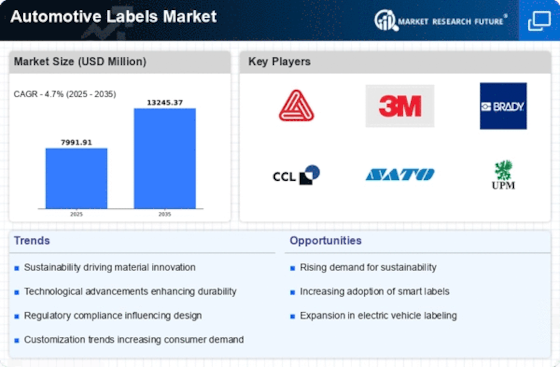
As per Market Research Future analysis, the Automotive Labels Market Size was estimated at 7991.91 USD Million in 2024. The Automotive Labels industry is projected to grow from 8367.53 USD Million in 2025 to 13245.37 USD Million by 2035, exhibiting a compound annual growth rate (CAGR) of 4.7% during the forecast period 2025 - 2035

Key Market Trends & Highlights

The Automotive Labels Market is poised for growth driven by sustainability and technological advancements.

  • North America remains the largest market for automotive labels, reflecting robust vehicle production and consumer demand. Asia-Pacific is the fastest-growing region, indicating a surge in automotive manufacturing and innovation. Asset labels dominate the market, while branding labels are experiencing rapid growth due to increasing customization trends. Key market drivers include regulatory compliance and rising vehicle production, which are shaping the industry's future.

Market Size & Forecast

2024 Market Size 7991.91 (USD Million)
2035 Market Size 13245.37 (USD Million)
CAGR (2025 - 2035) 4.7%
Largest Regional Market Share in 2024 Europe

Major Players

Avery Dennison (US), 3M (US), Brady Corporation (US), CCL Industries (CA), SATO Holdings (JP), UPM Raflatac (FI), Schreiner Group (DE), Mactac (US), Label Tech (US)

Market Trends

The Automotive Labels Market is currently experiencing a dynamic evolution, driven by various factors that influence consumer preferences and regulatory requirements. As vehicles become increasingly sophisticated, the demand for high-quality automotive label solutions that can withstand diverse environmental conditions is on the rise. This automotive labels market encompasses a wide range of applications, including safety labels, branding labels, and regulatory compliance labels, all of which fall under broader automotive product labeling each serving a distinct purpose in enhancing vehicle functionality and consumer awareness.

Furthermore, the shift towards electric vehicles and advanced driver-assistance systems is likely to create new opportunities for label manufacturers, as these technologies often require specialized labeling solutions to convey critical information effectively. In addition, sustainability trends are shaping the Automotive Labels Market, as manufacturers seek eco-friendly materials and processes to meet consumer expectations and regulatory standards.

Compliance with label requirements for automotive applications has become increasingly important, prompting innovation in label durability, adhesive performance, and material selection. The integration of smart technologies into labels, such as QR codes and NFC tags, appears to be gaining traction, providing consumers with instant access to product information and enhancing the overall user experience. As the market continues to evolve, stakeholders must remain agile and responsive to emerging trends, ensuring that their automotive labeling solutions  align with the changing landscape of the automotive industry. This adaptability will be crucial for maintaining competitiveness and meeting the diverse needs of consumers and manufacturers alike.

Sustainability Initiatives

The Automotive Labels Market is increasingly influenced by sustainability initiatives, as manufacturers strive to adopt eco-friendly materials and production methods. This shift in automotive product labeling  reflects a growing consumer demand for environmentally responsible products, prompting companies to innovate in label design and materials.

Technological Integration

The integration of advanced technologies into automotive labeling solutions is becoming more prevalent. Features such as QR codes and NFC tags are being incorporated, allowing consumers to access detailed product information and enhancing the interaction between vehicles and users.

Customization and Personalization

Customization is emerging as a key trend within the Automotive Labels Market. Consumers are seeking personalized labels that reflect their individual preferences, leading manufacturers to offer more tailored solutions that cater to specific branding and aesthetic requirements.

Automotive Labels Market Market Drivers

Customization Trends

Customization trends are emerging as a key driver in the Automotive Labels Market. As consumers seek personalized experiences, automotive manufacturers are responding by offering customized vehicle options, which include tailored labels. These labels can reflect individual preferences, such as unique designs, colors, and information specific to the vehicle's features. The trend towards customization is supported by advancements in printing technology, allowing for cost-effective production of small batches of personalized labels. This shift is particularly evident in the luxury and performance vehicle segments, where branding and personalization are paramount. As the demand for customized vehicles grows, the Automotive Labels Market is expected to expand, providing opportunities for label manufacturers to innovate and cater to this evolving consumer preference.

Regulatory Compliance

The Automotive Labels Market is increasingly influenced by stringent regulatory requirements aimed at enhancing vehicle safety and environmental standards. Governments worldwide are implementing regulations that necessitate clear labeling of automotive components, which includes safety warnings, material composition, and recycling information. For instance, the European Union's REACH regulation mandates that manufacturers provide detailed information on hazardous substances in automotive products. This regulatory landscape compels manufacturers to invest in high-quality labels that comply with these standards, thereby driving demand within the Automotive Labels Market. As a result, companies are likely to allocate resources towards developing labels that not only meet legal requirements but also enhance consumer trust and brand reputation.

Rising Vehicle Production

The Automotive Labels Market is experiencing growth driven by the rising production of vehicles across various segments, including passenger cars, commercial vehicles, and electric vehicles. As manufacturers ramp up production to meet increasing consumer demand, the need for effective labeling becomes paramount. Labels serve critical functions, such as providing essential information about vehicle specifications, safety features, and compliance with environmental regulations. Data from automotive production statistics indicate a steady increase in vehicle output, which correlates with a heightened demand for automotive labels. This trend suggests that as vehicle production continues to rise, the Automotive Labels Market will likely expand in tandem, creating opportunities for label manufacturers.

Technological Advancements

Technological advancements play a pivotal role in shaping the Automotive Labels Market. Innovations in printing technology, such as digital printing and advanced adhesive materials, enable manufacturers to produce high-quality, durable labels that withstand harsh automotive environments. The integration of QR codes and NFC technology into labels allows for enhanced interactivity, providing consumers with instant access to product information and maintenance guidelines. According to industry reports, the adoption of these technologies is expected to grow, with the market for smart labels projected to reach substantial figures by 2027. This trend indicates a shift towards more informative and user-friendly labeling solutions, thereby propelling growth in the Automotive Labels Market.

Consumer Awareness and Safety

Consumer awareness regarding vehicle safety and environmental impact is a significant driver for the Automotive Labels Market. As consumers become more informed about the importance of safety features and sustainable practices, the demand for clear and informative labels increases. Labels that provide information on safety ratings, material sourcing, and recycling options are becoming essential for manufacturers aiming to attract environmentally conscious buyers. This shift in consumer behavior is prompting automotive companies to prioritize labeling strategies that communicate their commitment to safety and sustainability. Consequently, the Automotive Labels Market is likely to see a surge in demand for labels that not only comply with regulations but also resonate with consumer values.

Market Segment Insights

By Type: Asset Labels (Largest) vs. Branding Labels (Fastest-Growing)

In the Automotive Labels Market, the distribution of market share among the various types is notably diverse. Asset Labels hold the largest share, primarily due to their essential role in vehicle identification and logistics management. Meanwhile, Branding Labels, which emphasize vehicle branding and manufacturer identity, have emerged as the fastest-growing segment, reflecting a rising trend in personalized vehicle aesthetics and brand loyalty among consumers. The growth trends within this segment are driven by several factors, including the increasing focus on asset management and tracking in the automotive industry, alongside the growing importance of branding among manufacturers. Additionally, regulations around safety and compliance have further boosted the demand for Warning &amp; Safety Labels, while the innovation in materials and printing technology has allowed for greater customization and durability in Branding and Dome Labels, supporting their rapid expansion in the market.

Asset Labels (Dominant) vs. Branding Labels (Emerging)

Asset Labels are currently the dominant segment in the Automotive Labels Market, renowned for their functionality in asset tracking and management. They are typically utilized for inventory management, ensuring vehicles can be efficiently tracked throughout their lifecycle. The emphasis is on durability and resilience, as these labels must withstand various environmental conditions. Conversely, Branding Labels represent an emerging segment, focusing on the artistic aspects of vehicle branding. They allow manufacturers to create a unique identity and enhance brand recognition, catering to the industry's shift towards personalization. As consumers increasingly prioritize brand loyalty, the demand for visually appealing and customizable Branding Labels is growing, thereby supporting their ascent as a vital segment in the market.

By Raw Materials: Polyethylene (PE) (Largest) vs. Polypropylene (PP) (Fastest-Growing)

In the automotive labels market, Polyethylene (PE) emerges as the largest segment, capturing a substantial share of the total market. Following closely is Polypropylene (PP), which has been gaining traction due to its favorable properties such as excellent clarity and adaptability. Polyethylene Terephthalate (PET) and Polyvinyl Chloride (PVC) are also prominent contributors, but their market shares are smaller compared to PE and PP. The 'Others' category, which includes various alternative raw materials, accounts for a limited portion of the market but is noteworthy for niche applications.

Polyethylene (PE) (Dominant) vs. Polypropylene (PP) (Emerging)

Polyethylene (PE) serves as the dominant force in the automotive labels market, especially favored for its lightweight nature and resistance to moisture and chemicals. With widespread applications ranging from labels on car interiors to exterior branding, PE is recognized for its versatility and affordability. On the other hand, Polypropylene (PP) is marked as an emerging raw material, experiencing significant growth in recent years. Its robust mechanical properties and ability to be processed into various forms make it ideal for intricate label designs. While PE maintains its market dominance, PP's rising popularity indicates shifting preferences as manufacturers seek innovative label solutions.

By Application: Engine Component Labels (Largest) vs. Exterior Labels (Fastest-Growing)

The Automotive Labels Market is characterized by a diverse range of applications, with Engine Component Labels securing the largest market share among the segment values. These labels play a crucial role in providing vital information on engine parts, catering to strict regulations and safety standards. Following closely is the market for Exterior Labels, which is witnessing significant growth due to increasing consumer demand for vehicle customization and branding opportunities. In recent years, the proliferation of lightweight materials and advanced printing technologies has bolstered the demand for Interior Labels as well, while the Other category captures niche applications such as warnings and operational instructions. The growth trends underscore a clear movement towards enhanced product visibility and compliance with industry regulations.

Engine Component Labels (Dominant) vs. Exterior Labels (Emerging)

Engine Component Labels dominate the Automotive Labels Market, given their critical function in ensuring compliance with safety standards and aiding in the identification of engine components. These labels are often subjected to extreme conditions, necessitating durable materials that withstand heat, oil, and other challenging environments. On the other hand, Exterior Labels are emerging as a key player within the market, driven by trends toward vehicle personalization and aesthetic enhancement. This category leverages innovative design techniques and sustainable materials to meet consumer expectations for both functionality and environmental responsibility. While Engine Component Labels maintain a stronghold on the market due to regulatory requirements, the growth of Exterior Labels indicates a shifting consumer focus towards style and uniqueness in automotive branding.

Get more detailed insights about Automotive Labels Market Research Report - Global Forecast till 2035

Regional Insights

North America : Market Leader in Innovation

North America is the largest market for automotive labels, holding approximately 40% of the global share. The region's growth is driven by increasing vehicle production, stringent regulations on vehicle safety, and a rising demand for advanced labeling solutions. The automotive sector's focus on sustainability and compliance with environmental regulations further fuels this demand. The United States and Canada are the leading countries in this market, with major players like Avery Dennison, 3M, and Brady Corporation establishing a strong presence. The competitive landscape is characterized by innovation and technological advancements, with companies investing in R&D to develop eco-friendly and durable labeling solutions. The presence of key players ensures a robust supply chain and distribution network.

Europe : Regulatory-Driven Market Growth

Europe is the second-largest market for automotive labels, accounting for around 30% of the global market share. The region's growth is significantly influenced by stringent regulations regarding vehicle emissions and safety standards. The European Union's commitment to sustainability and circular economy principles drives demand for eco-friendly labeling solutions, making it a key market for innovation. Leading countries include Germany, France, and the UK, where major players like Schreiner Group and UPM Raflatac are prominent. The competitive landscape is marked by a focus on sustainability and compliance with regulations, pushing companies to innovate. The presence of established automotive manufacturers in the region further enhances the demand for high-quality labeling solutions.

Asia-Pacific : Emerging Market Potential

Asia-Pacific is witnessing rapid growth in the automotive labels market, holding approximately 25% of the global share. The region's expansion is driven by increasing vehicle production, urbanization, and rising disposable incomes. Countries like China and India are leading this growth, supported by government initiatives to boost the automotive sector and improve infrastructure. China is the largest market in the region, with significant contributions from local manufacturers and global players like SATO Holdings. The competitive landscape is evolving, with a mix of established companies and new entrants focusing on innovative labeling solutions. The demand for high-quality, durable labels is increasing, driven by the growing automotive industry and consumer preferences for advanced features.

Middle East and Africa : Untapped Market Opportunities

The Middle East and Africa region is gradually emerging in the automotive labels market, holding about 5% of the global share. The growth is primarily driven by increasing vehicle sales, urbanization, and investments in infrastructure. Countries like South Africa and the UAE are leading this growth, with a focus on enhancing automotive manufacturing capabilities and improving regulatory frameworks. The competitive landscape is still developing, with opportunities for both local and international players. Key players are beginning to establish a presence in the region, focusing on innovative labeling solutions that meet the unique demands of the market. As the automotive sector continues to grow, the demand for high-quality labels is expected to rise significantly.

Key Players and Competitive Insights

Due to the presence of a few vendors in the market providing the solution with the majority of the market share, the competitive landscape of the automotive labels market is consolidated. Major players are focusing on investment and expansion to expand their business operations in fast-growing regions such as Asia-Pacific. Because companies are still investing in R&D to develop products and solutions that meet customer demands, strategic partnerships and acquisitions are seen as the most lucrative path to gaining maximum market share. March 2022 - Avery Dennison Corporation announced that it had acquired the liner less label technology developed by Catchpoint Ltd, a UK company based in Yorkshire, England. After receiving Catchpoint, Avery Dennison will have intellectual property that will help us achieve two key 2030 sustainability goals to produce innovations that promote the circular economy and to reduce environmental impact in operations and technology.

Key Companies in the Automotive Labels Market include

Industry Developments

March 2022 :  Brady Corporation and HSI, a provider of Environmental Health and Safety (EHS), compliance, and professional development solutions, have formed a partnership to provide companies of all sizes with customizable safety management solutions (SMS) and related services. Brady Corporation gains access to a new level of technology as a result of this agreement, which also broadens HSI's influence and development in the EHS and SMS sectors. The collaboration's focal point is a new adjustable, integrated SMS and labelling system that will improve safety programs across the country.

January 2022 :  QSX Labels, based in Everett, Massachusetts, was acquired by Resource Label Group, LLC, strengthening its regional foothold in New England and securing its leadership position in the label and packaging sector. QSX Labels is the twenty-third purchase for Resource Label.

Future Outlook

Automotive Labels Market Future Outlook

The Automotive Labels Market is projected to grow at a 4.7% CAGR from 2025 to 2035, driven by technological advancements, increasing vehicle production, and regulatory compliance.

New opportunities lie in:

  • <p>Integration of smart labels with IoT technology for real-time tracking. Development of eco-friendly label materials to meet sustainability demands. Expansion into emerging markets with tailored automotive labeling solutions.</p>

By 2035, the Automotive Labels Market is expected to achieve robust growth and innovation.

Market Segmentation

Automotive Labels Market Type Outlook

  • Asset Labels
  • Branding Labels
  • Dome Labels
  • Warning & Safety Labels
  • Others

Automotive Labels Market Application Outlook

  • Engine Component Labels
  • Exterior Labels
  • Interior Labels
  • Others

Automotive Labels Market Raw Materials Outlook

  • Polyethylene (PE)
  • Polyethylene Terephthalate (PET)
  • Polypropylene (PP)
  • Polyvinyl Chloride (PVC)
  • Others

Report Scope

MARKET SIZE 2024 7991.91(USD Million)
MARKET SIZE 2025 8367.53(USD Million)
MARKET SIZE 2035 13245.37(USD Million)
COMPOUND ANNUAL GROWTH RATE (CAGR) 4.7% (2025 - 2035)
REPORT COVERAGE Revenue Forecast, Competitive Landscape, Growth Factors, and Trends
BASE YEAR 2024
Market Forecast Period 2025 - 2035
Historical Data 2019 - 2024
Market Forecast Units USD Million
Key Companies Profiled Avery Dennison (US), 3M (US), Brady Corporation (US), CCL Industries (CA), SATO Holdings (JP), UPM Raflatac (FI), Schreiner Group (DE), Mactac (US), Label Tech (US)
Segments Covered Type, Raw Materials, Application, Region
Key Market Opportunities Integration of smart technology in Automotive Labels enhances traceability and compliance with evolving regulations.
Key Market Dynamics Rising demand for sustainable materials in automotive labels driven by environmental regulations and consumer preferences.
Countries Covered North America, Europe, APAC, South America, MEA

FAQs

What is the projected market valuation for the Automotive Labels Market in 2035?

<p>The projected market valuation for the Automotive Labels Market in 2035 is 13245.37 USD Million.</p>

What was the overall market valuation of the Automotive Labels Market in 2024?

<p>The overall market valuation of the Automotive Labels Market in 2024 was 7991.91 USD Million.</p>

What is the expected CAGR for the Automotive Labels Market during the forecast period 2025 - 2035?

<p>The expected CAGR for the Automotive Labels Market during the forecast period 2025 - 2035 is 4.7%.</p>

Which companies are considered key players in the Automotive Labels Market?

<p>Key players in the Automotive Labels Market include Avery Dennison, 3M, Brady Corporation, CCL Industries, SATO Holdings, UPM Raflatac, Schreiner Group, Mactac, and Label Tech.</p>

What segment had the highest valuation in the Automotive Labels Market in 2024?

<p>In 2024, the Branding Labels segment had the highest valuation at 2500.0 USD Million.</p>

What are the projected valuations for the Polypropylene (PP) segment by 2035?

<p>The projected valuation for the Polypropylene (PP) segment by 2035 is 4200.0 USD Million.</p>

How do Engine Component Labels perform in terms of market valuation?

<p>Engine Component Labels had a valuation of 1598.38 USD Million in 2024 and are projected to reach 2700.0 USD Million by 2035.</p>

What is the valuation range for Warning & Safety Labels in the Automotive Labels Market?

<p>The valuation range for Warning & Safety Labels is from 2000.0 USD Million to 3000.0 USD Million.</p>

Which raw material segment is expected to show significant growth by 2035?

<p>The Polyethylene Terephthalate (PET) segment is expected to show significant growth, with a projected valuation of 3500.0 USD Million by 2035.</p>

What is the valuation for Others in the Application segment for the Automotive Labels Market?

<p>The valuation for Others in the Application segment is projected to range from 799.7 USD Million to 1145.37 USD Million.</p>

  1. SECTION I: EXECUTIVE SUMMARY AND KEY HIGHLIGHTS
    1. | 1.1 EXECUTIVE SUMMARY
    2. | | 1.1.1 Market Overview
    3. | | 1.1.2 Key Findings
    4. | | 1.1.3 Market Segmentation
    5. | | 1.1.4 Competitive Landscape
    6. | | 1.1.5 Challenges and Opportunities
    7. | | 1.1.6 Future Outlook
  2. SECTION II: SCOPING, METHODOLOGY AND MARKET STRUCTURE
    1. | 2.1 MARKET INTRODUCTION
    2. | | 2.1.1 Definition
    3. | | 2.1.2 Scope of the study
    4. | | | 2.1.2.1 Research Objective
    5. | | | 2.1.2.2 Assumption
    6. | | | 2.1.2.3 Limitations
    7. | 2.2 RESEARCH METHODOLOGY
    8. | | 2.2.1 Overview
    9. | | 2.2.2 Data Mining
    10. | | 2.2.3 Secondary Research
    11. | | 2.2.4 Primary Research
    12. | | | 2.2.4.1 Primary Interviews and Information Gathering Process
    13. | | | 2.2.4.2 Breakdown of Primary Respondents
    14. | | 2.2.5 Forecasting Model
    15. | | 2.2.6 Market Size Estimation
    16. | | | 2.2.6.1 Bottom-Up Approach
    17. | | | 2.2.6.2 Top-Down Approach
    18. | | 2.2.7 Data Triangulation
    19. | | 2.2.8 Validation
  3. SECTION III: QUALITATIVE ANALYSIS
    1. | 3.1 MARKET DYNAMICS
    2. | | 3.1.1 Overview
    3. | | 3.1.2 Drivers
    4. | | 3.1.3 Restraints
    5. | | 3.1.4 Opportunities
    6. | 3.2 MARKET FACTOR ANALYSIS
    7. | | 3.2.1 Value chain Analysis
    8. | | 3.2.2 Porter's Five Forces Analysis
    9. | | | 3.2.2.1 Bargaining Power of Suppliers
    10. | | | 3.2.2.2 Bargaining Power of Buyers
    11. | | | 3.2.2.3 Threat of New Entrants
    12. | | | 3.2.2.4 Threat of Substitutes
    13. | | | 3.2.2.5 Intensity of Rivalry
    14. | | 3.2.3 COVID-19 Impact Analysis
    15. | | | 3.2.3.1 Market Impact Analysis
    16. | | | 3.2.3.2 Regional Impact
    17. | | | 3.2.3.3 Opportunity and Threat Analysis
  4. SECTION IV: QUANTITATIVE ANALYSIS
    1. | 4.1 Automobile, BY Type (USD Million)
    2. | | 4.1.1 Asset Labels
    3. | | 4.1.2 Branding Labels
    4. | | 4.1.3 Dome Labels
    5. | | 4.1.4 Warning & Safety Labels
    6. | | 4.1.5 Others
    7. | 4.2 Automobile, BY Raw Materials (USD Million)
    8. | | 4.2.1 Polyethylene (PE)
    9. | | 4.2.2 Polyethylene Terephthalate (PET)
    10. | | 4.2.3 Polypropylene (PP)
    11. | | 4.2.4 Polyvinyl Chloride (PVC)
    12. | | 4.2.5 Others
    13. | 4.3 Automobile, BY Application (USD Million)
    14. | | 4.3.1 Engine Component Labels
    15. | | 4.3.2 Exterior Labels
    16. | | 4.3.3 Interior Labels
    17. | | 4.3.4 Others
    18. | 4.4 Automobile, BY Region (USD Million)
    19. | | 4.4.1 North America
    20. | | | 4.4.1.1 US
    21. | | | 4.4.1.2 Canada
    22. | | 4.4.2 Europe
    23. | | | 4.4.2.1 Germany
    24. | | | 4.4.2.2 UK
    25. | | | 4.4.2.3 France
    26. | | | 4.4.2.4 Russia
    27. | | | 4.4.2.5 Italy
    28. | | | 4.4.2.6 Spain
    29. | | | 4.4.2.7 Rest of Europe
    30. | | 4.4.3 APAC
    31. | | | 4.4.3.1 China
    32. | | | 4.4.3.2 India
    33. | | | 4.4.3.3 Japan
    34. | | | 4.4.3.4 South Korea
    35. | | | 4.4.3.5 Malaysia
    36. | | | 4.4.3.6 Thailand
    37. | | | 4.4.3.7 Indonesia
    38. | | | 4.4.3.8 Rest of APAC
    39. | | 4.4.4 South America
    40. | | | 4.4.4.1 Brazil
    41. | | | 4.4.4.2 Mexico
    42. | | | 4.4.4.3 Argentina
    43. | | | 4.4.4.4 Rest of South America
    44. | | 4.4.5 MEA
    45. | | | 4.4.5.1 GCC Countries
    46. | | | 4.4.5.2 South Africa
    47. | | | 4.4.5.3 Rest of MEA
  5. SECTION V: COMPETITIVE ANALYSIS
    1. | 5.1 Competitive Landscape
    2. | | 5.1.1 Overview
    3. | | 5.1.2 Competitive Analysis
    4. | | 5.1.3 Market share Analysis
    5. | | 5.1.4 Major Growth Strategy in the Automobile
    6. | | 5.1.5 Competitive Benchmarking
    7. | | 5.1.6 Leading Players in Terms of Number of Developments in the Automobile
    8. | | 5.1.7 Key developments and growth strategies
    9. | | | 5.1.7.1 New Product Launch/Service Deployment
    10. | | | 5.1.7.2 Merger & Acquisitions
    11. | | | 5.1.7.3 Joint Ventures
    12. | | 5.1.8 Major Players Financial Matrix
    13. | | | 5.1.8.1 Sales and Operating Income
    14. | | | 5.1.8.2 Major Players R&D Expenditure. 2023
    15. | 5.2 Company Profiles
    16. | | 5.2.1 Avery Dennison (US)
    17. | | | 5.2.1.1 Financial Overview
    18. | | | 5.2.1.2 Products Offered
    19. | | | 5.2.1.3 Key Developments
    20. | | | 5.2.1.4 SWOT Analysis
    21. | | | 5.2.1.5 Key Strategies
    22. | | 5.2.2 3M (US)
    23. | | | 5.2.2.1 Financial Overview
    24. | | | 5.2.2.2 Products Offered
    25. | | | 5.2.2.3 Key Developments
    26. | | | 5.2.2.4 SWOT Analysis
    27. | | | 5.2.2.5 Key Strategies
    28. | | 5.2.3 Brady Corporation (US)
    29. | | | 5.2.3.1 Financial Overview
    30. | | | 5.2.3.2 Products Offered
    31. | | | 5.2.3.3 Key Developments
    32. | | | 5.2.3.4 SWOT Analysis
    33. | | | 5.2.3.5 Key Strategies
    34. | | 5.2.4 CCL Industries (CA)
    35. | | | 5.2.4.1 Financial Overview
    36. | | | 5.2.4.2 Products Offered
    37. | | | 5.2.4.3 Key Developments
    38. | | | 5.2.4.4 SWOT Analysis
    39. | | | 5.2.4.5 Key Strategies
    40. | | 5.2.5 SATO Holdings (JP)
    41. | | | 5.2.5.1 Financial Overview
    42. | | | 5.2.5.2 Products Offered
    43. | | | 5.2.5.3 Key Developments
    44. | | | 5.2.5.4 SWOT Analysis
    45. | | | 5.2.5.5 Key Strategies
    46. | | 5.2.6 UPM Raflatac (FI)
    47. | | | 5.2.6.1 Financial Overview
    48. | | | 5.2.6.2 Products Offered
    49. | | | 5.2.6.3 Key Developments
    50. | | | 5.2.6.4 SWOT Analysis
    51. | | | 5.2.6.5 Key Strategies
    52. | | 5.2.7 Schreiner Group (DE)
    53. | | | 5.2.7.1 Financial Overview
    54. | | | 5.2.7.2 Products Offered
    55. | | | 5.2.7.3 Key Developments
    56. | | | 5.2.7.4 SWOT Analysis
    57. | | | 5.2.7.5 Key Strategies
    58. | | 5.2.8 Mactac (US)
    59. | | | 5.2.8.1 Financial Overview
    60. | | | 5.2.8.2 Products Offered
    61. | | | 5.2.8.3 Key Developments
    62. | | | 5.2.8.4 SWOT Analysis
    63. | | | 5.2.8.5 Key Strategies
    64. | | 5.2.9 Label Tech (US)
    65. | | | 5.2.9.1 Financial Overview
    66. | | | 5.2.9.2 Products Offered
    67. | | | 5.2.9.3 Key Developments
    68. | | | 5.2.9.4 SWOT Analysis
    69. | | | 5.2.9.5 Key Strategies
    70. | 5.3 Appendix
    71. | | 5.3.1 References
    72. | | 5.3.2 Related Reports
  6. LIST OF FIGURES
    1. | 6.1 MARKET SYNOPSIS
    2. | 6.2 NORTH AMERICA MARKET ANALYSIS
    3. | 6.3 US MARKET ANALYSIS BY TYPE
    4. | 6.4 US MARKET ANALYSIS BY RAW MATERIALS
    5. | 6.5 US MARKET ANALYSIS BY APPLICATION
    6. | 6.6 CANADA MARKET ANALYSIS BY TYPE
    7. | 6.7 CANADA MARKET ANALYSIS BY RAW MATERIALS
    8. | 6.8 CANADA MARKET ANALYSIS BY APPLICATION
    9. | 6.9 EUROPE MARKET ANALYSIS
    10. | 6.10 GERMANY MARKET ANALYSIS BY TYPE
    11. | 6.11 GERMANY MARKET ANALYSIS BY RAW MATERIALS
    12. | 6.12 GERMANY MARKET ANALYSIS BY APPLICATION
    13. | 6.13 UK MARKET ANALYSIS BY TYPE
    14. | 6.14 UK MARKET ANALYSIS BY RAW MATERIALS
    15. | 6.15 UK MARKET ANALYSIS BY APPLICATION
    16. | 6.16 FRANCE MARKET ANALYSIS BY TYPE
    17. | 6.17 FRANCE MARKET ANALYSIS BY RAW MATERIALS
    18. | 6.18 FRANCE MARKET ANALYSIS BY APPLICATION
    19. | 6.19 RUSSIA MARKET ANALYSIS BY TYPE
    20. | 6.20 RUSSIA MARKET ANALYSIS BY RAW MATERIALS
    21. | 6.21 RUSSIA MARKET ANALYSIS BY APPLICATION
    22. | 6.22 ITALY MARKET ANALYSIS BY TYPE
    23. | 6.23 ITALY MARKET ANALYSIS BY RAW MATERIALS
    24. | 6.24 ITALY MARKET ANALYSIS BY APPLICATION
    25. | 6.25 SPAIN MARKET ANALYSIS BY TYPE
    26. | 6.26 SPAIN MARKET ANALYSIS BY RAW MATERIALS
    27. | 6.27 SPAIN MARKET ANALYSIS BY APPLICATION
    28. | 6.28 REST OF EUROPE MARKET ANALYSIS BY TYPE
    29. | 6.29 REST OF EUROPE MARKET ANALYSIS BY RAW MATERIALS
    30. | 6.30 REST OF EUROPE MARKET ANALYSIS BY APPLICATION
    31. | 6.31 APAC MARKET ANALYSIS
    32. | 6.32 CHINA MARKET ANALYSIS BY TYPE
    33. | 6.33 CHINA MARKET ANALYSIS BY RAW MATERIALS
    34. | 6.34 CHINA MARKET ANALYSIS BY APPLICATION
    35. | 6.35 INDIA MARKET ANALYSIS BY TYPE
    36. | 6.36 INDIA MARKET ANALYSIS BY RAW MATERIALS
    37. | 6.37 INDIA MARKET ANALYSIS BY APPLICATION
    38. | 6.38 JAPAN MARKET ANALYSIS BY TYPE
    39. | 6.39 JAPAN MARKET ANALYSIS BY RAW MATERIALS
    40. | 6.40 JAPAN MARKET ANALYSIS BY APPLICATION
    41. | 6.41 SOUTH KOREA MARKET ANALYSIS BY TYPE
    42. | 6.42 SOUTH KOREA MARKET ANALYSIS BY RAW MATERIALS
    43. | 6.43 SOUTH KOREA MARKET ANALYSIS BY APPLICATION
    44. | 6.44 MALAYSIA MARKET ANALYSIS BY TYPE
    45. | 6.45 MALAYSIA MARKET ANALYSIS BY RAW MATERIALS
    46. | 6.46 MALAYSIA MARKET ANALYSIS BY APPLICATION
    47. | 6.47 THAILAND MARKET ANALYSIS BY TYPE
    48. | 6.48 THAILAND MARKET ANALYSIS BY RAW MATERIALS
    49. | 6.49 THAILAND MARKET ANALYSIS BY APPLICATION
    50. | 6.50 INDONESIA MARKET ANALYSIS BY TYPE
    51. | 6.51 INDONESIA MARKET ANALYSIS BY RAW MATERIALS
    52. | 6.52 INDONESIA MARKET ANALYSIS BY APPLICATION
    53. | 6.53 REST OF APAC MARKET ANALYSIS BY TYPE
    54. | 6.54 REST OF APAC MARKET ANALYSIS BY RAW MATERIALS
    55. | 6.55 REST OF APAC MARKET ANALYSIS BY APPLICATION
    56. | 6.56 SOUTH AMERICA MARKET ANALYSIS
    57. | 6.57 BRAZIL MARKET ANALYSIS BY TYPE
    58. | 6.58 BRAZIL MARKET ANALYSIS BY RAW MATERIALS
    59. | 6.59 BRAZIL MARKET ANALYSIS BY APPLICATION
    60. | 6.60 MEXICO MARKET ANALYSIS BY TYPE
    61. | 6.61 MEXICO MARKET ANALYSIS BY RAW MATERIALS
    62. | 6.62 MEXICO MARKET ANALYSIS BY APPLICATION
    63. | 6.63 ARGENTINA MARKET ANALYSIS BY TYPE
    64. | 6.64 ARGENTINA MARKET ANALYSIS BY RAW MATERIALS
    65. | 6.65 ARGENTINA MARKET ANALYSIS BY APPLICATION
    66. | 6.66 REST OF SOUTH AMERICA MARKET ANALYSIS BY TYPE
    67. | 6.67 REST OF SOUTH AMERICA MARKET ANALYSIS BY RAW MATERIALS
    68. | 6.68 REST OF SOUTH AMERICA MARKET ANALYSIS BY APPLICATION
    69. | 6.69 MEA MARKET ANALYSIS
    70. | 6.70 GCC COUNTRIES MARKET ANALYSIS BY TYPE
    71. | 6.71 GCC COUNTRIES MARKET ANALYSIS BY RAW MATERIALS
    72. | 6.72 GCC COUNTRIES MARKET ANALYSIS BY APPLICATION
    73. | 6.73 SOUTH AFRICA MARKET ANALYSIS BY TYPE
    74. | 6.74 SOUTH AFRICA MARKET ANALYSIS BY RAW MATERIALS
    75. | 6.75 SOUTH AFRICA MARKET ANALYSIS BY APPLICATION
    76. | 6.76 REST OF MEA MARKET ANALYSIS BY TYPE
    77. | 6.77 REST OF MEA MARKET ANALYSIS BY RAW MATERIALS
    78. | 6.78 REST OF MEA MARKET ANALYSIS BY APPLICATION
    79. | 6.79 KEY BUYING CRITERIA OF AUTOMOBILE
    80. | 6.80 RESEARCH PROCESS OF MRFR
    81. | 6.81 DRO ANALYSIS OF AUTOMOBILE
    82. | 6.82 DRIVERS IMPACT ANALYSIS: AUTOMOBILE
    83. | 6.83 RESTRAINTS IMPACT ANALYSIS: AUTOMOBILE
    84. | 6.84 SUPPLY / VALUE CHAIN: AUTOMOBILE
    85. | 6.85 AUTOMOBILE, BY TYPE, 2024 (% SHARE)
    86. | 6.86 AUTOMOBILE, BY TYPE, 2024 TO 2035 (USD Million)
    87. | 6.87 AUTOMOBILE, BY RAW MATERIALS, 2024 (% SHARE)
    88. | 6.88 AUTOMOBILE, BY RAW MATERIALS, 2024 TO 2035 (USD Million)
    89. | 6.89 AUTOMOBILE, BY APPLICATION, 2024 (% SHARE)
    90. | 6.90 AUTOMOBILE, BY APPLICATION, 2024 TO 2035 (USD Million)
    91. | 6.91 BENCHMARKING OF MAJOR COMPETITORS
  7. LIST OF TABLES
    1. | 7.1 LIST OF ASSUMPTIONS
    2. | | 7.1.1
    3. | 7.2 North America MARKET SIZE ESTIMATES; FORECAST
    4. | | 7.2.1 BY TYPE, 2025-2035 (USD Million)
    5. | | 7.2.2 BY RAW MATERIALS, 2025-2035 (USD Million)
    6. | | 7.2.3 BY APPLICATION, 2025-2035 (USD Million)
    7. | 7.3 US MARKET SIZE ESTIMATES; FORECAST
    8. | | 7.3.1 BY TYPE, 2025-2035 (USD Million)
    9. | | 7.3.2 BY RAW MATERIALS, 2025-2035 (USD Million)
    10. | | 7.3.3 BY APPLICATION, 2025-2035 (USD Million)
    11. | 7.4 Canada MARKET SIZE ESTIMATES; FORECAST
    12. | | 7.4.1 BY TYPE, 2025-2035 (USD Million)
    13. | | 7.4.2 BY RAW MATERIALS, 2025-2035 (USD Million)
    14. | | 7.4.3 BY APPLICATION, 2025-2035 (USD Million)
    15. | 7.5 Europe MARKET SIZE ESTIMATES; FORECAST
    16. | | 7.5.1 BY TYPE, 2025-2035 (USD Million)
    17. | | 7.5.2 BY RAW MATERIALS, 2025-2035 (USD Million)
    18. | | 7.5.3 BY APPLICATION, 2025-2035 (USD Million)
    19. | 7.6 Germany MARKET SIZE ESTIMATES; FORECAST
    20. | | 7.6.1 BY TYPE, 2025-2035 (USD Million)
    21. | | 7.6.2 BY RAW MATERIALS, 2025-2035 (USD Million)
    22. | | 7.6.3 BY APPLICATION, 2025-2035 (USD Million)
    23. | 7.7 UK MARKET SIZE ESTIMATES; FORECAST
    24. | | 7.7.1 BY TYPE, 2025-2035 (USD Million)
    25. | | 7.7.2 BY RAW MATERIALS, 2025-2035 (USD Million)
    26. | | 7.7.3 BY APPLICATION, 2025-2035 (USD Million)
    27. | 7.8 France MARKET SIZE ESTIMATES; FORECAST
    28. | | 7.8.1 BY TYPE, 2025-2035 (USD Million)
    29. | | 7.8.2 BY RAW MATERIALS, 2025-2035 (USD Million)
    30. | | 7.8.3 BY APPLICATION, 2025-2035 (USD Million)
    31. | 7.9 Russia MARKET SIZE ESTIMATES; FORECAST
    32. | | 7.9.1 BY TYPE, 2025-2035 (USD Million)
    33. | | 7.9.2 BY RAW MATERIALS, 2025-2035 (USD Million)
    34. | | 7.9.3 BY APPLICATION, 2025-2035 (USD Million)
    35. | 7.10 Italy MARKET SIZE ESTIMATES; FORECAST
    36. | | 7.10.1 BY TYPE, 2025-2035 (USD Million)
    37. | | 7.10.2 BY RAW MATERIALS, 2025-2035 (USD Million)
    38. | | 7.10.3 BY APPLICATION, 2025-2035 (USD Million)
    39. | 7.11 Spain MARKET SIZE ESTIMATES; FORECAST
    40. | | 7.11.1 BY TYPE, 2025-2035 (USD Million)
    41. | | 7.11.2 BY RAW MATERIALS, 2025-2035 (USD Million)
    42. | | 7.11.3 BY APPLICATION, 2025-2035 (USD Million)
    43. | 7.12 Rest of Europe MARKET SIZE ESTIMATES; FORECAST
    44. | | 7.12.1 BY TYPE, 2025-2035 (USD Million)
    45. | | 7.12.2 BY RAW MATERIALS, 2025-2035 (USD Million)
    46. | | 7.12.3 BY APPLICATION, 2025-2035 (USD Million)
    47. | 7.13 APAC MARKET SIZE ESTIMATES; FORECAST
    48. | | 7.13.1 BY TYPE, 2025-2035 (USD Million)
    49. | | 7.13.2 BY RAW MATERIALS, 2025-2035 (USD Million)
    50. | | 7.13.3 BY APPLICATION, 2025-2035 (USD Million)
    51. | 7.14 China MARKET SIZE ESTIMATES; FORECAST
    52. | | 7.14.1 BY TYPE, 2025-2035 (USD Million)
    53. | | 7.14.2 BY RAW MATERIALS, 2025-2035 (USD Million)
    54. | | 7.14.3 BY APPLICATION, 2025-2035 (USD Million)
    55. | 7.15 India MARKET SIZE ESTIMATES; FORECAST
    56. | | 7.15.1 BY TYPE, 2025-2035 (USD Million)
    57. | | 7.15.2 BY RAW MATERIALS, 2025-2035 (USD Million)
    58. | | 7.15.3 BY APPLICATION, 2025-2035 (USD Million)
    59. | 7.16 Japan MARKET SIZE ESTIMATES; FORECAST
    60. | | 7.16.1 BY TYPE, 2025-2035 (USD Million)
    61. | | 7.16.2 BY RAW MATERIALS, 2025-2035 (USD Million)
    62. | | 7.16.3 BY APPLICATION, 2025-2035 (USD Million)
    63. | 7.17 South Korea MARKET SIZE ESTIMATES; FORECAST
    64. | | 7.17.1 BY TYPE, 2025-2035 (USD Million)
    65. | | 7.17.2 BY RAW MATERIALS, 2025-2035 (USD Million)
    66. | | 7.17.3 BY APPLICATION, 2025-2035 (USD Million)
    67. | 7.18 Malaysia MARKET SIZE ESTIMATES; FORECAST
    68. | | 7.18.1 BY TYPE, 2025-2035 (USD Million)
    69. | | 7.18.2 BY RAW MATERIALS, 2025-2035 (USD Million)
    70. | | 7.18.3 BY APPLICATION, 2025-2035 (USD Million)
    71. | 7.19 Thailand MARKET SIZE ESTIMATES; FORECAST
    72. | | 7.19.1 BY TYPE, 2025-2035 (USD Million)
    73. | | 7.19.2 BY RAW MATERIALS, 2025-2035 (USD Million)
    74. | | 7.19.3 BY APPLICATION, 2025-2035 (USD Million)
    75. | 7.20 Indonesia MARKET SIZE ESTIMATES; FORECAST
    76. | | 7.20.1 BY TYPE, 2025-2035 (USD Million)
    77. | | 7.20.2 BY RAW MATERIALS, 2025-2035 (USD Million)
    78. | | 7.20.3 BY APPLICATION, 2025-2035 (USD Million)
    79. | 7.21 Rest of APAC MARKET SIZE ESTIMATES; FORECAST
    80. | | 7.21.1 BY TYPE, 2025-2035 (USD Million)
    81. | | 7.21.2 BY RAW MATERIALS, 2025-2035 (USD Million)
    82. | | 7.21.3 BY APPLICATION, 2025-2035 (USD Million)
    83. | 7.22 South America MARKET SIZE ESTIMATES; FORECAST
    84. | | 7.22.1 BY TYPE, 2025-2035 (USD Million)
    85. | | 7.22.2 BY RAW MATERIALS, 2025-2035 (USD Million)
    86. | | 7.22.3 BY APPLICATION, 2025-2035 (USD Million)
    87. | 7.23 Brazil MARKET SIZE ESTIMATES; FORECAST
    88. | | 7.23.1 BY TYPE, 2025-2035 (USD Million)
    89. | | 7.23.2 BY RAW MATERIALS, 2025-2035 (USD Million)
    90. | | 7.23.3 BY APPLICATION, 2025-2035 (USD Million)
    91. | 7.24 Mexico MARKET SIZE ESTIMATES; FORECAST
    92. | | 7.24.1 BY TYPE, 2025-2035 (USD Million)
    93. | | 7.24.2 BY RAW MATERIALS, 2025-2035 (USD Million)
    94. | | 7.24.3 BY APPLICATION, 2025-2035 (USD Million)
    95. | 7.25 Argentina MARKET SIZE ESTIMATES; FORECAST
    96. | | 7.25.1 BY TYPE, 2025-2035 (USD Million)
    97. | | 7.25.2 BY RAW MATERIALS, 2025-2035 (USD Million)
    98. | | 7.25.3 BY APPLICATION, 2025-2035 (USD Million)
    99. | 7.26 Rest of South America MARKET SIZE ESTIMATES; FORECAST
    100. | | 7.26.1 BY TYPE, 2025-2035 (USD Million)
    101. | | 7.26.2 BY RAW MATERIALS, 2025-2035 (USD Million)
    102. | | 7.26.3 BY APPLICATION, 2025-2035 (USD Million)
    103. | 7.27 MEA MARKET SIZE ESTIMATES; FORECAST
    104. | | 7.27.1 BY TYPE, 2025-2035 (USD Million)
    105. | | 7.27.2 BY RAW MATERIALS, 2025-2035 (USD Million)
    106. | | 7.27.3 BY APPLICATION, 2025-2035 (USD Million)
    107. | 7.28 GCC Countries MARKET SIZE ESTIMATES; FORECAST
    108. | | 7.28.1 BY TYPE, 2025-2035 (USD Million)
    109. | | 7.28.2 BY RAW MATERIALS, 2025-2035 (USD Million)
    110. | | 7.28.3 BY APPLICATION, 2025-2035 (USD Million)
    111. | 7.29 South Africa MARKET SIZE ESTIMATES; FORECAST
    112. | | 7.29.1 BY TYPE, 2025-2035 (USD Million)
    113. | | 7.29.2 BY RAW MATERIALS, 2025-2035 (USD Million)
    114. | | 7.29.3 BY APPLICATION, 2025-2035 (USD Million)
    115. | 7.30 Rest of MEA MARKET SIZE ESTIMATES; FORECAST
    116. | | 7.30.1 BY TYPE, 2025-2035 (USD Million)
    117. | | 7.30.2 BY RAW MATERIALS, 2025-2035 (USD Million)
    118. | | 7.30.3 BY APPLICATION, 2025-2035 (USD Million)
    119. | 7.31 PRODUCT LAUNCH/PRODUCT DEVELOPMENT/APPROVAL
    120. | | 7.31.1
    121. | 7.32 ACQUISITION/PARTNERSHIP
    122. | | 7.32.1

Automobile Market Segmentation

Automobile By Type (USD Million, 2025-2035)

  • Asset Labels
  • Branding Labels
  • Dome Labels
  • Warning & Safety Labels
  • Others

Automobile By Raw Materials (USD Million, 2025-2035)

  • Polyethylene (PE)
  • Polyethylene Terephthalate (PET)
  • Polypropylene (PP)
  • Polyvinyl Chloride (PVC)
  • Others

Automobile By Application (USD Million, 2025-2035)

  • Engine Component Labels
  • Exterior Labels
  • Interior Labels
  • Others
Infographic

Free Sample Request

Kindly complete the form below to receive a free sample of this Report

Get Free Sample

Customer Strories

Compare Licence

×
Features License Type
Single User Multiuser License Enterprise User
Price $4,950 $5,950 $7,250
Maximum User Access Limit 1 User Upto 10 Users Unrestricted Access Throughout the Organization
Free Customization
Direct Access to Analyst
Deliverable Format
Platform Access
Discount on Next Purchase 10% 15% 15%
Printable Versions