×
Hero Background
English
Chinese
French
Japanese
Korean
German
Spanish

Automotive Labels Market Analysis

ID: MRFR/AT/1387-HCR
100 Pages
Sejal Akre
October 2025

Automotive Labels Market Research Report Information By Type (Asset Labels, Branding Labels, Dome Labels, Warning & Safety Labels, Others), By Raw Materials (Polyethylene (PE), Polyethylene terephthalate (PET), Polypropylene (PP), Polyvinyl chloride (PVC), Others), By Application (Engine Component Labels, Exterior Labels, Interior Labels, Others) And By Region (North America, Europe, Asia-Pacific, And Rest Of The World) - Forecast Till 2035

Share:
Download PDF ×

We do not share your information with anyone. However, we may send you emails based on your report interest from time to time. You may contact us at any time to opt-out.

Automotive Labels Market Infographic
Purchase Options

Market Analysis

In-depth Analysis of Automotive Labels Market Industry Landscape

There are various factors that determine the growth as well as the dynamics of Automotive Labels market. One major contributing factor is increasing automobile industry which requires efficient labeling solutions that can be used in different applications. For instance, they can provide vital information to their end users or act as brand identity materials or even help to meet safety standards stipulated by certain regulatory bodies. With increasing vehicle production globally there has been need for quality automotive labels driving up demand for labeling solutions within the automotive industry. Market dynamics for Automotive Labels have also changed significantly due to advancements in label materials and printing technologies. Continuous innovations made on adhesives manufacturing process contribute towards development of stickers that can withstand harsh conditions found in motor vehicles. Manufacturers have therefore invested heavily on R&D related activities aimed at developing advanced labeling solutions capable of meeting durability requirements, resilience from environmental factors and conformity with regulatory guidelines. Furthermore, integration of intelligent labeling options like RFID (Radio-Frequency Identification) tags has enhanced functionality of these products. The Automotive Labels market is influenced by regulatory frameworks and industrial standards that must be adhered to by players involved herein. Rules about safety issues; emissions control; provision of product-related information are applicable to this field. Specificity regarding what type of label should be used as well as how it should look means companies must comply with those regulations if they want their products sold legally under such tags. Therefore strict requirements concerning labeling products such as VIN (Vehicle Identification Numbers) labels and safety warnings have stimulated the adoption of labeling technologies that comply with regulatory guidelines. The overall health of the automotive industry as well as consumer purchasing power are some of the economic factors impacting the Automotive Labels market. Consequently, demand for auto labels can be influenced by fluctuations in motor vehicle production levels and consumer needs. During a recession period, there could be temporary negative impacts on this market but reliance on labeling solutions which are used for safety compliance, brand identification and information purposes ensures that the Automotive Labels market remains relevant in long term.

Author
Sejal Akre
Senior Research Analyst

She has over 5 years of rich experience, in market research and consulting providing valuable market insights to client. Hands on expertise in management consulting, and extensive knowledge in domain including ICT, Automotive & Transportation and Aerospace & Defense. She is skilled in Go-to market strategy, industry analysis, market sizing, in depth company profiling, competitive intelligence & benchmarking and value chain amongst others.

Leave a Comment

FAQs

What is the projected market valuation for the Automotive Labels Market in 2035?

The projected market valuation for the Automotive Labels Market in 2035 is 13245.37 USD Million.

What was the overall market valuation of the Automotive Labels Market in 2024?

The overall market valuation of the Automotive Labels Market in 2024 was 7991.91 USD Million.

What is the expected CAGR for the Automotive Labels Market during the forecast period 2025 - 2035?

The expected CAGR for the Automotive Labels Market during the forecast period 2025 - 2035 is 4.7%.

Which companies are considered key players in the Automotive Labels Market?

Key players in the Automotive Labels Market include Avery Dennison, 3M, Brady Corporation, CCL Industries, SATO Holdings, UPM Raflatac, Schreiner Group, Mactac, and Label Tech.

What segment had the highest valuation in the Automotive Labels Market in 2024?

In 2024, the Branding Labels segment had the highest valuation at 2500.0 USD Million.

What are the projected valuations for the Polypropylene (PP) segment by 2035?

The projected valuation for the Polypropylene (PP) segment by 2035 is 4200.0 USD Million.

How do Engine Component Labels perform in terms of market valuation?

Engine Component Labels had a valuation of 1598.38 USD Million in 2024 and are projected to reach 2700.0 USD Million by 2035.

Market Summary

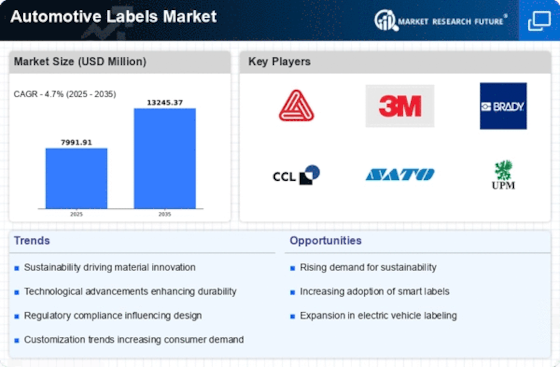
As per Market Research Future analysis, the Automotive Labels Market Size was estimated at 7991.91 USD Million in 2024. The Automotive Labels industry is projected to grow from 8367.53 USD Million in 2025 to 13245.37 USD Million by 2035, exhibiting a compound annual growth rate (CAGR) of 4.7% during the forecast period 2025 - 2035

Key Market Trends & Highlights

The Automotive Labels Market is poised for growth driven by sustainability and technological advancements.

  • North America remains the largest market for automotive labels, reflecting robust vehicle production and consumer demand. Asia-Pacific is the fastest-growing region, indicating a surge in automotive manufacturing and innovation. Asset labels dominate the market, while branding labels are experiencing rapid growth due to increasing customization trends. Key market drivers include regulatory compliance and rising vehicle production, which are shaping the industry's future.

Market Size & Forecast

2024 Market Size 7991.91 (USD Million)
2035 Market Size 13245.37 (USD Million)
CAGR (2025 - 2035) 4.7%
Largest Regional Market Share in 2024 Europe

Major Players

<p>Avery Dennison (US), 3M (US), Brady Corporation (US), CCL Industries (CA), SATO Holdings (JP), UPM Raflatac (FI), Schreiner Group (DE), Mactac (US), Label Tech (US)</p>

Market Trends

The Automotive Labels Market is currently experiencing a dynamic evolution, driven by various factors that influence consumer preferences and regulatory requirements. As vehicles become increasingly sophisticated, the demand for high-quality labels that can withstand diverse environmental conditions is on the rise. This market encompasses a wide range of applications, including safety labels, branding labels, and regulatory compliance labels, each serving a distinct purpose in enhancing vehicle functionality and consumer awareness. Furthermore, the shift towards electric vehicles and advanced driver-assistance systems is likely to create new opportunities for label manufacturers, as these technologies often require specialized labeling solutions to convey critical information effectively. In addition, sustainability trends are shaping the Automotive Labels Market, as manufacturers seek eco-friendly materials and processes to meet consumer expectations and regulatory standards. The integration of smart technologies into labels, such as QR codes and NFC tags, appears to be gaining traction, providing consumers with instant access to product information and enhancing the overall user experience. As the market continues to evolve, stakeholders must remain agile and responsive to emerging trends, ensuring that their offerings align with the changing landscape of the automotive industry. This adaptability will be crucial for maintaining competitiveness and meeting the diverse needs of consumers and manufacturers alike.

Sustainability Initiatives

The Automotive Labels Market is increasingly influenced by sustainability initiatives, as manufacturers strive to adopt eco-friendly materials and production methods. This trend reflects a growing consumer demand for environmentally responsible products, prompting companies to innovate in label design and materials.

Technological Integration

The integration of advanced technologies into automotive labels is becoming more prevalent. Features such as QR codes and NFC tags are being incorporated, allowing consumers to access detailed product information and enhancing the interaction between vehicles and users.

Customization and Personalization

Customization is emerging as a key trend within the Automotive Labels Market. Consumers are seeking personalized labels that reflect their individual preferences, leading manufacturers to offer more tailored solutions that cater to specific branding and aesthetic requirements.

Automotive Labels Market Market Drivers

Customization Trends

Customization trends are emerging as a key driver in the Automotive Labels Market. As consumers seek personalized experiences, automotive manufacturers are responding by offering customized vehicle options, which include tailored labels. These labels can reflect individual preferences, such as unique designs, colors, and information specific to the vehicle's features. The trend towards customization is supported by advancements in printing technology, allowing for cost-effective production of small batches of personalized labels. This shift is particularly evident in the luxury and performance vehicle segments, where branding and personalization are paramount. As the demand for customized vehicles grows, the Automotive Labels Market is expected to expand, providing opportunities for label manufacturers to innovate and cater to this evolving consumer preference.

Regulatory Compliance

The Automotive Labels Market is increasingly influenced by stringent regulatory requirements aimed at enhancing vehicle safety and environmental standards. Governments worldwide are implementing regulations that necessitate clear labeling of automotive components, which includes safety warnings, material composition, and recycling information. For instance, the European Union's REACH regulation mandates that manufacturers provide detailed information on hazardous substances in automotive products. This regulatory landscape compels manufacturers to invest in high-quality labels that comply with these standards, thereby driving demand within the Automotive Labels Market. As a result, companies are likely to allocate resources towards developing labels that not only meet legal requirements but also enhance consumer trust and brand reputation.

Rising Vehicle Production

The Automotive Labels Market is experiencing growth driven by the rising production of vehicles across various segments, including passenger cars, commercial vehicles, and electric vehicles. As manufacturers ramp up production to meet increasing consumer demand, the need for effective labeling becomes paramount. Labels serve critical functions, such as providing essential information about vehicle specifications, safety features, and compliance with environmental regulations. Data from automotive production statistics indicate a steady increase in vehicle output, which correlates with a heightened demand for automotive labels. This trend suggests that as vehicle production continues to rise, the Automotive Labels Market will likely expand in tandem, creating opportunities for label manufacturers.

Technological Advancements

Technological advancements play a pivotal role in shaping the Automotive Labels Market. Innovations in printing technology, such as digital printing and advanced adhesive materials, enable manufacturers to produce high-quality, durable labels that withstand harsh automotive environments. The integration of QR codes and NFC technology into labels allows for enhanced interactivity, providing consumers with instant access to product information and maintenance guidelines. According to industry reports, the adoption of these technologies is expected to grow, with the market for smart labels projected to reach substantial figures by 2027. This trend indicates a shift towards more informative and user-friendly labeling solutions, thereby propelling growth in the Automotive Labels Market.

Consumer Awareness and Safety

Consumer awareness regarding vehicle safety and environmental impact is a significant driver for the Automotive Labels Market. As consumers become more informed about the importance of safety features and sustainable practices, the demand for clear and informative labels increases. Labels that provide information on safety ratings, material sourcing, and recycling options are becoming essential for manufacturers aiming to attract environmentally conscious buyers. This shift in consumer behavior is prompting automotive companies to prioritize labeling strategies that communicate their commitment to safety and sustainability. Consequently, the Automotive Labels Market is likely to see a surge in demand for labels that not only comply with regulations but also resonate with consumer values.

Market Segment Insights

By Type: Asset Labels (Largest) vs. Branding Labels (Fastest-Growing)

<p>In the Automotive Labels Market, the distribution of market share among the various types is notably diverse. Asset Labels hold the largest share, primarily due to their essential role in vehicle identification and logistics management. Meanwhile, Branding Labels, which emphasize vehicle branding and manufacturer identity, have emerged as the fastest-growing segment, reflecting a rising trend in personalized vehicle aesthetics and brand loyalty among consumers. The growth trends within this segment are driven by several factors, including the increasing focus on asset management and tracking in the automotive industry, alongside the growing importance of branding among manufacturers. Additionally, regulations around safety and compliance have further boosted the demand for Warning &amp; Safety Labels, while the innovation in materials and printing technology has allowed for greater customization and durability in Branding and Dome Labels, supporting their rapid expansion in the market.</p>

<p>Asset Labels (Dominant) vs. Branding Labels (Emerging)</p>

<p>Asset Labels are currently the dominant segment in the Automotive Labels Market, renowned for their functionality in asset tracking and management. They are typically utilized for inventory management, ensuring vehicles can be efficiently tracked throughout their lifecycle. The emphasis is on durability and resilience, as these labels must withstand various environmental conditions. Conversely, Branding Labels represent an emerging segment, focusing on the artistic aspects of vehicle branding. They allow manufacturers to create a unique identity and enhance brand recognition, catering to the industry's shift towards personalization. As consumers increasingly prioritize brand loyalty, the demand for visually appealing and customizable Branding Labels is growing, thereby supporting their ascent as a vital segment in the market.</p>

By Raw Materials: Polyethylene (PE) (Largest) vs. Polypropylene (PP) (Fastest-Growing)

<p>In the automotive labels market, Polyethylene (PE) emerges as the largest segment, capturing a substantial share of the total market. Following closely is Polypropylene (PP), which has been gaining traction due to its favorable properties such as excellent clarity and adaptability. Polyethylene Terephthalate (PET) and Polyvinyl Chloride (PVC) are also prominent contributors, but their market shares are smaller compared to PE and PP. The 'Others' category, which includes various alternative raw materials, accounts for a limited portion of the market but is noteworthy for niche applications.</p>

<p>Polyethylene (PE) (Dominant) vs. Polypropylene (PP) (Emerging)</p>

<p>Polyethylene (PE) serves as the dominant force in the automotive labels market, especially favored for its lightweight nature and resistance to moisture and chemicals. With widespread applications ranging from labels on car interiors to exterior branding, PE is recognized for its versatility and affordability. On the other hand, Polypropylene (PP) is marked as an emerging raw material, experiencing significant growth in recent years. Its robust mechanical properties and ability to be processed into various forms make it ideal for intricate label designs. While PE maintains its market dominance, PP's rising popularity indicates shifting preferences as manufacturers seek innovative label solutions.</p>

By Application: Engine Component Labels (Largest) vs. Exterior Labels (Fastest-Growing)

<p>The Automotive Labels Market is characterized by a diverse range of applications, with Engine Component Labels securing the largest market share among the segment values. These labels play a crucial role in providing vital information on engine parts, catering to strict regulations and safety standards. Following closely is the market for Exterior Labels, which is witnessing significant growth due to increasing consumer demand for vehicle customization and branding opportunities. In recent years, the proliferation of lightweight materials and advanced printing technologies has bolstered the demand for Interior Labels as well, while the Other category captures niche applications such as warnings and operational instructions. The growth trends underscore a clear movement towards enhanced product visibility and compliance with industry regulations.</p>

<p>Engine Component Labels (Dominant) vs. Exterior Labels (Emerging)</p>

<p>Engine Component Labels dominate the Automotive Labels Market, given their critical function in ensuring compliance with safety standards and aiding in the identification of engine components. These labels are often subjected to extreme conditions, necessitating durable materials that withstand heat, oil, and other challenging environments. On the other hand, Exterior Labels are emerging as a key player within the market, driven by trends toward vehicle personalization and aesthetic enhancement. This category leverages innovative design techniques and sustainable materials to meet consumer expectations for both functionality and environmental responsibility. While Engine Component Labels maintain a stronghold on the market due to regulatory requirements, the growth of Exterior Labels indicates a shifting consumer focus towards style and uniqueness in automotive branding.</p>

Get more detailed insights about Automotive Labels Market Research Report - Global Forecast till 2035

Regional Insights

North America : Market Leader in Innovation

North America is the largest market for automotive labels, holding approximately 40% of the global share. The region's growth is driven by increasing vehicle production, stringent regulations on vehicle safety, and a rising demand for advanced labeling solutions. The automotive sector's focus on sustainability and compliance with environmental regulations further fuels this demand. The United States and Canada are the leading countries in this market, with major players like Avery Dennison, 3M, and Brady Corporation establishing a strong presence. The competitive landscape is characterized by innovation and technological advancements, with companies investing in R&D to develop eco-friendly and durable labeling solutions. The presence of key players ensures a robust supply chain and distribution network.

Europe : Regulatory-Driven Market Growth

Europe is the second-largest market for automotive labels, accounting for around 30% of the global market share. The region's growth is significantly influenced by stringent regulations regarding vehicle emissions and safety standards. The European Union's commitment to sustainability and circular economy principles drives demand for eco-friendly labeling solutions, making it a key market for innovation. Leading countries include Germany, France, and the UK, where major players like Schreiner Group and UPM Raflatac are prominent. The competitive landscape is marked by a focus on sustainability and compliance with regulations, pushing companies to innovate. The presence of established automotive manufacturers in the region further enhances the demand for high-quality labeling solutions.

Asia-Pacific : Emerging Market Potential

Asia-Pacific is witnessing rapid growth in the automotive labels market, holding approximately 25% of the global share. The region's expansion is driven by increasing vehicle production, urbanization, and rising disposable incomes. Countries like China and India are leading this growth, supported by government initiatives to boost the automotive sector and improve infrastructure. China is the largest market in the region, with significant contributions from local manufacturers and global players like SATO Holdings. The competitive landscape is evolving, with a mix of established companies and new entrants focusing on innovative labeling solutions. The demand for high-quality, durable labels is increasing, driven by the growing automotive industry and consumer preferences for advanced features.

Middle East and Africa : Untapped Market Opportunities

The Middle East and Africa region is gradually emerging in the automotive labels market, holding about 5% of the global share. The growth is primarily driven by increasing vehicle sales, urbanization, and investments in infrastructure. Countries like South Africa and the UAE are leading this growth, with a focus on enhancing automotive manufacturing capabilities and improving regulatory frameworks. The competitive landscape is still developing, with opportunities for both local and international players. Key players are beginning to establish a presence in the region, focusing on innovative labeling solutions that meet the unique demands of the market. As the automotive sector continues to grow, the demand for high-quality labels is expected to rise significantly.

Key Players and Competitive Insights

Due to the presence of a few vendors in the market providing the solution with the majority of the market share, the competitive landscape of the automotive labels market is consolidated. Major players are focusing on investment and expansion to expand their business operations in fast-growing regions such as Asia-Pacific. Because companies are still investing in R&D to develop products and solutions that meet customer demands, strategic partnerships and acquisitions are seen as the most lucrative path to gaining maximum market share.

March 2022 - Avery Dennison Corporation announced that it had acquired the liner less label technology developed by Catchpoint Ltd, a UK company based in Yorkshire, England. After receiving Catchpoint, Avery Dennison will have intellectual property that will help us achieve two key 2030 sustainability goals to produce innovations that promote the circular economy and to reduce environmental impact in operations and technology.

Key Companies in the Automotive Labels Market market include

Industry Developments

March 2022 :  Brady Corporation and HSI, a provider of Environmental Health and Safety (EHS), compliance, and professional development solutions, have formed a partnership to provide companies of all sizes with customizable safety management solutions (SMS) and related services. Brady Corporation gains access to a new level of technology as a result of this agreement, which also broadens HSI's influence and development in the EHS and SMS sectors. The collaboration's focal point is a new adjustable, integrated SMS and labelling system that will improve safety programs across the country.

January 2022 :  QSX Labels, based in Everett, Massachusetts, was acquired by Resource Label Group, LLC, strengthening its regional foothold in New England and securing its leadership position in the label and packaging sector. QSX Labels is the twenty-third purchase for Resource Label.

Future Outlook

Automotive Labels Market Future Outlook

<p>The Automotive Labels Market is projected to grow at a 4.7% CAGR from 2024 to 2035, driven by technological advancements, increasing vehicle production, and regulatory compliance.</p>

New opportunities lie in:

  • <p>Integration of smart labels with IoT technology for real-time tracking.</p>
  • <p>Development of eco-friendly label materials to meet sustainability demands.</p>
  • <p>Expansion into emerging markets with tailored automotive labeling solutions.</p>

<p>By 2035, the Automotive Labels Market is expected to achieve robust growth and innovation.</p>

Market Segmentation

Automotive Labels Market Type Outlook

  • Asset Labels
  • Branding Labels
  • Dome Labels
  • Warning & Safety Labels
  • Others

Automotive Labels Market Application Outlook

  • Engine Component Labels
  • Exterior Labels
  • Interior Labels
  • Others

Automotive Labels Market Raw Materials Outlook

  • Polyethylene (PE)
  • Polyethylene Terephthalate (PET)
  • Polypropylene (PP)
  • Polyvinyl Chloride (PVC)
  • Others

Report Scope

MARKET SIZE 2024 7991.91(USD Million)
MARKET SIZE 2025 8367.53(USD Million)
MARKET SIZE 2035 13245.37(USD Million)
COMPOUND ANNUAL GROWTH RATE (CAGR) 4.7% (2024 - 2035)
REPORT COVERAGE Revenue Forecast, Competitive Landscape, Growth Factors, and Trends
BASE YEAR 2024
Market Forecast Period 2025 - 2035
Historical Data 2019 - 2024
Market Forecast Units USD Million
Key Companies Profiled Avery Dennison (US), 3M (US), Brady Corporation (US), CCL Industries (CA), SATO Holdings (JP), UPM Raflatac (FI), Schreiner Group (DE), Mactac (US), Label Tech (US)
Segments Covered Type, Raw Materials, Application, Region
Key Market Opportunities Integration of smart technology in Automotive Labels enhances traceability and compliance with evolving regulations.
Key Market Dynamics Rising demand for sustainable materials in automotive labels driven by environmental regulations and consumer preferences.
Countries Covered North America, Europe, APAC, South America, MEA

FAQs

What is the projected market valuation for the Automotive Labels Market in 2035?

The projected market valuation for the Automotive Labels Market in 2035 is 13245.37 USD Million.

What was the overall market valuation of the Automotive Labels Market in 2024?

The overall market valuation of the Automotive Labels Market in 2024 was 7991.91 USD Million.

What is the expected CAGR for the Automotive Labels Market during the forecast period 2025 - 2035?

The expected CAGR for the Automotive Labels Market during the forecast period 2025 - 2035 is 4.7%.

Which companies are considered key players in the Automotive Labels Market?

Key players in the Automotive Labels Market include Avery Dennison, 3M, Brady Corporation, CCL Industries, SATO Holdings, UPM Raflatac, Schreiner Group, Mactac, and Label Tech.

What segment had the highest valuation in the Automotive Labels Market in 2024?

In 2024, the Branding Labels segment had the highest valuation at 2500.0 USD Million.

What are the projected valuations for the Polypropylene (PP) segment by 2035?

The projected valuation for the Polypropylene (PP) segment by 2035 is 4200.0 USD Million.

How do Engine Component Labels perform in terms of market valuation?

Engine Component Labels had a valuation of 1598.38 USD Million in 2024 and are projected to reach 2700.0 USD Million by 2035.

  1. SECTION I: EXECUTIVE SUMMARY AND KEY HIGHLIGHTS
    1. EXECUTIVE SUMMARY
      1. Market Overview
      2. Key Findings
      3. Market Segmentation
      4. Competitive Landscape
      5. Challenges and Opportunities
      6. Future Outlook 2
  2. SECTION II: SCOPING, METHODOLOGY AND MARKET STRUCTURE
    1. MARKET INTRODUCTION
      1. Definition
      2. Scope of the study
    2. RESEARCH METHODOLOGY
      1. Overview
      2. Data Mining
      3. Secondary Research
      4. Primary Research
      5. Forecasting Model
      6. Market Size Estimation
      7. Data Triangulation
      8. Validation 3
  3. SECTION III: QUALITATIVE ANALYSIS
    1. MARKET DYNAMICS
      1. Overview
      2. Drivers
      3. Restraints
      4. Opportunities
    2. MARKET FACTOR ANALYSIS
      1. Value chain Analysis
      2. Porter's Five Forces Analysis
      3. COVID-19 Impact Analysis
  4. SECTION IV: QUANTITATIVE ANALYSIS
    1. Automobile, BY Type (USD Million)
      1. Asset Labels
      2. Branding Labels
      3. Dome Labels
      4. Warning & Safety Labels
      5. Others
    2. Automobile, BY Raw Materials (USD Million)
      1. Polyethylene (PE)
      2. Polyethylene Terephthalate (PET)
      3. Polypropylene (PP)
      4. Polyvinyl Chloride (PVC)
      5. Others
    3. Automobile, BY Application (USD Million)
      1. Engine Component Labels
      2. Exterior Labels
      3. Interior Labels
      4. Others
    4. Automobile, BY Region (USD Million)
      1. North America
      2. Europe
      3. APAC
      4. South America
      5. MEA
  5. SECTION V: COMPETITIVE ANALYSIS
    1. Competitive Landscape
      1. Overview
      2. Competitive Analysis
      3. Market share Analysis
      4. Major Growth Strategy in the Automobile
      5. Competitive Benchmarking
      6. Leading Players in Terms of Number of Developments in the Automobile
      7. Key developments and growth strategies
      8. Major Players Financial Matrix
    2. Company Profiles
      1. Avery Dennison (US)
      2. 3M (US)
      3. Brady Corporation (US)
      4. CCL Industries (CA)
      5. SATO Holdings (JP)
      6. UPM Raflatac (FI)
      7. Schreiner Group (DE)
      8. Mactac (US)
      9. Label Tech (US)
    3. Appendix
      1. References
      2. Related Reports 6 LIST OF FIGURES
    4. MARKET SYNOPSIS
    5. NORTH AMERICA MARKET ANALYSIS
    6. US MARKET ANALYSIS BY TYPE
    7. US MARKET ANALYSIS BY RAW MATERIALS
    8. US MARKET ANALYSIS BY APPLICATION
    9. CANADA MARKET ANALYSIS BY TYPE
    10. CANADA MARKET ANALYSIS BY RAW MATERIALS
    11. CANADA MARKET ANALYSIS BY APPLICATION
    12. EUROPE MARKET ANALYSIS
    13. GERMANY MARKET ANALYSIS BY TYPE
    14. GERMANY MARKET ANALYSIS BY RAW MATERIALS
    15. GERMANY MARKET ANALYSIS BY APPLICATION
    16. UK MARKET ANALYSIS BY TYPE
    17. UK MARKET ANALYSIS BY RAW MATERIALS
    18. UK MARKET ANALYSIS BY APPLICATION
    19. FRANCE MARKET ANALYSIS BY TYPE
    20. FRANCE MARKET ANALYSIS BY RAW MATERIALS
    21. FRANCE MARKET ANALYSIS BY APPLICATION
    22. RUSSIA MARKET ANALYSIS BY TYPE
    23. RUSSIA MARKET ANALYSIS BY RAW MATERIALS
    24. RUSSIA MARKET ANALYSIS BY APPLICATION
    25. ITALY MARKET ANALYSIS BY TYPE
    26. ITALY MARKET ANALYSIS BY RAW MATERIALS
    27. ITALY MARKET ANALYSIS BY APPLICATION
    28. SPAIN MARKET ANALYSIS BY TYPE
    29. SPAIN MARKET ANALYSIS BY RAW MATERIALS
    30. SPAIN MARKET ANALYSIS BY APPLICATION
    31. REST OF EUROPE MARKET ANALYSIS BY TYPE
    32. REST OF EUROPE MARKET ANALYSIS BY RAW MATERIALS
    33. REST OF EUROPE MARKET ANALYSIS BY APPLICATION
    34. APAC MARKET ANALYSIS
    35. CHINA MARKET ANALYSIS BY TYPE
    36. CHINA MARKET ANALYSIS BY RAW MATERIALS
    37. CHINA MARKET ANALYSIS BY APPLICATION
    38. INDIA MARKET ANALYSIS BY TYPE
    39. INDIA MARKET ANALYSIS BY RAW MATERIALS
    40. INDIA MARKET ANALYSIS BY APPLICATION
    41. JAPAN MARKET ANALYSIS BY TYPE
    42. JAPAN MARKET ANALYSIS BY RAW MATERIALS
    43. JAPAN MARKET ANALYSIS BY APPLICATION
    44. SOUTH KOREA MARKET ANALYSIS BY TYPE
    45. SOUTH KOREA MARKET ANALYSIS BY RAW MATERIALS
    46. SOUTH KOREA MARKET ANALYSIS BY APPLICATION
    47. MALAYSIA MARKET ANALYSIS BY TYPE
    48. MALAYSIA MARKET ANALYSIS BY RAW MATERIALS
    49. MALAYSIA MARKET ANALYSIS BY APPLICATION
    50. THAILAND MARKET ANALYSIS BY TYPE
    51. THAILAND MARKET ANALYSIS BY RAW MATERIALS
    52. THAILAND MARKET ANALYSIS BY APPLICATION
    53. INDONESIA MARKET ANALYSIS BY TYPE
    54. INDONESIA MARKET ANALYSIS BY RAW MATERIALS
    55. INDONESIA MARKET ANALYSIS BY APPLICATION
    56. REST OF APAC MARKET ANALYSIS BY TYPE
    57. REST OF APAC MARKET ANALYSIS BY RAW MATERIALS
    58. REST OF APAC MARKET ANALYSIS BY APPLICATION
    59. SOUTH AMERICA MARKET ANALYSIS
    60. BRAZIL MARKET ANALYSIS BY TYPE
    61. BRAZIL MARKET ANALYSIS BY RAW MATERIALS
    62. BRAZIL MARKET ANALYSIS BY APPLICATION
    63. MEXICO MARKET ANALYSIS BY TYPE
    64. MEXICO MARKET ANALYSIS BY RAW MATERIALS
    65. MEXICO MARKET ANALYSIS BY APPLICATION
    66. ARGENTINA MARKET ANALYSIS BY TYPE
    67. ARGENTINA MARKET ANALYSIS BY RAW MATERIALS
    68. ARGENTINA MARKET ANALYSIS BY APPLICATION
    69. REST OF SOUTH AMERICA MARKET ANALYSIS BY TYPE
    70. REST OF SOUTH AMERICA MARKET ANALYSIS BY RAW MATERIALS
    71. REST OF SOUTH AMERICA MARKET ANALYSIS BY APPLICATION
    72. MEA MARKET ANALYSIS
    73. GCC COUNTRIES MARKET ANALYSIS BY TYPE
    74. GCC COUNTRIES MARKET ANALYSIS BY RAW MATERIALS
    75. GCC COUNTRIES MARKET ANALYSIS BY APPLICATION
    76. SOUTH AFRICA MARKET ANALYSIS BY TYPE
    77. SOUTH AFRICA MARKET ANALYSIS BY RAW MATERIALS
    78. SOUTH AFRICA MARKET ANALYSIS BY APPLICATION
    79. REST OF MEA MARKET ANALYSIS BY TYPE
    80. REST OF MEA MARKET ANALYSIS BY RAW MATERIALS
    81. REST OF MEA MARKET ANALYSIS BY APPLICATION
    82. KEY BUYING CRITERIA OF AUTOMOBILE
    83. RESEARCH PROCESS OF MRFR
    84. DRO ANALYSIS OF AUTOMOBILE
    85. DRIVERS IMPACT ANALYSIS: AUTOMOBILE
    86. RESTRAINTS IMPACT ANALYSIS: AUTOMOBILE
    87. SUPPLY / VALUE CHAIN: AUTOMOBILE
    88. AUTOMOBILE, BY TYPE, 2024 (% SHARE)
    89. AUTOMOBILE, BY TYPE, 2024 TO 2035 (USD Million)
    90. AUTOMOBILE, BY RAW MATERIALS, 2024 (% SHARE)
    91. AUTOMOBILE, BY RAW MATERIALS, 2024 TO 2035 (USD Million)
    92. AUTOMOBILE, BY APPLICATION, 2024 (% SHARE)
    93. AUTOMOBILE, BY APPLICATION, 2024 TO 2035 (USD Million)
    94. BENCHMARKING OF MAJOR COMPETITORS 7 LIST OF TABLES
    95. LIST OF ASSUMPTIONS
    96. North America MARKET SIZE ESTIMATES; FORECAST
      1. BY TYPE, 2025-2035 (USD Million)
      2. BY RAW MATERIALS, 2025-2035 (USD Million)
      3. BY APPLICATION, 2025-2035 (USD Million)
    97. US MARKET SIZE ESTIMATES; FORECAST
      1. BY TYPE, 2025-2035 (USD Million)
      2. BY RAW MATERIALS, 2025-2035 (USD Million)
      3. BY APPLICATION, 2025-2035 (USD Million)
    98. Canada MARKET SIZE ESTIMATES; FORECAST
      1. BY TYPE, 2025-2035 (USD Million)
      2. BY RAW MATERIALS, 2025-2035 (USD Million)
      3. BY APPLICATION, 2025-2035 (USD Million)
    99. Europe MARKET SIZE ESTIMATES; FORECAST
      1. BY TYPE, 2025-2035 (USD Million)
      2. BY RAW MATERIALS, 2025-2035 (USD Million)
      3. BY APPLICATION, 2025-2035 (USD Million)
    100. Germany MARKET SIZE ESTIMATES; FORECAST
      1. BY TYPE, 2025-2035 (USD Million)
      2. BY RAW MATERIALS, 2025-2035 (USD Million)
      3. BY APPLICATION, 2025-2035 (USD Million)
    101. UK MARKET SIZE ESTIMATES; FORECAST
      1. BY TYPE, 2025-2035 (USD Million)
      2. BY RAW MATERIALS, 2025-2035 (USD Million)
      3. BY APPLICATION, 2025-2035 (USD Million)
    102. France MARKET SIZE ESTIMATES; FORECAST
      1. BY TYPE, 2025-2035 (USD Million)
      2. BY RAW MATERIALS, 2025-2035 (USD Million)
      3. BY APPLICATION, 2025-2035 (USD Million)
    103. Russia MARKET SIZE ESTIMATES; FORECAST
      1. BY TYPE, 2025-2035 (USD Million)
      2. BY RAW MATERIALS, 2025-2035 (USD Million)
      3. BY APPLICATION, 2025-2035 (USD Million)
    104. Italy MARKET SIZE ESTIMATES; FORECAST
      1. BY TYPE, 2025-2035 (USD Million)
      2. BY RAW MATERIALS, 2025-2035 (USD Million)
      3. BY APPLICATION, 2025-2035 (USD Million)
    105. Spain MARKET SIZE ESTIMATES; FORECAST
      1. BY TYPE, 2025-2035 (USD Million)
      2. BY RAW MATERIALS, 2025-2035 (USD Million)
      3. BY APPLICATION, 2025-2035 (USD Million)
    106. Rest of Europe MARKET SIZE ESTIMATES; FORECAST
      1. BY TYPE, 2025-2035 (USD Million)
      2. BY RAW MATERIALS, 2025-2035 (USD Million)
      3. BY APPLICATION, 2025-2035 (USD Million)
    107. APAC MARKET SIZE ESTIMATES; FORECAST
      1. BY TYPE, 2025-2035 (USD Million)
      2. BY RAW MATERIALS, 2025-2035 (USD Million)
      3. BY APPLICATION, 2025-2035 (USD Million)
    108. China MARKET SIZE ESTIMATES; FORECAST
      1. BY TYPE, 2025-2035 (USD Million)
      2. BY RAW MATERIALS, 2025-2035 (USD Million)
      3. BY APPLICATION, 2025-2035 (USD Million)
    109. India MARKET SIZE ESTIMATES; FORECAST
      1. BY TYPE, 2025-2035 (USD Million)
      2. BY RAW MATERIALS, 2025-2035 (USD Million)
      3. BY APPLICATION, 2025-2035 (USD Million)
    110. Japan MARKET SIZE ESTIMATES; FORECAST
      1. BY TYPE, 2025-2035 (USD Million)
      2. BY RAW MATERIALS, 2025-2035 (USD Million)
      3. BY APPLICATION, 2025-2035 (USD Million)
    111. South Korea MARKET SIZE ESTIMATES; FORECAST
      1. BY TYPE, 2025-2035 (USD Million)
      2. BY RAW MATERIALS, 2025-2035 (USD Million)
      3. BY APPLICATION, 2025-2035 (USD Million)
    112. Malaysia MARKET SIZE ESTIMATES; FORECAST
      1. BY TYPE, 2025-2035 (USD Million)
      2. BY RAW MATERIALS, 2025-2035 (USD Million)
      3. BY APPLICATION, 2025-2035 (USD Million)
    113. Thailand MARKET SIZE ESTIMATES; FORECAST
      1. BY TYPE, 2025-2035 (USD Million)
      2. BY RAW MATERIALS, 2025-2035 (USD Million)
      3. BY APPLICATION, 2025-2035 (USD Million)
    114. Indonesia MARKET SIZE ESTIMATES; FORECAST
      1. BY TYPE, 2025-2035 (USD Million)
      2. BY RAW MATERIALS, 2025-2035 (USD Million)
      3. BY APPLICATION, 2025-2035 (USD Million)
    115. Rest of APAC MARKET SIZE ESTIMATES; FORECAST
      1. BY TYPE, 2025-2035 (USD Million)
      2. BY RAW MATERIALS, 2025-2035 (USD Million)
      3. BY APPLICATION, 2025-2035 (USD Million)
    116. South America MARKET SIZE ESTIMATES; FORECAST
      1. BY TYPE, 2025-2035 (USD Million)
      2. BY RAW MATERIALS, 2025-2035 (USD Million)
      3. BY APPLICATION, 2025-2035 (USD Million)
    117. Brazil MARKET SIZE ESTIMATES; FORECAST
      1. BY TYPE, 2025-2035 (USD Million)
      2. BY RAW MATERIALS, 2025-2035 (USD Million)
      3. BY APPLICATION, 2025-2035 (USD Million)
    118. Mexico MARKET SIZE ESTIMATES; FORECAST
      1. BY TYPE, 2025-2035 (USD Million)
      2. BY RAW MATERIALS, 2025-2035 (USD Million)
      3. BY APPLICATION, 2025-2035 (USD Million)
    119. Argentina MARKET SIZE ESTIMATES; FORECAST
      1. BY TYPE, 2025-2035 (USD Million)
      2. BY RAW MATERIALS, 2025-2035 (USD Million)
      3. BY APPLICATION, 2025-2035 (USD Million)
    120. Rest of South America MARKET SIZE ESTIMATES; FORECAST
      1. BY TYPE, 2025-2035 (USD Million)
      2. BY RAW MATERIALS, 2025-2035 (USD Million)
      3. BY APPLICATION, 2025-2035 (USD Million)
    121. MEA MARKET SIZE ESTIMATES; FORECAST
      1. BY TYPE, 2025-2035 (USD Million)
      2. BY RAW MATERIALS, 2025-2035 (USD Million)
      3. BY APPLICATION, 2025-2035 (USD Million)
    122. GCC Countries MARKET SIZE ESTIMATES; FORECAST
      1. BY TYPE, 2025-2035 (USD Million)
      2. BY RAW MATERIALS, 2025-2035 (USD Million)
      3. BY APPLICATION, 2025-2035 (USD Million)
    123. South Africa MARKET SIZE ESTIMATES; FORECAST
      1. BY TYPE, 2025-2035 (USD Million)
      2. BY RAW MATERIALS, 2025-2035 (USD Million)
      3. BY APPLICATION, 2025-2035 (USD Million)
    124. Rest of MEA MARKET SIZE ESTIMATES; FORECAST
      1. BY TYPE, 2025-2035 (USD Million)
      2. BY RAW MATERIALS, 2025-2035 (USD Million)
      3. BY APPLICATION, 2025-2035 (USD Million)
    125. PRODUCT LAUNCH/PRODUCT DEVELOPMENT/APPROVAL
    126. ACQUISITION/PARTNERSHIP

Automotive Labels Market Segmentation

Market Segmentation Overview

  • Detailed segmentation data will be available in the full report
  • Comprehensive analysis by multiple parameters
  • Regional and country-level breakdowns
  • Market size forecasts by segment
Infographic

Free Sample Request

Kindly complete the form below to receive a free sample of this Report

Get Free Sample

Customer Strories

Compare Licence

×
Features License Type
Single User Multiuser License Enterprise User
Price $4,950 $5,950 $7,250
Maximum User Access Limit 1 User Upto 10 Users Unrestricted Access Throughout the Organization
Free Customization
Direct Access to Analyst
Deliverable Format
Platform Access
Discount on Next Purchase 10% 15% 15%
Printable Versions