
×
Request Free Sample ×

Kindly complete the form below to receive a free sample of this Report

* Please use a valid business email

Leading companies partner with us for data-driven Insights

clients tt-cursor
Hero Background
English
Chinese
French
Japanese
Korean
German
Spanish

Automotive Exhaust Emission Control Device Market Analysis

ID: MRFR/AT/5725-HCR
100 Pages
Sejal Akre
February 2026

Automotive Exhaust Emission Control Device Market Research Report By Device Type (Catalytic Converters, Diesel Particulate Filters, Exhaust Gas Recirculation Systems, Selective Catalytic Reduction Systems), By Fuel Type (Gasoline, Diesel, Natural Gas, Alternative Fuels), By Vehicle Type (Passenger Cars, Light Commercial Vehicles, Heavy Commercial Vehicles, Two Wheelers), By Emission Standard (Euro 6, California Air Resources Board, Tier 2 Bin 5, BS-VI) and By Regional (North America, Europe, South America, Asia Pacific, Middle East and Africa) - Forecast to 2035

Share:
Download PDF ×

We do not share your information with anyone. However, we may send you emails based on your report interest from time to time. You may contact us at any time to opt-out.

Automotive Exhaust Emission Control Device Market Infographic
Purchase Options

Market Analysis

In-depth Analysis of Automotive Exhaust Emission Control Device Market Industry Landscape

The automotive exhaust emission control device market is facing loads of marketplace situations stimulated by environmental regulations, technological improvements, and shifting customer preferences. One of the number one drivers of the Automotive Exhaust Emission Control Device market is the escalating environmental awareness. Technological innovation is another key factor molding the situation of the automotive exhaust emission control device market. The global push toward electric and hybrid vehicles represent a noteworthy impact in the marketplace regarding emission-managed devices. While these alternative propulsion technologies aim to lessen the reliance on conventional inner combustion engines, the automobile enterprise is still transitioning, and inner combustion engines continue to be usual. As a result, emission control gadgets remain essential for minimizing the environmental footprint of conventional cars while the industry explores greener alternatives. Regional versions also affect market situations in emission requirements and regulatory frameworks. Different nations and areas have distinct emission regulations, creating a diverse platform for the automotive exhaust emission control device marketplace. Manufacturers must navigate those variations, adapting their products to fulfill specific regulatory necessities in special markets. This regional range can affect product development techniques, manufacturing approaches, and marketplace positioning, making it essential for organizations to have nuanced information on the regulatory platform in each vicinity they operate. Competitive forces in the Automotive Exhaust Emission Control Device market power manufacturers to distinguish their merchandise and benefit an aggressive facet. Companies strive to provide emission manipulation solutions that now not only meet regulatory requirements but additionally offer extra benefits, which include progressed gas efficiency and decreased maintenance charges. Strategic collaborations, mergers, and acquisitions are commonplace in the enterprise as organizations are trying to find to increase their product portfolios and global market presence. In the end, as the automobile industry undergoes a transformative shift toward cleaner and more sustainable mobility, the demand for effective and advanced emission management devices stays strong. Manufacturers need to navigate these situations adeptly to stay abreast of evolving regulatory structures, embrace technological improvements, and meet the changing desires of both the automotive enterprise and environmentally conscious clients.


Author
Sejal Akre
Senior Research Analyst

She has over 5 years of rich experience, in market research and consulting providing valuable market insights to client. Hands on expertise in management consulting, and extensive knowledge in domain including ICT, Automotive & Transportation and Aerospace & Defense. She is skilled in Go-to market strategy, industry analysis, market sizing, in depth company profiling, competitive intelligence & benchmarking and value chain amongst others.

Leave a Comment

FAQs

What is the projected market valuation for the Automotive Exhaust Emission Control Device Market in 2035?

<p>The projected market valuation for the Automotive Exhaust Emission Control Device Market in 2035 is 68.96 USD Billion.</p>

What was the market valuation for the Automotive Exhaust Emission Control Device Market in 2024?

<p>The market valuation for the Automotive Exhaust Emission Control Device Market in 2024 was 47.59 USD Billion.</p>

What is the expected CAGR for the Automotive Exhaust Emission Control Device Market from 2025 to 2035?

<p>The expected CAGR for the Automotive Exhaust Emission Control Device Market during the forecast period 2025 - 2035 is 3.43%.</p>

Which company is a key player in the Automotive Exhaust Emission Control Device Market?

<p>BorgWarner (US) is one of the key players in the Automotive Exhaust Emission Control Device Market.</p>

What are the projected revenues for Catalytic Converters by 2035?

<p>The projected revenues for Catalytic Converters are expected to reach 26.0 USD Billion by 2035.</p>

How do Diesel Particulate Filters perform in terms of market valuation by 2035?

<p>Diesel Particulate Filters are projected to achieve a market valuation of 18.0 USD Billion by 2035.</p>

What is the expected market size for Exhaust Gas Recirculation Systems in 2035?

<p>The expected market size for Exhaust Gas Recirculation Systems is anticipated to be 12.0 USD Billion by 2035.</p>

What is the projected market valuation for Selective Catalytic Reduction Systems by 2035?

<p>The projected market valuation for Selective Catalytic Reduction Systems is likely to reach 12.96 USD Billion by 2035.</p>

Which fuel type is expected to have the highest market valuation by 2035?

<p>Gasoline is expected to have the highest market valuation, projected at 25.0 USD Billion by 2035.</p>

What is the anticipated market size for Passenger Cars in the Automotive Exhaust Emission Control Device Market by 2035?

<p>The anticipated market size for Passenger Cars is expected to reach 30.0 USD Billion by 2035.</p>

Market Summary

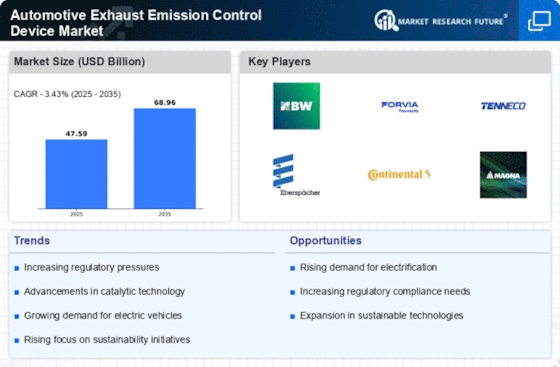
As per Market Research Future analysis, the Automotive Exhaust Emission Control Device Market was estimated at 47.59 USD Billion in 2024. The automotive exhaust emission control device industry is projected to grow from 49.22 USD Billion in 2025 to 68.96 USD Billion by 2035, exhibiting a compound annual growth rate (CAGR) of 3.43% during the forecast period 2025 - 2035

Key Market Trends & Highlights

The Automotive Exhaust Emission Control Device Market is poised for substantial growth driven by regulatory pressures and technological advancements.

  • North America remains the largest market for automotive exhaust emission control devices, reflecting robust regulatory frameworks. The Asia-Pacific region is emerging as the fastest-growing market, propelled by increasing vehicle production and environmental awareness. Catalytic converters dominate the market, while diesel particulate filters are witnessing rapid growth due to stringent emission standards. Key market drivers include rising environmental regulations and government incentives for clean technology, fostering demand for eco-friendly vehicles.

Market Size & Forecast

2024 Market Size 47.59 (USD Billion)
2035 Market Size 68.96 (USD Billion)
CAGR (2025 - 2035) 3.43%
Largest Regional Market Share in 2024 North America

Major Players

BorgWarner (US), Faurecia (FR), <a href="https://www.tenneco.com/solutions/clean-air">Tenneco</a> (US), Eberspaecher (DE), Continental (DE), Magna International (CA), Aisin Seiki (JP), <a href="https://www.delphiautoparts.com/en-gb/products-and-technologies/vehicle-electronics-engine-management/emissions">Delphi Technologies</a> (GB), Honeywell (US)

Market Trends

The Automotive Exhaust Emission Control Device Market is currently experiencing a transformative phase, driven by stringent regulatory frameworks and a growing emphasis on environmental sustainability. Governments worldwide are implementing more rigorous emission standards, compelling manufacturers to innovate and enhance their exhaust systems. This shift not only addresses pollution concerns but also aligns with the global movement towards cleaner energy solutions. As a result, the market is witnessing an influx of advanced technologies aimed at reducing harmful emissions, thereby improving air quality and public health. Moreover, the increasing consumer awareness regarding the environmental impact of vehicles is influencing purchasing decisions. Automakers are responding by integrating sophisticated emission control technologies into their designs, which may include catalytic converters, diesel particulate filters, and selective catalytic reduction systems. This trend suggests a potential shift towards hybrid and electric vehicles, which could further reshape the Automotive Exhaust Emission Control Device Market landscape. The interplay between regulatory pressures and consumer preferences appears to be steering the industry towards a more sustainable future, fostering innovation and collaboration among stakeholders in the automotive sector.

Regulatory Pressures

The Automotive Exhaust Emission Control Device Market is significantly influenced by evolving regulations aimed at reducing vehicular emissions. Governments are establishing stricter standards, which compel manufacturers to adopt advanced technologies to comply with these requirements. This trend indicates a proactive approach towards environmental protection and public health.

Technological Advancements

Innovations in emission control technologies are reshaping the Automotive Exhaust Emission Control Device Market. Manufacturers are increasingly investing in research and development to create more efficient systems, such as improved catalytic converters and advanced filtration methods. This trend highlights the industry's commitment to enhancing performance while minimizing environmental impact.

Consumer Awareness

Growing consumer awareness regarding environmental issues is impacting the Automotive Exhaust Emission Control Device Market. As individuals become more conscious of their carbon footprint, there is a rising demand for vehicles equipped with effective emission control systems. This trend suggests a shift in market dynamics, where eco-friendly options are prioritized.

Automotive Exhaust Emission Control Device Market Market Drivers

Increasing Environmental Regulations

The Automotive Exhaust Emission Control Device Market is experiencing a surge in demand due to stringent environmental regulations imposed by various governments. These regulations aim to reduce harmful emissions from vehicles, thereby promoting cleaner air and public health. For instance, regulations such as Euro 6 in Europe and Tier 3 in the United States mandate lower nitrogen oxides and particulate matter emissions. As a result, manufacturers are compelled to invest in advanced emission control technologies, which drives the market forward. The increasing focus on sustainability and environmental protection is likely to further bolster the demand for emission control devices, as compliance with these regulations becomes non-negotiable for automotive manufacturers.

Government Incentives for Clean Technology

Government incentives aimed at promoting clean technology are significantly influencing the Automotive Exhaust Emission Control Device Market. Various countries are offering tax rebates, subsidies, and grants to manufacturers and consumers who invest in low-emission vehicles and technologies. These incentives not only encourage the adoption of cleaner vehicles but also stimulate innovation in emission control technologies. For instance, programs that support the development of hydrogen fuel cell vehicles are gaining traction, which could lead to a new wave of emission control devices tailored for these technologies. As governments continue to prioritize environmental sustainability, the market for emission control devices is likely to expand.

Technological Innovations in Emission Control

Technological advancements play a pivotal role in shaping the Automotive Exhaust Emission Control Device Market. Innovations such as selective catalytic reduction (SCR) systems and advanced particulate filters are enhancing the efficiency of emission control devices. These technologies not only help in meeting regulatory standards but also improve vehicle performance. The market for SCR systems is projected to grow significantly, with estimates suggesting a compound annual growth rate of over 6% in the coming years. As automotive manufacturers increasingly adopt these cutting-edge technologies, the demand for sophisticated emission control devices is expected to rise, reflecting a shift towards more efficient and environmentally friendly vehicles.

Global Shift Towards Sustainable Transportation

The Automotive Exhaust Emission Control Device Market is benefiting from a broader global shift towards sustainable transportation solutions. This transition is driven by a combination of factors, including urbanization, rising fuel prices, and the need for energy efficiency. As cities become more congested, there is an increasing emphasis on reducing vehicular emissions to improve air quality. The market for emission control devices is expected to grow as automotive manufacturers respond to this demand by integrating advanced technologies into their vehicles. Furthermore, the push for sustainable public transportation systems is likely to create additional opportunities for emission control device manufacturers, enhancing market prospects.

Rising Consumer Demand for Eco-Friendly Vehicles

The Automotive Exhaust Emission Control Device Market is witnessing a notable shift in consumer preferences towards eco-friendly vehicles. As awareness of environmental issues grows, consumers are increasingly seeking vehicles that produce lower emissions. This trend is evident in the rising sales of electric and hybrid vehicles, which often incorporate advanced emission control technologies. According to recent data, the market for electric vehicles is anticipated to reach a substantial share of total vehicle sales by 2030. Consequently, automotive manufacturers are investing in emission control devices to cater to this evolving consumer demand, thereby driving growth in the market.

Market Segment Insights

By Device Type: Catalytic Converters (Largest) vs. Diesel Particulate Filters (Fastest-Growing)

The Automotive Exhaust Emission Control Device Market exhibits a diverse distribution of shares among its key segment values. Catalytic converters dominate this space, holding a significant market share due to their widespread use in vehicles to mitigate harmful emissions. Diesel particulate filters, however, represent the fastest-growing segment, reflecting a marked increase in diesel vehicle technology and the stringent regulatory frameworks that are being enforced globally. As manufacturers and consumers seek cleaner, more efficient solutions, these two segments lead the way in the market.

Device Type: Catalytic Converters (Dominant) vs. Diesel Particulate Filters (Emerging)

Catalytic converters are the cornerstone of automotive exhaust emission control, characterized by their efficiency in converting toxic gases into less harmful emissions, thereby playing a crucial role in compliance with environmental regulations. Their long-established position in the automotive market makes them the dominant device type. Conversely, diesel particulate filters have emerged as a vital technology in reducing particulate matter in diesel engines. With growing awareness around the environmental impacts of diesel emissions and evolving technology, this segment is experiencing rapid development, and manufacturers are focusing on innovative designs that enhance performance and filtration efficiency.

By Fuel Type: Gasoline (Largest) vs. Diesel (Fastest-Growing)

In the Automotive Exhaust Emission Control Device Market, gasoline remains the largest segment, significantly contributing to the overall market share due to its prevalence in consumer vehicles. Diesel follows closely, gaining a notable share as it is widely adopted in commercial vehicles due to its fuel efficiency and torque benefits. Natural gas and alternative fuels, while smaller in comparison, are gradually carving out their niches, driven by increasing regulatory pressures and shifts towards cleaner energy sources.

Gasoline (Dominant) vs. Alternative Fuels (Emerging)

Gasoline-powered vehicles dominate the Automotive Exhaust Emission Control Device Market, characterized by a robust infrastructure and established technology supporting emission control systems. This dominance is attributed to the vast number of gasoline vehicles on the road, which require efficient exhaust solutions to comply with stringent emission regulations. On the other hand, alternative fuels, such as electric and hydrogen, are emerging as viable competitors. These fuels are gaining popularity due to rising environmental concerns and government incentives promoting cleaner technology. As developments in technology and infrastructure advance, alternative fuels are expected to become more competitive in the exhaust emission control landscape.

By Vehicle Type: Passenger Cars (Largest) vs. Light Commercial Vehicles (Fastest-Growing)

In the Automotive Exhaust Emission Control Device Market, the distribution of market share among different vehicle types reveals that passenger cars hold the largest portion. Their widespread use and stringent emission regulations make them a primary focus for emissions control technologies. Conversely, light commercial vehicles are emerging as a significant contender, driven by increased regulations regarding emissions, particularly in urban environments. This segment's growth reflects a shift towards more environmentally friendly transport solutions. As the automotive industry evolves, the growth trends for these vehicle segments are shaped by several factors. The increasing demand for fuel-efficient and low-emission vehicles is primarily driving the growing adoption of emission control technologies among <a href="https://www.marketresearchfuture.com/reports/light-commercial-vehicles-market-7726">light commercial vehicles</a>, which are experiencing rapid advancements. Moreover, government initiatives and incentives to promote sustainable transportation are further fueling this growth, setting a precedent for passenger vehicles as well as light commercial vehicles in meeting stringent emissions standards.

Passenger Cars: Dominant vs. Light Commercial Vehicles: Emerging

Passenger cars are recognized as the dominant segment in the Automotive Exhaust Emission Control Device Market due to their extensive market presence and reliance on advanced emissions control technologies to comply with regulations. These vehicles are equipped with sophisticated technologies such as catalytic converters and particulate filters, which help minimize harmful emissions. On the other hand, light commercial vehicles represent an emerging segment, gaining traction in recent years due to the growing demand for delivery services and urban transportation solutions. This sector is adapting to new technologies quickly as manufacturers focus on developing efficient, low-emissions models. Both segments play a vital role in the drive for cleaner transportation, each presenting unique challenges and opportunities in the evolving market landscape.

By Emission Standard: Euro 6 (Largest) vs. BS VI (Fastest-Growing)

In the Automotive Exhaust Emission Control Device Market, emission standards play a pivotal role in shaping the landscape. Euro 6 leads the market, being the largest segment value, primarily due to its stringent regulatory requirements in Europe. It drives demand for advanced emission control technologies, reflecting significant market share. In contrast, BS VI is rapidly becoming a vital player in regions like India, as it aligns closely with global emission standards and addresses growing environmental concerns.

Emission Standards: Euro 6 (Dominant) vs. BS VI (Emerging)

Euro 6 is recognized as the dominant emission standard, mandating lower nitrogen oxide and particulate matter emissions from vehicles. Its implementation has prompted manufacturers to invest heavily in advanced exhaust systems, making it a benchmark in the global market. BS VI, on the other hand, is gaining momentum in the Indian automotive sector as the government aims for cleaner air quality. With stringent limits on pollutants, BS VI is currently seeing robust growth due to rising environmental awareness and regulatory pressure, positioning it as an emerging standard that will shape future automotive technologies.

Get more detailed insights about Automotive Exhaust Emission Control Device Market Research Report – Global Forecast till 2035

Regional Insights

The Automotive Exhaust Emission Control Device Market was pivotal in addressing environmental concerns and regulatory demands across regions. In 2023, North America dominated the market with a valuation of 16.5 USD Billion, reflecting its strong focus on emission regulation compliance and advanced technologies.

Europe followed closely, holding a significant share of 12.0 USD Billion in the same year, benefiting from stringent environmental policies and innovations in emission reduction. The APAC region, contributing 14.0 USD Billion, showcased growth opportunities driven by increasing vehicle production and a shift towards cleaner technologies.

South America, valued at 2.5 USD Billion, illustrated a growing market with potential as governments enforce stricter emissions standards. The MEA region, while smaller at 0.9 USD Billion, emerged as countries adopted measures to improve air quality.

The overall market was influenced by trends such as the rise of electric vehicles, growing awareness about air pollution, and technological advancements in exhaust systems, presenting opportunities for expansion across all regions. As a result, the regional segmentation of the Automotive Exhaust Emission Control Device Market revealed varied strengths and growth potential, underscoring the importance of local regulations and market dynamics.

Key Players and Competitive Insights

The Automotive Exhaust Emission Control Device Market has been experiencing significant growth due to increasing environmental regulations and the rising demand for fuel-efficient vehicles. This market is highly competitive, driven by technological advancements and the need for manufacturers to comply with stricter emission standards. Key players in this sector are leveraging research and development to innovate new solutions that enhance vehicle performance while reducing harmful emissions. As environmental concerns intensify globally, companies are focusing on creating advanced exhaust emission control technologies, contributing to a dynamic landscape. The competition is characterized by a mix of established automotive manufacturers and emerging players, with each vying to expand their market share through innovative product offerings and strategic collaborations. Ford Motor Company has established a robust presence in the Automotive Exhaust Emission Control Device Market by prioritizing sustainability and technology-driven solutions. The company has focused on enhancing its exhaust systems to meet stringent regulations while maintaining vehicle performance standards. Ford's commitment to investing in research and development has led to the adoption of advanced catalytic converters and exhaust gas recirculation systems that not only comply with current regulations but also align with future emission standards. Additionally, Ford's global footprint allows it to leverage supply chain efficiencies, ensuring that its emission control products are both effective and accessible to a wide range of customers, thus solidifying its competitive position. General Motors also plays a significant role in the Automotive Exhaust Emission Control Device Market, showcasing a commitment to innovation and environmental responsibility. The company has been proactive in enhancing its exhaust emission technologies, focusing on integrating advanced materials and sustainable practices into its manufacturing processes. General Motors is known for its ability to adapt quickly to changing regulations while consistently improving the performance and efficiency of its vehicles. By incorporating cutting-edge exhaust emission control devices, General Motors not only meets regulatory requirements but also strives to exceed customer expectations regarding vehicle quality and environmental impact. The strategic initiatives undertaken by General Motors in this market reflect its dedication to a cleaner, more sustainable automotive future, reinforcing its competitive stature amidst growing industry challenges.

Key Companies in the Automotive Exhaust Emission Control Device Market include

Industry Developments

Recent developments in the Automotive Exhaust Emission Control Device Market reveal significant activity among major players, including Ford Motor Company, General Motors, and Toyota Motor Corporation, with a strong focus on sustainability and regulatory compliance. These companies are increasingly investing in advanced technologies to enhance emission control systems, reflecting a growing emphasis on environmental standards.

The rise in electric and hybrid vehicles is reshaping market dynamics, prompting traditional manufacturers like Aisin Seiki and Delphi Technologies to adapt their strategies. Furthermore, mergers and acquisitions have garnered attention, particularly involving companies like Denso and Faurecia, as they seek to consolidate their market positions and drive innovation.

Recently, Johnson Matthey announced strategic partnerships aimed at developing next-generation emission control technologies that cater to evolving government regulations. Market valuations for key players such as Magna International and BASF are on an upward trend, positively impacting their strategic operations.

This growth is driven by both increasing consumer demand for cleaner vehicles and tightening emissions regulations globally, influencing investment and research priorities across the automotive sector. As these trends continue, the market is expected to witness heightened competition and further technological advancements.

Future Outlook

Automotive Exhaust Emission Control Device Market Future Outlook

The Automotive Exhaust Emission Control Device Market is projected to grow at a 3.43% CAGR from 2025 to 2035, driven by stringent regulations and technological advancements.

New opportunities lie in:

  • <p>Development of advanced catalytic converters for electric vehicles Integration of IoT for real-time emissions monitoring Expansion into emerging markets with tailored emission solutions</p>

By 2035, the market is expected to be robust, driven by innovation and regulatory compliance.

Market Segmentation

Automotive Exhaust Emission Control Device Market Fuel Type Outlook

  • Gasoline
  • Diesel
  • Natural Gas
  • Alternative Fuels

Automotive Exhaust Emission Control Device Market Device Type Outlook

  • Catalytic Converters
  • Diesel Particulate Filters
  • Exhaust Gas Recirculation Systems
  • Selective Catalytic Reduction Systems

Automotive Exhaust Emission Control Device Market Vehicle Type Outlook

  • Passenger Cars
  • Light Commercial Vehicles
  • Heavy Commercial Vehicles
  • Two Wheelers

Automotive Exhaust Emission Control Device Market Emission Standard Outlook

  • Euro 6
  • California Air Resources Board
  • Tier 2 Bin 5
  • BS VI

Report Scope

MARKET SIZE 2024 47.59(USD Billion)
MARKET SIZE 2025 49.22(USD Billion)
MARKET SIZE 2035 68.96(USD Billion)
COMPOUND ANNUAL GROWTH RATE (CAGR) 3.43% (2025 - 2035)
REPORT COVERAGE Revenue Forecast, Competitive Landscape, Growth Factors, and Trends
BASE YEAR 2024
Market Forecast Period 2025 - 2035
Historical Data 2019 - 2024
Market Forecast Units USD Billion
Key Companies Profiled BorgWarner (US), Faurecia (FR), Tenneco (US), Eberspaecher (DE), Continental (DE), Magna International (CA), Aisin Seiki (JP), Delphi Technologies (GB), Honeywell (US)
Segments Covered Device Type, Fuel Type, Vehicle Type, Emission Standard, Regional
Key Market Opportunities Integration of advanced sensors for real-time emissions monitoring in the Automotive Exhaust Emission Control Device Market.
Key Market Dynamics Rising regulatory pressures drive innovation in Automotive Exhaust Emission Control Devices, enhancing performance and compliance.
Countries Covered North America, Europe, APAC, South America, MEA

FAQs

What is the projected market valuation for the Automotive Exhaust Emission Control Device Market in 2035?

<p>The projected market valuation for the Automotive Exhaust Emission Control Device Market in 2035 is 68.96 USD Billion.</p>

What was the market valuation for the Automotive Exhaust Emission Control Device Market in 2024?

<p>The market valuation for the Automotive Exhaust Emission Control Device Market in 2024 was 47.59 USD Billion.</p>

What is the expected CAGR for the Automotive Exhaust Emission Control Device Market from 2025 to 2035?

<p>The expected CAGR for the Automotive Exhaust Emission Control Device Market during the forecast period 2025 - 2035 is 3.43%.</p>

Which company is a key player in the Automotive Exhaust Emission Control Device Market?

<p>BorgWarner (US) is one of the key players in the Automotive Exhaust Emission Control Device Market.</p>

What are the projected revenues for Catalytic Converters by 2035?

<p>The projected revenues for Catalytic Converters are expected to reach 26.0 USD Billion by 2035.</p>

How do Diesel Particulate Filters perform in terms of market valuation by 2035?

<p>Diesel Particulate Filters are projected to achieve a market valuation of 18.0 USD Billion by 2035.</p>

What is the expected market size for Exhaust Gas Recirculation Systems in 2035?

<p>The expected market size for Exhaust Gas Recirculation Systems is anticipated to be 12.0 USD Billion by 2035.</p>

What is the projected market valuation for Selective Catalytic Reduction Systems by 2035?

<p>The projected market valuation for Selective Catalytic Reduction Systems is likely to reach 12.96 USD Billion by 2035.</p>

Which fuel type is expected to have the highest market valuation by 2035?

<p>Gasoline is expected to have the highest market valuation, projected at 25.0 USD Billion by 2035.</p>

What is the anticipated market size for Passenger Cars in the Automotive Exhaust Emission Control Device Market by 2035?

<p>The anticipated market size for Passenger Cars is expected to reach 30.0 USD Billion by 2035.</p>

  1. SECTION I: EXECUTIVE SUMMARY AND KEY HIGHLIGHTS
    1. | 1.1 EXECUTIVE SUMMARY
    2. | | 1.1.1 Market Overview
    3. | | 1.1.2 Key Findings
    4. | | 1.1.3 Market Segmentation
    5. | | 1.1.4 Competitive Landscape
    6. | | 1.1.5 Challenges and Opportunities
    7. | | 1.1.6 Future Outlook
  2. SECTION II: SCOPING, METHODOLOGY AND MARKET STRUCTURE
    1. | 2.1 MARKET INTRODUCTION
    2. | | 2.1.1 Definition
    3. | | 2.1.2 Scope of the study
    4. | | | 2.1.2.1 Research Objective
    5. | | | 2.1.2.2 Assumption
    6. | | | 2.1.2.3 Limitations
    7. | 2.2 RESEARCH METHODOLOGY
    8. | | 2.2.1 Overview
    9. | | 2.2.2 Data Mining
    10. | | 2.2.3 Secondary Research
    11. | | 2.2.4 Primary Research
    12. | | | 2.2.4.1 Primary Interviews and Information Gathering Process
    13. | | | 2.2.4.2 Breakdown of Primary Respondents
    14. | | 2.2.5 Forecasting Model
    15. | | 2.2.6 Market Size Estimation
    16. | | | 2.2.6.1 Bottom-Up Approach
    17. | | | 2.2.6.2 Top-Down Approach
    18. | | 2.2.7 Data Triangulation
    19. | | 2.2.8 Validation
  3. SECTION III: QUALITATIVE ANALYSIS
    1. | 3.1 MARKET DYNAMICS
    2. | | 3.1.1 Overview
    3. | | 3.1.2 Drivers
    4. | | 3.1.3 Restraints
    5. | | 3.1.4 Opportunities
    6. | 3.2 MARKET FACTOR ANALYSIS
    7. | | 3.2.1 Value chain Analysis
    8. | | 3.2.2 Porter's Five Forces Analysis
    9. | | | 3.2.2.1 Bargaining Power of Suppliers
    10. | | | 3.2.2.2 Bargaining Power of Buyers
    11. | | | 3.2.2.3 Threat of New Entrants
    12. | | | 3.2.2.4 Threat of Substitutes
    13. | | | 3.2.2.5 Intensity of Rivalry
    14. | | 3.2.3 COVID-19 Impact Analysis
    15. | | | 3.2.3.1 Market Impact Analysis
    16. | | | 3.2.3.2 Regional Impact
    17. | | | 3.2.3.3 Opportunity and Threat Analysis
  4. SECTION IV: QUANTITATIVE ANALYSIS
    1. | 4.1 Automobile, BY Device Type (USD Billion)
    2. | | 4.1.1 Catalytic Converters
    3. | | 4.1.2 Diesel Particulate Filters
    4. | | 4.1.3 Exhaust Gas Recirculation Systems
    5. | | 4.1.4 Selective Catalytic Reduction Systems
    6. | 4.2 Automobile, BY Fuel Type (USD Billion)
    7. | | 4.2.1 Gasoline
    8. | | 4.2.2 Diesel
    9. | | 4.2.3 Natural Gas
    10. | | 4.2.4 Alternative Fuels
    11. | 4.3 Automobile, BY Vehicle Type (USD Billion)
    12. | | 4.3.1 Passenger Cars
    13. | | 4.3.2 Light Commercial Vehicles
    14. | | 4.3.3 Heavy Commercial Vehicles
    15. | | 4.3.4 Two Wheelers
    16. | 4.4 Automobile, BY Emission Standard (USD Billion)
    17. | | 4.4.1 Euro 6
    18. | | 4.4.2 California Air Resources Board
    19. | | 4.4.3 Tier 2 Bin 5
    20. | | 4.4.4 BS VI
    21. | 4.5 Automobile, BY Region (USD Billion)
    22. | | 4.5.1 North America
    23. | | | 4.5.1.1 US
    24. | | | 4.5.1.2 Canada
    25. | | 4.5.2 Europe
    26. | | | 4.5.2.1 Germany
    27. | | | 4.5.2.2 UK
    28. | | | 4.5.2.3 France
    29. | | | 4.5.2.4 Russia
    30. | | | 4.5.2.5 Italy
    31. | | | 4.5.2.6 Spain
    32. | | | 4.5.2.7 Rest of Europe
    33. | | 4.5.3 APAC
    34. | | | 4.5.3.1 China
    35. | | | 4.5.3.2 India
    36. | | | 4.5.3.3 Japan
    37. | | | 4.5.3.4 South Korea
    38. | | | 4.5.3.5 Malaysia
    39. | | | 4.5.3.6 Thailand
    40. | | | 4.5.3.7 Indonesia
    41. | | | 4.5.3.8 Rest of APAC
    42. | | 4.5.4 South America
    43. | | | 4.5.4.1 Brazil
    44. | | | 4.5.4.2 Mexico
    45. | | | 4.5.4.3 Argentina
    46. | | | 4.5.4.4 Rest of South America
    47. | | 4.5.5 MEA
    48. | | | 4.5.5.1 GCC Countries
    49. | | | 4.5.5.2 South Africa
    50. | | | 4.5.5.3 Rest of MEA
  5. SECTION V: COMPETITIVE ANALYSIS
    1. | 5.1 Competitive Landscape
    2. | | 5.1.1 Overview
    3. | | 5.1.2 Competitive Analysis
    4. | | 5.1.3 Market share Analysis
    5. | | 5.1.4 Major Growth Strategy in the Automobile
    6. | | 5.1.5 Competitive Benchmarking
    7. | | 5.1.6 Leading Players in Terms of Number of Developments in the Automobile
    8. | | 5.1.7 Key developments and growth strategies
    9. | | | 5.1.7.1 New Product Launch/Service Deployment
    10. | | | 5.1.7.2 Merger & Acquisitions
    11. | | | 5.1.7.3 Joint Ventures
    12. | | 5.1.8 Major Players Financial Matrix
    13. | | | 5.1.8.1 Sales and Operating Income
    14. | | | 5.1.8.2 Major Players R&D Expenditure. 2023
    15. | 5.2 Company Profiles
    16. | | 5.2.1 BorgWarner (US)
    17. | | | 5.2.1.1 Financial Overview
    18. | | | 5.2.1.2 Products Offered
    19. | | | 5.2.1.3 Key Developments
    20. | | | 5.2.1.4 SWOT Analysis
    21. | | | 5.2.1.5 Key Strategies
    22. | | 5.2.2 Faurecia (FR)
    23. | | | 5.2.2.1 Financial Overview
    24. | | | 5.2.2.2 Products Offered
    25. | | | 5.2.2.3 Key Developments
    26. | | | 5.2.2.4 SWOT Analysis
    27. | | | 5.2.2.5 Key Strategies
    28. | | 5.2.3 Tenneco (US)
    29. | | | 5.2.3.1 Financial Overview
    30. | | | 5.2.3.2 Products Offered
    31. | | | 5.2.3.3 Key Developments
    32. | | | 5.2.3.4 SWOT Analysis
    33. | | | 5.2.3.5 Key Strategies
    34. | | 5.2.4 Eberspaecher (DE)
    35. | | | 5.2.4.1 Financial Overview
    36. | | | 5.2.4.2 Products Offered
    37. | | | 5.2.4.3 Key Developments
    38. | | | 5.2.4.4 SWOT Analysis
    39. | | | 5.2.4.5 Key Strategies
    40. | | 5.2.5 Continental (DE)
    41. | | | 5.2.5.1 Financial Overview
    42. | | | 5.2.5.2 Products Offered
    43. | | | 5.2.5.3 Key Developments
    44. | | | 5.2.5.4 SWOT Analysis
    45. | | | 5.2.5.5 Key Strategies
    46. | | 5.2.6 Magna International (CA)
    47. | | | 5.2.6.1 Financial Overview
    48. | | | 5.2.6.2 Products Offered
    49. | | | 5.2.6.3 Key Developments
    50. | | | 5.2.6.4 SWOT Analysis
    51. | | | 5.2.6.5 Key Strategies
    52. | | 5.2.7 Aisin Seiki (JP)
    53. | | | 5.2.7.1 Financial Overview
    54. | | | 5.2.7.2 Products Offered
    55. | | | 5.2.7.3 Key Developments
    56. | | | 5.2.7.4 SWOT Analysis
    57. | | | 5.2.7.5 Key Strategies
    58. | | 5.2.8 Delphi Technologies (GB)
    59. | | | 5.2.8.1 Financial Overview
    60. | | | 5.2.8.2 Products Offered
    61. | | | 5.2.8.3 Key Developments
    62. | | | 5.2.8.4 SWOT Analysis
    63. | | | 5.2.8.5 Key Strategies
    64. | | 5.2.9 Honeywell (US)
    65. | | | 5.2.9.1 Financial Overview
    66. | | | 5.2.9.2 Products Offered
    67. | | | 5.2.9.3 Key Developments
    68. | | | 5.2.9.4 SWOT Analysis
    69. | | | 5.2.9.5 Key Strategies
    70. | 5.3 Appendix
    71. | | 5.3.1 References
    72. | | 5.3.2 Related Reports
  6. LIST OF FIGURES
    1. | 6.1 MARKET SYNOPSIS
    2. | 6.2 NORTH AMERICA MARKET ANALYSIS
    3. | 6.3 US MARKET ANALYSIS BY DEVICE TYPE
    4. | 6.4 US MARKET ANALYSIS BY FUEL TYPE
    5. | 6.5 US MARKET ANALYSIS BY VEHICLE TYPE
    6. | 6.6 US MARKET ANALYSIS BY EMISSION STANDARD
    7. | 6.7 CANADA MARKET ANALYSIS BY DEVICE TYPE
    8. | 6.8 CANADA MARKET ANALYSIS BY FUEL TYPE
    9. | 6.9 CANADA MARKET ANALYSIS BY VEHICLE TYPE
    10. | 6.10 CANADA MARKET ANALYSIS BY EMISSION STANDARD
    11. | 6.11 EUROPE MARKET ANALYSIS
    12. | 6.12 GERMANY MARKET ANALYSIS BY DEVICE TYPE
    13. | 6.13 GERMANY MARKET ANALYSIS BY FUEL TYPE
    14. | 6.14 GERMANY MARKET ANALYSIS BY VEHICLE TYPE
    15. | 6.15 GERMANY MARKET ANALYSIS BY EMISSION STANDARD
    16. | 6.16 UK MARKET ANALYSIS BY DEVICE TYPE
    17. | 6.17 UK MARKET ANALYSIS BY FUEL TYPE
    18. | 6.18 UK MARKET ANALYSIS BY VEHICLE TYPE
    19. | 6.19 UK MARKET ANALYSIS BY EMISSION STANDARD
    20. | 6.20 FRANCE MARKET ANALYSIS BY DEVICE TYPE
    21. | 6.21 FRANCE MARKET ANALYSIS BY FUEL TYPE
    22. | 6.22 FRANCE MARKET ANALYSIS BY VEHICLE TYPE
    23. | 6.23 FRANCE MARKET ANALYSIS BY EMISSION STANDARD
    24. | 6.24 RUSSIA MARKET ANALYSIS BY DEVICE TYPE
    25. | 6.25 RUSSIA MARKET ANALYSIS BY FUEL TYPE
    26. | 6.26 RUSSIA MARKET ANALYSIS BY VEHICLE TYPE
    27. | 6.27 RUSSIA MARKET ANALYSIS BY EMISSION STANDARD
    28. | 6.28 ITALY MARKET ANALYSIS BY DEVICE TYPE
    29. | 6.29 ITALY MARKET ANALYSIS BY FUEL TYPE
    30. | 6.30 ITALY MARKET ANALYSIS BY VEHICLE TYPE
    31. | 6.31 ITALY MARKET ANALYSIS BY EMISSION STANDARD
    32. | 6.32 SPAIN MARKET ANALYSIS BY DEVICE TYPE
    33. | 6.33 SPAIN MARKET ANALYSIS BY FUEL TYPE
    34. | 6.34 SPAIN MARKET ANALYSIS BY VEHICLE TYPE
    35. | 6.35 SPAIN MARKET ANALYSIS BY EMISSION STANDARD
    36. | 6.36 REST OF EUROPE MARKET ANALYSIS BY DEVICE TYPE
    37. | 6.37 REST OF EUROPE MARKET ANALYSIS BY FUEL TYPE
    38. | 6.38 REST OF EUROPE MARKET ANALYSIS BY VEHICLE TYPE
    39. | 6.39 REST OF EUROPE MARKET ANALYSIS BY EMISSION STANDARD
    40. | 6.40 APAC MARKET ANALYSIS
    41. | 6.41 CHINA MARKET ANALYSIS BY DEVICE TYPE
    42. | 6.42 CHINA MARKET ANALYSIS BY FUEL TYPE
    43. | 6.43 CHINA MARKET ANALYSIS BY VEHICLE TYPE
    44. | 6.44 CHINA MARKET ANALYSIS BY EMISSION STANDARD
    45. | 6.45 INDIA MARKET ANALYSIS BY DEVICE TYPE
    46. | 6.46 INDIA MARKET ANALYSIS BY FUEL TYPE
    47. | 6.47 INDIA MARKET ANALYSIS BY VEHICLE TYPE
    48. | 6.48 INDIA MARKET ANALYSIS BY EMISSION STANDARD
    49. | 6.49 JAPAN MARKET ANALYSIS BY DEVICE TYPE
    50. | 6.50 JAPAN MARKET ANALYSIS BY FUEL TYPE
    51. | 6.51 JAPAN MARKET ANALYSIS BY VEHICLE TYPE
    52. | 6.52 JAPAN MARKET ANALYSIS BY EMISSION STANDARD
    53. | 6.53 SOUTH KOREA MARKET ANALYSIS BY DEVICE TYPE
    54. | 6.54 SOUTH KOREA MARKET ANALYSIS BY FUEL TYPE
    55. | 6.55 SOUTH KOREA MARKET ANALYSIS BY VEHICLE TYPE
    56. | 6.56 SOUTH KOREA MARKET ANALYSIS BY EMISSION STANDARD
    57. | 6.57 MALAYSIA MARKET ANALYSIS BY DEVICE TYPE
    58. | 6.58 MALAYSIA MARKET ANALYSIS BY FUEL TYPE
    59. | 6.59 MALAYSIA MARKET ANALYSIS BY VEHICLE TYPE
    60. | 6.60 MALAYSIA MARKET ANALYSIS BY EMISSION STANDARD
    61. | 6.61 THAILAND MARKET ANALYSIS BY DEVICE TYPE
    62. | 6.62 THAILAND MARKET ANALYSIS BY FUEL TYPE
    63. | 6.63 THAILAND MARKET ANALYSIS BY VEHICLE TYPE
    64. | 6.64 THAILAND MARKET ANALYSIS BY EMISSION STANDARD
    65. | 6.65 INDONESIA MARKET ANALYSIS BY DEVICE TYPE
    66. | 6.66 INDONESIA MARKET ANALYSIS BY FUEL TYPE
    67. | 6.67 INDONESIA MARKET ANALYSIS BY VEHICLE TYPE
    68. | 6.68 INDONESIA MARKET ANALYSIS BY EMISSION STANDARD
    69. | 6.69 REST OF APAC MARKET ANALYSIS BY DEVICE TYPE
    70. | 6.70 REST OF APAC MARKET ANALYSIS BY FUEL TYPE
    71. | 6.71 REST OF APAC MARKET ANALYSIS BY VEHICLE TYPE
    72. | 6.72 REST OF APAC MARKET ANALYSIS BY EMISSION STANDARD
    73. | 6.73 SOUTH AMERICA MARKET ANALYSIS
    74. | 6.74 BRAZIL MARKET ANALYSIS BY DEVICE TYPE
    75. | 6.75 BRAZIL MARKET ANALYSIS BY FUEL TYPE
    76. | 6.76 BRAZIL MARKET ANALYSIS BY VEHICLE TYPE
    77. | 6.77 BRAZIL MARKET ANALYSIS BY EMISSION STANDARD
    78. | 6.78 MEXICO MARKET ANALYSIS BY DEVICE TYPE
    79. | 6.79 MEXICO MARKET ANALYSIS BY FUEL TYPE
    80. | 6.80 MEXICO MARKET ANALYSIS BY VEHICLE TYPE
    81. | 6.81 MEXICO MARKET ANALYSIS BY EMISSION STANDARD
    82. | 6.82 ARGENTINA MARKET ANALYSIS BY DEVICE TYPE
    83. | 6.83 ARGENTINA MARKET ANALYSIS BY FUEL TYPE
    84. | 6.84 ARGENTINA MARKET ANALYSIS BY VEHICLE TYPE
    85. | 6.85 ARGENTINA MARKET ANALYSIS BY EMISSION STANDARD
    86. | 6.86 REST OF SOUTH AMERICA MARKET ANALYSIS BY DEVICE TYPE
    87. | 6.87 REST OF SOUTH AMERICA MARKET ANALYSIS BY FUEL TYPE
    88. | 6.88 REST OF SOUTH AMERICA MARKET ANALYSIS BY VEHICLE TYPE
    89. | 6.89 REST OF SOUTH AMERICA MARKET ANALYSIS BY EMISSION STANDARD
    90. | 6.90 MEA MARKET ANALYSIS
    91. | 6.91 GCC COUNTRIES MARKET ANALYSIS BY DEVICE TYPE
    92. | 6.92 GCC COUNTRIES MARKET ANALYSIS BY FUEL TYPE
    93. | 6.93 GCC COUNTRIES MARKET ANALYSIS BY VEHICLE TYPE
    94. | 6.94 GCC COUNTRIES MARKET ANALYSIS BY EMISSION STANDARD
    95. | 6.95 SOUTH AFRICA MARKET ANALYSIS BY DEVICE TYPE
    96. | 6.96 SOUTH AFRICA MARKET ANALYSIS BY FUEL TYPE
    97. | 6.97 SOUTH AFRICA MARKET ANALYSIS BY VEHICLE TYPE
    98. | 6.98 SOUTH AFRICA MARKET ANALYSIS BY EMISSION STANDARD
    99. | 6.99 REST OF MEA MARKET ANALYSIS BY DEVICE TYPE
    100. | 6.100 REST OF MEA MARKET ANALYSIS BY FUEL TYPE
    101. | 6.101 REST OF MEA MARKET ANALYSIS BY VEHICLE TYPE
    102. | 6.102 REST OF MEA MARKET ANALYSIS BY EMISSION STANDARD
    103. | 6.103 KEY BUYING CRITERIA OF AUTOMOBILE
    104. | 6.104 RESEARCH PROCESS OF MRFR
    105. | 6.105 DRO ANALYSIS OF AUTOMOBILE
    106. | 6.106 DRIVERS IMPACT ANALYSIS: AUTOMOBILE
    107. | 6.107 RESTRAINTS IMPACT ANALYSIS: AUTOMOBILE
    108. | 6.108 SUPPLY / VALUE CHAIN: AUTOMOBILE
    109. | 6.109 AUTOMOBILE, BY DEVICE TYPE, 2024 (% SHARE)
    110. | 6.110 AUTOMOBILE, BY DEVICE TYPE, 2024 TO 2035 (USD Billion)
    111. | 6.111 AUTOMOBILE, BY FUEL TYPE, 2024 (% SHARE)
    112. | 6.112 AUTOMOBILE, BY FUEL TYPE, 2024 TO 2035 (USD Billion)
    113. | 6.113 AUTOMOBILE, BY VEHICLE TYPE, 2024 (% SHARE)
    114. | 6.114 AUTOMOBILE, BY VEHICLE TYPE, 2024 TO 2035 (USD Billion)
    115. | 6.115 AUTOMOBILE, BY EMISSION STANDARD, 2024 (% SHARE)
    116. | 6.116 AUTOMOBILE, BY EMISSION STANDARD, 2024 TO 2035 (USD Billion)
    117. | 6.117 BENCHMARKING OF MAJOR COMPETITORS
  7. LIST OF TABLES
    1. | 7.1 LIST OF ASSUMPTIONS
    2. | | 7.1.1
    3. | 7.2 North America MARKET SIZE ESTIMATES; FORECAST
    4. | | 7.2.1 BY DEVICE TYPE, 2025-2035 (USD Billion)
    5. | | 7.2.2 BY FUEL TYPE, 2025-2035 (USD Billion)
    6. | | 7.2.3 BY VEHICLE TYPE, 2025-2035 (USD Billion)
    7. | | 7.2.4 BY EMISSION STANDARD, 2025-2035 (USD Billion)
    8. | 7.3 US MARKET SIZE ESTIMATES; FORECAST
    9. | | 7.3.1 BY DEVICE TYPE, 2025-2035 (USD Billion)
    10. | | 7.3.2 BY FUEL TYPE, 2025-2035 (USD Billion)
    11. | | 7.3.3 BY VEHICLE TYPE, 2025-2035 (USD Billion)
    12. | | 7.3.4 BY EMISSION STANDARD, 2025-2035 (USD Billion)
    13. | 7.4 Canada MARKET SIZE ESTIMATES; FORECAST
    14. | | 7.4.1 BY DEVICE TYPE, 2025-2035 (USD Billion)
    15. | | 7.4.2 BY FUEL TYPE, 2025-2035 (USD Billion)
    16. | | 7.4.3 BY VEHICLE TYPE, 2025-2035 (USD Billion)
    17. | | 7.4.4 BY EMISSION STANDARD, 2025-2035 (USD Billion)
    18. | 7.5 Europe MARKET SIZE ESTIMATES; FORECAST
    19. | | 7.5.1 BY DEVICE TYPE, 2025-2035 (USD Billion)
    20. | | 7.5.2 BY FUEL TYPE, 2025-2035 (USD Billion)
    21. | | 7.5.3 BY VEHICLE TYPE, 2025-2035 (USD Billion)
    22. | | 7.5.4 BY EMISSION STANDARD, 2025-2035 (USD Billion)
    23. | 7.6 Germany MARKET SIZE ESTIMATES; FORECAST
    24. | | 7.6.1 BY DEVICE TYPE, 2025-2035 (USD Billion)
    25. | | 7.6.2 BY FUEL TYPE, 2025-2035 (USD Billion)
    26. | | 7.6.3 BY VEHICLE TYPE, 2025-2035 (USD Billion)
    27. | | 7.6.4 BY EMISSION STANDARD, 2025-2035 (USD Billion)
    28. | 7.7 UK MARKET SIZE ESTIMATES; FORECAST
    29. | | 7.7.1 BY DEVICE TYPE, 2025-2035 (USD Billion)
    30. | | 7.7.2 BY FUEL TYPE, 2025-2035 (USD Billion)
    31. | | 7.7.3 BY VEHICLE TYPE, 2025-2035 (USD Billion)
    32. | | 7.7.4 BY EMISSION STANDARD, 2025-2035 (USD Billion)
    33. | 7.8 France MARKET SIZE ESTIMATES; FORECAST
    34. | | 7.8.1 BY DEVICE TYPE, 2025-2035 (USD Billion)
    35. | | 7.8.2 BY FUEL TYPE, 2025-2035 (USD Billion)
    36. | | 7.8.3 BY VEHICLE TYPE, 2025-2035 (USD Billion)
    37. | | 7.8.4 BY EMISSION STANDARD, 2025-2035 (USD Billion)
    38. | 7.9 Russia MARKET SIZE ESTIMATES; FORECAST
    39. | | 7.9.1 BY DEVICE TYPE, 2025-2035 (USD Billion)
    40. | | 7.9.2 BY FUEL TYPE, 2025-2035 (USD Billion)
    41. | | 7.9.3 BY VEHICLE TYPE, 2025-2035 (USD Billion)
    42. | | 7.9.4 BY EMISSION STANDARD, 2025-2035 (USD Billion)
    43. | 7.10 Italy MARKET SIZE ESTIMATES; FORECAST
    44. | | 7.10.1 BY DEVICE TYPE, 2025-2035 (USD Billion)
    45. | | 7.10.2 BY FUEL TYPE, 2025-2035 (USD Billion)
    46. | | 7.10.3 BY VEHICLE TYPE, 2025-2035 (USD Billion)
    47. | | 7.10.4 BY EMISSION STANDARD, 2025-2035 (USD Billion)
    48. | 7.11 Spain MARKET SIZE ESTIMATES; FORECAST
    49. | | 7.11.1 BY DEVICE TYPE, 2025-2035 (USD Billion)
    50. | | 7.11.2 BY FUEL TYPE, 2025-2035 (USD Billion)
    51. | | 7.11.3 BY VEHICLE TYPE, 2025-2035 (USD Billion)
    52. | | 7.11.4 BY EMISSION STANDARD, 2025-2035 (USD Billion)
    53. | 7.12 Rest of Europe MARKET SIZE ESTIMATES; FORECAST
    54. | | 7.12.1 BY DEVICE TYPE, 2025-2035 (USD Billion)
    55. | | 7.12.2 BY FUEL TYPE, 2025-2035 (USD Billion)
    56. | | 7.12.3 BY VEHICLE TYPE, 2025-2035 (USD Billion)
    57. | | 7.12.4 BY EMISSION STANDARD, 2025-2035 (USD Billion)
    58. | 7.13 APAC MARKET SIZE ESTIMATES; FORECAST
    59. | | 7.13.1 BY DEVICE TYPE, 2025-2035 (USD Billion)
    60. | | 7.13.2 BY FUEL TYPE, 2025-2035 (USD Billion)
    61. | | 7.13.3 BY VEHICLE TYPE, 2025-2035 (USD Billion)
    62. | | 7.13.4 BY EMISSION STANDARD, 2025-2035 (USD Billion)
    63. | 7.14 China MARKET SIZE ESTIMATES; FORECAST
    64. | | 7.14.1 BY DEVICE TYPE, 2025-2035 (USD Billion)
    65. | | 7.14.2 BY FUEL TYPE, 2025-2035 (USD Billion)
    66. | | 7.14.3 BY VEHICLE TYPE, 2025-2035 (USD Billion)
    67. | | 7.14.4 BY EMISSION STANDARD, 2025-2035 (USD Billion)
    68. | 7.15 India MARKET SIZE ESTIMATES; FORECAST
    69. | | 7.15.1 BY DEVICE TYPE, 2025-2035 (USD Billion)
    70. | | 7.15.2 BY FUEL TYPE, 2025-2035 (USD Billion)
    71. | | 7.15.3 BY VEHICLE TYPE, 2025-2035 (USD Billion)
    72. | | 7.15.4 BY EMISSION STANDARD, 2025-2035 (USD Billion)
    73. | 7.16 Japan MARKET SIZE ESTIMATES; FORECAST
    74. | | 7.16.1 BY DEVICE TYPE, 2025-2035 (USD Billion)
    75. | | 7.16.2 BY FUEL TYPE, 2025-2035 (USD Billion)
    76. | | 7.16.3 BY VEHICLE TYPE, 2025-2035 (USD Billion)
    77. | | 7.16.4 BY EMISSION STANDARD, 2025-2035 (USD Billion)
    78. | 7.17 South Korea MARKET SIZE ESTIMATES; FORECAST
    79. | | 7.17.1 BY DEVICE TYPE, 2025-2035 (USD Billion)
    80. | | 7.17.2 BY FUEL TYPE, 2025-2035 (USD Billion)
    81. | | 7.17.3 BY VEHICLE TYPE, 2025-2035 (USD Billion)
    82. | | 7.17.4 BY EMISSION STANDARD, 2025-2035 (USD Billion)
    83. | 7.18 Malaysia MARKET SIZE ESTIMATES; FORECAST
    84. | | 7.18.1 BY DEVICE TYPE, 2025-2035 (USD Billion)
    85. | | 7.18.2 BY FUEL TYPE, 2025-2035 (USD Billion)
    86. | | 7.18.3 BY VEHICLE TYPE, 2025-2035 (USD Billion)
    87. | | 7.18.4 BY EMISSION STANDARD, 2025-2035 (USD Billion)
    88. | 7.19 Thailand MARKET SIZE ESTIMATES; FORECAST
    89. | | 7.19.1 BY DEVICE TYPE, 2025-2035 (USD Billion)
    90. | | 7.19.2 BY FUEL TYPE, 2025-2035 (USD Billion)
    91. | | 7.19.3 BY VEHICLE TYPE, 2025-2035 (USD Billion)
    92. | | 7.19.4 BY EMISSION STANDARD, 2025-2035 (USD Billion)
    93. | 7.20 Indonesia MARKET SIZE ESTIMATES; FORECAST
    94. | | 7.20.1 BY DEVICE TYPE, 2025-2035 (USD Billion)
    95. | | 7.20.2 BY FUEL TYPE, 2025-2035 (USD Billion)
    96. | | 7.20.3 BY VEHICLE TYPE, 2025-2035 (USD Billion)
    97. | | 7.20.4 BY EMISSION STANDARD, 2025-2035 (USD Billion)
    98. | 7.21 Rest of APAC MARKET SIZE ESTIMATES; FORECAST
    99. | | 7.21.1 BY DEVICE TYPE, 2025-2035 (USD Billion)
    100. | | 7.21.2 BY FUEL TYPE, 2025-2035 (USD Billion)
    101. | | 7.21.3 BY VEHICLE TYPE, 2025-2035 (USD Billion)
    102. | | 7.21.4 BY EMISSION STANDARD, 2025-2035 (USD Billion)
    103. | 7.22 South America MARKET SIZE ESTIMATES; FORECAST
    104. | | 7.22.1 BY DEVICE TYPE, 2025-2035 (USD Billion)
    105. | | 7.22.2 BY FUEL TYPE, 2025-2035 (USD Billion)
    106. | | 7.22.3 BY VEHICLE TYPE, 2025-2035 (USD Billion)
    107. | | 7.22.4 BY EMISSION STANDARD, 2025-2035 (USD Billion)
    108. | 7.23 Brazil MARKET SIZE ESTIMATES; FORECAST
    109. | | 7.23.1 BY DEVICE TYPE, 2025-2035 (USD Billion)
    110. | | 7.23.2 BY FUEL TYPE, 2025-2035 (USD Billion)
    111. | | 7.23.3 BY VEHICLE TYPE, 2025-2035 (USD Billion)
    112. | | 7.23.4 BY EMISSION STANDARD, 2025-2035 (USD Billion)
    113. | 7.24 Mexico MARKET SIZE ESTIMATES; FORECAST
    114. | | 7.24.1 BY DEVICE TYPE, 2025-2035 (USD Billion)
    115. | | 7.24.2 BY FUEL TYPE, 2025-2035 (USD Billion)
    116. | | 7.24.3 BY VEHICLE TYPE, 2025-2035 (USD Billion)
    117. | | 7.24.4 BY EMISSION STANDARD, 2025-2035 (USD Billion)
    118. | 7.25 Argentina MARKET SIZE ESTIMATES; FORECAST
    119. | | 7.25.1 BY DEVICE TYPE, 2025-2035 (USD Billion)
    120. | | 7.25.2 BY FUEL TYPE, 2025-2035 (USD Billion)
    121. | | 7.25.3 BY VEHICLE TYPE, 2025-2035 (USD Billion)
    122. | | 7.25.4 BY EMISSION STANDARD, 2025-2035 (USD Billion)
    123. | 7.26 Rest of South America MARKET SIZE ESTIMATES; FORECAST
    124. | | 7.26.1 BY DEVICE TYPE, 2025-2035 (USD Billion)
    125. | | 7.26.2 BY FUEL TYPE, 2025-2035 (USD Billion)
    126. | | 7.26.3 BY VEHICLE TYPE, 2025-2035 (USD Billion)
    127. | | 7.26.4 BY EMISSION STANDARD, 2025-2035 (USD Billion)
    128. | 7.27 MEA MARKET SIZE ESTIMATES; FORECAST
    129. | | 7.27.1 BY DEVICE TYPE, 2025-2035 (USD Billion)
    130. | | 7.27.2 BY FUEL TYPE, 2025-2035 (USD Billion)
    131. | | 7.27.3 BY VEHICLE TYPE, 2025-2035 (USD Billion)
    132. | | 7.27.4 BY EMISSION STANDARD, 2025-2035 (USD Billion)
    133. | 7.28 GCC Countries MARKET SIZE ESTIMATES; FORECAST
    134. | | 7.28.1 BY DEVICE TYPE, 2025-2035 (USD Billion)
    135. | | 7.28.2 BY FUEL TYPE, 2025-2035 (USD Billion)
    136. | | 7.28.3 BY VEHICLE TYPE, 2025-2035 (USD Billion)
    137. | | 7.28.4 BY EMISSION STANDARD, 2025-2035 (USD Billion)
    138. | 7.29 South Africa MARKET SIZE ESTIMATES; FORECAST
    139. | | 7.29.1 BY DEVICE TYPE, 2025-2035 (USD Billion)
    140. | | 7.29.2 BY FUEL TYPE, 2025-2035 (USD Billion)
    141. | | 7.29.3 BY VEHICLE TYPE, 2025-2035 (USD Billion)
    142. | | 7.29.4 BY EMISSION STANDARD, 2025-2035 (USD Billion)
    143. | 7.30 Rest of MEA MARKET SIZE ESTIMATES; FORECAST
    144. | | 7.30.1 BY DEVICE TYPE, 2025-2035 (USD Billion)
    145. | | 7.30.2 BY FUEL TYPE, 2025-2035 (USD Billion)
    146. | | 7.30.3 BY VEHICLE TYPE, 2025-2035 (USD Billion)
    147. | | 7.30.4 BY EMISSION STANDARD, 2025-2035 (USD Billion)
    148. | 7.31 PRODUCT LAUNCH/PRODUCT DEVELOPMENT/APPROVAL
    149. | | 7.31.1
    150. | 7.32 ACQUISITION/PARTNERSHIP
    151. | | 7.32.1

Automobile Market Segmentation

Automobile By Device Type (USD Billion, 2025-2035)

  • Catalytic Converters
  • Diesel Particulate Filters
  • Exhaust Gas Recirculation Systems
  • Selective Catalytic Reduction Systems

Automobile By Fuel Type (USD Billion, 2025-2035)

  • Gasoline
  • Diesel
  • Natural Gas
  • Alternative Fuels

Automobile By Vehicle Type (USD Billion, 2025-2035)

  • Passenger Cars
  • Light Commercial Vehicles
  • Heavy Commercial Vehicles
  • Two Wheelers

Automobile By Emission Standard (USD Billion, 2025-2035)

  • Euro 6
  • California Air Resources Board
  • Tier 2 Bin 5
  • BS VI
Infographic

Free Sample Request

Kindly complete the form below to receive a free sample of this Report

Get Free Sample

Customer Strories

Compare Licence

×
Features License Type
Single User Multiuser License Enterprise User
Price $4,950 $5,950 $7,250
Maximum User Access Limit 1 User Upto 10 Users Unrestricted Access Throughout the Organization
Free Customization
Direct Access to Analyst
Deliverable Format
Platform Access
Discount on Next Purchase 10% 15% 15%
Printable Versions