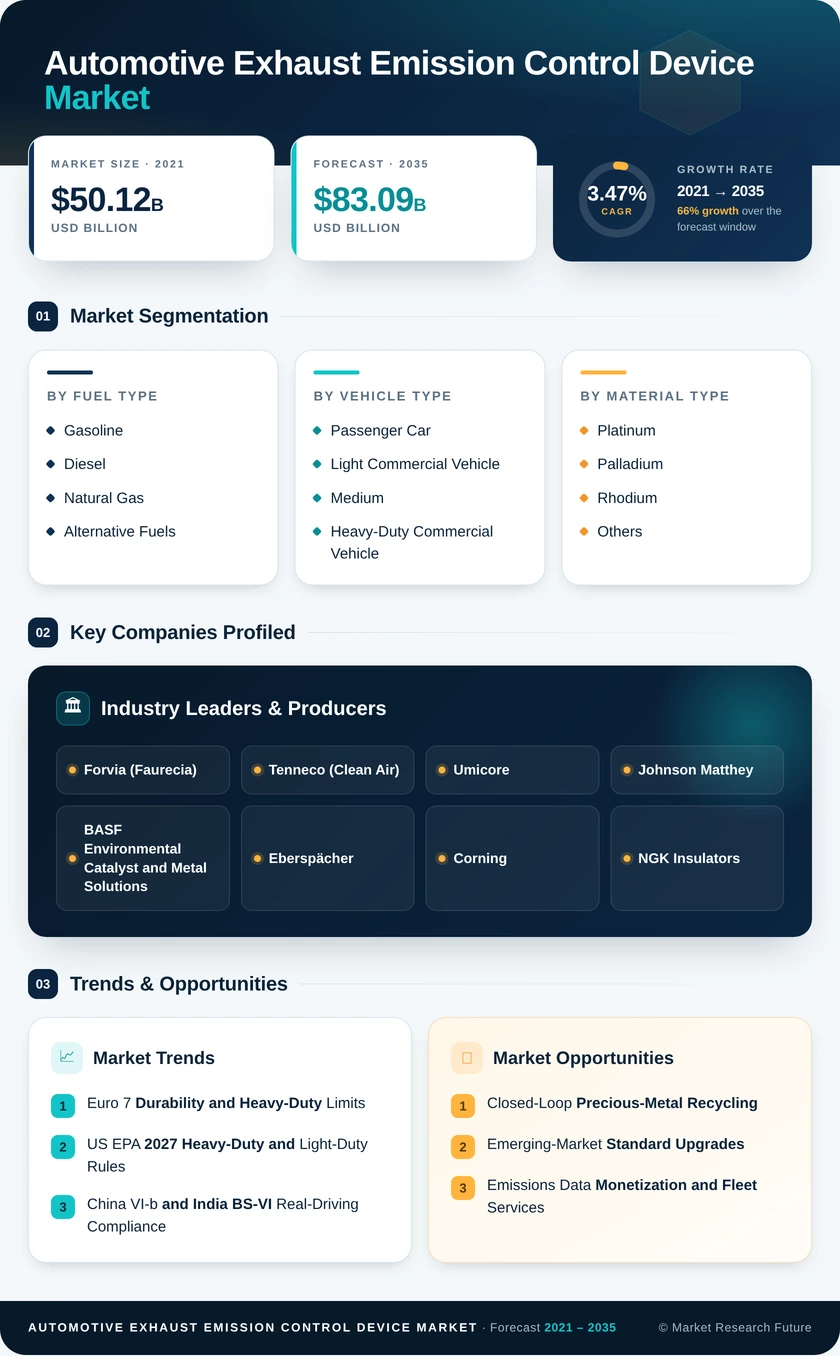
Segmentation Quick Reference
| Dimension | Sub-Segments | Dominant Segment | Fastest Growing Segment |
|---|---|---|---|
| By Fuel Type | Gasoline, Diesel, Natural Gas, Alternative Fuels | Diesel (55.4% share (2025)) | Alternative Fuels (5.65% CAGR) |
| By Vehicle Type | Passenger Car, Light Commercial Vehicle, Medium and Heavy-Duty Commercial Vehicle | Passenger Car (55.3% share (2025)) | Light Commercial Vehicle (4.63% CAGR) |
| By Material Type | Platinum, Palladium, Rhodium, Others | Platinum (46.5% share (2025)) | Rhodium (5.13% CAGR) |
| By Emission Standard | Euro 6/Euro 7, BS-VI, US EPA Tier 3, Others | Euro 6/Euro 7 (65.4% share (2025)) | BS-VI (6.09% CAGR) |
| By Distribution Channel | Original Equipment Manufacturer (OEM), Aftermarket | Original Equipment Manufacturer (OEM) (68.4% share (2025)) | Aftermarket (4.07% CAGR) |
| By Region | North America, Europe, Asia-Pacific, South America, Middle East & Africa | Asia-Pacific (45.2% share (2025)) | Asia-Pacific (4.1% CAGR) |
Market Segmentation Overview
By Fuel Type
| Sub-Segment | Key Trend |
|---|---|
| Gasoline | Particulate filtration and hybrid cold-start chemistry |
| Diesel | Multi-stage SCR and filter lines for heavy-duty compliance |
| Natural Gas | Lean-burn oxidation and three-way layouts for CNG and LNG fleets |
| Alternative Fuels | Low-temperature SCR for hydrogen combustion and biomethane engines |
Diesel leads because heavy-duty engines require the longest and most expensive exhaust lines, combining oxidation, filtration, SCR, and slip control. Alternative Fuels grows fastest as transit operators adopt CNG and biomethane buses and truck makers test hydrogen combustion, which still needs NOx control. Gasoline remains the volume base, with value rising through filtration mandates rather than unit growth.
By Vehicle Type
| Sub-Segment | Key Trend |
|---|---|
| Passenger Car | Close-coupled catalysts and gasoline filtration as standard |
| Light Commercial Vehicle | SCR-on-filter systems for high-mileage delivery vans |
| Medium and Heavy-Duty Commercial Vehicle | Extended useful-life designs for 2027–2029 heavy-duty rules |
Passenger Car holds the largest share of production volume, with hybrid platforms lifting catalyst content per unit. Light Commercial Vehicle grows fastest because delivery vans operating in low-emission zones accumulate high mileage and need durable SCR-on-filter hardware. Medium and Heavy-Duty Commercial Vehicle platforms carry the highest system value, driven by US and EU durability requirements.
By Material Type
| Sub-Segment | Key Trend |
|---|---|
| Platinum | Substitution into gasoline catalysts to hedge palladium risk |
| Palladium | Core gasoline three-way chemistry under thrifting pressure |
| Rhodium | Higher loadings for real-driving NOx compliance |
| Others | Copper and iron zeolites for SCR catalysts |
Platinum leads because it serves diesel oxidation and increasingly replaces palladium in gasoline formulations, reducing supply risk. Rhodium grows fastest since it is the most effective metal for gasoline NOx conversion, and China VI-b and BS-VI real-driving tests push loadings higher. Palladium retains a large value position, though thrifting programs are steadily reducing grams per catalyst.
By Emission Standard
| Sub-Segment | Key Trend |
|---|---|
| Euro 6/Euro 7 | Durability extension and heavy-duty ammonia and N2O limits |
| BS-VI |
Euro 6/Euro 7 leads the Automotive Exhaust Emission Control Device Market by emission standard because the classification includes China VI and other Euro-aligned regimes alongside Europe. BS-VI is the fastest-growing standard: India leapfrogged from BS-IV to BS-VI in April 2020, then added on-road testing in April 2023, raising catalyst loadings and diagnostic requirements [#6]. US EPA Tier 3 hardware is shaped by 150,000-mile durability and low-sulfur gasoline [#4].


 Noah Malgeri
Co-Founder

 Peter Groot koerkamp
Account and Business Manager

 Younghwan Choi
Senior Retail Manager

 Mark Irwin
Management Consultant

 Akif Moroglu
Strategy & Business Development Director

 Guilherme Gomes Martins
Product Management Director

 Joseph Aguayo
Sales Operations & Pricing Manager

 La Terria Dodd
Program Support Specialist

 Rob Kooiker
Group Product Manager HVAC & Fire Protection GMA