Request Free Sample ×

Kindly complete the form below to receive a free sample of this Report

* Please use a valid business email

Leading companies partner with us for data-driven Insights

clients tt-cursor
Hero Background
English
Chinese
French
Japanese
Korean
German
Spanish

Athleisure Market Share

ID: MRFR/CG/5943-CR
90 Pages
Snehal Singh
August 2021

Athleisure Market Size, Share, Industry Trend & Analysis Research Report Information By Product Type (Leggings, Tights & Joggers, Hoodies & Sweatshirts, Sneakers, Shorts, Sports Jackets, Sports Bra, Yoga Pants, and Others), By End User (Men, Women, and Unisex), By Distribution Channel (Store-Based and Non-Store Based), And By Region (North America, Europe, Asia-Pacific, And Rest Of The World) – Forecast Till 2035

Share:
Download PDF ×

We do not share your information with anyone. However, we may send you emails based on your report interest from time to time. You may contact us at any time to opt-out.

Athleisure Market Infographic
Purchase Options

Market Share

Athleisure Market Share Analysis

The athleisure market has experienced a significant surge in popularity in recent years, driven by changing consumer lifestyles and fashion preferences. Athleisure, a term coined from combining "athletic" and "leisure," refers to clothing designed for both athletic activities and everyday wear, blurring the lines between activewear and casual attire. This trend has gained momentum as more people seek versatile, comfortable, and stylish clothing options that seamlessly transition from the gym to daily activities.

One of the key market trends in athleisure is the focus on performance-enhancing fabrics and technologies. With advancements in textile engineering, manufacturers are developing innovative materials that offer moisture-wicking properties, breathability, and stretchability, providing athletes and fitness enthusiasts with optimal comfort and performance during workouts. Additionally, these high-performance fabrics are often incorporated into fashionable athleisure pieces, allowing consumers to look and feel good while staying active.

Another notable trend in the athleisure market is the emphasis on sustainability and ethical practices. As consumers become more environmentally conscious, there is a growing demand for athleisure brands that prioritize eco-friendly materials, ethical labor practices, and sustainable production methods. This has led to an increase in the availability of athleisure apparel made from recycled materials, organic cotton, and other sustainable fibers, as well as initiatives to reduce waste and carbon footprint throughout the supply chain.

Furthermore, inclusivity and diversity have become important driving forces in the athleisure market. Brands are recognizing the need to cater to a diverse range of body types, skin tones, and cultural backgrounds, leading to greater inclusivity in product offerings and marketing campaigns. This shift towards inclusivity not only reflects changing societal norms but also presents opportunities for brands to tap into new customer segments and foster a sense of belonging among consumers.

The rise of social media and influencer culture has also had a significant impact on the athleisure market. Platforms like Instagram and TikTok have become powerful marketing tools for athleisure brands, allowing them to reach a wider audience and engage with consumers in more authentic and relatable ways. Influencers, athletes, and celebrities often collaborate with athleisure brands to create sponsored content, showcasing their products in real-life settings and influencing purchasing decisions among their followers.

Additionally, the COVID-19 pandemic has accelerated certain trends within the athleisure market. With many people working remotely and spending more time at home, there has been a greater demand for comfortable and versatile clothing suitable for both work and leisure activities. This has led to an increase in sales of athleisure apparel such as joggers, leggings, and oversized hoodies, as consumers prioritize comfort and functionality in their wardrobes.

In conclusion, the athleisure market continues to evolve in response to changing consumer preferences, societal trends, and technological advancements. From performance-enhancing fabrics to sustainable practices and inclusivity initiatives, athleisure brands are adapting to meet the diverse needs of today's consumers. As the market continues to expand and innovate, one thing is certain: athleisure is here to stay, shaping the future of fashion and lifestyle trends for years to come.


Author
Author Profile
Snehal Singh
Manager - Research

High acumen in analyzing complex macro & micro markets with more than 6 years of work experience in the field of market research. By implementing her analytical skills in forecasting and estimation into market research reports, she has expertise in Packaging, Construction, and Equipment domains. She handles a team size of 20-25 resources and ensures smooth running of the projects, associated marketing activities, and client servicing.

Leave a Comment

FAQs

What is the projected market valuation of The Global Athleisure by 2035?

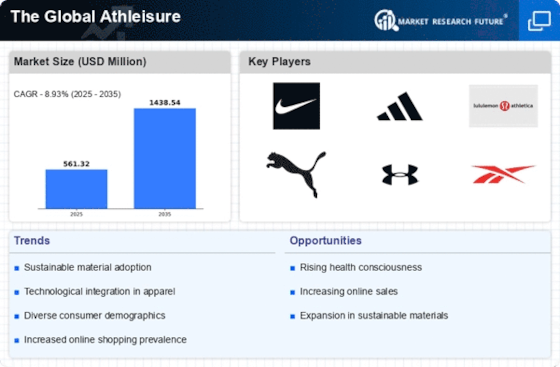
<p>The projected market valuation for The Global Athleisure by 2035 is 1438.54 USD Million.</p>

Which companies are considered key players in The Global Athleisure?

<p>Key players in The Global Athleisure include Nike, Adidas, Lululemon Athletica, Puma, Under Armour, Reebok, New Balance, ASICS, and Columbia Sportswear.</p>

What was the market valuation of The Global Athleisure in 2024?

<p>The overall market valuation of The Global Athleisure in 2024 was 561.32 USD Million.</p>

What is the expected CAGR for The Global Athleisure during the forecast period 2025 - 2035?

<p>The expected CAGR for The Global Athleisure during the forecast period 2025 - 2035 is 8.93%.</p>

How do the sales of women's athleisure products compare to men's in 2025?

<p>In 2025, sales of women's athleisure products are projected to reach 570.56 USD Million, compared to men's at 426.42 USD Million.</p>

What are the projected sales figures for leggings in The Global Athleisure?

<p>Projected sales figures for leggings in The Global Athleisure are expected to reach 290.0 USD Million by 2035.</p>

What distribution channel is anticipated to generate more revenue in The Global Athleisure?

The store-based distribution channel is anticipated to generate more revenue, with projections of 883.06 USD Million by 2035.

What is the expected market size for sneakers in The Global Athleisure by 2035?

The expected market size for sneakers in The Global Athleisure is projected to be 250.0 USD Million by 2035.

How do the sales of non-store based distribution channels compare to store-based channels?

In 2025, non-store based distribution channels are projected to generate 555.48 USD Million, compared to 883.06 USD Million from store-based channels.

What is the projected market size for sports bras in The Global Athleisure?

The projected market size for sports bras in The Global Athleisure is expected to reach 80.0 USD Million by 2035.

Market Summary

As per Market Research Future analysis, The Global Athleisure Market Size was estimated at 390.3 USD Billion in 2024. The athleisure industry is projected to grow from 425.0 USD Billion in 2025 to 997.0 USD Billion by 2035, exhibiting a compound annual growth rate (CAGR) of 8.90% during the forecast period 2025 - 2035

Key Market Trends & Highlights

The Global Athleisure Market is experiencing robust growth driven by evolving consumer preferences and technological advancements.

  • North America remains the largest market for athleisure, characterized by a strong demand for versatile and stylish activewear. The Asia-Pacific region is emerging as the fastest-growing market, fueled by increasing health consciousness and a rising middle class. Leggings continue to dominate the market as the largest segment, while sports bras are witnessing the fastest growth due to changing consumer attitudes towards fitness. Health and wellness trends, along with the expansion of e-commerce, are key drivers propelling the growth of the athleisure market.

Market Size & Forecast

2024 Market Size 390.3 (USD Billion)
2035 Market Size 997.0 (USD Billion)
CAGR (2025 - 2035) 8.90%
Largest Regional Market Share in 2024 North America

Major Players

Nike (US), <a href="https://www.adidas.com/us/workout">Adidas</a> (DE), Lululemon Athletica (CA), Puma (DE), Under Armour (US), <a href="https://www.reebok.com/collections/all-clothing?">Reebok</a> (GB), New Balance (US), ASICS (JP), Columbia Sportswear (US)

Market Trends

The Global Athleisure is currently experiencing a dynamic evolution, characterized by a blend of fashion and functionality. This sector, which encompasses athletic wear designed for both performance and casual wear, appears to be gaining traction among diverse consumer demographics. The increasing emphasis on health and wellness, coupled with a growing inclination towards comfortable clothing, suggests that athleisure is not merely a trend but rather a lifestyle choice for many. Retailers are adapting to this shift by offering innovative designs and sustainable materials, which may enhance consumer appeal and drive market growth. Moreover, the influence of social media and celebrity endorsements seems to play a pivotal role in shaping consumer preferences. As individuals seek to emulate the styles of influencers and athletes, brands are likely to invest in marketing strategies that leverage these platforms. This trend indicates a potential for continued expansion within The Global Athleisure, as companies strive to meet the evolving demands of their target audiences. The intersection of fashion, fitness, and sustainability may further redefine the landscape, creating opportunities for new entrants and established players alike.

Sustainability Focus

The Global Athleisure is witnessing a pronounced shift towards sustainable practices. Brands are increasingly prioritizing eco-friendly materials and ethical production methods, responding to consumer demand for environmentally conscious products. This trend not only enhances brand loyalty but also aligns with broader societal values regarding sustainability.

Technological Integration

Advancements in technology are significantly influencing The Global Athleisure. Wearable technology, such as fitness trackers and smart fabrics, is becoming more prevalent, allowing consumers to monitor their health and performance. This integration of technology into athleisure apparel may enhance user experience and drive sales.

Diverse Consumer Base

The Global Athleisure is expanding its reach to a more diverse consumer base. As the appeal of athleisure transcends age, gender, and lifestyle, brands are tailoring their offerings to cater to various demographics. This inclusivity may foster greater market penetration and encourage broader participation in fitness and wellness activities.

Athleisure Market Market Drivers

E-commerce Expansion

The rapid expansion of e-commerce platforms is significantly influencing The Global athleisure Industry. With the convenience of online shopping, consumers are increasingly turning to digital channels to purchase athleisure products. Recent data indicates that online sales of athleisure wear have surged, accounting for nearly 30% of total sales in the sector. This trend is likely to continue as brands enhance their online presence and invest in digital marketing strategies. The ability to reach a broader audience through e-commerce not only facilitates consumer access to a diverse range of products but also allows for personalized shopping experiences. Consequently, the growth of e-commerce is expected to be a major catalyst for the expansion of the athleisure market, as it aligns with the preferences of tech-savvy consumers.

Influence of Social Media

The influence of social media on consumer purchasing decisions is a notable driver for The Global Athleisure Industry. Platforms such as Instagram and TikTok have become vital for brands to engage with their target audience, showcasing athleisure products through influencer partnerships and user-generated content. This trend has led to a significant increase in brand visibility and consumer interest, with studies suggesting that social media marketing can boost sales by up to 20%. As consumers increasingly rely on social media for fashion inspiration, brands that effectively leverage these platforms are likely to see enhanced brand loyalty and customer engagement. The dynamic nature of social media also allows for real-time feedback, enabling brands to adapt quickly to consumer preferences, thereby driving growth in the athleisure market.

Health and Wellness Trends

The increasing emphasis on health and wellness is a pivotal driver for The Global Athleisure Industry. Consumers are becoming more health-conscious, leading to a surge in demand for activewear that is not only functional but also stylish. This trend is reflected in the market data, which indicates that the athleisure segment is projected to grow at a compound annual growth rate (CAGR) of approximately 8% over the next five years. As individuals seek to incorporate fitness into their daily routines, the appeal of athleisure clothing, which seamlessly transitions from workout to casual wear, becomes more pronounced. This shift in consumer behavior suggests that brands focusing on health-oriented marketing strategies may capture a larger share of the market, thereby driving growth in the industry.

Sustainability Initiatives

Sustainability initiatives are becoming increasingly crucial in shaping The Global Athleisure Industry. As consumers grow more environmentally conscious, there is a rising demand for athleisure products made from sustainable materials and ethical manufacturing practices. Market data suggests that brands adopting sustainable practices can experience a competitive advantage, as approximately 60% of consumers express a preference for eco-friendly products. This shift towards sustainability not only aligns with consumer values but also encourages brands to innovate in their product offerings. Companies that prioritize sustainability are likely to attract a loyal customer base, thereby contributing to the overall growth of the athleisure market. The integration of sustainable practices into business models is expected to be a key factor in the industry's evolution.

Diverse Consumer Demographics

The emergence of diverse consumer demographics is a significant driver for The Global Athleisure Industry. As athleisure wear becomes increasingly popular across various age groups, genders, and lifestyles, brands are recognizing the need to cater to a broader audience. Recent market analysis indicates that the demand for inclusive sizing and gender-neutral designs is on the rise, reflecting a shift in consumer expectations. This diversification presents an opportunity for brands to expand their product lines and reach untapped markets. By embracing inclusivity, companies can foster brand loyalty and enhance their market presence. The ability to appeal to a wide range of consumers is likely to be a crucial factor in driving growth within the athleisure market, as it aligns with contemporary societal values.

Market Segment Insights

By Product Type: Leggings (Largest) vs. Sports Bra (Fastest-Growing)

The Global Athleisure Industry is characterized by a diverse range of product types, with <a href="https://www.marketresearchfuture.com/reports/womens-tights-legging-market-24304">leggings</a> commanding the largest share. This segment has gained significant popularity due to lifestyle changes and the increasing adoption of athleisure wear for casual outings, workouts, and even office settings. Other notable segments include tights &amp; joggers, hoodies &amp; sweatshirts, and sneakers, each contributing substantially to the market's overall distribution. Collectively, these product types reflect the growing trend towards comfort and multifunctionality in everyday clothing. In terms of growth trends, the athleisure segment is witnessing remarkable expansion, particularly among women seeking stylish yet functional athletic wear. The sports bra segment has emerged as one of the fastest-growing categories, driven by a surge in fitness consciousness and an increase in women's participation in sports and physical activities. As companies innovate with designs that blend aesthetics with functionality, there is a demonstrated shift towards versatile pieces that can be worn beyond traditional athletic settings.

Leggings (Dominant) vs. Sports Bra (Emerging)

Leggings are currently the dominant product type within the athleisure market, favored for their versatility and comfort. Their ability to be worn for various occasions, from high-intensity workouts to casual outings, makes them a staple in many wardrobes. On the other hand, sports bras are emerging as a key player, particularly due to greater awareness around women's health and fitness. Increasing demand for stylish and functional sports bras reflects a trend toward ensuring adequate support and comfort during physical activities. Both segments are crucial in representing the shift towards blending fashion with function, appealing to a broad spectrum of consumers. As innovation drives designs and fabric technology improves, these two segments are expected to continue capturing consumer interest and loyalty.

By End User: Women (Largest) vs. Men (Fastest-Growing)

In The Global Athleisure Industry, the distribution among end user segments is notable. Women represent the largest share, driven by a strong consumer base that prioritizes both comfort and style. With the rise of social media influencers and the focus on self-care, athleisure apparel catering to women has gained prominence. Men, on the other hand, are increasingly embracing athleisure as their lifestyle evolves, reflecting a growing acceptance of sportswear in daily wear. This shift is reshaping market dynamics, highlighting the importance of catering to diverse consumer preferences. In terms of growth trends, men's athleisure is the fastest-growing segment in the market, supported by an increase in fitness consciousness and casual dressing amongst men. The rise of innovative designs and collaborations with celebrities and athletes are enhancing product appeal. Moreover, the blurring lines between fitness and fashion are prompting brands to launch collections that target the male athleisure market specifically. This has resulted in a competitive landscape where both segments are vying for consumer attention, making the analysis of preferences crucial for marketers.

Women: Dominant vs. Men: Emerging

Women have long been the dominant end user segment in the athleisure market, favored for their ability to blend functionality with fashion. This category includes a range of products that are versatile enough for the gym, work, and leisure, appealing to various lifestyles. Brands often focus on vibrant colors and stylish designs, allowing women to express their individuality while remaining comfortable. On the flip side, the men's segment is emerging rapidly, characterized by a shift towards more relaxed casual wear integrated with performance aspects. Men's athleisure is evolving with more brands entering the space, focusing on functionality and comfort, supported by endorsements and trends in casual culture. Both segments exhibit distinct characteristics but are united in their preference for versatility and style.

By Distribution Channel: Store-Based (Largest) vs. Non-Store Based (Fastest-Growing)

In The Global Athleisure Industry, Store-Based distribution channels substantially dominate, comprising a significant portion of overall sales. These channels, including department stores, specialty retailers, and fitness centers, provide consumers with the opportunity to physically examine products, ensuring a tactile shopping experience. As a result, Store-Based channels maintain a strong presence in consumer preference, bolstered by established brand identities and customer loyalty initiatives that enhance their market share in athleisure apparel. Conversely, Non-Store Based distribution channels, encompassing e-commerce platforms and mobile shopping applications, have emerged as the fastest-growing segment. This growth is largely driven by a shift in consumer behavior towards online shopping, accelerated by the convenience and accessibility of digital platforms. Influential trends, such as social media marketing and influencer endorsements, are further catalyzing the rapid expansion of Non-Store Based channels in the athleisure market, challenging traditional retail norms and reshaping consumer purchasing patterns.

Store-Based (Dominant) vs. Non-Store Based (Emerging)

The Store-Based distribution channel remains dominant in The Global Athleisure Industry, characterized by the physical presence of products in retail environments. These channels facilitate direct engagement with customers, allowing them to sample and try on products, which is particularly advantageous for athleisure apparel. Brands often utilize these locations for strategic marketing initiatives, promotional events, and customer loyalty programs, thereby fostering brand loyalty and repeat purchases. On the other hand, the Non-Store Based segment is an emerging powerhouse, gaining traction among tech-savvy consumers. E-commerce platforms, leveraging convenience and a wider reach, are appealing to younger demographics who prefer online shopping experiences. This segment's growth is enhanced by advancements in logistics and digital marketing tactics, positioning it as a critical player in shaping the future of the athleisure market.

Get more detailed insights about Athleisure Market Research Report-Global Forecast till 2035

Regional Insights

By Region, the study provides market insights into North America, Europe, Asia-Pacific, and the Rest of the World. North America athleisure market accounted for USD 1,68,113.89 million in 2021 and is expected to exhibit a significant CAGR growth during the study period. One of the key drivers of the market's rising growth throughout the forecast period is the expanding participation in various sporting events. Moreover, increased involvement in gyms and exercise facilities is largely due to greater health consciousness and the drive to seem fit.

Further, the major countries studied in the market report are: The U.S., Canada, Germany, France, UK, Italy, Spain, China, Japan, India, Australia, South Korea, and Brazil.

Europe athleisure market accounts for the second-largest market share. Sales of athletic clothing and equipment are increasing as customers' awareness of health and fitness increases in Europe. Due to the societal trend toward a healthier and more active lifestyle among all age groups and the rising popularity of sportswear worn as casualwear, athleisure is becoming increasingly popular in Europe. Further, the Germany athleisure market held the largest market share, and the UK athleisure market was the fastest-growing market in the European region.

The Asia-Pacific Athleisure Market is expected to grow at the fastest CAGR from 2022 to 2030. It is due to the growing millennial population in emerging nations, rapid urbanization, and rising per capita disposable incomes in emerging economies. Moreover, China athleisure market held the largest market share, and the India athleisure market was the fastest-growing market in the Asia-Pacific region.

For instance, the India athleisure market is the favored destination for health-conscious people. Traditional leaders in the athleisure market in the Asia-Pacific region include Reebok, Adidas, Nike, Puma, and Lotto. For instance, Adidas Australia introduced the "4DFWD" 3D-printed running shoe in September 2021. The e-midsole lattice structure of the 4DFWD shoe was produced by printing to convert vertical impact forces into horizontal forward motion. Hence, Asia-Pacific is anticipated to register the highest growth rate over the forecast period from 2022–2030.

Key Players and Competitive Insights

Major market players are spending a lot of money on R&D to increase their product lines, which will help the athleisure market grow even more. Market participants are also taking various strategic initiatives to grow their  footprint, with key market developments such as new product launches, contractual agreements, mergers and acquisitions, increased investments, and collaboration with other organizations. Competitors in the athleisure industry must offer cost-effective items to expand and survive in an increasingly competitive and rising market environment.
One of the primary business strategies manufacturers adopt in the athleisure industry to benefit clients and expand the market sector is manufacturing locally to reduce operating costs. In recent years, the athleisure industry has focused on developing a diversified product portfolio, which has intensified the competition in the market. The athleisure market major player such as Under Armour Inc. (US), Lululemon Athletica (Canada), Adidas AG (Germany), Nike Inc. (US), and others are working on expanding the market demand by investing in research and development activities.
Lululemon Athletica (Canada) is a Canadian multinational athletic apparel retailer headquartered in British Columbia and incorporated in Delaware, United States. It was established in 1998 to sell yoga pants and other yoga clothing, but it has grown to sell athletic wear, lifestyle clothing, accessories, and personal care items.
In June Lululemon announced a $500 million acquisition of MIRROR. Due to the COVID-19 pandemic, more people are doing virtual exercises at home instead of visiting a gym.
Also, Puma SE (Germany) creates and produces sporting goods like clothing, footwear, and accessories that are marketed under the PUMA and Cobra Golf names. It was created as a result of a family business split into Adidas and PUMA by German brothers Rudi and Adi Dassler. Although PUMA's heritage is in shoes, garment sales are increasing. Men's golf, sailing, motorsports, and denim items have been added to its growing collection of sporting gear styles. Moreover, PUMA runs its retail locations and manages product distribution.
PUMA is one of the top athletic shoe brands, along with NIKE and Adidas, and has long-standing sponsorship deals with leading sports clubs, including Manchester City, AC Milan, and the Italian national soccer team.
In July 18 Indian athletes signed contracts with Puma to compete for their nation in national and international hockey, shooting, and other sports competitions.

Key Companies in the Athleisure Market include

Industry Developments

August 2022: With the launch of its newest line, "ONLY PLAY," the renowned European fashion label for young women ONLY joined the athleisure clothing market. Excellent craftsmanship, feminine accents, and exceptional utility are all offered by ONLY PLAY, which also offers a remarkable fusion of the newest sportswear and fashion trends.

February 2022: Women's athleisure brand Aastey takes pride in being "inclusive." The clothing manufacturer has received ten crores from CXXO, a Kalaari Capital project. The $10 million CXXO program, which aims to support female entrepreneurs, received funding from Kalaari Capital.

Thursday, August 31, 2023: The financial results for lululemon athletica inc.'s second quarter of fiscal 2023 will be made public, the company stated today To discuss the financial results, the firm will hold a conference call at 4:30 p.m. Eastern time.

May 21, 2024: lululemon athletica inc.announced today that Sun Choe, the Chief Product Officer, has resigned and will be leaving the company later this month to seek another opportunity. This announcement coincides with the implementation of an upgraded and more integrated organizational structure.


Future Outlook

Athleisure Market Future Outlook

The Global Athleisure Industry Size is projected to grow at an 8.90% CAGR from 2025 to 2035, driven by increasing health consciousness, lifestyle changes, and technological advancements in fabric.

New opportunities lie in:

  • <p>Expansion into sustainable materials for eco-friendly product lines. Development of smart athleisure integrating wearable technology. Strategic partnerships with fitness influencers for targeted marketing campaigns.</p>

By 2035, the Athleisure Market Share is expected to solidify its position as a leading segment in the global apparel industry.

Market Segmentation

Athleisure Market End User Outlook

  • Men
  • Women
  • Unisex

Athleisure Market Product Type Outlook

  • Leggings
  • Tights & Joggers
  • Hoodies & Sweatshirts
  • Sneakers
  • Shorts
  • Sports Jackets
  • Sports Bra
  • Yoga Pants
  • Others

Athleisure Market Distribution Channel Outlook

  • Store-Based
  • Non-Store Based

Report Scope

MARKET SIZE 2024 390.3(USD Billion)
MARKET SIZE 2025 425.0 (USD Billion)
MARKET SIZE 2035 997.0 (USD Billion)
COMPOUND ANNUAL GROWTH RATE (CAGR) 8.90% (2025 - 2035)
REPORT COVERAGE Revenue Forecast, Competitive Landscape, Growth Factors, and Trends
BASE YEAR 2024
Market Forecast Period 2025 - 2035
Historical Data 2019 - 2024
Market Forecast Units USD Million
Key Companies Profiled Nike (US), Adidas (DE), Lululemon Athletica (CA), Puma (DE), Under Armour (US), Reebok (GB), New Balance (US), ASICS (JP), Columbia Sportswear (US)
Segments Covered Product Type, End User, Distribution Channel, Region
Key Market Opportunities Integration of sustainable materials and smart textiles in The Global Athleisure presents a lucrative opportunity.
Key Market Dynamics Rising consumer preference for comfort and versatility drives innovation and competition in the athleisure market.
Countries Covered North America, Europe, APAC, South America, MEA

FAQs

What is the projected market valuation of The Global Athleisure by 2035?

<p>The projected market valuation for The Global Athleisure by 2035 is 1438.54 USD Million.</p>

Which companies are considered key players in The Global Athleisure?

<p>Key players in The Global Athleisure include Nike, Adidas, Lululemon Athletica, Puma, Under Armour, Reebok, New Balance, ASICS, and Columbia Sportswear.</p>

What was the market valuation of The Global Athleisure in 2024?

<p>The overall market valuation of The Global Athleisure in 2024 was 561.32 USD Million.</p>

What is the expected CAGR for The Global Athleisure during the forecast period 2025 - 2035?

<p>The expected CAGR for The Global Athleisure during the forecast period 2025 - 2035 is 8.93%.</p>

How do the sales of women's athleisure products compare to men's in 2025?

<p>In 2025, sales of women's athleisure products are projected to reach 570.56 USD Million, compared to men's at 426.42 USD Million.</p>

What are the projected sales figures for leggings in The Global Athleisure?

<p>Projected sales figures for leggings in The Global Athleisure are expected to reach 290.0 USD Million by 2035.</p>

What distribution channel is anticipated to generate more revenue in The Global Athleisure?

The store-based distribution channel is anticipated to generate more revenue, with projections of 883.06 USD Million by 2035.

What is the expected market size for sneakers in The Global Athleisure by 2035?

The expected market size for sneakers in The Global Athleisure is projected to be 250.0 USD Million by 2035.

How do the sales of non-store based distribution channels compare to store-based channels?

In 2025, non-store based distribution channels are projected to generate 555.48 USD Million, compared to 883.06 USD Million from store-based channels.

What is the projected market size for sports bras in The Global Athleisure?

The projected market size for sports bras in The Global Athleisure is expected to reach 80.0 USD Million by 2035.

  1. SECTION I: EXECUTIVE SUMMARY AND KEY HIGHLIGHTS |
    1. EXECUTIVE SUMMARY | |
      1. Market Overview | |
      2. Key Findings | |
      3. Market Segmentation | |
      4. Competitive Landscape | |
      5. Challenges and Opportunities | |
      6. Future Outlook 2
  2. SECTION II: SCOPING, METHODOLOGY AND MARKET STRUCTURE |
    1. MARKET INTRODUCTION | |
      1. Definition | |
      2. Scope of the study | | |
    2. RESEARCH METHODOLOGY | |
      1. Overview | |
      2. Data Mining | |
      3. Secondary Research | |
      4. Primary Research | | |
      5. Forecasting Model | |
      6. Market Size Estimation | | |
      7. Data Triangulation | |
      8. Validation 3
  3. SECTION III: QUALITATIVE ANALYSIS |
    1. MARKET DYNAMICS | |
      1. Overview | |
      2. Drivers | |
      3. Restraints | |
      4. Opportunities |
    2. MARKET FACTOR ANALYSIS | |
      1. Value chain Analysis | |
      2. Porter's Five Forces Analysis | | |
      3. COVID-19 Impact Analysis | | |
  4. SECTION IV: QUANTITATIVE ANALYSIS |
    1. Consumer and Retail, BY Product Type (USD Million) | |
      1. Leggings | |
      2. Tights & Joggers | |
      3. Hoodies & Sweatshirts | |
      4. Sneakers | |
      5. Shorts | |
      6. Sports Jackets | |
      7. Sports Bra | |
      8. Yoga Pants | |
      9. Others |
    2. Consumer and Retail, BY End User (USD Million) | |
      1. Men | |
      2. Women | |
      3. Unisex |
    3. Consumer and Retail, BY Distribution Channel (USD Million) | |
      1. Store-Based | |
      2. Non-Store Based |
    4. Consumer and Retail, BY Region (USD Million) | |
      1. North America | | |
      2. Europe | | |
      3. APAC | | |
      4. South America | | |
      5. MEA | | |
  5. SECTION V: COMPETITIVE ANALYSIS |
    1. Competitive Landscape | |
      1. Overview | |
      2. Competitive Analysis | |
      3. Market share Analysis | |
      4. Major Growth Strategy in the Consumer and Retail | |
      5. Competitive Benchmarking | |
      6. Leading Players in Terms of Number of Developments in the Consumer and Retail | |
      7. Key developments and growth strategies | | |
      8. Major Players Financial Matrix | | |
    2. Company Profiles | |
      1. Nike (US) | | |
      2. Adidas (DE) | | |
      3. Lululemon Athletica (CA) | | |
      4. Puma (DE) | | |
      5. Under Armour (US) | | |
      6. Reebok (GB) | | |
      7. New Balance (US) | | |
      8. ASICS (JP) | | |
      9. Columbia Sportswear (US) | | |
    3. Appendix | |
      1. References | |
      2. Related Reports 6 LIST OF FIGURES |
    4. MARKET SYNOPSIS |
    5. NORTH AMERICA MARKET ANALYSIS |
    6. US MARKET ANALYSIS BY PRODUCT TYPE |
    7. US MARKET ANALYSIS BY END USER |
    8. US MARKET ANALYSIS BY DISTRIBUTION CHANNEL |
    9. CANADA MARKET ANALYSIS BY PRODUCT TYPE |
    10. CANADA MARKET ANALYSIS BY END USER |
    11. CANADA MARKET ANALYSIS BY DISTRIBUTION CHANNEL |
    12. EUROPE MARKET ANALYSIS |
    13. GERMANY MARKET ANALYSIS BY PRODUCT TYPE |
    14. GERMANY MARKET ANALYSIS BY END USER |
    15. GERMANY MARKET ANALYSIS BY DISTRIBUTION CHANNEL |
    16. UK MARKET ANALYSIS BY PRODUCT TYPE |
    17. UK MARKET ANALYSIS BY END USER |
    18. UK MARKET ANALYSIS BY DISTRIBUTION CHANNEL |
    19. FRANCE MARKET ANALYSIS BY PRODUCT TYPE |
    20. FRANCE MARKET ANALYSIS BY END USER |
    21. FRANCE MARKET ANALYSIS BY DISTRIBUTION CHANNEL |
    22. RUSSIA MARKET ANALYSIS BY PRODUCT TYPE |
    23. RUSSIA MARKET ANALYSIS BY END USER |
    24. RUSSIA MARKET ANALYSIS BY DISTRIBUTION CHANNEL |
    25. ITALY MARKET ANALYSIS BY PRODUCT TYPE |
    26. ITALY MARKET ANALYSIS BY END USER |
    27. ITALY MARKET ANALYSIS BY DISTRIBUTION CHANNEL |
    28. SPAIN MARKET ANALYSIS BY PRODUCT TYPE |
    29. SPAIN MARKET ANALYSIS BY END USER |
    30. SPAIN MARKET ANALYSIS BY DISTRIBUTION CHANNEL |
    31. REST OF EUROPE MARKET ANALYSIS BY PRODUCT TYPE |
    32. REST OF EUROPE MARKET ANALYSIS BY END USER |
    33. REST OF EUROPE MARKET ANALYSIS BY DISTRIBUTION CHANNEL |
    34. APAC MARKET ANALYSIS |
    35. CHINA MARKET ANALYSIS BY PRODUCT TYPE |
    36. CHINA MARKET ANALYSIS BY END USER |
    37. CHINA MARKET ANALYSIS BY DISTRIBUTION CHANNEL |
    38. INDIA MARKET ANALYSIS BY PRODUCT TYPE |
    39. INDIA MARKET ANALYSIS BY END USER |
    40. INDIA MARKET ANALYSIS BY DISTRIBUTION CHANNEL |
    41. JAPAN MARKET ANALYSIS BY PRODUCT TYPE |
    42. JAPAN MARKET ANALYSIS BY END USER |
    43. JAPAN MARKET ANALYSIS BY DISTRIBUTION CHANNEL |
    44. SOUTH KOREA MARKET ANALYSIS BY PRODUCT TYPE |
    45. SOUTH KOREA MARKET ANALYSIS BY END USER |
    46. SOUTH KOREA MARKET ANALYSIS BY DISTRIBUTION CHANNEL |
    47. MALAYSIA MARKET ANALYSIS BY PRODUCT TYPE |
    48. MALAYSIA MARKET ANALYSIS BY END USER |
    49. MALAYSIA MARKET ANALYSIS BY DISTRIBUTION CHANNEL |
    50. THAILAND MARKET ANALYSIS BY PRODUCT TYPE |
    51. THAILAND MARKET ANALYSIS BY END USER |
    52. THAILAND MARKET ANALYSIS BY DISTRIBUTION CHANNEL |
    53. INDONESIA MARKET ANALYSIS BY PRODUCT TYPE |
    54. INDONESIA MARKET ANALYSIS BY END USER |
    55. INDONESIA MARKET ANALYSIS BY DISTRIBUTION CHANNEL |
    56. REST OF APAC MARKET ANALYSIS BY PRODUCT TYPE |
    57. REST OF APAC MARKET ANALYSIS BY END USER |
    58. REST OF APAC MARKET ANALYSIS BY DISTRIBUTION CHANNEL |
    59. SOUTH AMERICA MARKET ANALYSIS |
    60. BRAZIL MARKET ANALYSIS BY PRODUCT TYPE |
    61. BRAZIL MARKET ANALYSIS BY END USER |
    62. BRAZIL MARKET ANALYSIS BY DISTRIBUTION CHANNEL |
    63. MEXICO MARKET ANALYSIS BY PRODUCT TYPE |
    64. MEXICO MARKET ANALYSIS BY END USER |
    65. MEXICO MARKET ANALYSIS BY DISTRIBUTION CHANNEL |
    66. ARGENTINA MARKET ANALYSIS BY PRODUCT TYPE |
    67. ARGENTINA MARKET ANALYSIS BY END USER |
    68. ARGENTINA MARKET ANALYSIS BY DISTRIBUTION CHANNEL |
    69. REST OF SOUTH AMERICA MARKET ANALYSIS BY PRODUCT TYPE |
    70. REST OF SOUTH AMERICA MARKET ANALYSIS BY END USER |
    71. REST OF SOUTH AMERICA MARKET ANALYSIS BY DISTRIBUTION CHANNEL |
    72. MEA MARKET ANALYSIS |
    73. GCC COUNTRIES MARKET ANALYSIS BY PRODUCT TYPE |
    74. GCC COUNTRIES MARKET ANALYSIS BY END USER |
    75. GCC COUNTRIES MARKET ANALYSIS BY DISTRIBUTION CHANNEL |
    76. SOUTH AFRICA MARKET ANALYSIS BY PRODUCT TYPE |
    77. SOUTH AFRICA MARKET ANALYSIS BY END USER |
    78. SOUTH AFRICA MARKET ANALYSIS BY DISTRIBUTION CHANNEL |
    79. REST OF MEA MARKET ANALYSIS BY PRODUCT TYPE |
    80. REST OF MEA MARKET ANALYSIS BY END USER |
    81. REST OF MEA MARKET ANALYSIS BY DISTRIBUTION CHANNEL |
    82. KEY BUYING CRITERIA OF CONSUMER AND RETAIL |
    83. RESEARCH PROCESS OF MRFR |
    84. DRO ANALYSIS OF CONSUMER AND RETAIL |
    85. DRIVERS IMPACT ANALYSIS: CONSUMER AND RETAIL |
    86. RESTRAINTS IMPACT ANALYSIS: CONSUMER AND RETAIL |
    87. SUPPLY / VALUE CHAIN: CONSUMER AND RETAIL |
    88. CONSUMER AND RETAIL, BY PRODUCT TYPE, 2024 (% SHARE) |
    89. CONSUMER AND RETAIL, BY PRODUCT TYPE, 2024 TO 2035 (USD Million) |
    90. CONSUMER AND RETAIL, BY END USER, 2024 (% SHARE) |
    91. CONSUMER AND RETAIL, BY END USER, 2024 TO 2035 (USD Million) |
    92. CONSUMER AND RETAIL, BY DISTRIBUTION CHANNEL, 2024 (% SHARE) |
    93. CONSUMER AND RETAIL, BY DISTRIBUTION CHANNEL, 2024 TO 2035 (USD Million) |
    94. BENCHMARKING OF MAJOR COMPETITORS 7 LIST OF TABLES |
    95. LIST OF ASSUMPTIONS | |
      1. |
    96. North America MARKET SIZE ESTIMATES; FORECAST | |
      1. BY PRODUCT TYPE, 2025-2035 (USD Million) | |
      2. BY END USER, 2025-2035 (USD Million) | |
      3. BY DISTRIBUTION CHANNEL, 2025-2035 (USD Million) |
    97. US MARKET SIZE ESTIMATES; FORECAST | |
      1. BY PRODUCT TYPE, 2025-2035 (USD Million) | |
      2. BY END USER, 2025-2035 (USD Million) | |
      3. BY DISTRIBUTION CHANNEL, 2025-2035 (USD Million) |
    98. Canada MARKET SIZE ESTIMATES; FORECAST | |
      1. BY PRODUCT TYPE, 2025-2035 (USD Million) | |
      2. BY END USER, 2025-2035 (USD Million) | |
      3. BY DISTRIBUTION CHANNEL, 2025-2035 (USD Million) |
    99. Europe MARKET SIZE ESTIMATES; FORECAST | |
      1. BY PRODUCT TYPE, 2025-2035 (USD Million) | |
      2. BY END USER, 2025-2035 (USD Million) | |
      3. BY DISTRIBUTION CHANNEL, 2025-2035 (USD Million) |
    100. Germany MARKET SIZE ESTIMATES; FORECAST | |
      1. BY PRODUCT TYPE, 2025-2035 (USD Million) | |
      2. BY END USER, 2025-2035 (USD Million) | |
      3. BY DISTRIBUTION CHANNEL, 2025-2035 (USD Million) |
    101. UK MARKET SIZE ESTIMATES; FORECAST | |
      1. BY PRODUCT TYPE, 2025-2035 (USD Million) | |
      2. BY END USER, 2025-2035 (USD Million) | |
      3. BY DISTRIBUTION CHANNEL, 2025-2035 (USD Million) |
    102. France MARKET SIZE ESTIMATES; FORECAST | |
      1. BY PRODUCT TYPE, 2025-2035 (USD Million) | |
      2. BY END USER, 2025-2035 (USD Million) | |
      3. BY DISTRIBUTION CHANNEL, 2025-2035 (USD Million) |
    103. Russia MARKET SIZE ESTIMATES; FORECAST | |
      1. BY PRODUCT TYPE, 2025-2035 (USD Million) | |
      2. BY END USER, 2025-2035 (USD Million) | |
      3. BY DISTRIBUTION CHANNEL, 2025-2035 (USD Million) |
    104. Italy MARKET SIZE ESTIMATES; FORECAST | |
      1. BY PRODUCT TYPE, 2025-2035 (USD Million) | |
      2. BY END USER, 2025-2035 (USD Million) | |
      3. BY DISTRIBUTION CHANNEL, 2025-2035 (USD Million) |
    105. Spain MARKET SIZE ESTIMATES; FORECAST | |
      1. BY PRODUCT TYPE, 2025-2035 (USD Million) | |
      2. BY END USER, 2025-2035 (USD Million) | |
      3. BY DISTRIBUTION CHANNEL, 2025-2035 (USD Million) |
    106. Rest of Europe MARKET SIZE ESTIMATES; FORECAST | |
      1. BY PRODUCT TYPE, 2025-2035 (USD Million) | |
      2. BY END USER, 2025-2035 (USD Million) | |
      3. BY DISTRIBUTION CHANNEL, 2025-2035 (USD Million) |
    107. APAC MARKET SIZE ESTIMATES; FORECAST | |
      1. BY PRODUCT TYPE, 2025-2035 (USD Million) | |
      2. BY END USER, 2025-2035 (USD Million) | |
      3. BY DISTRIBUTION CHANNEL, 2025-2035 (USD Million) |
    108. China MARKET SIZE ESTIMATES; FORECAST | |
      1. BY PRODUCT TYPE, 2025-2035 (USD Million) | |
      2. BY END USER, 2025-2035 (USD Million) | |
      3. BY DISTRIBUTION CHANNEL, 2025-2035 (USD Million) |
    109. India MARKET SIZE ESTIMATES; FORECAST | |
      1. BY PRODUCT TYPE, 2025-2035 (USD Million) | |
      2. BY END USER, 2025-2035 (USD Million) | |
      3. BY DISTRIBUTION CHANNEL, 2025-2035 (USD Million) |
    110. Japan MARKET SIZE ESTIMATES; FORECAST | |
      1. BY PRODUCT TYPE, 2025-2035 (USD Million) | |
      2. BY END USER, 2025-2035 (USD Million) | |
      3. BY DISTRIBUTION CHANNEL, 2025-2035 (USD Million) |
    111. South Korea MARKET SIZE ESTIMATES; FORECAST | |
      1. BY PRODUCT TYPE, 2025-2035 (USD Million) | |
      2. BY END USER, 2025-2035 (USD Million) | |
      3. BY DISTRIBUTION CHANNEL, 2025-2035 (USD Million) |
    112. Malaysia MARKET SIZE ESTIMATES; FORECAST | |
      1. BY PRODUCT TYPE, 2025-2035 (USD Million) | |
      2. BY END USER, 2025-2035 (USD Million) | |
      3. BY DISTRIBUTION CHANNEL, 2025-2035 (USD Million) |
    113. Thailand MARKET SIZE ESTIMATES; FORECAST | |
      1. BY PRODUCT TYPE, 2025-2035 (USD Million) | |
      2. BY END USER, 2025-2035 (USD Million) | |
      3. BY DISTRIBUTION CHANNEL, 2025-2035 (USD Million) |
    114. Indonesia MARKET SIZE ESTIMATES; FORECAST | |
      1. BY PRODUCT TYPE, 2025-2035 (USD Million) | |
      2. BY END USER, 2025-2035 (USD Million) | |
      3. BY DISTRIBUTION CHANNEL, 2025-2035 (USD Million) |
    115. Rest of APAC MARKET SIZE ESTIMATES; FORECAST | |
      1. BY PRODUCT TYPE, 2025-2035 (USD Million) | |
      2. BY END USER, 2025-2035 (USD Million) | |
      3. BY DISTRIBUTION CHANNEL, 2025-2035 (USD Million) |
    116. South America MARKET SIZE ESTIMATES; FORECAST | |
      1. BY PRODUCT TYPE, 2025-2035 (USD Million) | |
      2. BY END USER, 2025-2035 (USD Million) | |
      3. BY DISTRIBUTION CHANNEL, 2025-2035 (USD Million) |
    117. Brazil MARKET SIZE ESTIMATES; FORECAST | |
      1. BY PRODUCT TYPE, 2025-2035 (USD Million) | |
      2. BY END USER, 2025-2035 (USD Million) | |
      3. BY DISTRIBUTION CHANNEL, 2025-2035 (USD Million) |
    118. Mexico MARKET SIZE ESTIMATES; FORECAST | |
      1. BY PRODUCT TYPE, 2025-2035 (USD Million) | |
      2. BY END USER, 2025-2035 (USD Million) | |
      3. BY DISTRIBUTION CHANNEL, 2025-2035 (USD Million) |
    119. Argentina MARKET SIZE ESTIMATES; FORECAST | |
      1. BY PRODUCT TYPE, 2025-2035 (USD Million) | |
      2. BY END USER, 2025-2035 (USD Million) | |
      3. BY DISTRIBUTION CHANNEL, 2025-2035 (USD Million) |
    120. Rest of South America MARKET SIZE ESTIMATES; FORECAST | |
      1. BY PRODUCT TYPE, 2025-2035 (USD Million) | |
      2. BY END USER, 2025-2035 (USD Million) | |
      3. BY DISTRIBUTION CHANNEL, 2025-2035 (USD Million) |
    121. MEA MARKET SIZE ESTIMATES; FORECAST | |
      1. BY PRODUCT TYPE, 2025-2035 (USD Million) | |
      2. BY END USER, 2025-2035 (USD Million) | |
      3. BY DISTRIBUTION CHANNEL, 2025-2035 (USD Million) |
    122. GCC Countries MARKET SIZE ESTIMATES; FORECAST | |
      1. BY PRODUCT TYPE, 2025-2035 (USD Million) | |
      2. BY END USER, 2025-2035 (USD Million) | |
      3. BY DISTRIBUTION CHANNEL, 2025-2035 (USD Million) |
    123. South Africa MARKET SIZE ESTIMATES; FORECAST | |
      1. BY PRODUCT TYPE, 2025-2035 (USD Million) | |
      2. BY END USER, 2025-2035 (USD Million) | |
      3. BY DISTRIBUTION CHANNEL, 2025-2035 (USD Million) |
    124. Rest of MEA MARKET SIZE ESTIMATES; FORECAST | |
      1. BY PRODUCT TYPE, 2025-2035 (USD Million) | |
      2. BY END USER, 2025-2035 (USD Million) | |
      3. BY DISTRIBUTION CHANNEL, 2025-2035 (USD Million) |
    125. PRODUCT LAUNCH/PRODUCT DEVELOPMENT/APPROVAL | |
      1. |
    126. ACQUISITION/PARTNERSHIP | |

Consumer and Retail Market Segmentation

Consumer and Retail By Product Type (USD Million, 2025-2035)

  • Leggings
  • Tights & Joggers
  • Hoodies & Sweatshirts
  • Sneakers
  • Shorts
  • Sports Jackets
  • Sports Bra
  • Yoga Pants
  • Others

Consumer and Retail By End User (USD Million, 2025-2035)

  • Men
  • Women
  • Unisex

Consumer and Retail By Distribution Channel (USD Million, 2025-2035)

  • Store-Based
  • Non-Store Based
Infographic

Free Sample Request

Kindly complete the form below to receive a free sample of this Report

Get Free Sample

Customer Strories

Compare Licence

×
Features License Type
Single User Multiuser License Enterprise User
Price $4,950 $5,950 $7,250
Maximum User Access Limit 1 User Upto 10 Users Unrestricted Access Throughout the Organization
Free Customization
Direct Access to Analyst
Deliverable Format
Platform Access
Discount on Next Purchase 10% 15% 15%
Printable Versions