
Request Free Sample ×

Kindly complete the form below to receive a free sample of this Report

* Please use a valid business email

Leading companies partner with us for data-driven Insights

clients tt-cursor
Hero Background
English
Chinese
French
Japanese
Korean
German
Spanish

Artificial Intelligence (AI) in Supply Chain Market Share

ID: MRFR/ICT/5766-HCR
100 Pages
Ankit Gupta
March 2026

AI in Supply Chain Market Size, Share and Trends Analysis Research Report By Component (Software, Network, Hardware, FPGA, GPU, and ASIC), By End-users (Automotive, Retail, and Manufacturing), By Technology (Machine Learning and Natural Language Processing), And By Region (North America, Europe, Asia-Pacific, And Rest Of The World) –Market Forecast Till 2035

Share:
Download PDF ×

We do not share your information with anyone. However, we may send you emails based on your report interest from time to time. You may contact us at any time to opt-out.

Artificial Intelligence in Supply Chain Market Infographic
Purchase Options

Market Share

Artificial Intelligence in Supply Chain Market Share Analysis

In the AI supply chain market, collaborating and forming strategic alliances with top players in the sector is a powerful approach to gain market dominance. AI vendors can take advantage of their partners' experience, clientele, and market penetration to establish themselves as the go-to AI partners for businesses looking for cutting-edge supply chain solutions. They can also do this by co-developing AI solutions with industry leaders or integrating AI capabilities into already-existing supply chain ecosystems. Furthermore, a strong positioning strategy may emphasize innovation and distinction through the use of proprietary algorithms, cutting-edge AI capabilities, and distinctive value propositions. Businesses can set themselves apart in the market by being the leaders in innovation and able to bring about significant changes in supply chain operations. These companies can draw attention, investment, and market share by developing cutting-edge AI models, introducing novel applications of AI technology, or pioneering breakthroughs in AI research.

Additionally, gaining market dominance in the AI supply chain industry may depend on a strategy to AI product development and implementation that is customer-centric. AI vendors can customize their solutions to deliver measurable business outcomes, cultivate customer loyalty, and gain a competitive edge in the market by comprehending and addressing the unique pain points, priorities, and aspirations of supply chain professionals and organizations. This allows them to position themselves as reliable partners who are aware of and responsive to the industry's changing needs. Furthermore, positioning for market share heavily depends on the scalability and adaptability of AI solutions. Businesses can establish themselves as the go-to AI partners for companies looking for long-term value and flexibility by providing flexible, customizable, and scalable AI platforms that can handle a range of supply chain use cases, accommodate changing business requirements, and integrate easily with existing systems.

This will help these businesses gain a stronger foothold in the market. Maintaining a competitive edge in the AI supply chain market through thought leadership and industry knowledge is another successful positioning tactic. Through active participation in industry events, sharing of insights, best practices, and case studies, as well as active contribution to thought leadership in the AI supply chain, AI vendors can elevate their market positioning by establishing themselves as reliable authorities, thought leaders, and go-to advisors.


Author
Author Profile
Ankit Gupta
Team Lead - Research

Ankit Gupta is a seasoned market intelligence and strategic research professional with over six plus years of experience in the ICT and Semiconductor industries. With academic roots in Telecom, Marketing, and Electronics, he blends technical insight with business strategy. Ankit has led 200+ projects, including work for Fortune 500 clients like Microsoft and Rio Tinto, covering market sizing, tech forecasting, and go-to-market strategies. Known for bridging engineering and enterprise decision-making, his insights support growth, innovation, and investment planning across diverse technology markets.

Leave a Comment

FAQs

What is the projected market valuation for AI in the Supply Chain Market by 2035?

<p>The projected market valuation for AI in the Supply Chain Market is expected to reach 117.31 USD Billion by 2035.</p>

What was the overall market valuation for AI in the Supply Chain Market in 2024?

<p>The overall market valuation for AI in the Supply Chain Market was 51.35 USD Billion in 2024.</p>

What is the expected CAGR for the AI in Supply Chain Market during the forecast period 2025 - 2035?

<p>The expected CAGR for the AI in Supply Chain Market during the forecast period 2025 - 2035 is 7.8%.</p>

Which companies are considered key players in the AI in Supply Chain Market?

<p>Key players in the AI in Supply Chain Market include IBM, SAP, Oracle, Microsoft, Siemens, JDA Software, Blue Yonder, C3.ai, and Kinaxis.</p>

What are the projected valuations for the software segment in the AI in Supply Chain Market by 2035?

<p>The software segment is projected to grow from 20.0 USD Billion to 45.0 USD Billion by 2035.</p>

How does the hardware segment's valuation change from 2024 to 2035?

<p>The hardware segment's valuation is expected to increase from 8.0 USD Billion to 15.0 USD Billion by 2035.</p>

What is the anticipated growth for the automotive end-user segment in the AI in Supply Chain Market?

The automotive end-user segment is projected to grow from 15.0 USD Billion to 35.0 USD Billion by 2035.

What are the expected valuations for machine learning technology in the AI in Supply Chain Market by 2035?

The machine learning technology segment is expected to grow from 30.0 USD Billion to 70.0 USD Billion by 2035.

What is the projected growth for the natural language processing segment in the AI in Supply Chain Market?

The natural language processing segment is projected to increase from 21.35 USD Billion to 47.31 USD Billion by 2035.

How does the network segment's valuation evolve from 2024 to 2035?

The network segment's valuation is expected to rise from 10.0 USD Billion to 25.0 USD Billion by 2035.

Market Summary

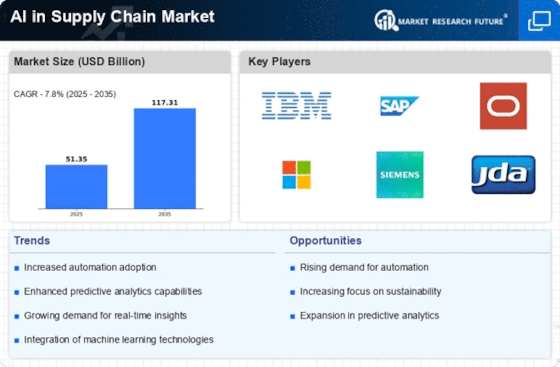
As per Market Research Future analysis, the AI in Supply Chain Market Size was estimated at 51.35 USD Billion in 2024. The AI in Supply Chain industry is projected to grow from 55.36 USD Billion in 2025 to 117.31 USD Billion by 2035, exhibiting a compound annual growth rate (CAGR) of 7.8% during the forecast period 2025 - 2035

Key Market Trends & Highlights

The AI in Supply Chain Market is experiencing robust growth driven by technological advancements and evolving consumer demands.

  • North America remains the largest market for AI in supply chain solutions, reflecting a strong adoption of advanced technologies. The Asia-Pacific region is emerging as the fastest-growing area, fueled by increasing investments in AI and automation. The retail segment continues to dominate the market, while the automotive sector is witnessing the most rapid growth in AI applications. Key market drivers include enhanced demand forecasting and cost reduction through automation, which are pivotal in shaping supply chain strategies.

Market Size & Forecast

2024 Market Size 51.35 (USD Billion)
2035 Market Size 117.31 (USD Billion)
CAGR (2025 - 2035) 7.8%
Largest Regional Market Share in 2024 North America

Major Players

<a title="IBM" href="https://www.ibm.com/think/topics/ai-supply-chain" target="_blank" rel="noopener">IBM</a> (US), Oracle (US), Microsoft (US), Siemens (DE), JDA Software (US), Blue Yonder (US), C3.ai (US), Kinaxis (CA), <a title="SAP" href="https://www.sap.com/resources/ai-in-supply-chain-management" target="_blank" rel="noopener">SAP</a> (DE)

Market Trends

The AI in Supply Chain Market is currently experiencing a transformative phase, driven by advancements in technology and the increasing need for efficiency. Organizations are increasingly adopting artificial intelligence to optimize logistics, enhance inventory management, and improve demand forecasting. This shift appears to be motivated by the desire to reduce operational costs and improve service levels. As companies integrate AI solutions, they are likely to witness enhanced decision-making capabilities and greater agility in responding to market fluctuations. The rapid adoption of artificial intelligence in supply chain operations is transforming global logistics networks, enabling smarter decision-making through AI and supply chain integration across industries. Furthermore, the growing emphasis on sustainability may also influence the adoption of AI technologies, as businesses seek to minimize their environmental impact while maintaining profitability.

In addition, the AI in Supply Chain Market seems to be characterized by a surge in collaboration between technology providers and supply chain stakeholders. This collaboration may lead to the development of innovative solutions tailored to specific industry needs. Emerging technologies such as generative AI in supply chain are reshaping planning, simulation, and decision automation, marking a major shift toward supply chain generative AI platforms. Moreover, the increasing availability of data and advancements in machine learning algorithms could further enhance the capabilities of AI systems. The convergence of supply chain and AI is enabling organizations to enhance visibility, responsiveness, and resilience across complex global operations. As organizations continue to explore the potential of AI, it is anticipated that the market will evolve, presenting new opportunities and challenges for stakeholders across the supply chain spectrum.

Enhanced Predictive Analytics

The integration of AI technologies into supply chain operations is likely to improve predictive analytics capabilities. This enhancement may allow organizations to anticipate demand fluctuations more accurately, thereby optimizing inventory levels and reducing waste. Advanced AI in supply chain planning and AI in supply chain optimization allow enterprises to anticipate demand fluctuations, mitigate disruptions, and enhance service levels through real-time analytics.

Automation of Supply Chain Processes

AI is expected to drive the automation of various supply chain processes, from procurement to logistics. This trend could lead to increased efficiency and reduced human error, enabling companies to streamline operations and focus on strategic initiatives. Organizations are increasingly adopting AI-based supply chain management and AI for supply chain management to automate procurement, logistics, and inventory workflows. An AI-powered supply chain improves forecasting accuracy, reduces operational costs, and strengthens end-to-end visibility. The adoption of AI in logistics and supply chain operations is accelerating globally, with companies leveraging artificial intelligence in logistics to optimize transportation routes, warehouse automation, and cross-border trade efficiency.

Sustainability Initiatives

The growing focus on sustainability within the AI in Supply Chain Market suggests that companies are increasingly leveraging AI to develop eco-friendly practices. This may involve optimizing routes for transportation or improving resource allocation to minimize environmental impact. Increased supply chain automation through AI in the supply chain enables organizations to reduce waste, optimize resource allocation, and achieve sustainability goals more effectively.

Artificial Intelligence in Supply Chain Market Market Drivers

Supply Chain Visibility

In the AI in Supply Chain Market, enhanced visibility across the supply chain is becoming a critical driver. AI technologies facilitate real-time tracking of goods and materials, enabling companies to monitor their supply chain operations more effectively. This visibility allows for quicker decision-making and improved risk management. For instance, organizations that implement AI solutions report a 30% reduction in supply chain disruptions. By leveraging AI for visibility, companies can identify bottlenecks, optimize routes, and enhance collaboration with suppliers and partners. This increased transparency not only improves operational efficiency but also fosters trust among stakeholders, which is essential in today's interconnected supply chain landscape.

Enhanced Demand Forecasting

The AI in Supply Chain Market is experiencing a surge in demand forecasting capabilities, driven by advanced machine learning algorithms. These algorithms analyze historical data, market trends, and consumer behavior to predict future demand with remarkable accuracy. According to recent estimates, companies utilizing AI-driven forecasting can reduce inventory costs by up to 20%. This enhanced forecasting ability allows businesses to optimize their supply chain operations, ensuring that products are available when needed while minimizing excess stock. As a result, organizations are increasingly investing in AI technologies to refine their demand planning processes, thereby improving overall efficiency and responsiveness in the supply chain.

Cost Reduction through Automation

Automation powered by AI is a pivotal driver in the AI in Supply Chain Market, as it significantly reduces operational costs. By automating repetitive tasks such as order processing, inventory management, and logistics planning, companies can streamline their operations and allocate resources more effectively. Research indicates that businesses adopting AI-driven automation can achieve cost savings of up to 25%. This reduction in costs is particularly beneficial in competitive markets where margins are tight. Furthermore, automation enhances accuracy and reduces human error, leading to improved service levels and customer satisfaction. As organizations seek to remain competitive, the integration of AI in automating supply chain processes is likely to accelerate.

Sustainability and Ethical Sourcing

Sustainability initiatives are becoming a key driver in the AI in Supply Chain Market, as companies strive to meet consumer demand for ethical sourcing and environmentally friendly practices. AI technologies facilitate the analysis of supply chain data to identify sustainable sourcing options and optimize resource usage. Organizations that implement AI-driven sustainability measures can reduce waste and improve their carbon footprint. Reports indicate that companies focusing on sustainability can enhance their brand reputation and customer loyalty, leading to increased market share. As consumers become more environmentally conscious, the integration of AI in promoting sustainable practices within the supply chain is likely to gain momentum.

Improved Supplier Relationship Management

The AI in Supply Chain Market is witnessing a transformation in supplier relationship management, driven by AI technologies. These tools enable companies to analyze supplier performance, assess risks, and identify opportunities for collaboration. By leveraging AI, organizations can enhance their negotiation strategies and foster stronger partnerships with suppliers. Data suggests that companies utilizing AI for supplier management experience a 15% improvement in supplier performance metrics. This improvement is crucial for maintaining a resilient supply chain, as strong supplier relationships can lead to better pricing, quality, and reliability. As businesses increasingly recognize the value of AI in managing supplier relationships, investment in these technologies is expected to grow.

Market Segment Insights

By Component: GPU (Largest) vs. Software (Fastest-Growing)

In the AI in Supply Chain Market, the component segment is predominantly driven by GPUs, which have secured a significant market share. GPUs are increasingly being utilized for complex computations and data analysis, making them crucial for AI applications in supply chains. On the other hand, software solutions are rapidly gaining traction, representing the fastest-growing aspect of this segment, as companies adopt advanced AI-driven applications to enhance efficiency and decision-making. The growing adoption of AI supply chain software and advanced supply chain AI solutions is driving demand for high-performance computing infrastructure, particularly GPUs and specialized AI accelerators.

GPU (Dominant) vs. Software (Emerging)

GPUs serve as the backbone of AI in Supply Chain operations owing to their unparalleled processing capabilities, significantly speeding up the data analysis and machine learning processes. Their established position is supported by strong demand for enhanced <a title="predictive analytics" href="https://www.marketresearchfuture.com/reports/predictive-analytics-market-6845" target="_blank" rel="noopener">predictive analytics</a> and real-time decision-making in supply chains. Conversely, software solutions, often termed as emerging, are revolutionizing this market by integrating AI technologies that optimize logistics, inventory management, and supplier relations. This segment is seeing exponential growth as organizations transition towards more automated and intelligent systems that foster agility and responsiveness in supply chain operations.

By End-users: Retail (Largest) vs. Automotive (Fastest-Growing)

The AI in Supply Chain Market is majorly driven by the retail sector, which holds a substantial market share due to its rapid integration of AI technologies for inventory management, customer demand forecasting, and supply chain optimization. Retailers utilize AI to enhance their operational efficiency and deliver personalized customer experiences, leading to its dominant position in the end-user segment. Conversely, the automotive industry is rapidly adopting AI solutions, driven by the need for advanced manufacturing processes, autonomous vehicles, and real-time supply chain analytics, making it a significant player in the market.

Retail (Dominant) vs. Automotive (Emerging)

The retail sector stands as the dominant force in the AI in Supply Chain Market, largely due to its adoption of AI for operational enhancements. Retailers leverage AI for predictive analytics, personalized marketing, and enhanced inventory management, which streamlines their supply chain processes. In contrast, the automotive industry is emerging as a key player, increasingly integrating AI to improve operational efficiency and support innovations like autonomous vehicles. The growing demand for smart manufacturing solutions and enhanced logistics capabilities positions automotive AI applications as a pivotal emerging trend, where manufacturers are focusing on AI for real-time <a title="data analysis" href="https://www.marketresearchfuture.com/reports/data-analytics-market-1689" target="_blank" rel="noopener">data analysis</a> and supply chain resilience.

By Technology: Machine Learning (Largest) vs. Natural Language Processing (Fastest-Growing)

In the AI in Supply Chain Market, Machine Learning dominates the technology segment due to its vast applications in predictive analytics and inventory optimization. It holds the largest market share as businesses increasingly rely on data-driven insights to enhance efficiency and reduce costs. Natural Language Processing (NLP), while smaller in market share, is rapidly gaining traction as organizations harness its capabilities for automating customer interactions and facilitating real-time decision-making in supply chains. The growth trends for these technologies reveal a dynamic landscape. Machine learning and supply chain integration plays a critical role in predictive analytics, demand forecasting, and anomaly detection. The adoption of machine learning in supply chain management enables organizations to transform historical data into actionable intelligence, improving agility and decision-making accuracy. Machine Learning continues to be the backbone of AI in supply chains, with many companies integrating it into their operations to improve forecasting accuracy. Conversely, NLP is emerging as a crucial component for enhancing communication and operational responsiveness, driven by the increasing demand for smarter automation tools that can understand and process human language effectively.

Technology: Machine Learning (Dominant) vs. Natural Language Processing (Emerging)

Machine Learning, as the dominant technology in the AI in Supply Chain Market, is characterized by its ability to analyze large datasets and generate actionable insights for supply chain optimization. Its applications extend from demand forecasting to predictive maintenance, allowing companies to make informed decisions that enhance operational efficiency. Companies investing in Machine Learning can leverage historical data to predict future trends, leading to more strategic resources allocation. On the other hand, <a title="Natural Language Processing" href="https://www.marketresearchfuture.com/reports/natural-language-processing-market-1288" target="_blank" rel="noopener">Natural Language Processing</a> (NLP) is an emerging technology that focuses on enabling machines to understand and respond to human language. As supply chains become increasingly complex, the demand for technologies that can interpret and analyze customer feedback, inquiries, and global communication has surged. NLP is instrumental in streamlining communication processes, automating customer service interactions, and enhancing real-time data analysis.

Get more detailed insights about Artificial Intelligence (AI) in Supply Chain Market Research Report – Global Forecast till 2035

Regional Insights

North America : Innovation and Leadership Hub

North America is the largest market for AI in the supply chain, holding approximately 45% of the global market share. The region's growth is driven by rapid technological advancements, increased investment in AI technologies, and a strong focus on automation and efficiency. Regulatory support from government initiatives further catalyzes this growth, fostering an environment conducive to innovation and adoption of AI solutions. The United States leads the market, with significant contributions from Canada. Major players like IBM, Oracle, and Microsoft are headquartered here, driving competition and innovation. The presence of advanced infrastructure and a skilled workforce enhances the region's competitive landscape, making it a focal point for AI development in supply chains. Companies are increasingly leveraging AI to optimize logistics, reduce costs, and improve decision-making processes.

Europe : Regulatory Framework and Growth

Europe is the second-largest market for AI in the supply chain, accounting for approximately 30% of the global market share. The region's growth is propelled by stringent regulations aimed at enhancing supply chain transparency and sustainability. Initiatives like the European Green Deal and the Digital Single Market strategy are pivotal in driving demand for AI solutions that improve efficiency and reduce environmental impact. Germany and the United Kingdom are the leading countries in this sector, with a strong presence of key players such as SAP and Siemens. The competitive landscape is characterized by a mix of established firms and innovative startups, all striving to leverage AI for enhanced supply chain management. The European market is increasingly focused on integrating AI with IoT and blockchain technologies to create more resilient and efficient supply chains.

Asia-Pacific : Rapid Growth and Adoption

Asia-Pacific is witnessing rapid growth in the AI supply chain market, holding about 20% of the global market share. The region's expansion is driven by increasing investments in technology, a burgeoning e-commerce sector, and a growing emphasis on digital transformation across industries. Countries like China and India are at the forefront, supported by favorable government policies and initiatives aimed at enhancing technological capabilities. China is the largest market in the region, with significant contributions from India and Japan. The competitive landscape is vibrant, featuring both local and international players. Companies are increasingly adopting AI to streamline operations, enhance customer experiences, and improve supply chain visibility. The region's focus on innovation and technology adoption positions it as a key player in The AI in Supply Chain.

Middle East and Africa : Emerging Market Potential

The Middle East and Africa region is emerging as a potential market for AI in the supply chain, currently holding about 5% of the global market share. The growth is driven by increasing investments in technology and a rising demand for efficient supply chain solutions. Governments are recognizing the importance of digital transformation, leading to initiatives that support AI adoption in various sectors, including logistics and manufacturing. Countries like South Africa and the UAE are leading the charge, with a growing number of startups and established companies exploring AI applications in supply chains. The competitive landscape is evolving, with local firms partnering with global technology providers to enhance their capabilities. As the region continues to invest in infrastructure and technology, the potential for AI in supply chains is expected to expand significantly.

Key Players and Competitive Insights

Leading market players are investing heavily in research and development to expand their product lines, which will help the AI in Supply Chain market grow even more. Recent AI in supply chain examples, including conversational platforms and decision-support tools, highlight emerging ChatGPT supply chain use cases such as demand scenario analysis, supplier communication automation, and logistics exception handling. Market participants are also undertaking various strategic activities to expand their footprint, with important market developments including new product launches, contractual agreements, mergers and acquisitions, higher investments, and collaboration with other organizations. To expand and survive in a more competitive and rising market climate, the AI in Supply Chain industry must offer cost-effective items.
Manufacturing locally to minimize operational costs is one of the key business tactics manufacturers use in the AI in Supply Chain industry to benefit clients and increase the market sector. The AI in Supply Chain industry has recently offered some of the most significant medical advantages. Major players in the AI in Supply Chain market, including Nvidia Corporation, IBM Corporation, Intel Corporation, Xilinx Inc., Samsung Electronics, Microsoft Corporation, Micron Technology, SAP SE, Oracle Corporation, Logility Inc., Amazon, LLamasoft and others are attempting to increase market demand by investing in research and development operations.
Nvidia Corporation NVIDIA pioneered accelerated computing to solve problems no one else could. Our work in artificial intelligence and the metaverse transforms the world's largest industries and profoundly impacts society. The metaverse, or 3D internet, promises a world where virtual collaboration is simple and industrial behemoths can reap the benefits of digital twins. NVIDIA OmniverseTM is a tool for creating and managing metaverse applications.
IBM Corporation, bring together all of the necessary technology and services, regardless of source, to assist clients in solving the most pressing business problems. Transformation is evolving from one-time project to an urgent, purpose-driven imperative. Modern businesses must move faster while also exhibiting greater empathy and openness. IBM Consulting is a new partner for modern business's new rules. We embrace an open way of working by bringing together a diverse set of voices and technologies. We work closely together, freely ideate, and quickly apply breakthrough innovations that exponentially impact how business is done.
We believe that open ecosystems, technologies, innovation, and cultures are critical to creating opportunities and charting the course for modern business and society.

Key Companies in the Artificial Intelligence in Supply Chain Market include

Industry Developments

  • Q1 2024: IBM launches LogiGen AI, a generative AI solution for logistics and transportation IBM introduced LogiGen AI, a generative AI platform designed to optimize route planning, demand forecasting, and anomaly detection for logistics providers, aiming to enhance operational efficiency and supply chain agility.
  • Q2 2024: Sanofi deploys AI-driven supply chain management to mitigate €300 million in revenue risks Sanofi implemented advanced AI systems to manage its global supply chain, enabling the company to predict and avoid significant inventory risks and improve operational efficiency.
  • Q2 2024: AI-managed supply chains experience 47% more cyberattack attempts in 2024 The World Economic Forum highlighted a surge in cyberattack attempts targeting AI-powered supply chains, prompting companies to invest in advanced AI security solutions and risk mitigation strategies.
  • Q2 2024: DocShipper launches predictive logistics platform with 87% accuracy for shipping delay forecasts DocShipper unveiled a new AI-powered simulation platform that predicts shipping delays up to 9 days in advance, allowing clients to proactively implement mitigation strategies.
  • Q2 2024: IBM partners with Maersk to deploy generative AI for global supply chain optimization IBM and Maersk announced a strategic partnership to integrate generative AI into Maersk’s global logistics operations, focusing on network design optimization and autonomous planning.
  • Q2 2024: Sanofi appoints new Chief Digital Supply Chain Officer to lead AI transformation Sanofi named a new executive to oversee its digital supply chain initiatives, emphasizing the company’s commitment to AI-driven operational improvements.
  • Q2 2024: DHL opens new AI-powered logistics hub in Singapore DHL inaugurated a state-of-the-art logistics facility in Singapore featuring AI-driven warehouse automation and predictive analytics for supply chain management.
  • Q3 2024: Microsoft acquires supply chain AI startup ClearMetal Microsoft completed the acquisition of ClearMetal, a startup specializing in AI-powered supply chain visibility and predictive analytics, to bolster its enterprise cloud offerings.
  • Q3 2024: Amazon launches AI-powered digital twin platform for supply chain simulation Amazon introduced a new digital twin platform leveraging AI to simulate and optimize supply chain operations, enabling real-time scenario testing and autonomous implementation.
  • Q3 2024: FourKites raises $80M to expand AI-driven supply chain visibility solutions Supply chain technology company FourKites secured $80 million in funding to accelerate development of its AI-powered visibility and predictive analytics platform.
  • Q4 2024: Siemens and SAP announce joint AI initiative for supply chain resilience Siemens and SAP launched a collaborative initiative to develop AI-powered tools for enhancing supply chain resilience and real-time risk management.
  • Q1 2025: Flexport wins $100M contract to deploy AI logistics platform for US government supply chains Flexport secured a major contract to implement its AI-driven logistics platform across multiple US government supply chains, focusing on predictive analytics and operational efficiency.

Future Outlook

Artificial Intelligence in Supply Chain Market Future Outlook

The AI in Supply Chain Market is projected to grow at a 7.8% CAGR from 2024 to 2035, driven by automation, data analytics, and enhanced decision-making capabilities.<br>By 2035, the market is expected to be robust, characterized by advanced AI applications and increased operational efficiencies. The future of AI in supply chain will be defined by autonomous planning systems, generative AI supply chain applications, and self-optimizing logistics networks that enhance resilience and scalability.

New opportunities lie in:

  • <p>Integration of AI-driven predictive analytics for inventory management. Development of autonomous delivery systems for last-mile logistics. Implementation of AI-based demand forecasting tools for supply chain optimization.</p>

By 2035, the market is expected to be robust, characterized by advanced AI applications and increased operational efficiencies.

Market Segmentation

Artificial Intelligence in Supply Chain Market Component Outlook

  • Software
  • Network
  • Hardware
  • FPGA
  • GPU
  • ASIC

Artificial Intelligence in Supply Chain Market End-users Outlook

  • Automotive
  • Retail
  • Manufacturing

Artificial Intelligence in Supply Chain Market Technology Outlook

  • Machine Learning
  • Natural Language Processing

Report Scope

MARKET SIZE 2024 51.35(USD Billion)
MARKET SIZE 2025 55.36(USD Billion)
MARKET SIZE 2035 117.31(USD Billion)
COMPOUND ANNUAL GROWTH RATE (CAGR) 7.8% (2025 - 2035)
REPORT COVERAGE Revenue Forecast, Competitive Landscape, Growth Factors, and Trends
BASE YEAR 2024
Market Forecast Period 2025 - 2035
Historical Data 2019 - 2024
Market Forecast Units USD Billion
Key Companies Profiled IBM (US), Oracle (US), Microsoft (US), Siemens (DE), JDA Software (US), Blue Yonder (US), C3.ai (US), Kinaxis (CA), SAP (DE)
Segments Covered Component, End-users, Technology, Region
Key Market Opportunities Integration of advanced analytics and machine learning enhances efficiency in the AI in Supply Chain Market.
Key Market Dynamics Rising integration of artificial intelligence enhances supply chain efficiency and responsiveness amid evolving consumer demands.
Countries Covered North America, Europe, APAC, South America, MEA

FAQs

What is the projected market valuation for AI in the Supply Chain Market by 2035?

<p>The projected market valuation for AI in the Supply Chain Market is expected to reach 117.31 USD Billion by 2035.</p>

What was the overall market valuation for AI in the Supply Chain Market in 2024?

<p>The overall market valuation for AI in the Supply Chain Market was 51.35 USD Billion in 2024.</p>

What is the expected CAGR for the AI in Supply Chain Market during the forecast period 2025 - 2035?

<p>The expected CAGR for the AI in Supply Chain Market during the forecast period 2025 - 2035 is 7.8%.</p>

Which companies are considered key players in the AI in Supply Chain Market?

<p>Key players in the AI in Supply Chain Market include IBM, SAP, Oracle, Microsoft, Siemens, JDA Software, Blue Yonder, C3.ai, and Kinaxis.</p>

What are the projected valuations for the software segment in the AI in Supply Chain Market by 2035?

<p>The software segment is projected to grow from 20.0 USD Billion to 45.0 USD Billion by 2035.</p>

How does the hardware segment's valuation change from 2024 to 2035?

<p>The hardware segment's valuation is expected to increase from 8.0 USD Billion to 15.0 USD Billion by 2035.</p>

What is the anticipated growth for the automotive end-user segment in the AI in Supply Chain Market?

The automotive end-user segment is projected to grow from 15.0 USD Billion to 35.0 USD Billion by 2035.

What are the expected valuations for machine learning technology in the AI in Supply Chain Market by 2035?

The machine learning technology segment is expected to grow from 30.0 USD Billion to 70.0 USD Billion by 2035.

What is the projected growth for the natural language processing segment in the AI in Supply Chain Market?

The natural language processing segment is projected to increase from 21.35 USD Billion to 47.31 USD Billion by 2035.

How does the network segment's valuation evolve from 2024 to 2035?

The network segment's valuation is expected to rise from 10.0 USD Billion to 25.0 USD Billion by 2035.

  1. SECTION I: EXECUTIVE SUMMARY AND KEY HIGHLIGHTS
    1. | 1.1 EXECUTIVE SUMMARY
    2. | | 1.1.1 Market Overview
    3. | | 1.1.2 Key Findings
    4. | | 1.1.3 Market Segmentation
    5. | | 1.1.4 Competitive Landscape
    6. | | 1.1.5 Challenges and Opportunities
    7. | | 1.1.6 Future Outlook
  2. SECTION II: SCOPING, METHODOLOGY AND MARKET STRUCTURE
    1. | 2.1 MARKET INTRODUCTION
    2. | | 2.1.1 Definition
    3. | | 2.1.2 Scope of the study
    4. | | | 2.1.2.1 Research Objective
    5. | | | 2.1.2.2 Assumption
    6. | | | 2.1.2.3 Limitations
    7. | 2.2 RESEARCH METHODOLOGY
    8. | | 2.2.1 Overview
    9. | | 2.2.2 Data Mining
    10. | | 2.2.3 Secondary Research
    11. | | 2.2.4 Primary Research
    12. | | | 2.2.4.1 Primary Interviews and Information Gathering Process
    13. | | | 2.2.4.2 Breakdown of Primary Respondents
    14. | | 2.2.5 Forecasting Model
    15. | | 2.2.6 Market Size Estimation
    16. | | | 2.2.6.1 Bottom-Up Approach
    17. | | | 2.2.6.2 Top-Down Approach
    18. | | 2.2.7 Data Triangulation
    19. | | 2.2.8 Validation
  3. SECTION III: QUALITATIVE ANALYSIS
    1. | 3.1 MARKET DYNAMICS
    2. | | 3.1.1 Overview
    3. | | 3.1.2 Drivers
    4. | | 3.1.3 Restraints
    5. | | 3.1.4 Opportunities
    6. | 3.2 MARKET FACTOR ANALYSIS
    7. | | 3.2.1 Value chain Analysis
    8. | | 3.2.2 Porter's Five Forces Analysis
    9. | | | 3.2.2.1 Bargaining Power of Suppliers
    10. | | | 3.2.2.2 Bargaining Power of Buyers
    11. | | | 3.2.2.3 Threat of New Entrants
    12. | | | 3.2.2.4 Threat of Substitutes
    13. | | | 3.2.2.5 Intensity of Rivalry
    14. | | 3.2.3 COVID-19 Impact Analysis
    15. | | | 3.2.3.1 Market Impact Analysis
    16. | | | 3.2.3.2 Regional Impact
    17. | | | 3.2.3.3 Opportunity and Threat Analysis
  4. SECTION IV: QUANTITATIVE ANALYSIS
    1. | 4.1 Information and Communications Technology, BY Component (USD Billion)
    2. | | 4.1.1 Software
    3. | | 4.1.2 Network
    4. | | 4.1.3 Hardware
    5. | | 4.1.4 FPGA
    6. | | 4.1.5 GPU
    7. | | 4.1.6 ASIC
    8. | 4.2 Information and Communications Technology, BY End-users (USD Billion)
    9. | | 4.2.1 Automotive
    10. | | 4.2.2 Retail
    11. | | 4.2.3 Manufacturing
    12. | 4.3 Information and Communications Technology, BY Technology (USD Billion)
    13. | | 4.3.1 Machine Learning
    14. | | 4.3.2 Natural Language Processing
    15. | 4.4 Information and Communications Technology, BY Region (USD Billion)
    16. | | 4.4.1 North America
    17. | | | 4.4.1.1 US
    18. | | | 4.4.1.2 Canada
    19. | | 4.4.2 Europe
    20. | | | 4.4.2.1 Germany
    21. | | | 4.4.2.2 UK
    22. | | | 4.4.2.3 France
    23. | | | 4.4.2.4 Russia
    24. | | | 4.4.2.5 Italy
    25. | | | 4.4.2.6 Spain
    26. | | | 4.4.2.7 Rest of Europe
    27. | | 4.4.3 APAC
    28. | | | 4.4.3.1 China
    29. | | | 4.4.3.2 India
    30. | | | 4.4.3.3 Japan
    31. | | | 4.4.3.4 South Korea
    32. | | | 4.4.3.5 Malaysia
    33. | | | 4.4.3.6 Thailand
    34. | | | 4.4.3.7 Indonesia
    35. | | | 4.4.3.8 Rest of APAC
    36. | | 4.4.4 South America
    37. | | | 4.4.4.1 Brazil
    38. | | | 4.4.4.2 Mexico
    39. | | | 4.4.4.3 Argentina
    40. | | | 4.4.4.4 Rest of South America
    41. | | 4.4.5 MEA
    42. | | | 4.4.5.1 GCC Countries
    43. | | | 4.4.5.2 South Africa
    44. | | | 4.4.5.3 Rest of MEA
  5. SECTION V: COMPETITIVE ANALYSIS
    1. | 5.1 Competitive Landscape
    2. | | 5.1.1 Overview
    3. | | 5.1.2 Competitive Analysis
    4. | | 5.1.3 Market share Analysis
    5. | | 5.1.4 Major Growth Strategy in the Information and Communications Technology
    6. | | 5.1.5 Competitive Benchmarking
    7. | | 5.1.6 Leading Players in Terms of Number of Developments in the Information and Communications Technology
    8. | | 5.1.7 Key developments and growth strategies
    9. | | | 5.1.7.1 New Product Launch/Service Deployment
    10. | | | 5.1.7.2 Merger & Acquisitions
    11. | | | 5.1.7.3 Joint Ventures
    12. | | 5.1.8 Major Players Financial Matrix
    13. | | | 5.1.8.1 Sales and Operating Income
    14. | | | 5.1.8.2 Major Players R&D Expenditure. 2023
    15. | 5.2 Company Profiles
    16. | | 5.2.1 IBM (US)
    17. | | | 5.2.1.1 Financial Overview
    18. | | | 5.2.1.2 Products Offered
    19. | | | 5.2.1.3 Key Developments
    20. | | | 5.2.1.4 SWOT Analysis
    21. | | | 5.2.1.5 Key Strategies
    22. | | 5.2.2 SAP (DE)
    23. | | | 5.2.2.1 Financial Overview
    24. | | | 5.2.2.2 Products Offered
    25. | | | 5.2.2.3 Key Developments
    26. | | | 5.2.2.4 SWOT Analysis
    27. | | | 5.2.2.5 Key Strategies
    28. | | 5.2.3 Oracle (US)
    29. | | | 5.2.3.1 Financial Overview
    30. | | | 5.2.3.2 Products Offered
    31. | | | 5.2.3.3 Key Developments
    32. | | | 5.2.3.4 SWOT Analysis
    33. | | | 5.2.3.5 Key Strategies
    34. | | 5.2.4 Microsoft (US)
    35. | | | 5.2.4.1 Financial Overview
    36. | | | 5.2.4.2 Products Offered
    37. | | | 5.2.4.3 Key Developments
    38. | | | 5.2.4.4 SWOT Analysis
    39. | | | 5.2.4.5 Key Strategies
    40. | | 5.2.5 Siemens (DE)
    41. | | | 5.2.5.1 Financial Overview
    42. | | | 5.2.5.2 Products Offered
    43. | | | 5.2.5.3 Key Developments
    44. | | | 5.2.5.4 SWOT Analysis
    45. | | | 5.2.5.5 Key Strategies
    46. | | 5.2.6 JDA Software (US)
    47. | | | 5.2.6.1 Financial Overview
    48. | | | 5.2.6.2 Products Offered
    49. | | | 5.2.6.3 Key Developments
    50. | | | 5.2.6.4 SWOT Analysis
    51. | | | 5.2.6.5 Key Strategies
    52. | | 5.2.7 Blue Yonder (US)
    53. | | | 5.2.7.1 Financial Overview
    54. | | | 5.2.7.2 Products Offered
    55. | | | 5.2.7.3 Key Developments
    56. | | | 5.2.7.4 SWOT Analysis
    57. | | | 5.2.7.5 Key Strategies
    58. | | 5.2.8 C3.ai (US)
    59. | | | 5.2.8.1 Financial Overview
    60. | | | 5.2.8.2 Products Offered
    61. | | | 5.2.8.3 Key Developments
    62. | | | 5.2.8.4 SWOT Analysis
    63. | | | 5.2.8.5 Key Strategies
    64. | | 5.2.9 Kinaxis (CA)
    65. | | | 5.2.9.1 Financial Overview
    66. | | | 5.2.9.2 Products Offered
    67. | | | 5.2.9.3 Key Developments
    68. | | | 5.2.9.4 SWOT Analysis
    69. | | | 5.2.9.5 Key Strategies
    70. | 5.3 Appendix
    71. | | 5.3.1 References
    72. | | 5.3.2 Related Reports
  6. LIST OF FIGURES
    1. | 6.1 MARKET SYNOPSIS
    2. | 6.2 NORTH AMERICA MARKET ANALYSIS
    3. | 6.3 US MARKET ANALYSIS BY COMPONENT
    4. | 6.4 US MARKET ANALYSIS BY END-USERS
    5. | 6.5 US MARKET ANALYSIS BY TECHNOLOGY
    6. | 6.6 CANADA MARKET ANALYSIS BY COMPONENT
    7. | 6.7 CANADA MARKET ANALYSIS BY END-USERS
    8. | 6.8 CANADA MARKET ANALYSIS BY TECHNOLOGY
    9. | 6.9 EUROPE MARKET ANALYSIS
    10. | 6.10 GERMANY MARKET ANALYSIS BY COMPONENT
    11. | 6.11 GERMANY MARKET ANALYSIS BY END-USERS
    12. | 6.12 GERMANY MARKET ANALYSIS BY TECHNOLOGY
    13. | 6.13 UK MARKET ANALYSIS BY COMPONENT
    14. | 6.14 UK MARKET ANALYSIS BY END-USERS
    15. | 6.15 UK MARKET ANALYSIS BY TECHNOLOGY
    16. | 6.16 FRANCE MARKET ANALYSIS BY COMPONENT
    17. | 6.17 FRANCE MARKET ANALYSIS BY END-USERS
    18. | 6.18 FRANCE MARKET ANALYSIS BY TECHNOLOGY
    19. | 6.19 RUSSIA MARKET ANALYSIS BY COMPONENT
    20. | 6.20 RUSSIA MARKET ANALYSIS BY END-USERS
    21. | 6.21 RUSSIA MARKET ANALYSIS BY TECHNOLOGY
    22. | 6.22 ITALY MARKET ANALYSIS BY COMPONENT
    23. | 6.23 ITALY MARKET ANALYSIS BY END-USERS
    24. | 6.24 ITALY MARKET ANALYSIS BY TECHNOLOGY
    25. | 6.25 SPAIN MARKET ANALYSIS BY COMPONENT
    26. | 6.26 SPAIN MARKET ANALYSIS BY END-USERS
    27. | 6.27 SPAIN MARKET ANALYSIS BY TECHNOLOGY
    28. | 6.28 REST OF EUROPE MARKET ANALYSIS BY COMPONENT
    29. | 6.29 REST OF EUROPE MARKET ANALYSIS BY END-USERS
    30. | 6.30 REST OF EUROPE MARKET ANALYSIS BY TECHNOLOGY
    31. | 6.31 APAC MARKET ANALYSIS
    32. | 6.32 CHINA MARKET ANALYSIS BY COMPONENT
    33. | 6.33 CHINA MARKET ANALYSIS BY END-USERS
    34. | 6.34 CHINA MARKET ANALYSIS BY TECHNOLOGY
    35. | 6.35 INDIA MARKET ANALYSIS BY COMPONENT
    36. | 6.36 INDIA MARKET ANALYSIS BY END-USERS
    37. | 6.37 INDIA MARKET ANALYSIS BY TECHNOLOGY
    38. | 6.38 JAPAN MARKET ANALYSIS BY COMPONENT
    39. | 6.39 JAPAN MARKET ANALYSIS BY END-USERS
    40. | 6.40 JAPAN MARKET ANALYSIS BY TECHNOLOGY
    41. | 6.41 SOUTH KOREA MARKET ANALYSIS BY COMPONENT
    42. | 6.42 SOUTH KOREA MARKET ANALYSIS BY END-USERS
    43. | 6.43 SOUTH KOREA MARKET ANALYSIS BY TECHNOLOGY
    44. | 6.44 MALAYSIA MARKET ANALYSIS BY COMPONENT
    45. | 6.45 MALAYSIA MARKET ANALYSIS BY END-USERS
    46. | 6.46 MALAYSIA MARKET ANALYSIS BY TECHNOLOGY
    47. | 6.47 THAILAND MARKET ANALYSIS BY COMPONENT
    48. | 6.48 THAILAND MARKET ANALYSIS BY END-USERS
    49. | 6.49 THAILAND MARKET ANALYSIS BY TECHNOLOGY
    50. | 6.50 INDONESIA MARKET ANALYSIS BY COMPONENT
    51. | 6.51 INDONESIA MARKET ANALYSIS BY END-USERS
    52. | 6.52 INDONESIA MARKET ANALYSIS BY TECHNOLOGY
    53. | 6.53 REST OF APAC MARKET ANALYSIS BY COMPONENT
    54. | 6.54 REST OF APAC MARKET ANALYSIS BY END-USERS
    55. | 6.55 REST OF APAC MARKET ANALYSIS BY TECHNOLOGY
    56. | 6.56 SOUTH AMERICA MARKET ANALYSIS
    57. | 6.57 BRAZIL MARKET ANALYSIS BY COMPONENT
    58. | 6.58 BRAZIL MARKET ANALYSIS BY END-USERS
    59. | 6.59 BRAZIL MARKET ANALYSIS BY TECHNOLOGY
    60. | 6.60 MEXICO MARKET ANALYSIS BY COMPONENT
    61. | 6.61 MEXICO MARKET ANALYSIS BY END-USERS
    62. | 6.62 MEXICO MARKET ANALYSIS BY TECHNOLOGY
    63. | 6.63 ARGENTINA MARKET ANALYSIS BY COMPONENT
    64. | 6.64 ARGENTINA MARKET ANALYSIS BY END-USERS
    65. | 6.65 ARGENTINA MARKET ANALYSIS BY TECHNOLOGY
    66. | 6.66 REST OF SOUTH AMERICA MARKET ANALYSIS BY COMPONENT
    67. | 6.67 REST OF SOUTH AMERICA MARKET ANALYSIS BY END-USERS
    68. | 6.68 REST OF SOUTH AMERICA MARKET ANALYSIS BY TECHNOLOGY
    69. | 6.69 MEA MARKET ANALYSIS
    70. | 6.70 GCC COUNTRIES MARKET ANALYSIS BY COMPONENT
    71. | 6.71 GCC COUNTRIES MARKET ANALYSIS BY END-USERS
    72. | 6.72 GCC COUNTRIES MARKET ANALYSIS BY TECHNOLOGY
    73. | 6.73 SOUTH AFRICA MARKET ANALYSIS BY COMPONENT
    74. | 6.74 SOUTH AFRICA MARKET ANALYSIS BY END-USERS
    75. | 6.75 SOUTH AFRICA MARKET ANALYSIS BY TECHNOLOGY
    76. | 6.76 REST OF MEA MARKET ANALYSIS BY COMPONENT
    77. | 6.77 REST OF MEA MARKET ANALYSIS BY END-USERS
    78. | 6.78 REST OF MEA MARKET ANALYSIS BY TECHNOLOGY
    79. | 6.79 KEY BUYING CRITERIA OF INFORMATION AND COMMUNICATIONS TECHNOLOGY
    80. | 6.80 RESEARCH PROCESS OF MRFR
    81. | 6.81 DRO ANALYSIS OF INFORMATION AND COMMUNICATIONS TECHNOLOGY
    82. | 6.82 DRIVERS IMPACT ANALYSIS: INFORMATION AND COMMUNICATIONS TECHNOLOGY
    83. | 6.83 RESTRAINTS IMPACT ANALYSIS: INFORMATION AND COMMUNICATIONS TECHNOLOGY
    84. | 6.84 SUPPLY / VALUE CHAIN: INFORMATION AND COMMUNICATIONS TECHNOLOGY
    85. | 6.85 INFORMATION AND COMMUNICATIONS TECHNOLOGY, BY COMPONENT, 2024 (% SHARE)
    86. | 6.86 INFORMATION AND COMMUNICATIONS TECHNOLOGY, BY COMPONENT, 2024 TO 2035 (USD Billion)
    87. | 6.87 INFORMATION AND COMMUNICATIONS TECHNOLOGY, BY END-USERS, 2024 (% SHARE)
    88. | 6.88 INFORMATION AND COMMUNICATIONS TECHNOLOGY, BY END-USERS, 2024 TO 2035 (USD Billion)
    89. | 6.89 INFORMATION AND COMMUNICATIONS TECHNOLOGY, BY TECHNOLOGY, 2024 (% SHARE)
    90. | 6.90 INFORMATION AND COMMUNICATIONS TECHNOLOGY, BY TECHNOLOGY, 2024 TO 2035 (USD Billion)
    91. | 6.91 BENCHMARKING OF MAJOR COMPETITORS
  7. LIST OF TABLES
    1. | 7.1 LIST OF ASSUMPTIONS
    2. | | 7.1.1
    3. | 7.2 North America MARKET SIZE ESTIMATES; FORECAST
    4. | | 7.2.1 BY COMPONENT, 2025-2035 (USD Billion)
    5. | | 7.2.2 BY END-USERS, 2025-2035 (USD Billion)
    6. | | 7.2.3 BY TECHNOLOGY, 2025-2035 (USD Billion)
    7. | 7.3 US MARKET SIZE ESTIMATES; FORECAST
    8. | | 7.3.1 BY COMPONENT, 2025-2035 (USD Billion)
    9. | | 7.3.2 BY END-USERS, 2025-2035 (USD Billion)
    10. | | 7.3.3 BY TECHNOLOGY, 2025-2035 (USD Billion)
    11. | 7.4 Canada MARKET SIZE ESTIMATES; FORECAST
    12. | | 7.4.1 BY COMPONENT, 2025-2035 (USD Billion)
    13. | | 7.4.2 BY END-USERS, 2025-2035 (USD Billion)
    14. | | 7.4.3 BY TECHNOLOGY, 2025-2035 (USD Billion)
    15. | 7.5 Europe MARKET SIZE ESTIMATES; FORECAST
    16. | | 7.5.1 BY COMPONENT, 2025-2035 (USD Billion)
    17. | | 7.5.2 BY END-USERS, 2025-2035 (USD Billion)
    18. | | 7.5.3 BY TECHNOLOGY, 2025-2035 (USD Billion)
    19. | 7.6 Germany MARKET SIZE ESTIMATES; FORECAST
    20. | | 7.6.1 BY COMPONENT, 2025-2035 (USD Billion)
    21. | | 7.6.2 BY END-USERS, 2025-2035 (USD Billion)
    22. | | 7.6.3 BY TECHNOLOGY, 2025-2035 (USD Billion)
    23. | 7.7 UK MARKET SIZE ESTIMATES; FORECAST
    24. | | 7.7.1 BY COMPONENT, 2025-2035 (USD Billion)
    25. | | 7.7.2 BY END-USERS, 2025-2035 (USD Billion)
    26. | | 7.7.3 BY TECHNOLOGY, 2025-2035 (USD Billion)
    27. | 7.8 France MARKET SIZE ESTIMATES; FORECAST
    28. | | 7.8.1 BY COMPONENT, 2025-2035 (USD Billion)
    29. | | 7.8.2 BY END-USERS, 2025-2035 (USD Billion)
    30. | | 7.8.3 BY TECHNOLOGY, 2025-2035 (USD Billion)
    31. | 7.9 Russia MARKET SIZE ESTIMATES; FORECAST
    32. | | 7.9.1 BY COMPONENT, 2025-2035 (USD Billion)
    33. | | 7.9.2 BY END-USERS, 2025-2035 (USD Billion)
    34. | | 7.9.3 BY TECHNOLOGY, 2025-2035 (USD Billion)
    35. | 7.10 Italy MARKET SIZE ESTIMATES; FORECAST
    36. | | 7.10.1 BY COMPONENT, 2025-2035 (USD Billion)
    37. | | 7.10.2 BY END-USERS, 2025-2035 (USD Billion)
    38. | | 7.10.3 BY TECHNOLOGY, 2025-2035 (USD Billion)
    39. | 7.11 Spain MARKET SIZE ESTIMATES; FORECAST
    40. | | 7.11.1 BY COMPONENT, 2025-2035 (USD Billion)
    41. | | 7.11.2 BY END-USERS, 2025-2035 (USD Billion)
    42. | | 7.11.3 BY TECHNOLOGY, 2025-2035 (USD Billion)
    43. | 7.12 Rest of Europe MARKET SIZE ESTIMATES; FORECAST
    44. | | 7.12.1 BY COMPONENT, 2025-2035 (USD Billion)
    45. | | 7.12.2 BY END-USERS, 2025-2035 (USD Billion)
    46. | | 7.12.3 BY TECHNOLOGY, 2025-2035 (USD Billion)
    47. | 7.13 APAC MARKET SIZE ESTIMATES; FORECAST
    48. | | 7.13.1 BY COMPONENT, 2025-2035 (USD Billion)
    49. | | 7.13.2 BY END-USERS, 2025-2035 (USD Billion)
    50. | | 7.13.3 BY TECHNOLOGY, 2025-2035 (USD Billion)
    51. | 7.14 China MARKET SIZE ESTIMATES; FORECAST
    52. | | 7.14.1 BY COMPONENT, 2025-2035 (USD Billion)
    53. | | 7.14.2 BY END-USERS, 2025-2035 (USD Billion)
    54. | | 7.14.3 BY TECHNOLOGY, 2025-2035 (USD Billion)
    55. | 7.15 India MARKET SIZE ESTIMATES; FORECAST
    56. | | 7.15.1 BY COMPONENT, 2025-2035 (USD Billion)
    57. | | 7.15.2 BY END-USERS, 2025-2035 (USD Billion)
    58. | | 7.15.3 BY TECHNOLOGY, 2025-2035 (USD Billion)
    59. | 7.16 Japan MARKET SIZE ESTIMATES; FORECAST
    60. | | 7.16.1 BY COMPONENT, 2025-2035 (USD Billion)
    61. | | 7.16.2 BY END-USERS, 2025-2035 (USD Billion)
    62. | | 7.16.3 BY TECHNOLOGY, 2025-2035 (USD Billion)
    63. | 7.17 South Korea MARKET SIZE ESTIMATES; FORECAST
    64. | | 7.17.1 BY COMPONENT, 2025-2035 (USD Billion)
    65. | | 7.17.2 BY END-USERS, 2025-2035 (USD Billion)
    66. | | 7.17.3 BY TECHNOLOGY, 2025-2035 (USD Billion)
    67. | 7.18 Malaysia MARKET SIZE ESTIMATES; FORECAST
    68. | | 7.18.1 BY COMPONENT, 2025-2035 (USD Billion)
    69. | | 7.18.2 BY END-USERS, 2025-2035 (USD Billion)
    70. | | 7.18.3 BY TECHNOLOGY, 2025-2035 (USD Billion)
    71. | 7.19 Thailand MARKET SIZE ESTIMATES; FORECAST
    72. | | 7.19.1 BY COMPONENT, 2025-2035 (USD Billion)
    73. | | 7.19.2 BY END-USERS, 2025-2035 (USD Billion)
    74. | | 7.19.3 BY TECHNOLOGY, 2025-2035 (USD Billion)
    75. | 7.20 Indonesia MARKET SIZE ESTIMATES; FORECAST
    76. | | 7.20.1 BY COMPONENT, 2025-2035 (USD Billion)
    77. | | 7.20.2 BY END-USERS, 2025-2035 (USD Billion)
    78. | | 7.20.3 BY TECHNOLOGY, 2025-2035 (USD Billion)
    79. | 7.21 Rest of APAC MARKET SIZE ESTIMATES; FORECAST
    80. | | 7.21.1 BY COMPONENT, 2025-2035 (USD Billion)
    81. | | 7.21.2 BY END-USERS, 2025-2035 (USD Billion)
    82. | | 7.21.3 BY TECHNOLOGY, 2025-2035 (USD Billion)
    83. | 7.22 South America MARKET SIZE ESTIMATES; FORECAST
    84. | | 7.22.1 BY COMPONENT, 2025-2035 (USD Billion)
    85. | | 7.22.2 BY END-USERS, 2025-2035 (USD Billion)
    86. | | 7.22.3 BY TECHNOLOGY, 2025-2035 (USD Billion)
    87. | 7.23 Brazil MARKET SIZE ESTIMATES; FORECAST
    88. | | 7.23.1 BY COMPONENT, 2025-2035 (USD Billion)
    89. | | 7.23.2 BY END-USERS, 2025-2035 (USD Billion)
    90. | | 7.23.3 BY TECHNOLOGY, 2025-2035 (USD Billion)
    91. | 7.24 Mexico MARKET SIZE ESTIMATES; FORECAST
    92. | | 7.24.1 BY COMPONENT, 2025-2035 (USD Billion)
    93. | | 7.24.2 BY END-USERS, 2025-2035 (USD Billion)
    94. | | 7.24.3 BY TECHNOLOGY, 2025-2035 (USD Billion)
    95. | 7.25 Argentina MARKET SIZE ESTIMATES; FORECAST
    96. | | 7.25.1 BY COMPONENT, 2025-2035 (USD Billion)
    97. | | 7.25.2 BY END-USERS, 2025-2035 (USD Billion)
    98. | | 7.25.3 BY TECHNOLOGY, 2025-2035 (USD Billion)
    99. | 7.26 Rest of South America MARKET SIZE ESTIMATES; FORECAST
    100. | | 7.26.1 BY COMPONENT, 2025-2035 (USD Billion)
    101. | | 7.26.2 BY END-USERS, 2025-2035 (USD Billion)
    102. | | 7.26.3 BY TECHNOLOGY, 2025-2035 (USD Billion)
    103. | 7.27 MEA MARKET SIZE ESTIMATES; FORECAST
    104. | | 7.27.1 BY COMPONENT, 2025-2035 (USD Billion)
    105. | | 7.27.2 BY END-USERS, 2025-2035 (USD Billion)
    106. | | 7.27.3 BY TECHNOLOGY, 2025-2035 (USD Billion)
    107. | 7.28 GCC Countries MARKET SIZE ESTIMATES; FORECAST
    108. | | 7.28.1 BY COMPONENT, 2025-2035 (USD Billion)
    109. | | 7.28.2 BY END-USERS, 2025-2035 (USD Billion)
    110. | | 7.28.3 BY TECHNOLOGY, 2025-2035 (USD Billion)
    111. | 7.29 South Africa MARKET SIZE ESTIMATES; FORECAST
    112. | | 7.29.1 BY COMPONENT, 2025-2035 (USD Billion)
    113. | | 7.29.2 BY END-USERS, 2025-2035 (USD Billion)
    114. | | 7.29.3 BY TECHNOLOGY, 2025-2035 (USD Billion)
    115. | 7.30 Rest of MEA MARKET SIZE ESTIMATES; FORECAST
    116. | | 7.30.1 BY COMPONENT, 2025-2035 (USD Billion)
    117. | | 7.30.2 BY END-USERS, 2025-2035 (USD Billion)
    118. | | 7.30.3 BY TECHNOLOGY, 2025-2035 (USD Billion)
    119. | 7.31 PRODUCT LAUNCH/PRODUCT DEVELOPMENT/APPROVAL
    120. | | 7.31.1
    121. | 7.32 ACQUISITION/PARTNERSHIP
    122. | | 7.32.1

Information and Communications Technology Market Segmentation

Information and Communications Technology By Component (USD Billion, 2025-2035)

  • Software
  • Network
  • Hardware
  • FPGA
  • GPU
  • ASIC

Information and Communications Technology By End-users (USD Billion, 2025-2035)

  • Automotive
  • Retail
  • Manufacturing

Information and Communications Technology By Technology (USD Billion, 2025-2035)

  • Machine Learning
  • Natural Language Processing
Infographic

Free Sample Request

Kindly complete the form below to receive a free sample of this Report

Get Free Sample

Customer Strories

Compare Licence

×
Features License Type
Single User Multiuser License Enterprise User
Price $4,950 $5,950 $7,250
Maximum User Access Limit 1 User Upto 10 Users Unrestricted Access Throughout the Organization
Free Customization
Direct Access to Analyst
Deliverable Format
Platform Access
Discount on Next Purchase 10% 15% 15%
Printable Versions