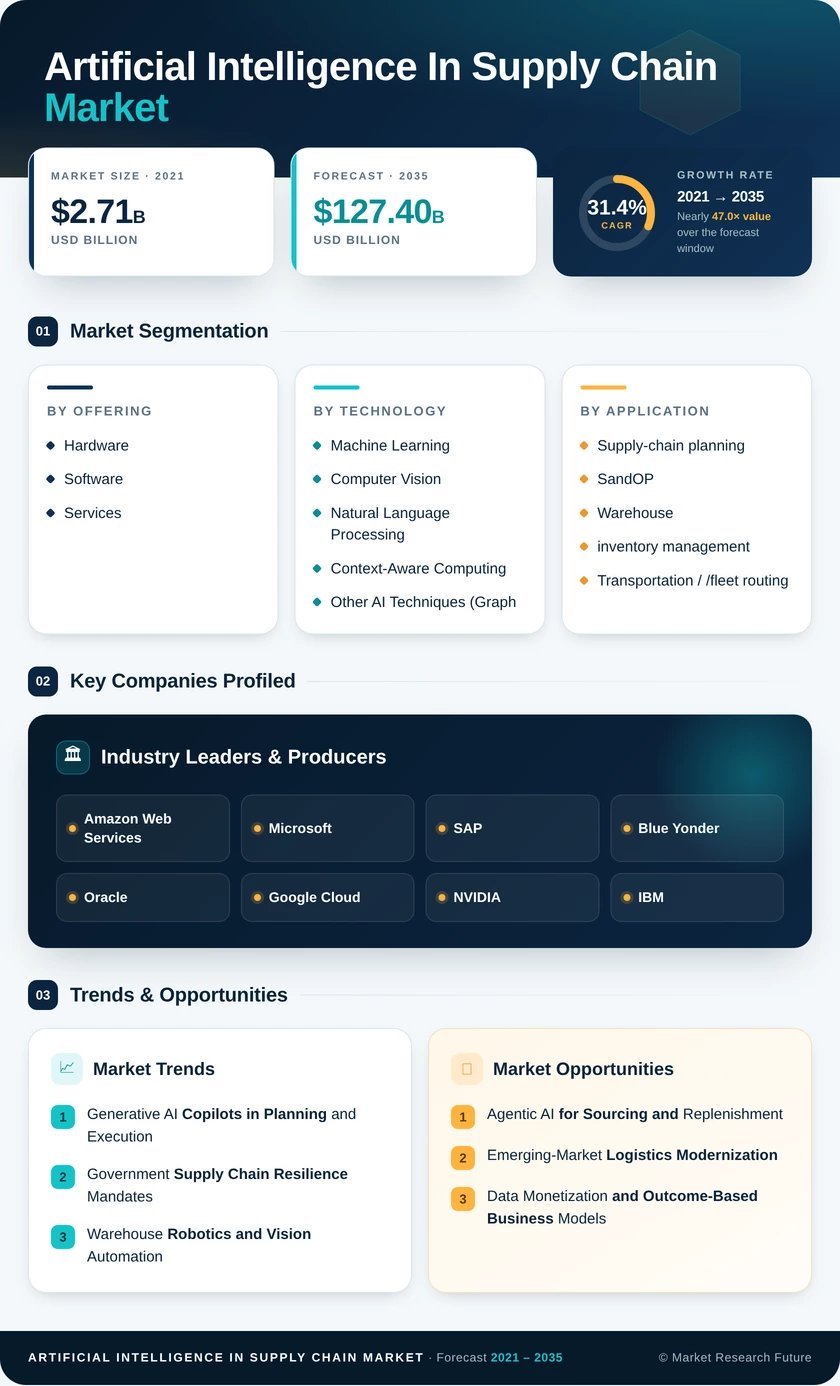
Segmentation Quick Reference
| Dimension | Sub-Segments | Dominant Segment | Fastest Growing Segment |
|---|
| By Offering | Hardware; Software; Services | Software (44.2% share) | Services (20.3% CAGR) |
| By Technology | Machine Learning; Computer Vision; Natural Language Processing; Context-Aware Computing; Other AI Techniques (Graph, GANs) | Machine Learning (34.8% share) | Context-Aware Computing (23.8% CAGR) |
| By Application | Supply-chain planning and SandOP; Warehouse and inventory management; Transportation/fleet routing; Risk and disruption management; Virtual assistants and chatbots; Procurement and sourcing optimisation | Warehouse and inventory management (30.1% share) | Risk and disruption management (21.4% CAGR) |
| By End-User Industry | Manufacturing; Automotive; Food and Beverages; Healthcare and Life-Sciences; Retail and E-commerce; Aerospace and Defence; Consumer-Packaged Goods; Other Industries (Energy, Chemicals) | Retail and E-commerce (25.3% share) | Healthcare and Life Sciences (18.2% CAGR) |
| By Region | North America; Europe; Asia-Pacific; South America; Middle East and Africa | North America (38.6% share) | Asia-Pacific (35.8% CAGR) |
Market Segmentation Overview
| Sub-Segment | Key Trend |
|---|
| Hardware | AI accelerator chips (GPU, TPU, ASIC), Edge devices and sensors, and Robotics and AMRs constrained by accelerator supply |
| Software | AI supply-chain platforms and Predictive analytics suites consolidating planning and execution |
| Services | Implementation and integration and Managed and support services expanding with skills gaps |
Software leads with a 44.2% share because buyers favor integrated suites over point tools for planning and execution. Services grows fastest at a 20.3% CAGR, as integration work and managed model operations fill internal skills gaps. Hardware stays smaller, but accelerator scarcity steers spending toward model compression and edge devices.
| Sub-Segment | Key Trend |
|---|
| Machine Learning | Default engine for demand sensing and replenishment |
| Computer Vision | Expanding from quality inspection to robotic navigation |
| Natural Language Processing | Structuring contracts and supplier communications |
| Context-Aware Computing | Real-time decisions from IoT telemetry |
| Other AI Techniques (Graph, GANs) | Supplier network graphs and synthetic training data |
Machine Learning holds a 34.8% share as the established engine for forecasting and inventory decisions. Context-Aware Computing grows fastest at a 23.8% CAGR because cheaper sensors and edge inference let networks react to temperature, equipment, and traffic conditions as they happen. Natural Language Processing and Computer Vision extend automation into procurement documents and warehouse floors.
| Sub-Segment | Key Trend |
|---|
| Supply-chain planning and SandOP | Copilots replacing spreadsheet-based planning cycles |
| Warehouse and inventory management | Vision-guided picking and automated storage |
| Transportation/fleet routing | GPU-accelerated routing under driver shortages |
| Risk and disruption management | Scenario simulation for geopolitical and climate shocks |
| Virtual assistants and chatbots | Generative assistants for planners and order inquiries |
| Procurement and sourcing optimisation | Agentic tail-spend and supplier risk scoring |
Warehouse and inventory management leads with a 30.1% share because automation projects there deliver short, measurable paybacks. Risk and disruption management grows fastest at a 21.4% CAGR as boards and lenders ask for quantified resilience against tariff and climate shocks. Procurement and sourcing optimisation is the application most exposed to upcoming agentic automation.
| Sub-Segment | Key Trend |
|---|
| Manufacturing | Production scheduling and predictive quality |
| Automotive | Multi-tier supplier risk and nearshoring |
| Food and Beverages | Shelf-life and freshness optimization |
| Healthcare and Life Sciences | Cold-chain monitoring and serialization analytics |
| Retail and E-commerce | Same-day fulfillment and omnichannel inventory |
| Aerospace and Defence | Sole-source supplier and obsolescence risk |
| Consumer-Packaged Goods | Demand sensing and promotion planning |
| Other Industries (Energy, Chemicals) | Hazardous materials routing and asset-heavy logistics |
Retail and E-commerce leads with a 25.3% share, built on early investment in fulfillment speed and omnichannel stock allocation. Healthcare and Life Sciences grows fastest at an 18.2% CAGR because DSCSA serialization and cold-chain integrity demand continuous, AI-based monitoring. Aerospace and Defence remains underserved, with few turnkey tools for sub-tier supplier mapping.


 Noah Malgeri
Co-Founder

 Peter Groot koerkamp
Account and Business Manager

 Younghwan Choi
Senior Retail Manager

 Mark Irwin
Management Consultant

 Akif Moroglu
Strategy & Business Development Director

 Guilherme Gomes Martins
Product Management Director

 Joseph Aguayo
Sales Operations & Pricing Manager

 La Terria Dodd
Program Support Specialist

 Rob Kooiker
Group Product Manager HVAC & Fire Protection GMA