Request Free Sample ×

Kindly complete the form below to receive a free sample of this Report

* Please use a valid business email

Leading companies partner with us for data-driven Insights

clients tt-cursor
Hero Background
English
Chinese
French
Japanese
Korean
German
Spanish

Anti Sniper Detection System Market Trends

ID: MRFR/AD/6145-HCR
133 Pages
Abbas Raut
Last Updated: April 06, 2026

Anti-Sniper Detection System Market Size, Share, Industry Trend & Analysis Research Report By Technology (Acoustic Detection Systems, Radar Detection Systems, Optical Detection Systems, Laser Detection Systems), By Component (Sensor Technology, Signal Processing Unit, Communication System, Display System), By Application (Military Defense, Law Enforcement, Civil Security, Commercial Protection), By End Use (Government Agencies, Private Security Firms, Military Organizations) andBy Regional (North America, Europe, South America, Asia Pacific, Middle East and Africa)- Forecast to 2035

Share:
Download PDF ×

We do not share your information with anyone. However, we may send you emails based on your report interest from time to time. You may contact us at any time to opt-out.

Anti Sniper Detection System Market Infographic
Purchase Options

Market Trends

Key Emerging Trends in the Anti Sniper Detection System Market

The Anti-Sniper Detection System market is experiencing several significant trends that reflect the evolving nature of security threats and advancements in detection technologies. Technological innovation stands out as a central trend. Advancements in sensor technology, artificial intelligence, and surveillance systems are rapidly transforming the market. The trend towards more sophisticated and intelligent detection systems aims to enhance accuracy, speed, and adaptability in identifying sniper threats, ensuring swifter responses to potential risks.

The integration of artificial intelligence (AI) and machine learning in Anti-Sniper Detection Systems is gaining prominence. AI-driven technologies, including machine learning algorithms and predictive analytics, are increasingly being deployed to improve detection accuracy and reduce false alarms. This trend emphasizes the development of smarter detection systems capable of analyzing vast amounts of data in real-time, thereby enhancing the capability to differentiate between actual threats and false positives.

Another noteworthy trend is the focus on multi-layered detection systems. Recognizing that no single technology provides foolproof protection against sniper threats, there's a growing trend towards integrating multiple detection methods. Combining acoustic sensors, infrared technologies, radar systems, and optical sensors creates a comprehensive defense mechanism that improves the chances of detecting and pinpointing sniper activity across various environments and scenarios.

Miniaturization and portability are emerging trends in the Anti-Sniper Detection System market. The trend towards developing compact, lightweight, and easily deployable detection systems caters to the need for mobility and versatility. Portable systems offer flexibility in deployment, allowing for rapid setup in diverse settings, including urban areas, military operations, and critical infrastructure, thereby enhancing security without compromising mobility.

Additionally, there is a growing trend towards the integration of anti-sniper technologies with broader security ecosystems. Anti-Sniper Detection Systems that seamlessly integrate with existing security infrastructure, such as surveillance cameras, access control systems, and command centers, are gaining traction. This integration aims to create a cohesive security network that enables synchronized responses and real-time information sharing across multiple security layers.

The demand for intelligent and proactive response mechanisms is driving a trend towards automation in anti-sniper systems. Automated response mechanisms, including drone deployment, alert systems, and automated tracking, are increasingly being incorporated into detection systems. This trend aims to enhance the speed and effectiveness of response measures once a sniper threat is detected, ensuring quicker neutralization of the threat.

Moreover, data analytics and predictive modeling are emerging as significant trends in the Anti-Sniper Detection System market. The analysis of historical data, behavioral patterns, and threat modeling contributes to the development of predictive models. These models enable proactive threat assessment, allowing security personnel to anticipate potential sniper threats based on patterns and trends, thereby enhancing preemptive security measures.

Author
Author Profile
Abbas Raut
Research Analyst

Abbas Raut is a Senior Research Analyst with 5+ years of experience delivering data-driven insights and strategic recommendations across the Automotive and Aerospace & Defense sectors. He specializes in emerging technologies, industry value chains, and global market dynamics shaping the future of mobility and defense. In automotive, Abbas has led studies on EVs, charging stations, BMS, superchargers, and more, guiding stakeholders through electrification and regulatory shifts. In Aerospace & Defense, he has analyzed markets for military electronics, drones, radars, and electronic warfare solutions, supporting procurement and investment strategies. With expertise in market sizing, forecasting, benchmarking, and technology adoption, Abbas is known for transforming complex datasets into actionable insights that drive strategy, innovation, and growth.

Leave a Comment

FAQs

What is the projected market valuation of the Anti-Sniper Detection System by 2035?

<p>The projected market valuation for the Anti-Sniper Detection System is expected to reach 4.744 USD Billion by 2035.</p>

What was the market valuation of the Anti-Sniper Detection System in 2024?

<p>The overall market valuation of the Anti-Sniper Detection System was 2.1 USD Billion in 2024.</p>

What is the expected CAGR for the Anti-Sniper Detection System market during the forecast period 2025 - 2035?

<p>The expected CAGR for the Anti-Sniper Detection System market during the forecast period 2025 - 2035 is 7.69%.</p>

Which companies are considered key players in the Anti-Sniper Detection System market?

<p>Key players in the Anti-Sniper Detection System market include Raytheon Technologies, Northrop Grumman, Thales Group, BAE Systems, Leonardo S.p.A., Elbit Systems, L3Harris Technologies, Saab AB, and Rheinmetall AG.</p>

What are the main technology segments within the Anti-Sniper Detection System market?

<p>The main technology segments include Acoustic Detection Systems, Radar Detection Systems, Optical Detection Systems, and Laser Detection Systems.</p>

How did the Acoustic Detection Systems segment perform in 2024?

<p>In 2024, the Acoustic Detection Systems segment was valued at 0.63 USD Billion and is projected to grow to 1.45 USD Billion by 2035.</p>

What is the valuation of the Sensor Technology component in the Anti-Sniper Detection System market?

<p>The Sensor Technology component was valued at 0.84 USD Billion in 2024 and is expected to reach 1.92 USD Billion by 2035.</p>

Which application segments are included in the Anti-Sniper Detection System market?

<p>Application segments include Military Defense, Law Enforcement, Civil Security, and Commercial Protection.</p>

What is the expected growth for the Military Defense application segment by 2035?

<p>The Military Defense application segment was valued at 0.84 USD Billion in 2024 and is projected to grow to 1.92 USD Billion by 2035.</p>

Who are the primary end users of Anti-Sniper Detection Systems?

<p>Primary end users include Government Agencies, Private Security Firms, and Military Organizations.</p>

Market Summary

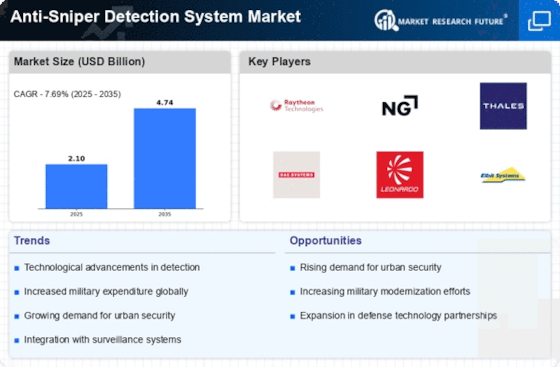
As per Market Research Future analysis, the Anti-Sniper Detection System Market was estimated at 2.1 USD Billion in 2024. The Anti-Sniper Detection System industry is projected to grow from 2.261 USD Billion in 2025 to 4.744 USD Billion by 2035, exhibiting a compound annual growth rate (CAGR) of 7.69% during the forecast period 2025 - 2035

Key Market Trends & Highlights

The Anti-Sniper Detection System Market is poised for substantial growth driven by technological advancements and rising security concerns.

  • North America remains the largest market for anti-sniper detection systems, reflecting its robust defense infrastructure.
  • The Asia-Pacific region is emerging as the fastest-growing market, fueled by increasing military modernization efforts.
  • Radar Detection Systems dominate the market, while Acoustic Detection Systems are witnessing rapid growth due to their innovative capabilities.
  • Rising security concerns and increased military expenditure are key drivers propelling the market forward.

Market Size & Forecast

2024 Market Size 2.1 (USD Billion)
2035 Market Size 4.744 (USD Billion)
CAGR (2025 - 2035) 7.69%
Largest Regional Market Share in 2024 North America

Major Players

Raytheon Technologies (US), Northrop Grumman (US), Thales Group (FR), BAE Systems (GB), Leonardo S.p.A. (IT), Elbit Systems (IL), L3Harris Technologies (US), Saab AB (SE), Rheinmetall AG (DE)

Market Trends

The Anti-Sniper Detection System Market is currently experiencing a notable evolution, driven by the increasing demand for enhanced security measures in military and civilian applications. As threats from snipers persist, the need for advanced detection systems that can identify and neutralize these risks has become paramount. This market appears to be influenced by technological advancements, with innovations in sensor technology and data analytics playing a crucial role in improving detection capabilities. Furthermore, the integration of artificial intelligence and machine learning into these systems suggests a shift towards more automated and efficient solutions, potentially transforming operational strategies in various sectors. In addition to technological progress, geopolitical tensions and rising security concerns are likely to propel the growth of the Anti-Sniper Detection System Market. Governments and defense organizations are increasingly investing in sophisticated surveillance and detection systems to safeguard personnel and assets. This trend indicates a broader recognition of the importance of proactive measures in countering sniper threats. As the market continues to evolve, collaboration between private sector companies and government entities may foster further innovation, ensuring that the systems developed are both effective and adaptable to changing security landscapes.

Technological Advancements

The Anti-Sniper Detection System Market is witnessing a surge in technological innovations, particularly in sensor and detection technologies. Enhanced capabilities in real-time data processing and analysis are enabling systems to identify threats more accurately and swiftly. This trend suggests a move towards more sophisticated solutions that can integrate seamlessly with existing security frameworks.

Increased Defense Spending

Rising geopolitical tensions and security threats are prompting governments to allocate more resources towards defense and security measures. This trend indicates a growing recognition of the necessity for advanced detection systems to protect personnel and critical infrastructure from sniper attacks, thereby driving market growth.

Integration of AI and Machine Learning

The incorporation of artificial intelligence and machine learning into anti-sniper systems is becoming increasingly prevalent. These technologies appear to enhance the predictive capabilities of detection systems, allowing for more proactive threat identification and response. This trend may lead to more efficient and effective security operations in various environments.

Anti Sniper Detection System Market Market Drivers

Growing Urban Warfare

The rise of urban warfare has created a unique set of challenges for military and law enforcement agencies, thereby driving the demand for the Anti-Sniper Detection System Market. In urban environments, the risk of sniper attacks increases due to the proximity of civilians and the complexity of the terrain. As a result, there is a pressing need for systems that can accurately detect and neutralize sniper threats in densely populated areas. The Anti-Sniper Detection System Market is likely to benefit from this trend, as stakeholders seek solutions that can operate effectively in urban settings. The emphasis on protecting civilian lives while ensuring operational effectiveness is expected to further fuel investments in anti-sniper technologies.

Rising Security Concerns

The increasing prevalence of asymmetric warfare and terrorism has heightened security concerns across various sectors, particularly in military and law enforcement. This trend drives the demand for advanced technologies, such as the Anti-Sniper Detection System Market, which offers enhanced situational awareness and protection against sniper threats. As nations prioritize the safety of their personnel and civilians, investments in anti-sniper technologies are likely to surge. Reports indicate that defense budgets are being allocated more towards innovative solutions that can effectively counter emerging threats. Consequently, the Anti-Sniper Detection System Market is poised for growth as stakeholders seek reliable systems to mitigate risks associated with sniper attacks.

Technological Innovations

The Anti-Sniper Detection System Market is experiencing a wave of technological innovations that enhance detection capabilities and response times. Advancements in sensor technology, data analytics, and communication systems are enabling the development of more sophisticated anti-sniper solutions. For instance, the integration of multi-spectral sensors allows for improved target identification and tracking, even in challenging environments. Furthermore, the market is witnessing the emergence of systems that utilize artificial intelligence to analyze data in real-time, thereby increasing operational efficiency. As these technologies evolve, they are likely to attract investment and interest from military and security agencies, further propelling the growth of the Anti-Sniper Detection System Market.

Increased Military Expenditure

Many nations are currently increasing their military expenditure, which is a significant driver for the Anti-Sniper Detection System Market. Governments are recognizing the necessity of modernizing their defense capabilities to address evolving threats. This trend is reflected in various defense budgets, which allocate substantial funds for advanced technologies, including anti-sniper systems. For example, recent reports indicate that several countries have earmarked portions of their defense budgets specifically for counter-sniper technologies. This increase in military spending not only enhances the capabilities of armed forces but also stimulates the Anti-Sniper Detection System Market, as manufacturers respond to the growing demand for effective solutions.

International Collaboration and Defense Partnerships

International collaboration and defense partnerships are becoming increasingly prevalent, influencing the Anti-Sniper Detection System Market. Countries are recognizing the importance of sharing knowledge and resources to combat common threats, including sniper attacks. Joint military exercises and collaborative research initiatives are fostering the development of advanced anti-sniper technologies. These partnerships not only enhance the capabilities of participating nations but also create opportunities for manufacturers in the Anti-Sniper Detection System Market to showcase their innovations. As nations work together to address security challenges, the demand for effective anti-sniper solutions is likely to grow, further driving the market.

Market Segment Insights

By Technology: Radar Detection Systems (Largest) vs. Acoustic Detection Systems (Fastest-Growing)

In the Anti-Sniper Detection System Market, the Radar Detection Systems hold the largest market share, outperforming other technologies in terms of adoption and implementation. Their superiority lies in their ability to detect long-range threats accurately, making them a preferred choice among defense organizations. Meanwhile, Acoustic Detection Systems are emerging as a significant player, rapidly increasing their share due to advancements in sound recognition technologies that enhance their effectiveness in urban environments.

Technology: Radar Detection Systems (Dominant) vs. Acoustic Detection Systems (Emerging)

Radar Detection Systems are characterized by their high precision and reliability for long-distance threat detection, often utilized in military segments where situational awareness is critical. They remain the dominant technology due to their advanced capabilities in various terrains. In contrast, Acoustic Detection Systems are becoming increasingly relevant, focusing on sound-based detection mechanisms that offer a versatile solution, particularly in tight urban environments. Their rapid advancement in sensor technology positions them as an emerging alternative, catering to scenarios where conventional methods may fall short.

By Component: Sensor Technology (Largest) vs. Signal Processing Unit (Fastest-Growing)

In the Anti-Sniper Detection System market, the component segment is primarily dominated by Sensor Technology, which holds the largest share due to its crucial role in identifying threats with high precision. Sensor Technology's extensive applications and reliability have made it a preferred choice among defense systems, leading to strong market penetration. Conversely, the Signal Processing Unit, though currently smaller in market share, is rapidly gaining traction as systems evolve and require enhanced data processing capabilities. This shift indicates an increasing reliance on advanced technology for interpreting signals more effectively, making it a critical part of the market. Growth trends in the component segment showcase an evident shift towards innovative technologies that enhance the effectiveness of Anti-Sniper systems. The demand for sophisticated Sensor Technology is spurred by heightened security concerns globally, driving investments in advanced detection capabilities. Meanwhile, the Signal Processing Unit is emerging as the fastest-growing area, propelled by advancements in data analytics and real-time processing methodologies, which are essential for modern warfare environments. As security challenges evolve, so does the technology, making this sector particularly dynamic and responsive to emerging threats.

Sensor Technology: Dominant vs. Signal Processing Unit: Emerging

Sensor Technology remains a dominant force within the Anti-Sniper Detection System market, characterized by its ability to detect and respond to threats with rapid accuracy. This component incorporates cutting-edge technologies that improve situational awareness and operational effectiveness for military and security forces. Its extensive use in various environmental conditions adds to its reliability, thereby solidifying its market position. On the other hand, the Signal Processing Unit is emerging, bringing transformative capabilities that enhance information processing and threat identification. As battlefield scenarios grow increasingly complex, this unit’s capacity to analyze vast amounts of data in real time is becoming essential. The surge in interest in automated and artificial intelligence-driven solutions further bolsters its position, indicating a shift towards innovative processing approaches in defense systems.

By Application: Military Defense (Largest) vs. Law Enforcement (Fastest-Growing)

The Anti-Sniper Detection System Market exhibits a diverse application landscape with significant market shares held by Military Defense, Law Enforcement, Civil Security, and Commercial Protection. Military Defense dominates the share with its extensive requirement for advanced detection systems to safeguard personnel and infrastructure from sniper threats in combat zones. In contrast, Law Enforcement agencies are increasingly adopting these systems due to rising public safety concerns, contributing to its rapid market growth.

Military Defense: Dominant vs. Law Enforcement: Emerging

Military Defense remains the dominant application of the Anti-Sniper Detection System Market due to its critical role in ensuring the safety of military personnel during deployments. The market position of Military Defense is solidified by extensive investments in advanced surveillance and detection technologies, aimed at countering sniper threats effectively. On the other hand, Law Enforcement is emerging rapidly as a significant segment as city and regional police forces recognize the necessity of these systems in urban environments. This growing need for enhanced public safety measures, driven by an uptick in gun-related incidents, positions Law Enforcement as a key player in the future of the market, with innovative solutions expected to meet their specific operational demands.

By End Use: Government Agencies (Largest) vs. Military Organizations (Fastest-Growing)

The Anti-Sniper Detection System Market is significantly influenced by its primary end users: Government Agencies, Private Security Firms, and Military Organizations. Government Agencies currently hold the largest market share, leveraging these systems for national security and public safety initiatives. Their strong investment in advanced surveillance and detection technology reinforces their dominant position in the market. Following them, Military Organizations exhibit rapid uptake of anti-sniper systems as they adapt to evolving battlefield threats, making them a key player in the sector. Meanwhile, Private Security Firms, while important, capture a smaller share of the market as their applications are more specialized and selective.

Government Agencies (Dominant) vs. Military Organizations (Emerging)

Government Agencies represent a dominant segment within the Anti-Sniper Detection System Market, primarily due to their robust funding and commitment to enhancing national security. They utilize these systems for a variety of applications, including urban security and protection of key infrastructure. This segment benefits from substantial policy support and public interest in safety technologies. On the other hand, Military Organizations are emerging as the fastest-growing segment as they continuously seek innovations in weapons detection and situational awareness for soldiers in combat. Their rapid technological adoption is driven by increased defense budgets and the pressing need to counter evolving threats on the battlefield.

Get more detailed insights about Anti Sniper Detection System Market Research Report – Global Forecast till 2035

Regional Insights

North America : Defense Innovation Leader

North America is the largest market for anti-sniper detection systems, holding approximately 45% of the global market share. The region's growth is driven by increasing defense budgets, technological advancements, and rising concerns over asymmetric warfare. Regulatory support from government agencies, including the Department of Defense, further catalyzes market expansion, emphasizing the need for advanced surveillance and detection technologies. The United States leads the market, with key players like Raytheon Technologies and Northrop Grumman dominating the landscape. The competitive environment is characterized by continuous innovation and partnerships among defense contractors. Canada also plays a significant role, focusing on enhancing its military capabilities, thereby contributing to the overall growth of the North American market.

Europe : Emerging Defense Market

Europe is witnessing a significant rise in the demand for anti-sniper detection systems, accounting for approximately 30% of the global market share. The region's growth is fueled by increasing geopolitical tensions and a commitment to enhancing national security. Regulatory frameworks, such as the European Defense Fund, are encouraging investments in advanced defense technologies, thereby driving market expansion. Leading countries in this region include the United Kingdom, France, and Germany, where companies like Thales Group and BAE Systems are prominent. The competitive landscape is marked by collaborations between governments and defense contractors, focusing on innovative solutions to counter emerging threats. The emphasis on interoperability among NATO allies further strengthens the market dynamics in Europe.

Asia-Pacific : Rapidly Growing Defense Sector

Asia-Pacific is emerging as a key player in the anti-sniper detection system market, holding around 20% of the global market share. The region's growth is driven by rising defense expenditures, particularly in countries like India and Australia, alongside increasing threats from regional conflicts. Government initiatives aimed at modernizing military capabilities are also propelling demand for advanced detection systems. China, India, and Australia are the leading countries in this market, with significant investments in defense technology. The competitive landscape features both domestic and international players, including Elbit Systems and L3Harris Technologies. The focus on indigenous manufacturing and technology transfer agreements is shaping the market dynamics, fostering innovation and self-reliance in defense capabilities.

Middle East and Africa : Strategic Defense Investments

The Middle East and Africa region is increasingly prioritizing anti-sniper detection systems, accounting for approximately 5% of the global market share. The growth is driven by ongoing conflicts and the need for enhanced security measures against terrorism. Governments are investing in advanced technologies to protect military and civilian assets, supported by international partnerships and defense agreements. Countries like Saudi Arabia, the UAE, and South Africa are at the forefront of this market, with a focus on acquiring cutting-edge defense solutions. The competitive landscape includes key players such as Saab AB and Rheinmetall AG, who are actively engaging in regional collaborations to address specific security challenges. The emphasis on modernization and strategic defense initiatives is shaping the market in this region.

Key Players and Competitive Insights

The Anti-Sniper Detection System Market is characterized by a dynamic competitive landscape driven by the increasing need for advanced defense solutions in military and security applications. As security threats evolve, the demand for efficient anti-sniper technologies continues to rise, prompting companies to invest heavily in research and development.The integration of advanced sensors, data analytics, and precision targeting technologies significantly alters the competitive dynamics. This market encompasses various segments, including land-based, airborne, and naval systems, catering to diverse operational needs. In this highly innovative space, companies strive to establish a strong foothold through strategic alliances, technological advancements, and enhanced product offerings, making competitive insights a pivotal factor in understanding market trends and players.General Dynamics has carved out a significant presence in the Anti-Sniper Detection System Market, leveraging its extensive expertise in defense technology and systems integration. The company's strengths lie in its robust research and development capabilities, which enable it to innovate continually and meet the diverse needs of its clients.With a comprehensive product portfolio that includes cutting-edge anti-sniper detection systems equipped with sophisticated sensor and tracking technologies, General Dynamics can effectively address the challenges posed by modern threats on the battlefield.The company's commitment to quality and reliability fosters strong customer loyalty as military organizations seek proven partners to ensure operational effectiveness in high-stakes environments. Additionally, General Dynamics' strategic partnerships with military agencies and defense contractors further enhance its market presence and ability to lead in innovative solution delivery.Saab AB is another formidable player within the Anti-Sniper Detection System Market, recognized for its commitment to creating effective defense solutions tailored to the needs of contemporary warfare. The company's strengths lie in its advanced technological capabilities, particularly in sensor technology and electronic warfare solutions.Saab AB's anti-sniper detection systems are designed to offer unmatched situational awareness, allowing military forces to respond rapidly and accurately to threats. The organization emphasizes research and innovation, continuously updating its product lines to stay ahead in addressing evolving security challenges.Furthermore, Saab AB's focus on international collaboration and localized production enhances its competitive edge, as it enables the company to adapt its offerings based on regional operational requirements. Through these strategies, Saab AB maintains a strong competitive position, ensuring its relevance in the fast-growing anti-sniper detection segment of the defense market.

Key Companies in the Anti Sniper Detection System Market include

Industry Developments

The Anti-Sniper Detection System Market has recently been marked by notable developments involving key industry players such as General Dynamics, Northrop Grumman, and BAE Systems. These companies have been actively enhancing their product offerings to address the growing demand for advanced detection and countermeasure systems amidst rising geopolitical tensions.

Saab AB and Leonardo S.p.A. have also made strides in integrating cutting-edge technologies to improve system efficacy. In recent news, significant mergers and acquisitions have reshaped the landscape; for instance, Raytheon Technologies and Lockheed Martin have collaborated to enhance their competitive positioning in the defense sector.

The market has seen an upward trend in valuation as governments and defense entities allocate increased budgets toward upgrading defense systems, including anti-sniper technologies. Hensoldt and Israel Aerospace Industries have reported growth in their respective portfolios due to strategic partnerships and innovation in detection systems.

Market assessments suggest that these developments are driving increased investment in anti-sniper detection solutions as military forces worldwide emphasize securing operational environments against lurking threats, underscoring the critical importance of sophisticated detection technologies in modern warfare.

Future Outlook

Anti Sniper Detection System Market Future Outlook

The Anti-Sniper Detection System Market is projected to grow at a 7.69% CAGR from 2025 to 2035, driven by technological advancements, increasing defense budgets, and rising security concerns.

New opportunities lie in:

  • Integration of AI-driven analytics for real-time threat assessment.
  • Development of portable anti-sniper systems for rapid deployment.
  • Partnerships with defense contractors for customized solutions.

By 2035, the market is expected to be robust, reflecting substantial growth and innovation.

Market Segmentation

Anti Sniper Detection System Market End Use Outlook

  • Government Agencies
  • Private Security Firms
  • Military Organizations

Anti Sniper Detection System Market Component Outlook

  • Sensor Technology
  • Signal Processing Unit
  • Communication System
  • Display System

Anti Sniper Detection System Market Technology Outlook

  • Acoustic Detection Systems
  • Radar Detection Systems
  • Optical Detection Systems
  • Laser Detection Systems

Anti Sniper Detection System Market Application Outlook

  • Military Defense
  • Law Enforcement
  • Civil Security
  • Commercial Protection

Report Scope

MARKET SIZE 2024 2.1(USD Billion)
MARKET SIZE 2025 2.261(USD Billion)
MARKET SIZE 2035 4.744(USD Billion)
COMPOUND ANNUAL GROWTH RATE (CAGR) 7.69% (2025 - 2035)
REPORT COVERAGE Revenue Forecast, Competitive Landscape, Growth Factors, and Trends
BASE YEAR 2024
Market Forecast Period 2025 - 2035
Historical Data 2019 - 2024
Market Forecast Units USD Billion
Key Companies Profiled Raytheon Technologies (US), Northrop Grumman (US), Thales Group (FR), BAE Systems (GB), Leonardo S.p.A. (IT), Elbit Systems (IL), L3Harris Technologies (US), Saab AB (SE), Rheinmetall AG (DE)
Segments Covered Technology, Component, Application, End Use, Regional
Key Market Opportunities Integration of advanced sensor technologies enhances situational awareness in the Anti-Sniper Detection System Market.
Key Market Dynamics Rising demand for advanced surveillance technologies drives innovation in Anti-Sniper Detection System development and deployment.
Countries Covered North America, Europe, APAC, South America, MEA

FAQs

What is the projected market valuation of the Anti-Sniper Detection System by 2035?

<p>The projected market valuation for the Anti-Sniper Detection System is expected to reach 4.744 USD Billion by 2035.</p>

What was the market valuation of the Anti-Sniper Detection System in 2024?

<p>The overall market valuation of the Anti-Sniper Detection System was 2.1 USD Billion in 2024.</p>

What is the expected CAGR for the Anti-Sniper Detection System market during the forecast period 2025 - 2035?

<p>The expected CAGR for the Anti-Sniper Detection System market during the forecast period 2025 - 2035 is 7.69%.</p>

Which companies are considered key players in the Anti-Sniper Detection System market?

<p>Key players in the Anti-Sniper Detection System market include Raytheon Technologies, Northrop Grumman, Thales Group, BAE Systems, Leonardo S.p.A., Elbit Systems, L3Harris Technologies, Saab AB, and Rheinmetall AG.</p>

What are the main technology segments within the Anti-Sniper Detection System market?

<p>The main technology segments include Acoustic Detection Systems, Radar Detection Systems, Optical Detection Systems, and Laser Detection Systems.</p>

How did the Acoustic Detection Systems segment perform in 2024?

<p>In 2024, the Acoustic Detection Systems segment was valued at 0.63 USD Billion and is projected to grow to 1.45 USD Billion by 2035.</p>

What is the valuation of the Sensor Technology component in the Anti-Sniper Detection System market?

<p>The Sensor Technology component was valued at 0.84 USD Billion in 2024 and is expected to reach 1.92 USD Billion by 2035.</p>

Which application segments are included in the Anti-Sniper Detection System market?

<p>Application segments include Military Defense, Law Enforcement, Civil Security, and Commercial Protection.</p>

What is the expected growth for the Military Defense application segment by 2035?

<p>The Military Defense application segment was valued at 0.84 USD Billion in 2024 and is projected to grow to 1.92 USD Billion by 2035.</p>

Who are the primary end users of Anti-Sniper Detection Systems?

<p>Primary end users include Government Agencies, Private Security Firms, and Military Organizations.</p>

  1. SECTION I: EXECUTIVE SUMMARY AND KEY HIGHLIGHTS
    1. | 1.1 EXECUTIVE SUMMARY
    2. | | 1.1.1 Market Overview
    3. | | 1.1.2 Key Findings
    4. | | 1.1.3 Market Segmentation
    5. | | 1.1.4 Competitive Landscape
    6. | | 1.1.5 Challenges and Opportunities
    7. | | 1.1.6 Future Outlook
  2. SECTION II: SCOPING, METHODOLOGY AND MARKET STRUCTURE
    1. | 2.1 MARKET INTRODUCTION
    2. | | 2.1.1 Definition
    3. | | 2.1.2 Scope of the study
    4. | | | 2.1.2.1 Research Objective
    5. | | | 2.1.2.2 Assumption
    6. | | | 2.1.2.3 Limitations
    7. | 2.2 RESEARCH METHODOLOGY
    8. | | 2.2.1 Overview
    9. | | 2.2.2 Data Mining
    10. | | 2.2.3 Secondary Research
    11. | | 2.2.4 Primary Research
    12. | | | 2.2.4.1 Primary Interviews and Information Gathering Process
    13. | | | 2.2.4.2 Breakdown of Primary Respondents
    14. | | 2.2.5 Forecasting Model
    15. | | 2.2.6 Market Size Estimation
    16. | | | 2.2.6.1 Bottom-Up Approach
    17. | | | 2.2.6.2 Top-Down Approach
    18. | | 2.2.7 Data Triangulation
    19. | | 2.2.8 Validation
  3. SECTION III: QUALITATIVE ANALYSIS
    1. | 3.1 MARKET DYNAMICS
    2. | | 3.1.1 Overview
    3. | | 3.1.2 Drivers
    4. | | 3.1.3 Restraints
    5. | | 3.1.4 Opportunities
    6. | 3.2 MARKET FACTOR ANALYSIS
    7. | | 3.2.1 Value chain Analysis
    8. | | 3.2.2 Porter's Five Forces Analysis
    9. | | | 3.2.2.1 Bargaining Power of Suppliers
    10. | | | 3.2.2.2 Bargaining Power of Buyers
    11. | | | 3.2.2.3 Threat of New Entrants
    12. | | | 3.2.2.4 Threat of Substitutes
    13. | | | 3.2.2.5 Intensity of Rivalry
    14. | | 3.2.3 COVID-19 Impact Analysis
    15. | | | 3.2.3.1 Market Impact Analysis
    16. | | | 3.2.3.2 Regional Impact
    17. | | | 3.2.3.3 Opportunity and Threat Analysis
  4. SECTION IV: QUANTITATIVE ANALYSIS
    1. | 4.1 Aerospace & Defense, BY Technology (USD Billion)
    2. | | 4.1.1 Acoustic Detection Systems
    3. | | 4.1.2 Radar Detection Systems
    4. | | 4.1.3 Optical Detection Systems
    5. | | 4.1.4 Laser Detection Systems
    6. | 4.2 Aerospace & Defense, BY Component (USD Billion)
    7. | | 4.2.1 Sensor Technology
    8. | | 4.2.2 Signal Processing Unit
    9. | | 4.2.3 Communication System
    10. | | 4.2.4 Display System
    11. | 4.3 Aerospace & Defense, BY Application (USD Billion)
    12. | | 4.3.1 Military Defense
    13. | | 4.3.2 Law Enforcement
    14. | | 4.3.3 Civil Security
    15. | | 4.3.4 Commercial Protection
    16. | 4.4 Aerospace & Defense, BY End Use (USD Billion)
    17. | | 4.4.1 Government Agencies
    18. | | 4.4.2 Private Security Firms
    19. | | 4.4.3 Military Organizations
    20. | 4.5 Aerospace & Defense, BY Region (USD Billion)
    21. | | 4.5.1 North America
    22. | | | 4.5.1.1 US
    23. | | | 4.5.1.2 Canada
    24. | | 4.5.2 Europe
    25. | | | 4.5.2.1 Germany
    26. | | | 4.5.2.2 UK
    27. | | | 4.5.2.3 France
    28. | | | 4.5.2.4 Russia
    29. | | | 4.5.2.5 Italy
    30. | | | 4.5.2.6 Spain
    31. | | | 4.5.2.7 Rest of Europe
    32. | | 4.5.3 APAC
    33. | | | 4.5.3.1 China
    34. | | | 4.5.3.2 India
    35. | | | 4.5.3.3 Japan
    36. | | | 4.5.3.4 South Korea
    37. | | | 4.5.3.5 Malaysia
    38. | | | 4.5.3.6 Thailand
    39. | | | 4.5.3.7 Indonesia
    40. | | | 4.5.3.8 Rest of APAC
    41. | | 4.5.4 South America
    42. | | | 4.5.4.1 Brazil
    43. | | | 4.5.4.2 Mexico
    44. | | | 4.5.4.3 Argentina
    45. | | | 4.5.4.4 Rest of South America
    46. | | 4.5.5 MEA
    47. | | | 4.5.5.1 GCC Countries
    48. | | | 4.5.5.2 South Africa
    49. | | | 4.5.5.3 Rest of MEA
  5. SECTION V: COMPETITIVE ANALYSIS
    1. | 5.1 Competitive Landscape
    2. | | 5.1.1 Overview
    3. | | 5.1.2 Competitive Analysis
    4. | | 5.1.3 Market share Analysis
    5. | | 5.1.4 Major Growth Strategy in the Aerospace & Defense
    6. | | 5.1.5 Competitive Benchmarking
    7. | | 5.1.6 Leading Players in Terms of Number of Developments in the Aerospace & Defense
    8. | | 5.1.7 Key developments and growth strategies
    9. | | | 5.1.7.1 New Product Launch/Service Deployment
    10. | | | 5.1.7.2 Merger & Acquisitions
    11. | | | 5.1.7.3 Joint Ventures
    12. | | 5.1.8 Major Players Financial Matrix
    13. | | | 5.1.8.1 Sales and Operating Income
    14. | | | 5.1.8.2 Major Players R&D Expenditure. 2023
    15. | 5.2 Company Profiles
    16. | | 5.2.1 Raytheon Technologies (US)
    17. | | | 5.2.1.1 Financial Overview
    18. | | | 5.2.1.2 Products Offered
    19. | | | 5.2.1.3 Key Developments
    20. | | | 5.2.1.4 SWOT Analysis
    21. | | | 5.2.1.5 Key Strategies
    22. | | 5.2.2 Northrop Grumman (US)
    23. | | | 5.2.2.1 Financial Overview
    24. | | | 5.2.2.2 Products Offered
    25. | | | 5.2.2.3 Key Developments
    26. | | | 5.2.2.4 SWOT Analysis
    27. | | | 5.2.2.5 Key Strategies
    28. | | 5.2.3 Thales Group (FR)
    29. | | | 5.2.3.1 Financial Overview
    30. | | | 5.2.3.2 Products Offered
    31. | | | 5.2.3.3 Key Developments
    32. | | | 5.2.3.4 SWOT Analysis
    33. | | | 5.2.3.5 Key Strategies
    34. | | 5.2.4 BAE Systems (GB)
    35. | | | 5.2.4.1 Financial Overview
    36. | | | 5.2.4.2 Products Offered
    37. | | | 5.2.4.3 Key Developments
    38. | | | 5.2.4.4 SWOT Analysis
    39. | | | 5.2.4.5 Key Strategies
    40. | | 5.2.5 Leonardo S.p.A. (IT)
    41. | | | 5.2.5.1 Financial Overview
    42. | | | 5.2.5.2 Products Offered
    43. | | | 5.2.5.3 Key Developments
    44. | | | 5.2.5.4 SWOT Analysis
    45. | | | 5.2.5.5 Key Strategies
    46. | | 5.2.6 Elbit Systems (IL)
    47. | | | 5.2.6.1 Financial Overview
    48. | | | 5.2.6.2 Products Offered
    49. | | | 5.2.6.3 Key Developments
    50. | | | 5.2.6.4 SWOT Analysis
    51. | | | 5.2.6.5 Key Strategies
    52. | | 5.2.7 L3Harris Technologies (US)
    53. | | | 5.2.7.1 Financial Overview
    54. | | | 5.2.7.2 Products Offered
    55. | | | 5.2.7.3 Key Developments
    56. | | | 5.2.7.4 SWOT Analysis
    57. | | | 5.2.7.5 Key Strategies
    58. | | 5.2.8 Saab AB (SE)
    59. | | | 5.2.8.1 Financial Overview
    60. | | | 5.2.8.2 Products Offered
    61. | | | 5.2.8.3 Key Developments
    62. | | | 5.2.8.4 SWOT Analysis
    63. | | | 5.2.8.5 Key Strategies
    64. | | 5.2.9 Rheinmetall AG (DE)
    65. | | | 5.2.9.1 Financial Overview
    66. | | | 5.2.9.2 Products Offered
    67. | | | 5.2.9.3 Key Developments
    68. | | | 5.2.9.4 SWOT Analysis
    69. | | | 5.2.9.5 Key Strategies
    70. | 5.3 Appendix
    71. | | 5.3.1 References
    72. | | 5.3.2 Related Reports
  6. LIST OF FIGURES
    1. | 6.1 MARKET SYNOPSIS
    2. | 6.2 NORTH AMERICA MARKET ANALYSIS
    3. | 6.3 US MARKET ANALYSIS BY TECHNOLOGY
    4. | 6.4 US MARKET ANALYSIS BY COMPONENT
    5. | 6.5 US MARKET ANALYSIS BY APPLICATION
    6. | 6.6 US MARKET ANALYSIS BY END USE
    7. | 6.7 CANADA MARKET ANALYSIS BY TECHNOLOGY
    8. | 6.8 CANADA MARKET ANALYSIS BY COMPONENT
    9. | 6.9 CANADA MARKET ANALYSIS BY APPLICATION
    10. | 6.10 CANADA MARKET ANALYSIS BY END USE
    11. | 6.11 EUROPE MARKET ANALYSIS
    12. | 6.12 GERMANY MARKET ANALYSIS BY TECHNOLOGY
    13. | 6.13 GERMANY MARKET ANALYSIS BY COMPONENT
    14. | 6.14 GERMANY MARKET ANALYSIS BY APPLICATION
    15. | 6.15 GERMANY MARKET ANALYSIS BY END USE
    16. | 6.16 UK MARKET ANALYSIS BY TECHNOLOGY
    17. | 6.17 UK MARKET ANALYSIS BY COMPONENT
    18. | 6.18 UK MARKET ANALYSIS BY APPLICATION
    19. | 6.19 UK MARKET ANALYSIS BY END USE
    20. | 6.20 FRANCE MARKET ANALYSIS BY TECHNOLOGY
    21. | 6.21 FRANCE MARKET ANALYSIS BY COMPONENT
    22. | 6.22 FRANCE MARKET ANALYSIS BY APPLICATION
    23. | 6.23 FRANCE MARKET ANALYSIS BY END USE
    24. | 6.24 RUSSIA MARKET ANALYSIS BY TECHNOLOGY
    25. | 6.25 RUSSIA MARKET ANALYSIS BY COMPONENT
    26. | 6.26 RUSSIA MARKET ANALYSIS BY APPLICATION
    27. | 6.27 RUSSIA MARKET ANALYSIS BY END USE
    28. | 6.28 ITALY MARKET ANALYSIS BY TECHNOLOGY
    29. | 6.29 ITALY MARKET ANALYSIS BY COMPONENT
    30. | 6.30 ITALY MARKET ANALYSIS BY APPLICATION
    31. | 6.31 ITALY MARKET ANALYSIS BY END USE
    32. | 6.32 SPAIN MARKET ANALYSIS BY TECHNOLOGY
    33. | 6.33 SPAIN MARKET ANALYSIS BY COMPONENT
    34. | 6.34 SPAIN MARKET ANALYSIS BY APPLICATION
    35. | 6.35 SPAIN MARKET ANALYSIS BY END USE
    36. | 6.36 REST OF EUROPE MARKET ANALYSIS BY TECHNOLOGY
    37. | 6.37 REST OF EUROPE MARKET ANALYSIS BY COMPONENT
    38. | 6.38 REST OF EUROPE MARKET ANALYSIS BY APPLICATION
    39. | 6.39 REST OF EUROPE MARKET ANALYSIS BY END USE
    40. | 6.40 APAC MARKET ANALYSIS
    41. | 6.41 CHINA MARKET ANALYSIS BY TECHNOLOGY
    42. | 6.42 CHINA MARKET ANALYSIS BY COMPONENT
    43. | 6.43 CHINA MARKET ANALYSIS BY APPLICATION
    44. | 6.44 CHINA MARKET ANALYSIS BY END USE
    45. | 6.45 INDIA MARKET ANALYSIS BY TECHNOLOGY
    46. | 6.46 INDIA MARKET ANALYSIS BY COMPONENT
    47. | 6.47 INDIA MARKET ANALYSIS BY APPLICATION
    48. | 6.48 INDIA MARKET ANALYSIS BY END USE
    49. | 6.49 JAPAN MARKET ANALYSIS BY TECHNOLOGY
    50. | 6.50 JAPAN MARKET ANALYSIS BY COMPONENT
    51. | 6.51 JAPAN MARKET ANALYSIS BY APPLICATION
    52. | 6.52 JAPAN MARKET ANALYSIS BY END USE
    53. | 6.53 SOUTH KOREA MARKET ANALYSIS BY TECHNOLOGY
    54. | 6.54 SOUTH KOREA MARKET ANALYSIS BY COMPONENT
    55. | 6.55 SOUTH KOREA MARKET ANALYSIS BY APPLICATION
    56. | 6.56 SOUTH KOREA MARKET ANALYSIS BY END USE
    57. | 6.57 MALAYSIA MARKET ANALYSIS BY TECHNOLOGY
    58. | 6.58 MALAYSIA MARKET ANALYSIS BY COMPONENT
    59. | 6.59 MALAYSIA MARKET ANALYSIS BY APPLICATION
    60. | 6.60 MALAYSIA MARKET ANALYSIS BY END USE
    61. | 6.61 THAILAND MARKET ANALYSIS BY TECHNOLOGY
    62. | 6.62 THAILAND MARKET ANALYSIS BY COMPONENT
    63. | 6.63 THAILAND MARKET ANALYSIS BY APPLICATION
    64. | 6.64 THAILAND MARKET ANALYSIS BY END USE
    65. | 6.65 INDONESIA MARKET ANALYSIS BY TECHNOLOGY
    66. | 6.66 INDONESIA MARKET ANALYSIS BY COMPONENT
    67. | 6.67 INDONESIA MARKET ANALYSIS BY APPLICATION
    68. | 6.68 INDONESIA MARKET ANALYSIS BY END USE
    69. | 6.69 REST OF APAC MARKET ANALYSIS BY TECHNOLOGY
    70. | 6.70 REST OF APAC MARKET ANALYSIS BY COMPONENT
    71. | 6.71 REST OF APAC MARKET ANALYSIS BY APPLICATION
    72. | 6.72 REST OF APAC MARKET ANALYSIS BY END USE
    73. | 6.73 SOUTH AMERICA MARKET ANALYSIS
    74. | 6.74 BRAZIL MARKET ANALYSIS BY TECHNOLOGY
    75. | 6.75 BRAZIL MARKET ANALYSIS BY COMPONENT
    76. | 6.76 BRAZIL MARKET ANALYSIS BY APPLICATION
    77. | 6.77 BRAZIL MARKET ANALYSIS BY END USE
    78. | 6.78 MEXICO MARKET ANALYSIS BY TECHNOLOGY
    79. | 6.79 MEXICO MARKET ANALYSIS BY COMPONENT
    80. | 6.80 MEXICO MARKET ANALYSIS BY APPLICATION
    81. | 6.81 MEXICO MARKET ANALYSIS BY END USE
    82. | 6.82 ARGENTINA MARKET ANALYSIS BY TECHNOLOGY
    83. | 6.83 ARGENTINA MARKET ANALYSIS BY COMPONENT
    84. | 6.84 ARGENTINA MARKET ANALYSIS BY APPLICATION
    85. | 6.85 ARGENTINA MARKET ANALYSIS BY END USE
    86. | 6.86 REST OF SOUTH AMERICA MARKET ANALYSIS BY TECHNOLOGY
    87. | 6.87 REST OF SOUTH AMERICA MARKET ANALYSIS BY COMPONENT
    88. | 6.88 REST OF SOUTH AMERICA MARKET ANALYSIS BY APPLICATION
    89. | 6.89 REST OF SOUTH AMERICA MARKET ANALYSIS BY END USE
    90. | 6.90 MEA MARKET ANALYSIS
    91. | 6.91 GCC COUNTRIES MARKET ANALYSIS BY TECHNOLOGY
    92. | 6.92 GCC COUNTRIES MARKET ANALYSIS BY COMPONENT
    93. | 6.93 GCC COUNTRIES MARKET ANALYSIS BY APPLICATION
    94. | 6.94 GCC COUNTRIES MARKET ANALYSIS BY END USE
    95. | 6.95 SOUTH AFRICA MARKET ANALYSIS BY TECHNOLOGY
    96. | 6.96 SOUTH AFRICA MARKET ANALYSIS BY COMPONENT
    97. | 6.97 SOUTH AFRICA MARKET ANALYSIS BY APPLICATION
    98. | 6.98 SOUTH AFRICA MARKET ANALYSIS BY END USE
    99. | 6.99 REST OF MEA MARKET ANALYSIS BY TECHNOLOGY
    100. | 6.100 REST OF MEA MARKET ANALYSIS BY COMPONENT
    101. | 6.101 REST OF MEA MARKET ANALYSIS BY APPLICATION
    102. | 6.102 REST OF MEA MARKET ANALYSIS BY END USE
    103. | 6.103 KEY BUYING CRITERIA OF AEROSPACE & DEFENSE
    104. | 6.104 RESEARCH PROCESS OF MRFR
    105. | 6.105 DRO ANALYSIS OF AEROSPACE & DEFENSE
    106. | 6.106 DRIVERS IMPACT ANALYSIS: AEROSPACE & DEFENSE
    107. | 6.107 RESTRAINTS IMPACT ANALYSIS: AEROSPACE & DEFENSE
    108. | 6.108 SUPPLY / VALUE CHAIN: AEROSPACE & DEFENSE
    109. | 6.109 AEROSPACE & DEFENSE, BY TECHNOLOGY, 2024 (% SHARE)
    110. | 6.110 AEROSPACE & DEFENSE, BY TECHNOLOGY, 2024 TO 2035 (USD Billion)
    111. | 6.111 AEROSPACE & DEFENSE, BY COMPONENT, 2024 (% SHARE)
    112. | 6.112 AEROSPACE & DEFENSE, BY COMPONENT, 2024 TO 2035 (USD Billion)
    113. | 6.113 AEROSPACE & DEFENSE, BY APPLICATION, 2024 (% SHARE)
    114. | 6.114 AEROSPACE & DEFENSE, BY APPLICATION, 2024 TO 2035 (USD Billion)
    115. | 6.115 AEROSPACE & DEFENSE, BY END USE, 2024 (% SHARE)
    116. | 6.116 AEROSPACE & DEFENSE, BY END USE, 2024 TO 2035 (USD Billion)
    117. | 6.117 BENCHMARKING OF MAJOR COMPETITORS
  7. LIST OF TABLES
    1. | 7.1 LIST OF ASSUMPTIONS
    2. | | 7.1.1
    3. | 7.2 North America MARKET SIZE ESTIMATES; FORECAST
    4. | | 7.2.1 BY TECHNOLOGY, 2025-2035 (USD Billion)
    5. | | 7.2.2 BY COMPONENT, 2025-2035 (USD Billion)
    6. | | 7.2.3 BY APPLICATION, 2025-2035 (USD Billion)
    7. | | 7.2.4 BY END USE, 2025-2035 (USD Billion)
    8. | 7.3 US MARKET SIZE ESTIMATES; FORECAST
    9. | | 7.3.1 BY TECHNOLOGY, 2025-2035 (USD Billion)
    10. | | 7.3.2 BY COMPONENT, 2025-2035 (USD Billion)
    11. | | 7.3.3 BY APPLICATION, 2025-2035 (USD Billion)
    12. | | 7.3.4 BY END USE, 2025-2035 (USD Billion)
    13. | 7.4 Canada MARKET SIZE ESTIMATES; FORECAST
    14. | | 7.4.1 BY TECHNOLOGY, 2025-2035 (USD Billion)
    15. | | 7.4.2 BY COMPONENT, 2025-2035 (USD Billion)
    16. | | 7.4.3 BY APPLICATION, 2025-2035 (USD Billion)
    17. | | 7.4.4 BY END USE, 2025-2035 (USD Billion)
    18. | 7.5 Europe MARKET SIZE ESTIMATES; FORECAST
    19. | | 7.5.1 BY TECHNOLOGY, 2025-2035 (USD Billion)
    20. | | 7.5.2 BY COMPONENT, 2025-2035 (USD Billion)
    21. | | 7.5.3 BY APPLICATION, 2025-2035 (USD Billion)
    22. | | 7.5.4 BY END USE, 2025-2035 (USD Billion)
    23. | 7.6 Germany MARKET SIZE ESTIMATES; FORECAST
    24. | | 7.6.1 BY TECHNOLOGY, 2025-2035 (USD Billion)
    25. | | 7.6.2 BY COMPONENT, 2025-2035 (USD Billion)
    26. | | 7.6.3 BY APPLICATION, 2025-2035 (USD Billion)
    27. | | 7.6.4 BY END USE, 2025-2035 (USD Billion)
    28. | 7.7 UK MARKET SIZE ESTIMATES; FORECAST
    29. | | 7.7.1 BY TECHNOLOGY, 2025-2035 (USD Billion)
    30. | | 7.7.2 BY COMPONENT, 2025-2035 (USD Billion)
    31. | | 7.7.3 BY APPLICATION, 2025-2035 (USD Billion)
    32. | | 7.7.4 BY END USE, 2025-2035 (USD Billion)
    33. | 7.8 France MARKET SIZE ESTIMATES; FORECAST
    34. | | 7.8.1 BY TECHNOLOGY, 2025-2035 (USD Billion)
    35. | | 7.8.2 BY COMPONENT, 2025-2035 (USD Billion)
    36. | | 7.8.3 BY APPLICATION, 2025-2035 (USD Billion)
    37. | | 7.8.4 BY END USE, 2025-2035 (USD Billion)
    38. | 7.9 Russia MARKET SIZE ESTIMATES; FORECAST
    39. | | 7.9.1 BY TECHNOLOGY, 2025-2035 (USD Billion)
    40. | | 7.9.2 BY COMPONENT, 2025-2035 (USD Billion)
    41. | | 7.9.3 BY APPLICATION, 2025-2035 (USD Billion)
    42. | | 7.9.4 BY END USE, 2025-2035 (USD Billion)
    43. | 7.10 Italy MARKET SIZE ESTIMATES; FORECAST
    44. | | 7.10.1 BY TECHNOLOGY, 2025-2035 (USD Billion)
    45. | | 7.10.2 BY COMPONENT, 2025-2035 (USD Billion)
    46. | | 7.10.3 BY APPLICATION, 2025-2035 (USD Billion)
    47. | | 7.10.4 BY END USE, 2025-2035 (USD Billion)
    48. | 7.11 Spain MARKET SIZE ESTIMATES; FORECAST
    49. | | 7.11.1 BY TECHNOLOGY, 2025-2035 (USD Billion)
    50. | | 7.11.2 BY COMPONENT, 2025-2035 (USD Billion)
    51. | | 7.11.3 BY APPLICATION, 2025-2035 (USD Billion)
    52. | | 7.11.4 BY END USE, 2025-2035 (USD Billion)
    53. | 7.12 Rest of Europe MARKET SIZE ESTIMATES; FORECAST
    54. | | 7.12.1 BY TECHNOLOGY, 2025-2035 (USD Billion)
    55. | | 7.12.2 BY COMPONENT, 2025-2035 (USD Billion)
    56. | | 7.12.3 BY APPLICATION, 2025-2035 (USD Billion)
    57. | | 7.12.4 BY END USE, 2025-2035 (USD Billion)
    58. | 7.13 APAC MARKET SIZE ESTIMATES; FORECAST
    59. | | 7.13.1 BY TECHNOLOGY, 2025-2035 (USD Billion)
    60. | | 7.13.2 BY COMPONENT, 2025-2035 (USD Billion)
    61. | | 7.13.3 BY APPLICATION, 2025-2035 (USD Billion)
    62. | | 7.13.4 BY END USE, 2025-2035 (USD Billion)
    63. | 7.14 China MARKET SIZE ESTIMATES; FORECAST
    64. | | 7.14.1 BY TECHNOLOGY, 2025-2035 (USD Billion)
    65. | | 7.14.2 BY COMPONENT, 2025-2035 (USD Billion)
    66. | | 7.14.3 BY APPLICATION, 2025-2035 (USD Billion)
    67. | | 7.14.4 BY END USE, 2025-2035 (USD Billion)
    68. | 7.15 India MARKET SIZE ESTIMATES; FORECAST
    69. | | 7.15.1 BY TECHNOLOGY, 2025-2035 (USD Billion)
    70. | | 7.15.2 BY COMPONENT, 2025-2035 (USD Billion)
    71. | | 7.15.3 BY APPLICATION, 2025-2035 (USD Billion)
    72. | | 7.15.4 BY END USE, 2025-2035 (USD Billion)
    73. | 7.16 Japan MARKET SIZE ESTIMATES; FORECAST
    74. | | 7.16.1 BY TECHNOLOGY, 2025-2035 (USD Billion)
    75. | | 7.16.2 BY COMPONENT, 2025-2035 (USD Billion)
    76. | | 7.16.3 BY APPLICATION, 2025-2035 (USD Billion)
    77. | | 7.16.4 BY END USE, 2025-2035 (USD Billion)
    78. | 7.17 South Korea MARKET SIZE ESTIMATES; FORECAST
    79. | | 7.17.1 BY TECHNOLOGY, 2025-2035 (USD Billion)
    80. | | 7.17.2 BY COMPONENT, 2025-2035 (USD Billion)
    81. | | 7.17.3 BY APPLICATION, 2025-2035 (USD Billion)
    82. | | 7.17.4 BY END USE, 2025-2035 (USD Billion)
    83. | 7.18 Malaysia MARKET SIZE ESTIMATES; FORECAST
    84. | | 7.18.1 BY TECHNOLOGY, 2025-2035 (USD Billion)
    85. | | 7.18.2 BY COMPONENT, 2025-2035 (USD Billion)
    86. | | 7.18.3 BY APPLICATION, 2025-2035 (USD Billion)
    87. | | 7.18.4 BY END USE, 2025-2035 (USD Billion)
    88. | 7.19 Thailand MARKET SIZE ESTIMATES; FORECAST
    89. | | 7.19.1 BY TECHNOLOGY, 2025-2035 (USD Billion)
    90. | | 7.19.2 BY COMPONENT, 2025-2035 (USD Billion)
    91. | | 7.19.3 BY APPLICATION, 2025-2035 (USD Billion)
    92. | | 7.19.4 BY END USE, 2025-2035 (USD Billion)
    93. | 7.20 Indonesia MARKET SIZE ESTIMATES; FORECAST
    94. | | 7.20.1 BY TECHNOLOGY, 2025-2035 (USD Billion)
    95. | | 7.20.2 BY COMPONENT, 2025-2035 (USD Billion)
    96. | | 7.20.3 BY APPLICATION, 2025-2035 (USD Billion)
    97. | | 7.20.4 BY END USE, 2025-2035 (USD Billion)
    98. | 7.21 Rest of APAC MARKET SIZE ESTIMATES; FORECAST
    99. | | 7.21.1 BY TECHNOLOGY, 2025-2035 (USD Billion)
    100. | | 7.21.2 BY COMPONENT, 2025-2035 (USD Billion)
    101. | | 7.21.3 BY APPLICATION, 2025-2035 (USD Billion)
    102. | | 7.21.4 BY END USE, 2025-2035 (USD Billion)
    103. | 7.22 South America MARKET SIZE ESTIMATES; FORECAST
    104. | | 7.22.1 BY TECHNOLOGY, 2025-2035 (USD Billion)
    105. | | 7.22.2 BY COMPONENT, 2025-2035 (USD Billion)
    106. | | 7.22.3 BY APPLICATION, 2025-2035 (USD Billion)
    107. | | 7.22.4 BY END USE, 2025-2035 (USD Billion)
    108. | 7.23 Brazil MARKET SIZE ESTIMATES; FORECAST
    109. | | 7.23.1 BY TECHNOLOGY, 2025-2035 (USD Billion)
    110. | | 7.23.2 BY COMPONENT, 2025-2035 (USD Billion)
    111. | | 7.23.3 BY APPLICATION, 2025-2035 (USD Billion)
    112. | | 7.23.4 BY END USE, 2025-2035 (USD Billion)
    113. | 7.24 Mexico MARKET SIZE ESTIMATES; FORECAST
    114. | | 7.24.1 BY TECHNOLOGY, 2025-2035 (USD Billion)
    115. | | 7.24.2 BY COMPONENT, 2025-2035 (USD Billion)
    116. | | 7.24.3 BY APPLICATION, 2025-2035 (USD Billion)
    117. | | 7.24.4 BY END USE, 2025-2035 (USD Billion)
    118. | 7.25 Argentina MARKET SIZE ESTIMATES; FORECAST
    119. | | 7.25.1 BY TECHNOLOGY, 2025-2035 (USD Billion)
    120. | | 7.25.2 BY COMPONENT, 2025-2035 (USD Billion)
    121. | | 7.25.3 BY APPLICATION, 2025-2035 (USD Billion)
    122. | | 7.25.4 BY END USE, 2025-2035 (USD Billion)
    123. | 7.26 Rest of South America MARKET SIZE ESTIMATES; FORECAST
    124. | | 7.26.1 BY TECHNOLOGY, 2025-2035 (USD Billion)
    125. | | 7.26.2 BY COMPONENT, 2025-2035 (USD Billion)
    126. | | 7.26.3 BY APPLICATION, 2025-2035 (USD Billion)
    127. | | 7.26.4 BY END USE, 2025-2035 (USD Billion)
    128. | 7.27 MEA MARKET SIZE ESTIMATES; FORECAST
    129. | | 7.27.1 BY TECHNOLOGY, 2025-2035 (USD Billion)
    130. | | 7.27.2 BY COMPONENT, 2025-2035 (USD Billion)
    131. | | 7.27.3 BY APPLICATION, 2025-2035 (USD Billion)
    132. | | 7.27.4 BY END USE, 2025-2035 (USD Billion)
    133. | 7.28 GCC Countries MARKET SIZE ESTIMATES; FORECAST
    134. | | 7.28.1 BY TECHNOLOGY, 2025-2035 (USD Billion)
    135. | | 7.28.2 BY COMPONENT, 2025-2035 (USD Billion)
    136. | | 7.28.3 BY APPLICATION, 2025-2035 (USD Billion)
    137. | | 7.28.4 BY END USE, 2025-2035 (USD Billion)
    138. | 7.29 South Africa MARKET SIZE ESTIMATES; FORECAST
    139. | | 7.29.1 BY TECHNOLOGY, 2025-2035 (USD Billion)
    140. | | 7.29.2 BY COMPONENT, 2025-2035 (USD Billion)
    141. | | 7.29.3 BY APPLICATION, 2025-2035 (USD Billion)
    142. | | 7.29.4 BY END USE, 2025-2035 (USD Billion)
    143. | 7.30 Rest of MEA MARKET SIZE ESTIMATES; FORECAST
    144. | | 7.30.1 BY TECHNOLOGY, 2025-2035 (USD Billion)
    145. | | 7.30.2 BY COMPONENT, 2025-2035 (USD Billion)
    146. | | 7.30.3 BY APPLICATION, 2025-2035 (USD Billion)
    147. | | 7.30.4 BY END USE, 2025-2035 (USD Billion)
    148. | 7.31 PRODUCT LAUNCH/PRODUCT DEVELOPMENT/APPROVAL
    149. | | 7.31.1
    150. | 7.32 ACQUISITION/PARTNERSHIP
    151. | | 7.32.1

Aerospace & Defense Market Segmentation

Aerospace & Defense By Technology (USD Billion, 2025-2035)

  • Acoustic Detection Systems
  • Radar Detection Systems
  • Optical Detection Systems
  • Laser Detection Systems

Aerospace & Defense By Component (USD Billion, 2025-2035)

  • Sensor Technology
  • Signal Processing Unit
  • Communication System
  • Display System

Aerospace & Defense By Application (USD Billion, 2025-2035)

  • Military Defense
  • Law Enforcement
  • Civil Security
  • Commercial Protection

Aerospace & Defense By End Use (USD Billion, 2025-2035)

  • Government Agencies
  • Private Security Firms
  • Military Organizations
Infographic

Free Sample Request

Kindly complete the form below to receive a free sample of this Report

Get Free Sample

Customer Strories

Compare Licence

×
Features License Type
Single User Multiuser License Enterprise User
Price $4,950 $5,950 $7,250
Maximum User Access Limit 1 User Upto 10 Users Unrestricted Access Throughout the Organization
Free Customization
Direct Access to Analyst
Deliverable Format
Platform Access
Discount on Next Purchase 10% 15% 15%
Printable Versions