Request Free Sample ×

Kindly complete the form below to receive a free sample of this Report

* Please use a valid business email

Leading companies partner with us for data-driven Insights

clients tt-cursor
Hero Background
English
Chinese
French
Japanese
Korean
German
Spanish

Animal Growth Promoters Enhancers Market Analysis

ID: MRFR/Agri/3918-HCR
128 Pages
Snehal Singh
Last Updated: April 16, 2026

Animal Growth Promoters & Performance Enhancers Market Size, Share, Industry Trend & Analysis Research Report Information By Product Type (Hormonal, Antibiotic, Probiotics & Prebiotics, Feed Enzymes, Phytogenic, and Others), By Livestock (Ruminants, Poultry, Porcine, and Others), And By Region (North America, Europe, Asia-Pacific, And Rest Of The World) – Forecast Till 2035

Share:
Download PDF ×

We do not share your information with anyone. However, we may send you emails based on your report interest from time to time. You may contact us at any time to opt-out.

Animal Growth Promoters Enhancers Market Infographic
Purchase Options

Market Analysis

Animal Growth Promoters & Performance Enhancers Market (Global, 2024)

Introduction

The Animal Growth Promoters and Performance Enhancers Market is poised to play a pivotal role in the evolving landscape of animal husbandry and livestock management. As the global demand for animal protein continues to surge, driven by population growth and changing dietary preferences, the need for efficient and sustainable farming practices has never been more critical. This market encompasses a diverse range of products, including antibiotics, hormones, probiotics, and feed additives, all designed to enhance growth rates, improve feed efficiency, and promote overall animal health. With increasing scrutiny on food safety and animal welfare, stakeholders are increasingly focused on developing innovative solutions that not only boost productivity but also align with regulatory standards and consumer expectations. The integration of advanced technologies and research into animal nutrition is further shaping the market dynamics, presenting both challenges and opportunities for manufacturers, farmers, and regulatory bodies alike. As the industry navigates these complexities, understanding the key trends, competitive landscape, and consumer preferences will be essential for stakeholders aiming to thrive in this rapidly evolving market.

PESTLE Analysis

Political
In 2024, the regulatory landscape for animal growth promoters and performance enhancers is heavily influenced by government policies aimed at food safety and animal welfare. The European Union has implemented stricter regulations, with 27 member states enforcing a ban on certain growth promoters, impacting approximately 15% of the market. Additionally, the U.S. government has allocated $50 million for research into alternative growth enhancement methods, reflecting a shift towards more sustainable practices in livestock management.
Economic
The economic environment for the animal growth promoters and performance enhancers market is characterized by fluctuating feed prices, which have seen an increase of 12% in the last year due to supply chain disruptions. Furthermore, the global livestock sector is projected to contribute $1.4 trillion to the economy in 2024, highlighting the importance of performance enhancers in maintaining productivity and profitability for farmers. This economic backdrop is driving demand for cost-effective solutions in animal husbandry.
Social
Consumer awareness regarding animal welfare and food quality is rising, with 68% of consumers in a recent survey indicating a preference for products from animals raised without growth promoters. This shift in consumer behavior is prompting producers to seek alternatives that align with public sentiment, leading to a 20% increase in demand for organic and natural growth enhancers. The social pressure for transparency in food production is reshaping marketing strategies within the industry.
Technological
Technological advancements are playing a crucial role in the development of innovative growth promoters and performance enhancers. In 2024, the market has seen a 30% increase in the adoption of precision feeding technologies, which utilize data analytics to optimize nutrient delivery to livestock. Additionally, the integration of biotechnology in developing new feed additives is projected to enhance growth rates by up to 15%, showcasing the potential for technology to improve efficiency in animal production.
Legal
The legal framework governing the use of animal growth promoters is becoming increasingly complex. In 2024, the FDA has issued new guidelines that require all growth enhancers to undergo rigorous safety assessments, with an estimated compliance cost of $2 million per product. Furthermore, countries like Canada are tightening their regulations, with a new law mandating that all growth promoters must be registered and approved before use, affecting over 500 products currently on the market.
Environmental
Environmental concerns are driving changes in the animal growth promoters and performance enhancers market. In 2024, the livestock sector is responsible for approximately 14.5% of global greenhouse gas emissions, prompting a push for more sustainable practices. As a result, there has been a 25% increase in the development of eco-friendly growth enhancers that reduce methane emissions from ruminants. This shift not only addresses environmental issues but also aligns with global sustainability goals.

Porter's Five Forces

Threat of New Entrants
Medium - The Animal Growth Promoters & Performance Enhancers Market in 2024 presents a moderate threat of new entrants. While the market has significant growth potential, the high regulatory standards and the need for substantial capital investment create barriers to entry. Established players benefit from brand loyalty and economies of scale, making it challenging for new companies to compete effectively. However, advancements in technology and increasing demand for innovative products may encourage new entrants to explore niche segments.
Bargaining Power of Suppliers
Low - Suppliers in the Animal Growth Promoters & Performance Enhancers Market have low bargaining power due to the availability of multiple sources for raw materials and ingredients. The market is characterized by a wide range of suppliers, which diminishes their influence over pricing and terms. Additionally, many companies are vertically integrating to reduce dependency on suppliers, further weakening their bargaining position. This dynamic allows manufacturers to negotiate favorable terms and maintain competitive pricing.
Bargaining Power of Buyers
High - Buyers in this market wield high bargaining power, primarily due to the increasing availability of alternative products and the growing awareness of animal health and nutrition. Large-scale buyers, such as livestock producers and feed manufacturers, can negotiate better prices and terms due to their purchasing volume. Furthermore, the trend towards sustainable and organic farming practices has led buyers to demand higher quality and more effective growth promoters, giving them leverage in negotiations with suppliers.
Threat of Substitutes
Medium - The threat of substitutes in the Animal Growth Promoters & Performance Enhancers Market is moderate. While there are alternative methods for enhancing animal growth and performance, such as improved breeding techniques and nutritional strategies, the effectiveness of these substitutes can vary. Additionally, the increasing focus on animal welfare and health may lead consumers to seek out natural or organic alternatives, which could pose a threat to traditional growth promoters. However, the established efficacy of current products helps mitigate this threat.
Competitive Rivalry
High - Competitive rivalry in the Animal Growth Promoters & Performance Enhancers Market is high, driven by the presence of numerous established players and the constant innovation in product offerings. Companies are engaged in aggressive marketing strategies and research and development to differentiate their products and capture market share. The rapid pace of technological advancements and changing consumer preferences further intensify competition, as firms strive to meet the evolving demands of the market.

SWOT Analysis

Strengths

  • Increasing demand for high-quality animal protein products.
  • Advancements in biotechnology leading to more effective growth promoters.
  • Established regulatory frameworks ensuring product safety and efficacy.

Weaknesses

  • Public concerns regarding the safety and ethical implications of growth promoters.
  • High dependency on regulatory approvals which can delay product launches.
  • Limited awareness among farmers about the benefits of performance enhancers.

Opportunities

  • Growing trend towards organic and natural growth promoters.
  • Expansion into emerging markets with rising meat consumption.
  • Potential for innovation in product formulations to enhance animal health.

Threats

  • Stringent regulations and potential bans on certain growth promoters.
  • Increasing competition from alternative protein sources and plant-based diets.
  • Economic fluctuations affecting livestock farming profitability.

Summary

The Animal Growth Promoters & Performance Enhancers Market in 2024 is characterized by strong demand driven by the need for high-quality animal protein and advancements in biotechnology. However, it faces challenges such as public skepticism and regulatory hurdles. Opportunities lie in the shift towards organic products and expansion into new markets, while threats include stringent regulations and competition from alternative protein sources. Strategic focus on innovation and education can help mitigate weaknesses and capitalize on emerging opportunities.


Author
Author Profile
Snehal Singh
Manager - Research

High acumen in analyzing complex macro & micro markets with more than 6 years of work experience in the field of market research. By implementing her analytical skills in forecasting and estimation into market research reports, she has expertise in Packaging, Construction, and Equipment domains. She handles a team size of 20-25 resources and ensures smooth running of the projects, associated marketing activities, and client servicing.

Leave a Comment

FAQs

What is the current valuation of the Animal Growth Promoters & Performance Enhancers Market?

<p>As of 2024, the market valuation stands at 13.82 USD Billion.</p>

What is the projected market size for the Animal Growth Promoters & Performance Enhancers Market by 2035?

<p>The market is expected to reach a valuation of 28.44 USD Billion by 2035.</p>

What is the expected CAGR for the Animal Growth Promoters & Performance Enhancers Market during the forecast period 2025 - 2035?

<p>The market is projected to grow at a CAGR of 6.78% from 2025 to 2035.</p>

Which segment of the market is expected to have the highest valuation in 2035?

<p>The Poultry segment is anticipated to reach a valuation of 10.7 USD Billion by 2035.</p>

How do the valuations of Antibiotics compare to Hormonal growth promoters in 2035?

<p>By 2035, Antibiotics are projected to be valued at 7.0 USD Billion, while Hormonal growth promoters are expected to reach 4.0 USD Billion.</p>

What are the key players in the Animal Growth Promoters & Performance Enhancers Market?

<p>Key players include Zoetis, Boehringer Ingelheim, Merck Animal Health, Elanco Animal Health, and Alltech.</p>

What is the projected valuation for the Ruminants segment by 2035?

The Ruminants segment is expected to reach a valuation of 8.5 USD Billion by 2035.

What is the expected growth for the Feed Enzymes segment from 2024 to 2035?

The Feed Enzymes segment is projected to grow from 2.5 USD Billion in 2024 to 5.0 USD Billion by 2035.

How does the valuation of Probiotics & Prebiotics in 2035 compare to that of Phytogenic products?

In 2035, Probiotics &amp; Prebiotics are expected to be valued at 4.0 USD Billion, similar to Phytogenic products, which are also projected at 4.0 USD Billion.

What is the expected valuation for the Porcine segment by 2035?

The Porcine segment is anticipated to reach a valuation of 4.2 USD Billion by 2035.

Market Summary

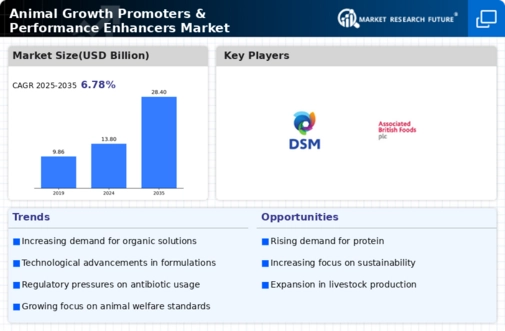
As per Market Research Future analysis, the Animal Growth Promoters & Performance Enhancers Market was estimated at 13.82 USD Billion in 2024. The market is projected to grow from 14.75 USD Billion in 2025 to 28.44 USD Billion by 2035, exhibiting a compound annual growth rate (CAGR) of 6.78% during the forecast period 2025 - 2035

Key Market Trends & Highlights

The Animal Growth Promoters and Performance Enhancers Market is experiencing a dynamic shift towards natural alternatives and innovative technologies.

  • The market is witnessing a notable shift towards natural alternatives as consumers increasingly prioritize sustainability. Technological advancements in nutrition are enhancing the efficacy of growth promoters, particularly in the ruminant segment. Regulatory changes are shaping compliance standards, influencing product formulations and market entry strategies. The rising demand for animal protein and a focus on animal health and welfare are driving growth in the North American market, particularly in the antibiotic segment.

Market Size & Forecast

2024 Market Size 13.82 (USD Billion)
2035 Market Size 28.44 (USD Billion)
CAGR (2025 - 2035) 6.78%
Largest Regional Market Share in 2024 North America

Major Players

Zoetis (US), Boehringer Ingelheim (DE), Merck Animal Health (US), Elanco Animal Health (US), Alltech (US), Nutreco (NL), Cargill (US), ADM (US), BASF (DE)

Market Trends

The Animal Growth Promoters & Performance Enhancers Market is currently experiencing a dynamic evolution, driven by various factors including increasing demand for animal protein and the need for enhanced livestock productivity. As consumers become more health-conscious, there is a growing emphasis on the quality of meat and dairy products, which in turn propels the adoption of growth promoters and performance enhancers. Regulatory frameworks are also adapting, with some regions tightening restrictions on antibiotic use, thereby creating opportunities for alternative solutions that can improve animal health and growth rates. This shift suggests a potential for innovation in the sector, as companies explore natural and organic options to meet consumer preferences. Moreover, advancements in biotechnology and nutrition science are likely to play a pivotal role in shaping the future of the Animal Growth Promoters & Performance Enhancers Market. The integration of precision feeding techniques and personalized nutrition strategies may enhance the effectiveness of these products, leading to improved feed conversion ratios and overall animal performance. As sustainability becomes a focal point in agricultural practices, the market may witness a transition towards more environmentally friendly solutions. This evolving landscape indicates that stakeholders must remain agile and responsive to changing consumer demands and regulatory environments to thrive in this competitive arena.

Shift Towards Natural Alternatives

There is a noticeable trend towards the use of natural growth promoters and performance enhancers. As consumers increasingly prefer organic and natural products, manufacturers are exploring plant-based additives and probiotics that can enhance animal growth without relying on synthetic chemicals.

Technological Advancements in Nutrition

Innovations in animal nutrition, particularly through biotechnology, are reshaping the market. Enhanced feed formulations and precision feeding techniques are being developed to optimize nutrient absorption, thereby improving growth rates and overall animal health.

Regulatory Changes and Compliance

The regulatory landscape is evolving, with stricter guidelines on the use of antibiotics in livestock. This shift is prompting producers to seek alternative growth enhancers that comply with new regulations, thereby influencing product development and market dynamics.

Animal Growth Promoters Enhancers Market Market Drivers

Focus on Animal Health and Welfare

There is a growing awareness regarding animal health and welfare among consumers and producers alike. This shift is influencing the Animal Growth Promoters & Performance Enhancers Market, as stakeholders increasingly prioritize the use of products that not only enhance growth but also promote overall well-being. The integration of performance enhancers that support immune function and reduce disease incidence is becoming more prevalent. As a result, the market is witnessing a shift towards products that align with these health-conscious trends, potentially leading to a more sustainable and ethical approach to animal husbandry.

Increasing Demand for Animal Protein

The rising global population and changing dietary preferences are driving an increased demand for animal protein. This trend is particularly evident in developing regions where meat consumption is on the rise. The Animal Growth Promoters & Performance Enhancers Market is poised to benefit from this surge, as producers seek to enhance livestock productivity to meet consumer needs. According to recent data, the demand for poultry and livestock products is expected to grow by approximately 20% over the next decade. This growth necessitates the use of growth promoters and performance enhancers to optimize feed efficiency and improve overall animal health, thereby ensuring a sustainable supply of animal protein.

Regulatory Support for Growth Enhancers

Regulatory frameworks are evolving to support the use of growth enhancers in livestock production. Many regions are implementing guidelines that facilitate the safe use of animal growth promoters, thereby fostering confidence among producers. The Animal Growth Promoters & Performance Enhancers Market is likely to benefit from this supportive regulatory environment, as it encourages the adoption of scientifically validated products. Furthermore, as regulations become more standardized, it may lead to increased market access for manufacturers, ultimately driving growth in the sector. This regulatory support is crucial for ensuring that products meet safety and efficacy standards while promoting animal health.

Rising Awareness of Sustainable Practices

Sustainability is becoming a central theme in the Animal Growth Promoters & Performance Enhancers Market. As consumers demand more environmentally friendly practices, producers are increasingly adopting sustainable methods to enhance animal growth. This includes the use of growth promoters that minimize environmental impact while maximizing productivity. The market is witnessing a shift towards products that are not only effective but also align with sustainability goals. This trend is likely to drive innovation in the sector, as companies seek to develop solutions that meet both economic and environmental objectives, thereby ensuring long-term viability in the market.

Technological Innovations in Feed Additives

Technological advancements in feed additives are revolutionizing the Animal Growth Promoters & Performance Enhancers Market. Innovations such as precision nutrition and the development of novel feed formulations are enabling producers to optimize growth rates and feed conversion ratios. For instance, the introduction of probiotics and enzymes in animal diets has shown promising results in enhancing nutrient absorption and overall performance. The market for feed additives is projected to grow significantly, with estimates suggesting a compound annual growth rate of around 6% over the next five years. This trend indicates a robust demand for innovative solutions that can improve livestock productivity.

Market Segment Insights

By Type: Antibiotic (Largest) vs. Probiotics & Prebiotics (Fastest-Growing)

The Animal Growth Promoters &amp; Performance Enhancers Market demonstrates a diverse range of segment values, with antibiotics capturing the largest share. These products remain integral to enhancing growth and overall health in livestock. Feed enzymes, hormonal agents, phytogenics, and others also contribute to the breadth of the market, each addressing specific animal health needs and regulatory frameworks. The adoption of probiotics and prebiotics is rapidly increasing due to their natural appeal and efficacy in promoting gut health, positioning them as a significant player in this sector. In recent years, the market has witnessed notable growth trends, particularly in the probiotics and prebiotics segment, which is fueled by a rising awareness of livestock health and the shift towards natural alternatives. The motivation for using growth promoters is increasingly rooted in sustainability and improving feed efficiency. Additionally, regulatory changes are paving the way for more innovative products, compelling traditional segments like antibiotics to adapt or face declining demand as alternative solutions gain market confidence.

Antibiotic: Dominant vs. Probiotics &amp; Prebiotics: Emerging

Antibiotics are established as the dominant force within the Animal Growth Promoters &amp; Performance Enhancers Market, primarily due to their historical effectiveness in growth enhancement and disease prevention. Their broad-spectrum capabilities ensure robust application across various animal species, from poultry to livestock. Conversely, probiotics and prebiotics are rapidly emerging as crucial alternatives, driven by a consumer push towards cleaner and more natural animal farming practices. Such products focus on enhancing gut health and nutrient absorption without the negatives associated with antibiotic use. This shift not only reflects changing market dynamics but also highlights the evolving attitudes within the agricultural sector towards sustainability and animal welfare, marking a significant transition in how growth is achieved in livestock.

By Livestock: Ruminants (Largest) vs. Poultry (Fastest-Growing)

In the Animal Growth Promoters &amp; Performance Enhancers Market, the 'Livestock' segment shows a diverse distribution of market share among ruminants, poultry, porcine, and others. Ruminants hold the largest share due to their significant demand for growth promoters in beef and dairy production. Poultry, on the other hand, is rapidly gaining traction as a preferred source of protein, driving a swift increase in the adoption of performance enhancers designed to improve feed efficiency and health. The growth trends in this segment are influenced by factors such as increasing meat consumption and a shift toward sustainable farming practices. Ruminants maintain a steady demand, while poultry emerges as the fastest-growing sector, propelled by innovations in feed formulations and a rising focus on animal health. Additionally, porcine and other livestock sectors are also adapting in response to market trends, although at a slower growth rate than poultry.

Ruminants (Dominant) vs. Poultry (Emerging)

Ruminants dominate the Animal Growth Promoters &amp; Performance Enhancers Market, with well-established practices that have been refined over years. This segment benefits from a long history of research and product development aimed at enhancing growth and productivity in cattle and sheep. Their strong market position is further supported by regulatory backing for certain growth promoters that enhance feed conversion and overall health. Conversely, the poultry segment is considered emerging but is rapidly closing the gap. With the increasing focus on efficient meat production, poultry harnesses innovative growth enhancers that cater specifically to birds, addressing challenges such as feed efficiency and disease management. The competitive landscape is evolving as poultry producers seek effective, safe enhancers to boost production while meeting consumer demands for healthier food options.

Get more detailed insights about Animal Growth Promoters & Performance Enhancers Market Research Report - Global Forecast till 2035

Regional Insights

By region, the study provides market insights into Europe, North America, Asia-Pacific, and the Rest of the World. The North American animal growth promoters & performance enhancers market accounted for USD 5.45 billion in 2022 and will likely exhibit a significant CAGR growth in the study period. The high regional consumption of meat and dairy products and the growing demand for sustainable and efficient livestock production require advanced growth-promoting solutions. Farmers in North America seek to optimize animal health and productivity while ensuring the responsible use of antibiotics and maintaining high animal welfare standards.

The robust presence of key market players and innovative research initiatives in the region further contributes to the development and adoption of novel animal growth promoters and performance enhancers, catering to the specific needs of North American livestock producers.

Further, the major countries studied in the market report are The US, German, Canada, the UK, France, Spain, China, Italy, India, Australia, Japan, South Korea, and Brazil.

Figure 2: Animal Growth Promoters & Performance Enhancers Market Share By Region 2022 (USD Billion)

Europe animal growth promoters & performance enhancers market accounts for the second-largest market share. The stringent EU regulations on antibiotic usage in animal farming propel the demand for sustainable growth-promoting alternatives, such as probiotics, prebiotics, and phytogenics. Moreover, the increasing concerns over antimicrobial resistance and the need to reduce environmental impacts drive the adoption of eco-friendly growth promoters in livestock production. Further, the German animal growth promoters & performance enhancers market held the largest market share, and the UK animal growth promoters & performance enhancers market was the fastest-growing market in the European region.

The Asia-Pacific Animal Growth Promoters & Performance Enhancers Market is expected to grow at the fastest CAGR from 2023 to 2032. The growing regional population, rising disposable incomes, and dietary changes drive the demand for animal-based protein sources, stimulating the need for improved livestock production efficiency. With several countries focusing on modernizing their livestock production systems, the Asia Pacific market offers immense growth potential for companies developing innovative animal growth promoters and performance enhancers to support sustainable and efficient agriculture practices.

Moreover, China’s animal growth promoters & performance enhancers market held the largest market share, and the Indian animal growth promoters & performance enhancers market was the fastest-growing market in the Asia-Pacific region.

Recent News:

September 2023:  The Department of Fisheries, India has authorized 732 artificial reef units for ten coastal states of India as a sub-activity of the "Integrated Modern Coastal Fishing Villages" component of the Centrally Sponsored Scheme (CSS), with the aim of fostering sustainable practices. With the technical assistance of the Fishery Survey of India (FSI) and the ICAR-Central Marine Fisheries Research Institute (CMFRI), the initiatives are currently being executed. The site selection processes for all states have been finalized, with the exception of Kerala and Maharashtra, which have concluded the tendering process for work execution.

As a result, the anticipated completion date for all initiatives is January 2024. It is anticipated that the implementation of sea ranching programs in all coastal states and the establishment of artificial reefs in coastal waters will serve as effective strategies to restore coastal fisheries and replenish fish inventories. In order to manage aquatic resources, including habitat enhancement, increase productivity, and rehabilitate and/or improve natural habitats, artificial reefs are technological interventions based on engineering.

Key Players and Competitive Insights

Leading market players are actively investing in research & development initiatives to expand their product portfolios and cater to the evolving needs of livestock producers. Key animal growth promoters & performance enhancers industry participants are also undertaking strategic activities to strengthen their presence and market share. Major market developments include frequent new product launches, where companies introduce advanced growth promoters tailored to address specific market demands and enhance livestock productivity.Collaborations, contractual agreements, and partnerships with other organizations are also prominent in the animal growth promoters & performance enhancers industry, enabling companies to access new markets and expand their distribution networks. In recent years, the animal growth promoters & performance enhancers industry has offered some of the most significant advantages that address specific nutritional requirements and improve animal health and overall performance. Major players in the animal growth promoters & performance enhancers market, including Cargill Incorporated (US), Royal DSM N.V. (Netherlands), Merck & Co.Inc (US), Alltech Corporation (US), Vetoquinol S.A. (France), Erber AG (Austria), Phibro Animal Health Corporation (US), Kemin Industries Inc (US), Zoetis Inc (US), Novozymes A/S (Denmark), BASF SE (Germany), Evonik Industries AG (Germany), Land O’Lakes Inc (US), Lallemand Inc (Canada), are making higher investments in manufacturing facilities to meet the increasing demand for growth promoters ly.Novozymes A/S is a Danish biotechnology company that was founded in 2000 as a result of the demerger of Novo Nordisk's biotechnology division. It operates as an independent entity within the Novo Group and is headquartered in Denmark. Novozymes is a leader in developing and producing industrial enzymes and microorganisms. Novozymes has a strong presence, with operations and sales offices in numerous countries across Europe, the Americas, Asia Pacific, Africa, and the Middle East.
In June Novozymes A/S launched ProAct 360, a protease technology for poultry, on three key fronts: feed affordability, efficiency, and sustainability.Kemin Industries Inc is a leading company that provides innovative solutions for human and animal nutrition, health, and safety. Kemin Industries offers a diverse portfolio of products and solutions across multiple industries. The company is a prominent player in developing and producing animal growth promoters and performance enhancers in the animal health segment. One of the recent developments by Kemin in the animal health sector was the launch of a new probiotic-based feed additive for livestock in 2020.This probiotic product was designed to promote gut health and improve nutrient absorption in various livestock species, supporting optimal growth and feed efficiency.

Key Companies in the Animal Growth Promoters Enhancers Market include

Industry Developments

  • August 2021: Cargill Incorporated has introduced a new feed additive called 'Promote.' The product is intended to improve poultry intestinal health and is projected to expand the company's product portfolio in markets.
  • April 2021: Kemin Industries Inc (US) has introduced Paradigmox Green, an antioxidant solution for organic livestock farming in the EMENA (Europe, Middle East, and North Africa) region.
  • March 2020: Evonik Industries AG has introduced a new product called 'Ecobiol,' a probiotic designed to promote cattle gut health. The introduction of this product strengthened the company's position in the business of animal growth promoters and performance enhancers.
  • Q1 2024: Elanco Animal Health Appoints New Chief Scientific Officer Elanco Animal Health named Dr. Maria Thompson as Chief Scientific Officer, tasking her with leading innovation in animal growth promoters and performance enhancers as the company expands its R&D pipeline.
  • Q2 2024: BASF Opens New Animal Nutrition Facility in Singapore BASF inaugurated a state-of-the-art manufacturing facility in Singapore to produce next-generation animal growth promoters and performance enhancers, aiming to meet rising demand in the Asia-Pacific region.
  • Q3 2024: DSM-Firmenich Launches Antibiotic-Free Growth Promoter for Swine DSM-Firmenich introduced a new antibiotic-free feed additive for swine, targeting European and North American markets amid tightening regulations on antibiotic use in animal agriculture.
  • Q2 2025: Phibro Animal Health Acquires Brazilian Feed Additive Producer NutriVet Phibro Animal Health completed the acquisition of NutriVet, a leading Brazilian manufacturer of animal growth promoters, expanding its presence in Latin America’s fast-growing livestock sector.
  • Q1 2025: Cargill Partners with Novozymes to Develop Enzyme-Based Growth Enhancers Cargill and Novozymes announced a strategic partnership to co-develop enzyme-based animal growth promoters, focusing on sustainable alternatives to antibiotics for global livestock producers.
  • Q4 2024: ADM Secures Major Supply Contract with Chinese Poultry Producer Archer Daniels Midland (ADM) signed a multi-year contract to supply its proprietary animal performance enhancers to one of China’s largest poultry producers, strengthening its foothold in the Asian market.
  • Q3 2024: Vetoquinol Launches Natural Growth Promoter for Dairy Cattle in Europe Vetoquinol introduced a plant-based growth promoter for dairy cattle, targeting European farmers seeking alternatives to synthetic additives amid evolving regulatory standards.
  • Q2 2024: Kemin Industries Expands Production Capacity for Animal Performance Enhancers in India Kemin Industries completed an expansion of its Indian manufacturing facility, doubling output of animal growth promoters to meet increasing demand from the region’s poultry and livestock sectors.
  • Q1 2025: Alltech Raises $200 Million in Private Placement to Fund Growth Promoter R&D Alltech disclosed in SEC filings that it raised $200 million in a private placement, with proceeds earmarked for research and development of next-generation animal growth promoters and performance enhancers.
  • Q2 2025: Evonik Industries Unveils Probiotic-Based Growth Enhancer for Aquaculture Evonik Industries launched a new probiotic-based product aimed at improving growth and health in farmed fish, expanding its animal nutrition portfolio into the rapidly growing aquaculture segment.

Future Outlook

Animal Growth Promoters Enhancers Market Future Outlook

The Animal Growth Promoters &amp; Performance Enhancers Market is projected to grow at a 6.78% CAGR from 2025 to 2035, driven by increasing demand for meat and dairy products, regulatory changes, and technological advancements.

New opportunities lie in:

  • <p>Development of precision feeding technologies for optimized nutrient delivery. Expansion into emerging markets with tailored growth promoter solutions. Investment in R&amp;D for natural and organic performance enhancers.</p>

By 2035, the market is expected to be robust, driven by innovation and strategic investments.

Market Segmentation

Animal Growth Promoters Enhancers Market Type Outlook

  • Antibiotic
  • Hormonal
  • Feed Enzymes
  • Probiotics & Prebiotics
  • Phytogenic
  • Others

Animal Growth Promoters Enhancers Market Livestock Outlook

  • Ruminants
  • Poultry
  • Porcine
  • Others

Report Scope

MARKET SIZE 2024 13.82(USD Billion)
MARKET SIZE 2025 14.75(USD Billion)
MARKET SIZE 2035 28.44(USD Billion)
COMPOUND ANNUAL GROWTH RATE (CAGR) 6.78% (2025 - 2035)
REPORT COVERAGE Revenue Forecast, Competitive Landscape, Growth Factors, and Trends
BASE YEAR 2024
Market Forecast Period 2025 - 2035
Historical Data 2019 - 2024
Market Forecast Units USD Billion
Key Companies Profiled Zoetis (US), Boehringer Ingelheim (DE), Merck Animal Health (US), Elanco Animal Health (US), Alltech (US), Nutreco (NL), Cargill (US), ADM (US), BASF (DE)
Segments Covered Product Type, Livestock, Region
Key Market Opportunities Adoption of innovative feed additives enhances livestock productivity and meets evolving consumer demands.
Key Market Dynamics Rising regulatory scrutiny and consumer demand drive innovation in animal growth promoters and performance enhancers.
Countries Covered North America, Europe, APAC, South America, MEA

FAQs

What is the current valuation of the Animal Growth Promoters & Performance Enhancers Market?

<p>As of 2024, the market valuation stands at 13.82 USD Billion.</p>

What is the projected market size for the Animal Growth Promoters & Performance Enhancers Market by 2035?

<p>The market is expected to reach a valuation of 28.44 USD Billion by 2035.</p>

What is the expected CAGR for the Animal Growth Promoters & Performance Enhancers Market during the forecast period 2025 - 2035?

<p>The market is projected to grow at a CAGR of 6.78% from 2025 to 2035.</p>

Which segment of the market is expected to have the highest valuation in 2035?

<p>The Poultry segment is anticipated to reach a valuation of 10.7 USD Billion by 2035.</p>

How do the valuations of Antibiotics compare to Hormonal growth promoters in 2035?

<p>By 2035, Antibiotics are projected to be valued at 7.0 USD Billion, while Hormonal growth promoters are expected to reach 4.0 USD Billion.</p>

What are the key players in the Animal Growth Promoters & Performance Enhancers Market?

<p>Key players include Zoetis, Boehringer Ingelheim, Merck Animal Health, Elanco Animal Health, and Alltech.</p>

What is the projected valuation for the Ruminants segment by 2035?

The Ruminants segment is expected to reach a valuation of 8.5 USD Billion by 2035.

What is the expected growth for the Feed Enzymes segment from 2024 to 2035?

The Feed Enzymes segment is projected to grow from 2.5 USD Billion in 2024 to 5.0 USD Billion by 2035.

How does the valuation of Probiotics & Prebiotics in 2035 compare to that of Phytogenic products?

In 2035, Probiotics &amp; Prebiotics are expected to be valued at 4.0 USD Billion, similar to Phytogenic products, which are also projected at 4.0 USD Billion.

What is the expected valuation for the Porcine segment by 2035?

The Porcine segment is anticipated to reach a valuation of 4.2 USD Billion by 2035.

  1. SECTION I: EXECUTIVE SUMMARY AND KEY HIGHLIGHTS
    1. | 1.1 EXECUTIVE SUMMARY
    2. | | 1.1.1 Market Overview
    3. | | 1.1.2 Key Findings
    4. | | 1.1.3 Market Segmentation
    5. | | 1.1.4 Competitive Landscape
    6. | | 1.1.5 Challenges and Opportunities
    7. | | 1.1.6 Future Outlook
  2. SECTION II: SCOPING, METHODOLOGY AND MARKET STRUCTURE
    1. | 2.1 MARKET INTRODUCTION
    2. | | 2.1.1 Definition
    3. | | 2.1.2 Scope of the study
    4. | | | 2.1.2.1 Research Objective
    5. | | | 2.1.2.2 Assumption
    6. | | | 2.1.2.3 Limitations
    7. | 2.2 RESEARCH METHODOLOGY
    8. | | 2.2.1 Overview
    9. | | 2.2.2 Data Mining
    10. | | 2.2.3 Secondary Research
    11. | | 2.2.4 Primary Research
    12. | | | 2.2.4.1 Primary Interviews and Information Gathering Process
    13. | | | 2.2.4.2 Breakdown of Primary Respondents
    14. | | 2.2.5 Forecasting Model
    15. | | 2.2.6 Market Size Estimation
    16. | | | 2.2.6.1 Bottom-Up Approach
    17. | | | 2.2.6.2 Top-Down Approach
    18. | | 2.2.7 Data Triangulation
    19. | | 2.2.8 Validation
  3. SECTION III: QUALITATIVE ANALYSIS
    1. | 3.1 MARKET DYNAMICS
    2. | | 3.1.1 Overview
    3. | | 3.1.2 Drivers
    4. | | 3.1.3 Restraints
    5. | | 3.1.4 Opportunities
    6. | 3.2 MARKET FACTOR ANALYSIS
    7. | | 3.2.1 Value chain Analysis
    8. | | 3.2.2 Porter's Five Forces Analysis
    9. | | | 3.2.2.1 Bargaining Power of Suppliers
    10. | | | 3.2.2.2 Bargaining Power of Buyers
    11. | | | 3.2.2.3 Threat of New Entrants
    12. | | | 3.2.2.4 Threat of Substitutes
    13. | | | 3.2.2.5 Intensity of Rivalry
    14. | | 3.2.3 COVID-19 Impact Analysis
    15. | | | 3.2.3.1 Market Impact Analysis
    16. | | | 3.2.3.2 Regional Impact
    17. | | | 3.2.3.3 Opportunity and Threat Analysis
  4. SECTION IV: QUANTITATIVE ANALYSIS
    1. | 4.1 Food, Beverages & Nutrition, BY Type (USD Billion)
    2. | | 4.1.1 Antibiotic
    3. | | 4.1.2 Hormonal
    4. | | 4.1.3 Feed Enzymes
    5. | | 4.1.4 Probiotics & Prebiotics
    6. | | 4.1.5 Phytogenic
    7. | | 4.1.6 Others
    8. | 4.2 Food, Beverages & Nutrition, BY Livestock (USD Billion)
    9. | | 4.2.1 Ruminants
    10. | | 4.2.2 Poultry
    11. | | 4.2.3 Porcine
    12. | | 4.2.4 Others
    13. | 4.3 Food, Beverages & Nutrition, BY Region (USD Billion)
    14. | | 4.3.1 North America
    15. | | | 4.3.1.1 US
    16. | | | 4.3.1.2 Canada
    17. | | 4.3.2 Europe
    18. | | | 4.3.2.1 Germany
    19. | | | 4.3.2.2 UK
    20. | | | 4.3.2.3 France
    21. | | | 4.3.2.4 Russia
    22. | | | 4.3.2.5 Italy
    23. | | | 4.3.2.6 Spain
    24. | | | 4.3.2.7 Rest of Europe
    25. | | 4.3.3 APAC
    26. | | | 4.3.3.1 China
    27. | | | 4.3.3.2 India
    28. | | | 4.3.3.3 Japan
    29. | | | 4.3.3.4 South Korea
    30. | | | 4.3.3.5 Malaysia
    31. | | | 4.3.3.6 Thailand
    32. | | | 4.3.3.7 Indonesia
    33. | | | 4.3.3.8 Rest of APAC
    34. | | 4.3.4 South America
    35. | | | 4.3.4.1 Brazil
    36. | | | 4.3.4.2 Mexico
    37. | | | 4.3.4.3 Argentina
    38. | | | 4.3.4.4 Rest of South America
    39. | | 4.3.5 MEA
    40. | | | 4.3.5.1 GCC Countries
    41. | | | 4.3.5.2 South Africa
    42. | | | 4.3.5.3 Rest of MEA
  5. SECTION V: COMPETITIVE ANALYSIS
    1. | 5.1 Competitive Landscape
    2. | | 5.1.1 Overview
    3. | | 5.1.2 Competitive Analysis
    4. | | 5.1.3 Market share Analysis
    5. | | 5.1.4 Major Growth Strategy in the Food, Beverages & Nutrition
    6. | | 5.1.5 Competitive Benchmarking
    7. | | 5.1.6 Leading Players in Terms of Number of Developments in the Food, Beverages & Nutrition
    8. | | 5.1.7 Key developments and growth strategies
    9. | | | 5.1.7.1 New Product Launch/Service Deployment
    10. | | | 5.1.7.2 Merger & Acquisitions
    11. | | | 5.1.7.3 Joint Ventures
    12. | | 5.1.8 Major Players Financial Matrix
    13. | | | 5.1.8.1 Sales and Operating Income
    14. | | | 5.1.8.2 Major Players R&D Expenditure. 2023
    15. | 5.2 Company Profiles
    16. | | 5.2.1 Zoetis (US)
    17. | | | 5.2.1.1 Financial Overview
    18. | | | 5.2.1.2 Products Offered
    19. | | | 5.2.1.3 Key Developments
    20. | | | 5.2.1.4 SWOT Analysis
    21. | | | 5.2.1.5 Key Strategies
    22. | | 5.2.2 Boehringer Ingelheim (DE)
    23. | | | 5.2.2.1 Financial Overview
    24. | | | 5.2.2.2 Products Offered
    25. | | | 5.2.2.3 Key Developments
    26. | | | 5.2.2.4 SWOT Analysis
    27. | | | 5.2.2.5 Key Strategies
    28. | | 5.2.3 Merck Animal Health (US)
    29. | | | 5.2.3.1 Financial Overview
    30. | | | 5.2.3.2 Products Offered
    31. | | | 5.2.3.3 Key Developments
    32. | | | 5.2.3.4 SWOT Analysis
    33. | | | 5.2.3.5 Key Strategies
    34. | | 5.2.4 Elanco Animal Health (US)
    35. | | | 5.2.4.1 Financial Overview
    36. | | | 5.2.4.2 Products Offered
    37. | | | 5.2.4.3 Key Developments
    38. | | | 5.2.4.4 SWOT Analysis
    39. | | | 5.2.4.5 Key Strategies
    40. | | 5.2.5 Alltech (US)
    41. | | | 5.2.5.1 Financial Overview
    42. | | | 5.2.5.2 Products Offered
    43. | | | 5.2.5.3 Key Developments
    44. | | | 5.2.5.4 SWOT Analysis
    45. | | | 5.2.5.5 Key Strategies
    46. | | 5.2.6 Nutreco (NL)
    47. | | | 5.2.6.1 Financial Overview
    48. | | | 5.2.6.2 Products Offered
    49. | | | 5.2.6.3 Key Developments
    50. | | | 5.2.6.4 SWOT Analysis
    51. | | | 5.2.6.5 Key Strategies
    52. | | 5.2.7 Cargill (US)
    53. | | | 5.2.7.1 Financial Overview
    54. | | | 5.2.7.2 Products Offered
    55. | | | 5.2.7.3 Key Developments
    56. | | | 5.2.7.4 SWOT Analysis
    57. | | | 5.2.7.5 Key Strategies
    58. | | 5.2.8 ADM (US)
    59. | | | 5.2.8.1 Financial Overview
    60. | | | 5.2.8.2 Products Offered
    61. | | | 5.2.8.3 Key Developments
    62. | | | 5.2.8.4 SWOT Analysis
    63. | | | 5.2.8.5 Key Strategies
    64. | | 5.2.9 BASF (DE)
    65. | | | 5.2.9.1 Financial Overview
    66. | | | 5.2.9.2 Products Offered
    67. | | | 5.2.9.3 Key Developments
    68. | | | 5.2.9.4 SWOT Analysis
    69. | | | 5.2.9.5 Key Strategies
    70. | 5.3 Appendix
    71. | | 5.3.1 References
    72. | | 5.3.2 Related Reports
  6. LIST OF FIGURES
    1. | 6.1 MARKET SYNOPSIS
    2. | 6.2 NORTH AMERICA MARKET ANALYSIS
    3. | 6.3 US MARKET ANALYSIS BY TYPE
    4. | 6.4 US MARKET ANALYSIS BY LIVESTOCK
    5. | 6.5 CANADA MARKET ANALYSIS BY TYPE
    6. | 6.6 CANADA MARKET ANALYSIS BY LIVESTOCK
    7. | 6.7 EUROPE MARKET ANALYSIS
    8. | 6.8 GERMANY MARKET ANALYSIS BY TYPE
    9. | 6.9 GERMANY MARKET ANALYSIS BY LIVESTOCK
    10. | 6.10 UK MARKET ANALYSIS BY TYPE
    11. | 6.11 UK MARKET ANALYSIS BY LIVESTOCK
    12. | 6.12 FRANCE MARKET ANALYSIS BY TYPE
    13. | 6.13 FRANCE MARKET ANALYSIS BY LIVESTOCK
    14. | 6.14 RUSSIA MARKET ANALYSIS BY TYPE
    15. | 6.15 RUSSIA MARKET ANALYSIS BY LIVESTOCK
    16. | 6.16 ITALY MARKET ANALYSIS BY TYPE
    17. | 6.17 ITALY MARKET ANALYSIS BY LIVESTOCK
    18. | 6.18 SPAIN MARKET ANALYSIS BY TYPE
    19. | 6.19 SPAIN MARKET ANALYSIS BY LIVESTOCK
    20. | 6.20 REST OF EUROPE MARKET ANALYSIS BY TYPE
    21. | 6.21 REST OF EUROPE MARKET ANALYSIS BY LIVESTOCK
    22. | 6.22 APAC MARKET ANALYSIS
    23. | 6.23 CHINA MARKET ANALYSIS BY TYPE
    24. | 6.24 CHINA MARKET ANALYSIS BY LIVESTOCK
    25. | 6.25 INDIA MARKET ANALYSIS BY TYPE
    26. | 6.26 INDIA MARKET ANALYSIS BY LIVESTOCK
    27. | 6.27 JAPAN MARKET ANALYSIS BY TYPE
    28. | 6.28 JAPAN MARKET ANALYSIS BY LIVESTOCK
    29. | 6.29 SOUTH KOREA MARKET ANALYSIS BY TYPE
    30. | 6.30 SOUTH KOREA MARKET ANALYSIS BY LIVESTOCK
    31. | 6.31 MALAYSIA MARKET ANALYSIS BY TYPE
    32. | 6.32 MALAYSIA MARKET ANALYSIS BY LIVESTOCK
    33. | 6.33 THAILAND MARKET ANALYSIS BY TYPE
    34. | 6.34 THAILAND MARKET ANALYSIS BY LIVESTOCK
    35. | 6.35 INDONESIA MARKET ANALYSIS BY TYPE
    36. | 6.36 INDONESIA MARKET ANALYSIS BY LIVESTOCK
    37. | 6.37 REST OF APAC MARKET ANALYSIS BY TYPE
    38. | 6.38 REST OF APAC MARKET ANALYSIS BY LIVESTOCK
    39. | 6.39 SOUTH AMERICA MARKET ANALYSIS
    40. | 6.40 BRAZIL MARKET ANALYSIS BY TYPE
    41. | 6.41 BRAZIL MARKET ANALYSIS BY LIVESTOCK
    42. | 6.42 MEXICO MARKET ANALYSIS BY TYPE
    43. | 6.43 MEXICO MARKET ANALYSIS BY LIVESTOCK
    44. | 6.44 ARGENTINA MARKET ANALYSIS BY TYPE
    45. | 6.45 ARGENTINA MARKET ANALYSIS BY LIVESTOCK
    46. | 6.46 REST OF SOUTH AMERICA MARKET ANALYSIS BY TYPE
    47. | 6.47 REST OF SOUTH AMERICA MARKET ANALYSIS BY LIVESTOCK
    48. | 6.48 MEA MARKET ANALYSIS
    49. | 6.49 GCC COUNTRIES MARKET ANALYSIS BY TYPE
    50. | 6.50 GCC COUNTRIES MARKET ANALYSIS BY LIVESTOCK
    51. | 6.51 SOUTH AFRICA MARKET ANALYSIS BY TYPE
    52. | 6.52 SOUTH AFRICA MARKET ANALYSIS BY LIVESTOCK
    53. | 6.53 REST OF MEA MARKET ANALYSIS BY TYPE
    54. | 6.54 REST OF MEA MARKET ANALYSIS BY LIVESTOCK
    55. | 6.55 KEY BUYING CRITERIA OF FOOD, BEVERAGES & NUTRITION
    56. | 6.56 RESEARCH PROCESS OF MRFR
    57. | 6.57 DRO ANALYSIS OF FOOD, BEVERAGES & NUTRITION
    58. | 6.58 DRIVERS IMPACT ANALYSIS: FOOD, BEVERAGES & NUTRITION
    59. | 6.59 RESTRAINTS IMPACT ANALYSIS: FOOD, BEVERAGES & NUTRITION
    60. | 6.60 SUPPLY / VALUE CHAIN: FOOD, BEVERAGES & NUTRITION
    61. | 6.61 FOOD, BEVERAGES & NUTRITION, BY TYPE, 2024 (% SHARE)
    62. | 6.62 FOOD, BEVERAGES & NUTRITION, BY TYPE, 2024 TO 2035 (USD Billion)
    63. | 6.63 FOOD, BEVERAGES & NUTRITION, BY LIVESTOCK, 2024 (% SHARE)
    64. | 6.64 FOOD, BEVERAGES & NUTRITION, BY LIVESTOCK, 2024 TO 2035 (USD Billion)
    65. | 6.65 BENCHMARKING OF MAJOR COMPETITORS
  7. LIST OF TABLES
    1. | 7.1 LIST OF ASSUMPTIONS
    2. | | 7.1.1
    3. | 7.2 North America MARKET SIZE ESTIMATES; FORECAST
    4. | | 7.2.1 BY TYPE, 2025-2035 (USD Billion)
    5. | | 7.2.2 BY LIVESTOCK, 2025-2035 (USD Billion)
    6. | 7.3 US MARKET SIZE ESTIMATES; FORECAST
    7. | | 7.3.1 BY TYPE, 2025-2035 (USD Billion)
    8. | | 7.3.2 BY LIVESTOCK, 2025-2035 (USD Billion)
    9. | 7.4 Canada MARKET SIZE ESTIMATES; FORECAST
    10. | | 7.4.1 BY TYPE, 2025-2035 (USD Billion)
    11. | | 7.4.2 BY LIVESTOCK, 2025-2035 (USD Billion)
    12. | 7.5 Europe MARKET SIZE ESTIMATES; FORECAST
    13. | | 7.5.1 BY TYPE, 2025-2035 (USD Billion)
    14. | | 7.5.2 BY LIVESTOCK, 2025-2035 (USD Billion)
    15. | 7.6 Germany MARKET SIZE ESTIMATES; FORECAST
    16. | | 7.6.1 BY TYPE, 2025-2035 (USD Billion)
    17. | | 7.6.2 BY LIVESTOCK, 2025-2035 (USD Billion)
    18. | 7.7 UK MARKET SIZE ESTIMATES; FORECAST
    19. | | 7.7.1 BY TYPE, 2025-2035 (USD Billion)
    20. | | 7.7.2 BY LIVESTOCK, 2025-2035 (USD Billion)
    21. | 7.8 France MARKET SIZE ESTIMATES; FORECAST
    22. | | 7.8.1 BY TYPE, 2025-2035 (USD Billion)
    23. | | 7.8.2 BY LIVESTOCK, 2025-2035 (USD Billion)
    24. | 7.9 Russia MARKET SIZE ESTIMATES; FORECAST
    25. | | 7.9.1 BY TYPE, 2025-2035 (USD Billion)
    26. | | 7.9.2 BY LIVESTOCK, 2025-2035 (USD Billion)
    27. | 7.10 Italy MARKET SIZE ESTIMATES; FORECAST
    28. | | 7.10.1 BY TYPE, 2025-2035 (USD Billion)
    29. | | 7.10.2 BY LIVESTOCK, 2025-2035 (USD Billion)
    30. | 7.11 Spain MARKET SIZE ESTIMATES; FORECAST
    31. | | 7.11.1 BY TYPE, 2025-2035 (USD Billion)
    32. | | 7.11.2 BY LIVESTOCK, 2025-2035 (USD Billion)
    33. | 7.12 Rest of Europe MARKET SIZE ESTIMATES; FORECAST
    34. | | 7.12.1 BY TYPE, 2025-2035 (USD Billion)
    35. | | 7.12.2 BY LIVESTOCK, 2025-2035 (USD Billion)
    36. | 7.13 APAC MARKET SIZE ESTIMATES; FORECAST
    37. | | 7.13.1 BY TYPE, 2025-2035 (USD Billion)
    38. | | 7.13.2 BY LIVESTOCK, 2025-2035 (USD Billion)
    39. | 7.14 China MARKET SIZE ESTIMATES; FORECAST
    40. | | 7.14.1 BY TYPE, 2025-2035 (USD Billion)
    41. | | 7.14.2 BY LIVESTOCK, 2025-2035 (USD Billion)
    42. | 7.15 India MARKET SIZE ESTIMATES; FORECAST
    43. | | 7.15.1 BY TYPE, 2025-2035 (USD Billion)
    44. | | 7.15.2 BY LIVESTOCK, 2025-2035 (USD Billion)
    45. | 7.16 Japan MARKET SIZE ESTIMATES; FORECAST
    46. | | 7.16.1 BY TYPE, 2025-2035 (USD Billion)
    47. | | 7.16.2 BY LIVESTOCK, 2025-2035 (USD Billion)
    48. | 7.17 South Korea MARKET SIZE ESTIMATES; FORECAST
    49. | | 7.17.1 BY TYPE, 2025-2035 (USD Billion)
    50. | | 7.17.2 BY LIVESTOCK, 2025-2035 (USD Billion)
    51. | 7.18 Malaysia MARKET SIZE ESTIMATES; FORECAST
    52. | | 7.18.1 BY TYPE, 2025-2035 (USD Billion)
    53. | | 7.18.2 BY LIVESTOCK, 2025-2035 (USD Billion)
    54. | 7.19 Thailand MARKET SIZE ESTIMATES; FORECAST
    55. | | 7.19.1 BY TYPE, 2025-2035 (USD Billion)
    56. | | 7.19.2 BY LIVESTOCK, 2025-2035 (USD Billion)
    57. | 7.20 Indonesia MARKET SIZE ESTIMATES; FORECAST
    58. | | 7.20.1 BY TYPE, 2025-2035 (USD Billion)
    59. | | 7.20.2 BY LIVESTOCK, 2025-2035 (USD Billion)
    60. | 7.21 Rest of APAC MARKET SIZE ESTIMATES; FORECAST
    61. | | 7.21.1 BY TYPE, 2025-2035 (USD Billion)
    62. | | 7.21.2 BY LIVESTOCK, 2025-2035 (USD Billion)
    63. | 7.22 South America MARKET SIZE ESTIMATES; FORECAST
    64. | | 7.22.1 BY TYPE, 2025-2035 (USD Billion)
    65. | | 7.22.2 BY LIVESTOCK, 2025-2035 (USD Billion)
    66. | 7.23 Brazil MARKET SIZE ESTIMATES; FORECAST
    67. | | 7.23.1 BY TYPE, 2025-2035 (USD Billion)
    68. | | 7.23.2 BY LIVESTOCK, 2025-2035 (USD Billion)
    69. | 7.24 Mexico MARKET SIZE ESTIMATES; FORECAST
    70. | | 7.24.1 BY TYPE, 2025-2035 (USD Billion)
    71. | | 7.24.2 BY LIVESTOCK, 2025-2035 (USD Billion)
    72. | 7.25 Argentina MARKET SIZE ESTIMATES; FORECAST
    73. | | 7.25.1 BY TYPE, 2025-2035 (USD Billion)
    74. | | 7.25.2 BY LIVESTOCK, 2025-2035 (USD Billion)
    75. | 7.26 Rest of South America MARKET SIZE ESTIMATES; FORECAST
    76. | | 7.26.1 BY TYPE, 2025-2035 (USD Billion)
    77. | | 7.26.2 BY LIVESTOCK, 2025-2035 (USD Billion)
    78. | 7.27 MEA MARKET SIZE ESTIMATES; FORECAST
    79. | | 7.27.1 BY TYPE, 2025-2035 (USD Billion)
    80. | | 7.27.2 BY LIVESTOCK, 2025-2035 (USD Billion)
    81. | 7.28 GCC Countries MARKET SIZE ESTIMATES; FORECAST
    82. | | 7.28.1 BY TYPE, 2025-2035 (USD Billion)
    83. | | 7.28.2 BY LIVESTOCK, 2025-2035 (USD Billion)
    84. | 7.29 South Africa MARKET SIZE ESTIMATES; FORECAST
    85. | | 7.29.1 BY TYPE, 2025-2035 (USD Billion)
    86. | | 7.29.2 BY LIVESTOCK, 2025-2035 (USD Billion)
    87. | 7.30 Rest of MEA MARKET SIZE ESTIMATES; FORECAST
    88. | | 7.30.1 BY TYPE, 2025-2035 (USD Billion)
    89. | | 7.30.2 BY LIVESTOCK, 2025-2035 (USD Billion)
    90. | 7.31 PRODUCT LAUNCH/PRODUCT DEVELOPMENT/APPROVAL
    91. | | 7.31.1
    92. | 7.32 ACQUISITION/PARTNERSHIP
    93. | | 7.32.1

Food, Beverages & Nutrition Market Segmentation

Food, Beverages & Nutrition By Type (USD Billion, 2025-2035)

  • Antibiotic
  • Hormonal
  • Feed Enzymes
  • Probiotics & Prebiotics
  • Phytogenic
  • Others

Food, Beverages & Nutrition By Livestock (USD Billion, 2025-2035)

  • Ruminants
  • Poultry
  • Porcine
  • Others
Infographic

Free Sample Request

Kindly complete the form below to receive a free sample of this Report

Get Free Sample

Customer Strories

Compare Licence

×
Features License Type
Single User Multiuser License Enterprise User
Price $4,950 $5,950 $7,250
Maximum User Access Limit 1 User Upto 10 Users Unrestricted Access Throughout the Organization
Free Customization
Direct Access to Analyst
Deliverable Format
Platform Access
Discount on Next Purchase 10% 15% 15%
Printable Versions