×
Hero Background
English
Chinese
French
Japanese
Korean
German
Spanish

Anhydrite Market Trends

ID: MRFR/CnM/1087-HCR
133 Pages
Chitranshi Jaiswal
October 2025

Anhydrite Market Research Report Information: By Type (Natural and Synthetic), Application (Soil Treatment, Construction, Fertilizers, Industrial, Drying Agents, and Others) And Region - Forecast Till 2035

Share:
Download PDF ×

We do not share your information with anyone. However, we may send you emails based on your report interest from time to time. You may contact us at any time to opt-out.

Anhydrite Market Infographic
Purchase Options

Market Trends

Key Emerging Trends in the Anhydrite Market

The rising development sector, need for gypsum alternatives, and advances in current applications are driving the anhydrite market. Anhydrite, a calcium sulfate mineral, is replacing gypsum in several development and current cycles. In concrete and mortar applications, anhydrite is becoming more popular in development. Anhydrite is added to concrete to reduce setting time, improve functioning, and improve appearance. As global growth continues, the Anhydrite Market is experiencing increasing demand, especially in areas with rapid foundation construction.

The development industry relies on anhydrite due to its unique qualities. Development materials benefit from anhydrite-based products' reduced shrinkage, increased strength, and improved solidness. Anhydrite is being used more in self-evening compounds, floor screeds, and joint fillers due to the trend toward cost-effective and high-performance development.

Anhydrite market trends are also impacted by gypsum substitution demand. Due to its synthetic structure and closeness to other developing materials, anhydrite may be a better alternative to gypsum in several applications. In areas where gypsum is scarce, anhydrite may be a viable alternative to reduce their environmental impact and increase unrefined drug utilization.

Modern application advances are shaping market dynamics. Modern processes like sulfuric corrosive employ anhydrite as a natural ingredient. Modern uses make anhydrite interesting in many fields, proving its versatility.

Amazing patterns are emerging in company collaboration and structure. Anhydrite producers are forming unions to strengthen their market position, exchange mechanical expertise, and explore new opportunities. These collaborations advance the Anhydrite Market and meet the changing needs of end-use enterprises.

Global financial factors also affect market trends. Financial factors including development, framework improvement, and modernization affect anhydrite demand. Financial fluctuations can affect market aspects, forcing companies to adapt and creating lucrative market opportunities.


Author
Chitranshi Jaiswal
Research Analyst Level I

In her 3 years of experience in the market research field, she has handled critical cross-domain projects. She has an in-depth knowledge of market estimation & analysis, problem-solving, primary as well as secondary research, and team management.She holds an engineering degree and is an MBA professional from a well-known university, capable of evaluating the market and competitive conditions. An exceptional strategist with excellent communication skills and a passion for delivering cutting-edge & practical insights for the market. Proficient in multi-tasking, and can successfully deal with competing demands, while maintaining complete confidentiality. Generated business through active client and project development, networking, and high-quality responses. Her knowledge and skills have helped in making solid business decisions, securing funding from investors, and avoiding business failures.

Leave a Comment

FAQs

What is the biggest driver of the global anhydrite market?

Cultivation of crops and the booming agriculture sector are two of the biggest drivers of the global anhydrite market.

Which is the best-performing region of the global anhydrite market?

The APAC is the largest region of the global anhydrite market due to rapid industrialization and urbanization.

Which is the second-best region for the global anhydrite market?

North America is the second-best region for the global anhydrite market owing to the growing use of fertilizers.

Who are the biggest players of the global anhydrite market?

Georgia-Pacific Gypsum LLC, Solvay, USG Corporation, Bisley & Company Pty Ltd., NATIONAL GYPSUM PROPERTIES, LLC, Lafarge Holcim, Knauf Gips KG, BDH Gypsum, Quzhou Zunlong Trading Co., Ltd., ACG Materials, Mineralis Lucentum, Saint-Gobain SA, ANHYDRITEC, Vanich Gypsum Co. Ltd, and General Mining And Trading Co., Ltd are the most notable players of the global anhydrite market.

What are the strategies of players in the global anhydrite market?

Mergers and acquisitions are the biggest strategy followed by the global anhydrite market.

Market Summary

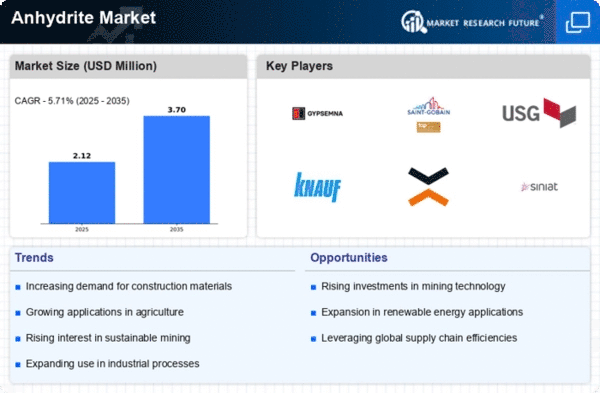
As per MRFR analysis, the Anhydrite Market Size was estimated at 2.01 USD Million in 2024. The Anhydrite industry is projected to grow from 2.12 in 2025 to 3.7 by 2035, exhibiting a compound annual growth rate (CAGR) of 5.71 during the forecast period 2025 - 2035.

Key Market Trends & Highlights

The Anhydrite Market is poised for growth driven by sustainable practices and technological advancements.

  • The North American region remains the largest market for anhydrite, primarily due to its robust construction sector.
  • Asia-Pacific is emerging as the fastest-growing region, fueled by rapid urbanization and infrastructure development.
  • The construction segment dominates the market, while the agriculture segment is witnessing the fastest growth in demand.
  • Key market drivers include rising demand in agriculture and significant growth in the construction sector.

Market Size & Forecast

2024 Market Size 2.01 (USD Million)
2035 Market Size 3.7 (USD Million)
CAGR (2025 - 2035) 5.71%
Largest Regional Market Share in 2024 North America

Major Players

<p>Gypsemna (AE), Knauf Gips (DE), Saint-Gobain (FR), USG Corporation (US), Etex Group (BE), Siniat (GB), Boral Limited (AU), LafargeHolcim (CH), National Gypsum Company (US)</p>

Market Trends

The Anhydrite Market is currently experiencing a dynamic phase characterized by evolving demand and supply dynamics. This mineral, primarily utilized in construction and agriculture, is witnessing a shift in application trends. The growing emphasis on sustainable building materials and agricultural practices appears to be driving interest in anhydrite as a viable alternative to traditional gypsum. Furthermore, the increasing urbanization and infrastructure development in various regions seem to bolster the market's growth potential, as anhydrite is favored for its properties that enhance the durability and strength of construction materials. In addition, the Anhydrite Market is likely to benefit from advancements in mining and processing technologies. These innovations may lead to more efficient extraction methods, thereby reducing production costs and enhancing product quality. Moreover, the rising awareness regarding the environmental impact of mining activities suggests that companies are increasingly adopting eco-friendly practices. This trend could potentially attract a broader customer base that prioritizes sustainability. Overall, the Anhydrite Market appears poised for growth, driven by a combination of technological advancements and shifting consumer preferences.

Sustainable Construction Practices

The Anhydrite Market is witnessing a notable shift towards sustainable construction practices. As builders and developers increasingly prioritize eco-friendly materials, anhydrite is emerging as a preferred choice due to its low environmental impact and beneficial properties.

Technological Advancements in Mining

Innovations in mining and processing technologies are transforming the Anhydrite Market. Enhanced extraction methods are likely to improve efficiency and reduce costs, making anhydrite more accessible to various industries.

Urbanization and Infrastructure Development

The ongoing urbanization and infrastructure projects across multiple regions are driving demand for anhydrite. Its application in construction materials is expected to grow, as it contributes to the strength and durability of structures.

Anhydrite Market Market Drivers

Agricultural Applications

The Global Anhydrite Market Industry benefits from its utilization in agriculture, particularly as a soil conditioner. Anhydrite Market improves soil structure and enhances nutrient availability, which is crucial for crop productivity. As global food demand rises, the agricultural sector increasingly adopts anhydrite to optimize yields. The incorporation of anhydrite in fertilizers is gaining traction, potentially leading to improved crop health and soil fertility. This trend aligns with the broader agricultural practices aimed at sustainable farming. The increasing awareness of soil health and productivity is likely to bolster the demand for anhydrite in the agricultural sector.

Rising Demand in Construction Sector

The Global Anhydrite Market Industry experiences a notable surge in demand driven by the construction sector. Anhydrite Market serves as a key component in the production of cement and gypsum-based products, which are essential for various construction applications. As urbanization accelerates globally, the need for infrastructure development increases, thereby propelling the consumption of anhydrite. In 2024, the market is projected to reach 0.24 billion USD, reflecting the growing reliance on anhydrite in construction materials. This trend is expected to continue, with the market anticipated to expand significantly as construction activities ramp up in emerging economies.

Technological Advancements in Mining

Technological innovations in mining processes significantly impact the Global Anhydrite Market Industry. Enhanced extraction techniques and processing technologies improve the efficiency and yield of anhydrite production. These advancements not only reduce operational costs but also minimize environmental impacts, making anhydrite more appealing to manufacturers. As companies adopt these technologies, the supply chain becomes more robust, ensuring a steady flow of anhydrite to meet rising global demand. The integration of automation and data analytics in mining operations is likely to further streamline production processes, contributing to market growth.

Growth in Global Population and Urbanization

The Global Anhydrite Market Industry is significantly impacted by the rapid growth of the global population and urbanization trends. As more people migrate to urban areas, the demand for housing and infrastructure escalates, leading to increased consumption of construction materials, including anhydrite. Projections indicate that by 2035, the market could expand to 4.02 billion USD, reflecting the correlation between urban development and anhydrite usage. This growth trajectory suggests a compound annual growth rate (CAGR) of 29.4% from 2025 to 2035, highlighting the critical role of anhydrite in meeting the needs of a burgeoning urban population.

Environmental Regulations Favoring Natural Minerals

The Global Anhydrite Market Industry is positively influenced by stringent environmental regulations that promote the use of natural minerals over synthetic alternatives. Anhydrite Market, being a naturally occurring mineral, aligns with the growing emphasis on sustainability and eco-friendly practices. Governments worldwide are increasingly implementing policies that encourage the use of natural resources in construction and agriculture. This shift not only supports the market for anhydrite but also positions it as a viable alternative to synthetic materials, which often have higher environmental footprints. The trend towards sustainability is expected to drive demand for anhydrite in various applications.

Market Segment Insights

By Application: Construction (Largest) vs. Agriculture (Fastest-Growing)

<p>In the Anhydrite Market, the application segment is notably dominated by construction, which encompasses various uses such as building materials and road construction. This sector's significant share illustrates its reliance on anhydrite for its properties that enhance durability and strength in construction applications. In contrast, agriculture emerges as a key growth area, leveraging anhydrite as a soil conditioner, which is increasingly recognized for improving soil structure and nutrient availability.</p>

<p>Construction (Dominant) vs. Agriculture (Emerging)</p>

<p>The construction segment is characterized by its vast utilization of anhydrite as a reliable material in the creation of concrete and other construction-related activities. Its dominance is attributed to the growing trends in construction and infrastructure development globally, where anhydrite's properties are leveraged to enhance the performance of construction materials. On the other hand, the agriculture segment is gaining momentum, propelled by increasing awareness of soil health and sustainable farming practices. This application is seen as emerging due to the rising demand for eco-friendly agricultural inputs, positioning anhydrite as a vital component for improving yields and soil quality.</p>

By End Use: Cement Production (Largest) vs. Fertilizers (Fastest-Growing)

<p>The Anhydrite Market exhibits a diverse distribution of end use segments, with Cement Production holding the dominant position due to its extensive application in construction. This segment encompasses a significant share of the overall market as an essential component in cement manufacturing processes, leveraging Anhydrite for its properties. Following closely, Soil Stabilization and Plaster utilize Anhydrite effectively, catering to specific industry needs; however, Fertilizers have recently emerged as a notable contender, growing rapidly within the sector.</p>

<p>Soil Stabilization (Dominant) vs. Plaster (Emerging)</p>

<p>Soil Stabilization has solidified its position as a dominant end-use segment in the Anhydrite Market, recognized for enhancing the engineering properties of soils, particularly in construction and infrastructural projects. The demand for effective stabilization techniques continues to fuel the growth of this segment. In contrast, Plaster is emerging as a compelling alternative, gaining traction for its application in interiors, providing aesthetic appeal and durability while utilizing Anhydrite to achieve desirable finishes, indicating a shift in consumer preferences toward innovative building solutions.</p>

By Form: Powder (Largest) vs. Granular (Fastest-Growing)

<p>In the Anhydrite Market, the Form segment is primarily divided into three key categories: Powder, Granular, and Pellets. Among these, Powder holds the largest market share due to its prevalent use in various industrial applications, such as agriculture and construction. Granular forms are also gaining traction, particularly as manufacturers seek to enhance the efficiency of their products. The Pellets form, while less dominant, holds niche applications and is gradually carving out a dedicated market space.</p>

<p>Powder (Dominant) vs. Granular (Emerging)</p>

<p>Powdered anhydrite is the dominant form in the market due to its versatility and ease of use across multiple applications, including soil conditioning and cement manufacturing. It provides excellent solubility and immediate availability for agricultural applications, making it a preferred choice. Conversely, Granular anhydrite is emerging as the fastest-growing segment, driven by its advantages in slow release and sustained nutrient availability. While it occupies a smaller market share currently, its tailored granule size for application efficiency is increasingly attracting interest among manufacturers and end-users alike, particularly in the agricultural sector.</p>

By Purity Level: High Purity (Largest) vs. Technical Grade (Fastest-Growing)

<p>The Anhydrite Market is segmented by purity level into three distinct categories: High Purity, Standard Purity, and Technical Grade. Currently, High Purity Anhydrite dominates the market due to its extensive applications in industries requiring stringent material specifications, such as pharmaceuticals and electronics. Standard Purity Anhydrite follows, being essential for various construction and industrial uses, while Technical Grade is emerging steadily, especially for niche applications.</p>

<p>High Purity (Dominant) vs. Technical Grade (Emerging)</p>

<p>High Purity Anhydrite is characterized by its superior properties, making it ideal for high-end applications where purity is critical. Its dominance in the market stems from the growing demand for high-performance materials in sectors like electronics, where even minuscule impurities can affect product quality. On the other hand, Technical Grade Anhydrite, categorized as an emerging player, offers a cost-effective alternative for various applications, particularly in construction and agriculture. As industries seek to balance quality and cost, Technical Grade is gaining traction, although it does not match the purity levels of its high-purity counterpart.</p>

By Source: Natural Anhydrite (Largest) vs. Synthetic Anhydrite (Fastest-Growing)

<p>In the Anhydrite Market, the distribution of market share between Natural Anhydrite and Synthetic Anhydrite reveals a significant preference for Natural Anhydrite, which holds a commanding lead. This natural variant is favored due to its availability and inherent qualities suitable for various applications. Conversely, Synthetic Anhydrite, while smaller in market share, is rapidly gaining traction due to innovations and shifts in consumer preferences, highlighting a diverse landscape within the segment.</p>

<p>Anhydrite Source: Natural (Dominant) vs. Synthetic (Emerging)</p>

<p>Natural Anhydrite dominates the Anhydrite Market, primarily sourced from natural deposits and recognized for its purity and quality, making it ideal for construction and agricultural applications. Its widespread usage contributes to its dominant status, as manufacturers rely heavily on this naturally occurring mineral. On the other hand, Synthetic Anhydrite is an emerging player that has quickly evolved due to advancements in production techniques. It offers distinct advantages, such as consistency and customization for specific industrial needs. As regulations tighten around natural resource extraction, Synthetic Anhydrite's role is expected to expand, appealing to environmentally-conscious consumers seeking sustainable alternatives.</p>

Get more detailed insights about Anhydrite Market Research Report - Forecast to 2035

Regional Insights

North America : Market Leader in Anhydrite

North America is poised to maintain its leadership in the anhydrite market, holding a significant market share of 0.8 in 2024. The region's growth is driven by robust construction activities, increasing demand for gypsum products, and favorable regulatory frameworks that promote sustainable building practices. The rising focus on energy-efficient materials further propels market expansion, making it a key player in the global landscape. The United States and Canada are the leading countries in this region, with major companies like USG Corporation and National Gypsum Company driving innovation and market growth. The competitive landscape is characterized by a mix of established players and emerging companies, all vying for market share. The presence of key players ensures a steady supply of high-quality anhydrite products, catering to diverse construction needs.

Europe : Growing Demand and Innovation

Europe's anhydrite market is experiencing significant growth, with a market size of 0.6 in 2024. The demand is fueled by increasing construction activities, particularly in residential and commercial sectors, alongside stringent regulations promoting sustainable building materials. The region's commitment to reducing carbon footprints and enhancing energy efficiency is a major catalyst for market expansion, driving innovation in product development. Leading countries such as Germany, France, and the UK are at the forefront of this growth, with key players like Knauf Gips and Saint-Gobain leading the charge. The competitive landscape is marked by a focus on technological advancements and sustainable practices, ensuring that European companies remain competitive in the global market. The presence of established firms fosters a robust supply chain, meeting the rising demand for anhydrite products.

Asia-Pacific : Emerging Market Potential

The Asia-Pacific region is emerging as a significant player in the anhydrite market, with a market size of 0.5 in 2024. Rapid urbanization, increasing infrastructure development, and a growing population are key drivers of demand. Additionally, government initiatives aimed at enhancing construction standards and promoting sustainable materials are catalyzing market growth, making this region a focal point for future investments in anhydrite production. Countries like China, India, and Australia are leading the charge, with a mix of local and international players competing for market share. Companies such as Boral Limited and LafargeHolcim are well-positioned to capitalize on the growing demand. The competitive landscape is evolving, with a focus on innovation and sustainability, ensuring that the region can meet the increasing needs of the construction industry.

Middle East and Africa : Untapped Market Opportunities

The Middle East and Africa region is witnessing a gradual increase in the anhydrite market, with a market size of 0.11 in 2024. The growth is primarily driven by ongoing infrastructure projects and urban development initiatives across various countries. Additionally, the region's focus on diversifying economies and enhancing construction capabilities is fostering demand for anhydrite products, presenting significant opportunities for market players. Countries such as the UAE and South Africa are leading the way in this emerging market, with key players like Gypsemna and Etex Group establishing a strong presence. The competitive landscape is characterized by a mix of local and international companies, all aiming to tap into the growing demand for construction materials. As the region continues to develop, the anhydrite market is expected to expand, driven by both public and private sector investments.

Key Players and Competitive Insights

The Anhydrite Market is characterized by a competitive landscape that is increasingly shaped by innovation, sustainability, and strategic partnerships. Key players such as Gypsemna (AE), Knauf Gips (DE), and Saint-Gobain (FR) are actively pursuing strategies that enhance their market positioning. Gypsemna (AE) focuses on expanding its product portfolio to include eco-friendly solutions, which aligns with the growing demand for sustainable building materials. Meanwhile, Knauf Gips (DE) emphasizes digital transformation, leveraging advanced technologies to optimize production processes and improve customer engagement. Saint-Gobain (FR) is also investing in regional expansion, particularly in emerging markets, to capitalize on the rising construction activities in those areas. Collectively, these strategies indicate a shift towards a more integrated and sustainable competitive environment.

In terms of business tactics, companies are increasingly localizing manufacturing to reduce transportation costs and enhance supply chain efficiency. The Anhydrite Market appears moderately fragmented, with several players vying for market share. However, the influence of major companies is significant, as they set industry standards and drive innovation. This competitive structure allows for a dynamic interplay between established firms and new entrants, fostering a climate of continuous improvement and adaptation.

In November 2025, Gypsemna (AE) announced a partnership with a local construction firm to develop a new line of sustainable anhydrite products. This collaboration is strategically important as it not only enhances Gypsemna's product offerings but also strengthens its foothold in the regional market, responding to the increasing demand for environmentally friendly construction materials.

In October 2025, Knauf Gips (DE) launched a new digital platform aimed at streamlining customer interactions and improving order processing efficiency. This initiative is likely to enhance customer satisfaction and loyalty, positioning Knauf Gips as a leader in customer-centric solutions within the market. The integration of digital tools into their operations suggests a forward-thinking approach that could redefine customer engagement in the industry.

In September 2025, Saint-Gobain (FR) completed the acquisition of a local anhydrite producer, which is expected to bolster its production capacity and market reach. This strategic move indicates a commitment to strengthening its supply chain and enhancing its competitive edge in the global market. The acquisition aligns with the broader trend of consolidation within the industry, as companies seek to optimize resources and expand their operational capabilities.

As of December 2025, the Anhydrite Market is witnessing trends that emphasize digitalization, sustainability, and the integration of AI technologies. Strategic alliances are becoming increasingly vital, as companies recognize the need to collaborate to enhance innovation and operational efficiency. The competitive differentiation is likely to evolve from traditional price-based competition to a focus on technological advancements, sustainable practices, and reliable supply chains. This shift suggests that companies that prioritize innovation and adaptability will be better positioned to thrive in the future.

Key Companies in the Anhydrite Market market include

Industry Developments

November 2021 – ScoZinc Mining Ltd. happily announced the establishment of a non-binding gypsum offtake agreement with a Nova Scotian end buyer for the life of mine supply of Gypsum from its permitted and 100% owned Scotia Mine situated in Nova Scotia, Canada.Mr. Mark Haywood, ScoZinc's CEO and President stated that the company is happy to bag a third and significant revenue stream opportunity for its Scotia Mine, which will be integrated into its future Pre-Feasibility Study update.

As stated in the news release of March 22, 2021, the addition of a Gypsum revenue stream is likely to enhance the previously strong economics of the Scotia Mine as defined by the company's 2020 Pre-Feasibility Study released on July 7, 2020.Gypsum is a soft sulfate mineral comprised of calcium sulfate dihydrate and is a type of evaporite mineral usually found in encrusted sedimentary deposits and dolomite, calcite, sulfur, anhydrite, and halite. The primary uses include the production of wallboard, soil conditioning, plaster of Paris, drywall cement, and a hardening retardant in Portland cement.

Geographical Analysis

The report covers brief analysis of the major geographic regions namely Asia Pacific, Europe, North America, Latin America, and the Middle East & Africa.

Intended Audience

    • Anhydrite Market manufacturers
    • Traders and Distributors of anhydrite market
    • Production process industries
    • Potential investors

Future Outlook

Anhydrite Market Future Outlook

<p>The Anhydrite Market is projected to grow at a 5.71% CAGR from 2024 to 2035, driven by increasing demand in construction and agriculture sectors.</p>

New opportunities lie in:

  • <p>Expansion into emerging markets with tailored product offerings.</p>
  • <p>Development of eco-friendly anhydrite-based construction materials.</p>
  • <p>Investment in advanced mining technologies to enhance production efficiency.</p>

<p>By 2035, the Anhydrite Market is expected to achieve robust growth, solidifying its position in global industries.</p>

Market Segmentation

Anhydrite Market Form Outlook

  • Powder
  • Granular
  • Pellets

Anhydrite Market Source Outlook

  • Natural Anhydrite
  • Synthetic Anhydrite

Anhydrite Market End Use Outlook

  • Cement Production
  • Soil Stabilization
  • Fertilizers
  • Plaster

Anhydrite Market Application Outlook

  • Construction
  • Agriculture
  • Industrial
  • Chemical Processing

Anhydrite Market Purity Level Outlook

  • High Purity
  • Standard Purity
  • Technical Grade

Report Scope

MARKET SIZE 20242.01(USD Million)
MARKET SIZE 20252.12(USD Million)
MARKET SIZE 20353.7(USD Million)
COMPOUND ANNUAL GROWTH RATE (CAGR)5.71% (2024 - 2035)
REPORT COVERAGERevenue Forecast, Competitive Landscape, Growth Factors, and Trends
BASE YEAR2024
Market Forecast Period2025 - 2035
Historical Data2019 - 2024
Market Forecast UnitsUSD Million
Key Companies ProfiledGypsemna (AE), Knauf Gips (DE), Saint-Gobain (FR), USG Corporation (US), Etex Group (BE), Siniat (GB), Boral Limited (AU), LafargeHolcim (CH), National Gypsum Company (US)
Segments CoveredApplication, End Use, Form, Purity Level, Source
Key Market OpportunitiesGrowing demand for sustainable construction materials enhances opportunities in the Anhydrite Market.
Key Market DynamicsRising demand for anhydrite in construction and agriculture drives market growth amid evolving regulatory frameworks.
Countries CoveredNorth America, Europe, APAC, South America, MEA

FAQs

What is the biggest driver of the global anhydrite market?

Cultivation of crops and the booming agriculture sector are two of the biggest drivers of the global anhydrite market.

Which is the best-performing region of the global anhydrite market?

The APAC is the largest region of the global anhydrite market due to rapid industrialization and urbanization.

Which is the second-best region for the global anhydrite market?

North America is the second-best region for the global anhydrite market owing to the growing use of fertilizers.

Who are the biggest players of the global anhydrite market?

Georgia-Pacific Gypsum LLC, Solvay, USG Corporation, Bisley &amp; Company Pty Ltd., NATIONAL GYPSUM PROPERTIES, LLC, Lafarge Holcim, Knauf Gips KG, BDH Gypsum, Quzhou Zunlong Trading Co., Ltd., ACG Materials, Mineralis Lucentum, Saint-Gobain SA, ANHYDRITEC, Vanich Gypsum Co. Ltd, and General Mining And Trading Co., Ltd are the most notable players of the global anhydrite market.

What are the strategies of players in the global anhydrite market?

Mergers and acquisitions are the biggest strategy followed by the global anhydrite market.

  1. Executive Summary
  2. Scope of the Report
    1. Market Definition
    2. Scope of the
      1. Research Objectives
      2. Assumptions & Limitations
    3. Study
    4. Markets Structure
    5. Market Research Methodology
    6. Research
    7. Process
    8. Secondary Research
    9. Primary Research
    10. Forecast Model
  3. Market Landscape
    1. Porter’s Five Forces Analysis
      1. Threat of New Entrants
      2. Bargaining Power of Buyers
      3. Threat of Substitutes
      4. Segment Rivalry
    2. Bargaining Power of Suppliers
    3. Value Chain/Supply Chain of Global Anhydrite Market
  4. Industry
    1. Overview of Global Anhydrite Market
    2. Introduction
    3. Growth Drivers
    4. Impact Analysis
    5. Market Challenges
  5. Market Trends
    1. Introduction
    2. Growth Trends
    3. Impact Analysis
    4. Global Anhydrite Market by Type
    5. Introduction
    6. Natural
      1. Market Estimates & Forecast,
      2. Market Estimates & Forecast by Region, 2020-2027
      3. Market Estimates & Forecast, 2020-2027
      4. Market Estimates & Forecast by Region, 2020-2027
    7. Synthetic
    8. Global Anhydrite Market by Application
    9. Introduction
    10. Soil treatment
      1. Market Estimates & Forecast,
      2. Market Estimates & Forecast by Region, 2020-2027
      3. Market Estimates & Forecast, 2020-2027
    11. Construction
    12. Market Estimates & Forecast by Region, 2020-2027
    13. Fertilizers
      1. Market Estimates & Forecast, 2020-2027
      2. Market Estimates &
    14. Forecast by Region, 2020-2027
    15. Industrial applications
      1. Market Estimates & Forecast, 2020-2027
    16. Market Estimates & Forecast by Region, 2020-2027
    17. Drying
      1. Market Estimates & Forecast, 2020-2027
      2. Market Estimates & Forecast by Region, 2020-2027
      3. Market Estimates & Forecast, 2020-2027
      4. Market Estimates & Forecast by Region, 2020-2027
    18. agents
    19. Others
    20. Global Anhydrite Market by Region
    21. Introduction
    22. North America
      1. Market Estimates & Forecast,
      2. Market Estimates & Forecast by Type, 2020-2027
      3. Canada
    23. Market Estimates & Forecast by Application, 2020-2027
    24. U.S.
    25. Market Estimates & Forecast by Type, 2020-2027
    26. & Forecast by Application, 2020-2027
    27. & Forecast by Type, 2020-2027
    28. Application, 2020-2027
    29. Europe
      1. Market
      2. Market Estimates & Forecast by
      3. Market Estimates & Forecast by Application, 2020-2027
      4. Germany
      5. Italy
      6. Spain
      7. U.K
      8. Poland
    30. Estimates & Forecast, 2020-2027
    31. Type, 2020-2027
    32. Market Estimates & Forecast by Application, 2020-2027
    33. France
    34. Market Estimates & Forecast by Type, 2020-2027
    35. & Forecast by Application, 2020-2027
    36. & Forecast by Type, 2020-2027
    37. Application, 2020-2027
    38. Estimates & Forecast, 2020-2027
    39. by Type, 2020-2027
    40. Forecast, 2020-2027
    41. Russia
    42. Market Estimates & Forecast by Type, 2020-2027
    43. & Forecast by Application, 2020-2027
    44. & Forecast by Type, 2020-2027
    45. by Application, 2020-2027
    46. Asia Pacific
      1. Market Estimates & Forecast
      2. Market Estimates & Forecast by Application, 2020-2027
      3. China
      4. Japan
      5. Australia
      6. New Zealand
      7. Rest of Asia Pacific
    47. Market Estimates & Forecast, 2020-2027
    48. by Type, 2020-2027
    49. Estimates & Forecast by Application, 2020-2027
    50. India
    51. Market Estimates & Forecast by Type, 2020-2027
    52. 9.4.4.3Market Estimates
    53. & Forecast by Application, 2020-2027
    54. & Forecast by Type, 2020-2027
    55. Application, 2020-2027
    56. Market Estimates & Forecast, 2020-2027
    57. by Type, 2020-2027
    58. & Forecast, 2020-2027
    59. & Forecast, 2020-2027
    60. Middle East & Africa
      1. Market Estimates
      2. Market Estimates & Forecast by Type, 2020-2027
      3. Market Estimates & Forecast by Application, 2020-2027
      4. Israel
      5. North Africa
      6. GCC
      7. Rest of Middle East & Africa
    61. & Forecast, 2020-2027
    62. Turkey
    63. Market Estimates & Forecast by Type, 2020-2027
    64. & Forecast by Application, 2020-2027
    65. & Forecast by Type, 2020-2027
    66. Application, 2020-2027
    67. & Forecast by Type, 2020-2027
    68. Application, 2020-2027
    69. Estimates & Forecast, 2020-2027
    70. by Type, 2020-2027
    71. & Forecast by Type, 2020-2027
    72. Application, 2020-2027
    73. Latin America
      1. Market Estimates & Forecast
      2. Market Estimates & Forecast by Application, 2020-2027
      3. Brazil
      4. Rest
    74. Market Estimates & Forecast, 2020-2027
    75. by Type, 2020-2027
    76. Forecast, 2020-2027
    77. Argentina
    78. Market Estimates & Forecast by Application, 2020-2027
    79. Mexico
    80. Market Estimates & Forecast by Type, 2020-2027
    81. & Forecast by Application, 2020-2027
    82. of Latin America
    83. Estimates & Forecast by Application, 2020-2027
  6. Company
    1. Landscape
  7. Company Profiles
    1. Solvay
    2. Type/Business Segment Overview
    3. Gypsum Co. Ltd
    4. Type/Business Segment Overview
    5. Mining and Trading Co., Ltd
    6. Type/Business Segment Overview
    7. Corporation
    8. Type/Business Segment Overview
    9. Holcim
    10. Segment Overview
    11. Key Developments
    12. Company Overview
    13. Overview
    14. Financial Updates
    15. Company Overview
    16. Overview
    17. Financial Updates
    18. ANHYDRITEC
    19. Type/Business Segment Overview
    20. Lucentum
    21. Type/Business Segment Overview
    22. Zunlong Trading Co., Ltd.
    23. Type/Business Segment Overview
    24. & Company Pty Ltd.
    25. Type/Business Segment Overview
    26. Segment Overview
    27. Key Developments
    28. Segment Overview
    29. Key Developments
  8. Company Overview
  9. Financial Updates
  10. Key Developments
    1. Vanich
      1. Company Overview
      2. Financial Updates
      3. Key Developments
    2. General
      1. Company Overview
      2. Financial Updates
      3. Key Developments
    3. USG
      1. Company Overview
      2. Financial Updates
      3. Key Developments
    4. Lafarge
      1. Company Overview
      2. Type/Business
      3. Financial Updates
    5. Knauf Gips KG
      1. Type/Business Segment Overview
      2. Financial Updates
      3. Key Developments
    6. Saint-Gobain SA
      1. Company
      2. Type/Business Segment Overview
      3. Key Developments
    7. NATIONAL GYPSUM PROPERTIES, LLC
      1. Type/Business Segment Overview
      2. Financial Updates
      3. Key Developments
    8. Georgia-Pacific Gypsum LLC
      1. Company
      2. Type/Business Segment Overview
      3. Key Developments
      4. Company Overview
      5. Financial Updates
      6. Key Developments
    9. Mineralis
      1. Company Overview
      2. Financial Updates
      3. Key Developments
    10. Quzhou
      1. Company Overview
      2. Financial Updates
      3. Key Developments
    11. Bisley
      1. Company Overview
      2. Financial Updates
      3. Key Developments
    12. BDH Gypsum
      1. Company Overview
      2. Type/Business
      3. Financial Updates
    13. ACG Materials
      1. Company Overview
      2. Type/Business
      3. Financial Updates
  11. Conclusion
  12. LIST OF TABLES
  13. World Population by Major Regions (2020 To 2030)
  14. Global Anhydrite Market: By Region, 2020-2027
  15. North America Anhydrite Market: By Country,
  16. Europe Anhydrite Market: By Country,
  17. Asia-Pacific Anhydrite Market: By
    1. Country, 2020-2027
  18. Middle East & Africa
    1. Anhydrite Market: By Country, 2020-2027
  19. Latin
    1. America Anhydrite Market: By Country, 2020-2027
    2. Table 8
    3. Global Anhydrite by Types Market: By Regions, 2020-2027
  20. North America Anhydrite by Types Market:
    1. By Country, 2020-2027
  21. Europe Anhydrite by
    1. Types Market: By Country, 2020-2027
    2. Table11 Asia-Pacific
    3. Anhydrite by Types Market: By Country, 2020-2027
    4. Table13
    5. Middle East & Africa Anhydrite by Types Market: By Country,
    6. Table12 Latin America Anhydrite by
    7. Types Market: By Country, 2020-2027
    8. Table14 North
    9. America Anhydrite for Application Market: By Country, 2020-2027
    10. Table13 Europe Anhydrite for Application Market: By Country,
    11. Table14 Asia-Pacific Anhydrite for
    12. Application Market: By Country, 2020-2027
    13. Table16 Middle
    14. East & Africa Anhydrite for Application Market: By Country, 2020-2027
    15. Table15 Latin America Anhydrite for Application
    16. Market: By Country, 2020-2027
    17. Table23 Global Types
    18. Market: By Region, 2020-2027
    19. Table24 Global Application
    20. Market: By Region, 2020-2027
    21. Table25 North America
  22. Anhydrite Market, By Country
    1. Table26 North America
  23. Anhydrite Market, By Types
    1. Table27 North America Anhydrite
  24. Market, By Application
    1. Table28 Europe: Anhydrite Market,
    2. By Country
  25. Table29 Europe: Anhydrite Market, By Types
  26. Table30 Europe: Anhydrite Market, By Application
  27. Table31 Asia-Pacific: Anhydrite Market, By Country
  28. Table32 Asia-Pacific: Anhydrite Market, By Types
  29. Table33 Asia-Pacific: Anhydrite Market, By Application
  30. Table36 Middle East & Africa: Anhydrite Market, By Country
    1. Table37 Middle East & Africa Anhydrite Market,
    2. By Types
    3. Table33 Middle East & Africa: Anhydrite
  31. Market, By Application
    1. Table34 Latin America: Anhydrite
  32. Market, By Country
    1. Table35 Latin America Anhydrite
  33. Market, By Types
    1. Table33 Latin America: Anhydrite
  34. Market, By Application
  35. LIST OF FIGURES
  36. Global
    1. Anhydrite Market segmentation
  37. Forecast Methodology
    1. FIGURE
  38. Porter’s Five Forces Analysis of Global Anhydrite Market
    1. FIGURE
  39. Value Chain of Global Anhydrite Market
  40. Share of Global
  41. Anhydrite Market in 2020, by country (in %)
  42. Global Anhydrite
    1. Market, 2020-2027,
  43. Sub segments of Type
    1. FIGURE 8
    2. Global Anhydrite Market size by Type, 2020
  44. Share of Global
    1. Anhydrite Market by Type, 2020 to 2027
  45. Sub segments of Application
  46. Global Anhydrite Market size by Application, 2020
    1. FIGURE
  47. Share of Global Anhydrite Market by Application, 2020 to 2027

Anhydrite Market Segmentation

Market Segmentation Overview

  • Detailed segmentation data will be available in the full report
  • Comprehensive analysis by multiple parameters
  • Regional and country-level breakdowns
  • Market size forecasts by segment
Infographic

Free Sample Request

Kindly complete the form below to receive a free sample of this Report

Get Free Sample

Customer Strories

Compare Licence

×
Features License Type
Single User Multiuser License Enterprise User
Price $4,950 $5,950 $7,250
Maximum User Access Limit 1 User Upto 10 Users Unrestricted Access Throughout the Organization
Free Customization
Direct Access to Analyst
Deliverable Format
Platform Access
Discount on Next Purchase 10% 15% 15%
Printable Versions