Request Free Sample ×

Kindly complete the form below to receive a free sample of this Report

* Please use a valid business email

Leading companies partner with us for data-driven Insights

clients tt-cursor
Hero Background
English
Chinese
French
Japanese
Korean
German
Spanish

Android STB TV Market Trends

ID: MRFR/SEM/8854-CR
190 Pages
Ankit Gupta
September 2020

Android STB and TV Market Size, Share and Research Report By Type (Android STB and Android TV), By Distribution Channel (Online and Offline/Retail), by Application (Residential and Commercial), And By Region (North America, Europe, Asia-Pacific, And Rest Of The World) –Industry Forecast Till 2035

Share:
Download PDF ×

We do not share your information with anyone. However, we may send you emails based on your report interest from time to time. You may contact us at any time to opt-out.

Android STB TV Market Infographic
Purchase Options

Market Trends

Key Emerging Trends in the Android STB TV Market

The Android Set-Top Box (STB) and TV market have been experiencing significant growth and evolution, driven by several key market trends. One of the prominent trends is the increasing adoption of streaming services and Over-the-Top (OTT) content consumption. With the rise of platforms like Netflix, Amazon Prime Video, and Disney+, consumers are moving away from traditional cable and satellite TV services towards on-demand streaming options. Android STBs and TVs offer access to a wide range of streaming apps and services through the Google Play Store, providing users with the flexibility to customize their entertainment experience and access content anytime, anywhere.

Moreover, the demand for smart home entertainment solutions and connected devices is driving the growth of the Android STB and TV market. Consumers are increasingly seeking integrated entertainment ecosystems that allow them to seamlessly access and control their favorite content across multiple devices. Android-powered STBs and TVs support features such as voice control, casting, screen mirroring, and smart home integration, enabling users to enjoy a personalized and immersive entertainment experience. Additionally, the integration of virtual assistants like Google Assistant and Amazon Alexa enhances the usability and convenience of Android STBs and TVs, enabling hands-free control and access to information and services.

Furthermore, the proliferation of high-resolution content formats such as 4K Ultra HD, HDR (High Dynamic Range), and Dolby Atmos audio is driving the demand for Android STBs and TVs capable of delivering superior picture and sound quality. Android-powered devices support advanced video and audio codecs, ensuring compatibility with the latest content formats and standards. This trend is particularly evident in the gaming and home theater segments, where consumers are seeking immersive and cinematic experiences. Android STBs and TVs with powerful processors, dedicated graphics capabilities, and support for gaming controllers cater to this growing demand for high-quality entertainment experiences.

Additionally, the convergence of traditional linear TV and online video content is reshaping the Android STB and TV market. Broadcasters and pay-TV operators are increasingly embracing IP-based delivery mechanisms and hybrid broadcast-OTT models to reach audiences across multiple platforms and devices. Android-powered STBs and TVs support features such as live TV integration, Electronic Program Guides (EPGs), and catch-up TV services, providing consumers with a seamless transition between linear and on-demand content. This convergence trend is driving the adoption of Android STBs and TVs as the preferred platform for accessing both traditional and online video content.

Moreover, the growing penetration of high-speed broadband internet and the rollout of 5G networks are fueling the demand for Android STBs and TVs with advanced connectivity features. With faster internet speeds and lower latency, consumers can stream high-definition and 4K content seamlessly on their Android-powered devices without buffering or interruptions. Additionally, the availability of Wi-Fi 6 and Ethernet connectivity options ensures reliable and stable connections, even in bandwidth-constrained environments. As streaming becomes the dominant mode of content consumption, Android STBs and TVs are well-positioned to capitalize on this trend by offering a wide range of content options and superior viewing experiences.


Author
Author Profile
Ankit Gupta
Team Lead - Research

Ankit Gupta is a seasoned market intelligence and strategic research professional with over six plus years of experience in the ICT and Semiconductor industries. With academic roots in Telecom, Marketing, and Electronics, he blends technical insight with business strategy. Ankit has led 200+ projects, including work for Fortune 500 clients like Microsoft and Rio Tinto, covering market sizing, tech forecasting, and go-to-market strategies. Known for bridging engineering and enterprise decision-making, his insights support growth, innovation, and investment planning across diverse technology markets.

Leave a Comment

FAQs

What is the projected market valuation for the Android STB and TV Market in 2035?

<p>The projected market valuation for the Android STB and TV Market in 2035 is 293.54 USD Billion.</p>

What was the overall market valuation of the Android STB and TV Market in 2024?

<p>The overall market valuation of the Android STB and TV Market in 2024 was 83.38 USD Billion.</p>

What is the expected CAGR for the Android STB and TV Market from 2025 to 2035?

<p>The expected CAGR for the Android STB and TV Market during the forecast period 2025 - 2035 is 12.12%.</p>

Which companies are considered key players in the Android STB and TV Market?

<p>Key players in the Android STB and TV Market include Google, Amazon, Roku, Samsung, Sony, Xiaomi, Nvidia, LG Electronics, and TCL.</p>

What are the projected revenues for Android STB and Android TV segments by 2035?

<p>By 2035, the projected revenues for the Android STB and Android TV segments are 140.0 USD Billion and 153.54 USD Billion, respectively.</p>

How do online and offline distribution channels compare in the Android STB and TV Market?

<p>In 2035, online distribution is projected to generate 118.54 USD Billion, while offline/retail channels are expected to reach 175.0 USD Billion.</p>

What is the revenue outlook for residential and commercial applications in the Android STB and TV Market?

By 2035, residential applications are projected to generate 180.0 USD Billion, while commercial applications are expected to reach 113.54 USD Billion.

How has the Android STB and TV Market evolved since 2024?

Since 2024, the Android STB and TV Market has shown substantial growth, with a valuation increase from 83.38 USD Billion to a projected 293.54 USD Billion by 2035.

What factors contribute to the growth of the Android STB and TV Market?

Factors contributing to the growth of the Android STB and TV Market include increasing consumer demand for smart TVs and advancements in streaming technology.

What segment is expected to dominate the Android STB and TV Market by 2035?

By 2035, the Android TV segment is expected to dominate the market, with projected revenues of 153.54 USD Billion.

Market Summary

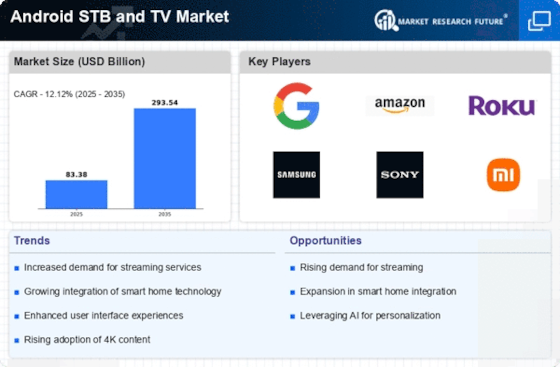
As per Market Research Future analysis, the Android STB and TV Market Size was estimated at 83.38 USD Billion in 2024. The Android STB and TV industry is projected to grow from 93.49 USD Billion in 2025 to 293.54 USD Billion by 2035, exhibiting a compound annual growth rate (CAGR) of 12.12% during the forecast period 2025 - 2035

Key Market Trends & Highlights

The Android STB and TV market is experiencing robust growth driven by technological advancements and changing consumer preferences.

  • The integration with smart home devices is becoming increasingly prevalent in North America, enhancing user convenience. Enhanced user experience remains a focal point, particularly in the Android STB segment, which continues to dominate the market. The rise of streaming services is particularly notable in the Asia-Pacific region, contributing to the rapid growth of Android TV offerings. Technological advancements in display quality and the growing demand for smart home integration are key drivers propelling market expansion.

Market Size & Forecast

2024 Market Size 83.38 (USD Billion)
2035 Market Size 293.54 (USD Billion)
CAGR (2025 - 2035) 12.12%
Largest Regional Market Share in 2024 North America

Major Players

Google (US), Amazon (US), Roku (US), Samsung (KR), Sony (JP), Xiaomi (CN), Nvidia (US), LG Electronics (KR), TCL (CN)

Market Trends

The Android STB and TV Market is currently experiencing a dynamic evolution, driven by advancements in technology and shifting consumer preferences. The proliferation of streaming services has led to an increased demand for devices that can seamlessly integrate with various platforms. As a result, manufacturers are focusing on enhancing user experience through improved interfaces and faster processing capabilities. This trend indicates a growing emphasis on providing consumers with a more personalized viewing experience, which may further stimulate market growth. Moreover, the rise of smart home ecosystems appears to be influencing the Android STB and TV Market significantly. Consumers are increasingly seeking devices that can connect and interact with other smart home products. This interconnectedness not only enhances convenience but also fosters a more integrated lifestyle. Consequently, manufacturers are likely to prioritize compatibility with a range of smart devices, which could reshape product offerings in the near future. Overall, the Android STB and TV Market seems poised for continued expansion as it adapts to the evolving landscape of consumer technology and preferences.

Integration with Smart Home Devices

The Android STB and TV Market is witnessing a trend towards greater integration with smart home technologies. Consumers are increasingly interested in devices that can communicate with other smart appliances, enhancing convenience and functionality. This trend suggests that manufacturers may focus on developing products that seamlessly connect with various smart home ecosystems.

Enhanced User Experience

There is a notable emphasis on improving user experience within the Android STB and TV Market. Companies are investing in advanced interfaces and faster processing speeds to provide consumers with a more intuitive and engaging viewing experience. This focus on user-centric design indicates a potential shift in how products are developed and marketed.

Rise of Streaming Services

The proliferation of streaming services is significantly impacting the Android STB and TV Market. As more consumers turn to on-demand content, there is a growing demand for devices that support multiple streaming platforms. This trend may lead manufacturers to prioritize compatibility and ease of access to various content providers.

Android STB TV Market Market Drivers

Expansion of Content Streaming Services

The Android STB and TV Market is witnessing a surge in the expansion of content streaming services, which has transformed how consumers access entertainment. With the proliferation of platforms such as Netflix, Hulu, and Amazon Prime Video, there is a growing expectation for devices that can deliver high-quality streaming experiences. Recent statistics indicate that over 70% of households subscribe to at least one streaming service, driving demand for STBs and smart TVs that can efficiently support these platforms. This trend compels manufacturers to enhance their devices' capabilities, ensuring they can handle high bandwidth and provide seamless user experiences. As a result, the Android STB and TV Market is likely to see continued growth, as consumers increasingly prioritize devices that offer diverse content options and superior streaming performance.

Shift Towards Subscription-Based Models

The Android STB and TV Market is experiencing a shift towards subscription-based models, which is reshaping consumer purchasing behavior. As traditional cable subscriptions decline, more consumers are opting for subscription services that offer flexibility and a wide range of content. This trend is evident in the increasing number of consumers who prefer to pay for on-demand content rather than committing to long-term contracts. Data shows that subscription video on demand (SVOD) services are expected to grow by approximately 15% annually, indicating a robust market opportunity for Android STB and TV manufacturers. This shift encourages companies to innovate their offerings, providing features that cater to the subscription model, such as user-friendly interfaces and personalized content recommendations, thereby enhancing the overall consumer experience.

Growing Demand for Smart Home Integration

The Android STB and TV Market is significantly influenced by the increasing demand for smart home integration. As households adopt smart devices, the need for seamless connectivity between televisions and other smart home products becomes paramount. This trend is reflected in the rising sales of smart TVs and STBs that offer compatibility with various smart home ecosystems. Data suggests that nearly 60% of consumers are interested in devices that can be controlled via voice commands or mobile applications. This integration not only enhances user convenience but also positions Android STB and TV products as central hubs in smart home environments. Consequently, manufacturers are focusing on developing devices that support multiple smart home protocols, thereby expanding their market reach and appealing to a broader audience.

Rising Consumer Preference for Customization

The Android STB and TV Market is significantly impacted by the rising consumer preference for customization in entertainment options. As viewers seek personalized experiences, manufacturers are increasingly focusing on developing devices that allow users to tailor their content and interface according to individual preferences. This trend is supported by data indicating that nearly 65% of consumers express a desire for customizable features in their viewing devices. The ability to curate content, create personalized profiles, and receive tailored recommendations enhances user satisfaction and engagement. Consequently, manufacturers are investing in software development and user interface design to meet these demands, positioning themselves competitively within the Android STB and TV Market. This focus on customization not only attracts a diverse consumer base but also fosters brand loyalty as users find value in personalized viewing experiences.

Technological Advancements in Display Quality

The Android STB and TV Market is experiencing a notable shift due to advancements in display technologies such as 4K and 8K resolution. These innovations enhance the viewing experience, making it more immersive and visually appealing. As consumers increasingly seek high-definition content, manufacturers are compelled to integrate these technologies into their products. The proliferation of OLED and QLED displays further elevates the competition among brands, driving innovation and consumer interest. According to recent data, the demand for high-resolution displays is projected to grow by over 20% annually, indicating a robust market potential. This trend not only influences consumer purchasing decisions but also shapes the overall landscape of the Android STB and TV Market, as companies strive to meet the evolving expectations of tech-savvy audiences.

Market Segment Insights

By Type: Android STB (Largest) vs. Android TV (Fastest-Growing)

In the Android STB and TV market, the segmentation reveals that Android STBs hold a significant market share, underscoring their status as the dominant player in this sector. These devices appeal to a wide range of consumers due to their compatibility with various applications and services, solidifying their position in households globally. In contrast, Android TVs, while smaller in market share compared to STBs, are rapidly gaining traction among users looking for integrated systems that combine television viewing with smart functionality.

Device Type: Android STB (Dominant) vs. Android TV (Emerging)

Android STBs are established as the dominant type in the market, providing users with robust features like streaming services, gaming, and user-friendly interfaces that enhance the viewing experience. Their extensive compatibility with various TV brands and models allows for versatile application across households. On the other hand, Android TVs are emerging in popularity, catering to tech-savvy consumers seeking an all-in-one solution. Functioning both as a television and a smart device, Android TVs are experiencing a surge in demand, driven by their evolving features and seamless integration with other smart home devices. As more consumers prioritize smart technology, the appeal of Android TVs is expected to grow significantly.

By Distribution Channel: Online (Largest) vs. Offline/Retail (Fastest-Growing)

The distribution channels for the Android STB and TV market are increasingly polarized between online and offline/retail avenues. Online channels currently dominate this segment, driven by the convenience of e-commerce platforms which allow consumers to compare products and read reviews easily. This channel has seen substantial investments in digital marketing by manufacturers, resulting in a significant market share that outpaces traditional retail channels. In contrast, offline/retail channels are experiencing a resurgence as consumers value the tactile experience and instant gratification of purchasing devices in-store. Retailers are innovating by creating engaging in-store experiences that combine technology with shopping, attracting consumers who prefer to make informed, hands-on purchases. This channel is also growing rapidly, fueled by the resurgence of interest in personal interactions and the immediate availability of products.

Online (Dominant) vs. Offline/Retail (Emerging)

The Online distribution channel in the Android STB and TV market stands as the dominant player, capitalizing on consumers' inclination towards digital shopping. Online platforms provide vast product ranges, competitive pricing, and detailed product information, making them an appealing choice for tech-savvy buyers. The rise of e-commerce giants and specialized electronics retailers enhances this channel's market position, ensuring consumers have access to the latest technologies at the click of a button. Meanwhile, the Offline/Retail segment is emerging as a strong competitor, driven by a growing number of consumers who prefer the immediacy and personal touch of in-store experiences. Retailers are focusing on experiences and personalized services that prove to be effective differentiation strategies to attract this segment of customers.

By Application: Residential (Largest) vs. Commercial (Fastest-Growing)

In the Android STB and TV market, the residential segment holds the largest share, driven by increasing consumer demand for home entertainment solutions and smart home integration. With the rise of streaming services and high-definition content, residential applications are at the forefront, catering to diverse viewer preferences and enhancing user experiences within the comfort of their homes. In contrast, the commercial segment is rapidly gaining traction due to growing adoption in hospitality, retail, and corporate sectors, where interactive displays and customized content solutions are becoming essential for engaging customers and enhancing brand experiences. The growth drivers for the application segment are rooted in technological advancements and evolving consumer behaviors. The shift towards smart TVs and set-top boxes equipped with Android platforms mirrors the increasing inclination for on-demand content access. Moreover, commercial users are investing in advanced solutions that bolster viewer engagement, sustainability, and operational efficiency. As businesses recognize the value of interactive technologies, the commercial segment's growth is anticipated to accelerate, positioning it as a key player in diversifying the Android STB and TV market landscape.

Application: Residential (Dominant) vs. Commercial (Emerging)

The residential segment stands as the dominant player in the Android STB and TV market, characterized by a wide adoption of smart TVs and set-top boxes that cater to a growing demand for streaming content and interconnected home environments. This segment thrives on innovations such as voice recognition, integrated apps, and personalized user experiences. In comparison, the commercial segment represents an emerging force, focusing on customized solutions that address specific industry needs, such as digital signage and interactive content delivery. As businesses increasingly leverage technology to improve customer engagement, the commercial application is set to evolve significantly, creating new opportunities for service providers who can offer tailored solutions that resonate with diverse commercial objectives.

Get more detailed insights about Android STB and TV Market Research Report - Global Forecast till 2035

Regional Insights

North America : Digital Entertainment Leader

North America is the largest market for Android STB and TV, holding approximately 45% of the global market share. The region's growth is driven by high consumer demand for streaming services, advancements in broadband infrastructure, and increasing adoption of smart TVs. Regulatory support for digital content distribution further fuels this growth, making it a vibrant hub for innovation in the entertainment sector. The competitive landscape is characterized by major players such as Google, Amazon, and Roku, which dominate the market with their advanced technologies and extensive content libraries. The presence of these key players, along with a growing number of startups, fosters a dynamic environment that encourages continuous improvement and consumer engagement. The U.S. remains the leading country, followed by Canada, which also shows significant growth in the adoption of Android-based devices.

Europe : Emerging Market for Streaming

Europe is witnessing rapid growth in the Android STB and TV market, accounting for approximately 30% of the global share. The region's demand is driven by increasing internet penetration, a shift towards on-demand content, and favorable regulations promoting digital innovation. Countries like Germany and the UK are leading this growth, supported by government initiatives aimed at enhancing digital infrastructure and consumer access to streaming services. The competitive landscape in Europe features key players such as Samsung, Sony, and LG Electronics, which are investing heavily in smart TV technologies. The presence of local manufacturers like Philips and emerging brands like Xiaomi also contributes to a diverse market. The region's regulatory framework encourages competition and innovation, ensuring a robust environment for both established and new entrants in the Android STB and TV space.

Asia-Pacific : Rapidly Growing Market

Asia-Pacific is an emerging powerhouse in the Android STB and TV market, holding around 20% of the global market share. The region's growth is propelled by rising disposable incomes, increasing smartphone penetration, and a growing appetite for digital content. Countries like China and India are at the forefront, with government initiatives aimed at expanding broadband access and promoting digital literacy, further driving demand for smart devices. The competitive landscape is marked by the presence of major players such as Xiaomi and TCL, which are rapidly gaining market share through affordable pricing and innovative features. Additionally, local brands are increasingly entering the market, intensifying competition. The region's diverse consumer base and varying preferences create opportunities for tailored solutions, making it a vibrant market for Android STB and TV products.

Middle East and Africa : Emerging Digital Frontier

The Middle East and Africa represent a resource-rich frontier for the Android STB and TV market, holding about 5% of the global share. The region's growth is driven by increasing internet connectivity, a young population eager for digital content, and investments in telecommunications infrastructure. Countries like South Africa and the UAE are leading the charge, with government initiatives aimed at enhancing digital access and promoting local content production. The competitive landscape is evolving, with both The Android STB and TV share. Companies like LG Electronics and Samsung are establishing a presence, while local startups are emerging to cater to specific consumer needs. The region's unique cultural diversity presents opportunities for customized content and services, making it an attractive market for Android STB and TV solutions.

Key Players and Competitive Insights

Leading market players invested heavily in research and Development (R&D) to scale up their manufacturing units and develop technologically advanced solutions, which will help the Android STB and TV market grow worldwide. Market participants are also undertaking various organic or inorganic strategic approaches to strengthen and expand their global footprint, with significant market developments including new product portfolios, contractual deals, mergers and acquisitions, capital expenditure, higher investments, and strategic alliances with other organizations. Businesses are also coming up with marketing strategies such as digital marketing, social media influencing, and content marketing to increase their scope of profit earnings.

The Android STB and TV industry must offer cost-effective and sustainable options to survive in a highly fragmented and dynamic market climate.

Manufacturing locally to minimize operational expenses and offer aftermarket services to customers is one of the critical business strategies organizations use in the global Android STB and TV industry to benefit customers and capture untapped market share and revenue. The Android STB and TV industry has recently offered significant advantages to the Information technology industry. Moreover, more industry participants are utilizing and adopting cutting-edge Technology has grown substantially.

Major players in the Android STB and TV market, including Arris International, Evolution Digital, Humax, Kaon Media Co Ltd, Nvidia Corporation, Sagemcom, Xiaomi Inc., Hisense, Sharp Corporation, Toshiba Corporation, Haier Inc., Vu Televisions, and Hitachi Ltd, are attempting to expand market share and demand by investing in R&D operations to produce sustainable and affordable solutions.

Evolution Digital is a global leader in providing various integrated video devices and whole-home Wi-Fi services.

In June Evolution Digital announced Evolution Device Manager (eDM), an online software-as-a-service solution that enables operators to deploy their eSTREAM 4K devices. It offers operators a hosted platform for managing, administering, and controlling their eSTREAM 4K equipment outdoors, enabling them to concentrate on other duties.

Irdeto is the global leader in web-based cybersecurity, enabling companies to develop ideas for a more secure and connected future. Irdeto announced a collaboration with Amlogic and Skyworth Digital in November 2019 to launch an inexpensive Android-powered combination set-top box.

Key Companies in the Android STB TV Market include

Industry Developments

ZTE and Telecab unveiled their B866V2FA set-top-box with Android TV™ support in March 2024, targeting HD-quality brands. Being able to offer third-party streaming apps and integrate the telecast pay TV business, this joint venture came out as a solution to this problem.

In January 2024, Tata Sky introduced India’s first 4K set-top-box, which will give access to ultra-HD 4K picture clarity of upcoming cricket matches both for existing and new subscribers. The box displays SD and HD channels alongside the 4K content.

In April 2024, Vereinigte Stadtwerke launched its own IPTV service, VS Media IPTV, in partnership with Zattoo. This service offered more than 130 TV channels, with some available in foreign languages that could be accessed through STBs and mobile devices.

Bouygues Telecom, a French company launched Bbox 4K HDR in March 2022. The new product launched is expected to be the main attraction since it can be connected to modern Wi-Fi. It should also have been expected that small LCD screen displayers would allow you to watch up to 100 hours of programming recorded from the cloud.

In June 2020, Evolution Digital released the Evolution Device Manager (eDM), a web-based software-as-a-service designed to enable operators to easily deploy their eSTREAM 4K devices. This platform provides an operator with a hosted environment that efficiently manages, administers, and controls their eSTREAM 4K devices remotely, thus allowing them time to focus on other duties.

GTPL Hathway Limited (GTPL), one of India’s leading digital cable TV and broadband services providers, unveiled the GTPL Genie set-top-box, which is Hybrid Android. This innovative device enables customers to watch Live TV & OTT channels at a very attractive bulk price. In addition, The GTPL Genie combines traditional cable TV reliability with modern features, providing a customizable environment that brings OTT entertainment apps together to provide extensive content diversity. Thus, the GTPL Genie now compliments your existing television screens with popular OTT content as well as traditional channels for only Connection Dil Se offers.

Future Outlook

Android STB TV Market Future Outlook

The Android STB and TV Market is projected to grow at a 12.12% CAGR from 2025 to 2035, driven by increasing consumer demand for <a href="https://www.marketresearchfuture.com/reports/diy-smart-home-market-2844">smart home</a> integration and enhanced streaming services.

New opportunities lie in:

  • Development of AI-driven content recommendation systems
  • Expansion into emerging markets with localized content
  • Partnerships with telecom providers for bundled service offerings

By 2035, the market is expected to be robust, driven by innovation and strategic partnerships.

Market Segmentation

Android STB TV Market Type Outlook

  • Android STB
  • Android TV

Android STB TV Market Application Outlook

  • Residential
  • Commercial

Android STB TV Market Distribution Channel Outlook

  • Online
  • Offline/Retail

Report Scope

MARKET SIZE 2024 83.38(USD Billion)
MARKET SIZE 2025 93.49(USD Billion)
MARKET SIZE 2035 293.54(USD Billion)
COMPOUND ANNUAL GROWTH RATE (CAGR) 12.12% (2025 - 2035)
REPORT COVERAGE Revenue Forecast, Competitive Landscape, Growth Factors, and Trends
BASE YEAR 2024
Market Forecast Period 2025 - 2035
Historical Data 2019 - 2024
Market Forecast Units USD Billion
Key Companies Profiled Google (US), Amazon (US), Roku (US), Samsung (KR), Sony (JP), Xiaomi (CN), Nvidia (US), LG Electronics (KR), TCL (CN)
Segments Covered Type, Distribution Channel, Application, Region
Key Market Opportunities Integration of advanced streaming services and smart home compatibility in the Android STB and TV Market.
Key Market Dynamics Rising consumer demand for smart features drives innovation in Android Set-Top Boxes and television technology.
Countries Covered North America, Europe, APAC, South America, MEA

FAQs

What is the projected market valuation for the Android STB and TV Market in 2035?

<p>The projected market valuation for the Android STB and TV Market in 2035 is 293.54 USD Billion.</p>

What was the overall market valuation of the Android STB and TV Market in 2024?

<p>The overall market valuation of the Android STB and TV Market in 2024 was 83.38 USD Billion.</p>

What is the expected CAGR for the Android STB and TV Market from 2025 to 2035?

<p>The expected CAGR for the Android STB and TV Market during the forecast period 2025 - 2035 is 12.12%.</p>

Which companies are considered key players in the Android STB and TV Market?

<p>Key players in the Android STB and TV Market include Google, Amazon, Roku, Samsung, Sony, Xiaomi, Nvidia, LG Electronics, and TCL.</p>

What are the projected revenues for Android STB and Android TV segments by 2035?

<p>By 2035, the projected revenues for the Android STB and Android TV segments are 140.0 USD Billion and 153.54 USD Billion, respectively.</p>

How do online and offline distribution channels compare in the Android STB and TV Market?

<p>In 2035, online distribution is projected to generate 118.54 USD Billion, while offline/retail channels are expected to reach 175.0 USD Billion.</p>

What is the revenue outlook for residential and commercial applications in the Android STB and TV Market?

By 2035, residential applications are projected to generate 180.0 USD Billion, while commercial applications are expected to reach 113.54 USD Billion.

How has the Android STB and TV Market evolved since 2024?

Since 2024, the Android STB and TV Market has shown substantial growth, with a valuation increase from 83.38 USD Billion to a projected 293.54 USD Billion by 2035.

What factors contribute to the growth of the Android STB and TV Market?

Factors contributing to the growth of the Android STB and TV Market include increasing consumer demand for smart TVs and advancements in streaming technology.

What segment is expected to dominate the Android STB and TV Market by 2035?

By 2035, the Android TV segment is expected to dominate the market, with projected revenues of 153.54 USD Billion.

  1. SECTION I: EXECUTIVE SUMMARY AND KEY HIGHLIGHTS
    1. | 1.1 EXECUTIVE SUMMARY
    2. | | 1.1.1 Market Overview
    3. | | 1.1.2 Key Findings
    4. | | 1.1.3 Market Segmentation
    5. | | 1.1.4 Competitive Landscape
    6. | | 1.1.5 Challenges and Opportunities
    7. | | 1.1.6 Future Outlook
  2. SECTION II: SCOPING, METHODOLOGY AND MARKET STRUCTURE
    1. | 2.1 MARKET INTRODUCTION
    2. | | 2.1.1 Definition
    3. | | 2.1.2 Scope of the study
    4. | | | 2.1.2.1 Research Objective
    5. | | | 2.1.2.2 Assumption
    6. | | | 2.1.2.3 Limitations
    7. | 2.2 RESEARCH METHODOLOGY
    8. | | 2.2.1 Overview
    9. | | 2.2.2 Data Mining
    10. | | 2.2.3 Secondary Research
    11. | | 2.2.4 Primary Research
    12. | | | 2.2.4.1 Primary Interviews and Information Gathering Process
    13. | | | 2.2.4.2 Breakdown of Primary Respondents
    14. | | 2.2.5 Forecasting Model
    15. | | 2.2.6 Market Size Estimation
    16. | | | 2.2.6.1 Bottom-Up Approach
    17. | | | 2.2.6.2 Top-Down Approach
    18. | | 2.2.7 Data Triangulation
    19. | | 2.2.8 Validation
  3. SECTION III: QUALITATIVE ANALYSIS
    1. | 3.1 MARKET DYNAMICS
    2. | | 3.1.1 Overview
    3. | | 3.1.2 Drivers
    4. | | 3.1.3 Restraints
    5. | | 3.1.4 Opportunities
    6. | 3.2 MARKET FACTOR ANALYSIS
    7. | | 3.2.1 Value chain Analysis
    8. | | 3.2.2 Porter's Five Forces Analysis
    9. | | | 3.2.2.1 Bargaining Power of Suppliers
    10. | | | 3.2.2.2 Bargaining Power of Buyers
    11. | | | 3.2.2.3 Threat of New Entrants
    12. | | | 3.2.2.4 Threat of Substitutes
    13. | | | 3.2.2.5 Intensity of Rivalry
    14. | | 3.2.3 COVID-19 Impact Analysis
    15. | | | 3.2.3.1 Market Impact Analysis
    16. | | | 3.2.3.2 Regional Impact
    17. | | | 3.2.3.3 Opportunity and Threat Analysis
  4. SECTION IV: QUANTITATIVE ANALYSIS
    1. | 4.1 Semiconductor & Electronics, BY Type (USD Billion)
    2. | | 4.1.1 Android STB
    3. | | 4.1.2 Android TV
    4. | 4.2 Semiconductor & Electronics, BY Distribution Channel (USD Billion)
    5. | | 4.2.1 Online
    6. | | 4.2.2 Offline/Retail
    7. | 4.3 Semiconductor & Electronics, BY Application (USD Billion)
    8. | | 4.3.1 Residential
    9. | | 4.3.2 Commercial
    10. | 4.4 Semiconductor & Electronics, BY Region (USD Billion)
    11. | | 4.4.1 North America
    12. | | | 4.4.1.1 US
    13. | | | 4.4.1.2 Canada
    14. | | 4.4.2 Europe
    15. | | | 4.4.2.1 Germany
    16. | | | 4.4.2.2 UK
    17. | | | 4.4.2.3 France
    18. | | | 4.4.2.4 Russia
    19. | | | 4.4.2.5 Italy
    20. | | | 4.4.2.6 Spain
    21. | | | 4.4.2.7 Rest of Europe
    22. | | 4.4.3 APAC
    23. | | | 4.4.3.1 China
    24. | | | 4.4.3.2 India
    25. | | | 4.4.3.3 Japan
    26. | | | 4.4.3.4 South Korea
    27. | | | 4.4.3.5 Malaysia
    28. | | | 4.4.3.6 Thailand
    29. | | | 4.4.3.7 Indonesia
    30. | | | 4.4.3.8 Rest of APAC
    31. | | 4.4.4 South America
    32. | | | 4.4.4.1 Brazil
    33. | | | 4.4.4.2 Mexico
    34. | | | 4.4.4.3 Argentina
    35. | | | 4.4.4.4 Rest of South America
    36. | | 4.4.5 MEA
    37. | | | 4.4.5.1 GCC Countries
    38. | | | 4.4.5.2 South Africa
    39. | | | 4.4.5.3 Rest of MEA
  5. SECTION V: COMPETITIVE ANALYSIS
    1. | 5.1 Competitive Landscape
    2. | | 5.1.1 Overview
    3. | | 5.1.2 Competitive Analysis
    4. | | 5.1.3 Market share Analysis
    5. | | 5.1.4 Major Growth Strategy in the Semiconductor & Electronics
    6. | | 5.1.5 Competitive Benchmarking
    7. | | 5.1.6 Leading Players in Terms of Number of Developments in the Semiconductor & Electronics
    8. | | 5.1.7 Key developments and growth strategies
    9. | | | 5.1.7.1 New Product Launch/Service Deployment
    10. | | | 5.1.7.2 Merger & Acquisitions
    11. | | | 5.1.7.3 Joint Ventures
    12. | | 5.1.8 Major Players Financial Matrix
    13. | | | 5.1.8.1 Sales and Operating Income
    14. | | | 5.1.8.2 Major Players R&D Expenditure. 2023
    15. | 5.2 Company Profiles
    16. | | 5.2.1 Google (US)
    17. | | | 5.2.1.1 Financial Overview
    18. | | | 5.2.1.2 Products Offered
    19. | | | 5.2.1.3 Key Developments
    20. | | | 5.2.1.4 SWOT Analysis
    21. | | | 5.2.1.5 Key Strategies
    22. | | 5.2.2 Amazon (US)
    23. | | | 5.2.2.1 Financial Overview
    24. | | | 5.2.2.2 Products Offered
    25. | | | 5.2.2.3 Key Developments
    26. | | | 5.2.2.4 SWOT Analysis
    27. | | | 5.2.2.5 Key Strategies
    28. | | 5.2.3 Roku (US)
    29. | | | 5.2.3.1 Financial Overview
    30. | | | 5.2.3.2 Products Offered
    31. | | | 5.2.3.3 Key Developments
    32. | | | 5.2.3.4 SWOT Analysis
    33. | | | 5.2.3.5 Key Strategies
    34. | | 5.2.4 Samsung (KR)
    35. | | | 5.2.4.1 Financial Overview
    36. | | | 5.2.4.2 Products Offered
    37. | | | 5.2.4.3 Key Developments
    38. | | | 5.2.4.4 SWOT Analysis
    39. | | | 5.2.4.5 Key Strategies
    40. | | 5.2.5 Sony (JP)
    41. | | | 5.2.5.1 Financial Overview
    42. | | | 5.2.5.2 Products Offered
    43. | | | 5.2.5.3 Key Developments
    44. | | | 5.2.5.4 SWOT Analysis
    45. | | | 5.2.5.5 Key Strategies
    46. | | 5.2.6 Xiaomi (CN)
    47. | | | 5.2.6.1 Financial Overview
    48. | | | 5.2.6.2 Products Offered
    49. | | | 5.2.6.3 Key Developments
    50. | | | 5.2.6.4 SWOT Analysis
    51. | | | 5.2.6.5 Key Strategies
    52. | | 5.2.7 Nvidia (US)
    53. | | | 5.2.7.1 Financial Overview
    54. | | | 5.2.7.2 Products Offered
    55. | | | 5.2.7.3 Key Developments
    56. | | | 5.2.7.4 SWOT Analysis
    57. | | | 5.2.7.5 Key Strategies
    58. | | 5.2.8 LG Electronics (KR)
    59. | | | 5.2.8.1 Financial Overview
    60. | | | 5.2.8.2 Products Offered
    61. | | | 5.2.8.3 Key Developments
    62. | | | 5.2.8.4 SWOT Analysis
    63. | | | 5.2.8.5 Key Strategies
    64. | | 5.2.9 TCL (CN)
    65. | | | 5.2.9.1 Financial Overview
    66. | | | 5.2.9.2 Products Offered
    67. | | | 5.2.9.3 Key Developments
    68. | | | 5.2.9.4 SWOT Analysis
    69. | | | 5.2.9.5 Key Strategies
    70. | 5.3 Appendix
    71. | | 5.3.1 References
    72. | | 5.3.2 Related Reports
  6. LIST OF FIGURES
    1. | 6.1 MARKET SYNOPSIS
    2. | 6.2 NORTH AMERICA MARKET ANALYSIS
    3. | 6.3 US MARKET ANALYSIS BY TYPE
    4. | 6.4 US MARKET ANALYSIS BY DISTRIBUTION CHANNEL
    5. | 6.5 US MARKET ANALYSIS BY APPLICATION
    6. | 6.6 CANADA MARKET ANALYSIS BY TYPE
    7. | 6.7 CANADA MARKET ANALYSIS BY DISTRIBUTION CHANNEL
    8. | 6.8 CANADA MARKET ANALYSIS BY APPLICATION
    9. | 6.9 EUROPE MARKET ANALYSIS
    10. | 6.10 GERMANY MARKET ANALYSIS BY TYPE
    11. | 6.11 GERMANY MARKET ANALYSIS BY DISTRIBUTION CHANNEL
    12. | 6.12 GERMANY MARKET ANALYSIS BY APPLICATION
    13. | 6.13 UK MARKET ANALYSIS BY TYPE
    14. | 6.14 UK MARKET ANALYSIS BY DISTRIBUTION CHANNEL
    15. | 6.15 UK MARKET ANALYSIS BY APPLICATION
    16. | 6.16 FRANCE MARKET ANALYSIS BY TYPE
    17. | 6.17 FRANCE MARKET ANALYSIS BY DISTRIBUTION CHANNEL
    18. | 6.18 FRANCE MARKET ANALYSIS BY APPLICATION
    19. | 6.19 RUSSIA MARKET ANALYSIS BY TYPE
    20. | 6.20 RUSSIA MARKET ANALYSIS BY DISTRIBUTION CHANNEL
    21. | 6.21 RUSSIA MARKET ANALYSIS BY APPLICATION
    22. | 6.22 ITALY MARKET ANALYSIS BY TYPE
    23. | 6.23 ITALY MARKET ANALYSIS BY DISTRIBUTION CHANNEL
    24. | 6.24 ITALY MARKET ANALYSIS BY APPLICATION
    25. | 6.25 SPAIN MARKET ANALYSIS BY TYPE
    26. | 6.26 SPAIN MARKET ANALYSIS BY DISTRIBUTION CHANNEL
    27. | 6.27 SPAIN MARKET ANALYSIS BY APPLICATION
    28. | 6.28 REST OF EUROPE MARKET ANALYSIS BY TYPE
    29. | 6.29 REST OF EUROPE MARKET ANALYSIS BY DISTRIBUTION CHANNEL
    30. | 6.30 REST OF EUROPE MARKET ANALYSIS BY APPLICATION
    31. | 6.31 APAC MARKET ANALYSIS
    32. | 6.32 CHINA MARKET ANALYSIS BY TYPE
    33. | 6.33 CHINA MARKET ANALYSIS BY DISTRIBUTION CHANNEL
    34. | 6.34 CHINA MARKET ANALYSIS BY APPLICATION
    35. | 6.35 INDIA MARKET ANALYSIS BY TYPE
    36. | 6.36 INDIA MARKET ANALYSIS BY DISTRIBUTION CHANNEL
    37. | 6.37 INDIA MARKET ANALYSIS BY APPLICATION
    38. | 6.38 JAPAN MARKET ANALYSIS BY TYPE
    39. | 6.39 JAPAN MARKET ANALYSIS BY DISTRIBUTION CHANNEL
    40. | 6.40 JAPAN MARKET ANALYSIS BY APPLICATION
    41. | 6.41 SOUTH KOREA MARKET ANALYSIS BY TYPE
    42. | 6.42 SOUTH KOREA MARKET ANALYSIS BY DISTRIBUTION CHANNEL
    43. | 6.43 SOUTH KOREA MARKET ANALYSIS BY APPLICATION
    44. | 6.44 MALAYSIA MARKET ANALYSIS BY TYPE
    45. | 6.45 MALAYSIA MARKET ANALYSIS BY DISTRIBUTION CHANNEL
    46. | 6.46 MALAYSIA MARKET ANALYSIS BY APPLICATION
    47. | 6.47 THAILAND MARKET ANALYSIS BY TYPE
    48. | 6.48 THAILAND MARKET ANALYSIS BY DISTRIBUTION CHANNEL
    49. | 6.49 THAILAND MARKET ANALYSIS BY APPLICATION
    50. | 6.50 INDONESIA MARKET ANALYSIS BY TYPE
    51. | 6.51 INDONESIA MARKET ANALYSIS BY DISTRIBUTION CHANNEL
    52. | 6.52 INDONESIA MARKET ANALYSIS BY APPLICATION
    53. | 6.53 REST OF APAC MARKET ANALYSIS BY TYPE
    54. | 6.54 REST OF APAC MARKET ANALYSIS BY DISTRIBUTION CHANNEL
    55. | 6.55 REST OF APAC MARKET ANALYSIS BY APPLICATION
    56. | 6.56 SOUTH AMERICA MARKET ANALYSIS
    57. | 6.57 BRAZIL MARKET ANALYSIS BY TYPE
    58. | 6.58 BRAZIL MARKET ANALYSIS BY DISTRIBUTION CHANNEL
    59. | 6.59 BRAZIL MARKET ANALYSIS BY APPLICATION
    60. | 6.60 MEXICO MARKET ANALYSIS BY TYPE
    61. | 6.61 MEXICO MARKET ANALYSIS BY DISTRIBUTION CHANNEL
    62. | 6.62 MEXICO MARKET ANALYSIS BY APPLICATION
    63. | 6.63 ARGENTINA MARKET ANALYSIS BY TYPE
    64. | 6.64 ARGENTINA MARKET ANALYSIS BY DISTRIBUTION CHANNEL
    65. | 6.65 ARGENTINA MARKET ANALYSIS BY APPLICATION
    66. | 6.66 REST OF SOUTH AMERICA MARKET ANALYSIS BY TYPE
    67. | 6.67 REST OF SOUTH AMERICA MARKET ANALYSIS BY DISTRIBUTION CHANNEL
    68. | 6.68 REST OF SOUTH AMERICA MARKET ANALYSIS BY APPLICATION
    69. | 6.69 MEA MARKET ANALYSIS
    70. | 6.70 GCC COUNTRIES MARKET ANALYSIS BY TYPE
    71. | 6.71 GCC COUNTRIES MARKET ANALYSIS BY DISTRIBUTION CHANNEL
    72. | 6.72 GCC COUNTRIES MARKET ANALYSIS BY APPLICATION
    73. | 6.73 SOUTH AFRICA MARKET ANALYSIS BY TYPE
    74. | 6.74 SOUTH AFRICA MARKET ANALYSIS BY DISTRIBUTION CHANNEL
    75. | 6.75 SOUTH AFRICA MARKET ANALYSIS BY APPLICATION
    76. | 6.76 REST OF MEA MARKET ANALYSIS BY TYPE
    77. | 6.77 REST OF MEA MARKET ANALYSIS BY DISTRIBUTION CHANNEL
    78. | 6.78 REST OF MEA MARKET ANALYSIS BY APPLICATION
    79. | 6.79 KEY BUYING CRITERIA OF SEMICONDUCTOR & ELECTRONICS
    80. | 6.80 RESEARCH PROCESS OF MRFR
    81. | 6.81 DRO ANALYSIS OF SEMICONDUCTOR & ELECTRONICS
    82. | 6.82 DRIVERS IMPACT ANALYSIS: SEMICONDUCTOR & ELECTRONICS
    83. | 6.83 RESTRAINTS IMPACT ANALYSIS: SEMICONDUCTOR & ELECTRONICS
    84. | 6.84 SUPPLY / VALUE CHAIN: SEMICONDUCTOR & ELECTRONICS
    85. | 6.85 SEMICONDUCTOR & ELECTRONICS, BY TYPE, 2024 (% SHARE)
    86. | 6.86 SEMICONDUCTOR & ELECTRONICS, BY TYPE, 2024 TO 2035 (USD Billion)
    87. | 6.87 SEMICONDUCTOR & ELECTRONICS, BY DISTRIBUTION CHANNEL, 2024 (% SHARE)
    88. | 6.88 SEMICONDUCTOR & ELECTRONICS, BY DISTRIBUTION CHANNEL, 2024 TO 2035 (USD Billion)
    89. | 6.89 SEMICONDUCTOR & ELECTRONICS, BY APPLICATION, 2024 (% SHARE)
    90. | 6.90 SEMICONDUCTOR & ELECTRONICS, BY APPLICATION, 2024 TO 2035 (USD Billion)
    91. | 6.91 BENCHMARKING OF MAJOR COMPETITORS
  7. LIST OF TABLES
    1. | 7.1 LIST OF ASSUMPTIONS
    2. | | 7.1.1
    3. | 7.2 North America MARKET SIZE ESTIMATES; FORECAST
    4. | | 7.2.1 BY TYPE, 2025-2035 (USD Billion)
    5. | | 7.2.2 BY DISTRIBUTION CHANNEL, 2025-2035 (USD Billion)
    6. | | 7.2.3 BY APPLICATION, 2025-2035 (USD Billion)
    7. | 7.3 US MARKET SIZE ESTIMATES; FORECAST
    8. | | 7.3.1 BY TYPE, 2025-2035 (USD Billion)
    9. | | 7.3.2 BY DISTRIBUTION CHANNEL, 2025-2035 (USD Billion)
    10. | | 7.3.3 BY APPLICATION, 2025-2035 (USD Billion)
    11. | 7.4 Canada MARKET SIZE ESTIMATES; FORECAST
    12. | | 7.4.1 BY TYPE, 2025-2035 (USD Billion)
    13. | | 7.4.2 BY DISTRIBUTION CHANNEL, 2025-2035 (USD Billion)
    14. | | 7.4.3 BY APPLICATION, 2025-2035 (USD Billion)
    15. | 7.5 Europe MARKET SIZE ESTIMATES; FORECAST
    16. | | 7.5.1 BY TYPE, 2025-2035 (USD Billion)
    17. | | 7.5.2 BY DISTRIBUTION CHANNEL, 2025-2035 (USD Billion)
    18. | | 7.5.3 BY APPLICATION, 2025-2035 (USD Billion)
    19. | 7.6 Germany MARKET SIZE ESTIMATES; FORECAST
    20. | | 7.6.1 BY TYPE, 2025-2035 (USD Billion)
    21. | | 7.6.2 BY DISTRIBUTION CHANNEL, 2025-2035 (USD Billion)
    22. | | 7.6.3 BY APPLICATION, 2025-2035 (USD Billion)
    23. | 7.7 UK MARKET SIZE ESTIMATES; FORECAST
    24. | | 7.7.1 BY TYPE, 2025-2035 (USD Billion)
    25. | | 7.7.2 BY DISTRIBUTION CHANNEL, 2025-2035 (USD Billion)
    26. | | 7.7.3 BY APPLICATION, 2025-2035 (USD Billion)
    27. | 7.8 France MARKET SIZE ESTIMATES; FORECAST
    28. | | 7.8.1 BY TYPE, 2025-2035 (USD Billion)
    29. | | 7.8.2 BY DISTRIBUTION CHANNEL, 2025-2035 (USD Billion)
    30. | | 7.8.3 BY APPLICATION, 2025-2035 (USD Billion)
    31. | 7.9 Russia MARKET SIZE ESTIMATES; FORECAST
    32. | | 7.9.1 BY TYPE, 2025-2035 (USD Billion)
    33. | | 7.9.2 BY DISTRIBUTION CHANNEL, 2025-2035 (USD Billion)
    34. | | 7.9.3 BY APPLICATION, 2025-2035 (USD Billion)
    35. | 7.10 Italy MARKET SIZE ESTIMATES; FORECAST
    36. | | 7.10.1 BY TYPE, 2025-2035 (USD Billion)
    37. | | 7.10.2 BY DISTRIBUTION CHANNEL, 2025-2035 (USD Billion)
    38. | | 7.10.3 BY APPLICATION, 2025-2035 (USD Billion)
    39. | 7.11 Spain MARKET SIZE ESTIMATES; FORECAST
    40. | | 7.11.1 BY TYPE, 2025-2035 (USD Billion)
    41. | | 7.11.2 BY DISTRIBUTION CHANNEL, 2025-2035 (USD Billion)
    42. | | 7.11.3 BY APPLICATION, 2025-2035 (USD Billion)
    43. | 7.12 Rest of Europe MARKET SIZE ESTIMATES; FORECAST
    44. | | 7.12.1 BY TYPE, 2025-2035 (USD Billion)
    45. | | 7.12.2 BY DISTRIBUTION CHANNEL, 2025-2035 (USD Billion)
    46. | | 7.12.3 BY APPLICATION, 2025-2035 (USD Billion)
    47. | 7.13 APAC MARKET SIZE ESTIMATES; FORECAST
    48. | | 7.13.1 BY TYPE, 2025-2035 (USD Billion)
    49. | | 7.13.2 BY DISTRIBUTION CHANNEL, 2025-2035 (USD Billion)
    50. | | 7.13.3 BY APPLICATION, 2025-2035 (USD Billion)
    51. | 7.14 China MARKET SIZE ESTIMATES; FORECAST
    52. | | 7.14.1 BY TYPE, 2025-2035 (USD Billion)
    53. | | 7.14.2 BY DISTRIBUTION CHANNEL, 2025-2035 (USD Billion)
    54. | | 7.14.3 BY APPLICATION, 2025-2035 (USD Billion)
    55. | 7.15 India MARKET SIZE ESTIMATES; FORECAST
    56. | | 7.15.1 BY TYPE, 2025-2035 (USD Billion)
    57. | | 7.15.2 BY DISTRIBUTION CHANNEL, 2025-2035 (USD Billion)
    58. | | 7.15.3 BY APPLICATION, 2025-2035 (USD Billion)
    59. | 7.16 Japan MARKET SIZE ESTIMATES; FORECAST
    60. | | 7.16.1 BY TYPE, 2025-2035 (USD Billion)
    61. | | 7.16.2 BY DISTRIBUTION CHANNEL, 2025-2035 (USD Billion)
    62. | | 7.16.3 BY APPLICATION, 2025-2035 (USD Billion)
    63. | 7.17 South Korea MARKET SIZE ESTIMATES; FORECAST
    64. | | 7.17.1 BY TYPE, 2025-2035 (USD Billion)
    65. | | 7.17.2 BY DISTRIBUTION CHANNEL, 2025-2035 (USD Billion)
    66. | | 7.17.3 BY APPLICATION, 2025-2035 (USD Billion)
    67. | 7.18 Malaysia MARKET SIZE ESTIMATES; FORECAST
    68. | | 7.18.1 BY TYPE, 2025-2035 (USD Billion)
    69. | | 7.18.2 BY DISTRIBUTION CHANNEL, 2025-2035 (USD Billion)
    70. | | 7.18.3 BY APPLICATION, 2025-2035 (USD Billion)
    71. | 7.19 Thailand MARKET SIZE ESTIMATES; FORECAST
    72. | | 7.19.1 BY TYPE, 2025-2035 (USD Billion)
    73. | | 7.19.2 BY DISTRIBUTION CHANNEL, 2025-2035 (USD Billion)
    74. | | 7.19.3 BY APPLICATION, 2025-2035 (USD Billion)
    75. | 7.20 Indonesia MARKET SIZE ESTIMATES; FORECAST
    76. | | 7.20.1 BY TYPE, 2025-2035 (USD Billion)
    77. | | 7.20.2 BY DISTRIBUTION CHANNEL, 2025-2035 (USD Billion)
    78. | | 7.20.3 BY APPLICATION, 2025-2035 (USD Billion)
    79. | 7.21 Rest of APAC MARKET SIZE ESTIMATES; FORECAST
    80. | | 7.21.1 BY TYPE, 2025-2035 (USD Billion)
    81. | | 7.21.2 BY DISTRIBUTION CHANNEL, 2025-2035 (USD Billion)
    82. | | 7.21.3 BY APPLICATION, 2025-2035 (USD Billion)
    83. | 7.22 South America MARKET SIZE ESTIMATES; FORECAST
    84. | | 7.22.1 BY TYPE, 2025-2035 (USD Billion)
    85. | | 7.22.2 BY DISTRIBUTION CHANNEL, 2025-2035 (USD Billion)
    86. | | 7.22.3 BY APPLICATION, 2025-2035 (USD Billion)
    87. | 7.23 Brazil MARKET SIZE ESTIMATES; FORECAST
    88. | | 7.23.1 BY TYPE, 2025-2035 (USD Billion)
    89. | | 7.23.2 BY DISTRIBUTION CHANNEL, 2025-2035 (USD Billion)
    90. | | 7.23.3 BY APPLICATION, 2025-2035 (USD Billion)
    91. | 7.24 Mexico MARKET SIZE ESTIMATES; FORECAST
    92. | | 7.24.1 BY TYPE, 2025-2035 (USD Billion)
    93. | | 7.24.2 BY DISTRIBUTION CHANNEL, 2025-2035 (USD Billion)
    94. | | 7.24.3 BY APPLICATION, 2025-2035 (USD Billion)
    95. | 7.25 Argentina MARKET SIZE ESTIMATES; FORECAST
    96. | | 7.25.1 BY TYPE, 2025-2035 (USD Billion)
    97. | | 7.25.2 BY DISTRIBUTION CHANNEL, 2025-2035 (USD Billion)
    98. | | 7.25.3 BY APPLICATION, 2025-2035 (USD Billion)
    99. | 7.26 Rest of South America MARKET SIZE ESTIMATES; FORECAST
    100. | | 7.26.1 BY TYPE, 2025-2035 (USD Billion)
    101. | | 7.26.2 BY DISTRIBUTION CHANNEL, 2025-2035 (USD Billion)
    102. | | 7.26.3 BY APPLICATION, 2025-2035 (USD Billion)
    103. | 7.27 MEA MARKET SIZE ESTIMATES; FORECAST
    104. | | 7.27.1 BY TYPE, 2025-2035 (USD Billion)
    105. | | 7.27.2 BY DISTRIBUTION CHANNEL, 2025-2035 (USD Billion)
    106. | | 7.27.3 BY APPLICATION, 2025-2035 (USD Billion)
    107. | 7.28 GCC Countries MARKET SIZE ESTIMATES; FORECAST
    108. | | 7.28.1 BY TYPE, 2025-2035 (USD Billion)
    109. | | 7.28.2 BY DISTRIBUTION CHANNEL, 2025-2035 (USD Billion)
    110. | | 7.28.3 BY APPLICATION, 2025-2035 (USD Billion)
    111. | 7.29 South Africa MARKET SIZE ESTIMATES; FORECAST
    112. | | 7.29.1 BY TYPE, 2025-2035 (USD Billion)
    113. | | 7.29.2 BY DISTRIBUTION CHANNEL, 2025-2035 (USD Billion)
    114. | | 7.29.3 BY APPLICATION, 2025-2035 (USD Billion)
    115. | 7.30 Rest of MEA MARKET SIZE ESTIMATES; FORECAST
    116. | | 7.30.1 BY TYPE, 2025-2035 (USD Billion)
    117. | | 7.30.2 BY DISTRIBUTION CHANNEL, 2025-2035 (USD Billion)
    118. | | 7.30.3 BY APPLICATION, 2025-2035 (USD Billion)
    119. | 7.31 PRODUCT LAUNCH/PRODUCT DEVELOPMENT/APPROVAL
    120. | | 7.31.1
    121. | 7.32 ACQUISITION/PARTNERSHIP
    122. | | 7.32.1

Semiconductor & Electronics Market Segmentation

Semiconductor & Electronics By Type (USD Billion, 2025-2035)

  • Android STB
  • Android TV

Semiconductor & Electronics By Distribution Channel (USD Billion, 2025-2035)

  • Online
  • Offline/Retail

Semiconductor & Electronics By Application (USD Billion, 2025-2035)

  • Residential
  • Commercial
Infographic

Free Sample Request

Kindly complete the form below to receive a free sample of this Report

Get Free Sample

Customer Strories

Compare Licence

×
Features License Type
Single User Multiuser License Enterprise User
Price $4,950 $5,950 $7,250
Maximum User Access Limit 1 User Upto 10 Users Unrestricted Access Throughout the Organization
Free Customization
Direct Access to Analyst
Deliverable Format
Platform Access
Discount on Next Purchase 10% 15% 15%
Printable Versions