×
Request Free Sample ×

Kindly complete the form below to receive a free sample of this Report

* Please use a valid business email

Leading companies partner with us for data-driven Insights

clients tt-cursor
Hero Background
English
Chinese
French
Japanese
Korean
German
Spanish

Ammonium Phosphate Market Size

ID: MRFR/CnM/4235-HCR
140 Pages
Chitranshi Jaiswal
October 2025

Ammonium Phosphate Market Research Report By Type (Mono-Ammonium Phosphate (MAP), Di-Ammonium Phosphate (DAP), Ammonium Polyphosphate), Application (Fertilizer, Animal Feed, Flame-Retardant, Water Treatment, Food & Beverages and others) and Region (Asia-Pacific, Latin America, North America, Europe and Middle East & Africa) - Forecast till 2035

Share:
Download PDF ×

We do not share your information with anyone. However, we may send you emails based on your report interest from time to time. You may contact us at any time to opt-out.

Ammonium Phosphate Market Infographic
×
Ammonium Phosphate Market Infographic Full View
Purchase Options

Ammonium Phosphate Size

Ammonium Phosphate Market Growth Projections and Opportunities

The Ammonium Phosphate market is influenced by a myriad of market factors that collectively shape its dynamics. One of the primary drivers is the ever-growing demand for fertilizers in the agriculture sector. Ammonium Phosphate, being a crucial component in many fertilizers, experiences a direct correlation with the global agricultural industry. As the global population continues to rise, the need for increased food production becomes imperative, leading to higher demand for fertilizers and, consequently, ammonium phosphate.

Moreover, government policies and regulations play a pivotal role in shaping the market landscape. Environmental concerns and the push towards sustainable agricultural practices have led to stricter regulations regarding the use and production of fertilizers. The Ammonium Phosphate market is thus influenced by compliance with these regulations, prompting manufacturers to invest in more environmentally friendly production methods and formulations.

Market factors are also significantly affected by geopolitical events and trade policies. The availability and pricing of raw materials, such as phosphoric acid and ammonia, are subject to geopolitical tensions and trade agreements. Fluctuations in the prices of these raw materials directly impact the production cost of ammonium phosphate, subsequently influencing its market pricing and competitiveness.

Technological advancements contribute to the evolution of the Ammonium Phosphate market. Innovations in production processes, such as the development of more efficient and sustainable methods, enhance the overall market efficiency. Additionally, advancements in agricultural technology and practices impact the demand for ammonium phosphate, as modern farming techniques often require specialized fertilizers to maximize yield and minimize environmental impact.

Market trends in consumer preferences and awareness of sustainable practices also play a role in shaping the Ammonium Phosphate market. With a growing emphasis on organic and sustainable farming, there is an increasing demand for eco-friendly fertilizers, impacting the market dynamics. Consumer awareness regarding the environmental impact of chemical fertilizers has led to a shift towards products that have a lower ecological footprint.

The global economy and currency exchange rates are crucial external factors that affect the Ammonium Phosphate market. Fluctuations in currency values can impact the cost of imports and exports, influencing the competitiveness of market players in different regions. Economic growth or recession can also impact overall consumer spending, subsequently affecting the demand for agricultural products and, by extension, ammonium phosphate.

Furthermore, the competitive landscape within the Ammonium Phosphate market is shaped by factors such as mergers and acquisitions, product developments, and strategic partnerships. Companies within the industry continuously strive to gain a competitive edge through these initiatives, impacting market concentration and influencing pricing dynamics.

The Ammonium Phosphate market is a complex and dynamic system influenced by a multitude of factors. From agricultural demands and environmental regulations to geopolitical events and technological advancements, these market factors collectively contribute to shaping the present and future trajectory of the Ammonium Phosphate market. Stakeholders in the industry must remain vigilant and adaptive to navigate these factors successfully and sustainably.

Ammonium Phosphate Market Size Graph
Author
Chitranshi Jaiswal
Research Analyst Level I

In her 3 years of experience in the market research field, she has handled critical cross-domain projects. She has an in-depth knowledge of market estimation & analysis, problem-solving, primary as well as secondary research, and team management.She holds an engineering degree and is an MBA professional from a well-known university, capable of evaluating the market and competitive conditions. An exceptional strategist with excellent communication skills and a passion for delivering cutting-edge & practical insights for the market. Proficient in multi-tasking, and can successfully deal with competing demands, while maintaining complete confidentiality. Generated business through active client and project development, networking, and high-quality responses. Her knowledge and skills have helped in making solid business decisions, securing funding from investors, and avoiding business failures.

Leave a Comment

FAQs

At what CAGR is the ammonium phosphate market expected to grow over the forecast period?

The ammonium phosphate market is predicted to grow at a 3.65% CAGR between 2025-2035.

Which region is predicted to dominate the ammonium phosphate market?

The APAC region is predicted to dominate the ammonium phosphate market during the forecast period.

What are the key factors driving the ammonium phosphate market?

Demand for water treatment, need for better yield, and technical advances in fertilizer formulations are boosting market growth.

Which factors may act as deterrents in the ammonium phosphate market?

Toxic effects of overfertilization may deter market growth.

What are the different applications of ammonium phosphate?

It has wide applications in food and beverage, water treatment, flame-retardant, animal feed, and fertilizers.

Market Summary

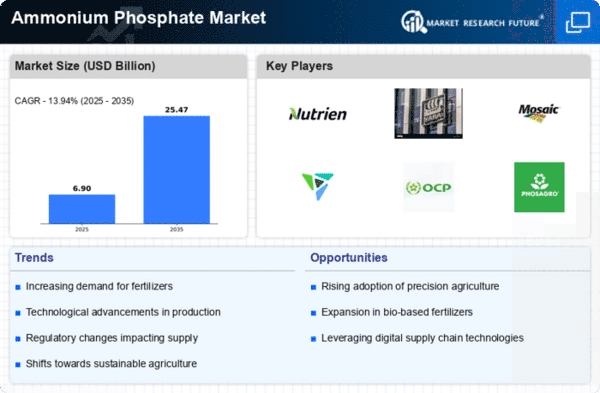
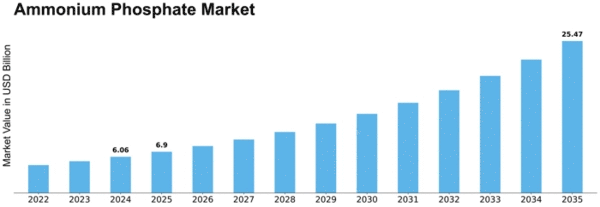
As per MRFR analysis, the Ammonium Phosphate Market Size was estimated at 6.06 USD Billion in 2024. The Ammonium Phosphate industry is projected to grow from 6.91 USD Billion in 2025 to 25.47 USD Billion by 2035, exhibiting a compound annual growth rate (CAGR) of 13.94 during the forecast period 2025 - 2035.

Key Market Trends & Highlights

The Ammonium Phosphate Market is poised for growth driven by sustainable practices and technological advancements.

  • North America remains the largest market for ammonium phosphate, driven by robust agricultural practices.
  • The Asia-Pacific region is experiencing rapid growth, fueled by increasing agricultural productivity and food security initiatives.
  • The fertilizers segment dominates the market, while the food additives segment is emerging as the fastest-growing area.
  • Rising demand for fertilizers and government initiatives supporting sustainable agriculture are key drivers of market expansion.

Market Size & Forecast

2024 Market Size 6.06 (USD Billion)
2035 Market Size 25.47 (USD Billion)
CAGR (2025 - 2035) 13.94%
Largest Regional Market Share in 2024 Asia-Pacific

Major Players

Nutrien Ltd (CA), Yara International ASA (NO), The Mosaic Company (US), CF Industries Holdings, Inc. (US), OCP Group (MA), PhosAgro (RU), EuroChem Group AG (CH), ICL Group Ltd (IL), K+S AG (DE)

Market Trends

The Ammonium Phosphate Market is currently experiencing a dynamic phase characterized by evolving demand patterns and innovative applications. This market, primarily driven by the agricultural sector, is witnessing a shift towards more sustainable practices. As farmers increasingly seek efficient fertilizers to enhance crop yields while minimizing environmental impact, the focus on ammonium phosphate as a key nutrient source appears to be intensifying. Furthermore, the growing trend of precision agriculture is likely to influence the market, as technology enables more targeted application of fertilizers, thereby optimizing resource use and improving productivity. In addition to agricultural applications, the Ammonium Phosphate Market is also seeing interest from various industrial sectors. The compound is utilized in the production of detergents, food additives, and flame retardants, among other products. This diversification of applications suggests a potential for growth beyond traditional uses. Moreover, the increasing emphasis on food security and sustainable farming practices may further bolster the market's expansion in the coming years, as stakeholders seek to balance productivity with ecological considerations. Overall, the Ammonium Phosphate Market appears poised for continued evolution, driven by both agricultural needs and industrial innovations.

Sustainable Agricultural Practices

The Ammonium Phosphate Market is increasingly influenced by the shift towards sustainable farming methods. Farmers are adopting practices that prioritize environmental health, leading to a heightened demand for fertilizers that enhance soil quality while reducing ecological footprints.

Technological Advancements in Fertilizer Application

The rise of precision agriculture is transforming how fertilizers are applied. Advanced technologies enable farmers to apply ammonium phosphate more efficiently, optimizing nutrient delivery and minimizing waste, which could enhance overall crop productivity.

Diversification of Industrial Applications

Beyond agriculture, the Ammonium Phosphate Market is expanding into various industrial sectors. Its use in products such as detergents and flame retardants indicates a growing recognition of its versatility, potentially driving market growth in non-agricultural domains.

Ammonium Phosphate Market Market Drivers

Rising Demand for Fertilizers

The Global Ammonium Phosphate Market Industry experiences a notable surge in demand for fertilizers, driven by the increasing need for food production to support a growing global population. As agricultural practices evolve, ammonium phosphate emerges as a preferred choice due to its high nutrient content and efficiency in enhancing crop yields. In 2024, the market is projected to reach 25.67 USD Billion, reflecting the critical role of fertilizers in sustainable agriculture. This trend is expected to continue, with the market potentially expanding to 38.12 USD Billion by 2035, indicating a compound annual growth rate of 3.66% from 2025 to 2035.

Government Initiatives and Subsidies

Government policies and initiatives play a pivotal role in shaping the Global Ammonium Phosphate Market Industry. Various countries implement subsidies and support programs aimed at enhancing agricultural productivity and sustainability. These initiatives often include financial incentives for farmers to adopt high-efficiency fertilizers like ammonium phosphate. By promoting its use, governments aim to ensure food security and boost local economies. Such policies not only stimulate market growth but also encourage research and development in fertilizer technologies, further solidifying the position of ammonium phosphate in the agricultural sector.

Technological Advancements in Production

Innovations in production technologies significantly influence the Global Ammonium Phosphate Market Industry. Enhanced manufacturing processes, such as more efficient synthesis methods and improved quality control measures, lead to higher yields and lower production costs. These advancements not only optimize resource utilization but also minimize environmental impacts, aligning with global sustainability goals. As producers adopt these technologies, they can meet the increasing demand for ammonium phosphate while maintaining competitive pricing. Consequently, this technological evolution is likely to bolster market growth, making ammonium phosphate a more attractive option for agricultural applications.

Market Dynamics and Competitive Landscape

The competitive landscape of the Global Ammonium Phosphate Market Industry is characterized by various players striving to capture market share through strategic partnerships, mergers, and acquisitions. This dynamic environment fosters innovation and drives the development of new products tailored to meet specific agricultural needs. Companies are increasingly focusing on enhancing their distribution networks and customer engagement strategies to strengthen their market position. As competition intensifies, it is anticipated that these dynamics will lead to improved product offerings and potentially lower prices, benefiting end-users and contributing to the overall growth of the ammonium phosphate market.

Environmental Regulations and Sustainability

The Global Ammonium Phosphate Market Industry is increasingly influenced by stringent environmental regulations aimed at promoting sustainable agricultural practices. As concerns regarding soil health and water quality rise, there is a growing emphasis on using fertilizers that minimize environmental impact. Ammonium phosphate, known for its efficient nutrient delivery, aligns well with these sustainability goals. Producers are adapting to these regulations by developing eco-friendly formulations and practices, which may enhance their market competitiveness. This shift towards sustainability is likely to drive demand for ammonium phosphate, as stakeholders seek to balance agricultural productivity with environmental stewardship.

Market Segment Insights

By Application: Fertilizers (Largest) vs. Food Additives (Fastest-Growing)

In the Ammonium Phosphate Market, the application of fertilizers holds the largest market share, significantly surpassing other segments. This dominance is largely driven by the increasing demand for agricultural products and the need for enhanced soil fertility. Fertilizers accounted for a substantial portion of the total market, showcasing their critical role in global food production workflows. Conversely, food additives are emerging as a fast-growing segment, reflecting the evolving consumer preferences towards fortified foods and nutritional enhancements. The growth trends for the Ammonium Phosphate Market highlight an increasing focus on sustainable farming practices and the necessity for efficient nutrient management in crop production. The fertilizers segment continues to benefit from technological advances, promoting higher yield potentials, while the food additives segment is experiencing a surge due to the rising health awareness among consumers. The growth in industrial chemicals supports these trends by providing necessary enhancements for processing and production methods across various applications.

Fertilizers (Dominant) vs. Animal Feed (Emerging)

Fertilizers, primarily composed of monoammonium phosphate (MAP) and diammonium phosphate (DAP), are central to agricultural productivity, enhancing growth rates and crop yields effectively. This segment is backed by consistent advancements in agricultural technologies and strong demand stemming from population growth. Meanwhile, animal feed represents an emerging segment within the Ammonium Phosphate Market, gaining traction due to the increasing livestock production and the push for quality feed to improve livestock health and growth performance. The incorporation of ammonium phosphates in animal feed formulations not only supports adequate nutrient provision but also promotes overall animal welfare, making it an appealing option for producers aiming to optimize livestock output. This evolving dynamic highlights a shift towards more integrated use of ammonium phosphates across diverse applications.

By End Use: Agriculture (Largest) vs. Food Industry (Fastest-Growing)

In the Ammonium Phosphate Market, the Agriculture segment stands out significantly, commanding a substantial share due to the increased demand for fertilizers globally. This segment's dominance is driven by the rising need for crop yield enhancement as the world focuses on food security. Meanwhile, the Food Industry follows closely behind, benefiting from the use of ammonium phosphate in food processing, making it a critical player in the segment distribution landscape. In terms of growth trends, the Agriculture sector is projected to continue its robust performance, fueled by advancements in farming practices and a consistent push for higher agricultural productivity. Conversely, the Food Industry is witnessing rapid growth, attributed to the increasing incorporation of ammonium phosphate as a food additive. Consumer preferences for processed foods and the expansion of food manufacturing facilities greatly influence this accelerated demand.

Agriculture (Dominant) vs. Pharmaceuticals (Emerging)

The Agriculture segment remains the dominant force within the Ammonium Phosphate Market, primarily due to its crucial role in enhancing soil fertility and supporting food production worldwide. Farmers increasingly rely on ammonium phosphate fertilizers to boost crop growth and sustainability, solidifying agriculture’s position. In contrast, the Pharmaceuticals segment is emerging as a significant player, leveraging ammonium phosphate for its various applications in drug formulation and production processes. Although currently smaller in scale, this segment is fueled by ongoing research and development efforts aimed at harnessing the benefits of ammonium phosphate in medical applications. Its growth potential is promising, driven by an increasing focus on health and wellness, thereby creating opportunities for innovation in pharmaceutical formulations.

By Form: Granular (Largest) vs. Powder (Fastest-Growing)

In the Ammonium Phosphate Market, the distribution among the segment values reveals granular formulations as the largest contributor, dominating the market in terms of volume and preference among end-users. This form is widely utilized due to its ease of handling and application efficiency in agriculture, making it a staple for fertilizers in diverse agricultural practices. Powdered ammonium phosphate, while smaller in share, rapidly gains traction as an innovative alternative due to its ease of blending with other soil amendments and fertilizers, appealing to niche markets and specific crop needs.

Granular (Dominant) vs. Liquid (Emerging)

Granular ammonium phosphate continues to hold a dominant position in the market, driven by its widespread adoption in conventional farming practices. Its solid form allows for uniform distribution and controlled release, enhancing nutrient availability to crops. Conversely, liquid ammonium phosphate is emerging as a significant contender, particularly in precision agriculture where ease of application and immediate nutrient uptake are crucial. This form caters to the growing trend of liquid fertilizers, presenting advantages like enhanced solubility and compatibility with fertigation methods, positioning it for future growth in specialized applications.

By Production Method: Wet Process (Largest) vs. Dry Process (Fastest-Growing)

In the Ammonium Phosphate Market, the production methods are primarily categorized into Wet Process, Dry Process, and Recycling. The Wet Process currently holds the largest market share due to its efficiency and effectiveness in producing high-quality ammonium phosphate fertilizers. However, the Dry Process is quickly gaining traction as manufacturers look for alternative and cost-effective methods to produce fertilizers. With environmental regulations shaping production strategies, these segments reflect diverse approaches to fulfilling market demands. As the market evolves, the growth dynamics favor the Dry Process, which is recognized for its lower environmental impact and operational costs. Companies adopting this methodology are capitalizing on technological advancements that enhance production efficiency. Meanwhile, the Recycling segment, though not the largest, is emerging as a sustainable option, driven by increasing demand for eco-friendly practices in agriculture. This potential for growth showcases a shift towards sustainable production methods in the ammonium phosphate sector.

Wet Process (Dominant) vs. Dry Process (Emerging)

The Wet Process is the dominant player in the Ammonium Phosphate Market, characterized by its ability to produce high-quality fertilizers through a chemical reaction involving phosphoric acid and ammonia. This method is preferred for its efficiency and the superior quality of the resulting product, making it a staple in traditional fertilizer production. On the other hand, the Dry Process is emerging as a competitive alternative, gaining popularity due to its lower environmental footprint and reduced operational costs. This method utilizes a straightforward granulation process that appeals to manufacturers looking to optimize efficiency while addressing environmental concerns. As awareness grows around sustainable practices, both processes are expected to adapt, with the Dry Process potentially capturing more market share in the coming years.

By Purity Level: High Purity (Largest) vs. Medium Purity (Fastest-Growing)

In the Ammonium Phosphate Market, purity level plays a crucial role in product application, with high purity varieties commanding a significant share due to their suitability for specialty fertilizers and advanced agricultural uses. The market distribution indicates that High Purity Ammonium Phosphate holds the dominant position, catering to high-end agricultural demands, while Medium Purity options appeal to cost-sensitive segments that require balance between performance and price. Low Purity products represent a smaller portion, often used in bulk applications where stringent quality is less critical. Growth trends in this segment are largely driven by increasing agricultural productivity needs, innovative farming techniques, and the growing demand for environmentally friendly fertilizers. High Purity products are gaining traction as farmers seek optimized nutrients for crop yields, while Medium Purity products are rapidly emerging as more economical solutions in developing regions. The shift towards sustainable practices and organic fertilization is also boosting high purity product acceptance, underlining a transformative phase for this segment in the coming years.

High Purity (Dominant) vs. Medium Purity (Emerging)

In the context of the Ammonium Phosphate Market, High Purity Ammonium Phosphate is characterized by its high nutrient content and reduced levels of impurities, making it the preferred choice for high-value crops and precision agriculture. This dominance is attributed to its ability to provide essential nutrients efficiently without harmful chemicals, resonating with the increasing demand for organic farming practices. Conversely, Medium Purity Ammonium Phosphate is positioned as an emerging alternative, striking a balance between quality and cost. It caters to a broader market segment looking for effective fertilization solutions at a more affordable price point. As agricultural demands evolve, both segments are adapting, with Medium Purity finding traction in various regions by addressing specific user needs and appealing to growers seeking both value and performance.

Get more detailed insights about Ammonium Phosphate Market Research Report - Global Forecast till 2035

Regional Insights

North America : Established Market with Growth Potential

The North American ammonium phosphate market is poised for steady growth, driven by increasing agricultural demand and advancements in fertilizer technology. With a market size of $1.52 billion, the region benefits from a robust agricultural sector, particularly in the U.S. and Canada. Regulatory support for sustainable farming practices is also a key driver, encouraging the use of efficient fertilizers to enhance crop yields. Leading players such as Nutrien Ltd and CF Industries Holdings dominate the market, leveraging their extensive distribution networks and innovative product offerings. The U.S. remains the largest contributor, supported by favorable policies and investments in agricultural research. As the market evolves, competition is expected to intensify, with companies focusing on sustainable practices and product differentiation to capture market share.

Europe : Sustainable Practices Driving Demand

Europe's ammonium phosphate market, valued at $1.21 billion, is significantly influenced by stringent environmental regulations and a shift towards sustainable agricultural practices. The region's commitment to reducing carbon emissions and promoting organic farming is driving demand for eco-friendly fertilizers. Countries like Germany and France are at the forefront, implementing policies that encourage the use of efficient fertilizers to enhance soil health and crop productivity. The competitive landscape features key players such as Yara International and EuroChem Group, who are investing in sustainable technologies and innovative solutions. The presence of a well-established agricultural sector, combined with regulatory incentives, positions Europe as a leader in the ammonium phosphate market. As the demand for sustainable fertilizers grows, companies are adapting their strategies to align with regulatory frameworks and consumer preferences.

Asia-Pacific : Emerging Powerhouse in Fertilizer Market

Asia-Pacific is the largest market for ammonium phosphate, with a size of $3.03 billion, driven by rapid agricultural expansion and increasing food production needs. The region's diverse agricultural landscape, coupled with rising population demands, has led to a surge in fertilizer consumption. Countries like China and India are key players, implementing policies to enhance agricultural productivity and ensure food security, which further fuels market growth. The competitive environment is characterized by major companies such as OCP Group and PhosAgro, who are expanding their operations to meet the growing demand. The presence of a large number of small and medium enterprises also contributes to market dynamics. As the region continues to invest in agricultural technology and infrastructure, the ammonium phosphate market is expected to thrive, supported by government initiatives and increasing awareness of sustainable practices.

Middle East and Africa : Resource-Rich Frontier for Fertilizers

The Middle East and Africa region, with a market size of $0.3 billion, presents significant growth opportunities in the ammonium phosphate sector. The region's rich natural resources and increasing agricultural investments are driving demand for fertilizers. Countries like Morocco and South Africa are focusing on enhancing agricultural productivity to meet local and global food demands, supported by government initiatives and foreign investments. The competitive landscape is evolving, with key players such as ICL Group and K+S AG expanding their presence. The region's unique challenges, including water scarcity and climate change, are prompting innovations in fertilizer application and usage. As the market matures, there is a growing emphasis on sustainable practices and efficient resource management to ensure long-term growth in the ammonium phosphate sector.

Key Players and Competitive Insights

The Ammonium Phosphate Market is characterized by a competitive landscape that is increasingly shaped by innovation, sustainability, and strategic partnerships. Key players such as Nutrien Ltd (CA), Yara International ASA (NO), and The Mosaic Company (US) are actively pursuing strategies that enhance their market positioning. Nutrien Ltd (CA) focuses on expanding its product portfolio through technological advancements, while Yara International ASA (NO) emphasizes sustainable practices in its operations. The Mosaic Company (US) is leveraging its extensive distribution network to optimize supply chain efficiencies, thereby enhancing its competitive edge. Collectively, these strategies contribute to a dynamic market environment where innovation and sustainability are paramount.In terms of business tactics, companies are increasingly localizing manufacturing to reduce transportation costs and enhance supply chain resilience. The market structure appears moderately fragmented, with several key players exerting influence over pricing and availability. This fragmentation allows for a diverse range of products and services, catering to various agricultural needs across different regions. The collective influence of these major players shapes market dynamics, as they compete not only on price but also on quality and sustainability initiatives.In November 2025, Yara International ASA (NO) announced a partnership with a leading technology firm to develop AI-driven solutions aimed at optimizing fertilizer application in precision agriculture. This strategic move is likely to enhance Yara's product offerings and position it as a leader in sustainable agricultural practices. By integrating AI technology, Yara may improve crop yields while minimizing environmental impact, aligning with global sustainability goals.In October 2025, The Mosaic Company (US) launched a new line of environmentally friendly ammonium phosphate fertilizers designed to reduce nutrient runoff. This initiative reflects a growing trend towards sustainable agricultural practices and positions Mosaic as a forward-thinking player in the market. The introduction of these products could potentially attract environmentally conscious consumers and enhance the company's reputation in the industry.In September 2025, Nutrien Ltd (CA) expanded its operations in South America by acquiring a local fertilizer manufacturer. This acquisition is expected to bolster Nutrien's market presence in the region and improve its supply chain capabilities. By localizing production, Nutrien may reduce costs and enhance its responsiveness to regional agricultural demands, thereby strengthening its competitive position.As of December 2025, the Ammonium Phosphate Market is witnessing trends that emphasize digitalization, sustainability, and technological integration. Strategic alliances are increasingly shaping the competitive landscape, as companies collaborate to enhance their product offerings and operational efficiencies. The shift from price-based competition to a focus on innovation and supply chain reliability is evident, suggesting that future competitive differentiation will hinge on the ability to adapt to changing market demands and technological advancements.

Key Companies in the Ammonium Phosphate Market include

Industry Developments

Future Outlook

Ammonium Phosphate Market Future Outlook

The Ammonium Phosphate Market is projected to grow at a 13.94% CAGR from 2024 to 2035, driven by increasing agricultural demand and sustainable farming practices.

New opportunities lie in:

  • Development of precision agriculture technologies for optimized nutrient application.
  • Expansion into emerging markets with tailored fertilizer solutions.
  • Investment in eco-friendly production methods to meet regulatory standards.

By 2035, the Ammonium Phosphate Market is expected to achieve robust growth and enhanced market positioning.

Market Segmentation

Ammonium Phosphate Market Form Outlook

  • Granular
  • Powder
  • Liquid

Ammonium Phosphate Market End Use Outlook

  • Agriculture
  • Food Industry
  • Pharmaceuticals
  • Chemical Manufacturing

Ammonium Phosphate Market Application Outlook

  • Fertilizers
  • Food Additives
  • Animal Feed
  • Industrial Chemicals

Ammonium Phosphate Market Purity Level Outlook

  • Low Purity
  • Medium Purity
  • High Purity

Ammonium Phosphate Market Production Method Outlook

  • Wet Process
  • Dry Process
  • Recycling

Report Scope

MARKET SIZE 20246.06(USD Billion)
MARKET SIZE 20256.91(USD Billion)
MARKET SIZE 203525.47(USD Billion)
COMPOUND ANNUAL GROWTH RATE (CAGR)13.94% (2025 - 2035)
REPORT COVERAGERevenue Forecast, Competitive Landscape, Growth Factors, and Trends
BASE YEAR2024
Market Forecast Period2025 - 2035
Historical Data2019 - 2024
Market Forecast UnitsUSD Billion
Key Companies ProfiledNutrien Ltd (CA), Yara International ASA (NO), The Mosaic Company (US), CF Industries Holdings, Inc. (US), OCP Group (MA), PhosAgro (RU), EuroChem Group AG (CH), ICL Group Ltd (IL), K+S AG (DE)
Segments CoveredApplication, End Use, Form, Production Method, Purity Level
Key Market OpportunitiesGrowing demand for sustainable fertilizers drives innovation in the Ammonium Phosphate Market.
Key Market DynamicsRising demand for sustainable fertilizers drives innovation and competition in the Ammonium Phosphate market.
Countries CoveredNorth America, Europe, APAC, South America, MEA

FAQs

At what CAGR is the ammonium phosphate market expected to grow over the forecast period?

The ammonium phosphate market is predicted to grow at a 3.65% CAGR between 2025-2035.

Which region is predicted to dominate the ammonium phosphate market?

The APAC region is predicted to dominate the ammonium phosphate market during the forecast period.

What are the key factors driving the ammonium phosphate market?

Demand for water treatment, need for better yield, and technical advances in fertilizer formulations are boosting market growth.

Which factors may act as deterrents in the ammonium phosphate market?

Toxic effects of overfertilization may deter market growth.

What are the different applications of ammonium phosphate?

It has wide applications in food and beverage, water treatment, flame-retardant, animal feed, and fertilizers.

  1. SECTION I: EXECUTIVE SUMMARY AND KEY HIGHLIGHTS
    1. | 1.1 EXECUTIVE SUMMARY
  2. SECTION II: SCOPING, METHODOLOGY AND MARKET STRUCTURE
    1. | 2.1 MARKET INTRODUCTION
    2. | 2.2 RESEARCH METHODOLOGY
  3. SECTION III: QUALITATIVE ANALYSIS
    1. | 3.1 MARKET DYNAMICS
    2. | 3.2 MARKET FACTOR ANALYSIS
  4. SECTION IV: QUANTITATIVE ANALYSIS
    1. | 4.1 Chemicals and Materials, BY Application (USD Billion)
    2. | 4.2 Chemicals and Materials, BY End Use (USD Billion)
    3. | 4.3 Chemicals and Materials, BY Form (USD Billion)
    4. | 4.4 Chemicals and Materials, BY Production Method (USD Billion)
    5. | 4.5 Chemicals and Materials, BY Purity Level (USD Billion)
    6. | 4.6 Chemicals and Materials, BY Region (USD Billion)
  5. SECTION V: COMPETITIVE ANALYSIS
    1. | 5.1 Competitive Landscape
    2. | 5.2 Company Profiles
    3. | 5.3 Appendix

Ammonium Phosphate Market Segmentation

Market Segmentation Overview

  • Detailed segmentation data will be available in the full report
  • Comprehensive analysis by multiple parameters
  • Regional and country-level breakdowns
  • Market size forecasts by segment
Infographic

Free Sample Request

Kindly complete the form below to receive a free sample of this Report

Get Free Sample

Customer Strories

Compare Licence

×
Features License Type
Single User Multiuser License Enterprise User
Price $4,950 $5,950 $7,250
Maximum User Access Limit 1 User Upto 10 Users Unrestricted Access Throughout the Organization
Free Customization
Direct Access to Analyst
Deliverable Format
Platform Access
Discount on Next Purchase 10% 15% 15%
Printable Versions