×
Hero Background
English
Chinese
French
Japanese
Korean
German
Spanish

Ammonium Phosphate Market Analysis

ID: MRFR/CnM/4235-HCR
140 Pages
Chitranshi Jaiswal
October 2025

Ammonium Phosphate Market Research Report By Type (Mono-Ammonium Phosphate (MAP), Di-Ammonium Phosphate (DAP), Ammonium Polyphosphate), Application (Fertilizer, Animal Feed, Flame-Retardant, Water Treatment, Food & Beverages and others) and Region (Asia-Pacific, Latin America, North America, Europe and Middle East & Africa) - Forecast till 2035

Share:
Download PDF ×

We do not share your information with anyone. However, we may send you emails based on your report interest from time to time. You may contact us at any time to opt-out.

Ammonium Phosphate Market Infographic
Purchase Options

Market Analysis

In-depth Analysis of Ammonium Phosphate Market Industry Landscape

The Ammonium Phosphate market is characterized by dynamic and multifaceted forces that shape its landscape. At its core, market dynamics refer to the constant changes and interactions between various factors that influence supply and demand, pricing, and overall industry trends. In the case of Ammonium Phosphate, a key player in the global fertilizer market, several factors contribute to the intricate dynamics.

Firstly, the market is significantly influenced by the agriculture sector. As Ammonium Phosphate is a crucial component in fertilizers, its demand is intricately tied to the agricultural practices worldwide. Fluctuations in global food demand, climatic conditions affecting crop yields, and shifts in farming practices all contribute to the dynamic nature of the Ammonium Phosphate market. For instance, during periods of high food demand or adverse weather conditions affecting traditional farming, the demand for fertilizers, including Ammonium Phosphate, tends to rise.

Global economic conditions also play a pivotal role in shaping the market dynamics. Economic growth, industrial development, and population trends influence the overall demand for agricultural products. As economies grow, the need for increased food production becomes apparent, thereby driving the demand for fertilizers. Conversely, economic downturns or recessions may lead to a temporary reduction in agricultural activities, impacting the demand for Ammonium Phosphate.

Government regulations and policies further contribute to the dynamics of the Ammonium Phosphate market. Environmental concerns, such as water pollution from excess fertilizer runoff, often lead to regulatory measures aimed at controlling the use of certain fertilizers. Changes in these regulations can affect the production, distribution, and pricing of Ammonium Phosphate. Additionally, subsidies or incentives provided by governments to promote sustainable agriculture practices can influence the market dynamics by encouraging or discouraging the use of specific fertilizers.

Competitive forces among key market players also contribute to the dynamic nature of the Ammonium Phosphate market. Companies continually strive to innovate, improve product quality, and optimize production processes to gain a competitive edge. Mergers and acquisitions, technological advancements, and strategic partnerships can reshape the market landscape, impacting supply chains and pricing structures. The constant pursuit of market share and profitability drives companies to adapt to changing market conditions, thereby contributing to the overall dynamism.

Price volatility is another significant aspect of the Ammonium Phosphate market dynamics. The prices of key raw materials, such as ammonia and phosphoric acid, can fluctuate due to factors like geopolitical tensions, natural disasters, or changes in energy prices. These fluctuations directly impact the production costs of Ammonium Phosphate, influencing its market price. Moreover, the interconnected nature of global markets means that events in one region can have ripple effects on prices and supply chains globally.

The Ammonium Phosphate market is a dynamic and complex environment shaped by a combination of factors. From agricultural trends and economic conditions to government regulations and competitive forces, each element contributes to the ever-changing dynamics of the market. Market participants, including producers, suppliers, and consumers, must navigate this dynamic landscape by staying informed about the various forces at play and adapting their strategies to ensure sustainable growth in this crucial sector of the global fertilizer market.


Author
Chitranshi Jaiswal
Research Analyst Level I

In her 3 years of experience in the market research field, she has handled critical cross-domain projects. She has an in-depth knowledge of market estimation & analysis, problem-solving, primary as well as secondary research, and team management.She holds an engineering degree and is an MBA professional from a well-known university, capable of evaluating the market and competitive conditions. An exceptional strategist with excellent communication skills and a passion for delivering cutting-edge & practical insights for the market. Proficient in multi-tasking, and can successfully deal with competing demands, while maintaining complete confidentiality. Generated business through active client and project development, networking, and high-quality responses. Her knowledge and skills have helped in making solid business decisions, securing funding from investors, and avoiding business failures.

Leave a Comment

FAQs

At what CAGR is the ammonium phosphate market expected to grow over the forecast period?

The ammonium phosphate market is predicted to grow at a 3.65% CAGR between 2025-2035.

Which region is predicted to dominate the ammonium phosphate market?

The APAC region is predicted to dominate the ammonium phosphate market during the forecast period.

What are the key factors driving the ammonium phosphate market?

Demand for water treatment, need for better yield, and technical advances in fertilizer formulations are boosting market growth.

Which factors may act as deterrents in the ammonium phosphate market?

Toxic effects of overfertilization may deter market growth.

What are the different applications of ammonium phosphate?

It has wide applications in food and beverage, water treatment, flame-retardant, animal feed, and fertilizers.

Market Summary

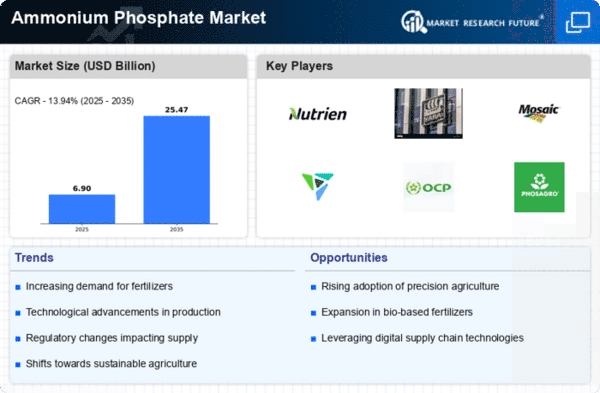
As per MRFR analysis, the Ammonium Phosphate Market Size was estimated at 6.06 USD Billion in 2024. The Ammonium Phosphate industry is projected to grow from 6.91 USD Billion in 2025 to 25.47 USD Billion by 2035, exhibiting a compound annual growth rate (CAGR) of 13.94 during the forecast period 2025 - 2035.

Key Market Trends & Highlights

The Ammonium Phosphate Market is poised for growth driven by sustainability and technological advancements.

  • North America remains the largest market for ammonium phosphate, primarily due to its extensive agricultural sector.
  • The Asia-Pacific region is emerging as the fastest-growing market, fueled by increasing agricultural productivity and food security initiatives.
  • The fertilizers segment dominates the market, while the food additives segment is experiencing rapid growth due to rising consumer demand for processed foods.
  • Key market drivers include the rising demand for fertilizers and the push for sustainable practices in agriculture.

Market Size & Forecast

2024 Market Size 6.06 (USD Billion)
2035 Market Size 25.47 (USD Billion)
CAGR (2025 - 2035) 13.94%
Largest Regional Market Share in 2024 Asia-Pacific

Major Players

<p>Nutrien (CA), Yara International (NO), The Mosaic Company (US), CF Industries (US), OCP Group (MA), PhosAgro (RU), ICL Group (IL), EuroChem Group (RU), K+S AG (DE)</p>

Market Trends

The Ammonium Phosphate Market is currently experiencing a dynamic phase characterized by evolving demand patterns and shifting production methodologies. This market, integral to the agricultural sector, is primarily driven by the need for effective fertilizers that enhance crop yield and soil fertility. As agricultural practices become increasingly sophisticated, the emphasis on sustainable and environmentally friendly products appears to be gaining traction. Consequently, manufacturers are likely to invest in innovative technologies that align with these emerging trends, potentially reshaping the competitive landscape. In addition to agricultural applications, the Ammonium Phosphate Market is witnessing a growing interest in its use within the industrial sector. This includes applications in food processing, pharmaceuticals, and water treatment, which may further diversify the market's growth avenues. The interplay between supply chain dynamics and regulatory frameworks could also influence market trajectories, as stakeholders navigate the complexities of compliance and sustainability. Overall, the Ammonium Phosphate Market seems poised for continued evolution, driven by both agricultural and industrial demands, while adapting to the challenges and opportunities presented by a changing global landscape.

Sustainable Fertilizer Development

There is a noticeable shift towards the development of sustainable fertilizers within the Ammonium Phosphate Market. This trend is driven by increasing awareness of environmental issues and the need for eco-friendly agricultural practices. Manufacturers are exploring innovative formulations that minimize ecological impact while maintaining efficacy.

Technological Advancements in Production

Technological advancements in production processes are reshaping the Ammonium Phosphate Market. Enhanced manufacturing techniques are likely to improve efficiency and reduce costs, enabling producers to meet rising demand more effectively. This trend may also lead to the introduction of new product variants.

Diversification of Applications

The diversification of applications for ammonium phosphate is becoming increasingly evident. Beyond traditional agricultural uses, this compound is finding roles in various industries, including food processing and pharmaceuticals. This expansion could open new revenue streams and enhance market resilience.

Ammonium Phosphate Market Market Drivers

Rising Demand for Fertilizers

The Global Ammonium Phosphate Market Industry experiences a notable surge in demand for fertilizers, driven by the increasing need for food production to support a growing global population. As agricultural practices evolve, ammonium phosphate emerges as a preferred choice due to its high nutrient content and efficiency in enhancing crop yields. In 2024, the market is projected to reach 25.67 USD Billion, reflecting the critical role of fertilizers in sustainable agriculture. This trend is expected to continue, with the market potentially expanding to 38.12 USD Billion by 2035, indicating a compound annual growth rate of 3.66% from 2025 to 2035.

Government Initiatives and Subsidies

Government policies and initiatives play a pivotal role in shaping the Global Ammonium Phosphate Market Industry. Various countries implement subsidies and support programs aimed at enhancing agricultural productivity and sustainability. These initiatives often include financial incentives for farmers to adopt high-efficiency fertilizers like ammonium phosphate. By promoting its use, governments aim to ensure food security and boost local economies. Such policies not only stimulate market growth but also encourage research and development in fertilizer technologies, further solidifying the position of ammonium phosphate in the agricultural sector.

Technological Advancements in Production

Innovations in production technologies significantly influence the Global Ammonium Phosphate Market Industry. Enhanced manufacturing processes, such as more efficient synthesis methods and improved quality control measures, lead to higher yields and lower production costs. These advancements not only optimize resource utilization but also minimize environmental impacts, aligning with global sustainability goals. As producers adopt these technologies, they can meet the increasing demand for ammonium phosphate while maintaining competitive pricing. Consequently, this technological evolution is likely to bolster market growth, making ammonium phosphate a more attractive option for agricultural applications.

Market Dynamics and Competitive Landscape

The competitive landscape of the Global Ammonium Phosphate Market Industry is characterized by various players striving to capture market share through strategic partnerships, mergers, and acquisitions. This dynamic environment fosters innovation and drives the development of new products tailored to meet specific agricultural needs. Companies are increasingly focusing on enhancing their distribution networks and customer engagement strategies to strengthen their market position. As competition intensifies, it is anticipated that these dynamics will lead to improved product offerings and potentially lower prices, benefiting end-users and contributing to the overall growth of the ammonium phosphate market.

Environmental Regulations and Sustainability

The Global Ammonium Phosphate Market Industry is increasingly influenced by stringent environmental regulations aimed at promoting sustainable agricultural practices. As concerns regarding soil health and water quality rise, there is a growing emphasis on using fertilizers that minimize environmental impact. Ammonium phosphate, known for its efficient nutrient delivery, aligns well with these sustainability goals. Producers are adapting to these regulations by developing eco-friendly formulations and practices, which may enhance their market competitiveness. This shift towards sustainability is likely to drive demand for ammonium phosphate, as stakeholders seek to balance agricultural productivity with environmental stewardship.

Market Segment Insights

By Application: Fertilizers (Largest) vs. Food Additives (Fastest-Growing)

<p>The Ammonium Phosphate Market exhibits a diverse application segment characterized by fertilizers, food additives, animal feed, and industrial chemicals. Fertilizers maintain a commanding share of the market, driven by the ongoing demand from the agriculture sector aimed at enhancing crop yields. The substantial utilization of ammonium phosphate fertilizers in various agricultural practices, coupled with increasing food production needs, solidifies its position as the largest segment in terms of market share. On the growth front, food additives are emerging as a significant segment, experiencing the fastest growth within the Ammonium Phosphate Market. This trend can be attributed to the rising consumer awareness regarding food quality and safety, leading manufacturers to incorporate ammonium phosphate for its stability and nutritional contributions. The enhanced focus on food preservation and flavor enhancement is anticipated to further boost the demand for ammonium phosphate in this application, underscoring its rapid expansion potential.</p>

<p>Fertilizers (Dominant) vs. Food Additives (Emerging)</p>

<p>Fertilizers constitute the dominant application of ammonium phosphate, recognized for their essential role in improving soil fertility and optimizing plant growth. With a long-standing presence in agricultural practices, fertilizers drive significant demand for ammonium phosphate, as they provide critical nutrients such as nitrogen and phosphorus that are vital for crop development. Conversely, the food additives segment is emerging swiftly, reflecting changing consumer preferences for healthier food options. Manufacturers are increasingly leveraging the stabilizing properties of ammonium phosphate, making it integral in food preservation and nutrient enhancement processes. This application not only caters to the evolving market needs but also positions itself as a crucial component in the food industry, fostering sustainable growth opportunities in the long run.</p>

By End Use: Agriculture (Largest) vs. Food Industry (Fastest-Growing)

<p>The Ammonium Phosphate Market exhibits a diverse range of end use segments, with agriculture being the most substantial contributor. This segment dominates the market due to its essential role as a fertilizer, improving crop yields and soil health. Following closely is the food industry, which utilizes ammonium phosphate as an additive to enhance food quality and shelf-life. Other notable segments include pharmaceuticals and chemical manufacturing, although they account for a smaller share in comparison to agriculture and food sectors. The growth trends in the end use segment of the Ammonium Phosphate Market are driven primarily by the rising global food demand and the increasing adoption of modern agriculture practices. The agriculture segment is witnessing consistent growth due to the need for sustainable agricultural solutions and the enhancement of crop productivity. Simultaneously, the food industry is rapidly evolving, reflecting a significant shift towards processed foods, which has propelled the use of ammonium phosphate as a vital ingredient.</p>

<p>Agriculture: Dominant vs. Food Industry: Emerging</p>

<p>In the Ammonium Phosphate Market, agriculture remains the dominant segment, leveraging the application of ammonium phosphate in fertilizer formulations. This sector thrives on the increasing demand for food production, emphasizing the importance of efficient nutrient management in crops. In contrast, the food industry has emerged as a key player, benefiting from changing dietary patterns and the growing trend towards processed and convenience foods. As the food industry evolves, the demand for additives that optimize preservation and enhance flavors positions ammonium phosphate as a valuable component. Both segments exhibit distinct characteristics, with agriculture focusing on productivity and sustainability while the food industry emphasizes quality and safety.</p>

By Form: Granular (Largest) vs. Liquid (Fastest-Growing)

<p>In the Ammonium Phosphate Market, the 'Form' segment is primarily composed of Granular, Powder, and Liquid forms. Granular ammonium phosphate holds the largest market share due to its widespread utilization in agriculture and crop production. Its physical properties make it easier to handle and apply in the field, catering to the demand from farmers seeking efficient fertilization solutions. Conversely, the powder and liquid forms, although smaller in market share, provide specialized functionalities that are increasingly being recognized in specific agricultural applications. The growth trends in this segment reveal a notable shift towards liquid ammonium phosphate, which is gaining traction as the fastest-growing category. This growth is driven by the rising demand for precision agriculture and environmentally friendly fertilization methods. Liquid forms offer enhanced solubility and nutrient availability, appealing to modern farming techniques that prioritize efficiency and sustainability. The adaptability of various forms of ammonium phosphate to meet diverse agricultural needs is a key factor in shaping this segment's future dynamics.</p>

<p>Granular (Dominant) vs. Powder (Emerging)</p>

<p>Granular ammonium phosphate is recognized as the dominant form in the market, characterized by its stable structure and ease of application in various agricultural settings. Its popularity stems from its effectiveness in promoting plant growth and soil health, which makes it a preferred choice among farmers seeking reliable fertilization solutions. The granular form's widespread availability and established supply chains further reinforce its market dominance. On the other hand, powder ammonium phosphate is emerging as a valuable alternative, primarily targeting specialized applications where uniformity and rapid dissolution are required. This form is gaining traction in regions where precise nutrient delivery is crucial, such as in high-value crop production. As the agricultural sector continues to embrace innovative practices, the powder form is expected to carve out a significant niche, driven by its tailored use in premium fertilization strategies.</p>

By Production Method: Wet Process (Largest) vs. Dry Process (Fastest-Growing)

<p>In the Ammonium Phosphate Market, the production method segment is characterized by a diverse range of processes, with the Wet Process holding the largest market share. It is preferred for its efficiency and ability to produce high-quality fertilizers. The Dry Process, while currently smaller, is gaining traction due to technological advancements and its perceived environmental benefits compared to traditional methods. As industry players seek more sustainable solutions, both methods continue to evolve in response to shifting market demands.</p>

<p>Production Methods: Wet Process (Dominant) vs. Dry Process (Emerging)</p>

<p>The Wet Process has established itself as the dominant production method in the Ammonium Phosphate Market due to its ability to consistently deliver high-grade phosphatic fertilizers with superior solubility. This method utilizes sulfuric acid in reaction with phosphate rock, making it well-suited for large-scale production. On the other hand, the Dry Process, emerging as a competitive alternative, relies on thermal processes and offers advantages in energy efficiency and reduced environmental impact. As sustainability becomes a priority, innovations in the Dry Process may position it favorably, catering to eco-conscious consumers and regulatory frameworks.</p>

By Purity Level: High Purity (Largest) vs. Medium Purity (Fastest-Growing)

<p>In the Ammonium Phosphate market, the distribution of market share among purity levels demonstrates a clear hierarchy. High purity ammonium phosphate takes precedence as the largest segment, catering predominantly to industries that require precise nutrient formulations, such as pharmaceuticals and specialty fertilizers. On the other hand, medium purity ammonium phosphate is steadily gaining traction, primarily due to its balanced cost-effectiveness and sufficient nutrient provision for various agricultural applications, making it a popular choice among mid-sized farmers. The growth trends for the purity level segment reflect changing consumer preferences and technological advancements. High purity products benefit from a solid consumer base demanding quality and reliability, especially in advanced agricultural practices. Meanwhile, the surge in medium purity ammonium phosphate is primarily driven by rising urbanization and increased agricultural productivity needs, as farmers seek viable options that combine affordability with effective nutrient delivery.</p>

<p>High Purity (Dominant) vs. Medium Purity (Emerging)</p>

<p>High purity ammonium phosphate represents the dominant player in the market, renowned for its exceptional quality and precision in nutrient content, making it ideal for high-value crops and specialized applications. This segment is characterized by strict manufacturing processes ensuring minimal impurities which appeal to sectors like pharmaceuticals that prioritize quality over cost. Conversely, medium purity ammonium phosphate is the emerging competitor, favored for its affordability without compromising much on efficacy. This segment is appealing to a broader audience, especially in regions with growing agricultural needs. As medium purity becomes more recognized for its optimal balance of performance and cost, its adoption is expected to rise, leading to a dynamic competition with high purity products.</p>

Get more detailed insights about Ammonium Phosphate Market Research Report - Global Forecast till 2035

Regional Insights

North America : Stable Growth Environment

The North American Ammonium Phosphate market is projected to reach $1.52 billion by December 2025, driven by increasing agricultural demand and sustainable farming practices. Regulatory support for environmentally friendly fertilizers is enhancing market growth. The region's focus on innovation in fertilizer technology is also a significant growth driver, as farmers seek efficient solutions to improve crop yields and soil health. Leading countries in this region include the US and Canada, where major players like Nutrien and CF Industries dominate the market. The competitive landscape is characterized by a mix of large-scale producers and regional suppliers, ensuring a diverse supply chain. The presence of established companies fosters innovation and competitive pricing, further solidifying North America's position in the global market.

Europe : Regulatory-Driven Market Dynamics

Europe's Ammonium Phosphate market is valued at $1.21 billion as of December 2025, with growth driven by stringent regulations promoting sustainable agriculture. The EU's Green Deal and Farm to Fork strategy are pivotal in shaping demand for eco-friendly fertilizers, pushing farmers towards more sustainable practices. This regulatory environment is expected to enhance market penetration and adoption of innovative fertilizers across the region. Key players in Europe include Yara International and EuroChem Group, with significant market shares in countries like Germany and France. The competitive landscape is marked by a focus on sustainability and innovation, as companies invest in R&D to meet regulatory standards. The presence of established firms ensures a robust supply chain, catering to the increasing demand for high-quality fertilizers in the agricultural sector.

Asia-Pacific : Emerging Market Powerhouse

The Asia-Pacific region leads the Ammonium Phosphate market with a valuation of $3.03 billion as of December 2025. This growth is fueled by rising agricultural production and increasing food security concerns. Countries like China and India are major contributors, with government initiatives supporting fertilizer use to enhance crop yields. The region's diverse agricultural landscape drives demand for various fertilizer types, including Ammonium Phosphate. China and India are the leading countries in this market, with significant investments from key players like Yara International and OCP Group. The competitive landscape is characterized by a mix of local and international firms, ensuring a dynamic market environment. The presence of established companies fosters innovation and competitive pricing, further solidifying Asia-Pacific's dominance in The Ammonium Phosphate.

Middle East and Africa : Resource-Rich Fertilizer Market

The Middle East and Africa's Ammonium Phosphate market is valued at $0.3 billion as of December 2025, with growth driven by increasing agricultural activities and the need for food security. The region's rich natural resources, particularly in phosphate rock, provide a strong foundation for fertilizer production. Government initiatives aimed at boosting agricultural output are also contributing to market growth, as countries seek to enhance self-sufficiency in food production. Leading countries in this region include Morocco and South Africa, where companies like OCP Group are prominent players. The competitive landscape is evolving, with local firms expanding their production capabilities to meet rising demand. The presence of key players ensures a steady supply of Ammonium Phosphate, catering to the agricultural needs of the region.

Key Players and Competitive Insights

The Ammonium Phosphate Market is characterized by a competitive landscape that is increasingly shaped by innovation, sustainability, and strategic partnerships. Key players such as Nutrien (CA), Yara International (NO), and The Mosaic Company (US) are actively pursuing strategies that enhance their market positioning. Nutrien (CA) focuses on digital transformation and precision agriculture, aiming to optimize fertilizer application and improve crop yields. Yara International (NO) emphasizes sustainability, investing in green ammonia production to reduce carbon emissions. Meanwhile, The Mosaic Company (US) is enhancing its operational efficiency through supply chain optimization and expanding its product portfolio to meet diverse agricultural needs. Collectively, these strategies indicate a shift towards more sustainable and technologically advanced practices within the market.

In terms of business tactics, companies are increasingly localizing manufacturing to reduce transportation costs and enhance supply chain resilience. The market structure appears moderately fragmented, with several key players exerting influence over pricing and product availability. This fragmentation allows for competitive dynamics where companies can differentiate themselves through innovation and customer service, rather than solely on price.

In November 2025, Nutrien (CA) announced a partnership with a leading agricultural technology firm to develop a new digital platform aimed at optimizing fertilizer use. This strategic move is likely to enhance Nutrien's competitive edge by providing farmers with data-driven insights, thereby improving crop productivity and sustainability. The collaboration underscores the growing importance of technology in the agricultural sector and reflects Nutrien's commitment to innovation.

In October 2025, Yara International (NO) launched a new line of eco-friendly fertilizers designed to minimize environmental impact. This initiative aligns with global sustainability trends and positions Yara as a leader in the green fertilizer segment. By focusing on environmentally responsible products, Yara is not only addressing regulatory pressures but also catering to the increasing consumer demand for sustainable agricultural practices.

In September 2025, The Mosaic Company (US) completed the acquisition of a regional fertilizer distributor, enhancing its market reach and distribution capabilities. This acquisition is strategically significant as it allows Mosaic to strengthen its supply chain and improve service delivery to its customers. The move reflects a broader trend of consolidation within the industry, as companies seek to enhance their competitive positioning through strategic acquisitions.

As of December 2025, the competitive trends in the Ammonium Phosphate Market are increasingly defined by digitalization, sustainability, and the integration of advanced technologies such as AI. Strategic alliances are becoming more prevalent, enabling companies to leverage complementary strengths and enhance their market offerings. Looking ahead, competitive differentiation is likely to evolve from traditional price-based competition towards a focus on innovation, technological advancements, and supply chain reliability. This shift suggests that companies that prioritize sustainable practices and technological integration will be better positioned to thrive in the future.

Key Companies in the Ammonium Phosphate Market market include

Industry Developments

Future Outlook

Ammonium Phosphate Market Future Outlook

<p>The Ammonium Phosphate Market is projected to grow at a 13.94% CAGR from 2024 to 2035, driven by increasing agricultural demand and sustainable farming practices.</p>

New opportunities lie in:

  • <p>Development of precision agriculture technologies for optimized nutrient application.</p>
  • <p>Expansion into emerging markets with tailored fertilizer solutions.</p>
  • <p>Investment in eco-friendly production methods to meet regulatory standards.</p>

<p>By 2035, the Ammonium Phosphate Market is expected to achieve robust growth and enhanced market positioning.</p>

Market Segmentation

Ammonium Phosphate Market Form Outlook

  • Granular
  • Powder
  • Liquid

Ammonium Phosphate Market End Use Outlook

  • Agriculture
  • Food Industry
  • Pharmaceuticals
  • Chemical Manufacturing

Ammonium Phosphate Market Application Outlook

  • Fertilizers
  • Food Additives
  • Animal Feed
  • Industrial Chemicals

Ammonium Phosphate Market Purity Level Outlook

  • Low Purity
  • Medium Purity
  • High Purity

Ammonium Phosphate Market Production Method Outlook

  • Wet Process
  • Dry Process
  • Recycling

Report Scope

MARKET SIZE 20246.06(USD Billion)
MARKET SIZE 20256.91(USD Billion)
MARKET SIZE 203525.47(USD Billion)
COMPOUND ANNUAL GROWTH RATE (CAGR)13.94% (2024 - 2035)
REPORT COVERAGERevenue Forecast, Competitive Landscape, Growth Factors, and Trends
BASE YEAR2024
Market Forecast Period2025 - 2035
Historical Data2019 - 2024
Market Forecast UnitsUSD Billion
Key Companies ProfiledNutrien (CA), Yara International (NO), The Mosaic Company (US), CF Industries (US), OCP Group (MA), PhosAgro (RU), ICL Group (IL), EuroChem Group (RU), K+S AG (DE)
Segments CoveredApplication, End Use, Form, Production Method, Purity Level
Key Market OpportunitiesGrowing demand for sustainable fertilizers drives innovation in the Ammonium Phosphate Market.
Key Market DynamicsRising demand for sustainable fertilizers drives innovation and competition in the Ammonium Phosphate market.
Countries CoveredNorth America, Europe, APAC, South America, MEA

FAQs

At what CAGR is the ammonium phosphate market expected to grow over the forecast period?

The ammonium phosphate market is predicted to grow at a 3.65% CAGR between 2025-2035.

Which region is predicted to dominate the ammonium phosphate market?

The APAC region is predicted to dominate the ammonium phosphate market during the forecast period.

What are the key factors driving the ammonium phosphate market?

Demand for water treatment, need for better yield, and technical advances in fertilizer formulations are boosting market growth.

Which factors may act as deterrents in the ammonium phosphate market?

Toxic effects of overfertilization may deter market growth.

What are the different applications of ammonium phosphate?

It has wide applications in food and beverage, water treatment, flame-retardant, animal feed, and fertilizers.

  1. Executive Summary
  2. Market Introduction
    1. Market Definition
    2. Scope of the
      1. Research
      2. Assumptions & Limitations
    3. Study
    4. Objectives
    5. Markets Structure
    6. Key Takeaways
    7. Market Research Methodology
    8. Research
    9. Process
    10. Primary Research
    11. Secondary Research
    12. Market Size Estimation
    13. Forecast Model
  3. Market Dynamics of the Global Ammonium
    1. Phosphate Market
    2. Introduction
    3. Drivers
    4. Restraints
    5. Opportunities
    6. Challenges
    7. Trends/Technology
  4. Market Factor Analysis of the Global Ammonium Phosphate
    1. Market
    2. Supply Chain Analysis
      1. Raw Type Suppliers
      2. Distributors/Retailers/Wholesalers/E-Commerce
      3. End User
      4. Bargaining
      5. Bargaining Power
      6. Threat of Substitutes
      7. Intensity of Rivalry
    3. Manufacturers/Producers
    4. Porter’s Five Forces Analysis
    5. Threat of New Entrants
    6. Power of Buyers
    7. of Suppliers
    8. Pricing Analysis
  5. Global Ammonium Phosphate Market,
    1. by Type
    2. Introduction
    3. Mono-Ammonium
      1. Market Estimates &
    4. Phosphate (MAP)
    5. Market Estimates & Forecast, 2020-2027
    6. Forecast, by Region, 2020-2027
    7. Di-Ammonium Phosphate
      1. Market Estimates
      2. Market Estimates & Forecast, by
    8. (DAP)
    9. & Forecast, 2020-2027
    10. Region, 2020-2027
    11. Ammonium Polyphosphate
      1. Market Estimates & Forecast,
      2. Market Estimates & Forecast, by Region, 2020-2027
  6. Global Ammonium Phosphate Market, by Application
    1. Introduction
    2. Fertilizer
      1. Market Estimates & Forecast, 2020-2027
      2. Market Estimates & Forecast, by Region, 2020-2027
      3. Market Estimates &
    3. Animal Feed
    4. Market Estimates & Forecast, 2020-2027
    5. Forecast, by Region, 2020-2027
    6. Flame Retardant
      1. Market Estimates & Forecast,
      2. Market Estimates & Forecast, by Region, 2020-2027
    7. Water Treatment
      1. Market Estimates & Forecast, 2020-2027
  7. Market Estimates & Forecast, by Region, 2020-2027
    1. Food & Beverages
    2. Market Estimates & Forecast, 2020-2027
    3. & Forecast, by Region, 2020-2027
  8. Market Estimates
    1. Others
      1. Market Estimates & Forecast,
      2. Market Estimates & Forecast, by Region, 2020-2027
  9. Global Ammonium Phosphate Market, by Region
    1. Introduction
    2. North America
      1. Market Estimates
      2. Market Estimates &
      3. US
      4. Canada
    3. Market Estimates & Forecast, 2020-2027
    4. & Forecast, by Type, 2020-2027
    5. Forecast, by Application, 2020-2027
    6. Estimates & Forecast, by Type, 2020-2027
    7. Market Estimates & Forecast, 2020-2027
    8. & Forecast, by Application, 2020-2027
    9. Europe
      1. Market Estimates & Forecast, 2020-2027
  10. Market Estimates & Forecast, by Type, 2020-2027
  11. Market Estimates & Forecast, by Application, 2020-2027
    1. Germany
    2. Market Estimates & Forecast, 2020-2027
    3. & Forecast, by Application, 2020-2027
    4. & Forecast, 2020-2027
    5. by Application, 2020-2027
    6. Estimates & Forecast, by Type, 2020-2027
    7. & Forecast, by Application, 2020-2027
    8. & Forecast, 2020-2027
    9. by Application, 2020-2027
    10. Forecast, 2020-2027
  12. Market Estimates & Forecast, by Type, 2020-2027
  13. Market Estimates
  14. France
  15. Market Estimates
  16. Market Estimates & Forecast, by Type, 2020-2027
  17. Market Estimates & Forecast,
  18. Italy
  19. Market Estimates & Forecast,
  20. Market
  21. Market Estimates & Forecast, by Application, 2020-2027
  22. Spain
  23. Market Estimates & Forecast, 2020-2027
  24. Market Estimates & Forecast, by Type,2020-2027
  25. Market Estimates
  26. UK
  27. Market Estimates
  28. Market Estimates & Forecast, by Type,2020-2027
  29. Market Estimates & Forecast,
  30. Russia
  31. Market Estimates &
  32. Market Estimates & Forecast, by Type,2020-2027
    1. Forecast, by Type, 2020-2027
    2. Rest of Europe
    3. Forecast, by Type, 2020-2027
    4. Forecast, 2020-2027
    5. by Type, 2020-2027
    6. by Application, 2020-2027
    7. Forecast, 2020-2027
  33. Market Estimates & Forecast, by Application,
  34. Poland
  35. Market Estimates & Forecast, 2020-2027
  36. Market Estimates &
  37. Market Estimates & Forecast, by Application, 2020-2027
  38. Market Estimates & Forecast, 2020-2027
  39. Market Estimates &
  40. Market Estimates & Forecast, by Application, 2020-2027
    1. Asia-Pacific
      1. Market Estimates &
      2. Market Estimates & Forecast,
      3. Market Estimates & Forecast,
      4. China
  41. Market Estimates & Forecast, by Type, 2020-2027
    1. by Application, 2020-2027
    2. & Forecast, 2020-2027
    3. & Forecast, by Application, 2020-2027
    4. & Forecast, 2020-2027
    5. & Forecast, by Application, 2020-2027
    6. & New Zealand
    7. Market Estimates & Forecast, 2020-2027
  42. Market Estimates & Forecast,
  43. India
  44. Market Estimates
  45. Market Estimates & Forecast, by Type, 2020-2027
  46. Market Estimates
  47. Japan
  48. Market Estimates
  49. Market Estimates & Forecast, by Type, 2020-2027
  50. Market Estimates
  51. Australia
  52. Market Estimates & Forecast, by Type,
  53. Market Estimates & Forecast, by Application, 2020-2027
    1. Rest of Asia-Pacific
    2. by Type, 2020-2027
  54. Market Estimates & Forecast, 2020-2027
  55. Market Estimates & Forecast,
  56. Market Estimates & Forecast, by Application, 2020-2027
    1. Middle East & Africa
      1. Market Estimates & Forecast, 2020-2027
  57. Market Estimates & Forecast, by Type, 2020-2027
  58. Market Estimates & Forecast, by Application, 2020-2027
    1. GCC
    2. & Forecast, 2020-2027
  59. Market Estimates
  60. Market Estimates & Forecast, by Type, 2020-2027
    1. Forecast, by Type, 2020-2027
    2. by Type, 2020-2027
  61. Market Estimates & Forecast, by Application,
  62. Israel
  63. Market Estimates & Forecast, 2020-2027
  64. Market Estimates &
  65. Market Estimates & Forecast, by Application, 2020-2027
  66. North Africa
  67. Market Estimates & Forecast, 2020-2027
  68. Market Estimates & Forecast,
  69. Market Estimates & Forecast, by Application, 2020-2027
    1. Turkey
    2. Market Estimates & Forecast, 2020-2027
    3. & Forecast, by Application, 2020-2027
    4. East & Africa
    5. Market Estimates & Forecast, 2020-2027
    6. & Forecast, by Application, 2020-2027
  70. Market Estimates & Forecast, by Type, 2020-2027
  71. Market Estimates
  72. Rest of Middle
  73. Market Estimates & Forecast, by Type, 2020-2027
  74. Market Estimates
    1. Latin America
      1. Market Estimates & Forecast, 2020-2027
  75. Market Estimates & Forecast, by Type, 2020-2027
  76. Market Estimates & Forecast, by Application, 2020-2027
    1. Brazil
    2. Market Estimates & Forecast, 2020-2027
    3. & Forecast, by Application, 2020-2027
    4. & Forecast, 2020-2027
    5. by Application, 2020-2027
    6. Forecast, 2020-2027
  77. Market Estimates & Forecast, by Type, 2020-2027
  78. Market Estimates
  79. Argentina
  80. Market Estimates
  81. Market Estimates & Forecast, by Type, 2020-2027
  82. Market Estimates & Forecast,
  83. Mexico
  84. Market Estimates &
  85. Market Estimates & Forecast, by Type, 2020-2027
    1. Forecast, 2020-2027
  86. Market Estimates & Forecast, by Application,
  87. Rest of Latin America
  88. Market Estimates &
  89. Market Estimates & Forecast, by Type, 2020-2027
  90. Market Estimates & Forecast, by Application,
  91. Company Landscape
    1. Introduction
    2. Market Strategy
    3. Key Development Analysis (Expansion/Mergers & Acquisitions/Joint
    4. Venture/New Type Development/Agreement/Investment)
  92. Company
    1. Profiles
    2. Nutrien Ltd
      1. Company
      2. Financial Updates
      3. Product/Business Segment Overview
      4. Key Developments
      5. SWOT Analysis
    3. Overview
    4. Key Strategies
    5. OCP
      1. Company Overview
      2. Product/Business
      3. Key Strategies
      4. Key Developments
    6. Financial Updates
    7. Segment Overview
    8. SWOT Analysis
    9. Haifa Group
      1. Company Overview
      2. Financial Updates
      3. Key Developments
      4. SWOT Analysis
    10. Product/Business Segment Overview
    11. Key Strategies
    12. Coromandel
      1. Financial Updates
      2. Product/Business Segment Overview
      3. Key Strategies
      4. SWOT Analysis
    13. International Limited
    14. Company Overview
    15. Key Developments
    16. Prayon S.A.
      1. Company Overview
      2. Key
      3. Key Developments
    17. Financial Updates
    18. Product/Business Segment Overview
    19. Strategies
    20. SWOT Analysis
    21. Chemische Fabrik Budenheim
      1. Company Overview
      2. Key
      3. Key Developments
    22. KG
    23. Financial Updates
    24. Product/Business Segment Overview
    25. Strategies
    26. SWOT Analysis
    27. Yunnan Yuntianhua International
      1. Company Overview
      2. Key
      3. Key Developments
    28. Chemical Co., Ltd
    29. Financial Updates
    30. Product/Business Segment Overview
    31. Strategies
    32. SWOT Analysis
    33. Innophos, Inc.
      1. Financial Updates
      2. Product/Business Segment Overview
      3. Key Strategies
      4. SWOT Analysis
    34. Company Overview
    35. Key Developments
    36. Forbes Pharmaceuticals
      1. Financial Updates
      2. Product/Business Segment Overview
      3. Key Developments
      4. SWOT Analysis
    37. Company Overview
    38. Key Strategies
    39. Maaden
      1. Company Overview
      2. Financial Updates
      3. Key Developments
      4. SWOT Analysis
    40. - Saudi Arabian Mining Company
    41. Product/Business Segment Overview
    42. Key Strategies
    43. The
      1. Company Overview
      2. Key
      3. Key Developments
    44. Mosaic Company
    45. Financial Updates
    46. Product/Business Segment Overview
    47. Strategies
    48. SWOT Analysis
    49. Innophos, Inc.
      1. Financial
      2. Product/Business Segment
      3. Key Strategies
      4. SWOT Analysis
    50. Company Overview
    51. Updates
    52. Overview
    53. Key Developments
  93. Conclusion
  94. LIST OF TABLES
  95. Global Ammonium Phosphate Market: by Region, 2020-2027
  96. North America: Ammonium Phosphate Market, by Country,
  97. Europe: Ammonium Phosphate Market, by Country,
  98. Asia-Pacific: Ammonium Phosphate Market,
    1. by Country, 2020-2027
  99. Middle East & Africa: Ammonium
  100. Phosphate Market, by Country, 2020-2027
  101. Latin America:
  102. Ammonium Phosphate Market, by Country, 2020-2027
  103. Global
  104. Ammonium Phosphate Type Market, by Regions, 2020-2027
  105. North
  106. America: Ammonium Phosphate Type Market, by Country, 2020-2027
    1. Table 9
  107. Europe: Ammonium Phosphate Type Market, by Country, 2020-2027
    1. Table10
  108. Asia-Pacific: Ammonium Phosphate Type Market, by Country, 2020-2027
    1. Table11
  109. Middle East & Africa: Ammonium Phosphate Type Market, by Country, 2020-2027
  110. Table12 Latin America: Ammonium Phosphate Type Market, by Country,
    1. Table13 Global Ammonium Phosphate Application Market,
    2. by Regions, 2020-2027
    3. Table14 North America: Ammonium Phosphate
  111. Application Market, by Country, 2020-2027
    1. Table15 Europe:
  112. Ammonium Phosphate Application Market, by Country, 2020-2027
    1. Table16
  113. Asia-Pacific: Ammonium Phosphate Application Market, by Country, 2020-2027
    1. Table17 Middle East & Africa: Ammonium Phosphate Application
  114. Market, by Country, 2020-2027
    1. Table18 Latin America: Ammonium
  115. Phosphate by Application Market, by Country, 2016-2025
    1. Table19
  116. Global Type Market, by Region, 2020-2027
    1. Table20 Global
  117. Application Market, by Region, 2020-2027
    1. Table21 North America:
  118. Ammonium Phosphate Market, by Country, 2020-2027
    1. Table22
  119. North America: Ammonium Phosphate Market, by Type, 2020-2027
    1. Table23
  120. North America: Ammonium Phosphate Market, by Application, 2020-2027
  121. Table24 Europe: Ammonium Phosphate Market, by Country, 2020-2027
  122. Table25 Europe: Ammonium Phosphate Market, by Type, 2020-2027
  123. Table26 Europe: Ammonium Phosphate Market, by Application, 2020-2027
    1. Table27 Asia-Pacific: Ammonium Phosphate Market, by
    2. Country, 2020-2027
    3. Table28 Asia-Pacific: Ammonium
  124. Phosphate Market, by Type, 2020-2027
    1. Table29 Asia-Pacific:
  125. Ammonium Phosphate Market, by Application, 2020-2027
    1. Table30
  126. Middle East & Africa: Ammonium Phosphate Market, by Country, 2020-2027
    1. Table31 Middle East & Africa: Ammonium Phosphate Market,
    2. by Type, 2020-2027
    3. Table32 Middle East & Africa:
  127. Ammonium Phosphate Market, by Application, 2020-2027
    1. Table33
  128. Latin America: Ammonium Phosphate Market, by Country, 2020-2027
  129. Table34 Latin America: Ammonium Phosphate Market, by Type, 2020-2027
  130. Table35 Latin America: Ammonium Phosphate Market, by Application,
  131. LIST OF FIGURES
  132. Global
    1. Ammonium Phosphate Market Segmentation
  133. Forecast Research
    1. Methodology
  134. Five Forces Analysis of the Global Ammonium
    1. Phosphate Market
  135. Supply Chain of the Global Ammonium
    1. Phosphate Market
  136. Global Ammonium Phosphate Market, 2020-2027,
    1. by Country, 2020
  137. Share of the Global Ammonium Phosphate
  138. Market, by Country, 2020-2027
  139. Global Ammonium Phosphate
  140. Market Size, by Type, 2020
  141. Share of the Global Ammonium
  142. Phosphate Market, by Type, 2020-2027
  143. Global Ammonium
  144. Phosphate Market Size, by Application, 2020
    1. FIGURE10 Share of the Global
  145. Ammonium Phosphate Market, by Application, 2020-2027

Ammonium Phosphate Market Segmentation

Market Segmentation Overview

  • Detailed segmentation data will be available in the full report
  • Comprehensive analysis by multiple parameters
  • Regional and country-level breakdowns
  • Market size forecasts by segment
Infographic

Free Sample Request

Kindly complete the form below to receive a free sample of this Report

Get Free Sample

Customer Strories

Compare Licence

×
Features License Type
Single User Multiuser License Enterprise User
Price $4,950 $5,950 $7,250
Maximum User Access Limit 1 User Upto 10 Users Unrestricted Access Throughout the Organization
Free Customization
Direct Access to Analyst
Deliverable Format
Platform Access
Discount on Next Purchase 10% 15% 15%
Printable Versions