Request Free Sample ×

Kindly complete the form below to receive a free sample of this Report

* Please use a valid business email

Leading companies partner with us for data-driven Insights

clients tt-cursor
Hero Background
English
Chinese
French
Japanese
Korean
German
Spanish

Alcoholic Beverages Market Size

ID: MRFR/FnB/2299-HCR
200 Pages
Snehal Singh
March 2026

Alcoholic Beverages Market Size, Share, Industry Trend & Analysis Research Report By Product Type (Beer, Wine, Spirits, Cider, Ready-to-Drink), By Distribution Channel (Supermarkets, Convenience Stores, Online Retail, Liquor Stores), By Alcoholic Strength (Low Alcohol, Medium Alcohol, High Alcohol), By Consumer Demographics (Millennials, Generation X, Baby Boomers, Gen Z) and By Regional (North America, Europe, South America, Asia Pacific, Middle East and Africa) - Forecast to 2035

Share:
Download PDF ×

We do not share your information with anyone. However, we may send you emails based on your report interest from time to time. You may contact us at any time to opt-out.

Alcoholic Beverages Market Infographic
Purchase Options

Alcoholic Beverages Size

Alcoholic Beverages Market Growth Projections and Opportunities

The market for alcoholic beverages suffers from a plethora of factors that affect its marketing dynamics and advancement. Consumer tastes are becoming higher and more people want to try premium or artisanal cocktails. Consumers have become more discerning and started seeking unique high class drinking experiences. This has contributed to a significant trend towards artisanal speciality alcoholic products. In the alcoholic beverages sector, crafted beer stalls are gaining popularity as people look for authenticity to get an extraordinary taste. The major driving factor for the macro environment in which alcoholic beverage industry operates is economic conditions. The demand for alcoholic beverages is also influenced by consumer spending patterns, disposable income levels and the economic conditions. The slump in the economy may result to consumers altering their approach towards purchases thereby purchasing cheaper brands or even trade down as valued by lower cost alternatives. In contrast, during periods of economic boom people may be more inclined to spend money on the costlier and luxury drinks thus universal market conditions. Alcoholic beverages market largely depends on the regulatory environment. All governments also enforce very strict limits on the distribution and sale of alcoholic beverages to ensure public safety as well industry control. License requirements, advertisement limitations and legal drinking age are among the factors determining market practices. These regulations are applicable to the manufacturers and distributers of alcoholic beverages that would need to follow them for ensuring legality on an aspect of integrity within its market. Cultural and social issues are the key factors influencing consumer preferences in Alcoholic Beverages Market. Drinking habits, traditions and cultural norms vary greatly place to people. For instance, cultural preferences affect their choices of certain types of drinks like sake in Japan or whiskey from Scotland. Moreover, social changes like the awareness of mindful drinking and emphasis on healthy lifestyles grant popularity to low-alcohol- or alcohol-free alternatives; this helps make the market more diverse. Technological advancements and innovation in the production methods have been responsible for Market of Alcoholic Beverages evolution. The introduction of new brewing techniques, distillation processes and fermentation procedures allow producers to produce alcoholic beverages with unique characteristics. This innovation has never stopped on the boundaries of beer, wine and spirits but opened creation as entirely new product categories such as hard seltzers or flavored alcoholic beverages.

Alcoholic Beverages Market Size Graph
Author
Author Profile
Snehal Singh
Manager - Research

High acumen in analyzing complex macro & micro markets with more than 6 years of work experience in the field of market research. By implementing her analytical skills in forecasting and estimation into market research reports, she has expertise in Packaging, Construction, and Equipment domains. She handles a team size of 20-25 resources and ensures smooth running of the projects, associated marketing activities, and client servicing.

Leave a Comment

FAQs

What is the current valuation of the alcoholic beverages market in 2025?

<p>The alcoholic beverages market valuation is approximately 1397.0 USD Billion in 2024.</p>

What is the projected market size for the alcoholic beverages sector by 2035?

<p>The market is expected to reach a valuation of 1970.0 USD Billion by 2035.</p>

What is the expected CAGR for the alcoholic beverages market during the forecast period 2025 - 2035?

<p>The anticipated CAGR for the alcoholic beverages market during 2025 - 2035 is 3.17%.</p>

Which product type holds the largest market share in the alcoholic beverages sector?

<p>Spirits appear to hold the largest market share, with valuations ranging from 500.0 to 700.0 USD Billion.</p>

How does the distribution channel impact the alcoholic beverages market?

<p>The off-trade distribution channel is projected to generate between 600.0 and 800.0 USD Billion, indicating its dominance.</p>

What demographic factors influence the alcoholic beverages market?

<p>Consumer demographics such as age and income level are projected to contribute between 300.0 to 500.0 USD Billion and 350.0 to 500.0 USD Billion, respectively.</p>

What are the packaging trends in the alcoholic beverages market?

<p>Bottles are expected to dominate the packaging segment, with valuations between 600.0 and 850.0 USD Billion.</p>

Which companies are considered key players in the alcoholic beverages market?

<p>Key players include Anheuser-Busch InBev, Diageo, Heineken, and Constellation Brands, among others.</p>

What is the market outlook for low and non-alcoholic beverages?

<p>Low alcohol and non-alcoholic segments are projected to generate between 139.7 and 197.0 USD Billion.</p>

How does the alcoholic beverages market perform in e-commerce?

<p>E-commerce is expected to contribute between 100.0 and 200.0 USD Billion, reflecting its growing importance.</p>

Market Summary

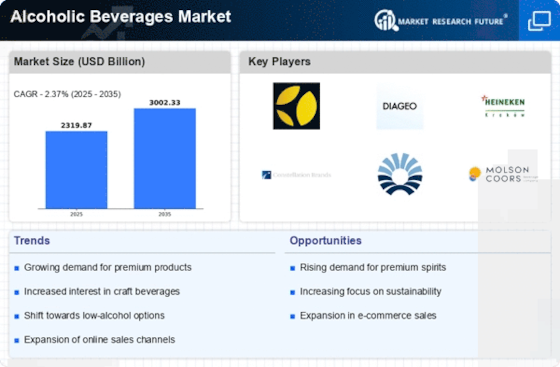
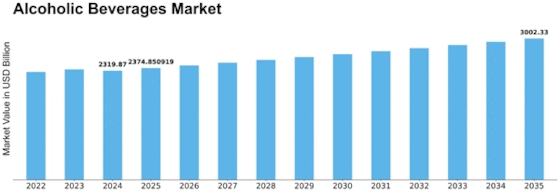
The global alcoholic beverages market was valued at USD 2319.87 billion in 2024 and is projected to reach from USD 2374.9 billion in 2025 to USD 3002.33 billion by 2035, registering a CAGR of 2.37% over the forecast period. The market covers beer, wine, distilled spirits, ready-to-drink (RTD) cocktails, hard seltzers, and cider — distributed through off-trade channels (supermarkets, liquor stores, online retail) and on-trade channels (bars, restaurants, and hotels).
The industry is also being reshaped by distribution innovation. E-commerce alcohol sales grew approximately 30% in the United States during 2023, reflecting a broader global relaxation of online liquor sales regulations. Off-trade channels held a 62.2% share of total distribution in 2024, with internet retailing identified as the fastest-growing channel within that segment. On-trade recovery post-pandemic has been steady, with premium bars and experiential hospitality venues reporting above-average growth in high-margin spirits categories.

Key Market Trends & Highlights

The Alcoholic Beverages Market is experiencing a dynamic shift towards health-conscious and premium offerings, driven by evolving consumer preferences.

  • Health-conscious choices are increasingly influencing consumer purchasing decisions in North America. Craft and premium alcoholic beverages are gaining traction, particularly in the Asia-Pacific region. Sustainability and ethical practices are becoming essential considerations for brands targeting environmentally aware consumers. The rise of e-commerce and online sales, alongside evolving consumer preferences, are key drivers propelling market growth.

Market Size & Forecast

2024 Market Size 2319.87 (USD Billion)
2035 Market Size 3002.33 (USD Billion)
CAGR (2025 - 2035) 2.37%
Largest Regional Market Share in 2024 Europe

Major Players

<a href="https://www.ab-inbev.com/">Anheuser-Busch InBev (BE)</a>, Diageo (GB), Heineken (NL), Constellation Brands (US), Pernod Ricard (FR), Molson Coors Beverage Company (US), Asahi Group Holdings (JP), Carlsberg Group (DK), Treasury Wine Estates (AU)

Market Trends

The Alcoholic Beverages Market is witnessing a dynamic transformation driven by health awareness, premiumization, and sustainability, shaping long-term rtd alcoholic beverages market trends and low alcohol beverages market trends. The rising popularity of convenience-led formats is driving growth in the ready to drink alcoholic beverages market, particularly within the rtd alcoholic beverage market globally. Additionally, the rise of craft beverages has introduced a diverse array of flavors and styles, appealing to a more adventurous consumer base. The market is also witnessing an increase in premiumization, where consumers are willing to pay more for high-quality products that offer unique experiences. Moreover, sustainability has emerged as a critical factor in purchasing decisions. Brands that prioritize eco-friendly practices and transparent sourcing are likely to resonate with environmentally aware consumers. The market is thus navigating a complex landscape, where innovation and adaptability are essential for success. As the industry continues to evolve, it appears that the focus will remain on creating products that align with the values and preferences of modern consumers, ensuring relevance in a competitive marketplace.

Health-Conscious Choices

The shift toward moderation has fueled demand across the low & no alcohol beverages market, encouraging innovation within both alcoholic and adjacent beverage categories. This shift indicates a desire for moderation and responsible drinking, leading to an increase in demand for alternatives that cater to these preferences.

Craft and Premium Offerings

The rise of craft beverages has diversified the Alcoholic Beverages Market, attracting consumers who seek unique flavors and experiences. Premiumization trends are influencing the organic alcoholic beverage market, as consumers seek quality, authenticity, and sustainable sourcing.

The wine market continues to evolve as consumer preferences shift toward premiumization, quality differentiation, and experiential consumption. Demand spans a wide range of product categories, including still, sparkling, and specialty wines, supported by both on-trade and off-trade channels. Growing interest in origin, grape variety, and production methods is influencing purchasing behavior. Sustainability, packaging innovation, and digital retail channels are increasingly shaping the competitive landscape of the global Alcoholic Beverages Market.

Sustainability and Ethical Practices

Sustainability has become a pivotal consideration for consumers when selecting alcoholic beverages. Brands that emphasize eco-friendly practices and ethical sourcing are likely to gain favor among environmentally conscious individuals, shaping future purchasing behaviors.

Alcoholic Beverages Market Market Drivers

Evolving Consumer Preferences

The alcoholic beverages Market is currently witnessing a shift in consumer preferences towards more diverse and innovative products. This trend is characterized by an increasing demand for craft beers, artisanal spirits, and unique flavor profiles. As consumers become more adventurous, they seek out beverages that offer distinct experiences, leading to a proliferation of small-scale producers. In 2025, the craft beer segment alone is projected to account for approximately 25 percent of the total beer market, indicating a robust growth trajectory. This evolution in consumer tastes is prompting established brands to adapt their offerings, thereby enhancing competition within the Alcoholic Beverages Market.

Regulatory Changes and Compliance

Regulatory changes are significantly influencing the Alcoholic Beverages Market. Governments are increasingly implementing stricter regulations regarding labeling, advertising, and distribution of alcoholic products. These regulations aim to promote responsible drinking and ensure consumer safety. In 2025, it is anticipated that compliance with these regulations will require producers to invest in better quality control measures and transparent labeling practices. This shift may lead to a consolidation of smaller players who struggle to meet compliance standards, thereby reshaping the competitive landscape of the Alcoholic Beverages Market. Consequently, larger companies may gain market share as they adapt more readily to these regulatory demands.

Rise of E-commerce and Online Sales

The rise of e-commerce is transforming the Alcoholic Beverages Market. With the increasing prevalence of online shopping, consumers are now able to purchase a wide variety of alcoholic beverages from the comfort of their homes. This trend is particularly pronounced among younger demographics who prefer the convenience of online platforms. In 2025, online sales of alcoholic beverages are projected to grow by over 15%, reflecting a shift in purchasing behavior. Retailers are responding by enhancing their online presence and offering exclusive products to attract consumers. This evolution in distribution channels is likely to reshape the Alcoholic Beverages Market, creating new opportunities for both established brands and emerging players.

Technological Advancements in Production

Technological advancements are playing a pivotal role in shaping the Alcoholic Beverages Market. Innovations in fermentation processes, distillation techniques, and packaging solutions are enhancing product quality and shelf life. For instance, the adoption of automation in brewing and bottling processes is streamlining production, reducing costs, and improving efficiency. Furthermore, advancements in data analytics are enabling producers to better understand consumer preferences and optimize their product lines accordingly. As a result, the Alcoholic Beverages Market is likely to see an increase in the introduction of new products that cater to specific consumer demands, thereby driving market growth.

Focus on Sustainability and Ethical Sourcing

Sustainability is becoming a central theme within the Alcoholic Beverages Market. Consumers are increasingly concerned about the environmental impact of their purchases, leading to a demand for sustainably produced beverages. Brands that prioritize ethical sourcing, eco-friendly packaging, and responsible production practices are likely to resonate with environmentally conscious consumers. In 2025, it is estimated that products marketed as sustainable will account for a significant portion of sales in the Alcoholic Beverages Market. This focus on sustainability not only enhances brand loyalty but also encourages innovation in production methods, as companies strive to meet the expectations of a more discerning consumer base.

Market Segment Insights

By Product Type: Beer (Largest) vs. Spirits (Fastest-Growing)

<p>In the alcoholic beverages market, beer stands out as the largest segment, commanding a substantial share of consumer preferences worldwide. This dominance is driven by a broad variety of beer styles, catering to diverse taste profiles, and an extensive distribution network. On the other hand, spirits have emerged as the fastest-growing segment, appealing to millennials and Gen Z consumers who are increasingly experimenting with premium liquor and cocktails. The versatility of spirits in both traditional and innovative drink recipes enhances their growing popularity. The growth trends in the alcoholic beverage sector indicate a shift in consumer preferences toward premiumization and artisanal products, particularly among spirits. This trend is fueled by changing drinking habits and a growing interest in mixology, resulting in a surge in niche brands and craft producers entering the market. Additionally, health-conscious choices are shaping the beverage landscape, leading to innovations such as low-alcohol and functional beverages that attract a broader audience, further driving the spirits segment's expansion.</p>

<p>Beer (Dominant) vs. Ready-to-Drink (Emerging)</p>

<p>Beer remains a dominant product type in the alcoholic beverages market, characterized by its rich heritage and extensive variety ranging from lagers to craft ales. This segment benefits from a loyal base of drinkers who appreciate both traditional brewing methods and contemporary innovation. In contrast, the ready-to-drink (RTD) beverages segment is emerging rapidly, appealing primarily to consumers seeking convenience and variety. Ready-to-drink cocktails and flavored beverages leverage their portability and ease of consumption, making them particularly popular among younger demographics. The RTD segment’s growth is also supported by innovative flavor combinations and attractive packaging that resonate with the on-the-go lifestyle of modern consumers, positioning it as a formidable player in the evolving alcoholic beverage landscape.</p>

By Distribution Channel: On-Trade (Largest) vs. E-commerce (Fastest-Growing)

<p>The distribution channels within the alcoholic beverages market showcase a diverse range of platforms that cater to consumer preferences. On-Trade channels, which encompass bars, restaurants, and clubs, hold a significant share as they provide social settings that enhance drinking experiences. Conversely, Off-Trade channels, including retail stores and supermarkets, also capture notable market segments, facilitating home consumption. E-commerce is emerging as a game-changer, attracting a growing number of consumers who prefer the convenience of online shopping. The market dynamics in this segment are significantly influenced by changing consumer behaviors and technological advancements. As more individuals leverage digital platforms, E-commerce continues to grow rapidly, appealing mainly to younger demographics who seek convenience and variety. Meanwhile, On-Trade channels benefit from social interactions and gourmet experiences, sustaining their appeal in urban settings. The shift towards digital purchasing and online brands signifies ongoing evolution in the distribution landscape of alcoholic beverages.</p>

<p>On-Trade (Dominant) vs. E-commerce (Emerging)</p>

<p>The On-Trade distribution channel stands out as the dominant segment within the alcoholic beverages market, characterized by its reliance on face-to-face interactions and vibrant settings, such as bars and restaurants. It thrives on creating unique consumption experiences that cannot be replicated in home environments. However, the E-commerce channel is rapidly emerging, driven by heightened consumer demand for convenience and the capacity to browse a vast selection of products from the comfort of home. E-commerce provides consumers with the ability to compare prices, explore new brands, and have their favorite beverages delivered directly to their doorsteps, making it an attractive alternative to traditional purchasing methods. Together, these channels reflect changing consumer dynamics and the ongoing transformation within the market.</p>

By Consumer Demographics: Millennials (Largest) vs. Gen Z (Fastest-Growing)

<p>In the alcoholic beverages market, consumer demographics reveal significant variations across age, gender, income level, lifestyle, and social status. Millennials hold the largest share, being key consumers and dominant influencers in the market. They prefer premium and craft beverages, which have reshaped market offerings, while Gen Z emerges as the fastest-growing demographic. Gen Z is increasingly experimenting with flavors and healthier options, making them a vital segment for future market growth. The growth trends within this segment are driven by a shift in preferences towards more socially responsible and sustainable drinking habits. Additionally, technological advancements in advertising and social media engagement have enabled brands to effectively target younger demographics. As both Millennials and Gen Z continue to influence market dynamics, brands must adapt their strategies to cater to the evolving tastes and preferences of these generations.</p>

<p>Millennials: (Dominant) vs. Gen Z (Emerging)</p>

<p>Millennials are characterized by their affinity for premium and craft alcoholic beverages, aligning their consumption with lifestyle and social experiences. They tend to prioritize brands that resonate with personal identity and values, leading to a robust market demand for unique flavors and sustainable products. On the other hand, Gen Z represents an emerging segment, rapidly gaining traction in the market. This demographic is inclined towards innovation, seeking flavored beverages, low-alcohol options, and healthier alternatives. Their purchasing decisions are heavily influenced by social media trends and peer recommendations, making them a unique and dynamic consumer base. Brands aiming to capture loyalty from both segments need to balance traditional preferences with innovative offerings to stay relevant and engaging.</p>

By Alcohol Content: Low Alcohol (Largest) vs. Non-Alcoholic (Fastest-Growing)

<p>The alcohol content segment of the alcoholic beverages market is characterized by a diverse range of offerings, with low alcohol beverages dominating the market. These products cater to consumers seeking moderation without sacrificing social enjoyment. In contrast, non-alcoholic beverages have emerged as a compelling option for health-conscious consumers, offering an alternative that mirrors traditional flavors without the associated alcohol content. This shift illustrates a growing segment of the population wanting to enjoy social experiences without consuming alcohol. Overall, these developments indicate a dynamic market that continues to evolve based on consumer preferences and lifestyle choices.</p>

<p>Low Alcohol: Dominant vs. Non-Alcoholic: Emerging</p>

<p>Low Alcohol beverages are positioned strongly within the market due to their ability to provide a satisfying experience while catering to consumers' desires for healthier options. This segment benefits from a diverse range of products including light beers, low-proof wines, and specialty cocktails that appeal to a broad audience. On the other hand, Non-Alcoholic beverages represent a rapidly emerging category driven by shifting consumer preferences. The rise of innovative non-alcoholic spirits, beers, and cocktails has contributed to this segment’s popularity, attracting younger demographics interested in social drinking without the effects of alcohol. Both segments showcase distinct characteristics that reflect changing attitudes towards alcohol consumption, indicating a robust and evolving marketplace.</p>

By Packaging Type: Bottles (Largest) vs. Cans (Fastest-Growing)

The packaging type segment within the alcoholic beverages market showcases a diverse distribution, with bottles holding a significant market share due to their traditional use and perceived quality. Cans, however, have gained traction in recent years and are increasingly preferred for their convenience and portability. Other packaging types, such as kegs, pouches, and tetra packs, follow but occupy smaller niches catered to specific consumer demands or event-driven consumption.

Bottles (Dominant) vs. Cans (Emerging)

Bottles have long been the dominant choice for packaging in the alcoholic beverages market, often associated with premium products such as wine and spirits. Their ability to provide an airtight seal preserves flavor and quality, appealing to discerning consumers. On the other hand, cans are emerging as a strong competitor, particularly in the craft beer sector, where they attract younger consumers with their lightweight and recyclable nature. This shift towards canned options highlights changing consumer preferences for convenience and sustainability, pushing breweries and distilleries to adapt their packaging strategies accordingly.

Get more detailed insights about Alcoholic Beverages Market Research Report - Forecast to 2035

Regional Insights

North America : Market Leader in Consumption

North America held the largest share of global alcoholic beverages revenue in 2024 at 38.4%, equivalent to approximately USD 895.8 billion. The United States is the region's primary growth engine, underpinned by strong consumer demand for premium spirits, RTD cocktails, and craft beer. Canada contributes steady demand for premium Scotch whisky imports and international craft brands.

Europe : Diverse and Evolving Market

Europe sustains robust demand anchored by deep drinking traditions in Germany, France, the UK, and Italy. Germany is Europe's largest beer market; Czechia leads globally in per capita beer consumption at 152.1 litres annually. The continent is also leading adoption of no- and low-alcohol alternatives, with the UK and Scandinavian markets showing double-digit growth in premium non-alcoholic spirits.

Asia-Pacific : Emerging Market Potential

Asia-Pacific is forecast to record the highest CAGR of any region through 2034. China remains the largest single market within the region; the IWSR projects it will become the world's largest alcoholic beverages market by absolute value before 2030. India is among the fastest-growing, with WHO data indicating a 38% rise in alcohol consumption between 2010 and 2018, a trend that has continued post-pandemic. Suntory Holdings established Suntory India Private Limited in 2024, reflecting the strategic priority global players are placing on South Asian market development.

Middle East and Africa: Untapped Market Opportunities

Middle East and Africa (MEA) presents a nuanced growth picture shaped by regulatory, cultural, and economic diversity across the region. In the Middle East, alcohol consumption is restricted or prohibited in several markets due to religious and legal frameworks, concentrating formal sales within tourism zones, duty-free retail, and expatriate communities in markets such as the UAE, Qatar, and Bahrain. Dubai and Abu Dhabi remain the region's most commercially significant markets, with premium and luxury spirits performing strongly in high-end hospitality and travel retail. In Africa, the picture is markedly different — the continent is one of the fastest-growing alcohol consumption regions globally. South Africa is the continent's largest and most developed alcoholic beverages market, with a strong domestic beer industry anchored by Heineken and AB InBev. Sub-Saharan Africa is witnessing rapid growth in mainstream beer and low-cost spirits, driven by urbanisation, a growing youth population, and rising disposable incomes. Diageo has a significant operational presence across Africa, with brewing facilities and distribution networks spanning Nigeria, Kenya, Ghana, Tanzania, and Ethiopia — markets where beer volume growth is consistently outpacing global averages.

Key Players and Competitive Insights

The global alcoholic beverages market is highly consolidated, with Anheuser-Busch InBev, Diageo plc, Heineken N.V., Pernod Ricard, Constellation Brands, Molson Coors, Carlsberg Group, and Bacardi Limited commanding a dominant share of global volume and value. Competition is intensifying across three strategic fronts: premiumisation of core portfolios, acquisition of craft and artisanal brands, and investment in no- and low-alcohol alternatives to hedge against long-term volume risk.


  • Anheuser-Busch InBev is the world's largest brewer, holding approximately 25–28% of global beer volume across 500+ brands including Budweiser, Corona, and Stella Artois. In 2024, the company expanded its AI-driven demand forecasting across its Asia-Pacific supply chain and strengthened direct-to-consumer e-commerce delivery in China and India.

  • Diageo plc is the world's largest spirits company by net sales, with flagship brands including Johnnie Walker, Guinness, Don Julio, and Tanqueray spanning every price tier from mainstream to ultra-premium. Its 2024 acquisition of a majority stake in Seedlip — the world's leading non-alcoholic spirits brand — marks a deliberate strategic pivot toward the no- and low-alcohol segment.

  • Heineken N.V. is the world's second-largest brewer and the largest in Europe, operating 300+ brands across 70+ countries. Heineken 0.0 has become one of the best-selling non-alcoholic beers globally, while its extensive African brewing network positions the company strongly in the continent's fastest-growing beer markets.

  • Pernod Ricard is the world's second-largest spirits company, built around premium brands including Absolut, Jameson, Chivas Regal, and Martell. The company deepened its presence in India in 2024 — one of the world's fastest-growing whiskey markets — where its Royal Stag and Imperial Blue brands are category leaders by volume.

  • Constellation Brands operates a premium-focused U.S. portfolio anchored by Corona, Modelo Especial, and Pacifico. Modelo Especial surpassed Bud Light to become the best-selling beer in the United States in 2023 and retained that position through 2024, underlining the company's dominance in the U.S. high-end beer segment.

  • Molson Coors divested four craft brewery brands — Revolver Brewing, Atwater Brewery, Terrapin Beer Co., and Hop Valley Brewing — to Tilray Brands in 2024, signalling a strategic pivot toward its core mainstream and above-premium lines while accelerating investment in non-alcoholic and flavoured malt beverages.

  • Carlsberg Group holds particular strength in Europe and Asia, with Carlsberg 0.0 and Tuborg 0.0 achieving strong penetration across Scandinavian and Western European markets. The company maintains a leading position in Eastern Europe and Central Asia, where per capita beer consumption continues to grow alongside rising incomes.

  • Bacardi Limited — the world's largest privately held spirits company — has strategically diversified beyond its rum heritage into tequila, gin, and premium vodka through brands including Patrón, Bombay Sapphire, and Grey Goose. Patrón's ultra-premium positioning has made it one of the most commercially successful tequila brands globally, benefiting directly from tequila's overtaking of vodka as the top-selling spirit in U.S. bars in 2024.

Key Companies in the Alcoholic Beverages Market include

Industry Developments

The global alcoholic beverages industry is undergoing rapid transformation driven by five converging forces: premiumisation, no- and low-alcohol growth, RTD expansion, sustainability investment, and digital distribution. These shifts are reshaping M&A activity, product development, and competitive strategy across every major market.

Premiumisation Driving Value Growth

Consumers across North America, Europe, and Asia-Pacific are consistently trading up to higher-priced products, expanding revenue per unit even as volume growth moderates. Tequila overtook vodka as the top-selling spirit in U.S. bars in 2024, reflecting a generational shift in category preference. Pernod Ricard expanded its ultra-premium spirits portfolio in 2024 to capture this trend, and in October 2023 acquired a majority stake in Château de Sancerre to strengthen its premium French wine offering.

No- and Low-Alcohol Segment Accelerating

A 2024 survey found 45% of Americans now consider moderate alcohol consumption harmful — a record high — accelerating demand for non-alcoholic spirits, dealcoholised wines, and low-ABV beers. Diageo acquired a majority stake in Seedlip, the world's leading non-alcoholic spirits brand, in 2024, making this segment a core strategic priority. Carlsberg's 0.0 variants have achieved strong commercial traction across Scandinavian and Western European markets.

RTD Cocktails and Hard Seltzers Reshaping the Market

The global RTD alcoholic beverages market was valued at USD 26.2 billion in 2024 and is projected to reach USD 49.3 billion by 2034 at a CAGR of 6.52%. Hard seltzers lead by volume in North America while spirits-based RTDs are the fastest-growing format in Europe and Asia-Pacific.

Sustainability Now a Commercial Imperative

Environmental responsibility has moved from reputational consideration to commercial necessity. In September 2023, Constellation Brands committed to significant investment in sustainable practices across its beer and wine operations including renewable energy, water conservation, and sustainable packaging. AB InBev has pledged to brew all beer using 100% renewable electricity globally, while Heineken has set science-based carbon reduction targets across its full value chain by 2030.

M&A and Digital Strategy Driving Consolidation

Acquisitions remain the primary mechanism for entering high-growth segments. In 2024, Tilray Brands acquired four craft breweries from Molson Coors — Revolver Brewing, Atwater Brewery, Terrapin Beer Co., and Hop Valley Brewing — consolidating its position among North America's top craft beer producers. Suntory established Suntory India Private Limited in 2024, prioritising South Asian market expansion. Across the industry, major players are accelerating investment in data-driven personalisation, influencer marketing, and e-commerce integration to reach millennial and Gen Z consumers.

Future Outlook

Alcoholic Beverages Market Future Outlook

The Alcoholic Beverages Market is projected to grow at a 2.37% CAGR from 2025 to 2035, driven by evolving consumer preferences, premiumization, and innovative distribution channels.

New opportunities lie in:

  • <p>Expansion of e-commerce platforms for direct-to-consumer sales. Development of low-alcohol and non-alcoholic beverage lines. Investment in sustainable packaging solutions to attract eco-conscious consumers.</p>

By 2035, the Alcoholic Beverages Market is projected to grow steadily, supported by innovation, evolving consumption habits, and expansion of the target market for alcoholic beverages across demographic

Market Segmentation

Alcoholic Beverages Market Type Outlook

  • Beer
  • Wine
  • Spirits
  • Cider
  • Ready-to-Drink

Alcoholic Beverages Market Alcoholic Strength Outlook

  • Low Alcohol
  • Medium Alcohol
  • High Alcohol

Alcoholic Beverages Market Distribution Channel Outlook

  • Supermarkets
  • Convenience Stores
  • Online Retail
  • Liquor Stores

Alcoholic Beverages Market Consumer Demographics Outlook

  • Millennials
  • Generation X
  • Baby Boomers
  • Gen Z

Report Scope

MARKET SIZE 2024 2319.87(USD Billion)
MARKET SIZE 2025 2374.9(USD Billion)
MARKET SIZE 2035 3002.33(USD Billion)
COMPOUND ANNUAL GROWTH RATE (CAGR) 2.37% (2025 - 2035)
REPORT COVERAGE Revenue Forecast, Competitive Landscape, Growth Factors, and Trends
BASE YEAR 2024
Market Forecast Period 2025 - 2035
Historical Data 2019 - 2024
Market Forecast Units USD Billion
Key Companies Profiled Anheuser-Busch InBev (BE), Diageo (GB), Heineken (NL), Constellation Brands (US), Pernod Ricard (FR), Molson Coors Beverage Company (US), Asahi Group Holdings (JP), Carlsberg Group (DK), Treasury Wine Estates (AU)
Segments Covered Product Type, Distribution Channel, Alcoholic Strength, Consumer Demographics, Boomers, Gen Z, Regional
Key Market Opportunities Growing demand for low-alcohol and alcohol-free options in the Alcoholic Beverages Market.
Key Market Dynamics Shifting consumer preferences towards premium products drive innovation and competition in the alcoholic beverages market.
Countries Covered North America, Europe, APAC, South America, MEA

FAQs

What is the current valuation of the alcoholic beverages market in 2025?

<p>The alcoholic beverages market valuation is approximately 1397.0 USD Billion in 2024.</p>

What is the projected market size for the alcoholic beverages sector by 2035?

<p>The market is expected to reach a valuation of 1970.0 USD Billion by 2035.</p>

What is the expected CAGR for the alcoholic beverages market during the forecast period 2025 - 2035?

<p>The anticipated CAGR for the alcoholic beverages market during 2025 - 2035 is 3.17%.</p>

Which product type holds the largest market share in the alcoholic beverages sector?

<p>Spirits appear to hold the largest market share, with valuations ranging from 500.0 to 700.0 USD Billion.</p>

How does the distribution channel impact the alcoholic beverages market?

<p>The off-trade distribution channel is projected to generate between 600.0 and 800.0 USD Billion, indicating its dominance.</p>

What demographic factors influence the alcoholic beverages market?

<p>Consumer demographics such as age and income level are projected to contribute between 300.0 to 500.0 USD Billion and 350.0 to 500.0 USD Billion, respectively.</p>

What are the packaging trends in the alcoholic beverages market?

<p>Bottles are expected to dominate the packaging segment, with valuations between 600.0 and 850.0 USD Billion.</p>

Which companies are considered key players in the alcoholic beverages market?

<p>Key players include Anheuser-Busch InBev, Diageo, Heineken, and Constellation Brands, among others.</p>

What is the market outlook for low and non-alcoholic beverages?

<p>Low alcohol and non-alcoholic segments are projected to generate between 139.7 and 197.0 USD Billion.</p>

How does the alcoholic beverages market perform in e-commerce?

<p>E-commerce is expected to contribute between 100.0 and 200.0 USD Billion, reflecting its growing importance.</p>

  1. SECTION I: EXECUTIVE SUMMARY AND KEY HIGHLIGHTS
    1. | 1.1 EXECUTIVE SUMMARY
    2. | | 1.1.1 Market Overview
    3. | | 1.1.2 Key Findings
    4. | | 1.1.3 Market Segmentation
    5. | | 1.1.4 Competitive Landscape
    6. | | 1.1.5 Challenges and Opportunities
    7. | | 1.1.6 Future Outlook
  2. SECTION II: SCOPING, METHODOLOGY AND MARKET STRUCTURE
    1. | 2.1 MARKET INTRODUCTION
    2. | | 2.1.1 Definition
    3. | | 2.1.2 Scope of the study
    4. | | | 2.1.2.1 Research Objective
    5. | | | 2.1.2.2 Assumption
    6. | | | 2.1.2.3 Limitations
    7. | 2.2 RESEARCH METHODOLOGY
    8. | | 2.2.1 Overview
    9. | | 2.2.2 Data Mining
    10. | | 2.2.3 Secondary Research
    11. | | 2.2.4 Primary Research
    12. | | | 2.2.4.1 Primary Interviews and Information Gathering Process
    13. | | | 2.2.4.2 Breakdown of Primary Respondents
    14. | | 2.2.5 Forecasting Model
    15. | | 2.2.6 Market Size Estimation
    16. | | | 2.2.6.1 Bottom-Up Approach
    17. | | | 2.2.6.2 Top-Down Approach
    18. | | 2.2.7 Data Triangulation
    19. | | 2.2.8 Validation
  3. SECTION III: QUALITATIVE ANALYSIS
    1. | 3.1 MARKET DYNAMICS
    2. | | 3.1.1 Overview
    3. | | 3.1.2 Drivers
    4. | | 3.1.3 Restraints
    5. | | 3.1.4 Opportunities
    6. | 3.2 MARKET FACTOR ANALYSIS
    7. | | 3.2.1 Value chain Analysis
    8. | | 3.2.2 Porter's Five Forces Analysis
    9. | | | 3.2.2.1 Bargaining Power of Suppliers
    10. | | | 3.2.2.2 Bargaining Power of Buyers
    11. | | | 3.2.2.3 Threat of New Entrants
    12. | | | 3.2.2.4 Threat of Substitutes
    13. | | | 3.2.2.5 Intensity of Rivalry
    14. | | 3.2.3 COVID-19 Impact Analysis
    15. | | | 3.2.3.1 Market Impact Analysis
    16. | | | 3.2.3.2 Regional Impact
    17. | | | 3.2.3.3 Opportunity and Threat Analysis
  4. SECTION IV: QUANTITATIVE ANALYSIS
    1. | 4.1 Food, Beverages & Nutrition, BY Product Type (USD Billion)
    2. | | 4.1.1 Beer
    3. | | 4.1.2 Wine
    4. | | 4.1.3 Spirits
    5. | | 4.1.4 Cider
    6. | | 4.1.5 Ready-to-Drink
    7. | 4.2 Food, Beverages & Nutrition, BY Distribution Channel (USD Billion)
    8. | | 4.2.1 On-Trade
    9. | | 4.2.2 Off-Trade
    10. | | 4.2.3 E-commerce
    11. | | 4.2.4 Supermarkets
    12. | | 4.2.5 Convenience Stores
    13. | 4.3 Food, Beverages & Nutrition, BY Consumer Demographics (USD Billion)
    14. | | 4.3.1 Age
    15. | | 4.3.2 Gender
    16. | | 4.3.3 Income Level
    17. | | 4.3.4 Lifestyle
    18. | | 4.3.5 Social Status
    19. | 4.4 Food, Beverages & Nutrition, BY Alcohol Content (USD Billion)
    20. | | 4.4.1 Low Alcohol
    21. | | 4.4.2 Medium Alcohol
    22. | | 4.4.3 High Alcohol
    23. | | 4.4.4 Non-Alcoholic
    24. | | 4.4.5 Alcohol-Free
    25. | 4.5 Food, Beverages & Nutrition, BY Packaging Type (USD Billion)
    26. | | 4.5.1 Bottles
    27. | | 4.5.2 Cans
    28. | | 4.5.3 Kegs
    29. | | 4.5.4 Pouches
    30. | | 4.5.5 Tetra Packs
    31. | 4.6 Food, Beverages & Nutrition, BY Region (USD Billion)
    32. | | 4.6.1 North America
    33. | | | 4.6.1.1 US
    34. | | | 4.6.1.2 Canada
    35. | | 4.6.2 Europe
    36. | | | 4.6.2.1 Germany
    37. | | | 4.6.2.2 UK
    38. | | | 4.6.2.3 France
    39. | | | 4.6.2.4 Russia
    40. | | | 4.6.2.5 Italy
    41. | | | 4.6.2.6 Spain
    42. | | | 4.6.2.7 Rest of Europe
    43. | | 4.6.3 APAC
    44. | | | 4.6.3.1 China
    45. | | | 4.6.3.2 India
    46. | | | 4.6.3.3 Japan
    47. | | | 4.6.3.4 South Korea
    48. | | | 4.6.3.5 Malaysia
    49. | | | 4.6.3.6 Thailand
    50. | | | 4.6.3.7 Indonesia
    51. | | | 4.6.3.8 Rest of APAC
    52. | | 4.6.4 South America
    53. | | | 4.6.4.1 Brazil
    54. | | | 4.6.4.2 Mexico
    55. | | | 4.6.4.3 Argentina
    56. | | | 4.6.4.4 Rest of South America
    57. | | 4.6.5 MEA
    58. | | | 4.6.5.1 GCC Countries
    59. | | | 4.6.5.2 South Africa
    60. | | | 4.6.5.3 Rest of MEA
  5. SECTION V: COMPETITIVE ANALYSIS
    1. | 5.1 Competitive Landscape
    2. | | 5.1.1 Overview
    3. | | 5.1.2 Competitive Analysis
    4. | | 5.1.3 Market share Analysis
    5. | | 5.1.4 Major Growth Strategy in the Food, Beverages & Nutrition
    6. | | 5.1.5 Competitive Benchmarking
    7. | | 5.1.6 Leading Players in Terms of Number of Developments in the Food, Beverages & Nutrition
    8. | | 5.1.7 Key developments and growth strategies
    9. | | | 5.1.7.1 New Product Launch/Service Deployment
    10. | | | 5.1.7.2 Merger & Acquisitions
    11. | | | 5.1.7.3 Joint Ventures
    12. | | 5.1.8 Major Players Financial Matrix
    13. | | | 5.1.8.1 Sales and Operating Income
    14. | | | 5.1.8.2 Major Players R&D Expenditure. 2023
    15. | 5.2 Company Profiles
    16. | | 5.2.1 Anheuser-Busch InBev (BE)
    17. | | | 5.2.1.1 Financial Overview
    18. | | | 5.2.1.2 Products Offered
    19. | | | 5.2.1.3 Key Developments
    20. | | | 5.2.1.4 SWOT Analysis
    21. | | | 5.2.1.5 Key Strategies
    22. | | 5.2.2 Diageo (GB)
    23. | | | 5.2.2.1 Financial Overview
    24. | | | 5.2.2.2 Products Offered
    25. | | | 5.2.2.3 Key Developments
    26. | | | 5.2.2.4 SWOT Analysis
    27. | | | 5.2.2.5 Key Strategies
    28. | | 5.2.3 Heineken (NL)
    29. | | | 5.2.3.1 Financial Overview
    30. | | | 5.2.3.2 Products Offered
    31. | | | 5.2.3.3 Key Developments
    32. | | | 5.2.3.4 SWOT Analysis
    33. | | | 5.2.3.5 Key Strategies
    34. | | 5.2.4 Constellation Brands (US)
    35. | | | 5.2.4.1 Financial Overview
    36. | | | 5.2.4.2 Products Offered
    37. | | | 5.2.4.3 Key Developments
    38. | | | 5.2.4.4 SWOT Analysis
    39. | | | 5.2.4.5 Key Strategies
    40. | | 5.2.5 Pernod Ricard (FR)
    41. | | | 5.2.5.1 Financial Overview
    42. | | | 5.2.5.2 Products Offered
    43. | | | 5.2.5.3 Key Developments
    44. | | | 5.2.5.4 SWOT Analysis
    45. | | | 5.2.5.5 Key Strategies
    46. | | 5.2.6 Molson Coors Beverage Company (US)
    47. | | | 5.2.6.1 Financial Overview
    48. | | | 5.2.6.2 Products Offered
    49. | | | 5.2.6.3 Key Developments
    50. | | | 5.2.6.4 SWOT Analysis
    51. | | | 5.2.6.5 Key Strategies
    52. | | 5.2.7 Asahi Group Holdings (JP)
    53. | | | 5.2.7.1 Financial Overview
    54. | | | 5.2.7.2 Products Offered
    55. | | | 5.2.7.3 Key Developments
    56. | | | 5.2.7.4 SWOT Analysis
    57. | | | 5.2.7.5 Key Strategies
    58. | | 5.2.8 Carlsberg Group (DK)
    59. | | | 5.2.8.1 Financial Overview
    60. | | | 5.2.8.2 Products Offered
    61. | | | 5.2.8.3 Key Developments
    62. | | | 5.2.8.4 SWOT Analysis
    63. | | | 5.2.8.5 Key Strategies
    64. | | 5.2.9 Treasury Wine Estates (AU)
    65. | | | 5.2.9.1 Financial Overview
    66. | | | 5.2.9.2 Products Offered
    67. | | | 5.2.9.3 Key Developments
    68. | | | 5.2.9.4 SWOT Analysis
    69. | | | 5.2.9.5 Key Strategies
    70. | 5.3 Appendix
    71. | | 5.3.1 References
    72. | | 5.3.2 Related Reports
  6. LIST OF FIGURES
    1. | 6.1 MARKET SYNOPSIS
    2. | 6.2 NORTH AMERICA MARKET ANALYSIS
    3. | 6.3 US MARKET ANALYSIS BY PRODUCT TYPE
    4. | 6.4 US MARKET ANALYSIS BY DISTRIBUTION CHANNEL
    5. | 6.5 US MARKET ANALYSIS BY CONSUMER DEMOGRAPHICS
    6. | 6.6 US MARKET ANALYSIS BY ALCOHOL CONTENT
    7. | 6.7 US MARKET ANALYSIS BY PACKAGING TYPE
    8. | 6.8 CANADA MARKET ANALYSIS BY PRODUCT TYPE
    9. | 6.9 CANADA MARKET ANALYSIS BY DISTRIBUTION CHANNEL
    10. | 6.10 CANADA MARKET ANALYSIS BY CONSUMER DEMOGRAPHICS
    11. | 6.11 CANADA MARKET ANALYSIS BY ALCOHOL CONTENT
    12. | 6.12 CANADA MARKET ANALYSIS BY PACKAGING TYPE
    13. | 6.13 EUROPE MARKET ANALYSIS
    14. | 6.14 GERMANY MARKET ANALYSIS BY PRODUCT TYPE
    15. | 6.15 GERMANY MARKET ANALYSIS BY DISTRIBUTION CHANNEL
    16. | 6.16 GERMANY MARKET ANALYSIS BY CONSUMER DEMOGRAPHICS
    17. | 6.17 GERMANY MARKET ANALYSIS BY ALCOHOL CONTENT
    18. | 6.18 GERMANY MARKET ANALYSIS BY PACKAGING TYPE
    19. | 6.19 UK MARKET ANALYSIS BY PRODUCT TYPE
    20. | 6.20 UK MARKET ANALYSIS BY DISTRIBUTION CHANNEL
    21. | 6.21 UK MARKET ANALYSIS BY CONSUMER DEMOGRAPHICS
    22. | 6.22 UK MARKET ANALYSIS BY ALCOHOL CONTENT
    23. | 6.23 UK MARKET ANALYSIS BY PACKAGING TYPE
    24. | 6.24 FRANCE MARKET ANALYSIS BY PRODUCT TYPE
    25. | 6.25 FRANCE MARKET ANALYSIS BY DISTRIBUTION CHANNEL
    26. | 6.26 FRANCE MARKET ANALYSIS BY CONSUMER DEMOGRAPHICS
    27. | 6.27 FRANCE MARKET ANALYSIS BY ALCOHOL CONTENT
    28. | 6.28 FRANCE MARKET ANALYSIS BY PACKAGING TYPE
    29. | 6.29 RUSSIA MARKET ANALYSIS BY PRODUCT TYPE
    30. | 6.30 RUSSIA MARKET ANALYSIS BY DISTRIBUTION CHANNEL
    31. | 6.31 RUSSIA MARKET ANALYSIS BY CONSUMER DEMOGRAPHICS
    32. | 6.32 RUSSIA MARKET ANALYSIS BY ALCOHOL CONTENT
    33. | 6.33 RUSSIA MARKET ANALYSIS BY PACKAGING TYPE
    34. | 6.34 ITALY MARKET ANALYSIS BY PRODUCT TYPE
    35. | 6.35 ITALY MARKET ANALYSIS BY DISTRIBUTION CHANNEL
    36. | 6.36 ITALY MARKET ANALYSIS BY CONSUMER DEMOGRAPHICS
    37. | 6.37 ITALY MARKET ANALYSIS BY ALCOHOL CONTENT
    38. | 6.38 ITALY MARKET ANALYSIS BY PACKAGING TYPE
    39. | 6.39 SPAIN MARKET ANALYSIS BY PRODUCT TYPE
    40. | 6.40 SPAIN MARKET ANALYSIS BY DISTRIBUTION CHANNEL
    41. | 6.41 SPAIN MARKET ANALYSIS BY CONSUMER DEMOGRAPHICS
    42. | 6.42 SPAIN MARKET ANALYSIS BY ALCOHOL CONTENT
    43. | 6.43 SPAIN MARKET ANALYSIS BY PACKAGING TYPE
    44. | 6.44 REST OF EUROPE MARKET ANALYSIS BY PRODUCT TYPE
    45. | 6.45 REST OF EUROPE MARKET ANALYSIS BY DISTRIBUTION CHANNEL
    46. | 6.46 REST OF EUROPE MARKET ANALYSIS BY CONSUMER DEMOGRAPHICS
    47. | 6.47 REST OF EUROPE MARKET ANALYSIS BY ALCOHOL CONTENT
    48. | 6.48 REST OF EUROPE MARKET ANALYSIS BY PACKAGING TYPE
    49. | 6.49 APAC MARKET ANALYSIS
    50. | 6.50 CHINA MARKET ANALYSIS BY PRODUCT TYPE
    51. | 6.51 CHINA MARKET ANALYSIS BY DISTRIBUTION CHANNEL
    52. | 6.52 CHINA MARKET ANALYSIS BY CONSUMER DEMOGRAPHICS
    53. | 6.53 CHINA MARKET ANALYSIS BY ALCOHOL CONTENT
    54. | 6.54 CHINA MARKET ANALYSIS BY PACKAGING TYPE
    55. | 6.55 INDIA MARKET ANALYSIS BY PRODUCT TYPE
    56. | 6.56 INDIA MARKET ANALYSIS BY DISTRIBUTION CHANNEL
    57. | 6.57 INDIA MARKET ANALYSIS BY CONSUMER DEMOGRAPHICS
    58. | 6.58 INDIA MARKET ANALYSIS BY ALCOHOL CONTENT
    59. | 6.59 INDIA MARKET ANALYSIS BY PACKAGING TYPE
    60. | 6.60 JAPAN MARKET ANALYSIS BY PRODUCT TYPE
    61. | 6.61 JAPAN MARKET ANALYSIS BY DISTRIBUTION CHANNEL
    62. | 6.62 JAPAN MARKET ANALYSIS BY CONSUMER DEMOGRAPHICS
    63. | 6.63 JAPAN MARKET ANALYSIS BY ALCOHOL CONTENT
    64. | 6.64 JAPAN MARKET ANALYSIS BY PACKAGING TYPE
    65. | 6.65 SOUTH KOREA MARKET ANALYSIS BY PRODUCT TYPE
    66. | 6.66 SOUTH KOREA MARKET ANALYSIS BY DISTRIBUTION CHANNEL
    67. | 6.67 SOUTH KOREA MARKET ANALYSIS BY CONSUMER DEMOGRAPHICS
    68. | 6.68 SOUTH KOREA MARKET ANALYSIS BY ALCOHOL CONTENT
    69. | 6.69 SOUTH KOREA MARKET ANALYSIS BY PACKAGING TYPE
    70. | 6.70 MALAYSIA MARKET ANALYSIS BY PRODUCT TYPE
    71. | 6.71 MALAYSIA MARKET ANALYSIS BY DISTRIBUTION CHANNEL
    72. | 6.72 MALAYSIA MARKET ANALYSIS BY CONSUMER DEMOGRAPHICS
    73. | 6.73 MALAYSIA MARKET ANALYSIS BY ALCOHOL CONTENT
    74. | 6.74 MALAYSIA MARKET ANALYSIS BY PACKAGING TYPE
    75. | 6.75 THAILAND MARKET ANALYSIS BY PRODUCT TYPE
    76. | 6.76 THAILAND MARKET ANALYSIS BY DISTRIBUTION CHANNEL
    77. | 6.77 THAILAND MARKET ANALYSIS BY CONSUMER DEMOGRAPHICS
    78. | 6.78 THAILAND MARKET ANALYSIS BY ALCOHOL CONTENT
    79. | 6.79 THAILAND MARKET ANALYSIS BY PACKAGING TYPE
    80. | 6.80 INDONESIA MARKET ANALYSIS BY PRODUCT TYPE
    81. | 6.81 INDONESIA MARKET ANALYSIS BY DISTRIBUTION CHANNEL
    82. | 6.82 INDONESIA MARKET ANALYSIS BY CONSUMER DEMOGRAPHICS
    83. | 6.83 INDONESIA MARKET ANALYSIS BY ALCOHOL CONTENT
    84. | 6.84 INDONESIA MARKET ANALYSIS BY PACKAGING TYPE
    85. | 6.85 REST OF APAC MARKET ANALYSIS BY PRODUCT TYPE
    86. | 6.86 REST OF APAC MARKET ANALYSIS BY DISTRIBUTION CHANNEL
    87. | 6.87 REST OF APAC MARKET ANALYSIS BY CONSUMER DEMOGRAPHICS
    88. | 6.88 REST OF APAC MARKET ANALYSIS BY ALCOHOL CONTENT
    89. | 6.89 REST OF APAC MARKET ANALYSIS BY PACKAGING TYPE
    90. | 6.90 SOUTH AMERICA MARKET ANALYSIS
    91. | 6.91 BRAZIL MARKET ANALYSIS BY PRODUCT TYPE
    92. | 6.92 BRAZIL MARKET ANALYSIS BY DISTRIBUTION CHANNEL
    93. | 6.93 BRAZIL MARKET ANALYSIS BY CONSUMER DEMOGRAPHICS
    94. | 6.94 BRAZIL MARKET ANALYSIS BY ALCOHOL CONTENT
    95. | 6.95 BRAZIL MARKET ANALYSIS BY PACKAGING TYPE
    96. | 6.96 MEXICO MARKET ANALYSIS BY PRODUCT TYPE
    97. | 6.97 MEXICO MARKET ANALYSIS BY DISTRIBUTION CHANNEL
    98. | 6.98 MEXICO MARKET ANALYSIS BY CONSUMER DEMOGRAPHICS
    99. | 6.99 MEXICO MARKET ANALYSIS BY ALCOHOL CONTENT
    100. | 6.100 MEXICO MARKET ANALYSIS BY PACKAGING TYPE
    101. | 6.101 ARGENTINA MARKET ANALYSIS BY PRODUCT TYPE
    102. | 6.102 ARGENTINA MARKET ANALYSIS BY DISTRIBUTION CHANNEL
    103. | 6.103 ARGENTINA MARKET ANALYSIS BY CONSUMER DEMOGRAPHICS
    104. | 6.104 ARGENTINA MARKET ANALYSIS BY ALCOHOL CONTENT
    105. | 6.105 ARGENTINA MARKET ANALYSIS BY PACKAGING TYPE
    106. | 6.106 REST OF SOUTH AMERICA MARKET ANALYSIS BY PRODUCT TYPE
    107. | 6.107 REST OF SOUTH AMERICA MARKET ANALYSIS BY DISTRIBUTION CHANNEL
    108. | 6.108 REST OF SOUTH AMERICA MARKET ANALYSIS BY CONSUMER DEMOGRAPHICS
    109. | 6.109 REST OF SOUTH AMERICA MARKET ANALYSIS BY ALCOHOL CONTENT
    110. | 6.110 REST OF SOUTH AMERICA MARKET ANALYSIS BY PACKAGING TYPE
    111. | 6.111 MEA MARKET ANALYSIS
    112. | 6.112 GCC COUNTRIES MARKET ANALYSIS BY PRODUCT TYPE
    113. | 6.113 GCC COUNTRIES MARKET ANALYSIS BY DISTRIBUTION CHANNEL
    114. | 6.114 GCC COUNTRIES MARKET ANALYSIS BY CONSUMER DEMOGRAPHICS
    115. | 6.115 GCC COUNTRIES MARKET ANALYSIS BY ALCOHOL CONTENT
    116. | 6.116 GCC COUNTRIES MARKET ANALYSIS BY PACKAGING TYPE
    117. | 6.117 SOUTH AFRICA MARKET ANALYSIS BY PRODUCT TYPE
    118. | 6.118 SOUTH AFRICA MARKET ANALYSIS BY DISTRIBUTION CHANNEL
    119. | 6.119 SOUTH AFRICA MARKET ANALYSIS BY CONSUMER DEMOGRAPHICS
    120. | 6.120 SOUTH AFRICA MARKET ANALYSIS BY ALCOHOL CONTENT
    121. | 6.121 SOUTH AFRICA MARKET ANALYSIS BY PACKAGING TYPE
    122. | 6.122 REST OF MEA MARKET ANALYSIS BY PRODUCT TYPE
    123. | 6.123 REST OF MEA MARKET ANALYSIS BY DISTRIBUTION CHANNEL
    124. | 6.124 REST OF MEA MARKET ANALYSIS BY CONSUMER DEMOGRAPHICS
    125. | 6.125 REST OF MEA MARKET ANALYSIS BY ALCOHOL CONTENT
    126. | 6.126 REST OF MEA MARKET ANALYSIS BY PACKAGING TYPE
    127. | 6.127 KEY BUYING CRITERIA OF FOOD, BEVERAGES & NUTRITION
    128. | 6.128 RESEARCH PROCESS OF MRFR
    129. | 6.129 DRO ANALYSIS OF FOOD, BEVERAGES & NUTRITION
    130. | 6.130 DRIVERS IMPACT ANALYSIS: FOOD, BEVERAGES & NUTRITION
    131. | 6.131 RESTRAINTS IMPACT ANALYSIS: FOOD, BEVERAGES & NUTRITION
    132. | 6.132 SUPPLY / VALUE CHAIN: FOOD, BEVERAGES & NUTRITION
    133. | 6.133 FOOD, BEVERAGES & NUTRITION, BY PRODUCT TYPE, 2024 (% SHARE)
    134. | 6.134 FOOD, BEVERAGES & NUTRITION, BY PRODUCT TYPE, 2024 TO 2035 (USD Billion)
    135. | 6.135 FOOD, BEVERAGES & NUTRITION, BY DISTRIBUTION CHANNEL, 2024 (% SHARE)
    136. | 6.136 FOOD, BEVERAGES & NUTRITION, BY DISTRIBUTION CHANNEL, 2024 TO 2035 (USD Billion)
    137. | 6.137 FOOD, BEVERAGES & NUTRITION, BY CONSUMER DEMOGRAPHICS, 2024 (% SHARE)
    138. | 6.138 FOOD, BEVERAGES & NUTRITION, BY CONSUMER DEMOGRAPHICS, 2024 TO 2035 (USD Billion)
    139. | 6.139 FOOD, BEVERAGES & NUTRITION, BY ALCOHOL CONTENT, 2024 (% SHARE)
    140. | 6.140 FOOD, BEVERAGES & NUTRITION, BY ALCOHOL CONTENT, 2024 TO 2035 (USD Billion)
    141. | 6.141 FOOD, BEVERAGES & NUTRITION, BY PACKAGING TYPE, 2024 (% SHARE)
    142. | 6.142 FOOD, BEVERAGES & NUTRITION, BY PACKAGING TYPE, 2024 TO 2035 (USD Billion)
    143. | 6.143 BENCHMARKING OF MAJOR COMPETITORS
  7. LIST OF TABLES
    1. | 7.1 LIST OF ASSUMPTIONS
    2. | | 7.1.1
    3. | 7.2 North America MARKET SIZE ESTIMATES; FORECAST
    4. | | 7.2.1 BY PRODUCT TYPE, 2025-2035 (USD Billion)
    5. | | 7.2.2 BY DISTRIBUTION CHANNEL, 2025-2035 (USD Billion)
    6. | | 7.2.3 BY CONSUMER DEMOGRAPHICS, 2025-2035 (USD Billion)
    7. | | 7.2.4 BY ALCOHOL CONTENT, 2025-2035 (USD Billion)
    8. | | 7.2.5 BY PACKAGING TYPE, 2025-2035 (USD Billion)
    9. | 7.3 US MARKET SIZE ESTIMATES; FORECAST
    10. | | 7.3.1 BY PRODUCT TYPE, 2025-2035 (USD Billion)
    11. | | 7.3.2 BY DISTRIBUTION CHANNEL, 2025-2035 (USD Billion)
    12. | | 7.3.3 BY CONSUMER DEMOGRAPHICS, 2025-2035 (USD Billion)
    13. | | 7.3.4 BY ALCOHOL CONTENT, 2025-2035 (USD Billion)
    14. | | 7.3.5 BY PACKAGING TYPE, 2025-2035 (USD Billion)
    15. | 7.4 Canada MARKET SIZE ESTIMATES; FORECAST
    16. | | 7.4.1 BY PRODUCT TYPE, 2025-2035 (USD Billion)
    17. | | 7.4.2 BY DISTRIBUTION CHANNEL, 2025-2035 (USD Billion)
    18. | | 7.4.3 BY CONSUMER DEMOGRAPHICS, 2025-2035 (USD Billion)
    19. | | 7.4.4 BY ALCOHOL CONTENT, 2025-2035 (USD Billion)
    20. | | 7.4.5 BY PACKAGING TYPE, 2025-2035 (USD Billion)
    21. | 7.5 Europe MARKET SIZE ESTIMATES; FORECAST
    22. | | 7.5.1 BY PRODUCT TYPE, 2025-2035 (USD Billion)
    23. | | 7.5.2 BY DISTRIBUTION CHANNEL, 2025-2035 (USD Billion)
    24. | | 7.5.3 BY CONSUMER DEMOGRAPHICS, 2025-2035 (USD Billion)
    25. | | 7.5.4 BY ALCOHOL CONTENT, 2025-2035 (USD Billion)
    26. | | 7.5.5 BY PACKAGING TYPE, 2025-2035 (USD Billion)
    27. | 7.6 Germany MARKET SIZE ESTIMATES; FORECAST
    28. | | 7.6.1 BY PRODUCT TYPE, 2025-2035 (USD Billion)
    29. | | 7.6.2 BY DISTRIBUTION CHANNEL, 2025-2035 (USD Billion)
    30. | | 7.6.3 BY CONSUMER DEMOGRAPHICS, 2025-2035 (USD Billion)
    31. | | 7.6.4 BY ALCOHOL CONTENT, 2025-2035 (USD Billion)
    32. | | 7.6.5 BY PACKAGING TYPE, 2025-2035 (USD Billion)
    33. | 7.7 UK MARKET SIZE ESTIMATES; FORECAST
    34. | | 7.7.1 BY PRODUCT TYPE, 2025-2035 (USD Billion)
    35. | | 7.7.2 BY DISTRIBUTION CHANNEL, 2025-2035 (USD Billion)
    36. | | 7.7.3 BY CONSUMER DEMOGRAPHICS, 2025-2035 (USD Billion)
    37. | | 7.7.4 BY ALCOHOL CONTENT, 2025-2035 (USD Billion)
    38. | | 7.7.5 BY PACKAGING TYPE, 2025-2035 (USD Billion)
    39. | 7.8 France MARKET SIZE ESTIMATES; FORECAST
    40. | | 7.8.1 BY PRODUCT TYPE, 2025-2035 (USD Billion)
    41. | | 7.8.2 BY DISTRIBUTION CHANNEL, 2025-2035 (USD Billion)
    42. | | 7.8.3 BY CONSUMER DEMOGRAPHICS, 2025-2035 (USD Billion)
    43. | | 7.8.4 BY ALCOHOL CONTENT, 2025-2035 (USD Billion)
    44. | | 7.8.5 BY PACKAGING TYPE, 2025-2035 (USD Billion)
    45. | 7.9 Russia MARKET SIZE ESTIMATES; FORECAST
    46. | | 7.9.1 BY PRODUCT TYPE, 2025-2035 (USD Billion)
    47. | | 7.9.2 BY DISTRIBUTION CHANNEL, 2025-2035 (USD Billion)
    48. | | 7.9.3 BY CONSUMER DEMOGRAPHICS, 2025-2035 (USD Billion)
    49. | | 7.9.4 BY ALCOHOL CONTENT, 2025-2035 (USD Billion)
    50. | | 7.9.5 BY PACKAGING TYPE, 2025-2035 (USD Billion)
    51. | 7.10 Italy MARKET SIZE ESTIMATES; FORECAST
    52. | | 7.10.1 BY PRODUCT TYPE, 2025-2035 (USD Billion)
    53. | | 7.10.2 BY DISTRIBUTION CHANNEL, 2025-2035 (USD Billion)
    54. | | 7.10.3 BY CONSUMER DEMOGRAPHICS, 2025-2035 (USD Billion)
    55. | | 7.10.4 BY ALCOHOL CONTENT, 2025-2035 (USD Billion)
    56. | | 7.10.5 BY PACKAGING TYPE, 2025-2035 (USD Billion)
    57. | 7.11 Spain MARKET SIZE ESTIMATES; FORECAST
    58. | | 7.11.1 BY PRODUCT TYPE, 2025-2035 (USD Billion)
    59. | | 7.11.2 BY DISTRIBUTION CHANNEL, 2025-2035 (USD Billion)
    60. | | 7.11.3 BY CONSUMER DEMOGRAPHICS, 2025-2035 (USD Billion)
    61. | | 7.11.4 BY ALCOHOL CONTENT, 2025-2035 (USD Billion)
    62. | | 7.11.5 BY PACKAGING TYPE, 2025-2035 (USD Billion)
    63. | 7.12 Rest of Europe MARKET SIZE ESTIMATES; FORECAST
    64. | | 7.12.1 BY PRODUCT TYPE, 2025-2035 (USD Billion)
    65. | | 7.12.2 BY DISTRIBUTION CHANNEL, 2025-2035 (USD Billion)
    66. | | 7.12.3 BY CONSUMER DEMOGRAPHICS, 2025-2035 (USD Billion)
    67. | | 7.12.4 BY ALCOHOL CONTENT, 2025-2035 (USD Billion)
    68. | | 7.12.5 BY PACKAGING TYPE, 2025-2035 (USD Billion)
    69. | 7.13 APAC MARKET SIZE ESTIMATES; FORECAST
    70. | | 7.13.1 BY PRODUCT TYPE, 2025-2035 (USD Billion)
    71. | | 7.13.2 BY DISTRIBUTION CHANNEL, 2025-2035 (USD Billion)
    72. | | 7.13.3 BY CONSUMER DEMOGRAPHICS, 2025-2035 (USD Billion)
    73. | | 7.13.4 BY ALCOHOL CONTENT, 2025-2035 (USD Billion)
    74. | | 7.13.5 BY PACKAGING TYPE, 2025-2035 (USD Billion)
    75. | 7.14 China MARKET SIZE ESTIMATES; FORECAST
    76. | | 7.14.1 BY PRODUCT TYPE, 2025-2035 (USD Billion)
    77. | | 7.14.2 BY DISTRIBUTION CHANNEL, 2025-2035 (USD Billion)
    78. | | 7.14.3 BY CONSUMER DEMOGRAPHICS, 2025-2035 (USD Billion)
    79. | | 7.14.4 BY ALCOHOL CONTENT, 2025-2035 (USD Billion)
    80. | | 7.14.5 BY PACKAGING TYPE, 2025-2035 (USD Billion)
    81. | 7.15 India MARKET SIZE ESTIMATES; FORECAST
    82. | | 7.15.1 BY PRODUCT TYPE, 2025-2035 (USD Billion)
    83. | | 7.15.2 BY DISTRIBUTION CHANNEL, 2025-2035 (USD Billion)
    84. | | 7.15.3 BY CONSUMER DEMOGRAPHICS, 2025-2035 (USD Billion)
    85. | | 7.15.4 BY ALCOHOL CONTENT, 2025-2035 (USD Billion)
    86. | | 7.15.5 BY PACKAGING TYPE, 2025-2035 (USD Billion)
    87. | 7.16 Japan MARKET SIZE ESTIMATES; FORECAST
    88. | | 7.16.1 BY PRODUCT TYPE, 2025-2035 (USD Billion)
    89. | | 7.16.2 BY DISTRIBUTION CHANNEL, 2025-2035 (USD Billion)
    90. | | 7.16.3 BY CONSUMER DEMOGRAPHICS, 2025-2035 (USD Billion)
    91. | | 7.16.4 BY ALCOHOL CONTENT, 2025-2035 (USD Billion)
    92. | | 7.16.5 BY PACKAGING TYPE, 2025-2035 (USD Billion)
    93. | 7.17 South Korea MARKET SIZE ESTIMATES; FORECAST
    94. | | 7.17.1 BY PRODUCT TYPE, 2025-2035 (USD Billion)
    95. | | 7.17.2 BY DISTRIBUTION CHANNEL, 2025-2035 (USD Billion)
    96. | | 7.17.3 BY CONSUMER DEMOGRAPHICS, 2025-2035 (USD Billion)
    97. | | 7.17.4 BY ALCOHOL CONTENT, 2025-2035 (USD Billion)
    98. | | 7.17.5 BY PACKAGING TYPE, 2025-2035 (USD Billion)
    99. | 7.18 Malaysia MARKET SIZE ESTIMATES; FORECAST
    100. | | 7.18.1 BY PRODUCT TYPE, 2025-2035 (USD Billion)
    101. | | 7.18.2 BY DISTRIBUTION CHANNEL, 2025-2035 (USD Billion)
    102. | | 7.18.3 BY CONSUMER DEMOGRAPHICS, 2025-2035 (USD Billion)
    103. | | 7.18.4 BY ALCOHOL CONTENT, 2025-2035 (USD Billion)
    104. | | 7.18.5 BY PACKAGING TYPE, 2025-2035 (USD Billion)
    105. | 7.19 Thailand MARKET SIZE ESTIMATES; FORECAST
    106. | | 7.19.1 BY PRODUCT TYPE, 2025-2035 (USD Billion)
    107. | | 7.19.2 BY DISTRIBUTION CHANNEL, 2025-2035 (USD Billion)
    108. | | 7.19.3 BY CONSUMER DEMOGRAPHICS, 2025-2035 (USD Billion)
    109. | | 7.19.4 BY ALCOHOL CONTENT, 2025-2035 (USD Billion)
    110. | | 7.19.5 BY PACKAGING TYPE, 2025-2035 (USD Billion)
    111. | 7.20 Indonesia MARKET SIZE ESTIMATES; FORECAST
    112. | | 7.20.1 BY PRODUCT TYPE, 2025-2035 (USD Billion)
    113. | | 7.20.2 BY DISTRIBUTION CHANNEL, 2025-2035 (USD Billion)
    114. | | 7.20.3 BY CONSUMER DEMOGRAPHICS, 2025-2035 (USD Billion)
    115. | | 7.20.4 BY ALCOHOL CONTENT, 2025-2035 (USD Billion)
    116. | | 7.20.5 BY PACKAGING TYPE, 2025-2035 (USD Billion)
    117. | 7.21 Rest of APAC MARKET SIZE ESTIMATES; FORECAST
    118. | | 7.21.1 BY PRODUCT TYPE, 2025-2035 (USD Billion)
    119. | | 7.21.2 BY DISTRIBUTION CHANNEL, 2025-2035 (USD Billion)
    120. | | 7.21.3 BY CONSUMER DEMOGRAPHICS, 2025-2035 (USD Billion)
    121. | | 7.21.4 BY ALCOHOL CONTENT, 2025-2035 (USD Billion)
    122. | | 7.21.5 BY PACKAGING TYPE, 2025-2035 (USD Billion)
    123. | 7.22 South America MARKET SIZE ESTIMATES; FORECAST
    124. | | 7.22.1 BY PRODUCT TYPE, 2025-2035 (USD Billion)
    125. | | 7.22.2 BY DISTRIBUTION CHANNEL, 2025-2035 (USD Billion)
    126. | | 7.22.3 BY CONSUMER DEMOGRAPHICS, 2025-2035 (USD Billion)
    127. | | 7.22.4 BY ALCOHOL CONTENT, 2025-2035 (USD Billion)
    128. | | 7.22.5 BY PACKAGING TYPE, 2025-2035 (USD Billion)
    129. | 7.23 Brazil MARKET SIZE ESTIMATES; FORECAST
    130. | | 7.23.1 BY PRODUCT TYPE, 2025-2035 (USD Billion)
    131. | | 7.23.2 BY DISTRIBUTION CHANNEL, 2025-2035 (USD Billion)
    132. | | 7.23.3 BY CONSUMER DEMOGRAPHICS, 2025-2035 (USD Billion)
    133. | | 7.23.4 BY ALCOHOL CONTENT, 2025-2035 (USD Billion)
    134. | | 7.23.5 BY PACKAGING TYPE, 2025-2035 (USD Billion)
    135. | 7.24 Mexico MARKET SIZE ESTIMATES; FORECAST
    136. | | 7.24.1 BY PRODUCT TYPE, 2025-2035 (USD Billion)
    137. | | 7.24.2 BY DISTRIBUTION CHANNEL, 2025-2035 (USD Billion)
    138. | | 7.24.3 BY CONSUMER DEMOGRAPHICS, 2025-2035 (USD Billion)
    139. | | 7.24.4 BY ALCOHOL CONTENT, 2025-2035 (USD Billion)
    140. | | 7.24.5 BY PACKAGING TYPE, 2025-2035 (USD Billion)
    141. | 7.25 Argentina MARKET SIZE ESTIMATES; FORECAST
    142. | | 7.25.1 BY PRODUCT TYPE, 2025-2035 (USD Billion)
    143. | | 7.25.2 BY DISTRIBUTION CHANNEL, 2025-2035 (USD Billion)
    144. | | 7.25.3 BY CONSUMER DEMOGRAPHICS, 2025-2035 (USD Billion)
    145. | | 7.25.4 BY ALCOHOL CONTENT, 2025-2035 (USD Billion)
    146. | | 7.25.5 BY PACKAGING TYPE, 2025-2035 (USD Billion)
    147. | 7.26 Rest of South America MARKET SIZE ESTIMATES; FORECAST
    148. | | 7.26.1 BY PRODUCT TYPE, 2025-2035 (USD Billion)
    149. | | 7.26.2 BY DISTRIBUTION CHANNEL, 2025-2035 (USD Billion)
    150. | | 7.26.3 BY CONSUMER DEMOGRAPHICS, 2025-2035 (USD Billion)
    151. | | 7.26.4 BY ALCOHOL CONTENT, 2025-2035 (USD Billion)
    152. | | 7.26.5 BY PACKAGING TYPE, 2025-2035 (USD Billion)
    153. | 7.27 MEA MARKET SIZE ESTIMATES; FORECAST
    154. | | 7.27.1 BY PRODUCT TYPE, 2025-2035 (USD Billion)
    155. | | 7.27.2 BY DISTRIBUTION CHANNEL, 2025-2035 (USD Billion)
    156. | | 7.27.3 BY CONSUMER DEMOGRAPHICS, 2025-2035 (USD Billion)
    157. | | 7.27.4 BY ALCOHOL CONTENT, 2025-2035 (USD Billion)
    158. | | 7.27.5 BY PACKAGING TYPE, 2025-2035 (USD Billion)
    159. | 7.28 GCC Countries MARKET SIZE ESTIMATES; FORECAST
    160. | | 7.28.1 BY PRODUCT TYPE, 2025-2035 (USD Billion)
    161. | | 7.28.2 BY DISTRIBUTION CHANNEL, 2025-2035 (USD Billion)
    162. | | 7.28.3 BY CONSUMER DEMOGRAPHICS, 2025-2035 (USD Billion)
    163. | | 7.28.4 BY ALCOHOL CONTENT, 2025-2035 (USD Billion)
    164. | | 7.28.5 BY PACKAGING TYPE, 2025-2035 (USD Billion)
    165. | 7.29 South Africa MARKET SIZE ESTIMATES; FORECAST
    166. | | 7.29.1 BY PRODUCT TYPE, 2025-2035 (USD Billion)
    167. | | 7.29.2 BY DISTRIBUTION CHANNEL, 2025-2035 (USD Billion)
    168. | | 7.29.3 BY CONSUMER DEMOGRAPHICS, 2025-2035 (USD Billion)
    169. | | 7.29.4 BY ALCOHOL CONTENT, 2025-2035 (USD Billion)
    170. | | 7.29.5 BY PACKAGING TYPE, 2025-2035 (USD Billion)
    171. | 7.30 Rest of MEA MARKET SIZE ESTIMATES; FORECAST
    172. | | 7.30.1 BY PRODUCT TYPE, 2025-2035 (USD Billion)
    173. | | 7.30.2 BY DISTRIBUTION CHANNEL, 2025-2035 (USD Billion)
    174. | | 7.30.3 BY CONSUMER DEMOGRAPHICS, 2025-2035 (USD Billion)
    175. | | 7.30.4 BY ALCOHOL CONTENT, 2025-2035 (USD Billion)
    176. | | 7.30.5 BY PACKAGING TYPE, 2025-2035 (USD Billion)
    177. | 7.31 PRODUCT LAUNCH/PRODUCT DEVELOPMENT/APPROVAL
    178. | | 7.31.1
    179. | 7.32 ACQUISITION/PARTNERSHIP
    180. | | 7.32.1

Food, Beverages & Nutrition Market Segmentation

Food, Beverages & Nutrition By Product Type (USD Billion, 2025-2035)

  • Beer
  • Wine
  • Spirits
  • Cider
  • Ready-to-Drink

Food, Beverages & Nutrition By Distribution Channel (USD Billion, 2025-2035)

  • On-Trade
  • Off-Trade
  • E-commerce
  • Supermarkets
  • Convenience Stores

Food, Beverages & Nutrition By Consumer Demographics (USD Billion, 2025-2035)

  • Age
  • Gender
  • Income Level
  • Lifestyle
  • Social Status

Food, Beverages & Nutrition By Alcohol Content (USD Billion, 2025-2035)

  • Low Alcohol
  • Medium Alcohol
  • High Alcohol
  • Non-Alcoholic
  • Alcohol-Free

Food, Beverages & Nutrition By Packaging Type (USD Billion, 2025-2035)

  • Bottles
  • Cans
  • Kegs
  • Pouches
  • Tetra Packs
Infographic

Free Sample Request

Kindly complete the form below to receive a free sample of this Report

Get Free Sample

Customer Strories

Compare Licence

×
Features License Type
Single User Multiuser License Enterprise User
Price $4,950 $5,950 $7,250
Maximum User Access Limit 1 User Upto 10 Users Unrestricted Access Throughout the Organization
Free Customization
Direct Access to Analyst
Deliverable Format
Platform Access
Discount on Next Purchase 10% 15% 15%
Printable Versions