
×
Request Free Sample ×

Kindly complete the form below to receive a free sample of this Report

* Please use a valid business email

Leading companies partner with us for data-driven Insights

clients tt-cursor
Hero Background
English
Chinese
French
Japanese
Korean
German
Spanish

Aircraft MRO Market Trends

ID: MRFR/AD/1031-CR
111 Pages
Swapnil Palwe
February 2021

Aircraft MRO Market Size, Share, Industry Trend & Analysis Research Report Information Report By MRO Type (Engine, Component, Line Maintenance, Airframe and Modifications), By Aircraft Type (Narrow-body, Wide-body and Others), By Application (Commercial Air Transport, Business and General Aviation and Military Aviation) - Forecast to 2030

Share:
Download PDF ×

We do not share your information with anyone. However, we may send you emails based on your report interest from time to time. You may contact us at any time to opt-out.

Aircraft MRO Market Infographic
×
Aircraft MRO Market Infographic Full View
Purchase Options

Market Trends

Key Emerging Trends in the Aircraft MRO Market

The Aircraft Maintenance, Repair, and Overhaul (MRO) market is witnessing dynamic traits that replicate the evolving panorama of the aviation enterprise. In recent years, the demand for MRO offerings has seen an outstanding surge, driven by the developing worldwide aviation area. The surge in plane modernization, environmental concerns, and regulatory mandates for replacing growing old fleets are riding the popularity of several engine production initiatives. Many engine manufacturers are devoted to growing effective yet cost-powerful engines for brand-new fleets. One tremendous trend shaping the Aircraft MRO market is the growing emphasis on predictive maintenance. With the integration of advanced analytics and sensor technologies, airways and MRO provider vendors are adopting predictive upkeep strategies to enhance operational efficiency. Moreover, the market is witnessing a wonderful shift closer to digitization and automation. Emerging technologies such as artificial intelligence (AI) and the Internet of Things (IoT) are playing a pivotal role in streamlining MRO tactics. Automation no longer most effectively improves the accuracy and pace of renovation sports but additionally contributes to financial savings ultimately. Environmental sustainability is another key driver shaping market tendencies inside the Aircraft MRO zone. As the aviation enterprise faces increasing scrutiny concerning its environmental effect, there may be a growing consciousness of eco-friendly MRO practices. Sustainable technologies, including biofuels and electric propulsion systems, are gaining traction, and MRO companies are adapting their services to house these rising tendencies. This shift aligns with the wider enterprise's commitment to lowering carbon emissions and promoting more sustainable aviation surroundings. Additionally, geopolitical factors and regulatory trends substantially affect the Aircraft MRO market. Changes in worldwide exchange agreements, safety regulations, and government policies can have an impact on the demand for MRO offerings. As nations enforce stricter safety standards and compliance necessities, MRO companies must adapt to ensure they meet the evolving regulatory panorama. The market is also witnessing improved collaboration and partnerships among MRO service vendors, airways, and original equipment manufacturers (OEMs). Strategic alliances intend to foster innovation percentage knowledge and enhance the general efficiency of MRO operations. These collaborations no longer benefit the stakeholders involved; however, they also contribute to the development of enterprise-extensive quality practices.

Author
Swapnil Palwe
Team Lead - Research

With a technical background as Bachelor's in Mechanical Engineering, with MBA in Operations Management , Swapnil has 6+ years of experience in market research, consulting and analytics with the tasks of data mining, analysis, and project execution. He is the POC for our clients, for their consulting projects running under the Automotive/A&D domain. Swapnil has worked on major projects in verticals such as Aerospace & Defense, Automotive and many other domain projects. He has worked on projects for fortune 500 companies' syndicate and consulting projects along with several government projects.

Leave a Comment

FAQs

What can be the market value by 2030?

Aircraft MRO Market Grow at a CAGR Of 6.05% by 2023 -2030

What are the key growth rendering factors in the worldwide market?

The key growth rendering factors in the worldwide market are increased focus of OEMs on aircraft MRO service and rapid aircraft fleet expansion. Also, the increased need for proper maintenance of engines & components is driving the growth of the aircraft MRO market.

Which region holds the highest share in the global market?

APAC holds the highest share in the global market.

What are the significant opportunities in the global market?

The significant opportunities in the global market include outsourcing of the aircraft engine MRO to third-party vendors.

What are the primary MRO types considered in the report?

The primary MRO types considered in the report include Airframe, Line Maintenance, Engine, Modifications, Component, and more.

Market Summary

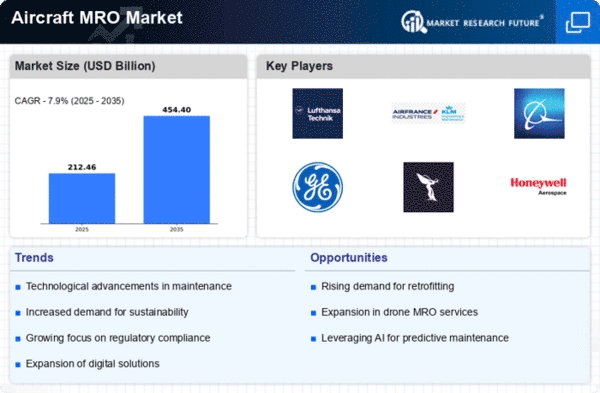
As per MRFR analysis, the Aircraft MRO Market Size was estimated at 196.9 USD Billion in 2024. The Aircraft MRO industry is projected to grow from 212.4 USD Billion in 2025 to 454.4 USD Billion by 2035, exhibiting a compound annual growth rate (CAGR) of 7.9 during the forecast period 2025 - 2035.

Key Market Trends & Highlights

The Aircraft MRO Market is poised for growth driven by technological advancements and sustainability initiatives.

  • North America remains the largest market for Aircraft MRO services, reflecting a mature aviation sector.
  • Asia-Pacific is emerging as the fastest-growing region, fueled by increasing air traffic and expanding airline networks.
  • Line Maintenance continues to dominate the market, while Component Maintenance is experiencing rapid growth due to technological innovations.
  • Key drivers such as the aging aircraft fleet and regulatory compliance are propelling demand for MRO services across both commercial and military aviation segments.

Market Size & Forecast

2024 Market Size 196.9 (USD Billion)
2035 Market Size 454.4 (USD Billion)
CAGR (2025 - 2035) 7.9%
Largest Regional Market Share in 2024 North America

Major Players

Lufthansa Technik (DE), Air France Industries KLM Engineering & Maintenance (FR), Boeing (US), General Electric (US), Rolls-Royce (GB), Honeywell Aerospace (US), MTU Aero Engines (DE), Safran (FR), HAECO (HK), ST Engineering (SG)

Market Trends

Aircraft MRO

Aircraft MRO Market Market Drivers

Fleet Modernization

Fleet modernization initiatives are a key driver in the Global aircraft mro Industry. Airlines are increasingly investing in newer, more efficient aircraft to enhance operational performance and reduce fuel consumption. This transition necessitates specialized MRO services tailored to the latest aircraft technologies. For instance, the introduction of composite materials and advanced avionics in new aircraft models requires MRO providers to adapt their capabilities accordingly. As airlines modernize their fleets, the demand for MRO services is expected to rise, further propelling the market's growth trajectory. This trend underscores the importance of innovation in maintaining competitiveness within the Global Aircraft MRO Market.

Regulatory Compliance

The Global Aircraft MRO Industry is significantly influenced by stringent regulatory requirements imposed by aviation authorities worldwide. These regulations mandate regular inspections, maintenance, and repairs to ensure aircraft safety and compliance with international standards. For example, the Federal Aviation Administration and the European Union Aviation Safety Agency enforce rigorous maintenance schedules that airlines must adhere to. This regulatory landscape compels airlines to invest in MRO services, thereby driving market growth. As the industry evolves, compliance with these regulations remains a critical factor, contributing to the anticipated increase in the Global Aircraft MRO Market to 192.7 USD Billion by 2035.

Increasing Air Traffic

The Global Aircraft MRO Industry is experiencing growth driven by the rising demand for air travel. As global air traffic continues to increase, airlines are compelled to maintain and enhance their fleets to meet passenger expectations. The International Air Transport Association projects that the number of air passengers will reach 8.2 billion by 2037, necessitating more frequent maintenance and repair services. This trend indicates a robust demand for MRO services, as airlines seek to ensure safety and reliability in their operations. Consequently, the Global Aircraft MRO Market is expected to reach 101.0 USD Billion in 2024, reflecting the industry's response to this growing need.

Market Growth Projections

The Global Aircraft MRO Industry is poised for substantial growth, with projections indicating a rise from 101.0 USD Billion in 2024 to 192.7 USD Billion by 2035. This growth trajectory reflects a compound annual growth rate of 6.05% from 2025 to 2035, driven by various factors including increasing air traffic, technological advancements, and regulatory compliance. The market's expansion is indicative of the broader trends within the aviation sector, where the demand for maintenance, repair, and overhaul services continues to escalate. This upward trend in market value underscores the critical role of MRO services in supporting the aviation industry's operational integrity and safety.

Sustainability Initiatives

Sustainability initiatives are becoming increasingly relevant within the Global Aircraft MRO Industry. Airlines are under pressure to reduce their environmental impact, prompting a shift towards more sustainable practices in maintenance and repair operations. This includes the adoption of eco-friendly materials, waste reduction strategies, and energy-efficient processes. For example, some MRO providers are implementing green technologies to minimize carbon footprints during maintenance activities. As sustainability becomes a priority for airlines, the demand for MRO services that align with these initiatives is likely to grow. This trend indicates a potential shift in market dynamics, as the industry adapts to evolving environmental standards.

Technological Advancements

Technological innovations play a pivotal role in shaping the Global Aircraft MRO Industry. The integration of advanced technologies such as predictive maintenance, artificial intelligence, and data analytics enhances operational efficiency and reduces downtime. For instance, predictive maintenance allows airlines to anticipate maintenance needs before they become critical, thereby optimizing resource allocation. This shift towards technology-driven solutions is likely to attract investments and improve service delivery in the MRO sector. As a result, the Global Aircraft MRO Market is projected to grow at a CAGR of 6.05% from 2025 to 2035, indicating a strong alignment with technological advancements.

Market Segment Insights

By Application: Line Maintenance (Largest) vs. Component Maintenance (Fastest-Growing)

In the Aircraft MRO Market, Line Maintenance holds the largest share, driven by the necessary routine checks and quick repairs that keep aircraft operational. This segment is crucial for airlines as it ensures minimal downtime and compliance with safety regulations. Component Maintenance follows closely, offering specialized services for aircraft parts, and is rapidly gaining traction due to the increasing complexity and technological advancements in components. As newer aircraft models enter service, there is a growing emphasis on component maintenance efficiency.

Line Maintenance (Dominant) vs. Component Maintenance (Emerging)

Line Maintenance is recognized as the dominant segment of the Aircraft MRO market due to its essential role in ensuring operational readiness and efficiency. With frequent inspections, repairs, and modifications performed between flights, this segment guarantees safety and compliance. On the other hand, Component Maintenance is emerging as a significant player as aircraft systems become increasingly sophisticated. This segment focuses on the maintenance of individual aircraft parts, incorporating advanced technologies like predictive maintenance and analytics to enhance performance. As airlines seek to optimize their operations, Component Maintenance is expected to witness robust growth driven by the need for increased reliability and safety in aviation.

By End Use: Commercial Aviation (Largest) vs. Military Aviation (Fastest-Growing)

The Aircraft MRO Market is majorly shaped by three end-use segments: Commercial Aviation, Military Aviation, and Cargo Aviation. Among these, Commercial Aviation occupies the largest market share, reflecting the vitality and extensive reliance on commercial flight operations globally. Military Aviation is gaining momentum, with an increasing budget allocation and modernization of military fleets which boosts the demand for maintenance, repair, and overhaul services. Cargo Aviation, while smaller in comparison, plays a significant support role in global trade and logistics, contributing to the overall market dynamics.

Commercial Aviation (Dominant) vs. Military Aviation (Emerging)

Commercial Aviation remains the dominant segment within the Aircraft MRO market due to its foundational role in global connectivity and travel. It encompasses a broad array of services ranging from routine maintenance to complex overhauls, driven by regulatory requirements and safety standards. Conversely, Military Aviation is emerging as a significant player, influenced by strategic military expansions and technological advancements in defense aircraft. This segment often demands specialized maintenance solutions to enhance operational readiness and ensure compliance with rigorous military standards, reflecting a proactive shift in investment towards advanced MRO capabilities.

By Service Type: Airframe Maintenance (Largest) vs. Engine Overhaul (Fastest-Growing)

In the Aircraft MRO Market, the Service Type segment consists of critical services such as Airframe Maintenance, Engine Overhaul, Component Repair, and Modification Services. Airframe Maintenance currently holds the largest share of the market owing to the essential nature of maintaining the core structure of the aircraft. On the other hand, Engine Overhaul is recognized as the fastest-growing segment, driven by stricter regulatory requirements and the increasing aging of aircraft fleets that necessitate timely engine servicing.

Airframe Maintenance (Dominant) vs. Engine Overhaul (Emerging)

Airframe Maintenance is a dominant player in the Aircraft MRO Market, essential for ensuring the structural integrity and safety of aircraft. This segment encompasses comprehensive inspections, repairs, and necessary alterations, which are not only crucial for adhering to safety standards but also extend the operational life of the aircraft. In contrast, Engine Overhaul is emerging rapidly, fueled by advancements in engine technology and heightened environmental standards. The need for more efficient fuel consumption and reduced emissions drives the demand for overhaul services, thus positioning it as a crucial segment for MRO providers looking to capture growth in this dynamic market.

By Maintenance Type: Scheduled Maintenance (Largest) vs. Unscheduled Maintenance (Fastest-Growing)

The Aircraft MRO market is primarily driven by Scheduled Maintenance, which holds the largest share due to its essential role in ensuring aircraft safety and compliance. This proactive approach helps in prolonging the asset's lifespan and reduces the risk of unforeseen mechanical failures. Unscheduled Maintenance, though currently smaller in share, has emerged as the fastest-growing segment, indicating a shifting focus on addressing unexpected operational challenges efficiently. As the aviation industry ramps up its operations, the demand for Unscheduled Maintenance is expected to rise significantly. This surge is driven by aging aircraft fleets and increased air travel worldwide, necessitating more responsive repair services. In contrast, Predictive Maintenance is gradually gaining traction, utilizing advanced analytics to forecast potential issues before they arise, effectively blending the benefits of both Scheduled and Unscheduled Maintenance strategies.

Scheduled Maintenance (Dominant) vs. Predictive Maintenance (Emerging)

Scheduled Maintenance stands out as the dominant force within the Maintenance Type segment, relying on pre-planned inspections and overhauls to adhere to aviation regulations and minimize downtime. Its systematic approach ensures that all maintenance needs are met timely, which is crucial in maintaining flight safety. Conversely, Predictive Maintenance represents an emerging trend characterized by the use of data analytics and IoT technologies to anticipate failures before they occur. While still gaining ground, this method promises to enhance operational efficiency and reduce costs by optimizing the maintenance schedule, ensuring that aircraft remain operational without the setbacks associated with unexpected repairs.

By Aircraft Type: Narrow Body Aircraft (Largest) vs. Wide Body Aircraft (Fastest-Growing)

In the Aircraft MRO market, Narrow Body Aircraft represent the largest share due to their extensive use in domestic and regional flights. These aircraft dominate the fleet, leading to increased demand for maintenance, repair, and overhaul services tailored for their unique operational requirements. Meanwhile, Wide Body Aircraft, while smaller in share, are the fastest-growing segment as international travel rebounds post-pandemic, necessitating focused MRO activity to maintain operational readiness.

Narrow Body Aircraft (Dominant) vs. Business Jets (Emerging)

Narrow Body Aircraft continue to dominate the Aircraft MRO market, primarily because they constitute a significant portion of the global airline fleet, thanks to their efficiency and versatility in various flight operations. The popularity of these aircraft in budget and scheduled airlines has led to increased demand for their maintenance services. On the other hand, Business Jets, although categorized as an emerging segment, are witnessing rapid growth, driven by a resurgence in private travel and corporate usage, emphasizing the need for specialized MRO services to cater to their unique operational and maintenance needs.

Get more detailed insights about Aircraft MRO Market Research Report – Global Forecast to 2035

Regional Insights

North America : Leading Market Innovators

North America continues to lead the Aircraft MRO market, holding a significant share of 98.45% in 2024. The region's growth is driven by increasing air travel demand, stringent safety regulations, and advancements in technology. The presence of major airlines and a robust supply chain further catalyze market expansion. Regulatory bodies are also emphasizing maintenance standards, ensuring high safety levels, which boosts demand for MRO services. The competitive landscape is characterized by key players such as Boeing, General Electric, and Honeywell Aerospace, which dominate the market with innovative solutions. The U.S. remains the largest contributor, supported by a well-established infrastructure and skilled workforce. Canada and Mexico are also emerging as significant players, enhancing the region's overall market dynamics. The focus on sustainability and efficiency in operations is shaping future growth trajectories.

Europe : Regulatory Framework and Growth

Europe's Aircraft MRO market is robust, with a market size of €54.12 billion. The region benefits from a strong regulatory framework that mandates high safety and maintenance standards, driving demand for MRO services. The increasing number of aircraft in operation and the push for modernization are key growth drivers. Additionally, the European Union's initiatives to enhance aviation safety and efficiency are pivotal in shaping market dynamics. Leading countries in this region include Germany, France, and the UK, where major players like Lufthansa Technik and Air France Industries KLM Engineering & Maintenance are headquartered. The competitive landscape is marked by collaborations and partnerships among companies to leverage technological advancements. The focus on digital transformation and predictive maintenance is expected to further enhance service offerings in the coming years.

Asia-Pacific : Emerging Market Opportunities

The Asia-Pacific region is witnessing significant growth in the Aircraft MRO market, with a market size of $36.23 billion. This growth is fueled by rising air travel demand, increasing fleet sizes, and the expansion of low-cost carriers. Additionally, government initiatives to enhance aviation infrastructure and safety regulations are pivotal in driving market dynamics. The region's focus on modernization and technological advancements is also contributing to the demand for MRO services. Countries like China, India, and Japan are leading the charge, with a growing number of key players such as ST Engineering and HAECO establishing a strong presence. The competitive landscape is evolving, with local companies increasingly partnering with global firms to enhance service capabilities. The emphasis on cost-effective solutions and efficiency is shaping the future of the MRO market in this region.

Middle East and Africa : Strategic Growth Initiatives

The Middle East and Africa region is emerging as a strategic player in the Aircraft MRO market, with a market size of $8.0 billion. The growth is driven by increasing air traffic, investments in aviation infrastructure, and a focus on enhancing operational efficiency. Regulatory bodies are also playing a crucial role in establishing safety standards, which is vital for market expansion. The region's strategic location as a global aviation hub further enhances its appeal for MRO services. Countries like the UAE and South Africa are at the forefront, with key players such as Emirates Engineering and Safran establishing operations. The competitive landscape is characterized by collaborations between local and international firms to leverage expertise and resources. The focus on sustainability and innovation is expected to drive future growth in the MRO sector across the region.

Key Players and Competitive Insights

The Aircraft MRO Market is characterized by a competitive landscape that is increasingly shaped by technological advancements and strategic partnerships. Key growth drivers include the rising demand for aircraft maintenance due to an expanding global fleet and the need for enhanced operational efficiency. Major players such as Lufthansa Technik (DE), Boeing (US), and Rolls-Royce (GB) are positioning themselves through innovation and digital transformation initiatives. For instance, Lufthansa Technik (DE) focuses on integrating advanced data analytics into its maintenance processes, thereby enhancing predictive maintenance capabilities. This strategic emphasis on technology not only improves service delivery but also strengthens their competitive edge in a market that is becoming more reliant on data-driven solutions.In terms of business tactics, companies are increasingly localizing manufacturing and optimizing supply chains to enhance responsiveness and reduce costs. The market structure appears moderately fragmented, with several key players exerting considerable influence. This fragmentation allows for a diverse range of services and innovations, yet the collective strength of major companies like Boeing (US) and General Electric (US) suggests a competitive environment where scale and technological prowess are paramount.

In November Boeing (US) announced a strategic partnership with a leading AI firm to develop predictive maintenance solutions that leverage machine learning algorithms. This move is significant as it underscores Boeing's commitment to enhancing operational efficiency and reducing downtime for airlines. By integrating AI into their MRO services, Boeing aims to provide more reliable and timely maintenance solutions, which could potentially reshape customer expectations in the industry.Similarly, in October 2025, Rolls-Royce (GB) unveiled a new digital platform designed to streamline maintenance operations for its engines. This platform utilizes real-time data analytics to optimize maintenance schedules and improve overall engine performance. The introduction of such technology not only enhances Rolls-Royce's service offerings but also positions the company as a leader in the digital transformation of the MRO sector, potentially attracting new clients seeking advanced solutions.

In December Air France Industries KLM Engineering & Maintenance (FR) launched a sustainability initiative aimed at reducing carbon emissions in its maintenance operations. This initiative includes the adoption of eco-friendly materials and processes, reflecting a growing trend towards sustainability in the MRO market. By prioritizing environmental responsibility, Air France Industries KLM is likely to appeal to a broader customer base that values sustainable practices, thereby enhancing its competitive positioning.

As of December the Aircraft MRO Market is witnessing trends that emphasize digitalization, sustainability, and the integration of AI technologies. Strategic alliances are becoming increasingly vital, as companies seek to leverage complementary strengths to enhance service offerings. The competitive differentiation is likely to evolve from traditional price-based competition to a focus on innovation, technological advancements, and supply chain reliability. This shift indicates a future where companies that prioritize these elements will be better positioned to thrive in an ever-evolving market.

Key Companies in the Aircraft MRO Market include

Industry Developments

  • Q2 2025: Lufthansa Technik opens new MRO facility in Manila to expand Asia-Pacific operations Lufthansa Technik inaugurated a new aircraft maintenance, repair, and overhaul (MRO) facility in Manila, Philippines, aiming to meet rising demand for MRO services in the Asia-Pacific region and support its growing airline customer base.
  • Q2 2025: Delta TechOps secures multi-year MRO contract with LATAM Airlines Delta TechOps announced a multi-year agreement to provide engine maintenance and overhaul services for LATAM Airlines' fleet, strengthening its position as a leading independent MRO provider in the Americas.
  • Q1 2025: Embraer launches new MRO center in Dubai to serve EMEA customers Embraer officially opened a new MRO center in Dubai, United Arab Emirates, expanding its global support network and enhancing service capabilities for commercial and executive jets in Europe, the Middle East, and Africa.
  • Q2 2024: Rolls-Royce and SIA Engineering form joint venture for next-generation engine MRO Rolls-Royce and SIA Engineering Company announced the formation of a joint venture in Singapore focused on MRO services for new-generation Trent engines, targeting growing demand from Asia-Pacific carriers.
  • Q3 2024: ST Engineering wins $600 million MRO contract from major US airline ST Engineering secured a $600 million contract to provide heavy maintenance and modification services for a major US airline's narrowbody fleet, marking one of the largest MRO deals in the company's history.
  • Q1 2025: AFI KLM E&M acquires majority stake in South African MRO provider SAA Technical AFI KLM E&M completed the acquisition of a majority stake in SAA Technical, expanding its footprint in Africa and enhancing its ability to serve regional and international airline customers.
  • Q2 2024: Honeywell launches predictive maintenance platform for commercial aircraft MRO Honeywell introduced a new digital platform leveraging AI and IoT to enable predictive maintenance for commercial aircraft, aiming to reduce downtime and optimize MRO operations for airline customers.
  • Q4 2024: AAR Corp. signs long-term MRO support agreement with Air India AAR Corp. entered into a long-term agreement to provide component repair and supply chain services for Air India's expanding fleet, supporting the airline's growth and modernization plans.
  • Q3 2024: Safran inaugurates new engine MRO facility in Hyderabad, India Safran opened a new engine MRO facility in Hyderabad, India, to support the growing fleet of CFM engines in the region and strengthen its service network in South Asia.
  • Q1 2025: StandardAero acquires Vector Aerospace to expand global MRO capabilities StandardAero completed the acquisition of Vector Aerospace, significantly expanding its global MRO footprint and service offerings for both commercial and military aircraft.
  • Q2 2024: Boeing Global Services opens new MRO facility in Miami Boeing Global Services opened a new MRO facility in Miami, Florida, to provide maintenance and modification services for commercial and government customers in the Americas.
  • Q4 2024: MTU Aero Engines and Pratt & Whitney sign partnership for GTF engine MRO in Europe MTU Aero Engines and Pratt & Whitney announced a partnership to establish a new MRO center in Germany dedicated to servicing GTF engines, addressing increasing demand from European airlines.


Future Outlook

Aircraft MRO Market Future Outlook

The Aircraft MRO Market is projected to grow at a 7.9% CAGR from 2025 to 2035, driven by technological advancements, increasing air traffic, and regulatory compliance demands.

New opportunities lie in:

  • Implementation of predictive maintenance technologies to reduce downtime.
  • Expansion of digital MRO platforms for enhanced operational efficiency.
  • Development of eco-friendly MRO solutions to meet sustainability goals.

By 2035, the Aircraft MRO Market is expected to be robust, driven by innovation and increased demand.

Market Segmentation

Aircraft MRO Market End Use Outlook

  • Commercial Aviation
  • Military Aviation
  • Cargo Aviation

Aircraft MRO Market Application Outlook

  • Line Maintenance
  • Base Maintenance
  • Component Maintenance
  • Engine Maintenance

Aircraft MRO Market Service Type Outlook

  • Airframe Maintenance
  • Engine Overhaul
  • Component Repair
  • Modification Services

Aircraft MRO Market Aircraft Type Outlook

  • Narrow Body Aircraft
  • Wide Body Aircraft
  • Regional Aircraft
  • Business Jets

Aircraft MRO Market Maintenance Type Outlook

  • Scheduled Maintenance
  • Unscheduled Maintenance
  • Predictive Maintenance

Report Scope

MARKET SIZE 2024196.9(USD Billion)
MARKET SIZE 2025212.4(USD Billion)
MARKET SIZE 2035454.4(USD Billion)
COMPOUND ANNUAL GROWTH RATE (CAGR)7.9% (2025 - 2035)
REPORT COVERAGERevenue Forecast, Competitive Landscape, Growth Factors, and Trends
BASE YEAR2024
Market Forecast Period2025 - 2035
Historical Data2019 - 2024
Market Forecast UnitsUSD Billion
Key Companies ProfiledLufthansa Technik (DE), Air France Industries KLM Engineering & Maintenance (FR), Boeing (US), General Electric (US), Rolls-Royce (GB), Honeywell Aerospace (US), MTU Aero Engines (DE), Safran (FR), HAECO (HK), ST Engineering (SG)
Segments CoveredApplication, End Use, Service Type, Maintenance Type, Aircraft Type
Key Market OpportunitiesIntegration of advanced predictive maintenance technologies enhances efficiency in the Aircraft MRO Market.
Key Market DynamicsTechnological advancements and regulatory changes drive competitive dynamics in the Aircraft Maintenance, Repair, and Overhaul market.
Countries CoveredNorth America, Europe, APAC, South America, MEA

FAQs

What can be the market value by 2030?

Aircraft MRO Market Grow at a CAGR Of 6.05% by 2023 -2030

What are the key growth rendering factors in the worldwide market?

The key growth rendering factors in the worldwide market are increased focus of OEMs on aircraft MRO service and rapid aircraft fleet expansion. Also, the increased need for proper maintenance of engines & components is driving the growth of the aircraft MRO market.

Which region holds the highest share in the global market?

APAC holds the highest share in the global market.

What are the significant opportunities in the global market?

The significant opportunities in the global market include outsourcing of the aircraft engine MRO to third-party vendors.

What are the primary MRO types considered in the report?

The primary MRO types considered in the report include Airframe, Line Maintenance, Engine, Modifications, Component, and more.

  1. SECTION I: EXECUTIVE SUMMARY AND KEY HIGHLIGHTS
    1. | 1.1 EXECUTIVE SUMMARY
    2. | 1.1.1 Market Overview
    3. | 1.1.2 Key Findings
    4. | 1.1.3 Market Segmentation
    5. | 1.1.4 Competitive Landscape
    6. | 1.1.5 Challenges and Opportunities
    7. | 1.1.6 Future Outlook
  2. SECTION II: SCOPING, METHODOLOGY AND MARKET STRUCTURE
    1. | 2.1 MARKET INTRODUCTION
    2. | 2.1.1 Definition
    3. | 2.1.2 Scope of the study
    4. |-- 2.1.2.1 Research Objective
    5. |-- 2.1.2.2 Assumption
    6. |-- 2.1.2.3 Limitations
    7. | 2.2 RESEARCH METHODOLOGY
    8. | 2.2.1 Overview
    9. | 2.2.2 Data Mining
    10. | 2.2.3 Secondary Research
    11. | 2.2.4 Primary Research
    12. |-- 2.2.4.1 Primary Interviews and Information Gathering Process
    13. |-- 2.2.4.2 Breakdown of Primary Respondents
    14. | 2.2.5 Forecasting Model
    15. | 2.2.6 Market Size Estimation
    16. |-- 2.2.6.1 Bottom-Up Approach
    17. |-- 2.2.6.2 Top-Down Approach
    18. | 2.2.7 Data Triangulation
    19. | 2.2.8 Validation
  3. SECTION III: QUALITATIVE ANALYSIS
    1. | 3.1 MARKET DYNAMICS
    2. | 3.1.1 Overview
    3. | 3.1.2 Drivers
    4. | 3.1.3 Restraints
    5. | 3.1.4 Opportunities
    6. | 3.2 MARKET FACTOR ANALYSIS
    7. | 3.2.1 Value chain Analysis
    8. | 3.2.2 Porter's Five Forces Analysis
    9. |-- 3.2.2.1 Bargaining Power of Suppliers
    10. |-- 3.2.2.2 Bargaining Power of Buyers
    11. |-- 3.2.2.3 Threat of New Entrants
    12. |-- 3.2.2.4 Threat of Substitutes
    13. |-- 3.2.2.5 Intensity of Rivalry
    14. | 3.2.3 COVID-19 Impact Analysis
    15. |-- 3.2.3.1 Market Impact Analysis
    16. |-- 3.2.3.2 Regional Impact
    17. |-- 3.2.3.3 Opportunity and Threat Analysis
  4. SECTION IV: QUANTITATIVE ANALYSIS
    1. | 4.1 Aerospace & Defense, BY Application (USD Billion)
    2. | 4.1.1 Line Maintenance
    3. | 4.1.2 Base Maintenance
    4. | 4.1.3 Component Maintenance
    5. | 4.1.4 Engine Maintenance
    6. | 4.2 Aerospace & Defense, BY End Use (USD Billion)
    7. | 4.2.1 Commercial Aviation
    8. | 4.2.2 Military Aviation
    9. | 4.2.3 Cargo Aviation
    10. | 4.3 Aerospace & Defense, BY Service Type (USD Billion)
    11. | 4.3.1 Airframe Maintenance
    12. | 4.3.2 Engine Overhaul
    13. | 4.3.3 Component Repair
    14. | 4.3.4 Modification Services
    15. | 4.4 Aerospace & Defense, BY Maintenance Type (USD Billion)
    16. | 4.4.1 Scheduled Maintenance
    17. | 4.4.2 Unscheduled Maintenance
    18. | 4.4.3 Predictive Maintenance
    19. | 4.5 Aerospace & Defense, BY Aircraft Type (USD Billion)
    20. | 4.5.1 Narrow Body Aircraft
    21. | 4.5.2 Wide Body Aircraft
    22. | 4.5.3 Regional Aircraft
    23. | 4.5.4 Business Jets
    24. | 4.6 Aerospace & Defense, BY Region (USD Billion)
    25. | 4.6.1 North America
    26. |-- 4.6.1.1 US
    27. |-- 4.6.1.2 Canada
    28. | 4.6.2 Europe
    29. |-- 4.6.2.1 Germany
    30. |-- 4.6.2.2 UK
    31. |-- 4.6.2.3 France
    32. |-- 4.6.2.4 Russia
    33. |-- 4.6.2.5 Italy
    34. |-- 4.6.2.6 Spain
    35. |-- 4.6.2.7 Rest of Europe
    36. | 4.6.3 APAC
    37. |-- 4.6.3.1 China
    38. |-- 4.6.3.2 India
    39. |-- 4.6.3.3 Japan
    40. |-- 4.6.3.4 South Korea
    41. |-- 4.6.3.5 Malaysia
    42. |-- 4.6.3.6 Thailand
    43. |-- 4.6.3.7 Indonesia
    44. |-- 4.6.3.8 Rest of APAC
    45. | 4.6.4 South America
    46. |-- 4.6.4.1 Brazil
    47. |-- 4.6.4.2 Mexico
    48. |-- 4.6.4.3 Argentina
    49. |-- 4.6.4.4 Rest of South America
    50. | 4.6.5 MEA
    51. |-- 4.6.5.1 GCC Countries
    52. |-- 4.6.5.2 South Africa
    53. |-- 4.6.5.3 Rest of MEA
  5. SECTION V: COMPETITIVE ANALYSIS
    1. | 5.1 Competitive Landscape
    2. | 5.1.1 Overview
    3. | 5.1.2 Competitive Analysis
    4. | 5.1.3 Market share Analysis
    5. | 5.1.4 Major Growth Strategy in the Aerospace & Defense
    6. | 5.1.5 Competitive Benchmarking
    7. | 5.1.6 Leading Players in Terms of Number of Developments in the Aerospace & Defense
    8. | 5.1.7 Key developments and growth strategies
    9. |-- 5.1.7.1 New Product Launch/Service Deployment
    10. |-- 5.1.7.2 Merger & Acquisitions
    11. |-- 5.1.7.3 Joint Ventures
    12. | 5.1.8 Major Players Financial Matrix
    13. |-- 5.1.8.1 Sales and Operating Income
    14. |-- 5.1.8.2 Major Players R&D Expenditure. 2023
    15. | 5.2 Company Profiles
    16. | 5.2.1 Lufthansa Technik (DE)
    17. |-- 5.2.1.1 Financial Overview
    18. |-- 5.2.1.2 Products Offered
    19. |-- 5.2.1.3 Key Developments
    20. |-- 5.2.1.4 SWOT Analysis
    21. |-- 5.2.1.5 Key Strategies
    22. | 5.2.2 Air France Industries KLM Engineering & Maintenance (FR)
    23. |-- 5.2.2.1 Financial Overview
    24. |-- 5.2.2.2 Products Offered
    25. |-- 5.2.2.3 Key Developments
    26. |-- 5.2.2.4 SWOT Analysis
    27. |-- 5.2.2.5 Key Strategies
    28. | 5.2.3 Boeing (US)
    29. |-- 5.2.3.1 Financial Overview
    30. |-- 5.2.3.2 Products Offered
    31. |-- 5.2.3.3 Key Developments
    32. |-- 5.2.3.4 SWOT Analysis
    33. |-- 5.2.3.5 Key Strategies
    34. | 5.2.4 General Electric (US)
    35. |-- 5.2.4.1 Financial Overview
    36. |-- 5.2.4.2 Products Offered
    37. |-- 5.2.4.3 Key Developments
    38. |-- 5.2.4.4 SWOT Analysis
    39. |-- 5.2.4.5 Key Strategies
    40. | 5.2.5 Rolls-Royce (GB)
    41. |-- 5.2.5.1 Financial Overview
    42. |-- 5.2.5.2 Products Offered
    43. |-- 5.2.5.3 Key Developments
    44. |-- 5.2.5.4 SWOT Analysis
    45. |-- 5.2.5.5 Key Strategies
    46. | 5.2.6 Honeywell Aerospace (US)
    47. |-- 5.2.6.1 Financial Overview
    48. |-- 5.2.6.2 Products Offered
    49. |-- 5.2.6.3 Key Developments
    50. |-- 5.2.6.4 SWOT Analysis
    51. |-- 5.2.6.5 Key Strategies
    52. | 5.2.7 MTU Aero Engines (DE)
    53. |-- 5.2.7.1 Financial Overview
    54. |-- 5.2.7.2 Products Offered
    55. |-- 5.2.7.3 Key Developments
    56. |-- 5.2.7.4 SWOT Analysis
    57. |-- 5.2.7.5 Key Strategies
    58. | 5.2.8 Safran (FR)
    59. |-- 5.2.8.1 Financial Overview
    60. |-- 5.2.8.2 Products Offered
    61. |-- 5.2.8.3 Key Developments
    62. |-- 5.2.8.4 SWOT Analysis
    63. |-- 5.2.8.5 Key Strategies
    64. | 5.2.9 HAECO (HK)
    65. |-- 5.2.9.1 Financial Overview
    66. |-- 5.2.9.2 Products Offered
    67. |-- 5.2.9.3 Key Developments
    68. |-- 5.2.9.4 SWOT Analysis
    69. |-- 5.2.9.5 Key Strategies
    70. | 5.2.10 ST Engineering (SG)
    71. |-- 5.2.10.1 Financial Overview
    72. |-- 5.2.10.2 Products Offered
    73. |-- 5.2.10.3 Key Developments
    74. |-- 5.2.10.4 SWOT Analysis
    75. |-- 5.2.10.5 Key Strategies
    76. | 5.3 Appendix
    77. | 5.3.1 References
    78. | 5.3.2 Related Reports

Aerospace & Defense Market Segmentation

Aerospace & Defense By Application (USD Billion, 2025-2035)

  • Line Maintenance
  • Base Maintenance
  • Component Maintenance
  • Engine Maintenance

Aerospace & Defense By End Use (USD Billion, 2025-2035)

  • Commercial Aviation
  • Military Aviation
  • Cargo Aviation

Aerospace & Defense By Service Type (USD Billion, 2025-2035)

  • Airframe Maintenance
  • Engine Overhaul
  • Component Repair
  • Modification Services

Aerospace & Defense By Maintenance Type (USD Billion, 2025-2035)

  • Scheduled Maintenance
  • Unscheduled Maintenance
  • Predictive Maintenance

Aerospace & Defense By Aircraft Type (USD Billion, 2025-2035)

  • Narrow Body Aircraft
  • Wide Body Aircraft
  • Regional Aircraft
  • Business Jets
Infographic

Free Sample Request

Kindly complete the form below to receive a free sample of this Report

Get Free Sample

Customer Strories

Compare Licence

×
Features License Type
Single User Multiuser License Enterprise User
Price $4,950 $5,950 $7,250
Maximum User Access Limit 1 User Upto 10 Users Unrestricted Access Throughout the Organization
Free Customization
Direct Access to Analyst
Deliverable Format
Platform Access
Discount on Next Purchase 10% 15% 15%
Printable Versions