×
Request Free Sample ×

Kindly complete the form below to receive a free sample of this Report

* Please use a valid business email

Leading companies partner with us for data-driven Insights

clients tt-cursor
Hero Background

Aircraft Video Surveillance Systems Market

ID: MRFR/AD/66508-CR
100 Pages
Aarti Dhapte
January 2026

Aircraft Video Surveillance Systems Market Research Report by Aircraft Type (Commercial Aviation, Military Aviation, General and Business Aviation, Advanced Air Mobility), by System Type (Cockpit Door Surveillance, Cabin Surveillance, External Surveillance, Flight Deck Entry Video Surveillance, Others), by Assembly (Retro-Fit, Line-Fit), by End User (Commercial Aviation Operators, Business Aviation Operators, Military & Defense Operators, Government & Law Enforcement Agencies), By Region – Forecast to 2035

Share:
Download PDF ×

We do not share your information with anyone. However, we may send you emails based on your report interest from time to time. You may contact us at any time to opt-out.

Purchase Options

Aircraft Video Surveillance Systems Market Summary

As per Market Research Future analysis, the Aircraft Video Surveillance Systems Market Size Was Valued at USD 311.37 Million in 2024. The Global Aircraft Video Surveillance Systems Industry Is Projected to grow from USD 365.51 Million in 2025 to USD 603.05 Million by 2035, Exhibiting A Compound Annual Growth Rate (CAGR) of 5.13% during the Forecast Period (2025 - 2035).

Key Market Trends & Highlights

The Aircraft Video Surveillance Systems Market, which includes cockpit door surveillance, cabin surveillance, external surveillance, flight deck entry video surveillance and others, is experiencing steady growth due to demand for surveillance, increasing commercial aircraft deliveries around the world, and growth in aircraft production. The global aircraft video surveillance systems is witnessing steady growth driven by:

Market Size & Forecast

2024 Market Size 311.37 (USD Million)
2035 Market Size 603.05 (USD Million)
CAGR (2025 - 2035) 5.13%

Major Players

AD Aerospace, Cabin Avionics, Collins Aerospace, Eirtech Aviation Services, Honey Optics, Kappa Optronics GmbH, KID-Systeme GmbH, Latecoere, Parket Meggitt PLC, And Otonomy Aviation.

Our Impact
Enabled $4.3B Revenue Impact for Fortune 500 and Leading Multinationals
Partnering with 2000+ Global Organizations Each Year
30K+ Citations by Top-Tier Firms in the Industry

Aircraft Video Surveillance Systems Market Trends

Adoption of AI and predictive analytics in surveillance systems

The combination of artificial intelligence (AI) and predictive analytics is becoming one of the most important trends in the aircraft video surveillance system market. Manual monitoring and reviewing of the traditional systems were overly relied upon, but the increased complexity in the air travel operations and increased interest in safety are fueling the move towards smarter and more automated solutions. Live video feeds can be analyzed by AI-powered devices in real time, and unusual behaviors, unattended baggage, or unauthorized cockpit access detected with far more precision than with human eyes. Predictive analytics can also expand these features by leveraging past data to predict what could happen or what risks may occur and prevent them before they develop, allowing proactive security controls.

This tendency is especially significant because airlines and aviation authorities are interested in enhancing the security measures without raising the amount of work performed by the crew to a large extent. AI-based surveillance will decrease the number of false alarms and offer actionable information, which enables flight crews and ground operators to devote their attention to making important decisions. In addition, having these systems capable of constantly learning and adapting enhances their efficiency in the long run, so that surveillance capabilities can change in line with the new security threats.

AI and predictive analytics are also used to optimize operational efficiency, in addition to safety. As an example, the data from surveillance can be utilized to track the processes of ground handling, maintenance, and flow of passengers, and assist the airlines in organizing ground operations and lowering turnaround times. Predictive security and operational intelligence are likely to become one of the trends of this market, with AI increasingly integrated into aircraft video surveillance systems as it becomes more affordable and scalable.

Regional Insights

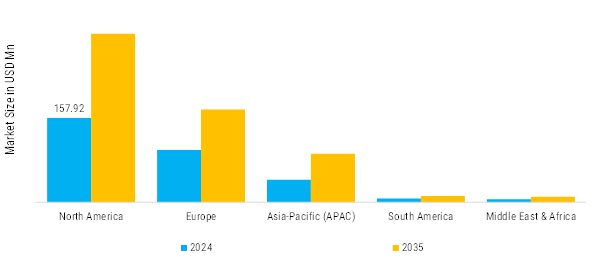
Based on region, the Aircraft Video Surveillance Systems Market is segmented into North America, Europe, Asia-Pacific, South America and Middle East and Africa. North America accounted for the largest market share in 2024 and is anticipated to reach USD 603.05 Million by 2035. Asia-Pacific is projected to grow at the highest CAGR of 5.13% during the forecast period.

North America: Most Established Market

North America remains the biggest and most established market of aircraft video surveillance system (AVSS) due to its highly advanced aviation ecosystem, stringent security requirements and passenger traffic. The region is dominated by the United States with the regulatory authorities of the Federal Aviation Administration (FAA) and Transportation Security Administration (TSA) imposing high standards on in-flight safety and monitoring. Airlines such as American Airlines, United Airline and Delta Air Line are busy updating their fleets with state of the art cabin and cockpit surveillance to ensure compliance and to enhance passenger confidence. Moreover, the quick restoration of the air traffic volumes after the pandemic has contributed to the further increase in the use of safety-enhancing technologies as operators aim at reducing the risk of unruly passengers, unauthorized access, or cargo security violations. Although on a smaller scale, Canada is no exception and Air Canada and WestJet are actively modernizing their onboard surveillance to comply with the changing requirements around the world.
Europe: Highly Regulatory and Manufacturing Base

Another large market in aircraft video surveillance systems is Europe that enjoys high regulatory environment, good manufacturing base, and a well-linked air transportation network. The European Union Aviation Safety Agency (EASA) is at the heart of influencing the AVSS adoption in that it sets high standards of safety that compel airlines to adopt the advanced surveillance solution. Lufthansa, British Airways, Air France-KLM, and Ryanair are some of the largest airlines in Europe and have been at the forefront of the adoption, as they are updating their fleets with systems that enhance safety of passengers, security of cargo and monitoring of the cockpit. Such investments are especially relevant considering the high intra-European flight density, where the large number of passengers and the repetitive cross-border flights predetermine the security as one of the priorities. Airlines are also considering how to restore passenger trust after the pandemic, in which overt investments in surveillance and safety technology will be a competitive advantage.

Asia-pacific: Experiencing Dynamic Growth

Asia-Pacific has been the most dynamic region in the world aircraft video surveillance system market owing to the increase in passenger traffic, growth in airline fleets and growth in safety regulations. The leading countries such as China and India are experiencing a rapid rise in the domestic and international air travel. China Southern Airlines, Air China, IndiGo and Air India are aggressively buying next-generation aircraft with a lot of them having sophisticated surveillance systems. The rise of the low-cost carriers within the Southeast Asian market such as AirAsia and VietJet has also increased the demand of AVSS as these airlines strive to improve the safety measures as they develop consumer trust. The rapid increase in passenger numbers within the area is what causes real-time cabin and cockpit surveillance to become a priority of the operational safety and the international technology of aviation.Another significant driver is modernization of the fleet. The native Chinese COMAC C919 initiative is also stimulating the adoption of local AVSS technologies, and the current development of aviation infrastructure in India via the UDAN initiative is opening up opportunities of adoption of advanced surveillance.

South America: Steadily Emerging and Growing

South America is a market that is steadily increasing in the need of aircraft video surveillance systems due to the increasing passenger demand, the increasing region connectivity and the progressive fleet modernization. Brazil and Mexico continue to be the biggest contributors as they have major carriers like LATAM Airlines, Gol Linhas Aereas and Aeromexico. The airlines are also investing in increased safety technologies to meet the international aviation standards as well as the increasing consumer demands in the in-flight security. The importance of AVSS in the safety of operations has been increasing as air travel has become more important in regional connectivity, especially in the vast and diverse geographies of South America. There is also cargo transport particularly agricultural exports, which has contributed to the need to have a strong surveillance in cargo holds.

Middle-East & Africa: Most Diverse Region

The Middle East and Africa constitute a very diverse yet a growing region of aircraft video surveillance system. The Middle East, especially has emerged as a global aviation hub with Emirates, Qatar Airways, Etihad Airways, and Saudi Arabian Airlines being the first to implement the use of advanced surveillance systems. The Saudi vision 2030 aviation growth plans, the airport infrastructure modernization, and Qatar are driving mass acquisitions of next-generation aircraft with AVSS. These are the competing airlines that compete on the quality of the services offered globally and consider the advanced onboard safety technologies as the major differentiators. Demand is also driven by the geopolitical environment of the region whereby governments are keen on both commercial and defence surveillance systems as a means of ensuring that operations are not jeopardized by any threat.


Key Players and Competitive Insights

Many global, regional, and local vendors characterize the Aircraft Video Surveillance Market. Several companies are leading the way as disruptors and innovators in the global aircraft video surveillance market by introducing groundbreaking technologies and sustainable solutions. AD Aerospace, Collins Aerospace, Kappa optronics, Otonomy Aviation, Parker Meggitt, Latecoere, and KID-Systeme are leading companies, and Collins and AD Aerospace are ahead on OEM integration and technology development.


Other recent developments are lightweight high-definition cameras, low-light and infrared imaging, AI-powered monitoring, and connectivity with inflight entertainment and connectivity systems. The market is also emphasizing rugged, robust systems that can be used in diverse conditions, and modularity designed for retrofits and maintenance simplicity. Collaborative efforts by airlines, aircraft builders, and technology providers are driving deployments faster.

Industry Developments

August 2025: Collins Aerospace is now providing JetBlue with FlightAware Foresight technology, a predictive analytics tool that helps airlines manage operations by improving visibility, efficiency and decision-making across the flight ecosystem.

Future Outlook

Aircraft Video Surveillance Systems Market Future Outlook

The Aircraft Video Surveillance Systems Market is projected to grow at a 5.13% CAGR from 2025 to 2035, driven by the increasing no of aircrafts, increasing defence needs and rising demand for surveillance and AI based security.

New opportunities lie in:

  • Emerging markets are investing in modernizing aircraft technology
  • Growth in the commercial aviation sector and increased air travel

As per the global aviation bodies and forecasts, the growing demand for air transport and an increase in the number of aircraft, especially in the Asia-Pacific, the Middle East, and parts of Latin America, are creating immense opportunities for the global aircraft surveillance market. The growing economies are now investing in the modernization of aircraft technology to meet global aviation safety standards. As airlines in these countries are acquiring new aircraft and upgrading their existing fleets, the need to integrate advanced video surveillance systems during the manufacturing and upgrade processes is becoming a priority.

Report Scope

Market Size 2024 311.37 (USD Million)
Market Size 2025 365.51 (USD Million)
Market Size 2035 603.05 (USD Million)
Compound Annual Growth Rate (CAGR) 5.13% (2025 - 2035)
Report Coverage Revenue Forecast, Competitive Landscape, Growth Factors, and Trends
Base Year 2024
Market Forecast Period 2025 - 2035
Historical Data 2019 - 2023
Market Forecast Units USD Million
Key Companies Profiled AD Aerospace, Cabin Avionics, Collins Aerospace, Eirtech Aviation Services, Honey Optics, Kappa Optronics GmbH, KID-Systeme GmbH, Latecoere, Parket Meggitt PLC, And Otonomy Aviation.
Segments Covered By Aircraft Type, By System Type, By Assembly, By End User
Key Market Opportunities ·         Potential for integration of AI and machine learning for advanced monitoring       ·         Emerging markets are investing in modernizing aircraft technology ·         Growth in the commercial aviation sector and increased air travel
Key Market Dynamics ·         Adoption of AI and predictive analytics in surveillance systems ·         Integration of cloud and edge computing for real-time monitoring
Region Covered North America, Europe, APAC, South America, MEA
Leave a Comment
Download Free Sample

Kindly complete the form below to receive a free sample of this Report

Compare Licence

×
Features License Type
Single User Multiuser License Enterprise User
Price $4,950 $5,950 $7,250
Maximum User Access Limit 1 User Upto 10 Users Unrestricted Access Throughout the Organization
Free Customization
Direct Access to Analyst
Deliverable Format
Platform Access
Discount on Next Purchase 10% 15% 15%
Printable Versions