
×
  • Cat-intel
  • MedIntelliX
  • Resources
  • About Us
  • Hero Background
    English
    Chinese
    French
    Japanese
    Korean
    German
    Spanish

    AI Recruitment Market Analysis

    ID: MRFR/ICT/6817-HCR
    111 Pages
    Aarti Dhapte
    October 2025

    AI Recruitment Market Research Report Information by Component (Software, Service), by Deployment (On-Cloud, On-Premise), by Vertical (Government, IT and Telecommunication, Healthcare, BFSI, Education, Enterprise, Others), and By Region (Asia-Pacific, North America, Europe, and Rest of the World) - Forecast till 2035.

    Share:
    Download PDF ×

    We do not share your information with anyone. However, we may send you emails based on your report interest from time to time. You may contact us at any time to opt-out.

    AI Recruitment Market Infographic
    Purchase Options

    Market Analysis

    In-depth Analysis of AI Recruitment Market Industry Landscape

    The structure of the market for AI recruitmen is now changing dramatically as more and more artificial intelligence technologies are integrated into hiring procedures. As organizations in different industries see the value of utilizing AI to simplify and improve recruitment, this has caused significant interest amongst solution providers. There is one major factor driving this market growth: the need to be efficient and precise in acquiring talent. With AI technologies, recruiters can easily scan massive amounts of data and pinpoint relevant candidate profiles to make decisions based on objective facts.

    This also speeds up the recruiting process, and hires become more closely attuned to what an organization needs. In addition, the AI recruitment market is seeing a rise in machine learning adoption. Employing machine learning, recruiters can make better decisions and fully prepare for future human resources requirements. This predictive capability saves time and helps organizations to maintain a leading edge in getting top talent. Another trend in the AI recruitment market is integrating natural language processing (NLP). With NLP, machines can read and comprehend human language. This makes it easier to evaluate resumes, job descriptions or the communication between recruiters and applicants. This streamlines the hiring process and raises candidates 'involvement, making interactions more personalized and responsive. The trend of distributed work and the globalization of labor have also weighed on market dynamics for AI recruitment.

    With organizations looking to recruit people worldwide, AI tools help find and assess candidates without the restriction of physical closeness. It's generated a more open-door approach to hiring, enabling companies to draw talent from all quarters and put together multifaceted dream teams. But the coming dependence on AI in recruitment is a tough assignment. Bias in algorithms and possible reinforcement of existing inequality are problems the industry must overcome. The ethical framing of the question about how to use AI in recruitment is becoming increasingly common, requiring organizations (large or small) that develop or apply their own recruiting tools and technologies to consider putting fairness atop design principles for applications.


    Author
    Aarti Dhapte
    Team Lead - Research

    She holds an experience of about 6+ years in Market Research and Business Consulting, working under the spectrum of Information Communication Technology, Telecommunications and Semiconductor domains. Aarti conceptualizes and implements a scalable business strategy and provides strategic leadership to the clients. Her expertise lies in market estimation, competitive intelligence, pipeline analysis, customer assessment, etc.

    Leave a Comment

    FAQs

    How much is the AI Recruitment market?

    The market for AI Recruitment was USD 577.7 Million in 2023.

    What is the market size for 2030 for the AI Recruitment market?

    The analytics market is expected to be USD 1,053.16 Million in 2032.

    What is the growth rate of the AI Recruitment market?

    The growth rate for the AI Recruitment market is 6.9% through the forecast period.

    Which region held the largest market share in the AI Recruitment market?

    At present, the North American region holds the largest market share.

    Who are the prominent players in the AI Recruitment market?

    The major players dominating the market are including PandoLogic, Inc., Leoforce, LLC, Harver B.V., Hackajob Ltd., Jobvite, Brilent, Inc., Entelo, Inc., and others.

    Market Summary

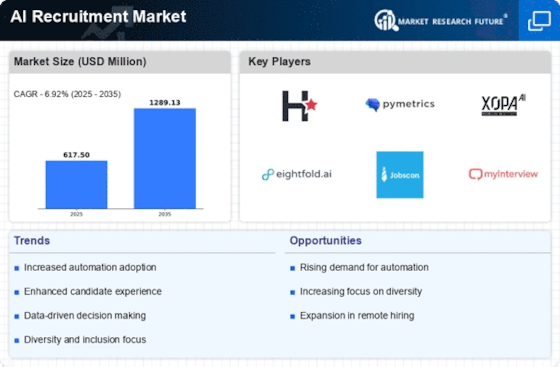
    As per Market Research Future Analysis, the AI Recruitment Market was valued at USD 617.50 Million in 2024 and is projected to reach USD 1289.13 Million by 2035, growing at a CAGR of 6.92% from 2025 to 2035. The market growth is driven by the need for efficient candidate screening, reduced HR spending, and the automation of recruitment processes. AI technologies, including Applicant Tracking Systems and Bots, enhance recruitment efficiency by quickly processing large volumes of applications and improving candidate engagement.

    Key Market Trends & Highlights

    Key trends driving the AI Recruitment Market include technological advancements and increased adoption across various sectors.

    • AI recruitment Market Size in 2024: USD 617.50 Million. Enterprise segment expected to grow at the fastest CAGR of 9.14% through the forecast period. Cloud deployment dominates with a market share of 67.2% and a projected CAGR of 6.81%.

    Market Size & Forecast

    2024 Market Size USD 617.50 Million
    2035 Market Size USD 1289.13 Million
    CAGR (2024-2035) 6.92%
    Largest Regional Market Share in 2022 North America (38.2%).

    Major Players

    <p>Key players in the AI Recruitment market include PandoLogic, Inc., Hackajob Ltd., Zoho Corporation, Leoforce, LLC, Harver B.V., Jobvite, Brilent, Inc., Entelo, Inc., and others.</p>

    Market Trends

    Decreasing overall spending in companies’ HR budgets boosts market growth.

    AI has become a part of everyone’s life in one way or another. It can be used in training machines through data labeling and developing AI pattern recognition for autonomous vehicles; AI has continued to match the human brain. Today, for example, with the help of video surveillance and deep learning, security systems worldwide can function better and more effectively.

    AI plays a significant role in the overall recruitment process. It helps recruiters scan thousands of CVs using AI technologies, such as the Applicant Tracking System (ATS). In this way, recruiters can save time and fill the positions more quickly.

    In many big companies, the recruiting process is automated and uses AI algorithms. These functions include initial screening to onboarding. Other AI tools, such as Bots, also can be said as robots, help set up interviews and easily respond to candidates’ questions. These bots use natural language processing (NLP) and interview analytics to assess candidates' suitability by skimming their soft skills and personality traits.


    AI Recruitment Market Segment Insight

    AI Recruitment Market Market Drivers

    Global Talent Shortage

    The Global AI Recruitment Market Industry is significantly impacted by the ongoing global talent shortage. As industries evolve and new technologies emerge, the demand for skilled professionals continues to outpace supply. Organizations are turning to AI recruitment solutions to identify and attract top talent more effectively. By utilizing predictive analytics, companies can forecast hiring needs and proactively engage with potential candidates. This proactive approach is crucial in a competitive labor market, where securing the right talent can determine an organization's success. The market's growth trajectory reflects this pressing need for innovative recruitment strategies.

    Market Growth Projections

    The Global AI Recruitment Market Industry is poised for substantial growth, with projections indicating a compound annual growth rate of 6.9% from 2025 to 2035. This growth trajectory suggests a robust demand for AI-driven recruitment solutions as organizations increasingly recognize the value of leveraging technology in their hiring processes. The market is expected to evolve, with innovations in AI and machine learning continuously reshaping recruitment practices. As companies seek to enhance their talent acquisition strategies, the integration of AI technologies will likely play a pivotal role in driving market expansion.

    Technological Advancements

    The Global AI Recruitment Market Industry is propelled by rapid technological advancements in artificial intelligence and machine learning. These innovations enhance the efficiency of recruitment processes, enabling organizations to analyze vast amounts of data swiftly. For instance, AI algorithms can sift through thousands of resumes in seconds, identifying the best candidates based on specific criteria. This capability not only reduces the time-to-hire but also improves the quality of hires. As a result, the market is projected to reach 617.5 USD Million in 2024, reflecting a growing reliance on technology in recruitment.

    Increased Demand for Automation

    The Global AI Recruitment Market Industry experiences a surge in demand for automation within hiring processes. Organizations are increasingly adopting AI-driven tools to streamline recruitment, thereby minimizing human bias and enhancing decision-making. Automated systems can conduct initial screenings, schedule interviews, and even engage with candidates through chatbots. This shift towards automation is indicative of a broader trend where companies seek to optimize their human resources. The market is expected to grow significantly, with projections indicating a rise to 1286.6 USD Million by 2035, driven by the need for efficiency and effectiveness in recruitment.

    Focus on Diversity and Inclusion

    The Global AI Recruitment Market Industry is also influenced by a growing emphasis on diversity and inclusion within the workforce. Companies are increasingly recognizing the importance of diverse teams for innovation and performance. AI recruitment tools can help identify and mitigate biases in hiring practices, ensuring a more equitable selection process. By leveraging data analytics, organizations can track diversity metrics and adjust their strategies accordingly. This focus on inclusivity is likely to contribute to the market's growth, as businesses strive to create environments that reflect a diverse range of perspectives.

    Regulatory Compliance and Data Security

    The Global AI Recruitment Market Industry is increasingly shaped by the need for regulatory compliance and data security. As organizations adopt AI-driven recruitment solutions, they must navigate complex legal frameworks regarding data protection and privacy. Compliance with regulations such as GDPR is essential to maintain candidate trust and avoid legal repercussions. AI tools that prioritize data security can help organizations mitigate risks associated with data breaches. This focus on compliance and security is likely to drive investment in AI recruitment technologies, ensuring that organizations can leverage these tools while adhering to legal standards.

    Market Segment Insights

    AI Recruitment Verticals Type Insights

    <p>Based on verticals type, the AI Recruitment market segmentation includes Government, IT and Telecommunication, Healthcare, BFSI, Education, Enterprise, and Others. The enterprise segment accounted for the largest share of this market and is expected to grow at the fastest CAGR of 9.14% through the forecast period. The enterprise sector includes manufacturing, trading, and packaging, which heavily utilizes AI for hiring.</p>

    <p>Figure 3: AI Recruitment Market, by Verticals, 2022 &amp; 2030 (USD Million)</p>

    <p>Source: Secondary Research, Primary Research, Market Research Future Database, and Analyst Review</p>

    AI Recruitment by Component Type Insights

    <p>The AI recruitment market is segmented into software and services based on component type. The software segment accounted for the largest share and is expected to grow at a CAGR of 6.72% through the forecast period. The AI recruitment market offers tremendous potential for growth. Technology development is a crucial driver of growth. Software is constantly being improved. In software, new features and programs are always being added. In the future, software for AI recruitment will have a lot of new functions. More consumers will visit the market as a result of all these improvements.</p>

    <p>The automated procedure increases candidate engagement during the hiring process by making the interview scheduling software more user-friendly. The demand for automated procedures expanded due to efficient software and systems implementation, thereby boosting the growth of the worldwide AI recruiting market. However, factors such as threats from open-source recruitment software may hinder the market growth.</p>

    <p>However, the services category is also anticipated to grow the fastest during the forecast period. Moreover, this category will show significant growth due to the expanding demand for technological infrastructure and resource development. As they can guarantee high security with their deployment, many large organizations now prioritize the services market area. While the IT administration personnel in the firm control the AI in recruitment, no outside service providers are involved in maintaining companies’ private information. Moreover, businesses that have not yet switched to a cloud platform may find the services market segment particularly advantageous.</p>

    AI Recruitment by Deployment Insights

    <p>The AI recruitment market is segmented into cloud and on-premises based on deployment type. The cloud segment dominates this market with a share of 67.2% and is also projected to witness growth opportunities with a CAGR of 6.81% in the upcoming years. Moreover, China, India, and Japan focus more on talent acquisition, intending to find highly qualified candidates whose abilities match the job description. The demand for AI recruiting technology has increased due to rising cloud-based service usage and national government initiatives to further digitization.</p>

    <p>The Asia Pacific AI Recruitment Market is expanding due to the increased demand for cloud-based AI recruiting solutions from SMEs in the region. The need for AI recruiting technology has increased due to the national government's measures to promote digitalization and the rising use of cloud-based services.</p>

    <p>The on-premises category is expected to grow at the fastest CAGR due to in-house implementation by small firms. Occasionally, the pre-trained models or the computational or storage demands of the cloud might be improper or too expensive. An on-premises solution might be more appropriate in those circumstances. Also, a vast ecosystem of tools designed for on-premises environments can operate with enormous amounts of CPU power, which can be costly in the cloud. Some clients believe that doing this on-site is more cost-effective or favor a capital expense model over an operational expense one.</p>

    Get more detailed insights about AI Recruitment Market Research Report - Global Forecast till 2035

    Regional Insights

    This market has been segmented by region into North America, Europe, Asia-Pacific, and the rest of the world. The North American region dominated this market with a share of 38.2% in 2022 and is expected to grow at a CAGR of 5.43% through the forecast period. American businesses quickly adopt AI-based machine learning technologies to guarantee the most efficient hiring procedure. Also, the expansion of IT businesses in the United States is fostering market expansion in this area. Innovative technologies like artificial intelligence and machine learning were initially applied in the US.

    Due to its advanced economic system, robust network infrastructure, and easy access to qualified specialists, China currently dominates the market, followed by Canada.

    Furthermore, the Asia-Pacific region is also expected to hold the second-highest position in this market during the forecast period. This region has a large number of software vendors. Also, the variety of job duties fuels the expansion of the AI recruitment industry. Throughout the predicted period, this region will have the second-best profitability rate. Also, there are numerous software vendors in this area. The rise of the AI recruitment sector is also fueled by the diversity of job duties. Over the anticipated period, these areas will have the second-highest profitability rate.

    Figure 4: AI RECRUITMENT MARKET, BY REGION, 2022 and 2030 (USD Million)

    AI RECRUITMENT MARKET, BY REGION, 2022 and 2030

    Source: Secondary Research, Primary Research, Market Research Future Database, and Analyst Review

    Demand for AI Recruitment is growing in several countries across the North American region.

    Also, AI would help recruiters access a broader talent pool through online career boards, social media platforms, and agency databases. In addition, recruiters would have the chance to look at specific profiles, such as former employees of the organization, during screening. These applications of implementing AI will drive artificial intelligence in the recruitment market's growth during the forecast period.

    Key Players and Competitive Insights

    These markets' leading players will form new collaboration agreements during the anticipated timeframe. That will result in market growth. The major market participants are starting to use AI for hiring in the healthcare sector.  

    Major AI Recruitment market players include PandoLogic, Inc., Leoforce, LLC, Harver B.V., Hackajob Ltd., Jobvite, Brilent, Inc., Entelo, Inc., and others, who are focusing on developing their business strategies.

    Key Companies in the AI Recruitment Market market include

    Industry Developments

    In May 2023, With the latest announcement of the enhancement of the relationship between SAP and Microsoft, the vision of an enterprise-ready generative AI that is capable of augmenting worker performance and growth is slowly coming into focus. Enterprises will be able to better retain, reskill and recruit workers to fill skills gaps when SAP SuccessFactors solutions are accompanied by Copilot in Viva Learning also Microsoft 365 Copilot.

    In September 2023, Employ Inc. reported that they were acquiring a smaller tech firm that focuses on recruitment analytics for A.I. The purpose is to strengthen the portfolio of Employ Inc. by bringing in top-notch predictive analytics techniques that would allow them to provide actionable insights to clients that would assist them in recruitment.

    In July 2023, Workday, Inc. announced the release of a new feature, “Workday Talent Insights,” which has been powered by AI technology. This product applies machine learning models to estimate employee effectiveness and assist organizations with pre-emptive measures for employee retention along with recruitment strategies that streamline the entire hiring process.

    In March 2023, Microsoft Corporation expanded its AI capabilities in recruiting by further embedding LinkedIn’s data analytics within Microsoft Teams. This advance has the potential to improve the recruitment process by delivering more extensive candidate profiles and enhancing the interactions of the recruitment team members.

    July 2023: Google's usage of AI models from Meta and Anthropic on their platform was expanded with dramatic effect. This partnership focuses on embedding generative AI into tools for HR and recruitment, such as candidate screening tools and interview scheduling tools. By increasing AI model usage, Google is going further to disrupt the conventional nature of HR technology by integrating AI analytics and recruitment tools.

    In July 2023, A consortium between SAP SE and IBM was established to enable the integration of AI-based Conversational Cloud AI HR solutions within the modules of SAP’s Success Factors. This collaboration will aim at improving skill assessments in organizations as well as diversity and inclusion analytics in organizations as more AI powered intelligence is applied. HR managers can apply this integration apply sophisticated screening, advanced resume parsing tools and tools related to employee development.

    Future Outlook

    AI Recruitment Market Future Outlook

    <p>The AI Recruitment Market is projected to grow at a 6.90% CAGR from 2025 to 2035, driven by advancements in machine learning, increased automation, and demand for data-driven hiring solutions.</p>

    New opportunities lie in:

    • <p>Develop AI-driven platforms for personalized candidate experiences. Leverage predictive analytics to enhance talent acquisition strategies. Integrate AI tools with existing HR systems for streamlined operations.</p>

    <p>By 2035, the AI Recruitment Market is expected to be a pivotal component of global hiring strategies.</p>

    Market Segmentation

    AI Recruitment Regional Outlook

    • {""=>["US"
    • "Canada"]}
    • {""=>["Germany"
    • "France"
    • "UK"
    • "Italy"
    • "Spain"
    • "Rest of Europe"]}
    • {""=>["China"
    • "Japan"
    • "India"
    • "Australia"
    • "South Korea"
    • "Rest of Asia-Pacific"]}
    • {""=>["Middle East"
    • "Africa"
    • "Latin America"]}

    AI Recruitment Component Type Outlook

    • Software
    • Services

    AI Recruitment Verticals Type Outlook

    • IT & Telecom
    • Government
    • BFSI
    • Healthcare
    • Education
    • Enterprises
    • Others

    AI Recruitment Deployment Type Outlook

    • Cloud
    • On-Premises

    Report Scope

    Report Attribute/Metric Details
    Market Size 2024 USD 617.5 Million
    Market Size 2035 1289.13
    Compound Annual Growth Rate (CAGR) 6.92% (2025 - 2035)
    Base Year 2024
    Forecast Period 2025 - 2035
    Historical Data 2019 to 2022
    Forecast Units Value (USD Million)
    Report Coverage Revenue Forecast, Competitive Landscape, Growth Factors, and Trends
    Segments Covered Vertical Type, Deployment Type, Component, and Region
    Geographies Covered North America, Europe, Asia Pacific, and the Rest of the World
    Countries Covered The U.S, Canada, Germany, France, the UK, Italy, Spain, China, Japan, India, Australia, South Korea, and Brazil
    Key Companies Profiled PandoLogic, Inc., Leoforce, LLC, Harver B.V, Hackajob Ltd., Jobvite, Brilent, Inc., Entelo, Inc., SmartRecruiters, CVViZ Softwares Pvt Ltd, HireVue, Talentrecruit, Beamery, TalentMind, Ultimate Software, Automatic Data Processing LCC, Oracle Corporation, IBM Corporation, Google LLC, Zoho Corporation and SAP SE, Mya Systems Inc., Deloitte, Quantegene, WekaIO and HireEZ
    Key Market Opportunities Big Data promotes better product designs by utilizing technologies at lower costs and with less hardware.
    Key Market Dynamics Growing usage of advanced technologies Screening high-quality candidates from unlimited databases Improving time and efficiency Decreasing overall spending in companies’ HR budgets
    Market Size 2025 660.23

    FAQs

    How much is the AI Recruitment market?

    The market for AI Recruitment was USD 577.7 Million in 2023.

    What is the market size for 2030 for the AI Recruitment market?

    The analytics market is expected to be USD 1,053.16 Million in 2032.

    What is the growth rate of the AI Recruitment market?

    The growth rate for the AI Recruitment market is 6.9% through the forecast period.

    Which region held the largest market share in the AI Recruitment market?

    At present, the North American region holds the largest market share.

    Who are the prominent players in the AI Recruitment market?

    The major players dominating the market are including PandoLogic, Inc., Leoforce, LLC, Harver B.V., Hackajob Ltd., Jobvite, Brilent, Inc., Entelo, Inc., and others.

    1. SECTION I: EXECUTIVE SUMMARY AND KEY HIGHLIGHTS
      1. | 1.1 EXECUTIVE SUMMARY
      2. | | 1.1.1 Market Overview
      3. | | 1.1.2 Key Findings
      4. | | 1.1.3 Market Segmentation
      5. | | 1.1.4 Competitive Landscape
      6. | | 1.1.5 Challenges and Opportunities
      7. | | 1.1.6 Future Outlook
    2. SECTION II: SCOPING, METHODOLOGY AND MARKET STRUCTURE
      1. | 2.1 MARKET INTRODUCTION
      2. | | 2.1.1 Definition
      3. | | 2.1.2 Scope of the study
      4. | | | 2.1.2.1 Research Objective
      5. | | | 2.1.2.2 Assumption
      6. | | | 2.1.2.3 Limitations
      7. | 2.2 RESEARCH METHODOLOGY
      8. | | 2.2.1 Overview
      9. | | 2.2.2 Data Mining
      10. | | 2.2.3 Secondary Research
      11. | | 2.2.4 Primary Research
      12. | | | 2.2.4.1 Primary Interviews and Information Gathering Process
      13. | | | 2.2.4.2 Breakdown of Primary Respondents
      14. | | 2.2.5 Forecasting Model
      15. | | 2.2.6 Market Size Estimation
      16. | | | 2.2.6.1 Bottom-Up Approach
      17. | | | 2.2.6.2 Top-Down Approach
      18. | | 2.2.7 Data Triangulation
      19. | | 2.2.8 Validation
    3. SECTION III: QUALITATIVE ANALYSIS
      1. | 3.1 MARKET DYNAMICS
      2. | | 3.1.1 Overview
      3. | | 3.1.2 Drivers
      4. | | 3.1.3 Restraints
      5. | | 3.1.4 Opportunities
      6. | 3.2 MARKET FACTOR ANALYSIS
      7. | | 3.2.1 Value chain Analysis
      8. | | 3.2.2 Porter's Five Forces Analysis
      9. | | | 3.2.2.1 Bargaining Power of Suppliers
      10. | | | 3.2.2.2 Bargaining Power of Buyers
      11. | | | 3.2.2.3 Threat of New Entrants
      12. | | | 3.2.2.4 Threat of Substitutes
      13. | | | 3.2.2.5 Intensity of Rivalry
      14. | | 3.2.3 COVID-19 Impact Analysis
      15. | | | 3.2.3.1 Market Impact Analysis
      16. | | | 3.2.3.2 Regional Impact
      17. | | | 3.2.3.3 Opportunity and Threat Analysis
    4. SECTION IV: QUANTITATIVE ANALYSIS
      1. | 4.1 Information and Communications Technology, BY Component Type (USD Million)
      2. | | 4.1.1 Software
      3. | | 4.1.2 Services
      4. | 4.2 Information and Communications Technology, BY Deployment Type (USD Million)
      5. | | 4.2.1 Cloud
      6. | | 4.2.2 On-Premises
      7. | 4.3 Information and Communications Technology, BY Verticals Type (USD Million)
      8. | | 4.3.1 IT & Telecom
      9. | | 4.3.2 Government
      10. | | 4.3.3 BFSI
      11. | | 4.3.4 Healthcare
      12. | | 4.3.5 Education
      13. | | 4.3.6 Enterprises
      14. | | 4.3.7 Others
      15. | 4.4 Information and Communications Technology, BY Region (USD Million)
      16. | | 4.4.1 North America
      17. | | | 4.4.1.1 US
      18. | | | 4.4.1.2 Canada
      19. | | 4.4.2 Europe
      20. | | | 4.4.2.1 Germany
      21. | | | 4.4.2.2 UK
      22. | | | 4.4.2.3 France
      23. | | | 4.4.2.4 Russia
      24. | | | 4.4.2.5 Italy
      25. | | | 4.4.2.6 Spain
      26. | | | 4.4.2.7 Rest of Europe
      27. | | 4.4.3 APAC
      28. | | | 4.4.3.1 China
      29. | | | 4.4.3.2 India
      30. | | | 4.4.3.3 Japan
      31. | | | 4.4.3.4 South Korea
      32. | | | 4.4.3.5 Malaysia
      33. | | | 4.4.3.6 Thailand
      34. | | | 4.4.3.7 Indonesia
      35. | | | 4.4.3.8 Rest of APAC
      36. | | 4.4.4 South America
      37. | | | 4.4.4.1 Brazil
      38. | | | 4.4.4.2 Mexico
      39. | | | 4.4.4.3 Argentina
      40. | | | 4.4.4.4 Rest of South America
      41. | | 4.4.5 MEA
      42. | | | 4.4.5.1 GCC Countries
      43. | | | 4.4.5.2 South Africa
      44. | | | 4.4.5.3 Rest of MEA
    5. SECTION V: COMPETITIVE ANALYSIS
      1. | 5.1 Competitive Landscape
      2. | | 5.1.1 Overview
      3. | | 5.1.2 Competitive Analysis
      4. | | 5.1.3 Market share Analysis
      5. | | 5.1.4 Major Growth Strategy in the Information and Communications Technology
      6. | | 5.1.5 Competitive Benchmarking
      7. | | 5.1.6 Leading Players in Terms of Number of Developments in the Information and Communications Technology
      8. | | 5.1.7 Key developments and growth strategies
      9. | | | 5.1.7.1 New Product Launch/Service Deployment
      10. | | | 5.1.7.2 Merger & Acquisitions
      11. | | | 5.1.7.3 Joint Ventures
      12. | | 5.1.8 Major Players Financial Matrix
      13. | | | 5.1.8.1 Sales and Operating Income
      14. | | | 5.1.8.2 Major Players R&D Expenditure. 2023
      15. | 5.2 Company Profiles
      16. | | 5.2.1 HireVue (US)
      17. | | | 5.2.1.1 Financial Overview
      18. | | | 5.2.1.2 Products Offered
      19. | | | 5.2.1.3 Key Developments
      20. | | | 5.2.1.4 SWOT Analysis
      21. | | | 5.2.1.5 Key Strategies
      22. | | 5.2.2 Pymetrics (US)
      23. | | | 5.2.2.1 Financial Overview
      24. | | | 5.2.2.2 Products Offered
      25. | | | 5.2.2.3 Key Developments
      26. | | | 5.2.2.4 SWOT Analysis
      27. | | | 5.2.2.5 Key Strategies
      28. | | 5.2.3 X0PA AI (SG)
      29. | | | 5.2.3.1 Financial Overview
      30. | | | 5.2.3.2 Products Offered
      31. | | | 5.2.3.3 Key Developments
      32. | | | 5.2.3.4 SWOT Analysis
      33. | | | 5.2.3.5 Key Strategies
      34. | | 5.2.4 Hiretual (US)
      35. | | | 5.2.4.1 Financial Overview
      36. | | | 5.2.4.2 Products Offered
      37. | | | 5.2.4.3 Key Developments
      38. | | | 5.2.4.4 SWOT Analysis
      39. | | | 5.2.4.5 Key Strategies
      40. | | 5.2.5 Eightfold.ai (US)
      41. | | | 5.2.5.1 Financial Overview
      42. | | | 5.2.5.2 Products Offered
      43. | | | 5.2.5.3 Key Developments
      44. | | | 5.2.5.4 SWOT Analysis
      45. | | | 5.2.5.5 Key Strategies
      46. | | 5.2.6 Jobscan (US)
      47. | | | 5.2.6.1 Financial Overview
      48. | | | 5.2.6.2 Products Offered
      49. | | | 5.2.6.3 Key Developments
      50. | | | 5.2.6.4 SWOT Analysis
      51. | | | 5.2.6.5 Key Strategies
      52. | | 5.2.7 MyInterview (AU)
      53. | | | 5.2.7.1 Financial Overview
      54. | | | 5.2.7.2 Products Offered
      55. | | | 5.2.7.3 Key Developments
      56. | | | 5.2.7.4 SWOT Analysis
      57. | | | 5.2.7.5 Key Strategies
      58. | | 5.2.8 Sparcstart (US)
      59. | | | 5.2.8.1 Financial Overview
      60. | | | 5.2.8.2 Products Offered
      61. | | | 5.2.8.3 Key Developments
      62. | | | 5.2.8.4 SWOT Analysis
      63. | | | 5.2.8.5 Key Strategies
      64. | 5.3 Appendix
      65. | | 5.3.1 References
      66. | | 5.3.2 Related Reports
    6. LIST OF FIGURES
      1. | 6.1 MARKET SYNOPSIS
      2. | 6.2 NORTH AMERICA MARKET ANALYSIS
      3. | 6.3 US MARKET ANALYSIS BY COMPONENT TYPE
      4. | 6.4 US MARKET ANALYSIS BY DEPLOYMENT TYPE
      5. | 6.5 US MARKET ANALYSIS BY VERTICALS TYPE
      6. | 6.6 CANADA MARKET ANALYSIS BY COMPONENT TYPE
      7. | 6.7 CANADA MARKET ANALYSIS BY DEPLOYMENT TYPE
      8. | 6.8 CANADA MARKET ANALYSIS BY VERTICALS TYPE
      9. | 6.9 EUROPE MARKET ANALYSIS
      10. | 6.10 GERMANY MARKET ANALYSIS BY COMPONENT TYPE
      11. | 6.11 GERMANY MARKET ANALYSIS BY DEPLOYMENT TYPE
      12. | 6.12 GERMANY MARKET ANALYSIS BY VERTICALS TYPE
      13. | 6.13 UK MARKET ANALYSIS BY COMPONENT TYPE
      14. | 6.14 UK MARKET ANALYSIS BY DEPLOYMENT TYPE
      15. | 6.15 UK MARKET ANALYSIS BY VERTICALS TYPE
      16. | 6.16 FRANCE MARKET ANALYSIS BY COMPONENT TYPE
      17. | 6.17 FRANCE MARKET ANALYSIS BY DEPLOYMENT TYPE
      18. | 6.18 FRANCE MARKET ANALYSIS BY VERTICALS TYPE
      19. | 6.19 RUSSIA MARKET ANALYSIS BY COMPONENT TYPE
      20. | 6.20 RUSSIA MARKET ANALYSIS BY DEPLOYMENT TYPE
      21. | 6.21 RUSSIA MARKET ANALYSIS BY VERTICALS TYPE
      22. | 6.22 ITALY MARKET ANALYSIS BY COMPONENT TYPE
      23. | 6.23 ITALY MARKET ANALYSIS BY DEPLOYMENT TYPE
      24. | 6.24 ITALY MARKET ANALYSIS BY VERTICALS TYPE
      25. | 6.25 SPAIN MARKET ANALYSIS BY COMPONENT TYPE
      26. | 6.26 SPAIN MARKET ANALYSIS BY DEPLOYMENT TYPE
      27. | 6.27 SPAIN MARKET ANALYSIS BY VERTICALS TYPE
      28. | 6.28 REST OF EUROPE MARKET ANALYSIS BY COMPONENT TYPE
      29. | 6.29 REST OF EUROPE MARKET ANALYSIS BY DEPLOYMENT TYPE
      30. | 6.30 REST OF EUROPE MARKET ANALYSIS BY VERTICALS TYPE
      31. | 6.31 APAC MARKET ANALYSIS
      32. | 6.32 CHINA MARKET ANALYSIS BY COMPONENT TYPE
      33. | 6.33 CHINA MARKET ANALYSIS BY DEPLOYMENT TYPE
      34. | 6.34 CHINA MARKET ANALYSIS BY VERTICALS TYPE
      35. | 6.35 INDIA MARKET ANALYSIS BY COMPONENT TYPE
      36. | 6.36 INDIA MARKET ANALYSIS BY DEPLOYMENT TYPE
      37. | 6.37 INDIA MARKET ANALYSIS BY VERTICALS TYPE
      38. | 6.38 JAPAN MARKET ANALYSIS BY COMPONENT TYPE
      39. | 6.39 JAPAN MARKET ANALYSIS BY DEPLOYMENT TYPE
      40. | 6.40 JAPAN MARKET ANALYSIS BY VERTICALS TYPE
      41. | 6.41 SOUTH KOREA MARKET ANALYSIS BY COMPONENT TYPE
      42. | 6.42 SOUTH KOREA MARKET ANALYSIS BY DEPLOYMENT TYPE
      43. | 6.43 SOUTH KOREA MARKET ANALYSIS BY VERTICALS TYPE
      44. | 6.44 MALAYSIA MARKET ANALYSIS BY COMPONENT TYPE
      45. | 6.45 MALAYSIA MARKET ANALYSIS BY DEPLOYMENT TYPE
      46. | 6.46 MALAYSIA MARKET ANALYSIS BY VERTICALS TYPE
      47. | 6.47 THAILAND MARKET ANALYSIS BY COMPONENT TYPE
      48. | 6.48 THAILAND MARKET ANALYSIS BY DEPLOYMENT TYPE
      49. | 6.49 THAILAND MARKET ANALYSIS BY VERTICALS TYPE
      50. | 6.50 INDONESIA MARKET ANALYSIS BY COMPONENT TYPE
      51. | 6.51 INDONESIA MARKET ANALYSIS BY DEPLOYMENT TYPE
      52. | 6.52 INDONESIA MARKET ANALYSIS BY VERTICALS TYPE
      53. | 6.53 REST OF APAC MARKET ANALYSIS BY COMPONENT TYPE
      54. | 6.54 REST OF APAC MARKET ANALYSIS BY DEPLOYMENT TYPE
      55. | 6.55 REST OF APAC MARKET ANALYSIS BY VERTICALS TYPE
      56. | 6.56 SOUTH AMERICA MARKET ANALYSIS
      57. | 6.57 BRAZIL MARKET ANALYSIS BY COMPONENT TYPE
      58. | 6.58 BRAZIL MARKET ANALYSIS BY DEPLOYMENT TYPE
      59. | 6.59 BRAZIL MARKET ANALYSIS BY VERTICALS TYPE
      60. | 6.60 MEXICO MARKET ANALYSIS BY COMPONENT TYPE
      61. | 6.61 MEXICO MARKET ANALYSIS BY DEPLOYMENT TYPE
      62. | 6.62 MEXICO MARKET ANALYSIS BY VERTICALS TYPE
      63. | 6.63 ARGENTINA MARKET ANALYSIS BY COMPONENT TYPE
      64. | 6.64 ARGENTINA MARKET ANALYSIS BY DEPLOYMENT TYPE
      65. | 6.65 ARGENTINA MARKET ANALYSIS BY VERTICALS TYPE
      66. | 6.66 REST OF SOUTH AMERICA MARKET ANALYSIS BY COMPONENT TYPE
      67. | 6.67 REST OF SOUTH AMERICA MARKET ANALYSIS BY DEPLOYMENT TYPE
      68. | 6.68 REST OF SOUTH AMERICA MARKET ANALYSIS BY VERTICALS TYPE
      69. | 6.69 MEA MARKET ANALYSIS
      70. | 6.70 GCC COUNTRIES MARKET ANALYSIS BY COMPONENT TYPE
      71. | 6.71 GCC COUNTRIES MARKET ANALYSIS BY DEPLOYMENT TYPE
      72. | 6.72 GCC COUNTRIES MARKET ANALYSIS BY VERTICALS TYPE
      73. | 6.73 SOUTH AFRICA MARKET ANALYSIS BY COMPONENT TYPE
      74. | 6.74 SOUTH AFRICA MARKET ANALYSIS BY DEPLOYMENT TYPE
      75. | 6.75 SOUTH AFRICA MARKET ANALYSIS BY VERTICALS TYPE
      76. | 6.76 REST OF MEA MARKET ANALYSIS BY COMPONENT TYPE
      77. | 6.77 REST OF MEA MARKET ANALYSIS BY DEPLOYMENT TYPE
      78. | 6.78 REST OF MEA MARKET ANALYSIS BY VERTICALS TYPE
      79. | 6.79 KEY BUYING CRITERIA OF INFORMATION AND COMMUNICATIONS TECHNOLOGY
      80. | 6.80 RESEARCH PROCESS OF MRFR
      81. | 6.81 DRO ANALYSIS OF INFORMATION AND COMMUNICATIONS TECHNOLOGY
      82. | 6.82 DRIVERS IMPACT ANALYSIS: INFORMATION AND COMMUNICATIONS TECHNOLOGY
      83. | 6.83 RESTRAINTS IMPACT ANALYSIS: INFORMATION AND COMMUNICATIONS TECHNOLOGY
      84. | 6.84 SUPPLY / VALUE CHAIN: INFORMATION AND COMMUNICATIONS TECHNOLOGY
      85. | 6.85 INFORMATION AND COMMUNICATIONS TECHNOLOGY, BY COMPONENT TYPE, 2024 (% SHARE)
      86. | 6.86 INFORMATION AND COMMUNICATIONS TECHNOLOGY, BY COMPONENT TYPE, 2024 TO 2035 (USD Million)
      87. | 6.87 INFORMATION AND COMMUNICATIONS TECHNOLOGY, BY DEPLOYMENT TYPE, 2024 (% SHARE)
      88. | 6.88 INFORMATION AND COMMUNICATIONS TECHNOLOGY, BY DEPLOYMENT TYPE, 2024 TO 2035 (USD Million)
      89. | 6.89 INFORMATION AND COMMUNICATIONS TECHNOLOGY, BY VERTICALS TYPE, 2024 (% SHARE)
      90. | 6.90 INFORMATION AND COMMUNICATIONS TECHNOLOGY, BY VERTICALS TYPE, 2024 TO 2035 (USD Million)
      91. | 6.91 BENCHMARKING OF MAJOR COMPETITORS
    7. LIST OF TABLES
      1. | 7.1 LIST OF ASSUMPTIONS
      2. | | 7.1.1
      3. | 7.2 North America MARKET SIZE ESTIMATES; FORECAST
      4. | | 7.2.1 BY COMPONENT TYPE, 2025-2035 (USD Million)
      5. | | 7.2.2 BY DEPLOYMENT TYPE, 2025-2035 (USD Million)
      6. | | 7.2.3 BY VERTICALS TYPE, 2025-2035 (USD Million)
      7. | 7.3 US MARKET SIZE ESTIMATES; FORECAST
      8. | | 7.3.1 BY COMPONENT TYPE, 2025-2035 (USD Million)
      9. | | 7.3.2 BY DEPLOYMENT TYPE, 2025-2035 (USD Million)
      10. | | 7.3.3 BY VERTICALS TYPE, 2025-2035 (USD Million)
      11. | 7.4 Canada MARKET SIZE ESTIMATES; FORECAST
      12. | | 7.4.1 BY COMPONENT TYPE, 2025-2035 (USD Million)
      13. | | 7.4.2 BY DEPLOYMENT TYPE, 2025-2035 (USD Million)
      14. | | 7.4.3 BY VERTICALS TYPE, 2025-2035 (USD Million)
      15. | 7.5 Europe MARKET SIZE ESTIMATES; FORECAST
      16. | | 7.5.1 BY COMPONENT TYPE, 2025-2035 (USD Million)
      17. | | 7.5.2 BY DEPLOYMENT TYPE, 2025-2035 (USD Million)
      18. | | 7.5.3 BY VERTICALS TYPE, 2025-2035 (USD Million)
      19. | 7.6 Germany MARKET SIZE ESTIMATES; FORECAST
      20. | | 7.6.1 BY COMPONENT TYPE, 2025-2035 (USD Million)
      21. | | 7.6.2 BY DEPLOYMENT TYPE, 2025-2035 (USD Million)
      22. | | 7.6.3 BY VERTICALS TYPE, 2025-2035 (USD Million)
      23. | 7.7 UK MARKET SIZE ESTIMATES; FORECAST
      24. | | 7.7.1 BY COMPONENT TYPE, 2025-2035 (USD Million)
      25. | | 7.7.2 BY DEPLOYMENT TYPE, 2025-2035 (USD Million)
      26. | | 7.7.3 BY VERTICALS TYPE, 2025-2035 (USD Million)
      27. | 7.8 France MARKET SIZE ESTIMATES; FORECAST
      28. | | 7.8.1 BY COMPONENT TYPE, 2025-2035 (USD Million)
      29. | | 7.8.2 BY DEPLOYMENT TYPE, 2025-2035 (USD Million)
      30. | | 7.8.3 BY VERTICALS TYPE, 2025-2035 (USD Million)
      31. | 7.9 Russia MARKET SIZE ESTIMATES; FORECAST
      32. | | 7.9.1 BY COMPONENT TYPE, 2025-2035 (USD Million)
      33. | | 7.9.2 BY DEPLOYMENT TYPE, 2025-2035 (USD Million)
      34. | | 7.9.3 BY VERTICALS TYPE, 2025-2035 (USD Million)
      35. | 7.10 Italy MARKET SIZE ESTIMATES; FORECAST
      36. | | 7.10.1 BY COMPONENT TYPE, 2025-2035 (USD Million)
      37. | | 7.10.2 BY DEPLOYMENT TYPE, 2025-2035 (USD Million)
      38. | | 7.10.3 BY VERTICALS TYPE, 2025-2035 (USD Million)
      39. | 7.11 Spain MARKET SIZE ESTIMATES; FORECAST
      40. | | 7.11.1 BY COMPONENT TYPE, 2025-2035 (USD Million)
      41. | | 7.11.2 BY DEPLOYMENT TYPE, 2025-2035 (USD Million)
      42. | | 7.11.3 BY VERTICALS TYPE, 2025-2035 (USD Million)
      43. | 7.12 Rest of Europe MARKET SIZE ESTIMATES; FORECAST
      44. | | 7.12.1 BY COMPONENT TYPE, 2025-2035 (USD Million)
      45. | | 7.12.2 BY DEPLOYMENT TYPE, 2025-2035 (USD Million)
      46. | | 7.12.3 BY VERTICALS TYPE, 2025-2035 (USD Million)
      47. | 7.13 APAC MARKET SIZE ESTIMATES; FORECAST
      48. | | 7.13.1 BY COMPONENT TYPE, 2025-2035 (USD Million)
      49. | | 7.13.2 BY DEPLOYMENT TYPE, 2025-2035 (USD Million)
      50. | | 7.13.3 BY VERTICALS TYPE, 2025-2035 (USD Million)
      51. | 7.14 China MARKET SIZE ESTIMATES; FORECAST
      52. | | 7.14.1 BY COMPONENT TYPE, 2025-2035 (USD Million)
      53. | | 7.14.2 BY DEPLOYMENT TYPE, 2025-2035 (USD Million)
      54. | | 7.14.3 BY VERTICALS TYPE, 2025-2035 (USD Million)
      55. | 7.15 India MARKET SIZE ESTIMATES; FORECAST
      56. | | 7.15.1 BY COMPONENT TYPE, 2025-2035 (USD Million)
      57. | | 7.15.2 BY DEPLOYMENT TYPE, 2025-2035 (USD Million)
      58. | | 7.15.3 BY VERTICALS TYPE, 2025-2035 (USD Million)
      59. | 7.16 Japan MARKET SIZE ESTIMATES; FORECAST
      60. | | 7.16.1 BY COMPONENT TYPE, 2025-2035 (USD Million)
      61. | | 7.16.2 BY DEPLOYMENT TYPE, 2025-2035 (USD Million)
      62. | | 7.16.3 BY VERTICALS TYPE, 2025-2035 (USD Million)
      63. | 7.17 South Korea MARKET SIZE ESTIMATES; FORECAST
      64. | | 7.17.1 BY COMPONENT TYPE, 2025-2035 (USD Million)
      65. | | 7.17.2 BY DEPLOYMENT TYPE, 2025-2035 (USD Million)
      66. | | 7.17.3 BY VERTICALS TYPE, 2025-2035 (USD Million)
      67. | 7.18 Malaysia MARKET SIZE ESTIMATES; FORECAST
      68. | | 7.18.1 BY COMPONENT TYPE, 2025-2035 (USD Million)
      69. | | 7.18.2 BY DEPLOYMENT TYPE, 2025-2035 (USD Million)
      70. | | 7.18.3 BY VERTICALS TYPE, 2025-2035 (USD Million)
      71. | 7.19 Thailand MARKET SIZE ESTIMATES; FORECAST
      72. | | 7.19.1 BY COMPONENT TYPE, 2025-2035 (USD Million)
      73. | | 7.19.2 BY DEPLOYMENT TYPE, 2025-2035 (USD Million)
      74. | | 7.19.3 BY VERTICALS TYPE, 2025-2035 (USD Million)
      75. | 7.20 Indonesia MARKET SIZE ESTIMATES; FORECAST
      76. | | 7.20.1 BY COMPONENT TYPE, 2025-2035 (USD Million)
      77. | | 7.20.2 BY DEPLOYMENT TYPE, 2025-2035 (USD Million)
      78. | | 7.20.3 BY VERTICALS TYPE, 2025-2035 (USD Million)
      79. | 7.21 Rest of APAC MARKET SIZE ESTIMATES; FORECAST
      80. | | 7.21.1 BY COMPONENT TYPE, 2025-2035 (USD Million)
      81. | | 7.21.2 BY DEPLOYMENT TYPE, 2025-2035 (USD Million)
      82. | | 7.21.3 BY VERTICALS TYPE, 2025-2035 (USD Million)
      83. | 7.22 South America MARKET SIZE ESTIMATES; FORECAST
      84. | | 7.22.1 BY COMPONENT TYPE, 2025-2035 (USD Million)
      85. | | 7.22.2 BY DEPLOYMENT TYPE, 2025-2035 (USD Million)
      86. | | 7.22.3 BY VERTICALS TYPE, 2025-2035 (USD Million)
      87. | 7.23 Brazil MARKET SIZE ESTIMATES; FORECAST
      88. | | 7.23.1 BY COMPONENT TYPE, 2025-2035 (USD Million)
      89. | | 7.23.2 BY DEPLOYMENT TYPE, 2025-2035 (USD Million)
      90. | | 7.23.3 BY VERTICALS TYPE, 2025-2035 (USD Million)
      91. | 7.24 Mexico MARKET SIZE ESTIMATES; FORECAST
      92. | | 7.24.1 BY COMPONENT TYPE, 2025-2035 (USD Million)
      93. | | 7.24.2 BY DEPLOYMENT TYPE, 2025-2035 (USD Million)
      94. | | 7.24.3 BY VERTICALS TYPE, 2025-2035 (USD Million)
      95. | 7.25 Argentina MARKET SIZE ESTIMATES; FORECAST
      96. | | 7.25.1 BY COMPONENT TYPE, 2025-2035 (USD Million)
      97. | | 7.25.2 BY DEPLOYMENT TYPE, 2025-2035 (USD Million)
      98. | | 7.25.3 BY VERTICALS TYPE, 2025-2035 (USD Million)
      99. | 7.26 Rest of South America MARKET SIZE ESTIMATES; FORECAST
      100. | | 7.26.1 BY COMPONENT TYPE, 2025-2035 (USD Million)
      101. | | 7.26.2 BY DEPLOYMENT TYPE, 2025-2035 (USD Million)
      102. | | 7.26.3 BY VERTICALS TYPE, 2025-2035 (USD Million)
      103. | 7.27 MEA MARKET SIZE ESTIMATES; FORECAST
      104. | | 7.27.1 BY COMPONENT TYPE, 2025-2035 (USD Million)
      105. | | 7.27.2 BY DEPLOYMENT TYPE, 2025-2035 (USD Million)
      106. | | 7.27.3 BY VERTICALS TYPE, 2025-2035 (USD Million)
      107. | 7.28 GCC Countries MARKET SIZE ESTIMATES; FORECAST
      108. | | 7.28.1 BY COMPONENT TYPE, 2025-2035 (USD Million)
      109. | | 7.28.2 BY DEPLOYMENT TYPE, 2025-2035 (USD Million)
      110. | | 7.28.3 BY VERTICALS TYPE, 2025-2035 (USD Million)
      111. | 7.29 South Africa MARKET SIZE ESTIMATES; FORECAST
      112. | | 7.29.1 BY COMPONENT TYPE, 2025-2035 (USD Million)
      113. | | 7.29.2 BY DEPLOYMENT TYPE, 2025-2035 (USD Million)
      114. | | 7.29.3 BY VERTICALS TYPE, 2025-2035 (USD Million)
      115. | 7.30 Rest of MEA MARKET SIZE ESTIMATES; FORECAST
      116. | | 7.30.1 BY COMPONENT TYPE, 2025-2035 (USD Million)
      117. | | 7.30.2 BY DEPLOYMENT TYPE, 2025-2035 (USD Million)
      118. | | 7.30.3 BY VERTICALS TYPE, 2025-2035 (USD Million)
      119. | 7.31 PRODUCT LAUNCH/PRODUCT DEVELOPMENT/APPROVAL
      120. | | 7.31.1
      121. | 7.32 ACQUISITION/PARTNERSHIP
      122. | | 7.32.1

    AI Recruitment Market Segmentation

    Market Segmentation Overview

    • Detailed segmentation data will be available in the full report
    • Comprehensive analysis by multiple parameters
    • Regional and country-level breakdowns
    • Market size forecasts by segment
    Infographic

    Free Sample Request

    Kindly complete the form below to receive a free sample of this Report

    Get Free Sample

    Customer Strories

    “I am very pleased with how market segments have been defined in a relevant way for my purposes (such as "Portable Freezers & refrigerators" and "last-mile"). In general the report is well structured. Thanks very much for your efforts.”

    Victoria Milne

    Founder
    Case Study
    Chemicals and Materials

    Compare Licence

    ×
    Features License Type
    Single User Multiuser License Enterprise User
    Price $4,950 $5,950 $7,250
    Maximum User Access Limit 1 User Upto 10 Users Unrestricted Access Throughout the Organization
    Free Customization
    Direct Access to Analyst
    Deliverable Format
    Platform Access
    Discount on Next Purchase 10% 15% 15%
    Printable Versions