
×
Request Free Sample ×

Kindly complete the form below to receive a free sample of this Report

* Please use a valid business email

Leading companies partner with us for data-driven Insights

clients tt-cursor
Hero Background
English
Chinese
French
Japanese
Korean
German
Spanish

AI In Aviation Market Trends

ID: MRFR/ICT/5206-HCR
100 Pages
Shubham Munde
October 2025

AI in Aviation Market Size, Share and Trends Analysis Report By Application (Flight Operations, Predictive Maintenance, Air Traffic Management, Passenger Experience), By Deployment Mode (Cloud, On-Premises), By Component (Hardware, Software, Services), By End Use (Commercial Aviation, Military Aviation, General Aviation) and By Regional (North America, Europe, South America, Asia Pacific, Middle East and Africa) - Forecast to 2035

Share:
Download PDF ×

We do not share your information with anyone. However, we may send you emails based on your report interest from time to time. You may contact us at any time to opt-out.

AI In Aviation Market Infographic
×
AI In Aviation Market Infographic Full View
Purchase Options

Market Trends

Key Emerging Trends in the AI In Aviation Market

A new age of technical improvements and operational efficiency has been ushered in by the gradually increasing market trends of artificial intelligence in the aviation sector. Artificial Intelligence (AI) is becoming a major force in aviation, revolutionizing everything from operating procedures to safety protocols. The growing use of AI in predictive analytics and aviation maintenance is one notable development. In order to reduce downtime and increase overall safety, airlines are using AI algorithms to evaluate massive volumes of data pertaining to aircraft health, identify any problems, and enable proactive maintenance. The use of AI to navigation, air traffic control, and flight operations is another noteworthy trend.

AI algorithms are being used to improve overall flight planning, optimize flight paths, and more effectively handle air traffic. This fits nicely with the aviation industry's rising emphasis on sustainability by lowering carbon emissions as well as fuel consumption. By offering real-time data analysis and decision-making support, AI integration into air traffic control systems is optimizing airspace use and improving aviation safety.

Furthermore, AI is essential to the development of fully and partially autonomous aircraft. Artificial Intelligence (AI) technologies are critical to the safe and dependable operation of these futuristic aircraft as the aviation industry investigates the potential of unmanned aerial vehicles (UAVs) and urban air mobility. Not only are these advancements changing the face of traditional aviation, but they are also creating new avenues for logistics and transportation. Artificial Intelligence is progressing significantly in the field of customer experience. Airlines are using artificial intelligence (AI)-powered chatbots and virtual assistants to improve customer service and engagement. These AI-powered user interfaces can handle a wide range of client inquiries, from managing reservations and making bookings to giving current flight information.

This trend lessens the workload for human customer support representatives, which boosts customer happiness while simultaneously increasing operational efficiency. Moreover, there is an increasing trend of partnerships and cooperation between AI technology suppliers and aviation enterprises. Airlines are realizing that in order to successfully apply AI technologies, they must make use of outside expertise. This pattern encourages creativity and speeds up the creation and application of AI technology in the aviation industry.


Author
Shubham Munde
Research Analyst Level II

With a technical background in information technology & semiconductors, Shubham has 4.5+ years of experience in market research and analytics with the tasks of data mining, analysis, and project execution. He is the POC for our clients, for their consulting projects running under the ICT/Semiconductor domain. Shubham holds a Bachelor’s in Information and Technology and a Master of Business Administration (MBA). Shubham has executed over 150 research projects for our clients under the brand name Market Research Future in the last 2 years. His core skill is building the research respondent relation for gathering the primary information from industry and market estimation for niche markets. He is having expertise in conducting secondary & primary research, market estimations, market projections, competitive analysis, analysing current market trends and market dynamics, deep-dive analysis on market scenarios, consumer behaviour, technological impact analysis, consulting, analytics, etc. He has worked on fortune 500 companies' syndicate and consulting projects along with several government projects. He has worked on the projects of top tech brands such as IBM, Google, Microsoft, AWS, Meta, Oracle, Cisco Systems, Samsung, Accenture, VMware, Schneider Electric, Dell, HP, Ericsson, and so many others. He has worked on Metaverse, Web 3.0, Zero-Trust security, cyber-security, blockchain, quantum computing, robotics, 5G technology, High-Performance computing, data centers, AI, automation, IT equipment, sensors, semiconductors, consumer electronics and so many tech domain projects.

Leave a Comment

FAQs

What is the projected market valuation of AI in Aviation by 2035?

The projected market valuation of AI in Aviation is expected to reach 22.69 USD Billion by 2035.

What was the market valuation of AI in Aviation in 2024?

The market valuation of AI in Aviation was 4.981 USD Billion in 2024.

What is the expected CAGR for the AI in Aviation Market from 2025 to 2035?

The expected CAGR for the AI in Aviation Market during the forecast period 2025 - 2035 is 14.78%.

Which companies are considered key players in the AI in Aviation Market?

Key players in the AI in Aviation Market include Boeing, Airbus, Lockheed Martin, Raytheon Technologies, General Electric, Honeywell, Northrop Grumman, Thales Group, and Siemens.

What are the main application segments of AI in Aviation and their valuations?

The main application segments include Flight Operations valued at 6.9 USD Billion, Predictive Maintenance at 5.5 USD Billion, Air Traffic Management at 5.9 USD Billion, and Passenger Experience at 4.5 USD Billion.

How is the AI in Aviation Market segmented by deployment mode?

The AI in Aviation Market is segmented into Cloud deployment valued at 13.5 USD Billion and On-Premises deployment at 9.19 USD Billion.

What components are included in the AI in Aviation Market and their respective valuations?

The components include Hardware valued at 5.75 USD Billion, Software at 10.5 USD Billion, and Services at 6.44 USD Billion.

What are the end-use segments of AI in Aviation and their market sizes?

End-use segments include Commercial Aviation valued at 11.5 USD Billion, Military Aviation at 6.5 USD Billion, and General Aviation at 4.69 USD Billion.

How does the AI in Aviation Market's growth compare across different segments?

The AI in Aviation Market shows varied growth, with Commercial Aviation and Software segments likely leading in valuation by 2035.

What trends are influencing the growth of AI in Aviation?

Trends influencing growth include advancements in predictive maintenance, enhanced passenger experience, and improved air traffic management.

Market Summary

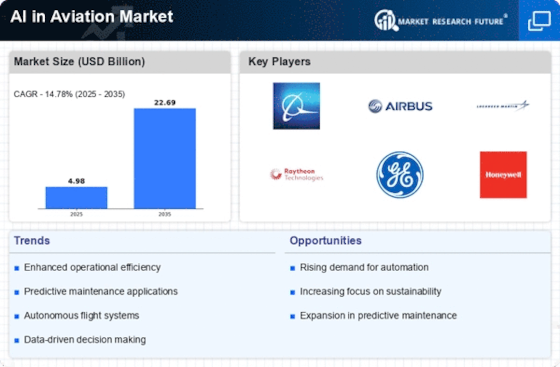
As per Market Research Future analysis, the AI in Aviation Market Size was estimated at 4.981 USD Billion in 2024. The AI in Aviation industry is projected to grow from 5.718 USD Billion in 2025 to 22.69 USD Billion by 2035, exhibiting a compound annual growth rate (CAGR) of 14.78% during the forecast period 2025 - 2035

Key Market Trends & Highlights

The AI in Aviation Market is poised for substantial growth driven by technological advancements and evolving consumer expectations.

  • North America remains the largest market for AI in aviation, showcasing robust investment in automation technologies. The Asia-Pacific region is emerging as the fastest-growing market, fueled by increasing air travel demand and technological adoption. Flight operations represent the largest segment, while passenger experience is rapidly gaining traction as a key focus area. Market drivers such as increased demand for automation and enhanced safety measures are propelling the adoption of AI solutions.

Market Size & Forecast

2024 Market Size 4.981 (USD Billion)
2035 Market Size 22.69 (USD Billion)
CAGR (2025 - 2035) 14.78%
Largest Regional Market Share in 2024 North America

Major Players

<p><a href="https://www.flightradar24.com/blog/b2b/flightradar24-to-supply-flight-data-services-to-boeing/">Boeing </a>(US), Airbus (FR), Lockheed Martin (US), Raytheon Technologies (US), General Electric (US), Honeywell (US), Northrop Grumman (US), Thales Group (FR),<a href="https://www.siemens.com/global/en/products/automation/topic-areas/solutions-for-machine-tools/cnc4you/basics-articles/cnc-process-chain.html"> Siemens </a>(DE)</p>

Market Trends

The AI in Aviation Market is currently experiencing a transformative phase, driven by advancements in technology and increasing demand for efficiency and safety. Airlines and manufacturers are increasingly adopting artificial intelligence to enhance operational processes, improve customer experiences, and optimize maintenance schedules. This shift appears to be influenced by the need for cost reduction and the desire to leverage data analytics for better decision-making. As a result, stakeholders are investing in AI solutions that promise to streamline operations and elevate service quality. Moreover, the integration of AI technologies into aviation is likely to reshape various aspects of the industry, from air traffic management to predictive maintenance. The potential for AI to analyze vast amounts of data in real-time suggests that it could significantly enhance safety protocols and operational efficiency. While challenges remain, such as regulatory hurdles and the need for skilled personnel, the overall trajectory of the AI in Aviation Market indicates a robust growth potential, with innovations continuously emerging to meet evolving industry demands.

Enhanced Operational Efficiency

The AI in Aviation Market is witnessing a trend towards enhanced operational efficiency. Airlines are increasingly utilizing AI algorithms to optimize flight schedules, manage crew assignments, and streamline ground operations. This trend suggests that AI can significantly reduce delays and improve resource allocation, ultimately leading to a more efficient aviation ecosystem.

Predictive Maintenance Solutions

Another notable trend in the AI in Aviation Market is the rise of predictive maintenance solutions. By employing machine learning algorithms, airlines can analyze data from aircraft systems to predict potential failures before they occur. This proactive approach not only minimizes downtime but also enhances safety and reduces maintenance costs.

Personalized Customer Experiences

The trend towards personalized customer experiences is gaining traction within the AI in Aviation Market. Airlines are leveraging AI to analyze passenger data and preferences, enabling them to offer tailored services and recommendations. This focus on personalization appears to enhance customer satisfaction and loyalty, ultimately benefiting the airline's bottom line.

AI In Aviation Market Market Drivers

Data-Driven Decision Making

The AI in Aviation Market is increasingly influenced by the need for data-driven decision-making. Airlines and aviation authorities are leveraging AI to analyze vast datasets, enabling them to make informed decisions regarding route planning, pricing strategies, and customer engagement. The ability to process and interpret data in real-time allows for agile responses to market changes and passenger preferences. Reports indicate that organizations utilizing AI for data analytics can improve operational performance by up to 20%. As the aviation sector becomes more competitive, the reliance on AI for strategic insights is expected to intensify, driving further investment in AI technologies.

Increased Demand for Automation

The AI in Aviation Market is experiencing a surge in demand for automation technologies. Airlines and airports are increasingly adopting AI-driven solutions to streamline operations, enhance safety, and improve customer service. According to recent data, the market for AI in aviation is projected to reach USD 3.5 billion by 2026, driven by the need for efficient resource management and operational excellence. Automation not only reduces human error but also optimizes flight schedules and maintenance processes. As the industry continues to evolve, the integration of AI technologies is likely to play a pivotal role in shaping the future of aviation, making it more efficient and responsive to passenger needs.

Enhanced Safety and Security Measures

Safety and security remain paramount in the aviation sector, and the AI in Aviation Market is responding to this need with advanced technologies. AI systems are being utilized for real-time threat detection, predictive analytics, and risk assessment, which are crucial for maintaining high safety standards. The implementation of AI-driven surveillance systems has shown to reduce incidents by up to 30%, according to industry reports. Furthermore, AI can analyze vast amounts of data to identify potential security breaches before they occur. As regulatory bodies continue to emphasize safety, the demand for AI solutions that enhance security protocols is expected to grow, thereby driving the market forward.

Personalization of Passenger Experience

The AI in Aviation Market is witnessing a shift towards personalized passenger experiences, driven by advancements in AI technologies. Airlines are utilizing AI to analyze customer data and preferences, enabling them to offer tailored services and recommendations. This personalization can enhance customer satisfaction and loyalty, which are crucial in a highly competitive market. For instance, AI-driven chatbots and virtual assistants are being deployed to provide real-time assistance to passengers, improving their overall travel experience. As airlines recognize the value of personalized services, investments in AI solutions that enhance customer engagement are likely to increase, further stimulating market growth.

Cost Reduction and Operational Efficiency

Cost efficiency is a critical driver in the AI in Aviation Market, as airlines seek to minimize operational expenses while maximizing service quality. AI technologies facilitate predictive maintenance, which can reduce maintenance costs by approximately 25% by anticipating equipment failures before they occur. Additionally, AI algorithms optimize fuel consumption and flight paths, leading to significant savings. The integration of AI in operational processes not only enhances efficiency but also contributes to sustainability efforts by reducing carbon footprints. As airlines face increasing pressure to operate cost-effectively, the adoption of AI solutions is likely to accelerate, further propelling market growth.

Market Segment Insights

By Application: Flight Operations (Largest) vs. Passenger Experience (Fastest-Growing)

<p>In the AI in Aviation Market, the application segment is divided into four primary areas: Flight Operations, Predictive Maintenance, Air Traffic Management, and Passenger Experience. Among these, Flight Operations holds the largest market share, driven by the increasing need for efficient flight planning, optimization, and safety enhancements. Meanwhile, the Passenger Experience segment is experiencing rapid growth as airlines seek innovative ways to improve customer satisfaction through AI-driven solutions.</p>

<p>Flight Operations (Dominant) vs. Passenger Experience (Emerging)</p>

<p>Flight Operations remains the dominant application within the AI in Aviation Market, leveraging machine learning algorithms to enhance flight safety, fuel efficiency, and operational efficiency. Its robust adoption among airlines ensures effective route management and real-time decision-making. Conversely, Passenger Experience is emerging as an important segment, with AI applications enhancing personalized services, luggage tracking, and seamless boarding processes. This shift is fueled by consumer expectations for high-quality services and the airlines’ drive to remain competitive in a technology-oriented market.</p>

By Deployment Mode: Cloud (Largest) vs. On-Premises (Fastest-Growing)

<p>The AI in Aviation Market exhibits a notable distribution in terms of deployment modes, with Cloud solutions dominating the segment. As airlines and aviation companies seek to leverage AI capabilities for enhanced operational efficiency and customer service, Cloud adoption has surged due to its scalability and cost-effectiveness. On the other hand, On-Premises deployment is gaining traction, particularly among companies with stringent data security requirements, marking a significant shift as these organizations strive to maintain control over their infrastructure while integrating advanced AI technologies.</p>

<p>Cloud (Dominant) vs. On-Premises (Emerging)</p>

<p>In the AI in Aviation Market, Cloud deployment stands as the dominant mode, favored for its flexibility, accessibility, and lower upfront costs. It enables aviation companies to rapidly deploy AI solutions and iterate on them without the need for extensive hardware investments. Conversely, On-Premises solutions, considered emerging, are increasingly sought after by organizations that prioritize data integrity and security. These companies are finding new ways to implement AI while maintaining their proprietary systems. As data privacy regulations become more stringent, the demand for On-Premises deployments is expected to grow, leading to a more nuanced balance between these two deployment strategies.</p>

By Component: Software (Largest) vs. Hardware (Fastest-Growing)

<p>In the AI in Aviation Market, the component segment reveals a notable distribution among hardware, software, and services. Software currently stands as the largest share contributor, driving innovations in data analytics, predictive maintenance, and operational efficiency. Meanwhile, hardware is gaining traction as a fast-growing segment, fueled by advancements in computing power, sensors, and connectivity, which are crucial for implementing AI applications in aviation. The growth trends in this segment are significantly influenced by the increasing demand for automation and enhanced decision-making in aviation operations. Factors such as the proliferation of IoT devices, the urgency for cost-saving measures, and a focus on improving safety and passenger experience are propelling software adoption. Furthermore, the hardware segment is witnessing rapid advancements, thereby attracting investments and encouraging further innovation in AI technologies for aviation purposes.</p>

<p>Software (Dominant) vs. Hardware (Emerging)</p>

<p>In the AI in Aviation Market, software solutions are recognized as the dominant force, providing extensive functionalities such as flight scheduling optimization, real-time maintenance analytics, and customer service enhancements through chatbots. These capabilities significantly boost operational efficiency and decision-making processes within the industry. Conversely, the hardware segment, while emerging, is rapidly evolving with advancements in artificial intelligence chips, edge computing devices, and integrated avionics systems. This segment supports the software's functionalities by ensuring that data processing can occur efficiently and in real time. As airlines and airports increasingly adopt AI, the synergy between hardware and software will be crucial in deploying comprehensive solutions that address industry challenges effectively.</p>

By End Use: Commercial Aviation (Largest) vs. Military Aviation (Fastest-Growing)

<p>The AI in Aviation market displays varied contributions from its end use segments, with Commercial Aviation holding the largest market share. This sector benefits from the extensive deployment of AI technologies in areas such as fleet management, customer service, and predictive maintenance. In contrast, Military Aviation, while holding a smaller share compared to Commercial Aviation, is experiencing rapid growth driven by advancements in AI applications for surveillance, drone operations, and enhanced decision-making capabilities. The integration of AI into military operations is increasingly recognized as vital for maintaining strategic advantages. Looking ahead, the growth trends within the AI in Aviation market indicate a significant acceleration for Military Aviation, fueled by increasing defense budgets and the urgent need for modernization of military fleets. The application of AI in enhancing operational efficiency and mission effectiveness is a key driver for this growth. Meanwhile, Commercial Aviation continues to expand its capabilities through AI, focusing on improving passenger experience and operational optimization. This dichotomy between the segments highlights a balancing act between existing dominance and emerging potential within the market.</p>

<p>Commercial Aviation: Dominant vs. Military Aviation: Emerging</p>

<p>In the AI in Aviation market, Commercial Aviation stands out as the dominant segment, characterized by its widespread adoption of advanced technologies that optimize various operational procedures. Airlines leverage AI for diverse applications, such as enhancing customer service with chatbots, optimizing flight routes, and predictive maintenance to reduce downtime. This focus on operational excellence and passenger satisfaction has established Commercial Aviation as a foundational pillar of the market. On the other hand, Military Aviation is witnessing burgeoning growth, marked by the integration of AI for strategic missions and enhanced combat capabilities. Innovations such as AI-driven drones and advanced analytics for real-time decision-making are transforming military operations, positioning Military Aviation as an emerging contender in this competitive landscape.</p>

Get more detailed insights about AI In Aviation Market Research Report - Global Forecast till 2035

Regional Insights

The Global AI in Aviation Market has showcased substantial growth across various regions, marking a significant increase in its revenue. In 2023, the market valuation highlighted North America as a dominant player, valued at 1.9 USD Billion, reflecting its majority holding in innovation and technology adoption in aviation. Europe follows with a valuation of 1.2 USD Billion, a region noted for its advanced regulatory frameworks promoting AI integration.

The APAC region, valued at 0.94 USD Billion, is rapidly emerging due to increasing investments in aviation infrastructure and a growing tech-savvy population.South America and MEA, valued at 0.2 USD Billion and 0.1 USD Billion, respectively, in 2023, represent the nascent stages of adoption yet show promising potential for growth as regional airlines explore AI for operational efficiency and customer experience enhancement. As the Global AI in Aviation Market data suggests, regional differentiation plays a crucial role in shaping industry trends, with each segment contributing uniquely to the overall market dynamics.

The statistics reveal that while North America leads, regions like APAC are positioned for significant future gains, driven by growing demand for advanced technological solutions.

Fig 3: AI In Aviation Market Regional Insights

Key Players and Competitive Insights

The Global AI in Aviation Market is characterized by rapid advancements and growing competitiveness among various players striving to enhance operational efficiency, safety, and passenger experience through artificial intelligence technologies. As the aviation industry increasingly adopts AI-driven solutions, companies are leveraging data analytics, machine learning, and automation to optimize flight operations, maintenance and logistics. The competitive landscape is shaped by innovation, adaptability to emerging technologies, and strategic partnerships that enable stakeholders to navigate the complexities of modern aviation demands.

Key factors driving competition include the need for improved decision-making processes, reduced operational costs, and enhanced customer satisfaction alongside regulatory compliance and a focus on sustainability.Airbus stands out in the Global AI Aviation Market with a significant focus on innovation and sustainability. The company has made notable strides in deploying AI for predictive maintenance, which helps airlines anticipate aircraft maintenance needs, thereby reducing downtime and operational costs. Airbus benefits from its strong brand reputation, extensive experience in aviation, and a comprehensive understanding of market requirements. 

The company is also actively engaged in research and development initiatives that explore AI applications for in-flight systems, flight planning, and air traffic management. Airbus's commitment to enhancing passenger safety through AI technology highlights its strategic positioning in the market, making it a strong competitor with a dedicated approach to leveraging artificial intelligence within the aviation sector.Siemens has emerged as a formidable player in the Global AI in Aviation Market, primarily through its innovative smart infrastructure solutions that integrate AI technologies.

The company's strengths lie in its robust analytics capabilities, which allow airlines and airport operators to optimize operations, manage energy consumption, and enhance airport infrastructure efficiently. Siemens has established a strong presence in the aviation industry by focusing on digitalization trends that enable improved operational efficiency and passenger experiences. With a commitment to sustainability and the development of smart airports, Siemens is well-positioned to harness AI advancements in aviation, fostering a competitive edge through its technological prowess and strategic partnerships across various domains within the aviation ecosystem.

Key Companies in the AI In Aviation Market include

Industry Developments

NVIDIA GPUs, Searidge Technologies was able to develop software in the form of AI in October of the year 2022. The purpose of their solution is to use vision AI to control the traffic and notify users about any safety issues within its digital tower and apron systems. Such advancement of technology not only enhances the effectiveness of airport operations but also fosters the growth of the market by making airports more appealing as it is easier to secure better efficient centers, thereby increasing the need for Searidge’s advanced solutions.

In April 2022, Banglore International Airport Limited, in partnership with Amazon, sought to create a JIC and promoted cost and time efficiency in aviation. The partnership supports the creation of technologies and solutions that address the aviation industry, improving efficiency, passenger satisfaction and increased safety levels. Hence, it promotes market growth by fostering new ideas and new investments, as well as helping to position BIAL as an aviation innovation leader.

A collaboration that began in the year 2018 only intensified in April 2022 between Boeing and Microsoft concerning the expansion of digital aviation. Over the years, Boeing has invested heavily in the future of the digital segment, and this has allowed him to use Microsoft Cloud, which in turn has enabled him to transform business systems, enhance important areas and bring forth new ideas in the field of digital aviation.

In July 2021, Tata Power Establishes a Partnership with Autogrid for the Introduction of Residential Demand Response Program to Strengthen the Consumer Demand Response Expansion Strategy.

April 2023- Campbell Wilson, the carrier’s CEO, stated that Air India would give a head start in using GPT-4 to enhance the customer experience on their website. It was reported that AI technology could soon be implemented to considerably influence the website’s FAQ segment.

May 2023- Etihad Airways will soon allow its customers to book their flights through artificial intelligence. “Abu Dhabi-based carrier entered a partnership with Astra Tech, which would allow the bookings through the chat application, BOTIM”.

In March 2023, Airbus announced that it had completed the purchase of smart predictive maintenance firm Uptake Technologies. The acquisition will enable Airbus to gain access to Uptake’s smart technology and expertise in predictive maintenance Ex.

Future Outlook

AI In Aviation Market Future Outlook

<p>The AI in Aviation Market is projected to grow at a 14.78% CAGR from 2024 to 2035, driven by advancements in automation, predictive maintenance, and enhanced passenger experiences.</p>

New opportunities lie in:

  • <p>Development of AI-driven predictive maintenance solutions for airlines.</p>
  • <p>Implementation of AI-based passenger flow management systems at airports.</p>
  • <p>Creation of personalized AI travel assistants for enhanced customer service.</p>

<p>By 2035, the AI in Aviation Market is expected to be robust, driven by innovation and strategic investments.</p>

Market Segmentation

AI In Aviation Market End Use Outlook

  • Commercial Aviation
  • Military Aviation
  • General Aviation

AI In Aviation Market Component Outlook

  • Hardware
  • Software
  • Services

AI In Aviation Market Application Outlook

  • Flight Operations
  • Predictive Maintenance
  • Air Traffic Management
  • Passenger Experience

AI In Aviation Market Deployment Mode Outlook

  • Cloud
  • On-Premises

Report Scope

MARKET SIZE 2024 4.981(USD Billion)
MARKET SIZE 2025 5.718(USD Billion)
MARKET SIZE 2035 22.69(USD Billion)
COMPOUND ANNUAL GROWTH RATE (CAGR) 14.78% (2024 - 2035)
REPORT COVERAGE Revenue Forecast, Competitive Landscape, Growth Factors, and Trends
BASE YEAR 2024
Market Forecast Period 2025 - 2035
Historical Data 2019 - 2024
Market Forecast Units USD Billion
Key Companies Profiled Boeing (US), Airbus (FR), Lockheed Martin (US), Raytheon Technologies (US), General Electric (US), Honeywell (US), Northrop Grumman (US), Thales Group (FR), Siemens (DE)
Segments Covered Application, Deployment Mode, Component, End Use, Regional
Key Market Opportunities Integration of advanced predictive maintenance solutions enhances operational efficiency in the AI in Aviation Market.
Key Market Dynamics Rising demand for automation and predictive analytics drives innovation in the artificial intelligence aviation sector.
Countries Covered North America, Europe, APAC, South America, MEA

FAQs

What is the projected market valuation of AI in Aviation by 2035?

The projected market valuation of AI in Aviation is expected to reach 22.69 USD Billion by 2035.

What was the market valuation of AI in Aviation in 2024?

The market valuation of AI in Aviation was 4.981 USD Billion in 2024.

What is the expected CAGR for the AI in Aviation Market from 2025 to 2035?

The expected CAGR for the AI in Aviation Market during the forecast period 2025 - 2035 is 14.78%.

Which companies are considered key players in the AI in Aviation Market?

Key players in the AI in Aviation Market include Boeing, Airbus, Lockheed Martin, Raytheon Technologies, General Electric, Honeywell, Northrop Grumman, Thales Group, and Siemens.

What are the main application segments of AI in Aviation and their valuations?

The main application segments include Flight Operations valued at 6.9 USD Billion, Predictive Maintenance at 5.5 USD Billion, Air Traffic Management at 5.9 USD Billion, and Passenger Experience at 4.5 USD Billion.

How is the AI in Aviation Market segmented by deployment mode?

The AI in Aviation Market is segmented into Cloud deployment valued at 13.5 USD Billion and On-Premises deployment at 9.19 USD Billion.

What components are included in the AI in Aviation Market and their respective valuations?

The components include Hardware valued at 5.75 USD Billion, Software at 10.5 USD Billion, and Services at 6.44 USD Billion.

What are the end-use segments of AI in Aviation and their market sizes?

End-use segments include Commercial Aviation valued at 11.5 USD Billion, Military Aviation at 6.5 USD Billion, and General Aviation at 4.69 USD Billion.

How does the AI in Aviation Market's growth compare across different segments?

The AI in Aviation Market shows varied growth, with Commercial Aviation and Software segments likely leading in valuation by 2035.

What trends are influencing the growth of AI in Aviation?

Trends influencing growth include advancements in predictive maintenance, enhanced passenger experience, and improved air traffic management.

  1. SECTION I: EXECUTIVE SUMMARY AND KEY HIGHLIGHTS
    1. EXECUTIVE SUMMARY
      1. Market Overview
      2. Key Findings
      3. Market Segmentation
      4. Competitive Landscape
      5. Challenges and Opportunities
      6. Future Outlook 2
  2. SECTION II: SCOPING, METHODOLOGY AND MARKET STRUCTURE
    1. MARKET INTRODUCTION
      1. Definition
      2. Scope of the study
    2. RESEARCH METHODOLOGY
      1. Overview
      2. Data Mining
      3. Secondary Research
      4. Primary Research
      5. Forecasting Model
      6. Market Size Estimation
      7. Data Triangulation
      8. Validation 3
  3. SECTION III: QUALITATIVE ANALYSIS
    1. MARKET DYNAMICS
      1. Overview
      2. Drivers
      3. Restraints
      4. Opportunities
    2. MARKET FACTOR ANALYSIS
      1. Value chain Analysis
      2. Porter's Five Forces Analysis
      3. COVID-19 Impact Analysis
  4. SECTION IV: QUANTITATIVE ANALYSIS
    1. Information and Communications Technology, BY Application (USD Billion)
      1. Flight Operations
      2. Predictive Maintenance
      3. Air Traffic Management
      4. Passenger Experience
    2. Information and Communications Technology, BY Deployment Mode (USD Billion)
      1. Cloud
      2. On-Premises
    3. Information and Communications Technology, BY Component (USD Billion)
      1. Hardware
      2. Software
      3. Services
    4. Information and Communications Technology, BY End Use (USD Billion)
      1. Commercial Aviation
      2. Military Aviation
      3. General Aviation
    5. Information and Communications Technology, BY Region (USD Billion)
      1. North America
      2. Europe
      3. APAC
      4. South America
      5. MEA
  5. SECTION V: COMPETITIVE ANALYSIS
    1. Competitive Landscape
      1. Overview
      2. Competitive Analysis
      3. Market share Analysis
      4. Major Growth Strategy in the Information and Communications Technology
      5. Competitive Benchmarking
      6. Leading Players in Terms of Number of Developments in the Information and Communications Technology
      7. Key developments and growth strategies
      8. Major Players Financial Matrix
    2. Company Profiles
      1. Boeing (US)
      2. Airbus (FR)
      3. Lockheed Martin (US)
      4. Raytheon Technologies (US)
      5. General Electric (US)
      6. Honeywell (US)
      7. Northrop Grumman (US)
      8. Thales Group (FR)
      9. Siemens (DE)
    3. Appendix
      1. References
      2. Related Reports 6 LIST OF FIGURES
    4. MARKET SYNOPSIS
    5. NORTH AMERICA MARKET ANALYSIS
    6. US MARKET ANALYSIS BY APPLICATION
    7. US MARKET ANALYSIS BY DEPLOYMENT MODE
    8. US MARKET ANALYSIS BY COMPONENT
    9. US MARKET ANALYSIS BY END USE
    10. CANADA MARKET ANALYSIS BY APPLICATION
    11. CANADA MARKET ANALYSIS BY DEPLOYMENT MODE
    12. CANADA MARKET ANALYSIS BY COMPONENT
    13. CANADA MARKET ANALYSIS BY END USE
    14. EUROPE MARKET ANALYSIS
    15. GERMANY MARKET ANALYSIS BY APPLICATION
    16. GERMANY MARKET ANALYSIS BY DEPLOYMENT MODE
    17. GERMANY MARKET ANALYSIS BY COMPONENT
    18. GERMANY MARKET ANALYSIS BY END USE
    19. UK MARKET ANALYSIS BY APPLICATION
    20. UK MARKET ANALYSIS BY DEPLOYMENT MODE
    21. UK MARKET ANALYSIS BY COMPONENT
    22. UK MARKET ANALYSIS BY END USE
    23. FRANCE MARKET ANALYSIS BY APPLICATION
    24. FRANCE MARKET ANALYSIS BY DEPLOYMENT MODE
    25. FRANCE MARKET ANALYSIS BY COMPONENT
    26. FRANCE MARKET ANALYSIS BY END USE
    27. RUSSIA MARKET ANALYSIS BY APPLICATION
    28. RUSSIA MARKET ANALYSIS BY DEPLOYMENT MODE
    29. RUSSIA MARKET ANALYSIS BY COMPONENT
    30. RUSSIA MARKET ANALYSIS BY END USE
    31. ITALY MARKET ANALYSIS BY APPLICATION
    32. ITALY MARKET ANALYSIS BY DEPLOYMENT MODE
    33. ITALY MARKET ANALYSIS BY COMPONENT
    34. ITALY MARKET ANALYSIS BY END USE
    35. SPAIN MARKET ANALYSIS BY APPLICATION
    36. SPAIN MARKET ANALYSIS BY DEPLOYMENT MODE
    37. SPAIN MARKET ANALYSIS BY COMPONENT
    38. SPAIN MARKET ANALYSIS BY END USE
    39. REST OF EUROPE MARKET ANALYSIS BY APPLICATION
    40. REST OF EUROPE MARKET ANALYSIS BY DEPLOYMENT MODE
    41. REST OF EUROPE MARKET ANALYSIS BY COMPONENT
    42. REST OF EUROPE MARKET ANALYSIS BY END USE
    43. APAC MARKET ANALYSIS
    44. CHINA MARKET ANALYSIS BY APPLICATION
    45. CHINA MARKET ANALYSIS BY DEPLOYMENT MODE
    46. CHINA MARKET ANALYSIS BY COMPONENT
    47. CHINA MARKET ANALYSIS BY END USE
    48. INDIA MARKET ANALYSIS BY APPLICATION
    49. INDIA MARKET ANALYSIS BY DEPLOYMENT MODE
    50. INDIA MARKET ANALYSIS BY COMPONENT
    51. INDIA MARKET ANALYSIS BY END USE
    52. JAPAN MARKET ANALYSIS BY APPLICATION
    53. JAPAN MARKET ANALYSIS BY DEPLOYMENT MODE
    54. JAPAN MARKET ANALYSIS BY COMPONENT
    55. JAPAN MARKET ANALYSIS BY END USE
    56. SOUTH KOREA MARKET ANALYSIS BY APPLICATION
    57. SOUTH KOREA MARKET ANALYSIS BY DEPLOYMENT MODE
    58. SOUTH KOREA MARKET ANALYSIS BY COMPONENT
    59. SOUTH KOREA MARKET ANALYSIS BY END USE
    60. MALAYSIA MARKET ANALYSIS BY APPLICATION
    61. MALAYSIA MARKET ANALYSIS BY DEPLOYMENT MODE
    62. MALAYSIA MARKET ANALYSIS BY COMPONENT
    63. MALAYSIA MARKET ANALYSIS BY END USE
    64. THAILAND MARKET ANALYSIS BY APPLICATION
    65. THAILAND MARKET ANALYSIS BY DEPLOYMENT MODE
    66. THAILAND MARKET ANALYSIS BY COMPONENT
    67. THAILAND MARKET ANALYSIS BY END USE
    68. INDONESIA MARKET ANALYSIS BY APPLICATION
    69. INDONESIA MARKET ANALYSIS BY DEPLOYMENT MODE
    70. INDONESIA MARKET ANALYSIS BY COMPONENT
    71. INDONESIA MARKET ANALYSIS BY END USE
    72. REST OF APAC MARKET ANALYSIS BY APPLICATION
    73. REST OF APAC MARKET ANALYSIS BY DEPLOYMENT MODE
    74. REST OF APAC MARKET ANALYSIS BY COMPONENT
    75. REST OF APAC MARKET ANALYSIS BY END USE
    76. SOUTH AMERICA MARKET ANALYSIS
    77. BRAZIL MARKET ANALYSIS BY APPLICATION
    78. BRAZIL MARKET ANALYSIS BY DEPLOYMENT MODE
    79. BRAZIL MARKET ANALYSIS BY COMPONENT
    80. BRAZIL MARKET ANALYSIS BY END USE
    81. MEXICO MARKET ANALYSIS BY APPLICATION
    82. MEXICO MARKET ANALYSIS BY DEPLOYMENT MODE
    83. MEXICO MARKET ANALYSIS BY COMPONENT
    84. MEXICO MARKET ANALYSIS BY END USE
    85. ARGENTINA MARKET ANALYSIS BY APPLICATION
    86. ARGENTINA MARKET ANALYSIS BY DEPLOYMENT MODE
    87. ARGENTINA MARKET ANALYSIS BY COMPONENT
    88. ARGENTINA MARKET ANALYSIS BY END USE
    89. REST OF SOUTH AMERICA MARKET ANALYSIS BY APPLICATION
    90. REST OF SOUTH AMERICA MARKET ANALYSIS BY DEPLOYMENT MODE
    91. REST OF SOUTH AMERICA MARKET ANALYSIS BY COMPONENT
    92. REST OF SOUTH AMERICA MARKET ANALYSIS BY END USE
    93. MEA MARKET ANALYSIS
    94. GCC COUNTRIES MARKET ANALYSIS BY APPLICATION
    95. GCC COUNTRIES MARKET ANALYSIS BY DEPLOYMENT MODE
    96. GCC COUNTRIES MARKET ANALYSIS BY COMPONENT
    97. GCC COUNTRIES MARKET ANALYSIS BY END USE
    98. SOUTH AFRICA MARKET ANALYSIS BY APPLICATION
    99. SOUTH AFRICA MARKET ANALYSIS BY DEPLOYMENT MODE
    100. SOUTH AFRICA MARKET ANALYSIS BY COMPONENT
    101. SOUTH AFRICA MARKET ANALYSIS BY END USE
    102. REST OF MEA MARKET ANALYSIS BY APPLICATION
    103. REST OF MEA MARKET ANALYSIS BY DEPLOYMENT MODE
    104. REST OF MEA MARKET ANALYSIS BY COMPONENT
    105. REST OF MEA MARKET ANALYSIS BY END USE
    106. KEY BUYING CRITERIA OF INFORMATION AND COMMUNICATIONS TECHNOLOGY
    107. RESEARCH PROCESS OF MRFR
    108. DRO ANALYSIS OF INFORMATION AND COMMUNICATIONS TECHNOLOGY
    109. DRIVERS IMPACT ANALYSIS: INFORMATION AND COMMUNICATIONS TECHNOLOGY
    110. RESTRAINTS IMPACT ANALYSIS: INFORMATION AND COMMUNICATIONS TECHNOLOGY
    111. SUPPLY / VALUE CHAIN: INFORMATION AND COMMUNICATIONS TECHNOLOGY
    112. INFORMATION AND COMMUNICATIONS TECHNOLOGY, BY APPLICATION, 2024 (% SHARE)
    113. INFORMATION AND COMMUNICATIONS TECHNOLOGY, BY APPLICATION, 2024 TO 2035 (USD Billion)
    114. INFORMATION AND COMMUNICATIONS TECHNOLOGY, BY DEPLOYMENT MODE, 2024 (% SHARE)
    115. INFORMATION AND COMMUNICATIONS TECHNOLOGY, BY DEPLOYMENT MODE, 2024 TO 2035 (USD Billion)
    116. INFORMATION AND COMMUNICATIONS TECHNOLOGY, BY COMPONENT, 2024 (% SHARE)
    117. INFORMATION AND COMMUNICATIONS TECHNOLOGY, BY COMPONENT, 2024 TO 2035 (USD Billion)
    118. INFORMATION AND COMMUNICATIONS TECHNOLOGY, BY END USE, 2024 (% SHARE)
    119. INFORMATION AND COMMUNICATIONS TECHNOLOGY, BY END USE, 2024 TO 2035 (USD Billion)
    120. BENCHMARKING OF MAJOR COMPETITORS 7 LIST OF TABLES
    121. LIST OF ASSUMPTIONS
    122. North America MARKET SIZE ESTIMATES; FORECAST
      1. BY APPLICATION, 2025-2035 (USD Billion)
      2. BY DEPLOYMENT MODE, 2025-2035 (USD Billion)
      3. BY COMPONENT, 2025-2035 (USD Billion)
      4. BY END USE, 2025-2035 (USD Billion)
    123. US MARKET SIZE ESTIMATES; FORECAST
      1. BY APPLICATION, 2025-2035 (USD Billion)
      2. BY DEPLOYMENT MODE, 2025-2035 (USD Billion)
      3. BY COMPONENT, 2025-2035 (USD Billion)
      4. BY END USE, 2025-2035 (USD Billion)
    124. Canada MARKET SIZE ESTIMATES; FORECAST
      1. BY APPLICATION, 2025-2035 (USD Billion)
      2. BY DEPLOYMENT MODE, 2025-2035 (USD Billion)
      3. BY COMPONENT, 2025-2035 (USD Billion)
      4. BY END USE, 2025-2035 (USD Billion)
    125. Europe MARKET SIZE ESTIMATES; FORECAST
      1. BY APPLICATION, 2025-2035 (USD Billion)
      2. BY DEPLOYMENT MODE, 2025-2035 (USD Billion)
      3. BY COMPONENT, 2025-2035 (USD Billion)
      4. BY END USE, 2025-2035 (USD Billion)
    126. Germany MARKET SIZE ESTIMATES; FORECAST
      1. BY APPLICATION, 2025-2035 (USD Billion)
      2. BY DEPLOYMENT MODE, 2025-2035 (USD Billion)
      3. BY COMPONENT, 2025-2035 (USD Billion)
      4. BY END USE, 2025-2035 (USD Billion)
    127. UK MARKET SIZE ESTIMATES; FORECAST
      1. BY APPLICATION, 2025-2035 (USD Billion)
      2. BY DEPLOYMENT MODE, 2025-2035 (USD Billion)
      3. BY COMPONENT, 2025-2035 (USD Billion)
      4. BY END USE, 2025-2035 (USD Billion)
    128. France MARKET SIZE ESTIMATES; FORECAST
      1. BY APPLICATION, 2025-2035 (USD Billion)
      2. BY DEPLOYMENT MODE, 2025-2035 (USD Billion)
      3. BY COMPONENT, 2025-2035 (USD Billion)
      4. BY END USE, 2025-2035 (USD Billion)
    129. Russia MARKET SIZE ESTIMATES; FORECAST
      1. BY APPLICATION, 2025-2035 (USD Billion)
      2. BY DEPLOYMENT MODE, 2025-2035 (USD Billion)
      3. BY COMPONENT, 2025-2035 (USD Billion)
      4. BY END USE, 2025-2035 (USD Billion)
    130. Italy MARKET SIZE ESTIMATES; FORECAST
      1. BY APPLICATION, 2025-2035 (USD Billion)
      2. BY DEPLOYMENT MODE, 2025-2035 (USD Billion)
      3. BY COMPONENT, 2025-2035 (USD Billion)
      4. BY END USE, 2025-2035 (USD Billion)
    131. Spain MARKET SIZE ESTIMATES; FORECAST
      1. BY APPLICATION, 2025-2035 (USD Billion)
      2. BY DEPLOYMENT MODE, 2025-2035 (USD Billion)
      3. BY COMPONENT, 2025-2035 (USD Billion)
      4. BY END USE, 2025-2035 (USD Billion)
    132. Rest of Europe MARKET SIZE ESTIMATES; FORECAST
      1. BY APPLICATION, 2025-2035 (USD Billion)
      2. BY DEPLOYMENT MODE, 2025-2035 (USD Billion)
      3. BY COMPONENT, 2025-2035 (USD Billion)
      4. BY END USE, 2025-2035 (USD Billion)
    133. APAC MARKET SIZE ESTIMATES; FORECAST
      1. BY APPLICATION, 2025-2035 (USD Billion)
      2. BY DEPLOYMENT MODE, 2025-2035 (USD Billion)
      3. BY COMPONENT, 2025-2035 (USD Billion)
      4. BY END USE, 2025-2035 (USD Billion)
    134. China MARKET SIZE ESTIMATES; FORECAST
      1. BY APPLICATION, 2025-2035 (USD Billion)
      2. BY DEPLOYMENT MODE, 2025-2035 (USD Billion)
      3. BY COMPONENT, 2025-2035 (USD Billion)
      4. BY END USE, 2025-2035 (USD Billion)
    135. India MARKET SIZE ESTIMATES; FORECAST
      1. BY APPLICATION, 2025-2035 (USD Billion)
      2. BY DEPLOYMENT MODE, 2025-2035 (USD Billion)
      3. BY COMPONENT, 2025-2035 (USD Billion)
      4. BY END USE, 2025-2035 (USD Billion)
    136. Japan MARKET SIZE ESTIMATES; FORECAST
      1. BY APPLICATION, 2025-2035 (USD Billion)
      2. BY DEPLOYMENT MODE, 2025-2035 (USD Billion)
      3. BY COMPONENT, 2025-2035 (USD Billion)
      4. BY END USE, 2025-2035 (USD Billion)
    137. South Korea MARKET SIZE ESTIMATES; FORECAST
      1. BY APPLICATION, 2025-2035 (USD Billion)
      2. BY DEPLOYMENT MODE, 2025-2035 (USD Billion)
      3. BY COMPONENT, 2025-2035 (USD Billion)
      4. BY END USE, 2025-2035 (USD Billion)
    138. Malaysia MARKET SIZE ESTIMATES; FORECAST
      1. BY APPLICATION, 2025-2035 (USD Billion)
      2. BY DEPLOYMENT MODE, 2025-2035 (USD Billion)
      3. BY COMPONENT, 2025-2035 (USD Billion)
      4. BY END USE, 2025-2035 (USD Billion)
    139. Thailand MARKET SIZE ESTIMATES; FORECAST
      1. BY APPLICATION, 2025-2035 (USD Billion)
      2. BY DEPLOYMENT MODE, 2025-2035 (USD Billion)
      3. BY COMPONENT, 2025-2035 (USD Billion)
      4. BY END USE, 2025-2035 (USD Billion)
    140. Indonesia MARKET SIZE ESTIMATES; FORECAST
      1. BY APPLICATION, 2025-2035 (USD Billion)
      2. BY DEPLOYMENT MODE, 2025-2035 (USD Billion)
      3. BY COMPONENT, 2025-2035 (USD Billion)
      4. BY END USE, 2025-2035 (USD Billion)
    141. Rest of APAC MARKET SIZE ESTIMATES; FORECAST
      1. BY APPLICATION, 2025-2035 (USD Billion)
      2. BY DEPLOYMENT MODE, 2025-2035 (USD Billion)
      3. BY COMPONENT, 2025-2035 (USD Billion)
      4. BY END USE, 2025-2035 (USD Billion)
    142. South America MARKET SIZE ESTIMATES; FORECAST
      1. BY APPLICATION, 2025-2035 (USD Billion)
      2. BY DEPLOYMENT MODE, 2025-2035 (USD Billion)
      3. BY COMPONENT, 2025-2035 (USD Billion)
      4. BY END USE, 2025-2035 (USD Billion)
    143. Brazil MARKET SIZE ESTIMATES; FORECAST
      1. BY APPLICATION, 2025-2035 (USD Billion)
      2. BY DEPLOYMENT MODE, 2025-2035 (USD Billion)
      3. BY COMPONENT, 2025-2035 (USD Billion)
      4. BY END USE, 2025-2035 (USD Billion)
    144. Mexico MARKET SIZE ESTIMATES; FORECAST
      1. BY APPLICATION, 2025-2035 (USD Billion)
      2. BY DEPLOYMENT MODE, 2025-2035 (USD Billion)
      3. BY COMPONENT, 2025-2035 (USD Billion)
      4. BY END USE, 2025-2035 (USD Billion)
    145. Argentina MARKET SIZE ESTIMATES; FORECAST
      1. BY APPLICATION, 2025-2035 (USD Billion)
      2. BY DEPLOYMENT MODE, 2025-2035 (USD Billion)
      3. BY COMPONENT, 2025-2035 (USD Billion)
      4. BY END USE, 2025-2035 (USD Billion)
    146. Rest of South America MARKET SIZE ESTIMATES; FORECAST
      1. BY APPLICATION, 2025-2035 (USD Billion)
      2. BY DEPLOYMENT MODE, 2025-2035 (USD Billion)
      3. BY COMPONENT, 2025-2035 (USD Billion)
      4. BY END USE, 2025-2035 (USD Billion)
    147. MEA MARKET SIZE ESTIMATES; FORECAST
      1. BY APPLICATION, 2025-2035 (USD Billion)
      2. BY DEPLOYMENT MODE, 2025-2035 (USD Billion)
      3. BY COMPONENT, 2025-2035 (USD Billion)
      4. BY END USE, 2025-2035 (USD Billion)
    148. GCC Countries MARKET SIZE ESTIMATES; FORECAST
      1. BY APPLICATION, 2025-2035 (USD Billion)
      2. BY DEPLOYMENT MODE, 2025-2035 (USD Billion)
      3. BY COMPONENT, 2025-2035 (USD Billion)
      4. BY END USE, 2025-2035 (USD Billion)
    149. South Africa MARKET SIZE ESTIMATES; FORECAST
      1. BY APPLICATION, 2025-2035 (USD Billion)
      2. BY DEPLOYMENT MODE, 2025-2035 (USD Billion)
      3. BY COMPONENT, 2025-2035 (USD Billion)
      4. BY END USE, 2025-2035 (USD Billion)
    150. Rest of MEA MARKET SIZE ESTIMATES; FORECAST
      1. BY APPLICATION, 2025-2035 (USD Billion)
      2. BY DEPLOYMENT MODE, 2025-2035 (USD Billion)
      3. BY COMPONENT, 2025-2035 (USD Billion)
      4. BY END USE, 2025-2035 (USD Billion)
    151. PRODUCT LAUNCH/PRODUCT DEVELOPMENT/APPROVAL
    152. ACQUISITION/PARTNERSHIP

AI in Aviation Market Segmentation


AI in Aviation Market By Application (USD Billion, 2019-2032)

Flight Operations

Predictive Maintenance

Air Traffic Management

Passenger Experience


AI in Aviation Market By Deployment Mode (USD Billion, 2019-2032)

Cloud

On-Premises


AI in Aviation Market By Component (USD Billion, 2019-2032)

Hardware

Software

Services


AI in Aviation Market By End Use (USD Billion, 2019-2032)

Commercial Aviation

Military Aviation

General Aviation


AI in Aviation Market By Regional (USD Billion, 2019-2032)

North America

Europe

South America

Asia Pacific

Middle East and Africa


AI in Aviation Market Regional Outlook (USD Billion, 2019-2032)


North America Outlook (USD Billion, 2019-2032)

North America AI in Aviation Market by Application Type

Flight Operations

Predictive Maintenance

Air Traffic Management

Passenger Experience

North America AI in Aviation Market by Deployment Mode Type

Cloud

On-Premises

North America AI in Aviation Market by Component Type

Hardware

Software

Services

North America AI in Aviation Market by End Use Type

Commercial Aviation

Military Aviation

General Aviation

North America AI in Aviation Market by Regional Type

US

Canada

US Outlook (USD Billion, 2019-2032)

US AI in Aviation Market by Application Type

Flight Operations

Predictive Maintenance

Air Traffic Management

Passenger Experience

US AI in Aviation Market by Deployment Mode Type

Cloud

On-Premises

US AI in Aviation Market by Component Type

Hardware

Software

Services

US AI in Aviation Market by End Use Type

Commercial Aviation

Military Aviation

General Aviation

CANADA Outlook (USD Billion, 2019-2032)

CANADA AI in Aviation Market by Application Type

Flight Operations

Predictive Maintenance

Air Traffic Management

Passenger Experience

CANADA AI in Aviation Market by Deployment Mode Type

Cloud

On-Premises

CANADA AI in Aviation Market by Component Type

Hardware

Software

Services

CANADA AI in Aviation Market by End Use Type

Commercial Aviation

Military Aviation

General Aviation

Europe Outlook (USD Billion, 2019-2032)

Europe AI in Aviation Market by Application Type

Flight Operations

Predictive Maintenance

Air Traffic Management

Passenger Experience

Europe AI in Aviation Market by Deployment Mode Type

Cloud

On-Premises

Europe AI in Aviation Market by Component Type

Hardware

Software

Services

Europe AI in Aviation Market by End Use Type

Commercial Aviation

Military Aviation

General Aviation

Europe AI in Aviation Market by Regional Type

Germany

UK

France

Russia

Italy

Spain

Rest of Europe

GERMANY Outlook (USD Billion, 2019-2032)

GERMANY AI in Aviation Market by Application Type

Flight Operations

Predictive Maintenance

Air Traffic Management

Passenger Experience

GERMANY AI in Aviation Market by Deployment Mode Type

Cloud

On-Premises

GERMANY AI in Aviation Market by Component Type

Hardware

Software

Services

GERMANY AI in Aviation Market by End Use Type

Commercial Aviation

Military Aviation

General Aviation

UK Outlook (USD Billion, 2019-2032)

UK AI in Aviation Market by Application Type

Flight Operations

Predictive Maintenance

Air Traffic Management

Passenger Experience

UK AI in Aviation Market by Deployment Mode Type

Cloud

On-Premises

UK AI in Aviation Market by Component Type

Hardware

Software

Services

UK AI in Aviation Market by End Use Type

Commercial Aviation

Military Aviation

General Aviation

FRANCE Outlook (USD Billion, 2019-2032)

FRANCE AI in Aviation Market by Application Type

Flight Operations

Predictive Maintenance

Air Traffic Management

Passenger Experience

FRANCE AI in Aviation Market by Deployment Mode Type

Cloud

On-Premises

FRANCE AI in Aviation Market by Component Type

Hardware

Software

Services

FRANCE AI in Aviation Market by End Use Type

Commercial Aviation

Military Aviation

General Aviation

RUSSIA Outlook (USD Billion, 2019-2032)

RUSSIA AI in Aviation Market by Application Type

Flight Operations

Predictive Maintenance

Air Traffic Management

Passenger Experience

RUSSIA AI in Aviation Market by Deployment Mode Type

Cloud

On-Premises

RUSSIA AI in Aviation Market by Component Type

Hardware

Software

Services

RUSSIA AI in Aviation Market by End Use Type

Commercial Aviation

Military Aviation

General Aviation

ITALY Outlook (USD Billion, 2019-2032)

ITALY AI in Aviation Market by Application Type

Flight Operations

Predictive Maintenance

Air Traffic Management

Passenger Experience

ITALY AI in Aviation Market by Deployment Mode Type

Cloud

On-Premises

ITALY AI in Aviation Market by Component Type

Hardware

Software

Services

ITALY AI in Aviation Market by End Use Type

Commercial Aviation

Military Aviation

General Aviation

SPAIN Outlook (USD Billion, 2019-2032)

SPAIN AI in Aviation Market by Application Type

Flight Operations

Predictive Maintenance

Air Traffic Management

Passenger Experience

SPAIN AI in Aviation Market by Deployment Mode Type

Cloud

On-Premises

SPAIN AI in Aviation Market by Component Type

Hardware

Software

Services

SPAIN AI in Aviation Market by End Use Type

Commercial Aviation

Military Aviation

General Aviation

REST OF EUROPE Outlook (USD Billion, 2019-2032)

REST OF EUROPE AI in Aviation Market by Application Type

Flight Operations

Predictive Maintenance

Air Traffic Management

Passenger Experience

REST OF EUROPE AI in Aviation Market by Deployment Mode Type

Cloud

On-Premises

REST OF EUROPE AI in Aviation Market by Component Type

Hardware

Software

Services

REST OF EUROPE AI in Aviation Market by End Use Type

Commercial Aviation

Military Aviation

General Aviation

APAC Outlook (USD Billion, 2019-2032)

APAC AI in Aviation Market by Application Type

Flight Operations

Predictive Maintenance

Air Traffic Management

Passenger Experience

APAC AI in Aviation Market by Deployment Mode Type

Cloud

On-Premises

APAC AI in Aviation Market by Component Type

Hardware

Software

Services

APAC AI in Aviation Market by End Use Type

Commercial Aviation

Military Aviation

General Aviation

APAC AI in Aviation Market by Regional Type

China

India

Japan

South Korea

Malaysia

Thailand

Indonesia

Rest of APAC

CHINA Outlook (USD Billion, 2019-2032)

CHINA AI in Aviation Market by Application Type

Flight Operations

Predictive Maintenance

Air Traffic Management

Passenger Experience

CHINA AI in Aviation Market by Deployment Mode Type

Cloud

On-Premises

CHINA AI in Aviation Market by Component Type

Hardware

Software

Services

CHINA AI in Aviation Market by End Use Type

Commercial Aviation

Military Aviation

General Aviation

INDIA Outlook (USD Billion, 2019-2032)

INDIA AI in Aviation Market by Application Type

Flight Operations

Predictive Maintenance

Air Traffic Management

Passenger Experience

INDIA AI in Aviation Market by Deployment Mode Type

Cloud

On-Premises

INDIA AI in Aviation Market by Component Type

Hardware

Software

Services

INDIA AI in Aviation Market by End Use Type

Commercial Aviation

Military Aviation

General Aviation

JAPAN Outlook (USD Billion, 2019-2032)

JAPAN AI in Aviation Market by Application Type

Flight Operations

Predictive Maintenance

Air Traffic Management

Passenger Experience

JAPAN AI in Aviation Market by Deployment Mode Type

Cloud

On-Premises

JAPAN AI in Aviation Market by Component Type

Hardware

Software

Services

JAPAN AI in Aviation Market by End Use Type

Commercial Aviation

Military Aviation

General Aviation

SOUTH KOREA Outlook (USD Billion, 2019-2032)

SOUTH KOREA AI in Aviation Market by Application Type

Flight Operations

Predictive Maintenance

Air Traffic Management

Passenger Experience

SOUTH KOREA AI in Aviation Market by Deployment Mode Type

Cloud

On-Premises

SOUTH KOREA AI in Aviation Market by Component Type

Hardware

Software

Services

SOUTH KOREA AI in Aviation Market by End Use Type

Commercial Aviation

Military Aviation

General Aviation

MALAYSIA Outlook (USD Billion, 2019-2032)

MALAYSIA AI in Aviation Market by Application Type

Flight Operations

Predictive Maintenance

Air Traffic Management

Passenger Experience

MALAYSIA AI in Aviation Market by Deployment Mode Type

Cloud

On-Premises

MALAYSIA AI in Aviation Market by Component Type

Hardware

Software

Services

MALAYSIA AI in Aviation Market by End Use Type

Commercial Aviation

Military Aviation

General Aviation

THAILAND Outlook (USD Billion, 2019-2032)

THAILAND AI in Aviation Market by Application Type

Flight Operations

Predictive Maintenance

Air Traffic Management

Passenger Experience

THAILAND AI in Aviation Market by Deployment Mode Type

Cloud

On-Premises

THAILAND AI in Aviation Market by Component Type

Hardware

Software

Services

THAILAND AI in Aviation Market by End Use Type

Commercial Aviation

Military Aviation

General Aviation

INDONESIA Outlook (USD Billion, 2019-2032)

INDONESIA AI in Aviation Market by Application Type

Flight Operations

Predictive Maintenance

Air Traffic Management

Passenger Experience

INDONESIA AI in Aviation Market by Deployment Mode Type

Cloud

On-Premises

INDONESIA AI in Aviation Market by Component Type

Hardware

Software

Services

INDONESIA AI in Aviation Market by End Use Type

Commercial Aviation

Military Aviation

General Aviation

REST OF APAC Outlook (USD Billion, 2019-2032)

REST OF APAC AI in Aviation Market by Application Type

Flight Operations

Predictive Maintenance

Air Traffic Management

Passenger Experience

REST OF APAC AI in Aviation Market by Deployment Mode Type

Cloud

On-Premises

REST OF APAC AI in Aviation Market by Component Type

Hardware

Software

Services

REST OF APAC AI in Aviation Market by End Use Type

Commercial Aviation

Military Aviation

General Aviation

South America Outlook (USD Billion, 2019-2032)

South America AI in Aviation Market by Application Type

Flight Operations

Predictive Maintenance

Air Traffic Management

Passenger Experience

South America AI in Aviation Market by Deployment Mode Type

Cloud

On-Premises

South America AI in Aviation Market by Component Type

Hardware

Software

Services

South America AI in Aviation Market by End Use Type

Commercial Aviation

Military Aviation

General Aviation

South America AI in Aviation Market by Regional Type

Brazil

Mexico

Argentina

Rest of South America

BRAZIL Outlook (USD Billion, 2019-2032)

BRAZIL AI in Aviation Market by Application Type

Flight Operations

Predictive Maintenance

Air Traffic Management

Passenger Experience

BRAZIL AI in Aviation Market by Deployment Mode Type

Cloud

On-Premises

BRAZIL AI in Aviation Market by Component Type

Hardware

Software

Services

BRAZIL AI in Aviation Market by End Use Type

Commercial Aviation

Military Aviation

General Aviation

MEXICO Outlook (USD Billion, 2019-2032)

MEXICO AI in Aviation Market by Application Type

Flight Operations

Predictive Maintenance

Air Traffic Management

Passenger Experience

MEXICO AI in Aviation Market by Deployment Mode Type

Cloud

On-Premises

MEXICO AI in Aviation Market by Component Type

Hardware

Software

Services

MEXICO AI in Aviation Market by End Use Type

Commercial Aviation

Military Aviation

General Aviation

ARGENTINA Outlook (USD Billion, 2019-2032)

ARGENTINA AI in Aviation Market by Application Type

Flight Operations

Predictive Maintenance

Air Traffic Management

Passenger Experience

ARGENTINA AI in Aviation Market by Deployment Mode Type

Cloud

On-Premises

ARGENTINA AI in Aviation Market by Component Type

Hardware

Software

Services

ARGENTINA AI in Aviation Market by End Use Type

Commercial Aviation

Military Aviation

General Aviation

REST OF SOUTH AMERICA Outlook (USD Billion, 2019-2032)

REST OF SOUTH AMERICA AI in Aviation Market by Application Type

Flight Operations

Predictive Maintenance

Air Traffic Management

Passenger Experience

REST OF SOUTH AMERICA AI in Aviation Market by Deployment Mode Type

Cloud

On-Premises

REST OF SOUTH AMERICA AI in Aviation Market by Component Type

Hardware

Software

Services

REST OF SOUTH AMERICA AI in Aviation Market by End Use Type

Commercial Aviation

Military Aviation

General Aviation

MEA Outlook (USD Billion, 2019-2032)

MEA AI in Aviation Market by Application Type

Flight Operations

Predictive Maintenance

Air Traffic Management

Passenger Experience

MEA AI in Aviation Market by Deployment Mode Type

Cloud

On-Premises

MEA AI in Aviation Market by Component Type

Hardware

Software

Services

MEA AI in Aviation Market by End Use Type

Commercial Aviation

Military Aviation

General Aviation

MEA AI in Aviation Market by Regional Type

GCC Countries

South Africa

Rest of MEA

GCC COUNTRIES Outlook (USD Billion, 2019-2032)

GCC COUNTRIES AI in Aviation Market by Application Type

Flight Operations

Predictive Maintenance

Air Traffic Management

Passenger Experience

GCC COUNTRIES AI in Aviation Market by Deployment Mode Type

Cloud

On-Premises

GCC COUNTRIES AI in Aviation Market by Component Type

Hardware

Software

Services

GCC COUNTRIES AI in Aviation Market by End Use Type

Commercial Aviation

Military Aviation

General Aviation

SOUTH AFRICA Outlook (USD Billion, 2019-2032)

SOUTH AFRICA AI in Aviation Market by Application Type

Flight Operations

Predictive Maintenance

Air Traffic Management

Passenger Experience

SOUTH AFRICA AI in Aviation Market by Deployment Mode Type

Cloud

On-Premises

SOUTH AFRICA AI in Aviation Market by Component Type

Hardware

Software

Services

SOUTH AFRICA AI in Aviation Market by End Use Type

Commercial Aviation

Military Aviation

General Aviation

REST OF MEA Outlook (USD Billion, 2019-2032)

REST OF MEA AI in Aviation Market by Application Type

Flight Operations

Predictive Maintenance

Air Traffic Management

Passenger Experience

REST OF MEA AI in Aviation Market by Deployment Mode Type

Cloud

On-Premises

REST OF MEA AI in Aviation Market by Component Type

Hardware

Software

Services

REST OF MEA AI in Aviation Market by End Use Type

Commercial Aviation

Military Aviation

General Aviation

Infographic

Free Sample Request

Kindly complete the form below to receive a free sample of this Report

Get Free Sample

Customer Strories

Compare Licence

×
Features License Type
Single User Multiuser License Enterprise User
Price $4,950 $5,950 $7,250
Maximum User Access Limit 1 User Upto 10 Users Unrestricted Access Throughout the Organization
Free Customization
Direct Access to Analyst
Deliverable Format
Platform Access
Discount on Next Purchase 10% 15% 15%
Printable Versions