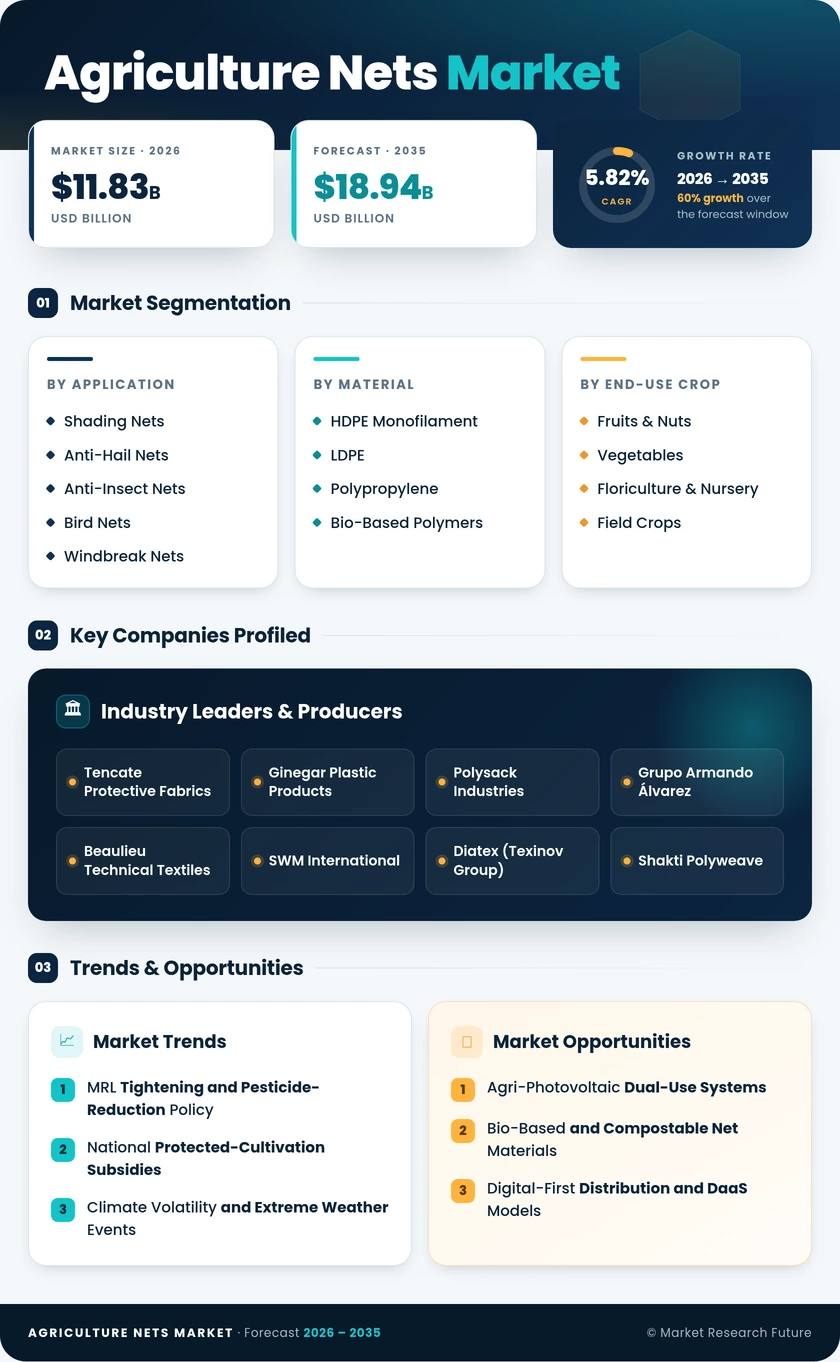
Segmentation Quick Reference
| Dimension | Sub-Segments | Dominant Segment | Fastest Growing Segment |
| By Application | Shading Nets, Anti-Hail Nets, Anti-Insect Nets, Bird Nets, Windbreak Nets | Shading Nets | Anti-Insect Nets |
| By Material | HDPE Monofilament, LDPE, Polypropylene, Bio-Based Polymers | HDPE Monofilament | Bio-Based Polymers |
| By End-Use Crop | Fruits & Nuts, Vegetables, Floriculture & Nursery, Field Crops | Fruits & Nuts | Vegetables |
| By Distribution Channel | Agri-Input Dealers, Direct to Grower (Online), Turn-Key Greenhouse Integrators, Government Tender / Cooperative | Agri-Input Dealers | Turn-Key Greenhouse Integrators |
Market Segmentation Overview
By Application
| Sub-Segment | Key Trend |
| Shading Nets | Retractable, sensor-integrated systems replacing fixed installations in commercial greenhouses |
| Anti-Hail Nets | Knitted HDPE construction rated for 40 mm hailstone impact, becoming standard in temperate orchards |
| Anti-Insect Nets | Fine-mesh (50-mesh) screens replacing broad-spectrum insecticide programs under tightening MRLs |
| Bird Nets | Lightweight PP nets expanding in berry and cherry segments where avian damage exceeds 15% of the yield |
| Windbreak Nets | Coastal and arid-zone deployments are growing as climate variability increases wind-damage frequency |
Shading nets remain the volume anchor, but innovation is concentrated in anti-insect and anti-hail applications where regulatory and climate pressures create willingness to pay for premium products.
By Material
| Sub-Segment | Key Trend |
| HDPE Monofilament | Dominant resin platform; 5–7 year UV-stabilized field life in tropical latitudes |
| LDPE | Used for flexible inner greenhouse screens and thermal energy-saving curtains |
| Polypropylene | Lightweight option favored in bird and windbreak applications |
| Bio-Based Polymers | PLA and PHA blends targeting EU EPR-compliant organic farming operations |
HDPE's cost-performance ratio keeps it dominant, but bio-based alternatives are gaining certification traction in organic and circular-economy supply chains.
By End-Use Crop
| Sub-Segment | Key Trend |
| Fruits & Nuts | High-value export crops drive demand for combined hail, shade, and insect protection |
| Vegetables | Net-house and greenhouse expansion in India, Mexico, and East Africa |
| Floriculture & Nursery | Light-management netting is critical for photoperiod-sensitive cut flowers |
| Field Crops | Emerging niche: shade netting over high-value spice and medicinal herb plots |
Fruits and nuts will retain the largest share, but vegetables are closing the gap as developing-country greenhouse acreage scales rapidly.
By Distribution Channel
| Sub-Segment | Key Trend |
| Agri-Input Dealers | Established rural networks dominate in Asia and Latin America |
| Direct to Grower (Online) | E-commerce platforms are disrupting dealer margins in India and East Africa |
| Turn-Key Greenhouse Integrators | Bundled netting-plus-climate-control contracts converting capex to opex |
| Government Tender / Cooperative | Subsidy-linked bulk procurement in India, Africa, and Gulf states |
The shift toward integrator-led bundled contracts is the most significant channel evolution, as it embeds netting into recurring service agreements and raises switching costs for end users.


 Noah Malgeri
Co-Founder

 Peter Groot koerkamp
Account and Business Manager

 Younghwan Choi
Senior Retail Manager

 Mark Irwin
Management Consultant

 Akif Moroglu
Strategy & Business Development Director

 Guilherme Gomes Martins
Product Management Director

 Joseph Aguayo
Sales Operations & Pricing Manager

 La Terria Dodd
Program Support Specialist

 Rob Kooiker
Group Product Manager HVAC & Fire Protection GMA