
Request Free Sample ×

Kindly complete the form below to receive a free sample of this Report

* Please use a valid business email

Leading companies partner with us for data-driven Insights

clients tt-cursor
Hero Background
English
Chinese
French
Japanese
Korean
German
Spanish

Agricultural Tires Market Share

ID: MRFR/AT/8979-CR
110 Pages
Triveni Bhoyar
October 2022

Agricultural Tires Market Research Report Information By Tire Type (Bias Tires, Radial Tires), By Application (Tractors, Combine Harvesters, Sprayers, Trailers, Loaders, Others), By Sales Channel (OEM, Aftermarket), And By Region (North America, Europe, Asia-Pacific, And Rest Of The World) - Growth & Industry Forecast to 2035

Share:
Download PDF ×

We do not share your information with anyone. However, we may send you emails based on your report interest from time to time. You may contact us at any time to opt-out.

Agricultural Tires Market Infographic
Purchase Options

Market Share

Agricultural Tires Market Share Analysis

The demand for tractors is on the rise, fueled by the adoption of precision farming and the increasing use of agricultural technologies aimed at boosting production. This surge in demand is further propelled by the growing number of farm training programs advocating for the widespread utilization of farm machinery. Tractors with engines capped at 1,500 CC are gaining popularity due to their versatility and space-saving features. Their compact size allows for more flexible applications, and manufacturers are inclined to experiment with new components and technologies in this segment before venturing into more powerful models.

These tractors, with lower horsepower, find their niche in soft soil environments, particularly in areas like river basins. Environments with softer soil conditions are ideal for tractors with less than 40 HP. The primary application for tractors in this category is in horticulture, where the need for precision and maneuverability is crucial. In developing nations, where labor costs are high, and farmers have limited disposable income, there is a substantial demand for tractors with lower horsepower. The preference for smaller, specialized tractors is also driven by the limited size of farms in these regions.

The adoption of tiny tractors comes with additional benefits, such as reduced fuel consumption. This aspect supports the empowerment of small and marginal farmers, providing them with a more cost-effective and sustainable solution for their agricultural needs. To further promote farm mechanization, governments in developing countries, like India, play a crucial role. They incentivize farmers by subsidizing equipment purchases and encourage bulk procurement through front-end organizations.

The market dynamics are evolving in response to the increasing demand from developing nations. Key players in the tractor industry are responding to this demand by introducing new products tailored to the specific needs of these regions. This innovation is not only driven by market demand but also by the necessity to address the unique challenges posed by the agricultural landscape in developing countries.

The rising need for tractors is intricately tied to the advancements in precision farming and the widespread adoption of farm technologies. The shift towards smaller, more versatile tractors with lower horsepower is a notable trend, especially in regions with soft soil conditions and smaller farms. The support from governments through subsidies and incentives further propels the adoption of tractors in developing nations, contributing to the overall growth and evolution of the tractor market.


Author
Author Profile
Triveni Bhoyar
Senior Research Analyst

Triveni Bhoyar has over 5 years of experience in the market research industry, specializing in the Automotive and Aerospace & Defense sectors. She has contributed to 200+ reports, including numerous custom projects for leading global companies, delivering solutions to complex business challenges. Renowned for her ability to generate valuable insights, Triveni excels in addressing unique market dynamics with precision and depth. Her expertise spans market sizing, competitive intelligence, and trend analysis, enabling clients to craft data-driven growth strategies. With strong analytical rigor and a client-centric approach, she plays a pivotal role in driving impactful, strategic decision-making.

Leave a Comment

FAQs

What is the current valuation of the Agricultural Tires Market as of 2024?

<p>The Agricultural Tires Market was valued at 8.212 USD Billion in 2024.</p>

What is the projected market size for the Agricultural Tires Market by 2035?

<p>The market is projected to reach 13.3 USD Billion by 2035.</p>

What is the expected CAGR for the Agricultural Tires Market during the forecast period 2025 - 2035?

<p>The expected CAGR for the Agricultural Tires Market during 2025 - 2035 is 4.48%.</p>

Which companies are considered key players in the Agricultural Tires Market?

<p>Key players include John Deere, Titan International, Trelleborg, BKT, Goodyear, Michelin, Continental, Bridgestone, and Pirelli.</p>

What are the two main types of agricultural tires in the market?

<p>The two main types of agricultural tires are Bias Tires and Radial Tires.</p>

What was the market valuation for Bias Tires in 2024?

<p>The market valuation for Bias Tires was between 3.5 and 5.5 USD Billion in 2024.</p>

What is the projected market valuation for Radial Tires by 2035?

The projected market valuation for Radial Tires is expected to be between 4.712 and 7.8 USD Billion by 2035.

Which application segments are included in the Agricultural Tires Market?

Application segments include Tractors, Combine Harvesters, Sprayers, Trailers, Loaders, and Others.

What was the market size for Tractors in 2024?

The market size for Tractors was between 2.5 and 4.0 USD Billion in 2024.

What is the expected market size for the Aftermarket sales channel by 2035?

The expected market size for the Aftermarket sales channel is projected to be between 4.712 and 7.8 USD Billion by 2035.

Market Summary

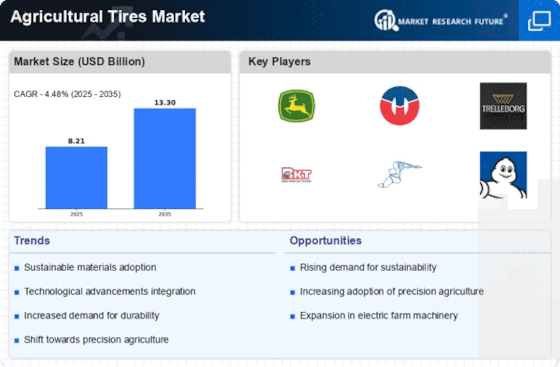
As per Market Research Future analysis, the Agricultural Tires Market Size was estimated at 8.212 USD Billion in 2024. The Agricultural Tires industry is projected to grow from 8.58 USD Billion in 2025 to 13.3 USD Billion by 2035, exhibiting a compound annual growth rate (CAGR) of 4.48% during the forecast period 2025 - 2035

Key Market Trends & Highlights

The Agricultural Tires Market is poised for growth driven by technological advancements and sustainability initiatives.

  • Technological advancements in tire design are enhancing performance and durability, particularly in North America. Sustainability and eco-friendly solutions are becoming increasingly important, influencing consumer preferences across the Asia-Pacific region. The radial tires segment remains the largest, while bias tires are experiencing rapid growth due to their cost-effectiveness. Rising demand for agricultural productivity and the expansion of precision farming techniques are key drivers propelling market growth.

Market Size & Forecast

2024 Market Size 8.212 (USD Billion)
2035 Market Size 13.3 (USD Billion)
CAGR (2025 - 2035) 4.48%
Largest Regional Market Share in 2024 North America

Major Players

John Deere (US), <a href="https://www.titan-intl.com/en/tires/agriculture">Titan International</a> (US), Trelleborg (SE), BKT (IN), Goodyear (US), Michelin (FR), Continental (DE), Bridgestone (JP), Pirelli (IT)

Market Trends

The Agricultural Tires Market is currently experiencing a dynamic evolution, driven by advancements in technology and increasing demand for efficient farming practices. As agricultural operations become more mechanized, the need for specialized tires that can withstand diverse terrains and conditions is paramount. Innovations in tire design, such as improved tread patterns and enhanced durability, are becoming increasingly prevalent. across the agriculture tire market. This shift not only enhances the performance of agricultural machinery but also contributes to better fuel efficiency and reduced soil compaction, which are critical for sustainable farming. Furthermore, the growing emphasis on precision agriculture is likely to influence tire development, as farmers seek solutions that optimize their equipment's performance and longevity shaping emerging agricultural tires market trends.. In addition to technological advancements, environmental considerations are shaping the agricultural tires market . Manufacturers are increasingly focusing on producing eco-friendly tires that minimize environmental impact while maintaining high performance standards. This trend aligns with the broader agricultural industry's commitment to sustainability and responsible resource management. As the market continues to evolve, it appears that the integration of innovative materials and designs will play a crucial role in meeting the diverse needs of farmers worldwide. Overall, the Agricultural Tires Market is poised for growth, driven by a combination of technological innovation and a commitment to sustainable practices.

Technological Advancements in Tire Design

Recent innovations in tire technology are transforming the Agricultural Tires Market. Enhanced tread patterns and materials are being developed to improve traction and durability, which are essential for modern farming equipment. These advancements not only boost performance but also contribute to better fuel efficiency and reduced soil damage. reinforcing key agricultural tires market trends.

Sustainability and Eco-Friendly Solutions

The increasing focus on environmental sustainability is influencing the Agricultural Tires Market. Manufacturers are prioritizing the development of eco-friendly tires that reduce carbon footprints while maintaining high performance. This trend reflects the agricultural sector's broader commitment to sustainable practices and responsible resource management.

Integration of Precision Agriculture

The rise of precision agriculture is shaping the Agricultural Tires Market by driving demand for specialized tires that enhance equipment performance. As farmers adopt advanced technologies to optimize their operations, the need for tires that can support these innovations becomes more pronounced, indicating a shift towards tailored solutions.

Agricultural Tires Market Market Drivers

Growing Focus on Sustainable Practices

The Agricultural Tires Market is witnessing a growing focus on sustainable practices within the agricultural sector. As environmental concerns rise, farmers are increasingly seeking eco-friendly tire options that minimize their carbon footprint. Manufacturers are responding by developing tires made from sustainable materials and implementing production processes that reduce waste and energy consumption. The market for sustainable agricultural tires is projected to expand as more farmers recognize the long-term benefits of investing in environmentally friendly solutions. This shift not only aligns with global sustainability goals but also enhances the reputation of agricultural businesses. The increasing availability of sustainable tire options is likely to drive growth in the Agricultural Tires Market, as more stakeholders prioritize eco-conscious choices.

Expansion of Precision Farming Techniques

The Agricultural Tires Market is significantly influenced by the expansion of precision farming techniques. Farmers increasingly adopt technologies that enhance efficiency and productivity, such as GPS-guided equipment and data analytics. These advancements necessitate the use of specialized tires that can support high-tech machinery, ensuring optimal performance in various agricultural tasks. The integration of precision agriculture is expected to grow at a rate of around 12% annually, indicating a substantial market opportunity for tire manufacturers. Tires designed for precision farming not only improve operational efficiency but also contribute to sustainable farming practices by minimizing soil disturbance and maximizing crop yields. This trend underscores the importance of innovation in tire design to cater to the specific requirements of precision agriculture.

Rising Demand for Agricultural Productivity

The Agricultural Tires Market experiences a notable surge in demand driven by the increasing need for enhanced agricultural productivity. As the global population continues to grow, the pressure on agricultural systems intensifies, necessitating the use of advanced machinery equipped with specialized tires. These tires are designed to improve traction, reduce soil compaction, and enhance fuel efficiency, thereby optimizing the performance of agricultural equipment. According to recent data, the agricultural machinery sector is projected to grow at a compound annual growth rate of approximately 5.5% over the next few years, further propelling the demand for high-quality agricultural tires. This trend indicates a robust market potential for manufacturers focusing on innovative tire solutions tailored to meet the evolving needs of modern farming practices.

Technological Innovations in Tire Manufacturing

Technological innovations in tire manufacturing are reshaping the Agricultural Tires Market. Advances in materials science and engineering have led to the development of tires that offer improved durability, performance, and safety. Innovations such as enhanced tread designs and the use of advanced rubber compounds contribute to better traction and longer service life. The market is expected to benefit from these technological advancements, as they enable manufacturers to produce tires that meet the rigorous demands of modern agricultural practices. Furthermore, the integration of smart technologies, such as sensors for monitoring tire pressure and wear, is likely to enhance operational efficiency. This trend suggests a promising future for the Agricultural Tires Market, as technology continues to play a pivotal role in tire development.

Increasing Investment in Agricultural Infrastructure

The Agricultural Tires Market is positively impacted by increasing investment in agricultural infrastructure. Governments and private entities are recognizing the importance of modernizing agricultural systems to enhance food security and economic growth. This investment often translates into the procurement of advanced agricultural machinery, which in turn drives the demand for specialized tires. As infrastructure projects expand, the need for reliable and efficient agricultural equipment becomes paramount, leading to a corresponding increase in tire sales. Recent reports indicate that investments in agricultural infrastructure are expected to rise by approximately 8% annually, creating a favorable environment for tire manufacturers. This trend highlights the interconnectedness of agricultural development and the tire market, suggesting a robust growth trajectory for the Agricultural Tires Market.

Market Segment Insights

By Type: Radial Tires (Largest) vs. Bias Tires (Fastest-Growing)

The Agricultural Tires Market is predominantly comprised of Radial Tires, which hold the largest share due to their superior performance and durability on various terrains. The market has seen a notable acceptance of Radial Tires among agricultural equipment manufacturers and farmers, thanks to their enhanced grip, fuel efficiency, and resistance to wear. On the other hand, Bias Tires remain a significant part of the market, appealing to cost-sensitive consumers and certain types of equipment where their design provides adequate performance.

Radial Tires (Dominant) vs. Bias Tires (Emerging)

Radial Tires are recognized for their innovative design, which allows for improved flexibility and reduced rolling resistance, making them a favored choice for modern agricultural operations. They provide excellent traction and stability, particularly on larger machinery, which increases productivity on farms. Conversely, <a href="https://www.marketresearchfuture.com/reports/bias-tire-market-24322">Bias Tires</a>, while traditionally considered less advanced, are experiencing a resurgence due to their lower cost and availability. They are often utilized in specific applications like older models of tractors and smaller agricultural equipment, where their strong construction and reliability continue to serve essential roles.

By Application: Tractors (Largest) vs. Combine Harvesters (Fastest-Growing)

In the Agricultural Tires Market, Tractors dominate the application segment, capturing the largest share due to their essential role in various farming operations. The demand for durable and high-performance tires specifically designed for tractors has been driven by the need for efficiency, enhanced productivity, and the growing trend towards mechanized farming practices. Combine Harvesters, on the other hand, are emerging as the fastest-growing application within the segment as mechanized harvesting becomes increasingly popular, further supported by advancements in technology and innovation within tire manufacturing.

Tractors (Dominant) vs. Combine Harvesters (Emerging)

Tractors constitute the dominant application within the Agricultural Tires Market, characterized by their versatility and critical role across diverse agricultural tasks, including plowing, tilling, and planting. These tires are designed to withstand the rugged terrains and heavy loads that tractors typically encounter. On the other hand, Combine Harvesters represent an emerging segment, driven by innovations that enhance harvesting efficiency and versatility. The demand for specialized tires that can seamlessly handle various crop types while maintaining grip and stability during operations is rapidly increasing. Tires for Combine Harvesters are engineered for optimal performance in harvest-season conditions, which further contributes to their growth as farmers increasingly invest in advanced harvesting equipment.

By Sales Channel: OEM (Largest) vs. Aftermarket (Fastest-Growing)

In the Agricultural Tires Market, the sales channel segment reveals a compelling distribution between OEM and aftermarket tires. The OEM segment holds a significant market share, driven by the increasing production of agricultural machinery and the consistent demand for quality tires directly from equipment manufacturers. In contrast, the aftermarket segment, while smaller, demonstrates remarkable growth potential as end-users seek replacement tires that offer enhanced performance and durability. This shift is indicative of changing consumer preferences towards upgraded products that cater to modern agricultural practices.

Sales Channel: OEM (Dominant) vs. Aftermarket (Emerging)

The OEM sales channel in the Agricultural Tires Market is characterized by established partnerships between tire manufacturers and agricultural equipment producers, ensuring a steady demand for specific tire types tailored to original machinery. This channel is typically associated with high-quality products and reliability, appealing to customers who prioritize performance. In contrast, the aftermarket segment, although emerging, is rapidly gaining traction as farmers and agricultural businesses are increasingly focused on cost-effectiveness and flexibility. This segment offers a diverse range of tire options, catering to various needs, such as enhanced traction or improved durability, appealing to a broader customer base seeking customized solutions for their evolving agricultural requirements.

Get more detailed insights about Agricultural Tires Market Research Report—Global Forecast till 2035

Regional Insights

North America : Agricultural Innovation Leader

North America is the largest market for agricultural tires, holding approximately 40% of the global share. The region's growth is driven by advancements in agricultural technology, increasing mechanization, and a focus on sustainable farming practices. Regulatory support for eco-friendly farming equipment further boosts demand, making it a key player in the agricultural sector. The United States and Canada are the leading countries in this market, with major players like John Deere and Titan International dominating the landscape. The competitive environment is characterized by innovation and partnerships, as companies strive to meet the evolving needs of farmers. The presence of established brands ensures a robust supply chain and product availability, enhancing market growth.

Europe : Sustainable Farming Initiatives

Europe is the second-largest market for agricultural tires, accounting for about 30% of the global market share. The region's growth is fueled by stringent regulations promoting sustainable agriculture and environmental protection. Initiatives aimed at reducing carbon footprints and enhancing soil health are key drivers, alongside increasing demand for high-performance tires that can withstand diverse agricultural conditions. Leading countries in this market include Germany, France, and the Netherlands, where companies like Michelin and Continental are prominent. The competitive landscape is marked by innovation in tire technology, focusing on durability and efficiency. The presence of major manufacturers and a strong distribution network contribute to the region's dynamic market environment.

Asia-Pacific : Emerging Market Potential

Asia-Pacific is witnessing rapid growth in the agricultural tires market, holding approximately 20% of the global share. The region's expansion is driven by increasing agricultural productivity, rising population, and the need for mechanization. Government initiatives aimed at enhancing food security and supporting farmers with subsidies for modern equipment are significant catalysts for market growth. Countries like India and China are at the forefront, with a growing presence of local and international players such as BKT and Bridgestone. The competitive landscape is evolving, with companies focusing on cost-effective solutions and innovative tire designs to cater to diverse agricultural needs. This dynamic environment is expected to attract further investments and technological advancements.

Middle East and Africa : Resource-Rich Agricultural Hub

The Middle East and Africa region is emerging as a significant market for agricultural tires, accounting for about 10% of the global share. The growth is driven by increasing agricultural activities, government initiatives to boost food production, and investments in irrigation and farming technologies. The region's diverse climate and soil conditions necessitate specialized tire solutions, further fueling demand. Leading countries include South Africa and Egypt, where local manufacturers and international brands like Goodyear and Trelleborg are expanding their presence. The competitive landscape is characterized by a mix of established players and new entrants, focusing on innovation and adaptability to local market needs. This growth trajectory is expected to continue as agricultural practices modernize and expand.

Key Players and Competitive Insights

Leading market players are investing heavily in research and development to expand their product lines, which will help the Agricultural Tires Market grow even more. Market participants are also undertaking various strategic activities to expand their footprint, with important market developments including new product launches, contractual agreements, mergers and acquisitions, higher investments, and collaboration with other organizations. The agricultural/farm tire industry must offer cost-effective items to expand and survive in a more competitive and rising market climate. Manufacturing locally to minimize operational costs is one of the key business tactics manufacturers use in the agricultural tires industry to benefit clients and increase the market sector. In recent years, the agricultural tires industry has offered some of the most significant advantages to the agriculture sector. Major players in the agricultural tires market, including Bridgestone Corp., Continental AG, Balakrishna Industries Limited, Titan International Inc., Trelleborg AB, Michelin, Nokian Tyres PLC, Pirelli & C SpA, Alliance Tire Group, and Apollo Tyres and others, are attempting to increase market demand by investing in research and development operations. Trelleborg AB is a engineering group focused on polymer technology, with headquarters in Trelleborg, Sweden, with 21,230 employees and with yearly revenue of 33.8 billion SEK as of 2021. The company first went public in 1964 and trades on the Nasdaq Stockholm exchange as a large-cap component. Trelleborg is a world leader in engineered polymer solutions that seal, damp, and protect critical applications in demanding environments. Its innovative solutions accelerate performance for customers in a sustainable way. Trelleborg is a world leader in engineered polymer solutions that seal, damp, and protect critical applications in demanding environments. Its innovative solutions accelerate performance for customers in a sustainable way. Trelleborg AB announced its plan to increase its production output from North American agriculture tire facilities to cater to the growing demand. The company generates 18% of wheels sales from the North American market. Michelin is a French multinational tire manufacturing company based in Clermont-Ferrand in the Auvergne-Rhône-Alpes region of France. It is the second-largest tire manufacturer behind Bridgestone and larger than Goodyear and Continental. Michelin, the leading tire company, is dedicated to sustainably improving the mobility of goods and people by manufacturing and marketing tires and services for every type of vehicle, including airplanes, automobiles, bicycles/motorcycles, earthmovers, farm equipment, and trucks. It also offers digital mobility support services and publishes travel guides, hotel and restaurant guides, maps, and road atlases. Michelin launched its Agribib Row Crop IF (improved flexion) agriculture tires, specially crafted for self-propelled and trailed sprayers, which allow higher load capacity, improved traction, and reduced soil contraction.

Key Companies in the Agricultural Tires Market include

Industry Developments

January 2022: Magna Tyres acquired Industra Ltd., which was a step toward expansion. Industra Ltd has a robust presence in the Polish market, with three tire segments, including Agricultural Tires Market. Earthmoving and Industrial Tires will aid Magna in marking its presence in the Polish market.

December 2021: Trelleborg AB announced its plan to increase its production output from North American agriculture tire facilities to cater to the growing demand. The company generates 18% of wheels sales from the North American market.

Future Outlook

Agricultural Tires Market Future Outlook

The Agricultural Tires Market is projected to grow at a 4.48% CAGR from 2025 to 2035, driven by technological advancements, increasing mechanization, and rising demand for sustainable farming practices.

New opportunities lie in:

  • <p>Development of smart tire technology for real-time monitoring Expansion into emerging markets with tailored product offerings Partnerships with agricultural equipment manufacturers for integrated solutions</p>

By 2035, the Agricultural Tires Market is expected to achieve robust growth, reflecting evolving agricultural needs.

Market Segmentation

Agricultural Tires Market Type Outlook

  • Bias Tires
  • Radial Tires

Agricultural Tires Market Application Outlook

  • Tractors
  • Combine Harvesters
  • Sprayers
  • Trailers
  • Loaders
  • Others

Agricultural Tires Market Sales Channel Outlook

  • OEM
  • Aftermarket

Report Scope

MARKET SIZE 2024 8.212(USD Billion)
MARKET SIZE 2025 8.58(USD Billion)
MARKET SIZE 2035 13.3(USD Billion)
COMPOUND ANNUAL GROWTH RATE (CAGR) 4.48% (2025 - 2035)
REPORT COVERAGE Revenue Forecast, Competitive Landscape, Growth Factors, and Trends
BASE YEAR 2024
Market Forecast Period 2025 - 2035
Historical Data 2019 - 2024
Market Forecast Units USD Billion
Key Companies Profiled John Deere (US), Titan International (US), Trelleborg (SE), BKT (IN), Goodyear (US), Michelin (FR), Continental (DE), Bridgestone (JP), Pirelli (IT)
Segments Covered Tire Type, Application, Sales Channel, Region
Key Market Opportunities Adoption of precision agriculture technologies enhances demand for specialized Agricultural Tires.
Key Market Dynamics Rising demand for durable agricultural tires driven by advancements in technology and changing farming practices.
Countries Covered North America, Europe, APAC, South America, MEA

FAQs

What is the current valuation of the Agricultural Tires Market as of 2024?

<p>The Agricultural Tires Market was valued at 8.212 USD Billion in 2024.</p>

What is the projected market size for the Agricultural Tires Market by 2035?

<p>The market is projected to reach 13.3 USD Billion by 2035.</p>

What is the expected CAGR for the Agricultural Tires Market during the forecast period 2025 - 2035?

<p>The expected CAGR for the Agricultural Tires Market during 2025 - 2035 is 4.48%.</p>

Which companies are considered key players in the Agricultural Tires Market?

<p>Key players include John Deere, Titan International, Trelleborg, BKT, Goodyear, Michelin, Continental, Bridgestone, and Pirelli.</p>

What are the two main types of agricultural tires in the market?

<p>The two main types of agricultural tires are Bias Tires and Radial Tires.</p>

What was the market valuation for Bias Tires in 2024?

<p>The market valuation for Bias Tires was between 3.5 and 5.5 USD Billion in 2024.</p>

What is the projected market valuation for Radial Tires by 2035?

The projected market valuation for Radial Tires is expected to be between 4.712 and 7.8 USD Billion by 2035.

Which application segments are included in the Agricultural Tires Market?

Application segments include Tractors, Combine Harvesters, Sprayers, Trailers, Loaders, and Others.

What was the market size for Tractors in 2024?

The market size for Tractors was between 2.5 and 4.0 USD Billion in 2024.

What is the expected market size for the Aftermarket sales channel by 2035?

The expected market size for the Aftermarket sales channel is projected to be between 4.712 and 7.8 USD Billion by 2035.

  1. SECTION I: EXECUTIVE SUMMARY AND KEY HIGHLIGHTS
    1. | 1.1 EXECUTIVE SUMMARY
    2. | | 1.1.1 Market Overview
    3. | | 1.1.2 Key Findings
    4. | | 1.1.3 Market Segmentation
    5. | | 1.1.4 Competitive Landscape
    6. | | 1.1.5 Challenges and Opportunities
    7. | | 1.1.6 Future Outlook
  2. SECTION II: SCOPING, METHODOLOGY AND MARKET STRUCTURE
    1. | 2.1 MARKET INTRODUCTION
    2. | | 2.1.1 Definition
    3. | | 2.1.2 Scope of the study
    4. | | | 2.1.2.1 Research Objective
    5. | | | 2.1.2.2 Assumption
    6. | | | 2.1.2.3 Limitations
    7. | 2.2 RESEARCH METHODOLOGY
    8. | | 2.2.1 Overview
    9. | | 2.2.2 Data Mining
    10. | | 2.2.3 Secondary Research
    11. | | 2.2.4 Primary Research
    12. | | | 2.2.4.1 Primary Interviews and Information Gathering Process
    13. | | | 2.2.4.2 Breakdown of Primary Respondents
    14. | | 2.2.5 Forecasting Model
    15. | | 2.2.6 Market Size Estimation
    16. | | | 2.2.6.1 Bottom-Up Approach
    17. | | | 2.2.6.2 Top-Down Approach
    18. | | 2.2.7 Data Triangulation
    19. | | 2.2.8 Validation
  3. SECTION III: QUALITATIVE ANALYSIS
    1. | 3.1 MARKET DYNAMICS
    2. | | 3.1.1 Overview
    3. | | 3.1.2 Drivers
    4. | | 3.1.3 Restraints
    5. | | 3.1.4 Opportunities
    6. | 3.2 MARKET FACTOR ANALYSIS
    7. | | 3.2.1 Value chain Analysis
    8. | | 3.2.2 Porter's Five Forces Analysis
    9. | | | 3.2.2.1 Bargaining Power of Suppliers
    10. | | | 3.2.2.2 Bargaining Power of Buyers
    11. | | | 3.2.2.3 Threat of New Entrants
    12. | | | 3.2.2.4 Threat of Substitutes
    13. | | | 3.2.2.5 Intensity of Rivalry
    14. | | 3.2.3 COVID-19 Impact Analysis
    15. | | | 3.2.3.1 Market Impact Analysis
    16. | | | 3.2.3.2 Regional Impact
    17. | | | 3.2.3.3 Opportunity and Threat Analysis
  4. SECTION IV: QUANTITATIVE ANALYSIS
    1. | 4.1 Automobile, BY Type (USD Billion)
    2. | | 4.1.1 Bias Tires
    3. | | 4.1.2 Radial Tires
    4. | 4.2 Automobile, BY Application (USD Billion)
    5. | | 4.2.1 Tractors
    6. | | 4.2.2 Combine Harvesters
    7. | | 4.2.3 Sprayers
    8. | | 4.2.4 Trailers
    9. | | 4.2.5 Loaders
    10. | | 4.2.6 Others
    11. | 4.3 Automobile, BY Sales Channel (USD Billion)
    12. | | 4.3.1 OEM
    13. | | 4.3.2 Aftermarket
    14. | 4.4 Automobile, BY Region (USD Billion)
    15. | | 4.4.1 North America
    16. | | | 4.4.1.1 US
    17. | | | 4.4.1.2 Canada
    18. | | 4.4.2 Europe
    19. | | | 4.4.2.1 Germany
    20. | | | 4.4.2.2 UK
    21. | | | 4.4.2.3 France
    22. | | | 4.4.2.4 Russia
    23. | | | 4.4.2.5 Italy
    24. | | | 4.4.2.6 Spain
    25. | | | 4.4.2.7 Rest of Europe
    26. | | 4.4.3 APAC
    27. | | | 4.4.3.1 China
    28. | | | 4.4.3.2 India
    29. | | | 4.4.3.3 Japan
    30. | | | 4.4.3.4 South Korea
    31. | | | 4.4.3.5 Malaysia
    32. | | | 4.4.3.6 Thailand
    33. | | | 4.4.3.7 Indonesia
    34. | | | 4.4.3.8 Rest of APAC
    35. | | 4.4.4 South America
    36. | | | 4.4.4.1 Brazil
    37. | | | 4.4.4.2 Mexico
    38. | | | 4.4.4.3 Argentina
    39. | | | 4.4.4.4 Rest of South America
    40. | | 4.4.5 MEA
    41. | | | 4.4.5.1 GCC Countries
    42. | | | 4.4.5.2 South Africa
    43. | | | 4.4.5.3 Rest of MEA
  5. SECTION V: COMPETITIVE ANALYSIS
    1. | 5.1 Competitive Landscape
    2. | | 5.1.1 Overview
    3. | | 5.1.2 Competitive Analysis
    4. | | 5.1.3 Market share Analysis
    5. | | 5.1.4 Major Growth Strategy in the Automobile
    6. | | 5.1.5 Competitive Benchmarking
    7. | | 5.1.6 Leading Players in Terms of Number of Developments in the Automobile
    8. | | 5.1.7 Key developments and growth strategies
    9. | | | 5.1.7.1 New Product Launch/Service Deployment
    10. | | | 5.1.7.2 Merger & Acquisitions
    11. | | | 5.1.7.3 Joint Ventures
    12. | | 5.1.8 Major Players Financial Matrix
    13. | | | 5.1.8.1 Sales and Operating Income
    14. | | | 5.1.8.2 Major Players R&D Expenditure. 2023
    15. | 5.2 Company Profiles
    16. | | 5.2.1 John Deere (US)
    17. | | | 5.2.1.1 Financial Overview
    18. | | | 5.2.1.2 Products Offered
    19. | | | 5.2.1.3 Key Developments
    20. | | | 5.2.1.4 SWOT Analysis
    21. | | | 5.2.1.5 Key Strategies
    22. | | 5.2.2 Titan International (US)
    23. | | | 5.2.2.1 Financial Overview
    24. | | | 5.2.2.2 Products Offered
    25. | | | 5.2.2.3 Key Developments
    26. | | | 5.2.2.4 SWOT Analysis
    27. | | | 5.2.2.5 Key Strategies
    28. | | 5.2.3 Trelleborg (SE)
    29. | | | 5.2.3.1 Financial Overview
    30. | | | 5.2.3.2 Products Offered
    31. | | | 5.2.3.3 Key Developments
    32. | | | 5.2.3.4 SWOT Analysis
    33. | | | 5.2.3.5 Key Strategies
    34. | | 5.2.4 BKT (IN)
    35. | | | 5.2.4.1 Financial Overview
    36. | | | 5.2.4.2 Products Offered
    37. | | | 5.2.4.3 Key Developments
    38. | | | 5.2.4.4 SWOT Analysis
    39. | | | 5.2.4.5 Key Strategies
    40. | | 5.2.5 Goodyear (US)
    41. | | | 5.2.5.1 Financial Overview
    42. | | | 5.2.5.2 Products Offered
    43. | | | 5.2.5.3 Key Developments
    44. | | | 5.2.5.4 SWOT Analysis
    45. | | | 5.2.5.5 Key Strategies
    46. | | 5.2.6 Michelin (FR)
    47. | | | 5.2.6.1 Financial Overview
    48. | | | 5.2.6.2 Products Offered
    49. | | | 5.2.6.3 Key Developments
    50. | | | 5.2.6.4 SWOT Analysis
    51. | | | 5.2.6.5 Key Strategies
    52. | | 5.2.7 Continental (DE)
    53. | | | 5.2.7.1 Financial Overview
    54. | | | 5.2.7.2 Products Offered
    55. | | | 5.2.7.3 Key Developments
    56. | | | 5.2.7.4 SWOT Analysis
    57. | | | 5.2.7.5 Key Strategies
    58. | | 5.2.8 Bridgestone (JP)
    59. | | | 5.2.8.1 Financial Overview
    60. | | | 5.2.8.2 Products Offered
    61. | | | 5.2.8.3 Key Developments
    62. | | | 5.2.8.4 SWOT Analysis
    63. | | | 5.2.8.5 Key Strategies
    64. | | 5.2.9 Pirelli (IT)
    65. | | | 5.2.9.1 Financial Overview
    66. | | | 5.2.9.2 Products Offered
    67. | | | 5.2.9.3 Key Developments
    68. | | | 5.2.9.4 SWOT Analysis
    69. | | | 5.2.9.5 Key Strategies
    70. | 5.3 Appendix
    71. | | 5.3.1 References
    72. | | 5.3.2 Related Reports
  6. LIST OF FIGURES
    1. | 6.1 MARKET SYNOPSIS
    2. | 6.2 NORTH AMERICA MARKET ANALYSIS
    3. | 6.3 US MARKET ANALYSIS BY TYPE
    4. | 6.4 US MARKET ANALYSIS BY APPLICATION
    5. | 6.5 US MARKET ANALYSIS BY SALES CHANNEL
    6. | 6.6 CANADA MARKET ANALYSIS BY TYPE
    7. | 6.7 CANADA MARKET ANALYSIS BY APPLICATION
    8. | 6.8 CANADA MARKET ANALYSIS BY SALES CHANNEL
    9. | 6.9 EUROPE MARKET ANALYSIS
    10. | 6.10 GERMANY MARKET ANALYSIS BY TYPE
    11. | 6.11 GERMANY MARKET ANALYSIS BY APPLICATION
    12. | 6.12 GERMANY MARKET ANALYSIS BY SALES CHANNEL
    13. | 6.13 UK MARKET ANALYSIS BY TYPE
    14. | 6.14 UK MARKET ANALYSIS BY APPLICATION
    15. | 6.15 UK MARKET ANALYSIS BY SALES CHANNEL
    16. | 6.16 FRANCE MARKET ANALYSIS BY TYPE
    17. | 6.17 FRANCE MARKET ANALYSIS BY APPLICATION
    18. | 6.18 FRANCE MARKET ANALYSIS BY SALES CHANNEL
    19. | 6.19 RUSSIA MARKET ANALYSIS BY TYPE
    20. | 6.20 RUSSIA MARKET ANALYSIS BY APPLICATION
    21. | 6.21 RUSSIA MARKET ANALYSIS BY SALES CHANNEL
    22. | 6.22 ITALY MARKET ANALYSIS BY TYPE
    23. | 6.23 ITALY MARKET ANALYSIS BY APPLICATION
    24. | 6.24 ITALY MARKET ANALYSIS BY SALES CHANNEL
    25. | 6.25 SPAIN MARKET ANALYSIS BY TYPE
    26. | 6.26 SPAIN MARKET ANALYSIS BY APPLICATION
    27. | 6.27 SPAIN MARKET ANALYSIS BY SALES CHANNEL
    28. | 6.28 REST OF EUROPE MARKET ANALYSIS BY TYPE
    29. | 6.29 REST OF EUROPE MARKET ANALYSIS BY APPLICATION
    30. | 6.30 REST OF EUROPE MARKET ANALYSIS BY SALES CHANNEL
    31. | 6.31 APAC MARKET ANALYSIS
    32. | 6.32 CHINA MARKET ANALYSIS BY TYPE
    33. | 6.33 CHINA MARKET ANALYSIS BY APPLICATION
    34. | 6.34 CHINA MARKET ANALYSIS BY SALES CHANNEL
    35. | 6.35 INDIA MARKET ANALYSIS BY TYPE
    36. | 6.36 INDIA MARKET ANALYSIS BY APPLICATION
    37. | 6.37 INDIA MARKET ANALYSIS BY SALES CHANNEL
    38. | 6.38 JAPAN MARKET ANALYSIS BY TYPE
    39. | 6.39 JAPAN MARKET ANALYSIS BY APPLICATION
    40. | 6.40 JAPAN MARKET ANALYSIS BY SALES CHANNEL
    41. | 6.41 SOUTH KOREA MARKET ANALYSIS BY TYPE
    42. | 6.42 SOUTH KOREA MARKET ANALYSIS BY APPLICATION
    43. | 6.43 SOUTH KOREA MARKET ANALYSIS BY SALES CHANNEL
    44. | 6.44 MALAYSIA MARKET ANALYSIS BY TYPE
    45. | 6.45 MALAYSIA MARKET ANALYSIS BY APPLICATION
    46. | 6.46 MALAYSIA MARKET ANALYSIS BY SALES CHANNEL
    47. | 6.47 THAILAND MARKET ANALYSIS BY TYPE
    48. | 6.48 THAILAND MARKET ANALYSIS BY APPLICATION
    49. | 6.49 THAILAND MARKET ANALYSIS BY SALES CHANNEL
    50. | 6.50 INDONESIA MARKET ANALYSIS BY TYPE
    51. | 6.51 INDONESIA MARKET ANALYSIS BY APPLICATION
    52. | 6.52 INDONESIA MARKET ANALYSIS BY SALES CHANNEL
    53. | 6.53 REST OF APAC MARKET ANALYSIS BY TYPE
    54. | 6.54 REST OF APAC MARKET ANALYSIS BY APPLICATION
    55. | 6.55 REST OF APAC MARKET ANALYSIS BY SALES CHANNEL
    56. | 6.56 SOUTH AMERICA MARKET ANALYSIS
    57. | 6.57 BRAZIL MARKET ANALYSIS BY TYPE
    58. | 6.58 BRAZIL MARKET ANALYSIS BY APPLICATION
    59. | 6.59 BRAZIL MARKET ANALYSIS BY SALES CHANNEL
    60. | 6.60 MEXICO MARKET ANALYSIS BY TYPE
    61. | 6.61 MEXICO MARKET ANALYSIS BY APPLICATION
    62. | 6.62 MEXICO MARKET ANALYSIS BY SALES CHANNEL
    63. | 6.63 ARGENTINA MARKET ANALYSIS BY TYPE
    64. | 6.64 ARGENTINA MARKET ANALYSIS BY APPLICATION
    65. | 6.65 ARGENTINA MARKET ANALYSIS BY SALES CHANNEL
    66. | 6.66 REST OF SOUTH AMERICA MARKET ANALYSIS BY TYPE
    67. | 6.67 REST OF SOUTH AMERICA MARKET ANALYSIS BY APPLICATION
    68. | 6.68 REST OF SOUTH AMERICA MARKET ANALYSIS BY SALES CHANNEL
    69. | 6.69 MEA MARKET ANALYSIS
    70. | 6.70 GCC COUNTRIES MARKET ANALYSIS BY TYPE
    71. | 6.71 GCC COUNTRIES MARKET ANALYSIS BY APPLICATION
    72. | 6.72 GCC COUNTRIES MARKET ANALYSIS BY SALES CHANNEL
    73. | 6.73 SOUTH AFRICA MARKET ANALYSIS BY TYPE
    74. | 6.74 SOUTH AFRICA MARKET ANALYSIS BY APPLICATION
    75. | 6.75 SOUTH AFRICA MARKET ANALYSIS BY SALES CHANNEL
    76. | 6.76 REST OF MEA MARKET ANALYSIS BY TYPE
    77. | 6.77 REST OF MEA MARKET ANALYSIS BY APPLICATION
    78. | 6.78 REST OF MEA MARKET ANALYSIS BY SALES CHANNEL
    79. | 6.79 KEY BUYING CRITERIA OF AUTOMOBILE
    80. | 6.80 RESEARCH PROCESS OF MRFR
    81. | 6.81 DRO ANALYSIS OF AUTOMOBILE
    82. | 6.82 DRIVERS IMPACT ANALYSIS: AUTOMOBILE
    83. | 6.83 RESTRAINTS IMPACT ANALYSIS: AUTOMOBILE
    84. | 6.84 SUPPLY / VALUE CHAIN: AUTOMOBILE
    85. | 6.85 AUTOMOBILE, BY TYPE, 2024 (% SHARE)
    86. | 6.86 AUTOMOBILE, BY TYPE, 2024 TO 2035 (USD Billion)
    87. | 6.87 AUTOMOBILE, BY APPLICATION, 2024 (% SHARE)
    88. | 6.88 AUTOMOBILE, BY APPLICATION, 2024 TO 2035 (USD Billion)
    89. | 6.89 AUTOMOBILE, BY SALES CHANNEL, 2024 (% SHARE)
    90. | 6.90 AUTOMOBILE, BY SALES CHANNEL, 2024 TO 2035 (USD Billion)
    91. | 6.91 BENCHMARKING OF MAJOR COMPETITORS
  7. LIST OF TABLES
    1. | 7.1 LIST OF ASSUMPTIONS
    2. | | 7.1.1
    3. | 7.2 North America MARKET SIZE ESTIMATES; FORECAST
    4. | | 7.2.1 BY TYPE, 2025-2035 (USD Billion)
    5. | | 7.2.2 BY APPLICATION, 2025-2035 (USD Billion)
    6. | | 7.2.3 BY SALES CHANNEL, 2025-2035 (USD Billion)
    7. | 7.3 US MARKET SIZE ESTIMATES; FORECAST
    8. | | 7.3.1 BY TYPE, 2025-2035 (USD Billion)
    9. | | 7.3.2 BY APPLICATION, 2025-2035 (USD Billion)
    10. | | 7.3.3 BY SALES CHANNEL, 2025-2035 (USD Billion)
    11. | 7.4 Canada MARKET SIZE ESTIMATES; FORECAST
    12. | | 7.4.1 BY TYPE, 2025-2035 (USD Billion)
    13. | | 7.4.2 BY APPLICATION, 2025-2035 (USD Billion)
    14. | | 7.4.3 BY SALES CHANNEL, 2025-2035 (USD Billion)
    15. | 7.5 Europe MARKET SIZE ESTIMATES; FORECAST
    16. | | 7.5.1 BY TYPE, 2025-2035 (USD Billion)
    17. | | 7.5.2 BY APPLICATION, 2025-2035 (USD Billion)
    18. | | 7.5.3 BY SALES CHANNEL, 2025-2035 (USD Billion)
    19. | 7.6 Germany MARKET SIZE ESTIMATES; FORECAST
    20. | | 7.6.1 BY TYPE, 2025-2035 (USD Billion)
    21. | | 7.6.2 BY APPLICATION, 2025-2035 (USD Billion)
    22. | | 7.6.3 BY SALES CHANNEL, 2025-2035 (USD Billion)
    23. | 7.7 UK MARKET SIZE ESTIMATES; FORECAST
    24. | | 7.7.1 BY TYPE, 2025-2035 (USD Billion)
    25. | | 7.7.2 BY APPLICATION, 2025-2035 (USD Billion)
    26. | | 7.7.3 BY SALES CHANNEL, 2025-2035 (USD Billion)
    27. | 7.8 France MARKET SIZE ESTIMATES; FORECAST
    28. | | 7.8.1 BY TYPE, 2025-2035 (USD Billion)
    29. | | 7.8.2 BY APPLICATION, 2025-2035 (USD Billion)
    30. | | 7.8.3 BY SALES CHANNEL, 2025-2035 (USD Billion)
    31. | 7.9 Russia MARKET SIZE ESTIMATES; FORECAST
    32. | | 7.9.1 BY TYPE, 2025-2035 (USD Billion)
    33. | | 7.9.2 BY APPLICATION, 2025-2035 (USD Billion)
    34. | | 7.9.3 BY SALES CHANNEL, 2025-2035 (USD Billion)
    35. | 7.10 Italy MARKET SIZE ESTIMATES; FORECAST
    36. | | 7.10.1 BY TYPE, 2025-2035 (USD Billion)
    37. | | 7.10.2 BY APPLICATION, 2025-2035 (USD Billion)
    38. | | 7.10.3 BY SALES CHANNEL, 2025-2035 (USD Billion)
    39. | 7.11 Spain MARKET SIZE ESTIMATES; FORECAST
    40. | | 7.11.1 BY TYPE, 2025-2035 (USD Billion)
    41. | | 7.11.2 BY APPLICATION, 2025-2035 (USD Billion)
    42. | | 7.11.3 BY SALES CHANNEL, 2025-2035 (USD Billion)
    43. | 7.12 Rest of Europe MARKET SIZE ESTIMATES; FORECAST
    44. | | 7.12.1 BY TYPE, 2025-2035 (USD Billion)
    45. | | 7.12.2 BY APPLICATION, 2025-2035 (USD Billion)
    46. | | 7.12.3 BY SALES CHANNEL, 2025-2035 (USD Billion)
    47. | 7.13 APAC MARKET SIZE ESTIMATES; FORECAST
    48. | | 7.13.1 BY TYPE, 2025-2035 (USD Billion)
    49. | | 7.13.2 BY APPLICATION, 2025-2035 (USD Billion)
    50. | | 7.13.3 BY SALES CHANNEL, 2025-2035 (USD Billion)
    51. | 7.14 China MARKET SIZE ESTIMATES; FORECAST
    52. | | 7.14.1 BY TYPE, 2025-2035 (USD Billion)
    53. | | 7.14.2 BY APPLICATION, 2025-2035 (USD Billion)
    54. | | 7.14.3 BY SALES CHANNEL, 2025-2035 (USD Billion)
    55. | 7.15 India MARKET SIZE ESTIMATES; FORECAST
    56. | | 7.15.1 BY TYPE, 2025-2035 (USD Billion)
    57. | | 7.15.2 BY APPLICATION, 2025-2035 (USD Billion)
    58. | | 7.15.3 BY SALES CHANNEL, 2025-2035 (USD Billion)
    59. | 7.16 Japan MARKET SIZE ESTIMATES; FORECAST
    60. | | 7.16.1 BY TYPE, 2025-2035 (USD Billion)
    61. | | 7.16.2 BY APPLICATION, 2025-2035 (USD Billion)
    62. | | 7.16.3 BY SALES CHANNEL, 2025-2035 (USD Billion)
    63. | 7.17 South Korea MARKET SIZE ESTIMATES; FORECAST
    64. | | 7.17.1 BY TYPE, 2025-2035 (USD Billion)
    65. | | 7.17.2 BY APPLICATION, 2025-2035 (USD Billion)
    66. | | 7.17.3 BY SALES CHANNEL, 2025-2035 (USD Billion)
    67. | 7.18 Malaysia MARKET SIZE ESTIMATES; FORECAST
    68. | | 7.18.1 BY TYPE, 2025-2035 (USD Billion)
    69. | | 7.18.2 BY APPLICATION, 2025-2035 (USD Billion)
    70. | | 7.18.3 BY SALES CHANNEL, 2025-2035 (USD Billion)
    71. | 7.19 Thailand MARKET SIZE ESTIMATES; FORECAST
    72. | | 7.19.1 BY TYPE, 2025-2035 (USD Billion)
    73. | | 7.19.2 BY APPLICATION, 2025-2035 (USD Billion)
    74. | | 7.19.3 BY SALES CHANNEL, 2025-2035 (USD Billion)
    75. | 7.20 Indonesia MARKET SIZE ESTIMATES; FORECAST
    76. | | 7.20.1 BY TYPE, 2025-2035 (USD Billion)
    77. | | 7.20.2 BY APPLICATION, 2025-2035 (USD Billion)
    78. | | 7.20.3 BY SALES CHANNEL, 2025-2035 (USD Billion)
    79. | 7.21 Rest of APAC MARKET SIZE ESTIMATES; FORECAST
    80. | | 7.21.1 BY TYPE, 2025-2035 (USD Billion)
    81. | | 7.21.2 BY APPLICATION, 2025-2035 (USD Billion)
    82. | | 7.21.3 BY SALES CHANNEL, 2025-2035 (USD Billion)
    83. | 7.22 South America MARKET SIZE ESTIMATES; FORECAST
    84. | | 7.22.1 BY TYPE, 2025-2035 (USD Billion)
    85. | | 7.22.2 BY APPLICATION, 2025-2035 (USD Billion)
    86. | | 7.22.3 BY SALES CHANNEL, 2025-2035 (USD Billion)
    87. | 7.23 Brazil MARKET SIZE ESTIMATES; FORECAST
    88. | | 7.23.1 BY TYPE, 2025-2035 (USD Billion)
    89. | | 7.23.2 BY APPLICATION, 2025-2035 (USD Billion)
    90. | | 7.23.3 BY SALES CHANNEL, 2025-2035 (USD Billion)
    91. | 7.24 Mexico MARKET SIZE ESTIMATES; FORECAST
    92. | | 7.24.1 BY TYPE, 2025-2035 (USD Billion)
    93. | | 7.24.2 BY APPLICATION, 2025-2035 (USD Billion)
    94. | | 7.24.3 BY SALES CHANNEL, 2025-2035 (USD Billion)
    95. | 7.25 Argentina MARKET SIZE ESTIMATES; FORECAST
    96. | | 7.25.1 BY TYPE, 2025-2035 (USD Billion)
    97. | | 7.25.2 BY APPLICATION, 2025-2035 (USD Billion)
    98. | | 7.25.3 BY SALES CHANNEL, 2025-2035 (USD Billion)
    99. | 7.26 Rest of South America MARKET SIZE ESTIMATES; FORECAST
    100. | | 7.26.1 BY TYPE, 2025-2035 (USD Billion)
    101. | | 7.26.2 BY APPLICATION, 2025-2035 (USD Billion)
    102. | | 7.26.3 BY SALES CHANNEL, 2025-2035 (USD Billion)
    103. | 7.27 MEA MARKET SIZE ESTIMATES; FORECAST
    104. | | 7.27.1 BY TYPE, 2025-2035 (USD Billion)
    105. | | 7.27.2 BY APPLICATION, 2025-2035 (USD Billion)
    106. | | 7.27.3 BY SALES CHANNEL, 2025-2035 (USD Billion)
    107. | 7.28 GCC Countries MARKET SIZE ESTIMATES; FORECAST
    108. | | 7.28.1 BY TYPE, 2025-2035 (USD Billion)
    109. | | 7.28.2 BY APPLICATION, 2025-2035 (USD Billion)
    110. | | 7.28.3 BY SALES CHANNEL, 2025-2035 (USD Billion)
    111. | 7.29 South Africa MARKET SIZE ESTIMATES; FORECAST
    112. | | 7.29.1 BY TYPE, 2025-2035 (USD Billion)
    113. | | 7.29.2 BY APPLICATION, 2025-2035 (USD Billion)
    114. | | 7.29.3 BY SALES CHANNEL, 2025-2035 (USD Billion)
    115. | 7.30 Rest of MEA MARKET SIZE ESTIMATES; FORECAST
    116. | | 7.30.1 BY TYPE, 2025-2035 (USD Billion)
    117. | | 7.30.2 BY APPLICATION, 2025-2035 (USD Billion)
    118. | | 7.30.3 BY SALES CHANNEL, 2025-2035 (USD Billion)
    119. | 7.31 PRODUCT LAUNCH/PRODUCT DEVELOPMENT/APPROVAL
    120. | | 7.31.1
    121. | 7.32 ACQUISITION/PARTNERSHIP
    122. | | 7.32.1

Automobile Market Segmentation

Automobile By Type (USD Billion, 2025-2035)

  • Bias Tires
  • Radial Tires

Automobile By Application (USD Billion, 2025-2035)

  • Tractors
  • Combine Harvesters
  • Sprayers
  • Trailers
  • Loaders
  • Others

Automobile By Sales Channel (USD Billion, 2025-2035)

  • OEM
  • Aftermarket
Infographic

Free Sample Request

Kindly complete the form below to receive a free sample of this Report

Get Free Sample

Customer Strories

Compare Licence

×
Features License Type
Single User Multiuser License Enterprise User
Price $4,950 $5,950 $7,250
Maximum User Access Limit 1 User Upto 10 Users Unrestricted Access Throughout the Organization
Free Customization
Direct Access to Analyst
Deliverable Format
Platform Access
Discount on Next Purchase 10% 15% 15%
Printable Versions
%>