×
Request Free Sample ×

Kindly complete the form below to receive a free sample of this Report

* Please use a valid business email

Leading companies partner with us for data-driven Insights

clients tt-cursor
Hero Background
English
Chinese
French
Japanese
Korean
German
Spanish

Aerospace Materials Market Trends

ID: MRFR/CnM/6956-HCR
111 Pages
Chitranshi Jaiswal
October 2025

Aerospace Materials Market Research Report Information By Material Type (Composite, Steel, Titanium, Aluminum, Others), By Aircraft Type (Civil Aircraft, Military Aircraft, Others) - Forecast to 2035

Share:
Download PDF ×

We do not share your information with anyone. However, we may send you emails based on your report interest from time to time. You may contact us at any time to opt-out.

Aerospace Materials Market Infographic
×
Aerospace Materials Market Infographic Full View
Purchase Options

Market Trends

Key Emerging Trends in the Aerospace Materials Market

There are notable trends in the aerospace materials market that highlight how the sector has changed in response to different influences. This is a thorough analysis of the market trends influencing the aerospace materials industry, are as follows: Growth in Lightweight Materials: To improve overall performance and fuel efficiency, the aerospace sector is seeing an increase in demand for lightweight materials. Aluminum alloys, titanium alloys, and advanced composites are becoming more and more popular as manufacturers look to lighten airplane components. Growing Use of Composite Materials: As a result of its ability to combine strength and light weight, composite materials are being used more and more in aircraft construction. Particularly, carbon fiber-reinforced composites have a high strength-to-weight ratio and are often utilized in parts like wings and fuselages. Emphasis on Environmental Impact and Fuel Efficiency: Tight rules and a sustainability-driven mindset are pushing aerospace companies to give priority to environmentally friendly production methods and fuel-efficient components. Research and development expenditures are made with the goal of producing high-performing materials with a less environmental effect. Developments in Metal Alloys: Current research and development initiatives aim to improve the characteristics of conventional metal alloys. Novel alloys of titanium and high-strength aluminum are being developed to withstand the harsh conditions of aeronautical applications. Quick Development in Commercial Aviation: The need for aerospace materials is being driven by the rapid expansion of the commercial aviation industry. In the process of producing aircraft, there is an increasing demand for dependable and effective materials due to the growth of airline fleets and increased air traffic. The rise of Additive Manufacturing: 3D printing, also known as additive manufacturing, is becoming more and more popular in the aerospace materials industry. This technique offers flexibility and efficiency in the manufacturing process by enabling the creation of lightweight, complicated components. Need for Materials Resistant to Heat: As high-speed and hypersonic aircraft become more common, there is an increasing need for heat-resistant materials that can sustain extremely high temperatures. Advanced alloys and ceramics are essential materials for components that will be subjected to high temperatures during flight.


Author
Chitranshi Jaiswal
Research Analyst Level I

In her 3 years of experience in the market research field, she has handled critical cross-domain projects. She has an in-depth knowledge of market estimation & analysis, problem-solving, primary as well as secondary research, and team management.She holds an engineering degree and is an MBA professional from a well-known university, capable of evaluating the market and competitive conditions. An exceptional strategist with excellent communication skills and a passion for delivering cutting-edge & practical insights for the market. Proficient in multi-tasking, and can successfully deal with competing demands, while maintaining complete confidentiality. Generated business through active client and project development, networking, and high-quality responses. Her knowledge and skills have helped in making solid business decisions, securing funding from investors, and avoiding business failures.

Leave a Comment

FAQs

Who are the change agents in the aerospace materials market?

Global Titanium Inc., AMETEK Inc., Precision Castparts Corp, Supreme Engineering Ltd, and AMG Advanced Metallurgical Group are the foremost contenders in the market.

What is the CAGR evolution observed in the aerospace materials market?

A 7% CAGR is assessed to create change in the upcoming period.

What is the paying capability of the Aerospace materials market in the estimated time frame of 2035?

A USD 60 Billion by 2035 is anticipated to influence the Aerospace Materials Market development in the figure time frame.

Which regions are controlling the aerospace materials market?

The North American region is estimated to guide the overall market in the forecast period.

Which factors are inspiring the aerospace materials market?

The collective aerospace fleet growth is likely to benefit the global market.

Market Summary

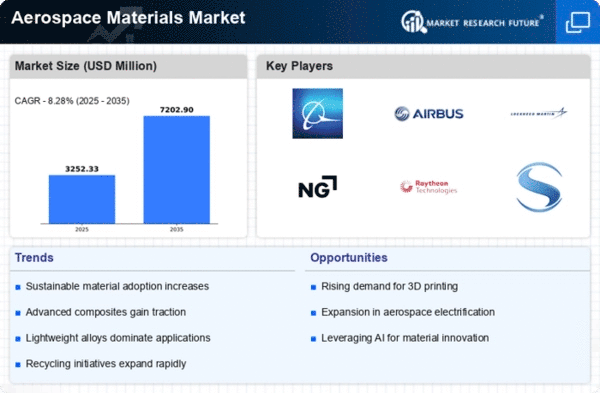
As per MRFR analysis, the Aerospace Materials Market Size was estimated at 3003.63 USD Million in 2024. The Aerospace Materials industry is projected to grow from 3252.21 USD Million in 2025 to 7202.9 USD Million by 2035, exhibiting a compound annual growth rate (CAGR) of 8.28 during the forecast period 2025 - 2035.

Key Market Trends & Highlights

The Aerospace Materials Market is poised for substantial growth driven by sustainability and technological advancements.

  • North America remains the largest market for aerospace materials, driven by robust demand in commercial aviation.
  • Asia-Pacific is emerging as the fastest-growing region, fueled by increasing investments in aerospace manufacturing.
  • The commercial aviation segment continues to dominate, while the space exploration segment is witnessing rapid expansion.
  • Technological advancements and the increasing demand for fuel efficiency are key drivers propelling market growth.

Market Size & Forecast

2024 Market Size 3003.63 (USD Million)
2035 Market Size 7202.9 (USD Million)
CAGR (2025 - 2035) 8.28%
Largest Regional Market Share in 2024 North America

Major Players

<p>Boeing (US), Airbus (FR), Lockheed Martin (US), Northrop Grumman (US), Raytheon Technologies (US), Safran (FR), General Dynamics (US), Thales (FR), Leonardo (IT), Mitsubishi Heavy Industries (JP)</p>

Market Trends

The Aerospace Materials Market is currently experiencing a dynamic evolution, driven by advancements in technology and increasing demand for lightweight, high-performance materials. This sector encompasses a diverse range of materials, including metals, composites, and polymers, each playing a crucial role in enhancing the efficiency and safety of aircraft. As environmental concerns gain prominence, manufacturers are increasingly focusing on sustainable practices, which may lead to the development of innovative materials that reduce carbon footprints. Furthermore, the integration of smart materials, which can adapt to changing conditions, appears to be a growing trend within the industry, potentially revolutionizing aircraft design and functionality. In addition to technological advancements, the Aerospace Materials Market is influenced by global economic factors and shifting consumer preferences. The rise of electric and hybrid aircraft is prompting a reevaluation of material requirements, as these new technologies necessitate different properties and performance characteristics. Collaboration between aerospace companies and material scientists is likely to foster the creation of next-generation materials that meet the evolving demands of the industry. Overall, the Aerospace Materials Market is poised for substantial growth, with ongoing research and development efforts paving the way for future innovations that could redefine the landscape of aviation materials.

Sustainability Initiatives

The Aerospace Materials Market is increasingly prioritizing sustainability, with manufacturers exploring eco-friendly materials and production methods. This trend reflects a broader commitment to reducing environmental impact and enhancing the lifecycle of aerospace products.

Smart Materials Integration

The incorporation of smart materials into aerospace applications is gaining traction. These materials, capable of responding to environmental changes, may enhance aircraft performance and safety, indicating a shift towards more adaptive and intelligent design.

Lightweight Material Development

There is a notable emphasis on the development of lightweight materials, which can improve fuel efficiency and overall aircraft performance. This trend suggests a continuous pursuit of innovative solutions to meet the demands of modern aviation.

Aerospace Materials Market Market Drivers

Market Trends and Projections

The Global Aerospace Materials Market Industry is characterized by various trends and projections that reflect its dynamic nature. The market is expected to reach a value of 60 USD Billion by 2035, with a modest CAGR of 0.12% anticipated from 2025 to 2035. Factors such as technological advancements, regulatory changes, and shifts in consumer preferences are likely to shape the industry's landscape. The increasing focus on sustainability and lightweight materials will further influence market dynamics. Understanding these trends is essential for stakeholders to navigate the evolving aerospace materials landscape effectively.

Increasing Focus on Sustainability

The Global Aerospace Materials Market Industry is witnessing a shift towards sustainability, as manufacturers prioritize environmentally friendly materials and practices. The aerospace sector is increasingly adopting bio-based composites and recyclable materials to minimize its ecological footprint. This trend aligns with global efforts to reduce greenhouse gas emissions and promote sustainable aviation. For instance, companies are exploring the use of natural fibers and resins in aircraft production. The emphasis on sustainability is likely to drive innovation and investment in new materials, contributing to the market's anticipated growth at a CAGR of 0.12% from 2025 to 2035.

Expansion of the Aerospace Industry

The expansion of the aerospace industry is a key driver of the Global Aerospace Materials Market Industry. As global air travel continues to grow, there is an increasing demand for new aircraft and upgrades to existing fleets. This expansion necessitates a corresponding increase in the supply of aerospace materials, including composites, metals, and alloys. The rise in commercial and military aircraft production is expected to bolster the market, with projections indicating a market value of 59.2 USD Billion in 2024. The ongoing development of new aircraft models, such as the next-generation commercial jets, further underscores the need for advanced materials to meet performance and efficiency standards.

Growing Demand for Lightweight Materials

The Global Aerospace Materials Market Industry experiences a notable increase in demand for lightweight materials, driven by the need for fuel efficiency and reduced emissions. Aircraft manufacturers are increasingly adopting advanced composites and aluminum alloys to achieve weight reduction. For instance, the use of carbon fiber reinforced polymers is becoming prevalent, as these materials can reduce aircraft weight by up to 20%. This trend is expected to contribute to the market's projected value of 59.2 USD Billion in 2024, as airlines seek to lower operational costs and enhance performance. The shift towards lightweight materials is likely to shape the industry's future significantly.

Regulatory Compliance and Safety Standards

Regulatory compliance and safety standards significantly influence the Global Aerospace Materials Market Industry. Stringent regulations imposed by aviation authorities necessitate the use of high-quality materials that meet safety and performance criteria. Manufacturers are compelled to invest in advanced materials that comply with these regulations, ensuring the safety of passengers and cargo. For example, the Federal Aviation Administration (FAA) mandates rigorous testing and certification processes for aerospace materials. This focus on compliance not only enhances safety but also drives innovation in material development, ultimately supporting the market's growth and stability.

Technological Advancements in Material Science

Technological advancements in material science play a crucial role in the Global Aerospace Materials Market Industry. Innovations such as additive manufacturing and nanotechnology are enabling the development of high-performance materials with superior properties. For example, the introduction of titanium alloys with enhanced strength-to-weight ratios allows for more efficient aircraft designs. These advancements not only improve the durability and performance of aerospace components but also reduce production costs. As the industry continues to evolve, the integration of these technologies is expected to support the market's growth trajectory, potentially reaching 60 USD Billion by 2035.

Market Segment Insights

By Application: Commercial Aviation (Largest) vs. Space Exploration (Fastest-Growing)

<p>In the Aerospace Materials Market, Commercial Aviation holds the largest share, driven by the extensive fleet of aircraft globally and the ongoing demand for lightweight, durable materials. Materials such as aluminum alloys, titanium, and composite materials are key to enhancing fuel efficiency and reducing emissions. In contrast, Space Exploration is emerging rapidly due to the increasing investments from both government and private sectors. The advent of reusable rockets and advancements in materials science are driving significant innovations in this area.</p>

<p>Aviation: Commercial (Dominant) vs. Space (Emerging)</p>

<p>Commercial Aviation is characterized by its established infrastructure and the predominant use of high-strength, lightweight materials that enhance aircraft performance and fuel efficiency. Innovations such as carbon fiber composites are becoming standard to reduce overall weight. On the other hand, Space Exploration is an emerging area, attracting substantial investment and research efforts aimed at developing advanced materials for extreme conditions. These materials need to withstand harsh environments, showcasing enhanced resilience and thermal capabilities, which significantly sets them apart from conventional aerospace applications.</p>

By Material Type: Aluminum Alloys (Largest) vs. Composite Materials (Fastest-Growing)

<p>The Aerospace Materials Market is predominantly driven by Aluminum Alloys, which command the largest market share due to their lightweight properties and strength. These alloys are preferred in aircraft manufacturing for their excellent fatigue resistance and corrosion resistance, making them a staple in the aerospace industry. Composite Materials, on the other hand, are becoming increasingly significant, driven by technological advancements and their superior weight-to-strength ratio, leading to their rapid adoption across various aircraft designs.</p>

<p>Aluminum Alloys (Dominant) vs. Composite Materials (Emerging)</p>

<p>Aluminum Alloys are recognized as the dominant material in aerospace applications due to their favorable mechanical properties and cost-effectiveness. They offer remarkable performance in terms of weight reduction and structural integrity. In contrast, Composite Materials are emerging rapidly in the market; they provide design flexibility and significant weight savings, leading to improved fuel efficiency and performance in aircraft. As manufacturers seek to innovate and optimize aircraft design, the integration of Composite Materials is expected to increase, marking a pivotal shift in the aerospace materials landscape.</p>

By End Use: Airframes (Largest) vs. Engines (Fastest-Growing)

<p>In the Aerospace Materials Market, airframes represent the largest segment, commanding a significant proportion of the total market share due to their essential role in aircraft structure. This segment is driven by innovations in lightweight materials and efficient designs that enhance overall aircraft performance. Engines, while currently smaller in market share, are recognized as the fastest-growing segment, spurred by advancements in engine efficiency and the increasing demand for fuel-efficient technologies in aviation.</p>

<p>Airframes (Dominant) vs. Fuel Systems (Emerging)</p>

<p>Airframes are viewed as the dominant segment within the aerospace materials market, characterized by their critical function in overall aircraft safety and performance. This segment benefits from ongoing research into composite materials that improve strength-to-weight ratios, translating into better fuel efficiency and performance. On the other hand, fuel systems are emerging as a significant area of focus, driven by the need for enhanced safety standards and new regulations that prioritize efficiency in fuel usage. Both segments exhibit unique characteristics; airframes are foundational to aircraft design, while fuel systems are becoming increasingly sophisticated, incorporating advanced materials to reduce weight and improve reliability.</p>

Get more detailed insights about Aerospace Materials Market Research Report - Global Forecast till 2035

Regional Insights

North America : Aerospace Innovation Leader

North America continues to lead the aerospace materials market, holding a significant share of 1501.45 million in 2024. The region's growth is driven by robust demand for advanced materials, particularly in the defense and commercial aviation sectors. Regulatory support, including initiatives for sustainable aviation, further catalyzes market expansion. The increasing focus on lightweight materials to enhance fuel efficiency is also a key driver of growth. The competitive landscape in North America is characterized by the presence of major players such as Boeing, Lockheed Martin, and Raytheon Technologies. These companies are at the forefront of innovation, investing heavily in research and development to create advanced aerospace materials. The U.S. government’s defense spending and support for aerospace initiatives bolster the market, ensuring a steady demand for high-performance materials.

Europe : Emerging Aerospace Hub

Europe's aerospace materials market is projected to reach 900.73 million by 2025, driven by increasing investments in aerospace technology and a strong focus on sustainability. The region benefits from stringent regulations promoting the use of advanced materials that enhance aircraft performance and reduce emissions. The European Union's Green Deal and Horizon Europe initiatives are pivotal in fostering innovation and supporting the aerospace sector's transition to greener technologies. Leading countries such as France, Germany, and the UK are home to key players like Airbus and Safran, which are instrumental in shaping the market landscape. The competitive environment is marked by collaborations between manufacturers and research institutions, aimed at developing next-generation materials. The presence of a skilled workforce and advanced manufacturing capabilities further strengthens Europe's position in The Aerospace Materials.

Asia-Pacific : Growing Aerospace Market

The Asia-Pacific aerospace materials market is on a growth trajectory, with a projected size of 500.73 million by 2025. This growth is fueled by increasing air travel demand and the expansion of the aviation sector in countries like China and India. Government initiatives aimed at boosting domestic manufacturing and reducing reliance on imports are also significant drivers. Additionally, the region is witnessing a shift towards lightweight materials to improve fuel efficiency and reduce operational costs. China and India are leading the charge in the aerospace materials market, with significant investments in infrastructure and technology. Major players like Mitsubishi Heavy Industries are expanding their operations to meet the rising demand. The competitive landscape is evolving, with new entrants emerging alongside established firms, creating a dynamic market environment that fosters innovation and growth.

Middle East and Africa : Emerging Aerospace Frontier

The Middle East and Africa aerospace materials market, valued at 100.72 million, is gradually emerging as a significant player in the global landscape. The region's growth is driven by increasing investments in aviation infrastructure and a rising number of air travelers. Governments are focusing on enhancing their aerospace capabilities, supported by initiatives to attract foreign investment and develop local manufacturing. The demand for advanced materials is expected to rise as airlines seek to improve fuel efficiency and reduce emissions. Countries like the UAE and South Africa are at the forefront of this growth, with initiatives aimed at developing their aerospace sectors. The competitive landscape is characterized by collaborations between local and international firms, enhancing technological capabilities. As the region continues to invest in aerospace, the potential for growth in aerospace materials is substantial, positioning it as a future hub for the industry.

Key Players and Competitive Insights

The Aerospace Materials Market is currently characterized by a dynamic competitive landscape, driven by technological advancements, sustainability initiatives, and increasing demand for lightweight materials. Major players such as Boeing (US), Airbus (FR), and Lockheed Martin (US) are at the forefront, each adopting distinct strategies to enhance their market positioning. Boeing (US) focuses on innovation in composite materials, aiming to reduce aircraft weight and improve fuel efficiency. Meanwhile, Airbus (FR) emphasizes partnerships with material suppliers to develop advanced alloys and composites, thereby enhancing its product offerings. Lockheed Martin (US) is investing heavily in digital transformation, utilizing AI and data analytics to optimize material selection and manufacturing processes, which collectively shapes a competitive environment that prioritizes technological prowess and sustainability.

Key business tactics within the Aerospace Materials Market include localizing manufacturing and optimizing supply chains to enhance responsiveness and reduce costs. The market structure appears moderately fragmented, with a mix of established players and emerging companies vying for market share. The collective influence of these key players fosters a competitive atmosphere where innovation and operational efficiency are paramount.

In November 2025, Boeing (US) announced a strategic partnership with a leading materials science company to develop next-generation composite materials aimed at reducing the environmental impact of aircraft manufacturing. This collaboration is expected to enhance Boeing's competitive edge by aligning with global sustainability goals and meeting regulatory demands for greener aviation solutions. The strategic importance of this partnership lies in its potential to revolutionize material properties, thereby improving aircraft performance and reducing lifecycle costs.

In October 2025, Airbus (FR) unveiled a new line of lightweight aluminum-lithium alloys designed for use in commercial aircraft. This development is significant as it not only enhances fuel efficiency but also positions Airbus as a leader in sustainable aerospace materials. The introduction of these alloys reflects Airbus's commitment to innovation and its proactive approach to addressing environmental concerns, which is increasingly becoming a critical factor in customer decision-making.

In September 2025, Lockheed Martin (US) launched an advanced manufacturing facility focused on additive manufacturing techniques for aerospace components. This facility is expected to streamline production processes and reduce lead times significantly. The strategic importance of this move lies in Lockheed Martin's ability to leverage cutting-edge technology to enhance production efficiency and respond swiftly to market demands, thereby solidifying its position in the competitive landscape.

As of December 2025, current competitive trends in the Aerospace Materials Market are heavily influenced by digitalization, sustainability, and AI integration. Strategic alliances are increasingly shaping the landscape, enabling companies to pool resources and expertise to drive innovation. The shift from price-based competition to a focus on technological advancement and supply chain reliability is evident, suggesting that future competitive differentiation will hinge on the ability to innovate and adapt to evolving market demands.

Key Companies in the Aerospace Materials Market include

Industry Developments

In June 2023, Allegheny Technologies Incorporated said it had secured an estimated $1.2 billion in new sales commitments for nickel and titanium materials from leading aerospace and defense companies.

In June 2023, DuPont de Nemours Inc. presented the set of advanced materials for aerospace technologies of the new generation at the 54 International Paris Show.

In May 2023, Hexcel Corporation announced the grand opening of a major extension project completion at the engineered core operations plant in Morocco to cater to the increasing need for lightweight advanced composite materials for the aerospace sector.

In October 2022, Toray Composite Materials America together with Speciality Materials, a manufacturer of boron fibers, established joint ventures for the manufacture of functional aerospace materials of the new generation. Such a move is expected to bolster Toray’s standing in the aerospace materials market.

In October 2021, Duncan Aviation announced the approval of its Welding and Machining departments to be certified under the AWS D1.2/D1.2M Code of America in Infrastructure Welded Aluminum. In order for the business to obtain this certificate, relevant institutional welding experience and developing the business’s still-welding experience were showcased. In order to perform a number of structural welding tasks, a recently developed powerful personal aluminum MiG cables burner with a digitally functional monitor has been acquired. Aluminum remains a crucial component of the aerospace industry.

In July 2021, the Defense Research and Development Institution had plans to fabricate quality beta titanium alloys, and this timber was integrated into the steel products primarily used in the aeronautical components. This titanium beta alloy was developed by the Defense Metallurgy Research Lab, a premier research institute in India engaged in the research domain of resources technology and science sociology. The primary function of a laboratory is the fabrication of ceramic, alloy, metals and other composite materials for the manufacturing of aircraft parts and aviation engine components.

Future Outlook

Aerospace Materials Market Future Outlook

<p>The Aerospace Materials Market is projected to grow at an 8.28% CAGR from 2024 to 2035, driven by advancements in lightweight materials, sustainability initiatives, and increased aircraft production.</p>

New opportunities lie in:

  • <p>Development of advanced composite materials for fuel efficiency</p>
  • <p>Integration of smart materials for real-time monitoring</p>
  • <p>Expansion of recycling programs for aerospace materials</p>

<p>By 2035, the Aerospace Materials Market is expected to achieve robust growth and innovation.</p>

Market Segmentation

Aerospace Materials Market End Use Outlook

  • Airframes
  • Engines
  • Landing Gear
  • Interior Components
  • Fuel Systems

Aerospace Materials Market Application Outlook

  • Commercial Aviation
  • Military Aviation
  • Space Exploration
  • Unmanned Aerial Vehicles
  • General Aviation

Aerospace Materials Market Material Type Outlook

  • Aluminum Alloys
  • Titanium Alloys
  • Composite Materials
  • Steel Alloys
  • Superalloys

Report Scope

MARKET SIZE 20243003.63(USD Million)
MARKET SIZE 20253252.21(USD Million)
MARKET SIZE 20357202.9(USD Million)
COMPOUND ANNUAL GROWTH RATE (CAGR)8.28% (2024 - 2035)
REPORT COVERAGERevenue Forecast, Competitive Landscape, Growth Factors, and Trends
BASE YEAR2024
Market Forecast Period2025 - 2035
Historical Data2019 - 2024
Market Forecast UnitsUSD Million
Key Companies ProfiledBoeing (US), Airbus (FR), Lockheed Martin (US), Northrop Grumman (US), Raytheon Technologies (US), Safran (FR), General Dynamics (US), Thales (FR), Leonardo (IT), Mitsubishi Heavy Industries (JP)
Segments CoveredApplication, Material Type, End Use
Key Market OpportunitiesAdvancements in lightweight composite materials enhance fuel efficiency and reduce emissions in the Aerospace Materials Market.
Key Market DynamicsTechnological advancements drive innovation in lightweight materials, enhancing fuel efficiency and performance in aerospace applications.
Countries CoveredNorth America, Europe, APAC, South America, MEA

FAQs

Who are the change agents in the aerospace materials market?

Global Titanium Inc., AMETEK Inc., Precision Castparts Corp, Supreme Engineering Ltd, and AMG Advanced Metallurgical Group are the foremost contenders in the market.

What is the CAGR evolution observed in the aerospace materials market?

A 7% CAGR is assessed to create change in the upcoming period.

What is the paying capability of the Aerospace materials market in the estimated time frame of 2035?

A USD 60 Billion by 2035 is anticipated to influence the Aerospace Materials Market development in the figure time frame.

Which regions are controlling the aerospace materials market?

The North American region is estimated to guide the overall market in the forecast period.

Which factors are inspiring the aerospace materials market?

The collective aerospace fleet growth is likely to benefit the global market.

  1. SECTION I: EXECUTIVE SUMMARY AND KEY HIGHLIGHTS
    1. | 1.1 EXECUTIVE SUMMARY
  2. SECTION II: SCOPING, METHODOLOGY AND MARKET STRUCTURE
    1. | 2.1 MARKET INTRODUCTION
    2. | 2.2 RESEARCH METHODOLOGY
  3. SECTION III: QUALITATIVE ANALYSIS
    1. | 3.1 MARKET DYNAMICS
    2. | 3.2 MARKET FACTOR ANALYSIS
  4. SECTION IV: QUANTITATIVE ANALYSIS
    1. | 4.1 Chemicals and Materials, BY Application (USD Million)
    2. | 4.2 Chemicals and Materials, BY Material Type (USD Million)
    3. | 4.3 Chemicals and Materials, BY End Use (USD Million)
    4. | 4.4 Chemicals and Materials, BY Region (USD Million)
  5. SECTION V: COMPETITIVE ANALYSIS
    1. | 5.1 Competitive Landscape
    2. | 5.2 Company Profiles
    3. | 5.3 Appendix

Aerospace Materials Market Segmentation

Market Segmentation Overview

  • Detailed segmentation data will be available in the full report
  • Comprehensive analysis by multiple parameters
  • Regional and country-level breakdowns
  • Market size forecasts by segment
Infographic

Free Sample Request

Kindly complete the form below to receive a free sample of this Report

Get Free Sample

Customer Strories

Compare Licence

×
Features License Type
Single User Multiuser License Enterprise User
Price $4,950 $5,950 $7,250
Maximum User Access Limit 1 User Upto 10 Users Unrestricted Access Throughout the Organization
Free Customization
Direct Access to Analyst
Deliverable Format
Platform Access
Discount on Next Purchase 10% 15% 15%
Printable Versions