×
Hero Background
English
Chinese
French
Japanese
Korean
German
Spanish

Aerospace Materials Market Analysis

ID: MRFR/CnM/6956-HCR
185 Pages
Chitranshi Jaiswal
October 2025

Aerospace Materials Market Research Report Information By Material Type (Composite, Steel, Titanium, Aluminum, Others), By Aircraft Type (Civil Aircraft, Military Aircraft, Others) - Forecast to 2035

Share:
Download PDF ×

We do not share your information with anyone. However, we may send you emails based on your report interest from time to time. You may contact us at any time to opt-out.

Aerospace Materials Market Infographic
Purchase Options

Market Analysis

In-depth Analysis of Aerospace Materials Market Industry Landscape

The market for aerospace materials is a dynamic one, with many factors influencing its development and expansion. For stakeholders to make strategic decisions and overcome the obstacles unique to this business, they must have a thorough understanding of the market dynamics. Here is a brief synopsis in the form of a paragraph using a pointer format: High Demand for Lightweight Materials: To improve overall performance and fuel efficiency, the aerospace sector places a premium on lightweight materials. The aerospace materials market is driven by the increasing demand for sophisticated composite materials, including titanium alloys and carbon fiber-reinforced polymers. Technological Developments in Material Science: The aerospace materials market is significantly shaped by ongoing developments in material science and engineering. High-performance materials appropriate for use in aviation components are developed through improvements in strength-to-weight ratios, durability, and thermal resistance. Aluminum Alloys' Strategic Importance: With their ability to combine strength and weight, aluminum alloys continue to be a major force in the aerospace materials industry. The market dynamics are driven by developments in aluminum alloy compositions, manufacturing techniques, and surface treatments to fulfill the severe requirements of current aircraft design. A Greater Emphasis on Sustainability Materials and manufacturing techniques are being reevaluated as the aerospace sector moves toward more sustainable practices. The market dynamics of aerospace materials are impacted by the industry's dedication to mitigating its environmental impact by utilizing sustainable materials and implementing recycling programs. Growing Demand in the Commercial Aviation Sector: The aerospace materials industry is mostly driven by the commercial aviation sector. There is a growing need for materials that combine performance and affordability due to the rise in air travel worldwide. The demand for materials that can meet strict safety regulations and resist the rigors of numerous flights shapes market dynamics. Strategic Partnerships & Alliances: The dynamics of the market are greatly influenced by cooperation and strategic alliances between research institutes, suppliers of materials, and aerospace manufacturers. By facilitating the flow of information, skills, and resources, these alliances promote innovation in aerospace materials and uphold the competitiveness of the sector. Strict Regulations: Strict regulatory requirements are in place to guarantee the safety and dependability of the aerospace materials market. Compliance with these standards strongly influences market dynamics, as firms spend in research and development to meet or exceed regulatory requirements. Effects of International Economic Trends: Global economic trends that impact the aerospace materials market include geopolitical changes and economic downturns. The demand for new aircraft and the level of maintenance, repair, and overhaul activity are the main causes of the market's volatility. Emerging Technologies and Materials: The aerospace materials landscape is changing as a result of the integration of emerging technologies like additive manufacturing (3D printing). The dynamics of the aerospace materials industry could be affected by the capacity of 3D printing technology to generate intricate and lightweight components, which could completely change manufacturing methods. Defense Sector as a Driving Force: The defense sector is a significant driver of the aerospace materials market, with specific requirements for materials with superior strength, resistance to extreme conditions, and advanced stealth capabilities. Market dynamics are influenced by defense budget allocations, geopolitical tensions, and the need for advanced materials in military aircraft.


Author
Chitranshi Jaiswal
Research Analyst Level I

In her 3 years of experience in the market research field, she has handled critical cross-domain projects. She has an in-depth knowledge of market estimation & analysis, problem-solving, primary as well as secondary research, and team management.She holds an engineering degree and is an MBA professional from a well-known university, capable of evaluating the market and competitive conditions. An exceptional strategist with excellent communication skills and a passion for delivering cutting-edge & practical insights for the market. Proficient in multi-tasking, and can successfully deal with competing demands, while maintaining complete confidentiality. Generated business through active client and project development, networking, and high-quality responses. Her knowledge and skills have helped in making solid business decisions, securing funding from investors, and avoiding business failures.

Leave a Comment

FAQs

Who are the change agents in the aerospace materials market?

Global Titanium Inc., AMETEK Inc., Precision Castparts Corp, Supreme Engineering Ltd, and AMG Advanced Metallurgical Group are the foremost contenders in the market.

What is the CAGR evolution observed in the aerospace materials market?

A 7% CAGR is assessed to create change in the upcoming period.

What is the paying capability of the Aerospace materials market in the estimated time frame of 2035?

A USD 60 Billion by 2035 is anticipated to influence the Aerospace Materials Market development in the figure time frame.

Which regions are controlling the aerospace materials market?

The North American region is estimated to guide the overall market in the forecast period.

Which factors are inspiring the aerospace materials market?

The collective aerospace fleet growth is likely to benefit the global market.

Market Summary

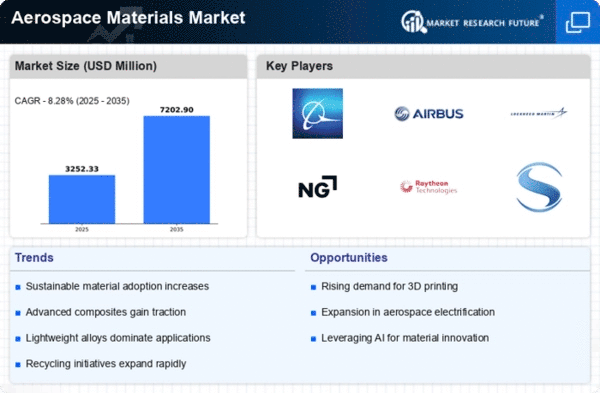
As per MRFR analysis, the Aerospace Materials Market Size was estimated at 3003.63 USD Million in 2024. The Aerospace Materials industry is projected to grow from 3252.21 USD Million in 2025 to 7202.9 USD Million by 2035, exhibiting a compound annual growth rate (CAGR) of 8.28 during the forecast period 2025 - 2035.

Key Market Trends & Highlights

The Aerospace Materials Market is poised for substantial growth driven by innovation and sustainability initiatives.

  • Sustainability in material development is becoming a pivotal focus within the aerospace materials sector, particularly in North America.
  • The integration of smart materials is gaining traction, enhancing performance and functionality in both commercial and military aviation applications.
  • Lightweighting strategies are increasingly prioritized, with composite materials emerging as the fastest-growing segment in the Asia-Pacific region.
  • Technological advancements and the increasing demand for fuel efficiency are key drivers propelling the growth of aluminum alloys and composite materials.

Market Size & Forecast

2024 Market Size 3003.63 (USD Million)
2035 Market Size 7202.9 (USD Million)
CAGR (2025 - 2035) 8.28%
Largest Regional Market Share in 2024 North America

Major Players

<p>Boeing (US), Airbus (FR), Lockheed Martin (US), Northrop Grumman (US), Raytheon Technologies (US), Safran (FR), General Dynamics (US), Thales (FR), Leonardo (IT), Mitsubishi Heavy Industries (JP)</p>

Market Trends

The Aerospace Materials Market is currently experiencing a transformative phase, driven by advancements in technology and increasing demand for lightweight, high-performance materials. This sector encompasses a diverse range of materials, including metals, composites, and polymers, each playing a crucial role in enhancing the efficiency and safety of aircraft. As environmental concerns gain prominence, manufacturers are increasingly focusing on sustainable practices, which may lead to the development of innovative materials that reduce carbon footprints. Furthermore, the integration of smart materials, which can adapt to changing conditions, appears to be a growing trend, potentially revolutionizing design and functionality in aerospace applications. In addition to technological advancements, the Aerospace Materials Market is influenced by global economic factors and shifting consumer preferences. The rise of electric and hybrid aircraft is prompting a reevaluation of material requirements, as these new technologies necessitate different properties and performance characteristics. Collaboration between aerospace companies and material scientists is likely to foster the creation of next-generation materials that meet the evolving demands of the industry. Overall, the Aerospace Materials Market seems poised for substantial growth, with ongoing research and development efforts paving the way for future innovations that could redefine the landscape of aviation materials.

Sustainability in Material Development

The Aerospace Materials Market is witnessing a notable shift towards sustainable material development. Manufacturers are increasingly prioritizing eco-friendly materials that minimize environmental impact. This trend is driven by regulatory pressures and consumer demand for greener solutions, leading to innovations in bio-based composites and recyclable materials.

Smart Materials Integration

The integration of smart materials into aerospace applications is emerging as a significant trend. These materials possess the ability to respond to environmental stimuli, enhancing aircraft performance and safety. The potential for adaptive structures that can change shape or properties in response to flight conditions is particularly promising.

Lightweighting Strategies

Lightweighting remains a critical focus within the Aerospace Materials Market. The pursuit of reduced weight in aircraft components is essential for improving fuel efficiency and overall performance. Advanced composites and innovative alloys are being developed to achieve this goal, reflecting a broader industry commitment to enhancing operational efficiency.

Aerospace Materials Market Market Drivers

Market Trends and Projections

The Global Aerospace Materials Market Industry is characterized by various trends and projections that reflect its dynamic nature. The market is expected to reach a value of 60 USD Billion by 2035, with a modest CAGR of 0.12% anticipated from 2025 to 2035. Factors such as technological advancements, regulatory changes, and shifts in consumer preferences are likely to shape the industry's landscape. The increasing focus on sustainability and lightweight materials will further influence market dynamics. Understanding these trends is essential for stakeholders to navigate the evolving aerospace materials landscape effectively.

Increasing Focus on Sustainability

The Global Aerospace Materials Market Industry is witnessing a shift towards sustainability, as manufacturers prioritize environmentally friendly materials and practices. The aerospace sector is increasingly adopting bio-based composites and recyclable materials to minimize its ecological footprint. This trend aligns with global efforts to reduce greenhouse gas emissions and promote sustainable aviation. For instance, companies are exploring the use of natural fibers and resins in aircraft production. The emphasis on sustainability is likely to drive innovation and investment in new materials, contributing to the market's anticipated growth at a CAGR of 0.12% from 2025 to 2035.

Expansion of the Aerospace Industry

The expansion of the aerospace industry is a key driver of the Global Aerospace Materials Market Industry. As global air travel continues to grow, there is an increasing demand for new aircraft and upgrades to existing fleets. This expansion necessitates a corresponding increase in the supply of aerospace materials, including composites, metals, and alloys. The rise in commercial and military aircraft production is expected to bolster the market, with projections indicating a market value of 59.2 USD Billion in 2024. The ongoing development of new aircraft models, such as the next-generation commercial jets, further underscores the need for advanced materials to meet performance and efficiency standards.

Growing Demand for Lightweight Materials

The Global Aerospace Materials Market Industry experiences a notable increase in demand for lightweight materials, driven by the need for fuel efficiency and reduced emissions. Aircraft manufacturers are increasingly adopting advanced composites and aluminum alloys to achieve weight reduction. For instance, the use of carbon fiber reinforced polymers is becoming prevalent, as these materials can reduce aircraft weight by up to 20%. This trend is expected to contribute to the market's projected value of 59.2 USD Billion in 2024, as airlines seek to lower operational costs and enhance performance. The shift towards lightweight materials is likely to shape the industry's future significantly.

Regulatory Compliance and Safety Standards

Regulatory compliance and safety standards significantly influence the Global Aerospace Materials Market Industry. Stringent regulations imposed by aviation authorities necessitate the use of high-quality materials that meet safety and performance criteria. Manufacturers are compelled to invest in advanced materials that comply with these regulations, ensuring the safety of passengers and cargo. For example, the Federal Aviation Administration (FAA) mandates rigorous testing and certification processes for aerospace materials. This focus on compliance not only enhances safety but also drives innovation in material development, ultimately supporting the market's growth and stability.

Technological Advancements in Material Science

Technological advancements in material science play a crucial role in the Global Aerospace Materials Market Industry. Innovations such as additive manufacturing and nanotechnology are enabling the development of high-performance materials with superior properties. For example, the introduction of titanium alloys with enhanced strength-to-weight ratios allows for more efficient aircraft designs. These advancements not only improve the durability and performance of aerospace components but also reduce production costs. As the industry continues to evolve, the integration of these technologies is expected to support the market's growth trajectory, potentially reaching 60 USD Billion by 2035.

Market Segment Insights

By Application: Commercial Aviation (Largest) vs. Military Aviation (Fastest-Growing)

<p>The Aerospace Materials Market showcases diverse applications, with Commercial Aviation holding the largest market share. This segment significantly benefits from increased passenger travel and the continuous demand for lightweight, high-strength materials that enhance fuel efficiency. On the other hand, Military Aviation is experiencing rapid growth due to heightened defense budgets and advancements in technology, leading to increased investments in aircraft upgrades and new developments.</p>

<p>Commercial Aviation (Dominant) vs. Military Aviation (Emerging)</p>

<p>Commercial Aviation remains the dominant segment, driven by the expanding global aircraft fleet and rising air traffic. This segment emphasizes the need for advanced aerospace materials that reduce weight, enhance durability, and improve fuel efficiency. In contrast, Military Aviation, although smaller, is emerging rapidly as governments prioritize modernization initiatives and new defense projects, creating a demand for advanced materials that can withstand extreme conditions and improve operational capabilities. Together, these segments reflect the overall innovation and adaptability within the aerospace materials landscape.</p>

By Material Type: Aluminum Alloys (Largest) vs. Composite Materials (Fastest-Growing)

<p>In the Aerospace Materials Market, Aluminum Alloys hold a significant market share due to their lightweight, durability, and cost-effectiveness. They are widely used in aircraft structures and components, providing essential strength while minimizing overall weight. Meanwhile, Composite Materials are gaining traction, appealing to manufacturers seeking to innovate due to their superior strength-to-weight ratio and resistance to corrosion. Their share is rapidly increasing as aerospace companies prioritize reducing fuel consumption and enhancing performance. The growth trends in this segment are shaped by advancements in technology and increasing demand for fuel-efficient aircraft. While Aluminum Alloys remain a staple in aerospace manufacturing, the rising acceptance of Composite Materials is transforming the landscape, driven by their performance advantages and the need for more sustainable practices. This shift reflects a broader trend of integrating advanced materials in aerospace applications, enhancing both efficiency and sustainability.</p>

<p>Aluminum Alloys (Dominant) vs. Composite Materials (Emerging)</p>

<p>Aluminum Alloys are the dominant material in the aerospace sector, characterized by their excellent strength, light weight, and recycled content. Their versatility allows for use in various aircraft components, making them the first choice for manufacturers. Conversely, Composite Materials, although considered emerging, are rapidly positioning themselves as viable alternatives due to their unmatched strength-to-weight ratio and reduced maintenance needs. They are particularly favored in modern aircraft designs like wings and fuselages, where reducing weight can significantly enhance fuel efficiency. As the industry shifts toward more innovative materials, the rivalry between these two segments intensifies, with Aluminum Alloys striving to maintain their dominance while Composite Materials carve out an expanding niche driven by technological advancements.</p>

By End Use: Airframes (Largest) vs. Engines (Fastest-Growing)

<p>The Aerospace Materials Market is significantly segmented into several end-use categories, with airframes holding the largest share due to their essential role in the primary structure of aircraft. This segment benefits from advancements in material technology, which enhance performance, reduce weight, and improve safety. In contrast, engines are noted as the fastest-growing segment, driven by the demand for more efficient propulsion systems that cater to increasing fuel efficiency regulations and performance standards.</p>

<p>Airframes (Dominant) vs. Engines (Emerging)</p>

<p>Airframes are critical in the aerospace sector, serving as the backbone of aircraft structure and supporting various load-bearing functions. As the dominant segment, airframes utilize advanced composite materials that offer strength-to-weight advantages, enhancing fuel efficiency and operational performance. Conversely, the engines segment is on an upward trajectory, embracing innovations like additive manufacturing and lightweight materials to create performance-driven solutions. This emerging segment responds to a rapidly evolving market where fuel efficiency and environmental standards are paramount, presenting a robust growth opportunity for manufacturers willing to invest in research and development.</p>

Get more detailed insights about Aerospace Materials Market Research Report - Global Forecast till 2035

Regional Insights

North America : Aerospace Innovation Leader

North America continues to lead the aerospace materials market, holding a significant share of 1501.45 million in 2024. The region's growth is driven by robust demand for advanced materials, particularly lightweight composites and alloys, which enhance fuel efficiency and performance. Regulatory support from agencies like the FAA promotes innovation and safety standards, further catalyzing market expansion. The competitive landscape is dominated by key players such as Boeing, Lockheed Martin, and Raytheon Technologies, which are heavily investing in R&D to develop next-generation materials. The U.S. and Canada are at the forefront, leveraging their technological expertise and strong manufacturing capabilities. This concentration of industry leaders fosters a dynamic environment for growth and collaboration in aerospace materials.

Europe : Emerging Aerospace Hub

Europe's aerospace materials market is projected to reach 900.73 million by 2025, driven by increasing demand for sustainable aviation solutions and regulatory frameworks promoting eco-friendly materials. The European Union's Green Deal and initiatives from the European Aviation Safety Agency (EASA) are pivotal in shaping market dynamics, encouraging the adoption of innovative materials that reduce environmental impact. Leading countries like France, Germany, and the UK are home to major players such as Airbus and Safran, which are investing in advanced materials to enhance aircraft performance. The competitive landscape is characterized by collaboration between manufacturers and research institutions, fostering innovation and ensuring compliance with stringent regulations. This synergy is crucial for maintaining Europe's position as a key player in The Aerospace Materials.

Asia-Pacific : Rapidly Growing Market

The Asia-Pacific aerospace materials market is expected to grow significantly, reaching 500.73 million by 2025. This growth is fueled by increasing air travel demand and government investments in aerospace infrastructure. Countries like China and India are enhancing their manufacturing capabilities, supported by favorable regulations and initiatives aimed at boosting local production and innovation in aerospace materials. China is emerging as a key player, with companies like Mitsubishi Heavy Industries leading the charge in developing advanced materials. The competitive landscape is evolving, with both domestic and international firms vying for market share. As the region continues to invest in aerospace technology, the demand for high-performance materials is set to rise, positioning Asia-Pacific as a vital player in The Aerospace Materials.

Middle East and Africa : Emerging Aerospace Frontier

The Middle East and Africa aerospace materials market, valued at 100.72 million, is on the cusp of significant growth. The region's strategic investments in aviation infrastructure and increasing air traffic are driving demand for advanced aerospace materials. Governments are implementing policies to enhance local manufacturing capabilities, which is expected to further stimulate market growth in the coming years. Countries like the UAE and South Africa are leading the charge, with initiatives aimed at attracting foreign investment and fostering innovation in aerospace technologies. The competitive landscape is characterized by a mix of local and international players, creating opportunities for collaboration and knowledge transfer. As the region develops its aerospace sector, the demand for high-quality materials will continue to rise, positioning it as a key player in the global market.

Key Players and Competitive Insights

The Aerospace Materials Market is currently characterized by a dynamic competitive landscape, driven by technological advancements, increasing demand for lightweight materials, and a growing emphasis on sustainability. Major players such as Boeing (US), Airbus (FR), and Lockheed Martin (US) are strategically positioned to leverage innovation and partnerships to enhance their market presence. Boeing (US) focuses on integrating advanced composite materials into its aircraft designs, while Airbus (FR) emphasizes the development of eco-friendly materials to meet stringent environmental regulations. Lockheed Martin (US) is investing heavily in research and development to create next-generation materials that improve performance and reduce costs, collectively shaping a competitive environment that prioritizes technological superiority and sustainability.

Key business tactics within the Aerospace Materials Market include localizing manufacturing and optimizing supply chains to enhance efficiency and reduce costs. The market structure appears moderately fragmented, with several key players exerting considerable influence. This fragmentation allows for a diverse range of materials and innovations, although the collective strength of major companies like Raytheon Technologies (US) and Northrop Grumman (US) suggests a trend towards consolidation in certain segments, particularly in advanced materials and composites.

In November 2025, Raytheon Technologies (US) announced a partnership with a leading materials science firm to develop next-generation lightweight composites aimed at improving fuel efficiency in commercial aircraft. This strategic move is likely to enhance Raytheon’s competitive edge by positioning it at the forefront of sustainable aviation technology, aligning with global trends towards reducing carbon emissions.

In October 2025, Northrop Grumman (US) unveiled a new manufacturing facility dedicated to the production of advanced aerospace materials, particularly focusing on additive manufacturing techniques. This facility is expected to streamline production processes and reduce lead times, thereby enhancing Northrop Grumman’s operational efficiency and responsiveness to market demands. Such investments indicate a commitment to innovation and a proactive approach to meeting the evolving needs of the aerospace sector.

In September 2025, Airbus (FR) launched a new initiative aimed at sourcing sustainable materials for its aircraft production, collaborating with various suppliers to ensure compliance with environmental standards. This initiative not only reflects Airbus’s commitment to sustainability but also positions the company as a leader in the transition towards greener aviation solutions, potentially influencing industry standards and practices.

As of December 2025, current competitive trends in the Aerospace Materials Market are increasingly defined by digitalization, sustainability, and the integration of artificial intelligence (AI) in material development processes. Strategic alliances among key players are shaping the landscape, fostering innovation and enhancing supply chain reliability. The shift from price-based competition to a focus on technological advancement and sustainable practices is evident, suggesting that future competitive differentiation will hinge on the ability to innovate and adapt to changing market demands.

Key Companies in the Aerospace Materials Market market include

Industry Developments

In June 2023, Allegheny Technologies Incorporated said it had secured an estimated $1.2 billion in new sales commitments for nickel and titanium materials from leading aerospace and defense companies.

In June 2023, DuPont de Nemours Inc. presented the set of advanced materials for aerospace technologies of the new generation at the 54 International Paris Show.

In May 2023, Hexcel Corporation announced the grand opening of a major extension project completion at the engineered core operations plant in Morocco to cater to the increasing need for lightweight advanced composite materials for the aerospace sector.

In October 2022, Toray Composite Materials America together with Speciality Materials, a manufacturer of boron fibers, established joint ventures for the manufacture of functional aerospace materials of the new generation. Such a move is expected to bolster Toray’s standing in the aerospace materials market.

In October 2021, Duncan Aviation announced the approval of its Welding and Machining departments to be certified under the AWS D1.2/D1.2M Code of America in Infrastructure Welded Aluminum. In order for the business to obtain this certificate, relevant institutional welding experience and developing the business’s still-welding experience were showcased. In order to perform a number of structural welding tasks, a recently developed powerful personal aluminum MiG cables burner with a digitally functional monitor has been acquired. Aluminum remains a crucial component of the aerospace industry.

In July 2021, the Defense Research and Development Institution had plans to fabricate quality beta titanium alloys, and this timber was integrated into the steel products primarily used in the aeronautical components. This titanium beta alloy was developed by the Defense Metallurgy Research Lab, a premier research institute in India engaged in the research domain of resources technology and science sociology. The primary function of a laboratory is the fabrication of ceramic, alloy, metals and other composite materials for the manufacturing of aircraft parts and aviation engine components.

Future Outlook

Aerospace Materials Market Future Outlook

<p>The Aerospace Materials Market is projected to grow at an 8.28% CAGR from 2024 to 2035, driven by advancements in lightweight materials, sustainability initiatives, and increased aerospace production.</p>

New opportunities lie in:

  • <p>Development of advanced composite materials for fuel efficiency</p>
  • <p>Integration of smart materials for real-time monitoring</p>
  • <p>Expansion into emerging markets with tailored aerospace solutions</p>

<p>By 2035, the Aerospace Materials Market is expected to achieve robust growth and innovation.</p>

Market Segmentation

Aerospace Materials Market End Use Outlook

  • Airframes
  • Engines
  • Landing Gear
  • Interior Components
  • Fuel Systems

Aerospace Materials Market Application Outlook

  • Commercial Aviation
  • Military Aviation
  • Space Exploration
  • Unmanned Aerial Vehicles
  • General Aviation

Aerospace Materials Market Material Type Outlook

  • Aluminum Alloys
  • Titanium Alloys
  • Composite Materials
  • Steel Alloys
  • Superalloys

Report Scope

MARKET SIZE 20243003.63(USD Million)
MARKET SIZE 20253252.21(USD Million)
MARKET SIZE 20357202.9(USD Million)
COMPOUND ANNUAL GROWTH RATE (CAGR)8.28% (2024 - 2035)
REPORT COVERAGERevenue Forecast, Competitive Landscape, Growth Factors, and Trends
BASE YEAR2024
Market Forecast Period2025 - 2035
Historical Data2019 - 2024
Market Forecast UnitsUSD Million
Key Companies ProfiledBoeing (US), Airbus (FR), Lockheed Martin (US), Northrop Grumman (US), Raytheon Technologies (US), Safran (FR), General Dynamics (US), Thales (FR), Leonardo (IT), Mitsubishi Heavy Industries (JP)
Segments CoveredApplication, Material Type, End Use
Key Market OpportunitiesAdvancements in lightweight composite materials enhance fuel efficiency and sustainability in the Aerospace Materials Market.
Key Market DynamicsTechnological advancements drive innovation in lightweight materials, enhancing fuel efficiency and performance in aerospace applications.
Countries CoveredNorth America, Europe, APAC, South America, MEA

FAQs

Who are the change agents in the aerospace materials market?

Global Titanium Inc., AMETEK Inc., Precision Castparts Corp, Supreme Engineering Ltd, and AMG Advanced Metallurgical Group are the foremost contenders in the market.

What is the CAGR evolution observed in the aerospace materials market?

A 7% CAGR is assessed to create change in the upcoming period.

What is the paying capability of the Aerospace materials market in the estimated time frame of 2035?

A USD 60 Billion by 2035 is anticipated to influence the Aerospace Materials Market development in the figure time frame.

Which regions are controlling the aerospace materials market?

The North American region is estimated to guide the overall market in the forecast period.

Which factors are inspiring the aerospace materials market?

The collective aerospace fleet growth is likely to benefit the global market.

  1. Executive Summary
  2. Scope of the Report
    1. Market Definition
    2. Scope of the Study
    3. List of Assumptions
    4. Markets Structure
  3. Market Research Methodology
    1. Research
    2. Process
    3. Primary Research
    4. Secondary Research
    5. Market Size
    6. Estimation
    7. Forecast Model
  4. Market Factor Analysis
    1. Supply
      1. Raw Material Suppliers
      2. Manufacturers/Producers
      3. Distributors/Retailers/Wholesalers/E-Commerce
      4. End-Use Industries/Material Type
    2. Chain Analysis
    3. of Aerospace Materials
    4. Merchants
    5. Porter’s Five
      1. Threat of New Entrants
      2. Intensity of Competitive
      3. Threat of Substitutes
      4. Bargaining Power of Suppliers
      5. Bargaining Power of Buyers
    6. Forces Model
    7. Rivalry
    8. Pricing Analysis
  5. Market
    1. Dynamics of Global Aerospace Materials Market
    2. Introduction
    3. Drivers
    4. Restraints
    5. Opportunities
    6. Challenges
  6. Global
  7. Aerospace Materials Market, by Material Type
    1. Introduction
    2. Composite
      1. Market Estimates & Forecast, 2020–2027
      2. Market Estimates
    3. & Forecast, by Region, 2020–2027
    4. Steel
      1. Market Estimates
      2. Market Estimates & Forecast, by Region,
    5. & Forecast, 2020–2027
    6. Titanium
      1. Market Estimates & Forecast, 2020–2027
      2. Market Estimates & Forecast, by Region, 2020–2027
    7. Aluminum
      1. Market Estimates & Forecast, 2020–2027
      2. Market Estimates
    8. & Forecast, by Region, 2020–2027
    9. Others
      1. Market Estimates
      2. Market Estimates & Forecast, by Region,
    10. & Forecast, 2020–2027
  8. Global Aerospace Materials Market, by Aircraft Type
    1. Introduction
    2. Civil Aircraft
      1. Market Estimates & Forecast,
      2. Market Estimates & Forecast, by Region, 2020–2027
    3. Military Aircraft
      1. Market Estimates & Forecast, 2020–2027
      2. Market Estimates & Forecast, by Region, 2020–2027
    4. Others
      1. Market Estimates & Forecast, 2020–2027
      2. Market Estimates
    5. & Forecast, by Region, 2020–2027
  9. Global Aerospace Materials Market,
    1. by Region
    2. Introduction
    3. North America
      1. Market Estimates
      2. Market Estimates & Forecast, by Material
      3. Market Estimates & Forecast, by Aircraft Type,
      4. US
      5. Canada
    4. & Forecast, 2020–2027
    5. Type, 2020–2027
    6. Europe
      1. Market Estimates & Forecast, 2020–2027
  10. Market Estimates & Forecast, by Material Type, 2020–2027
    1. Estimates & Forecast, by Aircraft Type, 2020–2027
    2. & Forecast, by Material Type, 2020–2027
    3. & Forecast, by Aircraft Type, 2020–2027
    4. Market Estimates & Forecast, 2020–2027
    5. Forecast, by Material Type, 2020–2027
    6. Forecast, by Aircraft Type, 2020–2027
    7. Estimates & Forecast, 2020–2027
    8. by Material Type, 2020–2027
    9. by Aircraft Type, 2020–2027
    10. & Forecast, 2020–2027
    11. Material Type, 2020–2027
    12. Aircraft Type, 2020–2027
    13. Forecast, 2020–2027
    14. Type, 2020–2027
    15. Type, 2020–2027
    16. China
  11. Market
  12. Germany
  13. Market Estimates & Forecast, 2020–2027
  14. Market Estimates
  15. Market Estimates
  16. France
  17. Market Estimates &
  18. Market Estimates &
  19. Italy
  20. Market
  21. Market Estimates & Forecast,
  22. Market Estimates & Forecast,
  23. Spain
  24. Market Estimates
  25. Market Estimates & Forecast, by
  26. Market Estimates & Forecast, by
  27. UK
  28. Market Estimates &
  29. Market Estimates & Forecast, by Material
  30. Market Estimates & Forecast, by Aircraft
  31. Russia
  32. Market Estimates & Forecast,
  33. Market Estimates & Forecast, by Material Type,
  34. Market Estimates & Forecast, by Aircraft Type,
  35. Poland
  36. Market Estimates & Forecast,
  37. Market Estimates & Forecast, by Material Type,
  38. Market Estimates & Forecast, by Aircraft Type,
    1. Asia-Pacific
      1. Market Estimates & Forecast,
      2. Market Estimates & Forecast, by Material Type, 2020–2027
      3. Market Estimates & Forecast, by Aircraft Type, 2020–2027
  39. Market Estimates & Forecast, by Material Type, 2020–2027
  40. Market Estimates & Forecast, by Aircraft Type, 2020–2027
    1. & Forecast, by Material Type, 2020–2027
    2. & Forecast, by Aircraft Type, 2020–2027
    3. Market Estimates & Forecast, 2020–2027
    4. Forecast, by Material Type, 2020–2027
    5. Forecast, by Aircraft Type, 2020–2027
    6. Estimates & Forecast, 2020–2027
    7. by Material Type, 2020–2027
    8. by Aircraft Type, 2020–2027
    9. & Forecast, 2020–2027
    10. Material Type, 2020–2027
    11. Aircraft Type, 2020–2027
    12. Estimates & Forecast, 2020–2027
    13. by Material Type, 2020–2027
    14. by Aircraft Type, 2020–2027
    15. Market Estimates & Forecast, 2020–2027
    16. Forecast, by Material Type, 2020–2027
    17. by Aircraft Type, 2020–2027
    18. & Forecast, 2020–2027
    19. Material Type, 2020–2027
    20. Aircraft Type, 2020–2027
    21. & Forecast, 2020–2027
    22. Material Type, 2020–2027
    23. Aircraft Type, 2020–2027
    24. & Forecast, 2020–2027
    25. Material Type, 2020–2027
    26. Aircraft Type, 2020–2027
    27. Forecast, 2020–2027
    28. Type, 2020–2027
    29. Type, 2020–2027
    30. Market Estimates & Forecast, 2020–2027
    31. Forecast, by Material Type, 2020–2027
    32. Forecast, by Aircraft Type, 2020–2027
    33. Estimates & Forecast, 2020–2027
    34. by Material Type, 2020–2027
    35. Aircraft Type, 2020–2027
    36. & Forecast, 2020–2027
    37. Material Type, 2020–2027
    38. Aircraft Type, 2020–2027
    39. & Forecast, 2020–2027
    40. Material Type, 2020–2027
    41. Aircraft Type, 2020–2027
    42. & Forecast, 2020–2027
    43. Material Type, 2020–2027
    44. Aircraft Type, 2020–2027
    45. Estimates & Forecast, 2020–2027
    46. by Material Type, 2020–2027
    47. by Aircraft Type, 2020–2027
  41. India
  42. Market Estimates & Forecast, 2020–2027
  43. Market Estimates
  44. Market Estimates
  45. Japan
  46. Market Estimates &
  47. Market Estimates &
  48. Australia
  49. Market
  50. Market Estimates & Forecast,
  51. Market Estimates & Forecast,
  52. New Zealand
  53. Market Estimates
  54. Market Estimates & Forecast, by
  55. Market Estimates & Forecast, by
  56. Rest of Asia-Pacific
  57. Market
  58. Market Estimates & Forecast,
  59. Market Estimates & Forecast,
    1. Middle East & Africa
      1. Market Estimates &
      2. Market Estimates & Forecast,
      3. Turkey
      4. Israel
      5. South Africa
      6. GCC
      7. Rest of the Middle East & Africa
    2. Latin America
      1. Market
      2. Market Estimates & Forecast,
      3. Market Estimates & Forecast, by
      4. Brazil
      5. Argentina
      6. Mexico
      7. Rest of Latin America
  60. Competitive Landscape
    1. Introduction
    2. Market Key Strategies
    3. Key Development Analysis
    4. (Expansions/Mergers
    5. & Acquisitions/Joint Ventures/New Product Developments/Agreements/Investments)
  61. Company Profiles
    1. Vitamin C60 BioResearch Corporation
      1. Financial Overview
      2. Products Offered
      3. Key Developments
      4. SWOT Analysis
      5. Key Strategies
    2. Company Overview
    3. Nano-C
      1. Company Overview
      2. Financial Overview
      3. Key Developments
      4. SWOT Analysis
    4. Products Offered
    5. Key Strategies
    6. Frontier Carbon Corporation
      1. Company Overview
      2. Financial Overview
      3. Products Offered
      4. Key Developments
      5. SWOT Analysis
      6. Key Strategies
    7. Solenne BV
      1. Financial Overview
      2. Products Offered
      3. Key Developments
      4. SWOT Analysis
      5. Key Strategies
    8. Company Overview
    9. MTR Ltd
      1. Company Overview
      2. Financial Overview
      3. Key Developments
      4. SWOT Analysis
    10. Products Offered
    11. Key Strategies
    12. BuckyUSA
      1. Company Overview
      2. Financial
      3. Products Offered
      4. Key Developments
      5. SWOT
      6. Key Strategies
    13. Overview
    14. Analysis
    15. American Elements
      1. Company
      2. Financial Overview
      3. Products Offered
      4. SWOT Analysis
      5. Key Strategies
      6. Company Overview
      7. Products Offered
      8. Key Developments
      9. SWOT Analysis
      10. Key Strategies
    16. Overview
    17. Key Developments
    18. Nanostructured & Amorphous Materials, Inc
    19. Financial Overview
    20. NeoTechProduct
      1. Financial Overview
      2. Products Offered
      3. Key Developments
      4. SWOT Analysis
      5. Key Strategies
    21. Company Overview
    22. Xiamen Funano New Material Technology Company LTD
      1. Company Overview
      2. Financial Overview
      3. Products Offered
      4. Key Developments
      5. SWOT Analysis
      6. Key Strategies
    23. Merck KGaA
      1. Financial Overview
      2. Products Offered
      3. Key Developments
      4. SWOT Analysis
      5. Key Strategies
    24. Company Overview
  62. Appendix
  63. LIST OF TABLES
  64. Global Aerospace Materials
  65. Market, by Region, 2020–2027
  66. North America: Aerospace Materials
  67. Market, by Country, 2020–2027
  68. Europe: Aerospace Materials Market,
    1. by Country, 2020–2027
  69. Asia-Pacific: Aerospace Materials Market,
    1. by Country, 2020–2027
  70. Middle East & Africa: Aerospace Materials
  71. Market, by Country, 2020–2027
  72. Latin America: Aerospace Materials
  73. Market, by Country, 2020–2027
  74. Global Aerospace Materials Material
  75. Type Market, by Region, 2020–2027
  76. North America: Aerospace Materials
  77. Material Type Market, by Country, 2020–2027
  78. Europe: Aerospace
  79. Materials Material Type Market, by Country, 2020–2027
  80. Asia-Pacific:
  81. Aerospace Materials Material Type Market, by Country, 2020–2027
    1. Table
  82. Middle East & Africa: Aerospace Materials Material Type Market, by Country,
  83. Latin America: Aerospace Materials Material Type
  84. Market, by Country, 2020–2027
  85. Global Aerospace Materials Aircraft
  86. Type Market, by Region, 2020–2027
  87. North America: Aerospace
  88. Materials Aircraft Type Market, by Country, 2020–2027
  89. Europe:
  90. Aerospace Materials Aircraft Type Market, by Country, 2020–2027
    1. Table
  91. Asia-Pacific: Aerospace Materials Aircraft Type Market, by Country, 2020–2027
  92. Middle East & Africa: Aerospace Materials Aircraft Type Market,
    1. by Country, 2020–2027
  93. Latin America: Aerospace Materials Aircraft
  94. Type Market, by Country, 2020–2027
  95. Global Material Type Market,
    1. by Region, 2020–2027
  96. Global Aircraft Type Market, by Region,
  97. North America: Aerospace Materials Market, by Country,
  98. North America: Aerospace Materials Market, by Material
    1. Type, 2020–2027
  99. North America: Aerospace Materials Market, by
    1. Aircraft Type, 2020–2027
  100. Europe: Aerospace Materials Market,
    1. by Country, 2020–2027
  101. Europe: Aerospace Materials Market, by
    1. Material Type, 2020–2027
  102. Europe: Aerospace Materials Market,
    1. by Aircraft Type, 2020–2027
  103. Asia-Pacific: Aerospace Materials
  104. Market, by Country, 2020–2027
  105. Asia-Pacific: Aerospace Materials
  106. Market, by Material Type, 2020–2027
  107. Asia-Pacific: Aerospace
  108. Materials Market, by Aircraft Type, 2020–2027
  109. Middle East &
  110. Africa: Aerospace Materials Market, by Country, 2020–2027
  111. Middle
  112. East & Africa: Aerospace Materials Market, by Material Type, 2020–2027
  113. Middle East & Africa: Aerospace Materials Market, by Aircraft Type,
  114. Latin America: Aerospace Materials Market, by Country,
  115. Latin America: Aerospace Materials Market, by Material
    1. Type, 2020–2027
  116. Latin America: Aerospace Materials Market, by
    1. Aircraft Type, 2020–2027
  117. LIST OF FIGURES
  118. Global Aerospace
    1. Materials Market Segmentation
  119. Forecast Research Methodology
    1. FIGURE
  120. Porter’s Five Forces Analysis of Global Aerospace Materials Market
    1. FIGURE
  121. Value Chain/Supply Chain of Global Aerospace Materials Market
  122. Share
  123. of Global Aerospace Materials Market, by Country, 2020 (%)
  124. Global
    1. Aerospace Materials Market, 2020–2027
  125. Global Aerospace Materials
  126. Market Size, by Material Type, 2020 (%)
  127. Share of Global Aerospace
  128. Materials Market, by Material Type, 2020–2027
  129. Global Aerospace
  130. Materials Market Size, by Aircraft Type, 2020 (%)
  131. Share of Global
  132. Aerospace Materials Market, by Aircraft Type, 2020–2027

Aerospace Materials Market Segmentation

Market Segmentation Overview

  • Detailed segmentation data will be available in the full report
  • Comprehensive analysis by multiple parameters
  • Regional and country-level breakdowns
  • Market size forecasts by segment
Infographic

Free Sample Request

Kindly complete the form below to receive a free sample of this Report

Get Free Sample

Customer Strories

Compare Licence

×
Features License Type
Single User Multiuser License Enterprise User
Price $4,950 $5,950 $7,250
Maximum User Access Limit 1 User Upto 10 Users Unrestricted Access Throughout the Organization
Free Customization
Direct Access to Analyst
Deliverable Format
Platform Access
Discount on Next Purchase 10% 15% 15%
Printable Versions