Request Free Sample ×

Kindly complete the form below to receive a free sample of this Report

* Please use a valid business email

Leading companies partner with us for data-driven Insights

clients tt-cursor
Hero Background
English
Chinese
French
Japanese
Korean
German
Spanish

Advanced Composites Market Analysis

ID: MRFR/CnM/3257-HCR
200 Pages
Chitranshi Jaiswal
Last Updated: April 06, 2026

Advanced Composites Market Size, Share & Industry Analysis Research Report By Application (Aerospace, Automotive, Construction, Electronics, Marine), By Type (Carbon Fiber Composites, Glass Fiber Composites, Aramid Fiber Composites, Natural Fiber Composites, Hybrid Composites), By Manufacturing Process (Layup, Filament Winding, Pultrusion, Resin Infusion, Out-of-Autoclave), By Matrix Type (Thermosetting Polymer, Thermoplastic Polymer, Metal Matrix, Ceramic Matrix), and By Regional (North America, Europe, South America, Asia Pacific, Middle East and Africa)-Forecast to 2035

Share:
Download PDF ×

We do not share your information with anyone. However, we may send you emails based on your report interest from time to time. You may contact us at any time to opt-out.

Advanced Composites Market Infographic
Purchase Options

Market Analysis

Advanced Composites Market (Global, 2024)

Introduction

The advanced composites market is set to undergo a significant transformation as the need for lightweight, high-strength materials that improve performance and efficiency continues to grow. The advanced composites market comprises a wide range of materials, including carbon, glass and aramid fibre composites. It is driven by the growing demand from a range of end-use industries, such as aerospace, automobiles, construction and renewable energy. The unique properties of advanced composites, such as their resistance to corrosion, their high strength and their design flexibility, make them the ideal material for applications that require superior performance under challenging conditions. Moreover, as the advanced composites market grows, the industry is set to focus on the development of new manufacturing techniques and the use of sustainable processes. This dynamic industry presents both challenges and opportunities for the companies operating in it, such as the need to comply with regulations and to find cost-effective solutions in an increasingly competitive environment.

PESTLE Analysis

Political
In 2024, government policy increasingly favors the use of high-tech composites, especially in the military and aeronautical sectors. For example, the U.S. Department of Defense allocates some $ 1.2 billion for the development of new materials, including composites, to enhance military capabilities. The European Union, moreover, adopts regulations promoting sustainable materials, and sets a goal that by 2025, at least 30% of all public procurements should be in advanced composites.
Economic
In 2024, the global economy is characterized by a projected increase in manufacturing. The International Monetary Fund estimates a 3.5% growth rate in the manufacturing sector. This growth will mainly affect the demand for advanced composites in the automotive and aeronautical industries, where the combined spending on lightweight materials is expected to reach 15 billion dollars. In addition, the rising cost of traditional materials, steel for example, which will average 800 dollars a ton, will push manufacturers to look for cheaper composite alternatives.
Social
A survey conducted in the developed countries shows that 68 per cent of consumers are willing to pay a premium for products made from advanced composites. This trend is especially visible in the automobile industry, where manufacturers are increasingly turning to composites to reduce the weight of their vehicles and thus improve fuel efficiency. And with growing awareness of the environment, more and more companies are investing in advanced composites. By 2024, the investment in sustainable composites is expected to reach $500 million.
Technological
The production of advanced composites is advancing rapidly. The introduction of automation has made it possible to produce large quantities. By 2024 it is expected that 40 per cent of the production of advanced composites will be automated, reducing production time and costs. Also, 3D printing of composites is gaining in importance, and by 2024 the market for 3D printed composites is expected to reach $1.5 billion. These developments in technology will broaden the field of applications for advanced composites.
Legal
In 2024 the regulatory framework for the use of advanced composites is becoming more and more strict, especially in the field of aeronautics and automobiles. In the United States, the Federal Aviation Administration has issued new guidelines that by 2024, in order to ensure the safety and performance of new aircraft, the composite content of all new parts should be increased from 25% to 50%. It is becoming mandatory for manufacturers to comply with international standards such as ISO 9001, and in this sense about 60% of advanced composites companies are seeking certification to meet the legal requirements.
Environmental
In the field of environment, the study of the recyclability and life cycle assessment of advanced composites is carried out. It is estimated that by 2024 about twenty per cent of the advanced composites produced will be made from recycled materials, thereby demonstrating a growing concern for the environment. In addition, the carbon footprint of composite production is being addressed by measures to reduce emissions by fifteen per cent by 2025. The industry is investing in the development of eco-friendly production methods, and it is estimated that in the coming year about $300 million will be spent on research into biodegradable composites.

Porter's Five Forces

Threat of New Entrants
In 2024, the threat of new entrants to the Advanced Composites Market is moderate. There are high barriers to entry, including high capital requirements, and a need for specialized technology and expertise. Also, economies of scale and strong brand recognition, which the established companies benefit from, can act as a deterrent to newcomers. However, technological developments can lower some of these barriers, thereby making it easier for niche players to enter the market.
Bargaining Power of Suppliers
The bargaining power of suppliers in the market for advanced composites is medium. It is based on a limited number of suppliers of raw materials such as carbon fibres and resins, which gives the suppliers some leverage. However, the growing number of alternative materials and the potential for vertical integration in the supply chain may reduce this power. The increasing diversification of companies’ supply chains may also reduce the suppliers’ overall power.
Bargaining Power of Buyers
High - The buyers in the advanced composites market have high bargaining power due to the many alternatives and the relative ease of changing suppliers. These buyers, from industries such as aeronautics, automobiles and construction, are more and more demanding cost-effective and high-performance materials, which gives them a strong hand in negotiations. In addition, the trend towards more sustainable and lightweight materials makes it easier for buyers to choose the best option.
Threat of Substitutes
The threat of substitutes in the advanced composites market is medium. In spite of the unique properties of advanced composites such as high strength-to-weight ratios, there are alternatives such as metals, plastics, and traditional composites which can be used in similar applications. In the long term, however, the development of substitute materials will be a challenge.
Competitive Rivalry
Competition in the advanced composites market is high, mainly due to the presence of several established players and the rapid advancement of technology. Competition is therefore intense, as companies are constantly striving to improve the performance and reduce the cost of their products. The market is characterized by frequent takeovers and mergers, as companies try to increase their capabilities and market share. This intense competition often leads to price wars and increased marketing expenditure, which further intensifies competition.

SWOT Analysis

Strengths

  • High strength-to-weight ratio, making advanced composites ideal for aerospace and automotive applications.
  • Growing demand for lightweight materials to improve fuel efficiency and reduce emissions.
  • Technological advancements in manufacturing processes, enhancing product quality and reducing costs.

Weaknesses

  • High initial costs associated with raw materials and production processes.
  • Limited recycling options for certain composite materials, raising environmental concerns.
  • Complexity in design and manufacturing can lead to longer lead times.

Opportunities

  • Increasing investments in renewable energy sectors, such as wind and solar, driving demand for advanced composites.
  • Emerging markets in Asia-Pacific and Latin America presenting new growth avenues.
  • Potential for innovation in biocomposites and sustainable materials to meet regulatory requirements.

Threats

  • Intense competition from traditional materials like metals and plastics.
  • Economic fluctuations impacting manufacturing and supply chain stability.
  • Regulatory challenges related to environmental impact and material safety.

Summary

The advanced composites market in 2024 is characterized by significant advantages, such as high performance and technological development, but also by difficulties, such as high costs and the environment. Opportunities for growth are significant, especially in the field of green energy and emerging countries, but competition and regulations can affect the market structure. Companies must therefore be aware of innovation and sustainability as a strategic priority.


Author
Author Profile
Chitranshi Jaiswal
Team Lead - Research

Chitranshi is a Team Leader in the Chemicals & Materials (CnM) and Energy & Power (EnP) domains, with 6+ years of experience in market research. She leads and mentors teams to deliver cross-domain projects that equip clients with actionable insights and growth strategies. She is skilled in market estimation, forecasting, competitive benchmarking, and both primary & secondary research, enabling her to turn complex data into decision-ready insights. An engineer and MBA professional, she combines technical expertise with strategic acumen to solve dynamic market challenges. Chitranshi has successfully managed projects that support market entry, investment planning, and competitive positioning, while building strong client relationships. Certified in Advanced Excel & Power BI she leverages data-driven approaches to ensure accuracy, clarity, and impactful outcomes.

Leave a Comment

FAQs

What is the projected market valuation of advanced composites by 2035?

<p>The advanced composites market is projected to reach a valuation of 50.0 USD Billion by 2035.</p>

What was the market valuation of advanced composites in 2024?

<p>In 2024, the overall market valuation of advanced composites was 30.0 USD Billion.</p>

What is the expected CAGR for the advanced composites market from 2025 to 2035?

<p>The expected CAGR for the advanced composites market during the forecast period 2025 - 2035 is 4.75%.</p>

Which application segments are expected to drive growth in the advanced composites market?

<p>The application segments expected to drive growth include Aerospace, Automotive, and Construction, with valuations projected between 10.0 to 16.0 USD Billion, 8.0 to 12.0 USD Billion, and 5.0 to 8.0 USD Billion respectively.</p>

Who are the key players in the advanced composites market?

<p>Key players in the advanced composites market include Hexcel Corporation, Toray Industries Inc., and SGL Carbon SE.</p>

What are the projected valuations for the automotive segment in 2025?

<p>The automotive segment is projected to have a valuation between 8.0 and 12.0 USD Billion in 2025.</p>

How does the marine segment compare to other application segments in terms of valuation?

<p>The marine segment is projected to reach a valuation between 3.0 and 5.0 USD Billion, which is lower than other segments like Aerospace and Automotive.</p>

What materials are primarily used in advanced composites?

<p>The primary materials used in advanced composites include Carbon Fiber, Glass Fiber, and Aramid Fiber, with projected valuations of 10.0 to 16.0 USD Billion, 8.0 to 12.0 USD Billion, and 5.0 to 8.0 USD Billion respectively.</p>

What manufacturing processes are utilized in the production of advanced composites?

<p>Manufacturing processes such as 3D Printing and Resin Transfer Molding are utilized, with projected valuations of 8.0 to 12.0 USD Billion and 7.0 to 10.0 USD Billion respectively.</p>

What is the significance of the healthcare segment in the advanced composites market?

<p>The healthcare segment is projected to reach a valuation between 3.0 and 5.0 USD Billion, indicating its growing relevance in the advanced composites market.</p>

Market Summary

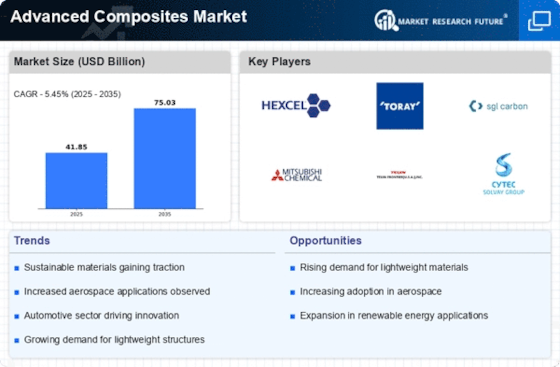
As per Market Research Future analysis, the Advanced Composites Market Size was estimated at 41.85 USD Billion in 2024. The Advanced Composites industry is projected to grow from 44.13 USD Billion in 2025 to 75.03 USD Billion by 2035, exhibiting a compound annual growth rate (CAGR) of 5.45% during the forecast period 2025 - 2035

Key Market Trends & Highlights

The Advanced Composites Market is poised for substantial growth driven by sustainability and technological innovations.

  • North America remains the largest market for advanced composites, particularly in the aerospace sector. Asia-Pacific is emerging as the fastest-growing region, fueled by increasing demand in the automotive industry. The aerospace segment continues to dominate, while the automotive segment is experiencing rapid growth due to evolving technologies. Key market drivers include rising demand in the aerospace sector and the transformation of the automotive industry.

Market Size & Forecast

2024 Market Size 41.85 (USD Billion)
2035 Market Size 75.03 (USD Billion)
CAGR (2025 - 2035) 5.45%
Largest Regional Market Share in 2024 North America

Major Players

Hexcel Corporation (US), Toray Industries, Inc. (JP), SGL Carbon SE (DE), Mitsubishi Chemical Corporation (JP), Teijin Limited (JP), Cytec Industries Inc. (US), Solvay S.A. (BE), 3M Company (US), BASF SE (DE)

Market Trends

The Advanced Composites Market is currently experiencing a transformative phase, driven by the increasing demand for lightweight and high-performance materials across various industries. This market encompasses a diverse range of materials, including carbon fiber, glass fiber, and aramid fiber composites, which are utilized in sectors such as aerospace, automotive, and construction. The emphasis on sustainability and energy efficiency is prompting manufacturers to innovate and develop advanced composite solutions that not only enhance performance but also reduce environmental impact. As industries strive for greater efficiency and lower emissions, the Advanced Composites Market is poised for substantial growth, reflecting a shift towards more sustainable practices. In addition to sustainability, technological advancements play a crucial role in shaping the landscape of the Advanced Composites Market. Innovations in manufacturing processes, such as automated fiber placement and additive manufacturing, are enabling the production of complex geometries and tailored properties. This evolution is likely to enhance the performance characteristics of composite materials, making them more appealing to end-users. Furthermore, the integration of smart technologies into composite materials is emerging as a notable trend, potentially leading to the development of self-sensing and self-repairing composites. Overall, the Advanced Composites Market appears to be on a trajectory of growth, driven by a combination of sustainability, technological innovation, and evolving consumer preferences.

Sustainability Initiatives

The Advanced Composites Market is increasingly influenced by sustainability initiatives, as industries seek to minimize their environmental footprint. Manufacturers are focusing on developing eco-friendly materials and processes, which may lead to a rise in the use of bio-based composites and recycling technologies. This trend reflects a broader commitment to sustainable practices across various sectors.

Technological Advancements

Technological advancements are reshaping the Advanced Composites Market, with innovations in manufacturing techniques and material properties. The adoption of automated processes and advanced manufacturing methods is likely to enhance production efficiency and material performance. This evolution may result in composites that are lighter, stronger, and more versatile.

Integration of Smart Technologies

The integration of smart technologies into composite materials is emerging as a significant trend within the Advanced Composites Market. This development could lead to the creation of self-sensing and self-repairing composites, which may enhance the functionality and longevity of products. Such innovations are expected to attract interest from various industries seeking advanced solutions.

Advanced Composites Market Market Drivers

Military and Defense Applications

The military and defense sectors are increasingly turning to advanced composites for their unique properties, including high strength-to-weight ratios and resistance to harsh environments. The advanced composites market is likely to see substantial growth as defense contractors seek to enhance the performance and durability of military vehicles, aircraft, and naval vessels. Recent estimates suggest that the defense sector's investment in advanced composites could exceed several billion dollars in the coming years, driven by the need for advanced materials that can withstand extreme conditions while maintaining operational efficiency. This trend indicates a robust demand for advanced composites, positioning the market as a critical component in the modernization of defense capabilities.

Rising Demand in Aerospace Sector

The aerospace sector is experiencing a notable surge in demand for advanced composites, driven by the need for lightweight materials that enhance fuel efficiency and performance. Advanced composites market is projected to witness a compound annual growth rate of approximately 8% over the next five years, as manufacturers increasingly adopt these materials to meet stringent regulatory standards and consumer expectations. The integration of advanced composites in aircraft structures not only reduces weight but also improves durability and resistance to environmental factors. As airlines focus on reducing operational costs and enhancing sustainability, the adoption of advanced composites is likely to become a pivotal strategy. This trend indicates a robust growth trajectory for the advanced composites market, as aerospace manufacturers invest in research and development to innovate and optimize composite materials.

Automotive Industry Transformation

The automotive industry is undergoing a significant transformation, with advanced composites playing a crucial role in the development of lighter, more fuel-efficient vehicles. The advanced composites market is expected to benefit from the increasing emphasis on electric vehicles (EVs) and hybrid models, which require materials that can reduce weight without compromising safety. Recent data suggests that the use of advanced composites in automotive applications could lead to weight reductions of up to 50%, thereby enhancing vehicle performance and range. As manufacturers strive to meet evolving consumer preferences and regulatory requirements, the integration of advanced composites is likely to accelerate. This shift not only supports the automotive industry's sustainability goals but also positions the advanced composites market as a key player in the future of transportation.

Emerging Applications in Consumer Goods

The advanced composites market is witnessing emerging applications in consumer goods, particularly in sports equipment, electronics, and high-performance consumer products. As manufacturers seek to enhance product performance and durability, the integration of advanced composites is becoming increasingly prevalent. For instance, the use of advanced composites in sporting goods can lead to lighter and more resilient products, appealing to performance-oriented consumers. Market data suggests that the consumer goods sector's adoption of advanced composites could grow significantly, potentially reaching a multi-billion dollar valuation by the end of the decade. This trend highlights the versatility of advanced composites and their potential to revolutionize various consumer markets, further driving the growth of the advanced composites market.

Growth in Renewable Energy Applications

The renewable energy sector is increasingly adopting advanced composites for various applications, particularly in wind turbine blades and solar panels. The advanced composites market is projected to expand as the demand for efficient and durable materials rises in the renewable energy landscape. Wind energy, for instance, has seen a significant increase in the use of advanced composites, with blades made from these materials offering improved performance and longevity. Reports indicate that the market for composite materials in wind energy could reach several billion dollars by 2026, reflecting a growing recognition of their benefits. This trend underscores the potential for the advanced composites market to contribute to The Advanced Composites Market.

Market Segment Insights

By Application: Aerospace (Largest) vs. Automotive (Fastest-Growing)

In the Advanced Composites Market, the application segment exhibits diverse distribution across sectors, with Aerospace holding the largest share due to its demand for lightweight and high-strength materials. The Automotive sector, while smaller currently, is rapidly evolving as manufacturers seek advanced composites to enhance fuel efficiency and performance. As electric and autonomous vehicles become more prevalent, the shift towards composite materials in automotive applications is gaining momentum.

Aerospace (Dominant) vs. Automotive (Emerging)

Aerospace remains the dominant application for advanced composites, characterized by its stringent performance requirements and stringent safety standards. This segment necessitates materials that provide high strength-to-weight ratios, thermal stability, and resistance to fatigue, making advanced composites essential for aircraft structures. Conversely, the automotive industry is emerging as a significant growth sector, driven by innovations in electric vehicles and a push towards sustainability. Automotive manufacturers are increasingly integrating advanced composites into their designs to achieve enhanced performance metrics and reduce overall weight, supporting the transition to greener technologies.

By End Use: Transportation (Largest) vs. Energy (Fastest-Growing)

<p>In the advanced composites market, the 'End Use' segment has a diverse distribution of applications with transportation being the largest contributor. This sector benefits from high demand for lightweight yet strong materials to enhance fuel efficiency and performance in vehicles. Other segments such as Industrial, Healthcare, and Consumer Goods also hold significant shares but are comparatively smaller in contribution when eyes are cast on the transportation sector's growth and demand. The energy sector, primarily driven by wind and solar applications, is witnessing rapid growth as the demand for sustainable energy solutions increases.</p>

<p>Transportation: Dominant vs. Energy: Emerging</p>

<p>The transportation sector is characterized by its dominant use of advanced composites to produce lighter, stronger vehicles, allowing for enhanced fuel economy and performance. This segment includes the automotive, aerospace, and rail industries, where the integration of composites facilitates innovative designs and reduces overall weight without compromising safety. In contrast, the energy segment is emerging rapidly, focusing on the use of advanced composites in renewable energy systems such as wind turbine blades and solar panels. These materials enhance reliability and durability in harsh environments, marking a significant innovation push. As the global shift towards renewable energy continues, this sector is poised for substantial growth.</p>

By Material Type: Carbon Fiber (Largest) vs. Glass Fiber (Fastest-Growing)

<p>The advanced composites market showcases a diverse range of material types, with carbon fiber leading the charge in market share. This robust material is favored for its high strength-to-weight ratio and excellent performance characteristics, making it a preferred choice in aerospace, automotive, and construction applications. Glass fiber, while following carbon fiber in terms of market share, has been gaining momentum and is rapidly growing due to its versatility and cost-effectiveness, appealing to a wide array of industries.</p>

<p>Carbon Fiber (Dominant) vs. Natural Fiber (Emerging)</p>

<p>Carbon fiber remains the dominant player in the advanced composites market, primarily recognized for its exceptional mechanical properties and low weight, which have significantly enhanced performance in high-stress applications. Meanwhile, natural fiber composites are emerging as a sustainable alternative, driven by the increasing demand for eco-friendly materials. These natural fibers offer advantages such as lower environmental impact and biodegradability, appealing to manufacturers focusing on sustainability. As industries increasingly prioritize green solutions, natural fibers are positioned to capture a growing market share, enhancing their competitive stance.</p>

By Manufacturing Process: Layup (Largest) vs. 3D Printing (Fastest-Growing)

<p>In the advanced composites market, the manufacturing process segment is characterized by various techniques, each holding a distinctive market share. The Layup method remains the largest contributor due to its broad application in aerospace and automotive industries, where complex shapes are required. In contrast, 3D Printing is gaining traction, moving rapidly to capture a significant portion of the market with its ability to produce lighter and more intricate designs while minimizing waste. Growth trends within this segment indicate a shift towards more innovative manufacturing techniques driven by increased demand for lightweight, high-performance materials. 3D Printing is particularly noteworthy as it caters to customization and rapid prototyping, making it attractive in industries looking for flexibility. Additionally, as sustainability becomes a priority, both Layup and 3D Printing processes are adapting to meet eco-friendly practices, thereby enhancing their appeal in the marketplace.</p>

<p>Layup (Dominant) vs. Filament Winding (Emerging)</p>

<p>Layup is recognized as the dominant manufacturing process in the advanced composites market, primarily due to its versatility and established presence in high-demand sectors like aerospace and automotive. It allows for the creation of complex, high-strength components customized to specific applications. Conversely, Filament Winding is emerging as a valuable alternative, particularly in producing cylindrical and spherical composites optimized for pressure vessels and pipes. This technique benefits from continuous fiber alignment, ensuring strength and durability in finished products. While Layup features a wider adoption across various fields, Filament Winding is carving out a niche by catering to specialized needs, sustaining demand in sectors like energy and infrastructure.</p>

By Reinforcement Type: Continuous Fiber (Largest) vs. Nanocomposites (Fastest-Growing)

<p>In the advanced composites market, Continuous Fiber stands out as the largest segment, holding a prominent share over other reinforcement types. This dominance is driven by the superior mechanical properties and strength-to-weight ratio of continuous fibers, which make them ideal for applications in aerospace, automotive, and sporting goods. Following behind, Short Fiber and Hybrid Fiber also maintain a significant presence, serving specific applications that benefit from their unique characteristics. Meanwhile, Nanocomposites are emerging, offering innovative solutions that integrate nanotechnology for enhanced performance.</p>

<p>Continuous Fiber (Dominant) vs. Nanocomposites (Emerging)</p>

<p>Continuous Fiber is notable for its unparalleled strength and durability, making it the preferred choice in sectors requiring high performance, such as aerospace and defense. Its ability to be molded into complex shapes without compromising structural integrity is key to its dominance. On the other hand, Nanocomposites represent a rapidly emerging segment, leveraging nanotechnology to achieve lightweight designs and enhanced properties. While still gaining traction, their potential for widespread applications in automotive and electronics could soon position them as a vital player within the advanced composites market.</p>

Get more detailed insights about Advanced Composites Market Research Report - Forecast till 2035

Regional Insights

North America led with a valuation of 12.5 USD Billion in 2024, emphasizing its significance and dominance in aerospace and automotive sectors, supported by continuous investments in Research and Development. Europe followed closely with a market valuation of 10.5 USD Billion in 2024, strengthened by a robust manufacturing base and stringent regulations driving the demand for lightweight materials.

Asia Pacific, valued at 14.0 USD Billion in 2024, emerged as a critical player due to its rapid industrialization and increasing demand in the transportation sector, highlighting its market growth potential.

Meanwhile, South America, with a value of 2.0 USD Billion, slowly gained traction as industries sought to enhance their production capabilities. The Middle East and Africa, valued at 3.85 USD Billion, witnessed gradual advancements in composite technology, focusing on oil and gas applications.

Each region contributed significantly to the Advanced Composites Market revenue, particularly North America and Asia Pacific, which dominated the market due to favorable government initiatives and technological advancements.

Key Players and Competitive Insights

The Advanced Composites Market is characterized by its dynamic landscape, driven by innovative technologies and heightened demand across various industries, including aerospace, automotive, and construction.As the market evolves, competitive insights reveal that organizations are leveraging advancements in material science to enhance product performance, reduce weight, and improve durability. The growing need for high-performance materials has led to strategic collaborations, mergers, and acquisitions among key players, enabling them to expand their market presence and diversify their product offerings.In this competitive environment, companies are focusing on research and development to sustain their competitive advantage and meet the evolving needs of customers across global markets.Kering SA has established a notable presence in the Advanced Composites Market through its commitment to sustainability and innovation. The company emphasizes eco-conscious practices while delivering high-quality composite materials that cater to a wide range of applications.With a strong focus on brand reputation, Kering SA leverages its strengths in design and creativity to introduce advanced composite solutions that align with modern consumer preferences for lightweight and durable products.The firm's strategic initiatives have enabled it to forge valuable partnerships, thus enhancing its market reach and establishing itself as a leader in sustainability within the composites sector.DuPont de Nemours has a substantial footprint in the Advanced Composites Market, known for its diverse range of specialized products and exceptional material performance. The company is recognized for its innovations in composite technology, particularly in areas such as aerospace and high-performance automotive applications.DuPont de Nemours offers key products that include advanced composite solutions with superior thermal stability and mechanical properties, positioning itself as a vital player in the industry. The company has pursued strategic mergers and acquisitions to bolster its product portfolio and expand its market presence globally.This focus on growth, coupled with a commitment to research and development, has solidified DuPont de Nemours as a competitive force, allowing it to respond effectively to market demands and trends.

Key Companies in the Advanced Composites Market include

Industry Developments

  • Q2 2024: Solvay opens new composite materials facility in South Korea to support aerospace growth Solvay inaugurated a new advanced composites manufacturing plant in Gunsan, South Korea, aimed at supplying lightweight materials for aerospace and defense customers in Asia.
  • Q2 2024: Toray Industries announces partnership with Boeing for next-generation carbon fiber composites Toray Industries signed a multi-year agreement with Boeing to co-develop advanced carbon fiber composite materials for use in future commercial aircraft.
  • Q2 2024: Hexcel launches new HexPly® M51 prepreg for high-rate aerospace manufacturing Hexcel introduced HexPly® M51, a new prepreg system designed to enable faster production rates and improved performance for aerospace composite structures.
  • Q2 2024: Teijin acquires Renegade Materials to expand aerospace composites portfolio Teijin Limited completed the acquisition of Renegade Materials, a US-based supplier of heat-resistant composite materials, strengthening its position in the aerospace sector.
  • Q3 2024: SGL Carbon secures multi-year contract with BMW for carbon fiber automotive components SGL Carbon signed a multi-year supply agreement with BMW to provide carbon fiber composite materials for use in electric vehicle chassis and body panels.
  • Q3 2024: Spirit AeroSystems opens new composites manufacturing center in Malaysia Spirit AeroSystems launched a new composites manufacturing facility in Subang, Malaysia, to support growing demand from commercial aerospace customers in the Asia-Pacific region.
  • Q3 2024: Toray Industries unveils new thermoplastic composite for hydrogen storage tanks Toray Industries announced the launch of a new thermoplastic composite material designed for lightweight, high-pressure hydrogen storage tanks used in fuel cell vehicles.
  • Q4 2024: Hexcel and Safran sign partnership to develop next-generation engine composites Hexcel and Safran entered a strategic partnership to co-develop advanced composite materials for use in next-generation aircraft engine components.
  • Q4 2024: Mitsubishi Chemical Group wins contract to supply composites for Airbus A350 Mitsubishi Chemical Group secured a contract to supply advanced composite materials for the production of Airbus A350 aircraft, expanding its footprint in the aerospace sector.
  • Q1 2025: Hexcel Corporation appoints Tom Gentile as new CEO Hexcel Corporation announced the appointment of Tom Gentile as Chief Executive Officer, effective January 2025, to lead the company’s growth in advanced composites.
  • Q1 2025: Spirit AeroSystems wins contract for composite wing structures for new Boeing model Spirit AeroSystems was awarded a major contract to manufacture composite wing structures for Boeing’s upcoming commercial aircraft program.
  • Q2 2025: Teijin launches new carbon fiber composite for wind turbine blades Teijin introduced a new carbon fiber composite material specifically engineered for use in next-generation wind turbine blades, targeting the renewable energy market.


Future Outlook

Advanced Composites Market Future Outlook

The Advanced Composites Market is projected to grow at a 5.45% CAGR from 2025 to 2035, driven by innovations in manufacturing processes, increasing demand in aerospace, and automotive sectors.

New opportunities lie in:

  • Development of bio-based composite materials for sustainable applications.</p><p>Expansion into emerging markets with tailored composite solutions.</p><p>Investment in advanced recycling technologies for composite materials.

By 2035, the Advanced Composites Market is expected to achieve substantial growth, reflecting evolving industry demands.

Market Segmentation

Advanced Composites Market Type Outlook

  • Carbon Fiber Composites
  • Glass Fiber Composites
  • Aramid Fiber Composites
  • Natural Fiber Composites
  • Hybrid Composites

Advanced Composites Market Application Outlook

  • Aerospace
  • Automotive
  • Construction
  • Electronics
  • Marine

Advanced Composites Market Matrix Type Outlook

  • Thermosetting Polymer
  • Thermoplastic Polymer
  • Metal Matrix
  • Ceramic Matrix

Advanced Composites Market Manufacturing Process Outlook

  • Layup
  • Filament Winding
  • Pultrusion
  • Resin Infusion
  • Out-of-Autoclave

Report Scope

MARKET SIZE 2024 41.85(USD Billion)
MARKET SIZE 2025 44.13(USD Billion)
MARKET SIZE 2035 75.03(USD Billion)
COMPOUND ANNUAL GROWTH RATE (CAGR) 5.45% (2025 - 2035)
REPORT COVERAGE Revenue Forecast, Competitive Landscape, Growth Factors, and Trends
BASE YEAR 2024
Market Forecast Period 2025 - 2035
Historical Data 2019 - 2024
Market Forecast Units USD Billion
Key Companies Profiled Hexcel Corporation (US), Toray Industries, Inc. (JP), SGL Carbon SE (DE), Mitsubishi Chemical Corporation (JP), Teijin Limited (JP), Cytec Industries Inc. (US), Solvay S.A. (BE), 3M Company (US), BASF SE (DE)
Segments Covered Application, Type, Manufacturing Process, Matrix Type, Regional
Key Market Opportunities Growing demand for lightweight materials in aerospace and automotive sectors drives Advanced Composites Market expansion.
Key Market Dynamics Rising demand for lightweight materials drives innovation and competition in the Advanced Composites Market.
Countries Covered North America, Europe, APAC, South America, MEA

FAQs

What is the projected market valuation of advanced composites by 2035?

<p>The advanced composites market is projected to reach a valuation of 50.0 USD Billion by 2035.</p>

What was the market valuation of advanced composites in 2024?

<p>In 2024, the overall market valuation of advanced composites was 30.0 USD Billion.</p>

What is the expected CAGR for the advanced composites market from 2025 to 2035?

<p>The expected CAGR for the advanced composites market during the forecast period 2025 - 2035 is 4.75%.</p>

Which application segments are expected to drive growth in the advanced composites market?

<p>The application segments expected to drive growth include Aerospace, Automotive, and Construction, with valuations projected between 10.0 to 16.0 USD Billion, 8.0 to 12.0 USD Billion, and 5.0 to 8.0 USD Billion respectively.</p>

Who are the key players in the advanced composites market?

<p>Key players in the advanced composites market include Hexcel Corporation, Toray Industries Inc., and SGL Carbon SE.</p>

What are the projected valuations for the automotive segment in 2025?

<p>The automotive segment is projected to have a valuation between 8.0 and 12.0 USD Billion in 2025.</p>

How does the marine segment compare to other application segments in terms of valuation?

<p>The marine segment is projected to reach a valuation between 3.0 and 5.0 USD Billion, which is lower than other segments like Aerospace and Automotive.</p>

What materials are primarily used in advanced composites?

<p>The primary materials used in advanced composites include Carbon Fiber, Glass Fiber, and Aramid Fiber, with projected valuations of 10.0 to 16.0 USD Billion, 8.0 to 12.0 USD Billion, and 5.0 to 8.0 USD Billion respectively.</p>

What manufacturing processes are utilized in the production of advanced composites?

<p>Manufacturing processes such as 3D Printing and Resin Transfer Molding are utilized, with projected valuations of 8.0 to 12.0 USD Billion and 7.0 to 10.0 USD Billion respectively.</p>

What is the significance of the healthcare segment in the advanced composites market?

<p>The healthcare segment is projected to reach a valuation between 3.0 and 5.0 USD Billion, indicating its growing relevance in the advanced composites market.</p>

  1. SECTION I: EXECUTIVE SUMMARY AND KEY HIGHLIGHTS
    1. | 1.1 EXECUTIVE SUMMARY
    2. | | 1.1.1 Market Overview
    3. | | 1.1.2 Key Findings
    4. | | 1.1.3 Market Segmentation
    5. | | 1.1.4 Competitive Landscape
    6. | | 1.1.5 Challenges and Opportunities
    7. | | 1.1.6 Future Outlook
  2. SECTION II: SCOPING, METHODOLOGY AND MARKET STRUCTURE
    1. | 2.1 MARKET INTRODUCTION
    2. | | 2.1.1 Definition
    3. | | 2.1.2 Scope of the study
    4. | | | 2.1.2.1 Research Objective
    5. | | | 2.1.2.2 Assumption
    6. | | | 2.1.2.3 Limitations
    7. | 2.2 RESEARCH METHODOLOGY
    8. | | 2.2.1 Overview
    9. | | 2.2.2 Data Mining
    10. | | 2.2.3 Secondary Research
    11. | | 2.2.4 Primary Research
    12. | | | 2.2.4.1 Primary Interviews and Information Gathering Process
    13. | | | 2.2.4.2 Breakdown of Primary Respondents
    14. | | 2.2.5 Forecasting Model
    15. | | 2.2.6 Market Size Estimation
    16. | | | 2.2.6.1 Bottom-Up Approach
    17. | | | 2.2.6.2 Top-Down Approach
    18. | | 2.2.7 Data Triangulation
    19. | | 2.2.8 Validation
  3. SECTION III: QUALITATIVE ANALYSIS
    1. | 3.1 MARKET DYNAMICS
    2. | | 3.1.1 Overview
    3. | | 3.1.2 Drivers
    4. | | 3.1.3 Restraints
    5. | | 3.1.4 Opportunities
    6. | 3.2 MARKET FACTOR ANALYSIS
    7. | | 3.2.1 Value chain Analysis
    8. | | 3.2.2 Porter's Five Forces Analysis
    9. | | | 3.2.2.1 Bargaining Power of Suppliers
    10. | | | 3.2.2.2 Bargaining Power of Buyers
    11. | | | 3.2.2.3 Threat of New Entrants
    12. | | | 3.2.2.4 Threat of Substitutes
    13. | | | 3.2.2.5 Intensity of Rivalry
    14. | | 3.2.3 COVID-19 Impact Analysis
    15. | | | 3.2.3.1 Market Impact Analysis
    16. | | | 3.2.3.2 Regional Impact
    17. | | | 3.2.3.3 Opportunity and Threat Analysis
  4. SECTION IV: QUANTITATIVE ANALYSIS
    1. | 4.1 Chemicals and Materials, BY Application (USD Billion)
    2. | | 4.1.1 Aerospace
    3. | | 4.1.2 Automotive
    4. | | 4.1.3 Construction
    5. | | 4.1.4 Electronics
    6. | | 4.1.5 Marine
    7. | 4.2 Chemicals and Materials, BY End Use (USD Billion)
    8. | | 4.2.1 Transportation
    9. | | 4.2.2 Industrial
    10. | | 4.2.3 Consumer Goods
    11. | | 4.2.4 Energy
    12. | | 4.2.5 Healthcare
    13. | 4.3 Chemicals and Materials, BY Material Type (USD Billion)
    14. | | 4.3.1 Carbon Fiber
    15. | | 4.3.2 Glass Fiber
    16. | | 4.3.3 Aramid Fiber
    17. | | 4.3.4 Natural Fiber
    18. | | 4.3.5 Thermoplastic Composites
    19. | 4.4 Chemicals and Materials, BY Manufacturing Process (USD Billion)
    20. | | 4.4.1 Layup
    21. | | 4.4.2 Filament Winding
    22. | | 4.4.3 Pultrusion
    23. | | 4.4.4 Resin Transfer Molding
    24. | | 4.4.5 3D Printing
    25. | 4.5 Chemicals and Materials, BY Reinforcement Type (USD Billion)
    26. | | 4.5.1 Continuous Fiber
    27. | | 4.5.2 Short Fiber
    28. | | 4.5.3 Hybrid Fiber
    29. | | 4.5.4 Nanocomposites
    30. | | 4.5.5 Textile Reinforcements
    31. | 4.6 Chemicals and Materials, BY Region (USD Billion)
    32. | | 4.6.1 North America
    33. | | | 4.6.1.1 US
    34. | | | 4.6.1.2 Canada
    35. | | 4.6.2 Europe
    36. | | | 4.6.2.1 Germany
    37. | | | 4.6.2.2 UK
    38. | | | 4.6.2.3 France
    39. | | | 4.6.2.4 Russia
    40. | | | 4.6.2.5 Italy
    41. | | | 4.6.2.6 Spain
    42. | | | 4.6.2.7 Rest of Europe
    43. | | 4.6.3 APAC
    44. | | | 4.6.3.1 China
    45. | | | 4.6.3.2 India
    46. | | | 4.6.3.3 Japan
    47. | | | 4.6.3.4 South Korea
    48. | | | 4.6.3.5 Malaysia
    49. | | | 4.6.3.6 Thailand
    50. | | | 4.6.3.7 Indonesia
    51. | | | 4.6.3.8 Rest of APAC
    52. | | 4.6.4 South America
    53. | | | 4.6.4.1 Brazil
    54. | | | 4.6.4.2 Mexico
    55. | | | 4.6.4.3 Argentina
    56. | | | 4.6.4.4 Rest of South America
    57. | | 4.6.5 MEA
    58. | | | 4.6.5.1 GCC Countries
    59. | | | 4.6.5.2 South Africa
    60. | | | 4.6.5.3 Rest of MEA
  5. SECTION V: COMPETITIVE ANALYSIS
    1. | 5.1 Competitive Landscape
    2. | | 5.1.1 Overview
    3. | | 5.1.2 Competitive Analysis
    4. | | 5.1.3 Market share Analysis
    5. | | 5.1.4 Major Growth Strategy in the Chemicals and Materials
    6. | | 5.1.5 Competitive Benchmarking
    7. | | 5.1.6 Leading Players in Terms of Number of Developments in the Chemicals and Materials
    8. | | 5.1.7 Key developments and growth strategies
    9. | | | 5.1.7.1 New Product Launch/Service Deployment
    10. | | | 5.1.7.2 Merger & Acquisitions
    11. | | | 5.1.7.3 Joint Ventures
    12. | | 5.1.8 Major Players Financial Matrix
    13. | | | 5.1.8.1 Sales and Operating Income
    14. | | | 5.1.8.2 Major Players R&D Expenditure. 2023
    15. | 5.2 Company Profiles
    16. | | 5.2.1 Hexcel Corporation (US)
    17. | | | 5.2.1.1 Financial Overview
    18. | | | 5.2.1.2 Products Offered
    19. | | | 5.2.1.3 Key Developments
    20. | | | 5.2.1.4 SWOT Analysis
    21. | | | 5.2.1.5 Key Strategies
    22. | | 5.2.2 Toray Industries Inc. (JP)
    23. | | | 5.2.2.1 Financial Overview
    24. | | | 5.2.2.2 Products Offered
    25. | | | 5.2.2.3 Key Developments
    26. | | | 5.2.2.4 SWOT Analysis
    27. | | | 5.2.2.5 Key Strategies
    28. | | 5.2.3 SGL Carbon SE (DE)
    29. | | | 5.2.3.1 Financial Overview
    30. | | | 5.2.3.2 Products Offered
    31. | | | 5.2.3.3 Key Developments
    32. | | | 5.2.3.4 SWOT Analysis
    33. | | | 5.2.3.5 Key Strategies
    34. | | 5.2.4 Mitsubishi Chemical Corporation (JP)
    35. | | | 5.2.4.1 Financial Overview
    36. | | | 5.2.4.2 Products Offered
    37. | | | 5.2.4.3 Key Developments
    38. | | | 5.2.4.4 SWOT Analysis
    39. | | | 5.2.4.5 Key Strategies
    40. | | 5.2.5 Teijin Limited (JP)
    41. | | | 5.2.5.1 Financial Overview
    42. | | | 5.2.5.2 Products Offered
    43. | | | 5.2.5.3 Key Developments
    44. | | | 5.2.5.4 SWOT Analysis
    45. | | | 5.2.5.5 Key Strategies
    46. | | 5.2.6 Solvay SA (BE)
    47. | | | 5.2.6.1 Financial Overview
    48. | | | 5.2.6.2 Products Offered
    49. | | | 5.2.6.3 Key Developments
    50. | | | 5.2.6.4 SWOT Analysis
    51. | | | 5.2.6.5 Key Strategies
    52. | | 5.2.7 BASF SE (DE)
    53. | | | 5.2.7.1 Financial Overview
    54. | | | 5.2.7.2 Products Offered
    55. | | | 5.2.7.3 Key Developments
    56. | | | 5.2.7.4 SWOT Analysis
    57. | | | 5.2.7.5 Key Strategies
    58. | | 5.2.8 Cytec Industries Inc. (US)
    59. | | | 5.2.8.1 Financial Overview
    60. | | | 5.2.8.2 Products Offered
    61. | | | 5.2.8.3 Key Developments
    62. | | | 5.2.8.4 SWOT Analysis
    63. | | | 5.2.8.5 Key Strategies
    64. | | 5.2.9 3M Company (US)
    65. | | | 5.2.9.1 Financial Overview
    66. | | | 5.2.9.2 Products Offered
    67. | | | 5.2.9.3 Key Developments
    68. | | | 5.2.9.4 SWOT Analysis
    69. | | | 5.2.9.5 Key Strategies
    70. | 5.3 Appendix
    71. | | 5.3.1 References
    72. | | 5.3.2 Related Reports
  6. LIST OF FIGURES
    1. | 6.1 MARKET SYNOPSIS
    2. | 6.2 NORTH AMERICA MARKET ANALYSIS
    3. | 6.3 US MARKET ANALYSIS BY APPLICATION
    4. | 6.4 US MARKET ANALYSIS BY END USE
    5. | 6.5 US MARKET ANALYSIS BY MATERIAL TYPE
    6. | 6.6 US MARKET ANALYSIS BY MANUFACTURING PROCESS
    7. | 6.7 US MARKET ANALYSIS BY REINFORCEMENT TYPE
    8. | 6.8 CANADA MARKET ANALYSIS BY APPLICATION
    9. | 6.9 CANADA MARKET ANALYSIS BY END USE
    10. | 6.10 CANADA MARKET ANALYSIS BY MATERIAL TYPE
    11. | 6.11 CANADA MARKET ANALYSIS BY MANUFACTURING PROCESS
    12. | 6.12 CANADA MARKET ANALYSIS BY REINFORCEMENT TYPE
    13. | 6.13 EUROPE MARKET ANALYSIS
    14. | 6.14 GERMANY MARKET ANALYSIS BY APPLICATION
    15. | 6.15 GERMANY MARKET ANALYSIS BY END USE
    16. | 6.16 GERMANY MARKET ANALYSIS BY MATERIAL TYPE
    17. | 6.17 GERMANY MARKET ANALYSIS BY MANUFACTURING PROCESS
    18. | 6.18 GERMANY MARKET ANALYSIS BY REINFORCEMENT TYPE
    19. | 6.19 UK MARKET ANALYSIS BY APPLICATION
    20. | 6.20 UK MARKET ANALYSIS BY END USE
    21. | 6.21 UK MARKET ANALYSIS BY MATERIAL TYPE
    22. | 6.22 UK MARKET ANALYSIS BY MANUFACTURING PROCESS
    23. | 6.23 UK MARKET ANALYSIS BY REINFORCEMENT TYPE
    24. | 6.24 FRANCE MARKET ANALYSIS BY APPLICATION
    25. | 6.25 FRANCE MARKET ANALYSIS BY END USE
    26. | 6.26 FRANCE MARKET ANALYSIS BY MATERIAL TYPE
    27. | 6.27 FRANCE MARKET ANALYSIS BY MANUFACTURING PROCESS
    28. | 6.28 FRANCE MARKET ANALYSIS BY REINFORCEMENT TYPE
    29. | 6.29 RUSSIA MARKET ANALYSIS BY APPLICATION
    30. | 6.30 RUSSIA MARKET ANALYSIS BY END USE
    31. | 6.31 RUSSIA MARKET ANALYSIS BY MATERIAL TYPE
    32. | 6.32 RUSSIA MARKET ANALYSIS BY MANUFACTURING PROCESS
    33. | 6.33 RUSSIA MARKET ANALYSIS BY REINFORCEMENT TYPE
    34. | 6.34 ITALY MARKET ANALYSIS BY APPLICATION
    35. | 6.35 ITALY MARKET ANALYSIS BY END USE
    36. | 6.36 ITALY MARKET ANALYSIS BY MATERIAL TYPE
    37. | 6.37 ITALY MARKET ANALYSIS BY MANUFACTURING PROCESS
    38. | 6.38 ITALY MARKET ANALYSIS BY REINFORCEMENT TYPE
    39. | 6.39 SPAIN MARKET ANALYSIS BY APPLICATION
    40. | 6.40 SPAIN MARKET ANALYSIS BY END USE
    41. | 6.41 SPAIN MARKET ANALYSIS BY MATERIAL TYPE
    42. | 6.42 SPAIN MARKET ANALYSIS BY MANUFACTURING PROCESS
    43. | 6.43 SPAIN MARKET ANALYSIS BY REINFORCEMENT TYPE
    44. | 6.44 REST OF EUROPE MARKET ANALYSIS BY APPLICATION
    45. | 6.45 REST OF EUROPE MARKET ANALYSIS BY END USE
    46. | 6.46 REST OF EUROPE MARKET ANALYSIS BY MATERIAL TYPE
    47. | 6.47 REST OF EUROPE MARKET ANALYSIS BY MANUFACTURING PROCESS
    48. | 6.48 REST OF EUROPE MARKET ANALYSIS BY REINFORCEMENT TYPE
    49. | 6.49 APAC MARKET ANALYSIS
    50. | 6.50 CHINA MARKET ANALYSIS BY APPLICATION
    51. | 6.51 CHINA MARKET ANALYSIS BY END USE
    52. | 6.52 CHINA MARKET ANALYSIS BY MATERIAL TYPE
    53. | 6.53 CHINA MARKET ANALYSIS BY MANUFACTURING PROCESS
    54. | 6.54 CHINA MARKET ANALYSIS BY REINFORCEMENT TYPE
    55. | 6.55 INDIA MARKET ANALYSIS BY APPLICATION
    56. | 6.56 INDIA MARKET ANALYSIS BY END USE
    57. | 6.57 INDIA MARKET ANALYSIS BY MATERIAL TYPE
    58. | 6.58 INDIA MARKET ANALYSIS BY MANUFACTURING PROCESS
    59. | 6.59 INDIA MARKET ANALYSIS BY REINFORCEMENT TYPE
    60. | 6.60 JAPAN MARKET ANALYSIS BY APPLICATION
    61. | 6.61 JAPAN MARKET ANALYSIS BY END USE
    62. | 6.62 JAPAN MARKET ANALYSIS BY MATERIAL TYPE
    63. | 6.63 JAPAN MARKET ANALYSIS BY MANUFACTURING PROCESS
    64. | 6.64 JAPAN MARKET ANALYSIS BY REINFORCEMENT TYPE
    65. | 6.65 SOUTH KOREA MARKET ANALYSIS BY APPLICATION
    66. | 6.66 SOUTH KOREA MARKET ANALYSIS BY END USE
    67. | 6.67 SOUTH KOREA MARKET ANALYSIS BY MATERIAL TYPE
    68. | 6.68 SOUTH KOREA MARKET ANALYSIS BY MANUFACTURING PROCESS
    69. | 6.69 SOUTH KOREA MARKET ANALYSIS BY REINFORCEMENT TYPE
    70. | 6.70 MALAYSIA MARKET ANALYSIS BY APPLICATION
    71. | 6.71 MALAYSIA MARKET ANALYSIS BY END USE
    72. | 6.72 MALAYSIA MARKET ANALYSIS BY MATERIAL TYPE
    73. | 6.73 MALAYSIA MARKET ANALYSIS BY MANUFACTURING PROCESS
    74. | 6.74 MALAYSIA MARKET ANALYSIS BY REINFORCEMENT TYPE
    75. | 6.75 THAILAND MARKET ANALYSIS BY APPLICATION
    76. | 6.76 THAILAND MARKET ANALYSIS BY END USE
    77. | 6.77 THAILAND MARKET ANALYSIS BY MATERIAL TYPE
    78. | 6.78 THAILAND MARKET ANALYSIS BY MANUFACTURING PROCESS
    79. | 6.79 THAILAND MARKET ANALYSIS BY REINFORCEMENT TYPE
    80. | 6.80 INDONESIA MARKET ANALYSIS BY APPLICATION
    81. | 6.81 INDONESIA MARKET ANALYSIS BY END USE
    82. | 6.82 INDONESIA MARKET ANALYSIS BY MATERIAL TYPE
    83. | 6.83 INDONESIA MARKET ANALYSIS BY MANUFACTURING PROCESS
    84. | 6.84 INDONESIA MARKET ANALYSIS BY REINFORCEMENT TYPE
    85. | 6.85 REST OF APAC MARKET ANALYSIS BY APPLICATION
    86. | 6.86 REST OF APAC MARKET ANALYSIS BY END USE
    87. | 6.87 REST OF APAC MARKET ANALYSIS BY MATERIAL TYPE
    88. | 6.88 REST OF APAC MARKET ANALYSIS BY MANUFACTURING PROCESS
    89. | 6.89 REST OF APAC MARKET ANALYSIS BY REINFORCEMENT TYPE
    90. | 6.90 SOUTH AMERICA MARKET ANALYSIS
    91. | 6.91 BRAZIL MARKET ANALYSIS BY APPLICATION
    92. | 6.92 BRAZIL MARKET ANALYSIS BY END USE
    93. | 6.93 BRAZIL MARKET ANALYSIS BY MATERIAL TYPE
    94. | 6.94 BRAZIL MARKET ANALYSIS BY MANUFACTURING PROCESS
    95. | 6.95 BRAZIL MARKET ANALYSIS BY REINFORCEMENT TYPE
    96. | 6.96 MEXICO MARKET ANALYSIS BY APPLICATION
    97. | 6.97 MEXICO MARKET ANALYSIS BY END USE
    98. | 6.98 MEXICO MARKET ANALYSIS BY MATERIAL TYPE
    99. | 6.99 MEXICO MARKET ANALYSIS BY MANUFACTURING PROCESS
    100. | 6.100 MEXICO MARKET ANALYSIS BY REINFORCEMENT TYPE
    101. | 6.101 ARGENTINA MARKET ANALYSIS BY APPLICATION
    102. | 6.102 ARGENTINA MARKET ANALYSIS BY END USE
    103. | 6.103 ARGENTINA MARKET ANALYSIS BY MATERIAL TYPE
    104. | 6.104 ARGENTINA MARKET ANALYSIS BY MANUFACTURING PROCESS
    105. | 6.105 ARGENTINA MARKET ANALYSIS BY REINFORCEMENT TYPE
    106. | 6.106 REST OF SOUTH AMERICA MARKET ANALYSIS BY APPLICATION
    107. | 6.107 REST OF SOUTH AMERICA MARKET ANALYSIS BY END USE
    108. | 6.108 REST OF SOUTH AMERICA MARKET ANALYSIS BY MATERIAL TYPE
    109. | 6.109 REST OF SOUTH AMERICA MARKET ANALYSIS BY MANUFACTURING PROCESS
    110. | 6.110 REST OF SOUTH AMERICA MARKET ANALYSIS BY REINFORCEMENT TYPE
    111. | 6.111 MEA MARKET ANALYSIS
    112. | 6.112 GCC COUNTRIES MARKET ANALYSIS BY APPLICATION
    113. | 6.113 GCC COUNTRIES MARKET ANALYSIS BY END USE
    114. | 6.114 GCC COUNTRIES MARKET ANALYSIS BY MATERIAL TYPE
    115. | 6.115 GCC COUNTRIES MARKET ANALYSIS BY MANUFACTURING PROCESS
    116. | 6.116 GCC COUNTRIES MARKET ANALYSIS BY REINFORCEMENT TYPE
    117. | 6.117 SOUTH AFRICA MARKET ANALYSIS BY APPLICATION
    118. | 6.118 SOUTH AFRICA MARKET ANALYSIS BY END USE
    119. | 6.119 SOUTH AFRICA MARKET ANALYSIS BY MATERIAL TYPE
    120. | 6.120 SOUTH AFRICA MARKET ANALYSIS BY MANUFACTURING PROCESS
    121. | 6.121 SOUTH AFRICA MARKET ANALYSIS BY REINFORCEMENT TYPE
    122. | 6.122 REST OF MEA MARKET ANALYSIS BY APPLICATION
    123. | 6.123 REST OF MEA MARKET ANALYSIS BY END USE
    124. | 6.124 REST OF MEA MARKET ANALYSIS BY MATERIAL TYPE
    125. | 6.125 REST OF MEA MARKET ANALYSIS BY MANUFACTURING PROCESS
    126. | 6.126 REST OF MEA MARKET ANALYSIS BY REINFORCEMENT TYPE
    127. | 6.127 KEY BUYING CRITERIA OF CHEMICALS AND MATERIALS
    128. | 6.128 RESEARCH PROCESS OF MRFR
    129. | 6.129 DRO ANALYSIS OF CHEMICALS AND MATERIALS
    130. | 6.130 DRIVERS IMPACT ANALYSIS: CHEMICALS AND MATERIALS
    131. | 6.131 RESTRAINTS IMPACT ANALYSIS: CHEMICALS AND MATERIALS
    132. | 6.132 SUPPLY / VALUE CHAIN: CHEMICALS AND MATERIALS
    133. | 6.133 CHEMICALS AND MATERIALS, BY APPLICATION, 2024 (% SHARE)
    134. | 6.134 CHEMICALS AND MATERIALS, BY APPLICATION, 2024 TO 2035 (USD Billion)
    135. | 6.135 CHEMICALS AND MATERIALS, BY END USE, 2024 (% SHARE)
    136. | 6.136 CHEMICALS AND MATERIALS, BY END USE, 2024 TO 2035 (USD Billion)
    137. | 6.137 CHEMICALS AND MATERIALS, BY MATERIAL TYPE, 2024 (% SHARE)
    138. | 6.138 CHEMICALS AND MATERIALS, BY MATERIAL TYPE, 2024 TO 2035 (USD Billion)
    139. | 6.139 CHEMICALS AND MATERIALS, BY MANUFACTURING PROCESS, 2024 (% SHARE)
    140. | 6.140 CHEMICALS AND MATERIALS, BY MANUFACTURING PROCESS, 2024 TO 2035 (USD Billion)
    141. | 6.141 CHEMICALS AND MATERIALS, BY REINFORCEMENT TYPE, 2024 (% SHARE)
    142. | 6.142 CHEMICALS AND MATERIALS, BY REINFORCEMENT TYPE, 2024 TO 2035 (USD Billion)
    143. | 6.143 BENCHMARKING OF MAJOR COMPETITORS
  7. LIST OF TABLES
    1. | 7.1 LIST OF ASSUMPTIONS
    2. | | 7.1.1
    3. | 7.2 North America MARKET SIZE ESTIMATES; FORECAST
    4. | | 7.2.1 BY APPLICATION, 2025-2035 (USD Billion)
    5. | | 7.2.2 BY END USE, 2025-2035 (USD Billion)
    6. | | 7.2.3 BY MATERIAL TYPE, 2025-2035 (USD Billion)
    7. | | 7.2.4 BY MANUFACTURING PROCESS, 2025-2035 (USD Billion)
    8. | | 7.2.5 BY REINFORCEMENT TYPE, 2025-2035 (USD Billion)
    9. | 7.3 US MARKET SIZE ESTIMATES; FORECAST
    10. | | 7.3.1 BY APPLICATION, 2025-2035 (USD Billion)
    11. | | 7.3.2 BY END USE, 2025-2035 (USD Billion)
    12. | | 7.3.3 BY MATERIAL TYPE, 2025-2035 (USD Billion)
    13. | | 7.3.4 BY MANUFACTURING PROCESS, 2025-2035 (USD Billion)
    14. | | 7.3.5 BY REINFORCEMENT TYPE, 2025-2035 (USD Billion)
    15. | 7.4 Canada MARKET SIZE ESTIMATES; FORECAST
    16. | | 7.4.1 BY APPLICATION, 2025-2035 (USD Billion)
    17. | | 7.4.2 BY END USE, 2025-2035 (USD Billion)
    18. | | 7.4.3 BY MATERIAL TYPE, 2025-2035 (USD Billion)
    19. | | 7.4.4 BY MANUFACTURING PROCESS, 2025-2035 (USD Billion)
    20. | | 7.4.5 BY REINFORCEMENT TYPE, 2025-2035 (USD Billion)
    21. | 7.5 Europe MARKET SIZE ESTIMATES; FORECAST
    22. | | 7.5.1 BY APPLICATION, 2025-2035 (USD Billion)
    23. | | 7.5.2 BY END USE, 2025-2035 (USD Billion)
    24. | | 7.5.3 BY MATERIAL TYPE, 2025-2035 (USD Billion)
    25. | | 7.5.4 BY MANUFACTURING PROCESS, 2025-2035 (USD Billion)
    26. | | 7.5.5 BY REINFORCEMENT TYPE, 2025-2035 (USD Billion)
    27. | 7.6 Germany MARKET SIZE ESTIMATES; FORECAST
    28. | | 7.6.1 BY APPLICATION, 2025-2035 (USD Billion)
    29. | | 7.6.2 BY END USE, 2025-2035 (USD Billion)
    30. | | 7.6.3 BY MATERIAL TYPE, 2025-2035 (USD Billion)
    31. | | 7.6.4 BY MANUFACTURING PROCESS, 2025-2035 (USD Billion)
    32. | | 7.6.5 BY REINFORCEMENT TYPE, 2025-2035 (USD Billion)
    33. | 7.7 UK MARKET SIZE ESTIMATES; FORECAST
    34. | | 7.7.1 BY APPLICATION, 2025-2035 (USD Billion)
    35. | | 7.7.2 BY END USE, 2025-2035 (USD Billion)
    36. | | 7.7.3 BY MATERIAL TYPE, 2025-2035 (USD Billion)
    37. | | 7.7.4 BY MANUFACTURING PROCESS, 2025-2035 (USD Billion)
    38. | | 7.7.5 BY REINFORCEMENT TYPE, 2025-2035 (USD Billion)
    39. | 7.8 France MARKET SIZE ESTIMATES; FORECAST
    40. | | 7.8.1 BY APPLICATION, 2025-2035 (USD Billion)
    41. | | 7.8.2 BY END USE, 2025-2035 (USD Billion)
    42. | | 7.8.3 BY MATERIAL TYPE, 2025-2035 (USD Billion)
    43. | | 7.8.4 BY MANUFACTURING PROCESS, 2025-2035 (USD Billion)
    44. | | 7.8.5 BY REINFORCEMENT TYPE, 2025-2035 (USD Billion)
    45. | 7.9 Russia MARKET SIZE ESTIMATES; FORECAST
    46. | | 7.9.1 BY APPLICATION, 2025-2035 (USD Billion)
    47. | | 7.9.2 BY END USE, 2025-2035 (USD Billion)
    48. | | 7.9.3 BY MATERIAL TYPE, 2025-2035 (USD Billion)
    49. | | 7.9.4 BY MANUFACTURING PROCESS, 2025-2035 (USD Billion)
    50. | | 7.9.5 BY REINFORCEMENT TYPE, 2025-2035 (USD Billion)
    51. | 7.10 Italy MARKET SIZE ESTIMATES; FORECAST
    52. | | 7.10.1 BY APPLICATION, 2025-2035 (USD Billion)
    53. | | 7.10.2 BY END USE, 2025-2035 (USD Billion)
    54. | | 7.10.3 BY MATERIAL TYPE, 2025-2035 (USD Billion)
    55. | | 7.10.4 BY MANUFACTURING PROCESS, 2025-2035 (USD Billion)
    56. | | 7.10.5 BY REINFORCEMENT TYPE, 2025-2035 (USD Billion)
    57. | 7.11 Spain MARKET SIZE ESTIMATES; FORECAST
    58. | | 7.11.1 BY APPLICATION, 2025-2035 (USD Billion)
    59. | | 7.11.2 BY END USE, 2025-2035 (USD Billion)
    60. | | 7.11.3 BY MATERIAL TYPE, 2025-2035 (USD Billion)
    61. | | 7.11.4 BY MANUFACTURING PROCESS, 2025-2035 (USD Billion)
    62. | | 7.11.5 BY REINFORCEMENT TYPE, 2025-2035 (USD Billion)
    63. | 7.12 Rest of Europe MARKET SIZE ESTIMATES; FORECAST
    64. | | 7.12.1 BY APPLICATION, 2025-2035 (USD Billion)
    65. | | 7.12.2 BY END USE, 2025-2035 (USD Billion)
    66. | | 7.12.3 BY MATERIAL TYPE, 2025-2035 (USD Billion)
    67. | | 7.12.4 BY MANUFACTURING PROCESS, 2025-2035 (USD Billion)
    68. | | 7.12.5 BY REINFORCEMENT TYPE, 2025-2035 (USD Billion)
    69. | 7.13 APAC MARKET SIZE ESTIMATES; FORECAST
    70. | | 7.13.1 BY APPLICATION, 2025-2035 (USD Billion)
    71. | | 7.13.2 BY END USE, 2025-2035 (USD Billion)
    72. | | 7.13.3 BY MATERIAL TYPE, 2025-2035 (USD Billion)
    73. | | 7.13.4 BY MANUFACTURING PROCESS, 2025-2035 (USD Billion)
    74. | | 7.13.5 BY REINFORCEMENT TYPE, 2025-2035 (USD Billion)
    75. | 7.14 China MARKET SIZE ESTIMATES; FORECAST
    76. | | 7.14.1 BY APPLICATION, 2025-2035 (USD Billion)
    77. | | 7.14.2 BY END USE, 2025-2035 (USD Billion)
    78. | | 7.14.3 BY MATERIAL TYPE, 2025-2035 (USD Billion)
    79. | | 7.14.4 BY MANUFACTURING PROCESS, 2025-2035 (USD Billion)
    80. | | 7.14.5 BY REINFORCEMENT TYPE, 2025-2035 (USD Billion)
    81. | 7.15 India MARKET SIZE ESTIMATES; FORECAST
    82. | | 7.15.1 BY APPLICATION, 2025-2035 (USD Billion)
    83. | | 7.15.2 BY END USE, 2025-2035 (USD Billion)
    84. | | 7.15.3 BY MATERIAL TYPE, 2025-2035 (USD Billion)
    85. | | 7.15.4 BY MANUFACTURING PROCESS, 2025-2035 (USD Billion)
    86. | | 7.15.5 BY REINFORCEMENT TYPE, 2025-2035 (USD Billion)
    87. | 7.16 Japan MARKET SIZE ESTIMATES; FORECAST
    88. | | 7.16.1 BY APPLICATION, 2025-2035 (USD Billion)
    89. | | 7.16.2 BY END USE, 2025-2035 (USD Billion)
    90. | | 7.16.3 BY MATERIAL TYPE, 2025-2035 (USD Billion)
    91. | | 7.16.4 BY MANUFACTURING PROCESS, 2025-2035 (USD Billion)
    92. | | 7.16.5 BY REINFORCEMENT TYPE, 2025-2035 (USD Billion)
    93. | 7.17 South Korea MARKET SIZE ESTIMATES; FORECAST
    94. | | 7.17.1 BY APPLICATION, 2025-2035 (USD Billion)
    95. | | 7.17.2 BY END USE, 2025-2035 (USD Billion)
    96. | | 7.17.3 BY MATERIAL TYPE, 2025-2035 (USD Billion)
    97. | | 7.17.4 BY MANUFACTURING PROCESS, 2025-2035 (USD Billion)
    98. | | 7.17.5 BY REINFORCEMENT TYPE, 2025-2035 (USD Billion)
    99. | 7.18 Malaysia MARKET SIZE ESTIMATES; FORECAST
    100. | | 7.18.1 BY APPLICATION, 2025-2035 (USD Billion)
    101. | | 7.18.2 BY END USE, 2025-2035 (USD Billion)
    102. | | 7.18.3 BY MATERIAL TYPE, 2025-2035 (USD Billion)
    103. | | 7.18.4 BY MANUFACTURING PROCESS, 2025-2035 (USD Billion)
    104. | | 7.18.5 BY REINFORCEMENT TYPE, 2025-2035 (USD Billion)
    105. | 7.19 Thailand MARKET SIZE ESTIMATES; FORECAST
    106. | | 7.19.1 BY APPLICATION, 2025-2035 (USD Billion)
    107. | | 7.19.2 BY END USE, 2025-2035 (USD Billion)
    108. | | 7.19.3 BY MATERIAL TYPE, 2025-2035 (USD Billion)
    109. | | 7.19.4 BY MANUFACTURING PROCESS, 2025-2035 (USD Billion)
    110. | | 7.19.5 BY REINFORCEMENT TYPE, 2025-2035 (USD Billion)
    111. | 7.20 Indonesia MARKET SIZE ESTIMATES; FORECAST
    112. | | 7.20.1 BY APPLICATION, 2025-2035 (USD Billion)
    113. | | 7.20.2 BY END USE, 2025-2035 (USD Billion)
    114. | | 7.20.3 BY MATERIAL TYPE, 2025-2035 (USD Billion)
    115. | | 7.20.4 BY MANUFACTURING PROCESS, 2025-2035 (USD Billion)
    116. | | 7.20.5 BY REINFORCEMENT TYPE, 2025-2035 (USD Billion)
    117. | 7.21 Rest of APAC MARKET SIZE ESTIMATES; FORECAST
    118. | | 7.21.1 BY APPLICATION, 2025-2035 (USD Billion)
    119. | | 7.21.2 BY END USE, 2025-2035 (USD Billion)
    120. | | 7.21.3 BY MATERIAL TYPE, 2025-2035 (USD Billion)
    121. | | 7.21.4 BY MANUFACTURING PROCESS, 2025-2035 (USD Billion)
    122. | | 7.21.5 BY REINFORCEMENT TYPE, 2025-2035 (USD Billion)
    123. | 7.22 South America MARKET SIZE ESTIMATES; FORECAST
    124. | | 7.22.1 BY APPLICATION, 2025-2035 (USD Billion)
    125. | | 7.22.2 BY END USE, 2025-2035 (USD Billion)
    126. | | 7.22.3 BY MATERIAL TYPE, 2025-2035 (USD Billion)
    127. | | 7.22.4 BY MANUFACTURING PROCESS, 2025-2035 (USD Billion)
    128. | | 7.22.5 BY REINFORCEMENT TYPE, 2025-2035 (USD Billion)
    129. | 7.23 Brazil MARKET SIZE ESTIMATES; FORECAST
    130. | | 7.23.1 BY APPLICATION, 2025-2035 (USD Billion)
    131. | | 7.23.2 BY END USE, 2025-2035 (USD Billion)
    132. | | 7.23.3 BY MATERIAL TYPE, 2025-2035 (USD Billion)
    133. | | 7.23.4 BY MANUFACTURING PROCESS, 2025-2035 (USD Billion)
    134. | | 7.23.5 BY REINFORCEMENT TYPE, 2025-2035 (USD Billion)
    135. | 7.24 Mexico MARKET SIZE ESTIMATES; FORECAST
    136. | | 7.24.1 BY APPLICATION, 2025-2035 (USD Billion)
    137. | | 7.24.2 BY END USE, 2025-2035 (USD Billion)
    138. | | 7.24.3 BY MATERIAL TYPE, 2025-2035 (USD Billion)
    139. | | 7.24.4 BY MANUFACTURING PROCESS, 2025-2035 (USD Billion)
    140. | | 7.24.5 BY REINFORCEMENT TYPE, 2025-2035 (USD Billion)
    141. | 7.25 Argentina MARKET SIZE ESTIMATES; FORECAST
    142. | | 7.25.1 BY APPLICATION, 2025-2035 (USD Billion)
    143. | | 7.25.2 BY END USE, 2025-2035 (USD Billion)
    144. | | 7.25.3 BY MATERIAL TYPE, 2025-2035 (USD Billion)
    145. | | 7.25.4 BY MANUFACTURING PROCESS, 2025-2035 (USD Billion)
    146. | | 7.25.5 BY REINFORCEMENT TYPE, 2025-2035 (USD Billion)
    147. | 7.26 Rest of South America MARKET SIZE ESTIMATES; FORECAST
    148. | | 7.26.1 BY APPLICATION, 2025-2035 (USD Billion)
    149. | | 7.26.2 BY END USE, 2025-2035 (USD Billion)
    150. | | 7.26.3 BY MATERIAL TYPE, 2025-2035 (USD Billion)
    151. | | 7.26.4 BY MANUFACTURING PROCESS, 2025-2035 (USD Billion)
    152. | | 7.26.5 BY REINFORCEMENT TYPE, 2025-2035 (USD Billion)
    153. | 7.27 MEA MARKET SIZE ESTIMATES; FORECAST
    154. | | 7.27.1 BY APPLICATION, 2025-2035 (USD Billion)
    155. | | 7.27.2 BY END USE, 2025-2035 (USD Billion)
    156. | | 7.27.3 BY MATERIAL TYPE, 2025-2035 (USD Billion)
    157. | | 7.27.4 BY MANUFACTURING PROCESS, 2025-2035 (USD Billion)
    158. | | 7.27.5 BY REINFORCEMENT TYPE, 2025-2035 (USD Billion)
    159. | 7.28 GCC Countries MARKET SIZE ESTIMATES; FORECAST
    160. | | 7.28.1 BY APPLICATION, 2025-2035 (USD Billion)
    161. | | 7.28.2 BY END USE, 2025-2035 (USD Billion)
    162. | | 7.28.3 BY MATERIAL TYPE, 2025-2035 (USD Billion)
    163. | | 7.28.4 BY MANUFACTURING PROCESS, 2025-2035 (USD Billion)
    164. | | 7.28.5 BY REINFORCEMENT TYPE, 2025-2035 (USD Billion)
    165. | 7.29 South Africa MARKET SIZE ESTIMATES; FORECAST
    166. | | 7.29.1 BY APPLICATION, 2025-2035 (USD Billion)
    167. | | 7.29.2 BY END USE, 2025-2035 (USD Billion)
    168. | | 7.29.3 BY MATERIAL TYPE, 2025-2035 (USD Billion)
    169. | | 7.29.4 BY MANUFACTURING PROCESS, 2025-2035 (USD Billion)
    170. | | 7.29.5 BY REINFORCEMENT TYPE, 2025-2035 (USD Billion)
    171. | 7.30 Rest of MEA MARKET SIZE ESTIMATES; FORECAST
    172. | | 7.30.1 BY APPLICATION, 2025-2035 (USD Billion)
    173. | | 7.30.2 BY END USE, 2025-2035 (USD Billion)
    174. | | 7.30.3 BY MATERIAL TYPE, 2025-2035 (USD Billion)
    175. | | 7.30.4 BY MANUFACTURING PROCESS, 2025-2035 (USD Billion)
    176. | | 7.30.5 BY REINFORCEMENT TYPE, 2025-2035 (USD Billion)
    177. | 7.31 PRODUCT LAUNCH/PRODUCT DEVELOPMENT/APPROVAL
    178. | | 7.31.1
    179. | 7.32 ACQUISITION/PARTNERSHIP
    180. | | 7.32.1

Chemicals and Materials Market Segmentation

Chemicals and Materials By Application (USD Billion, 2025-2035)

  • Aerospace
  • Automotive
  • Construction
  • Electronics
  • Marine

Chemicals and Materials By End Use (USD Billion, 2025-2035)

  • Transportation
  • Industrial
  • Consumer Goods
  • Energy
  • Healthcare

Chemicals and Materials By Material Type (USD Billion, 2025-2035)

  • Carbon Fiber
  • Glass Fiber
  • Aramid Fiber
  • Natural Fiber
  • Thermoplastic Composites

Chemicals and Materials By Manufacturing Process (USD Billion, 2025-2035)

  • Layup
  • Filament Winding
  • Pultrusion
  • Resin Transfer Molding
  • 3D Printing

Chemicals and Materials By Reinforcement Type (USD Billion, 2025-2035)

  • Continuous Fiber
  • Short Fiber
  • Hybrid Fiber
  • Nanocomposites
  • Textile Reinforcements
Infographic

Free Sample Request

Kindly complete the form below to receive a free sample of this Report

Get Free Sample

Customer Strories

Compare Licence

×
Features License Type
Single User Multiuser License Enterprise User
Price $4,950 $ $7,250
Maximum User Access Limit 1 User Upto 10 Users Unrestricted Access Throughout the Organization
Free Customization
Direct Access to Analyst
Deliverable Format
Platform Access
Discount on Next Purchase 10% 15% 15%
Printable Versions