×
Hero Background
English
Chinese
French
Japanese
Korean
German
Spanish

5G in Healthcare Market Share

ID: MRFR/HC/9232-HCR
200 Pages
Rahul Gotadki
October 2025

5G in Healthcare Market Size, Growth Research Report By Application (Telemedicine, Remote Patient Monitoring, Robotic Surgery, Augmented Reality, Health Analytics), By End Use (Hospitals, Clinics, Homecare, Emergency Medical Services, Pharmaceuticals), By Connectivity Type (Enhanced Mobile Broadband, Ultra-Reliable Low Latency Communications, Massive Machine Type Communications), By Component (Hardware, Software, Services) andBy Regional (North America, Europe, South America, Asia Pacific, Middle East and Africa)- Competitor Industry Analysi... read more

Share:
Download PDF ×

We do not share your information with anyone. However, we may send you emails based on your report interest from time to time. You may contact us at any time to opt-out.

5G in Healthcare Market Infographic
Purchase Options

Market Share

5G in Healthcare Market Share Analysis

The medical field has entered a connected age with 5G technology. This new era offers quicker data transmission, lower latency, and more dependable networks due to its reliability. Intelligent industry leaders are positioned themselves to capture a major share of the 5G healthcare market as the demand for innovative solutions grows. Due to the high demands of healthcare applications, corporations are investing heavily in robust network infrastructure. This is done to fulfill application needs. Investing in 5G infrastructure ensures that all devices and systems can connect quickly. This gives you an advantage over competitors. Healthcare organizations are increasingly partnering with phone companies to expand their clientele and market share. Healthcare facilities may use 5G technology to provide real-time telemedicine, remote tracking, and testing. This is possible with several individuals working together. Successful market companies are working hard to link IoT devices to 5G. This is being developed. This allows for the creation of a comprehensive healthcare environment in which all devices can easily communicate and share information to improve patient care, resource management, and company efficiency. Businesses are adapting to provide 5G services for healthcare. The process of "customization" involves creating networks and apps that prioritize critical healthcare data, ensure low latency for real-time communication, and maintain high security to protect patient data. Successful companies engage in edge computing technologies like cloud computing and distributed computing because they understand low-latency processing. Putting computers closer to data creation reduces latency, allowing virtual reality-assisted therapies like remote surgery to react faster. Expanding market share requires compliance with healthcare legislation and adequate data security. Because they matter equally. Many organizations are working to ensure their 5G technologies comply with privacy laws. This helps people and healthcare professionals trust each other and ensures critical information is transferred securely. Businesses recognize that 5G-enabled healthcare systems demand skilled managers, therefore they are implementing education and training programs. These courses aim to provide medical practitioners with the knowledge and skills to maximize 5G technology's benefits for patient care. Market firms are utilizing aggressive methods to enter new markets to stay ahead. This includes low-cost choices, expansion into new places, and promotion of 5G's healthcare benefits. Keep coming up with innovative concepts in the 5G healthcare market to stay competitive. Companies are investing heavily in R&D to find new applications for outmoded technology, improve them, and adapt to the evolving healthcare industry. This ensures a robust, growing industrial presence.


Author
Rahul Gotadki
Assistant Manager

He holds an experience of about 7+ years in Market Research and Business Consulting, working under the spectrum of Life Sciences and Healthcare domains. Rahul conceptualizes and implements a scalable business strategy and provides strategic leadership to the clients. His expertise lies in market estimation, competitive intelligence, pipeline analysis, customer assessment, etc. In addition to the above, his other responsibility includes strategic tracking of high growth markets & advising clients on the potential areas of focus they could direct their business initiatives

Leave a Comment

FAQs

What is the projected market valuation for the 5G in Healthcare Market by 2035?

The projected market valuation for the 5G in Healthcare Market by 2035 is 505.27 USD Billion.

What was the market valuation for the 5G in Healthcare Market in 2024?

The market valuation for the 5G in Healthcare Market in 2024 was 32.58 USD Billion.

What is the expected CAGR for the 5G in Healthcare Market during the forecast period 2025 - 2035?

The expected CAGR for the 5G in Healthcare Market during the forecast period 2025 - 2035 is 28.3%.

Which application segment is projected to have the highest valuation in 2035?

The Telemedicine application segment is projected to reach 120.0 USD Billion by 2035.

What is the projected valuation for Remote Patient Monitoring by 2035?

The projected valuation for Remote Patient Monitoring by 2035 is 110.0 USD Billion.

Which connectivity type is expected to dominate the market by 2035?

Ultra-Reliable Low Latency Communications is expected to dominate the market with a valuation of 200.0 USD Billion by 2035.

What is the anticipated valuation for the Hardware component in 2035?

The anticipated valuation for the Hardware component in 2035 is 120.0 USD Billion.

Which end-use segment is projected to have the highest growth by 2035?

The Hospitals end-use segment is projected to grow to 160.0 USD Billion by 2035.

What role do key players like Verizon and AT&T play in the 5G in Healthcare Market?

Key players like Verizon and AT&T are instrumental in driving innovation and infrastructure development within the 5G in Healthcare Market.

What is the projected valuation for the Services component by 2035?

The projected valuation for the Services component by 2035 is 205.27 USD Billion.

Market Summary

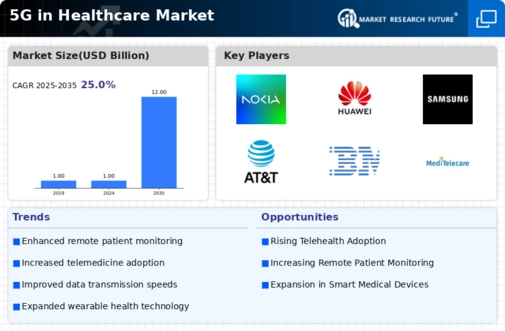
As per MRFR analysis, the 5G in Healthcare Market was estimated at 32.58 USD Billion in 2024. The 5G in Healthcare industry is projected to grow from 41.8 USD Billion in 2025 to 505.27 USD Billion by 2035, exhibiting a compound annual growth rate (CAGR) of 28.3 during the forecast period 2025 - 2035.

Key Market Trends & Highlights

The 5G in Healthcare Market is poised for substantial growth, driven by technological advancements and evolving healthcare needs.

  • Telemedicine capabilities are enhanced through 5G, facilitating more effective remote consultations in North America. Real-time data transmission is becoming increasingly vital, particularly in the Asia-Pacific region, where healthcare demands are rapidly evolving. The integration of AI and IoT technologies is transforming patient care, especially in the telemedicine segment, which remains the largest market segment. Enhanced patient monitoring and improved emergency response are key drivers propelling the growth of remote patient monitoring in homecare settings.

Market Size & Forecast

2024 Market Size 32.58 (USD Billion)
2035 Market Size 505.27 (USD Billion)
CAGR (2025 - 2035) 28.3%
Largest Regional Market Share in 2024 North America

Major Players

<p>Verizon (US), AT&amp;T (US), Huawei (CN), Nokia (FI), Ericsson (SE), Samsung (KR), Qualcomm (US), Cisco (US), ZTE (CN)</p>

Market Trends

The 5G in Healthcare Market is currently experiencing a transformative phase, driven by advancements in technology and the increasing demand for efficient healthcare solutions. The integration of 5G technology into healthcare systems appears to enhance connectivity, enabling real-time data transmission and improved patient monitoring. This shift is likely to facilitate telemedicine, remote surgeries, and the use of wearable devices, which may lead to better patient outcomes and streamlined operations within healthcare facilities. Furthermore, the potential for enhanced data analytics and artificial intelligence applications suggests that healthcare providers could leverage these innovations to make more informed decisions, ultimately improving the quality of care. Moreover, the ongoing development of smart hospitals and connected medical devices indicates a growing trend towards digitization in the healthcare sector. As healthcare organizations adopt 5G technology, they may find opportunities to optimize resource allocation and reduce operational costs. The collaboration between technology companies and healthcare providers seems to be fostering an environment ripe for innovation, which could redefine patient experiences and operational efficiencies. Overall, the 5G in Healthcare Market is poised for substantial growth, driven by the need for advanced solutions that address the complexities of modern healthcare delivery.

Enhanced Telemedicine Capabilities

The advent of 5G technology is likely to revolutionize telemedicine by providing high-speed connectivity. This enhancement may facilitate seamless video consultations, remote diagnostics, and virtual health monitoring, thereby improving access to healthcare services for patients in remote areas.

Real-Time Data Transmission

5G technology appears to enable real-time data transmission, which could significantly enhance patient monitoring and management. This capability may allow healthcare professionals to receive instant updates on patient conditions, leading to timely interventions and improved health outcomes.

Integration of AI and IoT

The integration of artificial intelligence and the Internet of Things within the 5G in Healthcare Market suggests a future where smart devices can communicate effectively. This interconnectedness may lead to more personalized treatment plans and efficient healthcare delivery.

5G in Healthcare Market Market Drivers

Telehealth Expansion

The 5G in Healthcare Market is experiencing a notable expansion in telehealth services. The high-speed connectivity provided by 5G technology enables healthcare providers to offer virtual consultations with minimal latency, enhancing the quality of care delivered remotely. This is particularly beneficial for patients in rural or underserved areas, where access to healthcare services may be limited. Recent data suggests that telehealth usage has increased by over 50% in various regions, highlighting the growing acceptance of remote healthcare solutions. The ability to conduct high-definition video consultations and share medical data instantaneously is transforming the patient-provider relationship. As telehealth continues to gain traction, the 5G in Healthcare Market is likely to see substantial growth, driven by both patient demand and provider capabilities.

Data-Driven Decision Making

The 5G in Healthcare Market is increasingly influenced by the shift towards data-driven decision making. With the enhanced data transmission capabilities of 5G, healthcare organizations can collect and analyze vast amounts of patient data in real-time. This facilitates more informed clinical decisions and personalized treatment plans, ultimately improving patient outcomes. The integration of advanced analytics and machine learning with 5G technology allows for predictive modeling and trend analysis, which can lead to proactive healthcare interventions. Market analysts project that the healthcare analytics market will reach USD 50 billion by 2027, driven by the need for actionable insights. As healthcare providers embrace data-driven strategies, the 5G in Healthcare Market is expected to flourish, fostering innovation and efficiency.

Enhanced Patient Monitoring

The 5G in Healthcare Market is witnessing a surge in demand for enhanced patient monitoring solutions. With the advent of 5G technology, healthcare providers can utilize real-time data transmission to monitor patients remotely, ensuring timely interventions. This capability is particularly crucial for chronic disease management, where continuous monitoring can lead to improved patient outcomes. According to recent estimates, the market for remote patient monitoring devices is projected to reach USD 2.5 billion by 2026, driven by the need for efficient healthcare delivery. The integration of 5G technology allows for high-definition video consultations and seamless data sharing, which enhances the overall patient experience. As healthcare systems increasingly adopt these technologies, the 5G in Healthcare Market is likely to expand significantly, offering new opportunities for innovation and improved healthcare services.

Improved Emergency Response

The 5G in Healthcare Market is poised to revolutionize emergency response systems. The ultra-reliable low-latency communication (URLLC) capabilities of 5G technology enable first responders to access critical patient data in real-time, facilitating quicker decision-making during emergencies. This is particularly vital in situations where every second counts, such as in trauma cases or cardiac arrests. Studies indicate that the implementation of 5G in emergency medical services could reduce response times by up to 30%, potentially saving lives. Furthermore, the ability to transmit high-quality video feeds from the scene to hospitals allows for better preparedness and resource allocation. As healthcare organizations recognize the potential of 5G to enhance emergency response, investments in this area are expected to grow, further driving the 5G in Healthcare Market.

Enhanced Connectivity for Medical Devices

The 5G in Healthcare Market is benefiting from enhanced connectivity for medical devices. The ability of 5G technology to support a vast number of connected devices simultaneously allows for the seamless integration of various medical equipment within healthcare facilities. This connectivity is crucial for the Internet of Medical Things (IoMT), where devices such as wearables, diagnostic tools, and imaging systems communicate in real-time. The market for IoMT is projected to grow significantly, with estimates suggesting it could reach USD 100 billion by 2025. Enhanced connectivity not only improves operational efficiency but also enables better patient monitoring and data collection. As healthcare providers increasingly adopt connected medical devices, the 5G in Healthcare Market is likely to expand, paving the way for innovative healthcare solutions.

Market Segment Insights

By Application: Telemedicine (Largest) vs. Remote Patient Monitoring (Fastest-Growing)

<p>In the 5G in Healthcare Market, Telemedicine currently emerges as the largest segment, significantly influencing the overall growth of the industry. It facilitates remote consultations and diagnostics, capturing a substantial share of the market. On the other hand, Remote Patient Monitoring is rapidly gaining traction, driven by the increasing need for continuous patient care and the efficiency that 5G technology provides. Both segments are pivotal, yet they showcase different trajectories within the healthcare landscape. The growth trend for Telemedicine is bolstered by a shift toward virtual care and patient convenience, ensuring it remains a staple in the healthcare system. Meanwhile, Remote Patient Monitoring, which relies on real-time data transfers, is expanding due to technological advancements and rising consumer awareness. Consequently, healthcare providers are recognizing the potential of these applications to improve patient outcomes and optimize operational efficiencies.</p>

<p>Telemedicine (Dominant) vs. Health Analytics (Emerging)</p>

<p>Telemedicine stands out as the dominant player in applications leveraging 5G technology, transforming healthcare delivery through virtual consultations and remote diagnostics. Its robust infrastructure and established adoption framework position it as a reliable choice among healthcare providers. Conversely, Health Analytics represents an emerging segment, harnessing the power of data analysis to derive insights from patient data. Despite being newer, this segment is rapidly evolving, propelled by the integration of Artificial Intelligence and machine learning for predictive analytics. As healthcare systems increasingly rely on data-driven decision-making, Health Analytics is anticipated to grow swiftly, complementing existing telemedicine services by offering enhanced treatment plans and optimizing patient care.</p>

By End Use: Hospitals (Largest) vs. Homecare (Fastest-Growing)

<p>The 5G in Healthcare Market exhibits a diverse segment distribution, with hospitals holding the largest share due to their extensive infrastructure and the need for advanced medical technologies. Clinics emerged as another significant segment, leveraging 5G for improved connectivity and patient management systems. Homecare is witnessing rapid adoption, primarily driven by the increasing preference for remote health services and telemedicine, which has enabled patients to receive care in the comfort of their homes. Other segments, such as Emergency Medical Services and Pharmaceuticals, also contribute to the market but remain smaller in size compared to hospitals and clinics. Growth trends in this sector indicate that while hospitals continue to invest heavily in 5G technology for enhanced operational efficiency, homecare stands out as the fastest-growing segment. This growth is largely influenced by an aging population, the rising incidence of chronic diseases, and advancements in telehealth solutions, which make remote patient monitoring viable and effective. Furthermore, the regulatory push towards integrated healthcare services supports the rapid emergence of solutions tailored for homecare, ensuring patients received timely and efficient care wherever they are.</p>

<p>Clinics: Emerging vs. Hospitals: Dominant</p>

<p>In the 5G in Healthcare Market, hospitals are clearly the dominant players, utilizing advanced technologies to streamline operations and enhance patient care. Their robust infrastructure allows for seamless integration of 5G applications, leading to improved surgical outcomes, better data management, and efficient emergency response systems. Conversely, clinics are characterized as an emerging segment, rapidly adapting to technological advancements. They capitalize on 5G to enhance patient interaction and streamline appointment scheduling, thereby improving the patient experience. The shift toward outpatient services has also seen clinics increasingly investing in digital tools powered by 5G, setting the stage for their potential growth. Both segments are witnessing transformative changes, yet they function distinctly within the healthcare ecosystem.</p>

By Connectivity Type: Enhanced Mobile Broadband (Largest) vs. Ultra-Reliable Low Latency Communications (Fastest-Growing)

<p>In the 5G in Healthcare Market, Enhanced Mobile Broadband (eMBB) leads the segment significantly, catering to healthcare applications requiring high data rates, such as telemedicine and high-definition remote surgeries. This connectivity type is crucial as more healthcare institutions adopt digital tools to facilitate better patient outcomes, ensuring extensive use cases and a larger market share compared to its counterparts. Ultra-Reliable Low Latency Communications (URLLC) is gaining rapid momentum, especially in real-time healthcare applications like remote surgery and patient monitoring systems. This segment's growth is driven by an increasing demand for dependable connections that require minimal latency, particularly benefiting medical procedures needing precise, real-time data transmission, which enhances the overall efficiency and effectiveness of healthcare services.</p>

<p>Connectivity: eMBB (Dominant) vs. URLLC (Emerging)</p>

<p>The Enhanced Mobile Broadband (eMBB) segment is characterized by its capability to support high-quality video conferencing, quick data transfers, and enhanced mobile services in healthcare settings. This connectivity type is essential for applications such as telehealth, remote patient monitoring, and data-heavy imaging services. As healthcare systems increasingly integrate digital solutions, eMBB has solidified its position as the dominant force in the market, providing extensive network coverage and higher throughput. In contrast, Ultra-Reliable Low Latency Communications (URLLC) is emerging due to its focus on applications requiring minimal latency, ensuring essential communications for critical situations, like remote surgeries and real-time diagnostics. This growing need for speed and reliability in healthcare technology sets the stage for URLLC’s expansion, particularly in environments where every millisecond matters.</p>

By Component: Software (Largest) vs. Hardware (Fastest-Growing)

<p>In the 5G in Healthcare Market, the component segment is primarily dominated by software solutions, which constitute the largest share. Software applications, particularly those enhancing telemedicine, remote patient monitoring, and medical imaging, play a crucial role in facilitating seamless communication and efficient data management. Hardware, while following as a secondary segment, is witnessing a rapid expansion as healthcare providers invest in advanced medical devices capable of utilizing 5G technology for improved performance and connectivity. The growth trends in this segment are largely driven by the increasing demand for real-time data transfer and enhanced connectivity within healthcare systems. As healthcare institutions adopt 5G technology to enhance patient care and operational efficiency, investment in both software and hardware is expected to surge. Key drivers include the rising prevalence of telehealth services, smart medical devices, and the need for comprehensive digital health solutions that can cope with the heightened data transmission requirements of 5G networks.</p>

<p>Software (Dominant) vs. Hardware (Emerging)</p>

<p>The software component within the 5G in Healthcare Market is characterized as dominant due to its vast range of applications, including AI-driven clinical decision support systems, real-time patient monitoring, and advanced data analytics platforms. Software solutions help healthcare professionals make informed decisions, improve patient outcomes, and streamline workflows. As telehealth and remote monitoring gain traction, these software platforms are seen as essential for operational success. In contrast, the hardware segment is emerging, marked by investments in 5G-compatible medical devices, such as wearable health monitors and high-speed diagnostic imaging equipment. As healthcare providers modernize their infrastructure to leverage 5G capabilities, the demand for these innovative hardware solutions continues to rise, poised to take on a significant role in transforming health services.</p>

Get more detailed insights about 5G in Healthcare Market Research Report—Global Forecast till 2035

Regional Insights

North America : Innovation and Leadership Hub

North America is poised to dominate the 5G in healthcare market, holding approximately 45% of the global share. The region's growth is driven by increasing demand for telehealth services, remote patient monitoring, and advanced medical imaging. Regulatory support from agencies like the FCC, which promotes 5G deployment, further catalyzes this growth. The U.S. government is actively investing in 5G infrastructure, enhancing connectivity in healthcare facilities. The United States leads the market, with significant contributions from companies like Verizon and AT&T, which are at the forefront of 5G technology. Canada is also emerging as a key player, focusing on integrating 5G into healthcare systems. The competitive landscape is characterized by partnerships between telecom providers and healthcare organizations, aiming to leverage 5G for improved patient outcomes and operational efficiency.

Europe : Regulatory Support and Growth

Europe is rapidly advancing in the 5G healthcare market, holding around 30% of the global share. The region benefits from strong regulatory frameworks that encourage innovation in digital health solutions. The European Commission's initiatives, such as the Digital Single Market strategy, aim to enhance connectivity and promote the use of 5G in healthcare settings. This regulatory support is crucial for driving investments and fostering collaboration among stakeholders. Leading countries include Germany, France, and the UK, which are investing heavily in 5G infrastructure for healthcare applications. The competitive landscape features major players like Nokia and Ericsson, who are collaborating with healthcare providers to implement 5G solutions. These partnerships are essential for developing smart hospitals and enhancing telemedicine services, ultimately improving patient care and operational efficiency.

Asia-Pacific : Emerging Powerhouse in Healthcare

Asia-Pacific is emerging as a significant player in the 5G healthcare market, accounting for approximately 20% of the global share. The region's growth is fueled by increasing investments in healthcare infrastructure and a rising demand for telehealth services. Countries like China and Japan are leading the charge, with government initiatives aimed at promoting 5G technology in healthcare. Regulatory bodies are actively working to create a conducive environment for 5G deployment, which is essential for enhancing healthcare delivery. China is the largest market in the region, with companies like Huawei and ZTE driving innovation in 5G technology. Japan follows closely, focusing on integrating 5G into its advanced healthcare systems. The competitive landscape is characterized by collaborations between telecom operators and healthcare providers, aiming to leverage 5G for improved patient outcomes and operational efficiency. This synergy is crucial for the region's healthcare transformation.

Middle East and Africa : Resource-Rich Frontier for Innovation

The Middle East and Africa are gradually adopting 5G technology in healthcare, holding about 5% of the global market share. The region's growth is driven by increasing investments in healthcare infrastructure and a rising demand for digital health solutions. Governments are recognizing the potential of 5G to enhance healthcare delivery, with initiatives aimed at improving connectivity in remote areas. Regulatory support is crucial for fostering innovation and attracting investments in this sector. Leading countries include South Africa and the UAE, which are making significant strides in implementing 5G technology in healthcare. The competitive landscape features partnerships between telecom providers and healthcare organizations, focusing on telemedicine and remote patient monitoring. These collaborations are essential for addressing healthcare challenges in the region and improving access to quality care for underserved populations.

Key Players and Competitive Insights

The 5G in Healthcare Market is currently characterized by a dynamic competitive landscape, driven by rapid technological advancements and an increasing demand for enhanced connectivity in healthcare settings. Key players such as Verizon (US), AT&T (US), and Huawei (CN) are strategically positioning themselves to capitalize on this growth. Verizon (US) focuses on expanding its 5G network capabilities, particularly in urban healthcare facilities, while AT&T (US) emphasizes partnerships with healthcare providers to develop tailored solutions. Huawei (CN) is leveraging its extensive experience in telecommunications to offer integrated 5G solutions that enhance telemedicine and remote patient monitoring. Collectively, these strategies indicate a trend towards collaboration and innovation, shaping a competitive environment that prioritizes advanced technological integration in healthcare.

In terms of business tactics, companies are increasingly localizing manufacturing and optimizing supply chains to enhance operational efficiency. The market structure appears moderately fragmented, with several key players exerting influence over specific segments. This fragmentation allows for niche players to emerge, yet the collective strength of major companies like Nokia (FI) and Ericsson (SE) ensures that they maintain a significant presence in the market. Their focus on developing robust 5G infrastructure solutions further solidifies their competitive edge.

In August 2025, Verizon (US) announced a partnership with a leading telehealth provider to enhance remote patient monitoring capabilities through its 5G network. This strategic move is likely to improve patient outcomes by enabling real-time data transmission and analysis, thereby facilitating timely medical interventions. Such initiatives not only bolster Verizon's market position but also reflect a broader trend towards integrating advanced connectivity solutions in healthcare.

Similarly, in September 2025, AT&T (US) launched a new initiative aimed at providing 5G-enabled smart hospital solutions, which include IoT devices for patient management. This initiative underscores AT&T's commitment to digital transformation in healthcare, potentially leading to improved operational efficiencies and patient care. The strategic importance of this move lies in its ability to create a more interconnected healthcare ecosystem, which is essential for future growth.

In October 2025, Huawei (CN) unveiled a new 5G healthcare platform designed to support telemedicine and remote diagnostics. This platform is expected to enhance the capabilities of healthcare providers by offering seamless connectivity and data management solutions. The introduction of such technology indicates Huawei's intent to solidify its position as a leader in the 5G healthcare space, particularly in regions where telehealth is gaining traction.

As of October 2025, current competitive trends in the 5G in Healthcare Market are increasingly defined by digitalization, sustainability, and the integration of artificial intelligence. Strategic alliances among key players are shaping the landscape, fostering innovation and collaboration. Looking ahead, it appears that competitive differentiation will evolve from traditional price-based competition to a focus on technological innovation, supply chain reliability, and the ability to deliver comprehensive healthcare solutions. This shift may ultimately redefine how companies engage with healthcare providers and patients alike.

Key Companies in the 5G in Healthcare Market market include

Industry Developments

In September 2023, Nokia introduced its Network as Code 5G application platform in collaboration with Google Cloud, with the objective of enhancing telehealth infrastructure and improving patient outcome efficiency.

Huawei has introduced a range of 4K+5G-enabled remote medical solutions, facilitating teleconsultation, digital ward rounds, patient monitoring, and connectivity for emergency command centers.  In August 2024, Samsung introduced the Galaxy A15 5G Healthcare Edition, a device paired with Knox-secure software designed for remote patient monitoring within healthcare device fleets. 

On April 1, 2024, GE Healthcare completed its acquisition of MIM Software, thereby augmenting its medical imaging capabilities with AI-driven analytics. Verily Life Sciences has advanced in health data platforms; however, there are no public disclosures linking these platforms to 5G deployment.  The overall market is experiencing growth, driven by significant investments from IBM, Cisco, Ericsson, Qualcomm, and other entities in secure 5G healthcare infrastructure.

Future Outlook

5G in Healthcare Market Future Outlook

<p>The 5G in Healthcare Market is projected to grow at a 28.3% CAGR from 2024 to 2035, driven by advancements in telemedicine, remote monitoring, and enhanced data analytics capabilities.</p>

New opportunities lie in:

  • <p>Development of AI-driven telehealth platforms</p><p>Integration of 5G-enabled wearable health devices</p><p>Creation of virtual reality training programs for medical professionals</p>

<p>By 2035, the market is expected to be robust, driven by innovative technologies and increased healthcare connectivity.</p>

Market Segmentation

5G in Healthcare Market End Use Outlook

  • Hospitals
  • Clinics
  • Homecare
  • Emergency Medical Services
  • Pharmaceuticals

5G in Healthcare Market Component Outlook

  • Hardware
  • Software
  • Services

5G in Healthcare Market Application Outlook

  • Telemedicine
  • Remote Patient Monitoring
  • Robotic Surgery
  • Augmented Reality
  • Health Analytics

5G in Healthcare Market Connectivity Type Outlook

  • Enhanced Mobile Broadband
  • Ultra-Reliable Low Latency Communications
  • Massive Machine Type Communications

Report Scope

MARKET SIZE 202432.58(USD Billion)
MARKET SIZE 202541.8(USD Billion)
MARKET SIZE 2035505.27(USD Billion)
COMPOUND ANNUAL GROWTH RATE (CAGR)28.3% (2024 - 2035)
REPORT COVERAGERevenue Forecast, Competitive Landscape, Growth Factors, and Trends
BASE YEAR2024
Market Forecast Period2025 - 2035
Historical Data2019 - 2024
Market Forecast UnitsUSD Billion
Key Companies ProfiledMarket analysis in progress
Segments CoveredMarket segmentation analysis in progress
Key Market OpportunitiesIntegration of remote patient monitoring and telemedicine through enhanced connectivity in the 5G in Healthcare Market.
Key Market DynamicsRapid advancements in 5G technology are transforming telemedicine and remote patient monitoring capabilities in healthcare.
Countries CoveredNorth America, Europe, APAC, South America, MEA

FAQs

What is the projected market valuation for the 5G in Healthcare Market by 2035?

The projected market valuation for the 5G in Healthcare Market by 2035 is 505.27 USD Billion.

What was the market valuation for the 5G in Healthcare Market in 2024?

The market valuation for the 5G in Healthcare Market in 2024 was 32.58 USD Billion.

What is the expected CAGR for the 5G in Healthcare Market during the forecast period 2025 - 2035?

The expected CAGR for the 5G in Healthcare Market during the forecast period 2025 - 2035 is 28.3%.

Which application segment is projected to have the highest valuation in 2035?

The Telemedicine application segment is projected to reach 120.0 USD Billion by 2035.

What is the projected valuation for Remote Patient Monitoring by 2035?

The projected valuation for Remote Patient Monitoring by 2035 is 110.0 USD Billion.

Which connectivity type is expected to dominate the market by 2035?

Ultra-Reliable Low Latency Communications is expected to dominate the market with a valuation of 200.0 USD Billion by 2035.

What is the anticipated valuation for the Hardware component in 2035?

The anticipated valuation for the Hardware component in 2035 is 120.0 USD Billion.

Which end-use segment is projected to have the highest growth by 2035?

The Hospitals end-use segment is projected to grow to 160.0 USD Billion by 2035.

What role do key players like Verizon and AT&T play in the 5G in Healthcare Market?

Key players like Verizon and AT&T are instrumental in driving innovation and infrastructure development within the 5G in Healthcare Market.

What is the projected valuation for the Services component by 2035?

The projected valuation for the Services component by 2035 is 205.27 USD Billion.

  1. SECTION I: EXECUTIVE SUMMARY AND KEY HIGHLIGHTS
    1. EXECUTIVE SUMMARY
      1. Market Overview
      2. Key Findings
      3. Market Segmentation
      4. Competitive Landscape
      5. Challenges and Opportunities
      6. Future Outlook
  2. SECTION II: SCOPING, METHODOLOGY AND MARKET STRUCTURE
    1. MARKET INTRODUCTION
      1. Definition
      2. Scope of the study
    2. RESEARCH METHODOLOGY
      1. Overview
      2. Data Mining
      3. Secondary Research
      4. Primary Research
      5. Forecasting Model
      6. Market Size Estimation
      7. Data Triangulation
      8. Validation
  3. SECTION III: QUALITATIVE ANALYSIS
    1. MARKET DYNAMICS
      1. Overview
      2. Drivers
      3. Restraints
      4. Opportunities
    2. MARKET FACTOR ANALYSIS
      1. Value chain Analysis
      2. Porter's Five Forces Analysis
      3. COVID-19 Impact Analysis
  4. SECTION IV: QUANTITATIVE ANALYSIS
    1. Healthcare, BY Application (USD Billion)
      1. Telemedicine
      2. Remote Patient Monitoring
      3. Robotic Surgery
      4. Augmented Reality
      5. Health Analytics
    2. Healthcare, BY End Use (USD Billion)
      1. Hospitals
      2. Clinics
      3. Homecare
      4. Emergency Medical Services
      5. Pharmaceuticals
    3. Healthcare, BY Connectivity Type (USD Billion)
      1. Enhanced Mobile Broadband
      2. Ultra-Reliable Low Latency Communications
      3. Massive Machine Type Communications
    4. Healthcare, BY Component (USD Billion)
      1. Hardware
      2. Software
      3. Services
    5. Healthcare, BY Region (USD Billion)
      1. North America
      2. Europe
      3. APAC
      4. South America
      5. MEA
  5. SECTION V: COMPETITIVE ANALYSIS
    1. Competitive Landscape
      1. Overview
      2. Competitive Analysis
      3. Market share Analysis
      4. Major Growth Strategy in the Healthcare
      5. Competitive Benchmarking
      6. Leading Players in Terms of Number of Developments in the Healthcare
      7. Key developments and growth strategies
      8. Major Players Financial Matrix
    2. Company Profiles
      1. Verizon (US)
      2. AT&T (US)
      3. Huawei (CN)
      4. Nokia (FI)
      5. Ericsson (SE)
      6. Samsung (KR)
      7. Qualcomm (US)
      8. Cisco (US)
      9. ZTE (CN)
    3. Appendix
      1. References
      2. Related Reports
  6. LIST OF FIGURES
    1. MARKET SYNOPSIS
    2. NORTH AMERICA MARKET ANALYSIS
    3. US MARKET ANALYSIS BY APPLICATION
    4. US MARKET ANALYSIS BY END USE
    5. US MARKET ANALYSIS BY CONNECTIVITY TYPE
    6. US MARKET ANALYSIS BY COMPONENT
    7. CANADA MARKET ANALYSIS BY APPLICATION
    8. CANADA MARKET ANALYSIS BY END USE
    9. CANADA MARKET ANALYSIS BY CONNECTIVITY TYPE
    10. CANADA MARKET ANALYSIS BY COMPONENT
    11. EUROPE MARKET ANALYSIS
    12. GERMANY MARKET ANALYSIS BY APPLICATION
    13. GERMANY MARKET ANALYSIS BY END USE
    14. GERMANY MARKET ANALYSIS BY CONNECTIVITY TYPE
    15. GERMANY MARKET ANALYSIS BY COMPONENT
    16. UK MARKET ANALYSIS BY APPLICATION
    17. UK MARKET ANALYSIS BY END USE
    18. UK MARKET ANALYSIS BY CONNECTIVITY TYPE
    19. UK MARKET ANALYSIS BY COMPONENT
    20. FRANCE MARKET ANALYSIS BY APPLICATION
    21. FRANCE MARKET ANALYSIS BY END USE
    22. FRANCE MARKET ANALYSIS BY CONNECTIVITY TYPE
    23. FRANCE MARKET ANALYSIS BY COMPONENT
    24. RUSSIA MARKET ANALYSIS BY APPLICATION
    25. RUSSIA MARKET ANALYSIS BY END USE
    26. RUSSIA MARKET ANALYSIS BY CONNECTIVITY TYPE
    27. RUSSIA MARKET ANALYSIS BY COMPONENT
    28. ITALY MARKET ANALYSIS BY APPLICATION
    29. ITALY MARKET ANALYSIS BY END USE
    30. ITALY MARKET ANALYSIS BY CONNECTIVITY TYPE
    31. ITALY MARKET ANALYSIS BY COMPONENT
    32. SPAIN MARKET ANALYSIS BY APPLICATION
    33. SPAIN MARKET ANALYSIS BY END USE
    34. SPAIN MARKET ANALYSIS BY CONNECTIVITY TYPE
    35. SPAIN MARKET ANALYSIS BY COMPONENT
    36. REST OF EUROPE MARKET ANALYSIS BY APPLICATION
    37. REST OF EUROPE MARKET ANALYSIS BY END USE
    38. REST OF EUROPE MARKET ANALYSIS BY CONNECTIVITY TYPE
    39. REST OF EUROPE MARKET ANALYSIS BY COMPONENT
    40. APAC MARKET ANALYSIS
    41. CHINA MARKET ANALYSIS BY APPLICATION
    42. CHINA MARKET ANALYSIS BY END USE
    43. CHINA MARKET ANALYSIS BY CONNECTIVITY TYPE
    44. CHINA MARKET ANALYSIS BY COMPONENT
    45. INDIA MARKET ANALYSIS BY APPLICATION
    46. INDIA MARKET ANALYSIS BY END USE
    47. INDIA MARKET ANALYSIS BY CONNECTIVITY TYPE
    48. INDIA MARKET ANALYSIS BY COMPONENT
    49. JAPAN MARKET ANALYSIS BY APPLICATION
    50. JAPAN MARKET ANALYSIS BY END USE
    51. JAPAN MARKET ANALYSIS BY CONNECTIVITY TYPE
    52. JAPAN MARKET ANALYSIS BY COMPONENT
    53. SOUTH KOREA MARKET ANALYSIS BY APPLICATION
    54. SOUTH KOREA MARKET ANALYSIS BY END USE
    55. SOUTH KOREA MARKET ANALYSIS BY CONNECTIVITY TYPE
    56. SOUTH KOREA MARKET ANALYSIS BY COMPONENT
    57. MALAYSIA MARKET ANALYSIS BY APPLICATION
    58. MALAYSIA MARKET ANALYSIS BY END USE
    59. MALAYSIA MARKET ANALYSIS BY CONNECTIVITY TYPE
    60. MALAYSIA MARKET ANALYSIS BY COMPONENT
    61. THAILAND MARKET ANALYSIS BY APPLICATION
    62. THAILAND MARKET ANALYSIS BY END USE
    63. THAILAND MARKET ANALYSIS BY CONNECTIVITY TYPE
    64. THAILAND MARKET ANALYSIS BY COMPONENT
    65. INDONESIA MARKET ANALYSIS BY APPLICATION
    66. INDONESIA MARKET ANALYSIS BY END USE
    67. INDONESIA MARKET ANALYSIS BY CONNECTIVITY TYPE
    68. INDONESIA MARKET ANALYSIS BY COMPONENT
    69. REST OF APAC MARKET ANALYSIS BY APPLICATION
    70. REST OF APAC MARKET ANALYSIS BY END USE
    71. REST OF APAC MARKET ANALYSIS BY CONNECTIVITY TYPE
    72. REST OF APAC MARKET ANALYSIS BY COMPONENT
    73. SOUTH AMERICA MARKET ANALYSIS
    74. BRAZIL MARKET ANALYSIS BY APPLICATION
    75. BRAZIL MARKET ANALYSIS BY END USE
    76. BRAZIL MARKET ANALYSIS BY CONNECTIVITY TYPE
    77. BRAZIL MARKET ANALYSIS BY COMPONENT
    78. MEXICO MARKET ANALYSIS BY APPLICATION
    79. MEXICO MARKET ANALYSIS BY END USE
    80. MEXICO MARKET ANALYSIS BY CONNECTIVITY TYPE
    81. MEXICO MARKET ANALYSIS BY COMPONENT
    82. ARGENTINA MARKET ANALYSIS BY APPLICATION
    83. ARGENTINA MARKET ANALYSIS BY END USE
    84. ARGENTINA MARKET ANALYSIS BY CONNECTIVITY TYPE
    85. ARGENTINA MARKET ANALYSIS BY COMPONENT
    86. REST OF SOUTH AMERICA MARKET ANALYSIS BY APPLICATION
    87. REST OF SOUTH AMERICA MARKET ANALYSIS BY END USE
    88. REST OF SOUTH AMERICA MARKET ANALYSIS BY CONNECTIVITY TYPE
    89. REST OF SOUTH AMERICA MARKET ANALYSIS BY COMPONENT
    90. MEA MARKET ANALYSIS
    91. GCC COUNTRIES MARKET ANALYSIS BY APPLICATION
    92. GCC COUNTRIES MARKET ANALYSIS BY END USE
    93. GCC COUNTRIES MARKET ANALYSIS BY CONNECTIVITY TYPE
    94. GCC COUNTRIES MARKET ANALYSIS BY COMPONENT
    95. SOUTH AFRICA MARKET ANALYSIS BY APPLICATION
    96. SOUTH AFRICA MARKET ANALYSIS BY END USE
    97. SOUTH AFRICA MARKET ANALYSIS BY CONNECTIVITY TYPE
    98. SOUTH AFRICA MARKET ANALYSIS BY COMPONENT
    99. REST OF MEA MARKET ANALYSIS BY APPLICATION
    100. REST OF MEA MARKET ANALYSIS BY END USE
    101. REST OF MEA MARKET ANALYSIS BY CONNECTIVITY TYPE
    102. REST OF MEA MARKET ANALYSIS BY COMPONENT
    103. KEY BUYING CRITERIA OF HEALTHCARE
    104. RESEARCH PROCESS OF MRFR
    105. DRO ANALYSIS OF HEALTHCARE
    106. DRIVERS IMPACT ANALYSIS: HEALTHCARE
    107. RESTRAINTS IMPACT ANALYSIS: HEALTHCARE
    108. SUPPLY / VALUE CHAIN: HEALTHCARE
    109. HEALTHCARE, BY APPLICATION, 2024 (% SHARE)
    110. HEALTHCARE, BY APPLICATION, 2024 TO 2035 (USD Billion)
    111. HEALTHCARE, BY END USE, 2024 (% SHARE)
    112. HEALTHCARE, BY END USE, 2024 TO 2035 (USD Billion)
    113. HEALTHCARE, BY CONNECTIVITY TYPE, 2024 (% SHARE)
    114. HEALTHCARE, BY CONNECTIVITY TYPE, 2024 TO 2035 (USD Billion)
    115. HEALTHCARE, BY COMPONENT, 2024 (% SHARE)
    116. HEALTHCARE, BY COMPONENT, 2024 TO 2035 (USD Billion)
    117. BENCHMARKING OF MAJOR COMPETITORS
  7. LIST OF TABLES
    1. LIST OF ASSUMPTIONS
    2. North America MARKET SIZE ESTIMATES; FORECAST
      1. BY APPLICATION, 2025-2035 (USD Billion)
      2. BY END USE, 2025-2035 (USD Billion)
      3. BY CONNECTIVITY TYPE, 2025-2035 (USD Billion)
      4. BY COMPONENT, 2025-2035 (USD Billion)
    3. US MARKET SIZE ESTIMATES; FORECAST
      1. BY APPLICATION, 2025-2035 (USD Billion)
      2. BY END USE, 2025-2035 (USD Billion)
      3. BY CONNECTIVITY TYPE, 2025-2035 (USD Billion)
      4. BY COMPONENT, 2025-2035 (USD Billion)
    4. Canada MARKET SIZE ESTIMATES; FORECAST
      1. BY APPLICATION, 2025-2035 (USD Billion)
      2. BY END USE, 2025-2035 (USD Billion)
      3. BY CONNECTIVITY TYPE, 2025-2035 (USD Billion)
      4. BY COMPONENT, 2025-2035 (USD Billion)
    5. Europe MARKET SIZE ESTIMATES; FORECAST
      1. BY APPLICATION, 2025-2035 (USD Billion)
      2. BY END USE, 2025-2035 (USD Billion)
      3. BY CONNECTIVITY TYPE, 2025-2035 (USD Billion)
      4. BY COMPONENT, 2025-2035 (USD Billion)
    6. Germany MARKET SIZE ESTIMATES; FORECAST
      1. BY APPLICATION, 2025-2035 (USD Billion)
      2. BY END USE, 2025-2035 (USD Billion)
      3. BY CONNECTIVITY TYPE, 2025-2035 (USD Billion)
      4. BY COMPONENT, 2025-2035 (USD Billion)
    7. UK MARKET SIZE ESTIMATES; FORECAST
      1. BY APPLICATION, 2025-2035 (USD Billion)
      2. BY END USE, 2025-2035 (USD Billion)
      3. BY CONNECTIVITY TYPE, 2025-2035 (USD Billion)
      4. BY COMPONENT, 2025-2035 (USD Billion)
    8. France MARKET SIZE ESTIMATES; FORECAST
      1. BY APPLICATION, 2025-2035 (USD Billion)
      2. BY END USE, 2025-2035 (USD Billion)
      3. BY CONNECTIVITY TYPE, 2025-2035 (USD Billion)
      4. BY COMPONENT, 2025-2035 (USD Billion)
    9. Russia MARKET SIZE ESTIMATES; FORECAST
      1. BY APPLICATION, 2025-2035 (USD Billion)
      2. BY END USE, 2025-2035 (USD Billion)
      3. BY CONNECTIVITY TYPE, 2025-2035 (USD Billion)
      4. BY COMPONENT, 2025-2035 (USD Billion)
    10. Italy MARKET SIZE ESTIMATES; FORECAST
      1. BY APPLICATION, 2025-2035 (USD Billion)
      2. BY END USE, 2025-2035 (USD Billion)
      3. BY CONNECTIVITY TYPE, 2025-2035 (USD Billion)
      4. BY COMPONENT, 2025-2035 (USD Billion)
    11. Spain MARKET SIZE ESTIMATES; FORECAST
      1. BY APPLICATION, 2025-2035 (USD Billion)
      2. BY END USE, 2025-2035 (USD Billion)
      3. BY CONNECTIVITY TYPE, 2025-2035 (USD Billion)
      4. BY COMPONENT, 2025-2035 (USD Billion)
    12. Rest of Europe MARKET SIZE ESTIMATES; FORECAST
      1. BY APPLICATION, 2025-2035 (USD Billion)
      2. BY END USE, 2025-2035 (USD Billion)
      3. BY CONNECTIVITY TYPE, 2025-2035 (USD Billion)
      4. BY COMPONENT, 2025-2035 (USD Billion)
    13. APAC MARKET SIZE ESTIMATES; FORECAST
      1. BY APPLICATION, 2025-2035 (USD Billion)
      2. BY END USE, 2025-2035 (USD Billion)
      3. BY CONNECTIVITY TYPE, 2025-2035 (USD Billion)
      4. BY COMPONENT, 2025-2035 (USD Billion)
    14. China MARKET SIZE ESTIMATES; FORECAST
      1. BY APPLICATION, 2025-2035 (USD Billion)
      2. BY END USE, 2025-2035 (USD Billion)
      3. BY CONNECTIVITY TYPE, 2025-2035 (USD Billion)
      4. BY COMPONENT, 2025-2035 (USD Billion)
    15. India MARKET SIZE ESTIMATES; FORECAST
      1. BY APPLICATION, 2025-2035 (USD Billion)
      2. BY END USE, 2025-2035 (USD Billion)
      3. BY CONNECTIVITY TYPE, 2025-2035 (USD Billion)
      4. BY COMPONENT, 2025-2035 (USD Billion)
    16. Japan MARKET SIZE ESTIMATES; FORECAST
      1. BY APPLICATION, 2025-2035 (USD Billion)
      2. BY END USE, 2025-2035 (USD Billion)
      3. BY CONNECTIVITY TYPE, 2025-2035 (USD Billion)
      4. BY COMPONENT, 2025-2035 (USD Billion)
    17. South Korea MARKET SIZE ESTIMATES; FORECAST
      1. BY APPLICATION, 2025-2035 (USD Billion)
      2. BY END USE, 2025-2035 (USD Billion)
      3. BY CONNECTIVITY TYPE, 2025-2035 (USD Billion)
      4. BY COMPONENT, 2025-2035 (USD Billion)
    18. Malaysia MARKET SIZE ESTIMATES; FORECAST
      1. BY APPLICATION, 2025-2035 (USD Billion)
      2. BY END USE, 2025-2035 (USD Billion)
      3. BY CONNECTIVITY TYPE, 2025-2035 (USD Billion)
      4. BY COMPONENT, 2025-2035 (USD Billion)
    19. Thailand MARKET SIZE ESTIMATES; FORECAST
      1. BY APPLICATION, 2025-2035 (USD Billion)
      2. BY END USE, 2025-2035 (USD Billion)
      3. BY CONNECTIVITY TYPE, 2025-2035 (USD Billion)
      4. BY COMPONENT, 2025-2035 (USD Billion)
    20. Indonesia MARKET SIZE ESTIMATES; FORECAST
      1. BY APPLICATION, 2025-2035 (USD Billion)
      2. BY END USE, 2025-2035 (USD Billion)
      3. BY CONNECTIVITY TYPE, 2025-2035 (USD Billion)
      4. BY COMPONENT, 2025-2035 (USD Billion)
    21. Rest of APAC MARKET SIZE ESTIMATES; FORECAST
      1. BY APPLICATION, 2025-2035 (USD Billion)
      2. BY END USE, 2025-2035 (USD Billion)
      3. BY CONNECTIVITY TYPE, 2025-2035 (USD Billion)
      4. BY COMPONENT, 2025-2035 (USD Billion)
    22. South America MARKET SIZE ESTIMATES; FORECAST
      1. BY APPLICATION, 2025-2035 (USD Billion)
      2. BY END USE, 2025-2035 (USD Billion)
      3. BY CONNECTIVITY TYPE, 2025-2035 (USD Billion)
      4. BY COMPONENT, 2025-2035 (USD Billion)
    23. Brazil MARKET SIZE ESTIMATES; FORECAST
      1. BY APPLICATION, 2025-2035 (USD Billion)
      2. BY END USE, 2025-2035 (USD Billion)
      3. BY CONNECTIVITY TYPE, 2025-2035 (USD Billion)
      4. BY COMPONENT, 2025-2035 (USD Billion)
    24. Mexico MARKET SIZE ESTIMATES; FORECAST
      1. BY APPLICATION, 2025-2035 (USD Billion)
      2. BY END USE, 2025-2035 (USD Billion)
      3. BY CONNECTIVITY TYPE, 2025-2035 (USD Billion)
      4. BY COMPONENT, 2025-2035 (USD Billion)
    25. Argentina MARKET SIZE ESTIMATES; FORECAST
      1. BY APPLICATION, 2025-2035 (USD Billion)
      2. BY END USE, 2025-2035 (USD Billion)
      3. BY CONNECTIVITY TYPE, 2025-2035 (USD Billion)
      4. BY COMPONENT, 2025-2035 (USD Billion)
    26. Rest of South America MARKET SIZE ESTIMATES; FORECAST
      1. BY APPLICATION, 2025-2035 (USD Billion)
      2. BY END USE, 2025-2035 (USD Billion)
      3. BY CONNECTIVITY TYPE, 2025-2035 (USD Billion)
      4. BY COMPONENT, 2025-2035 (USD Billion)
    27. MEA MARKET SIZE ESTIMATES; FORECAST
      1. BY APPLICATION, 2025-2035 (USD Billion)
      2. BY END USE, 2025-2035 (USD Billion)
      3. BY CONNECTIVITY TYPE, 2025-2035 (USD Billion)
      4. BY COMPONENT, 2025-2035 (USD Billion)
    28. GCC Countries MARKET SIZE ESTIMATES; FORECAST
      1. BY APPLICATION, 2025-2035 (USD Billion)
      2. BY END USE, 2025-2035 (USD Billion)
      3. BY CONNECTIVITY TYPE, 2025-2035 (USD Billion)
      4. BY COMPONENT, 2025-2035 (USD Billion)
    29. South Africa MARKET SIZE ESTIMATES; FORECAST
      1. BY APPLICATION, 2025-2035 (USD Billion)
      2. BY END USE, 2025-2035 (USD Billion)
      3. BY CONNECTIVITY TYPE, 2025-2035 (USD Billion)
      4. BY COMPONENT, 2025-2035 (USD Billion)
    30. Rest of MEA MARKET SIZE ESTIMATES; FORECAST
      1. BY APPLICATION, 2025-2035 (USD Billion)
      2. BY END USE, 2025-2035 (USD Billion)
      3. BY CONNECTIVITY TYPE, 2025-2035 (USD Billion)
      4. BY COMPONENT, 2025-2035 (USD Billion)
    31. PRODUCT LAUNCH/PRODUCT DEVELOPMENT/APPROVAL
    32. ACQUISITION/PARTNERSHIP

5G in Healthcare Market Segmentation

5G in Healthcare Market By Application (USD Billion, 2019-2035)

Telemedicine

Remote Patient Monitoring

Robotic Surgery

Augmented Reality

Health Analytics

5G in Healthcare Market By End Use (USD Billion, 2019-2035)

Hospitals

Clinics

Homecare

Emergency Medical Services

Pharmaceuticals

5G in Healthcare Market By Connectivity Type (USD Billion, 2019-2035)

Enhanced Mobile Broadband

Ultra-Reliable Low Latency Communications

Massive Machine Type Communications

5G in Healthcare Market By Component (USD Billion, 2019-2035)

Hardware

Software

Services

5G in Healthcare Market By Regional (USD Billion, 2019-2035)

North America

Europe

South America

Asia Pacific

Middle East and Africa

5G in Healthcare Market Regional Outlook (USD Billion, 2019-2035)

North America Outlook (USD Billion, 2019-2035)

North America 5G in Healthcare Market by Application Type

Telemedicine

Remote Patient Monitoring

Robotic Surgery

Augmented Reality

Health Analytics

North America 5G in Healthcare Market by End Use Type

Hospitals

Clinics

Homecare

Emergency Medical Services

Pharmaceuticals

North America 5G in Healthcare Market by Connectivity Type

Enhanced Mobile Broadband

Ultra-Reliable Low Latency Communications

Massive Machine Type Communications

North America 5G in Healthcare Market by Component Type

Hardware

Software

Services

North America 5G in Healthcare Market by Regional Type

US

Canada

US Outlook (USD Billion, 2019-2035)

US 5G in Healthcare Market by Application Type

Telemedicine

Remote Patient Monitoring

Robotic Surgery

Augmented Reality

Health Analytics

US 5G in Healthcare Market by End Use Type

Hospitals

Clinics

Homecare

Emergency Medical Services

Pharmaceuticals

US 5G in Healthcare Market by Connectivity Type

Enhanced Mobile Broadband

Ultra-Reliable Low Latency Communications

Massive Machine Type Communications

US 5G in Healthcare Market by Component Type

Hardware

Software

Services

CANADA Outlook (USD Billion, 2019-2035)

CANADA 5G in Healthcare Market by Application Type

Telemedicine

Remote Patient Monitoring

Robotic Surgery

Augmented Reality

Health Analytics

CANADA 5G in Healthcare Market by End Use Type

Hospitals

Clinics

Homecare

Emergency Medical Services

Pharmaceuticals

CANADA 5G in Healthcare Market by Connectivity Type

Enhanced Mobile Broadband

Ultra-Reliable Low Latency Communications

Massive Machine Type Communications

CANADA 5G in Healthcare Market by Component Type

Hardware

Software

Services

Europe Outlook (USD Billion, 2019-2035)

Europe 5G in Healthcare Market by Application Type

Telemedicine

Remote Patient Monitoring

Robotic Surgery

Augmented Reality

Health Analytics

Europe 5G in Healthcare Market by End Use Type

Hospitals

Clinics

Homecare

Emergency Medical Services

Pharmaceuticals

Europe 5G in Healthcare Market by Connectivity Type

Enhanced Mobile Broadband

Ultra-Reliable Low Latency Communications

Massive Machine Type Communications

Europe 5G in Healthcare Market by Component Type

Hardware

Software

Services

Europe 5G in Healthcare Market by Regional Type

Germany

UK

France

Russia

Italy

Spain

Rest of Europe

GERMANY Outlook (USD Billion, 2019-2035)

GERMANY 5G in Healthcare Market by Application Type

Telemedicine

Remote Patient Monitoring

Robotic Surgery

Augmented Reality

Health Analytics

GERMANY 5G in Healthcare Market by End Use Type

Hospitals

Clinics

Homecare

Emergency Medical Services

Pharmaceuticals

GERMANY 5G in Healthcare Market by Connectivity Type

Enhanced Mobile Broadband

Ultra-Reliable Low Latency Communications

Massive Machine Type Communications

GERMANY 5G in Healthcare Market by Component Type

Hardware

Software

Services

UK Outlook (USD Billion, 2019-2035)

UK 5G in Healthcare Market by Application Type

Telemedicine

Remote Patient Monitoring

Robotic Surgery

Augmented Reality

Health Analytics

UK 5G in Healthcare Market by End Use Type

Hospitals

Clinics

Homecare

Emergency Medical Services

Pharmaceuticals

UK 5G in Healthcare Market by Connectivity Type

Enhanced Mobile Broadband

Ultra-Reliable Low Latency Communications

Massive Machine Type Communications

UK 5G in Healthcare Market by Component Type

Hardware

Software

Services

FRANCE Outlook (USD Billion, 2019-2035)

FRANCE 5G in Healthcare Market by Application Type

Telemedicine

Remote Patient Monitoring

Robotic Surgery

Augmented Reality

Health Analytics

FRANCE 5G in Healthcare Market by End Use Type

Hospitals

Clinics

Homecare

Emergency Medical Services

Pharmaceuticals

FRANCE 5G in Healthcare Market by Connectivity Type

Enhanced Mobile Broadband

Ultra-Reliable Low Latency Communications

Massive Machine Type Communications

FRANCE 5G in Healthcare Market by Component Type

Hardware

Software

Services

RUSSIA Outlook (USD Billion, 2019-2035)

RUSSIA 5G in Healthcare Market by Application Type

Telemedicine

Remote Patient Monitoring

Robotic Surgery

Augmented Reality

Health Analytics

RUSSIA 5G in Healthcare Market by End Use Type

Hospitals

Clinics

Homecare

Emergency Medical Services

Pharmaceuticals

RUSSIA 5G in Healthcare Market by Connectivity Type

Enhanced Mobile Broadband

Ultra-Reliable Low Latency Communications

Massive Machine Type Communications

RUSSIA 5G in Healthcare Market by Component Type

Hardware

Software

Services

ITALY Outlook (USD Billion, 2019-2035)

ITALY 5G in Healthcare Market by Application Type

Telemedicine

Remote Patient Monitoring

Robotic Surgery

Augmented Reality

Health Analytics

ITALY 5G in Healthcare Market by End Use Type

Hospitals

Clinics

Homecare

Emergency Medical Services

Pharmaceuticals

ITALY 5G in Healthcare Market by Connectivity Type

Enhanced Mobile Broadband

Ultra-Reliable Low Latency Communications

Massive Machine Type Communications

ITALY 5G in Healthcare Market by Component Type

Hardware

Software

Services

SPAIN Outlook (USD Billion, 2019-2035)

SPAIN 5G in Healthcare Market by Application Type

Telemedicine

Remote Patient Monitoring

Robotic Surgery

Augmented Reality

Health Analytics

SPAIN 5G in Healthcare Market by End Use Type

Hospitals

Clinics

Homecare

Emergency Medical Services

Pharmaceuticals

SPAIN 5G in Healthcare Market by Connectivity Type

Enhanced Mobile Broadband

Ultra-Reliable Low Latency Communications

Massive Machine Type Communications

SPAIN 5G in Healthcare Market by Component Type

Hardware

Software

Services

REST OF EUROPE Outlook (USD Billion, 2019-2035)

REST OF EUROPE 5G in Healthcare Market by Application Type

Telemedicine

Remote Patient Monitoring

Robotic Surgery

Augmented Reality

Health Analytics

REST OF EUROPE 5G in Healthcare Market by End Use Type

Hospitals

Clinics

Homecare

Emergency Medical Services

Pharmaceuticals

REST OF EUROPE 5G in Healthcare Market by Connectivity Type

Enhanced Mobile Broadband

Ultra-Reliable Low Latency Communications

Massive Machine Type Communications

REST OF EUROPE 5G in Healthcare Market by Component Type

Hardware

Software

Services

APAC Outlook (USD Billion, 2019-2035)

APAC 5G in Healthcare Market by Application Type

Telemedicine

Remote Patient Monitoring

Robotic Surgery

Augmented Reality

Health Analytics

APAC 5G in Healthcare Market by End Use Type

Hospitals

Clinics

Homecare

Emergency Medical Services

Pharmaceuticals

APAC 5G in Healthcare Market by Connectivity Type

Enhanced Mobile Broadband

Ultra-Reliable Low Latency Communications

Massive Machine Type Communications

APAC 5G in Healthcare Market by Component Type

Hardware

Software

Services

APAC 5G in Healthcare Market by Regional Type

China

India

Japan

South Korea

Malaysia

Thailand

Indonesia

Rest of APAC

CHINA Outlook (USD Billion, 2019-2035)

CHINA 5G in Healthcare Market by Application Type

Telemedicine

Remote Patient Monitoring

Robotic Surgery

Augmented Reality

Health Analytics

CHINA 5G in Healthcare Market by End Use Type

Hospitals

Clinics

Homecare

Emergency Medical Services

Pharmaceuticals

CHINA 5G in Healthcare Market by Connectivity Type

Enhanced Mobile Broadband

Ultra-Reliable Low Latency Communications

Massive Machine Type Communications

CHINA 5G in Healthcare Market by Component Type

Hardware

Software

Services

INDIA Outlook (USD Billion, 2019-2035)

INDIA 5G in Healthcare Market by Application Type

Telemedicine

Remote Patient Monitoring

Robotic Surgery

Augmented Reality

Health Analytics

INDIA 5G in Healthcare Market by End Use Type

Hospitals

Clinics

Homecare

Emergency Medical Services

Pharmaceuticals

INDIA 5G in Healthcare Market by Connectivity Type

Enhanced Mobile Broadband

Ultra-Reliable Low Latency Communications

Massive Machine Type Communications

INDIA 5G in Healthcare Market by Component Type

Hardware

Software

Services

JAPAN Outlook (USD Billion, 2019-2035)

JAPAN 5G in Healthcare Market by Application Type

Telemedicine

Remote Patient Monitoring

Robotic Surgery

Augmented Reality

Health Analytics

JAPAN 5G in Healthcare Market by End Use Type

Hospitals

Clinics

Homecare

Emergency Medical Services

Pharmaceuticals

JAPAN 5G in Healthcare Market by Connectivity Type

Enhanced Mobile Broadband

Ultra-Reliable Low Latency Communications

Massive Machine Type Communications

JAPAN 5G in Healthcare Market by Component Type

Hardware

Software

Services

SOUTH KOREA Outlook (USD Billion, 2019-2035)

SOUTH KOREA 5G in Healthcare Market by Application Type

Telemedicine

Remote Patient Monitoring

Robotic Surgery

Augmented Reality

Health Analytics

SOUTH KOREA 5G in Healthcare Market by End Use Type

Hospitals

Clinics

Homecare

Emergency Medical Services

Pharmaceuticals

SOUTH KOREA 5G in Healthcare Market by Connectivity Type

Enhanced Mobile Broadband

Ultra-Reliable Low Latency Communications

Massive Machine Type Communications

SOUTH KOREA 5G in Healthcare Market by Component Type

Hardware

Software

Services

MALAYSIA Outlook (USD Billion, 2019-2035)

MALAYSIA 5G in Healthcare Market by Application Type

Telemedicine

Remote Patient Monitoring

Robotic Surgery

Augmented Reality

Health Analytics

MALAYSIA 5G in Healthcare Market by End Use Type

Hospitals

Clinics

Homecare

Emergency Medical Services

Pharmaceuticals

MALAYSIA 5G in Healthcare Market by Connectivity Type

Enhanced Mobile Broadband

Ultra-Reliable Low Latency Communications

Massive Machine Type Communications

MALAYSIA 5G in Healthcare Market by Component Type

Hardware

Software

Services

THAILAND Outlook (USD Billion, 2019-2035)

THAILAND 5G in Healthcare Market by Application Type

Telemedicine

Remote Patient Monitoring

Robotic Surgery

Augmented Reality

Health Analytics

THAILAND 5G in Healthcare Market by End Use Type

Hospitals

Clinics

Homecare

Emergency Medical Services

Pharmaceuticals

THAILAND 5G in Healthcare Market by Connectivity Type

Enhanced Mobile Broadband

Ultra-Reliable Low Latency Communications

Massive Machine Type Communications

THAILAND 5G in Healthcare Market by Component Type

Hardware

Software

Services

INDONESIA Outlook (USD Billion, 2019-2035)

INDONESIA 5G in Healthcare Market by Application Type

Telemedicine

Remote Patient Monitoring

Robotic Surgery

Augmented Reality

Health Analytics

INDONESIA 5G in Healthcare Market by End Use Type

Hospitals

Clinics

Homecare

Emergency Medical Services

Pharmaceuticals

INDONESIA 5G in Healthcare Market by Connectivity Type

Enhanced Mobile Broadband

Ultra-Reliable Low Latency Communications

Massive Machine Type Communications

INDONESIA 5G in Healthcare Market by Component Type

Hardware

Software

Services

REST OF APAC Outlook (USD Billion, 2019-2035)

REST OF APAC 5G in Healthcare Market by Application Type

Telemedicine

Remote Patient Monitoring

Robotic Surgery

Augmented Reality

Health Analytics

REST OF APAC 5G in Healthcare Market by End Use Type

Hospitals

Clinics

Homecare

Emergency Medical Services

Pharmaceuticals

REST OF APAC 5G in Healthcare Market by Connectivity Type

Enhanced Mobile Broadband

Ultra-Reliable Low Latency Communications

Massive Machine Type Communications

REST OF APAC 5G in Healthcare Market by Component Type

Hardware

Software

Services

South America Outlook (USD Billion, 2019-2035)

South America 5G in Healthcare Market by Application Type

Telemedicine

Remote Patient Monitoring

Robotic Surgery

Augmented Reality

Health Analytics

South America 5G in Healthcare Market by End Use Type

Hospitals

Clinics

Homecare

Emergency Medical Services

Pharmaceuticals

South America 5G in Healthcare Market by Connectivity Type

Enhanced Mobile Broadband

Ultra-Reliable Low Latency Communications

Massive Machine Type Communications

South America 5G in Healthcare Market by Component Type

Hardware

Software

Services

South America 5G in Healthcare Market by Regional Type

Brazil

Mexico

Argentina

Rest of South America

BRAZIL Outlook (USD Billion, 2019-2035)

BRAZIL 5G in Healthcare Market by Application Type

Telemedicine

Remote Patient Monitoring

Robotic Surgery

Augmented Reality

Health Analytics

BRAZIL 5G in Healthcare Market by End Use Type

Hospitals

Clinics

Homecare

Emergency Medical Services

Pharmaceuticals

BRAZIL 5G in Healthcare Market by Connectivity Type

Enhanced Mobile Broadband

Ultra-Reliable Low Latency Communications

Massive Machine Type Communications

BRAZIL 5G in Healthcare Market by Component Type

Hardware

Software

Services

MEXICO Outlook (USD Billion, 2019-2035)

MEXICO 5G in Healthcare Market by Application Type

Telemedicine

Remote Patient Monitoring

Robotic Surgery

Augmented Reality

Health Analytics

MEXICO 5G in Healthcare Market by End Use Type

Hospitals

Clinics

Homecare

Emergency Medical Services

Pharmaceuticals

MEXICO 5G in Healthcare Market by Connectivity Type

Enhanced Mobile Broadband

Ultra-Reliable Low Latency Communications

Massive Machine Type Communications

MEXICO 5G in Healthcare Market by Component Type

Hardware

Software

Services

ARGENTINA Outlook (USD Billion, 2019-2035)

ARGENTINA 5G in Healthcare Market by Application Type

Telemedicine

Remote Patient Monitoring

Robotic Surgery

Augmented Reality

Health Analytics

ARGENTINA 5G in Healthcare Market by End Use Type

Hospitals

Clinics

Homecare

Emergency Medical Services

Pharmaceuticals

ARGENTINA 5G in Healthcare Market by Connectivity Type

Enhanced Mobile Broadband

Ultra-Reliable Low Latency Communications

Massive Machine Type Communications

ARGENTINA 5G in Healthcare Market by Component Type

Hardware

Software

Services

REST OF SOUTH AMERICA Outlook (USD Billion, 2019-2035)

REST OF SOUTH AMERICA 5G in Healthcare Market by Application Type

Telemedicine

Remote Patient Monitoring

Robotic Surgery

Augmented Reality

Health Analytics

REST OF SOUTH AMERICA 5G in Healthcare Market by End Use Type

Hospitals

Clinics

Homecare

Emergency Medical Services

Pharmaceuticals

REST OF SOUTH AMERICA 5G in Healthcare Market by Connectivity Type

Enhanced Mobile Broadband

Ultra-Reliable Low Latency Communications

Massive Machine Type Communications

REST OF SOUTH AMERICA 5G in Healthcare Market by Component Type

Hardware

Software

Services

MEA Outlook (USD Billion, 2019-2035)

MEA 5G in Healthcare Market by Application Type

Telemedicine

Remote Patient Monitoring

Robotic Surgery

Augmented Reality

Health Analytics

MEA 5G in Healthcare Market by End Use Type

Hospitals

Clinics

Homecare

Emergency Medical Services

Pharmaceuticals

MEA 5G in Healthcare Market by Connectivity Type

Enhanced Mobile Broadband

Ultra-Reliable Low Latency Communications

Massive Machine Type Communications

MEA 5G in Healthcare Market by Component Type

Hardware

Software

Services

MEA 5G in Healthcare Market by Regional Type

GCC Countries

South Africa

Rest of MEA

GCC COUNTRIES Outlook (USD Billion, 2019-2035)

GCC COUNTRIES 5G in Healthcare Market by Application Type

Telemedicine

Remote Patient Monitoring

Robotic Surgery

Augmented Reality

Health Analytics

GCC COUNTRIES 5G in Healthcare Market by End Use Type

Hospitals

Clinics

Homecare

Emergency Medical Services

Pharmaceuticals

GCC COUNTRIES 5G in Healthcare Market by Connectivity Type

Enhanced Mobile Broadband

Ultra-Reliable Low Latency Communications

Massive Machine Type Communications

GCC COUNTRIES 5G in Healthcare Market by Component Type

Hardware

Software

Services

SOUTH AFRICA Outlook (USD Billion, 2019-2035)

SOUTH AFRICA 5G in Healthcare Market by Application Type

Telemedicine

Remote Patient Monitoring

Robotic Surgery

Augmented Reality

Health Analytics

SOUTH AFRICA 5G in Healthcare Market by End Use Type

Hospitals

Clinics

Homecare

Emergency Medical Services

Pharmaceuticals

SOUTH AFRICA 5G in Healthcare Market by Connectivity Type

Enhanced Mobile Broadband

Ultra-Reliable Low Latency Communications

Massive Machine Type Communications

SOUTH AFRICA 5G in Healthcare Market by Component Type

Hardware

Software

Services

REST OF MEA Outlook (USD Billion, 2019-2035)

REST OF MEA 5G in Healthcare Market by Application Type

Telemedicine

Remote Patient Monitoring

Robotic Surgery

Augmented Reality

Health Analytics

REST OF MEA 5G in Healthcare Market by End Use Type

Hospitals

Clinics

Homecare

Emergency Medical Services

Pharmaceuticals

REST OF MEA 5G in Healthcare Market by Connectivity Type

Enhanced Mobile Broadband

Ultra-Reliable Low Latency Communications

Massive Machine Type Communications

REST OF MEA 5G in Healthcare Market by Component Type

Hardware

Software

Services

Infographic

Free Sample Request

Kindly complete the form below to receive a free sample of this Report

Get Free Sample

Customer Strories

Compare Licence

×
Features License Type
Single User Multiuser License Enterprise User
Price $4,950 $5,950 $7,250
Maximum User Access Limit 1 User Upto 10 Users Unrestricted Access Throughout the Organization
Free Customization
Direct Access to Analyst
Deliverable Format
Platform Access
Discount on Next Purchase 10% 15% 15%
Printable Versions