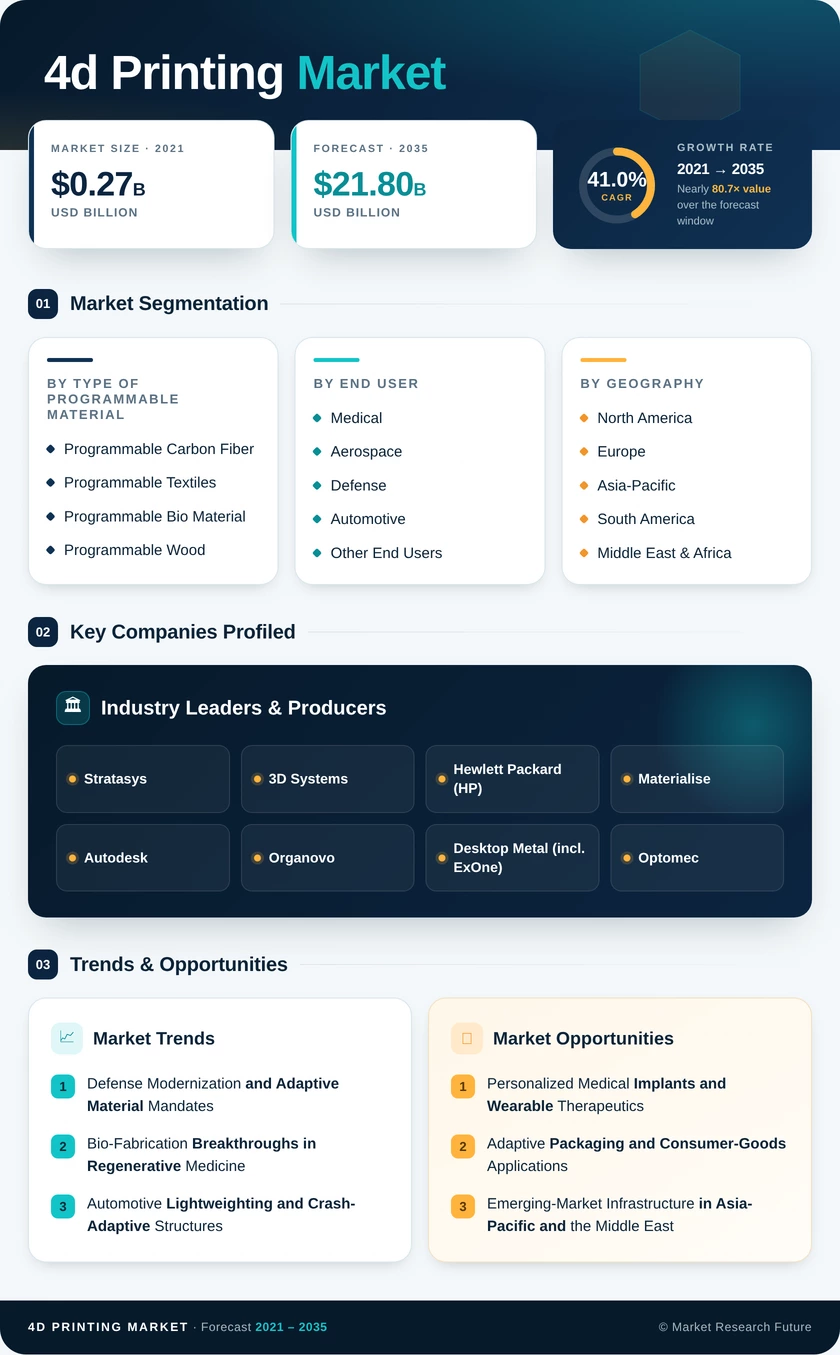
4D Printing Market (2026 – 2035)

ID: MRFR/SEM/1999-HCR 200 Pages Ankit Gupta Last Updated: September 15, 2026
4D Printing Market Size, Share and Research Report By Technology (Shape Memory Polymers, Self-Assembly, Bioprinting), By Material Type (Polymers, Metals, Composites, Ceramics), By Application (Aerospace, Healthcare, Automotive, Fashion, Construction), By End Use (Industrial, Consumer, Healthcare) and By Regional (North America, Europe, South America, Asia Pacific, Middle East and Africa) - Industry Forecast Till 2035
4D Printing Market
Market Size
Forecast Period2026-2035
CAGR (2026-2035)41.0%
2025 Market SizeUSD 0.70 Billion
2035 Market SizeUSD 21.80 Billion
Key Players
Stratasys
3D Systems
Hewlett Packard
Materialise
Autodesk
Organovo
Opportunities
  • Personalized Medical Implants and Wearable Therapeutics
  • Adaptive Packaging and Consumer-Goods Applications
  • Emerging-Market Infrastructure in Asia-Pacific and the Middle East
  1. 1 Market Overview |
    1. 1.1 Study Assumptions & Market Definition |
    2. 1.2 Scope of the Study |
    3. 1.3 Research Methodology
  2. 2 Market Summary & Key Takeaways
  3. 3 Market Dynamics |
    1. 3.1 Market Drivers Analysis | |
      1. 3.1.1 Defense Modernization & Adaptive Material Mandates | |
      2. 3.1.2 Bio-Fabrication Breakthroughs in Regenerative Medicine | |
      3. 3.1.3 Automotive Lightweighting & Crash-Adaptive Structures | |
      4. 3.1.4 Smart-Infrastructure Integration | |
      5. 3.1.5 Government R&D Grants & Academic Partnerships | |
      6. 3.1.6 Declining Cost Curves in Programmable Polymers |
    2. 3.2 Market Restraints Analysis | |
      1. 3.2.1 Limited Material Library & Performance Trade-Offs | |
      2. 3.2.2 High Hardware-Software Co-Design Complexity | |
      3. 3.2.3 Absence of Industry-Wide Testing Standards | |
      4. 3.2.4 Scalability Constraints in Batch Production | |
      5. 3.2.5 Intellectual-Property Ambiguity Around Programmable Designs |
    3. 3.3 Market Opportunity Analysis | |
      1. 3.3.1 Personalized Medical Implants & Wearable Therapeutics | |
      2. 3.3.2 Adaptive Packaging & Consumer-Goods Applications | |
      3. 3.3.3 Emerging-Market Infrastructure in Asia-Pacific & the Middle East | |
      4. 3.3.4 Digital-Twin Integration & Design-as-a-Service Platforms | |
      5. 3.3.5 Space & Satellite Deployable Structures |
    4. 3.4 Industry Value Chain Analysis |
    5. 3.5 Porter's Five Forces Analysis
  4. 4 Global 4D Printing Market Size & Forecast (2021–2035) |
    1. 4.1 Historical Market Size (2021–2025) |
    2. 4.2 Current & Forecast Market Size (2026–2035) |
    3. 4.3 Market Size by Revenue (USD Billion) |
    4. 4.4 Year-over-Year Growth Analysis
  5. 5 Segmentation Analysis |
    1. 5.1 By Type of Programmable Material | |
      1. 5.1.1 Programmable Carbon Fiber | |
      2. 5.1.2 Programmable Textiles | |
      3. 5.1.3 Programmable Bio Material | |
      4. 5.1.4 Programmable Wood |
    2. 5.2 By End User | |
      1. 5.2.1 Medical | |
      2. 5.2.2 Aerospace and Defense | |
      3. 5.2.3 Automotive | |
      4. 5.2.4 Other End Users
  6. 6 Regional Analysis |
    1. 6.1 North America | |
      1. 6.1.1 United States | |
      2. 6.1.2 Canada | |
      3. 6.1.3 Mexico |
    2. 6.2 Europe | |
      1. 6.2.1 Germany | |
      2. 6.2.2 United Kingdom | |
      3. 6.2.3 France | |
      4. 6.2.4 Italy | |
      5. 6.2.5 Spain | |
      6. 6.2.6 Nordic Countries | |
      7. 6.2.7 Russia | |
      8. 6.2.8 Rest of Europe |
    3. 6.3 Asia-Pacific | |
      1. 6.3.1 China | |
      2. 6.3.2 India | |
      3. 6.3.3 Japan | |
      4. 6.3.4 South Korea | |
      5. 6.3.5 ASEAN | |
      6. 6.3.6 Rest of Asia-Pacific |
    4. 6.4 South America | |
      1. 6.4.1 Brazil | |
      2. 6.4.2 Argentina | |
      3. 6.4.3 Rest of South America |
    5. 6.5 Middle East & Africa | |
      1. 6.5.1 Saudi Arabia | |
      2. 6.5.2 UAE | |
      3. 6.5.3 South Africa | |
      4. 6.5.4 Egypt | |
      5. 6.5.5 Rest of MEA
  7. 7 Competitive Landscape |
    1. 7.1 Market Share Analysis (2025) |
    2. 7.2 Competitive Benchmarking Matrix |
    3. 7.3 Company Profiles | |
      1. 7.3.1 Stratasys | |
      2. 7.3.2 3D Systems | |
      3. 7.3.3 Hewlett Packard (HP) | |
      4. 7.3.4 Materialise | |
      5. 7.3.5 Autodesk | |
      6. 7.3.6 Organovo | |
      7. 7.3.7 Desktop Metal (incl. ExOne) | |
      8. 7.3.8 Optomec | |
      9. 7.3.9 Nervous System | |
      10. 7.3.10 Dassault Systèmes
  8. 8 Future Outlook & Strategic Recommendations (2026–2035) |
    1. 8.1 AI-Accelerated Material Discovery |
    2. 8.2 Platform Economics & Print-as-a-Service |
    3. 8.3 Sustainability-Driven Adoption |
    4. 8.4 Multi-Stimulus Programmability & Autonomous Systems
  9. 9 Recent Developments & News
  10. 10 Frequently Asked Questions (FAQs)
  11. 11 Report Scope & Methodology |
    1. 11.1 Study Period & Base Year |
    2. 11.2 Data Sources & Citations |
    3. 11.3 Abbreviations
  12. 12 LIST OF TABLES |
  13. TABLE 1 Global 4D Printing Market Size & Forecast, by Revenue (USD Billion), 2021–2035 |
  14. TABLE 2 Global 4D Printing Market — Year-over-Year Growth Analysis, 2021–2035 |
  15. TABLE 3 Global 4D Printing Market — Driver Impact Analysis |
  16. TABLE 4 Global 4D Printing Market — Restraint Impact Analysis |
  17. TABLE 5 Global 4D Printing Market Size, by Type of Programmable Material, 2021–2035 (USD Billion) |
  18. TABLE 6 Global 4D Printing Market Size, by End User, 2021–2035 (USD Billion) |
  19. TABLE 7 Global 4D Printing Market Size, by Region, 2021–2035 (USD Billion) |
  20. TABLE 8 North America 4D Printing Market Size, by Country, 2021–2035 (USD Billion) |
  21. TABLE 9 Europe 4D Printing Market Size, by Country, 2021–2035 (USD Billion) |
  22. TABLE 10 Asia-Pacific 4D Printing Market Size, by Country, 2021–2035 (USD Billion) |
  23. TABLE 11 South America 4D Printing Market Size, by Country, 2021–2035 (USD Billion) |
  24. TABLE 12 Middle East & Africa 4D Printing Market Size, by Country, 2021–2035 (USD Billion) |
  25. TABLE 13 Competitive Benchmarking Matrix — Global 4D Printing Market, 2025 |
  26. TABLE 14 Company Profiles — Key Players, Global 4D Printing Market |
  27. TABLE 15 Recent Developments & Strategic Announcements, 2023–2025 |
  28. TABLE 16 Report Scope & Methodology Summary |
  29. TABLE 17 Detailed Sources and Citations |
  30. TABLE 18 North America 4D Printing Market Size, by Type of Programmable Material, 2021–2035 (USD Billion) |
  31. TABLE 19 North America 4D Printing Market Size, by End User, 2021–2035 (USD Billion) |
  32. TABLE 20 Europe 4D Printing Market Size, by Type of Programmable Material, 2021–2035 (USD Billion) |
  33. TABLE 21 Europe 4D Printing Market Size, by End User, 2021–2035 (USD Billion) |
  34. TABLE 22 Asia-Pacific 4D Printing Market Size, by Type of Programmable Material, 2021–2035 (USD Billion) |
  35. TABLE 23 Asia-Pacific 4D Printing Market Size, by End User, 2021–2035 (USD Billion) |
  36. TABLE 24 South America 4D Printing Market Size, by Type of Programmable Material, 2021–2035 (USD Billion) |
  37. TABLE 25 South America 4D Printing Market Size, by End User, 2021–2035 (USD Billion) |
  38. TABLE 26 Middle East & Africa 4D Printing Market Size, by Type of Programmable Material, 2021–2035 (USD Billion) |
  39. TABLE 27 Middle East & Africa 4D Printing Market Size, by End User, 2021–2035 (USD Billion) |
  40. TABLE 28 United States 4D Printing Market Size, by Type of Programmable Material, 2021–2035 (USD Billion) |
  41. TABLE 29 United States 4D Printing Market Size, by End User, 2021–2035 (USD Billion) |
  42. TABLE 30 Canada 4D Printing Market Size, by Type of Programmable Material, 2021–2035 (USD Billion) |
  43. TABLE 31 Canada 4D Printing Market Size, by End User, 2021–2035 (USD Billion) |
  44. TABLE 32 Mexico 4D Printing Market Size, by Type of Programmable Material, 2021–2035 (USD Billion) |
  45. TABLE 33 Mexico 4D Printing Market Size, by End User, 2021–2035 (USD Billion) |
  46. TABLE 34 Germany 4D Printing Market Size, by Type of Programmable Material, 2021–2035 (USD Billion) |
  47. TABLE 35 Germany 4D Printing Market Size, by End User, 2021–2035 (USD Billion) |
  48. TABLE 36 United Kingdom 4D Printing Market Size, by Type of Programmable Material, 2021–2035 (USD Billion) |
  49. TABLE 37 United Kingdom 4D Printing Market Size, by End User, 2021–2035 (USD Billion) |
  50. TABLE 38 France 4D Printing Market Size, by Type of Programmable Material, 2021–2035 (USD Billion) |
  51. TABLE 39 France 4D Printing Market Size, by End User, 2021–2035 (USD Billion) |
  52. TABLE 40 China 4D Printing Market Size, by Type of Programmable Material, 2021–2035 (USD Billion) |
  53. TABLE 41 China 4D Printing Market Size, by End User, 2021–2035 (USD Billion) |
  54. TABLE 42 India 4D Printing Market Size, by Type of Programmable Material, 2021–2035 (USD Billion) |
  55. TABLE 43 India 4D Printing Market Size, by End User, 2021–2035 (USD Billion) |
  56. TABLE 44 Japan 4D Printing Market Size, by Type of Programmable Material, 2021–2035 (USD Billion) |
  57. TABLE 45 Japan 4D Printing Market Size, by End User, 2021–2035 (USD Billion) |
  58. TABLE 46 South Korea 4D Printing Market Size, by Type of Programmable Material, 2021–2035 (USD Billion) |
  59. TABLE 47 South Korea 4D Printing Market Size, by End User, 2021–2035 (USD Billion) |
  60. TABLE 48 Brazil 4D Printing Market Size, by Type of Programmable Material, 2021–2035 (USD Billion) |
  61. TABLE 49 Brazil 4D Printing Market Size, by End User, 2021–2035 (USD Billion) |
  62. TABLE 50 Saudi Arabia 4D Printing Market Size, by Type of Programmable Material, 2021–2035 (USD Billion) |
  63. TABLE 51 Saudi Arabia 4D Printing Market Size, by End User, 2021–2035 (USD Billion) |
  64. TABLE 52 UAE 4D Printing Market Size, by Type of Programmable Material, 2021–2035 (USD Billion) |
  65. TABLE 53 UAE 4D Printing Market Size, by End User, 2021–2035 (USD Billion)
  66. 13 LIST OF FIGURES |
  67. FIGURE 1 Global 4D Printing Market Dynamics Overview |
  68. FIGURE 2 Industry Value Chain Analysis — 4D Printing Market |
  69. FIGURE 3 Porter's Five Forces Analysis — 4D Printing Market |
  70. FIGURE 4 Global 4D Printing Market Size Trend & Forecast (USD Billion), 2021–2035 |
  71. FIGURE 5 Global 4D Printing Market Share, by Type of Programmable Material (%), 2025 |
  72. FIGURE 6 Global 4D Printing Market Share, by End User (%), 2025 |
  73. FIGURE 7 Global 4D Printing Market Share, by Region (%), 2025 |
  74. FIGURE 8 North America 4D Printing Market Size Trend (USD Billion), 2021–2035 |
  75. FIGURE 9 Europe 4D Printing Market Size Trend (USD Billion), 2021–2035 |
  76. FIGURE 10 Asia-Pacific 4D Printing Market Size Trend (USD Billion), 2021–2035 |
  77. FIGURE 11 South America 4D Printing Market Size Trend (USD Billion), 2021–2035 |
  78. FIGURE 12 Middle East & Africa 4D Printing Market Size Trend (USD Billion), 2021–2035 |
  79. FIGURE 13 Competitive Landscape — Market Share Analysis (%), 2025 |
  80. FIGURE 14 Competitive Benchmarking Radar Chart — Top 10 Players

Segmentation Quick Reference

DimensionSub-SegmentsDominant SegmentFastest Growing Segment
Type of Programmable MaterialProgrammable Carbon Fiber, Programmable Textiles, Programmable Bio Material, Programmable WoodProgrammable Carbon FiberProgrammable Bio Material
End UserMedical, Aerospace and Defense, Automotive, Other End UsersMedicalAutomotive
GeographyNorth America, Europe, Asia-Pacific, South America, Middle East & AfricaNorth AmericaAsia-Pacific


Market Segmentation Overview

By Type of Programmable Material

Sub-SegmentKey Trend
Programmable Carbon FiberAerospace primes qualifying self-stiffening structural skins for next-gen airframes
Programmable TextilesAdaptive military and athletic wearables entering serial-production trials
Programmable Bio MaterialFDA Breakthrough Device designations accelerating implant commercialization
Programmable WoodSustainable-architecture studios prototyping humidity-responsive building envelopes


Programmable Carbon Fiber remains the revenue leader due to its alignment with high-value aerospace procurement cycles, while Programmable Bio Material is attracting the fastest-growing investment flows as clinical evidence and regulatory pathways converge. Programmable Textiles and Programmable Wood represent smaller but strategically important segments where niche applications could scale rapidly once material costs decline.

By End User

Sub-SegmentKey Trend
MedicalSelf-expanding implants and tissue scaffolds moving through Phase II/III clinical trials
Aerospace and DefenseAdaptive camouflage, self-healing composites, and deployable satellite structures
AutomotiveCrash-responsive crumple-zone inserts and thermal-adaptive ventilation components
Other End UsersConstruction self-healing materials, smart packaging, and consumer electronics


Medical end users currently drive the largest share of demand, supported by favorable regulatory mechanisms and strong clinical evidence for improved patient outcomes. Aerospace and Defense follows closely, leveraging large government contracts that provide revenue stability. Automotive is the fastest-growing end-user vertical as OEMs seek programmable structures to meet tightening emission and safety standards simultaneously.


 

Download PDF ×

We do not share your information with anyone. However, we may send you emails based on your report interest from time to time. You may contact us at any time to opt-out.