Automotive Companies Developing AI Systems for Self-Driving Cars in 2025
In 2025, major automotive manufacturers and technology partners are ramping up efforts to develop artificial intelligence systems for autonomous vehicles, positioning the self-driving car sector for unparalleled expansion as artificial intelligence assumes a pivotal role in automating vehicle perception, decision-making, and control. As leading OEMs and mobility technology companies expedite the integration of AI into advanced driver assistance systems (ADAS) and autonomous platforms, the industry is experiencing substantial innovation and strategic collaborations targeted at attaining higher levels of autonomy this year.
In 2025, a notable advancement is the growth of partnerships between established automobile manufacturers and artificial intelligence developers focused on autonomous technology. For instance, Honda entered into a multi-year collaboration with AI specialist Helm.ai to expedite the development of advanced vision-based autonomous systems that improve planning and control through deep neural perception—an initiative aimed at achieving safer and more reliable self-driving capabilities by 2025 and beyond.
Automotive manufacturers, including Mercedes-Benz, XPENG, and Volkswagen, are developing proprietary artificial intelligence systems for autonomous driving and advanced driver-assistance systems slated for release in 2025. Mercedes-Benz was among the initial OEMs to provide certified Level 3 autonomous driving functionality in select markets, while XPENG demonstrated sophisticated AI-driven driving systems targeting Level 4 autonomy, and Volkswagen launched highly automated systems designed for complex traffic conditions in China. Strategic partnerships with leading compute and software companies continue to shape the landscape of autonomous AI systems in 2025. NVIDIA remains at the forefront of autonomous vehicle computation development with its DRIVE AGX platform, which supports Level 4 readiness, and through strategic partnerships that expand AI capabilities across automotive clients and robotaxi initiatives.
Startups and specialized autonomous technology firms are also playing a significant role in driving momentum toward 2025. Entities such as WeRide, Zoox, and Nuro are deploying and evaluating driverless prototypes and commercial robotaxi services supported by AI perception and planning software, obtaining testing permits and forming partnerships that extend autonomous operations across regions, including the United States, Europe, and the Middle East.
As AI adoption grows across connected vehicles, predictive maintenance, and autonomous driving platforms, the automotive artificial intelligence market is expected to grow from USD 3.75 billion in 2024 to USD 5.2 billion in 2025, a nearly 38 percent increase. In 2025, AI, sensor technologies, and software development are propelling the autonomous vehicle market toward increasingly capable self-driving systems, while regulatory frameworks and safety validation emerge around real-world deployment and public acceptance.
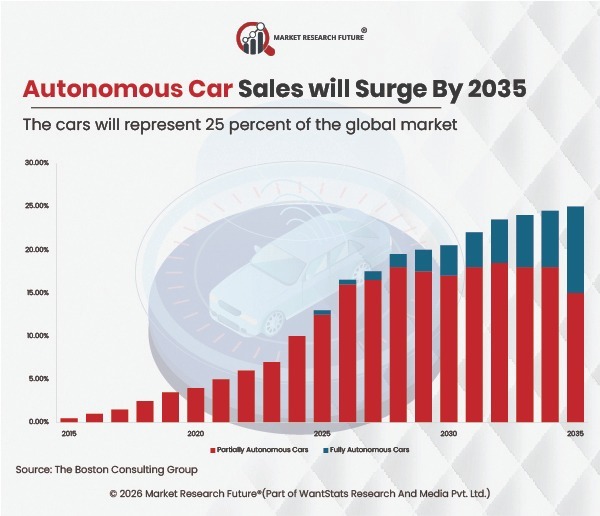
The figure shows a surge in autonomous car sales by the end of 2035: