保護繊維市場 概要
主要な市場動向とハイライト
市場規模と予測
| CAGR (2025 - 2035) | 4.71% |
| CAGR (2025 - 2035) | 4.71% |
The Protective Textile Market is currently experiencing a dynamic evolution, driven by advancements in technology and increasing awareness regarding safety standards across various industries. The demand for protective textiles is expanding, particularly in sectors such as healthcare, construction, and military applications. Innovations in materials, such as the development of lightweight, breathable fabrics that offer enhanced protection without compromising comfort, are becoming more prevalent. Furthermore, the integration of smart textiles, which can monitor environmental conditions and provide real-time feedback, appears to be gaining traction, suggesting a shift towards more sophisticated protective solutions. In addition to technological advancements, regulatory frameworks are becoming more stringent, compelling manufacturers to adhere to higher safety standards. This trend is likely to foster a competitive landscape where companies invest in research and development to create superior protective textiles. Sustainability is also emerging as a critical factor, with an increasing number of consumers and businesses prioritizing eco-friendly materials. As the Protective Textile Market continues to evolve, it seems poised for substantial growth, driven by innovation, regulatory compliance, and a commitment to sustainability.
The Protective Textile Market is witnessing a surge in the development of advanced materials that enhance safety and comfort. Innovations such as nanotechnology and smart textiles are becoming more common, allowing for fabrics that not only protect against hazards but also monitor environmental conditions. This trend indicates a shift towards multifunctional textiles that cater to diverse needs.
As safety regulations become increasingly stringent, manufacturers in the Protective Textile Market are compelled to meet higher standards. This trend suggests that companies are investing more in compliance and quality assurance processes, which may lead to improved product offerings and heightened consumer trust.
The growing emphasis on sustainability is influencing the Protective Textile Market, with a noticeable shift towards eco-friendly materials and production methods. This trend reflects a broader societal movement towards environmental responsibility, indicating that consumers are increasingly favoring products that align with their values.
職場の安全に関する意識が高まっており、これが保護繊維市場に大きな影響を与えています。組織は、危険な環境に関連するリスクを軽減するために、従業員に保護具を提供する重要性をますます認識しています。この高まる意識は、複数の業界での厳格な安全規制や基準の実施に反映されています。例えば、労働安全衛生局(OSHA)は、保護繊維を含む個人用保護具(PPE)の使用を積極的に促進しています。その結果、保護衣料の市場は2027年までに100億米ドルに達する見込みであり、堅調な成長軌道を示しています。この傾向は、保護繊維が安全性とコンプライアンスを確保する上で果たす重要な役割を強調し、保護繊維市場を推進しています。
繊維製造における技術革新は、保護繊維市場の形成において重要な役割を果たしています。ナノテクノロジー、スマートテキスタイル、先進的な織り技術などの革新が、保護用生地の性能特性を向上させています。例えば、ナノファイバーの統合により、防水性や通気性が向上し、ユーザーにとってより快適な繊維が実現します。環境条件を監視し、リアルタイムでフィードバックを提供できるスマートテキスタイルの市場も注目を集めています。スマートテキスタイルセグメントは、今後数年間で20%以上の年平均成長率で成長する可能性があると推定されています。これらの技術革新は、保護繊維の機能性を向上させるだけでなく、さまざまな分野での応用を拡大し、保護繊維市場を推進しています。
保護テキスタイル市場は、建設、医療、軍事用途などのさまざまなエンドユーザーセクターからの需要の著しい急増を経験しています。産業が労働者の安全を優先する中で、高度な保護テキスタイルの必要性が高まっています。たとえば、建設セクターは、厳格な安全規制と増加する建設プロジェクトの数により、年間約5%の成長率を見込んでいます。同様に、医療セクターにおけるガウンやマスクなどの保護テキスタイルの需要は、より強化された安全対策への広範な傾向を反映して、著しく増加することが予想されています。このような多様な産業からの需要の高まりは、保護テキスタイル市場を前進させ、特定の安全要件を満たす新しい材料の革新と開発を促進する可能性があります。
持続可能性は、消費者と製造業者が環境に優しい慣行をますます重視する中で、保護テキスタイル市場の中心的なテーマとなっています。有機コットンやリサイクルポリエステルなどの持続可能な材料の需要は、環境に配慮した製品を求める消費者の好みによって高まっています。持続可能なテキスタイルの市場は、2025年までに2,000億米ドルに達する可能性があると推定されており、これは消費者行動の大きな変化を反映しています。製造業者は、より環境に優しい生産方法を採用し、生分解性およびリサイクル可能な保護テキスタイルを開発するための研究に投資することで応えています。この持続可能性への焦点は、消費者の期待に応えるだけでなく、環境への影響を減少させることを目的とした規制の圧力とも一致しており、保護テキスタイル市場の動向に影響を与えています。
電子商取引とオンライン小売チャネルの拡大は、保護テキスタイルのマーケティングと販売方法を変革し、保護テキスタイル市場に影響を与えています。インターネットとモバイルデバイスの浸透が進む中、消費者はオンラインで保護具を購入する傾向が高まっています。この変化は、特定の業界に特化したオンラインプラットフォームの増加に特に顕著であり、幅広い保護テキスタイルを提供しています。2026年までに、保護衣料のオンライン販売が総販売の30%以上を占めると予測されています。この傾向は、消費者にとってのアクセスの向上だけでなく、製造業者がより広いオーディエンスにリーチできるようにします。電子商取引が成長し続ける中で、保護テキスタイル市場のダイナミクスを形成する上で重要な役割を果たすことが予想されます。
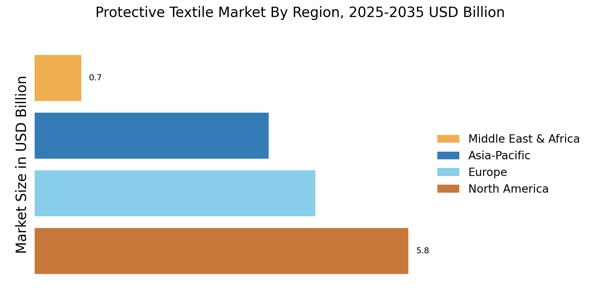
North America is the largest market for protective textiles, holding approximately 40% of the global share. The region's growth is driven by stringent safety regulations across industries such as construction, manufacturing, and healthcare. Increasing awareness of workplace safety and advancements in textile technology further fuel demand. Regulatory catalysts, including OSHA standards, are pivotal in shaping market dynamics, ensuring compliance and safety in various sectors. The United States dominates the North American market, with key players like DuPont, 3M, and Honeywell leading the charge. The competitive landscape is characterized by innovation and strategic partnerships, enhancing product offerings. Canada also plays a significant role, focusing on sustainable and high-performance textiles. The presence of established companies ensures a robust supply chain and continuous development in protective textile solutions.
Europe is witnessing significant growth in the protective textile market, accounting for approximately 30% of the global share. The region's expansion is largely driven by stringent regulations and standards set by the European Union, particularly in sectors like healthcare and industrial safety. The demand for high-performance textiles is increasing, propelled by innovations in material science and a growing emphasis on worker safety and environmental sustainability. Leading countries in Europe include Germany, France, and the Netherlands, with a strong presence of key players such as BASF SE and TenCate Protective Fabrics. The competitive landscape is marked by a focus on R&D and collaboration between manufacturers and research institutions. The market is also influenced by the EU's commitment to sustainability, pushing companies to develop eco-friendly protective textile solutions.
Asia-Pacific is rapidly emerging as a significant player in the protective textile market, holding around 25% of the global share. The region's growth is driven by increasing industrialization, rising safety awareness, and government initiatives promoting workplace safety. Countries like China and India are witnessing a surge in demand for protective textiles, particularly in construction and manufacturing sectors, supported by favorable regulations and investments in infrastructure. China is the largest market in the region, with a growing number of local manufacturers entering the market. Key players like Teijin Limited are expanding their operations to meet the rising demand. The competitive landscape is evolving, with a focus on innovation and cost-effective solutions. As the region continues to develop, the protective textile market is expected to see substantial growth, driven by both domestic and international demand.
The Middle East and Africa region is gradually emerging in the protective textile market, currently holding about 5% of the global share. The growth is primarily driven by increasing industrial activities, particularly in oil and gas, construction, and mining sectors. Government initiatives aimed at enhancing workplace safety and compliance with international standards are also contributing to market expansion. The region's potential is significant, with rising investments in infrastructure and industrial development. Leading countries in this region include South Africa and the UAE, where there is a growing demand for high-quality protective textiles. The competitive landscape is characterized by a mix of local and international players, with companies focusing on tailored solutions to meet specific industry needs. As the market matures, the presence of key players and increased awareness of safety standards will likely drive further growth in protective textiles.
The Protective Textile Market is currently characterized by a dynamic competitive landscape, driven by increasing demand for safety and protective gear across various industries, including healthcare, construction, and military applications. Key players such as DuPont (US), 3M (US), and Honeywell (US) are strategically positioned to leverage their extensive research and development capabilities, focusing on innovation and sustainability. These companies are not only enhancing their product offerings but are also exploring mergers and acquisitions to consolidate their market presence, thereby shaping a competitive environment that emphasizes technological advancement and operational efficiency.In terms of business tactics, companies are increasingly localizing manufacturing to reduce lead times and optimize supply chains. The market appears moderately fragmented, with a mix of established players and emerging companies vying for market share. The collective influence of these key players is significant, as they set industry standards and drive trends that smaller competitors often follow, thereby reinforcing their market dominance.
In August DuPont (US) announced the launch of a new line of flame-resistant fabrics designed specifically for the oil and gas industry. This strategic move not only underscores DuPont's commitment to innovation but also highlights its focus on addressing the specific needs of high-risk sectors. By tailoring products to meet stringent safety standards, DuPont is likely to enhance its competitive edge and capture a larger share of the protective textile market.Similarly, in July 2025, 3M (US) unveiled a partnership with a leading technology firm to integrate AI-driven analytics into its protective textile manufacturing processes. This collaboration aims to optimize production efficiency and improve product quality, suggesting that 3M is keen on leveraging digital transformation to maintain its leadership position. The integration of AI could potentially streamline operations and reduce costs, thereby enhancing profitability in a competitive market.
In September Honeywell (US) expanded its portfolio by acquiring a smaller firm specializing in advanced protective materials. This acquisition appears to be a strategic effort to bolster Honeywell's capabilities in high-performance textiles, particularly in sectors such as aerospace and defense. By integrating new technologies and expertise, Honeywell is likely to enhance its product offerings and strengthen its market position.
As of October current trends in the Protective Textile Market indicate a strong emphasis on digitalization, sustainability, and the integration of advanced technologies such as AI. Strategic alliances are increasingly shaping the competitive landscape, allowing companies to pool resources and expertise to innovate more effectively. Looking ahead, it seems that competitive differentiation will evolve from traditional price-based competition to a focus on innovation, technological advancements, and supply chain reliability, as companies strive to meet the growing demands of safety and performance in protective textiles.
September 2026: Arclin showcased its newly expanded Nomex® and Kevlar® personal protection portfolio at the National Safety Council Safety Congress & Expo 2026. The portfolio included Nomex® Xtreme Arc, a flame-resistant fabric designed for arc-flash and flash-fire hazards, and ArmorCell™ technology for thermal protection. The business was acquired from DuPont in April 2026, bringing the Kevlar and Nomex protective-materials portfolio under Arclin.
April 2026: DuPont completed the divestiture of its Aramids business, including Kevlar® and Nomex®, to Arclin in a transaction valued at approximately USD 1.8 billion. DuPont received approximately USD 1.2 billion in pre-tax cash proceeds, a USD 300 million note receivable and a non-controlling equity interest valued at approximately USD 325 million. The transaction transferred two established high-performance fiber brands used in protective clothing and other safety applications to Arclin.
May 2025: Honeywell completed the sale of its Personal Protective Equipment business to Protective Industrial Products (PIP) for USD 1.325 billion in an all-cash transaction. The transaction marked Honeywell's exit from the PPE business, transferring its protective-equipment operations to PIP and changing the competitive structure around Honeywell's former PPE portfolio.
保護テキスタイル市場は、2024年から2035年までの間に4.71%のCAGRで成長する見込みであり、これは技術の進歩、安全規制の強化、さまざまな業界での需要の高まりによって推進されます。
新しい機会は以下にあります:
2035年までに、保護繊維市場は大幅な成長と多様化を達成する見込みです。
| MARKET SIZE 2024 | 14.63(USD Billion) |
| MARKET SIZE 2025 | 15.32(USD Billion) |
| MARKET SIZE 2035 | 24.27(USD Billion) |
| COMPOUND ANNUAL GROWTH RATE (CAGR) | 4.71% (2025 - 2035) |
| REPORT COVERAGE | Revenue Forecast, Competitive Landscape, Growth Factors, and Trends |
| BASE YEAR | 2024 |
| Market Forecast Period | 2025 - 2035 |
| Historical Data | 2019 - 2024 |
| Market Forecast Units | USD Billion |
| Key Companies Profiled | DuPont (US), 3M (US), Honeywell (US), Milliken & Company (US), Teijin Limited (JP), W. L. Gore & Associates (US), BASF SE (DE), TenCate Protective Fabrics (NL), MCR Safety (US) |
| Segments Covered | Fiber Type, Protection Level, Application, End-Use, Regional |
| Key Market Opportunities | Integration of smart textiles with advanced protective features for enhanced safety and comfort. |
| Key Market Dynamics | Rising demand for advanced protective textiles driven by stringent safety regulations and technological innovations in various industries. |
| Countries Covered | North America, Europe, APAC, South America, MEA |
 Sejal Akre

このレポートの無料サンプルを受け取るには、以下のフォームにご記入ください


“This is really good guys. Excellent work on a tight deadline. I will continue to use you going forward and recommend you to others. Nice job”
 Noah Malgeri
Co-Founder

“Thanks for sending the report it gives us a good global view of the Betaïne market.”
 Peter Groot koerkamp
Account and Business Manager

“We found the report very insightful! we found your research firm very helpful. I'm sending this email to secure our future business.”
 Younghwan Choi
Senior Retail Manager

“I am very pleased with how market segments have been defined in a relevant way for my purposes (such as "Portable Freezers & refrigerators" and "last-mile"). In general the report is well structured. Thanks very much for your efforts.”
 Mark Irwin
Management Consultant

“We got the report in time, we really thank you for your support in this process. I also thank to all of your team as they did a great job.”
 Akif Moroglu
Strategy & Business Development Director

“The Automotive 48V ECU Components Procurement Intelligence Study” was a complex project, but the Market Research Future (MRFR) team handled it with quality, agility, and customer-centricity. They delivered all requested data on time and within the agreed scope. The team, including Shubhendra Anand and Rahul Gotadki, was always readily available to clarify questions and swiftly implement necessary adjustments, driving the project to a successful conclusion within a very demanding timeframe.
I would also like to specifically commend Akshay Agarwal for his responsiveness and support at every stage—from our initial inquiry on May 6th through to final delivery on June 18th. His dedication made the entire process seamless.”
 Guilherme Gomes Martins
Product Management Director

“Thanks. It’s been a pleasure working with you, please use me as reference with any other Intel employees.”
 Joseph Aguayo
Sales Operations & Pricing Manager

“Thank you, this will be very helpful for OQS.”
 La Terria Dodd
Program Support Specialist

“I have been reading the first document or the study, ,the Global HVAC and FP market report 2021 till 2026. Must say, good info! I have not gone in depth at all parts, but got a good indication of the data inside!”
 Rob Kooiker
Group Product Manager HVAC & Fire Protection GMA


