フローコンピュータ石油ガス市場 概要
主要な市場動向とハイライト
市場規模と予測
| CAGR (2025 - 2035) | 4.05% |
| CAGR (2025 - 2035) | 4.05% |
The Flow Computer Oil Gas Market is currently experiencing a transformative phase, driven by advancements in technology and increasing demand for efficient monitoring solutions. The integration of digital technologies, such as the Internet of Things (IoT) and artificial intelligence, appears to enhance the capabilities of flow computers, allowing for real-time data analysis and improved decision-making processes. This evolution is likely to lead to greater operational efficiency and cost savings for companies operating within the oil and gas sector. Furthermore, the growing emphasis on environmental sustainability may influence the adoption of flow computers that facilitate better resource management and reduce waste. In addition, the regulatory landscape surrounding the oil and gas industry is evolving, with stricter compliance requirements emerging globally. This shift may compel organizations to invest in advanced flow measurement technologies to ensure adherence to regulations and enhance safety protocols. As the market continues to adapt to these changes, it seems poised for growth, with innovations in flow measurement technology potentially reshaping operational practices. The Flow Computer Oil Gas Market is thus positioned at a critical juncture, where technological advancements and regulatory pressures converge to redefine industry standards and practices.
The incorporation of advanced technologies, such as IoT and AI, is reshaping the Flow Computer Oil Gas Market. These innovations enable real-time data collection and analysis, enhancing operational efficiency and decision-making.
Increasing regulatory requirements are driving the demand for sophisticated flow measurement solutions. Companies are likely to invest in advanced technologies to ensure compliance and improve safety measures.
The growing emphasis on environmental sustainability is influencing the adoption of flow computers that promote efficient resource management. This trend may lead to reduced waste and improved operational practices.
Intensifying market competition is a notable driver in the Flow Computer Oil Gas Market. As the number of players in the oil and gas sector increases, companies are compelled to adopt innovative technologies to maintain their competitive edge. This competitive landscape encourages investments in advanced flow measurement solutions that enhance efficiency and reduce costs. Recent analyses suggest that the market for flow computers is projected to grow at a compound annual growth rate of 12% over the next five years, driven by the need for companies to differentiate themselves through superior technology. As firms strive to optimize their operations and improve profitability, the demand for cutting-edge flow computer solutions is likely to rise, further stimulating growth in the Flow Computer Oil Gas Market.
The Flow Computer Oil Gas Market is experiencing a surge in technological advancements that enhance operational efficiency and data accuracy. Innovations such as advanced algorithms and machine learning are being integrated into flow computers, allowing for real-time data analysis and improved decision-making processes. According to recent data, the adoption of smart flow measurement technologies is projected to increase by approximately 25% over the next five years. This trend indicates a shift towards more automated and intelligent systems, which could potentially reduce operational costs and improve safety standards in oil and gas operations. As companies seek to optimize their production and reduce downtime, the demand for sophisticated flow computer solutions is likely to rise, driving growth in the Flow Computer Oil Gas Market.
In the Flow Computer Oil Gas Market, Differential Pressure Flow Meters hold a significant share as the largest segment, driven by their reliability and accuracy in measuring flow rates in various applications. Ultrasonic Flow Meters, while currently smaller in share, are gaining momentum thanks to advancements in technology and their increasing adoption in critical applications requiring non-invasive measurement techniques.
Differential Pressure Flow Meters dominate the Flow Computer Oil Gas Market due to their established reliability and widespread application in the oil and gas industry. They utilize the principle of pressure drop across an orifice to measure flow, making them ideal for high-pressure applications. Conversely, Ultrasonic Flow Meters are emerging as a preferred option for non-invasive flow measurement, appealing to operators looking for maintenance-free solutions. Their rapid growth is fueled by technological advancements, such as multi-path measurement techniques that enhance accuracy and provide robust data, positioning them as a viable alternative in various operational settings.
The Flow Computer Oil Gas Market sees a substantial distribution of market share across various end users, with oil and gas companies commanding the largest portion due to their extensive operational needs and reliance on precise flow measurement for efficiency. Power generation companies follow closely, increasingly adopting flow computer technologies to optimize fuel consumption and maintain regulatory compliance in the wake of stringent environmental standards.
Oil and gas companies represent the dominant player in the Flow Computer Oil Gas Market, as they require sophisticated flow control systems to manage the complexities of extraction and transportation. These companies prioritize technology that ensures accuracy and reliability in measuring fluid flow, which is crucial for operational efficiency and safety. On the other hand, power generation companies are emerging as significant users, with a growing interest in integrating flow computers into their systems to enhance performance and reduce costs. This shift is driven by the need for efficient energy generation and management, positioning them as a key segment alongside traditional oil and gas players.
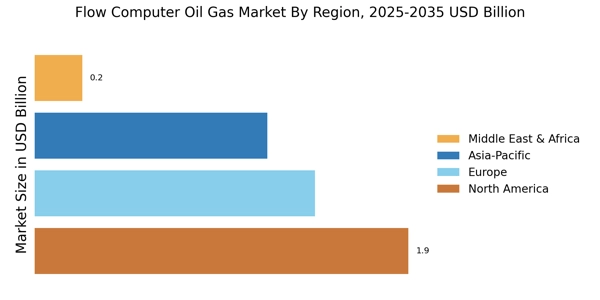
North America is the largest market for flow computers in the oil and gas sector, holding approximately 40% of the global market share. The region's growth is driven by technological advancements, increasing oil production, and stringent regulatory frameworks aimed at enhancing operational efficiency. The demand for automation and real-time monitoring solutions is also on the rise, further propelling market growth. The United States is the leading country in this region, with significant contributions from Canada. Major players like Emerson, Honeywell, and Rockwell Automation dominate the competitive landscape, leveraging innovative technologies to meet the evolving needs of the industry. The presence of established infrastructure and investment in R&D further solidifies North America's position as a key player in the flow computer market.
Europe is witnessing a significant transformation in the flow computer market, driven by regulatory initiatives aimed at reducing emissions and enhancing energy efficiency. The region holds approximately 30% of the global market share, with Germany and the UK being the largest contributors. The European Union's stringent regulations on energy consumption and environmental impact are key catalysts for market growth. Germany leads the market, supported by a robust industrial base and a focus on innovation. Key players like Siemens and Schneider Electric are actively involved in developing advanced flow measurement technologies. The competitive landscape is characterized by a mix of established companies and emerging startups, all striving to meet the increasing demand for efficient and reliable flow measurement solutions. The European market is poised for growth as it adapts to new regulatory frameworks and technological advancements.
Asia-Pacific is rapidly emerging as a significant player in the flow computer market, accounting for approximately 25% of the global market share. The region's growth is fueled by increasing energy demand, particularly in countries like China and India, where industrialization and urbanization are driving the need for advanced flow measurement solutions. Government initiatives to enhance energy efficiency and reduce emissions are also contributing to market expansion. China is the largest market in this region, with substantial investments in oil and gas infrastructure. The competitive landscape features both international and local players, including Yokogawa and KROHNE, who are focusing on innovation and technology to capture market share. As the region continues to develop, the demand for reliable and efficient flow measurement systems is expected to rise, positioning Asia-Pacific as a key market for future growth.
The Middle East and Africa region is characterized by its rich oil and gas resources, holding approximately 5% of The Flow Computer Oil Gas Market share. The growth in this region is primarily driven by the increasing exploration and production activities, alongside investments in modernizing existing infrastructure. Countries like Saudi Arabia and the UAE are leading the market, supported by government initiatives aimed at enhancing operational efficiency and sustainability. Saudi Arabia is the largest market in this region, with significant contributions from the UAE. The competitive landscape includes key players such as Endress+Hauser and Ametek, who are focusing on providing innovative solutions tailored to the unique challenges of the region. As the demand for efficient flow measurement systems grows, the Middle East and Africa are poised for substantial market development in the coming years.
The Flow Computer Oil Gas Market is currently characterized by a dynamic competitive landscape, driven by technological advancements and the increasing demand for efficient resource management. Key players such as Emerson (US), Honeywell (US), and Siemens (DE) are at the forefront, each adopting distinct strategies to enhance their market positioning. Emerson (US) emphasizes innovation through its advanced flow measurement technologies, while Honeywell (US) focuses on digital transformation initiatives to optimize operational efficiency. Siemens (DE) is actively pursuing regional expansion, particularly in emerging markets, thereby enhancing its global footprint. Collectively, these strategies contribute to a competitive environment that is increasingly focused on technological integration and operational excellence.In terms of business tactics, companies are localizing manufacturing to reduce costs and improve supply chain efficiency. The market structure appears moderately fragmented, with several key players exerting influence over various segments. This fragmentation allows for a diverse range of offerings, yet the collective strength of major companies like Emerson, Honeywell, and Siemens shapes the competitive dynamics significantly.
In August Emerson (US) announced a strategic partnership with a leading software firm to enhance its flow computer capabilities through AI integration. This move is likely to bolster Emerson's position in the market by enabling more sophisticated data analytics and predictive maintenance solutions, which are increasingly sought after in the oil and gas sector. The partnership underscores the importance of technological collaboration in driving innovation and meeting customer demands.
In September Honeywell (US) launched a new suite of digital solutions aimed at improving operational efficiency in oil and gas operations. This initiative reflects Honeywell's commitment to digital transformation, positioning the company as a leader in providing cutting-edge solutions that address the complexities of modern energy management. The introduction of these solutions is expected to enhance customer engagement and drive revenue growth in a competitive market.
In July Siemens (DE) completed the acquisition of a regional flow measurement company, which is anticipated to strengthen its product portfolio and expand its market reach. This acquisition aligns with Siemens' strategy to enhance its offerings in the flow computer segment, allowing for greater integration of advanced technologies and improved service delivery. Such strategic moves indicate a trend towards consolidation in the market, as companies seek to leverage synergies and enhance their competitive edge.
As of October the Flow Computer Oil Gas Market is witnessing significant trends such as digitalization, sustainability, and the integration of artificial intelligence. These trends are reshaping the competitive landscape, with strategic alliances becoming increasingly vital for companies aiming to differentiate themselves. The focus appears to be shifting from price-based competition to innovation, technology, and supply chain reliability, suggesting that future competitive differentiation will hinge on the ability to adapt to these evolving market demands.






フローコンピュータオイルガスマーケットは、2024年から2035年までの間に4.05%のCAGRで成長すると予測されており、これは技術の進歩、自動化の需要の増加、規制遵守によって推進されます。
新しい機会は以下にあります:
2035年までに、市場は堅調な成長を遂げ、流量測定ソリューションのリーダーとしての地位を確立することが期待されています。
| Parameter | Details |
|---|---|
| Market Scope | Flow Computer Oil & Gas Market by Offering, Measurement Principle, Application, Deployment Environment, Connectivity / Protocol, and Region |
| Study Period | 2021–2035 (Historical: 2021–2024; Base Year: 2025; Forecast: 2026–2035) |
| CAGR | 6.80% (2026–2035) |
| Market Size Checkpoints | USD 1.28 Billion (2025); USD 1.37 Billion (2026); USD 1.90 Billion (2031); USD 2.48 Billion (2035) |
| Fastest Growing Segments | Software-As-A-Service (embedded License); Ultrasonic; LNG and FLNG; Offshore (Fixed and Floating); Ethernet (OPC-UA / MQTT) |
| Companies Profiled | Emerson Electric Co., ABB Ltd., Honeywell International Inc., Schneider Electric SE, Yokogawa Electric Corporation, Endress+Hauser Group, Siemens AG, KROHNE Group, Sensia, Thermo Fisher Scientific Inc., Dynamic Flow Computers Inc. |
| Valuation Currency | USD Billion |
| CAGR Driver Disclaimer | Driver and restraint impact percentages are directional and are not additive to the headline CAGR. |
 Chitranshi Jaiswal

このレポートの無料サンプルを受け取るには、以下のフォームにご記入ください

“This is really good guys. Excellent work on a tight deadline. I will continue to use you going forward and recommend you to others. Nice job”
 Noah Malgeri
Co-Founder

“Thanks for sending the report it gives us a good global view of the Betaïne market.”
 Peter Groot koerkamp
Account and Business Manager

“We found the report very insightful! we found your research firm very helpful. I'm sending this email to secure our future business.”
 Younghwan Choi
Senior Retail Manager

“I am very pleased with how market segments have been defined in a relevant way for my purposes (such as "Portable Freezers & refrigerators" and "last-mile"). In general the report is well structured. Thanks very much for your efforts.”
 Mark Irwin
Management Consultant

“We got the report in time, we really thank you for your support in this process. I also thank to all of your team as they did a great job.”
 Akif Moroglu
Strategy & Business Development Director

“The Automotive 48V ECU Components Procurement Intelligence Study” was a complex project, but the Market Research Future (MRFR) team handled it with quality, agility, and customer-centricity. They delivered all requested data on time and within the agreed scope. The team, including Shubhendra Anand and Rahul Gotadki, was always readily available to clarify questions and swiftly implement necessary adjustments, driving the project to a successful conclusion within a very demanding timeframe.
I would also like to specifically commend Akshay Agarwal for his responsiveness and support at every stage—from our initial inquiry on May 6th through to final delivery on June 18th. His dedication made the entire process seamless.”
 Guilherme Gomes Martins
Product Management Director

“Thanks. It’s been a pleasure working with you, please use me as reference with any other Intel employees.”
 Joseph Aguayo
Sales Operations & Pricing Manager

“Thank you, this will be very helpful for OQS.”
 La Terria Dodd
Program Support Specialist

“I have been reading the first document or the study, ,the Global HVAC and FP market report 2021 till 2026. Must say, good info! I have not gone in depth at all parts, but got a good indication of the data inside!”
 Rob Kooiker
Group Product Manager HVAC & Fire Protection GMA



