×
  • Cat-intel
  • MedIntelliX
  • Resources
  • About Us
  • Hero Background
    English
    Chinese
    French
    Japanese
    Korean
    German
    Spanish

    US Carbon Monoxide Market Size

    ID: MRFR/CnM/12408-HCR
    111 Pages
    Chitranshi Jaiswal
    October 2025

    US Carbon Monoxide Market Research Report Information By Application (Metal Fabrication, Chemicals, Ore Processing & Extraction, Pharma & Biotechnology, and Electronics)–Market Forecast Till 2035.

    Share:
    Download PDF ×

    We do not share your information with anyone. However, we may send you emails based on your report interest from time to time. You may contact us at any time to opt-out.

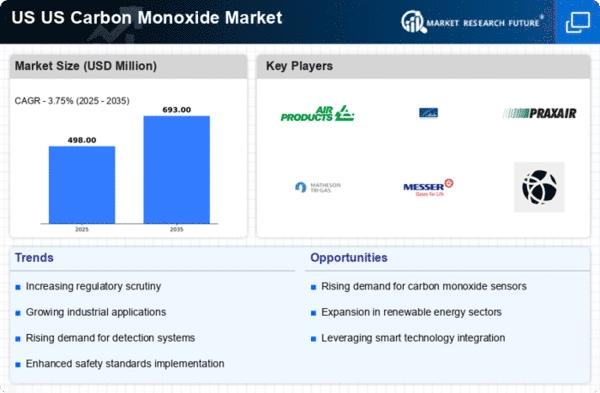
    US Carbon Monoxide Market Infographic
    Purchase Options

    Us Carbon Monoxide Size

    US Carbon Monoxide Market Growth Projections and Opportunities

    The US Carbon Monoxide (CO) Market is shaped by a variety of market factors that contribute to its growth and dynamics. One of the primary drivers is the widespread use of carbon monoxide in various industries. CO is employed in processes such as metal fabrication, chemicals production, and the manufacturing of certain gases. As these industries expand, the demand for carbon monoxide as a key industrial gas has increased, propelling the growth of the US CO market. The versatility and utility of CO across different sectors contribute to its consistent demand in the industrial landscape. The US carbon monoxide market size was valued at USD 0.51 Billion in 2022. The carbon monoxide industry is projected to grow from USD 0.54 Billion in 2023 to USD 0.83 Billion by 2032, exhibiting a compound annual growth rate (CAGR) of 5.50%

    Moreover, safety regulations and standards play a pivotal role in influencing the US Carbon Monoxide Market. Given the toxic nature of carbon monoxide, stringent safety guidelines govern its production, storage, and usage. Compliance with these regulations is crucial for ensuring workplace safety and preventing environmental hazards. Manufacturers and users of carbon monoxide must adhere to strict safety protocols, which, in turn, shape the market dynamics by emphasizing the importance of maintaining high safety standards in the handling of this industrial gas.

    Technological advancements and innovations in industrial processes also impact the market. As industries evolve and adopt new technologies, the requirements for specific gases, including carbon monoxide, may change. Innovations in manufacturing processes, such as those in the production of specialty chemicals or electronic components, may lead to an increased demand for carbon monoxide as a feedstock or reaction gas. This dynamic relationship between technological advancements and industrial applications influences the demand for carbon monoxide in the US market.

    The energy sector, particularly the interest in hydrogen production, contributes significantly to the US Carbon Monoxide Market. CO is a key raw material in the water gas shift reaction used to produce hydrogen. With the growing focus on hydrogen as a clean energy carrier, there is an increased demand for carbon monoxide in hydrogen production processes. This trend is closely tied to the broader goals of reducing carbon emissions and transitioning towards cleaner energy sources, positioning carbon monoxide as a crucial component in the evolving energy landscape.

    Competitive dynamics and industry consolidation further shape the US CO market. The presence of both global and regional players results in a competitive market environment, leading to strategic partnerships, acquisitions, and technological collaborations. These activities are driven by the pursuit of expanding market share, diversifying product portfolios, and leveraging synergies. The competitive landscape encourages companies to invest in research and development to improve production efficiency and explore new applications for carbon monoxide.

    Environmental considerations and sustainability are gaining prominence in the carbon monoxide market. Industries are increasingly seeking environmentally friendly alternatives and cleaner production processes. As a result, carbon monoxide producers are exploring ways to minimize their environmental impact, enhance energy efficiency, and reduce greenhouse gas emissions associated with CO production. This aligns with broader industry trends towards sustainability and responsible environmental practices.
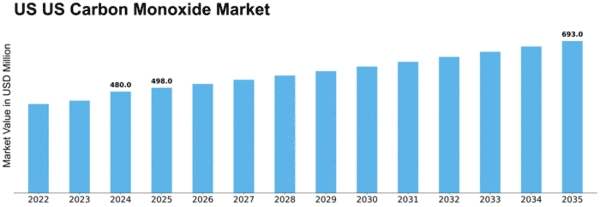
    US Carbon Monoxide Market Size Graph
    Author
    Chitranshi Jaiswal
    Research Analyst Level I

    In her 3 years of experience in the market research field, she has handled critical cross-domain projects. She has an in-depth knowledge of market estimation & analysis, problem-solving, primary as well as secondary research, and team management.She holds an engineering degree and is an MBA professional from a well-known university, capable of evaluating the market and competitive conditions. An exceptional strategist with excellent communication skills and a passion for delivering cutting-edge & practical insights for the market. Proficient in multi-tasking, and can successfully deal with competing demands, while maintaining complete confidentiality. Generated business through active client and project development, networking, and high-quality responses. Her knowledge and skills have helped in making solid business decisions, securing funding from investors, and avoiding business failures.

    Leave a Comment

    FAQs

    How much is the carbon monoxide market?

    The US carbon monoxide market size was valued at USD 0.51 Billion in 2022.

    What is the expansion rate of the carbon monoxide market?

    US Carbon Monoxide Market is expected to grow with a CAGR of 5.5% in the period 2025-2035

    Who are the prominent players in the carbon monoxide market?

    The prominent players in the carbon monoxide market are Air Products, Praxair, Air Liquide, Linde Plc., and American Gas Products.

    Which application had the most extensive market share in the carbon monoxide market?

    The road construction category had the largest share of the market.

    Market Summary

    As per MRFR analysis, the US Carbon Monoxide Market Size was estimated at 0.5697 USD Billion in 2024. The US Carbon Monoxide industry is projected to grow from 0.6011 in 2025 to 1.027 by 2035, exhibiting a compound annual growth rate (CAGR) of 5.5 during the forecast period 2025 - 2035.

    Key Market Trends & Highlights

    The US Carbon Monoxide Market is experiencing a shift towards advanced detection technologies and increased regulatory compliance.

    • Technological advancements in detection devices are reshaping the market landscape.
    • Integration with smart home systems is becoming increasingly prevalent among consumers.
    • North America remains the largest market, while Asia-Pacific is emerging as the fastest-growing region.
    • Growing awareness of health risks and regulatory compliance are driving demand for residential safety solutions.

    Market Size & Forecast

    2024 Market Size 0.5697 (USD Billion)
    2035 Market Size 1.027 (USD Billion)
    CAGR (2025 - 2035) 5.5%
    Largest Regional Market Share in 2024 North America

    Major Players

    <p>Honeywell International Inc (US), MSA Safety Incorporated (US), General Electric Company (US), 3M Company (US), Siemens AG (DE), Emerson Electric Co (US), Drägerwerk AG & Co KGaA (DE), National Instruments Corporation (US), Kidde (US), RKI Instruments Inc (US)</p>

    Market Trends

    The US Carbon Monoxide Market is currently experiencing a notable evolution, driven by increasing awareness regarding air quality and health implications associated with carbon monoxide exposure. Regulatory bodies are intensifying their focus on monitoring and controlling emissions, which has led to the development of advanced detection technologies. These innovations are not only enhancing safety measures in residential and industrial settings but also promoting the adoption of carbon monoxide detectors in various applications. As a result, the market is witnessing a shift towards more sophisticated and reliable solutions that cater to the growing demand for safety and compliance. Moreover, the rising trend of smart home technologies is influencing the US Carbon Monoxide Market. Consumers are increasingly seeking integrated systems that provide real-time monitoring and alerts, thereby enhancing safety in their living environments. This shift towards automation and connectivity is likely to drive further advancements in detection devices, making them more user-friendly and efficient. The interplay between regulatory pressures and consumer preferences appears to be shaping the future landscape of the market, suggesting a dynamic environment where innovation and safety are paramount.

    Technological Advancements in Detection Devices

    The US Carbon Monoxide Market is witnessing a surge in technological innovations, particularly in detection devices. Manufacturers are focusing on developing advanced sensors that offer higher accuracy and faster response times. These improvements are crucial for enhancing safety in both residential and commercial settings, as they enable quicker identification of carbon monoxide presence.

    Integration with Smart Home Systems

    There is a growing trend towards integrating carbon monoxide detection systems with smart home technologies. Consumers are increasingly interested in solutions that provide real-time monitoring and alerts through mobile applications. This integration not only enhances user convenience but also promotes proactive safety measures in households.

    Regulatory Compliance and Safety Standards

    Regulatory bodies are placing greater emphasis on safety standards related to carbon monoxide emissions and detection. This trend is driving manufacturers to innovate and comply with stricter regulations, thereby ensuring that their products meet the necessary safety requirements. As a result, the market is likely to see a rise in demand for compliant detection devices.

    US Carbon Monoxide Market Market Drivers

    Expansion of the Construction Sector

    The expansion of the construction sector is a vital driver for the US Carbon Monoxide Market. As new residential and commercial buildings are constructed, the need for carbon monoxide detection systems becomes increasingly critical. The construction industry has shown resilience and growth, with forecasts indicating a steady increase in building permits and housing starts. This growth is likely to lead to a higher demand for carbon monoxide detectors, as builders are required to adhere to safety regulations that mandate their installation. Furthermore, the trend towards energy-efficient homes, which often utilize gas appliances, further emphasizes the necessity for effective carbon monoxide monitoring. Consequently, the US Carbon Monoxide Market stands to benefit from the ongoing expansion in construction, as safety measures become integral to modern building practices.

    Increasing Awareness of Health Risks

    The rising awareness of the health risks associated with carbon monoxide exposure is a pivotal driver in the US Carbon Monoxide Market. Public health campaigns and educational initiatives have highlighted the dangers of carbon monoxide poisoning, leading to increased demand for detection devices. According to the Centers for Disease Control and Prevention, carbon monoxide poisoning results in over 400 deaths annually in the United States. This alarming statistic has prompted consumers to invest in carbon monoxide detectors, thereby driving market growth. Furthermore, the emphasis on safety in residential and commercial spaces has led to stricter regulations, compelling property owners to ensure compliance with safety standards. As awareness continues to grow, the US Carbon Monoxide Market is likely to experience sustained demand for innovative detection solutions.

    Regulatory Compliance and Safety Standards

    Regulatory compliance and safety standards play a crucial role in shaping the US Carbon Monoxide Market. Government regulations mandate the installation of carbon monoxide detectors in residential and commercial buildings, particularly in areas with fuel-burning appliances. The National Fire Protection Association has established guidelines that require these devices in new constructions, which has led to increased market penetration. As states adopt stricter building codes, the demand for compliant detection devices is expected to rise. This regulatory landscape not only ensures public safety but also drives innovation among manufacturers to meet evolving standards. Consequently, the US Carbon Monoxide Market is likely to expand as compliance becomes a priority for builders and homeowners alike.

    Technological Innovations in Detection Devices

    Technological advancements in detection devices are significantly influencing the US Carbon Monoxide Market. The introduction of smart detectors, which can connect to mobile devices and provide real-time alerts, has transformed consumer expectations. These innovations not only enhance safety but also improve user convenience. The market for smart home devices is projected to grow substantially, with estimates suggesting a compound annual growth rate of over 25% in the coming years. This trend indicates a shift towards integrated safety solutions that include carbon monoxide detection as a critical component. As manufacturers continue to innovate, the US Carbon Monoxide Market is poised for growth, driven by consumer demand for advanced technology that ensures safety and peace of mind.

    Growing Demand for Residential Safety Solutions

    The growing demand for residential safety solutions is a significant driver in the US Carbon Monoxide Market. Homeowners are increasingly prioritizing safety measures to protect their families from potential hazards, including carbon monoxide exposure. This trend is reflected in the rising sales of carbon monoxide detectors, which are now considered essential household items. Market data indicates that the residential segment accounts for a substantial share of the overall market, with projections suggesting continued growth as more consumers recognize the importance of proactive safety measures. Additionally, the increasing number of home renovations and new constructions further fuels this demand, as builders incorporate safety features into their designs. As a result, the US Carbon Monoxide Market is expected to thrive in response to this heightened focus on residential safety.

    Market Segment Insights

    Carbon Monoxide Application Insights

    <p>The US carbon monoxide market segmentation, based on application, includes metal fabrication, chemicals, ore processing &amp; extraction, pharma &amp; biotechnology, and electronics. The <a href="https://www.marketresearchfuture.com/reports/metal-fabrication-market-23082">metal fabrication</a> category held a major market share due to its crucial role in the production of metals through processes like hydrogen reduction. Carbon monoxide serves as a reducing agent, facilitating the extraction of metals from ores, particularly in the production of iron and steel.</p>

    <p>This demand is further fueled by the growth in the <a href="https://www.marketresearchfuture.com/reports/construction-market-16065">construction</a> and manufacturing industries, emphasizing the indispensable nature of carbon monoxide in metal fabrication processes, contributing to the overall expansion of the market. However, pharma &amp; biotechnology is the fastest-growing category due to its pivotal role in specialized applications. Carbon monoxide, sourced from various methods, serves as a crucial component in pharmaceutical manufacturing processes, enabling the synthesis of key products. Its utility extends to biotechnology for enhancing cell culture conditions and optimizing fermentation processes.</p>

    <p>The demand is further fueled by the industry's focus on efficient and sustainable production methods, emphasizing the critical role of carbon monoxide in advancing pharmaceutical and biotechnological innovations.</p>

    Carbon Monoxide Country Insights

    <p>The carbon monoxide market in the US is propelled by its widespread applications in diverse industries. Chemicals are crucial raw materials in the production of chemicals, plastics, and pharmaceuticals, fostering demand across manufacturing sectors. Additionally, carbon monoxide is extensively utilized in the presentation of metals, such as steel and iron, further boosting its market growth as these industries expand. The rising emphasis on clean energy and the shift towards hydrogen production through various methods, including carbon monoxide reforming, adds a sustainable dimension to its market.</p>

    <p>Strict regulations addressing environmental concerns and promoting cleaner industrial practices also stimulate the adoption of carbon monoxide as an essential component in emission control technologies, contributing to its sustained relevance in the US market.</p>

    Get more detailed insights about US Carbon Monoxide Market Research Report - Forecast by 2035

    Regional Insights

    North America : Market Leader in Safety Solutions

    The North American carbon monoxide market is primarily driven by stringent safety regulations and increasing awareness of CO hazards. The U.S. holds the largest market share at approximately 70%, followed by Canada at around 15%. Regulatory bodies like OSHA and the EPA enforce guidelines that mandate the installation of CO detectors in residential and commercial buildings, fueling demand for advanced detection technologies. Key players in this region include Honeywell International Inc, MSA Safety Incorporated, and General Electric Company, which dominate the market with innovative products. The competitive landscape is characterized by continuous technological advancements and partnerships among leading firms. The presence of established manufacturers ensures a robust supply chain, catering to the growing demand for safety solutions across various sectors.

    Europe : Emerging Regulatory Frameworks

    Europe's carbon monoxide market is witnessing growth due to increasing regulatory frameworks aimed at enhancing public safety. The region is characterized by a diverse market, with Germany and the UK being the largest contributors, holding approximately 30% and 25% of the market share, respectively. The European Union's directives on safety standards are pivotal in driving the adoption of CO detection systems across residential and industrial sectors. Leading countries in this region include Germany, the UK, and France, with significant investments in safety technologies. Key players such as Siemens AG and Drägerwerk AG are at the forefront, offering innovative solutions tailored to meet stringent regulations. The competitive landscape is marked by collaborations and technological advancements, ensuring that the market remains responsive to evolving safety needs.

    Asia-Pacific : Rapid Growth in Emerging Markets

    The Asia-Pacific carbon monoxide market is rapidly expanding, driven by urbanization and increasing industrial activities. Countries like China and India are leading this growth, with China holding approximately 40% of the market share, followed by India at around 20%. The rising awareness of safety standards and government initiatives to promote CO detection systems are significant catalysts for market growth in this region. The competitive landscape is evolving, with local and international players vying for market share. Key companies such as Emerson Electric Co and RKI Instruments Inc are establishing a strong presence through innovative product offerings. The region's market dynamics are influenced by a mix of regulatory requirements and consumer demand for enhanced safety solutions, making it a focal point for future investments.

    Middle East and Africa : Emerging Safety Awareness

    The Middle East and Africa carbon monoxide market is gradually gaining traction, driven by increasing awareness of safety standards and regulations. The region is characterized by a diverse market landscape, with South Africa and the UAE being the largest contributors, holding approximately 25% and 20% of the market share, respectively. Government initiatives aimed at improving public safety are pivotal in promoting the adoption of CO detection systems across various sectors. Leading countries in this region are South Africa, the UAE, and Saudi Arabia, with key players like Kidde and MSA Safety Incorporated making significant inroads. The competitive landscape is marked by a growing emphasis on technological advancements and partnerships to enhance product offerings. As safety awareness continues to rise, the market is expected to witness substantial growth in the coming years.

    Key Players and Competitive Insights

    Leading market participants are investing heavily in research and development to enhance their product lines, which will help the carbon monoxide market expand even more. Market participants are also undertaking different strategic activities to extend their footprint, with significant market developments including new product establishment, mergers and acquisitions, contractual agreements, and collaboration with other organizations. The carbon monoxide industry must deliver cost-effective items to extend and stay in a more competitive and growing market climate.

    Major players in the carbon monoxide market are attempting to expand market demand by investing in research and development operations, including Air Products, Praxair, Air Liquide, Linde Plc., and American Gas Products.

    Key Companies in the US Carbon Monoxide Market market include

    Industry Developments

    February 2022: Linde entered into an expanded agreement with Celanese to enhance prescreens. Linde expanded its existing agreement with Celanese Corporation to begin supplying carbon dioxide and hydrogen to the Celanese manufacturing establishment in Clear Lake, Texas.

    Future Outlook

    US Carbon Monoxide Market Future Outlook

    <p>The US Carbon Monoxide Market is projected to grow at a 5.5% CAGR from 2024 to 2035, driven by regulatory changes, technological advancements, and increasing safety awareness.</p>

    New opportunities lie in:

    • <p>Development of advanced carbon monoxide detection systems for residential use.</p>
    • <p>Expansion of carbon monoxide monitoring services in industrial sectors.</p>
    • <p>Integration of carbon monoxide sensors in smart home technologies.</p>

    <p>By 2035, the market is expected to be robust, driven by innovation and heightened safety standards.</p>

    Market Segmentation

    Carbon Monoxide Application Outlook

    • Metal Fabrication
    • Chemicals
    • Ore Processing & Extraction
    • Pharma & Biotechnology
    • Electronics

    Report Scope

    MARKET SIZE 20240.5697(USD Billion)
    MARKET SIZE 20250.6011(USD Billion)
    MARKET SIZE 20351.027(USD Billion)
    COMPOUND ANNUAL GROWTH RATE (CAGR)5.5% (2024 - 2035)
    REPORT COVERAGERevenue Forecast, Competitive Landscape, Growth Factors, and Trends
    BASE YEAR2024
    Market Forecast Period2025 - 2035
    Historical Data2019 - 2024
    Market Forecast UnitsUSD Billion
    Key Companies ProfiledMarket analysis in progress
    Segments CoveredMarket segmentation analysis in progress
    Key Market OpportunitiesIntegration of advanced detection technologies enhances safety measures in the US Carbon Monoxide Market.
    Key Market DynamicsRegulatory changes and technological advancements drive innovation in the US Carbon Monoxide detection and mitigation market.
    Countries CoveredNorth America, Europe, APAC, South America, MEA

    FAQs

    How much is the carbon monoxide market?

    The US carbon monoxide market size was valued at USD 0.51 Billion in 2022.

    What is the expansion rate of the carbon monoxide market?

    US Carbon Monoxide Market is expected to grow with a CAGR of 5.5% in the period 2025-2035

    Who are the prominent players in the carbon monoxide market?

    The prominent players in the carbon monoxide market are Air Products, Praxair, Air Liquide, Linde Plc., and American Gas Products.

    Which application had the most extensive market share in the carbon monoxide market?

    The road construction category had the largest share of the market.

    1. SECTION I: EXECUTIVE SUMMARY AND KEY HIGHLIGHTS
      1. | 1.1 EXECUTIVE SUMMARY
      2. | | 1.1.1 Market Overview
      3. | | 1.1.2 Key Findings
      4. | | 1.1.3 Market Segmentation
      5. | | 1.1.4 Competitive Landscape
      6. | | 1.1.5 Challenges and Opportunities
      7. | | 1.1.6 Future Outlook
    2. SECTION II: SCOPING, METHODOLOGY AND MARKET STRUCTURE
      1. | 2.1 MARKET INTRODUCTION
      2. | | 2.1.1 Definition
      3. | | 2.1.2 Scope of the study
      4. | | | 2.1.2.1 Research Objective
      5. | | | 2.1.2.2 Assumption
      6. | | | 2.1.2.3 Limitations
      7. | 2.2 RESEARCH METHODOLOGY
      8. | | 2.2.1 Overview
      9. | | 2.2.2 Data Mining
      10. | | 2.2.3 Secondary Research
      11. | | 2.2.4 Primary Research
      12. | | | 2.2.4.1 Primary Interviews and Information Gathering Process
      13. | | | 2.2.4.2 Breakdown of Primary Respondents
      14. | | 2.2.5 Forecasting Model
      15. | | 2.2.6 Market Size Estimation
      16. | | | 2.2.6.1 Bottom-Up Approach
      17. | | | 2.2.6.2 Top-Down Approach
      18. | | 2.2.7 Data Triangulation
      19. | | 2.2.8 Validation
    3. SECTION III: QUALITATIVE ANALYSIS
      1. | 3.1 MARKET DYNAMICS
      2. | | 3.1.1 Overview
      3. | | 3.1.2 Drivers
      4. | | 3.1.3 Restraints
      5. | | 3.1.4 Opportunities
      6. | 3.2 MARKET FACTOR ANALYSIS
      7. | | 3.2.1 Value chain Analysis
      8. | | 3.2.2 Porter's Five Forces Analysis
      9. | | | 3.2.2.1 Bargaining Power of Suppliers
      10. | | | 3.2.2.2 Bargaining Power of Buyers
      11. | | | 3.2.2.3 Threat of New Entrants
      12. | | | 3.2.2.4 Threat of Substitutes
      13. | | | 3.2.2.5 Intensity of Rivalry
      14. | | 3.2.3 COVID-19 Impact Analysis
      15. | | | 3.2.3.1 Market Impact Analysis
      16. | | | 3.2.3.2 Regional Impact
      17. | | | 3.2.3.3 Opportunity and Threat Analysis
    4. SECTION IV: QUANTITATIVE ANALYSIS
      1. | 4.1 Chemicals and Materials, BY Application (USD Billion)
      2. | | 4.1.1 Metal Fabrication
      3. | | 4.1.2 Chemicals
      4. | | 4.1.3 Ore Processing & Extraction
      5. | | 4.1.4 Pharma & Biotechnology
      6. | | 4.1.5 Electronics
      7. | 4.2 Chemicals and Materials, BY Region (USD Billion)
      8. | | 4.2.1 North America
      9. | | | 4.2.1.1 US
      10. | | | 4.2.1.2 Canada
      11. | | 4.2.2 Europe
      12. | | | 4.2.2.1 Germany
      13. | | | 4.2.2.2 UK
      14. | | | 4.2.2.3 France
      15. | | | 4.2.2.4 Russia
      16. | | | 4.2.2.5 Italy
      17. | | | 4.2.2.6 Spain
      18. | | | 4.2.2.7 Rest of Europe
      19. | | 4.2.3 APAC
      20. | | | 4.2.3.1 China
      21. | | | 4.2.3.2 India
      22. | | | 4.2.3.3 Japan
      23. | | | 4.2.3.4 South Korea
      24. | | | 4.2.3.5 Malaysia
      25. | | | 4.2.3.6 Thailand
      26. | | | 4.2.3.7 Indonesia
      27. | | | 4.2.3.8 Rest of APAC
      28. | | 4.2.4 South America
      29. | | | 4.2.4.1 Brazil
      30. | | | 4.2.4.2 Mexico
      31. | | | 4.2.4.3 Argentina
      32. | | | 4.2.4.4 Rest of South America
      33. | | 4.2.5 MEA
      34. | | | 4.2.5.1 GCC Countries
      35. | | | 4.2.5.2 South Africa
      36. | | | 4.2.5.3 Rest of MEA
    5. SECTION V: COMPETITIVE ANALYSIS
      1. | 5.1 Competitive Landscape
      2. | | 5.1.1 Overview
      3. | | 5.1.2 Competitive Analysis
      4. | | 5.1.3 Market share Analysis
      5. | | 5.1.4 Major Growth Strategy in the Chemicals and Materials
      6. | | 5.1.5 Competitive Benchmarking
      7. | | 5.1.6 Leading Players in Terms of Number of Developments in the Chemicals and Materials
      8. | | 5.1.7 Key developments and growth strategies
      9. | | | 5.1.7.1 New Product Launch/Service Deployment
      10. | | | 5.1.7.2 Merger & Acquisitions
      11. | | | 5.1.7.3 Joint Ventures
      12. | | 5.1.8 Major Players Financial Matrix
      13. | | | 5.1.8.1 Sales and Operating Income
      14. | | | 5.1.8.2 Major Players R&D Expenditure. 2023
      15. | 5.2 Company Profiles
      16. | | 5.2.1 Honeywell International Inc (US)
      17. | | | 5.2.1.1 Financial Overview
      18. | | | 5.2.1.2 Products Offered
      19. | | | 5.2.1.3 Key Developments
      20. | | | 5.2.1.4 SWOT Analysis
      21. | | | 5.2.1.5 Key Strategies
      22. | | 5.2.2 MSA Safety Incorporated (US)
      23. | | | 5.2.2.1 Financial Overview
      24. | | | 5.2.2.2 Products Offered
      25. | | | 5.2.2.3 Key Developments
      26. | | | 5.2.2.4 SWOT Analysis
      27. | | | 5.2.2.5 Key Strategies
      28. | | 5.2.3 General Electric Company (US)
      29. | | | 5.2.3.1 Financial Overview
      30. | | | 5.2.3.2 Products Offered
      31. | | | 5.2.3.3 Key Developments
      32. | | | 5.2.3.4 SWOT Analysis
      33. | | | 5.2.3.5 Key Strategies
      34. | | 5.2.4 3M Company (US)
      35. | | | 5.2.4.1 Financial Overview
      36. | | | 5.2.4.2 Products Offered
      37. | | | 5.2.4.3 Key Developments
      38. | | | 5.2.4.4 SWOT Analysis
      39. | | | 5.2.4.5 Key Strategies
      40. | | 5.2.5 Siemens AG (DE)
      41. | | | 5.2.5.1 Financial Overview
      42. | | | 5.2.5.2 Products Offered
      43. | | | 5.2.5.3 Key Developments
      44. | | | 5.2.5.4 SWOT Analysis
      45. | | | 5.2.5.5 Key Strategies
      46. | | 5.2.6 Emerson Electric Co (US)
      47. | | | 5.2.6.1 Financial Overview
      48. | | | 5.2.6.2 Products Offered
      49. | | | 5.2.6.3 Key Developments
      50. | | | 5.2.6.4 SWOT Analysis
      51. | | | 5.2.6.5 Key Strategies
      52. | | 5.2.7 Drägerwerk AG & Co KGaA (DE)
      53. | | | 5.2.7.1 Financial Overview
      54. | | | 5.2.7.2 Products Offered
      55. | | | 5.2.7.3 Key Developments
      56. | | | 5.2.7.4 SWOT Analysis
      57. | | | 5.2.7.5 Key Strategies
      58. | | 5.2.8 National Instruments Corporation (US)
      59. | | | 5.2.8.1 Financial Overview
      60. | | | 5.2.8.2 Products Offered
      61. | | | 5.2.8.3 Key Developments
      62. | | | 5.2.8.4 SWOT Analysis
      63. | | | 5.2.8.5 Key Strategies
      64. | | 5.2.9 Kidde (US)
      65. | | | 5.2.9.1 Financial Overview
      66. | | | 5.2.9.2 Products Offered
      67. | | | 5.2.9.3 Key Developments
      68. | | | 5.2.9.4 SWOT Analysis
      69. | | | 5.2.9.5 Key Strategies
      70. | | 5.2.10 RKI Instruments Inc (US)
      71. | | | 5.2.10.1 Financial Overview
      72. | | | 5.2.10.2 Products Offered
      73. | | | 5.2.10.3 Key Developments
      74. | | | 5.2.10.4 SWOT Analysis
      75. | | | 5.2.10.5 Key Strategies
      76. | 5.3 Appendix
      77. | | 5.3.1 References
      78. | | 5.3.2 Related Reports
    6. LIST OF FIGURES
      1. | 6.1 MARKET SYNOPSIS
      2. | 6.2 NORTH AMERICA MARKET ANALYSIS
      3. | 6.3 US MARKET ANALYSIS BY APPLICATION
      4. | 6.4 CANADA MARKET ANALYSIS BY APPLICATION
      5. | 6.5 EUROPE MARKET ANALYSIS
      6. | 6.6 GERMANY MARKET ANALYSIS BY APPLICATION
      7. | 6.7 UK MARKET ANALYSIS BY APPLICATION
      8. | 6.8 FRANCE MARKET ANALYSIS BY APPLICATION
      9. | 6.9 RUSSIA MARKET ANALYSIS BY APPLICATION
      10. | 6.10 ITALY MARKET ANALYSIS BY APPLICATION
      11. | 6.11 SPAIN MARKET ANALYSIS BY APPLICATION
      12. | 6.12 REST OF EUROPE MARKET ANALYSIS BY APPLICATION
      13. | 6.13 APAC MARKET ANALYSIS
      14. | 6.14 CHINA MARKET ANALYSIS BY APPLICATION
      15. | 6.15 INDIA MARKET ANALYSIS BY APPLICATION
      16. | 6.16 JAPAN MARKET ANALYSIS BY APPLICATION
      17. | 6.17 SOUTH KOREA MARKET ANALYSIS BY APPLICATION
      18. | 6.18 MALAYSIA MARKET ANALYSIS BY APPLICATION
      19. | 6.19 THAILAND MARKET ANALYSIS BY APPLICATION
      20. | 6.20 INDONESIA MARKET ANALYSIS BY APPLICATION
      21. | 6.21 REST OF APAC MARKET ANALYSIS BY APPLICATION
      22. | 6.22 SOUTH AMERICA MARKET ANALYSIS
      23. | 6.23 BRAZIL MARKET ANALYSIS BY APPLICATION
      24. | 6.24 MEXICO MARKET ANALYSIS BY APPLICATION
      25. | 6.25 ARGENTINA MARKET ANALYSIS BY APPLICATION
      26. | 6.26 REST OF SOUTH AMERICA MARKET ANALYSIS BY APPLICATION
      27. | 6.27 MEA MARKET ANALYSIS
      28. | 6.28 GCC COUNTRIES MARKET ANALYSIS BY APPLICATION
      29. | 6.29 SOUTH AFRICA MARKET ANALYSIS BY APPLICATION
      30. | 6.30 REST OF MEA MARKET ANALYSIS BY APPLICATION
      31. | 6.31 KEY BUYING CRITERIA OF CHEMICALS AND MATERIALS
      32. | 6.32 RESEARCH PROCESS OF MRFR
      33. | 6.33 DRO ANALYSIS OF CHEMICALS AND MATERIALS
      34. | 6.34 DRIVERS IMPACT ANALYSIS: CHEMICALS AND MATERIALS
      35. | 6.35 RESTRAINTS IMPACT ANALYSIS: CHEMICALS AND MATERIALS
      36. | 6.36 SUPPLY / VALUE CHAIN: CHEMICALS AND MATERIALS
      37. | 6.37 CHEMICALS AND MATERIALS, BY APPLICATION, 2024 (% SHARE)
      38. | 6.38 CHEMICALS AND MATERIALS, BY APPLICATION, 2024 TO 2035 (USD Billion)
      39. | 6.39 BENCHMARKING OF MAJOR COMPETITORS
    7. LIST OF TABLES
      1. | 7.1 LIST OF ASSUMPTIONS
      2. | | 7.1.1
      3. | 7.2 North America MARKET SIZE ESTIMATES; FORECAST
      4. | | 7.2.1 BY APPLICATION, 2025-2035 (USD Billion)
      5. | 7.3 US MARKET SIZE ESTIMATES; FORECAST
      6. | | 7.3.1 BY APPLICATION, 2025-2035 (USD Billion)
      7. | 7.4 Canada MARKET SIZE ESTIMATES; FORECAST
      8. | | 7.4.1 BY APPLICATION, 2025-2035 (USD Billion)
      9. | 7.5 Europe MARKET SIZE ESTIMATES; FORECAST
      10. | | 7.5.1 BY APPLICATION, 2025-2035 (USD Billion)
      11. | 7.6 Germany MARKET SIZE ESTIMATES; FORECAST
      12. | | 7.6.1 BY APPLICATION, 2025-2035 (USD Billion)
      13. | 7.7 UK MARKET SIZE ESTIMATES; FORECAST
      14. | | 7.7.1 BY APPLICATION, 2025-2035 (USD Billion)
      15. | 7.8 France MARKET SIZE ESTIMATES; FORECAST
      16. | | 7.8.1 BY APPLICATION, 2025-2035 (USD Billion)
      17. | 7.9 Russia MARKET SIZE ESTIMATES; FORECAST
      18. | | 7.9.1 BY APPLICATION, 2025-2035 (USD Billion)
      19. | 7.10 Italy MARKET SIZE ESTIMATES; FORECAST
      20. | | 7.10.1 BY APPLICATION, 2025-2035 (USD Billion)
      21. | 7.11 Spain MARKET SIZE ESTIMATES; FORECAST
      22. | | 7.11.1 BY APPLICATION, 2025-2035 (USD Billion)
      23. | 7.12 Rest of Europe MARKET SIZE ESTIMATES; FORECAST
      24. | | 7.12.1 BY APPLICATION, 2025-2035 (USD Billion)
      25. | 7.13 APAC MARKET SIZE ESTIMATES; FORECAST
      26. | | 7.13.1 BY APPLICATION, 2025-2035 (USD Billion)
      27. | 7.14 China MARKET SIZE ESTIMATES; FORECAST
      28. | | 7.14.1 BY APPLICATION, 2025-2035 (USD Billion)
      29. | 7.15 India MARKET SIZE ESTIMATES; FORECAST
      30. | | 7.15.1 BY APPLICATION, 2025-2035 (USD Billion)
      31. | 7.16 Japan MARKET SIZE ESTIMATES; FORECAST
      32. | | 7.16.1 BY APPLICATION, 2025-2035 (USD Billion)
      33. | 7.17 South Korea MARKET SIZE ESTIMATES; FORECAST
      34. | | 7.17.1 BY APPLICATION, 2025-2035 (USD Billion)
      35. | 7.18 Malaysia MARKET SIZE ESTIMATES; FORECAST
      36. | | 7.18.1 BY APPLICATION, 2025-2035 (USD Billion)
      37. | 7.19 Thailand MARKET SIZE ESTIMATES; FORECAST
      38. | | 7.19.1 BY APPLICATION, 2025-2035 (USD Billion)
      39. | 7.20 Indonesia MARKET SIZE ESTIMATES; FORECAST
      40. | | 7.20.1 BY APPLICATION, 2025-2035 (USD Billion)
      41. | 7.21 Rest of APAC MARKET SIZE ESTIMATES; FORECAST
      42. | | 7.21.1 BY APPLICATION, 2025-2035 (USD Billion)
      43. | 7.22 South America MARKET SIZE ESTIMATES; FORECAST
      44. | | 7.22.1 BY APPLICATION, 2025-2035 (USD Billion)
      45. | 7.23 Brazil MARKET SIZE ESTIMATES; FORECAST
      46. | | 7.23.1 BY APPLICATION, 2025-2035 (USD Billion)
      47. | 7.24 Mexico MARKET SIZE ESTIMATES; FORECAST
      48. | | 7.24.1 BY APPLICATION, 2025-2035 (USD Billion)
      49. | 7.25 Argentina MARKET SIZE ESTIMATES; FORECAST
      50. | | 7.25.1 BY APPLICATION, 2025-2035 (USD Billion)
      51. | 7.26 Rest of South America MARKET SIZE ESTIMATES; FORECAST
      52. | | 7.26.1 BY APPLICATION, 2025-2035 (USD Billion)
      53. | 7.27 MEA MARKET SIZE ESTIMATES; FORECAST
      54. | | 7.27.1 BY APPLICATION, 2025-2035 (USD Billion)
      55. | 7.28 GCC Countries MARKET SIZE ESTIMATES; FORECAST
      56. | | 7.28.1 BY APPLICATION, 2025-2035 (USD Billion)
      57. | 7.29 South Africa MARKET SIZE ESTIMATES; FORECAST
      58. | | 7.29.1 BY APPLICATION, 2025-2035 (USD Billion)
      59. | 7.30 Rest of MEA MARKET SIZE ESTIMATES; FORECAST
      60. | | 7.30.1 BY APPLICATION, 2025-2035 (USD Billion)
      61. | 7.31 PRODUCT LAUNCH/PRODUCT DEVELOPMENT/APPROVAL
      62. | | 7.31.1
      63. | 7.32 ACQUISITION/PARTNERSHIP
      64. | | 7.32.1

    US Carbon Monoxide Market Segmentation

    Market Segmentation Overview

    • Detailed segmentation data will be available in the full report
    • Comprehensive analysis by multiple parameters
    • Regional and country-level breakdowns
    • Market size forecasts by segment
    Infographic

    Free Sample Request

    Kindly complete the form below to receive a free sample of this Report

    Get Free Sample

    Customer Strories

    “I am very pleased with how market segments have been defined in a relevant way for my purposes (such as "Portable Freezers & refrigerators" and "last-mile"). In general the report is well structured. Thanks very much for your efforts.”

    Victoria Milne

    Founder
    Case Study
    Chemicals and Materials

    Compare Licence

    ×
    Features License Type
    Single User Multiuser License Enterprise User
    Price $4,950 $5,950 $7,250
    Maximum User Access Limit 1 User Upto 10 Users Unrestricted Access Throughout the Organization
    Free Customization
    Direct Access to Analyst
    Deliverable Format
    Platform Access
    Discount on Next Purchase 10% 15% 15%
    Printable Versions