×
  • Cat-intel
  • MedIntelliX
  • Resources
  • About Us
  • Hero Background
    English
    Chinese
    French
    Japanese
    Korean
    German
    Spanish

    US Carbon Monoxide Market Analysis

    ID: MRFR/CnM/12408-HCR
    111 Pages
    Chitranshi Jaiswal
    October 2025

    US Carbon Monoxide Market Research Report Information By Application (Metal Fabrication, Chemicals, Ore Processing & Extraction, Pharma & Biotechnology, and Electronics)–Market Forecast Till 2035.

    Share:
    Download PDF ×

    We do not share your information with anyone. However, we may send you emails based on your report interest from time to time. You may contact us at any time to opt-out.

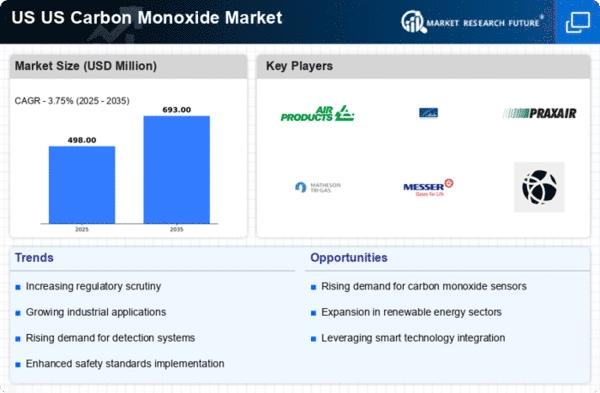
    US Carbon Monoxide Market Infographic
    Purchase Options

    Market Analysis

    In-depth Analysis of US Carbon Monoxide Market Industry Landscape

    The carbon monoxide (CO) market in the United States is undergoing dynamic changes driven by a combination of factors that influence both supply and demand. Carbon monoxide, a colorless and odorless gas, plays a significant role in various industries, from manufacturing and chemical processes to the production of specialty chemicals. The market dynamics are shaped by technological advancements, regulatory considerations, safety concerns, and the diverse applications of carbon monoxide.

    One key dynamic in the U.S. carbon monoxide market is the increasing demand from industries that utilize the gas for various applications. Carbon monoxide is an essential component in the production of chemicals, such as methanol and acetic acid, as well as in metallurgical processes like the reduction of iron ore. The growth in manufacturing, chemical, and metallurgical industries contributes to the rising demand for carbon monoxide. Manufacturers are adapting to this demand by investing in efficient production processes to ensure a stable and reliable supply of high-purity carbon monoxide.

    Regulatory considerations play a crucial role in shaping the market dynamics of carbon monoxide in the United States. The gas is subject to strict regulations to ensure safety, with organizations like the Occupational Safety and Health Administration (OSHA) setting standards for permissible exposure limits. Additionally, environmental regulations govern emissions from industrial processes where carbon monoxide is generated. Compliance with these regulations is a significant aspect for producers, influencing production practices and the overall structure of the carbon monoxide market.

    Safety concerns surrounding carbon monoxide are another important factor influencing the market dynamics. Given its toxic nature, safe handling, storage, and transportation of carbon monoxide are paramount. Stringent safety protocols are in place to prevent accidental releases and ensure the protection of workers and the surrounding environment. As safety standards evolve, manufacturers and users of carbon monoxide must invest in technologies and practices that mitigate the risks associated with its production and application.

    Technological advancements contribute to the dynamic nature of the U.S. carbon monoxide market. Innovations in production methods, such as advanced catalytic processes and gas separation technologies, enhance the efficiency and cost-effectiveness of carbon monoxide manufacturing. The development of cleaner and more sustainable production methods aligns with the broader industry trends toward environmentally friendly practices. Moreover, advancements in carbon monoxide sensors and monitoring technologies contribute to improved safety measures in various applications.

    Competition within the market fosters innovation and efficiency in carbon monoxide production. Companies are constantly seeking ways to differentiate themselves by optimizing production processes, ensuring product quality, and offering reliable supply chains. The competitive landscape drives manufacturers to explore new technologies and methods to enhance the overall value proposition for customers across different industries.

    The energy sector also plays a role in shaping the market dynamics of carbon monoxide in the United States. The gas is utilized in various energy-related applications, including the production of synthesis gas for use in power generation and as a feedstock for fuel cells. As the energy industry evolves with an increased focus on cleaner and more sustainable practices, the demand for carbon monoxide in these applications is likely to be influenced by the transition to renewable energy sources.

    Socio-economic factors, including economic growth, industrialization, and infrastructure development, contribute to the market dynamics of carbon monoxide. As industries expand and new infrastructure projects emerge, the demand for carbon monoxide as an essential industrial gas is expected to grow. Economic trends and shifts in industrial activities influence the consumption patterns and requirements of carbon monoxide users.


    Author
    Chitranshi Jaiswal
    Research Analyst Level I

    In her 3 years of experience in the market research field, she has handled critical cross-domain projects. She has an in-depth knowledge of market estimation & analysis, problem-solving, primary as well as secondary research, and team management.She holds an engineering degree and is an MBA professional from a well-known university, capable of evaluating the market and competitive conditions. An exceptional strategist with excellent communication skills and a passion for delivering cutting-edge & practical insights for the market. Proficient in multi-tasking, and can successfully deal with competing demands, while maintaining complete confidentiality. Generated business through active client and project development, networking, and high-quality responses. Her knowledge and skills have helped in making solid business decisions, securing funding from investors, and avoiding business failures.

    Leave a Comment

    FAQs

    How much is the carbon monoxide market?

    The US carbon monoxide market size was valued at USD 0.51 Billion in 2022.

    What is the expansion rate of the carbon monoxide market?

    US Carbon Monoxide Market is expected to grow with a CAGR of 5.5% in the period 2025-2035

    Who are the prominent players in the carbon monoxide market?

    The prominent players in the carbon monoxide market are Air Products, Praxair, Air Liquide, Linde Plc., and American Gas Products.

    Which application had the most extensive market share in the carbon monoxide market?

    The road construction category had the largest share of the market.

    Market Summary

    The US Carbon Monoxide market is projected to grow from 0.57 USD Million in 2024 to 1.03 USD Million by 2035.

    Key Market Trends & Highlights

    US Carbon Monoxide Key Trends and Highlights

    • The market is expected to experience a compound annual growth rate of 6.5 percent from 2025 to 2035. By 2035, the market valuation is anticipated to reach 2500 USD Million, indicating robust growth. in 2024, the market is valued at 0.57 USD Million, reflecting a solid foundation for future expansion. Growing adoption of safety regulations due to increasing awareness of carbon monoxide hazards is a major market driver.

    Market Size & Forecast

    2024 Market Size 0.57 (USD Million)
    2035 Market Size 1.03 (USD Million)
    CAGR (2025 - 2035) 5.50%
    Largest Regional Market Share in 2024 -)

    Major Players

    <p>Apple Inc (US), Microsoft Corp (US), Amazon.com Inc (US), Alphabet Inc (US), Berkshire Hathaway Inc (US), Tesla Inc (US), Meta Platforms Inc (US), Johnson &amp; Johnson (US), Visa Inc (US), Samsung Electronics Co Ltd (KR)</p>

    Market Trends

    Swelling demand for organic and inorganic chemicals is driving the market growth.

    The US carbon monoxide market CAGR is expanding due to the growing demand for chemicals from sectors such as pharmaceuticals, bulk chemical manufacturing, construction, and food & beverages, which is expected to drive market growth. CO is an important industrial compound employed in producing syngas or water gas. Syngas are used as fuel in industrial operations and are an efficient reducing agent used in producing metal from their oxides. For instance, CO is passed over iron oxides to form metallic iron, which drives the carbon monoxide market revenue.

    Additionally, the increasing emphasis on syngas as a cleaner alternative for energy generation propels demand. Carbon monoxide's role in manufacturing various chemicals further boosts its significance. As industries prioritize sustainable practices, the versatile applications of carbon monoxide contribute to its high demand, establishing it as a pivotal component in processes that span energy, chemicals, and manufacturing sectors worldwide.

    Furthermore, governments worldwide are increasingly recognizing the importance of mitigating carbon emissions and are allocating substantial funds to support projects and technologies focused on carbon monoxide reduction. These financial incentives incentivize industries to adopt cleaner processes and invest in carbon monoxide capture and utilization technologies. Funding initiatives range from research and development grants to subsidies for carbon capture infrastructure. This financial support not only accelerates innovation but also fosters the adoption of sustainable practices, positioning the carbon monoxide market as a key player in the US transition towards a low-carbon future.

    US Carbon Monoxide Market Market Drivers

    Regulatory Compliance and Standards

    Stringent regulatory compliance and safety standards are crucial drivers in the Global US Carbon Monoxide Market Industry. Government agencies have established regulations mandating the installation of carbon monoxide detectors in residential and commercial properties. This regulatory framework not only enhances public safety but also stimulates market demand for compliant products. As municipalities enforce these regulations, manufacturers are compelled to innovate and meet safety standards, thereby expanding their market presence. The anticipated growth trajectory suggests that the market could reach 2500 USD Million by 2035, driven by ongoing regulatory pressures.

    Expansion of the Construction Sector

    The expansion of the construction sector plays a vital role in driving the Global US Carbon Monoxide Market Industry. As new residential and commercial buildings are constructed, the demand for carbon monoxide detection systems is expected to rise correspondingly. Builders and developers are increasingly incorporating safety features into their designs to comply with regulations and meet consumer expectations. This trend is likely to contribute to the market's growth, with projections indicating a potential market value of 2500 USD Million by 2035. The construction industry's focus on safety and compliance will continue to influence market dynamics.

    Rising Awareness of Carbon Monoxide Risks

    The increasing awareness regarding the dangers associated with carbon monoxide exposure is a pivotal driver in the Global US Carbon Monoxide Market Industry. Public health campaigns and educational initiatives have highlighted the risks of carbon monoxide poisoning, particularly in residential settings. This heightened awareness has led to a surge in demand for carbon monoxide detectors and monitoring systems. As a result, the market is projected to reach 1250 USD Million in 2024, reflecting a growing recognition of safety measures. Furthermore, regulatory bodies are emphasizing the importance of compliance with safety standards, further propelling market growth.

    Growing Demand for Residential Safety Solutions

    The escalating demand for residential safety solutions is a significant factor propelling the Global US Carbon Monoxide Market Industry. Homeowners are increasingly prioritizing safety measures to protect their families from potential hazards, including carbon monoxide exposure. This trend is reflected in the rising sales of carbon monoxide detectors and alarms, which are becoming standard fixtures in homes. As awareness of indoor air quality and safety continues to grow, the market is expected to experience robust growth. The projected market value of 1250 USD Million in 2024 underscores the increasing investment in safety technologies.

    Technological Advancements in Detection Equipment

    Technological innovations in carbon monoxide detection equipment are significantly influencing the Global US Carbon Monoxide Market Industry. The development of advanced sensors and smart detection systems has enhanced the accuracy and reliability of monitoring devices. These innovations not only improve safety but also integrate with home automation systems, appealing to tech-savvy consumers. As the market evolves, these advancements are expected to contribute to a compound annual growth rate of 6.5% from 2025 to 2035. The integration of artificial intelligence and IoT capabilities into detection systems is likely to further drive market expansion.

    Market Segment Insights

    Carbon Monoxide Application Insights

    <p>The US carbon monoxide market segmentation, based on application, includes metal fabrication, chemicals, ore processing &amp; extraction, pharma &amp; biotechnology, and electronics. The <a href="https://www.marketresearchfuture.com/reports/metal-fabrication-market-23082">metal fabrication</a> category held a major market share due to its crucial role in the production of metals through processes like hydrogen reduction. Carbon monoxide serves as a reducing agent, facilitating the extraction of metals from ores, particularly in the production of iron and steel.</p>

    <p>This demand is further fueled by the growth in the <a href="https://www.marketresearchfuture.com/reports/construction-market-16065">construction</a> and manufacturing industries, emphasizing the indispensable nature of carbon monoxide in metal fabrication processes, contributing to the overall expansion of the market. However, pharma &amp; biotechnology is the fastest-growing category due to its pivotal role in specialized applications. Carbon monoxide, sourced from various methods, serves as a crucial component in pharmaceutical manufacturing processes, enabling the synthesis of key products. Its utility extends to biotechnology for enhancing cell culture conditions and optimizing fermentation processes.</p>

    <p>The demand is further fueled by the industry's focus on efficient and sustainable production methods, emphasizing the critical role of carbon monoxide in advancing pharmaceutical and biotechnological innovations.</p>

    Carbon Monoxide Country Insights

    <p>The carbon monoxide market in the US is propelled by its widespread applications in diverse industries. Chemicals are crucial raw materials in the production of chemicals, plastics, and pharmaceuticals, fostering demand across manufacturing sectors. Additionally, carbon monoxide is extensively utilized in the presentation of metals, such as steel and iron, further boosting its market growth as these industries expand. The rising emphasis on clean energy and the shift towards hydrogen production through various methods, including carbon monoxide reforming, adds a sustainable dimension to its market.</p>

    <p>Strict regulations addressing environmental concerns and promoting cleaner industrial practices also stimulate the adoption of carbon monoxide as an essential component in emission control technologies, contributing to its sustained relevance in the US market.</p>

    Get more detailed insights about US Carbon Monoxide Market Research Report - Forecast by 2035

    Regional Insights

    Key Players and Competitive Insights

    Leading market participants are investing heavily in research and development to enhance their product lines, which will help the carbon monoxide market expand even more. Market participants are also undertaking different strategic activities to extend their footprint, with significant market developments including new product establishment, mergers and acquisitions, contractual agreements, and collaboration with other organizations. The carbon monoxide industry must deliver cost-effective items to extend and stay in a more competitive and growing market climate.

    Major players in the carbon monoxide market are attempting to expand market demand by investing in research and development operations, including Air Products, Praxair, Air Liquide, Linde Plc., and American Gas Products.

    Key Companies in the US Carbon Monoxide Market market include

    Industry Developments

    February 2022: Linde entered into an expanded agreement with Celanese to enhance prescreens. Linde expanded its existing agreement with Celanese Corporation to begin supplying carbon dioxide and hydrogen to the Celanese manufacturing establishment in Clear Lake, Texas.

    Future Outlook

    US Carbon Monoxide Market Future Outlook

    <p>The US Carbon Monoxide Market is poised for growth at a 5.50% CAGR from 2025 to 2035, driven by regulatory advancements, technological innovations, and increasing safety awareness.</p>

    New opportunities lie in:

    • <p>Develop advanced carbon monoxide detection systems for residential use. Invest in R&amp;D for carbon monoxide capture technologies. Expand market presence in emerging economies with high industrial growth.</p>

    <p>By 2035, the US Carbon Monoxide Market is expected to achieve robust growth, reflecting enhanced safety and technological integration.</p>

    Market Segmentation

    Carbon Monoxide Application Outlook

    • Metal Fabrication
    • Chemicals
    • Ore Processing & Extraction
    • Pharma & Biotechnology
    • Electronics

    Report Scope

    Report Attribute/Metric Details
    Market Size 2024 USD 0.57 Billion
    Market Size 2025 USD 0.6 Billion
    Market Size 2035 1.03 (Value (USD Billion))
    Compound Annual Growth Rate (CAGR) 5.50% (2025 - 2035)
    Base Year 2024
    Market Forecast Period 2025 - 2035
    Historical Data 2020-2024
    Market Forecast Units Value (USD Billion)
    Report Coverage Growth Factors, Revenue Forecast, Market Competitive Landscape, and Trends
    Segments Covered Application and Region
    Countries Covered The US.
    Key Companies Profiled Air Products, Praxair, Air Liquide, Linde Plc., and American Gas Products.
    Key Market Opportunities Swelling demand for organic and inorganic chemicals The availability of funding from the Government
    Key Market Dynamics Growing environmental concerns regarding soil erosion. The expansion in the use of carbon monoxide in a broad range of construction applications.

    FAQs

    How much is the carbon monoxide market?

    The US carbon monoxide market size was valued at USD 0.51 Billion in 2022.

    What is the expansion rate of the carbon monoxide market?

    US Carbon Monoxide Market is expected to grow with a CAGR of 5.5% in the period 2025-2035

    Who are the prominent players in the carbon monoxide market?

    The prominent players in the carbon monoxide market are Air Products, Praxair, Air Liquide, Linde Plc., and American Gas Products.

    Which application had the most extensive market share in the carbon monoxide market?

    The road construction category had the largest share of the market.

    1. SECTION I: EXECUTIVE SUMMARY AND KEY HIGHLIGHTS
      1. | 1.1 EXECUTIVE SUMMARY
      2. | | 1.1.1 Market Overview
      3. | | 1.1.2 Key Findings
      4. | | 1.1.3 Market Segmentation
      5. | | 1.1.4 Competitive Landscape
      6. | | 1.1.5 Challenges and Opportunities
      7. | | 1.1.6 Future Outlook
    2. SECTION II: SCOPING, METHODOLOGY AND MARKET STRUCTURE
      1. | 2.1 MARKET INTRODUCTION
      2. | | 2.1.1 Definition
      3. | | 2.1.2 Scope of the study
      4. | | | 2.1.2.1 Research Objective
      5. | | | 2.1.2.2 Assumption
      6. | | | 2.1.2.3 Limitations
      7. | 2.2 RESEARCH METHODOLOGY
      8. | | 2.2.1 Overview
      9. | | 2.2.2 Data Mining
      10. | | 2.2.3 Secondary Research
      11. | | 2.2.4 Primary Research
      12. | | | 2.2.4.1 Primary Interviews and Information Gathering Process
      13. | | | 2.2.4.2 Breakdown of Primary Respondents
      14. | | 2.2.5 Forecasting Model
      15. | | 2.2.6 Market Size Estimation
      16. | | | 2.2.6.1 Bottom-Up Approach
      17. | | | 2.2.6.2 Top-Down Approach
      18. | | 2.2.7 Data Triangulation
      19. | | 2.2.8 Validation
    3. SECTION III: QUALITATIVE ANALYSIS
      1. | 3.1 MARKET DYNAMICS
      2. | | 3.1.1 Overview
      3. | | 3.1.2 Drivers
      4. | | 3.1.3 Restraints
      5. | | 3.1.4 Opportunities
      6. | 3.2 MARKET FACTOR ANALYSIS
      7. | | 3.2.1 Value chain Analysis
      8. | | 3.2.2 Porter's Five Forces Analysis
      9. | | | 3.2.2.1 Bargaining Power of Suppliers
      10. | | | 3.2.2.2 Bargaining Power of Buyers
      11. | | | 3.2.2.3 Threat of New Entrants
      12. | | | 3.2.2.4 Threat of Substitutes
      13. | | | 3.2.2.5 Intensity of Rivalry
      14. | | 3.2.3 COVID-19 Impact Analysis
      15. | | | 3.2.3.1 Market Impact Analysis
      16. | | | 3.2.3.2 Regional Impact
      17. | | | 3.2.3.3 Opportunity and Threat Analysis
    4. SECTION IV: QUANTITATIVE ANALYSIS
      1. | 4.1 Chemicals and Materials, BY Application (USD Billion)
      2. | | 4.1.1 Metal Fabrication
      3. | | 4.1.2 Chemicals
      4. | | 4.1.3 Ore Processing & Extraction
      5. | | 4.1.4 Pharma & Biotechnology
      6. | | 4.1.5 Electronics
      7. | 4.2 Chemicals and Materials, BY Region (USD Billion)
      8. | | 4.2.1 North America
      9. | | | 4.2.1.1 US
      10. | | | 4.2.1.2 Canada
      11. | | 4.2.2 Europe
      12. | | | 4.2.2.1 Germany
      13. | | | 4.2.2.2 UK
      14. | | | 4.2.2.3 France
      15. | | | 4.2.2.4 Russia
      16. | | | 4.2.2.5 Italy
      17. | | | 4.2.2.6 Spain
      18. | | | 4.2.2.7 Rest of Europe
      19. | | 4.2.3 APAC
      20. | | | 4.2.3.1 China
      21. | | | 4.2.3.2 India
      22. | | | 4.2.3.3 Japan
      23. | | | 4.2.3.4 South Korea
      24. | | | 4.2.3.5 Malaysia
      25. | | | 4.2.3.6 Thailand
      26. | | | 4.2.3.7 Indonesia
      27. | | | 4.2.3.8 Rest of APAC
      28. | | 4.2.4 South America
      29. | | | 4.2.4.1 Brazil
      30. | | | 4.2.4.2 Mexico
      31. | | | 4.2.4.3 Argentina
      32. | | | 4.2.4.4 Rest of South America
      33. | | 4.2.5 MEA
      34. | | | 4.2.5.1 GCC Countries
      35. | | | 4.2.5.2 South Africa
      36. | | | 4.2.5.3 Rest of MEA
    5. SECTION V: COMPETITIVE ANALYSIS
      1. | 5.1 Competitive Landscape
      2. | | 5.1.1 Overview
      3. | | 5.1.2 Competitive Analysis
      4. | | 5.1.3 Market share Analysis
      5. | | 5.1.4 Major Growth Strategy in the Chemicals and Materials
      6. | | 5.1.5 Competitive Benchmarking
      7. | | 5.1.6 Leading Players in Terms of Number of Developments in the Chemicals and Materials
      8. | | 5.1.7 Key developments and growth strategies
      9. | | | 5.1.7.1 New Product Launch/Service Deployment
      10. | | | 5.1.7.2 Merger & Acquisitions
      11. | | | 5.1.7.3 Joint Ventures
      12. | | 5.1.8 Major Players Financial Matrix
      13. | | | 5.1.8.1 Sales and Operating Income
      14. | | | 5.1.8.2 Major Players R&D Expenditure. 2023
      15. | 5.2 Company Profiles
      16. | | 5.2.1 Honeywell International Inc (US)
      17. | | | 5.2.1.1 Financial Overview
      18. | | | 5.2.1.2 Products Offered
      19. | | | 5.2.1.3 Key Developments
      20. | | | 5.2.1.4 SWOT Analysis
      21. | | | 5.2.1.5 Key Strategies
      22. | | 5.2.2 MSA Safety Incorporated (US)
      23. | | | 5.2.2.1 Financial Overview
      24. | | | 5.2.2.2 Products Offered
      25. | | | 5.2.2.3 Key Developments
      26. | | | 5.2.2.4 SWOT Analysis
      27. | | | 5.2.2.5 Key Strategies
      28. | | 5.2.3 General Electric Company (US)
      29. | | | 5.2.3.1 Financial Overview
      30. | | | 5.2.3.2 Products Offered
      31. | | | 5.2.3.3 Key Developments
      32. | | | 5.2.3.4 SWOT Analysis
      33. | | | 5.2.3.5 Key Strategies
      34. | | 5.2.4 3M Company (US)
      35. | | | 5.2.4.1 Financial Overview
      36. | | | 5.2.4.2 Products Offered
      37. | | | 5.2.4.3 Key Developments
      38. | | | 5.2.4.4 SWOT Analysis
      39. | | | 5.2.4.5 Key Strategies
      40. | | 5.2.5 Siemens AG (DE)
      41. | | | 5.2.5.1 Financial Overview
      42. | | | 5.2.5.2 Products Offered
      43. | | | 5.2.5.3 Key Developments
      44. | | | 5.2.5.4 SWOT Analysis
      45. | | | 5.2.5.5 Key Strategies
      46. | | 5.2.6 Emerson Electric Co (US)
      47. | | | 5.2.6.1 Financial Overview
      48. | | | 5.2.6.2 Products Offered
      49. | | | 5.2.6.3 Key Developments
      50. | | | 5.2.6.4 SWOT Analysis
      51. | | | 5.2.6.5 Key Strategies
      52. | | 5.2.7 Drägerwerk AG & Co KGaA (DE)
      53. | | | 5.2.7.1 Financial Overview
      54. | | | 5.2.7.2 Products Offered
      55. | | | 5.2.7.3 Key Developments
      56. | | | 5.2.7.4 SWOT Analysis
      57. | | | 5.2.7.5 Key Strategies
      58. | | 5.2.8 National Instruments Corporation (US)
      59. | | | 5.2.8.1 Financial Overview
      60. | | | 5.2.8.2 Products Offered
      61. | | | 5.2.8.3 Key Developments
      62. | | | 5.2.8.4 SWOT Analysis
      63. | | | 5.2.8.5 Key Strategies
      64. | | 5.2.9 Kidde (US)
      65. | | | 5.2.9.1 Financial Overview
      66. | | | 5.2.9.2 Products Offered
      67. | | | 5.2.9.3 Key Developments
      68. | | | 5.2.9.4 SWOT Analysis
      69. | | | 5.2.9.5 Key Strategies
      70. | | 5.2.10 RKI Instruments Inc (US)
      71. | | | 5.2.10.1 Financial Overview
      72. | | | 5.2.10.2 Products Offered
      73. | | | 5.2.10.3 Key Developments
      74. | | | 5.2.10.4 SWOT Analysis
      75. | | | 5.2.10.5 Key Strategies
      76. | 5.3 Appendix
      77. | | 5.3.1 References
      78. | | 5.3.2 Related Reports
    6. LIST OF FIGURES
      1. | 6.1 MARKET SYNOPSIS
      2. | 6.2 NORTH AMERICA MARKET ANALYSIS
      3. | 6.3 US MARKET ANALYSIS BY APPLICATION
      4. | 6.4 CANADA MARKET ANALYSIS BY APPLICATION
      5. | 6.5 EUROPE MARKET ANALYSIS
      6. | 6.6 GERMANY MARKET ANALYSIS BY APPLICATION
      7. | 6.7 UK MARKET ANALYSIS BY APPLICATION
      8. | 6.8 FRANCE MARKET ANALYSIS BY APPLICATION
      9. | 6.9 RUSSIA MARKET ANALYSIS BY APPLICATION
      10. | 6.10 ITALY MARKET ANALYSIS BY APPLICATION
      11. | 6.11 SPAIN MARKET ANALYSIS BY APPLICATION
      12. | 6.12 REST OF EUROPE MARKET ANALYSIS BY APPLICATION
      13. | 6.13 APAC MARKET ANALYSIS
      14. | 6.14 CHINA MARKET ANALYSIS BY APPLICATION
      15. | 6.15 INDIA MARKET ANALYSIS BY APPLICATION
      16. | 6.16 JAPAN MARKET ANALYSIS BY APPLICATION
      17. | 6.17 SOUTH KOREA MARKET ANALYSIS BY APPLICATION
      18. | 6.18 MALAYSIA MARKET ANALYSIS BY APPLICATION
      19. | 6.19 THAILAND MARKET ANALYSIS BY APPLICATION
      20. | 6.20 INDONESIA MARKET ANALYSIS BY APPLICATION
      21. | 6.21 REST OF APAC MARKET ANALYSIS BY APPLICATION
      22. | 6.22 SOUTH AMERICA MARKET ANALYSIS
      23. | 6.23 BRAZIL MARKET ANALYSIS BY APPLICATION
      24. | 6.24 MEXICO MARKET ANALYSIS BY APPLICATION
      25. | 6.25 ARGENTINA MARKET ANALYSIS BY APPLICATION
      26. | 6.26 REST OF SOUTH AMERICA MARKET ANALYSIS BY APPLICATION
      27. | 6.27 MEA MARKET ANALYSIS
      28. | 6.28 GCC COUNTRIES MARKET ANALYSIS BY APPLICATION
      29. | 6.29 SOUTH AFRICA MARKET ANALYSIS BY APPLICATION
      30. | 6.30 REST OF MEA MARKET ANALYSIS BY APPLICATION
      31. | 6.31 KEY BUYING CRITERIA OF CHEMICALS AND MATERIALS
      32. | 6.32 RESEARCH PROCESS OF MRFR
      33. | 6.33 DRO ANALYSIS OF CHEMICALS AND MATERIALS
      34. | 6.34 DRIVERS IMPACT ANALYSIS: CHEMICALS AND MATERIALS
      35. | 6.35 RESTRAINTS IMPACT ANALYSIS: CHEMICALS AND MATERIALS
      36. | 6.36 SUPPLY / VALUE CHAIN: CHEMICALS AND MATERIALS
      37. | 6.37 CHEMICALS AND MATERIALS, BY APPLICATION, 2024 (% SHARE)
      38. | 6.38 CHEMICALS AND MATERIALS, BY APPLICATION, 2024 TO 2035 (USD Billion)
      39. | 6.39 BENCHMARKING OF MAJOR COMPETITORS
    7. LIST OF TABLES
      1. | 7.1 LIST OF ASSUMPTIONS
      2. | | 7.1.1
      3. | 7.2 North America MARKET SIZE ESTIMATES; FORECAST
      4. | | 7.2.1 BY APPLICATION, 2025-2035 (USD Billion)
      5. | 7.3 US MARKET SIZE ESTIMATES; FORECAST
      6. | | 7.3.1 BY APPLICATION, 2025-2035 (USD Billion)
      7. | 7.4 Canada MARKET SIZE ESTIMATES; FORECAST
      8. | | 7.4.1 BY APPLICATION, 2025-2035 (USD Billion)
      9. | 7.5 Europe MARKET SIZE ESTIMATES; FORECAST
      10. | | 7.5.1 BY APPLICATION, 2025-2035 (USD Billion)
      11. | 7.6 Germany MARKET SIZE ESTIMATES; FORECAST
      12. | | 7.6.1 BY APPLICATION, 2025-2035 (USD Billion)
      13. | 7.7 UK MARKET SIZE ESTIMATES; FORECAST
      14. | | 7.7.1 BY APPLICATION, 2025-2035 (USD Billion)
      15. | 7.8 France MARKET SIZE ESTIMATES; FORECAST
      16. | | 7.8.1 BY APPLICATION, 2025-2035 (USD Billion)
      17. | 7.9 Russia MARKET SIZE ESTIMATES; FORECAST
      18. | | 7.9.1 BY APPLICATION, 2025-2035 (USD Billion)
      19. | 7.10 Italy MARKET SIZE ESTIMATES; FORECAST
      20. | | 7.10.1 BY APPLICATION, 2025-2035 (USD Billion)
      21. | 7.11 Spain MARKET SIZE ESTIMATES; FORECAST
      22. | | 7.11.1 BY APPLICATION, 2025-2035 (USD Billion)
      23. | 7.12 Rest of Europe MARKET SIZE ESTIMATES; FORECAST
      24. | | 7.12.1 BY APPLICATION, 2025-2035 (USD Billion)
      25. | 7.13 APAC MARKET SIZE ESTIMATES; FORECAST
      26. | | 7.13.1 BY APPLICATION, 2025-2035 (USD Billion)
      27. | 7.14 China MARKET SIZE ESTIMATES; FORECAST
      28. | | 7.14.1 BY APPLICATION, 2025-2035 (USD Billion)
      29. | 7.15 India MARKET SIZE ESTIMATES; FORECAST
      30. | | 7.15.1 BY APPLICATION, 2025-2035 (USD Billion)
      31. | 7.16 Japan MARKET SIZE ESTIMATES; FORECAST
      32. | | 7.16.1 BY APPLICATION, 2025-2035 (USD Billion)
      33. | 7.17 South Korea MARKET SIZE ESTIMATES; FORECAST
      34. | | 7.17.1 BY APPLICATION, 2025-2035 (USD Billion)
      35. | 7.18 Malaysia MARKET SIZE ESTIMATES; FORECAST
      36. | | 7.18.1 BY APPLICATION, 2025-2035 (USD Billion)
      37. | 7.19 Thailand MARKET SIZE ESTIMATES; FORECAST
      38. | | 7.19.1 BY APPLICATION, 2025-2035 (USD Billion)
      39. | 7.20 Indonesia MARKET SIZE ESTIMATES; FORECAST
      40. | | 7.20.1 BY APPLICATION, 2025-2035 (USD Billion)
      41. | 7.21 Rest of APAC MARKET SIZE ESTIMATES; FORECAST
      42. | | 7.21.1 BY APPLICATION, 2025-2035 (USD Billion)
      43. | 7.22 South America MARKET SIZE ESTIMATES; FORECAST
      44. | | 7.22.1 BY APPLICATION, 2025-2035 (USD Billion)
      45. | 7.23 Brazil MARKET SIZE ESTIMATES; FORECAST
      46. | | 7.23.1 BY APPLICATION, 2025-2035 (USD Billion)
      47. | 7.24 Mexico MARKET SIZE ESTIMATES; FORECAST
      48. | | 7.24.1 BY APPLICATION, 2025-2035 (USD Billion)
      49. | 7.25 Argentina MARKET SIZE ESTIMATES; FORECAST
      50. | | 7.25.1 BY APPLICATION, 2025-2035 (USD Billion)
      51. | 7.26 Rest of South America MARKET SIZE ESTIMATES; FORECAST
      52. | | 7.26.1 BY APPLICATION, 2025-2035 (USD Billion)
      53. | 7.27 MEA MARKET SIZE ESTIMATES; FORECAST
      54. | | 7.27.1 BY APPLICATION, 2025-2035 (USD Billion)
      55. | 7.28 GCC Countries MARKET SIZE ESTIMATES; FORECAST
      56. | | 7.28.1 BY APPLICATION, 2025-2035 (USD Billion)
      57. | 7.29 South Africa MARKET SIZE ESTIMATES; FORECAST
      58. | | 7.29.1 BY APPLICATION, 2025-2035 (USD Billion)
      59. | 7.30 Rest of MEA MARKET SIZE ESTIMATES; FORECAST
      60. | | 7.30.1 BY APPLICATION, 2025-2035 (USD Billion)
      61. | 7.31 PRODUCT LAUNCH/PRODUCT DEVELOPMENT/APPROVAL
      62. | | 7.31.1
      63. | 7.32 ACQUISITION/PARTNERSHIP
      64. | | 7.32.1

    US Carbon Monoxide Market Segmentation

    Market Segmentation Overview

    • Detailed segmentation data will be available in the full report
    • Comprehensive analysis by multiple parameters
    • Regional and country-level breakdowns
    • Market size forecasts by segment
    Infographic

    Free Sample Request

    Kindly complete the form below to receive a free sample of this Report

    Get Free Sample

    Customer Strories

    “I am very pleased with how market segments have been defined in a relevant way for my purposes (such as "Portable Freezers & refrigerators" and "last-mile"). In general the report is well structured. Thanks very much for your efforts.”

    Victoria Milne

    Founder
    Case Study
    Chemicals and Materials

    Compare Licence

    ×
    Features License Type
    Single User Multiuser License Enterprise User
    Price $4,950 $5,950 $7,250
    Maximum User Access Limit 1 User Upto 10 Users Unrestricted Access Throughout the Organization
    Free Customization
    Direct Access to Analyst
    Deliverable Format
    Platform Access
    Discount on Next Purchase 10% 15% 15%
    Printable Versions