• Cat-intel
  • MedIntelliX
  • Resources
  • About Us
  • Hero Background
    English
    Chinese
    French
    Japanese
    Korean
    German
    Spanish

    Organic Pesticides Market Analysis

    ID: MRFR/AGR/5266-CR
    140 Pages
    Pradeep Nandi
    September 2019

    Organic Pesticides Market Research Report Information By Type (Natural, and Synthetic), By Crop Type (Cereals & Grains, Oilseeds & Pulses, Fruits & Vegetables, and Others), By Application (Foliar, Soil Treatment, Seed Treatment, Others), And By Region (North America, Europe, Asia-Pacific, And Rest Of The World) –Market Forecast Till 2035

    Share:
    Download PDF ×

    We do not share your information with anyone. However, we may send you emails based on your report interest from time to time. You may contact us at any time to opt-out.

    Organic Pesticides Market Infographic
    Purchase Options

    Market Analysis

    In-depth Analysis of Organic Pesticides Market Industry Landscape

    The size of the organic pesticide market depends on various factors that influence its growth trajectory collectively. One such factor driving this market's expansion is the increasing global demand for organic products along with environmentally friendly farming methods. Consequently, rising awareness among consumers about the impact conventional agrochemicals have on the environment and health has increased their desire for natural substitutes like organic ones, which may be used to control pests during crop growth or storage. By 2027, Global Organic Pesticides Market is projected to be worth USD 8,318.6 Million with an expected Compound Annual Growth Rate (CAGR) of 8.4%. Furthermore, the organic pesticide market is also supported by regulatory frameworks and government initiatives that promote organic farming. To encourage organic farming methods, many countries have adopted strict rules limiting the use of synthetic chemicals in agriculture. Consequently, governments provide subsidies and grants to farmers, thereby encouraging the growth of the industry mentioned above. The organic pesticide adoption environment and market expansion are facilitated by industry practices aligned with regulatory standards. Another important factor is an increased awareness among farmers about the environmental and health benefits associated with using organic pesticides. Conventional pesticides have come under scrutiny because of their potential adverse impacts on human health and ecology, causing a shift towards organics by farmers globally. Moreover, the trend towards Integrated Pest Management (IPM) practices has significantly impacted the organic pesticide market size. IPM constitutes a holistic, sustainable pest control approach employing both biological, cultural, mechanical, and targeted insecticide application methodologies. Therefore, considering that this systematic approach seamlessly incorporates biopesticides into IPM strategies, it offers an alternative for controlling pests while leaving less of an environmental footprint than conventional agrochemicals utilized in agricultural production systems. As more farmers around the globe adopt IPM principles, demand for organic pesticides continues to rise, propelling market growth. Moreover, the growth in demand for organic food products has a direct effect on the organic pest control market. The increasing buyer inclination towards organically grown foods that are free from artificial fertilizers pushes farmers to employ organic farming principles and use organic pesticides. Nevertheless, there are some considerations for market growth, such as limited efficacy against some pests and high production costs, among others. In cases of severe infestation by pests, synthetic choices may work better than their organic counterparts; hence, not all organic pesticides have similar efficacy levels. To conclude, a range of factors, including customer preferences towards organic products, regulation support of organic farming, increasing farmer awareness, and adoption of IPM techniques coupled with the expanding market for organic food, determines the size of the Organic Pesticides market.

    Author
    Pradeep Nandi
    Senior Research Analyst

    I have a bachelor's degree in mechanical engineering and an MBA. I have more than two years of expertise in the retail, food, and beverage, chemical, and material industries, and hence have developed a sound cross-domain expertise. A firm believer in lifelong learning and sharing of knowledge. Having a proclivity for hatching ideas and trying to absorb as much information as possible in a short amount of time. Introducing corporates to the data and insight, which enables them to move from probability to possibility, has been my key areas of interest. 

    Leave a Comment

    FAQs

    How much is the organic pesticides market?

    The organic pesticides market size was valued at USD 5.1 Billion in 2022.

    What is the growth rate of the organic pesticide market?

    The market is projected to grow at a CAGR of 7.31 % during the forecast period, 2024-2032.

    Which region held the largest market share in the organic pesticides market?

    North America had the largest share of the market.

    Who are the key players in the organic pesticide market?

    The key players in the market are Andermatt Group AG, BASF SE, Arysta LifeScience Corporation., Syngenta, Bayer AG, Certis USA LLC, Dow Inc., Mark Agri Genetics Pvt. Ltd.

    Which type led the organic pesticide market?

    The natural category dominated the market in 2022.

    Which application segment had the largest market share in the organic pesticides market?

    The foliar segment had the largest share of the market.

    Market Summary

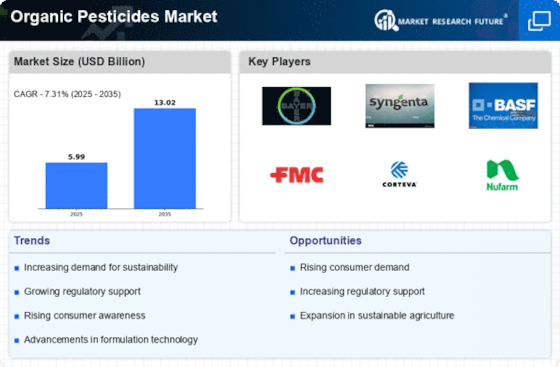
    As per Market Research Future Analysis, the Organic Pesticides Market was valued at USD 5.99 Billion in 2024 and is projected to grow to USD 13.02 Billion by 2035, with a CAGR of 7.31% from 2025 to 2035. The market is driven by increasing consumer demand for organic products, heightened awareness of health and environmental impacts of chemical pesticides, and supportive government regulations promoting organic farming. The natural segment is gaining traction due to its lower environmental impact, while fruits and vegetables dominate the crop type segment. Foliar applications are the preferred method of application, reflecting a shift towards sustainable pest management solutions.

    Key Market Trends & Highlights

    The organic pesticides market is experiencing significant growth driven by consumer preferences and regulatory support.

    • Market Size in 2024: USD 5.99 Billion
    • Projected Market Size by 2035: USD 13.02 Billion
    • CAGR from 2025 to 2035: 7.31%
    • Dominant Crop Type: Fruits & Vegetables

    Market Size & Forecast

    2024 Market Size USD 5.99 Billion
    2035 Market Size USD 13.02 Billion
    CAGR (2025-2035) 7.31%
    Largest Regional Market Share in 2024 North America

    Major Players

    Andermatt Group AG, BASF SE, Arysta LifeScience Corporation, Syngenta, Bayer AG, Certis USA LLC, Dow Inc., Mark Agri Genetics Pvt. Ltd., Parry America, Inc., Redox Industries Limited, Satpura Bio Fertiliser India Pvt Ltd, Sikkoindia

    Market Trends

    Growing consumer demand for organic products to drive market growth

    Growing consumer demand for organic products drives market CAGR. An increase in consumer demand for organic goods is one of the main reasons for boosting the value of the worldwide market for organic pesticides. As people grow increasingly aware of the risks that chemical pesticides pose to their health and the environment, demand for organic products—including both food and non-food items—is increasing rapidly. The market for organic pesticides is expanding in part due to legislation and government backing.

    For instance, many governments promote the use of organic pesticides through laws and rules that favor organic farming, such as the provision of financial help and subsidies. Demand for organic pesticides is rising as people become more aware of the advantages of organic agriculture.

    Fundamentally, compared to non-organically or conventionally produced crops, organic crops, and crop-based foods include a high amount of antioxidants, such as polyphenolics, ranging from 19% to 68%, as well as lower levels of cadmium (Cd) and pesticide residues. Those who consume organically produced foods also have a lower chance of developing chronic illnesses, such as neurological, cardiovascular, and some forms of cancer. However, organic vegetables do contain trace amounts of harmful metals and minerals. These elements have raised consumer interest in organic goods, which is boosting the demand for organic pesticides.

    For instance, to maintain sustainable agricultural output, Corteva, Inc. introduced a new organic pesticide named Entrust Organic for the Australian market in October 2021. In addition to being certified organic, the product has a good environmental profile and is selective towards important beneficial insects. The market for organic pesticides will develop throughout the projected period as a result of these new product introductions. Thus, driving the organic pesticides market revenue.

    The increasing consumer demand for sustainable agricultural practices appears to be driving the growth of the organic pesticides market, as stakeholders seek environmentally friendly alternatives to conventional chemicals.

    U.S. Department of Agriculture

    Organic Pesticides Market Market Drivers

    Market Growth Projections

    The Global Organic Pesticides Market Industry is poised for substantial growth, with projections indicating a market size of 5.99 USD Billion in 2024 and an anticipated increase to 13.0 USD Billion by 2035. This growth trajectory suggests a compound annual growth rate of 7.31% from 2025 to 2035. Such figures reflect the increasing adoption of organic farming practices and the rising demand for organic produce. The market's expansion is likely to be driven by various factors, including regulatory support, technological advancements, and heightened consumer awareness regarding sustainability. These dynamics collectively position the organic pesticides market for a promising future.

    Rising Demand for Organic Produce

    The increasing consumer preference for organic food products is a primary driver of the Global Organic Pesticides Market Industry. As health-conscious consumers become more aware of the potential risks associated with synthetic pesticides, the demand for organic alternatives has surged. This trend is reflected in the projected market growth, with the Global Organic Pesticides Market expected to reach 5.99 USD Billion in 2024. Retailers are responding by expanding their organic product lines, further fueling the need for organic pesticides. Consequently, this shift towards organic farming practices is likely to sustain the market's growth trajectory over the coming years.

    Regulatory Support for Organic Farming

    Government regulations promoting organic farming practices significantly influence the Global Organic Pesticides Market Industry. Many countries have established stringent guidelines to reduce the use of synthetic chemicals in agriculture, thereby encouraging farmers to adopt organic methods. For instance, the European Union has implemented policies that support organic farming, which in turn drives the demand for organic pesticides. This regulatory environment not only fosters market growth but also enhances consumer confidence in organic products. As a result, the market is anticipated to expand, with projections indicating a growth to 13.0 USD Billion by 2035.

    Global Population Growth and Food Security

    The rising global population and the corresponding need for food security are significant factors driving the Global Organic Pesticides Market Industry. As the world population continues to grow, the demand for food production intensifies, prompting farmers to adopt more sustainable agricultural practices. Organic farming, supported by organic pesticides, offers a viable solution to meet this demand while minimizing environmental harm. This necessity for sustainable food production is expected to propel the market forward, with projections indicating a substantial increase in market size by 2035. The interplay between population growth and sustainable agriculture underscores the importance of organic pesticides in future food systems.

    Technological Advancements in Organic Pesticides

    Innovations in the formulation and application of organic pesticides are transforming the Global Organic Pesticides Market Industry. Advances in biotechnology and natural product research have led to the development of more effective and environmentally friendly organic pesticides. These innovations not only improve pest control efficacy but also reduce the environmental impact associated with traditional pesticides. As farmers increasingly seek sustainable solutions, the adoption of these advanced organic pesticides is likely to rise. This trend is expected to contribute to a compound annual growth rate of 7.31% from 2025 to 2035, indicating a robust future for the market.

    Increased Awareness of Environmental Sustainability

    Growing awareness regarding environmental sustainability is a crucial driver of the Global Organic Pesticides Market Industry. Consumers and farmers alike are becoming more conscious of the ecological impacts of conventional farming practices, leading to a shift towards organic farming. This heightened awareness is prompting agricultural stakeholders to seek out organic pesticides that align with sustainable practices. As a result, the market is experiencing increased demand, which is likely to continue as environmental concerns remain at the forefront of agricultural discussions. This trend supports the overall growth of the organic pesticides market, reinforcing its relevance in modern agriculture.

    Market Segment Insights

    Organic Pesticides Type Insights

    The organic pesticides market segmentation, based on type includes natural and synthetic. The natural segment will account for a sizable market share in 2022. As consumers become increasingly aware of the risks that chemical pesticides pose to the environment and their health, natural insecticides are growing in popularity. Natural pesticides are less hazardous and detrimental to the environment than synthetic pesticides since they are made from natural resources like plants and minerals. The need for natural insecticides is being driven by increased consumer interest and awareness.

    Demand for natural pesticides is also being fueled by increasing government laws and support for organic farming, including financial aid and subsidies, as well as the expanding trend of organic farming.

    With a growing population, there is a higher demand for food and agricultural products. To meet this demand and ensure higher yields, farmers often resort to using synthetic organic pesticides to protect their crops from pests and diseases. Over the years, advancements in chemical synthesis and formulation technologies have made it easier and more cost-effective to produce synthetic organic pesticides. This has contributed to the availability and adoption of these pesticides in the agricultural sector.

    Organic Pesticides Crop Type Insights

    Based on crop type, the organic pesticides market segmentation includes cereals & grains, oilseeds and pulses, fruits & vegetables, and others. Fruits & vegetables dominate the market during the forecast period, as consumers around the world are becoming more health-conscious and are seeking safe and healthy food options. Fruits and vegetables are considered essential components of a balanced diet, and the demand for organic fruits and vegetables, which are grown without synthetic pesticides and chemical fertilizers, is growing. There is a growing trend of consumers preferring organic produce due to concerns about pesticide residues on conventionally grown fruits and vegetables.

    Organic Pesticides Application Insights

    The organic pesticides market segmentation, based on application, includes foliar, soil treatment, seed treatment, and others. The foliar segment dominates the market during the forecast period. As consumers become more conscious of the environmental and health impacts of conventional pesticides, the demand for organic alternatives like foliar organic pesticides is expected to rise. The convenience, effectiveness, and versatility of foliar applications make them an attractive option for farmers seeking sustainable and eco-friendly pest management solutions. Climate change and unpredictable weather patterns can lead to more frequent pest and disease outbreaks.

    Foliar applications can offer a quick response to combat these emerging challenges.

    Figure 1: Organic Pesticides Market by Application 2022 & 2032 (USD Billion)

    Source: Secondary Research, Primary Research, Market Research Future Database, and Analyst Review

    Get more detailed insights about Organic Pesticides Market Research Report : Global Forecast till 2023-2035

    Regional Insights

    By region, the study provides market insights into North America, Europe, Asia-Pacific, and Rest of the World. North America dominates the organic pesticides market. Growing demand for organic goods and growing knowledge of the advantages of organic farming are driving the market for organic pesticides in North America. The regional market's growth might be ascribed to the increased public knowledge of the advantages of organic pesticides. Another important aspect in the local market throughout the projection period is projected to be the growing use of organic pesticides as a result of the development of new procedures.

    The US is anticipated to gain the greatest market share over the study period out of all countries.

    Further, the major countries studied in the market report are The US, Canada, German, France, the UK, Italy, Spain, China, Japan, India, Australia, South Korea, and Brazil.

    Figure 2: ORGANIC PESTICIDES MARKET SHARE BY REGION 2022 (USD Billion)

    Organic Pesticides Market Share By Region 2022 (USD Billion)1

    Source: Secondary Research, Primary Research, Market Research Future Database, and Analyst Review

    Europe organic pesticides market accounts for the second-largest market share. The market share for organic pesticides is driven by increased consumer demand for ecologically friendly goods and a rise in the use of organic agricultural methods by farmers and producers. Additionally, businesses in the area make significant investments in the research and development of organic insecticides. Further, the German organic pesticides market held the largest market share, and the UK organic pesticides market was the fastest-growing market in the European region.

    The Asia Pacific Organic Pesticides Market is expected to grow at the fastest CAGR from 2023 to 2032. Asia-Pacific area, creating opportunities for the market for organic pesticides. Organic farming is being promoted by governments in nations like India, China, and Japan through policy support, subsidies, and awareness campaigns. For instance, to encourage the use of organic agricultural methods, India has created the National Programme for Organic Production (NPOP). The region's market for organic pesticides is growing in a supportive environment due to the rising use of organic farming techniques.

    Key Players and Competitive Insights

    Leading market players are investing heavily in research and development to expand their product lines, which will help the organic pesticides market grow even more. Market participants are also undertaking various strategic activities to expand their footprint, with important market developments including new product launches, contractual agreements, mergers and acquisitions, higher investments, and collaboration with other organizations. The organic pesticides industry must offer cost-effective items to expand and survive in a more competitive and rising market climate.

    Manufacturing locally to minimize operational costs is one of the key business tactics manufacturers use in the organic pesticides industry to benefit clients and increase the market sector. In recent years, the organic pesticide industry has offered some of the most significant medical advantages. Major players in the organic pesticides market, including Andermatt Group AG, BASF SE, Arysta LifeScience Corporation., Syngenta, Bayer AG, Certis USA LLC, Dow Inc., Mark Agri Genetics Pvt.

    Ltd., Parry America, Inc., Redox Industries Limited., Satpura Bio Fertiliser India Pvt Ltd, and Sikkoindia, and others, are attempting to increase market demand by investing in research and development operations.

    Syngenta has recognized the growing demand for organic and sustainable products and practices in the agricultural industry. The company has been expanding its portfolio to include more environmentally friendly and organic options. While Syngenta's core business remains focused on conventional agriculture, it has shown an interest in diversifying its offerings to cater to the growing organic market. For instance, in May 2022 Victrato, a seed treatment introduced by Syngenta through its seed care division, fights nematodes and important soil-borne fungi to boost the quality and yield of a variety of crops including soybeans, corn, cereals, cotton, and rice.

    BASF's organic pesticides may include biofungicides, bioinsecticides, and other bio-based solutions that provide effective pest and disease management while minimizing environmental impact and promoting sustainable farming practices. For instance, in October 2022 Insecticide Exponus, a new product from BASF, uses the active chemical broflanilide in a unique formulation. With the introduction of BASF's insecticide Exponus, farmers in India will be able to safeguard their crops and increase output.

    Key Companies in the Organic Pesticides Market market include

    Industry Developments

    March 2022: New pesticide Corprima was introduced by FMC India. Powered by the innovative Rynaxypyr insect control technology from FMC. One of the main problems for Indian farmers is fruit borers, therefore Corprima provides crop protection against them.

    May 2021: Sinochem and ChemChina, China's two centrally managed, state-owned chemical producers, were being reorganized and combined to create a monstrous corporation. Both businesses have their headquarters in Beijing and have several subsidiaries in various industry sectors.

    Future Outlook

    Organic Pesticides Market Future Outlook

    The Organic Pesticides Market is projected to grow at a 7.31% CAGR from 2025 to 2035, driven by increasing consumer demand for sustainable agriculture and regulatory support for organic farming.

    New opportunities lie in:

    • Develop innovative biopesticide formulations targeting specific pests to enhance efficacy.
    • Expand distribution channels through partnerships with organic retailers and e-commerce platforms.
    • Invest in research for new organic compounds to meet evolving agricultural needs.

    By 2035, the Organic Pesticides Market is expected to achieve substantial growth, reflecting a robust shift towards sustainable agricultural practices.

    Market Segmentation

    Organic Pesticides Type Outlook

    • Natural
    • Synthetic

    Organic Pesticides Regional Outlook

    North America
    • US
    • Canada

    Organic Pesticides Crop Type Outlook

    • Cereals & Grains
    • Oilseeds & Pulses
    • Fruits & Vegetables
    • Others

    Organic Pesticides Application Outlook

    • Foliar
    • Soil Treatment
    • Seed Treatment
    • Others

    Report Scope

    Report Attribute/Metric Details
    Market Size 2024 USD 5.9927856 Billion
    Market Size 2035 13.02 (Value (USD Billion))
    Compound Annual Growth Rate (CAGR) 7.31% (2025 - 2035)
    Base Year 2024
    Market Forecast Period 2025 - 2035
    Historical Data 2018- 2022
    Market Forecast Units Value (USD Billion)
    Report Coverage Revenue Forecast, Market Competitive Landscape, Growth Factors, and Trends
    Segments Covered Type, Crop Type, Application, and Region
    Geographies Covered North America, Europe, Asia Pacific, and the Rest of the World
    Countries Covered The US, Canada, German, France, UK, Italy, Spain, China, Japan, India, Australia, South Korea, and Brazil
    Key Companies Profiled Andermatt Group AG, BASF SE, Arysta LifeScience Corporation., Syngenta, Bayer AG, Certis USA LLC, Dow Inc., Mark Agri Genetics Pvt. Ltd., Parry America, Inc., Redox Industries Limited., Satpura Bio Fertiliser India Pvt Ltd, and Sikkoindia
    Key Market Opportunities Favorable support from government organizationsRising trend of e-commerce and online sales
    Key Market Dynamics Growing consumer demand for organic products
    Market Size 2025 6.43 (Value (USD Billion))

    FAQs

    How much is the organic pesticides market?

    The organic pesticides market size was valued at USD 5.1 Billion in 2022.

    What is the growth rate of the organic pesticide market?

    The market is projected to grow at a CAGR of 7.31 % during the forecast period, 2024-2032.

    Which region held the largest market share in the organic pesticides market?

    North America had the largest share of the market.

    Who are the key players in the organic pesticide market?

    The key players in the market are Andermatt Group AG, BASF SE, Arysta LifeScience Corporation., Syngenta, Bayer AG, Certis USA LLC, Dow Inc., Mark Agri Genetics Pvt. Ltd.

    Which type led the organic pesticide market?

    The natural category dominated the market in 2022.

    Which application segment had the largest market share in the organic pesticides market?

    The foliar segment had the largest share of the market.

    1. SECTION I: EXECUTIVE SUMMARY AND KEY HIGHLIGHTS
      1. | 1.1 EXECUTIVE SUMMARY
      2. | | 1.1.1 Market Overview
      3. | | 1.1.2 Key Findings
      4. | | 1.1.3 Market Segmentation
      5. | | 1.1.4 Competitive Landscape
      6. | | 1.1.5 Challenges and Opportunities
      7. | | 1.1.6 Future Outlook
    2. SECTION II: SCOPING, METHODOLOGY AND MARKET STRUCTURE
      1. | 2.1 MARKET INTRODUCTION
      2. | | 2.1.1 Definition
      3. | | 2.1.2 Scope of the study
      4. | | | 2.1.2.1 Research Objective
      5. | | | 2.1.2.2 Assumption
      6. | | | 2.1.2.3 Limitations
      7. | 2.2 RESEARCH METHODOLOGY
      8. | | 2.2.1 Overview
      9. | | 2.2.2 Data Mining
      10. | | 2.2.3 Secondary Research
      11. | | 2.2.4 Primary Research
      12. | | | 2.2.4.1 Primary Interviews and Information Gathering Process
      13. | | | 2.2.4.2 Breakdown of Primary Respondents
      14. | | 2.2.5 Forecasting Model
      15. | | 2.2.6 Market Size Estimation
      16. | | | 2.2.6.1 Bottom-Up Approach
      17. | | | 2.2.6.2 Top-Down Approach
      18. | | 2.2.7 Data Triangulation
      19. | | 2.2.8 Validation
    3. SECTION III: QUALITATIVE ANALYSIS
      1. | 3.1 MARKET DYNAMICS
      2. | | 3.1.1 Overview
      3. | | 3.1.2 Drivers
      4. | | 3.1.3 Restraints
      5. | | 3.1.4 Opportunities
      6. | 3.2 MARKET FACTOR ANALYSIS
      7. | | 3.2.1 Value chain Analysis
      8. | | 3.2.2 Porter's Five Forces Analysis
      9. | | | 3.2.2.1 Bargaining Power of Suppliers
      10. | | | 3.2.2.2 Bargaining Power of Buyers
      11. | | | 3.2.2.3 Threat of New Entrants
      12. | | | 3.2.2.4 Threat of Substitutes
      13. | | | 3.2.2.5 Intensity of Rivalry
      14. | | 3.2.3 COVID-19 Impact Analysis
      15. | | | 3.2.3.1 Market Impact Analysis
      16. | | | 3.2.3.2 Regional Impact
      17. | | | 3.2.3.3 Opportunity and Threat Analysis
    4. SECTION IV: QUANTITATIVE ANALYSIS
      1. | 4.1 Security, Access Control and Robotics, BY Type (USD Billion)
      2. | | 4.1.1 Natural
      3. | | 4.1.2 Synthetic
      4. | 4.2 Security, Access Control and Robotics, BY Crop Type (USD Billion)
      5. | | 4.2.1 Cereals & Grains
      6. | | 4.2.2 Oilseeds & Pulses
      7. | | 4.2.3 Fruits & Vegetables
      8. | | 4.2.4 Others
      9. | 4.3 Security, Access Control and Robotics, BY Application (USD Billion)
      10. | | 4.3.1 Foliar
      11. | | 4.3.2 Soil Treatment
      12. | | 4.3.3 Seed Treatment
      13. | | 4.3.4 Others
      14. | 4.4 Security, Access Control and Robotics, BY Region (USD Billion)
      15. | | 4.4.1 North America
      16. | | | 4.4.1.1 US
      17. | | | 4.4.1.2 Canada
      18. | | 4.4.2 Europe
      19. | | | 4.4.2.1 Germany
      20. | | | 4.4.2.2 UK
      21. | | | 4.4.2.3 France
      22. | | | 4.4.2.4 Russia
      23. | | | 4.4.2.5 Italy
      24. | | | 4.4.2.6 Spain
      25. | | | 4.4.2.7 Rest of Europe
      26. | | 4.4.3 APAC
      27. | | | 4.4.3.1 China
      28. | | | 4.4.3.2 India
      29. | | | 4.4.3.3 Japan
      30. | | | 4.4.3.4 South Korea
      31. | | | 4.4.3.5 Malaysia
      32. | | | 4.4.3.6 Thailand
      33. | | | 4.4.3.7 Indonesia
      34. | | | 4.4.3.8 Rest of APAC
      35. | | 4.4.4 South America
      36. | | | 4.4.4.1 Brazil
      37. | | | 4.4.4.2 Mexico
      38. | | | 4.4.4.3 Argentina
      39. | | | 4.4.4.4 Rest of South America
      40. | | 4.4.5 MEA
      41. | | | 4.4.5.1 GCC Countries
      42. | | | 4.4.5.2 South Africa
      43. | | | 4.4.5.3 Rest of MEA
    5. SECTION V: COMPETITIVE ANALYSIS
      1. | 5.1 Competitive Landscape
      2. | | 5.1.1 Overview
      3. | | 5.1.2 Competitive Analysis
      4. | | 5.1.3 Market share Analysis
      5. | | 5.1.4 Major Growth Strategy in the Security, Access Control and Robotics
      6. | | 5.1.5 Competitive Benchmarking
      7. | | 5.1.6 Leading Players in Terms of Number of Developments in the Security, Access Control and Robotics
      8. | | 5.1.7 Key developments and growth strategies
      9. | | | 5.1.7.1 New Product Launch/Service Deployment
      10. | | | 5.1.7.2 Merger & Acquisitions
      11. | | | 5.1.7.3 Joint Ventures
      12. | | 5.1.8 Major Players Financial Matrix
      13. | | | 5.1.8.1 Sales and Operating Income
      14. | | | 5.1.8.2 Major Players R&D Expenditure. 2023
      15. | 5.2 Company Profiles
      16. | | 5.2.1 Bayer AG (DE)
      17. | | | 5.2.1.1 Financial Overview
      18. | | | 5.2.1.2 Products Offered
      19. | | | 5.2.1.3 Key Developments
      20. | | | 5.2.1.4 SWOT Analysis
      21. | | | 5.2.1.5 Key Strategies
      22. | | 5.2.2 Syngenta AG (CH)
      23. | | | 5.2.2.1 Financial Overview
      24. | | | 5.2.2.2 Products Offered
      25. | | | 5.2.2.3 Key Developments
      26. | | | 5.2.2.4 SWOT Analysis
      27. | | | 5.2.2.5 Key Strategies
      28. | | 5.2.3 BASF SE (DE)
      29. | | | 5.2.3.1 Financial Overview
      30. | | | 5.2.3.2 Products Offered
      31. | | | 5.2.3.3 Key Developments
      32. | | | 5.2.3.4 SWOT Analysis
      33. | | | 5.2.3.5 Key Strategies
      34. | | 5.2.4 FMC Corporation (US)
      35. | | | 5.2.4.1 Financial Overview
      36. | | | 5.2.4.2 Products Offered
      37. | | | 5.2.4.3 Key Developments
      38. | | | 5.2.4.4 SWOT Analysis
      39. | | | 5.2.4.5 Key Strategies
      40. | | 5.2.5 Corteva Agriscience (US)
      41. | | | 5.2.5.1 Financial Overview
      42. | | | 5.2.5.2 Products Offered
      43. | | | 5.2.5.3 Key Developments
      44. | | | 5.2.5.4 SWOT Analysis
      45. | | | 5.2.5.5 Key Strategies
      46. | | 5.2.6 Nufarm Limited (AU)
      47. | | | 5.2.6.1 Financial Overview
      48. | | | 5.2.6.2 Products Offered
      49. | | | 5.2.6.3 Key Developments
      50. | | | 5.2.6.4 SWOT Analysis
      51. | | | 5.2.6.5 Key Strategies
      52. | | 5.2.7 Certis USA LLC (US)
      53. | | | 5.2.7.1 Financial Overview
      54. | | | 5.2.7.2 Products Offered
      55. | | | 5.2.7.3 Key Developments
      56. | | | 5.2.7.4 SWOT Analysis
      57. | | | 5.2.7.5 Key Strategies
      58. | | 5.2.8 Organic Laboratories Inc. (US)
      59. | | | 5.2.8.1 Financial Overview
      60. | | | 5.2.8.2 Products Offered
      61. | | | 5.2.8.3 Key Developments
      62. | | | 5.2.8.4 SWOT Analysis
      63. | | | 5.2.8.5 Key Strategies
      64. | | 5.2.9 AgroFresh Solutions Inc. (US)
      65. | | | 5.2.9.1 Financial Overview
      66. | | | 5.2.9.2 Products Offered
      67. | | | 5.2.9.3 Key Developments
      68. | | | 5.2.9.4 SWOT Analysis
      69. | | | 5.2.9.5 Key Strategies
      70. | 5.3 Appendix
      71. | | 5.3.1 References
      72. | | 5.3.2 Related Reports
    6. LIST OF FIGURES
      1. | 6.1 MARKET SYNOPSIS
      2. | 6.2 NORTH AMERICA MARKET ANALYSIS
      3. | 6.3 US MARKET ANALYSIS BY TYPE
      4. | 6.4 US MARKET ANALYSIS BY CROP TYPE
      5. | 6.5 US MARKET ANALYSIS BY APPLICATION
      6. | 6.6 CANADA MARKET ANALYSIS BY TYPE
      7. | 6.7 CANADA MARKET ANALYSIS BY CROP TYPE
      8. | 6.8 CANADA MARKET ANALYSIS BY APPLICATION
      9. | 6.9 EUROPE MARKET ANALYSIS
      10. | 6.10 GERMANY MARKET ANALYSIS BY TYPE
      11. | 6.11 GERMANY MARKET ANALYSIS BY CROP TYPE
      12. | 6.12 GERMANY MARKET ANALYSIS BY APPLICATION
      13. | 6.13 UK MARKET ANALYSIS BY TYPE
      14. | 6.14 UK MARKET ANALYSIS BY CROP TYPE
      15. | 6.15 UK MARKET ANALYSIS BY APPLICATION
      16. | 6.16 FRANCE MARKET ANALYSIS BY TYPE
      17. | 6.17 FRANCE MARKET ANALYSIS BY CROP TYPE
      18. | 6.18 FRANCE MARKET ANALYSIS BY APPLICATION
      19. | 6.19 RUSSIA MARKET ANALYSIS BY TYPE
      20. | 6.20 RUSSIA MARKET ANALYSIS BY CROP TYPE
      21. | 6.21 RUSSIA MARKET ANALYSIS BY APPLICATION
      22. | 6.22 ITALY MARKET ANALYSIS BY TYPE
      23. | 6.23 ITALY MARKET ANALYSIS BY CROP TYPE
      24. | 6.24 ITALY MARKET ANALYSIS BY APPLICATION
      25. | 6.25 SPAIN MARKET ANALYSIS BY TYPE
      26. | 6.26 SPAIN MARKET ANALYSIS BY CROP TYPE
      27. | 6.27 SPAIN MARKET ANALYSIS BY APPLICATION
      28. | 6.28 REST OF EUROPE MARKET ANALYSIS BY TYPE
      29. | 6.29 REST OF EUROPE MARKET ANALYSIS BY CROP TYPE
      30. | 6.30 REST OF EUROPE MARKET ANALYSIS BY APPLICATION
      31. | 6.31 APAC MARKET ANALYSIS
      32. | 6.32 CHINA MARKET ANALYSIS BY TYPE
      33. | 6.33 CHINA MARKET ANALYSIS BY CROP TYPE
      34. | 6.34 CHINA MARKET ANALYSIS BY APPLICATION
      35. | 6.35 INDIA MARKET ANALYSIS BY TYPE
      36. | 6.36 INDIA MARKET ANALYSIS BY CROP TYPE
      37. | 6.37 INDIA MARKET ANALYSIS BY APPLICATION
      38. | 6.38 JAPAN MARKET ANALYSIS BY TYPE
      39. | 6.39 JAPAN MARKET ANALYSIS BY CROP TYPE
      40. | 6.40 JAPAN MARKET ANALYSIS BY APPLICATION
      41. | 6.41 SOUTH KOREA MARKET ANALYSIS BY TYPE
      42. | 6.42 SOUTH KOREA MARKET ANALYSIS BY CROP TYPE
      43. | 6.43 SOUTH KOREA MARKET ANALYSIS BY APPLICATION
      44. | 6.44 MALAYSIA MARKET ANALYSIS BY TYPE
      45. | 6.45 MALAYSIA MARKET ANALYSIS BY CROP TYPE
      46. | 6.46 MALAYSIA MARKET ANALYSIS BY APPLICATION
      47. | 6.47 THAILAND MARKET ANALYSIS BY TYPE
      48. | 6.48 THAILAND MARKET ANALYSIS BY CROP TYPE
      49. | 6.49 THAILAND MARKET ANALYSIS BY APPLICATION
      50. | 6.50 INDONESIA MARKET ANALYSIS BY TYPE
      51. | 6.51 INDONESIA MARKET ANALYSIS BY CROP TYPE
      52. | 6.52 INDONESIA MARKET ANALYSIS BY APPLICATION
      53. | 6.53 REST OF APAC MARKET ANALYSIS BY TYPE
      54. | 6.54 REST OF APAC MARKET ANALYSIS BY CROP TYPE
      55. | 6.55 REST OF APAC MARKET ANALYSIS BY APPLICATION
      56. | 6.56 SOUTH AMERICA MARKET ANALYSIS
      57. | 6.57 BRAZIL MARKET ANALYSIS BY TYPE
      58. | 6.58 BRAZIL MARKET ANALYSIS BY CROP TYPE
      59. | 6.59 BRAZIL MARKET ANALYSIS BY APPLICATION
      60. | 6.60 MEXICO MARKET ANALYSIS BY TYPE
      61. | 6.61 MEXICO MARKET ANALYSIS BY CROP TYPE
      62. | 6.62 MEXICO MARKET ANALYSIS BY APPLICATION
      63. | 6.63 ARGENTINA MARKET ANALYSIS BY TYPE
      64. | 6.64 ARGENTINA MARKET ANALYSIS BY CROP TYPE
      65. | 6.65 ARGENTINA MARKET ANALYSIS BY APPLICATION
      66. | 6.66 REST OF SOUTH AMERICA MARKET ANALYSIS BY TYPE
      67. | 6.67 REST OF SOUTH AMERICA MARKET ANALYSIS BY CROP TYPE
      68. | 6.68 REST OF SOUTH AMERICA MARKET ANALYSIS BY APPLICATION
      69. | 6.69 MEA MARKET ANALYSIS
      70. | 6.70 GCC COUNTRIES MARKET ANALYSIS BY TYPE
      71. | 6.71 GCC COUNTRIES MARKET ANALYSIS BY CROP TYPE
      72. | 6.72 GCC COUNTRIES MARKET ANALYSIS BY APPLICATION
      73. | 6.73 SOUTH AFRICA MARKET ANALYSIS BY TYPE
      74. | 6.74 SOUTH AFRICA MARKET ANALYSIS BY CROP TYPE
      75. | 6.75 SOUTH AFRICA MARKET ANALYSIS BY APPLICATION
      76. | 6.76 REST OF MEA MARKET ANALYSIS BY TYPE
      77. | 6.77 REST OF MEA MARKET ANALYSIS BY CROP TYPE
      78. | 6.78 REST OF MEA MARKET ANALYSIS BY APPLICATION
      79. | 6.79 KEY BUYING CRITERIA OF SECURITY, ACCESS CONTROL AND ROBOTICS
      80. | 6.80 RESEARCH PROCESS OF MRFR
      81. | 6.81 DRO ANALYSIS OF SECURITY, ACCESS CONTROL AND ROBOTICS
      82. | 6.82 DRIVERS IMPACT ANALYSIS: SECURITY, ACCESS CONTROL AND ROBOTICS
      83. | 6.83 RESTRAINTS IMPACT ANALYSIS: SECURITY, ACCESS CONTROL AND ROBOTICS
      84. | 6.84 SUPPLY / VALUE CHAIN: SECURITY, ACCESS CONTROL AND ROBOTICS
      85. | 6.85 SECURITY, ACCESS CONTROL AND ROBOTICS, BY TYPE, 2024 (% SHARE)
      86. | 6.86 SECURITY, ACCESS CONTROL AND ROBOTICS, BY TYPE, 2024 TO 2035 (USD Billion)
      87. | 6.87 SECURITY, ACCESS CONTROL AND ROBOTICS, BY CROP TYPE, 2024 (% SHARE)
      88. | 6.88 SECURITY, ACCESS CONTROL AND ROBOTICS, BY CROP TYPE, 2024 TO 2035 (USD Billion)
      89. | 6.89 SECURITY, ACCESS CONTROL AND ROBOTICS, BY APPLICATION, 2024 (% SHARE)
      90. | 6.90 SECURITY, ACCESS CONTROL AND ROBOTICS, BY APPLICATION, 2024 TO 2035 (USD Billion)
      91. | 6.91 BENCHMARKING OF MAJOR COMPETITORS
    7. LIST OF TABLES
      1. | 7.1 LIST OF ASSUMPTIONS
      2. | | 7.1.1
      3. | 7.2 North America MARKET SIZE ESTIMATES; FORECAST
      4. | | 7.2.1 BY TYPE, 2025-2035 (USD Billion)
      5. | | 7.2.2 BY CROP TYPE, 2025-2035 (USD Billion)
      6. | | 7.2.3 BY APPLICATION, 2025-2035 (USD Billion)
      7. | 7.3 US MARKET SIZE ESTIMATES; FORECAST
      8. | | 7.3.1 BY TYPE, 2025-2035 (USD Billion)
      9. | | 7.3.2 BY CROP TYPE, 2025-2035 (USD Billion)
      10. | | 7.3.3 BY APPLICATION, 2025-2035 (USD Billion)
      11. | 7.4 Canada MARKET SIZE ESTIMATES; FORECAST
      12. | | 7.4.1 BY TYPE, 2025-2035 (USD Billion)
      13. | | 7.4.2 BY CROP TYPE, 2025-2035 (USD Billion)
      14. | | 7.4.3 BY APPLICATION, 2025-2035 (USD Billion)
      15. | 7.5 Europe MARKET SIZE ESTIMATES; FORECAST
      16. | | 7.5.1 BY TYPE, 2025-2035 (USD Billion)
      17. | | 7.5.2 BY CROP TYPE, 2025-2035 (USD Billion)
      18. | | 7.5.3 BY APPLICATION, 2025-2035 (USD Billion)
      19. | 7.6 Germany MARKET SIZE ESTIMATES; FORECAST
      20. | | 7.6.1 BY TYPE, 2025-2035 (USD Billion)
      21. | | 7.6.2 BY CROP TYPE, 2025-2035 (USD Billion)
      22. | | 7.6.3 BY APPLICATION, 2025-2035 (USD Billion)
      23. | 7.7 UK MARKET SIZE ESTIMATES; FORECAST
      24. | | 7.7.1 BY TYPE, 2025-2035 (USD Billion)
      25. | | 7.7.2 BY CROP TYPE, 2025-2035 (USD Billion)
      26. | | 7.7.3 BY APPLICATION, 2025-2035 (USD Billion)
      27. | 7.8 France MARKET SIZE ESTIMATES; FORECAST
      28. | | 7.8.1 BY TYPE, 2025-2035 (USD Billion)
      29. | | 7.8.2 BY CROP TYPE, 2025-2035 (USD Billion)
      30. | | 7.8.3 BY APPLICATION, 2025-2035 (USD Billion)
      31. | 7.9 Russia MARKET SIZE ESTIMATES; FORECAST
      32. | | 7.9.1 BY TYPE, 2025-2035 (USD Billion)
      33. | | 7.9.2 BY CROP TYPE, 2025-2035 (USD Billion)
      34. | | 7.9.3 BY APPLICATION, 2025-2035 (USD Billion)
      35. | 7.10 Italy MARKET SIZE ESTIMATES; FORECAST
      36. | | 7.10.1 BY TYPE, 2025-2035 (USD Billion)
      37. | | 7.10.2 BY CROP TYPE, 2025-2035 (USD Billion)
      38. | | 7.10.3 BY APPLICATION, 2025-2035 (USD Billion)
      39. | 7.11 Spain MARKET SIZE ESTIMATES; FORECAST
      40. | | 7.11.1 BY TYPE, 2025-2035 (USD Billion)
      41. | | 7.11.2 BY CROP TYPE, 2025-2035 (USD Billion)
      42. | | 7.11.3 BY APPLICATION, 2025-2035 (USD Billion)
      43. | 7.12 Rest of Europe MARKET SIZE ESTIMATES; FORECAST
      44. | | 7.12.1 BY TYPE, 2025-2035 (USD Billion)
      45. | | 7.12.2 BY CROP TYPE, 2025-2035 (USD Billion)
      46. | | 7.12.3 BY APPLICATION, 2025-2035 (USD Billion)
      47. | 7.13 APAC MARKET SIZE ESTIMATES; FORECAST
      48. | | 7.13.1 BY TYPE, 2025-2035 (USD Billion)
      49. | | 7.13.2 BY CROP TYPE, 2025-2035 (USD Billion)
      50. | | 7.13.3 BY APPLICATION, 2025-2035 (USD Billion)
      51. | 7.14 China MARKET SIZE ESTIMATES; FORECAST
      52. | | 7.14.1 BY TYPE, 2025-2035 (USD Billion)
      53. | | 7.14.2 BY CROP TYPE, 2025-2035 (USD Billion)
      54. | | 7.14.3 BY APPLICATION, 2025-2035 (USD Billion)
      55. | 7.15 India MARKET SIZE ESTIMATES; FORECAST
      56. | | 7.15.1 BY TYPE, 2025-2035 (USD Billion)
      57. | | 7.15.2 BY CROP TYPE, 2025-2035 (USD Billion)
      58. | | 7.15.3 BY APPLICATION, 2025-2035 (USD Billion)
      59. | 7.16 Japan MARKET SIZE ESTIMATES; FORECAST
      60. | | 7.16.1 BY TYPE, 2025-2035 (USD Billion)
      61. | | 7.16.2 BY CROP TYPE, 2025-2035 (USD Billion)
      62. | | 7.16.3 BY APPLICATION, 2025-2035 (USD Billion)
      63. | 7.17 South Korea MARKET SIZE ESTIMATES; FORECAST
      64. | | 7.17.1 BY TYPE, 2025-2035 (USD Billion)
      65. | | 7.17.2 BY CROP TYPE, 2025-2035 (USD Billion)
      66. | | 7.17.3 BY APPLICATION, 2025-2035 (USD Billion)
      67. | 7.18 Malaysia MARKET SIZE ESTIMATES; FORECAST
      68. | | 7.18.1 BY TYPE, 2025-2035 (USD Billion)
      69. | | 7.18.2 BY CROP TYPE, 2025-2035 (USD Billion)
      70. | | 7.18.3 BY APPLICATION, 2025-2035 (USD Billion)
      71. | 7.19 Thailand MARKET SIZE ESTIMATES; FORECAST
      72. | | 7.19.1 BY TYPE, 2025-2035 (USD Billion)
      73. | | 7.19.2 BY CROP TYPE, 2025-2035 (USD Billion)
      74. | | 7.19.3 BY APPLICATION, 2025-2035 (USD Billion)
      75. | 7.20 Indonesia MARKET SIZE ESTIMATES; FORECAST
      76. | | 7.20.1 BY TYPE, 2025-2035 (USD Billion)
      77. | | 7.20.2 BY CROP TYPE, 2025-2035 (USD Billion)
      78. | | 7.20.3 BY APPLICATION, 2025-2035 (USD Billion)
      79. | 7.21 Rest of APAC MARKET SIZE ESTIMATES; FORECAST
      80. | | 7.21.1 BY TYPE, 2025-2035 (USD Billion)
      81. | | 7.21.2 BY CROP TYPE, 2025-2035 (USD Billion)
      82. | | 7.21.3 BY APPLICATION, 2025-2035 (USD Billion)
      83. | 7.22 South America MARKET SIZE ESTIMATES; FORECAST
      84. | | 7.22.1 BY TYPE, 2025-2035 (USD Billion)
      85. | | 7.22.2 BY CROP TYPE, 2025-2035 (USD Billion)
      86. | | 7.22.3 BY APPLICATION, 2025-2035 (USD Billion)
      87. | 7.23 Brazil MARKET SIZE ESTIMATES; FORECAST
      88. | | 7.23.1 BY TYPE, 2025-2035 (USD Billion)
      89. | | 7.23.2 BY CROP TYPE, 2025-2035 (USD Billion)
      90. | | 7.23.3 BY APPLICATION, 2025-2035 (USD Billion)
      91. | 7.24 Mexico MARKET SIZE ESTIMATES; FORECAST
      92. | | 7.24.1 BY TYPE, 2025-2035 (USD Billion)
      93. | | 7.24.2 BY CROP TYPE, 2025-2035 (USD Billion)
      94. | | 7.24.3 BY APPLICATION, 2025-2035 (USD Billion)
      95. | 7.25 Argentina MARKET SIZE ESTIMATES; FORECAST
      96. | | 7.25.1 BY TYPE, 2025-2035 (USD Billion)
      97. | | 7.25.2 BY CROP TYPE, 2025-2035 (USD Billion)
      98. | | 7.25.3 BY APPLICATION, 2025-2035 (USD Billion)
      99. | 7.26 Rest of South America MARKET SIZE ESTIMATES; FORECAST
      100. | | 7.26.1 BY TYPE, 2025-2035 (USD Billion)
      101. | | 7.26.2 BY CROP TYPE, 2025-2035 (USD Billion)
      102. | | 7.26.3 BY APPLICATION, 2025-2035 (USD Billion)
      103. | 7.27 MEA MARKET SIZE ESTIMATES; FORECAST
      104. | | 7.27.1 BY TYPE, 2025-2035 (USD Billion)
      105. | | 7.27.2 BY CROP TYPE, 2025-2035 (USD Billion)
      106. | | 7.27.3 BY APPLICATION, 2025-2035 (USD Billion)
      107. | 7.28 GCC Countries MARKET SIZE ESTIMATES; FORECAST
      108. | | 7.28.1 BY TYPE, 2025-2035 (USD Billion)
      109. | | 7.28.2 BY CROP TYPE, 2025-2035 (USD Billion)
      110. | | 7.28.3 BY APPLICATION, 2025-2035 (USD Billion)
      111. | 7.29 South Africa MARKET SIZE ESTIMATES; FORECAST
      112. | | 7.29.1 BY TYPE, 2025-2035 (USD Billion)
      113. | | 7.29.2 BY CROP TYPE, 2025-2035 (USD Billion)
      114. | | 7.29.3 BY APPLICATION, 2025-2035 (USD Billion)
      115. | 7.30 Rest of MEA MARKET SIZE ESTIMATES; FORECAST
      116. | | 7.30.1 BY TYPE, 2025-2035 (USD Billion)
      117. | | 7.30.2 BY CROP TYPE, 2025-2035 (USD Billion)
      118. | | 7.30.3 BY APPLICATION, 2025-2035 (USD Billion)
      119. | 7.31 PRODUCT LAUNCH/PRODUCT DEVELOPMENT/APPROVAL
      120. | | 7.31.1
      121. | 7.32 ACQUISITION/PARTNERSHIP
      122. | | 7.32.1

    Organic Pesticides Market Segmentation

    Organic Pesticides Type Outlook (USD Billion, 2018-2032)

    • Natural
    • Synthetic

    Organic Pesticides Crop Type Outlook (USD Billion, 2018-2032)

    • Cereals and Grains
    • Oilseeds & Pulses
    • Fruits & Vegetables
    • Others

    Organic Pesticides Application Outlook (USD Billion, 2018-2032)

    • Foliar
    • Soil Treatment
    • Seed Treatment
    • Others

    Organic Pesticides Regional Outlook (USD Billion, 2018-2032)

    • North America Outlook (USD Billion, 2018-2032)

      • North America Organic Pesticides by Type
        • Natural
        • Synthetic
      • North America Organic Pesticides by Crop Type
        • Cereals and Grains
        • Oilseeds & Pulses
        • Fruits & Vegetables
        • Others
      • North America Organic Pesticides by Application
        • Foliar
        • Soil Treatment
        • Seed Treatment
        • Others
      • US Outlook (USD Billion, 2018-2032)

      • US Organic Pesticides by Type
        • Natural
        • Synthetic
      • US Organic Pesticides by Crop Type
        • Cereals and Grains
        • Oilseeds & Pulses
        • Fruits & Vegetables
        • Others
      • US Organic Pesticides by Application
        • Foliar
        • Soil Treatment
        • Seed Treatment
        • Others
      • CANADA Outlook (USD Billion, 2018-2032)

      • CANADA Organic Pesticides by Fusion Type
        • Natural
        • Synthetic
      • CANADA Organic Pesticides by Crop Type
        • Cereals and Grains
        • Oilseeds & Pulses
        • Fruits & Vegetables
        • Others
      • CANADA Organic Pesticides by Application
        • Foliar
        • Soil Treatment
        • Seed Treatment
        • Others
    • Europe Outlook (GERMANYD Million, 2018-2032)

      • Europe Organic Pesticides by Type
        • Natural
        • Synthetic
      • Europe Organic Pesticides by Crop Type
        • Cereals and Grains
        • Oilseeds & Pulses
        • Fruits & Vegetables
        • Others
      • Europe Organic Pesticides by Application
        • Foliar
        • Soil Treatment
        • Seed Treatment
        • Others
      • GERMANY Outlook (USD Billion, 2018-2032)

      • GERMANY Organic Pesticides by Type
        • Natural
        • Synthetic
      • GERMANY Organic Pesticides by Crop Type
        • Cereals and Grains
        • Oilseeds & Pulses
        • Fruits & Vegetables
        • Others
      • GERMANY Organic Pesticides by Application
        • Foliar
        • Soil Treatment
        • Seed Treatment
        • Others
      • FRANCE Outlook (USD Billion, 2018-2032)

      • FRANCE Organic Pesticides by Type
        • Natural
        • Synthetic
      • FRANCE Organic Pesticides by Crop Type
        • Cereals and Grains
        • Oilseeds & Pulses
        • Fruits & Vegetables
        • Others
      • FRANCE Organic Pesticides by Application
        • Foliar
        • Soil Treatment
        • Seed Treatment
        • Others
      • UK Outlook (USD Billion, 2018-2032)

      • UK Organic Pesticides by Type
        • Natural
        • Synthetic
      • UK Organic Pesticides by Crop Type
        • Cereals and Grains
        • Oilseeds & Pulses
        • Fruits & Vegetables
        • Others
      • UK Organic Pesticides by Application
        • Foliar
        • Soil Treatment
        • Seed Treatment
        • Others
      • ITALY Outlook (USD Billion, 2018-2032)

      • ITALY Organic Pesticides by Type
        • Natural
        • Synthetic
      • ITALY Organic Pesticides by Crop Type

        • Cereals and Grains
        • Oilseeds & Pulses
        • Fruits & Vegetables
        • Others
      • ITALY Organic Pesticides by Application

        • Foliar
        • Soil Treatment
        • Seed Treatment
        • Others
      • SPAIN Outlook (USD Billion, 2018-2032)

      • SPAIN Organic Pesticides by Fusion Type
        • Natural
        • Synthetic
      • SPAIN Organic Pesticides by Crop Type
        • Cereals and Grains
        • Oilseeds & Pulses
        • Fruits & Vegetables
        • Others
      • SPAIN Organic Pesticides by Application
        • Foliar
        • Soil Treatment
        • Seed Treatment
        • Others
      • Rest of Europe Outlook (USD Billion, 2018-2032)

      • Rest of Europe Organic Pesticides by Type
        • Natural
        • Synthetic
      • Rest of Europe Organic Pesticides by Crop Type
        • Cereals and Grains
        • Oilseeds & Pulses
        • Fruits & Vegetables
        • Others
      • Rest of Europe Organic Pesticides by Application
        • Foliar
        • Soil Treatment
        • Seed Treatment
        • Others
    • Asia Pacific Outlook (USD Billion, 2018-2032)

      • Asia Pacific Organic Pesticides by Type
        • Natural
        • Synthetic
      • Asia Pacific Organic Pesticides by Crop Type
        • Cereals and Grains
        • Oilseeds & Pulses
        • Fruits & Vegetables
        • Others
      • Asia Pacific Organic Pesticides by Application
        • Foliar
        • Soil Treatment
        • Seed Treatment
        • Others
      • China Outlook (USD Billion, 2018-2032)

      • China Organic Pesticides by Type
        • Natural
        • Synthetic
      • China Organic Pesticides by Crop Type
        • Cereals and Grains
        • Oilseeds & Pulses
        • Fruits & Vegetables
        • Others
      • China Organic Pesticides by Application
        • Foliar
        • Soil Treatment
        • Seed Treatment
        • Others
      • Japan Outlook (USD Billion, 2018-2032)

      • Japan Organic Pesticides by Fusion Type
        • Natural
        • Synthetic
      • Japan Organic Pesticides by Crop Type
        • Cereals and Grains
        • Oilseeds & Pulses
        • Fruits & Vegetables
        • Others
      • Japan Organic Pesticides by Application
        • Foliar
        • Soil Treatment
        • Seed Treatment
        • Others
      • India Outlook (USD Billion, 2018-2032)

      • India Organic Pesticides by Type
        • Natural
        • Synthetic
      • India Organic Pesticides by Crop Type
        • Cereals and Grains
        • Oilseeds & Pulses
        • Fruits & Vegetables
        • Others
      • India Organic Pesticides by Application
        • Foliar
        • Soil Treatment
        • Seed Treatment
        • Others
      • Australia Outlook (USD Billion, 2018-2032)

      • Australia Organic Pesticides by Fusion Type
        • Natural
        • Synthetic
      • Australia Organic Pesticides by Crop Type
        • Cereals and Grains
        • Oilseeds & Pulses
        • Fruits & Vegetables
        • Others
      • Australia Organic Pesticides by Application
        • Foliar
        • Soil Treatment
        • Seed Treatment
        • Others
      • Rest of Asia Pacific Outlook (USD Billion, 2018-2032)

      • Rest of Asia Pacific Organic Pesticides by Type
        • Natural
        • Synthetic
      • Rest of Asia Pacific Organic Pesticides by Crop Type
        • Cereals and Grains
        • Oilseeds & Pulses
        • Fruits & Vegetables
        • Others
      • Rest of Asia Pacific Organic Pesticides by Application
        • Foliar
        • Soil Treatment
        • Seed Treatment
        • Others
    • Rest of World Outlook (USD Billion, 2018-2032)

      • Rest of World Organic Pesticides by Type
        • Natural
        • Synthetic
      • Rest of World Organic Pesticides by Crop Type
        • Cereals and Grains
        • Oilseeds & Pulses
        • Fruits & Vegetables
        • Others
      • Rest of World Organic Pesticides by Application
        • Foliar
        • Soil Treatment
        • Seed Treatment
        • Others
      • Middle East Outlook (USD Billion, 2018-2032)

      • Middle East Organic Pesticides by Type
        • Natural
        • Synthetic
      • Middle East Organic Pesticides by Crop Type
        • Cereals and Grains
        • Oilseeds & Pulses
        • Fruits & Vegetables
        • Others
      • Middle East Organic Pesticides by Application
        • Foliar
        • Soil Treatment
        • Seed Treatment
        • Others
      • Africa Outlook (USD Billion, 2018-2032)

      • Africa Organic Pesticides by Type
        • Natural
        • Synthetic
      • Africa Organic Pesticides by Crop Type
        • Cereals and Grains
        • Oilseeds & Pulses
        • Fruits & Vegetables
        • Others
      • Africa Organic Pesticides by Application
        • Foliar
        • Soil Treatment
        • Seed Treatment
        • Others
      • Latin America Outlook (USD Billion, 2018-2032)

      • Latin America Organic Pesticides by Type
        • Natural
        • Synthetic
      • Latin America Organic Pesticides by Crop Type
        • Cereals and Grains
        • Oilseeds & Pulses
        • Fruits & Vegetables
        • Others
      • Latin America Organic Pesticides by Application
        • Foliar
        • Soil Treatment
        • Seed Treatment
        • Others
    Infographic

    Free Sample Request

    Kindly complete the form below to receive a free sample of this Report

    Get Free Sample

    Customer Strories

    “I am very pleased with how market segments have been defined in a relevant way for my purposes (such as "Portable Freezers & refrigerators" and "last-mile"). In general the report is well structured. Thanks very much for your efforts.”

    Victoria Milne

    Founder
    Case Study
    Chemicals and Materials

    Compare Licence

    ×
    Features License Type
    Single User Multiuser License Enterprise User
    Price $4,950 $5,950 $7,250
    Maximum User Access Limit 1 User Upto 10 Users Unrestricted Access Throughout the Organization
    Free Customization
    Direct Access to Analyst
    Deliverable Format
    Platform Access
    Discount on Next Purchase 10% 15% 15%
    Printable Versions