Request Free Sample ×

Kindly complete the form below to receive a free sample of this Report

* Please use a valid business email

Leading companies partner with us for data-driven Insights

clients tt-cursor
Hero Background
English
Chinese
French
Japanese
Korean
German
Spanish

Organic Pesticides Market Trends

ID: MRFR/Agri/5266-CR
140 Pages
Snehal Singh
September 2019

Organic Pesticides Market Size, Share, Industry Trend & Analysis Research Report Information By Type (Natural, and Synthetic), By Crop Type (Cereals & Grains, Oilseeds & Pulses, Fruits & Vegetables, and Others), By Application (Foliar, Soil Treatment, Seed Treatment, Others), And By Region (North America, Europe, Asia-Pacific, And Rest Of The World) – Forecast Till 2035

Share:
Download PDF ×

We do not share your information with anyone. However, we may send you emails based on your report interest from time to time. You may contact us at any time to opt-out.

Organic Pesticides Market Infographic
Purchase Options

Market Trends

Key Emerging Trends in the Organic Pesticides Market

Companies use different strategies to gain a competitive edge in the fast-growing organic pesticide industry. This is one area where most companies have placed their focus. Some firms invest heavily in R&D to come up with environmentally friendly pesticides that can be used while observing principles set out for organic farming. During the review period, the FRV segment will register the highest CAGR amongst crop-type segments as per the worldwide Organic Pesticides Market 2023 Forecast report. Additionally, this part took home 50.32% of total sales during 2018, making it the largest player in this crop protection sector. An increase in demand for consumer health has led to an increase in demand for natural fruits and vegetables, which is a reflection of this particular section's robustness. Pricing is a significant positioning factor when differentiating within the Organic Pesticides industry. A few companies might choose competitive pricing so as to make sure that people are able to buy them widely. Therefore, they may also brand them as superior items due to their nature being natural and eco-friendly. Market segmentation is another key aspect of market share positioning in the Organic Pesticides market. Companies target specific consumers based on factors such as crop type, pest infestation, and regional preference. Nowadays, strategic partnerships and collaborations are common in the organic pesticide sector. Companies may partner with organic farming associations, research centers, or distributors to enhance their complementary strengths. Market expansion is a popular approach by which companies aim to increase their market share within the Organic Pesticides industry. Geographical expansion is one-way companies can increase their presence in this field, where they enter new markets or expand into existing ones but across different regions. Successful geographical expansion necessitates a deep understanding of local organic farming practices, regulatory landscapes, and prevalent pest challenges. In order to offer solutions that can fit the particular requirements of specific areas wherever they go, companies should consider designing such products specifically for those locations, thereby cutting on reliance on few markets and raising their overall shares. Marketing and branding strategies contribute significantly to positioning within the market share of the organic pesticides industry. Businesses build up strong brand identities and carry out targeted marketing campaigns on product promotion through various media. To wrap it up, the emergence of monopolistic competition has made several people employ numerous strategies in an effort to improve their market share positions. Personal differentiation process involves making certain changes regarding the price list. Segments that are identified by enterprises on the basis of crop types, pest invasions, or regional tastes influence the positions of organic pesticide stakeholders. Strategic alliances are now becoming quite common in the area of organic pesticides. Most firms form agreements with organic farming associations, research institutions, or even distributors so that they can leverage each other's powers. This calls for extending themselves geographically beyond what existed only in some nations since being limited in terms of a particular region may deny them an opportunity. It is necessary. However, successful geographical expansion entails a comprehensive knowledge of prevailing prevalent agricultural techniques as well as systems plus bug-related issues. With respect to these regional needs concerning this pesticide, these organizations could reach out to various customers around then, thus minimizing over-reliance on a few specific marketplaces and raising the overall shares.

Author
Author Profile
Snehal Singh
Manager - Research

High acumen in analyzing complex macro & micro markets with more than 6 years of work experience in the field of market research. By implementing her analytical skills in forecasting and estimation into market research reports, she has expertise in Packaging, Construction, and Equipment domains. She handles a team size of 20-25 resources and ensures smooth running of the projects, associated marketing activities, and client servicing.

Leave a Comment

FAQs

What is the current valuation of the Organic Pesticides Market?

<p>The Organic Pesticides Market was valued at 5.993 USD Billion in 2024.</p>

What is the projected market size for the Organic Pesticides Market by 2035?

<p>The market is projected to reach 13.02 USD Billion by 2035.</p>

What is the expected CAGR for the Organic Pesticides Market during the forecast period 2025 - 2035?

<p>The expected CAGR for the Organic Pesticides Market during 2025 - 2035 is 7.31%.</p>

Which companies are considered key players in the Organic Pesticides Market?

<p>Key players include Bayer AG, Syngenta AG, BASF SE, FMC Corporation, Corteva Agriscience, Nufarm Limited, Certis USA LLC, Organic Laboratories Inc., and AgroFresh Solutions Inc.</p>

How does the market segment for Natural and Synthetic organic pesticides compare?

<p>In 2024, the market for Natural organic pesticides was valued at 2.9965 USD Billion, while Synthetic organic pesticides also held a valuation of 2.9965 USD Billion.</p>

What are the projected valuations for different crop types in the Organic Pesticides Market?

<p>By 2035, the Fruits & Vegetables segment is expected to grow from 2.5 USD Billion to 5.5 USD Billion, while Cereals & Grains may increase from 1.5 USD Billion to 3.2 USD Billion.</p>

What applications are driving growth in the Organic Pesticides Market?

The Foliar application segment is projected to grow from 2.5 USD Billion in 2024 to 5.5 USD Billion by 2035.

What is the growth potential for the Soil Treatment application in the Organic Pesticides Market?

The Soil Treatment application segment is expected to expand from 1.5 USD Billion in 2024 to 3.5 USD Billion by 2035.

How do the valuations of Oilseeds & Pulses compare to other crop types?

The Oilseeds &amp; Pulses segment is projected to grow from 1.2 USD Billion in 2024 to 2.5 USD Billion by 2035, indicating a robust growth trajectory.

What trends are influencing the Organic Pesticides Market?

The increasing demand for sustainable agricultural practices and the growth of organic farming are likely influencing the expansion of the Organic Pesticides Market.

Market Summary

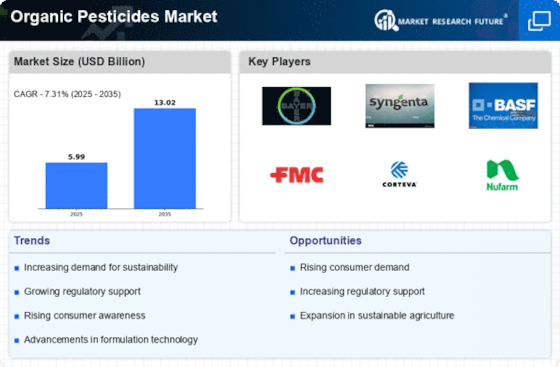
As per Market Research Future analysis, the Organic Pesticides Market Size was estimated at 5.993 USD Billion in 2024. The Organic Pesticides industry is projected to grow from 6.431 USD Billion in 2025 to 13.02 USD Billion by 2035, exhibiting a compound annual growth rate (CAGR) of 7.31% during the forecast period 2025 - 2035

Key Market Trends & Highlights

The Organic Pesticides Market is experiencing robust growth driven by consumer preferences and technological advancements.

  • Rising consumer demand for organic products is shaping the market landscape, particularly in North America.
  • Technological advancements in organic solutions are enhancing the efficacy and appeal of organic pesticides.
  • The supportive regulatory environment is fostering growth, especially in the Asia-Pacific region, which is the fastest-growing market.
  • Increasing awareness of health benefits and sustainability concerns are key drivers propelling the organic pesticides market forward.

Market Size & Forecast

2024 Market Size 5.993 (USD Billion)
2035 Market Size 13.02 (USD Billion)
CAGR (2025 - 2035) 7.31%
Largest Regional Market Share in 2024 North America

Major Players

Bayer AG (DE), Syngenta AG (CH), BASF SE (DE), FMC Corporation (US), Corteva Agriscience (US), Nufarm Limited (AU), Certis USA LLC (US), Organic Laboratories Inc. (US), AgroFresh Solutions Inc. (US)

Market Trends

The Organic Pesticides Market is currently experiencing a notable shift towards sustainable agricultural practices. This transformation is driven by increasing consumer awareness regarding the adverse effects of synthetic chemicals on health and the environment. Farmers are progressively adopting organic solutions to enhance crop yield while minimizing ecological footprints. The demand for organic produce is on the rise, prompting agricultural stakeholders to explore innovative pest management strategies that align with organic farming principles. As a result, the market is witnessing a surge in the development and availability of eco-friendly pest control products. Moreover, regulatory frameworks are evolving to support the growth of the Organic Pesticides Market. Governments are implementing policies that encourage the use of organic inputs, thereby fostering a conducive environment for market expansion. This regulatory support, coupled with advancements in research and technology, is likely to enhance the efficacy and accessibility of organic pesticides. The market appears poised for further growth as stakeholders recognize the potential benefits of integrating organic solutions into conventional farming practices. Overall, the Organic Pesticides Market is on a trajectory towards increased adoption, driven by both consumer demand and supportive policies.

Rising Consumer Demand for Organic Products

There is a growing trend among consumers favoring organic products, which is influencing farmers to adopt organic pesticides. This shift is largely attributed to heightened awareness of health and environmental issues associated with synthetic chemicals.

Technological Advancements in Organic Solutions

Innovations in agricultural technology are facilitating the development of more effective organic pesticides. These advancements may enhance pest control efficacy while ensuring compliance with organic farming standards.

Supportive Regulatory Environment

Governments are increasingly implementing policies that promote the use of organic pesticides. This supportive regulatory framework is likely to encourage more farmers to transition towards organic farming practices.

Organic Pesticides Market Market Drivers

Regulatory Support for Organic Farming

The Organic Pesticides Market benefits from a supportive regulatory environment that encourages the use of organic farming practices. Governments in various regions are implementing policies and regulations that promote organic agriculture, including subsidies and incentives for farmers who adopt organic methods. This regulatory support is crucial in fostering the growth of the organic pesticide segment, as it provides farmers with the necessary resources and guidance to transition from conventional to organic farming. Market data indicates that regions with robust regulatory frameworks for organic farming are witnessing a faster adoption of organic pesticides, contributing to an overall increase in market share. As regulations continue to evolve, the organic pesticides market is likely to expand, driven by both consumer demand and governmental support.

Increasing Awareness of Health Benefits

The Organic Pesticides Market is experiencing a notable surge in consumer awareness regarding the health benefits associated with organic farming practices. As individuals become more informed about the potential health risks linked to synthetic pesticides, there is a growing preference for organic alternatives. This shift is reflected in market data, indicating that the organic pesticide segment is projected to grow at a compound annual growth rate of approximately 12% over the next five years. Consumers are increasingly seeking products that align with their health-conscious lifestyles, thereby driving demand for organic pesticides. This trend is further supported by educational campaigns and initiatives aimed at promoting sustainable agricultural practices, which emphasize the advantages of organic pesticides in reducing chemical residues in food products.

Sustainability and Environmental Concerns

The Organic Pesticides Market is significantly influenced by rising sustainability and environmental concerns among consumers and agricultural stakeholders. As awareness of environmental degradation and biodiversity loss grows, there is a marked shift towards sustainable farming practices. Organic pesticides, which are derived from natural sources, are perceived as a more environmentally friendly option compared to their synthetic counterparts. Market data suggests that the organic pesticide segment is expected to capture a larger share of the overall pesticide market, driven by the increasing adoption of sustainable agricultural practices. This trend is likely to be bolstered by government initiatives promoting eco-friendly farming methods, which further enhances the appeal of organic pesticides as a viable solution for pest management.

Consumer Preference for Sustainable Practices

The Organic Pesticides Market is significantly shaped by the growing consumer preference for sustainable agricultural practices. As consumers become more environmentally conscious, they are increasingly favoring products that are produced using organic methods. This shift in consumer behavior is driving demand for organic pesticides, as they are perceived as a key component of sustainable farming. Market data indicates that the organic pesticide segment is likely to experience substantial growth, fueled by the rising popularity of organic food products. Retailers are responding to this trend by expanding their offerings of organic products, which further enhances the visibility and accessibility of organic pesticides. As consumer preferences continue to evolve, the organic pesticides market is expected to thrive, reflecting a broader commitment to sustainability in agriculture.

Technological Innovations in Organic Pesticides

The Organic Pesticides Market is poised for growth due to ongoing technological innovations that enhance the efficacy and application of organic pesticides. Advances in biotechnology and research are leading to the development of more effective organic pest control solutions, which are crucial for meeting the demands of modern agriculture. These innovations not only improve the performance of organic pesticides but also address challenges such as pest resistance and application efficiency. Market data suggests that the introduction of new formulations and delivery systems is likely to attract more farmers to adopt organic pesticides, thereby expanding the market. As technology continues to evolve, the organic pesticides market is expected to benefit from increased investment in research and development, further solidifying its position in the agricultural sector.

Market Segment Insights

By Type: Natural (Largest) vs. Synthetic (Fastest-Growing)

<p>In the Organic Pesticides Market, the market share is significantly dominated by natural pesticides, which harness naturally occurring substances, making up a substantial portion of the market. Synthetic organic pesticides, while not as large in market share, are rapidly gaining traction, appealing to consumers looking for effective pest control solutions that maintain organic compliance. This distribution highlights a clear preference among consumers towards sustainable practices, although synthetic options are carving out a notable niche.</p>

<p>Pesticide Type: Natural (Dominant) vs. Synthetic (Emerging)</p>

<p>Natural organic pesticides are characterized by their reliance on botanicals and microbials, offering eco-friendly pest control options that align with the growing consumer demand for sustainable agriculture. Their dominant market position is supported by a strong consumer preference for environmentally safe products. Conversely, synthetic organic pesticides are gaining ground due to their effectiveness and targeted action against specific pests, attracting farmers who seek reliable solutions for pest management while adhering to organic standards. This duality in preferences illustrates a complex landscape where both segments are evolving to meet varying consumer demands.</p>

By Crop Type: Fruits & Vegetables (Largest) vs. Oilseeds & Pulses (Fastest-Growing)

<p>In the Organic Pesticides Market, the distribution of market share among crop types reveals that Fruits & Vegetables holds the largest segment, commanding significant attention from consumers and organic farmers alike. This dominance is attributed to the increasing consumer preference for organic produce, which is perceived as healthier and more environmentally friendly than conventionally grown alternatives. In contrast, the Oilseeds & Pulses segment, while smaller, is rapidly gaining traction, driven by rising awareness of sustainable farming practices and a growing demand for plant-based proteins.</p>

<p>Fruits & Vegetables (Dominant) vs. Oilseeds & Pulses (Emerging)</p>

<p>The Fruits & Vegetables segment stands out as a dominant force within the Organic Pesticides Market, largely because of the heightened demand for pesticide-free produce in both local and international markets. Consumers are increasingly opting for organic fruits and vegetables, spurred by health awareness and environmental concerns. Conversely, the Oilseeds & Pulses segment is emerging as a dynamic player in the market, benefiting from the expanding plant-based protein trend and a push for sustainable farming methodologies. This segment's growth is fueled by innovations in organic pesticides specifically formulated to enhance yields without compromising ecological balance.</p>

By Application: Foliar (Largest) vs. Soil Treatment (Fastest-Growing)

<p>In the Organic Pesticides Market, the application segment exhibits diverse preferences among farmers and agricultural stakeholders. Foliar treatments hold the largest market share, being favored for their effectiveness in directly targeting plant surfaces. This efficiency drives their continued dominance, especially in high-value crops. Conversely, Soil Treatment is emerging as the fastest-growing segment, as farmers increasingly recognize the importance of enhancing soil health to maximize crop yield and sustainability. The growth trends within the application segment are significantly influenced by the rising consumer demand for organic produce and environmentally friendly farming practices. Foliar applications will likely maintain their stronghold due to research-backed efficacy, while Soil Treatment is seeing rapid adoption due to its long-term benefits in pest management and soil vitality. Innovations in formulation and distribution for both segments are catalyzing growth and diversification in the market.</p>

<p>Foliar (Dominant) vs. Soil Treatment (Emerging)</p>

<p>Foliar application of organic pesticides remains the dominant choice in the market due to its targeted approach that minimizes chemical input and maximizes plant protection. This method enables immediate absorption by leaves, increasing its efficiency relative to other forms. In contrast, Soil Treatment, while considered emerging, is gaining substantial traction, especially among organic practitioners seeking sustainable agricultural practices. This method focuses on improving soil quality and pest resistance through natural amendments, making it appealing to eco-conscious farmers. The shift towards integrated pest management strategies is also supporting the rise of Soil Treatment, as it complements other practices aimed at increasing overall crop resilience.</p>

Get more detailed insights about Organic Pesticides Market Research Report : Global Forecast till 2023-2035

Regional Insights

North America : Sustainable Agriculture Leader

North America is the largest market for organic pesticides, holding approximately 40% of the global share. The region's growth is driven by increasing consumer demand for organic produce, stringent regulations promoting sustainable farming practices, and advancements in organic pesticide formulations. The U.S. leads this market, followed closely by Canada, as both countries implement policies that encourage organic farming and reduce chemical pesticide usage. The competitive landscape in North America is robust, featuring key players such as Bayer AG, Corteva Agriscience, and FMC Corporation. These companies are investing heavily in research and development to innovate organic solutions that meet regulatory standards. The presence of established agricultural practices and a growing awareness of environmental sustainability further bolster the market, making it a focal point for organic pesticide development.

Europe : Regulatory Framework Innovator

Europe is the second-largest market for organic pesticides, accounting for approximately 30% of the global market share. The region's growth is fueled by stringent EU regulations aimed at reducing chemical pesticide use and promoting organic farming. Countries like Germany and France are at the forefront, implementing policies that support organic agriculture and enhance consumer awareness of organic products. Leading countries in Europe include Germany, France, and the Netherlands, where the competitive landscape is characterized by a mix of local and international players. Companies such as BASF SE and Syngenta AG are actively involved in developing innovative organic solutions. The European market is also witnessing increased collaboration between governments and agricultural organizations to promote sustainable practices, further driving the demand for organic pesticides.

Asia-Pacific : Emerging Market Potential

Asia-Pacific is rapidly emerging as a significant player in the organic pesticides market, holding about 20% of the global share. The region's growth is driven by rising consumer awareness of health and environmental issues, coupled with increasing agricultural productivity demands. Countries like China and India are leading this trend, supported by government initiatives that encourage organic farming practices and reduce reliance on synthetic chemicals. The competitive landscape in Asia-Pacific is diverse, with both local and international companies vying for market share. Key players include Nufarm Limited and Certis USA LLC, which are focusing on developing region-specific organic solutions. The increasing adoption of organic farming techniques and the growing export potential of organic produce are further propelling market growth, making Asia-Pacific a vital region for organic pesticide innovation.

Middle East and Africa : Resource-Rich Agricultural Frontier

The Middle East and Africa region is gradually developing its organic pesticides market, currently holding about 10% of the global share. The growth is primarily driven by increasing agricultural activities and a rising demand for organic products among consumers. Countries like South Africa and Kenya are leading the charge, supported by government initiatives aimed at promoting sustainable agricultural practices and reducing chemical pesticide usage. In this region, the competitive landscape is still evolving, with local players and international companies beginning to establish a presence. The market is characterized by a growing interest in organic farming, driven by both consumer demand and regulatory support. As awareness of environmental issues increases, the Middle East and Africa are poised for significant growth in the organic pesticides sector, attracting investments and innovations in sustainable agriculture.

Key Players and Competitive Insights

Leading market players are investing heavily in research and development to expand their product lines, which will help the organic pesticides market grow even more. Market participants are also undertaking various strategic activities to expand their footprint, with important market developments including new product launches, contractual agreements, mergers and acquisitions, higher investments, and collaboration with other organizations. The organic pesticides industry must offer cost-effective items to expand and survive in a more competitive and rising market climate.
Manufacturing locally to minimize operational costs is one of the key business tactics manufacturers use in the organic pesticides industry to benefit clients and increase the market sector. In recent years, the organic pesticide industry has offered some of the most significant medical advantages. Major players in the organic pesticides market, including Andermatt Group AG, BASF SE, Arysta LifeScience Corporation., Syngenta, Bayer AG, Certis USA LLC, Dow Inc., Mark Agri Genetics Pvt.
Ltd., Parry America, Inc., Redox Industries Limited., Satpura Bio Fertiliser India Pvt Ltd, and Sikkoindia, and others, are attempting to increase market demand by investing in research and development operations.
Syngenta has recognized the growing demand for organic and sustainable products and practices in the agricultural industry. The company has been expanding its portfolio to include more environmentally friendly and organic options. While Syngenta's core business remains focused on conventional agriculture, it has shown an interest in diversifying its offerings to cater to the growing organic market. For instance, in May 2022 Victrato, a seed treatment introduced by Syngenta through its seed care division, fights nematodes and important soil-borne fungi to boost the quality and yield of a variety of crops including soybeans, corn, cereals, cotton, and rice.
BASF's organic pesticides may include biofungicides, bioinsecticides, and other bio-based solutions that provide effective pest and disease management while minimizing environmental impact and promoting sustainable farming practices. For instance, in October 2022 Insecticide Exponus, a new product from BASF, uses the active chemical broflanilide in a unique formulation. With the introduction of BASF's insecticide Exponus, farmers in India will be able to safeguard their crops and increase output.

Key Companies in the Organic Pesticides Market include

Industry Developments

March 2022: New pesticide Corprima was introduced by FMC India. Powered by the innovative Rynaxypyr insect control technology from FMC. One of the main problems for Indian farmers is fruit borers, therefore Corprima provides crop protection against them.

May 2021: Sinochem and ChemChina, China's two centrally managed, state-owned chemical producers, were being reorganized and combined to create a monstrous corporation. Both businesses have their headquarters in Beijing and have several subsidiaries in various industry sectors.

Future Outlook

Organic Pesticides Market Future Outlook

The Organic Pesticides Market is projected to grow at a 7.31% CAGR from 2025 to 2035, driven by increasing consumer demand for sustainable agriculture and regulatory support.

New opportunities lie in:

  • Development of biopesticide formulations targeting specific pests
  • Expansion into emerging markets with tailored organic solutions
  • Investment in R&D for innovative pest management technologies

By 2035, the Organic Pesticides Market is expected to achieve substantial growth and market penetration.

Market Segmentation

Organic Pesticides Market Type Outlook

  • Natural
  • Synthetic

Organic Pesticides Market Crop Type Outlook

  • Cereals & Grains
  • Oilseeds & Pulses
  • Fruits & Vegetables
  • Others

Organic Pesticides Market Application Outlook

  • Foliar
  • Soil Treatment
  • Seed Treatment
  • Others

Report Scope

MARKET SIZE 2024 5.993(USD Billion)
MARKET SIZE 2025 6.431(USD Billion)
MARKET SIZE 2035 13.02(USD Billion)
COMPOUND ANNUAL GROWTH RATE (CAGR) 7.31% (2025 - 2035)
REPORT COVERAGE Revenue Forecast, Competitive Landscape, Growth Factors, and Trends
BASE YEAR 2024
Market Forecast Period 2025 - 2035
Historical Data 2019 - 2024
Market Forecast Units USD Billion
Key Companies Profiled Bayer AG (DE), Syngenta AG (CH), BASF SE (DE), FMC Corporation (US), Corteva Agriscience (US), Nufarm Limited (AU), Certis USA LLC (US), Organic Laboratories Inc. (US), AgroFresh Solutions Inc. (US)
Segments Covered Type, Crop Type, Application, Region
Key Market Opportunities Growing consumer demand for sustainable agriculture drives innovation in the Organic Pesticides Market.
Key Market Dynamics Rising consumer demand for sustainable agriculture drives innovation and competition in the organic pesticides market.
Countries Covered North America, Europe, APAC, South America, MEA

FAQs

What is the current valuation of the Organic Pesticides Market?

<p>The Organic Pesticides Market was valued at 5.993 USD Billion in 2024.</p>

What is the projected market size for the Organic Pesticides Market by 2035?

<p>The market is projected to reach 13.02 USD Billion by 2035.</p>

What is the expected CAGR for the Organic Pesticides Market during the forecast period 2025 - 2035?

<p>The expected CAGR for the Organic Pesticides Market during 2025 - 2035 is 7.31%.</p>

Which companies are considered key players in the Organic Pesticides Market?

<p>Key players include Bayer AG, Syngenta AG, BASF SE, FMC Corporation, Corteva Agriscience, Nufarm Limited, Certis USA LLC, Organic Laboratories Inc., and AgroFresh Solutions Inc.</p>

How does the market segment for Natural and Synthetic organic pesticides compare?

<p>In 2024, the market for Natural organic pesticides was valued at 2.9965 USD Billion, while Synthetic organic pesticides also held a valuation of 2.9965 USD Billion.</p>

What are the projected valuations for different crop types in the Organic Pesticides Market?

<p>By 2035, the Fruits & Vegetables segment is expected to grow from 2.5 USD Billion to 5.5 USD Billion, while Cereals & Grains may increase from 1.5 USD Billion to 3.2 USD Billion.</p>

What applications are driving growth in the Organic Pesticides Market?

The Foliar application segment is projected to grow from 2.5 USD Billion in 2024 to 5.5 USD Billion by 2035.

What is the growth potential for the Soil Treatment application in the Organic Pesticides Market?

The Soil Treatment application segment is expected to expand from 1.5 USD Billion in 2024 to 3.5 USD Billion by 2035.

How do the valuations of Oilseeds & Pulses compare to other crop types?

The Oilseeds &amp; Pulses segment is projected to grow from 1.2 USD Billion in 2024 to 2.5 USD Billion by 2035, indicating a robust growth trajectory.

What trends are influencing the Organic Pesticides Market?

The increasing demand for sustainable agricultural practices and the growth of organic farming are likely influencing the expansion of the Organic Pesticides Market.

  1. SECTION I: EXECUTIVE SUMMARY AND KEY HIGHLIGHTS
    1. | 1.1 EXECUTIVE SUMMARY
    2. | | 1.1.1 Market Overview
    3. | | 1.1.2 Key Findings
    4. | | 1.1.3 Market Segmentation
    5. | | 1.1.4 Competitive Landscape
    6. | | 1.1.5 Challenges and Opportunities
    7. | | 1.1.6 Future Outlook
  2. SECTION II: SCOPING, METHODOLOGY AND MARKET STRUCTURE
    1. | 2.1 MARKET INTRODUCTION
    2. | | 2.1.1 Definition
    3. | | 2.1.2 Scope of the study
    4. | | | 2.1.2.1 Research Objective
    5. | | | 2.1.2.2 Assumption
    6. | | | 2.1.2.3 Limitations
    7. | 2.2 RESEARCH METHODOLOGY
    8. | | 2.2.1 Overview
    9. | | 2.2.2 Data Mining
    10. | | 2.2.3 Secondary Research
    11. | | 2.2.4 Primary Research
    12. | | | 2.2.4.1 Primary Interviews and Information Gathering Process
    13. | | | 2.2.4.2 Breakdown of Primary Respondents
    14. | | 2.2.5 Forecasting Model
    15. | | 2.2.6 Market Size Estimation
    16. | | | 2.2.6.1 Bottom-Up Approach
    17. | | | 2.2.6.2 Top-Down Approach
    18. | | 2.2.7 Data Triangulation
    19. | | 2.2.8 Validation
  3. SECTION III: QUALITATIVE ANALYSIS
    1. | 3.1 MARKET DYNAMICS
    2. | | 3.1.1 Overview
    3. | | 3.1.2 Drivers
    4. | | 3.1.3 Restraints
    5. | | 3.1.4 Opportunities
    6. | 3.2 MARKET FACTOR ANALYSIS
    7. | | 3.2.1 Value chain Analysis
    8. | | 3.2.2 Porter's Five Forces Analysis
    9. | | | 3.2.2.1 Bargaining Power of Suppliers
    10. | | | 3.2.2.2 Bargaining Power of Buyers
    11. | | | 3.2.2.3 Threat of New Entrants
    12. | | | 3.2.2.4 Threat of Substitutes
    13. | | | 3.2.2.5 Intensity of Rivalry
    14. | | 3.2.3 COVID-19 Impact Analysis
    15. | | | 3.2.3.1 Market Impact Analysis
    16. | | | 3.2.3.2 Regional Impact
    17. | | | 3.2.3.3 Opportunity and Threat Analysis
  4. SECTION IV: QUANTITATIVE ANALYSIS
    1. | 4.1 Security, Access Control and Robotics, BY Type (USD Billion)
    2. | | 4.1.1 Natural
    3. | | 4.1.2 Synthetic
    4. | 4.2 Security, Access Control and Robotics, BY Crop Type (USD Billion)
    5. | | 4.2.1 Cereals & Grains
    6. | | 4.2.2 Oilseeds & Pulses
    7. | | 4.2.3 Fruits & Vegetables
    8. | | 4.2.4 Others
    9. | 4.3 Security, Access Control and Robotics, BY Application (USD Billion)
    10. | | 4.3.1 Foliar
    11. | | 4.3.2 Soil Treatment
    12. | | 4.3.3 Seed Treatment
    13. | | 4.3.4 Others
    14. | 4.4 Security, Access Control and Robotics, BY Region (USD Billion)
    15. | | 4.4.1 North America
    16. | | | 4.4.1.1 US
    17. | | | 4.4.1.2 Canada
    18. | | 4.4.2 Europe
    19. | | | 4.4.2.1 Germany
    20. | | | 4.4.2.2 UK
    21. | | | 4.4.2.3 France
    22. | | | 4.4.2.4 Russia
    23. | | | 4.4.2.5 Italy
    24. | | | 4.4.2.6 Spain
    25. | | | 4.4.2.7 Rest of Europe
    26. | | 4.4.3 APAC
    27. | | | 4.4.3.1 China
    28. | | | 4.4.3.2 India
    29. | | | 4.4.3.3 Japan
    30. | | | 4.4.3.4 South Korea
    31. | | | 4.4.3.5 Malaysia
    32. | | | 4.4.3.6 Thailand
    33. | | | 4.4.3.7 Indonesia
    34. | | | 4.4.3.8 Rest of APAC
    35. | | 4.4.4 South America
    36. | | | 4.4.4.1 Brazil
    37. | | | 4.4.4.2 Mexico
    38. | | | 4.4.4.3 Argentina
    39. | | | 4.4.4.4 Rest of South America
    40. | | 4.4.5 MEA
    41. | | | 4.4.5.1 GCC Countries
    42. | | | 4.4.5.2 South Africa
    43. | | | 4.4.5.3 Rest of MEA
  5. SECTION V: COMPETITIVE ANALYSIS
    1. | 5.1 Competitive Landscape
    2. | | 5.1.1 Overview
    3. | | 5.1.2 Competitive Analysis
    4. | | 5.1.3 Market share Analysis
    5. | | 5.1.4 Major Growth Strategy in the Security, Access Control and Robotics
    6. | | 5.1.5 Competitive Benchmarking
    7. | | 5.1.6 Leading Players in Terms of Number of Developments in the Security, Access Control and Robotics
    8. | | 5.1.7 Key developments and growth strategies
    9. | | | 5.1.7.1 New Product Launch/Service Deployment
    10. | | | 5.1.7.2 Merger & Acquisitions
    11. | | | 5.1.7.3 Joint Ventures
    12. | | 5.1.8 Major Players Financial Matrix
    13. | | | 5.1.8.1 Sales and Operating Income
    14. | | | 5.1.8.2 Major Players R&D Expenditure. 2023
    15. | 5.2 Company Profiles
    16. | | 5.2.1 Bayer AG (DE)
    17. | | | 5.2.1.1 Financial Overview
    18. | | | 5.2.1.2 Products Offered
    19. | | | 5.2.1.3 Key Developments
    20. | | | 5.2.1.4 SWOT Analysis
    21. | | | 5.2.1.5 Key Strategies
    22. | | 5.2.2 Syngenta AG (CH)
    23. | | | 5.2.2.1 Financial Overview
    24. | | | 5.2.2.2 Products Offered
    25. | | | 5.2.2.3 Key Developments
    26. | | | 5.2.2.4 SWOT Analysis
    27. | | | 5.2.2.5 Key Strategies
    28. | | 5.2.3 BASF SE (DE)
    29. | | | 5.2.3.1 Financial Overview
    30. | | | 5.2.3.2 Products Offered
    31. | | | 5.2.3.3 Key Developments
    32. | | | 5.2.3.4 SWOT Analysis
    33. | | | 5.2.3.5 Key Strategies
    34. | | 5.2.4 FMC Corporation (US)
    35. | | | 5.2.4.1 Financial Overview
    36. | | | 5.2.4.2 Products Offered
    37. | | | 5.2.4.3 Key Developments
    38. | | | 5.2.4.4 SWOT Analysis
    39. | | | 5.2.4.5 Key Strategies
    40. | | 5.2.5 Corteva Agriscience (US)
    41. | | | 5.2.5.1 Financial Overview
    42. | | | 5.2.5.2 Products Offered
    43. | | | 5.2.5.3 Key Developments
    44. | | | 5.2.5.4 SWOT Analysis
    45. | | | 5.2.5.5 Key Strategies
    46. | | 5.2.6 Nufarm Limited (AU)
    47. | | | 5.2.6.1 Financial Overview
    48. | | | 5.2.6.2 Products Offered
    49. | | | 5.2.6.3 Key Developments
    50. | | | 5.2.6.4 SWOT Analysis
    51. | | | 5.2.6.5 Key Strategies
    52. | | 5.2.7 Certis USA LLC (US)
    53. | | | 5.2.7.1 Financial Overview
    54. | | | 5.2.7.2 Products Offered
    55. | | | 5.2.7.3 Key Developments
    56. | | | 5.2.7.4 SWOT Analysis
    57. | | | 5.2.7.5 Key Strategies
    58. | | 5.2.8 Organic Laboratories Inc. (US)
    59. | | | 5.2.8.1 Financial Overview
    60. | | | 5.2.8.2 Products Offered
    61. | | | 5.2.8.3 Key Developments
    62. | | | 5.2.8.4 SWOT Analysis
    63. | | | 5.2.8.5 Key Strategies
    64. | | 5.2.9 AgroFresh Solutions Inc. (US)
    65. | | | 5.2.9.1 Financial Overview
    66. | | | 5.2.9.2 Products Offered
    67. | | | 5.2.9.3 Key Developments
    68. | | | 5.2.9.4 SWOT Analysis
    69. | | | 5.2.9.5 Key Strategies
    70. | 5.3 Appendix
    71. | | 5.3.1 References
    72. | | 5.3.2 Related Reports
  6. LIST OF FIGURES
    1. | 6.1 MARKET SYNOPSIS
    2. | 6.2 NORTH AMERICA MARKET ANALYSIS
    3. | 6.3 US MARKET ANALYSIS BY TYPE
    4. | 6.4 US MARKET ANALYSIS BY CROP TYPE
    5. | 6.5 US MARKET ANALYSIS BY APPLICATION
    6. | 6.6 CANADA MARKET ANALYSIS BY TYPE
    7. | 6.7 CANADA MARKET ANALYSIS BY CROP TYPE
    8. | 6.8 CANADA MARKET ANALYSIS BY APPLICATION
    9. | 6.9 EUROPE MARKET ANALYSIS
    10. | 6.10 GERMANY MARKET ANALYSIS BY TYPE
    11. | 6.11 GERMANY MARKET ANALYSIS BY CROP TYPE
    12. | 6.12 GERMANY MARKET ANALYSIS BY APPLICATION
    13. | 6.13 UK MARKET ANALYSIS BY TYPE
    14. | 6.14 UK MARKET ANALYSIS BY CROP TYPE
    15. | 6.15 UK MARKET ANALYSIS BY APPLICATION
    16. | 6.16 FRANCE MARKET ANALYSIS BY TYPE
    17. | 6.17 FRANCE MARKET ANALYSIS BY CROP TYPE
    18. | 6.18 FRANCE MARKET ANALYSIS BY APPLICATION
    19. | 6.19 RUSSIA MARKET ANALYSIS BY TYPE
    20. | 6.20 RUSSIA MARKET ANALYSIS BY CROP TYPE
    21. | 6.21 RUSSIA MARKET ANALYSIS BY APPLICATION
    22. | 6.22 ITALY MARKET ANALYSIS BY TYPE
    23. | 6.23 ITALY MARKET ANALYSIS BY CROP TYPE
    24. | 6.24 ITALY MARKET ANALYSIS BY APPLICATION
    25. | 6.25 SPAIN MARKET ANALYSIS BY TYPE
    26. | 6.26 SPAIN MARKET ANALYSIS BY CROP TYPE
    27. | 6.27 SPAIN MARKET ANALYSIS BY APPLICATION
    28. | 6.28 REST OF EUROPE MARKET ANALYSIS BY TYPE
    29. | 6.29 REST OF EUROPE MARKET ANALYSIS BY CROP TYPE
    30. | 6.30 REST OF EUROPE MARKET ANALYSIS BY APPLICATION
    31. | 6.31 APAC MARKET ANALYSIS
    32. | 6.32 CHINA MARKET ANALYSIS BY TYPE
    33. | 6.33 CHINA MARKET ANALYSIS BY CROP TYPE
    34. | 6.34 CHINA MARKET ANALYSIS BY APPLICATION
    35. | 6.35 INDIA MARKET ANALYSIS BY TYPE
    36. | 6.36 INDIA MARKET ANALYSIS BY CROP TYPE
    37. | 6.37 INDIA MARKET ANALYSIS BY APPLICATION
    38. | 6.38 JAPAN MARKET ANALYSIS BY TYPE
    39. | 6.39 JAPAN MARKET ANALYSIS BY CROP TYPE
    40. | 6.40 JAPAN MARKET ANALYSIS BY APPLICATION
    41. | 6.41 SOUTH KOREA MARKET ANALYSIS BY TYPE
    42. | 6.42 SOUTH KOREA MARKET ANALYSIS BY CROP TYPE
    43. | 6.43 SOUTH KOREA MARKET ANALYSIS BY APPLICATION
    44. | 6.44 MALAYSIA MARKET ANALYSIS BY TYPE
    45. | 6.45 MALAYSIA MARKET ANALYSIS BY CROP TYPE
    46. | 6.46 MALAYSIA MARKET ANALYSIS BY APPLICATION
    47. | 6.47 THAILAND MARKET ANALYSIS BY TYPE
    48. | 6.48 THAILAND MARKET ANALYSIS BY CROP TYPE
    49. | 6.49 THAILAND MARKET ANALYSIS BY APPLICATION
    50. | 6.50 INDONESIA MARKET ANALYSIS BY TYPE
    51. | 6.51 INDONESIA MARKET ANALYSIS BY CROP TYPE
    52. | 6.52 INDONESIA MARKET ANALYSIS BY APPLICATION
    53. | 6.53 REST OF APAC MARKET ANALYSIS BY TYPE
    54. | 6.54 REST OF APAC MARKET ANALYSIS BY CROP TYPE
    55. | 6.55 REST OF APAC MARKET ANALYSIS BY APPLICATION
    56. | 6.56 SOUTH AMERICA MARKET ANALYSIS
    57. | 6.57 BRAZIL MARKET ANALYSIS BY TYPE
    58. | 6.58 BRAZIL MARKET ANALYSIS BY CROP TYPE
    59. | 6.59 BRAZIL MARKET ANALYSIS BY APPLICATION
    60. | 6.60 MEXICO MARKET ANALYSIS BY TYPE
    61. | 6.61 MEXICO MARKET ANALYSIS BY CROP TYPE
    62. | 6.62 MEXICO MARKET ANALYSIS BY APPLICATION
    63. | 6.63 ARGENTINA MARKET ANALYSIS BY TYPE
    64. | 6.64 ARGENTINA MARKET ANALYSIS BY CROP TYPE
    65. | 6.65 ARGENTINA MARKET ANALYSIS BY APPLICATION
    66. | 6.66 REST OF SOUTH AMERICA MARKET ANALYSIS BY TYPE
    67. | 6.67 REST OF SOUTH AMERICA MARKET ANALYSIS BY CROP TYPE
    68. | 6.68 REST OF SOUTH AMERICA MARKET ANALYSIS BY APPLICATION
    69. | 6.69 MEA MARKET ANALYSIS
    70. | 6.70 GCC COUNTRIES MARKET ANALYSIS BY TYPE
    71. | 6.71 GCC COUNTRIES MARKET ANALYSIS BY CROP TYPE
    72. | 6.72 GCC COUNTRIES MARKET ANALYSIS BY APPLICATION
    73. | 6.73 SOUTH AFRICA MARKET ANALYSIS BY TYPE
    74. | 6.74 SOUTH AFRICA MARKET ANALYSIS BY CROP TYPE
    75. | 6.75 SOUTH AFRICA MARKET ANALYSIS BY APPLICATION
    76. | 6.76 REST OF MEA MARKET ANALYSIS BY TYPE
    77. | 6.77 REST OF MEA MARKET ANALYSIS BY CROP TYPE
    78. | 6.78 REST OF MEA MARKET ANALYSIS BY APPLICATION
    79. | 6.79 KEY BUYING CRITERIA OF SECURITY, ACCESS CONTROL AND ROBOTICS
    80. | 6.80 RESEARCH PROCESS OF MRFR
    81. | 6.81 DRO ANALYSIS OF SECURITY, ACCESS CONTROL AND ROBOTICS
    82. | 6.82 DRIVERS IMPACT ANALYSIS: SECURITY, ACCESS CONTROL AND ROBOTICS
    83. | 6.83 RESTRAINTS IMPACT ANALYSIS: SECURITY, ACCESS CONTROL AND ROBOTICS
    84. | 6.84 SUPPLY / VALUE CHAIN: SECURITY, ACCESS CONTROL AND ROBOTICS
    85. | 6.85 SECURITY, ACCESS CONTROL AND ROBOTICS, BY TYPE, 2024 (% SHARE)
    86. | 6.86 SECURITY, ACCESS CONTROL AND ROBOTICS, BY TYPE, 2024 TO 2035 (USD Billion)
    87. | 6.87 SECURITY, ACCESS CONTROL AND ROBOTICS, BY CROP TYPE, 2024 (% SHARE)
    88. | 6.88 SECURITY, ACCESS CONTROL AND ROBOTICS, BY CROP TYPE, 2024 TO 2035 (USD Billion)
    89. | 6.89 SECURITY, ACCESS CONTROL AND ROBOTICS, BY APPLICATION, 2024 (% SHARE)
    90. | 6.90 SECURITY, ACCESS CONTROL AND ROBOTICS, BY APPLICATION, 2024 TO 2035 (USD Billion)
    91. | 6.91 BENCHMARKING OF MAJOR COMPETITORS
  7. LIST OF TABLES
    1. | 7.1 LIST OF ASSUMPTIONS
    2. | | 7.1.1
    3. | 7.2 North America MARKET SIZE ESTIMATES; FORECAST
    4. | | 7.2.1 BY TYPE, 2025-2035 (USD Billion)
    5. | | 7.2.2 BY CROP TYPE, 2025-2035 (USD Billion)
    6. | | 7.2.3 BY APPLICATION, 2025-2035 (USD Billion)
    7. | 7.3 US MARKET SIZE ESTIMATES; FORECAST
    8. | | 7.3.1 BY TYPE, 2025-2035 (USD Billion)
    9. | | 7.3.2 BY CROP TYPE, 2025-2035 (USD Billion)
    10. | | 7.3.3 BY APPLICATION, 2025-2035 (USD Billion)
    11. | 7.4 Canada MARKET SIZE ESTIMATES; FORECAST
    12. | | 7.4.1 BY TYPE, 2025-2035 (USD Billion)
    13. | | 7.4.2 BY CROP TYPE, 2025-2035 (USD Billion)
    14. | | 7.4.3 BY APPLICATION, 2025-2035 (USD Billion)
    15. | 7.5 Europe MARKET SIZE ESTIMATES; FORECAST
    16. | | 7.5.1 BY TYPE, 2025-2035 (USD Billion)
    17. | | 7.5.2 BY CROP TYPE, 2025-2035 (USD Billion)
    18. | | 7.5.3 BY APPLICATION, 2025-2035 (USD Billion)
    19. | 7.6 Germany MARKET SIZE ESTIMATES; FORECAST
    20. | | 7.6.1 BY TYPE, 2025-2035 (USD Billion)
    21. | | 7.6.2 BY CROP TYPE, 2025-2035 (USD Billion)
    22. | | 7.6.3 BY APPLICATION, 2025-2035 (USD Billion)
    23. | 7.7 UK MARKET SIZE ESTIMATES; FORECAST
    24. | | 7.7.1 BY TYPE, 2025-2035 (USD Billion)
    25. | | 7.7.2 BY CROP TYPE, 2025-2035 (USD Billion)
    26. | | 7.7.3 BY APPLICATION, 2025-2035 (USD Billion)
    27. | 7.8 France MARKET SIZE ESTIMATES; FORECAST
    28. | | 7.8.1 BY TYPE, 2025-2035 (USD Billion)
    29. | | 7.8.2 BY CROP TYPE, 2025-2035 (USD Billion)
    30. | | 7.8.3 BY APPLICATION, 2025-2035 (USD Billion)
    31. | 7.9 Russia MARKET SIZE ESTIMATES; FORECAST
    32. | | 7.9.1 BY TYPE, 2025-2035 (USD Billion)
    33. | | 7.9.2 BY CROP TYPE, 2025-2035 (USD Billion)
    34. | | 7.9.3 BY APPLICATION, 2025-2035 (USD Billion)
    35. | 7.10 Italy MARKET SIZE ESTIMATES; FORECAST
    36. | | 7.10.1 BY TYPE, 2025-2035 (USD Billion)
    37. | | 7.10.2 BY CROP TYPE, 2025-2035 (USD Billion)
    38. | | 7.10.3 BY APPLICATION, 2025-2035 (USD Billion)
    39. | 7.11 Spain MARKET SIZE ESTIMATES; FORECAST
    40. | | 7.11.1 BY TYPE, 2025-2035 (USD Billion)
    41. | | 7.11.2 BY CROP TYPE, 2025-2035 (USD Billion)
    42. | | 7.11.3 BY APPLICATION, 2025-2035 (USD Billion)
    43. | 7.12 Rest of Europe MARKET SIZE ESTIMATES; FORECAST
    44. | | 7.12.1 BY TYPE, 2025-2035 (USD Billion)
    45. | | 7.12.2 BY CROP TYPE, 2025-2035 (USD Billion)
    46. | | 7.12.3 BY APPLICATION, 2025-2035 (USD Billion)
    47. | 7.13 APAC MARKET SIZE ESTIMATES; FORECAST
    48. | | 7.13.1 BY TYPE, 2025-2035 (USD Billion)
    49. | | 7.13.2 BY CROP TYPE, 2025-2035 (USD Billion)
    50. | | 7.13.3 BY APPLICATION, 2025-2035 (USD Billion)
    51. | 7.14 China MARKET SIZE ESTIMATES; FORECAST
    52. | | 7.14.1 BY TYPE, 2025-2035 (USD Billion)
    53. | | 7.14.2 BY CROP TYPE, 2025-2035 (USD Billion)
    54. | | 7.14.3 BY APPLICATION, 2025-2035 (USD Billion)
    55. | 7.15 India MARKET SIZE ESTIMATES; FORECAST
    56. | | 7.15.1 BY TYPE, 2025-2035 (USD Billion)
    57. | | 7.15.2 BY CROP TYPE, 2025-2035 (USD Billion)
    58. | | 7.15.3 BY APPLICATION, 2025-2035 (USD Billion)
    59. | 7.16 Japan MARKET SIZE ESTIMATES; FORECAST
    60. | | 7.16.1 BY TYPE, 2025-2035 (USD Billion)
    61. | | 7.16.2 BY CROP TYPE, 2025-2035 (USD Billion)
    62. | | 7.16.3 BY APPLICATION, 2025-2035 (USD Billion)
    63. | 7.17 South Korea MARKET SIZE ESTIMATES; FORECAST
    64. | | 7.17.1 BY TYPE, 2025-2035 (USD Billion)
    65. | | 7.17.2 BY CROP TYPE, 2025-2035 (USD Billion)
    66. | | 7.17.3 BY APPLICATION, 2025-2035 (USD Billion)
    67. | 7.18 Malaysia MARKET SIZE ESTIMATES; FORECAST
    68. | | 7.18.1 BY TYPE, 2025-2035 (USD Billion)
    69. | | 7.18.2 BY CROP TYPE, 2025-2035 (USD Billion)
    70. | | 7.18.3 BY APPLICATION, 2025-2035 (USD Billion)
    71. | 7.19 Thailand MARKET SIZE ESTIMATES; FORECAST
    72. | | 7.19.1 BY TYPE, 2025-2035 (USD Billion)
    73. | | 7.19.2 BY CROP TYPE, 2025-2035 (USD Billion)
    74. | | 7.19.3 BY APPLICATION, 2025-2035 (USD Billion)
    75. | 7.20 Indonesia MARKET SIZE ESTIMATES; FORECAST
    76. | | 7.20.1 BY TYPE, 2025-2035 (USD Billion)
    77. | | 7.20.2 BY CROP TYPE, 2025-2035 (USD Billion)
    78. | | 7.20.3 BY APPLICATION, 2025-2035 (USD Billion)
    79. | 7.21 Rest of APAC MARKET SIZE ESTIMATES; FORECAST
    80. | | 7.21.1 BY TYPE, 2025-2035 (USD Billion)
    81. | | 7.21.2 BY CROP TYPE, 2025-2035 (USD Billion)
    82. | | 7.21.3 BY APPLICATION, 2025-2035 (USD Billion)
    83. | 7.22 South America MARKET SIZE ESTIMATES; FORECAST
    84. | | 7.22.1 BY TYPE, 2025-2035 (USD Billion)
    85. | | 7.22.2 BY CROP TYPE, 2025-2035 (USD Billion)
    86. | | 7.22.3 BY APPLICATION, 2025-2035 (USD Billion)
    87. | 7.23 Brazil MARKET SIZE ESTIMATES; FORECAST
    88. | | 7.23.1 BY TYPE, 2025-2035 (USD Billion)
    89. | | 7.23.2 BY CROP TYPE, 2025-2035 (USD Billion)
    90. | | 7.23.3 BY APPLICATION, 2025-2035 (USD Billion)
    91. | 7.24 Mexico MARKET SIZE ESTIMATES; FORECAST
    92. | | 7.24.1 BY TYPE, 2025-2035 (USD Billion)
    93. | | 7.24.2 BY CROP TYPE, 2025-2035 (USD Billion)
    94. | | 7.24.3 BY APPLICATION, 2025-2035 (USD Billion)
    95. | 7.25 Argentina MARKET SIZE ESTIMATES; FORECAST
    96. | | 7.25.1 BY TYPE, 2025-2035 (USD Billion)
    97. | | 7.25.2 BY CROP TYPE, 2025-2035 (USD Billion)
    98. | | 7.25.3 BY APPLICATION, 2025-2035 (USD Billion)
    99. | 7.26 Rest of South America MARKET SIZE ESTIMATES; FORECAST
    100. | | 7.26.1 BY TYPE, 2025-2035 (USD Billion)
    101. | | 7.26.2 BY CROP TYPE, 2025-2035 (USD Billion)
    102. | | 7.26.3 BY APPLICATION, 2025-2035 (USD Billion)
    103. | 7.27 MEA MARKET SIZE ESTIMATES; FORECAST
    104. | | 7.27.1 BY TYPE, 2025-2035 (USD Billion)
    105. | | 7.27.2 BY CROP TYPE, 2025-2035 (USD Billion)
    106. | | 7.27.3 BY APPLICATION, 2025-2035 (USD Billion)
    107. | 7.28 GCC Countries MARKET SIZE ESTIMATES; FORECAST
    108. | | 7.28.1 BY TYPE, 2025-2035 (USD Billion)
    109. | | 7.28.2 BY CROP TYPE, 2025-2035 (USD Billion)
    110. | | 7.28.3 BY APPLICATION, 2025-2035 (USD Billion)
    111. | 7.29 South Africa MARKET SIZE ESTIMATES; FORECAST
    112. | | 7.29.1 BY TYPE, 2025-2035 (USD Billion)
    113. | | 7.29.2 BY CROP TYPE, 2025-2035 (USD Billion)
    114. | | 7.29.3 BY APPLICATION, 2025-2035 (USD Billion)
    115. | 7.30 Rest of MEA MARKET SIZE ESTIMATES; FORECAST
    116. | | 7.30.1 BY TYPE, 2025-2035 (USD Billion)
    117. | | 7.30.2 BY CROP TYPE, 2025-2035 (USD Billion)
    118. | | 7.30.3 BY APPLICATION, 2025-2035 (USD Billion)
    119. | 7.31 PRODUCT LAUNCH/PRODUCT DEVELOPMENT/APPROVAL
    120. | | 7.31.1
    121. | 7.32 ACQUISITION/PARTNERSHIP
    122. | | 7.32.1

Security, Access Control and Robotics Market Segmentation

Security, Access Control and Robotics By Type (USD Billion, 2025-2035)

  • Natural
  • Synthetic

Security, Access Control and Robotics By Crop Type (USD Billion, 2025-2035)

  • Cereals & Grains
  • Oilseeds & Pulses
  • Fruits & Vegetables
  • Others

Security, Access Control and Robotics By Application (USD Billion, 2025-2035)

  • Foliar
  • Soil Treatment
  • Seed Treatment
  • Others
Infographic

Free Sample Request

Kindly complete the form below to receive a free sample of this Report

Get Free Sample

Customer Strories

Compare Licence

×
Features License Type
Single User Multiuser License Enterprise User
Price $4,950 $5,950 $7,250
Maximum User Access Limit 1 User Upto 10 Users Unrestricted Access Throughout the Organization
Free Customization
Direct Access to Analyst
Deliverable Format
Platform Access
Discount on Next Purchase 10% 15% 15%
Printable Versions