
• Cat-intel
  • MedIntelliX
  • Resources
  • About Us
  • Hero Background
    English
    Chinese
    French
    Japanese
    Korean
    German
    Spanish

    Freeze of Gait Market Trends

    ID: MRFR/HC/10578-HCR
    87 Pages
    Kinjoll Dey
    October 2025

    Freeze of Gait Market Research Report Information By Type (Oral Dopaminergic Medication, Wearable and Walking Aid Devices, Deep Brain Stimulation, Others), End User (Hospitals, Clinics, Others) and Region (North America, Europe, Asia-Pacific, and Rest of the World)—Forecast till 2035

    Share:
    Download PDF ×

    We do not share your information with anyone. However, we may send you emails based on your report interest from time to time. You may contact us at any time to opt-out.

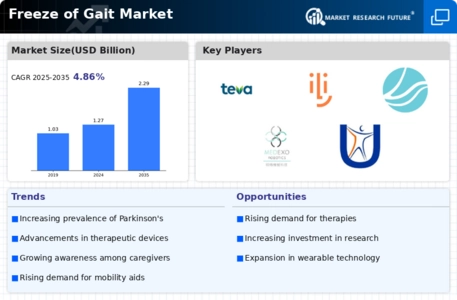
    Freeze of Gait Market Infographic
    Purchase Options

    Market Trends

    Key Emerging Trends in the Freeze of Gait Market

    The market for Freeze of Gait (FOG), a phenomenon commonly associated with Parkinson's disease, is undergoing notable trends driven by advancements in medical research, technology, and a heightened focus on improving the quality of life for individuals experiencing FOG. Understanding these trends is crucial for healthcare professionals, researchers, and companies developing interventions for this challenging motor symptom. Wearables such as motion sensors and accelerometers are assisting in one the main application area in dealing with FOG. The medical market suggests wearable devices which are able to detect seizures and monitor the patients' condition, such devices directly provide the doctors with real-time data for more substantial and specific solutions. FOG market has got on the example of incorporating robotic assists which may assist people who suffer from freezing episodes. ROBOTIC suits and tools with warning assist to provide external support and improve gait stability. As such, MFOG will affect less daily life. VR is being utilized as a rehabilitation approach for courses Aimed at taming FOG. The VR technology gives the opportunity for people to walk in-depth simulated-environments in order to perfect and enhance their gait patterns. In this way, the individuals will have a secure and controlled setting to address FOG-related difficulties. In the ATG treatment, pharmaceutical remains one of the most prominent approaches. Markets give impetus to researches into medications and neurotransmitter modulation so as to find out the causes associated with fog which are deep-rooted hence as a result providing specific medicine that aim to achieve better targeting. Rehabilitative interventions with cognitive focus, frequently, are on the rise in order to address the symptoms of FOG. Such approaches as cognitive involvement and dual-task practices take into consideration the aspect of how these processes and motional are coordinated which helps prevent the case of freezing phenomena.

    Neurofeedback and brain-computer interfaces are emerging as innovative approaches to address FOG. Market trends indicate research into technologies that provide real-time feedback on brain activity, allowing individuals to learn to modulate their neural patterns and potentially reduce the occurrence of freezing episodes. The integration of artificial intelligence is shaping market trends in FOG interventions. AI algorithms are being employed to analyze complex datasets from wearable devices, enabling personalized treatment plans and enhancing the precision of therapeutic interventions based on individual patient profiles.


    Author
    Kinjoll Dey
    Research Analyst Level I

    He is an extremely curious individual currently working in Healthcare and Medical Devices Domain. Kinjoll is comfortably versed in data centric research backed by healthcare educational background. He leverages extensive data mining and analytics tools such as Primary and Secondary Research, Statistical Analysis, Machine Learning, Data Modelling. His key role also involves Technical Sales Support, Client Interaction and Project management within the Healthcare team. Lastly, he showcases extensive affinity towards learning new skills and remain fascinated in implementing them.

    Leave a Comment

    FAQs

    How much is the Freeze of Gait market?

    The Freeze of Gait Market is anticipated to reach USD 1.19 billion at a CAGR of 4.86% during the forecast period of 2023 to 2032.

    How big is the US Freeze of Gait market?

    The US freeze of gait market is anticipated to reach USD 0.40 billion at a CAGR of 5.26% during the forecast period of 2023 to 2032.

    What is the growth rate of the freeze of gait market?

    The Freeze of Gait Market is expected to register a CAGR of 4.86% during the forecast period of 2023 to 2032.

    Which region held the largest market share in the freeze of gait market?

    The North America freeze of gait market accounted for the largest market share during the study period.

    Who are the key players in the Freeze of Gait market?

    Teva Pharmaceuticals (Israel), Sun Pharmaceutical Industries Ltd (India), Viatris Inc (US), Gondola Medical Technologies SA (Switzerland), Gyenno Technologies Co., Ltd. (China), Beats Medical Limited (Ireland), Agilitas (Australia), Walk with Path (Vesterbro), MedEXO Robotics (Hong Kong), Ustep (US).

    Which type had the largest market share in the freeze of gait market?

    The wearable and walking aid devices segment held the majority share in 2022 contributing to around 45% with respect to the Freeze of Gait Market.

    Which end user holds the largest segment share in the Freeze of Gait market?

    The hospitals segment held the majority share in 2022 contributing to over 60% with respect to the Freeze of Gait Market.

    Market Summary

    The Global Freeze of Gait Market is projected to grow from 1.27 USD Billion in 2024 to 2.29 USD Billion by 2035, reflecting a robust CAGR of 5.52%.

    Key Market Trends & Highlights

    Freeze of Gait Key Trends and Highlights

    • The market valuation is expected to increase from 1.27 USD Billion in 2024 to 2.29 USD Billion by 2035.
    • A compound annual growth rate (CAGR) of 5.52% is anticipated for the period from 2025 to 2035.
    • The growth trajectory indicates a rising demand for innovative treatment solutions in the Freeze of Gait segment.
    • Growing adoption of advanced therapeutic technologies due to increasing awareness of gait disorders is a major market driver.

    Market Size & Forecast

    2024 Market Size 1.27 (USD Billion)
    2035 Market Size 2.29 (USD Billion)
    CAGR (2025-2035) 5.52%
    Largest Regional Market Share in 2024 latin_america)

    Major Players

    Teva Pharmaceuticals (Israel), Sun Pharmaceutical Industries Ltd (India), Viatris Inc (US), Gondola Medical Technologies SA (Switzerland), Gyenno Technologies Co., Ltd. (China), Beats Medical Limited (Ireland), Agilitas (Australia), Walk with Path (Vesterbro), MedEXO Robotics (Hong Kong), Ustep (US)

    Market Trends

    Increasing prevalence of Parkinson’s disease and other related diseases

    Parkinson's disease is a disorder of the central nervous system that causes unintended or uncontrollable movements, such as stiffness, shaking, and difficulty with coordination and balance. These symptoms generally begin slowly and worsen over time. This may result in difficulty walking and talking. Freezing of gait (FoG) is one of the most debilitating motor symptoms in Parkinson's disease (PD) patients. Freezing of gait is an abnormal gait pattern that leads to a sudden inability to initiate or continue walking.

    According to data published in Nature Journal, in the year 2022, FoG affected about 50% of Parkinson's disease patients and 80% of advanced Parkinson's disease patients. According to the Parkinson’s Foundation, currently around one million people in the US are living with Parkinson's disease (PD), and it is estimated that this number will rise to 1.2 million by 2030.

    The increasing prevalence of neurological disorders among the aging population appears to drive the demand for innovative solutions addressing freeze of gait, highlighting a critical need for enhanced therapeutic interventions.

    National Institute of Neurological Disorders and Stroke (NINDS)

    Freeze of Gait Market Market Drivers

    Increasing Prevalence of Parkinson's Disease

    The Global Freeze of Gait Market Industry is experiencing growth due to the rising prevalence of Parkinson's disease, which is a significant contributor to gait disturbances. As of 2024, the estimated number of individuals diagnosed with Parkinson's disease is projected to reach approximately 10 million worldwide. This increase in patient population necessitates the development of effective therapeutic interventions, thereby driving demand for products and services within the Global Freeze of Gait Market Industry. The anticipated rise in cases is expected to contribute to the market's value, which is estimated to reach 1.27 USD Billion in 2024, indicating a pressing need for innovative solutions.

    Market Segment Insights

    Freeze of Gait Type Insights

    The Freeze of Gait Market segmentation, based on type, includes oral dopaminergic medication, wearable and walking aid devices, deep brain stimulation, and others. The wearable and walking aid devices segment is to hold the majority share in 2022 in the Freeze of Gait Market revenue due to easy to use, increasing disability case across the globe as well as increasing cases on uncontrollable moments are raise the demand of wearable and walking aid devices. Wearable and walking devices easily track the patient’s health and technological advancement in wearable and walking devices are further drive the growth of this segment.

    October 2021: Teva collaborated with MODAG for licensing and development of neurodegenerative disease drug candidate. This collaboration enhances the company’s product portfolio and business in the market.

    Freeze of Gait End User Insights

    The Freeze of Gait Market segmentation is based on end user that includes hospitals, clinics, others. The hospitals segment has dominated the market in 2022 due to the easy accessibility, growing cases of advanced Parkinson disease, expansion of muscle disorder treatment capability. Furthermore, availability of advanced treatment facilities, proficient medical staff and rising patient pool are driving the growth of this segment in freeze of gait market.

    November 2020: MedEXO Robotics, a Hong Kong-based robotics technology company had newly launched the ExoBeam walking device to relief patient with Parkinson’s disease and other movement disorders.

    Figure 2: FREEZE OF GAIT MARKET, BY END USER, 2022 & 2032 (USD BILLION)

    Source: Secondary Research, Primary Research, Market Research Future Database, and Analyst Review

    Get more detailed insights about Freeze of Gait Market Research Report—Global Forecast till 2035

    Regional Insights

    By Region, the study segments the market into North America, Europe, Asia-Pacific, and Rest of the World.

    The North America Freeze of Gait market is expected to account for USD 0.48 billion in 2022 and is expected to exhibit a 5.17% CAGR during the study period. This is attributed to the business presence of major key player, rising FDA approval, and increasing awareness about the medication and therapies, rising prevalence of Parkinson disease in the region drive the regional market growth during the forecast period.

    In 2022, as per the Parkinson's Foundation, an estimated 90,000 suffered from Parkinson disease in the US people are affected by Freeze of Gait in the US, and this denotes a steep 50% growth from the earlier estimated rate of 60,000 diagnoses annually which is contributing to market growth over the forecast period.

    Further, the major countries studied are the U.S., Canada, Germany, France, the UK, Italy, Spain, China, Japan, India, Australia, South Korea, and Brazil.

    Figure 3: GLOBAL FREEZE OF GAIT SHARE (%) BY REGION 2022

    FREEZE OF GAIT SHARE (%) BY REGION 2022

    Source: Secondary Research, Primary Research, Market Research Future Database, and Analyst Review

    Europe Freeze of Gait market is expected to account for the second-largest market share due to the increasing healthcare expenditure, rising demand for advanced therapeutics, and increasing geriatric population lead to risk of Parkinson disease associated freeze of gait which drive the growth of freeze gait in Europe region.

    Accessibility to advanced technology for disease diagnosis, the rising geriatric population prone to Freeze of Gait is driving up demand for effective treatment & therapeutics and increasing awareness about the freeze of gait. For instance, At present time more than 1.2 million people suffering from Parkinson’s in Europe and this number is forecast to double by 2030.

    In addition, The cost per Parkinson’s patient amounts to approximately USD 12,058 on average across Europe, and a cost to Europe of USD 15.24 billion annually Thus, increasing treatment cost per patient in Europe, rising research and development activity positively impact on the growth of freeze of gait market. Additionally,  favorable government support for better treatment facility are boosting the growth of the Freeze of Gait market in Europe.

    The Asia-Pacific freeze of gait market is expected to grow at a CAGR of 6.03% from 2023 to 2032. This is due to factors such as rising medical facility, increasing government initiative for freeze gait treatment, presence of large patient pool of Parkinson disease associated with freeze of gait are positively impact on the growth of freeze of gait market in Asia-Pacific region. Furthermore, availability of cheap labour cost, increasing interest of major key players for investment in Asia-Pacific region are further drive the growth of this market.

    The Rest of the World includes the Middle East, Africa, and Latin America. Middle East hold the major market share in middle east and Africa region due to rising government support for business establishment of key players, rising incidence of freeze of gait limited increasing number of research companies and subsidiaries involved in R&D, and increasing initiatives are taken by Middle East countries to develop their healthcare infrastructure. Moreover, growing awareness and demand from the general population for effective treatments are likely to favor market growth.

    Key Players and Competitive Insights

    The freeze of gait market is distinguished by the presence of numerous global, regional, and local players catering to the increasing research funding and collaborations, and growing Parkinson’s diseases. Because of increased adoption of advanced medical technologies and continuous development by companies, the freeze of gait market is becoming more profitable.

    Several factors are driving market growth, including increasing prevalence of Parkinson’s disease and other related diseases, the growing geriatric population, and increasing investment in R&D. Furthermore, the freeze of gait market is highly competitive, with players competing, collaborating, and investing heavily in research and development to gain a significant market share. The market is expanding with rising investment by key players. The growth of key market players is dependent on market conditions, government support, and industry development. 

    Key players in the Freeze of Gait Market focus on expanding regionally and improving their product quality and delivery. Although international players dominate the market, regional players with small market shares also have a considerable presence. The international players may strengthen their presence through acquisitions and collaborative agreements during the forecast period. It has also been forecasted that improvement of the global economic scenario combined with efforts to enhance product delivery globally is fueling the market growth, thereby making it an ideal time for new players with innovative products to enter the market and increase the market share.

    The market is moderately fragmented due to rising competition, product launches, increased collaborative partnerships, and other strategic decisions to achieve operational efficiency.

    Key Companies in the Freeze of Gait Market market include

    Industry Developments

    October 2021: Teva collaborated with MODAG for licensing and development of neurodegenerative disease drug candidate. This collaboration enhances the company’s product portfolio and business in the market.

    September 2021: Gondola Medical Technologies collaborated with Mount Sinai Health System (US) to enhance the scientific understanding of Automated Peripheral Mechanical Stimulation (AMPS) therapy.

    Future Outlook

    Freeze of Gait Market Future Outlook

    The Freeze of Gait Market is projected to grow at a 5.52% CAGR from 2024 to 2035, driven by technological advancements, increasing awareness, and rising geriatric populations.

    New opportunities lie in:

    • Develop wearable devices that monitor gait patterns in real-time for personalized interventions.
    • Invest in telehealth solutions to provide remote therapy for patients experiencing gait freezing.
    • Create partnerships with rehabilitation centers to integrate innovative gait training programs.

    By 2035, the Freeze of Gait Market is expected to demonstrate robust growth, reflecting advancements in treatment and technology.

    Market Segmentation

    Freeze of Gait Type Outlook

    • Oral Dopaminergic Medication
    • Wearable and Walking Aid Devices
    • Deep Brain Stimulation
    • Others

    Freeze of Gait End User Outlook

    • Hospitals
    • Clinics
    • Others

    Freeze of Gait Regional Outlook

    North America
    • US Canada
    • US
    • Canada

    Report Scope

    Report Attribute/Metric Details
     Market Size 2022 USD 1.19 billion
     Market Size 2023 USD 1.22 billion
    Market Size 2032 USD 1.99 billion
    Compound Annual Growth Rate (CAGR) 4.86% (2023- 2032)
    Base Year 2022
    Forecast Period 2023- 2032
    Historical Data 2019, 2020, and 2021
    Forecast Units Value (USD Billion)
    Report Coverage Revenue Forecast, Competitive Landscape, Growth Factors, and Trends
    Segments Covered Type, End User, and Region
    Geographies Covered North America, Europe, Asia Pacific, and Rest of the World
    Countries Covered The U.S, Canada, Germany, France, the UK, Italy, Spain, China, Japan, India, Australia, South Korea, and Brazil
    Key Companies Profiled Teva Pharmaceuticals (Israel), Sun Pharmaceutical Industries Ltd (India), Viatris Inc (US), Gondola Medical Technologies SA (Switzerland), Gyenno Technologies Co., Ltd. (China), Beats Medical Limited (Ireland), Agilitas (Australia), Walk with Path (Vesterbro), MedEXO Robotics (Hong Kong), Ustep (US)
    Key Market Opportunities ·       Technological advancement and new product launches
    Key Market Dynamics ·       Increasing investment in R&D

    FAQs

    How much is the Freeze of Gait market?

    The Freeze of Gait Market is anticipated to reach USD 1.19 billion at a CAGR of 4.86% during the forecast period of 2023 to 2032.

    How big is the US Freeze of Gait market?

    The US freeze of gait market is anticipated to reach USD 0.40 billion at a CAGR of 5.26% during the forecast period of 2023 to 2032.

    What is the growth rate of the freeze of gait market?

    The Freeze of Gait Market is expected to register a CAGR of 4.86% during the forecast period of 2023 to 2032.

    Which region held the largest market share in the freeze of gait market?

    The North America freeze of gait market accounted for the largest market share during the study period.

    Who are the key players in the Freeze of Gait market?

    Teva Pharmaceuticals (Israel), Sun Pharmaceutical Industries Ltd (India), Viatris Inc (US), Gondola Medical Technologies SA (Switzerland), Gyenno Technologies Co., Ltd. (China), Beats Medical Limited (Ireland), Agilitas (Australia), Walk with Path (Vesterbro), MedEXO Robotics (Hong Kong), Ustep (US).

    Which type had the largest market share in the freeze of gait market?

    The wearable and walking aid devices segment held the majority share in 2022 contributing to around 45% with respect to the Freeze of Gait Market.

    Which end user holds the largest segment share in the Freeze of Gait market?

    The hospitals segment held the majority share in 2022 contributing to over 60% with respect to the Freeze of Gait Market.

    1. SECTION I: EXECUTIVE SUMMARY AND KEY HIGHLIGHTS
      1. | 1.1 EXECUTIVE SUMMARY
      2. | | 1.1.1 Market Overview
      3. | | 1.1.2 Key Findings
      4. | | 1.1.3 Market Segmentation
      5. | | 1.1.4 Competitive Landscape
      6. | | 1.1.5 Challenges and Opportunities
      7. | | 1.1.6 Future Outlook
    2. SECTION II: SCOPING, METHODOLOGY AND MARKET STRUCTURE
      1. | 2.1 MARKET INTRODUCTION
      2. | | 2.1.1 Definition
      3. | | 2.1.2 Scope of the study
      4. | | | 2.1.2.1 Research Objective
      5. | | | 2.1.2.2 Assumption
      6. | | | 2.1.2.3 Limitations
      7. | 2.2 RESEARCH METHODOLOGY
      8. | | 2.2.1 Overview
      9. | | 2.2.2 Data Mining
      10. | | 2.2.3 Secondary Research
      11. | | 2.2.4 Primary Research
      12. | | | 2.2.4.1 Primary Interviews and Information Gathering Process
      13. | | | 2.2.4.2 Breakdown of Primary Respondents
      14. | | 2.2.5 Forecasting Model
      15. | | 2.2.6 Market Size Estimation
      16. | | | 2.2.6.1 Bottom-Up Approach
      17. | | | 2.2.6.2 Top-Down Approach
      18. | | 2.2.7 Data Triangulation
      19. | | 2.2.8 Validation
    3. SECTION III: QUALITATIVE ANALYSIS
      1. | 3.1 MARKET DYNAMICS
      2. | | 3.1.1 Overview
      3. | | 3.1.2 Drivers
      4. | | 3.1.3 Restraints
      5. | | 3.1.4 Opportunities
      6. | 3.2 MARKET FACTOR ANALYSIS
      7. | | 3.2.1 Value chain Analysis
      8. | | 3.2.2 Porter's Five Forces Analysis
      9. | | | 3.2.2.1 Bargaining Power of Suppliers
      10. | | | 3.2.2.2 Bargaining Power of Buyers
      11. | | | 3.2.2.3 Threat of New Entrants
      12. | | | 3.2.2.4 Threat of Substitutes
      13. | | | 3.2.2.5 Intensity of Rivalry
      14. | | 3.2.3 COVID-19 Impact Analysis
      15. | | | 3.2.3.1 Market Impact Analysis
      16. | | | 3.2.3.2 Regional Impact
      17. | | | 3.2.3.3 Opportunity and Threat Analysis
    4. SECTION IV: QUANTITATIVE ANALYSIS
      1. | 4.1 Healthcare, BY Type (USD Billion)
      2. | | 4.1.1 Oral Dopaminergic Medication
      3. | | 4.1.2 Wearable and Walking Aid Devices
      4. | | 4.1.3 Deep Brain Stimulation
      5. | | 4.1.4 Others
      6. | 4.2 Healthcare, BY End User (USD Billion)
      7. | | 4.2.1 Hospitals
      8. | | 4.2.2 Clinics
      9. | | 4.2.3 Others
      10. | 4.3 Healthcare, BY Region (USD Billion)
      11. | | 4.3.1 North America
      12. | | | 4.3.1.1 US
      13. | | | 4.3.1.2 Canada
      14. | | 4.3.2 Europe
      15. | | | 4.3.2.1 Germany
      16. | | | 4.3.2.2 UK
      17. | | | 4.3.2.3 France
      18. | | | 4.3.2.4 Russia
      19. | | | 4.3.2.5 Italy
      20. | | | 4.3.2.6 Spain
      21. | | | 4.3.2.7 Rest of Europe
      22. | | 4.3.3 APAC
      23. | | | 4.3.3.1 China
      24. | | | 4.3.3.2 India
      25. | | | 4.3.3.3 Japan
      26. | | | 4.3.3.4 South Korea
      27. | | | 4.3.3.5 Malaysia
      28. | | | 4.3.3.6 Thailand
      29. | | | 4.3.3.7 Indonesia
      30. | | | 4.3.3.8 Rest of APAC
      31. | | 4.3.4 South America
      32. | | | 4.3.4.1 Brazil
      33. | | | 4.3.4.2 Mexico
      34. | | | 4.3.4.3 Argentina
      35. | | | 4.3.4.4 Rest of South America
      36. | | 4.3.5 MEA
      37. | | | 4.3.5.1 GCC Countries
      38. | | | 4.3.5.2 South Africa
      39. | | | 4.3.5.3 Rest of MEA
    5. SECTION V: COMPETITIVE ANALYSIS
      1. | 5.1 Competitive Landscape
      2. | | 5.1.1 Overview
      3. | | 5.1.2 Competitive Analysis
      4. | | 5.1.3 Market share Analysis
      5. | | 5.1.4 Major Growth Strategy in the Healthcare
      6. | | 5.1.5 Competitive Benchmarking
      7. | | 5.1.6 Leading Players in Terms of Number of Developments in the Healthcare
      8. | | 5.1.7 Key developments and growth strategies
      9. | | | 5.1.7.1 New Product Launch/Service Deployment
      10. | | | 5.1.7.2 Merger & Acquisitions
      11. | | | 5.1.7.3 Joint Ventures
      12. | | 5.1.8 Major Players Financial Matrix
      13. | | | 5.1.8.1 Sales and Operating Income
      14. | | | 5.1.8.2 Major Players R&D Expenditure. 2023
      15. | 5.2 Company Profiles
      16. | | 5.2.1 Medtronic (US)
      17. | | | 5.2.1.1 Financial Overview
      18. | | | 5.2.1.2 Products Offered
      19. | | | 5.2.1.3 Key Developments
      20. | | | 5.2.1.4 SWOT Analysis
      21. | | | 5.2.1.5 Key Strategies
      22. | | 5.2.2 Boston Scientific (US)
      23. | | | 5.2.2.1 Financial Overview
      24. | | | 5.2.2.2 Products Offered
      25. | | | 5.2.2.3 Key Developments
      26. | | | 5.2.2.4 SWOT Analysis
      27. | | | 5.2.2.5 Key Strategies
      28. | | 5.2.3 Abbott Laboratories (US)
      29. | | | 5.2.3.1 Financial Overview
      30. | | | 5.2.3.2 Products Offered
      31. | | | 5.2.3.3 Key Developments
      32. | | | 5.2.3.4 SWOT Analysis
      33. | | | 5.2.3.5 Key Strategies
      34. | | 5.2.4 NeuroPace (US)
      35. | | | 5.2.4.1 Financial Overview
      36. | | | 5.2.4.2 Products Offered
      37. | | | 5.2.4.3 Key Developments
      38. | | | 5.2.4.4 SWOT Analysis
      39. | | | 5.2.4.5 Key Strategies
      40. | | 5.2.5 St. Jude Medical (US)
      41. | | | 5.2.5.1 Financial Overview
      42. | | | 5.2.5.2 Products Offered
      43. | | | 5.2.5.3 Key Developments
      44. | | | 5.2.5.4 SWOT Analysis
      45. | | | 5.2.5.5 Key Strategies
      46. | | 5.2.6 Stryker Corporation (US)
      47. | | | 5.2.6.1 Financial Overview
      48. | | | 5.2.6.2 Products Offered
      49. | | | 5.2.6.3 Key Developments
      50. | | | 5.2.6.4 SWOT Analysis
      51. | | | 5.2.6.5 Key Strategies
      52. | | 5.2.7 Bioness (US)
      53. | | | 5.2.7.1 Financial Overview
      54. | | | 5.2.7.2 Products Offered
      55. | | | 5.2.7.3 Key Developments
      56. | | | 5.2.7.4 SWOT Analysis
      57. | | | 5.2.7.5 Key Strategies
      58. | | 5.2.8 Horizon Therapeutics (IE)
      59. | | | 5.2.8.1 Financial Overview
      60. | | | 5.2.8.2 Products Offered
      61. | | | 5.2.8.3 Key Developments
      62. | | | 5.2.8.4 SWOT Analysis
      63. | | | 5.2.8.5 Key Strategies
      64. | 5.3 Appendix
      65. | | 5.3.1 References
      66. | | 5.3.2 Related Reports
    6. LIST OF FIGURES
      1. | 6.1 MARKET SYNOPSIS
      2. | 6.2 NORTH AMERICA MARKET ANALYSIS
      3. | 6.3 US MARKET ANALYSIS BY TYPE
      4. | 6.4 US MARKET ANALYSIS BY END USER
      5. | 6.5 CANADA MARKET ANALYSIS BY TYPE
      6. | 6.6 CANADA MARKET ANALYSIS BY END USER
      7. | 6.7 EUROPE MARKET ANALYSIS
      8. | 6.8 GERMANY MARKET ANALYSIS BY TYPE
      9. | 6.9 GERMANY MARKET ANALYSIS BY END USER
      10. | 6.10 UK MARKET ANALYSIS BY TYPE
      11. | 6.11 UK MARKET ANALYSIS BY END USER
      12. | 6.12 FRANCE MARKET ANALYSIS BY TYPE
      13. | 6.13 FRANCE MARKET ANALYSIS BY END USER
      14. | 6.14 RUSSIA MARKET ANALYSIS BY TYPE
      15. | 6.15 RUSSIA MARKET ANALYSIS BY END USER
      16. | 6.16 ITALY MARKET ANALYSIS BY TYPE
      17. | 6.17 ITALY MARKET ANALYSIS BY END USER
      18. | 6.18 SPAIN MARKET ANALYSIS BY TYPE
      19. | 6.19 SPAIN MARKET ANALYSIS BY END USER
      20. | 6.20 REST OF EUROPE MARKET ANALYSIS BY TYPE
      21. | 6.21 REST OF EUROPE MARKET ANALYSIS BY END USER
      22. | 6.22 APAC MARKET ANALYSIS
      23. | 6.23 CHINA MARKET ANALYSIS BY TYPE
      24. | 6.24 CHINA MARKET ANALYSIS BY END USER
      25. | 6.25 INDIA MARKET ANALYSIS BY TYPE
      26. | 6.26 INDIA MARKET ANALYSIS BY END USER
      27. | 6.27 JAPAN MARKET ANALYSIS BY TYPE
      28. | 6.28 JAPAN MARKET ANALYSIS BY END USER
      29. | 6.29 SOUTH KOREA MARKET ANALYSIS BY TYPE
      30. | 6.30 SOUTH KOREA MARKET ANALYSIS BY END USER
      31. | 6.31 MALAYSIA MARKET ANALYSIS BY TYPE
      32. | 6.32 MALAYSIA MARKET ANALYSIS BY END USER
      33. | 6.33 THAILAND MARKET ANALYSIS BY TYPE
      34. | 6.34 THAILAND MARKET ANALYSIS BY END USER
      35. | 6.35 INDONESIA MARKET ANALYSIS BY TYPE
      36. | 6.36 INDONESIA MARKET ANALYSIS BY END USER
      37. | 6.37 REST OF APAC MARKET ANALYSIS BY TYPE
      38. | 6.38 REST OF APAC MARKET ANALYSIS BY END USER
      39. | 6.39 SOUTH AMERICA MARKET ANALYSIS
      40. | 6.40 BRAZIL MARKET ANALYSIS BY TYPE
      41. | 6.41 BRAZIL MARKET ANALYSIS BY END USER
      42. | 6.42 MEXICO MARKET ANALYSIS BY TYPE
      43. | 6.43 MEXICO MARKET ANALYSIS BY END USER
      44. | 6.44 ARGENTINA MARKET ANALYSIS BY TYPE
      45. | 6.45 ARGENTINA MARKET ANALYSIS BY END USER
      46. | 6.46 REST OF SOUTH AMERICA MARKET ANALYSIS BY TYPE
      47. | 6.47 REST OF SOUTH AMERICA MARKET ANALYSIS BY END USER
      48. | 6.48 MEA MARKET ANALYSIS
      49. | 6.49 GCC COUNTRIES MARKET ANALYSIS BY TYPE
      50. | 6.50 GCC COUNTRIES MARKET ANALYSIS BY END USER
      51. | 6.51 SOUTH AFRICA MARKET ANALYSIS BY TYPE
      52. | 6.52 SOUTH AFRICA MARKET ANALYSIS BY END USER
      53. | 6.53 REST OF MEA MARKET ANALYSIS BY TYPE
      54. | 6.54 REST OF MEA MARKET ANALYSIS BY END USER
      55. | 6.55 KEY BUYING CRITERIA OF HEALTHCARE
      56. | 6.56 RESEARCH PROCESS OF MRFR
      57. | 6.57 DRO ANALYSIS OF HEALTHCARE
      58. | 6.58 DRIVERS IMPACT ANALYSIS: HEALTHCARE
      59. | 6.59 RESTRAINTS IMPACT ANALYSIS: HEALTHCARE
      60. | 6.60 SUPPLY / VALUE CHAIN: HEALTHCARE
      61. | 6.61 HEALTHCARE, BY TYPE, 2024 (% SHARE)
      62. | 6.62 HEALTHCARE, BY TYPE, 2024 TO 2035 (USD Billion)
      63. | 6.63 HEALTHCARE, BY END USER, 2024 (% SHARE)
      64. | 6.64 HEALTHCARE, BY END USER, 2024 TO 2035 (USD Billion)
      65. | 6.65 BENCHMARKING OF MAJOR COMPETITORS
    7. LIST OF TABLES
      1. | 7.1 LIST OF ASSUMPTIONS
      2. | | 7.1.1
      3. | 7.2 North America MARKET SIZE ESTIMATES; FORECAST
      4. | | 7.2.1 BY TYPE, 2025-2035 (USD Billion)
      5. | | 7.2.2 BY END USER, 2025-2035 (USD Billion)
      6. | 7.3 US MARKET SIZE ESTIMATES; FORECAST
      7. | | 7.3.1 BY TYPE, 2025-2035 (USD Billion)
      8. | | 7.3.2 BY END USER, 2025-2035 (USD Billion)
      9. | 7.4 Canada MARKET SIZE ESTIMATES; FORECAST
      10. | | 7.4.1 BY TYPE, 2025-2035 (USD Billion)
      11. | | 7.4.2 BY END USER, 2025-2035 (USD Billion)
      12. | 7.5 Europe MARKET SIZE ESTIMATES; FORECAST
      13. | | 7.5.1 BY TYPE, 2025-2035 (USD Billion)
      14. | | 7.5.2 BY END USER, 2025-2035 (USD Billion)
      15. | 7.6 Germany MARKET SIZE ESTIMATES; FORECAST
      16. | | 7.6.1 BY TYPE, 2025-2035 (USD Billion)
      17. | | 7.6.2 BY END USER, 2025-2035 (USD Billion)
      18. | 7.7 UK MARKET SIZE ESTIMATES; FORECAST
      19. | | 7.7.1 BY TYPE, 2025-2035 (USD Billion)
      20. | | 7.7.2 BY END USER, 2025-2035 (USD Billion)
      21. | 7.8 France MARKET SIZE ESTIMATES; FORECAST
      22. | | 7.8.1 BY TYPE, 2025-2035 (USD Billion)
      23. | | 7.8.2 BY END USER, 2025-2035 (USD Billion)
      24. | 7.9 Russia MARKET SIZE ESTIMATES; FORECAST
      25. | | 7.9.1 BY TYPE, 2025-2035 (USD Billion)
      26. | | 7.9.2 BY END USER, 2025-2035 (USD Billion)
      27. | 7.10 Italy MARKET SIZE ESTIMATES; FORECAST
      28. | | 7.10.1 BY TYPE, 2025-2035 (USD Billion)
      29. | | 7.10.2 BY END USER, 2025-2035 (USD Billion)
      30. | 7.11 Spain MARKET SIZE ESTIMATES; FORECAST
      31. | | 7.11.1 BY TYPE, 2025-2035 (USD Billion)
      32. | | 7.11.2 BY END USER, 2025-2035 (USD Billion)
      33. | 7.12 Rest of Europe MARKET SIZE ESTIMATES; FORECAST
      34. | | 7.12.1 BY TYPE, 2025-2035 (USD Billion)
      35. | | 7.12.2 BY END USER, 2025-2035 (USD Billion)
      36. | 7.13 APAC MARKET SIZE ESTIMATES; FORECAST
      37. | | 7.13.1 BY TYPE, 2025-2035 (USD Billion)
      38. | | 7.13.2 BY END USER, 2025-2035 (USD Billion)
      39. | 7.14 China MARKET SIZE ESTIMATES; FORECAST
      40. | | 7.14.1 BY TYPE, 2025-2035 (USD Billion)
      41. | | 7.14.2 BY END USER, 2025-2035 (USD Billion)
      42. | 7.15 India MARKET SIZE ESTIMATES; FORECAST
      43. | | 7.15.1 BY TYPE, 2025-2035 (USD Billion)
      44. | | 7.15.2 BY END USER, 2025-2035 (USD Billion)
      45. | 7.16 Japan MARKET SIZE ESTIMATES; FORECAST
      46. | | 7.16.1 BY TYPE, 2025-2035 (USD Billion)
      47. | | 7.16.2 BY END USER, 2025-2035 (USD Billion)
      48. | 7.17 South Korea MARKET SIZE ESTIMATES; FORECAST
      49. | | 7.17.1 BY TYPE, 2025-2035 (USD Billion)
      50. | | 7.17.2 BY END USER, 2025-2035 (USD Billion)
      51. | 7.18 Malaysia MARKET SIZE ESTIMATES; FORECAST
      52. | | 7.18.1 BY TYPE, 2025-2035 (USD Billion)
      53. | | 7.18.2 BY END USER, 2025-2035 (USD Billion)
      54. | 7.19 Thailand MARKET SIZE ESTIMATES; FORECAST
      55. | | 7.19.1 BY TYPE, 2025-2035 (USD Billion)
      56. | | 7.19.2 BY END USER, 2025-2035 (USD Billion)
      57. | 7.20 Indonesia MARKET SIZE ESTIMATES; FORECAST
      58. | | 7.20.1 BY TYPE, 2025-2035 (USD Billion)
      59. | | 7.20.2 BY END USER, 2025-2035 (USD Billion)
      60. | 7.21 Rest of APAC MARKET SIZE ESTIMATES; FORECAST
      61. | | 7.21.1 BY TYPE, 2025-2035 (USD Billion)
      62. | | 7.21.2 BY END USER, 2025-2035 (USD Billion)
      63. | 7.22 South America MARKET SIZE ESTIMATES; FORECAST
      64. | | 7.22.1 BY TYPE, 2025-2035 (USD Billion)
      65. | | 7.22.2 BY END USER, 2025-2035 (USD Billion)
      66. | 7.23 Brazil MARKET SIZE ESTIMATES; FORECAST
      67. | | 7.23.1 BY TYPE, 2025-2035 (USD Billion)
      68. | | 7.23.2 BY END USER, 2025-2035 (USD Billion)
      69. | 7.24 Mexico MARKET SIZE ESTIMATES; FORECAST
      70. | | 7.24.1 BY TYPE, 2025-2035 (USD Billion)
      71. | | 7.24.2 BY END USER, 2025-2035 (USD Billion)
      72. | 7.25 Argentina MARKET SIZE ESTIMATES; FORECAST
      73. | | 7.25.1 BY TYPE, 2025-2035 (USD Billion)
      74. | | 7.25.2 BY END USER, 2025-2035 (USD Billion)
      75. | 7.26 Rest of South America MARKET SIZE ESTIMATES; FORECAST
      76. | | 7.26.1 BY TYPE, 2025-2035 (USD Billion)
      77. | | 7.26.2 BY END USER, 2025-2035 (USD Billion)
      78. | 7.27 MEA MARKET SIZE ESTIMATES; FORECAST
      79. | | 7.27.1 BY TYPE, 2025-2035 (USD Billion)
      80. | | 7.27.2 BY END USER, 2025-2035 (USD Billion)
      81. | 7.28 GCC Countries MARKET SIZE ESTIMATES; FORECAST
      82. | | 7.28.1 BY TYPE, 2025-2035 (USD Billion)
      83. | | 7.28.2 BY END USER, 2025-2035 (USD Billion)
      84. | 7.29 South Africa MARKET SIZE ESTIMATES; FORECAST
      85. | | 7.29.1 BY TYPE, 2025-2035 (USD Billion)
      86. | | 7.29.2 BY END USER, 2025-2035 (USD Billion)
      87. | 7.30 Rest of MEA MARKET SIZE ESTIMATES; FORECAST
      88. | | 7.30.1 BY TYPE, 2025-2035 (USD Billion)
      89. | | 7.30.2 BY END USER, 2025-2035 (USD Billion)
      90. | 7.31 PRODUCT LAUNCH/PRODUCT DEVELOPMENT/APPROVAL
      91. | | 7.31.1
      92. | 7.32 ACQUISITION/PARTNERSHIP
      93. | | 7.32.1

    Freeze of Gait Market Segmentation

    Freeze of Gait Type Outlook

    • Oral Dopaminergic Medication
    • Wearable and Walking Aid Devices
    • Deep Brain Stimulation
    • Others

    Freeze of Gait End User Outlook

    • Hospitals
    • Clinics
    • Others


    Freeze of Gait Regional Outlook (USD Billion, 2019-2032)

    • North America Outlook (USD Billion, 2019-2032)
      • North America Freeze of Gait by Type
        • Oral Dopaminergic Medication
        • Wearable and Walking Aid Devices
        • Deep Brain Stimulation
        • Others


    • North America Freeze of Gait by End User
      • Hospitals
      • Clinics
      • Others


    • US Outlook (USD Billion, 2019-2032)
    • US Freeze of Gait by Type
      • Oral Dopaminergic Medication
      • Wearable and Walking Aid Devices
      • Deep Brain Stimulation
      • Others


    • US Freeze of Gait by End User
      • Hospitals
      • Clinics
      • Others


    • Canada Outlook (USD Billion, 2019-2032)
    • Canada Freeze of Gait by Type
      • Oral Dopaminergic Medication
      • Wearable and Walking Aid Devices
      • Deep Brain Stimulation
      • Others


    • Canada Freeze of Gait by End User
      • Hospitals
      • Clinics
      • Others


    • Europe Outlook (USD Billion, 2019-2032)


    • Europe Freeze of Gait by Type
      • Oral Dopaminergic Medication
      • Wearable and Walking Aid Devices
      • Deep Brain Stimulation
      • Others


    • Europe Freeze of Gait by End User
      • Hospitals
      • Clinics
      • Others


    • Germany Outlook (USD Billion, 2019-2032)
    • Germany Freeze of Gait by Type
      • Oral Dopaminergic Medication
      • Wearable and Walking Aid Devices
      • Deep Brain Stimulation
      • Others


    • Germany Freeze of Gait by End User
      • Hospitals
      • Clinics
      • Others


    • France Outlook (USD Billion, 2019-2032)
    • France Freeze of Gait by Type
      • Oral Dopaminergic Medication
      • Wearable and Walking Aid Devices
      • Deep Brain Stimulation
      • Others


    • France Freeze of Gait by End User
      • Hospitals
      • Clinics
      • Others


    • UK Outlook (USD Billion, 2019-2032)
    • UK Freeze of Gait by Type
      • Oral Dopaminergic Medication
      • Wearable and Walking Aid Devices
      • Deep Brain Stimulation
      • Others


    • UK Freeze of Gait by End User
      • Hospitals
      • Clinics
      • Others


    • Italy Outlook (USD Billion, 2019-2032)
    • Italy Freeze of Gait by Type
      • Oral Dopaminergic Medication
      • Wearable and Walking Aid Devices
      • Deep Brain Stimulation
      • Others


    • Italy Freeze of Gait by End User
      • Hospitals
      • Clinics
      • Others


    • Spain Outlook (USD Billion, 2019-2032)
    • Spain Freeze of Gait by Type
      • Oral Dopaminergic Medication
      • Wearable and Walking Aid Devices
      • Deep Brain Stimulation
      • Others


    • Spain Freeze of Gait by End User
      • Hospitals
      • Clinics
      • Others


    • Rest of Europe Outlook (USD Billion, 2019-2032)
    • Rest of Europe Freeze of Gait by Type
      • Oral Dopaminergic Medication
      • Wearable and Walking Aid Devices
      • Deep Brain Stimulation
      • Others


    • Rest of Europe Freeze of Gait by End User
      • Hospitals
      • Clinics
      • Others
    • Asia-Pacific Outlook (USD Billion, 2019-2032)


    • Asia-Pacific Outlook (USD Billion, 2019-2032)


    • Asia-Pacific Freeze of Gait by Type
      • Oral Dopaminergic Medication
      • Wearable and Walking Aid Devices
      • Deep Brain Stimulation
      • Others


    • Asia-Pacific Freeze of Gait by End User
      • Hospitals
      • Clinics
      • Others


    • China Outlook (USD Billion, 2019-2032)
    • China Freeze of Gait by Type
      • Oral Dopaminergic Medication
      • Wearable and Walking Aid Devices
      • Deep Brain Stimulation
      • Others


    • China Freeze of Gait by End User
      • Hospitals
      • Clinics
      • Others


    • India Outlook (USD Billion, 2019-2032)
    • India Freeze of Gait by Type
      • Oral Dopaminergic Medication
      • Wearable and Walking Aid Devices
      • Deep Brain Stimulation
      • Others


    • India Freeze of Gait by End User
      • Hospitals
      • Clinics
      • Others


    • Japan Outlook (USD Billion, 2019-2032)
    • Japan Freeze of Gait by Type
      • Oral Dopaminergic Medication
      • Wearable and Walking Aid Devices
      • Deep Brain Stimulation
      • Others


    • Japan Freeze of Gait by End User
      • Hospitals
      • Clinics
      • Others


    • Australia Outlook (USD Billion, 2019-2032)
    • Australia Freeze of Gait by Type
      • Oral Dopaminergic Medication
      • Wearable and Walking Aid Devices
      • Deep Brain Stimulation
      • Others


    • Australia Freeze of Gait by End User
      • Hospitals
      • Clinics
      • Others


    • South Korea Outlook (USD Billion, 2019-2032)
    • South Korea Freeze of Gait by Type
      • Oral Dopaminergic Medication
      • Wearable and Walking Aid Devices
      • Deep Brain Stimulation
      • Others


    • South Korea Freeze of Gait by End User
      • Hospitals
      • Clinics
      • Others


    • Rest of Asia-Pacific Outlook (USD Billion, 2019-2032)
    • Rest of Asia-Pacific Freeze of Gait by Type
      • Oral Dopaminergic Medication
      • Wearable and Walking Aid Devices
      • Deep Brain Stimulation
      • Others


    • Rest of Asia-Pacific Freeze of Gait by End User
      • Hospitals
      • Clinics
      • Others


    • Rest of the World Outlook (USD Billion, 2019-2032)
    • Rest of the World Outlook (USD Billion, 2019-2032)


    • Rest of the World Freeze of Gait by Type
      • Oral Dopaminergic Medication
      • Wearable and Walking Aid Devices
      • Deep Brain Stimulation
      • Others


    • Rest of the World Freeze of Gait by End User
      • Hospitals
      • Clinics
      • Others
    • Middle East Outlook (USD Billion, 2019-2032)
    • Middle East Freeze of Gait by Type
      • Oral Dopaminergic Medication
      • Wearable and Walking Aid Devices
      • Deep Brain Stimulation
      • Others


    • Middle East Freeze of Gait by End User
      • Hospitals
      • Clinics
      • Others


    • Africa Outlook (USD Billion, 2019-2032)
    • Africa Freeze of Gait by Type
      • Oral Dopaminergic Medication
      • Wearable and Walking Aid Devices
      • Deep Brain Stimulation
      • Others


    • Africa Freeze of Gait by End User
      • Hospitals
      • Clinics
      • Others


    • Latin America Outlook (USD Billion, 2019-2032)
    • Latin America Freeze of Gait by Type
      • Oral Dopaminergic Medication
      • Wearable and Walking Aid Devices
      • Deep Brain Stimulation
      • Others


    • Latin America Freeze of Gait by End User
      • Hospitals
      • Clinics
      • Others
    Infographic

    Free Sample Request

    Kindly complete the form below to receive a free sample of this Report

    Get Free Sample

    Customer Strories

    “I am very pleased with how market segments have been defined in a relevant way for my purposes (such as "Portable Freezers & refrigerators" and "last-mile"). In general the report is well structured. Thanks very much for your efforts.”

    Victoria Milne

    Founder
    Case Study
    Chemicals and Materials

    Compare Licence

    ×
    Features License Type
    Single User Multiuser License Enterprise User
    Price $4,950 $5,950 $7,250
    Maximum User Access Limit 1 User Upto 10 Users Unrestricted Access Throughout the Organization
    Free Customization
    Direct Access to Analyst
    Deliverable Format
    Platform Access
    Discount on Next Purchase 10% 15% 15%
    Printable Versions