×
  • Cat-intel
  • MedIntelliX
  • Resources
  • About Us
  • Hero Background
    English
    Chinese
    French
    Japanese
    Korean
    German
    Spanish

    Automotive Synthetic Leather Market Trends

    ID: MRFR/CnM/12512-HCR
    128 Pages
    Priya Nagrale
    October 2025

    Automotive Synthetic Leather Market Research Report Information By Type (PU, PVC, and Bio-Based), By Distribution Channel (OEM and Aftermarket), And By Region (North America, Europe, Asia-Pacific, And Rest Of The World) –Market Forecast Till 2035

    Share:
    Download PDF ×

    We do not share your information with anyone. However, we may send you emails based on your report interest from time to time. You may contact us at any time to opt-out.

    Automotive Synthetic Leather Market Infographic
    Purchase Options

    Market Trends

    Key Emerging Trends in the Automotive Synthetic Leather Market

    The market trends of automotive synthetic leather are undergoing significant changes influenced by technological advancements, consumer preferences, and the automotive industry's increasing focus on sustainability. A notable trend in this market is the growing demand for high-quality automotive synthetic leather that closely mimics the look and feel of genuine leather. As consumers seek luxurious and aesthetically pleasing interiors in their vehicles, manufacturers are investing in advanced manufacturing techniques to produce synthetic leather with realistic textures, softness, and durability, providing a premium alternative to traditional leather upholstery.

    Moreover, environmental sustainability is a key influencer in the automotive synthetic leather market. With a heightened awareness of ecological concerns, there is an increasing shift towards eco-friendly and cruelty-free materials in the automotive industry. Manufacturers are responding by developing synthetic leather made from sustainable sources, incorporating recycled materials, and utilizing environmentally friendly production processes. This trend aligns with the broader automotive industry's commitment to reducing its environmental footprint and meeting consumer expectations for sustainable and ethically sourced materials.

    Customization is emerging as another significant trend in the automotive synthetic leather market. As consumers seek personalized and unique vehicle interiors, manufacturers are offering synthetic leather options with a wide range of colors, textures, and finishes. Customizable synthetic leather interiors allow automakers to cater to diverse consumer preferences, enabling a more tailored and individualized approach to automotive design.

    Technological advancements are playing a crucial role in reshaping the automotive synthetic leather market. Manufacturers are incorporating innovative technologies to enhance the performance characteristics of synthetic leather, such as improved resistance to wear, UV stability, and ease of maintenance. Additionally, advancements in manufacturing processes, including 3D printing and digital embossing, contribute to the production of synthetic leather with intricate patterns and realistic textures, further enhancing its appeal in automotive interiors.

    Furthermore, there is a growing trend towards the integration of smart features in automotive synthetic leather. With the rise of connected and autonomous vehicles, manufacturers are exploring the incorporation of sensor technologies and heating/cooling functionalities directly into synthetic leather surfaces. This not only enhances the comfort and convenience of vehicle interiors but also aligns with the industry's push towards smart and innovative automotive technologies.

    In terms of market dynamics, competition among automotive synthetic leather manufacturers is intensifying. Companies are investing in research and development to enhance the realism, sustainability, customization, technological features, and smart functionalities of their synthetic leather products. Meeting automotive industry standards for durability, safety, and environmental impact, as well as staying attuned to evolving consumer preferences, are critical factors for success in this competitive market. As the automotive industry continues to embrace synthetic leather as a premium interior material, the market is expected to witness sustained growth and further innovation.

    Author
    Priya Nagrale
    Senior Research Analyst

    With an experience of over five years in market research industry (Chemicals & Materials domain), I gather and analyze market data from diverse sources to produce results, which are then presented back to a client. Also, provide recommendations based on the findings. As a Senior Research Analyst, I perform quality checks (QC) for market estimations, QC for reports, and handle queries and work extensively on client customizations. Also, handle the responsibilities of client proposals, report planning, report finalization, and execution

    Leave a Comment

    FAQs

    How much is the Automotive Synthetic Leather market?

    The Automotive Synthetic Leather Market size was valued at USD 68.7 billion in 2023.

    What is the growth rate of the Automotive Synthetic Leather market?

    The global market is foreseen to rise at a CAGR of 5.10% during the forecast period, 2025-2035.

    Which region held the biggest market share in the Automotive Synthetic Leather market?

    North America had the biggest share in the global market

    Who are the prime players in the Automotive Synthetic Leather market?

    The key players in the market are Mayur Uniquoters Limited, San Fang Chemical Industry Co. Ltd, Alfatex Italia SRL, Yantai Wanhua Artificial Leather Group Co. Ltd, Nan Ya Plastics Corporation, Kuraray Co. Ltd, Zhejiang Hexin Industry Group Co. Ltd., Toray Group, H.R. Polycoats Pvt. Ltd, Filwel Co. Ltd.

    Which type led to the automotive synthetic leather market?

    The PU category dominated the market in 2022.

    Which distribution channel held the largest market revenue share in the Automotive Synthetic Leather market?

    The OEM had the largest share in the global market.

    Market Summary

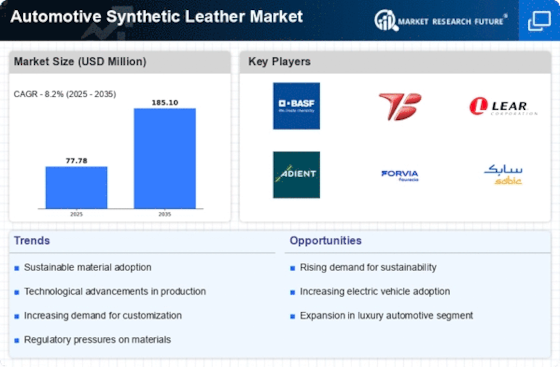
    As per MRFR analysis, the Automotive Synthetic Leather Market Size was estimated at 77.78 USD Million in 2024. The Automotive Synthetic Leather industry is projected to grow from 84.16 USD Million in 2025 to 185.1 USD Million by 2035, exhibiting a compound annual growth rate (CAGR) of 8.2 during the forecast period 2025 - 2035.

    Key Market Trends & Highlights

    The Automotive Synthetic Leather Market is poised for substantial growth driven by sustainability and technological advancements.

    • The North American region remains the largest market for automotive synthetic leather, reflecting a strong demand for high-quality materials.
    • In contrast, the Asia-Pacific region is emerging as the fastest-growing market, fueled by increasing automotive production and consumer preferences.
    • Polyurethane (PU) synthetic leather dominates the market, while bio-based alternatives are gaining traction as the fastest-growing segment.
    • Sustainability initiatives and technological innovations are key drivers, influencing both OEM and aftermarket segments in their quest for eco-friendly solutions.

    Market Size & Forecast

    2024 Market Size 77.78 (USD Million)
    2035 Market Size 185.1 (USD Million)
    CAGR (2025 - 2035) 8.2%
    Largest Regional Market Share in 2024 North America

    Major Players

    <p>BASF (DE), Toyota Boshoku (JP), Lear Corporation (US), Adient (US), Faurecia (FR), SABIC (SA), Covestro (DE), Hyosung (KR), Nitto Denko (JP)</p>

    Market Trends

    The Automotive Synthetic Leather Market is currently experiencing a notable transformation, driven by evolving consumer preferences and increasing environmental awareness. As manufacturers strive to meet the demand for sustainable materials, synthetic leather is emerging as a viable alternative to traditional leather. This shift is not merely a trend but appears to be a fundamental change in how automotive interiors are designed and produced. The market is characterized by a growing emphasis on durability, aesthetics, and eco-friendliness, which are becoming essential criteria for both consumers and manufacturers alike. Moreover, advancements in technology are facilitating the development of high-quality synthetic leather that closely mimics the look and feel of genuine leather. This innovation is likely to enhance the appeal of synthetic options, making them more attractive to a broader audience. Additionally, the Automotive Synthetic Leather Market is witnessing a surge in collaborations between automotive manufacturers and synthetic leather producers, indicating a strategic alignment towards sustainable practices. As the industry continues to evolve, it seems poised for further growth, with an increasing number of vehicles incorporating synthetic materials into their designs, thereby reshaping the future of automotive interiors.

    Sustainability Focus

    The Automotive Synthetic Leather Market is increasingly prioritizing sustainability, as consumers demand eco-friendly materials. This trend reflects a broader societal shift towards environmental responsibility, prompting manufacturers to explore innovative production methods that minimize ecological impact.

    Technological Advancements

    Ongoing technological innovations are enhancing the quality and performance of synthetic leather. These advancements enable the creation of materials that not only replicate the aesthetic appeal of natural leather but also offer superior durability and ease of maintenance.

    Collaborative Efforts

    There is a noticeable trend of collaboration between automotive manufacturers and synthetic leather suppliers. These partnerships aim to integrate sustainable practices into production processes, fostering a more cohesive approach to meeting consumer expectations and regulatory standards.

    Automotive Synthetic Leather Market Market Drivers

    Cost-Effectiveness

    Cost-effectiveness is a significant driver in the Automotive Synthetic Leather Market. Synthetic leather typically offers a more affordable alternative to genuine leather, making it an attractive option for manufacturers looking to reduce production costs. The lower price point does not compromise quality, as advancements in technology have led to the creation of synthetic materials that closely mimic the look and feel of real leather. This affordability allows automotive companies to maintain competitive pricing while still providing high-quality interiors. As the demand for cost-effective solutions continues to rise, the Automotive Synthetic Leather Market is likely to see sustained growth. By 2025, the emphasis on cost-effectiveness will remain a key factor influencing purchasing decisions in the automotive sector.

    Consumer Preferences

    Consumer preferences are evolving, significantly impacting the Automotive Synthetic Leather Market. There is a noticeable shift towards synthetic materials due to their perceived benefits, such as affordability, ease of maintenance, and ethical considerations. Many consumers are opting for synthetic leather as it offers a cruelty-free alternative to traditional leather, aligning with their values. This trend is particularly pronounced among younger demographics who prioritize sustainability and ethical consumption. As a result, manufacturers are increasingly focusing on developing high-quality synthetic leather that meets these consumer demands. By 2025, the Automotive Synthetic Leather Market is expected to expand as more consumers choose synthetic options, driving innovation and competition among producers.

    Regulatory Compliance

    Regulatory compliance is a critical driver for the Automotive Synthetic Leather Market. Governments worldwide are implementing stringent regulations regarding the use of hazardous materials in automotive interiors. Synthetic leather, often free from harmful chemicals like phthalates and formaldehyde, presents a viable alternative to traditional leather. This compliance not only ensures consumer safety but also encourages manufacturers to adopt synthetic options. As regulations become more rigorous, the demand for compliant materials is likely to increase, propelling the growth of the Automotive Synthetic Leather Market. By 2025, it is anticipated that adherence to these regulations will significantly influence purchasing decisions, further solidifying the market's position.

    Technological Innovations

    Technological innovations play a pivotal role in shaping the Automotive Synthetic Leather Market. Advances in manufacturing processes, such as 3D printing and digital printing, enable the production of high-quality synthetic leather with enhanced durability and aesthetic appeal. These innovations allow for customization, catering to diverse consumer preferences. Furthermore, the integration of smart technologies, such as temperature regulation and moisture control, is becoming more prevalent in synthetic leather products. As a result, the market is witnessing a surge in demand for technologically advanced materials that offer both functionality and style. By 2025, the Automotive Synthetic Leather Market is expected to experience significant growth, driven by these technological advancements that enhance product offerings.

    Sustainability Initiatives

    The Automotive Synthetic Leather Market is increasingly influenced by sustainability initiatives. As consumers become more environmentally conscious, manufacturers are compelled to adopt eco-friendly materials. Synthetic leather, often produced with less environmental impact than traditional leather, aligns with this trend. The market is projected to grow as companies seek to reduce their carbon footprint and enhance their brand image through sustainable practices. In 2025, the demand for sustainable automotive materials is expected to rise, with synthetic leather being a preferred choice due to its recyclability and lower resource consumption. This shift not only meets consumer expectations but also complies with stringent regulations aimed at reducing environmental harm, thereby driving growth in the Automotive Synthetic Leather Market.

    Market Segment Insights

    By Type: PU (Largest) vs. Bio-Based (Fastest-Growing)

    <p>In the Automotive Synthetic Leather Market, the primary segments include PU, PVC, and Bio-Based materials. Among these, PU leather holds the largest market share due to its superior quality, aesthetics, and durability, making it a preferred choice for various automotive applications. PVC follows as a competitive option, offering cost-effectiveness and ease of maintenance; however, its market presence is diminishing due to the growing preference for eco-friendlier materials. In contrast, Bio-Based leather is emerging as a significant segment, driven by increasing consumer demand for sustainable alternatives, which is reshaping market dynamics.</p>

    <p>PU (Dominant) vs. Bio-Based (Emerging)</p>

    <p>PU leather is characterized by its versatility, luxurious feel, and excellent performance, positioning it as the dominant type in the Automotive Synthetic Leather Market. Its wear resistance and wide-ranging applications in passenger vehicles, luxury cars, and upholstery contribute to its stronghold. On the other hand, Bio-Based synthetic leather, derived from renewable resources, is gaining traction as an emerging segment. It appeals to environmentally conscious consumers and automakers looking to comply with sustainability initiatives. As technology advances, these materials are expected to provide comparable quality to traditional options while emphasizing eco-friendliness, promoting a shifting paradigm in automotive interiors.</p>

    By Distribution Channel: OEM (Largest) vs. Aftermarket (Fastest-Growing)

    <p>In the Automotive Synthetic Leather Market, the distribution of market share between OEMs and the aftermarket is quite distinct. OEMs maintain a significant lead, catering to major automotive manufacturers who prefer high-quality materials for vehicle production. This segment benefits from the established relationships between manufacturers and suppliers, ensuring a steady demand for synthetic leather in new vehicles. In contrast, the aftermarket segment is on the rise, fueled by increasing consumer interest in vehicle customization and interior upgrades. Customers are now more inclined to enhance their vehicles with synthetic leather upholstery and accessories that reflect their personal style. The growth trends within these segments are shaped by various factors. The OEM sector is robust, driven by the expansion of electric vehicles and the need for lightweight materials that enhance fuel efficiency. Meanwhile, the aftermarket segment is experiencing a surge, primarily due to rising disposable incomes and a growing trend of personalization among consumers. Additionally, awareness of sustainable materials in automotive interiors is fostering an increased demand for synthetic leather alternatives among aftermarket buyers, contributing to their rapid growth trajectory.</p>

    <p>OEM (Dominant) vs. Aftermarket (Emerging)</p>

    <p>The OEM segment of the Automotive Synthetic Leather Market is characterized by its dominant position, supported by long-term contracts with major automotive manufacturers. This segment focuses on high-quality, durable products that meet rigorous industry standards and specifications, ensuring that vehicles are equipped with aesthetically pleasing and functional interiors. With an emphasis on performance and sustainability, OEM synthetic leather is often used in high-end vehicles, appealing to a market segment that prioritizes quality and environmental impact. Conversely, the aftermarket segment is emerging rapidly, driven by the trend of customization and improvement in vehicle interiors. Consumers are increasingly opting for synthetic leather products that offer diverse designs, colors, and finishes to personalize their cars. This segment is characterized by a wide range of products, including seat covers, floor mats, and steering wheel covers, promoting both style and comfort. The growth of e-commerce has also allowed aftermarket suppliers to reach a broader audience, further propelling their market share.</p>

    Get more detailed insights about Automotive Synthetic Leather Market Research Report — Global Forecast till 2035

    Regional Insights

    By region, the study gives market insights into the North America, Europe, Asia-Pacific, and the Rest of the World. The North American Automotive Synthetic Leather market area will dominate this market due to a combination of robust demand from the region's well-established automotive industry and a growing preference for sustainable and cruelty-free materials and the region's stringent environmental regulations, coupled with the automotive sector's commitment to meeting these standards.

    Further, the prime countries studied in the market report are The US, Canada, Germany, France, the UK, Italy, Spain, Japan, China, India, Australia, South Korea, and Brazil.

    Figure 2: AUTOMOTIVE SYNTHETIC LEATHER MARKET SHARE BY REGION 2022 (USD Billion)

    AUTOMOTIVE SYNTHETIC LEATHER MARKET SHARE BY REGION 2022

    Source: The Secondary Research, Primary Research, Market Research Future Database and Analyst Review

    Europe's Automotive Synthetic Leather market accounts for the second-largest market share due to the region's strong emphasis on sustainability, coupled with stringent regulations promoting eco-friendly materials in the automotive industry. Further, the German Automotive Synthetic Leather market held the largest market revenue share, and the UK Automotive Synthetic Leather market was the fastest-growing market in the European region.

    The Asia-Pacific Automotive Synthetic Leather Market is expected to grow at the fastest CAGR from the year 2023 to 2032. This is due to the region's burgeoning automotive manufacturing sector, coupled with a growing consumer awareness and preference for sustainable and cruelty-free materials in vehicle interiors. Moreover, China’s Automotive Synthetic Leather market held the largest market share, and the Indian Automotive Synthetic Leather market was the fastest-growing market in the Asia-Pacific region.

    Key Players and Competitive Insights

    Leading market players are investing heavily in the research and development in order to expand their product lines, which will help the Automotive Synthetic Leather market grow even more. Market players are also undertaking a variety of strategic activities to spread their global footprint, with important market developments including mergers and acquisitions, new product launches, contractual agreements, higher investments, and collaboration with other organizations. To spread and survive in a more competitive and rising market climate, the Automotive Synthetic Leather industry must offer cost-effective items.

    Manufacturing locally to minimize the operational costs is one of the key business tactics used by the manufacturers in the global Automotive Synthetic Leather industry to benefit the clients and increase the market sector. In recent years, the Automotive Synthetic Leather industry has offered some of the most significant advantages to the automotive industry. Major players in the Automotive Synthetic Leather market, including Mayur Uniquoters Limited, San Fang Chemical Industry Co. Ltd, Alfatex Italia SRL, Yantai Wanhua Artificial Leather Group Co. Ltd, Nan Ya Plastics Corporation, Kuraray Co. Ltd, Zhejiang Hexin Industry Group Co. Ltd., Toray Group, H.R. Polycoats Pvt.

    Ltd, Filwel Co. Ltd, and others are trying to increase market demand by investing in the research and development operations.

    BASF SE, headquartered in Ludwigshafen, Germany, is one of the world's largest chemical companies and a leading provider of a broad range of products and solutions. Founded in 1865, BASF operates in various segments, including chemicals, materials, industrial solutions, surface technologies, nutrition and care, and agricultural solutions. The company is known for its commitment to sustainability and innovation, consistently developing products that address global challenges such as climate change, resource efficiency, and food security.

    In October 2023, BASF SE and Teijin Limited announced a partnership in order to develop and market a new generation of high-performance synthetic leather for automotive applications. This partnership leverages BASF's expertise in advanced materials and Teijin's experience in synthetic leather production to create innovative solutions for car manufacturers.

    Hyundai Motor Company, the South Korean multinational automotive manufacturer is one of the largest and most prominent players in the global automotive industry. Established in 1967, Hyundai has evolved into a powerhouse, producing a diverse range of vehicles, including sedans, SUVs, and electric vehicles. Known for its commitment to innovation and quality, Hyundai has gained international recognition for its advancements in technology, design, and fuel efficiency.

    In September 2023, Hyundai Motor Company and Kolon Industries Inc. signed a strategic partnership to develop and manufacture sustainable and eco-friendly synthetic leather for Hyundai's future electric vehicle models. This partnership aims to reduce the environmental impact of car manufacturing and meet the growing demand for sustainable materials.

    Key Companies in the Automotive Synthetic Leather Market market include

    Industry Developments

    July 2023: The Japanese automotive supplier Yazaki Corporation acquired a majority stake in the US-based synthetic leather startup EcoLeather Inc., a developer of bio-based and sustainable synthetic leather materials. This acquisition provides Yazaki access to cutting-edge sustainable technology and strengthens its position in the eco-friendly automotive materials market.

    June 2023: The Chinese automotive interior supplier Lingyun Industrial Group acquired the European synthetic leather manufacturer Fein Polymers GmbH. This acquisition expands Lingyun's global reach and strengthens its presence in the European automotive market.

    May 2023: The US-based private equity firm Clayton, Dubilier & Rice acquired a controlling stake in the global leader in synthetic leather production, Kuraray Noritake Co., Ltd. This acquisition is expected to accelerate Kuraray Noritake's growth and expansion into new markets.

    Future Outlook

    Automotive Synthetic Leather Market Future Outlook

    <p>The Automotive Synthetic Leather Market is projected to grow at an 8.2% CAGR from 2024 to 2035, driven by increasing demand for sustainable materials and technological advancements.</p>

    New opportunities lie in:

    • <p>Expansion into electric vehicle interiors with eco-friendly synthetic leather solutions.</p>
    • <p>Development of customizable synthetic leather for luxury automotive segments.</p>
    • <p>Partnerships with automotive manufacturers for integrated interior design solutions.</p>

    <p>By 2035, the market is expected to solidify its position as a leader in sustainable automotive materials.</p>

    Market Segmentation

    Automotive Synthetic Leather Market Type Outlook

    • PU
    • PVC
    • Bio-Based

    Automotive Synthetic Leather Market Distribution Channel Outlook

    • OEM
    • Aftermarket

    Report Scope

    MARKET SIZE 202477.78(USD Million)
    MARKET SIZE 202584.16(USD Million)
    MARKET SIZE 2035185.1(USD Million)
    COMPOUND ANNUAL GROWTH RATE (CAGR)8.2% (2024 - 2035)
    REPORT COVERAGERevenue Forecast, Competitive Landscape, Growth Factors, and Trends
    BASE YEAR2024
    Market Forecast Period2025 - 2035
    Historical Data2019 - 2024
    Market Forecast UnitsUSD Million
    Key Companies ProfiledMarket analysis in progress
    Segments CoveredMarket segmentation analysis in progress
    Key Market OpportunitiesGrowing demand for sustainable materials drives innovation in the Automotive Synthetic Leather Market.
    Key Market DynamicsRising demand for sustainable materials drives innovation and competition in the automotive synthetic leather market.
    Countries CoveredNorth America, Europe, APAC, South America, MEA

    FAQs

    How much is the Automotive Synthetic Leather market?

    The Automotive Synthetic Leather Market size was valued at USD 68.7 billion in 2023.

    What is the growth rate of the Automotive Synthetic Leather market?

    The global market is foreseen to rise at a CAGR of 5.10% during the forecast period, 2025-2035.

    Which region held the biggest market share in the Automotive Synthetic Leather market?

    North America had the biggest share in the global market

    Who are the prime players in the Automotive Synthetic Leather market?

    The key players in the market are Mayur Uniquoters Limited, San Fang Chemical Industry Co. Ltd, Alfatex Italia SRL, Yantai Wanhua Artificial Leather Group Co. Ltd, Nan Ya Plastics Corporation, Kuraray Co. Ltd, Zhejiang Hexin Industry Group Co. Ltd., Toray Group, H.R. Polycoats Pvt. Ltd, Filwel Co. Ltd.

    Which type led to the automotive synthetic leather market?

    The PU category dominated the market in 2022.

    Which distribution channel held the largest market revenue share in the Automotive Synthetic Leather market?

    The OEM had the largest share in the global market.

    1. SECTION I: EXECUTIVE SUMMARY AND KEY HIGHLIGHTS
      1. | 1.1 EXECUTIVE SUMMARY
      2. | | 1.1.1 Market Overview
      3. | | 1.1.2 Key Findings
      4. | | 1.1.3 Market Segmentation
      5. | | 1.1.4 Competitive Landscape
      6. | | 1.1.5 Challenges and Opportunities
      7. | | 1.1.6 Future Outlook
    2. SECTION II: SCOPING, METHODOLOGY AND MARKET STRUCTURE
      1. | 2.1 MARKET INTRODUCTION
      2. | | 2.1.1 Definition
      3. | | 2.1.2 Scope of the study
      4. | | | 2.1.2.1 Research Objective
      5. | | | 2.1.2.2 Assumption
      6. | | | 2.1.2.3 Limitations
      7. | 2.2 RESEARCH METHODOLOGY
      8. | | 2.2.1 Overview
      9. | | 2.2.2 Data Mining
      10. | | 2.2.3 Secondary Research
      11. | | 2.2.4 Primary Research
      12. | | | 2.2.4.1 Primary Interviews and Information Gathering Process
      13. | | | 2.2.4.2 Breakdown of Primary Respondents
      14. | | 2.2.5 Forecasting Model
      15. | | 2.2.6 Market Size Estimation
      16. | | | 2.2.6.1 Bottom-Up Approach
      17. | | | 2.2.6.2 Top-Down Approach
      18. | | 2.2.7 Data Triangulation
      19. | | 2.2.8 Validation
    3. SECTION III: QUALITATIVE ANALYSIS
      1. | 3.1 MARKET DYNAMICS
      2. | | 3.1.1 Overview
      3. | | 3.1.2 Drivers
      4. | | 3.1.3 Restraints
      5. | | 3.1.4 Opportunities
      6. | 3.2 MARKET FACTOR ANALYSIS
      7. | | 3.2.1 Value chain Analysis
      8. | | 3.2.2 Porter's Five Forces Analysis
      9. | | | 3.2.2.1 Bargaining Power of Suppliers
      10. | | | 3.2.2.2 Bargaining Power of Buyers
      11. | | | 3.2.2.3 Threat of New Entrants
      12. | | | 3.2.2.4 Threat of Substitutes
      13. | | | 3.2.2.5 Intensity of Rivalry
      14. | | 3.2.3 COVID-19 Impact Analysis
      15. | | | 3.2.3.1 Market Impact Analysis
      16. | | | 3.2.3.2 Regional Impact
      17. | | | 3.2.3.3 Opportunity and Threat Analysis
    4. SECTION IV: QUANTITATIVE ANALYSIS
      1. | 4.1 Chemicals and Materials, BY Type (USD Million)
      2. | | 4.1.1 PU
      3. | | 4.1.2 PVC
      4. | | 4.1.3 Bio-Based
      5. | 4.2 Chemicals and Materials, BY Distribution Channel (USD Million)
      6. | | 4.2.1 OEM
      7. | | 4.2.2 Aftermarket
      8. | 4.3 Chemicals and Materials, BY Region (USD Million)
      9. | | 4.3.1 North America
      10. | | | 4.3.1.1 US
      11. | | | 4.3.1.2 Canada
      12. | | 4.3.2 Europe
      13. | | | 4.3.2.1 Germany
      14. | | | 4.3.2.2 UK
      15. | | | 4.3.2.3 France
      16. | | | 4.3.2.4 Russia
      17. | | | 4.3.2.5 Italy
      18. | | | 4.3.2.6 Spain
      19. | | | 4.3.2.7 Rest of Europe
      20. | | 4.3.3 APAC
      21. | | | 4.3.3.1 China
      22. | | | 4.3.3.2 India
      23. | | | 4.3.3.3 Japan
      24. | | | 4.3.3.4 South Korea
      25. | | | 4.3.3.5 Malaysia
      26. | | | 4.3.3.6 Thailand
      27. | | | 4.3.3.7 Indonesia
      28. | | | 4.3.3.8 Rest of APAC
      29. | | 4.3.4 South America
      30. | | | 4.3.4.1 Brazil
      31. | | | 4.3.4.2 Mexico
      32. | | | 4.3.4.3 Argentina
      33. | | | 4.3.4.4 Rest of South America
      34. | | 4.3.5 MEA
      35. | | | 4.3.5.1 GCC Countries
      36. | | | 4.3.5.2 South Africa
      37. | | | 4.3.5.3 Rest of MEA
    5. SECTION V: COMPETITIVE ANALYSIS
      1. | 5.1 Competitive Landscape
      2. | | 5.1.1 Overview
      3. | | 5.1.2 Competitive Analysis
      4. | | 5.1.3 Market share Analysis
      5. | | 5.1.4 Major Growth Strategy in the Chemicals and Materials
      6. | | 5.1.5 Competitive Benchmarking
      7. | | 5.1.6 Leading Players in Terms of Number of Developments in the Chemicals and Materials
      8. | | 5.1.7 Key developments and growth strategies
      9. | | | 5.1.7.1 New Product Launch/Service Deployment
      10. | | | 5.1.7.2 Merger & Acquisitions
      11. | | | 5.1.7.3 Joint Ventures
      12. | | 5.1.8 Major Players Financial Matrix
      13. | | | 5.1.8.1 Sales and Operating Income
      14. | | | 5.1.8.2 Major Players R&D Expenditure. 2023
      15. | 5.2 Company Profiles
      16. | | 5.2.1 BASF (DE)
      17. | | | 5.2.1.1 Financial Overview
      18. | | | 5.2.1.2 Products Offered
      19. | | | 5.2.1.3 Key Developments
      20. | | | 5.2.1.4 SWOT Analysis
      21. | | | 5.2.1.5 Key Strategies
      22. | | 5.2.2 Toyota Boshoku (JP)
      23. | | | 5.2.2.1 Financial Overview
      24. | | | 5.2.2.2 Products Offered
      25. | | | 5.2.2.3 Key Developments
      26. | | | 5.2.2.4 SWOT Analysis
      27. | | | 5.2.2.5 Key Strategies
      28. | | 5.2.3 Lear Corporation (US)
      29. | | | 5.2.3.1 Financial Overview
      30. | | | 5.2.3.2 Products Offered
      31. | | | 5.2.3.3 Key Developments
      32. | | | 5.2.3.4 SWOT Analysis
      33. | | | 5.2.3.5 Key Strategies
      34. | | 5.2.4 Adient (US)
      35. | | | 5.2.4.1 Financial Overview
      36. | | | 5.2.4.2 Products Offered
      37. | | | 5.2.4.3 Key Developments
      38. | | | 5.2.4.4 SWOT Analysis
      39. | | | 5.2.4.5 Key Strategies
      40. | | 5.2.5 Faurecia (FR)
      41. | | | 5.2.5.1 Financial Overview
      42. | | | 5.2.5.2 Products Offered
      43. | | | 5.2.5.3 Key Developments
      44. | | | 5.2.5.4 SWOT Analysis
      45. | | | 5.2.5.5 Key Strategies
      46. | | 5.2.6 SABIC (SA)
      47. | | | 5.2.6.1 Financial Overview
      48. | | | 5.2.6.2 Products Offered
      49. | | | 5.2.6.3 Key Developments
      50. | | | 5.2.6.4 SWOT Analysis
      51. | | | 5.2.6.5 Key Strategies
      52. | | 5.2.7 Covestro (DE)
      53. | | | 5.2.7.1 Financial Overview
      54. | | | 5.2.7.2 Products Offered
      55. | | | 5.2.7.3 Key Developments
      56. | | | 5.2.7.4 SWOT Analysis
      57. | | | 5.2.7.5 Key Strategies
      58. | | 5.2.8 Hyosung (KR)
      59. | | | 5.2.8.1 Financial Overview
      60. | | | 5.2.8.2 Products Offered
      61. | | | 5.2.8.3 Key Developments
      62. | | | 5.2.8.4 SWOT Analysis
      63. | | | 5.2.8.5 Key Strategies
      64. | | 5.2.9 Nitto Denko (JP)
      65. | | | 5.2.9.1 Financial Overview
      66. | | | 5.2.9.2 Products Offered
      67. | | | 5.2.9.3 Key Developments
      68. | | | 5.2.9.4 SWOT Analysis
      69. | | | 5.2.9.5 Key Strategies
      70. | 5.3 Appendix
      71. | | 5.3.1 References
      72. | | 5.3.2 Related Reports
    6. LIST OF FIGURES
      1. | 6.1 MARKET SYNOPSIS
      2. | 6.2 NORTH AMERICA MARKET ANALYSIS
      3. | 6.3 US MARKET ANALYSIS BY TYPE
      4. | 6.4 US MARKET ANALYSIS BY DISTRIBUTION CHANNEL
      5. | 6.5 CANADA MARKET ANALYSIS BY TYPE
      6. | 6.6 CANADA MARKET ANALYSIS BY DISTRIBUTION CHANNEL
      7. | 6.7 EUROPE MARKET ANALYSIS
      8. | 6.8 GERMANY MARKET ANALYSIS BY TYPE
      9. | 6.9 GERMANY MARKET ANALYSIS BY DISTRIBUTION CHANNEL
      10. | 6.10 UK MARKET ANALYSIS BY TYPE
      11. | 6.11 UK MARKET ANALYSIS BY DISTRIBUTION CHANNEL
      12. | 6.12 FRANCE MARKET ANALYSIS BY TYPE
      13. | 6.13 FRANCE MARKET ANALYSIS BY DISTRIBUTION CHANNEL
      14. | 6.14 RUSSIA MARKET ANALYSIS BY TYPE
      15. | 6.15 RUSSIA MARKET ANALYSIS BY DISTRIBUTION CHANNEL
      16. | 6.16 ITALY MARKET ANALYSIS BY TYPE
      17. | 6.17 ITALY MARKET ANALYSIS BY DISTRIBUTION CHANNEL
      18. | 6.18 SPAIN MARKET ANALYSIS BY TYPE
      19. | 6.19 SPAIN MARKET ANALYSIS BY DISTRIBUTION CHANNEL
      20. | 6.20 REST OF EUROPE MARKET ANALYSIS BY TYPE
      21. | 6.21 REST OF EUROPE MARKET ANALYSIS BY DISTRIBUTION CHANNEL
      22. | 6.22 APAC MARKET ANALYSIS
      23. | 6.23 CHINA MARKET ANALYSIS BY TYPE
      24. | 6.24 CHINA MARKET ANALYSIS BY DISTRIBUTION CHANNEL
      25. | 6.25 INDIA MARKET ANALYSIS BY TYPE
      26. | 6.26 INDIA MARKET ANALYSIS BY DISTRIBUTION CHANNEL
      27. | 6.27 JAPAN MARKET ANALYSIS BY TYPE
      28. | 6.28 JAPAN MARKET ANALYSIS BY DISTRIBUTION CHANNEL
      29. | 6.29 SOUTH KOREA MARKET ANALYSIS BY TYPE
      30. | 6.30 SOUTH KOREA MARKET ANALYSIS BY DISTRIBUTION CHANNEL
      31. | 6.31 MALAYSIA MARKET ANALYSIS BY TYPE
      32. | 6.32 MALAYSIA MARKET ANALYSIS BY DISTRIBUTION CHANNEL
      33. | 6.33 THAILAND MARKET ANALYSIS BY TYPE
      34. | 6.34 THAILAND MARKET ANALYSIS BY DISTRIBUTION CHANNEL
      35. | 6.35 INDONESIA MARKET ANALYSIS BY TYPE
      36. | 6.36 INDONESIA MARKET ANALYSIS BY DISTRIBUTION CHANNEL
      37. | 6.37 REST OF APAC MARKET ANALYSIS BY TYPE
      38. | 6.38 REST OF APAC MARKET ANALYSIS BY DISTRIBUTION CHANNEL
      39. | 6.39 SOUTH AMERICA MARKET ANALYSIS
      40. | 6.40 BRAZIL MARKET ANALYSIS BY TYPE
      41. | 6.41 BRAZIL MARKET ANALYSIS BY DISTRIBUTION CHANNEL
      42. | 6.42 MEXICO MARKET ANALYSIS BY TYPE
      43. | 6.43 MEXICO MARKET ANALYSIS BY DISTRIBUTION CHANNEL
      44. | 6.44 ARGENTINA MARKET ANALYSIS BY TYPE
      45. | 6.45 ARGENTINA MARKET ANALYSIS BY DISTRIBUTION CHANNEL
      46. | 6.46 REST OF SOUTH AMERICA MARKET ANALYSIS BY TYPE
      47. | 6.47 REST OF SOUTH AMERICA MARKET ANALYSIS BY DISTRIBUTION CHANNEL
      48. | 6.48 MEA MARKET ANALYSIS
      49. | 6.49 GCC COUNTRIES MARKET ANALYSIS BY TYPE
      50. | 6.50 GCC COUNTRIES MARKET ANALYSIS BY DISTRIBUTION CHANNEL
      51. | 6.51 SOUTH AFRICA MARKET ANALYSIS BY TYPE
      52. | 6.52 SOUTH AFRICA MARKET ANALYSIS BY DISTRIBUTION CHANNEL
      53. | 6.53 REST OF MEA MARKET ANALYSIS BY TYPE
      54. | 6.54 REST OF MEA MARKET ANALYSIS BY DISTRIBUTION CHANNEL
      55. | 6.55 KEY BUYING CRITERIA OF CHEMICALS AND MATERIALS
      56. | 6.56 RESEARCH PROCESS OF MRFR
      57. | 6.57 DRO ANALYSIS OF CHEMICALS AND MATERIALS
      58. | 6.58 DRIVERS IMPACT ANALYSIS: CHEMICALS AND MATERIALS
      59. | 6.59 RESTRAINTS IMPACT ANALYSIS: CHEMICALS AND MATERIALS
      60. | 6.60 SUPPLY / VALUE CHAIN: CHEMICALS AND MATERIALS
      61. | 6.61 CHEMICALS AND MATERIALS, BY TYPE, 2024 (% SHARE)
      62. | 6.62 CHEMICALS AND MATERIALS, BY TYPE, 2024 TO 2035 (USD Million)
      63. | 6.63 CHEMICALS AND MATERIALS, BY DISTRIBUTION CHANNEL, 2024 (% SHARE)
      64. | 6.64 CHEMICALS AND MATERIALS, BY DISTRIBUTION CHANNEL, 2024 TO 2035 (USD Million)
      65. | 6.65 BENCHMARKING OF MAJOR COMPETITORS
    7. LIST OF TABLES
      1. | 7.1 LIST OF ASSUMPTIONS
      2. | | 7.1.1
      3. | 7.2 North America MARKET SIZE ESTIMATES; FORECAST
      4. | | 7.2.1 BY TYPE, 2025-2035 (USD Million)
      5. | | 7.2.2 BY DISTRIBUTION CHANNEL, 2025-2035 (USD Million)
      6. | 7.3 US MARKET SIZE ESTIMATES; FORECAST
      7. | | 7.3.1 BY TYPE, 2025-2035 (USD Million)
      8. | | 7.3.2 BY DISTRIBUTION CHANNEL, 2025-2035 (USD Million)
      9. | 7.4 Canada MARKET SIZE ESTIMATES; FORECAST
      10. | | 7.4.1 BY TYPE, 2025-2035 (USD Million)
      11. | | 7.4.2 BY DISTRIBUTION CHANNEL, 2025-2035 (USD Million)
      12. | 7.5 Europe MARKET SIZE ESTIMATES; FORECAST
      13. | | 7.5.1 BY TYPE, 2025-2035 (USD Million)
      14. | | 7.5.2 BY DISTRIBUTION CHANNEL, 2025-2035 (USD Million)
      15. | 7.6 Germany MARKET SIZE ESTIMATES; FORECAST
      16. | | 7.6.1 BY TYPE, 2025-2035 (USD Million)
      17. | | 7.6.2 BY DISTRIBUTION CHANNEL, 2025-2035 (USD Million)
      18. | 7.7 UK MARKET SIZE ESTIMATES; FORECAST
      19. | | 7.7.1 BY TYPE, 2025-2035 (USD Million)
      20. | | 7.7.2 BY DISTRIBUTION CHANNEL, 2025-2035 (USD Million)
      21. | 7.8 France MARKET SIZE ESTIMATES; FORECAST
      22. | | 7.8.1 BY TYPE, 2025-2035 (USD Million)
      23. | | 7.8.2 BY DISTRIBUTION CHANNEL, 2025-2035 (USD Million)
      24. | 7.9 Russia MARKET SIZE ESTIMATES; FORECAST
      25. | | 7.9.1 BY TYPE, 2025-2035 (USD Million)
      26. | | 7.9.2 BY DISTRIBUTION CHANNEL, 2025-2035 (USD Million)
      27. | 7.10 Italy MARKET SIZE ESTIMATES; FORECAST
      28. | | 7.10.1 BY TYPE, 2025-2035 (USD Million)
      29. | | 7.10.2 BY DISTRIBUTION CHANNEL, 2025-2035 (USD Million)
      30. | 7.11 Spain MARKET SIZE ESTIMATES; FORECAST
      31. | | 7.11.1 BY TYPE, 2025-2035 (USD Million)
      32. | | 7.11.2 BY DISTRIBUTION CHANNEL, 2025-2035 (USD Million)
      33. | 7.12 Rest of Europe MARKET SIZE ESTIMATES; FORECAST
      34. | | 7.12.1 BY TYPE, 2025-2035 (USD Million)
      35. | | 7.12.2 BY DISTRIBUTION CHANNEL, 2025-2035 (USD Million)
      36. | 7.13 APAC MARKET SIZE ESTIMATES; FORECAST
      37. | | 7.13.1 BY TYPE, 2025-2035 (USD Million)
      38. | | 7.13.2 BY DISTRIBUTION CHANNEL, 2025-2035 (USD Million)
      39. | 7.14 China MARKET SIZE ESTIMATES; FORECAST
      40. | | 7.14.1 BY TYPE, 2025-2035 (USD Million)
      41. | | 7.14.2 BY DISTRIBUTION CHANNEL, 2025-2035 (USD Million)
      42. | 7.15 India MARKET SIZE ESTIMATES; FORECAST
      43. | | 7.15.1 BY TYPE, 2025-2035 (USD Million)
      44. | | 7.15.2 BY DISTRIBUTION CHANNEL, 2025-2035 (USD Million)
      45. | 7.16 Japan MARKET SIZE ESTIMATES; FORECAST
      46. | | 7.16.1 BY TYPE, 2025-2035 (USD Million)
      47. | | 7.16.2 BY DISTRIBUTION CHANNEL, 2025-2035 (USD Million)
      48. | 7.17 South Korea MARKET SIZE ESTIMATES; FORECAST
      49. | | 7.17.1 BY TYPE, 2025-2035 (USD Million)
      50. | | 7.17.2 BY DISTRIBUTION CHANNEL, 2025-2035 (USD Million)
      51. | 7.18 Malaysia MARKET SIZE ESTIMATES; FORECAST
      52. | | 7.18.1 BY TYPE, 2025-2035 (USD Million)
      53. | | 7.18.2 BY DISTRIBUTION CHANNEL, 2025-2035 (USD Million)
      54. | 7.19 Thailand MARKET SIZE ESTIMATES; FORECAST
      55. | | 7.19.1 BY TYPE, 2025-2035 (USD Million)
      56. | | 7.19.2 BY DISTRIBUTION CHANNEL, 2025-2035 (USD Million)
      57. | 7.20 Indonesia MARKET SIZE ESTIMATES; FORECAST
      58. | | 7.20.1 BY TYPE, 2025-2035 (USD Million)
      59. | | 7.20.2 BY DISTRIBUTION CHANNEL, 2025-2035 (USD Million)
      60. | 7.21 Rest of APAC MARKET SIZE ESTIMATES; FORECAST
      61. | | 7.21.1 BY TYPE, 2025-2035 (USD Million)
      62. | | 7.21.2 BY DISTRIBUTION CHANNEL, 2025-2035 (USD Million)
      63. | 7.22 South America MARKET SIZE ESTIMATES; FORECAST
      64. | | 7.22.1 BY TYPE, 2025-2035 (USD Million)
      65. | | 7.22.2 BY DISTRIBUTION CHANNEL, 2025-2035 (USD Million)
      66. | 7.23 Brazil MARKET SIZE ESTIMATES; FORECAST
      67. | | 7.23.1 BY TYPE, 2025-2035 (USD Million)
      68. | | 7.23.2 BY DISTRIBUTION CHANNEL, 2025-2035 (USD Million)
      69. | 7.24 Mexico MARKET SIZE ESTIMATES; FORECAST
      70. | | 7.24.1 BY TYPE, 2025-2035 (USD Million)
      71. | | 7.24.2 BY DISTRIBUTION CHANNEL, 2025-2035 (USD Million)
      72. | 7.25 Argentina MARKET SIZE ESTIMATES; FORECAST
      73. | | 7.25.1 BY TYPE, 2025-2035 (USD Million)
      74. | | 7.25.2 BY DISTRIBUTION CHANNEL, 2025-2035 (USD Million)
      75. | 7.26 Rest of South America MARKET SIZE ESTIMATES; FORECAST
      76. | | 7.26.1 BY TYPE, 2025-2035 (USD Million)
      77. | | 7.26.2 BY DISTRIBUTION CHANNEL, 2025-2035 (USD Million)
      78. | 7.27 MEA MARKET SIZE ESTIMATES; FORECAST
      79. | | 7.27.1 BY TYPE, 2025-2035 (USD Million)
      80. | | 7.27.2 BY DISTRIBUTION CHANNEL, 2025-2035 (USD Million)
      81. | 7.28 GCC Countries MARKET SIZE ESTIMATES; FORECAST
      82. | | 7.28.1 BY TYPE, 2025-2035 (USD Million)
      83. | | 7.28.2 BY DISTRIBUTION CHANNEL, 2025-2035 (USD Million)
      84. | 7.29 South Africa MARKET SIZE ESTIMATES; FORECAST
      85. | | 7.29.1 BY TYPE, 2025-2035 (USD Million)
      86. | | 7.29.2 BY DISTRIBUTION CHANNEL, 2025-2035 (USD Million)
      87. | 7.30 Rest of MEA MARKET SIZE ESTIMATES; FORECAST
      88. | | 7.30.1 BY TYPE, 2025-2035 (USD Million)
      89. | | 7.30.2 BY DISTRIBUTION CHANNEL, 2025-2035 (USD Million)
      90. | 7.31 PRODUCT LAUNCH/PRODUCT DEVELOPMENT/APPROVAL
      91. | | 7.31.1
      92. | 7.32 ACQUISITION/PARTNERSHIP
      93. | | 7.32.1

    Automotive Synthetic Leather Market Segmentation

    Market Segmentation Overview

    • Detailed segmentation data will be available in the full report
    • Comprehensive analysis by multiple parameters
    • Regional and country-level breakdowns
    • Market size forecasts by segment
    Infographic

    Free Sample Request

    Kindly complete the form below to receive a free sample of this Report

    Get Free Sample

    Customer Strories

    “I am very pleased with how market segments have been defined in a relevant way for my purposes (such as "Portable Freezers & refrigerators" and "last-mile"). In general the report is well structured. Thanks very much for your efforts.”

    Victoria Milne

    Founder
    Case Study
    Chemicals and Materials

    Compare Licence

    ×
    Features License Type
    Single User Multiuser License Enterprise User
    Price $4,950 $5,950 $7,250
    Maximum User Access Limit 1 User Upto 10 Users Unrestricted Access Throughout the Organization
    Free Customization
    Direct Access to Analyst
    Deliverable Format
    Platform Access
    Discount on Next Purchase 10% 15% 15%
    Printable Versions