×
  • Cat-intel
  • MedIntelliX
  • Resources
  • About Us
  • Hero Background
    English
    Chinese
    French
    Japanese
    Korean
    German
    Spanish

    Aluminum Curtain Wall Market Size

    ID: MRFR/CO/6034-HCR
    110 Pages
    Snehal Singh
    October 2025

    Aluminum Curtain Wall Market Research Report Information By Type (Stick-built, Semi-unitized, Unitized), By Application (Residential, Non-residential) And By Region (North America, Europe, Asia-Pacific, And Rest Of The World) –Market Forecast Till 2035

    Share:
    Download PDF ×

    We do not share your information with anyone. However, we may send you emails based on your report interest from time to time. You may contact us at any time to opt-out.

    Aluminum Curtain Wall Market Infographic
    Purchase Options

    Aluminum Curtain Wall Size

    Aluminum Curtain Wall Market Growth Projections and Opportunities

    The aluminum curtain wall market is influenced by several key factors that shape its dynamics and growth trajectory. One significant market factor is the increasing demand for energy-efficient and aesthetically pleasing building facades. Aluminum curtain walls, consisting of lightweight aluminum frames and glass panels, offer architects and developers a versatile solution for creating modern and sustainable building exteriors. With a focus on energy efficiency and green building practices, the demand for aluminum curtain walls equipped with thermal insulation and solar control features is on the rise, particularly in commercial and high-rise residential construction projects.

    This leads to the rise in urbanization which promotes the growth of the market. High penetration of the aluminum curtain wall in the commercial construction activities especially in the region of India, China, Australia, and some of the Indonesian region has spurred up the aluminum curtain wall market size. Moreover, curtains have been widely used in offices, hospitals, restaurants, and hotels. There are several other advantages associated with the usage of the aluminum wall like enhancing the thermal efficiency of the houses or buildings for preventing the spread of fire.

    Moreover, technological advancements and innovations in aluminum curtain wall systems contribute to market growth. Manufacturers are continuously developing new materials, designs, and fabrication techniques to enhance the performance, durability, and aesthetics of aluminum curtain walls. For example, the introduction of high-performance coatings and finishes improves the weather resistance and maintenance requirements of aluminum frames, while advancements in glass technology enable the integration of energy-efficient glazing options such as low-emissivity coatings and insulated glass units.

    Market factors also include regulatory standards and building codes governing building envelope performance and safety. Government regulations and industry standards prescribe specific requirements for curtain wall systems to ensure compliance with structural integrity, fire safety, and energy efficiency standards. Compliance with these regulations is essential for architects, developers, and builders to obtain permits and certifications for construction projects, driving market demand for aluminum curtain walls that meet regulatory requirements.

    Furthermore, macroeconomic factors such as urbanization and construction activity influence the demand for aluminum curtain walls. With rapid urbanization and population growth, there is a growing need for commercial and residential buildings with modern and aesthetically pleasing facades. Additionally, infrastructure development projects, such as airports, hospitals, and educational institutions, contribute to market growth for aluminum curtain walls as these projects require durable and visually appealing building exteriors.

    Additionally, market factors encompass environmental considerations and sustainability concerns. As governments and businesses increasingly prioritize environmental sustainability and energy efficiency, there is a growing demand for eco-friendly building materials and systems, including aluminum curtain walls. Manufacturers are responding to this demand by incorporating recycled materials, energy-efficient components, and sustainable fabrication processes into their aluminum curtain wall offerings to meet the growing demand for environmentally responsible building solutions.

    Global market trends and trade dynamics also influence the aluminum curtain wall market. International trade agreements, tariffs, and trade barriers impact the import and export of aluminum curtain wall components, affecting pricing dynamics and market competitiveness. Moreover, regional differences in architectural styles and design preferences influence the demand for specific types of aluminum curtain wall systems in different geographic markets.
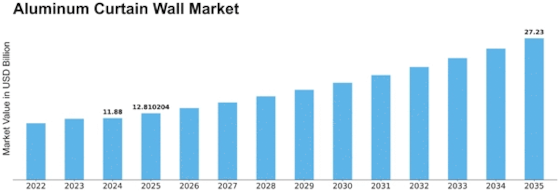
    Aluminum Curtain Wall Market Size Graph
    Author
    Snehal Singh
    Assistant Manager - Research

    High acumen in analyzing complex macro & micro markets with more than 6 years of work experience in the field of market research. By implementing her analytical skills in forecasting and estimation into market research reports, she has expertise in Packaging, Construction, and Equipment domains. She handles a team size of 20-25 resources and ensures smooth running of the projects, associated marketing activities, and client servicing.

    Leave a Comment

    FAQs

    What is the projected market valuation of the Aluminum Curtain Wall Market by 2035?

    The Aluminum Curtain Wall Market is projected to reach a valuation of 27.23 USD Billion by 2035.

    What was the market valuation of the Aluminum Curtain Wall Market in 2024?

    In 2024, the market valuation of the Aluminum Curtain Wall Market was 11.88 USD Billion.

    What is the expected CAGR for the Aluminum Curtain Wall Market during the forecast period 2025 - 2035?

    The expected CAGR for the Aluminum Curtain Wall Market during the forecast period 2025 - 2035 is 7.83%.

    Which segment of the Aluminum Curtain Wall Market had the highest valuation in 2024?

    In 2024, the Non-residential application segment had the highest valuation at 7.13 USD Billion.

    What are the three types of aluminum curtain walls and their projected valuations by 2035?

    The three types are Stick-built, Semi-unitized, and Unitized, with projected valuations of 8.12, 9.45, and 9.66 USD Billion respectively by 2035.

    Who are the key players in the Aluminum Curtain Wall Market?

    Key players include Schüco International KG, Kawneer Company, Inc., Reynaers Aluminium, and others.

    Market Summary

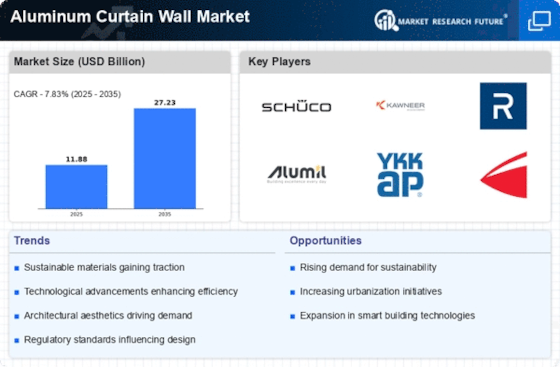
    As per MRFR analysis, the Aluminum Curtain Wall Market Size was estimated at 11.88 USD Billion in 2024. The Aluminum Curtain Wall industry is projected to grow from 12.81 USD Billion in 2025 to 27.23 USD Billion by 2035, exhibiting a compound annual growth rate (CAGR) of 7.83 during the forecast period 2025 - 2035.

    Key Market Trends & Highlights

    The Aluminum Curtain Wall Market is poised for growth driven by sustainability and technological advancements.

    • The market is increasingly influenced by sustainability initiatives, reflecting a broader commitment to eco-friendly construction practices.
    • Technological innovations are enhancing the performance and aesthetic appeal of aluminum curtain walls, making them more desirable in modern architecture.
    • North America remains the largest market, while the Asia-Pacific region is emerging as the fastest-growing area for aluminum curtain wall applications.
    • The demand for unitized systems in residential projects is propelled by urbanization trends and regulatory compliance, highlighting key market drivers.

    Market Size & Forecast

    2024 Market Size 11.88 (USD Billion)
    2035 Market Size 27.23 (USD Billion)
    CAGR (2025 - 2035) 7.83%
    Largest Regional Market Share in 2024 North America

    Major Players

    <p>Schüco International KG (DE), Kawneer Company, Inc. (US), Reynaers Aluminium (BE), Alumil S.A. (GR), YKK AP Inc. (JP), Sapa Group (NO), Saint-Gobain (FR), Alcoa Corporation (US), Mitsubishi Chemical Corporation (JP)</p>

    Market Trends

    The Aluminum Curtain Wall Market is currently experiencing a dynamic evolution, driven by various factors that influence architectural design and construction practices. The increasing emphasis on energy efficiency and sustainability appears to be a primary catalyst, as architects and builders seek materials that not only enhance aesthetic appeal but also contribute to environmental goals. This trend is further supported by advancements in manufacturing technologies, which enable the production of lightweight yet durable aluminum systems. As a result, the market is witnessing a shift towards innovative designs that integrate functionality with visual impact, appealing to a diverse range of commercial and residential applications. Moreover, the growing urbanization and infrastructure development across various regions seem to bolster the demand for aluminum curtain walls. Urban centers are increasingly adopting modern architectural styles, which often incorporate expansive glass facades and aluminum frameworks. This inclination towards contemporary design is likely to continue, as stakeholders prioritize both form and function in their projects. Additionally, the market may benefit from the rising awareness of the advantages of aluminum, such as its recyclability and low maintenance requirements, which align with the broader trends of sustainability and resource conservation. Overall, the Aluminum Curtain Wall Market is poised for continued growth, reflecting the evolving needs of the construction industry and the increasing integration of innovative materials in building design.

    Sustainability Focus

    The emphasis on sustainable building practices is reshaping the Aluminum Curtain Wall Market. Stakeholders are increasingly prioritizing materials that minimize environmental impact, leading to a rise in demand for energy-efficient aluminum systems. This trend aligns with global efforts to reduce carbon footprints and promote eco-friendly construction.

    Technological Advancements

    Innovations in manufacturing processes are significantly influencing the Aluminum Curtain Wall Market. Enhanced production techniques allow for the creation of lightweight, durable, and aesthetically pleasing aluminum systems. These advancements facilitate the integration of complex designs, catering to modern architectural demands.

    Urbanization and Modernization

    Rapid urbanization is driving the growth of the Aluminum Curtain Wall Market. As cities expand, there is a notable shift towards contemporary architectural styles that utilize aluminum curtain walls. This trend reflects a broader movement towards modern design, characterized by large glass facades and sleek aluminum frameworks.

    Aluminum Curtain Wall Market Market Drivers

    Urbanization Trends

    Urbanization trends are significantly impacting the Aluminum Curtain Wall Market. As populations migrate towards urban centers, the demand for high-rise buildings and commercial spaces is escalating. Aluminum curtain walls are favored in urban architecture due to their lightweight nature and ability to provide expansive glass facades, which enhance natural light and aesthetic appeal. Recent statistics suggest that urban areas are projected to account for over 70% of the global population by 2050, driving the need for innovative building solutions. This urban expansion is likely to propel the demand for aluminum curtain walls, as they offer both functional and aesthetic benefits in densely populated environments. Consequently, the market is poised for growth as urbanization continues to reshape the architectural landscape.

    Aesthetic Versatility

    Aesthetic versatility is a defining characteristic driving the Aluminum Curtain Wall Market. The ability of aluminum curtain walls to accommodate various architectural styles makes them a preferred choice among architects and designers. With a wide range of finishes, colors, and design options, aluminum curtain walls can seamlessly integrate into diverse building designs, from modern skyscrapers to traditional structures. This adaptability not only enhances the visual appeal of buildings but also allows for creative expression in architectural design. Market trends indicate that the demand for customized aluminum curtain walls is on the rise, as clients seek unique solutions that reflect their brand identity. This trend is likely to contribute to the sustained growth of the aluminum curtain wall market, as aesthetic considerations become increasingly important in construction.

    Regulatory Compliance

    Regulatory compliance is a crucial driver for the Aluminum Curtain Wall Market. Governments worldwide are implementing stringent building codes and standards aimed at enhancing energy efficiency and safety in construction. These regulations often mandate the use of materials that meet specific performance criteria, which aluminum curtain walls can fulfill. For instance, many regions require buildings to achieve certain energy performance ratings, and aluminum curtain walls are well-suited to meet these requirements. Market analysis indicates that compliance with these regulations could lead to a 20% increase in the adoption of aluminum curtain walls in new constructions. As builders and developers strive to adhere to these evolving standards, the demand for aluminum curtain walls is expected to rise.

    Technological Innovations

    Technological advancements play a pivotal role in shaping the Aluminum Curtain Wall Market. Innovations in manufacturing processes, such as improved extrusion techniques and surface treatments, enhance the performance and aesthetic appeal of aluminum curtain walls. These advancements not only increase durability but also allow for greater design flexibility. The integration of smart technologies, such as automated shading systems and energy-efficient glazing, further elevates the functionality of aluminum curtain walls. Market data indicates that the adoption of these technologies could lead to a 15% increase in market growth over the next five years. As architects and builders seek to incorporate cutting-edge solutions into their designs, the demand for technologically advanced aluminum curtain walls is expected to surge.

    Sustainability Initiatives

    The Aluminum Curtain Wall Market is increasingly influenced by sustainability initiatives. As environmental concerns gain prominence, architects and builders are prioritizing eco-friendly materials. Aluminum, being recyclable, aligns with these sustainability goals. The demand for energy-efficient buildings is also rising, as structures with aluminum curtain walls can significantly reduce energy consumption. According to recent data, buildings utilizing aluminum curtain walls can achieve up to 30% energy savings compared to traditional materials. This trend is likely to drive the market forward, as more stakeholders seek to comply with stringent environmental regulations and certifications. Furthermore, the emphasis on sustainable construction practices is expected to enhance the appeal of aluminum curtain walls, making them a preferred choice in the construction sector.

    Market Segment Insights

    By Type: Unitized (Largest) vs. Stick-built (Fastest-Growing)

    <p>In the Aluminum Curtain Wall Market, the share distribution among various types is critical for understanding overall industry dynamics. The unitized curtain walls currently dominate the market, favored for their efficiency, ease of installation, and reduced labor costs. At the same time, the stick-built segment, which allows for more flexibility in design, is experiencing a surge in popularity, particularly in custom projects where uniqueness matters. This growing interest reflects changing consumer preferences and advancements in construction techniques.</p>

    <p>Type: Unitized (Dominant) vs. Stick-built (Emerging)</p>

    <p>The unitized segment represents the dominant force in the Aluminum Curtain Wall Market, known for its prefabricated panels that are manufactured off-site and assembled quickly on-site. This system not only speeds up construction timelines but also minimizes potential issues related to weather during installation. Conversely, the stick-built method is emerging as a preferred choice for smaller projects and renovations due to its flexibility and adaptability. With rising demand for customized solutions, stick-built systems are appealing to architects and builders seeking unique designs. As construction practices evolve, both segments are anticipated to coexist and cater to varying market needs.</p>

    By Application: Residential (Largest) vs. Non-Residential (Fastest-Growing)

    <p>In the Aluminum Curtain Wall Market, the application segment is primarily divided into residential and non-residential categories. The residential segment holds the largest share, driven by a steady demand from housing construction projects and renovations. Homeowners increasingly prefer aluminum curtain walls for their aesthetic appeal, energy efficiency, and durability. This segment benefits from consistent investments in residential developments, particularly in urban areas where space is at a premium, leading to an increased adoption of modern architectural styles that feature aluminum façades. On the other hand, the non-residential segment showcases the fastest growth, fueled by a surge in commercial and institutional construction activities. The demand for aluminum curtain walls in office buildings, shopping centers, and educational institutions has significantly expanded as developers seek sustainability and energy-efficient building materials. The trend towards green architecture, alongside technological advancements in manufacturing processes, has further contributed to the rapid evolution of this segment, positioning it for robust growth in the coming years.</p>

    <p>Application: Residential (Dominant) vs. Non-Residential (Emerging)</p>

    <p>The residential segment in the Aluminum Curtain Wall Market is characterized by its focus on providing homeowners with stylish, high-performance building solutions. This segment is viewed as dominant due to its consistent demand driven by ongoing residential construction and renovation projects. Aluminum curtain walls offer superior energy efficiency and maintenance benefits, appealing to environmentally conscious homeowners. In contrast, the non-residential segment is emerging, thriving on the back of increasing commercial construction endeavors. Developers are increasingly opting for aluminum materials to enhance the aesthetic value of their buildings while ensuring compliance with stringent energy regulations. This segment’s focus on innovation and sustainability makes it dynamically adaptive, promising substantial growth potential as businesses seek to modernize facilities.</p>

    Get more detailed insights about Aluminum Curtain Wall Market Research Report-Global Forecast till 2035

    Regional Insights

    North America : Market Leader in Innovation

    North America is the largest market for aluminum curtain walls, holding approximately 40% of the global market share. The region's growth is driven by increasing urbanization, a surge in commercial construction, and stringent energy efficiency regulations. The demand for sustainable building materials is also a significant catalyst, with government initiatives promoting green building practices. The United States and Canada are the leading countries in this market, with major players like Kawneer Company, Inc. and Alcoa Corporation dominating the landscape. The competitive environment is characterized by innovation and technological advancements, with companies focusing on energy-efficient solutions and aesthetic designs to meet consumer demands.

    Europe : Sustainable Building Practices

    Europe is the second-largest market for aluminum curtain walls, accounting for around 30% of the global share. The region's growth is propelled by stringent environmental regulations and a strong emphasis on sustainable construction practices. The European Union's directives on energy efficiency and carbon reduction are significant drivers, encouraging the adoption of aluminum curtain walls in new projects. Leading countries include Germany, France, and the UK, where companies like Schüco International KG and Reynaers Aluminium are prominent. The competitive landscape is marked by a focus on innovation and sustainability, with firms investing in R&D to develop eco-friendly products that comply with evolving regulations.

    Asia-Pacific : Emerging Market Potential

    Asia-Pacific is witnessing rapid growth in the aluminum curtain wall market, holding approximately 25% of the global share. The region's expansion is driven by urbanization, increasing disposable incomes, and a booming construction sector. Countries like China and India are leading this growth, supported by government initiatives to enhance infrastructure and promote energy-efficient buildings. China is the largest market in the region, with significant contributions from local manufacturers and international players like YKK AP Inc. and Mitsubishi Chemical Corporation. The competitive landscape is evolving, with a mix of established companies and new entrants focusing on innovative designs and cost-effective solutions to capture market share.

    Middle East and Africa : Growing Infrastructure Investments

    The Middle East and Africa region is emerging as a significant player in the aluminum curtain wall market, accounting for about 5% of the global share. The growth is driven by substantial investments in infrastructure and commercial projects, particularly in the Gulf Cooperation Council (GCC) countries. Government initiatives aimed at diversifying economies and enhancing urban development are key catalysts for market expansion. Countries like the UAE and Saudi Arabia are at the forefront, with major projects boosting demand for aluminum curtain walls. The competitive landscape features both local and international players, with firms focusing on high-quality materials and innovative designs to meet the demands of modern architecture.

    Key Players and Competitive Insights

    The Aluminum Curtain Wall Market is currently characterized by a dynamic competitive landscape, driven by increasing urbanization, a growing emphasis on energy efficiency, and advancements in architectural design. Major players such as Schüco International KG (Germany), Kawneer Company, Inc. (US), and Reynaers Aluminium (Belgium) are strategically positioning themselves through innovation and regional expansion. Schüco International KG (Germany) focuses on sustainable building solutions, while Kawneer Company, Inc. (US) emphasizes product diversification and technological enhancements. Reynaers Aluminium (Belgium) is enhancing its market presence through strategic partnerships, collectively shaping a competitive environment that prioritizes sustainability and technological advancement.

    Key business tactics within the Aluminum Curtain Wall Market include localizing manufacturing and optimizing supply chains to enhance efficiency and reduce costs. The market appears moderately fragmented, with a mix of established players and emerging companies. The collective influence of key players is significant, as they drive innovation and set industry standards, thereby shaping the overall market structure.

    In August 2025, Schüco International KG (Germany) announced the launch of a new range of energy-efficient curtain wall systems designed to meet stringent sustainability standards. This strategic move not only reinforces Schüco's commitment to environmental responsibility but also positions the company to capture a growing segment of eco-conscious consumers and builders. The introduction of these systems is likely to enhance their competitive edge in a market increasingly focused on sustainability.

    In July 2025, Kawneer Company, Inc. (US) unveiled a new digital platform aimed at streamlining the design and ordering process for curtain wall systems. This initiative reflects a broader trend towards digital transformation in the construction industry, allowing Kawneer to improve customer engagement and operational efficiency. By leveraging technology, the company appears poised to enhance its market share and respond more effectively to customer needs.

    In September 2025, Reynaers Aluminium (Belgium) entered into a strategic partnership with a leading architectural firm to develop innovative curtain wall solutions tailored for high-rise buildings. This collaboration is indicative of Reynaers' strategy to integrate design and functionality, potentially leading to groundbreaking advancements in curtain wall technology. Such partnerships may enhance their reputation and market position, particularly in the premium segment of the market.

    As of October 2025, current competitive trends in the Aluminum Curtain Wall Market are increasingly defined by digitalization, sustainability, and the integration of artificial intelligence. Strategic alliances are becoming more prevalent, enabling companies to pool resources and expertise to drive innovation. The competitive differentiation is likely to evolve from traditional price-based competition towards a focus on technological advancements, sustainability, and supply chain reliability, suggesting a transformative shift in how companies compete in this sector.

    Key Companies in the Aluminum Curtain Wall Market market include

    Industry Developments

    • Q2 2024: Apogee Enterprises Announces New State-of-the-Art Aluminum Curtain Wall Manufacturing Facility in Texas Apogee Enterprises, a leading provider of architectural aluminum solutions, announced the opening of a new manufacturing facility in Texas dedicated to advanced aluminum curtain wall systems, aiming to meet growing demand in the southern U.S. commercial construction market.
    • Q2 2024: YKK AP America Expands Georgia Plant to Boost Aluminum Curtain Wall Production YKK AP America announced a major expansion of its Dublin, Georgia manufacturing plant, increasing capacity for aluminum curtain wall systems and creating over 100 new jobs to support rising demand in the U.S. market.
    • Q3 2024: Schüco International Acquires Stake in U.S. Curtain Wall Specialist Enclos German building envelope giant Schüco International announced the acquisition of a minority stake in Enclos, a leading U.S. curtain wall contractor, to strengthen its presence in the North American aluminum curtain wall market.
    • Q2 2024: Permasteelisa Group Wins $200 Million Curtain Wall Contract for New York Skyscraper Permasteelisa Group secured a $200 million contract to design, manufacture, and install a custom aluminum curtain wall system for a new 70-story commercial tower in Manhattan, marking one of the largest U.S. curtain wall projects of 2024.
    • Q1 2025: Oldcastle BuildingEnvelope Appoints New CEO to Drive Curtain Wall Business Growth Oldcastle BuildingEnvelope, a major supplier of aluminum curtain wall systems, announced the appointment of a new CEO, signaling a strategic focus on expanding its curtain wall business in North America and Europe.
    • Q2 2025: Kawneer Launches Next-Generation High-Performance Aluminum Curtain Wall System Kawneer Company, Inc. introduced a new high-performance aluminum curtain wall system designed for enhanced energy efficiency and rapid installation, targeting large-scale commercial and institutional projects.
    • Q2 2024: Aluplex India Secures Major Curtain Wall Contract for Mumbai International Airport Expansion Aluplex India, a leading curtain wall manufacturer, announced it has been awarded a significant contract to supply and install aluminum curtain wall systems for the expansion of Mumbai International Airport.
    • Q3 2024: China State Construction Engineering Wins $150 Million Curtain Wall Project in Dubai China State Construction Engineering Corporation secured a $150 million contract to deliver aluminum curtain wall systems for a new mixed-use skyscraper development in Dubai.
    • Q1 2025: C.R. Laurence Opens New Aluminum Curtain Wall Fabrication Facility in California C.R. Laurence Co., Inc. announced the opening of a new fabrication facility in California dedicated to producing advanced aluminum curtain wall systems for the West Coast commercial construction market.
    • Q2 2025: Saint-Gobain Acquires UK-Based Aluminum Curtain Wall Manufacturer Saint-Gobain, the French building materials giant, completed the acquisition of a leading UK-based aluminum curtain wall manufacturer to expand its product portfolio and strengthen its position in the European façade market.
    • Q2 2024: EFCO Corporation Launches New Unitized Aluminum Curtain Wall System EFCO Corporation introduced a new unitized aluminum curtain wall system designed for faster installation and improved thermal performance, targeting high-rise commercial projects in North America.
    • Q3 2024: Focchi Group Wins Curtain Wall Contract for Paris Olympic Village Italy's Focchi Group secured a contract to supply and install aluminum curtain wall systems for several buildings in the Paris Olympic Village, ahead of the 2024 Summer Olympics.

    Future Outlook

    Aluminum Curtain Wall Market Future Outlook

    <p>The Aluminum Curtain Wall Market is projected to grow at a 7.83% CAGR from 2024 to 2035, driven by urbanization, energy efficiency demands, and technological advancements.</p>

    New opportunities lie in:

    • <p>Integration of smart building technologies for enhanced energy management.</p>
    • <p>Development of lightweight, high-strength aluminum alloys for improved performance.</p>
    • <p>Expansion into emerging markets with tailored product offerings.</p>

    <p>By 2035, the market is expected to achieve robust growth, positioning itself as a leader in sustainable building solutions.</p>

    Market Segmentation

    Aluminum Curtain Wall Market Type Outlook

    • Stick-built
    • Semi-unitized
    • Unitized

    Aluminum Curtain Wall Market Application Outlook

    • Residential
    • Non-residential

    Report Scope

    MARKET SIZE 202411.88(USD Billion)
    MARKET SIZE 202512.81(USD Billion)
    MARKET SIZE 203527.23(USD Billion)
    COMPOUND ANNUAL GROWTH RATE (CAGR)7.83% (2024 - 2035)
    REPORT COVERAGERevenue Forecast, Competitive Landscape, Growth Factors, and Trends
    BASE YEAR2024
    Market Forecast Period2025 - 2035
    Historical Data2019 - 2024
    Market Forecast UnitsUSD Billion
    Key Companies ProfiledMarket analysis in progress
    Segments CoveredMarket segmentation analysis in progress
    Key Market OpportunitiesIntegration of smart technologies in Aluminum Curtain Wall Market enhances energy efficiency and aesthetic appeal.
    Key Market DynamicsRising demand for energy-efficient buildings drives innovation in aluminum curtain wall technologies and design solutions.
    Countries CoveredNorth America, Europe, APAC, South America, MEA

    FAQs

    What is the projected market valuation of the Aluminum Curtain Wall Market by 2035?

    The Aluminum Curtain Wall Market is projected to reach a valuation of 27.23 USD Billion by 2035.

    What was the market valuation of the Aluminum Curtain Wall Market in 2024?

    In 2024, the market valuation of the Aluminum Curtain Wall Market was 11.88 USD Billion.

    What is the expected CAGR for the Aluminum Curtain Wall Market during the forecast period 2025 - 2035?

    The expected CAGR for the Aluminum Curtain Wall Market during the forecast period 2025 - 2035 is 7.83%.

    Which segment of the Aluminum Curtain Wall Market had the highest valuation in 2024?

    In 2024, the Non-residential application segment had the highest valuation at 7.13 USD Billion.

    What are the three types of aluminum curtain walls and their projected valuations by 2035?

    The three types are Stick-built, Semi-unitized, and Unitized, with projected valuations of 8.12, 9.45, and 9.66 USD Billion respectively by 2035.

    Who are the key players in the Aluminum Curtain Wall Market?

    Key players include Schüco International KG, Kawneer Company, Inc., Reynaers Aluminium, and others.

    1. SECTION I: EXECUTIVE SUMMARY AND KEY HIGHLIGHTS
      1. | 1.1 EXECUTIVE SUMMARY
      2. | | 1.1.1 Market Overview
      3. | | 1.1.2 Key Findings
      4. | | 1.1.3 Market Segmentation
      5. | | 1.1.4 Competitive Landscape
      6. | | 1.1.5 Challenges and Opportunities
      7. | | 1.1.6 Future Outlook
    2. SECTION II: SCOPING, METHODOLOGY AND MARKET STRUCTURE
      1. | 2.1 MARKET INTRODUCTION
      2. | | 2.1.1 Definition
      3. | | 2.1.2 Scope of the study
      4. | | | 2.1.2.1 Research Objective
      5. | | | 2.1.2.2 Assumption
      6. | | | 2.1.2.3 Limitations
      7. | 2.2 RESEARCH METHODOLOGY
      8. | | 2.2.1 Overview
      9. | | 2.2.2 Data Mining
      10. | | 2.2.3 Secondary Research
      11. | | 2.2.4 Primary Research
      12. | | | 2.2.4.1 Primary Interviews and Information Gathering Process
      13. | | | 2.2.4.2 Breakdown of Primary Respondents
      14. | | 2.2.5 Forecasting Model
      15. | | 2.2.6 Market Size Estimation
      16. | | | 2.2.6.1 Bottom-Up Approach
      17. | | | 2.2.6.2 Top-Down Approach
      18. | | 2.2.7 Data Triangulation
      19. | | 2.2.8 Validation
    3. SECTION III: QUALITATIVE ANALYSIS
      1. | 3.1 MARKET DYNAMICS
      2. | | 3.1.1 Overview
      3. | | 3.1.2 Drivers
      4. | | 3.1.3 Restraints
      5. | | 3.1.4 Opportunities
      6. | 3.2 MARKET FACTOR ANALYSIS
      7. | | 3.2.1 Value chain Analysis
      8. | | 3.2.2 Porter's Five Forces Analysis
      9. | | | 3.2.2.1 Bargaining Power of Suppliers
      10. | | | 3.2.2.2 Bargaining Power of Buyers
      11. | | | 3.2.2.3 Threat of New Entrants
      12. | | | 3.2.2.4 Threat of Substitutes
      13. | | | 3.2.2.5 Intensity of Rivalry
      14. | | 3.2.3 COVID-19 Impact Analysis
      15. | | | 3.2.3.1 Market Impact Analysis
      16. | | | 3.2.3.2 Regional Impact
      17. | | | 3.2.3.3 Opportunity and Threat Analysis
    4. SECTION IV: QUANTITATIVE ANALYSIS
      1. | 4.1 Packaging & Transport, BY Type (USD Billion)
      2. | | 4.1.1 Stick-built
      3. | | 4.1.2 Semi-unitized
      4. | | 4.1.3 Unitized
      5. | 4.2 Packaging & Transport, BY Application (USD Billion)
      6. | | 4.2.1 Residential
      7. | | 4.2.2 Non-residential
      8. | 4.3 Packaging & Transport, BY Region (USD Billion)
      9. | | 4.3.1 North America
      10. | | | 4.3.1.1 US
      11. | | | 4.3.1.2 Canada
      12. | | 4.3.2 Europe
      13. | | | 4.3.2.1 Germany
      14. | | | 4.3.2.2 UK
      15. | | | 4.3.2.3 France
      16. | | | 4.3.2.4 Russia
      17. | | | 4.3.2.5 Italy
      18. | | | 4.3.2.6 Spain
      19. | | | 4.3.2.7 Rest of Europe
      20. | | 4.3.3 APAC
      21. | | | 4.3.3.1 China
      22. | | | 4.3.3.2 India
      23. | | | 4.3.3.3 Japan
      24. | | | 4.3.3.4 South Korea
      25. | | | 4.3.3.5 Malaysia
      26. | | | 4.3.3.6 Thailand
      27. | | | 4.3.3.7 Indonesia
      28. | | | 4.3.3.8 Rest of APAC
      29. | | 4.3.4 South America
      30. | | | 4.3.4.1 Brazil
      31. | | | 4.3.4.2 Mexico
      32. | | | 4.3.4.3 Argentina
      33. | | | 4.3.4.4 Rest of South America
      34. | | 4.3.5 MEA
      35. | | | 4.3.5.1 GCC Countries
      36. | | | 4.3.5.2 South Africa
      37. | | | 4.3.5.3 Rest of MEA
    5. SECTION V: COMPETITIVE ANALYSIS
      1. | 5.1 Competitive Landscape
      2. | | 5.1.1 Overview
      3. | | 5.1.2 Competitive Analysis
      4. | | 5.1.3 Market share Analysis
      5. | | 5.1.4 Major Growth Strategy in the Packaging & Transport
      6. | | 5.1.5 Competitive Benchmarking
      7. | | 5.1.6 Leading Players in Terms of Number of Developments in the Packaging & Transport
      8. | | 5.1.7 Key developments and growth strategies
      9. | | | 5.1.7.1 New Product Launch/Service Deployment
      10. | | | 5.1.7.2 Merger & Acquisitions
      11. | | | 5.1.7.3 Joint Ventures
      12. | | 5.1.8 Major Players Financial Matrix
      13. | | | 5.1.8.1 Sales and Operating Income
      14. | | | 5.1.8.2 Major Players R&D Expenditure. 2023
      15. | 5.2 Company Profiles
      16. | | 5.2.1 Schüco International KG (DE)
      17. | | | 5.2.1.1 Financial Overview
      18. | | | 5.2.1.2 Products Offered
      19. | | | 5.2.1.3 Key Developments
      20. | | | 5.2.1.4 SWOT Analysis
      21. | | | 5.2.1.5 Key Strategies
      22. | | 5.2.2 Kawneer Company, Inc. (US)
      23. | | | 5.2.2.1 Financial Overview
      24. | | | 5.2.2.2 Products Offered
      25. | | | 5.2.2.3 Key Developments
      26. | | | 5.2.2.4 SWOT Analysis
      27. | | | 5.2.2.5 Key Strategies
      28. | | 5.2.3 Reynaers Aluminium (BE)
      29. | | | 5.2.3.1 Financial Overview
      30. | | | 5.2.3.2 Products Offered
      31. | | | 5.2.3.3 Key Developments
      32. | | | 5.2.3.4 SWOT Analysis
      33. | | | 5.2.3.5 Key Strategies
      34. | | 5.2.4 Alumil S.A. (GR)
      35. | | | 5.2.4.1 Financial Overview
      36. | | | 5.2.4.2 Products Offered
      37. | | | 5.2.4.3 Key Developments
      38. | | | 5.2.4.4 SWOT Analysis
      39. | | | 5.2.4.5 Key Strategies
      40. | | 5.2.5 YKK AP Inc. (JP)
      41. | | | 5.2.5.1 Financial Overview
      42. | | | 5.2.5.2 Products Offered
      43. | | | 5.2.5.3 Key Developments
      44. | | | 5.2.5.4 SWOT Analysis
      45. | | | 5.2.5.5 Key Strategies
      46. | | 5.2.6 Sapa Group (NO)
      47. | | | 5.2.6.1 Financial Overview
      48. | | | 5.2.6.2 Products Offered
      49. | | | 5.2.6.3 Key Developments
      50. | | | 5.2.6.4 SWOT Analysis
      51. | | | 5.2.6.5 Key Strategies
      52. | | 5.2.7 Saint-Gobain (FR)
      53. | | | 5.2.7.1 Financial Overview
      54. | | | 5.2.7.2 Products Offered
      55. | | | 5.2.7.3 Key Developments
      56. | | | 5.2.7.4 SWOT Analysis
      57. | | | 5.2.7.5 Key Strategies
      58. | | 5.2.8 Alcoa Corporation (US)
      59. | | | 5.2.8.1 Financial Overview
      60. | | | 5.2.8.2 Products Offered
      61. | | | 5.2.8.3 Key Developments
      62. | | | 5.2.8.4 SWOT Analysis
      63. | | | 5.2.8.5 Key Strategies
      64. | | 5.2.9 Mitsubishi Chemical Corporation (JP)
      65. | | | 5.2.9.1 Financial Overview
      66. | | | 5.2.9.2 Products Offered
      67. | | | 5.2.9.3 Key Developments
      68. | | | 5.2.9.4 SWOT Analysis
      69. | | | 5.2.9.5 Key Strategies
      70. | 5.3 Appendix
      71. | | 5.3.1 References
      72. | | 5.3.2 Related Reports
    6. LIST OF FIGURES
      1. | 6.1 MARKET SYNOPSIS
      2. | 6.2 NORTH AMERICA MARKET ANALYSIS
      3. | 6.3 US MARKET ANALYSIS BY TYPE
      4. | 6.4 US MARKET ANALYSIS BY APPLICATION
      5. | 6.5 CANADA MARKET ANALYSIS BY TYPE
      6. | 6.6 CANADA MARKET ANALYSIS BY APPLICATION
      7. | 6.7 EUROPE MARKET ANALYSIS
      8. | 6.8 GERMANY MARKET ANALYSIS BY TYPE
      9. | 6.9 GERMANY MARKET ANALYSIS BY APPLICATION
      10. | 6.10 UK MARKET ANALYSIS BY TYPE
      11. | 6.11 UK MARKET ANALYSIS BY APPLICATION
      12. | 6.12 FRANCE MARKET ANALYSIS BY TYPE
      13. | 6.13 FRANCE MARKET ANALYSIS BY APPLICATION
      14. | 6.14 RUSSIA MARKET ANALYSIS BY TYPE
      15. | 6.15 RUSSIA MARKET ANALYSIS BY APPLICATION
      16. | 6.16 ITALY MARKET ANALYSIS BY TYPE
      17. | 6.17 ITALY MARKET ANALYSIS BY APPLICATION
      18. | 6.18 SPAIN MARKET ANALYSIS BY TYPE
      19. | 6.19 SPAIN MARKET ANALYSIS BY APPLICATION
      20. | 6.20 REST OF EUROPE MARKET ANALYSIS BY TYPE
      21. | 6.21 REST OF EUROPE MARKET ANALYSIS BY APPLICATION
      22. | 6.22 APAC MARKET ANALYSIS
      23. | 6.23 CHINA MARKET ANALYSIS BY TYPE
      24. | 6.24 CHINA MARKET ANALYSIS BY APPLICATION
      25. | 6.25 INDIA MARKET ANALYSIS BY TYPE
      26. | 6.26 INDIA MARKET ANALYSIS BY APPLICATION
      27. | 6.27 JAPAN MARKET ANALYSIS BY TYPE
      28. | 6.28 JAPAN MARKET ANALYSIS BY APPLICATION
      29. | 6.29 SOUTH KOREA MARKET ANALYSIS BY TYPE
      30. | 6.30 SOUTH KOREA MARKET ANALYSIS BY APPLICATION
      31. | 6.31 MALAYSIA MARKET ANALYSIS BY TYPE
      32. | 6.32 MALAYSIA MARKET ANALYSIS BY APPLICATION
      33. | 6.33 THAILAND MARKET ANALYSIS BY TYPE
      34. | 6.34 THAILAND MARKET ANALYSIS BY APPLICATION
      35. | 6.35 INDONESIA MARKET ANALYSIS BY TYPE
      36. | 6.36 INDONESIA MARKET ANALYSIS BY APPLICATION
      37. | 6.37 REST OF APAC MARKET ANALYSIS BY TYPE
      38. | 6.38 REST OF APAC MARKET ANALYSIS BY APPLICATION
      39. | 6.39 SOUTH AMERICA MARKET ANALYSIS
      40. | 6.40 BRAZIL MARKET ANALYSIS BY TYPE
      41. | 6.41 BRAZIL MARKET ANALYSIS BY APPLICATION
      42. | 6.42 MEXICO MARKET ANALYSIS BY TYPE
      43. | 6.43 MEXICO MARKET ANALYSIS BY APPLICATION
      44. | 6.44 ARGENTINA MARKET ANALYSIS BY TYPE
      45. | 6.45 ARGENTINA MARKET ANALYSIS BY APPLICATION
      46. | 6.46 REST OF SOUTH AMERICA MARKET ANALYSIS BY TYPE
      47. | 6.47 REST OF SOUTH AMERICA MARKET ANALYSIS BY APPLICATION
      48. | 6.48 MEA MARKET ANALYSIS
      49. | 6.49 GCC COUNTRIES MARKET ANALYSIS BY TYPE
      50. | 6.50 GCC COUNTRIES MARKET ANALYSIS BY APPLICATION
      51. | 6.51 SOUTH AFRICA MARKET ANALYSIS BY TYPE
      52. | 6.52 SOUTH AFRICA MARKET ANALYSIS BY APPLICATION
      53. | 6.53 REST OF MEA MARKET ANALYSIS BY TYPE
      54. | 6.54 REST OF MEA MARKET ANALYSIS BY APPLICATION
      55. | 6.55 KEY BUYING CRITERIA OF PACKAGING & TRANSPORT
      56. | 6.56 RESEARCH PROCESS OF MRFR
      57. | 6.57 DRO ANALYSIS OF PACKAGING & TRANSPORT
      58. | 6.58 DRIVERS IMPACT ANALYSIS: PACKAGING & TRANSPORT
      59. | 6.59 RESTRAINTS IMPACT ANALYSIS: PACKAGING & TRANSPORT
      60. | 6.60 SUPPLY / VALUE CHAIN: PACKAGING & TRANSPORT
      61. | 6.61 PACKAGING & TRANSPORT, BY TYPE, 2024 (% SHARE)
      62. | 6.62 PACKAGING & TRANSPORT, BY TYPE, 2024 TO 2035 (USD Billion)
      63. | 6.63 PACKAGING & TRANSPORT, BY APPLICATION, 2024 (% SHARE)
      64. | 6.64 PACKAGING & TRANSPORT, BY APPLICATION, 2024 TO 2035 (USD Billion)
      65. | 6.65 BENCHMARKING OF MAJOR COMPETITORS
    7. LIST OF TABLES
      1. | 7.1 LIST OF ASSUMPTIONS
      2. | | 7.1.1
      3. | 7.2 North America MARKET SIZE ESTIMATES; FORECAST
      4. | | 7.2.1 BY TYPE, 2025-2035 (USD Billion)
      5. | | 7.2.2 BY APPLICATION, 2025-2035 (USD Billion)
      6. | 7.3 US MARKET SIZE ESTIMATES; FORECAST
      7. | | 7.3.1 BY TYPE, 2025-2035 (USD Billion)
      8. | | 7.3.2 BY APPLICATION, 2025-2035 (USD Billion)
      9. | 7.4 Canada MARKET SIZE ESTIMATES; FORECAST
      10. | | 7.4.1 BY TYPE, 2025-2035 (USD Billion)
      11. | | 7.4.2 BY APPLICATION, 2025-2035 (USD Billion)
      12. | 7.5 Europe MARKET SIZE ESTIMATES; FORECAST
      13. | | 7.5.1 BY TYPE, 2025-2035 (USD Billion)
      14. | | 7.5.2 BY APPLICATION, 2025-2035 (USD Billion)
      15. | 7.6 Germany MARKET SIZE ESTIMATES; FORECAST
      16. | | 7.6.1 BY TYPE, 2025-2035 (USD Billion)
      17. | | 7.6.2 BY APPLICATION, 2025-2035 (USD Billion)
      18. | 7.7 UK MARKET SIZE ESTIMATES; FORECAST
      19. | | 7.7.1 BY TYPE, 2025-2035 (USD Billion)
      20. | | 7.7.2 BY APPLICATION, 2025-2035 (USD Billion)
      21. | 7.8 France MARKET SIZE ESTIMATES; FORECAST
      22. | | 7.8.1 BY TYPE, 2025-2035 (USD Billion)
      23. | | 7.8.2 BY APPLICATION, 2025-2035 (USD Billion)
      24. | 7.9 Russia MARKET SIZE ESTIMATES; FORECAST
      25. | | 7.9.1 BY TYPE, 2025-2035 (USD Billion)
      26. | | 7.9.2 BY APPLICATION, 2025-2035 (USD Billion)
      27. | 7.10 Italy MARKET SIZE ESTIMATES; FORECAST
      28. | | 7.10.1 BY TYPE, 2025-2035 (USD Billion)
      29. | | 7.10.2 BY APPLICATION, 2025-2035 (USD Billion)
      30. | 7.11 Spain MARKET SIZE ESTIMATES; FORECAST
      31. | | 7.11.1 BY TYPE, 2025-2035 (USD Billion)
      32. | | 7.11.2 BY APPLICATION, 2025-2035 (USD Billion)
      33. | 7.12 Rest of Europe MARKET SIZE ESTIMATES; FORECAST
      34. | | 7.12.1 BY TYPE, 2025-2035 (USD Billion)
      35. | | 7.12.2 BY APPLICATION, 2025-2035 (USD Billion)
      36. | 7.13 APAC MARKET SIZE ESTIMATES; FORECAST
      37. | | 7.13.1 BY TYPE, 2025-2035 (USD Billion)
      38. | | 7.13.2 BY APPLICATION, 2025-2035 (USD Billion)
      39. | 7.14 China MARKET SIZE ESTIMATES; FORECAST
      40. | | 7.14.1 BY TYPE, 2025-2035 (USD Billion)
      41. | | 7.14.2 BY APPLICATION, 2025-2035 (USD Billion)
      42. | 7.15 India MARKET SIZE ESTIMATES; FORECAST
      43. | | 7.15.1 BY TYPE, 2025-2035 (USD Billion)
      44. | | 7.15.2 BY APPLICATION, 2025-2035 (USD Billion)
      45. | 7.16 Japan MARKET SIZE ESTIMATES; FORECAST
      46. | | 7.16.1 BY TYPE, 2025-2035 (USD Billion)
      47. | | 7.16.2 BY APPLICATION, 2025-2035 (USD Billion)
      48. | 7.17 South Korea MARKET SIZE ESTIMATES; FORECAST
      49. | | 7.17.1 BY TYPE, 2025-2035 (USD Billion)
      50. | | 7.17.2 BY APPLICATION, 2025-2035 (USD Billion)
      51. | 7.18 Malaysia MARKET SIZE ESTIMATES; FORECAST
      52. | | 7.18.1 BY TYPE, 2025-2035 (USD Billion)
      53. | | 7.18.2 BY APPLICATION, 2025-2035 (USD Billion)
      54. | 7.19 Thailand MARKET SIZE ESTIMATES; FORECAST
      55. | | 7.19.1 BY TYPE, 2025-2035 (USD Billion)
      56. | | 7.19.2 BY APPLICATION, 2025-2035 (USD Billion)
      57. | 7.20 Indonesia MARKET SIZE ESTIMATES; FORECAST
      58. | | 7.20.1 BY TYPE, 2025-2035 (USD Billion)
      59. | | 7.20.2 BY APPLICATION, 2025-2035 (USD Billion)
      60. | 7.21 Rest of APAC MARKET SIZE ESTIMATES; FORECAST
      61. | | 7.21.1 BY TYPE, 2025-2035 (USD Billion)
      62. | | 7.21.2 BY APPLICATION, 2025-2035 (USD Billion)
      63. | 7.22 South America MARKET SIZE ESTIMATES; FORECAST
      64. | | 7.22.1 BY TYPE, 2025-2035 (USD Billion)
      65. | | 7.22.2 BY APPLICATION, 2025-2035 (USD Billion)
      66. | 7.23 Brazil MARKET SIZE ESTIMATES; FORECAST
      67. | | 7.23.1 BY TYPE, 2025-2035 (USD Billion)
      68. | | 7.23.2 BY APPLICATION, 2025-2035 (USD Billion)
      69. | 7.24 Mexico MARKET SIZE ESTIMATES; FORECAST
      70. | | 7.24.1 BY TYPE, 2025-2035 (USD Billion)
      71. | | 7.24.2 BY APPLICATION, 2025-2035 (USD Billion)
      72. | 7.25 Argentina MARKET SIZE ESTIMATES; FORECAST
      73. | | 7.25.1 BY TYPE, 2025-2035 (USD Billion)
      74. | | 7.25.2 BY APPLICATION, 2025-2035 (USD Billion)
      75. | 7.26 Rest of South America MARKET SIZE ESTIMATES; FORECAST
      76. | | 7.26.1 BY TYPE, 2025-2035 (USD Billion)
      77. | | 7.26.2 BY APPLICATION, 2025-2035 (USD Billion)
      78. | 7.27 MEA MARKET SIZE ESTIMATES; FORECAST
      79. | | 7.27.1 BY TYPE, 2025-2035 (USD Billion)
      80. | | 7.27.2 BY APPLICATION, 2025-2035 (USD Billion)
      81. | 7.28 GCC Countries MARKET SIZE ESTIMATES; FORECAST
      82. | | 7.28.1 BY TYPE, 2025-2035 (USD Billion)
      83. | | 7.28.2 BY APPLICATION, 2025-2035 (USD Billion)
      84. | 7.29 South Africa MARKET SIZE ESTIMATES; FORECAST
      85. | | 7.29.1 BY TYPE, 2025-2035 (USD Billion)
      86. | | 7.29.2 BY APPLICATION, 2025-2035 (USD Billion)
      87. | 7.30 Rest of MEA MARKET SIZE ESTIMATES; FORECAST
      88. | | 7.30.1 BY TYPE, 2025-2035 (USD Billion)
      89. | | 7.30.2 BY APPLICATION, 2025-2035 (USD Billion)
      90. | 7.31 PRODUCT LAUNCH/PRODUCT DEVELOPMENT/APPROVAL
      91. | | 7.31.1
      92. | 7.32 ACQUISITION/PARTNERSHIP
      93. | | 7.32.1

    Aluminum Curtain Wall Type Outlook (USD Billion, 2018-2032)

    • Stick-built
    • Semi-unitized
    • Unitized

    Aluminum Curtain Wall Application Outlook (USD Billion, 2018-2032)

    • Residential
    • Non-residential

    Aluminum Curtain Wall Regional Outlook (USD Billion, 2018-2032)

    • North America Outlook (USD Billion, 2018-2032)

      • North America Aluminum Curtain Wall by Type
        • Stick-built
        • Semi-unitized
        • Unitized
      • North America Aluminum Curtain Wall by Application
        • Residential
        • Non-residential
      • US Outlook (USD Billion, 2018-2032)

      • US Aluminum Curtain Wall by Type
        • Stick-built
        • Semi-unitized
        • Unitized
      • US Aluminum Curtain Wall by Application
        • Residential
        • Non-residential
      • CANADA Outlook (USD Billion, 2018-2032)

      • CANADA Aluminum Curtain Wall by Type
        • Stick-built
        • Semi-unitized
        • Unitized
      • CANADA Aluminum Curtain Wall by Application
        • Residential
        • Non-residential
    • Europe Outlook (USD Billion, 2018-2032)

      • Europe Aluminum Curtain Wall by Type
        • Stick-built
        • Semi-unitized
        • Unitized
      • Europe Aluminum Curtain Wall by Application
        • Residential
        • Non-residential
      • Germany Outlook (USD Billion, 2018-2032)

      • Germany Aluminum Curtain Wall by Type
        • Stick-built
        • Semi-unitized
        • Unitized
      • Germany Aluminum Curtain Wall by Application
        • Residential
        • Non-residential
      • France Outlook (USD Billion, 2018-2032)

      • France Aluminum Curtain Wall by Type
        • Stick-built
        • Semi-unitized
        • Unitized
      • France Aluminum Curtain Wall by Application
        • Residential
        • Non-residential
      • UK Outlook (USD Billion, 2018-2032)

      • UK Aluminum Curtain Wall by Type
        • Stick-built
        • Semi-unitized
        • Unitized
      • UK Aluminum Curtain Wall by Application
        • Residential
        • Non-residential
      • ITALY Outlook (USD Billion, 2018-2032)

      • ITALY Aluminum Curtain Wall by Type
        • Stick-built
        • Semi-unitized
        • Unitized
      • ITALY Aluminum Curtain Wall by Application
        • Residential
        • Non-residential
      • SPAIN Outlook (USD Billion, 2018-2032)

      • Spain Aluminum Curtain Wall by Type
        • Stick-built
        • Semi-unitized
        • Unitized
      • Spain Aluminum Curtain Wall by Application
        • Residential
        • Non-residential
      • Rest Of Europe Outlook (USD Billion, 2018-2032)

      • Rest Of Europe Aluminum Curtain Wall by Type
        • Stick-built
        • Semi-unitized
        • Unitized
      • REST OF EUROPE Aluminum Curtain Wall by Application
        • Residential
        • Non-residential
    • Asia-Pacific Outlook (USD Billion, 2018-2032)

      • Asia-Pacific Aluminum Curtain Wall by Type
        • Stick-built
        • Semi-unitized
        • Unitized
      • Asia-Pacific Aluminum Curtain Wall by Application
        • Residential
        • Non-residential
      • China Outlook (USD Billion, 2018-2032)

      • China Aluminum Curtain Wall by Type
        • Stick-built
        • Semi-unitized
        • Unitized
      • China Aluminum Curtain Wall by Application
        • Residential
        • Non-residential
      • Japan Outlook (USD Billion, 2018-2032)

      • Japan Aluminum Curtain Wall by Type
        • Stick-built
        • Semi-unitized
        • Unitized
      • Japan Aluminum Curtain Wall by Application
        • Residential
        • Non-residential
      • India Outlook (USD Billion, 2018-2032)

      • India Aluminum Curtain Wall by Type
        • Stick-built
        • Semi-unitized
        • Unitized
      • India Aluminum Curtain Wall by Application
        • Residential
        • Non-residential
      • Australia Outlook (USD Billion, 2018-2032)

      • Australia Aluminum Curtain Wall by Type
        • Stick-built
        • Semi-unitized
        • Unitized
      • Australia Aluminum Curtain Wall by Application
        • Residential
        • Non-residential
      • Rest of Asia-Pacific Outlook (USD Billion, 2018-2032)

      • Rest of Asia-Pacific Aluminum Curtain Wall by Type
        • Stick-built
        • Semi-unitized
        • Unitized
      • Rest of Asia-Pacific Aluminum Curtain Wall by Application
        • Residential
        • Non-residential
    • Rest of the World Outlook (USD Billion, 2018-2032)

      • Rest of the World Aluminum Curtain Wall by Type
        • Stick-built
        • Semi-unitized
        • Unitized
      • Rest of the World Aluminum Curtain Wall by Application
        • Residential
        • Non-residential
      • Middle East Outlook (USD Billion, 2018-2032)

      • Middle East Aluminum Curtain Wall by Type
        • Stick-built
        • Semi-unitized
        • Unitized
      • Middle East Aluminum Curtain Wall by Application
        • Residential
        • Non-residential
      • Africa Outlook (USD Billion, 2018-2032)

      • Africa Aluminum Curtain Wall by Type
        • Stick-built
        • Semi-unitized
        • Unitized
      • Africa Aluminum Curtain Wall by Application
        • Residential
        • Non-residential
      • Latin America Outlook (USD Billion, 2018-2032)

      • Latin America Aluminum Curtain Wall by Type
        • Stick-built
        • Semi-unitized
        • Unitized
      • Latin America Aluminum Curtain Wall by Application
        • Residential
        • Non-residential
    Infographic

    Free Sample Request

    Kindly complete the form below to receive a free sample of this Report

    Get Free Sample

    Customer Strories

    “I am very pleased with how market segments have been defined in a relevant way for my purposes (such as "Portable Freezers & refrigerators" and "last-mile"). In general the report is well structured. Thanks very much for your efforts.”

    Victoria Milne

    Founder
    Case Study
    Chemicals and Materials

    Compare Licence

    ×
    Features License Type
    Single User Multiuser License Enterprise User
    Price $4,950 $5,950 $7,250
    Maximum User Access Limit 1 User Upto 10 Users Unrestricted Access Throughout the Organization
    Free Customization
    Direct Access to Analyst
    Deliverable Format
    Platform Access
    Discount on Next Purchase 10% 15% 15%
    Printable Versions