



What was the market valuation of the US wafer fabrication market in 2024?
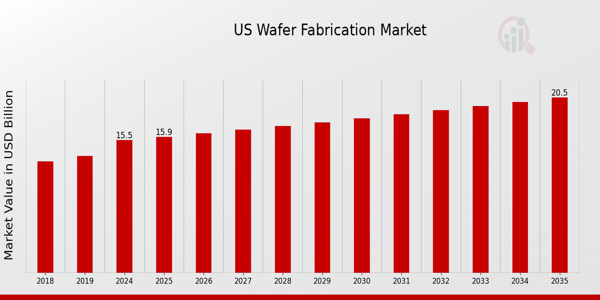
The market valuation of the US wafer fabrication market was $19.6 Billion in 2024.
What is the projected market valuation for the US wafer fabrication market in 2035?
The projected market valuation for the US wafer fabrication market is $27.9 Billion in 2035.
What is the expected CAGR for the US wafer fabrication market during the forecast period 2025 - 2035?
The expected CAGR for the US wafer fabrication market during the forecast period 2025 - 2035 is 3.26%.
Which companies are considered key players in the US wafer fabrication market?
Key players in the US wafer fabrication market include Intel Corporation, GlobalFoundries, Micron Technology, and Broadcom Inc.
What are the segment valuations for different process types in the US wafer fabrication market?
The segment valuations for process types include $13.6 Billion for Front End of Line Processing and $6.0 Billion for Back End of Line Processing.
How do the valuations of different technology nodes compare in the US wafer fabrication market?
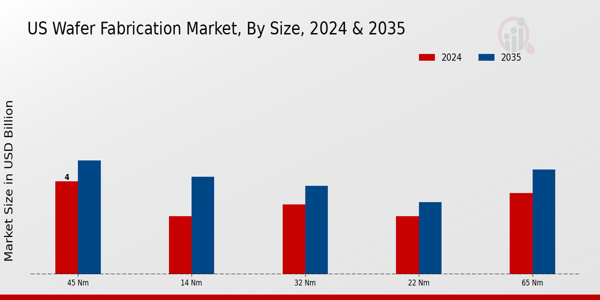
Valuations for technology nodes range from $2.0 Billion for 10 nm to $4.5 Billion for 45 nm.
What is the market size for different end-user segments in the US wafer fabrication market?
The market size for end-user segments includes $7.84 Billion for Integrated Device Manufacturer and $5.88 Billion for Foundry.
What is the significance of the 7 nm technology node in the US wafer fabrication market?
The 7 nm technology node has a valuation of $2.6 Billion, indicating its relevance in advanced semiconductor manufacturing.
How does the US wafer fabrication market's growth compare to other regions?
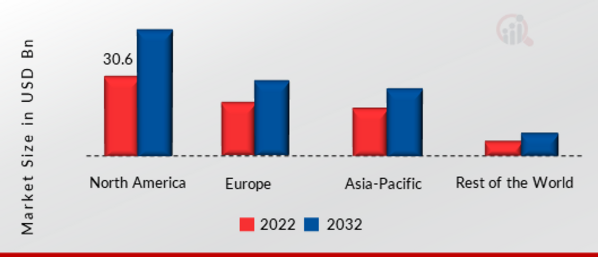
While specific regional comparisons are not provided, the US wafer fabrication market is poised for growth with a projected valuation increase to $27.9 Billion by 2035.
What trends are influencing the US wafer fabrication market in 2025?
Trends influencing the US wafer fabrication market in 2025 include advancements in technology nodes and increasing demand from end-user segments.


















