资本支出市场

资本支出市场研究报告按行业(制造业、能源和公用事业、电信、医疗保健、交通运输)、按支出类型(新设备、替换设备、基础设施升级、研发)、按资金来源(内部融资、外部融资(债务或股权)、政府补助或补贴)、按组织规模(中小企业、大型企业、政府机构)以及按地区(北美、欧洲、南美、亚太、中东和非洲) - 预测到2035年

ID: MRFR/BS/27408-HCR 128 Pages Ankit Gupta Last Updated: October 02, 2026
Capital Expenditure Market
Market Size
Forecast Period2025 - 2035
CAGR (2025 - 2035)3.93%
2024 Market Size$ 1,481.85 Billion
2025 Market Size$ 1,540.12 Billion
2035 Market Size$ 2,264.9 Billion
Key Players
General Electric
Siemens
Honeywell
Schneider Electric
ABB
Emerson Electric
Opportunities
  • Infrastructure Development Initiatives
  • Increased Urbanization and Population Growth
  • Rising Demand for Renewable Energy Solutions

资本支出市场 摘要

根据MRFR分析,资本支出市场在2024年的估计为1481.85亿美元。资本支出行业预计将从2025年的1540.12亿美元增长到2035年的2264.9亿美元,预计在2025年至2035年的预测期内,年均增长率(CAGR)为3.93。

主要市场趋势和亮点

资本支出市场目前正经历向可持续性和技术整合的转型。

  • "北美仍然是资本支出的最大市场,受到强劲基础设施发展计划的推动。
  • 亚太地区正在成为增长最快的市场,受快速城市化和人口增长的推动。
  • 制造业部门继续主导,而能源和公用事业部门则见证了最高的增长率。
  • 主要市场驱动因素包括对可再生能源解决方案的需求上升以及资本项目中的技术进步。"

市场规模与预测

2024 Market Size 1481.85(美元十亿)
2035 Market Size 2264.9(美元十亿)
CAGR (2025 - 2035) 3.93%

主要参与者

通用电气(美国)、西门子(德国)、霍尼韦尔(美国)、施耐德电气(法国)、ABB(瑞士)、艾默生电气(美国)、罗克韦尔自动化(美国)、三菱电机(日本)、日立(日本)

资本支出市场 Drivers

基础设施发展倡议

资本支出市场目前正经历基础设施发展倡议的激增。各国政府和私营实体正越来越多地投资于交通、能源和通信基础设施,以增强连接性和效率。例如,预计到2025年,基础设施支出将达到约3万亿美元,这一增长是由于现代化和扩展的需求。这一趋势可能会刺激资本支出的需求,因为项目需要大量的财务资源。此外,公共私营合作伙伴关系的关注预计将促进投资流动,从而增强资本支出市场。随着各国优先考虑基础设施,对建筑和材料等相关行业的连锁反应变得显而易见,表明资本支出将呈现强劲的增长轨迹。

监管变更和合规要求

监管变化和合规要求对资本支出市场产生了相当大的影响。随着各国政府实施更严格的环境标准和安全协议,公司被迫将更多资金分配用于合规相关支出。预计到2025年,合规成本将占资本预算的一个重要部分,在某些行业中可能超过15%。这一趋势强调了企业投资可持续实践和技术的必要性,从而影响其整体资本支出策略。因此,资本支出市场可能会随着组织适应这些监管环境而演变,促进合规驱动项目的创新和投资。

城市化和人口增长加速

城市化和人口增长是资本支出市场的驱动因素。随着城市地区的扩展,对住房、交通和公共服务的需求加剧,迫切需要大量的资本投资。到2025年,城市人口预计将显著增加,导致与城市基础设施相关的资本支出预计将增加超过25%。这一趋势迫使政府和私营实体优先考虑满足不断增长的城市中心需求的资本项目。因此,资本支出市场可能会从这一人口变化中受益,因为对城市发展的投资对于可持续增长和改善生活质量变得至关重要。

资本项目中的技术进步

技术进步正在重塑资本支出市场,组织越来越多地采用创新解决方案以提高项目效率并降低成本。将人工智能、机器学习和数据分析整合到资本项目中已成为常态。预计到2025年,资本项目的技术投资将占总资本支出的20%以上。这一转变不仅简化了运营,还改善了决策过程,从而实现了更有效的资源分配。随着公司利用技术优化其资本支出,行业可能会见证项目管理实践的转变,最终推动资本支出市场的增长。

对可再生能源解决方案的需求上升

可再生能源解决方案的需求上升是资本支出市场的一个关键驱动因素。随着各国努力实现气候目标并向可持续能源来源过渡,对可再生能源基础设施的投资正在激增。预计到2025年,可再生能源部门的资本支出将超过1万亿美元,反映出对可持续发展的日益承诺。这一转变不仅增强了能源安全,还刺激了就业创造和经济增长。因此,资本支出市场有望扩张,因为公司将资源分配到太阳能、风能和其他可再生技术上。能源需求与资本投资之间的相互作用可能会塑造行业的未来格局。

市场细分洞察

按行业:制造业(最大)与能源和公用事业(增长最快)

资本支出市场受到各个行业的显著影响,其中制造业在市场份额中占据领先地位。该行业受益于对技术、自动化和设施升级的持续投资,推动其主导地位。紧随其后,能源和公用事业代表了一个快速扩张的细分市场,受到对可持续能源解决方案和基础设施改善日益增长的需求的推动。这些行业不断发展,塑造资本支出的整体动态。

制造业(主导)与能源和公用事业(新兴)

制造业仍然是资本支出市场的主导力量,因为它在生产技术和流程方面进行了大量投资。该行业包括汽车、电子和消费品等多个行业,所有这些行业都在努力实现运营效率和创新。相比之下,能源和公用事业被归类为新兴领域,这得益于全球向可再生能源和智能电网技术的转变。这些投资反映了该行业对监管变化和可持续发展目标的适应能力,使其具备了显著增长的潜力。

按支出类型:新设备(最大)与研发(增长最快)

在资本支出市场中,支出类型主要由新设备采购主导,成为企业提升生产力和效率的重要投资领域。同时,基础设施升级也占据了相当大的份额,反映出持续致力于维护或改善运营能力的承诺。替换设备提供了稳定的收入来源,但与新兴领域相比,其增长速度较慢。增长趋势显示,研发支出正在强劲扩张,受到全球化和快速技术进步的推动。企业越来越重视研发,以创新和保持竞争力。这一转变表明了一个更广泛的市场趋势,即公司认识到在设备和基础设施等传统支出领域之外,投资未来能力的重要性。

新设备:主导与研发:新兴

新设备支出以其显著的市场存在为特征,组织寻求获取最新的技术和机械,以推动效率和效能。该细分市场在决定市场整体资本流动方面具有影响力。相比之下,研究与开发代表了一个新兴细分市场,随着企业在创新流程和技术上的投资增加而获得关注。这种通过新设备强化当前运营,同时通过研发寻求进步的双重策略,为增长提供了平衡的战略。公司正在认识到在研发方面的潜在长期投资回报,进一步使其能够在日益竞争的环境中适应和发展。

按资金来源:内部融资(最大)与外部融资(增长最快)

在资本支出市场中,资金来源主要由内部融资驱动,这在企业所采用的各种融资方式中占据了最大的份额。这种方式使公司能够利用其留存收益和现金储备进行资本投资,从而减少对外部来源的依赖。同时,外部融资,包括债务和股权选项,已成为一个重要的竞争者,吸引越来越多寻求扩展业务而不增加内部资源压力的企业。

内部融资:主导与外部融资:新兴

内部融资作为资本支出市场中许多公司的支柱,提供了稳定性和对项目的控制,而无需承担额外的负债。其主导地位反映了对与长期战略目标一致的自筹资金项目的偏好。相比之下,外部融资虽然仍然是一个新兴力量,但在初创企业和快速发展的行业中正逐渐获得关注。企业越来越多地探索创新的融资途径,包括众筹和基于股权的解决方案,以支持其增长。这一趋势突显了一个动态的转变,即公司在资金来源上变得更加灵活,以优化其资本支出,认识到在竞争日益激烈的环境中利用外部资源的潜力。

按组织规模:大型企业(最大)与中小型企业(SMEs)(增长最快)

在资本支出市场,大型企业占据主导地位,受益于更强的财务资源和扩展的运营能力。他们在技术、基础设施和设备上的重大投资使他们能够有效地利用市场机会。相比之下,中小型企业(SMEs)构成了一个快速扩张的细分市场,受益于其适应性和创新的资本支出方式。随着越来越多的中小型企业通过更新技术和优化资源配置寻求竞争优势,它们的整体份额正在增加。

大型企业(主导)与政府机构(新兴)

大型企业在资本支出市场中扮演着至关重要的角色,因其能够在各个行业进行大量投资。它们建立了高效的流程和更强的议价能力,使其能够获取先进的技术和服务。另一方面,政府机构作为重要参与者也在不断崛起,通常由公共资金和旨在改善基础设施和服务的倡议推动。尽管由于监管限制,它们的支出模式通常较慢,但日益增强的现代化推动和公私合营的合作使政府机构能够采取更积极的资本支出方式。

获取关于资本支出市场的更多详细见解

区域洞察

North America : Innovation and Investment Hub

North America is poised for significant growth in the capital expenditure market, driven by robust infrastructure investments and technological advancements. The United States leads this region, holding approximately 70% of the market share, followed by Canada at around 20%. Regulatory support for green technologies and infrastructure development is further catalyzing this growth, making it a key player in the global market. The competitive landscape is dominated by major players such as General Electric, Honeywell, and Emerson Electric, which are investing heavily in innovation and sustainability. The presence of these key players, along with a favorable business environment, positions North America as a leader in capital expenditure. The focus on smart technologies and renewable energy solutions is expected to enhance market dynamics in the coming years.

Europe : Sustainable Growth and Innovation

Europe is experiencing a surge in capital expenditure, driven by the need for sustainable infrastructure and digital transformation. Germany and France are the largest markets, collectively accounting for about 60% of the region's share. The European Union's Green Deal and various national initiatives are regulatory catalysts that promote investments in renewable energy and smart infrastructure, enhancing overall market growth. Leading countries like Germany, France, and the UK are home to key players such as Siemens and Schneider Electric, which are at the forefront of innovation in the capital expenditure market. The competitive landscape is characterized by a strong emphasis on sustainability and technological advancements, with companies investing in smart grid technologies and energy-efficient solutions. This focus positions Europe as a significant player in The Capital Expenditure Market.

Asia-Pacific : Emerging Markets and Growth Potential

The Asia-Pacific region is witnessing rapid growth in capital expenditure, fueled by urbanization, industrialization, and government initiatives. China and India are the largest markets, together holding approximately 65% of the region's market share. The push for infrastructure development and smart city projects, along with favorable government policies, are key drivers of this growth, making the region a focal point for capital investments. Countries like China, Japan, and India are home to major players such as Mitsubishi Electric and Hitachi, which are investing in advanced technologies and infrastructure projects. The competitive landscape is evolving, with a mix of local and international companies vying for market share. The emphasis on innovation and sustainability is expected to drive further growth in the capital expenditure market across Asia-Pacific.

Middle East and Africa : Resource-Rich and Growing Demand

The Middle East and Africa region is experiencing a growing demand for capital expenditure, driven by resource wealth and infrastructure development. The United Arab Emirates and South Africa are the largest markets, collectively accounting for about 55% of the region's market share. Government initiatives aimed at diversifying economies and investing in infrastructure are key growth drivers, positioning the region as an emerging player in the global market. Countries like Saudi Arabia and Nigeria are focusing on large-scale projects, attracting investments from both local and international firms. The competitive landscape features a mix of established players and new entrants, all aiming to capitalize on the region's growth potential. The emphasis on sustainable development and infrastructure investment is expected to enhance market dynamics in the coming years.
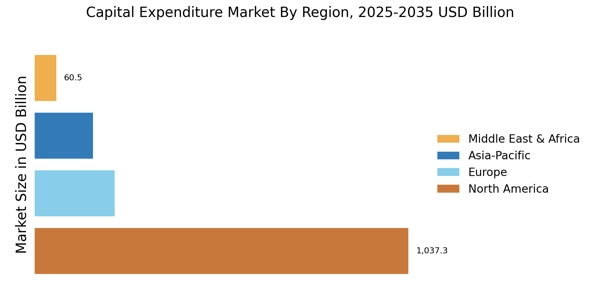

资本支出市场 Regional Image

主要参与者和竞争洞察

The Capital Expenditure Market is currently characterized by a dynamic competitive landscape, driven by technological advancements, sustainability initiatives, and the increasing need for infrastructure modernization. Major players such as General Electric (US), Siemens (DE), and Honeywell (US) are strategically positioning themselves through innovation and partnerships. General Electric (US) focuses on digital transformation and smart infrastructure, while Siemens (DE) emphasizes sustainable energy solutions and automation technologies. Honeywell (US) is enhancing its portfolio through acquisitions and expanding its presence in the industrial automation sector. Collectively, these strategies not only enhance their competitive edge but also shape the market's trajectory towards more integrated and efficient capital expenditure solutions.In terms of business tactics, companies are increasingly localizing manufacturing and optimizing supply chains to enhance responsiveness and reduce costs. The Capital Expenditure Market appears moderately fragmented, with a mix of established players and emerging firms vying for market share. The collective influence of key players is significant, as they drive innovation and set industry standards, thereby shaping the competitive structure of the market.
In August Siemens (DE) announced a strategic partnership with a leading renewable energy firm to develop advanced energy management systems. This collaboration is poised to enhance Siemens' capabilities in providing sustainable solutions, aligning with global trends towards decarbonization. The strategic importance of this partnership lies in its potential to position Siemens as a leader in the energy transition, thereby attracting new clients and reinforcing its market presence.
In September Honeywell (US) unveiled a new suite of AI-driven analytics tools aimed at optimizing industrial operations. This launch reflects Honeywell's commitment to integrating cutting-edge technology into its offerings, enhancing operational efficiency for clients. The introduction of these tools is likely to strengthen Honeywell's competitive position by addressing the growing demand for data-driven decision-making in capital expenditure projects.
In July General Electric (US) completed the acquisition of a prominent software company specializing in predictive maintenance solutions. This acquisition is strategically significant as it allows General Electric to enhance its digital capabilities, offering clients more robust solutions for asset management. The integration of predictive analytics into their existing portfolio could lead to improved operational efficiencies and reduced downtime for clients, thereby solidifying General Electric's leadership in the market.
As of October the Capital Expenditure Market is witnessing a pronounced shift towards digitalization, sustainability, and AI integration. Strategic alliances are increasingly shaping the competitive landscape, enabling companies to leverage complementary strengths and enhance their service offerings. Looking ahead, competitive differentiation is likely to evolve from traditional price-based competition to a focus on innovation, technology integration, and supply chain reliability. This shift underscores the importance of adaptability and forward-thinking strategies in navigating the complexities of the modern capital expenditure environment.

资本支出市场市场的主要公司包括

Recent Industry Developments

Q2 2026: General Electric (US) expanded GE Vernova’s bushing manufacturing capacity in Italy with additional production lines, forming part of its planned $11 billion capital-expenditure and R&D investment program for 2025–2028

Q2 2026: Honeywell (US) outlined a medium-term capital-allocation framework targeting capital expenditure of approximately 3% of annual sales, alongside growth investments following its planned corporate separation

Q2 2026: Schneider Electric (FR) reported record first-half 2026 revenue and said it was advancing disciplined capital allocation, while its 2026–2030 decarbonization plan includes approximately €300 million of CapEx for site electrification and SF6-free product transition

Q2 2026: ABB (CH) announced approximately $75 million of additional 2026 investment in India to expand manufacturing capacity and R&D capabilities across critical electrification segments, including renewable energy, metro rail and data centers

Q2 2026: Mitsubishi Electric (JP) reported ¥310.746 billion in capital investment for the fiscal year ended March 31, 2026, with major investments supporting production capacity in power systems, factory automation, automotive equipment and power devices.

The Capital Expenditure Market is anticipated to grow steadily over the next decade, reaching a value of USD 1939.7 billion by 2032, expanding at a CAGR of 3.93% from 2024-2032. This growth is attributed to increasing investments in infrastructure, energy, and manufacturing sectors. Government initiatives to promote sustainable development and digital transformation are further driving market expansion. Recent developments include the rise of smart cities and autonomous vehicles, which require significant capital expenditure. Moreover, the growing focus on renewable energy sources and the adoption of Industry 4.0 technologies are creating new opportunities for market growth.

未来展望

资本支出市场 未来展望

资本支出市场预计将在2024年至2035年间以3.93%的年复合增长率增长,推动因素包括技术进步、基础设施投资和可持续发展倡议。

新机遇在于:

  • 对智能基础设施技术的投资
  • 可再生能源项目的扩展
  • 资本规划的先进分析开发

到2035年,市场预计将展现出强劲的增长和增加的投资机会。

市场细分

资本支出市场行业展望

  • 制造业
  • 能源和公用事业
  • 电信
  • 医疗保健
  • 交通运输

组织资本支出市场规模展望

  • 中小企业(SMEs)
  • 大型企业
  • 政府机构

资本支出市场支出类型展望

  • 新设备
  • 替换设备
  • 基础设施升级
  • 研究与开发

资本支出市场资金来源展望

  • 内部融资
  • 外部融资(债务或股权)
  • 政府补助或补贴

报告范围

MARKET SIZE 2024 1481.85(USD Billion)
MARKET SIZE 2025 1540.12(USD Billion)
MARKET SIZE 2035 2264.9(USD Billion)
COMPOUND ANNUAL GROWTH RATE (CAGR) 3.93% (2025 - 2035)
REPORT COVERAGE Revenue Forecast, Competitive Landscape, Growth Factors, and Trends
BASE YEAR 2024
Market Forecast Period 2025 - 2035
Historical Data 2019 - 2024
Market Forecast Units USD Billion
Key Companies Profiled General Electric (US), Siemens (DE), Honeywell (US), Schneider Electric (FR), ABB (CH), Emerson Electric (US), Rockwell Automation (US), Mitsubishi Electric (JP), Hitachi (JP)
Segments Covered Industry, Type of Expenditure, Source of Funding, Size of Organization, Regional
Key Market Opportunities Integration of advanced analytics in Capital Expenditure Market decision-making processes.
Key Market Dynamics Rising technological advancements drive increased capital expenditure in infrastructure and manufacturing sectors, enhancing competitive positioning.
Countries Covered North America, Europe, APAC, South America, MEA

Frequently Asked Questions

到2035年,资本支出市场的预计市场估值是多少?
预计到2035年,资本支出市场的估值将达到2264.9亿美元。
2024年资本支出市场的整体市场估值是多少?
在2024年,资本支出市场的整体市场估值为1481.85亿美元。
在2025年至2035年的预测期内,资本支出市场的预期CAGR是多少?
在2025年至2035年的预测期内,资本支出市场的预期CAGR为3.93%。
2024年哪个行业细分的估值最高?
能源和公用事业部门在2024年的估值最高,达到了4000亿美元。
到2035年,基础设施升级的预计支出是多少?
到2035年,基础设施升级的支出预计将达到4500亿至7000亿美元。
中小企业(SMEs)在资本支出方面与大型企业相比如何?
在2024年,中小型企业(SMEs)的支出范围为370.46到580.0亿美元,而大型企业的支出范围为740.92到1150.0亿美元。
政府补助或补贴在资本支出市场中扮演什么角色?
政府补助或补贴预计将为资本支出市场贡献2963.7亿至4444.62亿美元。
哪些关键参与者正在引领资本支出市场?
资本支出市场的主要参与者包括通用电气、西门子、霍尼韦尔、施耐德电气、ABB、艾默生电气、罗克韦尔自动化、三菱电机和日立。
到2035年,预计研发支出是多少?
预计到2035年,研发支出的预计范围为4818.5亿至6649亿美元。
2024年资本支出市场的表现如何影响未来趋势?
2024年的表现,估值为1481.85亿美元,表明在2025年至2035年的预测期内将呈现强劲的增长轨迹。
作者
Author Author Profile Ankit Gupta LinkedIn Team Lead - Research
Ankit Gupta is a seasoned market intelligence and strategic research professional with over six plus years of experience in the ICT and Semiconductor industries. With academic roots in Telecom, Marketing, and Electronics, he blends technical insight with business strategy. Ankit has led 200+ projects, including work for Fortune 500 clients like Microsoft and Rio Tinto, covering market sizing, tech forecasting, and go-to-market strategies. Known for bridging engineering and enterprise decision-making, his insights support growth, innovation, and investment planning across diverse technology markets.
下载免费样本

请填写以下表格以获取本报告的免费样本

Download PDF ×

We do not share your information with anyone. However, we may send you emails based on your report interest from time to time. You may contact us at any time to opt-out.