Request Free Sample ×

Kindly complete the form below to receive a free sample of this Report

* Please use a valid business email

Leading companies partner with us for data-driven Insights

clients tt-cursor
Hero Background
English
Chinese
French
Japanese
Korean
German
Spanish

Zinc Chloride Market Analysis

ID: MRFR/CnM/17692-HCR
128 Pages
Anshula Mandaokar
Last Updated: April 06, 2026

Zinc Chloride Market Research Report Information By Grade (High Purity Grade, Battery Grade, Technical Grade, and Commercial Grade), By Form (Powder and Liquid), By End Use Sector (Electronics, Chemical, Agriculture, Pharmaceuticals, and Others), And By Region (North America, Europe, Asia-Pacific, And Rest Of The World) –Market Forecast Till 2035

Share:
Download PDF ×

We do not share your information with anyone. However, we may send you emails based on your report interest from time to time. You may contact us at any time to opt-out.

Zinc Chloride Market Infographic
Purchase Options

Market Analysis

In-depth Analysis of Zinc Chloride Market Industry Landscape

The zinc chloride market operates within a dynamic framework influenced by various factors that impact production, distribution, and demand dynamics. Zinc chloride, a chemical compound consisting of zinc and chlorine, finds application in diverse industries, including chemicals, metallurgy, textiles, and batteries. Understanding the market dynamics of zinc chloride involves analyzing key elements such as raw material availability, manufacturing processes, end-user preferences, regulatory policies, and competitive forces.

Raw material availability and pricing play a crucial role in shaping market dynamics in the zinc chloride industry. Zinc chloride is typically produced from zinc ores through various extraction and refining processes. Fluctuations in zinc ore reserves, mining activities, and geopolitical factors can impact raw material availability and pricing, affecting production costs for zinc chloride manufacturers. Additionally, factors such as energy prices, transportation costs, and environmental regulations further influence production costs and pricing dynamics in the zinc chloride market.

Manufacturing processes and technological advancements drive efficiency and innovation in the zinc chloride industry. Zinc chloride is commonly produced through either the direct reaction of zinc metal with hydrochloric acid or the indirect route of roasting zinc ores followed by reaction with hydrochloric acid. Advancements in production technologies, such as solvent extraction and electrolysis, have led to improvements in production efficiency, product purity, and environmental sustainability. These advancements enable zinc chloride manufacturers to optimize production processes, reduce waste generation, and minimize environmental impacts, aligning with sustainability goals and regulatory requirements.

End-user preferences and application trends are key drivers of demand dynamics in the zinc chloride market. Zinc chloride finds applications in various sectors, including chemicals (as a catalyst and flux), metallurgy (as a flux and electrolyte), textiles (as a mordant and dye fixative), and batteries (as an electrolyte). The demand for zinc chloride is influenced by factors such as industrial activity, technological advancements, product formulations, and regulatory requirements. For example, the increasing adoption of zinc chloride as an electrolyte in batteries for energy storage applications drives demand growth in the zinc chloride market.

Regulatory policies and quality standards shape market dynamics by influencing product specifications, safety requirements, and market access. Governments worldwide enact regulations aimed at ensuring the safety and quality of zinc chloride products, as well as mitigating potential environmental and health risks associated with their use. Compliance with regulatory requirements, such as chemical registration, safety data sheet (SDS) requirements, and workplace exposure limits, is essential for zinc chloride manufacturers to gain market approval, ensure consumer safety, and maintain product credibility. Additionally, adherence to quality standards and certifications, such as ISO standards and Good Manufacturing Practices (GMP), further enhances product quality and market competitiveness.

Competitive forces drive market dynamics by influencing pricing strategies, product differentiation, and market share. The zinc chloride market is characterized by a diverse array of suppliers, including multinational corporations, regional manufacturers, and specialty chemical producers. Intense competition prevails due to factors such as product quality, supply chain efficiency, and customer relationships. Companies compete for market share by offering a range of zinc chloride grades tailored to specific application requirements, as well as value-added services such as technical support, logistics solutions, and regulatory compliance assistance. Moreover, strategic partnerships, mergers, and acquisitions enable companies to expand their product portfolios and geographic presence, enhancing competitiveness in the global zinc chloride market.

Author
Author Profile
Anshula Mandaokar
Team Lead - Research

Anshula Mandaokar holds an academic degree in Chemical Engineering and has been contributing to the field for more than 5 years. She has expertise in Market Research and Business Consulting and serves as a Team Lead for a reputed Market Research firm under the Chemicals and Materials domain spectrum. She has worked on multiple projects, generating explicit results in a quick turnaround time. Her understanding of data interpretation justifies her role as a leader.

Leave a Comment

FAQs

What is the projected market valuation of the Zinc Chloride Market by 2035?

<p>The projected market valuation of the Zinc Chloride Market is expected to reach 0.6089 USD Billion by 2035.</p>

What was the overall market valuation of the Zinc Chloride Market in 2024?

<p>The overall market valuation of the Zinc Chloride Market was 0.3485 USD Billion in 2024.</p>

What is the expected CAGR for the Zinc Chloride Market during the forecast period 2025 - 2035?

<p>The expected CAGR for the Zinc Chloride Market during the forecast period 2025 - 2035 is 5.2%.</p>

Which companies are considered key players in the Zinc Chloride Market?

<p>Key players in the Zinc Chloride Market include Zinc Nacional, American Zinc Recycling, Mitsui Mining and Smelting, and Hindustan Zinc.</p>

What are the different grades of Zinc Chloride and their market valuations?

<p>The market valuations for different grades of Zinc Chloride include High Purity Grade at 0.1 to 0.18 USD Billion and Battery Grade at 0.08 to 0.14 USD Billion.</p>

How does the market for Zinc Chloride in powder form compare to liquid form?

<p>The market for Zinc Chloride in powder form is valued between 0.1742 and 0.3045 USD Billion, while the liquid form is valued between 0.1743 and 0.3044 USD Billion.</p>

What end-use sectors are driving the demand for Zinc Chloride?

The end-use sectors driving demand for Zinc Chloride include Chemicals, valued at 0.12 to 0.2 USD Billion, and Agriculture, valued at 0.08 to 0.14 USD Billion.

What is the market valuation range for Technical Grade Zinc Chloride?

The market valuation range for Technical Grade Zinc Chloride is between 0.09 and 0.15 USD Billion.

How does the market valuation for Commercial Grade Zinc Chloride compare to other grades?

The market valuation for Commercial Grade Zinc Chloride ranges from 0.0585 to 0.1189 USD Billion, which is lower than other grades.

What trends are influencing the growth of the Zinc Chloride Market?

Trends influencing the growth of the Zinc Chloride Market include increasing applications in electronics and agriculture, contributing to the projected CAGR of 5.2%.

Market Summary

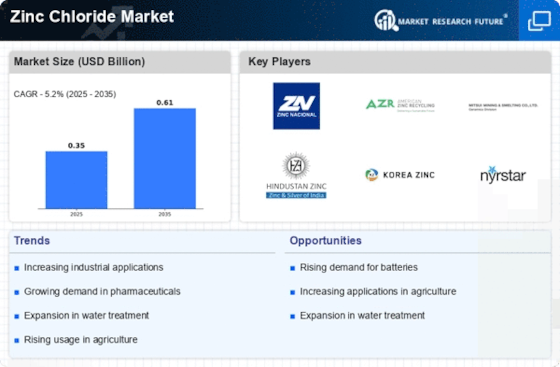
As per Market Research Future analysis, the Zinc Chloride Market Size was estimated at 0.3485 USD Billion in 2024. The Zinc Chloride industry is projected to grow from USD 0.3667 Billion in 2025 to USD 0.6089 Billion by 2035, exhibiting a compound annual growth rate (CAGR) of 5.2% during the forecast period 2025 - 2035

Key Market Trends & Highlights

The Zinc Chloride Market is poised for growth driven by sustainability and technological advancements.

  • North America remains the largest market for zinc chloride, driven by robust demand in various industrial applications. Asia-Pacific is emerging as the fastest-growing region, reflecting increasing investments in water treatment and battery technologies. The high purity grade segment dominates the market, while the battery grade segment is witnessing rapid growth due to advancements in energy storage solutions. Rising demand in chemical manufacturing and an increased focus on sustainable practices are key drivers propelling market expansion.

Market Size & Forecast

2024 Market Size 0.3485 (USD Billion)
2035 Market Size 0.6089 (USD Billion)
CAGR (2025 - 2035) 5.2%
Largest Regional Market Share in 2024 North America

Major Players

Zinc Nacional (MX), American Zinc Recycling (US), Mitsui Mining and Smelting (JP), Hindustan Zinc (IN), Korea Zinc (KR), Nyrstar (BE), Teck Resources (CA), Zinc Oxide LLC (US), Shaanxi Nonferrous Tianzhu (CN)

Market Trends

The Zinc Chloride Market is currently experiencing a dynamic phase characterized by evolving applications and increasing demand across various sectors. This compound, known for its versatility, finds utility in industries such as textiles, pharmaceuticals, and electronics. The growing emphasis on sustainable practices appears to drive innovation in production methods, potentially leading to more eco-friendly alternatives. Furthermore, the market seems to be influenced by regulatory frameworks that encourage the use of safer chemical products, thereby shaping consumer preferences and industry standards. In addition, the zinc chloride market is witnessing a shift towards advanced formulations that enhance performance and efficiency.  

As industries seek to optimize their processes, the demand for high-purity zinc chloride is likely to rise. This trend may be further supported by technological advancements that facilitate the development of specialized applications. Overall, the market landscape suggests a promising trajectory, with opportunities for growth and diversification as stakeholders adapt to changing market dynamics and consumer expectations.

Sustainable Production Practices

The zinc chloride market is increasingly leaning towards sustainable production methods. Manufacturers are exploring eco-friendly alternatives that minimize environmental impact. This trend reflects a broader industry shift towards sustainability, driven by consumer demand for greener products.

Technological Advancements in Applications

Innovations in technology are reshaping the applications of zinc chloride. Enhanced formulations are being developed to improve performance in various sectors, including electronics and pharmaceuticals. This trend indicates a growing focus on efficiency and effectiveness in product usage.

Regulatory Influences on Market Dynamics

Regulatory frameworks are playing a crucial role in shaping the zinc chloride market . Stricter guidelines regarding chemical safety are prompting manufacturers to adapt their offerings. This trend suggests that compliance with regulations may drive innovation and influence consumer choices.

Zinc Chloride Market Market Drivers

Expanding Use in Battery Technology

The Zinc Chloride Market is witnessing a surge in interest due to the expanding applications of zinc chloride in battery technology. With the increasing demand for energy storage solutions, particularly in renewable energy systems, zinc chloride batteries are gaining traction. These batteries are known for their safety, cost-effectiveness, and environmental benefits. The Zinc Chloride Market is projected to grow significantly, with zinc-based batteries expected to capture a notable share. This shift towards sustainable energy storage solutions indicates a promising future for the Zinc Chloride Market, as manufacturers explore innovative applications of zinc chloride in battery production.

Growth in Water Treatment Applications

The Zinc Chloride Market is significantly influenced by the growing emphasis on water treatment solutions. Zinc chloride is utilized as a coagulant and flocculant in various water treatment processes, which is becoming increasingly critical as water quality concerns rise. The market for water treatment chemicals is expected to reach USD 50 billion by 2026, with zinc chloride playing a pivotal role in this growth. As municipalities and industries invest in advanced water purification technologies, the demand for zinc chloride is anticipated to surge. This trend underscores the importance of the Zinc Chloride Market in addressing global water scarcity and quality issues.

Rising Demand in Chemical Manufacturing

The Zinc Chloride Market is experiencing a notable increase in demand due to its extensive applications in chemical manufacturing. Zinc chloride serves as a vital component in the production of various chemicals, including textiles, rubber, and pharmaceuticals. The market for zinc chloride is projected to grow at a compound annual growth rate (CAGR) of approximately 4.5% over the next few years, driven by the rising need for chemical intermediates. As industries seek to enhance production efficiency and reduce costs, the adoption of zinc chloride in chemical processes is likely to expand. This trend indicates a robust future for the Zinc Chloride Market, as manufacturers increasingly rely on this compound to meet their operational needs.

Increased Focus on Sustainable Practices

The Zinc Chloride Market is being shaped by a growing focus on sustainable production practices. As industries strive to minimize their environmental impact, the demand for eco-friendly chemicals, including zinc chloride, is on the rise. Companies are increasingly adopting sustainable sourcing and production methods, which not only enhance their brand image but also comply with stringent environmental regulations. The market for sustainable chemicals is projected to grow at a CAGR of 5% over the next five years, indicating a shift in consumer preferences towards greener alternatives. This trend is likely to bolster the Zinc Chloride Market as manufacturers align their practices with sustainability goals.

Technological Innovations in Industrial Applications

The Zinc Chloride Market is benefiting from technological innovations that enhance its applications across various industrial sectors. Advances in manufacturing processes and product formulations are enabling more efficient use of zinc chloride in sectors such as construction, electronics, and agriculture. For instance, the development of high-purity zinc chloride is opening new avenues in electronics, where it is used in the production of semiconductors. The industrial chemicals market is expected to grow substantially, with zinc chloride positioned as a key player due to its versatility. This evolution suggests a dynamic future for the Zinc Chloride Market, driven by continuous innovation and application expansion.

Market Segment Insights

By Grade: High Purity Grade (Largest) vs. Battery Grade (Fastest-Growing)

<p>The Zinc Chloride Market exhibits a diverse range of segment values across grades, with High Purity Grade leading in market share. This segment is primarily driven by its applications in pharmaceuticals and analytical chemistry. Following closely is Battery Grade, which forms a significant part of the market due to its vital role in energy storage solutions, catering to the growing demand in electric vehicle battery production. Growth trends indicate that while the High Purity Grade maintains its dominant position, Battery Grade is emerging rapidly due to the rising popularity of rechargeable batteries. Innovations in battery technology and increasing implementation of zinc-based energy solutions are further propelling the growth of this segment. Technical and Commercial Grades follow, meeting the needs of various industrial applications, albeit with slower growth rates compared to their counterparts.</p>

<p>High Purity Grade (Dominant) vs. Battery Grade (Emerging)</p>

<p>High Purity Grade is characterized by its exceptionally high levels of purity, making it ideal for applications in electronics and pharmaceuticals where the quality of materials is paramount. This grade commands a significant portion of the Zinc Chloride Market due to its critical usage in precision demands. It holds a dominant position, reflected in consistent demand driven by innovation in high-tech applications. In contrast, Battery Grade presents itself as an emerging opportunity within the market, fueled by the electrification of transportation and renewable energy storage systems. This grade exhibits characteristics tailored toward enhancing battery performance, making it a key focus for manufacturers looking to align with eco-friendly initiatives and advancements in energy technology.</p>

By Form: Powder (Largest) vs. Liquid (Fastest-Growing)

<p>In the Zinc Chloride Market, the Powder form currently holds the largest market share, dominating various applications including chemical processing and corrosion resistance. The versatility of powder zinc chloride in different formulations allows it to cater to a wide range of industries, making it the preferred choice among manufacturers. In contrast, the Liquid form has been gaining traction due to its ease of application and effectiveness in specific scenarios, although it occupies a smaller portion of the market at present.</p>

<p>Zinc Chloride Powder (Dominant) vs. Zinc Chloride Liquid (Emerging)</p>

<p>Zinc Chloride Powder is revered for its stability and efficacy across diverse applications such as metallurgy and water treatment. Its solid form offers advantages in storage and transportation, and it can be easily integrated into various industrial processes. On the other hand, Zinc Chloride Liquid is emerging rapidly, driven by its convenience in formulations requiring fluid dynamics, such as coatings and adhesives. While it faces competition from its powdered counterpart, its ease of use and adaptability positions it as a favorable option for industries seeking efficient solutions.</p>

By End Use Sector: Electronics (Largest) vs. Agriculture (Fastest-Growing)

<p>In the Zinc Chloride Market, the distribution among end-use sectors highlights Electronics as the predominant consumer, leveraging its applications in batteries and circuit boards. Agriculture follows closely, utilizing Zinc Chloride for various growth-promoting solutions. Other significant sectors include Chemicals, Pharmaceuticals, and miscellaneous applications, which together contribute substantially to market dynamics. While Chemicals and Pharmaceuticals are traditional sectors for Zinc Chloride use, Agriculture is gaining traction in response to increasing agricultural needs and innovations. Growth trends within the Zinc Chloride market indicate a robust demand in Electronics due to advancements in technology and increasing production of electronic devices. Meanwhile, the Agriculture sector is witnessing rapid growth driven by the need for sustainable farming practices and enhanced crop productivity. The rise of organic farming is also promoting the use of Zinc Chloride as a vital nutrient, substantially boosting its market presence in this segment.</p>

<p>Electronics: Dominant vs. Agriculture: Emerging</p>

<p>Electronics stands out as the dominant end-use sector in the Zinc Chloride Market, leveraging its essential role in the manufacturing of batteries, semiconductors, and various electronic components. This segment enjoys a stable market position due to the incessant demand for consumer electronics and technology advancements. In contrast, Agriculture is emerging rapidly as a vital sector, propelled by the increasing emphasis on sustainable agriculture and soil health. The demand for Zinc Chloride as a micronutrient in fertilizers and its role in promoting plant growth has attracted attention from farmers seeking improved crop yields. This sector is expected to gain ground due to changing agricultural practices and a growing focus on environmentally friendly solutions.</p>

Get more detailed insights about Zinc Chloride Market Research Report - Global Forecast by 2035

Regional Insights

North America : Market Leader in Zinc Production

North America is the largest market for zinc chloride, holding approximately 40% of the global market share. The region's growth is driven by increasing demand in various applications, including agriculture, pharmaceuticals, and industrial processes. Regulatory support for sustainable practices and environmental compliance further catalyzes market expansion. The U.S. and Canada are the primary contributors to this growth, with a focus on innovation and recycling initiatives. The competitive landscape in North America features key players such as American Zinc Recycling and Teck Resources, which are leading the charge in sustainable zinc production. The presence of advanced manufacturing facilities and a robust supply chain enhances the region's market position. Additionally, the U.S. government's initiatives to promote domestic production and reduce reliance on imports are expected to bolster market growth further.

Europe : Regulatory Framework Driving Growth

Europe is the second-largest market for zinc chloride, accounting for approximately 30% of the global share. The region's growth is significantly influenced by stringent environmental regulations and a shift towards sustainable practices. Countries like Germany and Belgium are at the forefront, with increasing investments in green technologies and recycling initiatives. The European Union's commitment to reducing carbon emissions is a key driver for market expansion. Leading countries in Europe include Germany, Belgium, and the Netherlands, where major players like Nyrstar and Mitsui Mining and Smelting operate. The competitive landscape is characterized by a focus on innovation and sustainability, with companies investing in research and development to meet regulatory standards. The presence of a well-established supply chain and collaboration among industry stakeholders further enhances market dynamics.

Asia-Pacific : Emerging Market with High Potential

Asia-Pacific is witnessing rapid growth in the zinc chloride market, holding approximately 25% of the global share. The region's industrialization and urbanization are key drivers, with countries like China and India leading the demand for zinc chloride in various applications, including construction and agriculture. Government initiatives to boost infrastructure development and promote sustainable practices are also contributing to market growth. China is the largest market in the region, with significant contributions from companies like Shaanxi Nonferrous Tianzhu and Hindustan Zinc. The competitive landscape is evolving, with local players expanding their production capacities to meet rising demand. Additionally, the region's focus on technological advancements and efficient production methods is expected to enhance its market position in the coming years.

Middle East and Africa : Resource-Rich Region with Challenges

The Middle East and Africa region holds a smaller share of The Zinc Chloride Market, approximately 5%. However, the region is rich in mineral resources, presenting significant growth potential. The demand for zinc chloride is driven by applications in agriculture and construction, with countries like South Africa and Morocco leading the way. Regulatory frameworks are gradually evolving to support sustainable mining practices, which could catalyze market growth. In the competitive landscape, local players are beginning to emerge, but the market is still dominated by imports. The presence of key players is limited, and challenges such as political instability and infrastructure deficits hinder growth. However, ongoing investments in mining and processing facilities are expected to improve the market dynamics in the region over time.

Key Players and Competitive Insights

Leading market players often engage in strategic partnerships and collaborations to expand their market reach, leverage complementary strengths, and access new technologies. Collaborative efforts with other industry players, research institutions, or technology providers can enhance innovation, improve product offerings, and open doors to new market segments. Market participants are also undertaking various strategic activities to expand their footprint, with important market developments including new product launches, contractual agreements, mergers and acquisitions, higher investments, and collaboration with other organizations. To expand and survive in a more competitive and rising market climate, the Zinc Chloride industry must offer cost-effective items.Investing in research and development is one of the key business tactics manufacturers use in the Zinc Chloride industry to benefit clients and increase the market share. In recent years, the Zinc Chloride industry has offered some of the most significant advantages to Consumers. Major players in the Zinc Chloride Market, including Zaclon LLC, Costal Zinc Group, TIB Chemicals, Flaurea Chemicals, Vap Industries, Haihang Industries, Haryana Chemical Industries, and others, are attempting to increase market demand by investing in product development to increase their product line and cater to diverse consumer needs.Dongtai Coastal Zinc Industry Group Co., Ltd, established in 2003, stands as a leader in zinc chloride production, offering an array of high-quality products such as zinc chloride anhydrous, zinc powder, and zinc oxide. With 5 subsidiaries and 4 production bases, the company boasts an annual capacity of 35,000 tons of Zinc Chloride Market, commanding over 50% of the high-end market share. Through a robust marketing network, their premium products cater not only to domestic demand but also find markets in over 30 countries.The company's commitment to eco-friendly and sustainable development, coupled with a focus on harmonizing safety, environmental protection, and economic benefits, positions it as a reliable and esteemed player in the market. On May 18, 2021, Dongtai Coastal Zinc Industry Group concluded its participation as a sponsor in the "2021 (16th) Lead Zinc Summit" in Xiamen. Alongside industry elites and scholars, the company engaged in discussions about the lead and zinc industry's development trends, assessed the current market landscape, and explored future opportunities.TIB Chemicals AG, a globally oriented medium-sized enterprise, specializes in the development, production, and distribution of chemical products. With a portfolio spanning basic chemicals, inorganic specialty chemicals, and cutting-edge coating systems, the company offers a diverse range of over 1000 products. Committed to sustainability, TIB Chemicals ensures that 50% of their raw materials and energies are derived from sustainable sources. Boasting over 150 years of experience as a family-run entity in the chemical industry, TIB Chemicals combines tradition with innovation.With 450 dedicated employees passionate about chemistry, the company is known for its customer-centric approach, offering both standardized products and tailored solutions to meet diverse industry needs.

Key Companies in the Zinc Chloride Market include

Industry Developments

March 2021: CoastalZinc Zinc Chloride Market completed the registration process under the EU REACH (Registration, Evaluation, Authorization, and Restriction of Chemicals) framework. REACH, a regulation established by the European Union, aimed to enhance the protection of human health and the environment by addressing the potential risks associated with chemicals. This comprehensive initiative also sought to improve the competitiveness of the EU chemicals industry while advocating for alternative methods of hazard assessment to minimize animal testing. The achievement underscores CoastalZinc's commitment to regulatory compliance and reinforces its dedication to ensuring the safety and sustainability of its zinc chloride products by EU standards.

Zinc Chloride Market Solutions from Sigma-Aldrich: In early 2024, the company unveiled a new line of zinc chloride solutions with improved stability and purity for use in lab and industrial environments. Better packaging is included with the solutions to guarantee product integrity.

Fisher Scientific High-Purity Zinc Chloride Market Powder: This high-purity powder was released in 2024 and is intended for specific uses in research and chemical synthesis. It performs better thanks to its increased consistency and solubility.

Future Outlook

Zinc Chloride Market Future Outlook

The Zinc Chloride Market is projected to grow at a 5.2% CAGR from 2025 to 2035, driven by increasing demand in various industrial applications and advancements in production technologies.

New opportunities lie in:

  • <p>Expansion into emerging markets with tailored product offerings.</p>
  • <p> </p>
  • <p>Development of eco-friendly zinc chloride formulations for sustainable industries.</p>
  • <p>Investment in R&amp;D for innovative applications in pharmaceuticals and electronics.</p>

By 2035, the Zinc Chloride Market is expected to achieve robust growth, solidifying its position as a key industrial chemical.

Market Segmentation

Zinc Chloride Market Form Outlook

  • Powder
  • Liquid

Zinc Chloride Market Grade Outlook

  • High Purity Grade
  • Battery Grade
  • Technical Grade
  • Commercial Grade

Zinc Chloride Market End Use Sector Outlook

  • Electronics
  • Chemical
  • Agriculture
  • Pharmaceuticals
  • Others

Report Scope

MARKET SIZE 2024 0.3485(USD Billion)
MARKET SIZE 2025 0.3667(USD Billion)
MARKET SIZE 2035 0.6089(USD Billion)
COMPOUND ANNUAL GROWTH RATE (CAGR) 5.2% (2025 - 2035)
REPORT COVERAGE Revenue Forecast, Competitive Landscape, Growth Factors, and Trends
BASE YEAR 2024
Market Forecast Period 2025 - 2035
Historical Data 2019 - 2024
Market Forecast Units USD Billion
Key Companies Profiled Zinc Nacional (MX), American Zinc Recycling (US), Mitsui Mining and Smelting (JP), Hindustan Zinc (IN), Korea Zinc (KR), Nyrstar (BE), Teck Resources (CA), Zinc Oxide LLC (US), Shaanxi Nonferrous Tianzhu (CN)
Segments Covered Grade, Form, End Use Sector, Region
Key Market Opportunities Growing demand for Zinc Chloride in battery technology and renewable energy applications presents significant market opportunities.
Key Market Dynamics Rising demand for zinc chloride in various industrial applications drives competitive dynamics and supply chain adjustments.
Countries Covered North America, Europe, APAC, South America, MEA

FAQs

What is the projected market valuation of the Zinc Chloride Market by 2035?

<p>The projected market valuation of the Zinc Chloride Market is expected to reach 0.6089 USD Billion by 2035.</p>

What was the overall market valuation of the Zinc Chloride Market in 2024?

<p>The overall market valuation of the Zinc Chloride Market was 0.3485 USD Billion in 2024.</p>

What is the expected CAGR for the Zinc Chloride Market during the forecast period 2025 - 2035?

<p>The expected CAGR for the Zinc Chloride Market during the forecast period 2025 - 2035 is 5.2%.</p>

Which companies are considered key players in the Zinc Chloride Market?

<p>Key players in the Zinc Chloride Market include Zinc Nacional, American Zinc Recycling, Mitsui Mining and Smelting, and Hindustan Zinc.</p>

What are the different grades of Zinc Chloride and their market valuations?

<p>The market valuations for different grades of Zinc Chloride include High Purity Grade at 0.1 to 0.18 USD Billion and Battery Grade at 0.08 to 0.14 USD Billion.</p>

How does the market for Zinc Chloride in powder form compare to liquid form?

<p>The market for Zinc Chloride in powder form is valued between 0.1742 and 0.3045 USD Billion, while the liquid form is valued between 0.1743 and 0.3044 USD Billion.</p>

What end-use sectors are driving the demand for Zinc Chloride?

The end-use sectors driving demand for Zinc Chloride include Chemicals, valued at 0.12 to 0.2 USD Billion, and Agriculture, valued at 0.08 to 0.14 USD Billion.

What is the market valuation range for Technical Grade Zinc Chloride?

The market valuation range for Technical Grade Zinc Chloride is between 0.09 and 0.15 USD Billion.

How does the market valuation for Commercial Grade Zinc Chloride compare to other grades?

The market valuation for Commercial Grade Zinc Chloride ranges from 0.0585 to 0.1189 USD Billion, which is lower than other grades.

What trends are influencing the growth of the Zinc Chloride Market?

Trends influencing the growth of the Zinc Chloride Market include increasing applications in electronics and agriculture, contributing to the projected CAGR of 5.2%.

  1. SECTION I: EXECUTIVE SUMMARY AND KEY HIGHLIGHTS
    1. | 1.1 EXECUTIVE SUMMARY
    2. | | 1.1.1 Market Overview
    3. | | 1.1.2 Key Findings
    4. | | 1.1.3 Market Segmentation
    5. | | 1.1.4 Competitive Landscape
    6. | | 1.1.5 Challenges and Opportunities
    7. | | 1.1.6 Future Outlook
  2. SECTION II: SCOPING, METHODOLOGY AND MARKET STRUCTURE
    1. | 2.1 MARKET INTRODUCTION
    2. | | 2.1.1 Definition
    3. | | 2.1.2 Scope of the study
    4. | | | 2.1.2.1 Research Objective
    5. | | | 2.1.2.2 Assumption
    6. | | | 2.1.2.3 Limitations
    7. | 2.2 RESEARCH METHODOLOGY
    8. | | 2.2.1 Overview
    9. | | 2.2.2 Data Mining
    10. | | 2.2.3 Secondary Research
    11. | | 2.2.4 Primary Research
    12. | | | 2.2.4.1 Primary Interviews and Information Gathering Process
    13. | | | 2.2.4.2 Breakdown of Primary Respondents
    14. | | 2.2.5 Forecasting Model
    15. | | 2.2.6 Market Size Estimation
    16. | | | 2.2.6.1 Bottom-Up Approach
    17. | | | 2.2.6.2 Top-Down Approach
    18. | | 2.2.7 Data Triangulation
    19. | | 2.2.8 Validation
  3. SECTION III: QUALITATIVE ANALYSIS
    1. | 3.1 MARKET DYNAMICS
    2. | | 3.1.1 Overview
    3. | | 3.1.2 Drivers
    4. | | 3.1.3 Restraints
    5. | | 3.1.4 Opportunities
    6. | 3.2 MARKET FACTOR ANALYSIS
    7. | | 3.2.1 Value chain Analysis
    8. | | 3.2.2 Porter's Five Forces Analysis
    9. | | | 3.2.2.1 Bargaining Power of Suppliers
    10. | | | 3.2.2.2 Bargaining Power of Buyers
    11. | | | 3.2.2.3 Threat of New Entrants
    12. | | | 3.2.2.4 Threat of Substitutes
    13. | | | 3.2.2.5 Intensity of Rivalry
    14. | | 3.2.3 COVID-19 Impact Analysis
    15. | | | 3.2.3.1 Market Impact Analysis
    16. | | | 3.2.3.2 Regional Impact
    17. | | | 3.2.3.3 Opportunity and Threat Analysis
  4. SECTION IV: QUANTITATIVE ANALYSIS
    1. | 4.1 Chemicals and Materials, BY Grade (USD Billion)
    2. | | 4.1.1 High Purity Grade
    3. | | 4.1.2 Battery Grade
    4. | | 4.1.3 Technical Grade
    5. | | 4.1.4 Commercial Grade
    6. | 4.2 Chemicals and Materials, BY Form (USD Billion)
    7. | | 4.2.1 Powder
    8. | | 4.2.2 Liquid
    9. | 4.3 Chemicals and Materials, BY End Use Sector (USD Billion)
    10. | | 4.3.1 Electronics
    11. | | 4.3.2 Chemical
    12. | | 4.3.3 Agriculture
    13. | | 4.3.4 Pharmaceuticals
    14. | | 4.3.5 Others
    15. | 4.4 Chemicals and Materials, BY Region (USD Billion)
    16. | | 4.4.1 North America
    17. | | | 4.4.1.1 US
    18. | | | 4.4.1.2 Canada
    19. | | 4.4.2 Europe
    20. | | | 4.4.2.1 Germany
    21. | | | 4.4.2.2 UK
    22. | | | 4.4.2.3 France
    23. | | | 4.4.2.4 Russia
    24. | | | 4.4.2.5 Italy
    25. | | | 4.4.2.6 Spain
    26. | | | 4.4.2.7 Rest of Europe
    27. | | 4.4.3 APAC
    28. | | | 4.4.3.1 China
    29. | | | 4.4.3.2 India
    30. | | | 4.4.3.3 Japan
    31. | | | 4.4.3.4 South Korea
    32. | | | 4.4.3.5 Malaysia
    33. | | | 4.4.3.6 Thailand
    34. | | | 4.4.3.7 Indonesia
    35. | | | 4.4.3.8 Rest of APAC
    36. | | 4.4.4 South America
    37. | | | 4.4.4.1 Brazil
    38. | | | 4.4.4.2 Mexico
    39. | | | 4.4.4.3 Argentina
    40. | | | 4.4.4.4 Rest of South America
    41. | | 4.4.5 MEA
    42. | | | 4.4.5.1 GCC Countries
    43. | | | 4.4.5.2 South Africa
    44. | | | 4.4.5.3 Rest of MEA
  5. SECTION V: COMPETITIVE ANALYSIS
    1. | 5.1 Competitive Landscape
    2. | | 5.1.1 Overview
    3. | | 5.1.2 Competitive Analysis
    4. | | 5.1.3 Market share Analysis
    5. | | 5.1.4 Major Growth Strategy in the Chemicals and Materials
    6. | | 5.1.5 Competitive Benchmarking
    7. | | 5.1.6 Leading Players in Terms of Number of Developments in the Chemicals and Materials
    8. | | 5.1.7 Key developments and growth strategies
    9. | | | 5.1.7.1 New Product Launch/Service Deployment
    10. | | | 5.1.7.2 Merger & Acquisitions
    11. | | | 5.1.7.3 Joint Ventures
    12. | | 5.1.8 Major Players Financial Matrix
    13. | | | 5.1.8.1 Sales and Operating Income
    14. | | | 5.1.8.2 Major Players R&D Expenditure. 2023
    15. | 5.2 Company Profiles
    16. | | 5.2.1 Zinc Nacional (MX)
    17. | | | 5.2.1.1 Financial Overview
    18. | | | 5.2.1.2 Products Offered
    19. | | | 5.2.1.3 Key Developments
    20. | | | 5.2.1.4 SWOT Analysis
    21. | | | 5.2.1.5 Key Strategies
    22. | | 5.2.2 American Zinc Recycling (US)
    23. | | | 5.2.2.1 Financial Overview
    24. | | | 5.2.2.2 Products Offered
    25. | | | 5.2.2.3 Key Developments
    26. | | | 5.2.2.4 SWOT Analysis
    27. | | | 5.2.2.5 Key Strategies
    28. | | 5.2.3 Mitsui Mining and Smelting (JP)
    29. | | | 5.2.3.1 Financial Overview
    30. | | | 5.2.3.2 Products Offered
    31. | | | 5.2.3.3 Key Developments
    32. | | | 5.2.3.4 SWOT Analysis
    33. | | | 5.2.3.5 Key Strategies
    34. | | 5.2.4 Hindustan Zinc (IN)
    35. | | | 5.2.4.1 Financial Overview
    36. | | | 5.2.4.2 Products Offered
    37. | | | 5.2.4.3 Key Developments
    38. | | | 5.2.4.4 SWOT Analysis
    39. | | | 5.2.4.5 Key Strategies
    40. | | 5.2.5 Korea Zinc (KR)
    41. | | | 5.2.5.1 Financial Overview
    42. | | | 5.2.5.2 Products Offered
    43. | | | 5.2.5.3 Key Developments
    44. | | | 5.2.5.4 SWOT Analysis
    45. | | | 5.2.5.5 Key Strategies
    46. | | 5.2.6 Nyrstar (BE)
    47. | | | 5.2.6.1 Financial Overview
    48. | | | 5.2.6.2 Products Offered
    49. | | | 5.2.6.3 Key Developments
    50. | | | 5.2.6.4 SWOT Analysis
    51. | | | 5.2.6.5 Key Strategies
    52. | | 5.2.7 Teck Resources (CA)
    53. | | | 5.2.7.1 Financial Overview
    54. | | | 5.2.7.2 Products Offered
    55. | | | 5.2.7.3 Key Developments
    56. | | | 5.2.7.4 SWOT Analysis
    57. | | | 5.2.7.5 Key Strategies
    58. | | 5.2.8 Zinc Oxide LLC (US)
    59. | | | 5.2.8.1 Financial Overview
    60. | | | 5.2.8.2 Products Offered
    61. | | | 5.2.8.3 Key Developments
    62. | | | 5.2.8.4 SWOT Analysis
    63. | | | 5.2.8.5 Key Strategies
    64. | | 5.2.9 Shaanxi Nonferrous Tianzhu (CN)
    65. | | | 5.2.9.1 Financial Overview
    66. | | | 5.2.9.2 Products Offered
    67. | | | 5.2.9.3 Key Developments
    68. | | | 5.2.9.4 SWOT Analysis
    69. | | | 5.2.9.5 Key Strategies
    70. | 5.3 Appendix
    71. | | 5.3.1 References
    72. | | 5.3.2 Related Reports
  6. LIST OF FIGURES
    1. | 6.1 MARKET SYNOPSIS
    2. | 6.2 NORTH AMERICA MARKET ANALYSIS
    3. | 6.3 US MARKET ANALYSIS BY GRADE
    4. | 6.4 US MARKET ANALYSIS BY FORM
    5. | 6.5 US MARKET ANALYSIS BY END USE SECTOR
    6. | 6.6 CANADA MARKET ANALYSIS BY GRADE
    7. | 6.7 CANADA MARKET ANALYSIS BY FORM
    8. | 6.8 CANADA MARKET ANALYSIS BY END USE SECTOR
    9. | 6.9 EUROPE MARKET ANALYSIS
    10. | 6.10 GERMANY MARKET ANALYSIS BY GRADE
    11. | 6.11 GERMANY MARKET ANALYSIS BY FORM
    12. | 6.12 GERMANY MARKET ANALYSIS BY END USE SECTOR
    13. | 6.13 UK MARKET ANALYSIS BY GRADE
    14. | 6.14 UK MARKET ANALYSIS BY FORM
    15. | 6.15 UK MARKET ANALYSIS BY END USE SECTOR
    16. | 6.16 FRANCE MARKET ANALYSIS BY GRADE
    17. | 6.17 FRANCE MARKET ANALYSIS BY FORM
    18. | 6.18 FRANCE MARKET ANALYSIS BY END USE SECTOR
    19. | 6.19 RUSSIA MARKET ANALYSIS BY GRADE
    20. | 6.20 RUSSIA MARKET ANALYSIS BY FORM
    21. | 6.21 RUSSIA MARKET ANALYSIS BY END USE SECTOR
    22. | 6.22 ITALY MARKET ANALYSIS BY GRADE
    23. | 6.23 ITALY MARKET ANALYSIS BY FORM
    24. | 6.24 ITALY MARKET ANALYSIS BY END USE SECTOR
    25. | 6.25 SPAIN MARKET ANALYSIS BY GRADE
    26. | 6.26 SPAIN MARKET ANALYSIS BY FORM
    27. | 6.27 SPAIN MARKET ANALYSIS BY END USE SECTOR
    28. | 6.28 REST OF EUROPE MARKET ANALYSIS BY GRADE
    29. | 6.29 REST OF EUROPE MARKET ANALYSIS BY FORM
    30. | 6.30 REST OF EUROPE MARKET ANALYSIS BY END USE SECTOR
    31. | 6.31 APAC MARKET ANALYSIS
    32. | 6.32 CHINA MARKET ANALYSIS BY GRADE
    33. | 6.33 CHINA MARKET ANALYSIS BY FORM
    34. | 6.34 CHINA MARKET ANALYSIS BY END USE SECTOR
    35. | 6.35 INDIA MARKET ANALYSIS BY GRADE
    36. | 6.36 INDIA MARKET ANALYSIS BY FORM
    37. | 6.37 INDIA MARKET ANALYSIS BY END USE SECTOR
    38. | 6.38 JAPAN MARKET ANALYSIS BY GRADE
    39. | 6.39 JAPAN MARKET ANALYSIS BY FORM
    40. | 6.40 JAPAN MARKET ANALYSIS BY END USE SECTOR
    41. | 6.41 SOUTH KOREA MARKET ANALYSIS BY GRADE
    42. | 6.42 SOUTH KOREA MARKET ANALYSIS BY FORM
    43. | 6.43 SOUTH KOREA MARKET ANALYSIS BY END USE SECTOR
    44. | 6.44 MALAYSIA MARKET ANALYSIS BY GRADE
    45. | 6.45 MALAYSIA MARKET ANALYSIS BY FORM
    46. | 6.46 MALAYSIA MARKET ANALYSIS BY END USE SECTOR
    47. | 6.47 THAILAND MARKET ANALYSIS BY GRADE
    48. | 6.48 THAILAND MARKET ANALYSIS BY FORM
    49. | 6.49 THAILAND MARKET ANALYSIS BY END USE SECTOR
    50. | 6.50 INDONESIA MARKET ANALYSIS BY GRADE
    51. | 6.51 INDONESIA MARKET ANALYSIS BY FORM
    52. | 6.52 INDONESIA MARKET ANALYSIS BY END USE SECTOR
    53. | 6.53 REST OF APAC MARKET ANALYSIS BY GRADE
    54. | 6.54 REST OF APAC MARKET ANALYSIS BY FORM
    55. | 6.55 REST OF APAC MARKET ANALYSIS BY END USE SECTOR
    56. | 6.56 SOUTH AMERICA MARKET ANALYSIS
    57. | 6.57 BRAZIL MARKET ANALYSIS BY GRADE
    58. | 6.58 BRAZIL MARKET ANALYSIS BY FORM
    59. | 6.59 BRAZIL MARKET ANALYSIS BY END USE SECTOR
    60. | 6.60 MEXICO MARKET ANALYSIS BY GRADE
    61. | 6.61 MEXICO MARKET ANALYSIS BY FORM
    62. | 6.62 MEXICO MARKET ANALYSIS BY END USE SECTOR
    63. | 6.63 ARGENTINA MARKET ANALYSIS BY GRADE
    64. | 6.64 ARGENTINA MARKET ANALYSIS BY FORM
    65. | 6.65 ARGENTINA MARKET ANALYSIS BY END USE SECTOR
    66. | 6.66 REST OF SOUTH AMERICA MARKET ANALYSIS BY GRADE
    67. | 6.67 REST OF SOUTH AMERICA MARKET ANALYSIS BY FORM
    68. | 6.68 REST OF SOUTH AMERICA MARKET ANALYSIS BY END USE SECTOR
    69. | 6.69 MEA MARKET ANALYSIS
    70. | 6.70 GCC COUNTRIES MARKET ANALYSIS BY GRADE
    71. | 6.71 GCC COUNTRIES MARKET ANALYSIS BY FORM
    72. | 6.72 GCC COUNTRIES MARKET ANALYSIS BY END USE SECTOR
    73. | 6.73 SOUTH AFRICA MARKET ANALYSIS BY GRADE
    74. | 6.74 SOUTH AFRICA MARKET ANALYSIS BY FORM
    75. | 6.75 SOUTH AFRICA MARKET ANALYSIS BY END USE SECTOR
    76. | 6.76 REST OF MEA MARKET ANALYSIS BY GRADE
    77. | 6.77 REST OF MEA MARKET ANALYSIS BY FORM
    78. | 6.78 REST OF MEA MARKET ANALYSIS BY END USE SECTOR
    79. | 6.79 KEY BUYING CRITERIA OF CHEMICALS AND MATERIALS
    80. | 6.80 RESEARCH PROCESS OF MRFR
    81. | 6.81 DRO ANALYSIS OF CHEMICALS AND MATERIALS
    82. | 6.82 DRIVERS IMPACT ANALYSIS: CHEMICALS AND MATERIALS
    83. | 6.83 RESTRAINTS IMPACT ANALYSIS: CHEMICALS AND MATERIALS
    84. | 6.84 SUPPLY / VALUE CHAIN: CHEMICALS AND MATERIALS
    85. | 6.85 CHEMICALS AND MATERIALS, BY GRADE, 2024 (% SHARE)
    86. | 6.86 CHEMICALS AND MATERIALS, BY GRADE, 2024 TO 2035 (USD Billion)
    87. | 6.87 CHEMICALS AND MATERIALS, BY FORM, 2024 (% SHARE)
    88. | 6.88 CHEMICALS AND MATERIALS, BY FORM, 2024 TO 2035 (USD Billion)
    89. | 6.89 CHEMICALS AND MATERIALS, BY END USE SECTOR, 2024 (% SHARE)
    90. | 6.90 CHEMICALS AND MATERIALS, BY END USE SECTOR, 2024 TO 2035 (USD Billion)
    91. | 6.91 BENCHMARKING OF MAJOR COMPETITORS
  7. LIST OF TABLES
    1. | 7.1 LIST OF ASSUMPTIONS
    2. | | 7.1.1
    3. | 7.2 North America MARKET SIZE ESTIMATES; FORECAST
    4. | | 7.2.1 BY GRADE, 2025-2035 (USD Billion)
    5. | | 7.2.2 BY FORM, 2025-2035 (USD Billion)
    6. | | 7.2.3 BY END USE SECTOR, 2025-2035 (USD Billion)
    7. | 7.3 US MARKET SIZE ESTIMATES; FORECAST
    8. | | 7.3.1 BY GRADE, 2025-2035 (USD Billion)
    9. | | 7.3.2 BY FORM, 2025-2035 (USD Billion)
    10. | | 7.3.3 BY END USE SECTOR, 2025-2035 (USD Billion)
    11. | 7.4 Canada MARKET SIZE ESTIMATES; FORECAST
    12. | | 7.4.1 BY GRADE, 2025-2035 (USD Billion)
    13. | | 7.4.2 BY FORM, 2025-2035 (USD Billion)
    14. | | 7.4.3 BY END USE SECTOR, 2025-2035 (USD Billion)
    15. | 7.5 Europe MARKET SIZE ESTIMATES; FORECAST
    16. | | 7.5.1 BY GRADE, 2025-2035 (USD Billion)
    17. | | 7.5.2 BY FORM, 2025-2035 (USD Billion)
    18. | | 7.5.3 BY END USE SECTOR, 2025-2035 (USD Billion)
    19. | 7.6 Germany MARKET SIZE ESTIMATES; FORECAST
    20. | | 7.6.1 BY GRADE, 2025-2035 (USD Billion)
    21. | | 7.6.2 BY FORM, 2025-2035 (USD Billion)
    22. | | 7.6.3 BY END USE SECTOR, 2025-2035 (USD Billion)
    23. | 7.7 UK MARKET SIZE ESTIMATES; FORECAST
    24. | | 7.7.1 BY GRADE, 2025-2035 (USD Billion)
    25. | | 7.7.2 BY FORM, 2025-2035 (USD Billion)
    26. | | 7.7.3 BY END USE SECTOR, 2025-2035 (USD Billion)
    27. | 7.8 France MARKET SIZE ESTIMATES; FORECAST
    28. | | 7.8.1 BY GRADE, 2025-2035 (USD Billion)
    29. | | 7.8.2 BY FORM, 2025-2035 (USD Billion)
    30. | | 7.8.3 BY END USE SECTOR, 2025-2035 (USD Billion)
    31. | 7.9 Russia MARKET SIZE ESTIMATES; FORECAST
    32. | | 7.9.1 BY GRADE, 2025-2035 (USD Billion)
    33. | | 7.9.2 BY FORM, 2025-2035 (USD Billion)
    34. | | 7.9.3 BY END USE SECTOR, 2025-2035 (USD Billion)
    35. | 7.10 Italy MARKET SIZE ESTIMATES; FORECAST
    36. | | 7.10.1 BY GRADE, 2025-2035 (USD Billion)
    37. | | 7.10.2 BY FORM, 2025-2035 (USD Billion)
    38. | | 7.10.3 BY END USE SECTOR, 2025-2035 (USD Billion)
    39. | 7.11 Spain MARKET SIZE ESTIMATES; FORECAST
    40. | | 7.11.1 BY GRADE, 2025-2035 (USD Billion)
    41. | | 7.11.2 BY FORM, 2025-2035 (USD Billion)
    42. | | 7.11.3 BY END USE SECTOR, 2025-2035 (USD Billion)
    43. | 7.12 Rest of Europe MARKET SIZE ESTIMATES; FORECAST
    44. | | 7.12.1 BY GRADE, 2025-2035 (USD Billion)
    45. | | 7.12.2 BY FORM, 2025-2035 (USD Billion)
    46. | | 7.12.3 BY END USE SECTOR, 2025-2035 (USD Billion)
    47. | 7.13 APAC MARKET SIZE ESTIMATES; FORECAST
    48. | | 7.13.1 BY GRADE, 2025-2035 (USD Billion)
    49. | | 7.13.2 BY FORM, 2025-2035 (USD Billion)
    50. | | 7.13.3 BY END USE SECTOR, 2025-2035 (USD Billion)
    51. | 7.14 China MARKET SIZE ESTIMATES; FORECAST
    52. | | 7.14.1 BY GRADE, 2025-2035 (USD Billion)
    53. | | 7.14.2 BY FORM, 2025-2035 (USD Billion)
    54. | | 7.14.3 BY END USE SECTOR, 2025-2035 (USD Billion)
    55. | 7.15 India MARKET SIZE ESTIMATES; FORECAST
    56. | | 7.15.1 BY GRADE, 2025-2035 (USD Billion)
    57. | | 7.15.2 BY FORM, 2025-2035 (USD Billion)
    58. | | 7.15.3 BY END USE SECTOR, 2025-2035 (USD Billion)
    59. | 7.16 Japan MARKET SIZE ESTIMATES; FORECAST
    60. | | 7.16.1 BY GRADE, 2025-2035 (USD Billion)
    61. | | 7.16.2 BY FORM, 2025-2035 (USD Billion)
    62. | | 7.16.3 BY END USE SECTOR, 2025-2035 (USD Billion)
    63. | 7.17 South Korea MARKET SIZE ESTIMATES; FORECAST
    64. | | 7.17.1 BY GRADE, 2025-2035 (USD Billion)
    65. | | 7.17.2 BY FORM, 2025-2035 (USD Billion)
    66. | | 7.17.3 BY END USE SECTOR, 2025-2035 (USD Billion)
    67. | 7.18 Malaysia MARKET SIZE ESTIMATES; FORECAST
    68. | | 7.18.1 BY GRADE, 2025-2035 (USD Billion)
    69. | | 7.18.2 BY FORM, 2025-2035 (USD Billion)
    70. | | 7.18.3 BY END USE SECTOR, 2025-2035 (USD Billion)
    71. | 7.19 Thailand MARKET SIZE ESTIMATES; FORECAST
    72. | | 7.19.1 BY GRADE, 2025-2035 (USD Billion)
    73. | | 7.19.2 BY FORM, 2025-2035 (USD Billion)
    74. | | 7.19.3 BY END USE SECTOR, 2025-2035 (USD Billion)
    75. | 7.20 Indonesia MARKET SIZE ESTIMATES; FORECAST
    76. | | 7.20.1 BY GRADE, 2025-2035 (USD Billion)
    77. | | 7.20.2 BY FORM, 2025-2035 (USD Billion)
    78. | | 7.20.3 BY END USE SECTOR, 2025-2035 (USD Billion)
    79. | 7.21 Rest of APAC MARKET SIZE ESTIMATES; FORECAST
    80. | | 7.21.1 BY GRADE, 2025-2035 (USD Billion)
    81. | | 7.21.2 BY FORM, 2025-2035 (USD Billion)
    82. | | 7.21.3 BY END USE SECTOR, 2025-2035 (USD Billion)
    83. | 7.22 South America MARKET SIZE ESTIMATES; FORECAST
    84. | | 7.22.1 BY GRADE, 2025-2035 (USD Billion)
    85. | | 7.22.2 BY FORM, 2025-2035 (USD Billion)
    86. | | 7.22.3 BY END USE SECTOR, 2025-2035 (USD Billion)
    87. | 7.23 Brazil MARKET SIZE ESTIMATES; FORECAST
    88. | | 7.23.1 BY GRADE, 2025-2035 (USD Billion)
    89. | | 7.23.2 BY FORM, 2025-2035 (USD Billion)
    90. | | 7.23.3 BY END USE SECTOR, 2025-2035 (USD Billion)
    91. | 7.24 Mexico MARKET SIZE ESTIMATES; FORECAST
    92. | | 7.24.1 BY GRADE, 2025-2035 (USD Billion)
    93. | | 7.24.2 BY FORM, 2025-2035 (USD Billion)
    94. | | 7.24.3 BY END USE SECTOR, 2025-2035 (USD Billion)
    95. | 7.25 Argentina MARKET SIZE ESTIMATES; FORECAST
    96. | | 7.25.1 BY GRADE, 2025-2035 (USD Billion)
    97. | | 7.25.2 BY FORM, 2025-2035 (USD Billion)
    98. | | 7.25.3 BY END USE SECTOR, 2025-2035 (USD Billion)
    99. | 7.26 Rest of South America MARKET SIZE ESTIMATES; FORECAST
    100. | | 7.26.1 BY GRADE, 2025-2035 (USD Billion)
    101. | | 7.26.2 BY FORM, 2025-2035 (USD Billion)
    102. | | 7.26.3 BY END USE SECTOR, 2025-2035 (USD Billion)
    103. | 7.27 MEA MARKET SIZE ESTIMATES; FORECAST
    104. | | 7.27.1 BY GRADE, 2025-2035 (USD Billion)
    105. | | 7.27.2 BY FORM, 2025-2035 (USD Billion)
    106. | | 7.27.3 BY END USE SECTOR, 2025-2035 (USD Billion)
    107. | 7.28 GCC Countries MARKET SIZE ESTIMATES; FORECAST
    108. | | 7.28.1 BY GRADE, 2025-2035 (USD Billion)
    109. | | 7.28.2 BY FORM, 2025-2035 (USD Billion)
    110. | | 7.28.3 BY END USE SECTOR, 2025-2035 (USD Billion)
    111. | 7.29 South Africa MARKET SIZE ESTIMATES; FORECAST
    112. | | 7.29.1 BY GRADE, 2025-2035 (USD Billion)
    113. | | 7.29.2 BY FORM, 2025-2035 (USD Billion)
    114. | | 7.29.3 BY END USE SECTOR, 2025-2035 (USD Billion)
    115. | 7.30 Rest of MEA MARKET SIZE ESTIMATES; FORECAST
    116. | | 7.30.1 BY GRADE, 2025-2035 (USD Billion)
    117. | | 7.30.2 BY FORM, 2025-2035 (USD Billion)
    118. | | 7.30.3 BY END USE SECTOR, 2025-2035 (USD Billion)
    119. | 7.31 PRODUCT LAUNCH/PRODUCT DEVELOPMENT/APPROVAL
    120. | | 7.31.1
    121. | 7.32 ACQUISITION/PARTNERSHIP
    122. | | 7.32.1

Chemicals and Materials Market Segmentation

Chemicals and Materials By Grade (USD Billion, 2025-2035)

  • High Purity Grade
  • Battery Grade
  • Technical Grade
  • Commercial Grade

Chemicals and Materials By Form (USD Billion, 2025-2035)

  • Powder
  • Liquid

Chemicals and Materials By End Use Sector (USD Billion, 2025-2035)

  • Electronics
  • Chemical
  • Agriculture
  • Pharmaceuticals
  • Others
Infographic

Free Sample Request

Kindly complete the form below to receive a free sample of this Report

Get Free Sample

Customer Strories

Compare Licence

×
Features License Type
Single User Multiuser License Enterprise User
Price $4,950 $5,950 $7,250
Maximum User Access Limit 1 User Upto 10 Users Unrestricted Access Throughout the Organization
Free Customization
Direct Access to Analyst
Deliverable Format
Platform Access
Discount on Next Purchase 10% 15% 15%
Printable Versions