
Request Free Sample ×

Kindly complete the form below to receive a free sample of this Report

* Please use a valid business email

Leading companies partner with us for data-driven Insights

clients tt-cursor
Hero Background
English
Chinese
French
Japanese
Korean
German
Spanish

Wind Turbine Gearbox Market Size

ID: MRFR/EnP/5153-CR
199 Pages
Chitranshi Jaiswal
January 2025

Wind Turbine Gearbox Market Research Report By Application (Onshore Wind Power, Offshore Wind Power), By Gearbox Type (Planetary Gearbox, Helical Gearbox, Hybrid Gearbox), By Turbine Capacity (Below 1.5 MW, 1.5 MW - 3 MW, Above 3 MW), By End Use (Power Generation, Industrial, Commercial) and By Regional (North America, Europe, South America, Asia Pacific, Middle East and Africa) - Forecast to 2035

Share:
Download PDF ×

We do not share your information with anyone. However, we may send you emails based on your report interest from time to time. You may contact us at any time to opt-out.

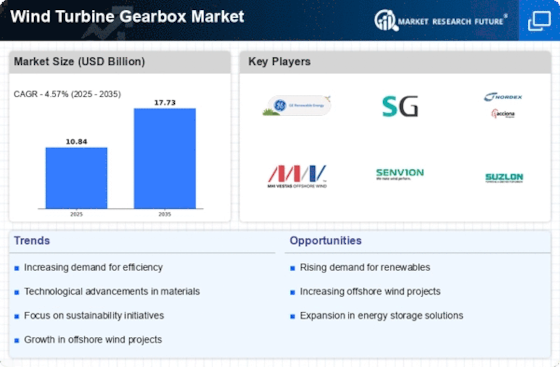
Wind Turbine Gearbox Market Infographic
Purchase Options

Wind Turbine Gearbox Size

Wind Turbine Gearbox Market Growth Projections and Opportunities

Multiple factors shape the market dynamics of wind turbine gearbox including One key factor is the global need to harness renewable and clean energy sources. Considering the global effort to minimize carbon footprint and shift towards clean energy, wind power has seen a tremendous increase in demand. This growing need directly affects the wind turbine gearbox market as these gearboxes are essential in converting energy into electricity because of increasing demand. Government policies and regulations are the most important driving factors of wind turbine gearbox market. Policies, directed towards supporting such as subsidies and incentives for projects related to renewable energy ensure that there is investment in the wind power infrastructure which ultimately drives demand of wind turbine gearboxes. On the other hand, shifts in regulations or uncertainty of government support can create hurdles to market growth. Technological developments also play a major role in the market of wind turbine gearbox. Continuous innovations and developments in gearbox design & materials make gear boxes efficient, reliable as well as long-lived. In their efforts to invest in research and development of more sophisticated and competitive gearboxes, the market witnesses changes with regards to product types as well competition. Another important factor that influences the wind turbine gearbox market is globally and regionally overall economic environment. Economic stability creates the enabling environment for investment in renewable energy projects which increases demand of wind turbine gearboxes. On the other hand, project delays or cancellations due to economic recessions tend to have a negative impact on the market. Variations in the wind turbine gearbox market are greatly influenced by supply chain dynamics. Raw material availability and price, in the form of steel and alloys manufacturing costs largely influence. Furthermore, changes in supply chain involved with natural disasters or geopolitical tension can cause unstable prices and availability of gearbox. Market of wind turbine gearbox is influenced by the global energy prices, especially those associated with fossil fuels. When traditional energy prices are high there is a greater incentive for investment in renewable forms of power like wind power. On the other hand, a sharp decline in fossil fuel prices can initially reduce wind energy solutions adoption. Environmental awareness and public perceptions are becoming major market drivers. The need for sustainable options increases as awareness of climate change and the effect such traditional sources have on nature rises. The continuously increasing positive perception of wind energy in the public draws numerous governments, companies, and individuals into investing on wind power projects which consequently spurs demand for application within Wind Farm Turbine Gearboxes.
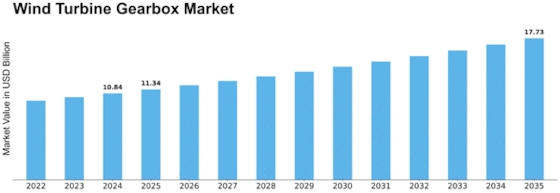
Wind Turbine Gearbox Market Size Graph
Author
Author Profile
Chitranshi Jaiswal
Team Lead - Research

Chitranshi is a Team Leader in the Chemicals & Materials (CnM) and Energy & Power (EnP) domains, with 6+ years of experience in market research. She leads and mentors teams to deliver cross-domain projects that equip clients with actionable insights and growth strategies. She is skilled in market estimation, forecasting, competitive benchmarking, and both primary & secondary research, enabling her to turn complex data into decision-ready insights. An engineer and MBA professional, she combines technical expertise with strategic acumen to solve dynamic market challenges. Chitranshi has successfully managed projects that support market entry, investment planning, and competitive positioning, while building strong client relationships. Certified in Advanced Excel & Power BI she leverages data-driven approaches to ensure accuracy, clarity, and impactful outcomes.

Leave a Comment

FAQs

What is the projected market valuation of the Wind Turbine Gearbox Market by 2035?

<p>The Wind Turbine Gearbox Market is projected to reach a valuation of 17.73 USD Billion by 2035.</p>

What was the market valuation of the Wind Turbine Gearbox Market in 2024?

<p>In 2024, the overall market valuation was 10.84 USD Billion.</p>

What is the expected CAGR for the Wind Turbine Gearbox Market during the forecast period 2025 - 2035?

<p>The expected CAGR for the Wind Turbine Gearbox Market during the forecast period 2025 - 2035 is 4.57%.</p>

Which companies are considered key players in the Wind Turbine Gearbox Market?

<p>Key players in the Wind Turbine Gearbox Market include GE Renewable Energy, Siemens Gamesa, Nordex, MHI Vestas, Senvion, Suzlon Energy, Goldwind, Envision Energy, and Siemens Energy.</p>

What are the projected values for the Onshore and Offshore Wind Power segments by 2035?

<p>By 2035, the Onshore Wind Power segment is projected to reach 10.5 USD Billion, while the Offshore Wind Power segment is expected to reach 7.23 USD Billion.</p>

How do the different gearbox types compare in terms of market valuation?

<p>By 2035, the Planetary Gearbox is projected to reach 6.93 USD Billion, the Helical Gearbox 5.2 USD Billion, and the Hybrid Gearbox 5.6 USD Billion.</p>

What is the anticipated market size for turbine capacities above 3 MW by 2035?

<p>The market size for turbine capacities above 3 MW is anticipated to reach 5.73 USD Billion by 2035.</p>

What are the expected market values for the end-use segments by 2035?

<p>By 2035, the Power Generation segment is projected to reach 8.0 USD Billion, the Industrial segment 5.0 USD Billion, and the Commercial segment 4.73 USD Billion.</p>

What trends are influencing the growth of the Wind Turbine Gearbox Market?

<p>The growth of the Wind Turbine Gearbox Market appears to be influenced by increasing investments in renewable energy and advancements in gearbox technology.</p>

How does the Wind Turbine Gearbox Market's growth compare to other renewable energy sectors?

<p>While specific comparisons to other renewable energy sectors are complex, the Wind Turbine Gearbox Market's projected CAGR of 4.57% suggests a steady growth trajectory within the broader renewable energy landscape.</p>

Market Summary

As per Market Research Future analysis, the Wind Turbine Gearbox Market Size was estimated at 10.84 USD Billion in 2024. The Wind Turbine Gearbox industry is projected to grow from 11.34 USD Billion in 2025 to 17.73 USD Billion by 2035, exhibiting a compound annual growth rate (CAGR) of 4.5% during the forecast period 2025 - 2035

Key Market Trends & Highlights

The Wind Turbine Gearbox Market is poised for substantial growth driven by technological advancements and a shift towards sustainability.

  • North America remains the largest market for wind turbine gearboxes, driven by robust investments in renewable energy infrastructure. Asia-Pacific is emerging as the fastest-growing region, reflecting a significant increase in offshore wind projects. Onshore wind power continues to dominate the market, while offshore wind power is rapidly gaining traction due to its growth potential. Key market drivers include increasing demand for renewable energy and government incentives that support technological innovations in gearbox design.

Market Size & Forecast

2024 Market Size 10.84 (USD Billion)
2035 Market Size 17.73 (USD Billion)
CAGR (2025 - 2035) 4.57%
Largest Regional Market Share in 2024 Europe

Major Players

GE Renewable Energy (US), Siemens Gamesa (ES), <a href="https://www.nordex-online.com/en/2025/11/press-release-nordex-group-opens-new-test-bench-for-wind-turbine-electrical-systems-in-rostock/">Nordex </a>(DE), MHI Vestas (DK), Senvion (DE), Suzlon Energy (IN), Goldwind (CN), Envision Energy (CN), Siemens Energy (DE)

Market Trends

The Wind Turbine Gearbox Market is currently experiencing a transformative phase, driven by the increasing demand for renewable energy sources and advancements in technology. As nations strive to reduce their carbon footprints, the emphasis on wind energy has intensified, leading to a surge in the installation of wind turbines. This, in turn, has created a robust demand for efficient and reliable gearboxes, which are crucial for converting the rotational energy generated by wind into usable electrical energy. The market appears to be evolving, with manufacturers focusing on enhancing the durability and performance of gearboxes to meet the growing expectations of the industry. Moreover, the Wind Turbine Gearbox Market is witnessing a shift towards innovative designs and materials that promise improved efficiency and reduced maintenance costs. The integration of smart technologies, such as predictive maintenance and IoT capabilities, is likely to play a pivotal role in shaping the future landscape of this market. As stakeholders continue to invest in research and development, the potential for breakthroughs in gearbox technology seems promising. Overall, the Wind Turbine Gearbox Market is poised for growth, reflecting the broader trends in the renewable energy sector and the ongoing quest for sustainable solutions.

Technological Advancements

The Wind Turbine Gearbox Market is increasingly influenced by technological innovations that enhance efficiency and reliability. Manufacturers are exploring advanced materials and designs to improve performance and reduce wear and tear. This trend suggests a focus on developing gearboxes that can withstand harsh environmental conditions while maintaining optimal functionality.

Shift Towards Sustainability

There is a noticeable shift towards sustainability within the Wind Turbine Gearbox Market, as stakeholders prioritize eco-friendly practices. This trend indicates a growing preference for gearboxes that not only perform well but also minimize environmental impact. Companies are likely to adopt greener manufacturing processes and materials to align with global sustainability goals.

Integration of Smart Technologies

The integration of smart technologies into the Wind Turbine Gearbox Market is becoming increasingly prevalent. This trend highlights the potential for predictive maintenance and real-time monitoring, which can enhance operational efficiency. By leveraging data analytics and IoT, manufacturers may improve gearbox performance and reduce downtime, ultimately benefiting the entire wind energy sector.

Wind Turbine Gearbox Market Market Drivers

Government Incentives and Policies

Government incentives and supportive policies play a pivotal role in driving the Wind Turbine Gearbox Market. Many countries have implemented favorable regulations and financial incentives to promote the adoption of wind energy. For instance, tax credits, grants, and subsidies for renewable energy projects encourage investments in wind turbine technology. This regulatory support not only enhances the economic viability of wind projects but also stimulates demand for advanced gearboxes that improve turbine efficiency. As a result, the Wind Turbine Gearbox Market is likely to experience growth as more projects are initiated under these favorable conditions.

Increasing Demand for Renewable Energy

The rising demand for renewable energy sources is a primary driver for the Wind Turbine Gearbox Market. As nations strive to reduce carbon emissions and combat climate change, investments in wind energy have surged. According to recent data, the wind energy sector is projected to grow at a compound annual growth rate of approximately 8% over the next decade. This growth necessitates the development and deployment of efficient wind turbine gearboxes, which are crucial for converting wind energy into electrical power. The Wind Turbine Gearbox Market is thus positioned to benefit from this increasing demand, as more wind farms are established to meet energy needs sustainably.

Technological Innovations in Gearbox Design

Technological innovations in gearbox design are significantly influencing the Wind Turbine Gearbox Market. Advances in materials science and engineering have led to the development of lighter, more durable gearboxes that enhance the overall efficiency of wind turbines. Innovations such as direct drive systems and hybrid gearboxes are gaining traction, potentially reducing maintenance costs and increasing reliability. The market for wind turbine gearboxes is expected to expand as manufacturers adopt these cutting-edge technologies, which not only improve performance but also align with the industry's shift towards more sustainable practices.

Growing Investment in Offshore Wind Projects

The growing investment in offshore wind projects is a crucial driver for the Wind Turbine Gearbox Market. Offshore wind farms are becoming increasingly popular due to their higher energy generation potential compared to onshore installations. As countries invest in expanding their offshore wind capabilities, the demand for specialized gearboxes designed for harsh marine environments is likely to rise. This trend is supported by projections indicating that offshore wind capacity could reach over 200 GW by 2030. Consequently, the Wind Turbine Gearbox Market stands to benefit from this surge in offshore developments.

Rising Energy Costs and Energy Security Concerns

Rising energy costs and concerns over energy security are propelling the Wind Turbine Gearbox Market forward. As traditional energy sources become more volatile and expensive, there is a growing impetus to invest in renewable energy solutions like wind power. This shift is driven by the need for stable and affordable energy sources. The Wind Turbine Gearbox Market is likely to see increased demand as more stakeholders recognize the long-term cost benefits of wind energy. Furthermore, the emphasis on energy independence is encouraging investments in domestic wind energy projects, further stimulating market growth.

Market Segment Insights

By Application: Onshore Wind Power (Largest) vs. Offshore Wind Power (Fastest-Growing)

The Wind Turbine Gearbox Market showcases a significant division in application, with the onshore wind power segment holding the largest market share. This widespread dominance is attributed to the extensive deployment of onshore <a href="https://www.marketresearchfuture.com/reports/ocean-wind-farm-market-21837">wind farms</a>, which are generally easier to implement and maintain compared to offshore counterparts. Onshore wind power not only benefits from lower operational costs but also resonates with existing regulatory frameworks that favor terrestrial installations, enhancing its market position. Conversely, the offshore wind power segment is recognized as the fastest-growing area within the market. This growth is driven by technological advancements that improve offshore turbine efficiency and increase energy output. Additionally, rising investments in renewable energy initiatives and government incentives are propelling the offshore segment, fostering a favorable environment for future expansion as countries aim to meet aggressive sustainability targets.

Application: Onshore Wind Power (Dominant) vs. Offshore Wind Power (Emerging)

<a href="https://www.marketresearchfuture.com/reports/onshore-wind-energy-market-5996">Onshore wind</a> power has established itself as the dominant player in the Wind Turbine Gearbox Market, benefitting from its established infrastructure and lower capital requirements. This sector’s resilience is bolstered by favorable government policies, providing a solid framework for future projects. In contrast, offshore wind power, while emerging, has captured attention due to its potential for higher energy yield in optimal conditions. Although currently less prevalent, advances in technology and decreasing costs are paving the way for increased adoption, as offshore wind farms exploit the untapped potential of maritime locations. Both segments are expected to play vital roles in shaping a sustainable energy future, complementing each other to meet diverse energy needs.

By Gearbox Type: Planetary Gearbox (Largest) vs. Helical Gearbox (Fastest-Growing)

In the Wind Turbine Gearbox Market, the Planetary Gearbox currently holds the largest share, attributed to its efficient design and reliability, making it the preferred choice among manufacturers. In contrast, the Helical Gearbox, while smaller in market share, is witnessing rapid growth due to its quieter operation and improved torque capabilities, appealing to a segment of manufacturers focused on performance and efficiency. The growth of the Helical Gearbox is driven by advancements in design and materials that enhance performance and reduce maintenance costs. As wind energy demands increase, the versatility and operational benefits of Helical Gearboxes position them as a compelling choice for newer turbine models, potentially capturing more market share in the coming years.

Helical Gearbox: Emerging vs. Planetary Gearbox: Dominant

The Planetary Gearbox is well-established within the Wind Turbine Gearbox Market, characterized by its compact design and ability to handle high torque loads, making it favored for large-scale applications. Its robustness and efficiency in power transmission contribute significantly to its dominant position. On the other hand, the Helical Gearbox is emerging as a strong competitor, known for its smooth operation and lower noise levels, which enhance the overall performance of wind turbines. This evolving gearbox design benefits from innovations in engineering and materials, allowing for better energy efficiency and extended lifespan, thus attracting interest from manufacturers seeking to optimize turbine performance.

By Turbine Capacity: 1.5 MW - 3 MW (Largest) vs. Above 3 MW (Fastest-Growing)

The Wind Turbine Gearbox Market exhibits a diverse distribution in turbine capacity segments. The 1.5 MW - 3 MW category holds the largest market share, primarily driven by its extensive deployment in onshore wind farms. Meanwhile, the segment for above 3 MW turbines is rapidly gaining traction due to increasing investments in larger renewable energy projects and technological advancements that enhance efficiency and reliability in energy conversion. As the global focus shifts towards more sustainable energy sources, the demand for higher capacity turbines is expected to grow. The growth in this segment is propelled by manufacturers' evolving designs that cater to larger installations, resulting in a significant market shift towards meeting energy demands more effectively with larger wind turbines.

1.5 MW - 3 MW (Dominant) vs. Below 1.5 MW (Emerging)

The 1.5 MW - 3 MW segment stands out as the dominant player in the Wind Turbine Gearbox Market, attributable to its well-established presence in both onshore and offshore applications. These turbines balance efficiency and output, making them ideal for extensive wind farm projects. Contrarily, the below 1.5 MW segment is categorized as emerging, often focusing on localized or distributed energy solutions. While this segment tends to cater to smaller installations or niche markets, the growing need for renewable energy in suburban and rural areas indicates its potential for future growth. Innovations tailored for lower-capacity turbines are driving enhancements in performance and reliability, leading to gradual acceptance and integration into mainstream energy portfolios.

By End Use: Power Generation (Largest) vs. Industrial (Fastest-Growing)

The Wind Turbine Gearbox Market is predominantly driven by the power generation segment, which holds the largest market share due to the rising demand for renewable energy sources globally. This segment is characterized by a significant investment in wind energy projects, supported by government incentives and policies aimed at reducing carbon emissions. The industrial segment, while smaller, is emerging rapidly, particularly in sectors that require efficient energy solutions and are looking to reduce operational costs through renewable energy integration.

Power Generation: Dominant vs. Industrial: Emerging

The power generation segment significantly dominates the Wind Turbine Gearbox Market, accounting for the bulk of demand. This sector benefits from the increasing establishment of wind farms and advancements in gear technology that enhance the efficiency of energy conversion from wind to electricity. In contrast, the industrial segment is gaining traction as industries seek sustainable energy practices to alleviate reliance on fossil fuels. This segment's growth is propelled by industrial players investing in on-site renewable energy solutions, thus catalyzing the need for wind turbine gearboxes to support diverse applications beyond traditional energy generation.

Get more detailed insights about Wind Turbine Gearbox Market Report-Forecast till 2035

Regional Insights

The Wind Turbine Gearbox Market exhibits notable growth across its regional segments, with an overall valuation of 10.37 USD Billion in 2023. In this landscape, North America Wind Turbine Gearbox Market holds a significant market value of 2.55 USD Billion, projected to rise to 3.62 USD Billion by 2032, highlighting its integral role in the regional growth narrative. Europe Wind Turbine Gearbox Market follows closely with a valuation of 3.12 USD Billion in 2023, expected to reach 4.56 USD Billion by 2032, making it a dominant player due to established infrastructure and a strong focus on renewable energy.

The APAC region, valued at 3.46 USD Billion in the current year, showcases substantial potential for expansion, forecasted to hit 5.44 USD Billion in 2032, driven by rapid industrialization and increasing energy demands. South America, while smaller at 0.72 USD Billion in 2023, is projected to grow to 1.05 USD Billion, indicating rising interest in sustainable energy solutions. The MEA region, with a current valuation of 0.52 USD Billion, reaching 0.73 USD Billion by 2032, reflects both challenges and opportunities for market entrants as it diversifies energy sources.

The Wind Turbine Gearbox Market data suggests a vibrant growth trend influenced by regional dynamics, industry advancements, and governmental support for eco-friendly energy systems.

Key Players and Competitive Insights

The Wind Turbine Gearbox Market is an essential segment within the renewable energy sector, playing a crucial role in the efficient operation of wind turbines. As global energy demands shift towards sustainable sources, the market for wind turbine gearboxes has witnessed significant growth driven by advancements in technology and increasing investments in renewable energy infrastructure. The competition in this market is characterized by a blend of established industry leaders and emerging players, all striving to enhance gearbox performance to cater to the growing number of wind energy installations. As environmental regulations become stricter and the international push for decarbonization intensifies, companies are leveraging their technological capabilities to create innovative solutions that meet market demands while ensuring economic feasibility. This competitive landscape requires companies to be agile and responsive to changing consumer preferences and technological advancements, ultimately shaping the future of wind turbine gearbox solutions. Bosch Rexroth stands out in the Wind Turbine Gearbox Market due to its extensive experience in drive and control technology, which significantly contributes to its strength in wind turbine gearbox manufacturing. The company’s emphasis on high efficiency and reliability makes its gearboxes highly regarded in the industry. Its robust RD infrastructure enables Bosch Rexroth to innovate and refine gearbox designs, thus improving performance and reducing maintenance needs. Additionally, Bosch Rexroth has a vast global presence, ensuring that its products are available in major wind energy markets worldwide. This positions the company as a preferred choice among turbine manufacturers and energy producers seeking reliable and efficient gearbox solutions. The company's commitment to sustainability aligns with the market's overall goals, further solidifying its presence in the eco-conscious energy sector. Senvion plays an important role in the Wind Turbine Gearbox Market, focusing on tailored solutions specifically designed for various wind conditions and turbine sizes. Known for its innovative approaches to gearbox technology, Senvion has made significant strides in developing gear systems that enhance efficiency and durability. The company’s dedication to comprehensive service offerings, including maintenance and upgrades, ensures that clients receive optimal operational performance over the lifespan of their wind turbines. Senvion's strategic partnerships and collaborations with other industry players enhance its market reach and technological capabilities. This collaborative spirit, combined with a focus on research and development, empowers Senvion to remain competitive in the rapidly evolving landscape of the wind energy market. The company's commitment to maximizing energy output while minimizing environmental impact resonates well with the industry's shift towards sustainability, making Senvion a notable player in the global wind turbine gearbox landscape.

Key Companies in the Wind Turbine Gearbox Market include

Industry Developments

Recent developments in the Wind Turbine Gearbox Market indicate significant advancements and strategic movements among key players. Companies such as Siemens Gamesa and Vestas are focusing on enhancing gearbox designs to improve efficiency and reduce maintenance costs, responding to increased demand for renewable energy sources. The market is witnessing growth driven by rising investments in wind energy, with Bosch Rexroth and ZF Friedrichshafen at the forefront of innovative technology developments.

Additionally, MAs are shaping the competitive landscape, with notable activities involving Mitsubishi Heavy Industries expanding their capabilities through strategic partnerships. Clark Energy’s efforts to explore renewable solutions underscore the strong emphasis on sustainability within the sector. Recent valuations show a positive trend, with firms such as General Electric and Schneider Electric experiencing robust financial performance, further propelling market growth. The ongoing development of offshore wind projects is also pushing the demand for advanced gearbox solutions.

Amid these dynamics, companies are continually adapting to regulatory changes and market demands, ensuring they maintain a competitive edge in the evolving Wind Turbine Gearbox Market.

Future Outlook

Wind Turbine Gearbox Market Future Outlook

The Wind Turbine Gearbox Market is projected to grow at a 4.57% CAGR from 2025 to 2035, driven by technological advancements, increasing renewable energy investments, and demand for efficiency.

New opportunities lie in:

  • <p>Development of advanced composite materials for lightweight gearboxes. Integration of IoT for predictive maintenance solutions. Expansion into emerging markets with tailored gearbox designs.</p>

By 2035, the market is expected to be robust, driven by innovation and strategic investments.

Market Segmentation

Wind Turbine Gearbox Market End Use Outlook

  • Power Generation
  • Industrial
  • Commercial

Wind Turbine Gearbox Market Application Outlook

  • Onshore Wind Power
  • Offshore Wind Power

Wind Turbine Gearbox Market Gearbox Type Outlook

  • Planetary Gearbox
  • Helical Gearbox
  • Hybrid Gearbox

Wind Turbine Gearbox Market Turbine Capacity Outlook

  • Below 1.5 MW
  • 1.5 MW - 3 MW
  • Above 3 MW

Report Scope

MARKET SIZE 2024 10.84(USD Billion)
MARKET SIZE 2025 11.34(USD Billion)
MARKET SIZE 2035 17.73(USD Billion)
COMPOUND ANNUAL GROWTH RATE (CAGR) 4.57% (2025 - 2035)
REPORT COVERAGE Revenue Forecast, Competitive Landscape, Growth Factors, and Trends
BASE YEAR 2024
Market Forecast Period 2025 - 2035
Historical Data 2019 - 2024
Market Forecast Units USD Billion
Key Companies Profiled GE Renewable Energy (US), Siemens Gamesa (ES), Nordex (DE), MHI Vestas (DK), Senvion (DE), Suzlon Energy (IN), Goldwind (CN), Envision Energy (CN), Siemens Energy (DE)
Segments Covered Application, Gearbox Type, Turbine Capacity, End Use, Regional
Key Market Opportunities Advancements in lightweight materials enhance efficiency in the Wind Turbine Gearbox Market.
Key Market Dynamics Technological advancements and regulatory pressures drive innovation and competition in the wind turbine gearbox market.
Countries Covered North America, Europe, APAC, South America, MEA

FAQs

What is the projected market valuation of the Wind Turbine Gearbox Market by 2035?

<p>The Wind Turbine Gearbox Market is projected to reach a valuation of 17.73 USD Billion by 2035.</p>

What was the market valuation of the Wind Turbine Gearbox Market in 2024?

<p>In 2024, the overall market valuation was 10.84 USD Billion.</p>

What is the expected CAGR for the Wind Turbine Gearbox Market during the forecast period 2025 - 2035?

<p>The expected CAGR for the Wind Turbine Gearbox Market during the forecast period 2025 - 2035 is 4.57%.</p>

Which companies are considered key players in the Wind Turbine Gearbox Market?

<p>Key players in the Wind Turbine Gearbox Market include GE Renewable Energy, Siemens Gamesa, Nordex, MHI Vestas, Senvion, Suzlon Energy, Goldwind, Envision Energy, and Siemens Energy.</p>

What are the projected values for the Onshore and Offshore Wind Power segments by 2035?

<p>By 2035, the Onshore Wind Power segment is projected to reach 10.5 USD Billion, while the Offshore Wind Power segment is expected to reach 7.23 USD Billion.</p>

How do the different gearbox types compare in terms of market valuation?

<p>By 2035, the Planetary Gearbox is projected to reach 6.93 USD Billion, the Helical Gearbox 5.2 USD Billion, and the Hybrid Gearbox 5.6 USD Billion.</p>

What is the anticipated market size for turbine capacities above 3 MW by 2035?

<p>The market size for turbine capacities above 3 MW is anticipated to reach 5.73 USD Billion by 2035.</p>

What are the expected market values for the end-use segments by 2035?

<p>By 2035, the Power Generation segment is projected to reach 8.0 USD Billion, the Industrial segment 5.0 USD Billion, and the Commercial segment 4.73 USD Billion.</p>

What trends are influencing the growth of the Wind Turbine Gearbox Market?

<p>The growth of the Wind Turbine Gearbox Market appears to be influenced by increasing investments in renewable energy and advancements in gearbox technology.</p>

How does the Wind Turbine Gearbox Market's growth compare to other renewable energy sectors?

<p>While specific comparisons to other renewable energy sectors are complex, the Wind Turbine Gearbox Market's projected CAGR of 4.57% suggests a steady growth trajectory within the broader renewable energy landscape.</p>

  1. SECTION I: EXECUTIVE SUMMARY AND KEY HIGHLIGHTS
    1. | 1.1 EXECUTIVE SUMMARY
    2. | | 1.1.1 Market Overview
    3. | | 1.1.2 Key Findings
    4. | | 1.1.3 Market Segmentation
    5. | | 1.1.4 Competitive Landscape
    6. | | 1.1.5 Challenges and Opportunities
    7. | | 1.1.6 Future Outlook
  2. SECTION II: SCOPING, METHODOLOGY AND MARKET STRUCTURE
    1. | 2.1 MARKET INTRODUCTION
    2. | | 2.1.1 Definition
    3. | | 2.1.2 Scope of the study
    4. | | | 2.1.2.1 Research Objective
    5. | | | 2.1.2.2 Assumption
    6. | | | 2.1.2.3 Limitations
    7. | 2.2 RESEARCH METHODOLOGY
    8. | | 2.2.1 Overview
    9. | | 2.2.2 Data Mining
    10. | | 2.2.3 Secondary Research
    11. | | 2.2.4 Primary Research
    12. | | | 2.2.4.1 Primary Interviews and Information Gathering Process
    13. | | | 2.2.4.2 Breakdown of Primary Respondents
    14. | | 2.2.5 Forecasting Model
    15. | | 2.2.6 Market Size Estimation
    16. | | | 2.2.6.1 Bottom-Up Approach
    17. | | | 2.2.6.2 Top-Down Approach
    18. | | 2.2.7 Data Triangulation
    19. | | 2.2.8 Validation
  3. SECTION III: QUALITATIVE ANALYSIS
    1. | 3.1 MARKET DYNAMICS
    2. | | 3.1.1 Overview
    3. | | 3.1.2 Drivers
    4. | | 3.1.3 Restraints
    5. | | 3.1.4 Opportunities
    6. | 3.2 MARKET FACTOR ANALYSIS
    7. | | 3.2.1 Value chain Analysis
    8. | | 3.2.2 Porter's Five Forces Analysis
    9. | | | 3.2.2.1 Bargaining Power of Suppliers
    10. | | | 3.2.2.2 Bargaining Power of Buyers
    11. | | | 3.2.2.3 Threat of New Entrants
    12. | | | 3.2.2.4 Threat of Substitutes
    13. | | | 3.2.2.5 Intensity of Rivalry
    14. | | 3.2.3 COVID-19 Impact Analysis
    15. | | | 3.2.3.1 Market Impact Analysis
    16. | | | 3.2.3.2 Regional Impact
    17. | | | 3.2.3.3 Opportunity and Threat Analysis
  4. SECTION IV: QUANTITATIVE ANALYSIS
    1. | 4.1 Energy & Power, BY Application (USD Billion)
    2. | | 4.1.1 Onshore Wind Power
    3. | | 4.1.2 Offshore Wind Power
    4. | 4.2 Energy & Power, BY Gearbox Type (USD Billion)
    5. | | 4.2.1 Planetary Gearbox
    6. | | 4.2.2 Helical Gearbox
    7. | | 4.2.3 Hybrid Gearbox
    8. | 4.3 Energy & Power, BY Turbine Capacity (USD Billion)
    9. | | 4.3.1 Below 1.5 MW
    10. | | 4.3.2 1.5 MW - 3 MW
    11. | | 4.3.3 Above 3 MW
    12. | 4.4 Energy & Power, BY End Use (USD Billion)
    13. | | 4.4.1 Power Generation
    14. | | 4.4.2 Industrial
    15. | | 4.4.3 Commercial
    16. | 4.5 Energy & Power, BY Region (USD Billion)
    17. | | 4.5.1 North America
    18. | | | 4.5.1.1 US
    19. | | | 4.5.1.2 Canada
    20. | | 4.5.2 Europe
    21. | | | 4.5.2.1 Germany
    22. | | | 4.5.2.2 UK
    23. | | | 4.5.2.3 France
    24. | | | 4.5.2.4 Russia
    25. | | | 4.5.2.5 Italy
    26. | | | 4.5.2.6 Spain
    27. | | | 4.5.2.7 Rest of Europe
    28. | | 4.5.3 APAC
    29. | | | 4.5.3.1 China
    30. | | | 4.5.3.2 India
    31. | | | 4.5.3.3 Japan
    32. | | | 4.5.3.4 South Korea
    33. | | | 4.5.3.5 Malaysia
    34. | | | 4.5.3.6 Thailand
    35. | | | 4.5.3.7 Indonesia
    36. | | | 4.5.3.8 Rest of APAC
    37. | | 4.5.4 South America
    38. | | | 4.5.4.1 Brazil
    39. | | | 4.5.4.2 Mexico
    40. | | | 4.5.4.3 Argentina
    41. | | | 4.5.4.4 Rest of South America
    42. | | 4.5.5 MEA
    43. | | | 4.5.5.1 GCC Countries
    44. | | | 4.5.5.2 South Africa
    45. | | | 4.5.5.3 Rest of MEA
  5. SECTION V: COMPETITIVE ANALYSIS
    1. | 5.1 Competitive Landscape
    2. | | 5.1.1 Overview
    3. | | 5.1.2 Competitive Analysis
    4. | | 5.1.3 Market share Analysis
    5. | | 5.1.4 Major Growth Strategy in the Energy & Power
    6. | | 5.1.5 Competitive Benchmarking
    7. | | 5.1.6 Leading Players in Terms of Number of Developments in the Energy & Power
    8. | | 5.1.7 Key developments and growth strategies
    9. | | | 5.1.7.1 New Product Launch/Service Deployment
    10. | | | 5.1.7.2 Merger & Acquisitions
    11. | | | 5.1.7.3 Joint Ventures
    12. | | 5.1.8 Major Players Financial Matrix
    13. | | | 5.1.8.1 Sales and Operating Income
    14. | | | 5.1.8.2 Major Players R&D Expenditure. 2023
    15. | 5.2 Company Profiles
    16. | | 5.2.1 GE Renewable Energy (US)
    17. | | | 5.2.1.1 Financial Overview
    18. | | | 5.2.1.2 Products Offered
    19. | | | 5.2.1.3 Key Developments
    20. | | | 5.2.1.4 SWOT Analysis
    21. | | | 5.2.1.5 Key Strategies
    22. | | 5.2.2 Siemens Gamesa (ES)
    23. | | | 5.2.2.1 Financial Overview
    24. | | | 5.2.2.2 Products Offered
    25. | | | 5.2.2.3 Key Developments
    26. | | | 5.2.2.4 SWOT Analysis
    27. | | | 5.2.2.5 Key Strategies
    28. | | 5.2.3 Nordex (DE)
    29. | | | 5.2.3.1 Financial Overview
    30. | | | 5.2.3.2 Products Offered
    31. | | | 5.2.3.3 Key Developments
    32. | | | 5.2.3.4 SWOT Analysis
    33. | | | 5.2.3.5 Key Strategies
    34. | | 5.2.4 MHI Vestas (DK)
    35. | | | 5.2.4.1 Financial Overview
    36. | | | 5.2.4.2 Products Offered
    37. | | | 5.2.4.3 Key Developments
    38. | | | 5.2.4.4 SWOT Analysis
    39. | | | 5.2.4.5 Key Strategies
    40. | | 5.2.5 Senvion (DE)
    41. | | | 5.2.5.1 Financial Overview
    42. | | | 5.2.5.2 Products Offered
    43. | | | 5.2.5.3 Key Developments
    44. | | | 5.2.5.4 SWOT Analysis
    45. | | | 5.2.5.5 Key Strategies
    46. | | 5.2.6 Suzlon Energy (IN)
    47. | | | 5.2.6.1 Financial Overview
    48. | | | 5.2.6.2 Products Offered
    49. | | | 5.2.6.3 Key Developments
    50. | | | 5.2.6.4 SWOT Analysis
    51. | | | 5.2.6.5 Key Strategies
    52. | | 5.2.7 Goldwind (CN)
    53. | | | 5.2.7.1 Financial Overview
    54. | | | 5.2.7.2 Products Offered
    55. | | | 5.2.7.3 Key Developments
    56. | | | 5.2.7.4 SWOT Analysis
    57. | | | 5.2.7.5 Key Strategies
    58. | | 5.2.8 Envision Energy (CN)
    59. | | | 5.2.8.1 Financial Overview
    60. | | | 5.2.8.2 Products Offered
    61. | | | 5.2.8.3 Key Developments
    62. | | | 5.2.8.4 SWOT Analysis
    63. | | | 5.2.8.5 Key Strategies
    64. | | 5.2.9 Siemens Energy (DE)
    65. | | | 5.2.9.1 Financial Overview
    66. | | | 5.2.9.2 Products Offered
    67. | | | 5.2.9.3 Key Developments
    68. | | | 5.2.9.4 SWOT Analysis
    69. | | | 5.2.9.5 Key Strategies
    70. | 5.3 Appendix
    71. | | 5.3.1 References
    72. | | 5.3.2 Related Reports
  6. LIST OF FIGURES
    1. | 6.1 MARKET SYNOPSIS
    2. | 6.2 NORTH AMERICA MARKET ANALYSIS
    3. | 6.3 US MARKET ANALYSIS BY APPLICATION
    4. | 6.4 US MARKET ANALYSIS BY GEARBOX TYPE
    5. | 6.5 US MARKET ANALYSIS BY TURBINE CAPACITY
    6. | 6.6 US MARKET ANALYSIS BY END USE
    7. | 6.7 CANADA MARKET ANALYSIS BY APPLICATION
    8. | 6.8 CANADA MARKET ANALYSIS BY GEARBOX TYPE
    9. | 6.9 CANADA MARKET ANALYSIS BY TURBINE CAPACITY
    10. | 6.10 CANADA MARKET ANALYSIS BY END USE
    11. | 6.11 EUROPE MARKET ANALYSIS
    12. | 6.12 GERMANY MARKET ANALYSIS BY APPLICATION
    13. | 6.13 GERMANY MARKET ANALYSIS BY GEARBOX TYPE
    14. | 6.14 GERMANY MARKET ANALYSIS BY TURBINE CAPACITY
    15. | 6.15 GERMANY MARKET ANALYSIS BY END USE
    16. | 6.16 UK MARKET ANALYSIS BY APPLICATION
    17. | 6.17 UK MARKET ANALYSIS BY GEARBOX TYPE
    18. | 6.18 UK MARKET ANALYSIS BY TURBINE CAPACITY
    19. | 6.19 UK MARKET ANALYSIS BY END USE
    20. | 6.20 FRANCE MARKET ANALYSIS BY APPLICATION
    21. | 6.21 FRANCE MARKET ANALYSIS BY GEARBOX TYPE
    22. | 6.22 FRANCE MARKET ANALYSIS BY TURBINE CAPACITY
    23. | 6.23 FRANCE MARKET ANALYSIS BY END USE
    24. | 6.24 RUSSIA MARKET ANALYSIS BY APPLICATION
    25. | 6.25 RUSSIA MARKET ANALYSIS BY GEARBOX TYPE
    26. | 6.26 RUSSIA MARKET ANALYSIS BY TURBINE CAPACITY
    27. | 6.27 RUSSIA MARKET ANALYSIS BY END USE
    28. | 6.28 ITALY MARKET ANALYSIS BY APPLICATION
    29. | 6.29 ITALY MARKET ANALYSIS BY GEARBOX TYPE
    30. | 6.30 ITALY MARKET ANALYSIS BY TURBINE CAPACITY
    31. | 6.31 ITALY MARKET ANALYSIS BY END USE
    32. | 6.32 SPAIN MARKET ANALYSIS BY APPLICATION
    33. | 6.33 SPAIN MARKET ANALYSIS BY GEARBOX TYPE
    34. | 6.34 SPAIN MARKET ANALYSIS BY TURBINE CAPACITY
    35. | 6.35 SPAIN MARKET ANALYSIS BY END USE
    36. | 6.36 REST OF EUROPE MARKET ANALYSIS BY APPLICATION
    37. | 6.37 REST OF EUROPE MARKET ANALYSIS BY GEARBOX TYPE
    38. | 6.38 REST OF EUROPE MARKET ANALYSIS BY TURBINE CAPACITY
    39. | 6.39 REST OF EUROPE MARKET ANALYSIS BY END USE
    40. | 6.40 APAC MARKET ANALYSIS
    41. | 6.41 CHINA MARKET ANALYSIS BY APPLICATION
    42. | 6.42 CHINA MARKET ANALYSIS BY GEARBOX TYPE
    43. | 6.43 CHINA MARKET ANALYSIS BY TURBINE CAPACITY
    44. | 6.44 CHINA MARKET ANALYSIS BY END USE
    45. | 6.45 INDIA MARKET ANALYSIS BY APPLICATION
    46. | 6.46 INDIA MARKET ANALYSIS BY GEARBOX TYPE
    47. | 6.47 INDIA MARKET ANALYSIS BY TURBINE CAPACITY
    48. | 6.48 INDIA MARKET ANALYSIS BY END USE
    49. | 6.49 JAPAN MARKET ANALYSIS BY APPLICATION
    50. | 6.50 JAPAN MARKET ANALYSIS BY GEARBOX TYPE
    51. | 6.51 JAPAN MARKET ANALYSIS BY TURBINE CAPACITY
    52. | 6.52 JAPAN MARKET ANALYSIS BY END USE
    53. | 6.53 SOUTH KOREA MARKET ANALYSIS BY APPLICATION
    54. | 6.54 SOUTH KOREA MARKET ANALYSIS BY GEARBOX TYPE
    55. | 6.55 SOUTH KOREA MARKET ANALYSIS BY TURBINE CAPACITY
    56. | 6.56 SOUTH KOREA MARKET ANALYSIS BY END USE
    57. | 6.57 MALAYSIA MARKET ANALYSIS BY APPLICATION
    58. | 6.58 MALAYSIA MARKET ANALYSIS BY GEARBOX TYPE
    59. | 6.59 MALAYSIA MARKET ANALYSIS BY TURBINE CAPACITY
    60. | 6.60 MALAYSIA MARKET ANALYSIS BY END USE
    61. | 6.61 THAILAND MARKET ANALYSIS BY APPLICATION
    62. | 6.62 THAILAND MARKET ANALYSIS BY GEARBOX TYPE
    63. | 6.63 THAILAND MARKET ANALYSIS BY TURBINE CAPACITY
    64. | 6.64 THAILAND MARKET ANALYSIS BY END USE
    65. | 6.65 INDONESIA MARKET ANALYSIS BY APPLICATION
    66. | 6.66 INDONESIA MARKET ANALYSIS BY GEARBOX TYPE
    67. | 6.67 INDONESIA MARKET ANALYSIS BY TURBINE CAPACITY
    68. | 6.68 INDONESIA MARKET ANALYSIS BY END USE
    69. | 6.69 REST OF APAC MARKET ANALYSIS BY APPLICATION
    70. | 6.70 REST OF APAC MARKET ANALYSIS BY GEARBOX TYPE
    71. | 6.71 REST OF APAC MARKET ANALYSIS BY TURBINE CAPACITY
    72. | 6.72 REST OF APAC MARKET ANALYSIS BY END USE
    73. | 6.73 SOUTH AMERICA MARKET ANALYSIS
    74. | 6.74 BRAZIL MARKET ANALYSIS BY APPLICATION
    75. | 6.75 BRAZIL MARKET ANALYSIS BY GEARBOX TYPE
    76. | 6.76 BRAZIL MARKET ANALYSIS BY TURBINE CAPACITY
    77. | 6.77 BRAZIL MARKET ANALYSIS BY END USE
    78. | 6.78 MEXICO MARKET ANALYSIS BY APPLICATION
    79. | 6.79 MEXICO MARKET ANALYSIS BY GEARBOX TYPE
    80. | 6.80 MEXICO MARKET ANALYSIS BY TURBINE CAPACITY
    81. | 6.81 MEXICO MARKET ANALYSIS BY END USE
    82. | 6.82 ARGENTINA MARKET ANALYSIS BY APPLICATION
    83. | 6.83 ARGENTINA MARKET ANALYSIS BY GEARBOX TYPE
    84. | 6.84 ARGENTINA MARKET ANALYSIS BY TURBINE CAPACITY
    85. | 6.85 ARGENTINA MARKET ANALYSIS BY END USE
    86. | 6.86 REST OF SOUTH AMERICA MARKET ANALYSIS BY APPLICATION
    87. | 6.87 REST OF SOUTH AMERICA MARKET ANALYSIS BY GEARBOX TYPE
    88. | 6.88 REST OF SOUTH AMERICA MARKET ANALYSIS BY TURBINE CAPACITY
    89. | 6.89 REST OF SOUTH AMERICA MARKET ANALYSIS BY END USE
    90. | 6.90 MEA MARKET ANALYSIS
    91. | 6.91 GCC COUNTRIES MARKET ANALYSIS BY APPLICATION
    92. | 6.92 GCC COUNTRIES MARKET ANALYSIS BY GEARBOX TYPE
    93. | 6.93 GCC COUNTRIES MARKET ANALYSIS BY TURBINE CAPACITY
    94. | 6.94 GCC COUNTRIES MARKET ANALYSIS BY END USE
    95. | 6.95 SOUTH AFRICA MARKET ANALYSIS BY APPLICATION
    96. | 6.96 SOUTH AFRICA MARKET ANALYSIS BY GEARBOX TYPE
    97. | 6.97 SOUTH AFRICA MARKET ANALYSIS BY TURBINE CAPACITY
    98. | 6.98 SOUTH AFRICA MARKET ANALYSIS BY END USE
    99. | 6.99 REST OF MEA MARKET ANALYSIS BY APPLICATION
    100. | 6.100 REST OF MEA MARKET ANALYSIS BY GEARBOX TYPE
    101. | 6.101 REST OF MEA MARKET ANALYSIS BY TURBINE CAPACITY
    102. | 6.102 REST OF MEA MARKET ANALYSIS BY END USE
    103. | 6.103 KEY BUYING CRITERIA OF ENERGY & POWER
    104. | 6.104 RESEARCH PROCESS OF MRFR
    105. | 6.105 DRO ANALYSIS OF ENERGY & POWER
    106. | 6.106 DRIVERS IMPACT ANALYSIS: ENERGY & POWER
    107. | 6.107 RESTRAINTS IMPACT ANALYSIS: ENERGY & POWER
    108. | 6.108 SUPPLY / VALUE CHAIN: ENERGY & POWER
    109. | 6.109 ENERGY & POWER, BY APPLICATION, 2024 (% SHARE)
    110. | 6.110 ENERGY & POWER, BY APPLICATION, 2024 TO 2035 (USD Billion)
    111. | 6.111 ENERGY & POWER, BY GEARBOX TYPE, 2024 (% SHARE)
    112. | 6.112 ENERGY & POWER, BY GEARBOX TYPE, 2024 TO 2035 (USD Billion)
    113. | 6.113 ENERGY & POWER, BY TURBINE CAPACITY, 2024 (% SHARE)
    114. | 6.114 ENERGY & POWER, BY TURBINE CAPACITY, 2024 TO 2035 (USD Billion)
    115. | 6.115 ENERGY & POWER, BY END USE, 2024 (% SHARE)
    116. | 6.116 ENERGY & POWER, BY END USE, 2024 TO 2035 (USD Billion)
    117. | 6.117 BENCHMARKING OF MAJOR COMPETITORS
  7. LIST OF TABLES
    1. | 7.1 LIST OF ASSUMPTIONS
    2. | | 7.1.1
    3. | 7.2 North America MARKET SIZE ESTIMATES; FORECAST
    4. | | 7.2.1 BY APPLICATION, 2025-2035 (USD Billion)
    5. | | 7.2.2 BY GEARBOX TYPE, 2025-2035 (USD Billion)
    6. | | 7.2.3 BY TURBINE CAPACITY, 2025-2035 (USD Billion)
    7. | | 7.2.4 BY END USE, 2025-2035 (USD Billion)
    8. | 7.3 US MARKET SIZE ESTIMATES; FORECAST
    9. | | 7.3.1 BY APPLICATION, 2025-2035 (USD Billion)
    10. | | 7.3.2 BY GEARBOX TYPE, 2025-2035 (USD Billion)
    11. | | 7.3.3 BY TURBINE CAPACITY, 2025-2035 (USD Billion)
    12. | | 7.3.4 BY END USE, 2025-2035 (USD Billion)
    13. | 7.4 Canada MARKET SIZE ESTIMATES; FORECAST
    14. | | 7.4.1 BY APPLICATION, 2025-2035 (USD Billion)
    15. | | 7.4.2 BY GEARBOX TYPE, 2025-2035 (USD Billion)
    16. | | 7.4.3 BY TURBINE CAPACITY, 2025-2035 (USD Billion)
    17. | | 7.4.4 BY END USE, 2025-2035 (USD Billion)
    18. | 7.5 Europe MARKET SIZE ESTIMATES; FORECAST
    19. | | 7.5.1 BY APPLICATION, 2025-2035 (USD Billion)
    20. | | 7.5.2 BY GEARBOX TYPE, 2025-2035 (USD Billion)
    21. | | 7.5.3 BY TURBINE CAPACITY, 2025-2035 (USD Billion)
    22. | | 7.5.4 BY END USE, 2025-2035 (USD Billion)
    23. | 7.6 Germany MARKET SIZE ESTIMATES; FORECAST
    24. | | 7.6.1 BY APPLICATION, 2025-2035 (USD Billion)
    25. | | 7.6.2 BY GEARBOX TYPE, 2025-2035 (USD Billion)
    26. | | 7.6.3 BY TURBINE CAPACITY, 2025-2035 (USD Billion)
    27. | | 7.6.4 BY END USE, 2025-2035 (USD Billion)
    28. | 7.7 UK MARKET SIZE ESTIMATES; FORECAST
    29. | | 7.7.1 BY APPLICATION, 2025-2035 (USD Billion)
    30. | | 7.7.2 BY GEARBOX TYPE, 2025-2035 (USD Billion)
    31. | | 7.7.3 BY TURBINE CAPACITY, 2025-2035 (USD Billion)
    32. | | 7.7.4 BY END USE, 2025-2035 (USD Billion)
    33. | 7.8 France MARKET SIZE ESTIMATES; FORECAST
    34. | | 7.8.1 BY APPLICATION, 2025-2035 (USD Billion)
    35. | | 7.8.2 BY GEARBOX TYPE, 2025-2035 (USD Billion)
    36. | | 7.8.3 BY TURBINE CAPACITY, 2025-2035 (USD Billion)
    37. | | 7.8.4 BY END USE, 2025-2035 (USD Billion)
    38. | 7.9 Russia MARKET SIZE ESTIMATES; FORECAST
    39. | | 7.9.1 BY APPLICATION, 2025-2035 (USD Billion)
    40. | | 7.9.2 BY GEARBOX TYPE, 2025-2035 (USD Billion)
    41. | | 7.9.3 BY TURBINE CAPACITY, 2025-2035 (USD Billion)
    42. | | 7.9.4 BY END USE, 2025-2035 (USD Billion)
    43. | 7.10 Italy MARKET SIZE ESTIMATES; FORECAST
    44. | | 7.10.1 BY APPLICATION, 2025-2035 (USD Billion)
    45. | | 7.10.2 BY GEARBOX TYPE, 2025-2035 (USD Billion)
    46. | | 7.10.3 BY TURBINE CAPACITY, 2025-2035 (USD Billion)
    47. | | 7.10.4 BY END USE, 2025-2035 (USD Billion)
    48. | 7.11 Spain MARKET SIZE ESTIMATES; FORECAST
    49. | | 7.11.1 BY APPLICATION, 2025-2035 (USD Billion)
    50. | | 7.11.2 BY GEARBOX TYPE, 2025-2035 (USD Billion)
    51. | | 7.11.3 BY TURBINE CAPACITY, 2025-2035 (USD Billion)
    52. | | 7.11.4 BY END USE, 2025-2035 (USD Billion)
    53. | 7.12 Rest of Europe MARKET SIZE ESTIMATES; FORECAST
    54. | | 7.12.1 BY APPLICATION, 2025-2035 (USD Billion)
    55. | | 7.12.2 BY GEARBOX TYPE, 2025-2035 (USD Billion)
    56. | | 7.12.3 BY TURBINE CAPACITY, 2025-2035 (USD Billion)
    57. | | 7.12.4 BY END USE, 2025-2035 (USD Billion)
    58. | 7.13 APAC MARKET SIZE ESTIMATES; FORECAST
    59. | | 7.13.1 BY APPLICATION, 2025-2035 (USD Billion)
    60. | | 7.13.2 BY GEARBOX TYPE, 2025-2035 (USD Billion)
    61. | | 7.13.3 BY TURBINE CAPACITY, 2025-2035 (USD Billion)
    62. | | 7.13.4 BY END USE, 2025-2035 (USD Billion)
    63. | 7.14 China MARKET SIZE ESTIMATES; FORECAST
    64. | | 7.14.1 BY APPLICATION, 2025-2035 (USD Billion)
    65. | | 7.14.2 BY GEARBOX TYPE, 2025-2035 (USD Billion)
    66. | | 7.14.3 BY TURBINE CAPACITY, 2025-2035 (USD Billion)
    67. | | 7.14.4 BY END USE, 2025-2035 (USD Billion)
    68. | 7.15 India MARKET SIZE ESTIMATES; FORECAST
    69. | | 7.15.1 BY APPLICATION, 2025-2035 (USD Billion)
    70. | | 7.15.2 BY GEARBOX TYPE, 2025-2035 (USD Billion)
    71. | | 7.15.3 BY TURBINE CAPACITY, 2025-2035 (USD Billion)
    72. | | 7.15.4 BY END USE, 2025-2035 (USD Billion)
    73. | 7.16 Japan MARKET SIZE ESTIMATES; FORECAST
    74. | | 7.16.1 BY APPLICATION, 2025-2035 (USD Billion)
    75. | | 7.16.2 BY GEARBOX TYPE, 2025-2035 (USD Billion)
    76. | | 7.16.3 BY TURBINE CAPACITY, 2025-2035 (USD Billion)
    77. | | 7.16.4 BY END USE, 2025-2035 (USD Billion)
    78. | 7.17 South Korea MARKET SIZE ESTIMATES; FORECAST
    79. | | 7.17.1 BY APPLICATION, 2025-2035 (USD Billion)
    80. | | 7.17.2 BY GEARBOX TYPE, 2025-2035 (USD Billion)
    81. | | 7.17.3 BY TURBINE CAPACITY, 2025-2035 (USD Billion)
    82. | | 7.17.4 BY END USE, 2025-2035 (USD Billion)
    83. | 7.18 Malaysia MARKET SIZE ESTIMATES; FORECAST
    84. | | 7.18.1 BY APPLICATION, 2025-2035 (USD Billion)
    85. | | 7.18.2 BY GEARBOX TYPE, 2025-2035 (USD Billion)
    86. | | 7.18.3 BY TURBINE CAPACITY, 2025-2035 (USD Billion)
    87. | | 7.18.4 BY END USE, 2025-2035 (USD Billion)
    88. | 7.19 Thailand MARKET SIZE ESTIMATES; FORECAST
    89. | | 7.19.1 BY APPLICATION, 2025-2035 (USD Billion)
    90. | | 7.19.2 BY GEARBOX TYPE, 2025-2035 (USD Billion)
    91. | | 7.19.3 BY TURBINE CAPACITY, 2025-2035 (USD Billion)
    92. | | 7.19.4 BY END USE, 2025-2035 (USD Billion)
    93. | 7.20 Indonesia MARKET SIZE ESTIMATES; FORECAST
    94. | | 7.20.1 BY APPLICATION, 2025-2035 (USD Billion)
    95. | | 7.20.2 BY GEARBOX TYPE, 2025-2035 (USD Billion)
    96. | | 7.20.3 BY TURBINE CAPACITY, 2025-2035 (USD Billion)
    97. | | 7.20.4 BY END USE, 2025-2035 (USD Billion)
    98. | 7.21 Rest of APAC MARKET SIZE ESTIMATES; FORECAST
    99. | | 7.21.1 BY APPLICATION, 2025-2035 (USD Billion)
    100. | | 7.21.2 BY GEARBOX TYPE, 2025-2035 (USD Billion)
    101. | | 7.21.3 BY TURBINE CAPACITY, 2025-2035 (USD Billion)
    102. | | 7.21.4 BY END USE, 2025-2035 (USD Billion)
    103. | 7.22 South America MARKET SIZE ESTIMATES; FORECAST
    104. | | 7.22.1 BY APPLICATION, 2025-2035 (USD Billion)
    105. | | 7.22.2 BY GEARBOX TYPE, 2025-2035 (USD Billion)
    106. | | 7.22.3 BY TURBINE CAPACITY, 2025-2035 (USD Billion)
    107. | | 7.22.4 BY END USE, 2025-2035 (USD Billion)
    108. | 7.23 Brazil MARKET SIZE ESTIMATES; FORECAST
    109. | | 7.23.1 BY APPLICATION, 2025-2035 (USD Billion)
    110. | | 7.23.2 BY GEARBOX TYPE, 2025-2035 (USD Billion)
    111. | | 7.23.3 BY TURBINE CAPACITY, 2025-2035 (USD Billion)
    112. | | 7.23.4 BY END USE, 2025-2035 (USD Billion)
    113. | 7.24 Mexico MARKET SIZE ESTIMATES; FORECAST
    114. | | 7.24.1 BY APPLICATION, 2025-2035 (USD Billion)
    115. | | 7.24.2 BY GEARBOX TYPE, 2025-2035 (USD Billion)
    116. | | 7.24.3 BY TURBINE CAPACITY, 2025-2035 (USD Billion)
    117. | | 7.24.4 BY END USE, 2025-2035 (USD Billion)
    118. | 7.25 Argentina MARKET SIZE ESTIMATES; FORECAST
    119. | | 7.25.1 BY APPLICATION, 2025-2035 (USD Billion)
    120. | | 7.25.2 BY GEARBOX TYPE, 2025-2035 (USD Billion)
    121. | | 7.25.3 BY TURBINE CAPACITY, 2025-2035 (USD Billion)
    122. | | 7.25.4 BY END USE, 2025-2035 (USD Billion)
    123. | 7.26 Rest of South America MARKET SIZE ESTIMATES; FORECAST
    124. | | 7.26.1 BY APPLICATION, 2025-2035 (USD Billion)
    125. | | 7.26.2 BY GEARBOX TYPE, 2025-2035 (USD Billion)
    126. | | 7.26.3 BY TURBINE CAPACITY, 2025-2035 (USD Billion)
    127. | | 7.26.4 BY END USE, 2025-2035 (USD Billion)
    128. | 7.27 MEA MARKET SIZE ESTIMATES; FORECAST
    129. | | 7.27.1 BY APPLICATION, 2025-2035 (USD Billion)
    130. | | 7.27.2 BY GEARBOX TYPE, 2025-2035 (USD Billion)
    131. | | 7.27.3 BY TURBINE CAPACITY, 2025-2035 (USD Billion)
    132. | | 7.27.4 BY END USE, 2025-2035 (USD Billion)
    133. | 7.28 GCC Countries MARKET SIZE ESTIMATES; FORECAST
    134. | | 7.28.1 BY APPLICATION, 2025-2035 (USD Billion)
    135. | | 7.28.2 BY GEARBOX TYPE, 2025-2035 (USD Billion)
    136. | | 7.28.3 BY TURBINE CAPACITY, 2025-2035 (USD Billion)
    137. | | 7.28.4 BY END USE, 2025-2035 (USD Billion)
    138. | 7.29 South Africa MARKET SIZE ESTIMATES; FORECAST
    139. | | 7.29.1 BY APPLICATION, 2025-2035 (USD Billion)
    140. | | 7.29.2 BY GEARBOX TYPE, 2025-2035 (USD Billion)
    141. | | 7.29.3 BY TURBINE CAPACITY, 2025-2035 (USD Billion)
    142. | | 7.29.4 BY END USE, 2025-2035 (USD Billion)
    143. | 7.30 Rest of MEA MARKET SIZE ESTIMATES; FORECAST
    144. | | 7.30.1 BY APPLICATION, 2025-2035 (USD Billion)
    145. | | 7.30.2 BY GEARBOX TYPE, 2025-2035 (USD Billion)
    146. | | 7.30.3 BY TURBINE CAPACITY, 2025-2035 (USD Billion)
    147. | | 7.30.4 BY END USE, 2025-2035 (USD Billion)
    148. | 7.31 PRODUCT LAUNCH/PRODUCT DEVELOPMENT/APPROVAL
    149. | | 7.31.1
    150. | 7.32 ACQUISITION/PARTNERSHIP
    151. | | 7.32.1

Energy & Power Market Segmentation

Energy & Power By Application (USD Billion, 2025-2035)

  • Onshore Wind Power
  • Offshore Wind Power

Energy & Power By Gearbox Type (USD Billion, 2025-2035)

  • Planetary Gearbox
  • Helical Gearbox
  • Hybrid Gearbox

Energy & Power By Turbine Capacity (USD Billion, 2025-2035)

  • Below 1.5 MW
  • 1.5 MW - 3 MW
  • Above 3 MW

Energy & Power By End Use (USD Billion, 2025-2035)

  • Power Generation
  • Industrial
  • Commercial
Infographic

Free Sample Request

Kindly complete the form below to receive a free sample of this Report

Get Free Sample

Customer Strories

Compare Licence

×
Features License Type
Single User Multiuser License Enterprise User
Price $4,950 $5,950 $7,250
Maximum User Access Limit 1 User Upto 10 Users Unrestricted Access Throughout the Organization
Free Customization
Direct Access to Analyst
Deliverable Format
Platform Access
Discount on Next Purchase 10% 15% 15%
Printable Versions