Request Free Sample ×

Kindly complete the form below to receive a free sample of this Report

* Please use a valid business email

Leading companies partner with us for data-driven Insights

clients tt-cursor
Hero Background
English
Chinese
French
Japanese
Korean
German
Spanish

Whiskey Market Size

ID: MRFR/FnB/1472-HCR
128 Pages
Sakshi Gupta
December 2024

Whiskey Market Size, Share, Industry Trend & Analysis Research Report By Type (Scotch, Irish, Bourbon, Rye, Tennessee), By Product Type (Single Malt, Blended Malt, Grain Whisky, Blended Whisky), By Sales Channel (Supermarkets, Online Retailers, Specialty Stores, Duty-Free Shops), By Packaging Type (Bottles, Cans, Kegs, Tetra Pak) and By Regional (North America, Europe, South America, Asia Pacific, Middle East and Africa) - Forecast to 2035

Share:
Download PDF ×

We do not share your information with anyone. However, we may send you emails based on your report interest from time to time. You may contact us at any time to opt-out.

Whiskey Market Infographic
Purchase Options

Whiskey Size

Whiskey Market Growth Projections and Opportunities

The Whiskey Market is influenced by a range of factors that collectively define its dynamics and growth patterns. One of the primary drivers of this market is the evolving consumer preferences and a growing appreciation for premium and craft spirits. As consumers seek unique and high-quality alcoholic beverages, there has been a notable surge in the demand for premium and artisanal whiskeys. This trend is driven by a desire for distinct flavors, craftsmanship, and the storytelling aspect associated with small-batch and craft whiskey production.

Changing demographics and lifestyle choices also contribute significantly to the whiskey market's growth. Younger consumers, in particular, are increasingly drawn to whiskey as their drink of choice, shifting away from traditional preferences. This demographic shift, coupled with the influence of popular culture and the rise of cocktail culture, has led to an expanding consumer base for whiskey products. As a versatile spirit, whiskey has found its place in a variety of cocktails, attracting a broader audience.

The global trend towards experiential consumption plays a pivotal role in shaping the whiskey market. Consumers are not just buying a product; they are seeking an experience, and whiskey, with its rich history, diverse expressions, and sophisticated tasting notes, provides a multisensory experience for enthusiasts. Distillery tours, tastings, and whiskey-themed events contribute to this experiential aspect, fostering brand loyalty and a deeper connection between consumers and the products they choose.

The impact of regional and cultural influences is evident in the whiskey market. Different regions, such as Scotland, Ireland, the United States, and Japan, have distinct whiskey traditions and production methods, each contributing to a diverse range of whiskey styles. Consumer preferences for specific whiskey types, such as Scotch, Bourbon, or Rye, are often influenced by these regional traditions, creating a dynamic and varied market landscape.

Technological advancements and innovations in whiskey production also play a role in the market's evolution. From traditional distillation methods to experimentation with cask types and aging processes, distillers continuously explore new ways to create unique and innovative whiskey expressions. Additionally, digital platforms and e-commerce have transformed the way consumers discover and purchase whiskey, providing them with a broader selection and convenient access to rare and limited-edition releases.

Market competition and the presence of established and emerging brands contribute to the whiskey industry's vibrancy. Distilleries compete not only in terms of product quality but also in branding, marketing, and storytelling. The introduction of limited-edition releases, collaborations, and innovative packaging further intensify competition, catering to the diverse preferences and expectations of consumers.

Government regulations and trade policies related to alcohol production and distribution significantly impact the whiskey market. Compliance with age restrictions, labeling requirements, and taxation policies is crucial for both domestic and international trade. Additionally, geopolitical factors, such as trade agreements and tariffs, influence the global movement of whiskey products and can impact pricing and availability.
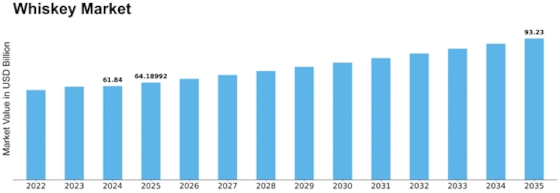

Whiskey Market Size Graph
Author
Author Profile
Sakshi Gupta
Team Lead - Research

Currently a Team Lead in consumer goods, FMCG, and F&B, she translates rigorous research into decisive strategy. She develops GTM roadmaps, pricing architectures, and competitive benchmarks for companies across Europe, the US, and APAC. She synthesize insights, align cross-functional teams, and drive execution from brief to measurable outcomes. She leads end-to-end engagements with crisp analysis, compelling storytelling, and a strong command of Power BI, Tableau, SQL, and advanced research platforms.

Leave a Comment

FAQs

What is the current valuation of the Whiskey Market as of 2024?

<p>The Whiskey Market was valued at 61.84 USD Billion in 2024.</p>

What is the projected market valuation for the Whiskey Market in 2035?

The Whiskey Market is projected to reach a valuation of 93.23 USD Billion by 2035.

What is the expected CAGR for the Whiskey Market during the forecast period 2025 - 2035?

The expected CAGR for the Whiskey Market during the forecast period 2025 - 2035 is 3.8%.

Which segment of the Whiskey Market had the highest valuation in 2024?

In 2024, the Bourbon segment had the highest valuation at 20.0 USD Billion.

What are the projected valuations for the Scotch segment by 2035?

The Scotch segment is projected to reach valuations between 10.0 and 15.0 USD Billion by 2035.

Which sales channel is expected to generate the most revenue in the Whiskey Market?

Supermarkets are expected to generate the most revenue, with projected valuations between 25.0 and 37.0 USD Billion.

What is the projected growth for the Blended Whisky segment by 2035?

The Blended Whisky segment is projected to grow to valuations between 24.84 and 38.23 USD Billion by 2035.

Who are the key players in the Whiskey Market?

Key players in the Whiskey Market include Diageo, Pernod Ricard, Brown-Forman, and Beam Suntory.

What is the expected trend for online retailers in the Whiskey Market by 2035?

Online retailers are expected to see valuations between 10.0 and 15.0 USD Billion by 2035.

How does the packaging type of bottles compare to cans in the Whiskey Market?

Bottles are projected to have valuations between 30.92 and 45.0 USD Billion, significantly higher than cans, which are expected to reach 10.0 to 15.0 USD Billion.

Market Summary

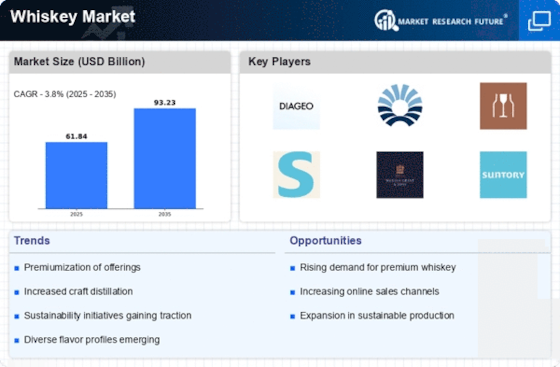
As per Market Research Future analysis, the Whiskey Market Size was estimated at 61.84 USD Billion in 2024. The Whiskey industry is projected to grow from 64.19 USD Billion in 2025 to 93.23 USD Billion by 2035, exhibiting a compound annual growth rate (CAGR) of 3.8% during the forecast period 2025 - 2035

Key Market Trends & Highlights

The whiskey market is experiencing dynamic growth driven by evolving consumer preferences and innovative practices.

  • The rise of craft whiskey is reshaping consumer expectations, particularly in North America. Innovative flavor profiles are gaining traction, appealing to adventurous palates in both North America and Asia-Pacific. Technological integration is enhancing production efficiency and consumer engagement, especially in the Scotch and Irish segments. Increasing consumer interest in premium products and the expansion of whiskey tourism are key drivers propelling market growth.

Market Size & Forecast

2024 Market Size 61.84 (USD Billion)
2035 Market Size 93.23 (USD Billion)
CAGR (2025 - 2035) 3.8%
Largest Regional Market Share in 2024 North America

Major Players

<p>Diageo (GB), Pernod Ricard (FR), <a href="https://www.brown-forman.com/">Brown-Forman (US)</a>, Beam Suntory (US), William Grant &amp; Sons (GB), Suntory Holdings (JP), Chivas Brothers (GB), Edradour Distillery (GB), Morrison Bowmore Distillers (GB)</p>

Market Trends

The Whiskey Market is currently experiencing a dynamic evolution, characterized by shifting consumer preferences and an increasing appreciation for premium offerings. As consumers become more discerning, there is a noticeable trend towards artisanal and craft whiskey brands, which emphasize quality and unique production methods. This shift appears to be driven by a desire for authenticity and a deeper connection to the product, leading to a burgeoning interest in small-batch distilleries. Furthermore, the global landscape of whiskey consumption is diversifying, with emerging markets showing a growing affinity for whiskey, thereby expanding the overall consumer base. In addition to the rise of craft brands, the Whiskey Market is witnessing a surge in innovative flavor profiles and experimental blends. Modern whiskey market research emphasizes the importance of the "flavor-first" approach, as consumers move away from strict age statements in favor of unique sensory experiences. Distillers are increasingly exploring unconventional ingredients and aging processes, which may attract a younger demographic seeking novel experiences. This trend suggests that the market is not only adapting to traditional tastes but also embracing creativity and experimentation. As the Whiskey Market growth continues, it is likely to see further integration of technology in production and marketing, enhancing consumer engagement and accessibility. Overall, the current trajectory indicates a vibrant and multifaceted market poised for continued growth and transformation.

Rise of Craft Whiskey Market

The Whiskey Market is seeing a notable increase in the popularity of craft whiskey brands. Consumers are gravitating towards artisanal products that highlight unique production techniques and local ingredients. This trend reflects a broader desire for authenticity and quality, as buyers seek to connect with the stories behind their beverages.

Innovative Flavor Profiles

There is a growing trend towards innovative flavor profiles within the Whiskey Market. Distillers are experimenting with unconventional ingredients and aging methods, appealing to adventurous consumers. This exploration of new tastes not only attracts younger demographics but also revitalizes interest among seasoned whiskey enthusiasts. One of the most significant whiskey market trends is the "hybridization" of aging, with distillers experimenting with unconventional finishes in tequila, mezcal, and craft beer barrels.

Technological Integration

The integration of technology in the Whiskey Market is becoming increasingly prevalent. From production processes to marketing strategies, distilleries are leveraging digital tools to enhance consumer engagement. This trend may lead to improved accessibility and a more personalized experience for whiskey aficionados.

Whiskey Market Market Drivers

Expansion of Whiskey Tourism

Whiskey Market tourism is emerging as a significant driver within the Whiskey Market, attracting enthusiasts and casual drinkers alike to distilleries around the world. This trend is fueled by the desire for immersive experiences that allow consumers to engage with the whiskey-making process. Distilleries are increasingly offering tours, tastings, and educational workshops, which not only enhance brand loyalty but also contribute to local economies. Data indicates that whiskey tourism has the potential to generate millions in revenue, with visitors often purchasing products directly from distilleries. This phenomenon not only boosts sales but also fosters a deeper connection between consumers and brands, thereby strengthening the Whiskey Market.

Growing Popularity of Whiskey Cocktails

The Whiskey Market is witnessing a resurgence in the popularity of whiskey-based cocktails, which has broadened the appeal of whiskey among younger demographics. Classic cocktails such as the Old Fashioned and Whiskey Market Sour are experiencing a revival, while innovative mixology is introducing new whiskey cocktails to the market. This trend is supported by the rise of craft cocktail bars and the increasing availability of premium mixers. Market data suggests that whiskey cocktails account for a significant portion of on-premise sales, indicating a shift in consumer preferences. As more consumers experiment with whiskey in cocktails, the overall consumption of whiskey is likely to increase, further driving growth in the Whiskey Market.

Emergence of Online Retail and E-commerce

The rise of e-commerce is transforming the Whiskey Market, providing consumers with unprecedented access to a wide range of products. Online retail platforms are enabling distilleries to reach a broader audience, including international markets that were previously difficult to penetrate. This shift is particularly beneficial for smaller distilleries, which can leverage online sales to increase visibility and sales without the need for extensive brick-and-mortar presence. Market data indicates that online sales of alcoholic beverages, including whiskey, are projected to grow significantly in the coming years. As consumers increasingly prefer the convenience of online shopping, the Whiskey Market is likely to adapt and evolve to meet these changing consumer behaviors.

Sustainability and Ethical Production Practices

Sustainability is becoming a crucial consideration within the Whiskey Market, as consumers increasingly prioritize environmentally friendly and ethically produced products. Distilleries are adopting sustainable practices, such as sourcing local ingredients and implementing eco-friendly production methods. This shift is not only appealing to environmentally conscious consumers but also aligns with broader trends in the food and beverage sector. Data suggests that brands emphasizing sustainability can command higher prices and foster greater customer loyalty. As the demand for transparency and ethical practices grows, distilleries that prioritize sustainability are likely to gain a competitive edge in the Whiskey Market.

Increasing Consumer Interest in Premium Products

The Whiskey Market is experiencing a notable shift towards premiumization, as consumers increasingly seek high-quality, artisanal products. This trend is driven by a growing appreciation for craftsmanship and authenticity in whiskey production. According to recent data, the premium whiskey segment has seen a compound annual growth rate of approximately 8% over the past few years. Consumers are willing to pay a premium for unique flavor profiles and limited-edition releases, which has led to a surge in demand for small-batch distilleries. This shift not only enhances the overall market value but also encourages distillers to innovate and experiment with new production techniques, thereby enriching the Whiskey Market with diverse offerings.

Market Segment Insights

By Type: Scotch (Largest) vs. Irish (Fastest-Growing)

<p>The whiskey market is broadly segmented into Scotch, Irish, Bourbon, Rye, and Tennessee whiskies. Among these, Scotch dominates with the largest market share, renowned for its rich heritage and distinct production processes. This segment benefits from a loyal consumer base and recognition as a premium choice worldwide. Irish whiskey, while smaller in share, is emerging rapidly in popularity due to its smoothness and accessibility, appealing to a younger demographic and gaining traction in new markets.</p>

<p>Whiskey Type: Scotch (Dominant) vs. Irish (Emerging)</p>

<p>Scotch whiskey is characterized by its method of production, involving malted barley and a mandatory aging process in oak barrels, leading to distinctive flavors that embody tradition and craftsmanship. It has established itself as a dominant force globally, appealing to connoisseurs and collectors alike. Meanwhile, Irish whiskey, with its triple distillation process, offers a smoother, lighter taste, making it an inviting option for those unfamiliar with whiskey. This segment is witnessing a surge in interest, particularly among millennials, driven by innovative marketing and the rise of cocktail culture, setting the stage for significant growth in the coming years.</p>

By Product Type: Single Malt (Largest) vs. Blended Whisky (Fastest-Growing)

<p>In the Whiskey Market, the product type segment is characterized by a diverse array of options, with Single Malt whisky leading in market share due to its premium positioning and rich heritage. It appeals to consumers seeking authenticity and quality, while other segments like Blended Malt, Grain Whisky, and Blended Whisky have varying levels of market presence. Blended Whisky, although traditionally seen as less premium, is gaining momentum among younger drinkers who value versatility and affordability, reshaping the competitive landscape. The growth trajectory for these product types reflects changing consumer preferences and a continual push towards innovation. Single Malt remains a favorite among enthusiasts and collectors, often associated with specific regions and craftsmanship. Meanwhile, Blended Whisky is on the rise, driven by strategic marketing, diverse flavor profiles, and increased availability in global markets, suggesting a shift in consumer habit towards blended expressions.</p>

<p>Single Malt (Dominant) vs. Blended Whisky (Emerging)</p>

<p>Single Malt whisky stands out as the dominant player in the whiskey market, celebrated for its distinct flavor profiles and craftsmanship that stems from a single distillery. This segment appeals strongly to connoisseurs and is associated with a rich, heritage-driven narrative that adds to its premium status. It typically commands higher price points and forms a crucial component of the luxury alcohol spectrum. Conversely, Blended Whisky has emerged as a fast-growing segment, appealing to a broader demographic due to its affordability and versatility. It combines various whiskies to create a balanced taste that is approachable for newer consumers. This segment thrives on innovative branding and marketing strategies, appealing to the younger generation who appreciate mixed drinks and cocktails, thus broadening its market reach.</p>

By Sales Channel: Supermarkets (Largest) vs. Online Retailers (Fastest-Growing)

<p>In the Whiskey Market, sales channels exhibit varied distribution metrics. Supermarkets currently dominate the market due to their extensive reach and customer convenience, accounting for the largest share of whiskey sales. Following closely, specialty stores continue to cater to whiskey enthusiasts looking for specific brands and artisanal options, while duty-free shops attract travelers seeking premium products. Online retailers have emerged significantly, leveraging e-commerce trends to capture a growing segment of the market.</p>

<p>Supermarkets (Dominant) vs. Online Retailers (Emerging)</p>

<p>Supermarkets stand out as the dominant force in the whiskey sales channel due to their ability to offer a wide array of products at competitive prices, attracting a broad consumer base. Their physical presence allows for impulsive purchases, while promotional events and loyalty programs further enhance customer engagement. In contrast, online retailers are emerging quickly by providing convenience and access to a wider variety of products that may not be available locally. The rise of digital marketing strategies and enhanced delivery options play crucial roles in this dynamic, appealing especially to younger consumers seeking easy access to diverse whiskey options.</p>

By Packaging Type: Bottles (Largest) vs. Cans (Fastest-Growing)

<p>In the Whiskey Market, the distribution of packaging types reflects diverse consumer preferences and market strategies. Bottles dominate the market, accounting for the majority of sales due to their traditional use, aesthetic appeal, and the association with premium products. Cans, while a smaller segment, are gaining traction among younger consumers, driven by their convenience and portability, leading to a noticeable shift in market dynamics.</p>

<p>Bottles (Dominant) vs. Cans (Emerging)</p>

<p>Bottles are the dominant packaging type in the Whiskey Market, representing the traditional choice favored by connoisseurs and collectors. Their design often emphasizes craftsmanship and quality, enhancing the product's perceived value. On the other hand, cans are emerging as a popular alternative, particularly among younger consumers seeking convenience and a more casual drinking experience. This shift is fueled by innovative branding and the rise of ready-to-drink whiskey cocktails in cans, appealing to a broader audience. As lifestyle changes continue to influence consumer preferences, both packaging types are likely to evolve to meet these demands.</p>

Whiskey Market Packaging Type Insights

<p>Whiskey Market Packaging Type Insights</p>

<p>The Packaging Type segment within the Whiskey Market showcases significant variations, each playing a crucial role in catering to consumer preferences and enhancing product experience. The market is expected to be valued at 64.99 billion USD in 2024, reflecting an increasing demand for diverse packaging solutions. Bottles remain a dominating choice, often associated with premium branding and classic appeal, while cans are gaining traction due to their convenience and portability, appealing particularly to younger consumers.</p>

<p>Kegs are predominantly utilized in bars and restaurants, providing a cost-effective solution for serving whiskey in larger quantities, thus enhancing the on-premise consumption experience.Tetra Pak offers innovative and sustainable options, reflecting a shift towards environmentally friendly packaging solutions. Overall, the Whiskey Market data indicates that consumer trends favor convenient and sustainable packaging options, influencing the growth dynamics of this segment. As the industry evolves, manufacturers must adapt to changing preferences to harness growth opportunities within the Whiskey Market, ensuring they remain competitive in a transformative landscape.</p>

Get more detailed insights about Whiskey Market Research Report - Forecast till 2035

Regional Insights

North America : Whiskey Market's Thriving Market

North America remains the largest market for whiskey, accounting for approximately 45% of global consumption. The growth is driven by increasing demand for premium and craft whiskey, alongside a rising trend in cocktail culture. The Us Whiskey Market is witnessing a profound shift toward "purposeful drinking," where consumers prioritize craft transparency and authentic heritage over high-volume consumption. Regulatory support, such as reduced tariffs on imported spirits, has further catalyzed market expansion. The U.S. leads this region, followed closely by Canada, which holds about 15% of the market share. The competitive landscape is dominated by major players like Brown-Forman and Diageo, who are investing heavily in marketing and product innovation. The U.S. market is characterized by a diverse range of whiskey styles, including bourbon and rye, appealing to a broad consumer base. Craft distilleries are also gaining traction, contributing to the dynamic market environment. The presence of established brands and new entrants fosters a competitive yet collaborative atmosphere.

Europe : Heritage and Innovation Combined

Europe, particularly the UK and Ireland, is a significant player in the whiskey market, holding around 30% of global consumption. The region benefits from a rich heritage of whiskey production, with increasing interest in artisanal and craft distilleries. Regulatory frameworks, such as the EU's geographical indications, protect traditional whiskey production methods, enhancing market value. The UK is the largest market in Europe, followed by Ireland, which has seen a resurgence in whiskey exports. Leading countries like Scotland and Ireland are home to renowned brands such as Chivas Brothers and William Grant & Sons. The competitive landscape is marked by a blend of established brands and emerging craft distilleries, fostering innovation. The European market is also witnessing a rise in whiskey tourism, attracting enthusiasts and contributing to local economies. This combination of tradition and modernity positions Europe as a key player in The Whiskey Market.

Asia-Pacific : Emerging Markets on the Rise

The Asia-Pacific region is rapidly emerging as a significant market for whiskey, accounting for approximately 20% of global consumption. Countries like Japan and India are leading this growth, driven by increasing disposable incomes and a growing interest in premium spirits. Regulatory changes, such as reduced import duties on whiskey, have also facilitated market expansion. The China Whiskey Market is undergoing a domestic revolution as international spirits giants open large-scale distilleries within the country to produce "Eastern character" malts. The whiskey market in India has become a global powerhouse, with home-grown single malts now gaining international acclaim and challenging established Scotch brands.

Japan is the largest market in this region, with India following closely behind, contributing to the dynamic landscape of whiskey consumption. The competitive environment is characterized by both local and international players, including Suntory Holdings and Beam Suntory. Japanese whiskey, known for its craftsmanship, has gained global acclaim, while Indian brands are expanding their footprint internationally. The region's diverse consumer preferences are prompting brands to innovate and adapt, creating a vibrant market atmosphere that is attracting investment and interest from global players. The Global Whiskey Market Size continues to expand as emerging middle-class populations in Asia and Latin America adopt Western-style premium spirits.

Middle East and Africa : Cultural Shifts in Spirits Consumption

The Middle East and Africa region is witnessing a gradual increase in whiskey consumption, holding about 5% of the global market. This growth is primarily driven by changing cultural attitudes towards alcohol consumption and a burgeoning middle class with increased purchasing power. Countries like South Africa and the UAE are leading this trend, supported by regulatory changes that are becoming more favorable towards alcohol sales. South Africa is the largest market in the region, with the UAE following closely behind. The competitive landscape features a mix of international brands and local distilleries, with key players like Morrison Bowmore Distillers making their mark. The region's unique cultural dynamics are influencing consumer preferences, leading to a growing interest in premium and imported whiskey. As the market evolves, brands are focusing on tailored marketing strategies to appeal to diverse consumer segments, enhancing their presence in this emerging market.

Key Players and Competitive Insights

The competitive landscape of the Whiskey Market is characterized by a multitude of players striving for market share in an increasingly crowded space. This industry comprises various segments, including Scotch, Irish whiskey, American whiskey, and others, each presenting unique opportunities and challenges. The growing demand for premium and artisanal products has led to heightened competition among established brands and newcomers alike. Consumer preferences are shifting towards quality and authenticity, forcing companies to innovate and enhance their offerings to meet these evolving tastes.Moreover, the penetration of whiskey into emerging markets presents opportunities for growth, while established markets continue to solidify their positions through strategic maneuvers, branding efforts, and marketing initiatives. As the market matures, the emphasis on sustainability and responsible drinking is expected to shape competitive strategies significantly.Beam Suntory stands out in the Whiskey Market as a formidable player, leveraging its extensive portfolio of brands to secure a strong market presence. The company focuses on producing high-quality products that appeal to a variety of consumer tastes and preferences.Beam Suntory has built a reputation for its craftsmanship, emphasizing heritage and tradition while continuing to experiment with innovative techniques. The company benefits from a well-established distribution network and strong brand recognition globally, facilitating its ability to penetrate various markets. This robust presence allows Beam Suntory to engage effectively with consumers through targeted marketing strategies, further solidifying its competitive edge in the whiskey sector.Furthermore, the company's strategic partnerships and collaborations enhance its capabilities, allowing for more effective outreach to different demographics and market segments.Pernod Ricard holds a significant position in the Whiskey Market, showcasing a diverse array of key products that resonate with global consumers. The company’s portfolio includes several well-known whiskey brands, which are strategically positioned within various price segments to cater to a broad audience. Pernod Ricard's strengths lie in its extensive market reach, bolstered by an efficient distribution network and strong relationships with retailers and distributors worldwide.The company invests heavily in marketing and promotional campaigns to elevate brand visibility and engagement. Pernod Ricard has been active in pursuing mergers and acquisitions to expand its footprint in the whiskey market, acquiring brands that complement its existing portfolio and offer potential for growth. This proactive approach enables Pernod Ricard to enhance its offerings and strengthen its competitive stance, positioning itself favorably to capitalize on emerging trends within the whiskey landscape on a global scale.

Key Companies in the Whiskey Market include

Industry Developments

The Whiskey Market has seen significant developments recently, with Beam Suntory and Diageo leading the charge in product innovation and sustainability initiatives.

American Single-Malt Whiskey Market is formally recognized by TTB as a separate category in January 2025, allowing for more precise categorization and promotion of domestic malt whiskies.

In March 2025 In remembrance of former boss Barry Berish, Booker's whiskey (Beam Suntory) produces Barry's Batch, a 125.7-proof whiskey matured over seven years, as its inaugural 2025 expression.

Beam Suntory rebrands as Suntory Global Spirits in May 2024 to reflect its growing global reach and consolidate its global spirits portfolio under a single identity.


Future Outlook

Whiskey Market Future Outlook

<p>The Whiskey Market is projected to grow at a 3.8% CAGR from 2025 to 2035, driven by premiumization, global expansion, and innovative marketing strategies.</p>

New opportunities lie in:

  • <p>Expansion into emerging markets with tailored product offerings.</p>
  • <p> </p>
  • <p>Development of sustainable packaging solutions to attract eco-conscious consumers.</p>
  • <p>Investment in digital marketing platforms to enhance brand engagement and reach.</p>

<p>By 2035, the Whiskey Market is expected to solidify its growth trajectory, reflecting evolving consumer preferences and market dynamics.</p>

Market Segmentation

Whiskey Market Type Outlook

  • Scotch
  • Irish
  • Bourbon
  • Rye
  • Tennessee

Whiskey Market Product Type Outlook

  • Single Malt
  • Blended Malt
  • Grain Whisky
  • Blended Whisky

Whiskey Market Sales Channel Outlook

  • Supermarkets
  • Online Retailers
  • Specialty Stores
  • Duty-Free Shops

Whiskey Market Packaging Type Outlook

  • Bottles
  • Cans
  • Kegs
  • Tetra Pak

Report Scope

MARKET SIZE 2024 61.84(USD Billion)
MARKET SIZE 2025 64.19(USD Billion)
MARKET SIZE 2035 93.23(USD Billion)
COMPOUND ANNUAL GROWTH RATE (CAGR) 3.8% (2025 - 2035)
REPORT COVERAGE Revenue Forecast, Competitive Landscape, Growth Factors, and Trends
BASE YEAR 2024
Market Forecast Period 2025 - 2035
Historical Data 2019 - 2024
Market Forecast Units USD Billion
Key Companies Profiled Diageo (GB), Pernod Ricard (FR), Brown-Forman (US), Beam Suntory (US), William Grant & Sons (GB), Suntory Holdings (JP), Chivas Brothers (GB), Edradour Distillery (GB), Morrison Bowmore Distillers (GB)
Segments Covered Type, Product Type, Sales Channel, Packaging Type, Regional
Key Market Opportunities Growing consumer interest in premium and craft whiskey brands presents significant market opportunities.
Key Market Dynamics Rising consumer preference for premium whiskey drives market consolidation and influences production and distribution strategies.
Countries Covered North America, Europe, APAC, South America, MEA

FAQs

What is the current valuation of the Whiskey Market as of 2024?

<p>The Whiskey Market was valued at 61.84 USD Billion in 2024.</p>

What is the projected market valuation for the Whiskey Market in 2035?

The Whiskey Market is projected to reach a valuation of 93.23 USD Billion by 2035.

What is the expected CAGR for the Whiskey Market during the forecast period 2025 - 2035?

The expected CAGR for the Whiskey Market during the forecast period 2025 - 2035 is 3.8%.

Which segment of the Whiskey Market had the highest valuation in 2024?

In 2024, the Bourbon segment had the highest valuation at 20.0 USD Billion.

What are the projected valuations for the Scotch segment by 2035?

The Scotch segment is projected to reach valuations between 10.0 and 15.0 USD Billion by 2035.

Which sales channel is expected to generate the most revenue in the Whiskey Market?

Supermarkets are expected to generate the most revenue, with projected valuations between 25.0 and 37.0 USD Billion.

What is the projected growth for the Blended Whisky segment by 2035?

The Blended Whisky segment is projected to grow to valuations between 24.84 and 38.23 USD Billion by 2035.

Who are the key players in the Whiskey Market?

Key players in the Whiskey Market include Diageo, Pernod Ricard, Brown-Forman, and Beam Suntory.

What is the expected trend for online retailers in the Whiskey Market by 2035?

Online retailers are expected to see valuations between 10.0 and 15.0 USD Billion by 2035.

How does the packaging type of bottles compare to cans in the Whiskey Market?

Bottles are projected to have valuations between 30.92 and 45.0 USD Billion, significantly higher than cans, which are expected to reach 10.0 to 15.0 USD Billion.

  1. SECTION I: EXECUTIVE SUMMARY AND KEY HIGHLIGHTS
    1. | 1.1 EXECUTIVE SUMMARY
    2. | | 1.1.1 Market Overview
    3. | | 1.1.2 Key Findings
    4. | | 1.1.3 Market Segmentation
    5. | | 1.1.4 Competitive Landscape
    6. | | 1.1.5 Challenges and Opportunities
    7. | | 1.1.6 Future Outlook
  2. SECTION II: SCOPING, METHODOLOGY AND MARKET STRUCTURE
    1. | 2.1 MARKET INTRODUCTION
    2. | | 2.1.1 Definition
    3. | | 2.1.2 Scope of the study
    4. | | | 2.1.2.1 Research Objective
    5. | | | 2.1.2.2 Assumption
    6. | | | 2.1.2.3 Limitations
    7. | 2.2 RESEARCH METHODOLOGY
    8. | | 2.2.1 Overview
    9. | | 2.2.2 Data Mining
    10. | | 2.2.3 Secondary Research
    11. | | 2.2.4 Primary Research
    12. | | | 2.2.4.1 Primary Interviews and Information Gathering Process
    13. | | | 2.2.4.2 Breakdown of Primary Respondents
    14. | | 2.2.5 Forecasting Model
    15. | | 2.2.6 Market Size Estimation
    16. | | | 2.2.6.1 Bottom-Up Approach
    17. | | | 2.2.6.2 Top-Down Approach
    18. | | 2.2.7 Data Triangulation
    19. | | 2.2.8 Validation
  3. SECTION III: QUALITATIVE ANALYSIS
    1. | 3.1 MARKET DYNAMICS
    2. | | 3.1.1 Overview
    3. | | 3.1.2 Drivers
    4. | | 3.1.3 Restraints
    5. | | 3.1.4 Opportunities
    6. | 3.2 MARKET FACTOR ANALYSIS
    7. | | 3.2.1 Value chain Analysis
    8. | | 3.2.2 Porter's Five Forces Analysis
    9. | | | 3.2.2.1 Bargaining Power of Suppliers
    10. | | | 3.2.2.2 Bargaining Power of Buyers
    11. | | | 3.2.2.3 Threat of New Entrants
    12. | | | 3.2.2.4 Threat of Substitutes
    13. | | | 3.2.2.5 Intensity of Rivalry
    14. | | 3.2.3 COVID-19 Impact Analysis
    15. | | | 3.2.3.1 Market Impact Analysis
    16. | | | 3.2.3.2 Regional Impact
    17. | | | 3.2.3.3 Opportunity and Threat Analysis
  4. SECTION IV: QUANTITATIVE ANALYSIS
    1. | 4.1 Food, Beverages & Nutrition, BY Type (USD Billion)
    2. | | 4.1.1 Scotch
    3. | | 4.1.2 Irish
    4. | | 4.1.3 Bourbon
    5. | | 4.1.4 Rye
    6. | | 4.1.5 Tennessee
    7. | 4.2 Food, Beverages & Nutrition, BY Product Type (USD Billion)
    8. | | 4.2.1 Single Malt
    9. | | 4.2.2 Blended Malt
    10. | | 4.2.3 Grain Whisky
    11. | | 4.2.4 Blended Whisky
    12. | 4.3 Food, Beverages & Nutrition, BY Sales Channel (USD Billion)
    13. | | 4.3.1 Supermarkets
    14. | | 4.3.2 Online Retailers
    15. | | 4.3.3 Specialty Stores
    16. | | 4.3.4 Duty-Free Shops
    17. | 4.4 Food, Beverages & Nutrition, BY Packaging Type (USD Billion)
    18. | | 4.4.1 Bottles
    19. | | 4.4.2 Cans
    20. | | 4.4.3 Kegs
    21. | | 4.4.4 Tetra Pak
    22. | 4.5 Food, Beverages & Nutrition, BY Region (USD Billion)
    23. | | 4.5.1 North America
    24. | | | 4.5.1.1 US
    25. | | | 4.5.1.2 Canada
    26. | | 4.5.2 Europe
    27. | | | 4.5.2.1 Germany
    28. | | | 4.5.2.2 UK
    29. | | | 4.5.2.3 France
    30. | | | 4.5.2.4 Russia
    31. | | | 4.5.2.5 Italy
    32. | | | 4.5.2.6 Spain
    33. | | | 4.5.2.7 Rest of Europe
    34. | | 4.5.3 APAC
    35. | | | 4.5.3.1 China
    36. | | | 4.5.3.2 India
    37. | | | 4.5.3.3 Japan
    38. | | | 4.5.3.4 South Korea
    39. | | | 4.5.3.5 Malaysia
    40. | | | 4.5.3.6 Thailand
    41. | | | 4.5.3.7 Indonesia
    42. | | | 4.5.3.8 Rest of APAC
    43. | | 4.5.4 South America
    44. | | | 4.5.4.1 Brazil
    45. | | | 4.5.4.2 Mexico
    46. | | | 4.5.4.3 Argentina
    47. | | | 4.5.4.4 Rest of South America
    48. | | 4.5.5 MEA
    49. | | | 4.5.5.1 GCC Countries
    50. | | | 4.5.5.2 South Africa
    51. | | | 4.5.5.3 Rest of MEA
  5. SECTION V: COMPETITIVE ANALYSIS
    1. | 5.1 Competitive Landscape
    2. | | 5.1.1 Overview
    3. | | 5.1.2 Competitive Analysis
    4. | | 5.1.3 Market share Analysis
    5. | | 5.1.4 Major Growth Strategy in the Food, Beverages & Nutrition
    6. | | 5.1.5 Competitive Benchmarking
    7. | | 5.1.6 Leading Players in Terms of Number of Developments in the Food, Beverages & Nutrition
    8. | | 5.1.7 Key developments and growth strategies
    9. | | | 5.1.7.1 New Product Launch/Service Deployment
    10. | | | 5.1.7.2 Merger & Acquisitions
    11. | | | 5.1.7.3 Joint Ventures
    12. | | 5.1.8 Major Players Financial Matrix
    13. | | | 5.1.8.1 Sales and Operating Income
    14. | | | 5.1.8.2 Major Players R&D Expenditure. 2023
    15. | 5.2 Company Profiles
    16. | | 5.2.1 Diageo (GB)
    17. | | | 5.2.1.1 Financial Overview
    18. | | | 5.2.1.2 Products Offered
    19. | | | 5.2.1.3 Key Developments
    20. | | | 5.2.1.4 SWOT Analysis
    21. | | | 5.2.1.5 Key Strategies
    22. | | 5.2.2 Pernod Ricard (FR)
    23. | | | 5.2.2.1 Financial Overview
    24. | | | 5.2.2.2 Products Offered
    25. | | | 5.2.2.3 Key Developments
    26. | | | 5.2.2.4 SWOT Analysis
    27. | | | 5.2.2.5 Key Strategies
    28. | | 5.2.3 Brown-Forman (US)
    29. | | | 5.2.3.1 Financial Overview
    30. | | | 5.2.3.2 Products Offered
    31. | | | 5.2.3.3 Key Developments
    32. | | | 5.2.3.4 SWOT Analysis
    33. | | | 5.2.3.5 Key Strategies
    34. | | 5.2.4 Beam Suntory (US)
    35. | | | 5.2.4.1 Financial Overview
    36. | | | 5.2.4.2 Products Offered
    37. | | | 5.2.4.3 Key Developments
    38. | | | 5.2.4.4 SWOT Analysis
    39. | | | 5.2.4.5 Key Strategies
    40. | | 5.2.5 William Grant & Sons (GB)
    41. | | | 5.2.5.1 Financial Overview
    42. | | | 5.2.5.2 Products Offered
    43. | | | 5.2.5.3 Key Developments
    44. | | | 5.2.5.4 SWOT Analysis
    45. | | | 5.2.5.5 Key Strategies
    46. | | 5.2.6 Suntory Holdings (JP)
    47. | | | 5.2.6.1 Financial Overview
    48. | | | 5.2.6.2 Products Offered
    49. | | | 5.2.6.3 Key Developments
    50. | | | 5.2.6.4 SWOT Analysis
    51. | | | 5.2.6.5 Key Strategies
    52. | | 5.2.7 Chivas Brothers (GB)
    53. | | | 5.2.7.1 Financial Overview
    54. | | | 5.2.7.2 Products Offered
    55. | | | 5.2.7.3 Key Developments
    56. | | | 5.2.7.4 SWOT Analysis
    57. | | | 5.2.7.5 Key Strategies
    58. | | 5.2.8 Edradour Distillery (GB)
    59. | | | 5.2.8.1 Financial Overview
    60. | | | 5.2.8.2 Products Offered
    61. | | | 5.2.8.3 Key Developments
    62. | | | 5.2.8.4 SWOT Analysis
    63. | | | 5.2.8.5 Key Strategies
    64. | | 5.2.9 Morrison Bowmore Distillers (GB)
    65. | | | 5.2.9.1 Financial Overview
    66. | | | 5.2.9.2 Products Offered
    67. | | | 5.2.9.3 Key Developments
    68. | | | 5.2.9.4 SWOT Analysis
    69. | | | 5.2.9.5 Key Strategies
    70. | 5.3 Appendix
    71. | | 5.3.1 References
    72. | | 5.3.2 Related Reports
  6. LIST OF FIGURES
    1. | 6.1 MARKET SYNOPSIS
    2. | 6.2 NORTH AMERICA MARKET ANALYSIS
    3. | 6.3 US MARKET ANALYSIS BY TYPE
    4. | 6.4 US MARKET ANALYSIS BY PRODUCT TYPE
    5. | 6.5 US MARKET ANALYSIS BY SALES CHANNEL
    6. | 6.6 US MARKET ANALYSIS BY PACKAGING TYPE
    7. | 6.7 CANADA MARKET ANALYSIS BY TYPE
    8. | 6.8 CANADA MARKET ANALYSIS BY PRODUCT TYPE
    9. | 6.9 CANADA MARKET ANALYSIS BY SALES CHANNEL
    10. | 6.10 CANADA MARKET ANALYSIS BY PACKAGING TYPE
    11. | 6.11 EUROPE MARKET ANALYSIS
    12. | 6.12 GERMANY MARKET ANALYSIS BY TYPE
    13. | 6.13 GERMANY MARKET ANALYSIS BY PRODUCT TYPE
    14. | 6.14 GERMANY MARKET ANALYSIS BY SALES CHANNEL
    15. | 6.15 GERMANY MARKET ANALYSIS BY PACKAGING TYPE
    16. | 6.16 UK MARKET ANALYSIS BY TYPE
    17. | 6.17 UK MARKET ANALYSIS BY PRODUCT TYPE
    18. | 6.18 UK MARKET ANALYSIS BY SALES CHANNEL
    19. | 6.19 UK MARKET ANALYSIS BY PACKAGING TYPE
    20. | 6.20 FRANCE MARKET ANALYSIS BY TYPE
    21. | 6.21 FRANCE MARKET ANALYSIS BY PRODUCT TYPE
    22. | 6.22 FRANCE MARKET ANALYSIS BY SALES CHANNEL
    23. | 6.23 FRANCE MARKET ANALYSIS BY PACKAGING TYPE
    24. | 6.24 RUSSIA MARKET ANALYSIS BY TYPE
    25. | 6.25 RUSSIA MARKET ANALYSIS BY PRODUCT TYPE
    26. | 6.26 RUSSIA MARKET ANALYSIS BY SALES CHANNEL
    27. | 6.27 RUSSIA MARKET ANALYSIS BY PACKAGING TYPE
    28. | 6.28 ITALY MARKET ANALYSIS BY TYPE
    29. | 6.29 ITALY MARKET ANALYSIS BY PRODUCT TYPE
    30. | 6.30 ITALY MARKET ANALYSIS BY SALES CHANNEL
    31. | 6.31 ITALY MARKET ANALYSIS BY PACKAGING TYPE
    32. | 6.32 SPAIN MARKET ANALYSIS BY TYPE
    33. | 6.33 SPAIN MARKET ANALYSIS BY PRODUCT TYPE
    34. | 6.34 SPAIN MARKET ANALYSIS BY SALES CHANNEL
    35. | 6.35 SPAIN MARKET ANALYSIS BY PACKAGING TYPE
    36. | 6.36 REST OF EUROPE MARKET ANALYSIS BY TYPE
    37. | 6.37 REST OF EUROPE MARKET ANALYSIS BY PRODUCT TYPE
    38. | 6.38 REST OF EUROPE MARKET ANALYSIS BY SALES CHANNEL
    39. | 6.39 REST OF EUROPE MARKET ANALYSIS BY PACKAGING TYPE
    40. | 6.40 APAC MARKET ANALYSIS
    41. | 6.41 CHINA MARKET ANALYSIS BY TYPE
    42. | 6.42 CHINA MARKET ANALYSIS BY PRODUCT TYPE
    43. | 6.43 CHINA MARKET ANALYSIS BY SALES CHANNEL
    44. | 6.44 CHINA MARKET ANALYSIS BY PACKAGING TYPE
    45. | 6.45 INDIA MARKET ANALYSIS BY TYPE
    46. | 6.46 INDIA MARKET ANALYSIS BY PRODUCT TYPE
    47. | 6.47 INDIA MARKET ANALYSIS BY SALES CHANNEL
    48. | 6.48 INDIA MARKET ANALYSIS BY PACKAGING TYPE
    49. | 6.49 JAPAN MARKET ANALYSIS BY TYPE
    50. | 6.50 JAPAN MARKET ANALYSIS BY PRODUCT TYPE
    51. | 6.51 JAPAN MARKET ANALYSIS BY SALES CHANNEL
    52. | 6.52 JAPAN MARKET ANALYSIS BY PACKAGING TYPE
    53. | 6.53 SOUTH KOREA MARKET ANALYSIS BY TYPE
    54. | 6.54 SOUTH KOREA MARKET ANALYSIS BY PRODUCT TYPE
    55. | 6.55 SOUTH KOREA MARKET ANALYSIS BY SALES CHANNEL
    56. | 6.56 SOUTH KOREA MARKET ANALYSIS BY PACKAGING TYPE
    57. | 6.57 MALAYSIA MARKET ANALYSIS BY TYPE
    58. | 6.58 MALAYSIA MARKET ANALYSIS BY PRODUCT TYPE
    59. | 6.59 MALAYSIA MARKET ANALYSIS BY SALES CHANNEL
    60. | 6.60 MALAYSIA MARKET ANALYSIS BY PACKAGING TYPE
    61. | 6.61 THAILAND MARKET ANALYSIS BY TYPE
    62. | 6.62 THAILAND MARKET ANALYSIS BY PRODUCT TYPE
    63. | 6.63 THAILAND MARKET ANALYSIS BY SALES CHANNEL
    64. | 6.64 THAILAND MARKET ANALYSIS BY PACKAGING TYPE
    65. | 6.65 INDONESIA MARKET ANALYSIS BY TYPE
    66. | 6.66 INDONESIA MARKET ANALYSIS BY PRODUCT TYPE
    67. | 6.67 INDONESIA MARKET ANALYSIS BY SALES CHANNEL
    68. | 6.68 INDONESIA MARKET ANALYSIS BY PACKAGING TYPE
    69. | 6.69 REST OF APAC MARKET ANALYSIS BY TYPE
    70. | 6.70 REST OF APAC MARKET ANALYSIS BY PRODUCT TYPE
    71. | 6.71 REST OF APAC MARKET ANALYSIS BY SALES CHANNEL
    72. | 6.72 REST OF APAC MARKET ANALYSIS BY PACKAGING TYPE
    73. | 6.73 SOUTH AMERICA MARKET ANALYSIS
    74. | 6.74 BRAZIL MARKET ANALYSIS BY TYPE
    75. | 6.75 BRAZIL MARKET ANALYSIS BY PRODUCT TYPE
    76. | 6.76 BRAZIL MARKET ANALYSIS BY SALES CHANNEL
    77. | 6.77 BRAZIL MARKET ANALYSIS BY PACKAGING TYPE
    78. | 6.78 MEXICO MARKET ANALYSIS BY TYPE
    79. | 6.79 MEXICO MARKET ANALYSIS BY PRODUCT TYPE
    80. | 6.80 MEXICO MARKET ANALYSIS BY SALES CHANNEL
    81. | 6.81 MEXICO MARKET ANALYSIS BY PACKAGING TYPE
    82. | 6.82 ARGENTINA MARKET ANALYSIS BY TYPE
    83. | 6.83 ARGENTINA MARKET ANALYSIS BY PRODUCT TYPE
    84. | 6.84 ARGENTINA MARKET ANALYSIS BY SALES CHANNEL
    85. | 6.85 ARGENTINA MARKET ANALYSIS BY PACKAGING TYPE
    86. | 6.86 REST OF SOUTH AMERICA MARKET ANALYSIS BY TYPE
    87. | 6.87 REST OF SOUTH AMERICA MARKET ANALYSIS BY PRODUCT TYPE
    88. | 6.88 REST OF SOUTH AMERICA MARKET ANALYSIS BY SALES CHANNEL
    89. | 6.89 REST OF SOUTH AMERICA MARKET ANALYSIS BY PACKAGING TYPE
    90. | 6.90 MEA MARKET ANALYSIS
    91. | 6.91 GCC COUNTRIES MARKET ANALYSIS BY TYPE
    92. | 6.92 GCC COUNTRIES MARKET ANALYSIS BY PRODUCT TYPE
    93. | 6.93 GCC COUNTRIES MARKET ANALYSIS BY SALES CHANNEL
    94. | 6.94 GCC COUNTRIES MARKET ANALYSIS BY PACKAGING TYPE
    95. | 6.95 SOUTH AFRICA MARKET ANALYSIS BY TYPE
    96. | 6.96 SOUTH AFRICA MARKET ANALYSIS BY PRODUCT TYPE
    97. | 6.97 SOUTH AFRICA MARKET ANALYSIS BY SALES CHANNEL
    98. | 6.98 SOUTH AFRICA MARKET ANALYSIS BY PACKAGING TYPE
    99. | 6.99 REST OF MEA MARKET ANALYSIS BY TYPE
    100. | 6.100 REST OF MEA MARKET ANALYSIS BY PRODUCT TYPE
    101. | 6.101 REST OF MEA MARKET ANALYSIS BY SALES CHANNEL
    102. | 6.102 REST OF MEA MARKET ANALYSIS BY PACKAGING TYPE
    103. | 6.103 KEY BUYING CRITERIA OF FOOD, BEVERAGES & NUTRITION
    104. | 6.104 RESEARCH PROCESS OF MRFR
    105. | 6.105 DRO ANALYSIS OF FOOD, BEVERAGES & NUTRITION
    106. | 6.106 DRIVERS IMPACT ANALYSIS: FOOD, BEVERAGES & NUTRITION
    107. | 6.107 RESTRAINTS IMPACT ANALYSIS: FOOD, BEVERAGES & NUTRITION
    108. | 6.108 SUPPLY / VALUE CHAIN: FOOD, BEVERAGES & NUTRITION
    109. | 6.109 FOOD, BEVERAGES & NUTRITION, BY TYPE, 2024 (% SHARE)
    110. | 6.110 FOOD, BEVERAGES & NUTRITION, BY TYPE, 2024 TO 2035 (USD Billion)
    111. | 6.111 FOOD, BEVERAGES & NUTRITION, BY PRODUCT TYPE, 2024 (% SHARE)
    112. | 6.112 FOOD, BEVERAGES & NUTRITION, BY PRODUCT TYPE, 2024 TO 2035 (USD Billion)
    113. | 6.113 FOOD, BEVERAGES & NUTRITION, BY SALES CHANNEL, 2024 (% SHARE)
    114. | 6.114 FOOD, BEVERAGES & NUTRITION, BY SALES CHANNEL, 2024 TO 2035 (USD Billion)
    115. | 6.115 FOOD, BEVERAGES & NUTRITION, BY PACKAGING TYPE, 2024 (% SHARE)
    116. | 6.116 FOOD, BEVERAGES & NUTRITION, BY PACKAGING TYPE, 2024 TO 2035 (USD Billion)
    117. | 6.117 BENCHMARKING OF MAJOR COMPETITORS
  7. LIST OF TABLES
    1. | 7.1 LIST OF ASSUMPTIONS
    2. | | 7.1.1
    3. | 7.2 North America MARKET SIZE ESTIMATES; FORECAST
    4. | | 7.2.1 BY TYPE, 2025-2035 (USD Billion)
    5. | | 7.2.2 BY PRODUCT TYPE, 2025-2035 (USD Billion)
    6. | | 7.2.3 BY SALES CHANNEL, 2025-2035 (USD Billion)
    7. | | 7.2.4 BY PACKAGING TYPE, 2025-2035 (USD Billion)
    8. | 7.3 US MARKET SIZE ESTIMATES; FORECAST
    9. | | 7.3.1 BY TYPE, 2025-2035 (USD Billion)
    10. | | 7.3.2 BY PRODUCT TYPE, 2025-2035 (USD Billion)
    11. | | 7.3.3 BY SALES CHANNEL, 2025-2035 (USD Billion)
    12. | | 7.3.4 BY PACKAGING TYPE, 2025-2035 (USD Billion)
    13. | 7.4 Canada MARKET SIZE ESTIMATES; FORECAST
    14. | | 7.4.1 BY TYPE, 2025-2035 (USD Billion)
    15. | | 7.4.2 BY PRODUCT TYPE, 2025-2035 (USD Billion)
    16. | | 7.4.3 BY SALES CHANNEL, 2025-2035 (USD Billion)
    17. | | 7.4.4 BY PACKAGING TYPE, 2025-2035 (USD Billion)
    18. | 7.5 Europe MARKET SIZE ESTIMATES; FORECAST
    19. | | 7.5.1 BY TYPE, 2025-2035 (USD Billion)
    20. | | 7.5.2 BY PRODUCT TYPE, 2025-2035 (USD Billion)
    21. | | 7.5.3 BY SALES CHANNEL, 2025-2035 (USD Billion)
    22. | | 7.5.4 BY PACKAGING TYPE, 2025-2035 (USD Billion)
    23. | 7.6 Germany MARKET SIZE ESTIMATES; FORECAST
    24. | | 7.6.1 BY TYPE, 2025-2035 (USD Billion)
    25. | | 7.6.2 BY PRODUCT TYPE, 2025-2035 (USD Billion)
    26. | | 7.6.3 BY SALES CHANNEL, 2025-2035 (USD Billion)
    27. | | 7.6.4 BY PACKAGING TYPE, 2025-2035 (USD Billion)
    28. | 7.7 UK MARKET SIZE ESTIMATES; FORECAST
    29. | | 7.7.1 BY TYPE, 2025-2035 (USD Billion)
    30. | | 7.7.2 BY PRODUCT TYPE, 2025-2035 (USD Billion)
    31. | | 7.7.3 BY SALES CHANNEL, 2025-2035 (USD Billion)
    32. | | 7.7.4 BY PACKAGING TYPE, 2025-2035 (USD Billion)
    33. | 7.8 France MARKET SIZE ESTIMATES; FORECAST
    34. | | 7.8.1 BY TYPE, 2025-2035 (USD Billion)
    35. | | 7.8.2 BY PRODUCT TYPE, 2025-2035 (USD Billion)
    36. | | 7.8.3 BY SALES CHANNEL, 2025-2035 (USD Billion)
    37. | | 7.8.4 BY PACKAGING TYPE, 2025-2035 (USD Billion)
    38. | 7.9 Russia MARKET SIZE ESTIMATES; FORECAST
    39. | | 7.9.1 BY TYPE, 2025-2035 (USD Billion)
    40. | | 7.9.2 BY PRODUCT TYPE, 2025-2035 (USD Billion)
    41. | | 7.9.3 BY SALES CHANNEL, 2025-2035 (USD Billion)
    42. | | 7.9.4 BY PACKAGING TYPE, 2025-2035 (USD Billion)
    43. | 7.10 Italy MARKET SIZE ESTIMATES; FORECAST
    44. | | 7.10.1 BY TYPE, 2025-2035 (USD Billion)
    45. | | 7.10.2 BY PRODUCT TYPE, 2025-2035 (USD Billion)
    46. | | 7.10.3 BY SALES CHANNEL, 2025-2035 (USD Billion)
    47. | | 7.10.4 BY PACKAGING TYPE, 2025-2035 (USD Billion)
    48. | 7.11 Spain MARKET SIZE ESTIMATES; FORECAST
    49. | | 7.11.1 BY TYPE, 2025-2035 (USD Billion)
    50. | | 7.11.2 BY PRODUCT TYPE, 2025-2035 (USD Billion)
    51. | | 7.11.3 BY SALES CHANNEL, 2025-2035 (USD Billion)
    52. | | 7.11.4 BY PACKAGING TYPE, 2025-2035 (USD Billion)
    53. | 7.12 Rest of Europe MARKET SIZE ESTIMATES; FORECAST
    54. | | 7.12.1 BY TYPE, 2025-2035 (USD Billion)
    55. | | 7.12.2 BY PRODUCT TYPE, 2025-2035 (USD Billion)
    56. | | 7.12.3 BY SALES CHANNEL, 2025-2035 (USD Billion)
    57. | | 7.12.4 BY PACKAGING TYPE, 2025-2035 (USD Billion)
    58. | 7.13 APAC MARKET SIZE ESTIMATES; FORECAST
    59. | | 7.13.1 BY TYPE, 2025-2035 (USD Billion)
    60. | | 7.13.2 BY PRODUCT TYPE, 2025-2035 (USD Billion)
    61. | | 7.13.3 BY SALES CHANNEL, 2025-2035 (USD Billion)
    62. | | 7.13.4 BY PACKAGING TYPE, 2025-2035 (USD Billion)
    63. | 7.14 China MARKET SIZE ESTIMATES; FORECAST
    64. | | 7.14.1 BY TYPE, 2025-2035 (USD Billion)
    65. | | 7.14.2 BY PRODUCT TYPE, 2025-2035 (USD Billion)
    66. | | 7.14.3 BY SALES CHANNEL, 2025-2035 (USD Billion)
    67. | | 7.14.4 BY PACKAGING TYPE, 2025-2035 (USD Billion)
    68. | 7.15 India MARKET SIZE ESTIMATES; FORECAST
    69. | | 7.15.1 BY TYPE, 2025-2035 (USD Billion)
    70. | | 7.15.2 BY PRODUCT TYPE, 2025-2035 (USD Billion)
    71. | | 7.15.3 BY SALES CHANNEL, 2025-2035 (USD Billion)
    72. | | 7.15.4 BY PACKAGING TYPE, 2025-2035 (USD Billion)
    73. | 7.16 Japan MARKET SIZE ESTIMATES; FORECAST
    74. | | 7.16.1 BY TYPE, 2025-2035 (USD Billion)
    75. | | 7.16.2 BY PRODUCT TYPE, 2025-2035 (USD Billion)
    76. | | 7.16.3 BY SALES CHANNEL, 2025-2035 (USD Billion)
    77. | | 7.16.4 BY PACKAGING TYPE, 2025-2035 (USD Billion)
    78. | 7.17 South Korea MARKET SIZE ESTIMATES; FORECAST
    79. | | 7.17.1 BY TYPE, 2025-2035 (USD Billion)
    80. | | 7.17.2 BY PRODUCT TYPE, 2025-2035 (USD Billion)
    81. | | 7.17.3 BY SALES CHANNEL, 2025-2035 (USD Billion)
    82. | | 7.17.4 BY PACKAGING TYPE, 2025-2035 (USD Billion)
    83. | 7.18 Malaysia MARKET SIZE ESTIMATES; FORECAST
    84. | | 7.18.1 BY TYPE, 2025-2035 (USD Billion)
    85. | | 7.18.2 BY PRODUCT TYPE, 2025-2035 (USD Billion)
    86. | | 7.18.3 BY SALES CHANNEL, 2025-2035 (USD Billion)
    87. | | 7.18.4 BY PACKAGING TYPE, 2025-2035 (USD Billion)
    88. | 7.19 Thailand MARKET SIZE ESTIMATES; FORECAST
    89. | | 7.19.1 BY TYPE, 2025-2035 (USD Billion)
    90. | | 7.19.2 BY PRODUCT TYPE, 2025-2035 (USD Billion)
    91. | | 7.19.3 BY SALES CHANNEL, 2025-2035 (USD Billion)
    92. | | 7.19.4 BY PACKAGING TYPE, 2025-2035 (USD Billion)
    93. | 7.20 Indonesia MARKET SIZE ESTIMATES; FORECAST
    94. | | 7.20.1 BY TYPE, 2025-2035 (USD Billion)
    95. | | 7.20.2 BY PRODUCT TYPE, 2025-2035 (USD Billion)
    96. | | 7.20.3 BY SALES CHANNEL, 2025-2035 (USD Billion)
    97. | | 7.20.4 BY PACKAGING TYPE, 2025-2035 (USD Billion)
    98. | 7.21 Rest of APAC MARKET SIZE ESTIMATES; FORECAST
    99. | | 7.21.1 BY TYPE, 2025-2035 (USD Billion)
    100. | | 7.21.2 BY PRODUCT TYPE, 2025-2035 (USD Billion)
    101. | | 7.21.3 BY SALES CHANNEL, 2025-2035 (USD Billion)
    102. | | 7.21.4 BY PACKAGING TYPE, 2025-2035 (USD Billion)
    103. | 7.22 South America MARKET SIZE ESTIMATES; FORECAST
    104. | | 7.22.1 BY TYPE, 2025-2035 (USD Billion)
    105. | | 7.22.2 BY PRODUCT TYPE, 2025-2035 (USD Billion)
    106. | | 7.22.3 BY SALES CHANNEL, 2025-2035 (USD Billion)
    107. | | 7.22.4 BY PACKAGING TYPE, 2025-2035 (USD Billion)
    108. | 7.23 Brazil MARKET SIZE ESTIMATES; FORECAST
    109. | | 7.23.1 BY TYPE, 2025-2035 (USD Billion)
    110. | | 7.23.2 BY PRODUCT TYPE, 2025-2035 (USD Billion)
    111. | | 7.23.3 BY SALES CHANNEL, 2025-2035 (USD Billion)
    112. | | 7.23.4 BY PACKAGING TYPE, 2025-2035 (USD Billion)
    113. | 7.24 Mexico MARKET SIZE ESTIMATES; FORECAST
    114. | | 7.24.1 BY TYPE, 2025-2035 (USD Billion)
    115. | | 7.24.2 BY PRODUCT TYPE, 2025-2035 (USD Billion)
    116. | | 7.24.3 BY SALES CHANNEL, 2025-2035 (USD Billion)
    117. | | 7.24.4 BY PACKAGING TYPE, 2025-2035 (USD Billion)
    118. | 7.25 Argentina MARKET SIZE ESTIMATES; FORECAST
    119. | | 7.25.1 BY TYPE, 2025-2035 (USD Billion)
    120. | | 7.25.2 BY PRODUCT TYPE, 2025-2035 (USD Billion)
    121. | | 7.25.3 BY SALES CHANNEL, 2025-2035 (USD Billion)
    122. | | 7.25.4 BY PACKAGING TYPE, 2025-2035 (USD Billion)
    123. | 7.26 Rest of South America MARKET SIZE ESTIMATES; FORECAST
    124. | | 7.26.1 BY TYPE, 2025-2035 (USD Billion)
    125. | | 7.26.2 BY PRODUCT TYPE, 2025-2035 (USD Billion)
    126. | | 7.26.3 BY SALES CHANNEL, 2025-2035 (USD Billion)
    127. | | 7.26.4 BY PACKAGING TYPE, 2025-2035 (USD Billion)
    128. | 7.27 MEA MARKET SIZE ESTIMATES; FORECAST
    129. | | 7.27.1 BY TYPE, 2025-2035 (USD Billion)
    130. | | 7.27.2 BY PRODUCT TYPE, 2025-2035 (USD Billion)
    131. | | 7.27.3 BY SALES CHANNEL, 2025-2035 (USD Billion)
    132. | | 7.27.4 BY PACKAGING TYPE, 2025-2035 (USD Billion)
    133. | 7.28 GCC Countries MARKET SIZE ESTIMATES; FORECAST
    134. | | 7.28.1 BY TYPE, 2025-2035 (USD Billion)
    135. | | 7.28.2 BY PRODUCT TYPE, 2025-2035 (USD Billion)
    136. | | 7.28.3 BY SALES CHANNEL, 2025-2035 (USD Billion)
    137. | | 7.28.4 BY PACKAGING TYPE, 2025-2035 (USD Billion)
    138. | 7.29 South Africa MARKET SIZE ESTIMATES; FORECAST
    139. | | 7.29.1 BY TYPE, 2025-2035 (USD Billion)
    140. | | 7.29.2 BY PRODUCT TYPE, 2025-2035 (USD Billion)
    141. | | 7.29.3 BY SALES CHANNEL, 2025-2035 (USD Billion)
    142. | | 7.29.4 BY PACKAGING TYPE, 2025-2035 (USD Billion)
    143. | 7.30 Rest of MEA MARKET SIZE ESTIMATES; FORECAST
    144. | | 7.30.1 BY TYPE, 2025-2035 (USD Billion)
    145. | | 7.30.2 BY PRODUCT TYPE, 2025-2035 (USD Billion)
    146. | | 7.30.3 BY SALES CHANNEL, 2025-2035 (USD Billion)
    147. | | 7.30.4 BY PACKAGING TYPE, 2025-2035 (USD Billion)
    148. | 7.31 PRODUCT LAUNCH/PRODUCT DEVELOPMENT/APPROVAL
    149. | | 7.31.1
    150. | 7.32 ACQUISITION/PARTNERSHIP
    151. | | 7.32.1

Food, Beverages & Nutrition Market Segmentation

Food, Beverages & Nutrition By Type (USD Billion, 2025-2035)

  • Scotch
  • Irish
  • Bourbon
  • Rye
  • Tennessee

Food, Beverages & Nutrition By Product Type (USD Billion, 2025-2035)

  • Single Malt
  • Blended Malt
  • Grain Whisky
  • Blended Whisky

Food, Beverages & Nutrition By Sales Channel (USD Billion, 2025-2035)

  • Supermarkets
  • Online Retailers
  • Specialty Stores
  • Duty-Free Shops

Food, Beverages & Nutrition By Packaging Type (USD Billion, 2025-2035)

  • Bottles
  • Cans
  • Kegs
  • Tetra Pak
Infographic

Free Sample Request

Kindly complete the form below to receive a free sample of this Report

Get Free Sample

Customer Strories

Compare Licence

×
Features License Type
Single User Multiuser License Enterprise User
Price $4,950 $5,950 $7,250
Maximum User Access Limit 1 User Upto 10 Users Unrestricted Access Throughout the Organization
Free Customization
Direct Access to Analyst
Deliverable Format
Platform Access
Discount on Next Purchase 10% 15% 15%
Printable Versions