
×
Request Free Sample ×

Kindly complete the form below to receive a free sample of this Report

* Please use a valid business email

Leading companies partner with us for data-driven Insights

clients tt-cursor
Hero Background
English
Chinese
French
Japanese
Korean
German
Spanish

Web Filtering Market Analysis

ID: MRFR/ICT/4506-HCR
100 Pages
Ankit Gupta
October 2025

Global Web Filtering Market Research Report & ndash; By Filtering Type (Dns Filtering, Url Filtering, Keyword Filtering), By Deployment (On-Cloud, On-Premise), Organization Size (Sme, Large Enterprises), Vertical (Bfsi, Retail, Healthcare) –– Forecast Till 2035

Share:
Download PDF ×

We do not share your information with anyone. However, we may send you emails based on your report interest from time to time. You may contact us at any time to opt-out.

Web Filtering Market Infographic
×
Web Filtering Market Infographic Full View
Purchase Options

Market Analysis

In-depth Analysis of Web Filtering Market Industry Landscape

The web filtering market is encountering dynamic movements driven by developing network safety dangers, administrative changes, and the rising requirement for associations to guarantee a protected internet based climate. As organizations and people keep on depending vigorously on the web for correspondence, cooperation, and data recovery, the interest for successful web filtering arrangements has escalated. One of the vital driving variables in the market elements is the consistently developing complexity of digital dangers. With the ascent of malware, phishing assaults, and other internet based risks, associations are constrained to embrace vigorous web filtering apparatuses to protect their organizations and delicate data.

Besides, administrative necessities and consistence guidelines play had a urgent impact in molding the market elements of web filtering. States and administrative bodies overall are progressively stressing the requirement for information security and protection. This has driven associations to execute extensive web filtering answers for follow these guidelines, staying away from possible lawful repercussions and safeguarding their standing. Thus, the web filtering market has seen a flood popular for arrangements that block noxious substance as well as guarantee adherence to information security regulations and industry-explicit consistence guidelines.

The shift towards remote work and the rising utilization of cell phones have additionally added to the advancing elements of the web filtering market. As additional representatives access organization networks from different areas and gadgets, the conventional edge based security approach turns out to be less successful. This has prompted a developing interest for cloud-based web filtering arrangements that can give steady insurance no matter what the client's area or gadget. The market has answered by offering imaginative and adaptable web filtering arrangements that take special care of the different requirements of current, appropriated labor forces.

Moreover, the market elements are affected by the developing mindfulness among associations about the significance of worker efficiency and web use arrangements. Web filtering arrangements are not just seen as instruments for hindering noxious substance yet additionally as means to oversee transfer speed, control admittance to non-business related websites, and screen representative internet based exercises. This double spotlight on security and efficiency has prompted the improvement of exhaustive web filtering arrangements that work out some kind of harmony between guaranteeing a protected web-based climate and advancing effective utilization of web assets inside associations.


Author
Ankit Gupta
Senior Research Analyst

Ankit Gupta is an analyst in market research industry in ICT and SEMI industry. With post-graduation in "Telecom and Marketing Management" and graduation in "Electronics and Telecommunication" vertical he is well versed with recent development in ICT industry as a whole. Having worked on more than 150+ reports including consultation for fortune 500 companies such as Microsoft and Rio Tinto in identifying solutions with respect to business problems his opinions are inclined towards mixture of technical and managerial aspects.

Leave a Comment

FAQs

What is the expected CAGR growth for the Global Web Filtering Market by the end of the global forecast period in 2030?

The global market for Global Web Filtering Market is expected to grow at a CAGR of 12.44% by the end of the forecast period in 2030.

Which region is considered to have the largest market share for Global Web Filtering Market during the forecast period?

North America is considered to have the largest market share for Global Web Filtering Market during the forecast period 2022-2030.

Who are the key players in the Global Web Filtering Market?

Some of the major key players in the Global Web Filtering Market are Cisco Systems, Inc. (U.S.), Symantec Corporation (U.S.), McAfee, Inc. (U.S), Palo Alto Networks, Inc. (U.S.), Fortinet (U.S.), Trend Micro Inc. (Japan), Forcepoint (U.S.), Sophos Group plc (U.K), Barracuda Networks, Inc. (U.S.), Zscaler (U.S.), Trustwave Holdings (U.S.) and others.

Market Summary

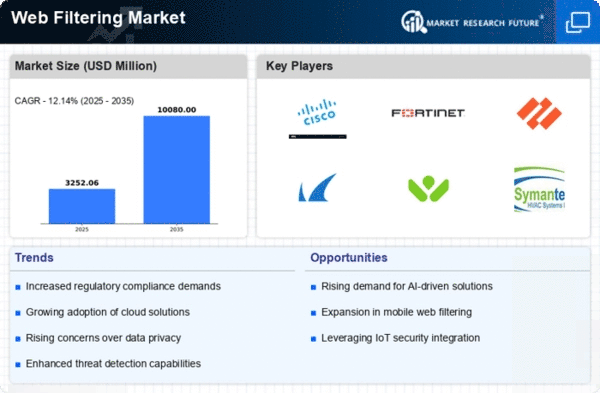
As per MRFR analysis, the Web Filtering Market Size was estimated at 2900.0 USD Million in 2024. The Web Filtering industry is projected to grow from 3200.0 in 2025 to 10080.0 by 2035, exhibiting a compound annual growth rate (CAGR) of 12.14 during the forecast period 2025 - 2035.

Key Market Trends & Highlights

The Web Filtering Market is experiencing robust growth driven by technological advancements and increasing cybersecurity concerns.

  • The integration of AI and machine learning is transforming web filtering solutions, enhancing their effectiveness. User experience is becoming a focal point, as organizations seek to balance security with usability. Cloud-based filtering solutions are gaining traction, particularly in North America, which remains the largest market. Increasing cybersecurity threats and regulatory compliance requirements are major drivers propelling growth in the content filtering and healthcare segments.

Market Size & Forecast

2024 Market Size 2900.0 (USD Million)
2035 Market Size 10080.0 (USD Million)
CAGR (2025 - 2035) 12.14%
Largest Regional Market Share in 2024 North America

Major Players

<p>Cisco Systems (US), Fortinet (US), Palo Alto Networks (US), Barracuda Networks (US), Webroot (US), Symantec (US), McAfee (US), Zscaler (US), Forcepoint (US)</p>

Market Trends

The Web Filtering Market is currently experiencing a transformative phase, driven by the increasing need for cybersecurity and the protection of sensitive information. Organizations across various sectors are recognizing the necessity of implementing robust web filtering solutions to mitigate risks associated with malicious websites and inappropriate content. This heightened awareness is fostering a growing demand for advanced filtering technologies that not only block harmful sites but also enhance productivity by allowing access to relevant resources. As businesses continue to adapt to the evolving digital landscape, the integration of artificial intelligence and machine learning into web filtering solutions appears to be a pivotal trend, enabling more sophisticated threat detection and response capabilities. Moreover, the rise of remote work and the proliferation of mobile devices have further underscored the importance of effective web filtering strategies. Companies are increasingly seeking solutions that can provide comprehensive protection across diverse environments, including on-premises and cloud-based systems. This shift is likely to drive innovation within the Web Filtering Market, as vendors strive to offer flexible, scalable, and user-friendly solutions that cater to the unique needs of their clients. As the market evolves, it seems that collaboration between technology providers and end-users will be essential in shaping the future of web filtering, ensuring that organizations can navigate the complexities of the online world safely and efficiently.

Integration of AI and Machine Learning

The incorporation of artificial intelligence and machine learning technologies into web filtering solutions is becoming increasingly prevalent. These advanced systems can analyze vast amounts of data to identify patterns and detect potential threats more effectively than traditional methods. This trend suggests a shift towards more proactive security measures, allowing organizations to respond swiftly to emerging risks.

Focus on User Experience

There is a growing emphasis on enhancing user experience within web filtering solutions. Vendors are recognizing that intuitive interfaces and seamless integration with existing systems are crucial for user adoption. This trend indicates a move towards solutions that not only provide robust security but also prioritize ease of use, thereby improving overall productivity.

Cloud-Based Filtering Solutions

The demand for cloud-based web filtering solutions is on the rise, as organizations seek flexibility and scalability in their security measures. These solutions offer the advantage of centralized management and real-time updates, which can be particularly beneficial for businesses with remote or distributed workforces. This trend highlights a broader shift towards cloud technologies in the cybersecurity landscape.

Web Filtering Market Market Drivers

Rising Cybersecurity Threats

The Global Web Filtering Market Industry is experiencing growth driven by the increasing frequency and sophistication of cyber threats. Organizations are compelled to adopt web filtering solutions to safeguard sensitive data and maintain operational integrity. In 2024, the market is projected to reach 2.81 USD Billion, reflecting a heightened awareness of cybersecurity risks. As cybercriminals evolve their tactics, businesses are likely to invest in advanced web filtering technologies to mitigate potential breaches. This trend indicates a proactive approach to cybersecurity, where companies prioritize protective measures to ensure compliance with regulations and protect their reputations.

Market Segment Insights

By Application: Content Filtering (Largest) vs. Malware Protection (Fastest-Growing)

<p>In the Web Filtering Market, the application segment is primarily divided into five key areas: Content Filtering, Malware Protection, Data Loss Prevention, Network Security, and Web Access Management. Among these, Content Filtering stands out as the largest segment, dominating the market due to its essential role in allowing organizations to manage and regulate internet usage effectively. Malware Protection follows closely, experiencing substantial market interest as organizations prioritize cybersecurity measures in light of increasing cyber threats.</p>

<p>Content Filtering (Dominant) vs. Malware Protection (Emerging)</p>

<p>Content Filtering is the dominant application in the Web Filtering Market, serving as a crucial tool for businesses to control employee internet usage and enhance productivity by allowing or blocking access to specific content types. This segment helps organizations mitigate risks linked to inappropriate or harmful content. On the other hand, Malware Protection is emerging rapidly, driven by the growing frequency of cyberattacks and the need for robust security solutions. As organizations become more reliant on digital infrastructure, the demand for effective Malware Protection solutions is surging, making it a crucial area of focus for vendors aiming to capture market share and provide comprehensive security offerings.</p>

By End Use: Education (Largest) vs. Healthcare (Fastest-Growing)

<p>The web filtering market is characterized by diverse end-use segments such as Education, Healthcare, Government, Corporate, and Telecommunications. Among these, the Education sector holds the largest share, driven by the increasing need for online safety and content regulation in academic environments. Educational institutions prioritize web filtering solutions to safeguard students from inappropriate content and ensure a focused learning atmosphere, making them a dominant force in the market. In contrast, the Healthcare sector is rapidly emerging as the fastest-growing segment within the web filtering market. The rising adoption of digital health records and telemedicine services is propelling demand for robust web filtering solutions that can ensure patient confidentiality and prevent cyber threats. As <a title="healthcare" href="https://www.marketresearchfuture.com/categories/healthcare-market-report" target="_blank" rel="noopener">healthcare</a> organizations continue investing in IT security, their need for effective web filtering is expected to grow significantly over the coming years.</p>

<p>Education: Largest vs. Healthcare: Fastest-Growing</p>

<p>The Education sector stands out as the dominant segment in the web filtering market, primarily due to its focus on maintaining a safe online environment for students and staff. Educational institutions are increasingly implementing these solutions to filter out harmful content and enforce acceptable use policies, which are critical for creating conducive learning spaces. On the other hand, the Healthcare sector, while currently smaller in market share, is recognized as the fastest-growing segment. With the surge in digital health technologies, healthcare providers are prioritizing web filtering to protect sensitive patient information from cyber threats. The integration of telehealth services necessitates advanced filtering solutions that can accommodate the unique needs of healthcare environments, marking this sector as an emerging player with substantial growth potential.</p>

By Deployment Type: Cloud-Based (Largest) vs. On-Premises (Fastest-Growing)

<p>In the web filtering market, deployment type segmentation is witnessing significant trends. The cloud-based segment is currently the largest, dominating market share due to its scalability, lower costs, and ease of implementation. On-premises solutions are still preferred by many traditional organizations that prioritize control over their data and security, though their market share is gradually decreasing. <a title="Hybrid solutions" href="https://www.marketresearchfuture.com/reports/hybrid-power-solution-market-2053" target="_blank" rel="noopener">Hybrid solutions</a> are also emerging as a balanced alternative, tailored for organizations looking for flexibility in deployment. The growth trends in this segment are driven by organizational demand for more robust and versatile web filtering solutions, especially as remote work becomes more prevalent. Cloud-based offerings are experiencing rapid adoption because they require less internal management and offer real-time updates. On-premises solutions are adapting to enhance features and compete more aggressively by integrating with cloud services, while hybrid models are gaining traction as businesses seek the best of both worlds.</p>

<p>Cloud-Based (Dominant) vs. On-Premises (Emerging)</p>

<p>Cloud-based web filtering solutions are characterized by their superior flexibility, allowing organizations to scale their security measures according to needs without substantial infrastructure investments. This model ensures that companies benefit from the latest updates and features with minimal downtime. On the other hand, on-premises solutions, although emerging, are becoming increasingly advanced, focusing on robust security features and customization. While they are traditionally favored for sensitive industries, their growth is slowing compared to cloud-based solutions. In contrast, hybrid deployment methods are gaining attention as they provide a structured approach that leverages both cloud capabilities and on-premises controls, catering to the diverse needs of modern enterprises.</p>

By Organization Size: Small Enterprises (Largest) vs. Large Enterprises (Fastest-Growing)

<p>In the Web Filtering Market, the organization size significantly impacts market share distribution. Small Enterprises hold the largest share, indicating a strong adoption of web filtering solutions to protect their limited resources. Meanwhile, Large Enterprises are experiencing a rapid growth rate as they seek advanced filtering solutions to manage the increasing complexity of cybersecurity threats. The medium enterprises are positioned between these two, leveraging a mix of robust solutions while capitalizing on budget constraints that influence their purchasing decisions. The remarkable growth trends in this segment are driven by the increasing awareness of cybersecurity within organizations of all sizes. Small Enterprises, often vulnerable to attacks, prioritize cost-effective web filtering solutions to mitigate risks. On the other hand, Large Enterprises are increasingly investing in sophisticated web filtering technologies, such as AI and machine learning, to enhance their security posture and respond to evolving threats, positioning them as a fast-growing segment within the market.</p>

<p>Small Enterprises (Dominant) vs. Large Enterprises (Emerging)</p>

<p>In the Web Filtering Market, Small Enterprises represent a dominant segment, driven by their need for affordable, user-friendly web filtering solutions. Their limited IT resources often lead them to adopt basic filtering methods that are easy to implement and manage. As they face increasing online threats, these enterprises increasingly prioritize web filtering to safeguard their operations against malware, phishing, and other web-based threats. In contrast, Large Enterprises are emerging rapidly as they invest in advanced, scalable filtering solutions that offer comprehensive protection across numerous endpoints. These organizations typically have more extensive networks and complex security needs, prompting them to seek customizable web filtering technologies that can integrate with their existing cybersecurity infrastructure, thereby enhancing their overall security strategy.</p>

By Technology: URL Filtering (Largest) vs. DNS Filtering (Fastest-Growing)

<p>In the Web Filtering Market, the technology segment is characterized by a diverse range of filtering methods, with URL Filtering holding the largest share. This method's effectiveness in blocking unwanted content and securing user access has made it prevalent among enterprises. Meanwhile, DNS Filtering has emerged as the fastest-growing technology in this space, driven by the increasing adoption of cloud services and the need for robust security measures in web traffic management. The growth trends in the technology segment are propelled by various factors including the surge in cyber threats and the growing demand for secure web access. Companies are increasingly investing in sophisticated filtering technologies to protect sensitive information and ensure compliance with regulatory standards. As organizations migrate to cloud solutions, the importance of resilient web filtering technologies, particularly DNS Filtering, becomes crucial for safeguarding organizational assets and mitigating risks associated with malicious online activity.</p>

<p>Web Filtering Technology: URL Filtering (Dominant) vs. DNS Filtering (Emerging)</p>

<p>URL Filtering stands as the dominant force in the web filtering technology segment, widely utilized by businesses to restrict access to undesirable websites and protect users from harmful content. Its robust capabilities in effectively categorizing web traffic ensure organizations maintain compliance with regulatory requirements while fostering a safe internet environment for users. On the other hand, DNS Filtering is recognized as an emerging technology that is rapidly gaining traction due to its capacity to protect against a broader range of online threats, including phishing attacks. By preventing users from accessing malicious domains at the DNS level, it significantly enhances security. Together, these two technologies are reshaping the landscape of web filtering, each fulfilling a unique role in contemporary cybersecurity strategies.</p>

Get more detailed insights about Web Filtering Market Research Report – Forecast to 2035

Regional Insights

North America : Market Leader in Web Filtering

North America continues to lead the Web Filtering Market, holding a significant share of 1450.0M in 2024. The region's growth is driven by increasing cybersecurity threats, regulatory compliance requirements, and a surge in remote work. Organizations are investing heavily in web filtering solutions to protect sensitive data and ensure safe browsing experiences. The demand for advanced security features and real-time threat intelligence is propelling market expansion. The competitive landscape in North America is robust, featuring key players such as Cisco Systems, Fortinet, and Palo Alto Networks. These companies are at the forefront of innovation, offering comprehensive solutions tailored to various industries. The presence of established tech firms and a strong focus on R&D further enhance the region's market position, making it a hub for cutting-edge web filtering technologies.

Europe : Growing Demand for Security Solutions

Europe's Web Filtering Market is projected to reach 800.0M by 2025, driven by increasing regulatory pressures and a heightened focus on data privacy. The General Data Protection Regulation (GDPR) has catalyzed organizations to adopt stringent web filtering measures to comply with legal requirements. Additionally, the rise in cyber threats has led to a growing demand for advanced filtering solutions that ensure secure internet access and protect sensitive information. Leading countries in this region include the UK, Germany, and France, where major players like Symantec and McAfee are actively enhancing their offerings. The competitive landscape is characterized by a mix of established firms and emerging startups, all striving to innovate and meet the evolving needs of businesses. The emphasis on compliance and security is shaping the market dynamics, fostering a culture of proactive threat management.

Asia-Pacific : Emerging Powerhouse in Cybersecurity

The Asia-Pacific region is witnessing a rapid expansion in the Web Filtering Market, projected to reach 550.0M by 2025. This growth is fueled by increasing internet penetration, rising cyber threats, and a growing awareness of cybersecurity among businesses. Governments are also implementing regulations to enhance online safety, driving demand for effective web filtering solutions. The region's diverse market landscape presents both challenges and opportunities for growth. Countries like China, India, and Japan are leading the charge, with a mix of local and international players competing for market share. Companies such as Zscaler and Forcepoint are making significant inroads, offering tailored solutions to meet regional needs. The competitive environment is dynamic, with a focus on innovation and adaptability to local market conditions, positioning Asia-Pacific as a key player in the global web filtering landscape.

Middle East and Africa : Emerging Market with Potential

The Middle East and Africa (MEA) region is gradually emerging in the Web Filtering Market, with a projected size of 100.0M by 2025. The growth is driven by increasing internet usage, a rise in cyber threats, and a growing emphasis on data protection. Governments are beginning to recognize the importance of cybersecurity, leading to initiatives that promote the adoption of web filtering solutions across various sectors. This evolving landscape presents significant opportunities for market players. Key countries in this region include South Africa, UAE, and Nigeria, where local and international companies are vying for market presence. The competitive landscape is characterized by a mix of established firms and new entrants, all aiming to capture the growing demand for web filtering solutions. As awareness of cybersecurity continues to rise, the MEA region is poised for substantial growth in the coming years.

Key Players and Competitive Insights

The Web Filtering Market is currently characterized by a dynamic competitive landscape, driven by increasing concerns over cybersecurity and the need for robust online protection. Major players such as Cisco Systems (US), Fortinet (US), and Palo Alto Networks (US) are at the forefront, each adopting distinct strategies to enhance their market positioning. Cisco Systems (US) focuses on innovation through continuous development of its security solutions, while Fortinet (US) emphasizes a comprehensive approach to cybersecurity, integrating web filtering with broader network security measures. Palo Alto Networks (US) is leveraging its advanced AI capabilities to enhance threat detection and response, thereby shaping a competitive environment that prioritizes technological advancement and integrated solutions.In terms of business tactics, companies are increasingly localizing their operations to better serve regional markets, optimizing supply chains to enhance efficiency. The market structure appears moderately fragmented, with a mix of established players and emerging startups. This fragmentation allows for diverse offerings, yet the collective influence of key players like Cisco Systems (US) and Fortinet (US) tends to dominate market trends and consumer preferences.


In November Cisco Systems (US) announced a strategic partnership with a leading cloud service provider to enhance its web filtering capabilities. This collaboration is expected to integrate advanced machine learning algorithms into Cisco's existing solutions, thereby improving real-time threat detection. Such a move not only strengthens Cisco's product offerings but also positions it favorably against competitors by enhancing its technological edge.Similarly, in October 2025, Fortinet (US) launched a new suite of web filtering tools designed specifically for small to medium-sized enterprises (SMEs). This initiative reflects Fortinet's commitment to expanding its market reach and addressing the unique security challenges faced by SMEs. By tailoring solutions to this segment, Fortinet is likely to capture a significant share of the growing demand for accessible cybersecurity solutions.


In September Palo Alto Networks (US) unveiled an innovative AI-driven web filtering solution that promises to reduce false positives significantly. This development is crucial as it enhances user experience while maintaining high security standards. The introduction of such advanced technology indicates a shift towards more intelligent filtering systems, which could redefine user expectations and competitive benchmarks in the market.


As of December current trends in the Web Filtering Market are heavily influenced by digitalization, sustainability, and the integration of AI technologies. Strategic alliances are becoming increasingly vital, as companies recognize the need for collaborative efforts to enhance their offerings. The competitive differentiation is likely to evolve from traditional price-based strategies to a focus on innovation, technological advancements, and supply chain reliability. This shift suggests that companies that prioritize these aspects will be better positioned to thrive in an increasingly complex market.

Key Companies in the Web Filtering Market include

Industry Developments

In July 2020, McAfee recently announced McAfee Enterprise Security Manager (ESM) Cloud, a new cloud-based security and information event management (SIEM) solution for security operations teams in their threat-hunting activities, incident response, and detection.

In June 2020, ElevenPaths, the cybersecurity division of Telefónica Tech, has joined forces with Fortinet to offer new managed security services targeted at customers serving in the industrial sector who are looking for advanced OT/IT/IoT security.

In March 2024, ReasonLabs introduced major updates to its Safer Web DNS Filtering product, which the home user cyber protection pioneer says matches Fortune 500 companies. V3.12 is the latest version that includes extensive enhancements to its infrastructure and UI, reinforcing Safer Web as a strong and friendly tool against online threats. It helps Safer Web run even faster and more efficiently, and it lowers latency. The upgrades will not affect users’ browsing experience but will still protect them from potential threats.

Microsoft has just unveiled that web content filtering will be generally available for all Windows enterprise customers in October 2021. According to Doucette, Microsoft now regularly updates web content filtering reports that can be viewed via their new Microsoft 365 Defender portal located at security.microsoft.com. Also, through Advanced Hunting and Device Timeline, blocks that have not been added yet can be accessed, making it easier to look into block events across an entire organization.

Samsung Electronics launched Less Microfiber™ Filter, a cloth washer exterior filter introduced to decrease significantly plastic microfibers released while washing clothes on Kune 2023. Inspired by Patagonia’s clothing company and supported by the international ocean conservation body ‘Ocean Wise’, this filter follows last year’s Less Microfiber™ Cycle, which successfully cut out microplastics during washes making laundry sustainable without any effort at all! It is already available on sale in South Korea and Great Britain, with other markets expected to get it on rollout before Q3 ends.

Future Outlook

Web Filtering Market Future Outlook

<p>The Web Filtering Market is projected to grow at a 12.14% CAGR from 2025 to 2035, driven by increasing cybersecurity threats, regulatory compliance, and the rise of remote work.</p>

New opportunities lie in:

  • <p>Development of AI-driven filtering solutions for enhanced threat detection. Expansion into emerging markets with tailored web filtering services. Partnerships with educational institutions for customized content filtering solutions.</p>

<p>By 2035, the Web Filtering Market is expected to be robust, reflecting substantial growth and innovation.</p>

Market Segmentation

Web Filtering Market End Use Outlook

  • Education
  • Healthcare
  • Government
  • Corporate
  • Telecommunications

Web Filtering Market Technology Outlook

  • URL Filtering
  • DNS Filtering
  • IP Filtering
  • Keyword Filtering

Web Filtering Market Application Outlook

  • Content Filtering
  • Malware Protection
  • Data Loss Prevention
  • Network Security
  • Web Access Management

Web Filtering Market Deployment Type Outlook

  • On-Premises
  • Cloud-Based
  • Hybrid

Web Filtering Market Organization Size Outlook

  • Small Enterprises
  • Medium Enterprises
  • Large Enterprises

Report Scope

MARKET SIZE 2024 2900.0(USD Million)
MARKET SIZE 2025 3200.0(USD Million)
MARKET SIZE 2035 10080.0(USD Million)
COMPOUND ANNUAL GROWTH RATE (CAGR) 12.14% (2025 - 2035)
REPORT COVERAGE Revenue Forecast, Competitive Landscape, Growth Factors, and Trends
BASE YEAR 2024
Market Forecast Period 2025 - 2035
Historical Data 2019 - 2024
Market Forecast Units USD Million
Key Companies Profiled Cisco Systems (US), Fortinet (US), Palo Alto Networks (US), Barracuda Networks (US), Webroot (US), Symantec (US), McAfee (US), Zscaler (US), Forcepoint (US)
Segments Covered Application, End Use, Deployment Type, Organization Size, Technology
Key Market Opportunities Integration of artificial intelligence enhances threat detection in the Web Filtering Market.
Key Market Dynamics Rising demand for enhanced cybersecurity drives innovation and competition in the web filtering market.
Countries Covered North America, Europe, APAC, South America, MEA

FAQs

What is the expected CAGR growth for the Global Web Filtering Market by the end of the global forecast period in 2030?

The global market for Global Web Filtering Market is expected to grow at a CAGR of 12.44% by the end of the forecast period in 2030.

Which region is considered to have the largest market share for Global Web Filtering Market during the forecast period?

North America is considered to have the largest market share for Global Web Filtering Market during the forecast period 2022-2030.

Who are the key players in the Global Web Filtering Market?

Some of the major key players in the Global Web Filtering Market are Cisco Systems, Inc. (U.S.), Symantec Corporation (U.S.), McAfee, Inc. (U.S), Palo Alto Networks, Inc. (U.S.), Fortinet (U.S.), Trend Micro Inc. (Japan), Forcepoint (U.S.), Sophos Group plc (U.K), Barracuda Networks, Inc. (U.S.), Zscaler (U.S.), Trustwave Holdings (U.S.) and others.

  1. SECTION I: EXECUTIVE SUMMARY AND KEY HIGHLIGHTS
    1. | 1.1 EXECUTIVE SUMMARY
    2. | 1.1.1 Market Overview
    3. | 1.1.2 Key Findings
    4. | 1.1.3 Market Segmentation
    5. | 1.1.4 Competitive Landscape
    6. | 1.1.5 Challenges and Opportunities
    7. | 1.1.6 Future Outlook
  2. SECTION II: SCOPING, METHODOLOGY AND MARKET STRUCTURE
    1. | 2.1 MARKET INTRODUCTION
    2. | 2.1.1 Definition
    3. | 2.1.2 Scope of the study
    4. |-- 2.1.2.1 Research Objective
    5. |-- 2.1.2.2 Assumption
    6. |-- 2.1.2.3 Limitations
    7. | 2.2 RESEARCH METHODOLOGY
    8. | 2.2.1 Overview
    9. | 2.2.2 Data Mining
    10. | 2.2.3 Secondary Research
    11. | 2.2.4 Primary Research
    12. |-- 2.2.4.1 Primary Interviews and Information Gathering Process
    13. |-- 2.2.4.2 Breakdown of Primary Respondents
    14. | 2.2.5 Forecasting Model
    15. | 2.2.6 Market Size Estimation
    16. |-- 2.2.6.1 Bottom-Up Approach
    17. |-- 2.2.6.2 Top-Down Approach
    18. | 2.2.7 Data Triangulation
    19. | 2.2.8 Validation
  3. SECTION III: QUALITATIVE ANALYSIS
    1. | 3.1 MARKET DYNAMICS
    2. | 3.1.1 Overview
    3. | 3.1.2 Drivers
    4. | 3.1.3 Restraints
    5. | 3.1.4 Opportunities
    6. | 3.2 MARKET FACTOR ANALYSIS
    7. | 3.2.1 Value chain Analysis
    8. | 3.2.2 Porter's Five Forces Analysis
    9. |-- 3.2.2.1 Bargaining Power of Suppliers
    10. |-- 3.2.2.2 Bargaining Power of Buyers
    11. |-- 3.2.2.3 Threat of New Entrants
    12. |-- 3.2.2.4 Threat of Substitutes
    13. |-- 3.2.2.5 Intensity of Rivalry
    14. | 3.2.3 COVID-19 Impact Analysis
    15. |-- 3.2.3.1 Market Impact Analysis
    16. |-- 3.2.3.2 Regional Impact
    17. |-- 3.2.3.3 Opportunity and Threat Analysis
  4. SECTION IV: QUANTITATIVE ANALYSIS
    1. | 4.1 Information and Communications Technology, BY Application (USD Million)
    2. | 4.1.1 Content Filtering
    3. | 4.1.2 Malware Protection
    4. | 4.1.3 Data Loss Prevention
    5. | 4.1.4 Network Security
    6. | 4.1.5 Web Access Management
    7. | 4.2 Information and Communications Technology, BY End Use (USD Million)
    8. | 4.2.1 Education
    9. | 4.2.2 Healthcare
    10. | 4.2.3 Government
    11. | 4.2.4 Corporate
    12. | 4.2.5 Telecommunications
    13. | 4.3 Information and Communications Technology, BY Deployment Type (USD Million)
    14. | 4.3.1 On-Premises
    15. | 4.3.2 Cloud-Based
    16. | 4.3.3 Hybrid
    17. | 4.4 Information and Communications Technology, BY Organization Size (USD Million)
    18. | 4.4.1 Small Enterprises
    19. | 4.4.2 Medium Enterprises
    20. | 4.4.3 Large Enterprises
    21. | 4.5 Information and Communications Technology, BY Technology (USD Million)
    22. | 4.5.1 URL Filtering
    23. | 4.5.2 DNS Filtering
    24. | 4.5.3 IP Filtering
    25. | 4.5.4 Keyword Filtering
    26. | 4.6 Information and Communications Technology, BY Region (USD Million)
    27. | 4.6.1 North America
    28. |-- 4.6.1.1 US
    29. |-- 4.6.1.2 Canada
    30. | 4.6.2 Europe
    31. |-- 4.6.2.1 Germany
    32. |-- 4.6.2.2 UK
    33. |-- 4.6.2.3 France
    34. |-- 4.6.2.4 Russia
    35. |-- 4.6.2.5 Italy
    36. |-- 4.6.2.6 Spain
    37. |-- 4.6.2.7 Rest of Europe
    38. | 4.6.3 APAC
    39. |-- 4.6.3.1 China
    40. |-- 4.6.3.2 India
    41. |-- 4.6.3.3 Japan
    42. |-- 4.6.3.4 South Korea
    43. |-- 4.6.3.5 Malaysia
    44. |-- 4.6.3.6 Thailand
    45. |-- 4.6.3.7 Indonesia
    46. |-- 4.6.3.8 Rest of APAC
    47. | 4.6.4 South America
    48. |-- 4.6.4.1 Brazil
    49. |-- 4.6.4.2 Mexico
    50. |-- 4.6.4.3 Argentina
    51. |-- 4.6.4.4 Rest of South America
    52. | 4.6.5 MEA
    53. |-- 4.6.5.1 GCC Countries
    54. |-- 4.6.5.2 South Africa
    55. |-- 4.6.5.3 Rest of MEA
  5. SECTION V: COMPETITIVE ANALYSIS
    1. | 5.1 Competitive Landscape
    2. | 5.1.1 Overview
    3. | 5.1.2 Competitive Analysis
    4. | 5.1.3 Market share Analysis
    5. | 5.1.4 Major Growth Strategy in the Information and Communications Technology
    6. | 5.1.5 Competitive Benchmarking
    7. | 5.1.6 Leading Players in Terms of Number of Developments in the Information and Communications Technology
    8. | 5.1.7 Key developments and growth strategies
    9. |-- 5.1.7.1 New Product Launch/Service Deployment
    10. |-- 5.1.7.2 Merger & Acquisitions
    11. |-- 5.1.7.3 Joint Ventures
    12. | 5.1.8 Major Players Financial Matrix
    13. |-- 5.1.8.1 Sales and Operating Income
    14. |-- 5.1.8.2 Major Players R&D Expenditure. 2023
    15. | 5.2 Company Profiles
    16. | 5.2.1 Cisco Systems (US)
    17. |-- 5.2.1.1 Financial Overview
    18. |-- 5.2.1.2 Products Offered
    19. |-- 5.2.1.3 Key Developments
    20. |-- 5.2.1.4 SWOT Analysis
    21. |-- 5.2.1.5 Key Strategies
    22. | 5.2.2 Fortinet (US)
    23. |-- 5.2.2.1 Financial Overview
    24. |-- 5.2.2.2 Products Offered
    25. |-- 5.2.2.3 Key Developments
    26. |-- 5.2.2.4 SWOT Analysis
    27. |-- 5.2.2.5 Key Strategies
    28. | 5.2.3 Palo Alto Networks (US)
    29. |-- 5.2.3.1 Financial Overview
    30. |-- 5.2.3.2 Products Offered
    31. |-- 5.2.3.3 Key Developments
    32. |-- 5.2.3.4 SWOT Analysis
    33. |-- 5.2.3.5 Key Strategies
    34. | 5.2.4 Barracuda Networks (US)
    35. |-- 5.2.4.1 Financial Overview
    36. |-- 5.2.4.2 Products Offered
    37. |-- 5.2.4.3 Key Developments
    38. |-- 5.2.4.4 SWOT Analysis
    39. |-- 5.2.4.5 Key Strategies
    40. | 5.2.5 Webroot (US)
    41. |-- 5.2.5.1 Financial Overview
    42. |-- 5.2.5.2 Products Offered
    43. |-- 5.2.5.3 Key Developments
    44. |-- 5.2.5.4 SWOT Analysis
    45. |-- 5.2.5.5 Key Strategies
    46. | 5.2.6 Symantec (US)
    47. |-- 5.2.6.1 Financial Overview
    48. |-- 5.2.6.2 Products Offered
    49. |-- 5.2.6.3 Key Developments
    50. |-- 5.2.6.4 SWOT Analysis
    51. |-- 5.2.6.5 Key Strategies
    52. | 5.2.7 McAfee (US)
    53. |-- 5.2.7.1 Financial Overview
    54. |-- 5.2.7.2 Products Offered
    55. |-- 5.2.7.3 Key Developments
    56. |-- 5.2.7.4 SWOT Analysis
    57. |-- 5.2.7.5 Key Strategies
    58. | 5.2.8 Zscaler (US)
    59. |-- 5.2.8.1 Financial Overview
    60. |-- 5.2.8.2 Products Offered
    61. |-- 5.2.8.3 Key Developments
    62. |-- 5.2.8.4 SWOT Analysis
    63. |-- 5.2.8.5 Key Strategies
    64. | 5.2.9 Forcepoint (US)
    65. |-- 5.2.9.1 Financial Overview
    66. |-- 5.2.9.2 Products Offered
    67. |-- 5.2.9.3 Key Developments
    68. |-- 5.2.9.4 SWOT Analysis
    69. |-- 5.2.9.5 Key Strategies
    70. | 5.3 Appendix
    71. | 5.3.1 References
    72. | 5.3.2 Related Reports

Information and Communications Technology Market Segmentation

Information and Communications Technology By Application (USD Million, 2025-2035)

  • Content Filtering
  • Malware Protection
  • Data Loss Prevention
  • Network Security
  • Web Access Management

Information and Communications Technology By End Use (USD Million, 2025-2035)

  • Education
  • Healthcare
  • Government
  • Corporate
  • Telecommunications

Information and Communications Technology By Deployment Type (USD Million, 2025-2035)

  • On-Premises
  • Cloud-Based
  • Hybrid

Information and Communications Technology By Organization Size (USD Million, 2025-2035)

  • Small Enterprises
  • Medium Enterprises
  • Large Enterprises

Information and Communications Technology By Technology (USD Million, 2025-2035)

  • URL Filtering
  • DNS Filtering
  • IP Filtering
  • Keyword Filtering
Infographic

Free Sample Request

Kindly complete the form below to receive a free sample of this Report

Get Free Sample

Customer Strories

Compare Licence

×
Features License Type
Single User Multiuser License Enterprise User
Price $4,950 $5,950 $7,250
Maximum User Access Limit 1 User Upto 10 Users Unrestricted Access Throughout the Organization
Free Customization
Direct Access to Analyst
Deliverable Format
Platform Access
Discount on Next Purchase 10% 15% 15%
Printable Versions