
Request Free Sample ×

Kindly complete the form below to receive a free sample of this Report

* Please use a valid business email

Leading companies partner with us for data-driven Insights

clients tt-cursor
Hero Background
English
Chinese
French
Japanese
Korean
German
Spanish

Web Analytics Market Trends

ID: MRFR/ICT/8078-HCR
100 Pages
Ankit Gupta
March 2026

Web Analytics Market Size, Share and Research Report: By Application (Social Media Management, and Display Advertising Optimization), By Vertical (Retail, Manufacturing, Information Technology, BFSI, Healthcare, and Transportation & Logistics), By Deployment (On-cloud and On-premise), By Service (Professional Service and Managed Service), By Solution (Search Engine Tracking & Ranking, and Heat Map Analytics), And By Region (North America, Europe, Asia-Pacific, And Rest Of The World) – Market Forecast Till 2035.

Share:
Download PDF ×

We do not share your information with anyone. However, we may send you emails based on your report interest from time to time. You may contact us at any time to opt-out.

Web Analytics Market Infographic
Purchase Options

Market Trends

Key Emerging Trends in the Web Analytics Market

The web analytics market is encountering dynamic movements and outstanding patterns that are reshaping the scene of computerized examination. As organizations progressively perceive the significance of information driven direction, the interest in web examination arrangements has flooded. One unmistakable pattern is the developing reception of cutting-edge examination apparatuses that go past conventional measurements. Organizations are currently utilizing AI and computerized reasoning to acquire further bits of knowledge into client conduct, empowering them to go with additional educated vital choices.

One more huge pattern in the market is the accentuation on client security and information assurance. With the execution of stricter guidelines, for example, GDPR and CCPA, organizations are focusing on instruments and procedures that guarantee consistence with these norms. Subsequently, there is a rising interest in examination arrangements that offer powerful security includes and empower associations to gather and break down information while regarding client assent and protection inclinations. The shift towards ongoing examination is likewise an eminent market pattern.

Organizations are progressively looking for moment bits of knowledge to answer rapidly to changing economic situations and client conduct. Constant examination permits associations to adjust their methodologies on the fly, enhance client encounters, and address issues speedily. This pattern is especially obvious in ventures where fast navigation is basic, like online business and internet promoting. The joining of cross-channel investigation is picking up speed as organizations expect to comprehend the all-encompassing client venture across different touchpoints. With buyers collaborating with brands through numerous channels, including sites, portable applications, virtual entertainment, and disconnected channels, there is a developing requirement for examination arrangements that give a brought together perspective on client conduct across these channels. This pattern is driven by the craving to make a consistent and customized client experience.

The ascent of portable examination is one more key pattern in the web analytics market. As mobile use keeps on overwhelming, organizations are zeroing in on grasping client conduct on versatile stages. Versatile examination instruments offer bits of knowledge into application use, client commitment, and transformation rates on cell phones, permitting organizations to fit their procedures to the inclinations and propensities for portable clients. ML and AI are assuming an undeniably significant part in Web Analytics. These advancements empower computerized investigation of huge measures of information, revealing examples and patterns that would be trying to physically recognize.

Artificial intelligence-controlled examination devices are being utilized for prescient investigation, empowering organizations to expect client conduct and patterns, at last improving their essential dynamic cycles. The interest for adjustable and easy to understand investigation arrangements is on the ascent. Organizations are looking for stages that can be effectively customized to their particular requirements and inclinations. This pattern is driving advancement in the improvement of natural dashboards, adjustable reports, and easy to use interfaces, making it more straightforward for non-specialized clients to get bits of knowledge from examination information. Cooperative investigation is arising as a pattern that cultivates collaboration and information driven decision-production inside associations.

Organizations are perceiving the benefit of separating storehouses and advancing cooperation among various divisions. Cooperative examination apparatuses empower groups to share experiences, team up on information investigation, and on the whole drive business results. The market is seeing expanded rivalry, prompting a different scope of contributions from merchants. Thus, organizations have the chance to browse various arrangements that take care of their particular necessities and financial plans. This serious scene is driving merchants to constantly improve and upgrade their contributions, prompting the fast development of web analytics innovation.


Author
Author Profile
Ankit Gupta
Team Lead - Research

Ankit Gupta is a seasoned market intelligence and strategic research professional with over six plus years of experience in the ICT and Semiconductor industries. With academic roots in Telecom, Marketing, and Electronics, he blends technical insight with business strategy. Ankit has led 200+ projects, including work for Fortune 500 clients like Microsoft and Rio Tinto, covering market sizing, tech forecasting, and go-to-market strategies. Known for bridging engineering and enterprise decision-making, his insights support growth, innovation, and investment planning across diverse technology markets.

Leave a Comment

FAQs

What is the current valuation of the Web Analytics market in 2024?

<p>The Web Analytics market was valued at 16.72 USD Billion in 2024.</p>

What is the projected market size for the Web Analytics market by 2035?

<p>The market is projected to reach 99.66 USD Billion by 2035.</p>

What is the expected CAGR for the Web Analytics market during the forecast period 2025 - 2035?

<p>The expected CAGR for the Web Analytics market during 2025 - 2035 is 17.62%.</p>

Which companies are considered key players in the Web Analytics market?

<p>Key players include Google, Adobe, IBM, Oracle, SAP, Microsoft, Mixpanel, Heap, Piwik PRO, and Matomo.</p>

What are the main application segments within the Web Analytics market?

<p>The main application segments include Social Media Management and Display Advertising Optimization.</p>

How does the retail sector perform in the Web Analytics market?

<p>The retail sector was valued at 2.5 USD Billion in 2024 and is projected to grow to 15.0 USD Billion by 2035.</p>

What is the valuation of the Information Technology segment in the Web Analytics market?

The Information Technology segment was valued at 4.0 USD Billion in 2024 and is expected to reach 25.0 USD Billion by 2035.

What are the deployment models in the Web Analytics market?

The deployment models include On-cloud and On-premise, both valued at 8.36 USD Billion in 2024.

What services are offered in the Web Analytics market?

Services include Professional Service and Managed Service, with valuations of 6.68 USD Billion and 10.04 USD Billion in 2024, respectively.

What solutions are available in the Web Analytics market?

Solutions include Search Engine Tracking &amp; Ranking and Heat Map Analytics, valued at 6.68 USD Billion and 10.04 USD Billion in 2024.

Market Summary

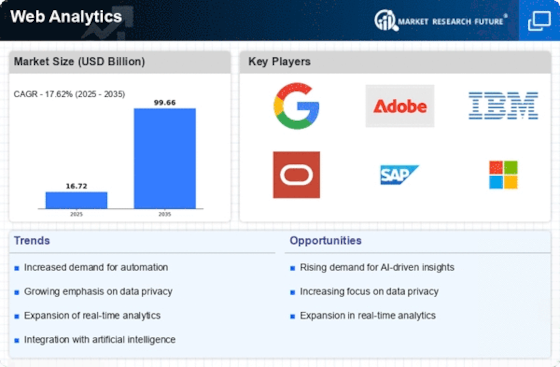
As per Market Research Future analysis, the Web Analytics Market size was estimated at 16.72 USD Billion in 2024. The Web Analytics industry is projected to grow from 19.67 USD Billion in 2025 to 99.66 USD Billion by 2035, exhibiting a compound annual growth rate (CAGR) of 17.62% during the forecast period 2025 - 2035

Key Market Trends & Highlights

The Web Analytics Market is experiencing robust growth driven by technological advancements and evolving consumer expectations.

  • The integration of AI and machine learning is transforming data analysis capabilities across various sectors. North America remains the largest market for web analytics, while Asia-Pacific is emerging as the fastest-growing region. Social media management continues to dominate the market, whereas display advertising optimization is witnessing rapid growth. Rising demand for data-driven decision making and the expansion of digital marketing initiatives are key drivers propelling market growth.

Market Size & Forecast

2024 Market Size 16.72 (USD Billion)
2035 Market Size 99.66 (USD Billion)
CAGR (2025 - 2035) 17.62%
Largest Regional Market Share in 2024 North America

Major Players

Google (US), Adobe (US), IBM (US), Oracle (US), SAP (DE), Microsoft (US), Mixpanel (US), Heap (US), Piwik PRO (PL), Matomo (NZ)

Market Trends

The Web Analytics Market is currently experiencing a transformative phase, driven by the increasing need for businesses to understand consumer behavior and optimize their online presence. As organizations strive to enhance user experience and improve conversion rates, the demand for sophisticated analytics tools has surged. This market encompasses a variety of solutions that enable companies to collect, analyze, and interpret data from their digital platforms. The integration of artificial intelligence and machine learning into these tools appears to be a pivotal factor, as it allows for more accurate predictions and personalized marketing strategies. Furthermore, the growing emphasis on data privacy and compliance is shaping the development of analytics solutions, compelling providers to innovate while adhering to regulatory standards. In addition, the rise of e-commerce and digital marketing initiatives has further propelled the Web Analytics Market. Businesses are increasingly leveraging analytics to gain insights into customer journeys, enabling them to tailor their offerings and enhance engagement. The shift towards mobile and multi-channel strategies necessitates robust analytics capabilities, as organizations seek to track performance across various touchpoints. As the landscape evolves, it seems likely that the Web Analytics Market will continue to expand, driven by technological advancements and the ever-changing demands of consumers.

Integration of AI and Machine Learning

The incorporation of artificial intelligence and machine learning technologies into web analytics tools is becoming more prevalent. This trend allows for enhanced data processing capabilities, enabling businesses to derive deeper insights and make informed decisions based on predictive analytics.

Focus on Data Privacy

With increasing concerns surrounding data privacy, the Web Analytics Market is witnessing a shift towards compliance-focused solutions. Companies are prioritizing tools that not only provide insights but also ensure adherence to regulations, thereby fostering consumer trust.

Growth of E-commerce Analytics

As e-commerce continues to flourish, there is a notable rise in the demand for specialized analytics solutions tailored for online retail. Businesses are seeking to understand customer behavior in digital environments, leading to the development of tools that cater specifically to e-commerce needs.

Web Analytics Market Market Drivers

Expansion of Digital Marketing Initiatives

The Web Analytics Market is significantly influenced by the expansion of digital marketing initiatives across various sectors. As businesses increasingly allocate budgets towards online advertising and promotional activities, the necessity for robust web analytics tools becomes evident. In 2025, it is estimated that digital marketing expenditures will surpass traditional marketing budgets, further emphasizing the importance of tracking and analyzing online performance. This shift necessitates the implementation of comprehensive web analytics solutions to measure campaign effectiveness, user engagement, and conversion rates. As a result, organizations are likely to invest in advanced analytics platforms that provide real-time insights, thereby enhancing their marketing strategies and driving customer acquisition.

Adoption of Cloud-Based Analytics Solutions

The Web Analytics Market is increasingly characterized by the adoption of cloud-based analytics solutions. Organizations are gravitating towards cloud technologies due to their scalability, flexibility, and cost-effectiveness. In 2025, it is anticipated that cloud-based web analytics solutions will account for a significant portion of the market share, driven by the need for real-time data access and collaboration among teams. This shift allows businesses to analyze vast amounts of data without the constraints of traditional on-premises systems. As a result, the demand for cloud-based web analytics tools is likely to rise, enabling organizations to harness the power of data analytics in a more efficient manner.

Rising Demand for Data-Driven Decision Making

The Web Analytics Market is experiencing a notable surge in demand for data-driven decision making. Organizations are increasingly recognizing the value of data analytics in shaping their strategies and enhancing operational efficiency. According to recent estimates, the market for web analytics is projected to grow at a compound annual growth rate of approximately 20% over the next five years. This growth is largely attributed to businesses seeking to leverage insights derived from user behavior and engagement metrics. As companies strive to optimize their online presence, the need for sophisticated web analytics tools becomes paramount. Consequently, this driver is likely to propel the adoption of advanced analytics solutions, enabling organizations to make informed decisions that align with consumer preferences and market trends.

Emergence of Advanced Data Visualization Techniques

The Web Analytics Market is experiencing a transformation with the emergence of advanced data visualization techniques. As organizations seek to make sense of complex data sets, the ability to present data in a visually appealing and easily interpretable manner becomes essential. In 2025, it is expected that the integration of advanced visualization tools within web analytics platforms will enhance user engagement and facilitate better decision-making. This trend indicates a growing recognition of the importance of data storytelling in conveying insights effectively. Consequently, businesses are likely to invest in web analytics solutions that offer sophisticated visualization capabilities, thereby improving their analytical processes and fostering a data-driven culture.

Increased Focus on Customer Experience Optimization

The Web Analytics Market is witnessing a heightened focus on customer experience optimization. Businesses are increasingly aware that a seamless and personalized user experience is crucial for retaining customers and driving sales. In 2025, it is projected that companies will invest over 30% of their marketing budgets in enhancing customer experience through data analytics. This trend underscores the importance of web analytics tools that can provide insights into user behavior, preferences, and pain points. By leveraging these insights, organizations can tailor their offerings and improve customer satisfaction. Consequently, the demand for web analytics solutions that facilitate customer journey mapping and experience enhancement is likely to grow, further propelling the market.

Market Segment Insights

By Application: Social Media Management (Largest) vs. Display Advertising Optimization (Fastest-Growing)

In the Web Analytics Market, Social Media Management represents the largest application segment, characterized by numerous businesses leveraging platforms like Facebook, Twitter, and Instagram for customer engagement and brand promotion. This segment captures a significant market share due to the increasing importance of social media channels in marketing strategies. Conversely, Display Advertising Optimization, while smaller in share, is emerging rapidly as more companies are harnessing data analytics to reach target audiences more effectively, resulting in increased investments and strategic shifts towards display ad campaigns. The growth trends in this segment are driven by the shift in consumer behavior towards digital interactions and the effectiveness of analytics tools in optimizing advertising efforts. Social Media Management specifically benefits from the high engagement rates on social platforms, stimulating demand from brands seeking effective ways to analyze consumer interactions. Meanwhile, Display Advertising Optimization is on the rise as businesses seek personalized, data-driven strategies to enhance ad performance and ROI, driven by advances in <a href="https://www.marketresearchfuture.com/reports/machine-learning-market-2494">machine learning</a> and predictive analytics, making this segment the fastest growing within the Web Analytics Market.

Social Media Management (Dominant) vs. Display Advertising Optimization (Emerging)

Social Media Management plays a dominant role in the Web Analytics Market, as organizations increasingly recognize the power of social media engagement. This segment focuses on analyzing consumer behavior on popular platforms and providing insights to optimize content and interaction strategies. On the other hand, Display Advertising Optimization is an emerging segment that specializes in utilizing analytics to enhance the effectiveness of online advertisements. This involves real-time data collection and analysis to fine-tune ad placements and creative content. While <a href="https://www.marketresearchfuture.com/reports/social-media-management-software-market-31114">Social Media Management</a> remains prevalent due to its broad reach and established practices, Display Advertising Optimization is gaining traction as brands recognize the potential of targeted campaigns and the ability to measure their success accurately. Both segments are crucial in helping businesses understand their audiences better and engage with them more effectively.

By Vertical: Retail (Largest) vs. Healthcare (Fastest-Growing)

Within the Web Analytics Market, the Retail sector has established itself as the largest segment, reflecting its integration of online shopping and digital marketing strategies. The influx of online retail businesses and the increasing need for data-driven insights have significantly bolstered retail's market share. Conversely, segments like Healthcare are emerging rapidly, as they capitalize on the digital transformation trend to enhance patient engagement and manage operational efficiencies through data analytics.

Retail: Customer Insights (Dominant) vs. Healthcare: Patient Engagement (Emerging)

The Retail sector dominates the Web Analytics Market through its focus on customer insights and engagement. Retailers leverage web analytics to optimize their e-commerce ecosystems, drive targeted marketing, and enhance <a href="https://www.marketresearchfuture.com/reports/customer-experience-analytics-market-3119">customer experiences</a>, establishing them as frontrunners in the sector. On the other hand, the Healthcare sector is emerging as a vital player, focusing on patient engagement and operational efficiencies. By adopting web analytics, healthcare providers enhance patient interaction and streamline processes, ultimately leading to better healthcare outcomes. This synergy between analytics and patient care positions Healthcare as a fast-growing contender in the market.

By Deployment: On-cloud (Largest) vs. On-premise (Fastest-Growing)

In the Web Analytics Market, the deployment segment is characterized by a clear preference for on-cloud solutions, which hold the largest market share. These solutions offer scalability, ease of access, and reduced IT overhead, making them increasingly attractive for businesses looking to optimize their analytics capabilities. In contrast, on-premise deployments, while smaller in overall share, are witnessing a notable uptick in interest due to concerns regarding data security and compliance. Such preferences have resulted in a dynamic shift within this segment, reflecting broader trends in IT deployment strategies.

Deployment: On-cloud (Dominant) vs. On-premise (Emerging)

On-cloud deployments in the Web Analytics Market are deemed dominant due to their flexibility and accessibility, allowing businesses to leverage powerful insights without the burden of extensive infrastructure. These solutions enable real-time data analysis, enhancing decision-making processes across organizations. Meanwhile, on-premise solutions are emerging as a viable alternative for businesses with stringent data control requirements. This growing interest is fueled by the need for enhanced data security and compliance with regulations. As organizations increasingly prioritize data privacy, the on-premise segment is expected to experience significant growth, offering tailored analytics solutions that meet specific business needs.

By Service: Professional Service (Largest) vs. Managed Service (Fastest-Growing)

In the Web Analytics Market, the 'Professional Service' segment holds a dominant position, offering expert guidance and tailored solutions to businesses seeking to optimize their online performance. Companies rely on these services for data analysis, strategy formulation, and implementation of analytics tools. Conversely, the 'Managed Service' segment is also significant, providing businesses with outsourced analytics support, allowing them to focus on core competencies while leveraging expert insights to enhance decision-making processes. This dual offering enriches the market landscape by catering to diverse client needs and preferences.

Professional Service (Dominant) vs. Managed Service (Emerging)

The 'Professional Service' segment is characterized by high-touch consulting that involves in-depth engagement with clients to improve their web analytics capabilities. This segment attracts companies that require customized solutions to complex analytics challenges. In contrast, the 'Managed Service' segment is rapidly gaining popularity as organizations look to streamline operations by outsourcing analytics functions. Managed Services offer a more flexible, scalable approach that appeals to smaller businesses and startups seeking to enter the Web Analytics Market space with minimal overhead. As technology evolves, both segments play critical roles in shaping how organizations utilize data-driven insights to guide their digital strategies.

By Solution: Search Engine Tracking & Ranking (Largest) vs. Heat Map Analytics (Fastest-Growing)

In the Web Analytics Market, Search Engine Tracking &amp; Ranking holds a significant share, being the dominant solution that many businesses rely on to improve their search visibility. This segment has established itself as a staple feature for digital marketers and website owners who prioritize their search engine results and organic traffic. Alongside, Heat Map Analytics, while currently a smaller segment, is rapidly gaining attention for its unique ability to visualize user behavior on websites, thus providing actionable insights for optimization.

Search Engine Tracking &amp; Ranking (Dominant) vs. Heat Map Analytics (Emerging)

Search Engine Tracking &amp; Ranking is a crucial solution within the Web Analytics Market sector, leveraging tools that analyze website rankings and visibility across search engines. This segment empowers businesses to adapt their SEO strategies effectively, driving organic traffic through targeted keyword analysis and competitor insights. In contrast, Heat Map Analytics, though emerging, is carving a niche by focusing on user engagement through heat maps and session recordings. This solution helps businesses understand how users interact with their websites, guiding design improvements and enhancing user experience, thus making it an increasingly important tool in comprehensive web analysis.

Get more detailed insights about Web Analytics Market Research Report - Global Forecast till 2035

Regional Insights

By Region, the study provides market insights into North America, Europe, Asia-Pacific, and the Rest of the World. The North American web analytics market is anticipated to expand at a significant CAGR during the study period, accounting for USD 1.68 billion in 2021. North America is projected to dominate the market in the coming years owing to the wide adoption of advanced and latest technology among various organizations to enhance their websites publishing about services and products. The presence of key players especially in the US acts as a key driving factor for the market growth in the region.

The region has witnessed favorable conditions for market growth due to the implementation of data management technologies, government regulations, established player presence, and interest from enterprises to apply ML and BI solutions. Leading technology players such as Google, AWS, Salesforce, Microsoft, and IBM have been investing significantly in R&D activities for developing new AI-based solutions. 

These companies target higher revenue due to the increasing competition across North America. Apart from these established players, startups also receive funding from various bodies for their innovative ideas and products. Moreover, the major countries covered in the market report include the United States, Germany, Canada, France, the United Kingdom, Italy, Spain, India, Japan, Australia, China, South Korea, and Brazil.

Figure 3: WEB ANALYTICS MARKET SHARE BY REGION 2022 (%)

The European web analytics market is the world's second-largest owing to the rise in adopting cloud and IoT technologies and high rate of implementation of the analytics solutions as the IT infrastructure in this region is well developed. Elements like the strong presence of major web analytics providers and well-established technology development centers drive the market growth. Moreover, the region's increasing investments in AI and machine learning are integral to future marketing automation products. Companies like Amazon and Apple leverage artificial intelligence to conduct voice-based marketing through devices like Alexa and Siri.

This is further expected to enhance the development of the market. Further, the German web analytics market held the largest market share, and the France web analytics market was the fastest-growing market in the European region.

The Asia Pacific web analytics market is expected to grow at the fastest rate of CAGR during the forecast period. This is because of the increasing number of analytics outsourcing activities and increased adoption of analytics solutions by the various end user industries. Moreover, increasing marketing services and social media presence in this region is a key driver for the regional market growth.

Besides, some of the significant factors, such as the growing adoption of SaaS cloud services, increasing demand for data integration services, and expanding 5G network coverage, are estimated to provide a massive scope for the market studied in the region. Furthermore, China’s web analytics market held the largest market share, and the Indian web analytics market was the fastest-growing market in the Asia-Pacific region.

Key Players and Competitive Insights

The market is mildly concentrated, with many industry players working within national and international boundaries. Some of the key players competing in the web analytics market include Google Analytics, Omniture Inc, Webtrends Corp., and Yahoo Analytics. These major companies are actively engaged in various market strategies including mergers, product launches, and expansion of production units to diversify their business operation and increase their existing consumer base.Google Analytics is aimed at marketers as opposed to technologists and webmasters who were initially targeted by the web analytics industry. It generates detailed website traffic statistics. It also determines the source of the traffic by tracking visitors from all referrers including direct visits, search engines, social networks, and other sources. Additionally, it also helps to measures conversions and sales.

Key Companies in the Web Analytics Market include

Industry Developments

  • Q2 2024: FullStory acquires Hotjar to expand digital experience analytics platform FullStory, a leading digital experience analytics company, announced the acquisition of Hotjar, a popular web analytics and behavior insights platform, to broaden its product offerings and global reach.
  • Q2 2024: Adobe Launches New AI-Powered Web Analytics Market Features in Adobe Analytics Adobe introduced advanced AI-driven capabilities in its Adobe Analytics platform, enabling businesses to gain deeper insights into customer journeys and automate anomaly detection for web traffic.
  • Q3 2024: Google appoints new VP of Product for Google Analytics Google announced the appointment of a new Vice President of Product for its Google Analytics division, signaling a renewed focus on privacy-centric analytics solutions.
  • Q2 2024: Mixpanel Raises $50 Million in Series C Funding to Accelerate Product Innovation Mixpanel, a leading product analytics company, secured $50 million in Series C funding to expand its engineering teams and accelerate the development of new web analytics features.
  • Q1 2025: Contentsquare partners with Microsoft to integrate web analytics with Azure Contentsquare announced a strategic partnership with Microsoft to integrate its web analytics platform with Microsoft Azure, aiming to provide enterprise customers with enhanced data privacy and scalability.
  • Q2 2024: Heap launches new privacy-first web analytics suite Heap unveiled a new suite of privacy-first web analytics tools designed to help businesses comply with evolving data protection regulations while maintaining actionable insights.
  • Q3 2024: Piwik PRO secures major contract with European government agency Piwik PRO, a privacy-focused web analytics provider, won a multi-year contract to supply analytics solutions to a major European government agency, emphasizing compliance with GDPR.
  • Q2 2024: Matomo announces launch of cloud-native analytics platform Matomo, an open-source web analytics provider, launched a new cloud-native analytics platform to offer customers greater scalability and simplified deployment.
  • Q1 2025: Glassbox appoints new Chief Technology Officer Glassbox, a digital experience analytics company, named a new CTO to lead its technology strategy and drive innovation in web analytics and user experience monitoring.
  • Q2 2024: Crazy Egg introduces real-time heatmap analytics for e-commerce Crazy Egg launched a new real-time heatmap analytics feature aimed at e-commerce businesses, enabling instant visualization of user interactions and conversion bottlenecks.
  • Q3 2024: Amplitude partners with Shopify to deliver advanced analytics to merchants Amplitude announced a partnership with Shopify to provide advanced web and product analytics tools directly to Shopify merchants, enhancing their ability to optimize online sales.
  • Q1 2025: Quantum Metric opens new European headquarters in Amsterdam Quantum Metric, a digital analytics platform, opened a new European headquarters in Amsterdam to support its expanding customer base and comply with regional data regulations.

Future Outlook

Web Analytics Market Future Outlook

The Web Analytics Market is projected to grow at a 17.62% CAGR from 2025 to 2035, driven by increasing data-driven decision-making and the rise of e-commerce.

New opportunities lie in:

  • Integration of AI-driven predictive analytics tools</p><p>Development of real-time customer journey mapping solutions</p><p>Expansion into emerging markets with localized analytics platforms

By 2035, the Web Analytics Market is expected to be robust, reflecting substantial growth and innovation.

Market Segmentation

Web Analytics Market Service Outlook

  • Professional Service
  • Managed Service

Web Analytics Market Solution Outlook

  • Search Engine Tracking & Ranking
  • Heat Map Analytics

Web Analytics Market Vertical Outlook

  • Retail
  • Manufacturing
  • Information Technology
  • BFSI
  • Healthcare
  • Transportation & Logistics

Web Analytics Market Deployment Outlook

  • On-cloud
  • On-premise

Web Analytics Market Application Outlook

  • Social Media Management
  • Display Advertising Optimization

Report Scope

MARKET SIZE 2024 16.72(USD Billion)
MARKET SIZE 2025 19.67(USD Billion)
MARKET SIZE 2035 99.66(USD Billion)
COMPOUND ANNUAL GROWTH RATE (CAGR) 17.62% (2025 - 2035)
REPORT COVERAGE Revenue Forecast, Competitive Landscape, Growth Factors, and Trends
BASE YEAR 2024
Market Forecast Period 2025 - 2035
Historical Data 2019 - 2024
Market Forecast Units USD Billion
Key Companies Profiled Google (US), Adobe (US), IBM (US), Oracle (US), SAP (DE), Microsoft (US), Mixpanel (US), Heap (US), Piwik PRO (PL), Matomo (NZ)
Segments Covered Application, Vertical, Deployment, Service, Solution, Region
Key Market Opportunities Integration of artificial intelligence enhances predictive analytics capabilities in the Web Analytics market.
Key Market Dynamics Rising demand for data-driven insights drives innovation and competition in the Web Analytics market.
Countries Covered North America, Europe, APAC, South America, MEA

FAQs

What is the current valuation of the Web Analytics market in 2024?

<p>The Web Analytics market was valued at 16.72 USD Billion in 2024.</p>

What is the projected market size for the Web Analytics market by 2035?

<p>The market is projected to reach 99.66 USD Billion by 2035.</p>

What is the expected CAGR for the Web Analytics market during the forecast period 2025 - 2035?

<p>The expected CAGR for the Web Analytics market during 2025 - 2035 is 17.62%.</p>

Which companies are considered key players in the Web Analytics market?

<p>Key players include Google, Adobe, IBM, Oracle, SAP, Microsoft, Mixpanel, Heap, Piwik PRO, and Matomo.</p>

What are the main application segments within the Web Analytics market?

<p>The main application segments include Social Media Management and Display Advertising Optimization.</p>

How does the retail sector perform in the Web Analytics market?

<p>The retail sector was valued at 2.5 USD Billion in 2024 and is projected to grow to 15.0 USD Billion by 2035.</p>

What is the valuation of the Information Technology segment in the Web Analytics market?

The Information Technology segment was valued at 4.0 USD Billion in 2024 and is expected to reach 25.0 USD Billion by 2035.

What are the deployment models in the Web Analytics market?

The deployment models include On-cloud and On-premise, both valued at 8.36 USD Billion in 2024.

What services are offered in the Web Analytics market?

Services include Professional Service and Managed Service, with valuations of 6.68 USD Billion and 10.04 USD Billion in 2024, respectively.

What solutions are available in the Web Analytics market?

Solutions include Search Engine Tracking &amp; Ranking and Heat Map Analytics, valued at 6.68 USD Billion and 10.04 USD Billion in 2024.

  1. SECTION I: EXECUTIVE SUMMARY AND KEY HIGHLIGHTS
    1. | 1.1 EXECUTIVE SUMMARY
    2. | | 1.1.1 Market Overview
    3. | | 1.1.2 Key Findings
    4. | | 1.1.3 Market Segmentation
    5. | | 1.1.4 Competitive Landscape
    6. | | 1.1.5 Challenges and Opportunities
    7. | | 1.1.6 Future Outlook
  2. SECTION II: SCOPING, METHODOLOGY AND MARKET STRUCTURE
    1. | 2.1 MARKET INTRODUCTION
    2. | | 2.1.1 Definition
    3. | | 2.1.2 Scope of the study
    4. | | | 2.1.2.1 Research Objective
    5. | | | 2.1.2.2 Assumption
    6. | | | 2.1.2.3 Limitations
    7. | 2.2 RESEARCH METHODOLOGY
    8. | | 2.2.1 Overview
    9. | | 2.2.2 Data Mining
    10. | | 2.2.3 Secondary Research
    11. | | 2.2.4 Primary Research
    12. | | | 2.2.4.1 Primary Interviews and Information Gathering Process
    13. | | | 2.2.4.2 Breakdown of Primary Respondents
    14. | | 2.2.5 Forecasting Model
    15. | | 2.2.6 Market Size Estimation
    16. | | | 2.2.6.1 Bottom-Up Approach
    17. | | | 2.2.6.2 Top-Down Approach
    18. | | 2.2.7 Data Triangulation
    19. | | 2.2.8 Validation
  3. SECTION III: QUALITATIVE ANALYSIS
    1. | 3.1 MARKET DYNAMICS
    2. | | 3.1.1 Overview
    3. | | 3.1.2 Drivers
    4. | | 3.1.3 Restraints
    5. | | 3.1.4 Opportunities
    6. | 3.2 MARKET FACTOR ANALYSIS
    7. | | 3.2.1 Value chain Analysis
    8. | | 3.2.2 Porter's Five Forces Analysis
    9. | | | 3.2.2.1 Bargaining Power of Suppliers
    10. | | | 3.2.2.2 Bargaining Power of Buyers
    11. | | | 3.2.2.3 Threat of New Entrants
    12. | | | 3.2.2.4 Threat of Substitutes
    13. | | | 3.2.2.5 Intensity of Rivalry
    14. | | 3.2.3 COVID-19 Impact Analysis
    15. | | | 3.2.3.1 Market Impact Analysis
    16. | | | 3.2.3.2 Regional Impact
    17. | | | 3.2.3.3 Opportunity and Threat Analysis
  4. SECTION IV: QUANTITATIVE ANALYSIS
    1. | 4.1 Information and Communications Technology, BY Application (USD Billion)
    2. | | 4.1.1 Social Media Management
    3. | | 4.1.2 Display Advertising Optimization
    4. | 4.2 Information and Communications Technology, BY Vertical (USD Billion)
    5. | | 4.2.1 Retail
    6. | | 4.2.2 Manufacturing
    7. | | 4.2.3 Information Technology
    8. | | 4.2.4 BFSI
    9. | | 4.2.5 Healthcare
    10. | | 4.2.6 Transportation & Logistics
    11. | 4.3 Information and Communications Technology, BY Deployment (USD Billion)
    12. | | 4.3.1 On-cloud
    13. | | 4.3.2 On-premise
    14. | 4.4 Information and Communications Technology, BY Service (USD Billion)
    15. | | 4.4.1 Professional Service
    16. | | 4.4.2 Managed Service
    17. | 4.5 Information and Communications Technology, BY Solution (USD Billion)
    18. | | 4.5.1 Search Engine Tracking & Ranking
    19. | | 4.5.2 Heat Map Analytics
    20. | 4.6 Information and Communications Technology, BY Region (USD Billion)
    21. | | 4.6.1 North America
    22. | | | 4.6.1.1 US
    23. | | | 4.6.1.2 Canada
    24. | | 4.6.2 Europe
    25. | | | 4.6.2.1 Germany
    26. | | | 4.6.2.2 UK
    27. | | | 4.6.2.3 France
    28. | | | 4.6.2.4 Russia
    29. | | | 4.6.2.5 Italy
    30. | | | 4.6.2.6 Spain
    31. | | | 4.6.2.7 Rest of Europe
    32. | | 4.6.3 APAC
    33. | | | 4.6.3.1 China
    34. | | | 4.6.3.2 India
    35. | | | 4.6.3.3 Japan
    36. | | | 4.6.3.4 South Korea
    37. | | | 4.6.3.5 Malaysia
    38. | | | 4.6.3.6 Thailand
    39. | | | 4.6.3.7 Indonesia
    40. | | | 4.6.3.8 Rest of APAC
    41. | | 4.6.4 South America
    42. | | | 4.6.4.1 Brazil
    43. | | | 4.6.4.2 Mexico
    44. | | | 4.6.4.3 Argentina
    45. | | | 4.6.4.4 Rest of South America
    46. | | 4.6.5 MEA
    47. | | | 4.6.5.1 GCC Countries
    48. | | | 4.6.5.2 South Africa
    49. | | | 4.6.5.3 Rest of MEA
  5. SECTION V: COMPETITIVE ANALYSIS
    1. | 5.1 Competitive Landscape
    2. | | 5.1.1 Overview
    3. | | 5.1.2 Competitive Analysis
    4. | | 5.1.3 Market share Analysis
    5. | | 5.1.4 Major Growth Strategy in the Information and Communications Technology
    6. | | 5.1.5 Competitive Benchmarking
    7. | | 5.1.6 Leading Players in Terms of Number of Developments in the Information and Communications Technology
    8. | | 5.1.7 Key developments and growth strategies
    9. | | | 5.1.7.1 New Product Launch/Service Deployment
    10. | | | 5.1.7.2 Merger & Acquisitions
    11. | | | 5.1.7.3 Joint Ventures
    12. | | 5.1.8 Major Players Financial Matrix
    13. | | | 5.1.8.1 Sales and Operating Income
    14. | | | 5.1.8.2 Major Players R&D Expenditure. 2023
    15. | 5.2 Company Profiles
    16. | | 5.2.1 Google (US)
    17. | | | 5.2.1.1 Financial Overview
    18. | | | 5.2.1.2 Products Offered
    19. | | | 5.2.1.3 Key Developments
    20. | | | 5.2.1.4 SWOT Analysis
    21. | | | 5.2.1.5 Key Strategies
    22. | | 5.2.2 Adobe (US)
    23. | | | 5.2.2.1 Financial Overview
    24. | | | 5.2.2.2 Products Offered
    25. | | | 5.2.2.3 Key Developments
    26. | | | 5.2.2.4 SWOT Analysis
    27. | | | 5.2.2.5 Key Strategies
    28. | | 5.2.3 IBM (US)
    29. | | | 5.2.3.1 Financial Overview
    30. | | | 5.2.3.2 Products Offered
    31. | | | 5.2.3.3 Key Developments
    32. | | | 5.2.3.4 SWOT Analysis
    33. | | | 5.2.3.5 Key Strategies
    34. | | 5.2.4 Oracle (US)
    35. | | | 5.2.4.1 Financial Overview
    36. | | | 5.2.4.2 Products Offered
    37. | | | 5.2.4.3 Key Developments
    38. | | | 5.2.4.4 SWOT Analysis
    39. | | | 5.2.4.5 Key Strategies
    40. | | 5.2.5 SAP (DE)
    41. | | | 5.2.5.1 Financial Overview
    42. | | | 5.2.5.2 Products Offered
    43. | | | 5.2.5.3 Key Developments
    44. | | | 5.2.5.4 SWOT Analysis
    45. | | | 5.2.5.5 Key Strategies
    46. | | 5.2.6 Microsoft (US)
    47. | | | 5.2.6.1 Financial Overview
    48. | | | 5.2.6.2 Products Offered
    49. | | | 5.2.6.3 Key Developments
    50. | | | 5.2.6.4 SWOT Analysis
    51. | | | 5.2.6.5 Key Strategies
    52. | | 5.2.7 Mixpanel (US)
    53. | | | 5.2.7.1 Financial Overview
    54. | | | 5.2.7.2 Products Offered
    55. | | | 5.2.7.3 Key Developments
    56. | | | 5.2.7.4 SWOT Analysis
    57. | | | 5.2.7.5 Key Strategies
    58. | | 5.2.8 Heap (US)
    59. | | | 5.2.8.1 Financial Overview
    60. | | | 5.2.8.2 Products Offered
    61. | | | 5.2.8.3 Key Developments
    62. | | | 5.2.8.4 SWOT Analysis
    63. | | | 5.2.8.5 Key Strategies
    64. | | 5.2.9 Piwik PRO (PL)
    65. | | | 5.2.9.1 Financial Overview
    66. | | | 5.2.9.2 Products Offered
    67. | | | 5.2.9.3 Key Developments
    68. | | | 5.2.9.4 SWOT Analysis
    69. | | | 5.2.9.5 Key Strategies
    70. | | 5.2.10 Matomo (NZ)
    71. | | | 5.2.10.1 Financial Overview
    72. | | | 5.2.10.2 Products Offered
    73. | | | 5.2.10.3 Key Developments
    74. | | | 5.2.10.4 SWOT Analysis
    75. | | | 5.2.10.5 Key Strategies
    76. | 5.3 Appendix
    77. | | 5.3.1 References
    78. | | 5.3.2 Related Reports
  6. LIST OF FIGURES
    1. | 6.1 MARKET SYNOPSIS
    2. | 6.2 NORTH AMERICA MARKET ANALYSIS
    3. | 6.3 US MARKET ANALYSIS BY APPLICATION
    4. | 6.4 US MARKET ANALYSIS BY VERTICAL
    5. | 6.5 US MARKET ANALYSIS BY DEPLOYMENT
    6. | 6.6 US MARKET ANALYSIS BY SERVICE
    7. | 6.7 US MARKET ANALYSIS BY SOLUTION
    8. | 6.8 CANADA MARKET ANALYSIS BY APPLICATION
    9. | 6.9 CANADA MARKET ANALYSIS BY VERTICAL
    10. | 6.10 CANADA MARKET ANALYSIS BY DEPLOYMENT
    11. | 6.11 CANADA MARKET ANALYSIS BY SERVICE
    12. | 6.12 CANADA MARKET ANALYSIS BY SOLUTION
    13. | 6.13 EUROPE MARKET ANALYSIS
    14. | 6.14 GERMANY MARKET ANALYSIS BY APPLICATION
    15. | 6.15 GERMANY MARKET ANALYSIS BY VERTICAL
    16. | 6.16 GERMANY MARKET ANALYSIS BY DEPLOYMENT
    17. | 6.17 GERMANY MARKET ANALYSIS BY SERVICE
    18. | 6.18 GERMANY MARKET ANALYSIS BY SOLUTION
    19. | 6.19 UK MARKET ANALYSIS BY APPLICATION
    20. | 6.20 UK MARKET ANALYSIS BY VERTICAL
    21. | 6.21 UK MARKET ANALYSIS BY DEPLOYMENT
    22. | 6.22 UK MARKET ANALYSIS BY SERVICE
    23. | 6.23 UK MARKET ANALYSIS BY SOLUTION
    24. | 6.24 FRANCE MARKET ANALYSIS BY APPLICATION
    25. | 6.25 FRANCE MARKET ANALYSIS BY VERTICAL
    26. | 6.26 FRANCE MARKET ANALYSIS BY DEPLOYMENT
    27. | 6.27 FRANCE MARKET ANALYSIS BY SERVICE
    28. | 6.28 FRANCE MARKET ANALYSIS BY SOLUTION
    29. | 6.29 RUSSIA MARKET ANALYSIS BY APPLICATION
    30. | 6.30 RUSSIA MARKET ANALYSIS BY VERTICAL
    31. | 6.31 RUSSIA MARKET ANALYSIS BY DEPLOYMENT
    32. | 6.32 RUSSIA MARKET ANALYSIS BY SERVICE
    33. | 6.33 RUSSIA MARKET ANALYSIS BY SOLUTION
    34. | 6.34 ITALY MARKET ANALYSIS BY APPLICATION
    35. | 6.35 ITALY MARKET ANALYSIS BY VERTICAL
    36. | 6.36 ITALY MARKET ANALYSIS BY DEPLOYMENT
    37. | 6.37 ITALY MARKET ANALYSIS BY SERVICE
    38. | 6.38 ITALY MARKET ANALYSIS BY SOLUTION
    39. | 6.39 SPAIN MARKET ANALYSIS BY APPLICATION
    40. | 6.40 SPAIN MARKET ANALYSIS BY VERTICAL
    41. | 6.41 SPAIN MARKET ANALYSIS BY DEPLOYMENT
    42. | 6.42 SPAIN MARKET ANALYSIS BY SERVICE
    43. | 6.43 SPAIN MARKET ANALYSIS BY SOLUTION
    44. | 6.44 REST OF EUROPE MARKET ANALYSIS BY APPLICATION
    45. | 6.45 REST OF EUROPE MARKET ANALYSIS BY VERTICAL
    46. | 6.46 REST OF EUROPE MARKET ANALYSIS BY DEPLOYMENT
    47. | 6.47 REST OF EUROPE MARKET ANALYSIS BY SERVICE
    48. | 6.48 REST OF EUROPE MARKET ANALYSIS BY SOLUTION
    49. | 6.49 APAC MARKET ANALYSIS
    50. | 6.50 CHINA MARKET ANALYSIS BY APPLICATION
    51. | 6.51 CHINA MARKET ANALYSIS BY VERTICAL
    52. | 6.52 CHINA MARKET ANALYSIS BY DEPLOYMENT
    53. | 6.53 CHINA MARKET ANALYSIS BY SERVICE
    54. | 6.54 CHINA MARKET ANALYSIS BY SOLUTION
    55. | 6.55 INDIA MARKET ANALYSIS BY APPLICATION
    56. | 6.56 INDIA MARKET ANALYSIS BY VERTICAL
    57. | 6.57 INDIA MARKET ANALYSIS BY DEPLOYMENT
    58. | 6.58 INDIA MARKET ANALYSIS BY SERVICE
    59. | 6.59 INDIA MARKET ANALYSIS BY SOLUTION
    60. | 6.60 JAPAN MARKET ANALYSIS BY APPLICATION
    61. | 6.61 JAPAN MARKET ANALYSIS BY VERTICAL
    62. | 6.62 JAPAN MARKET ANALYSIS BY DEPLOYMENT
    63. | 6.63 JAPAN MARKET ANALYSIS BY SERVICE
    64. | 6.64 JAPAN MARKET ANALYSIS BY SOLUTION
    65. | 6.65 SOUTH KOREA MARKET ANALYSIS BY APPLICATION
    66. | 6.66 SOUTH KOREA MARKET ANALYSIS BY VERTICAL
    67. | 6.67 SOUTH KOREA MARKET ANALYSIS BY DEPLOYMENT
    68. | 6.68 SOUTH KOREA MARKET ANALYSIS BY SERVICE
    69. | 6.69 SOUTH KOREA MARKET ANALYSIS BY SOLUTION
    70. | 6.70 MALAYSIA MARKET ANALYSIS BY APPLICATION
    71. | 6.71 MALAYSIA MARKET ANALYSIS BY VERTICAL
    72. | 6.72 MALAYSIA MARKET ANALYSIS BY DEPLOYMENT
    73. | 6.73 MALAYSIA MARKET ANALYSIS BY SERVICE
    74. | 6.74 MALAYSIA MARKET ANALYSIS BY SOLUTION
    75. | 6.75 THAILAND MARKET ANALYSIS BY APPLICATION
    76. | 6.76 THAILAND MARKET ANALYSIS BY VERTICAL
    77. | 6.77 THAILAND MARKET ANALYSIS BY DEPLOYMENT
    78. | 6.78 THAILAND MARKET ANALYSIS BY SERVICE
    79. | 6.79 THAILAND MARKET ANALYSIS BY SOLUTION
    80. | 6.80 INDONESIA MARKET ANALYSIS BY APPLICATION
    81. | 6.81 INDONESIA MARKET ANALYSIS BY VERTICAL
    82. | 6.82 INDONESIA MARKET ANALYSIS BY DEPLOYMENT
    83. | 6.83 INDONESIA MARKET ANALYSIS BY SERVICE
    84. | 6.84 INDONESIA MARKET ANALYSIS BY SOLUTION
    85. | 6.85 REST OF APAC MARKET ANALYSIS BY APPLICATION
    86. | 6.86 REST OF APAC MARKET ANALYSIS BY VERTICAL
    87. | 6.87 REST OF APAC MARKET ANALYSIS BY DEPLOYMENT
    88. | 6.88 REST OF APAC MARKET ANALYSIS BY SERVICE
    89. | 6.89 REST OF APAC MARKET ANALYSIS BY SOLUTION
    90. | 6.90 SOUTH AMERICA MARKET ANALYSIS
    91. | 6.91 BRAZIL MARKET ANALYSIS BY APPLICATION
    92. | 6.92 BRAZIL MARKET ANALYSIS BY VERTICAL
    93. | 6.93 BRAZIL MARKET ANALYSIS BY DEPLOYMENT
    94. | 6.94 BRAZIL MARKET ANALYSIS BY SERVICE
    95. | 6.95 BRAZIL MARKET ANALYSIS BY SOLUTION
    96. | 6.96 MEXICO MARKET ANALYSIS BY APPLICATION
    97. | 6.97 MEXICO MARKET ANALYSIS BY VERTICAL
    98. | 6.98 MEXICO MARKET ANALYSIS BY DEPLOYMENT
    99. | 6.99 MEXICO MARKET ANALYSIS BY SERVICE
    100. | 6.100 MEXICO MARKET ANALYSIS BY SOLUTION
    101. | 6.101 ARGENTINA MARKET ANALYSIS BY APPLICATION
    102. | 6.102 ARGENTINA MARKET ANALYSIS BY VERTICAL
    103. | 6.103 ARGENTINA MARKET ANALYSIS BY DEPLOYMENT
    104. | 6.104 ARGENTINA MARKET ANALYSIS BY SERVICE
    105. | 6.105 ARGENTINA MARKET ANALYSIS BY SOLUTION
    106. | 6.106 REST OF SOUTH AMERICA MARKET ANALYSIS BY APPLICATION
    107. | 6.107 REST OF SOUTH AMERICA MARKET ANALYSIS BY VERTICAL
    108. | 6.108 REST OF SOUTH AMERICA MARKET ANALYSIS BY DEPLOYMENT
    109. | 6.109 REST OF SOUTH AMERICA MARKET ANALYSIS BY SERVICE
    110. | 6.110 REST OF SOUTH AMERICA MARKET ANALYSIS BY SOLUTION
    111. | 6.111 MEA MARKET ANALYSIS
    112. | 6.112 GCC COUNTRIES MARKET ANALYSIS BY APPLICATION
    113. | 6.113 GCC COUNTRIES MARKET ANALYSIS BY VERTICAL
    114. | 6.114 GCC COUNTRIES MARKET ANALYSIS BY DEPLOYMENT
    115. | 6.115 GCC COUNTRIES MARKET ANALYSIS BY SERVICE
    116. | 6.116 GCC COUNTRIES MARKET ANALYSIS BY SOLUTION
    117. | 6.117 SOUTH AFRICA MARKET ANALYSIS BY APPLICATION
    118. | 6.118 SOUTH AFRICA MARKET ANALYSIS BY VERTICAL
    119. | 6.119 SOUTH AFRICA MARKET ANALYSIS BY DEPLOYMENT
    120. | 6.120 SOUTH AFRICA MARKET ANALYSIS BY SERVICE
    121. | 6.121 SOUTH AFRICA MARKET ANALYSIS BY SOLUTION
    122. | 6.122 REST OF MEA MARKET ANALYSIS BY APPLICATION
    123. | 6.123 REST OF MEA MARKET ANALYSIS BY VERTICAL
    124. | 6.124 REST OF MEA MARKET ANALYSIS BY DEPLOYMENT
    125. | 6.125 REST OF MEA MARKET ANALYSIS BY SERVICE
    126. | 6.126 REST OF MEA MARKET ANALYSIS BY SOLUTION
    127. | 6.127 KEY BUYING CRITERIA OF INFORMATION AND COMMUNICATIONS TECHNOLOGY
    128. | 6.128 RESEARCH PROCESS OF MRFR
    129. | 6.129 DRO ANALYSIS OF INFORMATION AND COMMUNICATIONS TECHNOLOGY
    130. | 6.130 DRIVERS IMPACT ANALYSIS: INFORMATION AND COMMUNICATIONS TECHNOLOGY
    131. | 6.131 RESTRAINTS IMPACT ANALYSIS: INFORMATION AND COMMUNICATIONS TECHNOLOGY
    132. | 6.132 SUPPLY / VALUE CHAIN: INFORMATION AND COMMUNICATIONS TECHNOLOGY
    133. | 6.133 INFORMATION AND COMMUNICATIONS TECHNOLOGY, BY APPLICATION, 2024 (% SHARE)
    134. | 6.134 INFORMATION AND COMMUNICATIONS TECHNOLOGY, BY APPLICATION, 2024 TO 2035 (USD Billion)
    135. | 6.135 INFORMATION AND COMMUNICATIONS TECHNOLOGY, BY VERTICAL, 2024 (% SHARE)
    136. | 6.136 INFORMATION AND COMMUNICATIONS TECHNOLOGY, BY VERTICAL, 2024 TO 2035 (USD Billion)
    137. | 6.137 INFORMATION AND COMMUNICATIONS TECHNOLOGY, BY DEPLOYMENT, 2024 (% SHARE)
    138. | 6.138 INFORMATION AND COMMUNICATIONS TECHNOLOGY, BY DEPLOYMENT, 2024 TO 2035 (USD Billion)
    139. | 6.139 INFORMATION AND COMMUNICATIONS TECHNOLOGY, BY SERVICE, 2024 (% SHARE)
    140. | 6.140 INFORMATION AND COMMUNICATIONS TECHNOLOGY, BY SERVICE, 2024 TO 2035 (USD Billion)
    141. | 6.141 INFORMATION AND COMMUNICATIONS TECHNOLOGY, BY SOLUTION, 2024 (% SHARE)
    142. | 6.142 INFORMATION AND COMMUNICATIONS TECHNOLOGY, BY SOLUTION, 2024 TO 2035 (USD Billion)
    143. | 6.143 BENCHMARKING OF MAJOR COMPETITORS
  7. LIST OF TABLES
    1. | 7.1 LIST OF ASSUMPTIONS
    2. | | 7.1.1
    3. | 7.2 North America MARKET SIZE ESTIMATES; FORECAST
    4. | | 7.2.1 BY APPLICATION, 2025-2035 (USD Billion)
    5. | | 7.2.2 BY VERTICAL, 2025-2035 (USD Billion)
    6. | | 7.2.3 BY DEPLOYMENT, 2025-2035 (USD Billion)
    7. | | 7.2.4 BY SERVICE, 2025-2035 (USD Billion)
    8. | | 7.2.5 BY SOLUTION, 2025-2035 (USD Billion)
    9. | 7.3 US MARKET SIZE ESTIMATES; FORECAST
    10. | | 7.3.1 BY APPLICATION, 2025-2035 (USD Billion)
    11. | | 7.3.2 BY VERTICAL, 2025-2035 (USD Billion)
    12. | | 7.3.3 BY DEPLOYMENT, 2025-2035 (USD Billion)
    13. | | 7.3.4 BY SERVICE, 2025-2035 (USD Billion)
    14. | | 7.3.5 BY SOLUTION, 2025-2035 (USD Billion)
    15. | 7.4 Canada MARKET SIZE ESTIMATES; FORECAST
    16. | | 7.4.1 BY APPLICATION, 2025-2035 (USD Billion)
    17. | | 7.4.2 BY VERTICAL, 2025-2035 (USD Billion)
    18. | | 7.4.3 BY DEPLOYMENT, 2025-2035 (USD Billion)
    19. | | 7.4.4 BY SERVICE, 2025-2035 (USD Billion)
    20. | | 7.4.5 BY SOLUTION, 2025-2035 (USD Billion)
    21. | 7.5 Europe MARKET SIZE ESTIMATES; FORECAST
    22. | | 7.5.1 BY APPLICATION, 2025-2035 (USD Billion)
    23. | | 7.5.2 BY VERTICAL, 2025-2035 (USD Billion)
    24. | | 7.5.3 BY DEPLOYMENT, 2025-2035 (USD Billion)
    25. | | 7.5.4 BY SERVICE, 2025-2035 (USD Billion)
    26. | | 7.5.5 BY SOLUTION, 2025-2035 (USD Billion)
    27. | 7.6 Germany MARKET SIZE ESTIMATES; FORECAST
    28. | | 7.6.1 BY APPLICATION, 2025-2035 (USD Billion)
    29. | | 7.6.2 BY VERTICAL, 2025-2035 (USD Billion)
    30. | | 7.6.3 BY DEPLOYMENT, 2025-2035 (USD Billion)
    31. | | 7.6.4 BY SERVICE, 2025-2035 (USD Billion)
    32. | | 7.6.5 BY SOLUTION, 2025-2035 (USD Billion)
    33. | 7.7 UK MARKET SIZE ESTIMATES; FORECAST
    34. | | 7.7.1 BY APPLICATION, 2025-2035 (USD Billion)
    35. | | 7.7.2 BY VERTICAL, 2025-2035 (USD Billion)
    36. | | 7.7.3 BY DEPLOYMENT, 2025-2035 (USD Billion)
    37. | | 7.7.4 BY SERVICE, 2025-2035 (USD Billion)
    38. | | 7.7.5 BY SOLUTION, 2025-2035 (USD Billion)
    39. | 7.8 France MARKET SIZE ESTIMATES; FORECAST
    40. | | 7.8.1 BY APPLICATION, 2025-2035 (USD Billion)
    41. | | 7.8.2 BY VERTICAL, 2025-2035 (USD Billion)
    42. | | 7.8.3 BY DEPLOYMENT, 2025-2035 (USD Billion)
    43. | | 7.8.4 BY SERVICE, 2025-2035 (USD Billion)
    44. | | 7.8.5 BY SOLUTION, 2025-2035 (USD Billion)
    45. | 7.9 Russia MARKET SIZE ESTIMATES; FORECAST
    46. | | 7.9.1 BY APPLICATION, 2025-2035 (USD Billion)
    47. | | 7.9.2 BY VERTICAL, 2025-2035 (USD Billion)
    48. | | 7.9.3 BY DEPLOYMENT, 2025-2035 (USD Billion)
    49. | | 7.9.4 BY SERVICE, 2025-2035 (USD Billion)
    50. | | 7.9.5 BY SOLUTION, 2025-2035 (USD Billion)
    51. | 7.10 Italy MARKET SIZE ESTIMATES; FORECAST
    52. | | 7.10.1 BY APPLICATION, 2025-2035 (USD Billion)
    53. | | 7.10.2 BY VERTICAL, 2025-2035 (USD Billion)
    54. | | 7.10.3 BY DEPLOYMENT, 2025-2035 (USD Billion)
    55. | | 7.10.4 BY SERVICE, 2025-2035 (USD Billion)
    56. | | 7.10.5 BY SOLUTION, 2025-2035 (USD Billion)
    57. | 7.11 Spain MARKET SIZE ESTIMATES; FORECAST
    58. | | 7.11.1 BY APPLICATION, 2025-2035 (USD Billion)
    59. | | 7.11.2 BY VERTICAL, 2025-2035 (USD Billion)
    60. | | 7.11.3 BY DEPLOYMENT, 2025-2035 (USD Billion)
    61. | | 7.11.4 BY SERVICE, 2025-2035 (USD Billion)
    62. | | 7.11.5 BY SOLUTION, 2025-2035 (USD Billion)
    63. | 7.12 Rest of Europe MARKET SIZE ESTIMATES; FORECAST
    64. | | 7.12.1 BY APPLICATION, 2025-2035 (USD Billion)
    65. | | 7.12.2 BY VERTICAL, 2025-2035 (USD Billion)
    66. | | 7.12.3 BY DEPLOYMENT, 2025-2035 (USD Billion)
    67. | | 7.12.4 BY SERVICE, 2025-2035 (USD Billion)
    68. | | 7.12.5 BY SOLUTION, 2025-2035 (USD Billion)
    69. | 7.13 APAC MARKET SIZE ESTIMATES; FORECAST
    70. | | 7.13.1 BY APPLICATION, 2025-2035 (USD Billion)
    71. | | 7.13.2 BY VERTICAL, 2025-2035 (USD Billion)
    72. | | 7.13.3 BY DEPLOYMENT, 2025-2035 (USD Billion)
    73. | | 7.13.4 BY SERVICE, 2025-2035 (USD Billion)
    74. | | 7.13.5 BY SOLUTION, 2025-2035 (USD Billion)
    75. | 7.14 China MARKET SIZE ESTIMATES; FORECAST
    76. | | 7.14.1 BY APPLICATION, 2025-2035 (USD Billion)
    77. | | 7.14.2 BY VERTICAL, 2025-2035 (USD Billion)
    78. | | 7.14.3 BY DEPLOYMENT, 2025-2035 (USD Billion)
    79. | | 7.14.4 BY SERVICE, 2025-2035 (USD Billion)
    80. | | 7.14.5 BY SOLUTION, 2025-2035 (USD Billion)
    81. | 7.15 India MARKET SIZE ESTIMATES; FORECAST
    82. | | 7.15.1 BY APPLICATION, 2025-2035 (USD Billion)
    83. | | 7.15.2 BY VERTICAL, 2025-2035 (USD Billion)
    84. | | 7.15.3 BY DEPLOYMENT, 2025-2035 (USD Billion)
    85. | | 7.15.4 BY SERVICE, 2025-2035 (USD Billion)
    86. | | 7.15.5 BY SOLUTION, 2025-2035 (USD Billion)
    87. | 7.16 Japan MARKET SIZE ESTIMATES; FORECAST
    88. | | 7.16.1 BY APPLICATION, 2025-2035 (USD Billion)
    89. | | 7.16.2 BY VERTICAL, 2025-2035 (USD Billion)
    90. | | 7.16.3 BY DEPLOYMENT, 2025-2035 (USD Billion)
    91. | | 7.16.4 BY SERVICE, 2025-2035 (USD Billion)
    92. | | 7.16.5 BY SOLUTION, 2025-2035 (USD Billion)
    93. | 7.17 South Korea MARKET SIZE ESTIMATES; FORECAST
    94. | | 7.17.1 BY APPLICATION, 2025-2035 (USD Billion)
    95. | | 7.17.2 BY VERTICAL, 2025-2035 (USD Billion)
    96. | | 7.17.3 BY DEPLOYMENT, 2025-2035 (USD Billion)
    97. | | 7.17.4 BY SERVICE, 2025-2035 (USD Billion)
    98. | | 7.17.5 BY SOLUTION, 2025-2035 (USD Billion)
    99. | 7.18 Malaysia MARKET SIZE ESTIMATES; FORECAST
    100. | | 7.18.1 BY APPLICATION, 2025-2035 (USD Billion)
    101. | | 7.18.2 BY VERTICAL, 2025-2035 (USD Billion)
    102. | | 7.18.3 BY DEPLOYMENT, 2025-2035 (USD Billion)
    103. | | 7.18.4 BY SERVICE, 2025-2035 (USD Billion)
    104. | | 7.18.5 BY SOLUTION, 2025-2035 (USD Billion)
    105. | 7.19 Thailand MARKET SIZE ESTIMATES; FORECAST
    106. | | 7.19.1 BY APPLICATION, 2025-2035 (USD Billion)
    107. | | 7.19.2 BY VERTICAL, 2025-2035 (USD Billion)
    108. | | 7.19.3 BY DEPLOYMENT, 2025-2035 (USD Billion)
    109. | | 7.19.4 BY SERVICE, 2025-2035 (USD Billion)
    110. | | 7.19.5 BY SOLUTION, 2025-2035 (USD Billion)
    111. | 7.20 Indonesia MARKET SIZE ESTIMATES; FORECAST
    112. | | 7.20.1 BY APPLICATION, 2025-2035 (USD Billion)
    113. | | 7.20.2 BY VERTICAL, 2025-2035 (USD Billion)
    114. | | 7.20.3 BY DEPLOYMENT, 2025-2035 (USD Billion)
    115. | | 7.20.4 BY SERVICE, 2025-2035 (USD Billion)
    116. | | 7.20.5 BY SOLUTION, 2025-2035 (USD Billion)
    117. | 7.21 Rest of APAC MARKET SIZE ESTIMATES; FORECAST
    118. | | 7.21.1 BY APPLICATION, 2025-2035 (USD Billion)
    119. | | 7.21.2 BY VERTICAL, 2025-2035 (USD Billion)
    120. | | 7.21.3 BY DEPLOYMENT, 2025-2035 (USD Billion)
    121. | | 7.21.4 BY SERVICE, 2025-2035 (USD Billion)
    122. | | 7.21.5 BY SOLUTION, 2025-2035 (USD Billion)
    123. | 7.22 South America MARKET SIZE ESTIMATES; FORECAST
    124. | | 7.22.1 BY APPLICATION, 2025-2035 (USD Billion)
    125. | | 7.22.2 BY VERTICAL, 2025-2035 (USD Billion)
    126. | | 7.22.3 BY DEPLOYMENT, 2025-2035 (USD Billion)
    127. | | 7.22.4 BY SERVICE, 2025-2035 (USD Billion)
    128. | | 7.22.5 BY SOLUTION, 2025-2035 (USD Billion)
    129. | 7.23 Brazil MARKET SIZE ESTIMATES; FORECAST
    130. | | 7.23.1 BY APPLICATION, 2025-2035 (USD Billion)
    131. | | 7.23.2 BY VERTICAL, 2025-2035 (USD Billion)
    132. | | 7.23.3 BY DEPLOYMENT, 2025-2035 (USD Billion)
    133. | | 7.23.4 BY SERVICE, 2025-2035 (USD Billion)
    134. | | 7.23.5 BY SOLUTION, 2025-2035 (USD Billion)
    135. | 7.24 Mexico MARKET SIZE ESTIMATES; FORECAST
    136. | | 7.24.1 BY APPLICATION, 2025-2035 (USD Billion)
    137. | | 7.24.2 BY VERTICAL, 2025-2035 (USD Billion)
    138. | | 7.24.3 BY DEPLOYMENT, 2025-2035 (USD Billion)
    139. | | 7.24.4 BY SERVICE, 2025-2035 (USD Billion)
    140. | | 7.24.5 BY SOLUTION, 2025-2035 (USD Billion)
    141. | 7.25 Argentina MARKET SIZE ESTIMATES; FORECAST
    142. | | 7.25.1 BY APPLICATION, 2025-2035 (USD Billion)
    143. | | 7.25.2 BY VERTICAL, 2025-2035 (USD Billion)
    144. | | 7.25.3 BY DEPLOYMENT, 2025-2035 (USD Billion)
    145. | | 7.25.4 BY SERVICE, 2025-2035 (USD Billion)
    146. | | 7.25.5 BY SOLUTION, 2025-2035 (USD Billion)
    147. | 7.26 Rest of South America MARKET SIZE ESTIMATES; FORECAST
    148. | | 7.26.1 BY APPLICATION, 2025-2035 (USD Billion)
    149. | | 7.26.2 BY VERTICAL, 2025-2035 (USD Billion)
    150. | | 7.26.3 BY DEPLOYMENT, 2025-2035 (USD Billion)
    151. | | 7.26.4 BY SERVICE, 2025-2035 (USD Billion)
    152. | | 7.26.5 BY SOLUTION, 2025-2035 (USD Billion)
    153. | 7.27 MEA MARKET SIZE ESTIMATES; FORECAST
    154. | | 7.27.1 BY APPLICATION, 2025-2035 (USD Billion)
    155. | | 7.27.2 BY VERTICAL, 2025-2035 (USD Billion)
    156. | | 7.27.3 BY DEPLOYMENT, 2025-2035 (USD Billion)
    157. | | 7.27.4 BY SERVICE, 2025-2035 (USD Billion)
    158. | | 7.27.5 BY SOLUTION, 2025-2035 (USD Billion)
    159. | 7.28 GCC Countries MARKET SIZE ESTIMATES; FORECAST
    160. | | 7.28.1 BY APPLICATION, 2025-2035 (USD Billion)
    161. | | 7.28.2 BY VERTICAL, 2025-2035 (USD Billion)
    162. | | 7.28.3 BY DEPLOYMENT, 2025-2035 (USD Billion)
    163. | | 7.28.4 BY SERVICE, 2025-2035 (USD Billion)
    164. | | 7.28.5 BY SOLUTION, 2025-2035 (USD Billion)
    165. | 7.29 South Africa MARKET SIZE ESTIMATES; FORECAST
    166. | | 7.29.1 BY APPLICATION, 2025-2035 (USD Billion)
    167. | | 7.29.2 BY VERTICAL, 2025-2035 (USD Billion)
    168. | | 7.29.3 BY DEPLOYMENT, 2025-2035 (USD Billion)
    169. | | 7.29.4 BY SERVICE, 2025-2035 (USD Billion)
    170. | | 7.29.5 BY SOLUTION, 2025-2035 (USD Billion)
    171. | 7.30 Rest of MEA MARKET SIZE ESTIMATES; FORECAST
    172. | | 7.30.1 BY APPLICATION, 2025-2035 (USD Billion)
    173. | | 7.30.2 BY VERTICAL, 2025-2035 (USD Billion)
    174. | | 7.30.3 BY DEPLOYMENT, 2025-2035 (USD Billion)
    175. | | 7.30.4 BY SERVICE, 2025-2035 (USD Billion)
    176. | | 7.30.5 BY SOLUTION, 2025-2035 (USD Billion)
    177. | 7.31 PRODUCT LAUNCH/PRODUCT DEVELOPMENT/APPROVAL
    178. | | 7.31.1
    179. | 7.32 ACQUISITION/PARTNERSHIP
    180. | | 7.32.1

Information and Communications Technology Market Segmentation

Information and Communications Technology By Application (USD Billion, 2025-2035)

  • Social Media Management
  • Display Advertising Optimization

Information and Communications Technology By Vertical (USD Billion, 2025-2035)

  • Retail
  • Manufacturing
  • Information Technology
  • BFSI
  • Healthcare
  • Transportation & Logistics

Information and Communications Technology By Deployment (USD Billion, 2025-2035)

  • On-cloud
  • On-premise

Information and Communications Technology By Service (USD Billion, 2025-2035)

  • Professional Service
  • Managed Service

Information and Communications Technology By Solution (USD Billion, 2025-2035)

  • Search Engine Tracking & Ranking
  • Heat Map Analytics
Infographic

Free Sample Request

Kindly complete the form below to receive a free sample of this Report

Get Free Sample

Customer Strories

Compare Licence

×
Features License Type
Single User Multiuser License Enterprise User
Price $4,950 $5,950 $7,250
Maximum User Access Limit 1 User Upto 10 Users Unrestricted Access Throughout the Organization
Free Customization
Direct Access to Analyst
Deliverable Format
Platform Access
Discount on Next Purchase 10% 15% 15%
Printable Versions