×
Hero Background
English
Chinese
French
Japanese
Korean
German
Spanish

Walkie Talkie Market Size

ID: MRFR/SEM/2961-CR
146 Pages
Aarti Dhapte
November 2020

Walkie Talkie Market Research Report Information By Type (Analog, Digital), By Ownership (Licensed, License-Free), By End User (Consumer/Personal Use, Enterprises & Commercial, Aerospace & Defense, Law Enforcement & Security) and By Region (North America, Europe, Asia-Pacific, and Rest of the World) –Industry Forecast Till 2035

Share:
Download PDF ×

We do not share your information with anyone. However, we may send you emails based on your report interest from time to time. You may contact us at any time to opt-out.

Walkie Talkie Market Infographic
Purchase Options

Walkie Talkie Size

Walkie Talkie Market Growth Projections and Opportunities

The walkie-talkie market is influenced by several key factors that shape its growth and trajectory in today's communications landscape. One significant factor driving the market is the increasing demand for reliable and instant communication solutions across various industries and applications. Walkie-talkies offer a simple yet effective means of communication, allowing users to stay connected in environments where traditional cellular networks may be unreliable or unavailable. Industries such as construction, manufacturing, hospitality, security, and event management rely on walkie-talkies for real-time coordination, enhancing operational efficiency, and ensuring safety.

Moreover, the need for robust communication systems in emergency and disaster response scenarios fuels the demand for walkie-talkies. These devices play a critical role in enabling seamless communication among first responders, emergency personnel, and disaster relief teams during crises such as natural disasters, accidents, or public safety incidents. Walkie-talkies provide a reliable communication lifeline in situations where other forms of communication infrastructure may be compromised, making them indispensable tools for emergency preparedness and response efforts.

Furthermore, technological advancements and innovations in walkie-talkie design and functionality drive market growth. Manufacturers are continually improving walkie-talkie features such as range, battery life, durability, and audio quality to meet the evolving needs of users. Modern walkie-talkies may incorporate features like GPS tracking, Bluetooth connectivity, voice activation, and waterproofing, expanding their utility in diverse environments and applications. Additionally, the integration of digital technology into walkie-talkie systems enhances communication clarity, security, and interoperability, further driving market demand.

Additionally, the growing trend of outdoor recreational activities and adventure sports contributes to the expansion of the walkie-talkie market. Outdoor enthusiasts, hikers, campers, hunters, and boaters rely on walkie-talkies for communication during group outings or in remote areas where cellular coverage is limited. Walkie-talkies provide a convenient and cost-effective way for individuals to stay connected with friends and family members while enjoying outdoor adventures, enhancing safety and coordination during recreational pursuits.

Moreover, regulatory compliance and licensing requirements influence the walkie-talkie market dynamics. In many countries, walkie-talkie users are required to obtain licenses or permits to operate certain frequency bands to ensure efficient spectrum management and prevent interference with other communication systems. Compliance with regulatory standards and certification requirements is essential for walkie-talkie manufacturers and users to ensure legal operation and adherence to safety protocols. These regulations shape the design, distribution, and usage of walkie-talkie devices in different regions and industries, impacting market dynamics and competitiveness.

Furthermore, the increasing adoption of walkie-talkie solutions in emerging markets and developing countries drives market growth. As economies expand, infrastructure develops, and industrialization accelerates, there is a growing need for reliable communication tools to support business operations, public safety, and community services. Walkie-talkies offer cost-effective and scalable communication solutions that cater to the specific requirements and constraints of emerging markets, making them an attractive option for businesses, governments, and organizations seeking to improve connectivity and collaboration.

Additionally, the COVID-19 pandemic has highlighted the importance of walkie-talkies in maintaining communication and operational continuity in healthcare, public safety, and essential services. Healthcare professionals, emergency responders, and frontline workers rely on walkie-talkies for rapid communication and coordination in crisis situations, facilitating timely responses and resource allocation. The pandemic has underscored the resilience and versatility of walkie-talkies as essential tools for communication and collaboration in times of uncertainty and adversity.

Walkie Talkie Market Size Graph
Author
Aarti Dhapte
Team Lead - Research

She holds an experience of about 6+ years in Market Research and Business Consulting, working under the spectrum of Information Communication Technology, Telecommunications and Semiconductor domains. Aarti conceptualizes and implements a scalable business strategy and provides strategic leadership to the clients. Her expertise lies in market estimation, competitive intelligence, pipeline analysis, customer assessment, etc.

Leave a Comment

FAQs

What is the current valuation of the Walkie Talkie Market as of 2024?

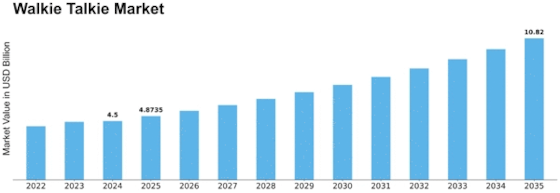
The Walkie Talkie Market was valued at 4.5 USD Billion in 2024.

What is the projected market size for the Walkie Talkie Market in 2035?

The market is projected to reach 10.82 USD Billion by 2035.

What is the expected CAGR for the Walkie Talkie Market during the forecast period 2025 - 2035?

The expected CAGR for the Walkie Talkie Market during 2025 - 2035 is 8.3%.

Which companies are considered key players in the Walkie Talkie Market?

Key players include Motorola Solutions, Kenwood, Icom, Tait Communications, Hytera, Uniden, Cobra Electronics, Midland Radio, and Vertex Standard.

How does the market segment for Analog and Digital Walkie Talkies compare?

In 2024, Analog Walkie Talkies were valued at 1.5 USD Billion, while Digital Walkie Talkies reached 3.0 USD Billion.

What are the projected valuations for Licensed and License-Free Walkie Talkies by 2035?

By 2035, Licensed Walkie Talkies are expected to reach 4.3 USD Billion, while License-Free Walkie Talkies may grow to 6.52 USD Billion.

Market Summary

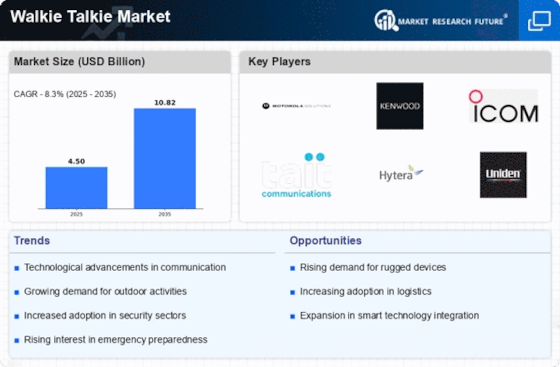
As per MRFR analysis, the Walkie Talkie Market Size was estimated at 4.5 USD Billion in 2024. The Walkie Talkie industry is projected to grow from 4.874 USD Billion in 2025 to 10.82 USD Billion by 2035, exhibiting a compound annual growth rate (CAGR) of 8.3 during the forecast period 2025 - 2035.

Key Market Trends & Highlights

The Walkie Talkie Market is experiencing robust growth driven by technological advancements and increasing demand across various sectors.

  • North America remains the largest market for walkie talkies, driven by extensive use in professional sectors. The Asia-Pacific region is emerging as the fastest-growing market, fueled by rising outdoor activities and recreational use. Digital walkie talkies dominate the market, while analog models are witnessing the fastest growth due to their simplicity and reliability. Technological advancements and the rising demand in emergency services are key drivers propelling market expansion.

Market Size & Forecast

2024 Market Size 4.5 (USD Billion)
2035 Market Size 10.82 (USD Billion)
CAGR (2025 - 2035) 8.3%
Largest Regional Market Share in 2024 North America

Major Players

<p>Motorola Solutions (US), Kenwood (JP), Icom (JP), Tait Communications (NZ), Hytera (CN), Uniden (AU), Cobra Electronics (US), Midland Radio (US), Vertex Standard (JP)</p>

Market Trends

The Walkie Talkie Market is currently experiencing a notable transformation, driven by advancements in technology and evolving consumer preferences. The integration of digital communication features into traditional walkie talkies is reshaping the landscape, allowing for enhanced connectivity and improved user experience. Furthermore, the demand for reliable communication devices in various sectors, including security, construction, and outdoor activities, appears to be on the rise. This trend suggests that walkie talkies are not merely relics of the past but are adapting to meet contemporary needs. In addition, the increasing focus on safety and emergency preparedness is likely to bolster the Walkie Talkie Market. As individuals and organizations prioritize effective communication during critical situations, the utility of walkie talkies becomes more pronounced. Moreover, the growing popularity of recreational activities, such as hiking and camping, may further stimulate market growth. Overall, the Walkie Talkie Market seems poised for continued evolution, reflecting broader technological trends and societal shifts.

Technological Integration

The Walkie Talkie Market is witnessing a surge in the incorporation of advanced technologies. Features such as Bluetooth connectivity, GPS tracking, and digital encryption are becoming commonplace, enhancing functionality and security. This trend indicates a shift towards more sophisticated communication tools that cater to diverse user needs.

Increased Demand in Professional Sectors

Various industries, including construction, security, and event management, are increasingly relying on walkie talkies for efficient communication. This growing demand suggests that businesses recognize the value of instant communication in enhancing operational efficiency and safety.

Focus on Recreational Use

The rise in outdoor recreational activities is contributing to the Walkie Talkie Market's expansion. As more individuals engage in activities like hiking, camping, and adventure sports, the need for reliable communication devices becomes essential, indicating a potential growth area for manufacturers.

Walkie Talkie Market Market Drivers

Enhanced User Experience

The Walkie Talkie Market is evolving to enhance user experience, which is becoming a key driver of growth. Manufacturers are focusing on ergonomic designs, user-friendly interfaces, and customizable features to cater to diverse consumer needs. The introduction of lightweight models and long-range capabilities is appealing to both professional users and recreational enthusiasts. Market Research Future indicates that consumer preferences are shifting towards devices that offer not only functionality but also comfort and ease of use. This trend is likely to influence purchasing decisions, as users seek walkie talkies that align with their specific requirements. As manufacturers continue to innovate and improve user experience, the Walkie Talkie Market is expected to thrive.

Technological Advancements

The Walkie Talkie Market is experiencing a surge in technological advancements, which is driving its growth. Innovations such as digital signal processing, enhanced battery life, and improved audio quality are making walkie talkies more appealing to consumers. The integration of features like Bluetooth connectivity and GPS tracking is also becoming commonplace. According to recent data, the market is projected to grow at a compound annual growth rate of approximately 7.5% over the next five years. This growth is indicative of the increasing reliance on advanced communication tools in various sectors, including security, construction, and event management. As technology continues to evolve, the Walkie Talkie Market is likely to see further enhancements that cater to both professional and recreational users.

Growth in Outdoor Activities

The Walkie Talkie Market is benefiting from the increasing popularity of outdoor activities. As more individuals engage in hiking, camping, and other recreational pursuits, the demand for reliable communication devices has surged. Walkie talkies provide a practical solution for maintaining contact in remote areas where cellular signals may be weak or nonexistent. Market analysis suggests that the recreational segment is growing at a rate of approximately 6% annually, driven by the desire for safety and connectivity during outdoor adventures. This trend is further supported by the rise of adventure tourism, which emphasizes the importance of communication tools. As outdoor enthusiasts seek dependable devices, the Walkie Talkie Market is poised for continued growth.

Rising Demand in Emergency Services

The Walkie Talkie Market is witnessing a notable increase in demand from emergency services. Organizations such as police, fire departments, and medical response teams rely heavily on reliable communication devices during critical situations. The need for instant communication in emergencies has led to a rise in the adoption of walkie talkies, which offer durability and ease of use. Recent statistics indicate that the emergency services sector accounts for a significant portion of walkie talkie sales, with an estimated market share of around 30%. This trend is expected to continue as agencies prioritize effective communication tools to enhance operational efficiency and safety. Consequently, the Walkie Talkie Market is likely to expand as more emergency services recognize the value of these devices.

Expansion in Industrial Applications

The Walkie Talkie Market is experiencing expansion due to its increasing applications in various industrial sectors. Industries such as manufacturing, logistics, and construction are adopting walkie talkies for their efficiency in facilitating communication among teams. These devices enable instant communication, which is crucial for maintaining productivity and safety in fast-paced environments. Recent data indicates that the industrial segment is projected to account for over 40% of the total market share by 2026. This growth is attributed to the need for seamless communication in large facilities and job sites. As industries continue to recognize the advantages of walkie talkies, the Walkie Talkie Market is likely to see sustained demand.

Market Segment Insights

Walkie Talkie Market Type Insights

<p>The Walkie Talkie Market segmentation, based on type, includes Analog and Digital. The analog segment dominated the market in 2022 because they were typically less expensive than their digital equivalents, analog walkie talkies were a popular option for companies and organizations searching for economical communication solutions.</p>

<p>Source: Secondary Research, Primary Research, MRFR Database and Analyst Review</p>

Walkie Talkie Market Distribution channel Insights

<p>The Walkie Talkie Market segmentation, based on Ownership, includes licensed and License-Free. The licensed category generated the most income in 2022. It is more difficult for unauthorized users to access or eavesdrop on conversations when using licensed frequencies, which add an extra degree of security. In sectors like<a href="https://www.marketresearchfuture.com/reports/public-safety-sensor-market-30699"> public safety</a>, defense, and security services, this level of security is essential.</p>

Walkie Talkie Market End User Insights

<p>The Walkie Talkie Market segmentation, based on End User, includes Consumer/Personal Use, Enterprises &amp; Commercial, Aerospace &amp; Defense, and Law Enforcement &amp; Security. The enterprises &amp; commercial category generated the most income in 2022. With the instantaneous and real-time communication offered by walkie talkies, decisions may be made more quickly and quickly adjusted to changing situations. This is especially important in fields that demand prompt cooperation and swift action.</p>

Get more detailed insights about Walkie Talkie Market Research Report - Forecast till 2035

Regional Insights

North America : Market Leader in Technology

North America is the largest market for walkie talkies, holding approximately 40% of the global share. The region's growth is driven by increasing demand in sectors such as public safety, construction, and event management. Regulatory support for communication technologies and advancements in digital walkie talkies further catalyze market expansion. The U.S. is the primary contributor, followed by Canada, which holds around 15% of the market share. The competitive landscape in North America is robust, featuring key players like Motorola Solutions, Cobra Electronics, and Midland Radio. These companies are innovating with features such as enhanced battery life and digital encryption. The presence of established distribution networks and a focus on customer service also bolster their market positions. The region's emphasis on safety and efficient communication continues to drive demand for walkie talkies.

Europe : Emerging Market with Growth Potential

Europe is witnessing significant growth in the walkie talkie market, accounting for approximately 30% of the global share. The demand is fueled by the increasing need for reliable communication in industries such as security, logistics, and event management. Regulatory frameworks promoting digital communication technologies are also enhancing market prospects. Germany and the UK are the largest markets, together holding about 20% of the total market share in the region. Leading countries in Europe include Germany, the UK, and France, with a competitive landscape featuring key players like Kenwood and Icom. The market is characterized by a mix of established brands and emerging companies focusing on innovative solutions. The presence of advanced manufacturing facilities and a strong distribution network further support market growth. The region is poised for continued expansion as businesses seek efficient communication solutions.

Asia-Pacific : Rapid Growth in Emerging Economies

Asia-Pacific is an emerging powerhouse in the walkie talkie market, holding around 25% of the global share. The region's growth is driven by rapid industrialization, urbanization, and the increasing adoption of advanced communication technologies. Countries like China and India are leading this growth, with China alone accounting for nearly 15% of the market share. Regulatory initiatives promoting digital communication are also contributing to market expansion. The competitive landscape in Asia-Pacific is diverse, featuring key players such as Hytera and Tait Communications. The region is characterized by a mix of local and international brands, with a focus on affordability and functionality. The increasing demand for walkie talkies in sectors like construction, hospitality, and public safety is further driving market growth. As the region continues to develop, the demand for reliable communication solutions is expected to rise significantly.

Middle East and Africa : Untapped Potential in Communication

The Middle East and Africa region is gradually emerging in the walkie talkie market, holding approximately 5% of the global share. The growth is primarily driven by increasing investments in infrastructure and the need for reliable communication in sectors such as security and construction. Countries like South Africa and the UAE are leading the market, with South Africa accounting for about 3% of the total share. Regulatory support for communication technologies is also a key driver of growth. The competitive landscape in this region is still developing, with a mix of local and international players. Companies like Uniden and Cobra Electronics are making strides in the market. The demand for walkie talkies is expected to rise as businesses and governments invest in communication infrastructure. The region's untapped potential presents opportunities for growth as the market matures.

Key Players and Competitive Insights

The Walkie Talkie Market is currently characterized by a dynamic competitive landscape, driven by technological advancements and increasing demand for reliable communication solutions across various sectors. Key players such as Motorola Solutions (US), Hytera (CN), and Kenwood (JP) are at the forefront, each adopting distinct strategies to enhance their market positioning. Motorola Solutions (US) emphasizes innovation through the integration of advanced digital technologies into their products, while Hytera (CN) focuses on expanding its global footprint through strategic partnerships and regional expansions. Kenwood (JP), on the other hand, appears to prioritize product diversification and customer-centric solutions, which collectively shape a competitive environment that is both robust and evolving.

In terms of business tactics, companies are increasingly localizing manufacturing to reduce costs and enhance supply chain efficiency. This trend is particularly evident in the moderately fragmented structure of the market, where the collective influence of key players fosters a competitive yet collaborative atmosphere. The emphasis on optimizing supply chains and local production capabilities is likely to enhance responsiveness to market demands, thereby strengthening competitive positions.

In August 2025, Motorola Solutions (US) announced the launch of a new line of ruggedized walkie-talkies designed specifically for outdoor and industrial applications. This strategic move not only reinforces their commitment to innovation but also addresses the growing demand for durable communication devices in challenging environments. The introduction of these products is expected to capture a significant share of the market, particularly among sectors such as construction and emergency services.

In September 2025, Hytera (CN) entered into a strategic partnership with a leading telecommunications provider to enhance its digital communication solutions. This collaboration aims to integrate Hytera's walkie-talkie technology with advanced network capabilities, thereby improving overall communication efficiency. Such partnerships are indicative of a broader trend towards digital transformation within the industry, positioning Hytera as a key player in the evolving landscape of communication technology.

In July 2025, Kenwood (JP) unveiled a new software platform that allows for seamless integration of their walkie-talkies with smart devices. This innovation not only enhances user experience but also reflects a growing trend towards the convergence of traditional communication devices with modern technology. By adopting such forward-thinking strategies, Kenwood is likely to attract a younger demographic, thereby expanding its market reach.

As of October 2025, the Walkie Talkie Market is witnessing significant trends such as digitalization, sustainability, and the integration of artificial intelligence. These trends are reshaping competitive dynamics, with strategic alliances becoming increasingly vital for success. The shift from price-based competition to a focus on innovation, technology, and supply chain reliability is evident, suggesting that companies must continuously adapt to maintain their competitive edge. Looking ahead, differentiation will likely hinge on the ability to leverage technology and foster collaborative partnerships, ensuring sustained growth in an ever-evolving market.

Key Companies in the Walkie Talkie Market market include

Industry Developments

January 2024: Santa Monica-based AI startup Rabbit introduced r1 during CES 2024. This is an artificial intelligence device that is handheld and works like a walkie-talkie with camera functionality. The main idea behind the r1 is that it does everything any app can do without requiring a smartphone. All users have to do is press the button on the side of the AI device, talk to the card-sized walkie-talkie about their request, and wait for the machine to do it. Simply put, r1 wants an app-free online experience by putting everything an app does into one portable touchscreen.

There are primarily two things that power Rabbit’s r1: its in-house OS, named rabbit OS, and Large Action Model (LAM), known as its system designed for making AI see and perform apps the same as humans do, like buying items and completing purchases.

Microsoft added a walkie-talkie feature to Teams in July 2020 — a new high-water mark in its effort to sell the collaboration app to frontline workers, such as retail sales associates, plumbers, and nurses who don’t sit at desks all day. To capture these kinds of users, Microsoft could significantly expand its business collaboration software if it convinces companies to license Teams for them.

The tech giant has been trying for years, with varying success, to make Teams more appealing for frontline workers who rarely use email or chat apps but need tools for communicating across time zones or taking shift notes when other employees aren't around. Several hardware vendors have also integrated products with the service.

Xiaomi’s ecological chain company BEEBEST — which is known for its wide range of walkie-talkies, including the impressive smart walkie-talkie that adopts a feature phone design launched in 2019 — has now released BEEBEST A308 Walkie-Talkie in June 2021. It is currently available on sale at Jingdong Mall for only 349 yuan ($54). BEEBEST A308 Walkie-Talkie uses an ultra-thin lightweight design, which differentiates it from traditional walkie-talkies. It weighs only 137g and has a thickness of 16mm. Additionally, the body is designed for users to hold comfortably.

January 2022: Microsoft made the Microsoft Teams Walkie-Talkie feature available to all Android and iOS users.

January 2022: The noise-cancelling walkie-talkie radio, which features DSP chips and was released by Kickstarter, one of the top businesses in the market, creates a digital reproduction of the noise before it reaches the receiver. As a result, it is thought that the gadget can communicate more clearly even in the noisiest environments.

Future Outlook

Walkie Talkie Market Future Outlook

<p>The Walkie Talkie Market is projected to grow at an 8.3% CAGR from 2024 to 2035, driven by advancements in technology, increased demand in various sectors, and enhanced communication needs.</p>

New opportunities lie in:

  • <p>Integration of AI for predictive maintenance solutions.</p><p>Development of ruggedized models for extreme environments.</p><p>Expansion into emerging markets with tailored pricing strategies.</p>

<p>By 2035, the Walkie Talkie Market is expected to achieve substantial growth, solidifying its position in global communications.</p>

Market Segmentation

Walkie Talkie Market Type Outlook

  • Analog
  • Digital

Walkie Talkie Market End User Outlook

  • Consumer/Personal Use
  • Enterprises & Commercial
  • Aerospace & Defense
  • Law Enforcement & Security

Walkie Talkie Market Ownership Outlook

  • Licensed
  • License-Free

Report Scope

MARKET SIZE 20244.5(USD Billion)
MARKET SIZE 20254.874(USD Billion)
MARKET SIZE 203510.82(USD Billion)
COMPOUND ANNUAL GROWTH RATE (CAGR)8.3% (2024 - 2035)
REPORT COVERAGERevenue Forecast, Competitive Landscape, Growth Factors, and Trends
BASE YEAR2024
Market Forecast Period2025 - 2035
Historical Data2019 - 2024
Market Forecast UnitsUSD Billion
Key Companies ProfiledMarket analysis in progress
Segments CoveredMarket segmentation analysis in progress
Key Market OpportunitiesIntegration of advanced digital technologies enhances communication efficiency in the Walkie Talkie Market.
Key Market DynamicsTechnological advancements and evolving consumer preferences drive innovation and competition in the walkie talkie market.
Countries CoveredNorth America, Europe, APAC, South America, MEA

FAQs

What is the current valuation of the Walkie Talkie Market as of 2024?

The Walkie Talkie Market was valued at 4.5 USD Billion in 2024.

What is the projected market size for the Walkie Talkie Market in 2035?

The market is projected to reach 10.82 USD Billion by 2035.

What is the expected CAGR for the Walkie Talkie Market during the forecast period 2025 - 2035?

The expected CAGR for the Walkie Talkie Market during 2025 - 2035 is 8.3%.

Which companies are considered key players in the Walkie Talkie Market?

Key players include Motorola Solutions, Kenwood, Icom, Tait Communications, Hytera, Uniden, Cobra Electronics, Midland Radio, and Vertex Standard.

How does the market segment for Analog and Digital Walkie Talkies compare?

In 2024, Analog Walkie Talkies were valued at 1.5 USD Billion, while Digital Walkie Talkies reached 3.0 USD Billion.

What are the projected valuations for Licensed and License-Free Walkie Talkies by 2035?

By 2035, Licensed Walkie Talkies are expected to reach 4.3 USD Billion, while License-Free Walkie Talkies may grow to 6.52 USD Billion.

  1. SECTION I: EXECUTIVE SUMMARY AND KEY HIGHLIGHTS
    1. EXECUTIVE SUMMARY
      1. Market Overview
      2. Key Findings
      3. Market Segmentation
      4. Competitive Landscape
      5. Challenges and Opportunities
      6. Future Outlook 2
  2. SECTION II: SCOPING, METHODOLOGY AND MARKET STRUCTURE
    1. MARKET INTRODUCTION
      1. Definition
      2. Scope of the study
    2. RESEARCH METHODOLOGY
      1. Overview
      2. Data Mining
      3. Secondary Research
      4. Primary Research
      5. Forecasting Model
      6. Market Size Estimation
      7. Data Triangulation
      8. Validation 3
  3. SECTION III: QUALITATIVE ANALYSIS
    1. MARKET DYNAMICS
      1. Overview
      2. Drivers
      3. Restraints
      4. Opportunities
    2. MARKET FACTOR ANALYSIS
      1. Value chain Analysis
      2. Porter's Five Forces Analysis
      3. COVID-19 Impact Analysis
  4. SECTION IV: QUANTITATIVE ANALYSIS
    1. Semiconductor & Electronics, BY Type (USD Billion)
      1. Analog
      2. Digital
    2. Semiconductor & Electronics, BY Ownership (USD Billion)
      1. Licensed
      2. License-Free
    3. Semiconductor & Electronics, BY End User (USD Billion)
      1. Consumer/Personal Use
      2. Enterprises & Commercial
      3. Aerospace & Defense
      4. Law Enforcement & Security
    4. Semiconductor & Electronics, BY Region (USD Billion)
      1. North America
      2. Europe
      3. APAC
      4. South America
      5. MEA
  5. SECTION V: COMPETITIVE ANALYSIS
    1. Competitive Landscape
      1. Overview
      2. Competitive Analysis
      3. Market share Analysis
      4. Major Growth Strategy in the Semiconductor & Electronics
      5. Competitive Benchmarking
      6. Leading Players in Terms of Number of Developments in the Semiconductor & Electronics
      7. Key developments and growth strategies
      8. Major Players Financial Matrix
    2. Company Profiles
      1. Motorola Solutions (US)
      2. Kenwood (JP)
      3. Icom (JP)
      4. Tait Communications (NZ)
      5. Hytera (CN)
      6. Uniden (AU)
      7. Cobra Electronics (US)
      8. Midland Radio (US)
      9. Vertex Standard (JP)
    3. Appendix
      1. References
      2. Related Reports 6 LIST OF FIGURES
    4. MARKET SYNOPSIS
    5. NORTH AMERICA MARKET ANALYSIS
    6. US MARKET ANALYSIS BY TYPE
    7. US MARKET ANALYSIS BY OWNERSHIP
    8. US MARKET ANALYSIS BY END USER
    9. CANADA MARKET ANALYSIS BY TYPE
    10. CANADA MARKET ANALYSIS BY OWNERSHIP
    11. CANADA MARKET ANALYSIS BY END USER
    12. EUROPE MARKET ANALYSIS
    13. GERMANY MARKET ANALYSIS BY TYPE
    14. GERMANY MARKET ANALYSIS BY OWNERSHIP
    15. GERMANY MARKET ANALYSIS BY END USER
    16. UK MARKET ANALYSIS BY TYPE
    17. UK MARKET ANALYSIS BY OWNERSHIP
    18. UK MARKET ANALYSIS BY END USER
    19. FRANCE MARKET ANALYSIS BY TYPE
    20. FRANCE MARKET ANALYSIS BY OWNERSHIP
    21. FRANCE MARKET ANALYSIS BY END USER
    22. RUSSIA MARKET ANALYSIS BY TYPE
    23. RUSSIA MARKET ANALYSIS BY OWNERSHIP
    24. RUSSIA MARKET ANALYSIS BY END USER
    25. ITALY MARKET ANALYSIS BY TYPE
    26. ITALY MARKET ANALYSIS BY OWNERSHIP
    27. ITALY MARKET ANALYSIS BY END USER
    28. SPAIN MARKET ANALYSIS BY TYPE
    29. SPAIN MARKET ANALYSIS BY OWNERSHIP
    30. SPAIN MARKET ANALYSIS BY END USER
    31. REST OF EUROPE MARKET ANALYSIS BY TYPE
    32. REST OF EUROPE MARKET ANALYSIS BY OWNERSHIP
    33. REST OF EUROPE MARKET ANALYSIS BY END USER
    34. APAC MARKET ANALYSIS
    35. CHINA MARKET ANALYSIS BY TYPE
    36. CHINA MARKET ANALYSIS BY OWNERSHIP
    37. CHINA MARKET ANALYSIS BY END USER
    38. INDIA MARKET ANALYSIS BY TYPE
    39. INDIA MARKET ANALYSIS BY OWNERSHIP
    40. INDIA MARKET ANALYSIS BY END USER
    41. JAPAN MARKET ANALYSIS BY TYPE
    42. JAPAN MARKET ANALYSIS BY OWNERSHIP
    43. JAPAN MARKET ANALYSIS BY END USER
    44. SOUTH KOREA MARKET ANALYSIS BY TYPE
    45. SOUTH KOREA MARKET ANALYSIS BY OWNERSHIP
    46. SOUTH KOREA MARKET ANALYSIS BY END USER
    47. MALAYSIA MARKET ANALYSIS BY TYPE
    48. MALAYSIA MARKET ANALYSIS BY OWNERSHIP
    49. MALAYSIA MARKET ANALYSIS BY END USER
    50. THAILAND MARKET ANALYSIS BY TYPE
    51. THAILAND MARKET ANALYSIS BY OWNERSHIP
    52. THAILAND MARKET ANALYSIS BY END USER
    53. INDONESIA MARKET ANALYSIS BY TYPE
    54. INDONESIA MARKET ANALYSIS BY OWNERSHIP
    55. INDONESIA MARKET ANALYSIS BY END USER
    56. REST OF APAC MARKET ANALYSIS BY TYPE
    57. REST OF APAC MARKET ANALYSIS BY OWNERSHIP
    58. REST OF APAC MARKET ANALYSIS BY END USER
    59. SOUTH AMERICA MARKET ANALYSIS
    60. BRAZIL MARKET ANALYSIS BY TYPE
    61. BRAZIL MARKET ANALYSIS BY OWNERSHIP
    62. BRAZIL MARKET ANALYSIS BY END USER
    63. MEXICO MARKET ANALYSIS BY TYPE
    64. MEXICO MARKET ANALYSIS BY OWNERSHIP
    65. MEXICO MARKET ANALYSIS BY END USER
    66. ARGENTINA MARKET ANALYSIS BY TYPE
    67. ARGENTINA MARKET ANALYSIS BY OWNERSHIP
    68. ARGENTINA MARKET ANALYSIS BY END USER
    69. REST OF SOUTH AMERICA MARKET ANALYSIS BY TYPE
    70. REST OF SOUTH AMERICA MARKET ANALYSIS BY OWNERSHIP
    71. REST OF SOUTH AMERICA MARKET ANALYSIS BY END USER
    72. MEA MARKET ANALYSIS
    73. GCC COUNTRIES MARKET ANALYSIS BY TYPE
    74. GCC COUNTRIES MARKET ANALYSIS BY OWNERSHIP
    75. GCC COUNTRIES MARKET ANALYSIS BY END USER
    76. SOUTH AFRICA MARKET ANALYSIS BY TYPE
    77. SOUTH AFRICA MARKET ANALYSIS BY OWNERSHIP
    78. SOUTH AFRICA MARKET ANALYSIS BY END USER
    79. REST OF MEA MARKET ANALYSIS BY TYPE
    80. REST OF MEA MARKET ANALYSIS BY OWNERSHIP
    81. REST OF MEA MARKET ANALYSIS BY END USER
    82. KEY BUYING CRITERIA OF SEMICONDUCTOR & ELECTRONICS
    83. RESEARCH PROCESS OF MRFR
    84. DRO ANALYSIS OF SEMICONDUCTOR & ELECTRONICS
    85. DRIVERS IMPACT ANALYSIS: SEMICONDUCTOR & ELECTRONICS
    86. RESTRAINTS IMPACT ANALYSIS: SEMICONDUCTOR & ELECTRONICS
    87. SUPPLY / VALUE CHAIN: SEMICONDUCTOR & ELECTRONICS
    88. SEMICONDUCTOR & ELECTRONICS, BY TYPE, 2024 (% SHARE)
    89. SEMICONDUCTOR & ELECTRONICS, BY TYPE, 2024 TO 2035 (USD Billion)
    90. SEMICONDUCTOR & ELECTRONICS, BY OWNERSHIP, 2024 (% SHARE)
    91. SEMICONDUCTOR & ELECTRONICS, BY OWNERSHIP, 2024 TO 2035 (USD Billion)
    92. SEMICONDUCTOR & ELECTRONICS, BY END USER, 2024 (% SHARE)
    93. SEMICONDUCTOR & ELECTRONICS, BY END USER, 2024 TO 2035 (USD Billion)
    94. BENCHMARKING OF MAJOR COMPETITORS 7 LIST OF TABLES
    95. LIST OF ASSUMPTIONS
    96. North America MARKET SIZE ESTIMATES; FORECAST
      1. BY TYPE, 2025-2035 (USD Billion)
      2. BY OWNERSHIP, 2025-2035 (USD Billion)
      3. BY END USER, 2025-2035 (USD Billion)
    97. US MARKET SIZE ESTIMATES; FORECAST
      1. BY TYPE, 2025-2035 (USD Billion)
      2. BY OWNERSHIP, 2025-2035 (USD Billion)
      3. BY END USER, 2025-2035 (USD Billion)
    98. Canada MARKET SIZE ESTIMATES; FORECAST
      1. BY TYPE, 2025-2035 (USD Billion)
      2. BY OWNERSHIP, 2025-2035 (USD Billion)
      3. BY END USER, 2025-2035 (USD Billion)
    99. Europe MARKET SIZE ESTIMATES; FORECAST
      1. BY TYPE, 2025-2035 (USD Billion)
      2. BY OWNERSHIP, 2025-2035 (USD Billion)
      3. BY END USER, 2025-2035 (USD Billion)
    100. Germany MARKET SIZE ESTIMATES; FORECAST
      1. BY TYPE, 2025-2035 (USD Billion)
      2. BY OWNERSHIP, 2025-2035 (USD Billion)
      3. BY END USER, 2025-2035 (USD Billion)
    101. UK MARKET SIZE ESTIMATES; FORECAST
      1. BY TYPE, 2025-2035 (USD Billion)
      2. BY OWNERSHIP, 2025-2035 (USD Billion)
      3. BY END USER, 2025-2035 (USD Billion)
    102. France MARKET SIZE ESTIMATES; FORECAST
      1. BY TYPE, 2025-2035 (USD Billion)
      2. BY OWNERSHIP, 2025-2035 (USD Billion)
      3. BY END USER, 2025-2035 (USD Billion)
    103. Russia MARKET SIZE ESTIMATES; FORECAST
      1. BY TYPE, 2025-2035 (USD Billion)
      2. BY OWNERSHIP, 2025-2035 (USD Billion)
      3. BY END USER, 2025-2035 (USD Billion)
    104. Italy MARKET SIZE ESTIMATES; FORECAST
      1. BY TYPE, 2025-2035 (USD Billion)
      2. BY OWNERSHIP, 2025-2035 (USD Billion)
      3. BY END USER, 2025-2035 (USD Billion)
    105. Spain MARKET SIZE ESTIMATES; FORECAST
      1. BY TYPE, 2025-2035 (USD Billion)
      2. BY OWNERSHIP, 2025-2035 (USD Billion)
      3. BY END USER, 2025-2035 (USD Billion)
    106. Rest of Europe MARKET SIZE ESTIMATES; FORECAST
      1. BY TYPE, 2025-2035 (USD Billion)
      2. BY OWNERSHIP, 2025-2035 (USD Billion)
      3. BY END USER, 2025-2035 (USD Billion)
    107. APAC MARKET SIZE ESTIMATES; FORECAST
      1. BY TYPE, 2025-2035 (USD Billion)
      2. BY OWNERSHIP, 2025-2035 (USD Billion)
      3. BY END USER, 2025-2035 (USD Billion)
    108. China MARKET SIZE ESTIMATES; FORECAST
      1. BY TYPE, 2025-2035 (USD Billion)
      2. BY OWNERSHIP, 2025-2035 (USD Billion)
      3. BY END USER, 2025-2035 (USD Billion)
    109. India MARKET SIZE ESTIMATES; FORECAST
      1. BY TYPE, 2025-2035 (USD Billion)
      2. BY OWNERSHIP, 2025-2035 (USD Billion)
      3. BY END USER, 2025-2035 (USD Billion)
    110. Japan MARKET SIZE ESTIMATES; FORECAST
      1. BY TYPE, 2025-2035 (USD Billion)
      2. BY OWNERSHIP, 2025-2035 (USD Billion)
      3. BY END USER, 2025-2035 (USD Billion)
    111. South Korea MARKET SIZE ESTIMATES; FORECAST
      1. BY TYPE, 2025-2035 (USD Billion)
      2. BY OWNERSHIP, 2025-2035 (USD Billion)
      3. BY END USER, 2025-2035 (USD Billion)
    112. Malaysia MARKET SIZE ESTIMATES; FORECAST
      1. BY TYPE, 2025-2035 (USD Billion)
      2. BY OWNERSHIP, 2025-2035 (USD Billion)
      3. BY END USER, 2025-2035 (USD Billion)
    113. Thailand MARKET SIZE ESTIMATES; FORECAST
      1. BY TYPE, 2025-2035 (USD Billion)
      2. BY OWNERSHIP, 2025-2035 (USD Billion)
      3. BY END USER, 2025-2035 (USD Billion)
    114. Indonesia MARKET SIZE ESTIMATES; FORECAST
      1. BY TYPE, 2025-2035 (USD Billion)
      2. BY OWNERSHIP, 2025-2035 (USD Billion)
      3. BY END USER, 2025-2035 (USD Billion)
    115. Rest of APAC MARKET SIZE ESTIMATES; FORECAST
      1. BY TYPE, 2025-2035 (USD Billion)
      2. BY OWNERSHIP, 2025-2035 (USD Billion)
      3. BY END USER, 2025-2035 (USD Billion)
    116. South America MARKET SIZE ESTIMATES; FORECAST
      1. BY TYPE, 2025-2035 (USD Billion)
      2. BY OWNERSHIP, 2025-2035 (USD Billion)
      3. BY END USER, 2025-2035 (USD Billion)
    117. Brazil MARKET SIZE ESTIMATES; FORECAST
      1. BY TYPE, 2025-2035 (USD Billion)
      2. BY OWNERSHIP, 2025-2035 (USD Billion)
      3. BY END USER, 2025-2035 (USD Billion)
    118. Mexico MARKET SIZE ESTIMATES; FORECAST
      1. BY TYPE, 2025-2035 (USD Billion)
      2. BY OWNERSHIP, 2025-2035 (USD Billion)
      3. BY END USER, 2025-2035 (USD Billion)
    119. Argentina MARKET SIZE ESTIMATES; FORECAST
      1. BY TYPE, 2025-2035 (USD Billion)
      2. BY OWNERSHIP, 2025-2035 (USD Billion)
      3. BY END USER, 2025-2035 (USD Billion)
    120. Rest of South America MARKET SIZE ESTIMATES; FORECAST
      1. BY TYPE, 2025-2035 (USD Billion)
      2. BY OWNERSHIP, 2025-2035 (USD Billion)
      3. BY END USER, 2025-2035 (USD Billion)
    121. MEA MARKET SIZE ESTIMATES; FORECAST
      1. BY TYPE, 2025-2035 (USD Billion)
      2. BY OWNERSHIP, 2025-2035 (USD Billion)
      3. BY END USER, 2025-2035 (USD Billion)
    122. GCC Countries MARKET SIZE ESTIMATES; FORECAST
      1. BY TYPE, 2025-2035 (USD Billion)
      2. BY OWNERSHIP, 2025-2035 (USD Billion)
      3. BY END USER, 2025-2035 (USD Billion)
    123. South Africa MARKET SIZE ESTIMATES; FORECAST
      1. BY TYPE, 2025-2035 (USD Billion)
      2. BY OWNERSHIP, 2025-2035 (USD Billion)
      3. BY END USER, 2025-2035 (USD Billion)
    124. Rest of MEA MARKET SIZE ESTIMATES; FORECAST
      1. BY TYPE, 2025-2035 (USD Billion)
      2. BY OWNERSHIP, 2025-2035 (USD Billion)
      3. BY END USER, 2025-2035 (USD Billion)
    125. PRODUCT LAUNCH/PRODUCT DEVELOPMENT/APPROVAL
    126. ACQUISITION/PARTNERSHIP

Walkie Talkie Market Segmentation

Walkie Talkie Market type Outlook (USD Billion, 2018-2032)

Analog

Digital

Walkie Talkie Market Ownership Outlook (USD Billion, 2018-2032)

licensed

License-Free

Walkie Talkie Market End User Outlook (USD Billion, 2018-2032)

Consumer/Personal Use

Enterprises & Commercial

Aerospace & Defense

Law Enforcement & Security

Walkie Talkie Market Regional Outlook (USD Billion, 2018-2032)

North America Outlook (USD Billion, 2018-2032)

Walkie Talkie Market by type

Analog

Digital

Walkie Talkie Market by Ownership

licensed

License-Free

Walkie Talkie Market by End User

Consumer/Personal Use

Enterprises & Commercial

Aerospace & Defense

Law Enforcement & Security

US Outlook (USD Billion, 2018-2032)

Walkie Talkie Market by type

Analog

Digital

Walkie Talkie Market by Ownership

licensed

License-Free

Walkie Talkie Market by End User

Consumer/Personal Use

Enterprises & Commercial

Aerospace & Defense

Law Enforcement & Security

Canada Outlook (USD Billion, 2018-2032)

Walkie Talkie Market by type

Analog

Digital

Walkie Talkie Market by Ownership

licensed

License-Free

Walkie Talkie Market by End User

Consumer/Personal Use

Enterprises & Commercial

Aerospace & Defense

Law Enforcement & Security

Europe Outlook (USD Billion, 2018-2032)

Walkie Talkie Market by type

Analog

Digital

Walkie Talkie Market by Ownership

licensed

License-Free

Walkie Talkie Market by End User

Consumer/Personal Use

Enterprises & Commercial

Aerospace & Defense

Law Enforcement & Security

Germany Outlook (USD Billion, 2018-2032)

Walkie Talkie Market by type

Analog

Digital

Walkie Talkie Market by Ownership

licensed

License-Free

Walkie Talkie Market by End User

Consumer/Personal Use

Enterprises & Commercial

Aerospace & Defense

Law Enforcement & Security

France Outlook (USD Billion, 2018-2032)

Walkie Talkie Market by type

Analog

Digital

Walkie Talkie Market by Ownership

licensed

License-Free

Walkie Talkie Market by End User

Consumer/Personal Use

Enterprises & Commercial

Aerospace & Defense

Law Enforcement & Security

UK Outlook (USD Billion, 2018-2032)

Walkie Talkie Market by type

Analog

Digital

Walkie Talkie Market by Ownership

licensed

License-Free

Walkie Talkie Market by End User

Consumer/Personal Use

Enterprises & Commercial

Aerospace & Defense

Law Enforcement & Security

Italy Outlook (USD Billion, 2018-2032)

Walkie Talkie Market by type

Analog

Digital

Walkie Talkie Market by Ownership

licensed

License-Free

Walkie Talkie Market by End User

Consumer/Personal Use

Enterprises & Commercial

Aerospace & Defense

Law Enforcement & Security

Spain Outlook (USD Billion, 2018-2032)

Walkie Talkie Market by type

Analog

Digital

Walkie Talkie Market by Ownership

licensed

License-Free

Walkie Talkie Market by End User

Consumer/Personal Use

Enterprises & Commercial

Aerospace & Defense

Law Enforcement & Security

Rest Of Europe Outlook (USD Billion, 2018-2032)

Walkie Talkie Market by type

Analog

Digital

Walkie Talkie Market by Ownership

licensed

License-Free

Walkie Talkie Market by End User

Consumer/Personal Use

Enterprises & Commercial

Aerospace & Defense

Law Enforcement & Security

Asia-Pacific Outlook (USD Billion, 2018-2032)

Walkie Talkie Market by type

Analog

Digital

Walkie Talkie Market by Ownership

licensed

License-Free

Walkie Talkie Market by End User

Consumer/Personal Use

Enterprises & Commercial

Aerospace & Defense

Law Enforcement & Security

China Outlook (USD Billion, 2018-2032)

Walkie Talkie Market by type

Analog

Digital

Walkie Talkie Market by Ownership

licensed

License-Free

Walkie Talkie Market by End User

Consumer/Personal Use

Enterprises & Commercial

Aerospace & Defense

Law Enforcement & Security

Japan Outlook (USD Billion, 2018-2032)

Walkie Talkie Market by type

Analog

Digital

Walkie Talkie Market by Ownership

licensed

License-Free

Walkie Talkie Market by End User

Consumer/Personal Use

Enterprises & Commercial

Aerospace & Defense

Law Enforcement & Security

India Outlook (USD Billion, 2018-2032)

Walkie Talkie Market by type

Analog

Digital

Walkie Talkie Market by Ownership

licensed

License-Free

Walkie Talkie Market by End User

Consumer/Personal Use

Enterprises & Commercial

Aerospace & Defense

Law Enforcement & Security

Australia Outlook (USD Billion, 2018-2032)

Walkie Talkie Market by type

Analog

Digital

Walkie Talkie Market by Ownership

licensed

License-Free

Walkie Talkie Market by End User

Consumer/Personal Use

Enterprises & Commercial

Aerospace & Defense

Law Enforcement & Security

Rest of Asia-Pacific Outlook (USD Billion, 2018-2032)

Walkie Talkie Market by type

Analog

Digital

Walkie Talkie Market by Ownership

licensed

License-Free

Walkie Talkie Market by End User

Consumer/Personal Use

Enterprises & Commercial

Aerospace & Defense

Law Enforcement & Security

Rest of the World Outlook (USD Billion, 2018-2032)

Walkie Talkie Market by type

Analog

Digital

Walkie Talkie Market by Ownership

licensed

License-Free

Walkie Talkie Market by End User

Consumer/Personal Use

Enterprises & Commercial

Aerospace & Defense

Law Enforcement & Security

Middle East Outlook (USD Billion, 2018-2032)

Walkie Talkie Market by type

Analog

Digital

Walkie Talkie Market by Ownership

licensed

License-Free

Walkie Talkie Market by End User

Consumer/Personal Use

Enterprises & Commercial

Aerospace & Defense

Law Enforcement & Security

Africa Outlook (USD Billion, 2018-2032)

Walkie Talkie Market by type

Analog

Digital

Walkie Talkie Market by Ownership

licensed

License-Free

Walkie Talkie Market by End User

Consumer/Personal Use

Enterprises & Commercial

Aerospace & Defense

Law Enforcement & Security

Latin America Outlook (USD Billion, 2018-2032)

Walkie Talkie Market by type

Analog

Digital

Walkie Talkie Market by Ownership

licensed

License-Free

Walkie Talkie Market by End User

Consumer/Personal Use

Enterprises & Commercial

Aerospace & Defense

Law Enforcement & Security

Infographic

Free Sample Request

Kindly complete the form below to receive a free sample of this Report

Get Free Sample

Customer Strories

Compare Licence

×
Features License Type
Single User Multiuser License Enterprise User
Price $4,950 $5,950 $7,250
Maximum User Access Limit 1 User Upto 10 Users Unrestricted Access Throughout the Organization
Free Customization
Direct Access to Analyst
Deliverable Format
Platform Access
Discount on Next Purchase 10% 15% 15%
Printable Versions