Request Free Sample ×

Kindly complete the form below to receive a free sample of this Report

* Please use a valid business email

Leading companies partner with us for data-driven Insights

clients tt-cursor
Hero Background
English
Chinese
French
Japanese
Korean
German
Spanish

Wafer Level Packaging Market Analysis

ID: MRFR/SEM/10774-HCR
200 Pages
Kiran Jinkalwad
Last Updated: April 06, 2026

Wafer Level Packaging Market Size, Share and Research Report By Type (3D TSV WLP, 2.5D TSV WLP, WLCSP, Nano WLP and Others), By Technology (Fan in wafer level packaging and Fan out wafer level packaging), By End-User (Consumer Electronics, IT and Telecommunication, Automotive and Healthcare), and By Region (North America, Europe, Asia-Pacific, And Rest Of The World) –Industry Forecast Till 2035

Share:
Download PDF ×

We do not share your information with anyone. However, we may send you emails based on your report interest from time to time. You may contact us at any time to opt-out.

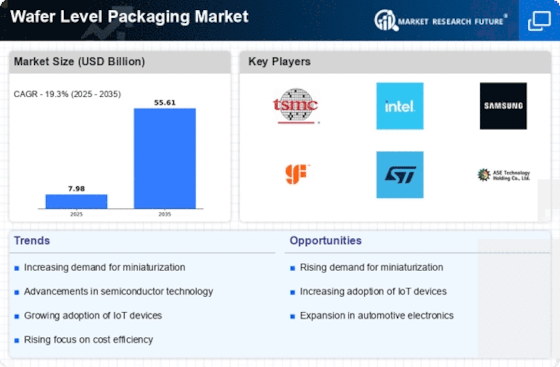
Wafer Level Packaging Market Infographic
Purchase Options

Market Analysis

In-depth Analysis of Wafer Level Packaging Market Industry Landscape

The market for Wafer Level Packaging (WLP) is an ever-changing and adaptable landscape, in which factors external to the process of manufacturing itself affect its development. A good grasp of these market dynamics is crucial for industry players to make informed choices and keep ahead. The nature of market dynamics is influenced by the desire for higher performance, smaller form factors and greater reliability in advanced semiconductor devices. With wafer level packaging, higher density integrated circuits become possible and this helps to bring about advanced electronic products. In terms of market dynamics, the consumer electronics sector is key. In the production of smartphones, wearables and other consumer electronic devices, packaging at wafer level is widely used. The need for lightweight, space-saving electronic components in these devices spurs an expanding WLP market. The need for improved system integration is the market's primary dynamic. The wafer level packaging technique allows several functions and parts to be integrated into one package, making fewer external components necessary. This increases the efficiency of semiconductor devices in general as well as their reliability. International supply chain disruptions affect market dynamics. Semiconductor shortages and problems in getting hold of raw materials can affect the production or availability of wafer level packaging solutions, which then have an effect on prices as well as competition among suppliers. Market dynamics are due to investment in research and development, as well as collaboration. To promote WLP technologies, generate new ideas and stay ahead of the rapidly developing semiconductor packaging environment each year most companies form some sort of partnership with other manufacturers or enter into joint-venture arrangements. Further increasing the automotive industry's reliance on electronics are advanced driver-assistance systems (ADAS) and in-vehicle connectivity, which adds market impetus. Above all, the stringent requirements for reliability and performance in automotive semiconductor components need wafer level packaging.

Author
Author Profile
Kiran Jinkalwad
Research Associate Level - II

Kiran Jinkalwad brings over four years of experience in market research, specializing in the ICT and Semiconductor sectors. She has worked on 50+ projects, including custom studies for companies like Microsoft and Huawei, addressing complex business challenges. With a background in Electronics and Telecommunication, Kiran excels in market estimation, forecasting, and strategic analysis. His sharp analytical skills and industry knowledge consistently deliver actionable insights for diverse clients.

Leave a Comment

FAQs

What is the projected market valuation of the Wafer Level Packaging Market by 2035?

<p>The Wafer Level Packaging Market is projected to reach a valuation of 55.61 USD Billion by 2035.</p>

What was the market valuation of the Wafer Level Packaging Market in 2024?

<p>In 2024, the Wafer Level Packaging Market was valued at 7.981 USD Billion.</p>

What is the expected CAGR for the Wafer Level Packaging Market during the forecast period 2025 - 2035?

<p>The expected CAGR for the Wafer Level Packaging Market during the forecast period 2025 - 2035 is 19.3%.</p>

Which companies are considered key players in the Wafer Level Packaging Market?

<p>Key players in the Wafer Level Packaging Market include TSMC, Intel, Samsung, GlobalFoundries, and others.</p>

What are the main types of Wafer Level Packaging and their projected valuations?

<p>The main types include 3D TSV WLP, 2.5D TSV WLP, WLCSP, Nano WLP, and others, with valuations ranging from 1.0 to 15.0 USD Billion.</p>

How does the Fan Out Wafer Level Packaging segment compare to Fan In Wafer Level Packaging in terms of market size?

<p>Fan Out Wafer Level Packaging is projected to reach 37.12 USD Billion, while Fan In Wafer Level Packaging is expected to reach 18.5 USD Billion.</p>

What end-user segments are driving the Wafer Level Packaging Market?

The end-user segments driving the market include Consumer Electronics, IT and Telecommunication, Automotive, and Healthcare.

What is the projected valuation for the Consumer Electronics segment by 2035?

The Consumer Electronics segment is projected to reach a valuation of 18.5 USD Billion by 2035.

What is the expected growth trajectory for the Automotive segment in the Wafer Level Packaging Market?

The Automotive segment is expected to grow to 10.0 USD Billion by 2035.

How does the projected growth of the Wafer Level Packaging Market reflect on technological advancements?

The projected growth indicates a strong correlation with advancements in technology, particularly in sectors like Consumer Electronics and Automotive.

Market Summary

As per Market Research Future analysis, the Wafer Level Packaging Market was estimated at 8.6 USD Billion in 2024. The Wafer Level Packaging industry is projected to grow from 9.5 USD Billion in 2025 to 25.2 USD Billion by 2035, exhibiting a compound annual growth rate (CAGR) of 10.25% during the forecast period 2025 - 2035

Key Market Trends & Highlights

The Wafer Level Packaging Market is poised for substantial growth driven by technological advancements and increasing demand for miniaturized electronics.

  • The market is witnessing a trend towards the miniaturization of electronic devices, enhancing portability and functionality. Sustainability initiatives are gaining traction, prompting manufacturers to adopt eco-friendly materials and processes. Integration with IoT technologies is becoming prevalent, facilitating smarter and more connected devices. Rising demand for high-performance electronics and advancements in semiconductor technology are key drivers propelling market growth.

Market Size & Forecast

2024 Market Size 8.6 (USD Billion)
2035 Market Size 25.2 (USD Billion)
CAGR (2025 - 2035) 10.25%
Largest Regional Market Share in 2024 North America

Major Players

TSMC (TW), Intel (US), Samsung (KR), GlobalFoundries (US), STMicroelectronics (FR), ASE Technology Holding Co., Ltd. (TW), Amkor Technology (US), Siliconware Precision Industries Co., Ltd. (TW), NXP Semiconductors (NL)

Market Trends

The Wafer Level Packaging Market is currently experiencing a transformative phase, driven by advancements in semiconductor technology and the increasing demand for miniaturized electronic devices. This The Wafer Level Packaging market appears to be expanding as manufacturers seek to enhance performance while reducing the size and weight of components. The integration of wafer level packaging techniques allows for improved thermal management and electrical performance, which seems to be appealing to various sectors, including consumer electronics, automotive, and telecommunications. Furthermore, the trend towards Internet of Things (IoT) devices is likely to propel the adoption of wafer level packaging solutions, as these applications require compact and efficient packaging methods. In addition, the Wafer Level Packaging Market is witnessing a shift towards sustainable practices. Companies are increasingly focusing on environmentally friendly materials and processes, which may contribute to a more sustainable supply chain. This shift not only addresses regulatory pressures but also aligns with consumer preferences for greener products. As the Wafer Level Packaging market evolves, it appears that innovation in packaging technologies will play a crucial role in meeting the diverse needs of end-users, ultimately shaping the future landscape of the semiconductor industry. The ongoing research and development efforts indicate a promising outlook for wafer level packaging solutions in the coming years.

Miniaturization of Electronic Devices

The trend towards smaller and more efficient electronic devices is driving the demand for wafer level packaging solutions. As consumer electronics become increasingly compact, manufacturers are adopting advanced packaging techniques to meet these requirements.

Sustainability Initiatives

There is a growing emphasis on sustainable practices within the Wafer Level Packaging Market. Companies are exploring eco-friendly materials and processes, which may enhance their market appeal and comply with environmental regulations.

Integration with IoT Technologies

The rise of Internet of Things applications is influencing the Wafer Level Packaging Market. As IoT devices require efficient and compact packaging, this trend is likely to boost the adoption of innovative packaging solutions.

Wafer Level Packaging Market Market Drivers

Growing Adoption of 5G Technology

The rollout of 5G technology is poised to have a profound impact on the Wafer Level Packaging Market. With the increasing demand for faster data transmission and improved connectivity, there is a pressing need for advanced packaging solutions that can support the high-frequency requirements of 5G applications. Wafer level packaging offers the necessary performance characteristics, such as low inductance and reduced signal loss, making it suitable for 5G-enabled devices. The 5G infrastructure market is projected to reach approximately USD 700 billion by 2025, creating substantial opportunities for wafer level packaging providers. As telecommunications companies invest heavily in 5G networks, the demand for compatible packaging solutions is expected to rise, further driving the growth of the wafer level packaging market.

Increased Focus on Cost Efficiency

Cost efficiency remains a critical driver in the Wafer Level Packaging Market. As manufacturers seek to optimize production processes and reduce overall costs, wafer level packaging presents an attractive alternative to traditional packaging methods. The ability to integrate multiple functions into a single package not only minimizes material usage but also streamlines assembly processes. This efficiency can lead to significant cost savings, particularly in high-volume production scenarios. Reports suggest that companies utilizing wafer level packaging can achieve up to 30% reduction in manufacturing costs compared to conventional methods. As competition intensifies, the emphasis on cost-effective solutions is likely to drive further adoption of wafer level packaging technologies across various sectors, including consumer electronics and automotive.

Emergence of Automotive Electronics

The Wafer Level Packaging Market is witnessing a notable shift due to the emergence of automotive electronics. As vehicles become increasingly equipped with advanced electronic systems, the demand for reliable and efficient packaging solutions is on the rise. Wafer level packaging is particularly advantageous in automotive applications, where space constraints and performance reliability are critical. The automotive electronics market is anticipated to grow at a compound annual growth rate of around 7% through 2025, driven by trends such as electric vehicles and autonomous driving technologies. This growth presents a significant opportunity for wafer level packaging, as manufacturers seek to enhance the performance and reliability of automotive components. Consequently, the integration of wafer level packaging in automotive electronics is likely to become a key trend in the coming years.

Advancements in Semiconductor Technology

The Wafer Level Packaging Market is significantly influenced by advancements in semiconductor technology. As semiconductor manufacturers strive to enhance chip performance and reduce costs, wafer level packaging emerges as a viable solution. The integration of advanced materials and processes in wafer level packaging enables the production of smaller, more efficient chips. For instance, the introduction of 3D packaging techniques has the potential to increase chip density and performance, which is crucial for applications in artificial intelligence and machine learning. The semiconductor market is expected to grow at a compound annual growth rate of around 5.5% through 2025, further propelling the adoption of wafer level packaging solutions. This growth indicates a robust demand for innovative packaging technologies that can support the evolving needs of the semiconductor industry.

Rising Demand for High-Performance Electronics

The Wafer Level Packaging Market is experiencing a surge in demand for high-performance electronic devices. As consumer electronics evolve, there is a growing need for packaging solutions that can accommodate advanced functionalities while maintaining compact sizes. This trend is particularly evident in sectors blets, and wearables, where performance and miniaturization are paramount. The market for smartphones alone is projected to reach approximately 1.5 billion units by 2025, driving the need for innovative packaging solutions. Wafer level packaging offers a pathway to achieve these performance metrics, as it allows for reduced form factors and enhanced thermal management. Consequently, manufacturers are increasingly adopting wafer level packaging technologisuch as smartphones, taes to meet the expectations of consumers and maintain competitive advantages.


Market Segment Insights

By Type: 3D TSV WLP (Largest) vs. WLCSP (Fastest-Growing)

<p>In the Wafer Level Packaging Market, the segment distribution illustrates that 3D TSV WLP dominates with the largest market share, significantly outpacing other types. This segment is favored for its ability to stack multiple chips vertically, enhancing performance and space efficiency. Following behind is WLCSP, which is rapidly gaining traction due to its compact design and cost-effectiveness, making it increasingly appealing for various applications.</p>

<p>3D TSV WLP (Dominant) vs. WLCSP (Emerging)</p>

<p>3D TSV WLP, as the dominant segment, boasts high performance and integration capabilities, making it ideal for high-end computing and advanced applications. It allows for increased density and reduced form factor, attributes that manufacturers and end-users highly value. In contrast, WLCSP is an emerging player, characterized by its simpler manufacturing processes and lower costs, which make it attractive for consumer electronics. This segment's rise is driven by the demand for smaller, more efficient packaging solutions, which are critical in mobile and IoT devices.</p>

By Technology: Fan-In Wafer Level Packaging (Largest) vs. Fan-Out Wafer Level Packaging (Fastest-Growing)

<p>In the Wafer Level Packaging Market, Fan-In Wafer Level Packaging has established itself as the leading technology segment, dominating market share due to its widespread application in consumer electronics and mobile devices. This segment leverages its advantages in size reduction and performance enhancement, driving its consistent preference among manufacturers. Conversely, Fan-Out Wafer Level Packaging is emerging rapidly as a competitive alternative, capturing significant interest from stakeholders looking to maximize performance while minimizing space. Its innovative approach to packaging design allows for higher density and flexibility, enabling increased functionality in smaller form factors.</p>

<p>Technology: Fan-In Wafer Level Packaging (Dominant) vs. Fan-Out Wafer Level Packaging (Emerging)</p>

<p>Fan-In Wafer Level Packaging has a solid foothold in the Wafer Level Packaging Market, characterized by its ability to integrate numerous chips into a compact space, which is particularly vital for mobile and portable devices. This technology's dominance is attributed to its established manufacturing techniques and lower costs of production. On the other hand, Fan-Out Wafer Level Packaging is regarded as an emerging technology that offers superior thermal and electrical performance, setting a new standard for semiconductor packaging. Its flexible design allows for improved signal integrity, making it attractive for high-performance applications such as 5G technology and advanced computing. As the industry evolves, the adaptability and efficiency of Fan-Out technology are expected to drive its growth.</p>

By End-User: Consumer Electronics (Largest) vs. Automotive (Fastest-Growing)

<p>The Wafer Level Packaging (WLP) market is significantly influenced by its end-user segments, with Consumer Electronics holding the largest share. This sector encompasses a vast array of applications such as smartphones, tablets, and wearable devices, contributing to its prominence in the market landscape. Meanwhile, sectors like Automotive and Healthcare are also key players, but they trail behind in overall market share, reflecting the diverse applications of WLP technology across different industries. In terms of growth trends, the Automotive sector is identified as the fastest-growing segment, driven by the increasing adoption of advanced driver-assistance systems (ADAS) and electric vehicles (EVs). These trends highlight the growing demand for compact and efficient packaging solutions to meet the performance needs of next-generation automotive applications. Additionally, innovations in healthcare and IT & telecom further propel the WLP market, pointing to a broadening scope in end-user engagement and technological advancements.</p>

<p>Consumer Electronics (Dominant) vs. Automotive (Emerging)</p>

<p>Consumer Electronics stands as a dominant force in the Wafer Level Packaging market, driven by the insatiable demand for smartphones and other portable gadgets. This segment thrives on rapid innovation cycles, necessitating advanced packaging solutions to enhance device performance while minimizing size and weight. On the other hand, Automotive serves as an emerging segment, rapidly evolving with the integration of semiconductor technologies in vehicles. Factors such as the push for electric vehicles and smart automotive features are enhancing the appeal of WLP in this sector, promoting the need for efficient thermal management and robust performance within compact formats. Both segments are critical in shaping the future of WLP, with Consumer Electronics ensuring immediate demand and Automotive paving the way for future growth.</p>

Get more detailed insights about Wafer Level Packaging Market Research Report - Global Forecast 2035

Regional Insights

North America : Innovation and Technology Hub

North America is the largest market for Wafer Level Packaging Market (WLP), holding approximately 40% of the global market share. The region's growth is driven by advancements in semiconductor technology, increasing demand for miniaturized electronic devices, and supportive government policies promoting innovation. The presence of major players like Intel and Global Foundries further fuels market expansion, alongside a robust ecosystem of research institutions and tech companies. The United States stands out as the leading country in this sector, with significant contributions from California and Texas. The competitive landscape is characterized by a mix of established firms and emerging startups, all vying for market share. Key players such as TSMC and Amkor Technology are investing heavily in R&D to enhance their WLP offerings, ensuring they remain at the forefront of technological advancements. The region's focus on sustainability and efficiency is also shaping future developments.

Europe : Emerging Market with Potential

Europe is witnessing a significant rise in the Wafer Level Packaging Market, currently holding around 25% of the global share. The growth is propelled by increasing demand for high-performance electronics and automotive applications, alongside stringent regulations promoting energy efficiency and sustainability. Countries like Germany and France are leading this growth, supported by government initiatives aimed at bolstering semiconductor manufacturing capabilities. Germany is the largest market in Europe, with a strong presence of key players such as STMicroelectronics and NXP Semiconductors. The competitive landscape is evolving, with collaborations between established firms and startups focusing on innovative packaging solutions. The European Wafer Level Packaging market is also characterized by a growing emphasis on research and development, driven by the need for advanced technologies in various sectors, including automotive and consumer electronics.

Asia-Pacific : Manufacturing Powerhouse

Asia-Pacific is a powerhouse in the Wafer Level Packaging Market, accounting for approximately 30% of the global share. The region's growth is fueled by the rapid expansion of consumer electronics, automotive, and telecommunications sectors. Countries like China, South Korea, and Taiwan are at the forefront, benefiting from strong manufacturing capabilities and government support for semiconductor innovation and production. China is the largest market in the region, with significant contributions from companies like TSMC and ASE Technology Holding. The competitive landscape is marked by intense rivalry among local and international players, all striving to enhance their WLP technologies. The region's focus on integrating advanced packaging solutions into next-generation devices is driving further investments and collaborations, ensuring its dominance in the global Wafer Level Packaging market.

Middle East and Africa : Emerging Frontier for Technology

The Middle East and Africa (MEA) region is emerging as a new frontier for the Wafer Level Packaging Market, currently holding about 5% of the global share. The growth is driven by increasing investments in technology infrastructure and a rising demand for electronic devices. Countries like South Africa and the UAE are making strides in developing their semiconductor industries, supported by government initiatives aimed at fostering innovation and attracting foreign investment. South Africa is leading the Wafer Level Packaging market in the region, with a growing number of tech startups and collaborations with international firms. The competitive landscape is still developing, with opportunities for both local and global players to establish a foothold. The region's focus on diversifying its economy and enhancing technological capabilities is expected to drive future growth in the Wafer Level Packaging Market sector.

Key Players and Competitive Insights

Leading market players are investing heavily in research and development in order to expand their product lines, which will help the wafer level packaging market, grow even more. Market participants are also undertaking a variety of strategic activities to expand their footprint, with important market developments including new product launches, contractual agreements, mergers and acquisitions, higher investments, and collaboration with other organizations. To expand and survive in a more competitive and rising market climate, wafer level packaging industry must offer cost-effective items. Manufacturing locally to minimize operational costs is one of the key business tactics used by manufacturers in the wafer level packaging industry to benefit clients and increase the market sector. In recent years, the wafer level packaging industry has offered some of the most significant advantages to medicine. Major players in the wafer level packaging market are attempting to increase market demand by investing in research and development operations includes Fujitsu, Qualcomm Technologies, Inc., Tokyo Electron Ltd., Jiangsu Changjiang Electronics Technology Co. Ltd, Applied Materials, Inc., Amkor Technology, Inc., Lam Research Corporation, ASML Holding N.V, Toshiba Corporation, and Deca Technologies. Amkor Technology Inc. (Amkor) offers solutions and services for semiconductor packaging and testing. The business provides complete system-level and final test services, as well as turnkey packaging and test services for semiconductor wafers, including bumping, back-grinding, packing, wafer probing, package design, and drop-shipping. It benefits contract foundries, original equipment manufacturers, integrated device makers (IDMs), and fabless semiconductor firms. The artificial intelligence, automotive, communications, computer, consumer, industrial, internet of things, and networking industries all find use for Amkor's products. Offering equipment for semiconductor fabrication, ASML Holding NV (ASML) is a provider of microelectronics solutions. equipment for lithography, metrology and inspection, and remanufactured equipment are all part of the company's product line. The company's computational lithography and patterning control software solutions help clients achieve high yield and improved operating efficiency. The foundries, NAND-flash memory, and DRAM memory chip industries are all target markets for ASML's products.

Key Companies in the Wafer Level Packaging Market include

Industry Developments

March 2023: For the networking and mobile sectors, ASE Inc. recently introduced its newly created advanced fan-out package-on-package (FoPoP) solutions. The company developed this technology to provide low latency and high bandwidth benefits for consumer electronics applications.

Future Outlook

Wafer Level Packaging Market Future Outlook

The Wafer Level Packaging Market is projected to grow at a 10.25% CAGR from 2025 to 2035, driven by advancements in miniaturization, increased demand for consumer electronics, and the rise of IoT applications.

New opportunities lie in:

  • <p>Development of advanced thermal management solutions for high-performance devices. Expansion into emerging markets with tailored packaging solutions. Investment in R&amp;D for next-generation materials to enhance performance.</p>

By 2035, the Wafer Level Packaging Market is expected to achieve substantial growth, solidifying its critical role in the semiconductor industry.

Market Segmentation

Wafer Level Packaging Market Type Outlook

  • 3D TSV WLP
  • 2.5D TSV WLP
  • WLCSP
  • Nano WLP
  • Others

Wafer Level Packaging Market End-User Outlook

  • Consumer Electronics
  • IT and Telecommunication
  • Automotive
  • Healthcare

Wafer Level Packaging Market Technology Outlook

  • Fan In Wafer Level Packaging
  • Fan Out Wafer Level Packaging

Report Scope

MARKET SIZE 2024 8.6 (USD Billion)
MARKET SIZE 2025 9.5 (USD Billion)
MARKET SIZE 2035 25.2 (USD Billion)
COMPOUND ANNUAL GROWTH RATE (CAGR) 10.25% (2025 - 2035)
REPORT COVERAGE Revenue Forecast, Competitive Landscape, Growth Factors, and Trends
BASE YEAR 2024
Market Forecast Period 2025 - 2035
Historical Data 2019 - 2024
Market Forecast Units USD Billion
Key Companies Profiled TSMC (TW), Intel (US), Samsung (KR), GlobalFoundries (US), STMicroelectronics (FR), ASE Technology Holding Co., Ltd. (TW), Amkor Technology (US), Siliconware Precision Industries Co., Ltd. (TW), NXP Semiconductors (NL)
Segments Covered Type, Technology, End-User, Region
Key Market Opportunities Advancements in miniaturization and integration drive growth in the Wafer Level Packaging Market.
Key Market Dynamics Technological advancements drive innovation in Wafer Level Packaging, enhancing performance and reducing manufacturing costs.
Countries Covered North America, Europe, APAC, South America, MEA

FAQs

What is the projected market valuation of the Wafer Level Packaging Market by 2035?

<p>The Wafer Level Packaging Market is projected to reach a valuation of 55.61 USD Billion by 2035.</p>

What was the market valuation of the Wafer Level Packaging Market in 2024?

<p>In 2024, the Wafer Level Packaging Market was valued at 7.981 USD Billion.</p>

What is the expected CAGR for the Wafer Level Packaging Market during the forecast period 2025 - 2035?

<p>The expected CAGR for the Wafer Level Packaging Market during the forecast period 2025 - 2035 is 19.3%.</p>

Which companies are considered key players in the Wafer Level Packaging Market?

<p>Key players in the Wafer Level Packaging Market include TSMC, Intel, Samsung, GlobalFoundries, and others.</p>

What are the main types of Wafer Level Packaging and their projected valuations?

<p>The main types include 3D TSV WLP, 2.5D TSV WLP, WLCSP, Nano WLP, and others, with valuations ranging from 1.0 to 15.0 USD Billion.</p>

How does the Fan Out Wafer Level Packaging segment compare to Fan In Wafer Level Packaging in terms of market size?

<p>Fan Out Wafer Level Packaging is projected to reach 37.12 USD Billion, while Fan In Wafer Level Packaging is expected to reach 18.5 USD Billion.</p>

What end-user segments are driving the Wafer Level Packaging Market?

The end-user segments driving the market include Consumer Electronics, IT and Telecommunication, Automotive, and Healthcare.

What is the projected valuation for the Consumer Electronics segment by 2035?

The Consumer Electronics segment is projected to reach a valuation of 18.5 USD Billion by 2035.

What is the expected growth trajectory for the Automotive segment in the Wafer Level Packaging Market?

The Automotive segment is expected to grow to 10.0 USD Billion by 2035.

How does the projected growth of the Wafer Level Packaging Market reflect on technological advancements?

The projected growth indicates a strong correlation with advancements in technology, particularly in sectors like Consumer Electronics and Automotive.

  1. SECTION I: EXECUTIVE SUMMARY AND KEY HIGHLIGHTS
    1. | 1.1 EXECUTIVE SUMMARY
    2. | | 1.1.1 Market Overview
    3. | | 1.1.2 Key Findings
    4. | | 1.1.3 Market Segmentation
    5. | | 1.1.4 Competitive Landscape
    6. | | 1.1.5 Challenges and Opportunities
    7. | | 1.1.6 Future Outlook
  2. SECTION II: SCOPING, METHODOLOGY AND MARKET STRUCTURE
    1. | 2.1 MARKET INTRODUCTION
    2. | | 2.1.1 Definition
    3. | | 2.1.2 Scope of the study
    4. | | | 2.1.2.1 Research Objective
    5. | | | 2.1.2.2 Assumption
    6. | | | 2.1.2.3 Limitations
    7. | 2.2 RESEARCH METHODOLOGY
    8. | | 2.2.1 Overview
    9. | | 2.2.2 Data Mining
    10. | | 2.2.3 Secondary Research
    11. | | 2.2.4 Primary Research
    12. | | | 2.2.4.1 Primary Interviews and Information Gathering Process
    13. | | | 2.2.4.2 Breakdown of Primary Respondents
    14. | | 2.2.5 Forecasting Model
    15. | | 2.2.6 Market Size Estimation
    16. | | | 2.2.6.1 Bottom-Up Approach
    17. | | | 2.2.6.2 Top-Down Approach
    18. | | 2.2.7 Data Triangulation
    19. | | 2.2.8 Validation
  3. SECTION III: QUALITATIVE ANALYSIS
    1. | 3.1 MARKET DYNAMICS
    2. | | 3.1.1 Overview
    3. | | 3.1.2 Drivers
    4. | | 3.1.3 Restraints
    5. | | 3.1.4 Opportunities
    6. | 3.2 MARKET FACTOR ANALYSIS
    7. | | 3.2.1 Value chain Analysis
    8. | | 3.2.2 Porter's Five Forces Analysis
    9. | | | 3.2.2.1 Bargaining Power of Suppliers
    10. | | | 3.2.2.2 Bargaining Power of Buyers
    11. | | | 3.2.2.3 Threat of New Entrants
    12. | | | 3.2.2.4 Threat of Substitutes
    13. | | | 3.2.2.5 Intensity of Rivalry
    14. | | 3.2.3 COVID-19 Impact Analysis
    15. | | | 3.2.3.1 Market Impact Analysis
    16. | | | 3.2.3.2 Regional Impact
    17. | | | 3.2.3.3 Opportunity and Threat Analysis
  4. SECTION IV: QUANTITATIVE ANALYSIS
    1. | 4.1 Semiconductor & Electronics, BY Type (USD Billion)
    2. | | 4.1.1 3D TSV WLP
    3. | | 4.1.2 2.5D TSV WLP
    4. | | 4.1.3 WLCSP
    5. | | 4.1.4 Nano WLP
    6. | | 4.1.5 Others
    7. | 4.2 Semiconductor & Electronics, BY Technology (USD Billion)
    8. | | 4.2.1 Fan In Wafer Level Packaging
    9. | | 4.2.2 Fan Out Wafer Level Packaging
    10. | 4.3 Semiconductor & Electronics, BY End-User (USD Billion)
    11. | | 4.3.1 Consumer Electronics
    12. | | 4.3.2 IT and Telecommunication
    13. | | 4.3.3 Automotive
    14. | | 4.3.4 Healthcare
    15. | 4.4 Semiconductor & Electronics, BY Region (USD Billion)
    16. | | 4.4.1 North America
    17. | | | 4.4.1.1 US
    18. | | | 4.4.1.2 Canada
    19. | | 4.4.2 Europe
    20. | | | 4.4.2.1 Germany
    21. | | | 4.4.2.2 UK
    22. | | | 4.4.2.3 France
    23. | | | 4.4.2.4 Russia
    24. | | | 4.4.2.5 Italy
    25. | | | 4.4.2.6 Spain
    26. | | | 4.4.2.7 Rest of Europe
    27. | | 4.4.3 APAC
    28. | | | 4.4.3.1 China
    29. | | | 4.4.3.2 India
    30. | | | 4.4.3.3 Japan
    31. | | | 4.4.3.4 South Korea
    32. | | | 4.4.3.5 Malaysia
    33. | | | 4.4.3.6 Thailand
    34. | | | 4.4.3.7 Indonesia
    35. | | | 4.4.3.8 Rest of APAC
    36. | | 4.4.4 South America
    37. | | | 4.4.4.1 Brazil
    38. | | | 4.4.4.2 Mexico
    39. | | | 4.4.4.3 Argentina
    40. | | | 4.4.4.4 Rest of South America
    41. | | 4.4.5 MEA
    42. | | | 4.4.5.1 GCC Countries
    43. | | | 4.4.5.2 South Africa
    44. | | | 4.4.5.3 Rest of MEA
  5. SECTION V: COMPETITIVE ANALYSIS
    1. | 5.1 Competitive Landscape
    2. | | 5.1.1 Overview
    3. | | 5.1.2 Competitive Analysis
    4. | | 5.1.3 Market share Analysis
    5. | | 5.1.4 Major Growth Strategy in the Semiconductor & Electronics
    6. | | 5.1.5 Competitive Benchmarking
    7. | | 5.1.6 Leading Players in Terms of Number of Developments in the Semiconductor & Electronics
    8. | | 5.1.7 Key developments and growth strategies
    9. | | | 5.1.7.1 New Product Launch/Service Deployment
    10. | | | 5.1.7.2 Merger & Acquisitions
    11. | | | 5.1.7.3 Joint Ventures
    12. | | 5.1.8 Major Players Financial Matrix
    13. | | | 5.1.8.1 Sales and Operating Income
    14. | | | 5.1.8.2 Major Players R&D Expenditure. 2023
    15. | 5.2 Company Profiles
    16. | | 5.2.1 TSMC (TW)
    17. | | | 5.2.1.1 Financial Overview
    18. | | | 5.2.1.2 Products Offered
    19. | | | 5.2.1.3 Key Developments
    20. | | | 5.2.1.4 SWOT Analysis
    21. | | | 5.2.1.5 Key Strategies
    22. | | 5.2.2 Intel (US)
    23. | | | 5.2.2.1 Financial Overview
    24. | | | 5.2.2.2 Products Offered
    25. | | | 5.2.2.3 Key Developments
    26. | | | 5.2.2.4 SWOT Analysis
    27. | | | 5.2.2.5 Key Strategies
    28. | | 5.2.3 Samsung (KR)
    29. | | | 5.2.3.1 Financial Overview
    30. | | | 5.2.3.2 Products Offered
    31. | | | 5.2.3.3 Key Developments
    32. | | | 5.2.3.4 SWOT Analysis
    33. | | | 5.2.3.5 Key Strategies
    34. | | 5.2.4 GlobalFoundries (US)
    35. | | | 5.2.4.1 Financial Overview
    36. | | | 5.2.4.2 Products Offered
    37. | | | 5.2.4.3 Key Developments
    38. | | | 5.2.4.4 SWOT Analysis
    39. | | | 5.2.4.5 Key Strategies
    40. | | 5.2.5 STMicroelectronics (FR)
    41. | | | 5.2.5.1 Financial Overview
    42. | | | 5.2.5.2 Products Offered
    43. | | | 5.2.5.3 Key Developments
    44. | | | 5.2.5.4 SWOT Analysis
    45. | | | 5.2.5.5 Key Strategies
    46. | | 5.2.6 ASE Technology Holding Co., Ltd. (TW)
    47. | | | 5.2.6.1 Financial Overview
    48. | | | 5.2.6.2 Products Offered
    49. | | | 5.2.6.3 Key Developments
    50. | | | 5.2.6.4 SWOT Analysis
    51. | | | 5.2.6.5 Key Strategies
    52. | | 5.2.7 Amkor Technology (US)
    53. | | | 5.2.7.1 Financial Overview
    54. | | | 5.2.7.2 Products Offered
    55. | | | 5.2.7.3 Key Developments
    56. | | | 5.2.7.4 SWOT Analysis
    57. | | | 5.2.7.5 Key Strategies
    58. | | 5.2.8 Siliconware Precision Industries Co., Ltd. (TW)
    59. | | | 5.2.8.1 Financial Overview
    60. | | | 5.2.8.2 Products Offered
    61. | | | 5.2.8.3 Key Developments
    62. | | | 5.2.8.4 SWOT Analysis
    63. | | | 5.2.8.5 Key Strategies
    64. | | 5.2.9 NXP Semiconductors (NL)
    65. | | | 5.2.9.1 Financial Overview
    66. | | | 5.2.9.2 Products Offered
    67. | | | 5.2.9.3 Key Developments
    68. | | | 5.2.9.4 SWOT Analysis
    69. | | | 5.2.9.5 Key Strategies
    70. | 5.3 Appendix
    71. | | 5.3.1 References
    72. | | 5.3.2 Related Reports
  6. LIST OF FIGURES
    1. | 6.1 MARKET SYNOPSIS
    2. | 6.2 NORTH AMERICA MARKET ANALYSIS
    3. | 6.3 US MARKET ANALYSIS BY TYPE
    4. | 6.4 US MARKET ANALYSIS BY TECHNOLOGY
    5. | 6.5 US MARKET ANALYSIS BY END-USER
    6. | 6.6 CANADA MARKET ANALYSIS BY TYPE
    7. | 6.7 CANADA MARKET ANALYSIS BY TECHNOLOGY
    8. | 6.8 CANADA MARKET ANALYSIS BY END-USER
    9. | 6.9 EUROPE MARKET ANALYSIS
    10. | 6.10 GERMANY MARKET ANALYSIS BY TYPE
    11. | 6.11 GERMANY MARKET ANALYSIS BY TECHNOLOGY
    12. | 6.12 GERMANY MARKET ANALYSIS BY END-USER
    13. | 6.13 UK MARKET ANALYSIS BY TYPE
    14. | 6.14 UK MARKET ANALYSIS BY TECHNOLOGY
    15. | 6.15 UK MARKET ANALYSIS BY END-USER
    16. | 6.16 FRANCE MARKET ANALYSIS BY TYPE
    17. | 6.17 FRANCE MARKET ANALYSIS BY TECHNOLOGY
    18. | 6.18 FRANCE MARKET ANALYSIS BY END-USER
    19. | 6.19 RUSSIA MARKET ANALYSIS BY TYPE
    20. | 6.20 RUSSIA MARKET ANALYSIS BY TECHNOLOGY
    21. | 6.21 RUSSIA MARKET ANALYSIS BY END-USER
    22. | 6.22 ITALY MARKET ANALYSIS BY TYPE
    23. | 6.23 ITALY MARKET ANALYSIS BY TECHNOLOGY
    24. | 6.24 ITALY MARKET ANALYSIS BY END-USER
    25. | 6.25 SPAIN MARKET ANALYSIS BY TYPE
    26. | 6.26 SPAIN MARKET ANALYSIS BY TECHNOLOGY
    27. | 6.27 SPAIN MARKET ANALYSIS BY END-USER
    28. | 6.28 REST OF EUROPE MARKET ANALYSIS BY TYPE
    29. | 6.29 REST OF EUROPE MARKET ANALYSIS BY TECHNOLOGY
    30. | 6.30 REST OF EUROPE MARKET ANALYSIS BY END-USER
    31. | 6.31 APAC MARKET ANALYSIS
    32. | 6.32 CHINA MARKET ANALYSIS BY TYPE
    33. | 6.33 CHINA MARKET ANALYSIS BY TECHNOLOGY
    34. | 6.34 CHINA MARKET ANALYSIS BY END-USER
    35. | 6.35 INDIA MARKET ANALYSIS BY TYPE
    36. | 6.36 INDIA MARKET ANALYSIS BY TECHNOLOGY
    37. | 6.37 INDIA MARKET ANALYSIS BY END-USER
    38. | 6.38 JAPAN MARKET ANALYSIS BY TYPE
    39. | 6.39 JAPAN MARKET ANALYSIS BY TECHNOLOGY
    40. | 6.40 JAPAN MARKET ANALYSIS BY END-USER
    41. | 6.41 SOUTH KOREA MARKET ANALYSIS BY TYPE
    42. | 6.42 SOUTH KOREA MARKET ANALYSIS BY TECHNOLOGY
    43. | 6.43 SOUTH KOREA MARKET ANALYSIS BY END-USER
    44. | 6.44 MALAYSIA MARKET ANALYSIS BY TYPE
    45. | 6.45 MALAYSIA MARKET ANALYSIS BY TECHNOLOGY
    46. | 6.46 MALAYSIA MARKET ANALYSIS BY END-USER
    47. | 6.47 THAILAND MARKET ANALYSIS BY TYPE
    48. | 6.48 THAILAND MARKET ANALYSIS BY TECHNOLOGY
    49. | 6.49 THAILAND MARKET ANALYSIS BY END-USER
    50. | 6.50 INDONESIA MARKET ANALYSIS BY TYPE
    51. | 6.51 INDONESIA MARKET ANALYSIS BY TECHNOLOGY
    52. | 6.52 INDONESIA MARKET ANALYSIS BY END-USER
    53. | 6.53 REST OF APAC MARKET ANALYSIS BY TYPE
    54. | 6.54 REST OF APAC MARKET ANALYSIS BY TECHNOLOGY
    55. | 6.55 REST OF APAC MARKET ANALYSIS BY END-USER
    56. | 6.56 SOUTH AMERICA MARKET ANALYSIS
    57. | 6.57 BRAZIL MARKET ANALYSIS BY TYPE
    58. | 6.58 BRAZIL MARKET ANALYSIS BY TECHNOLOGY
    59. | 6.59 BRAZIL MARKET ANALYSIS BY END-USER
    60. | 6.60 MEXICO MARKET ANALYSIS BY TYPE
    61. | 6.61 MEXICO MARKET ANALYSIS BY TECHNOLOGY
    62. | 6.62 MEXICO MARKET ANALYSIS BY END-USER
    63. | 6.63 ARGENTINA MARKET ANALYSIS BY TYPE
    64. | 6.64 ARGENTINA MARKET ANALYSIS BY TECHNOLOGY
    65. | 6.65 ARGENTINA MARKET ANALYSIS BY END-USER
    66. | 6.66 REST OF SOUTH AMERICA MARKET ANALYSIS BY TYPE
    67. | 6.67 REST OF SOUTH AMERICA MARKET ANALYSIS BY TECHNOLOGY
    68. | 6.68 REST OF SOUTH AMERICA MARKET ANALYSIS BY END-USER
    69. | 6.69 MEA MARKET ANALYSIS
    70. | 6.70 GCC COUNTRIES MARKET ANALYSIS BY TYPE
    71. | 6.71 GCC COUNTRIES MARKET ANALYSIS BY TECHNOLOGY
    72. | 6.72 GCC COUNTRIES MARKET ANALYSIS BY END-USER
    73. | 6.73 SOUTH AFRICA MARKET ANALYSIS BY TYPE
    74. | 6.74 SOUTH AFRICA MARKET ANALYSIS BY TECHNOLOGY
    75. | 6.75 SOUTH AFRICA MARKET ANALYSIS BY END-USER
    76. | 6.76 REST OF MEA MARKET ANALYSIS BY TYPE
    77. | 6.77 REST OF MEA MARKET ANALYSIS BY TECHNOLOGY
    78. | 6.78 REST OF MEA MARKET ANALYSIS BY END-USER
    79. | 6.79 KEY BUYING CRITERIA OF SEMICONDUCTOR & ELECTRONICS
    80. | 6.80 RESEARCH PROCESS OF MRFR
    81. | 6.81 DRO ANALYSIS OF SEMICONDUCTOR & ELECTRONICS
    82. | 6.82 DRIVERS IMPACT ANALYSIS: SEMICONDUCTOR & ELECTRONICS
    83. | 6.83 RESTRAINTS IMPACT ANALYSIS: SEMICONDUCTOR & ELECTRONICS
    84. | 6.84 SUPPLY / VALUE CHAIN: SEMICONDUCTOR & ELECTRONICS
    85. | 6.85 SEMICONDUCTOR & ELECTRONICS, BY TYPE, 2024 (% SHARE)
    86. | 6.86 SEMICONDUCTOR & ELECTRONICS, BY TYPE, 2024 TO 2035 (USD Billion)
    87. | 6.87 SEMICONDUCTOR & ELECTRONICS, BY TECHNOLOGY, 2024 (% SHARE)
    88. | 6.88 SEMICONDUCTOR & ELECTRONICS, BY TECHNOLOGY, 2024 TO 2035 (USD Billion)
    89. | 6.89 SEMICONDUCTOR & ELECTRONICS, BY END-USER, 2024 (% SHARE)
    90. | 6.90 SEMICONDUCTOR & ELECTRONICS, BY END-USER, 2024 TO 2035 (USD Billion)
    91. | 6.91 BENCHMARKING OF MAJOR COMPETITORS
  7. LIST OF TABLES
    1. | 7.1 LIST OF ASSUMPTIONS
    2. | | 7.1.1
    3. | 7.2 North America MARKET SIZE ESTIMATES; FORECAST
    4. | | 7.2.1 BY TYPE, 2025-2035 (USD Billion)
    5. | | 7.2.2 BY TECHNOLOGY, 2025-2035 (USD Billion)
    6. | | 7.2.3 BY END-USER, 2025-2035 (USD Billion)
    7. | 7.3 US MARKET SIZE ESTIMATES; FORECAST
    8. | | 7.3.1 BY TYPE, 2025-2035 (USD Billion)
    9. | | 7.3.2 BY TECHNOLOGY, 2025-2035 (USD Billion)
    10. | | 7.3.3 BY END-USER, 2025-2035 (USD Billion)
    11. | 7.4 Canada MARKET SIZE ESTIMATES; FORECAST
    12. | | 7.4.1 BY TYPE, 2025-2035 (USD Billion)
    13. | | 7.4.2 BY TECHNOLOGY, 2025-2035 (USD Billion)
    14. | | 7.4.3 BY END-USER, 2025-2035 (USD Billion)
    15. | 7.5 Europe MARKET SIZE ESTIMATES; FORECAST
    16. | | 7.5.1 BY TYPE, 2025-2035 (USD Billion)
    17. | | 7.5.2 BY TECHNOLOGY, 2025-2035 (USD Billion)
    18. | | 7.5.3 BY END-USER, 2025-2035 (USD Billion)
    19. | 7.6 Germany MARKET SIZE ESTIMATES; FORECAST
    20. | | 7.6.1 BY TYPE, 2025-2035 (USD Billion)
    21. | | 7.6.2 BY TECHNOLOGY, 2025-2035 (USD Billion)
    22. | | 7.6.3 BY END-USER, 2025-2035 (USD Billion)
    23. | 7.7 UK MARKET SIZE ESTIMATES; FORECAST
    24. | | 7.7.1 BY TYPE, 2025-2035 (USD Billion)
    25. | | 7.7.2 BY TECHNOLOGY, 2025-2035 (USD Billion)
    26. | | 7.7.3 BY END-USER, 2025-2035 (USD Billion)
    27. | 7.8 France MARKET SIZE ESTIMATES; FORECAST
    28. | | 7.8.1 BY TYPE, 2025-2035 (USD Billion)
    29. | | 7.8.2 BY TECHNOLOGY, 2025-2035 (USD Billion)
    30. | | 7.8.3 BY END-USER, 2025-2035 (USD Billion)
    31. | 7.9 Russia MARKET SIZE ESTIMATES; FORECAST
    32. | | 7.9.1 BY TYPE, 2025-2035 (USD Billion)
    33. | | 7.9.2 BY TECHNOLOGY, 2025-2035 (USD Billion)
    34. | | 7.9.3 BY END-USER, 2025-2035 (USD Billion)
    35. | 7.10 Italy MARKET SIZE ESTIMATES; FORECAST
    36. | | 7.10.1 BY TYPE, 2025-2035 (USD Billion)
    37. | | 7.10.2 BY TECHNOLOGY, 2025-2035 (USD Billion)
    38. | | 7.10.3 BY END-USER, 2025-2035 (USD Billion)
    39. | 7.11 Spain MARKET SIZE ESTIMATES; FORECAST
    40. | | 7.11.1 BY TYPE, 2025-2035 (USD Billion)
    41. | | 7.11.2 BY TECHNOLOGY, 2025-2035 (USD Billion)
    42. | | 7.11.3 BY END-USER, 2025-2035 (USD Billion)
    43. | 7.12 Rest of Europe MARKET SIZE ESTIMATES; FORECAST
    44. | | 7.12.1 BY TYPE, 2025-2035 (USD Billion)
    45. | | 7.12.2 BY TECHNOLOGY, 2025-2035 (USD Billion)
    46. | | 7.12.3 BY END-USER, 2025-2035 (USD Billion)
    47. | 7.13 APAC MARKET SIZE ESTIMATES; FORECAST
    48. | | 7.13.1 BY TYPE, 2025-2035 (USD Billion)
    49. | | 7.13.2 BY TECHNOLOGY, 2025-2035 (USD Billion)
    50. | | 7.13.3 BY END-USER, 2025-2035 (USD Billion)
    51. | 7.14 China MARKET SIZE ESTIMATES; FORECAST
    52. | | 7.14.1 BY TYPE, 2025-2035 (USD Billion)
    53. | | 7.14.2 BY TECHNOLOGY, 2025-2035 (USD Billion)
    54. | | 7.14.3 BY END-USER, 2025-2035 (USD Billion)
    55. | 7.15 India MARKET SIZE ESTIMATES; FORECAST
    56. | | 7.15.1 BY TYPE, 2025-2035 (USD Billion)
    57. | | 7.15.2 BY TECHNOLOGY, 2025-2035 (USD Billion)
    58. | | 7.15.3 BY END-USER, 2025-2035 (USD Billion)
    59. | 7.16 Japan MARKET SIZE ESTIMATES; FORECAST
    60. | | 7.16.1 BY TYPE, 2025-2035 (USD Billion)
    61. | | 7.16.2 BY TECHNOLOGY, 2025-2035 (USD Billion)
    62. | | 7.16.3 BY END-USER, 2025-2035 (USD Billion)
    63. | 7.17 South Korea MARKET SIZE ESTIMATES; FORECAST
    64. | | 7.17.1 BY TYPE, 2025-2035 (USD Billion)
    65. | | 7.17.2 BY TECHNOLOGY, 2025-2035 (USD Billion)
    66. | | 7.17.3 BY END-USER, 2025-2035 (USD Billion)
    67. | 7.18 Malaysia MARKET SIZE ESTIMATES; FORECAST
    68. | | 7.18.1 BY TYPE, 2025-2035 (USD Billion)
    69. | | 7.18.2 BY TECHNOLOGY, 2025-2035 (USD Billion)
    70. | | 7.18.3 BY END-USER, 2025-2035 (USD Billion)
    71. | 7.19 Thailand MARKET SIZE ESTIMATES; FORECAST
    72. | | 7.19.1 BY TYPE, 2025-2035 (USD Billion)
    73. | | 7.19.2 BY TECHNOLOGY, 2025-2035 (USD Billion)
    74. | | 7.19.3 BY END-USER, 2025-2035 (USD Billion)
    75. | 7.20 Indonesia MARKET SIZE ESTIMATES; FORECAST
    76. | | 7.20.1 BY TYPE, 2025-2035 (USD Billion)
    77. | | 7.20.2 BY TECHNOLOGY, 2025-2035 (USD Billion)
    78. | | 7.20.3 BY END-USER, 2025-2035 (USD Billion)
    79. | 7.21 Rest of APAC MARKET SIZE ESTIMATES; FORECAST
    80. | | 7.21.1 BY TYPE, 2025-2035 (USD Billion)
    81. | | 7.21.2 BY TECHNOLOGY, 2025-2035 (USD Billion)
    82. | | 7.21.3 BY END-USER, 2025-2035 (USD Billion)
    83. | 7.22 South America MARKET SIZE ESTIMATES; FORECAST
    84. | | 7.22.1 BY TYPE, 2025-2035 (USD Billion)
    85. | | 7.22.2 BY TECHNOLOGY, 2025-2035 (USD Billion)
    86. | | 7.22.3 BY END-USER, 2025-2035 (USD Billion)
    87. | 7.23 Brazil MARKET SIZE ESTIMATES; FORECAST
    88. | | 7.23.1 BY TYPE, 2025-2035 (USD Billion)
    89. | | 7.23.2 BY TECHNOLOGY, 2025-2035 (USD Billion)
    90. | | 7.23.3 BY END-USER, 2025-2035 (USD Billion)
    91. | 7.24 Mexico MARKET SIZE ESTIMATES; FORECAST
    92. | | 7.24.1 BY TYPE, 2025-2035 (USD Billion)
    93. | | 7.24.2 BY TECHNOLOGY, 2025-2035 (USD Billion)
    94. | | 7.24.3 BY END-USER, 2025-2035 (USD Billion)
    95. | 7.25 Argentina MARKET SIZE ESTIMATES; FORECAST
    96. | | 7.25.1 BY TYPE, 2025-2035 (USD Billion)
    97. | | 7.25.2 BY TECHNOLOGY, 2025-2035 (USD Billion)
    98. | | 7.25.3 BY END-USER, 2025-2035 (USD Billion)
    99. | 7.26 Rest of South America MARKET SIZE ESTIMATES; FORECAST
    100. | | 7.26.1 BY TYPE, 2025-2035 (USD Billion)
    101. | | 7.26.2 BY TECHNOLOGY, 2025-2035 (USD Billion)
    102. | | 7.26.3 BY END-USER, 2025-2035 (USD Billion)
    103. | 7.27 MEA MARKET SIZE ESTIMATES; FORECAST
    104. | | 7.27.1 BY TYPE, 2025-2035 (USD Billion)
    105. | | 7.27.2 BY TECHNOLOGY, 2025-2035 (USD Billion)
    106. | | 7.27.3 BY END-USER, 2025-2035 (USD Billion)
    107. | 7.28 GCC Countries MARKET SIZE ESTIMATES; FORECAST
    108. | | 7.28.1 BY TYPE, 2025-2035 (USD Billion)
    109. | | 7.28.2 BY TECHNOLOGY, 2025-2035 (USD Billion)
    110. | | 7.28.3 BY END-USER, 2025-2035 (USD Billion)
    111. | 7.29 South Africa MARKET SIZE ESTIMATES; FORECAST
    112. | | 7.29.1 BY TYPE, 2025-2035 (USD Billion)
    113. | | 7.29.2 BY TECHNOLOGY, 2025-2035 (USD Billion)
    114. | | 7.29.3 BY END-USER, 2025-2035 (USD Billion)
    115. | 7.30 Rest of MEA MARKET SIZE ESTIMATES; FORECAST
    116. | | 7.30.1 BY TYPE, 2025-2035 (USD Billion)
    117. | | 7.30.2 BY TECHNOLOGY, 2025-2035 (USD Billion)
    118. | | 7.30.3 BY END-USER, 2025-2035 (USD Billion)
    119. | 7.31 PRODUCT LAUNCH/PRODUCT DEVELOPMENT/APPROVAL
    120. | | 7.31.1
    121. | 7.32 ACQUISITION/PARTNERSHIP
    122. | | 7.32.1

Semiconductor & Electronics Market Segmentation

Semiconductor & Electronics By Type (USD Billion, 2025-2035)

  • 3D TSV WLP
  • 2.5D TSV WLP
  • WLCSP
  • Nano WLP
  • Others

Semiconductor & Electronics By Technology (USD Billion, 2025-2035)

  • Fan In Wafer Level Packaging
  • Fan Out Wafer Level Packaging

Semiconductor & Electronics By End-User (USD Billion, 2025-2035)

  • Consumer Electronics
  • IT and Telecommunication
  • Automotive
  • Healthcare
Infographic

Free Sample Request

Kindly complete the form below to receive a free sample of this Report

Get Free Sample

Customer Strories

Compare Licence

×
Features License Type
Single User Multiuser License Enterprise User
Price $4,950 $5,950 $7,250
Maximum User Access Limit 1 User Upto 10 Users Unrestricted Access Throughout the Organization
Free Customization
Direct Access to Analyst
Deliverable Format
Platform Access
Discount on Next Purchase 10% 15% 15%
Printable Versions